Tag Archives | Nordhavn

Marina di Ragusa, Sicily to Gozo, Malta


After launching the boat, we waited a few days to get things straightened out and it was time to move on to our next destination, Malta, which is a small island nation about 60 miles due south of Sicily.

Our exit from Marina di Ragusa got complicated when we went to get money from an ATM in town.  It was closed.  All of them… We then went to recharge our phones and found that they could not do it.  We then went to pay our bill at the marina by credit card and found that they could not do it either. We then went to the grocery store to buy food and they could not take our credit card….. Evidently, all the internet was down in the area because there was some construction going on involving digging a hole in the street and some local enterprising “businessmen” took the opportunity to steal the copper cable normally buried in the ground which carried all of the internet for the area! Finally, the office manager, who did not live in the area, was kind enough to do our billing from her home! Off we went…

Carol loves to read the various guides and books about our destination, so she does a VERY thorough study of everything to do with our destination.  This is a good thing because I just hate reading the stuff myself.  I get through about two pages and then I am bored. Don’t get me wrong…. I love our destinations….I just dislike reading about them before we get there.

Anyway, as you might guess, I knew little about Malta.  I do recall as a child cheering for this guy pictured below.  He was known as “Baron Mikel Sicluna From The Island Of Malta” who was a “Professional” wrestler on TV along the likes of Haystack Calhoun, George “the animal” Steele and Mr. Fuji.


Baron Mikel Scicluna from the Island of Malta (RIP)


Here is our route from Sicily to Malta: 60 miles

Back to our Journey. We did our normal 6 ways from Sunday weather checks.  We used Passageweather.com, Ocens Weather, seaweather.net and a few more.  Sometimes it is hard to believe that you will be encountering 10 knot winds on your voyage when it is blowing 30 knots at the dock. None of the reports  really conflicted and it looked like 10 kts on the beam with 2-3 foot swells.  Fortunately, this time,  they were right on target. It was a beautiful ride with no mechanical issues.  Actually, my biggest worry was that the desalination system (watermaker), would not work properly.  We were intentionally low on water when we left with the idea that we would be able to make a few hundred gallons during the trip.  I had just de-winterized the system and you never know how it will run for the first time in the season. It worked flawlessly, which was a good omen for the trip itself.

We plugged on at about 8.5 kts and in about 7 hours we pulled into Gozo, the smaller island on Malta’s west side.


Look how tiny Seabird appears after the ferry starts moving.


Mgarr marina is a small boat basin within the harbor at Gozo.  upon entering, you are supposed to dock at the end of one of the T’s and check in with customs and immigration.  It was one of the more pleasant check ins that we have had, because of the side tie docking and the very pleasant authorities.  Check in took about 15 minutes.   In the Med, a side tie floating dock is EXTREMELY rare and a pleasure for us.  With only two of us on each boat, med mooring, while doable, is a bit of work, especially if there is little help at the dock.  Anyway, we were on a side tie at the end of a T, with good electricity.

The first order of business was……you guessed it…….finding 3G internet SIM cards!  Unfortunately, it was late when we arrived and the next day everything was closed by the time we got to town. Since we were only going to be there a few days, we decided to go the ancient route and use free wifi signals around the restaurant on our iPads.

We had done most of our touring in Malta last season so we didn’t do much touring other than our normal daily morning walks along the cliffs, which we loved. The views of the Blue lagoon across the channel and the spectacular crystal clear water was worth the trip.


 We did this walk nearly every day along the coast of Gozo

The chief purpose of our visit was to fill up with cheap(er) fuel. As I mentioned in my previous blog entry, the original plan was to head from Malta to Tunisia and fill up with cheap fuel. I think the latest price there was around $1.50 per gallon and we needed about 1500 gallons. Because of the recent problems with security there, we decided to skip the place and fuel up in Malta.

It is more expensive there (about $4.65/gal) but cheaper than the rest of Europe and as a bonus we add another 30 years or so to our lives.

I hate adding fuel to the boat. Number one, it is expensive and time consuming as well as boring. The second thing is, while I love most things about our boat, the tank venting system is a bit undersized.  If you add much more than 25 gallons per minute, it overwhelms the tiny vents and you end up with a geyser made of diesel fuel blowing 3 or 4 feet into the air, landing on me, the deck and, if I don’t move quickly, into the water, creating a potentially nasty situation with the authorities. To minimize the risk, I listen very closely to the gurgling in the tank as I fill it. When the noise changes, I stop.

Here was the problem in Malta:  they really don’t have a fuel dock. You need to bring the boat to the side of a concrete pier and a truck pulls up with a tankful of diesel fuel and a very LOUD pump, making it difficult to hear the tank on board gurgling.

Actually, I did fine on the first three tanks. My problem happened on the fourth tank. Since I KNEW that tank was empty and it held 200 gallons, I told the fuel truck operator to stop at 190 gallons. Shortly after adding 100 gallons, that nasty diesel just burst out of the tank fill, all over me and all over the deck rapidly heading for the (gulp) overboard drain!  Crap!  I shut the hose off immediately and covered the drain with a small piece of absorbent cloth that I had nearby. Carol quickly ran to the engine room and got a bunch more and I was able to sop most of it up. The problem is that I actually had 100 gallons already in the tank when I started  and had not verified it before refueling. The other thing was, with the loud pump on the truck running, I could not hear the gurgling sound when it was filling up.

I would probably write that up as one of my most miserable experiences on Seabird but I need to remind myself of the time the same sort of thing happened to me years ago in San Diego, but that time it was my sewage holding tank that blew up all over me and the deck……  Don’t ask……

I guess that is not a perfect segue into the subject of food, but anyway….we actually found a REAL Thai restaurant in Gozo.  We had read that they served Thai food at this place up on the hill above the marina, but the big surprise came when we discovered that the chef was from Thailand.  The food was so good that we asked to meet him and he came out to say hello.  We had a nice conversation with him and he was very excited that we had spent two years in Thailand on the boat.

We stayed in Malta for a few more days and then headed back to Sicily for our next two stops which were Siracusa and Taormina.

A few more pictures of Malta……


This is an anchorage close to the Blue Lagoon and one of our favorites


This is from last season in Malta. It was a beautiful
small anchorage surrounded by rock formations.


The two images above are from the harbor that we
spent fourth of July last season.


A view from up top in Gozo


And….Last but not least….

This was a photo  from one of our road trips in Italy.  I wonder 
what they named the roll…..?


Marina di Ragusa, Sicily to Gozo, Malta


After launching the boat, we waited a few days to get things straightened out and it was time to move on to our next destination, Malta, which is a small island nation about 60 miles due south of Sicily.

Our exit from Marina di Ragusa got complicated when we went to get money from an ATM in town.  It was closed.  All of them… We then went to recharge our phones and found that they could not do it.  We then went to pay our bill at the marina by credit card and found that they could not do it either. We then went to the grocery store to buy food and they could not take our credit card….. Evidently, all the internet was down in the area because there was some construction going on involving digging a hole in the street and some local enterprising “businessmen” took the opportunity to steal the copper cable normally buried in the ground which carried all of the internet for the area! Finally, the office manager, who did not live in the area, was kind enough to do our billing from her home! Off we went…

Carol loves to read the various guides and books about our destination, so she does a VERY thorough study of everything to do with our destination.  This is a good thing because I just hate reading the stuff myself.  I get through about two pages and then I am bored. Don’t get me wrong…. I love our destinations….I just dislike reading about them before we get there.

Anyway, as you might guess, I knew little about Malta.  I do recall as a child cheering for this guy pictured below.  He was known as “Baron Mikel Sicluna From The Island Of Malta” who was a “Professional” wrestler on TV along the likes of Haystack Calhoun, George “the animal” Steele and Mr. Fuji.


Baron Mikel Scicluna from the Island of Malta (RIP)


Here is our route from Sicily to Malta: 60 miles

Back to our Journey. We did our normal 6 ways from Sunday weather checks.  We used Passageweather.com, Ocens Weather, seaweather.net and a few more.  Sometimes it is hard to believe that you will be encountering 10 knot winds on your voyage when it is blowing 30 knots at the dock. None of the reports  really conflicted and it looked like 10 kts on the beam with 2-3 foot swells.  Fortunately, this time,  they were right on target. It was a beautiful ride with no mechanical issues.  Actually, my biggest worry was that the desalination system (watermaker), would not work properly.  We were intentionally low on water when we left with the idea that we would be able to make a few hundred gallons during the trip.  I had just de-winterized the system and you never know how it will run for the first time in the season. It worked flawlessly, which was a good omen for the trip itself.

We plugged on at about 8.5 kts and in about 7 hours we pulled into Gozo, the smaller island on Malta’s west side.


Look how tiny Seabird appears after the ferry starts moving.


Mgarr marina is a small boat basin within the harbor at Gozo.  upon entering, you are supposed to dock at the end of one of the T’s and check in with customs and immigration.  It was one of the more pleasant check ins that we have had, because of the side tie docking and the very pleasant authorities.  Check in took about 15 minutes.   In the Med, a side tie floating dock is EXTREMELY rare and a pleasure for us.  With only two of us on each boat, med mooring, while doable, is a bit of work, especially if there is little help at the dock.  Anyway, we were on a side tie at the end of a T, with good electricity.

The first order of business was……you guessed it…….finding 3G internet SIM cards!  Unfortunately, it was late when we arrived and the next day everything was closed by the time we got to town. Since we were only going to be there a few days, we decided to go the ancient route and use free wifi signals around the restaurant on our iPads.

We had done most of our touring in Malta last season so we didn’t do much touring other than our normal daily morning walks along the cliffs, which we loved. The views of the Blue lagoon across the channel and the spectacular crystal clear water was worth the trip.


 We did this walk nearly every day along the coast of Gozo

The chief purpose of our visit was to fill up with cheap(er) fuel. As I mentioned in my previous blog entry, the original plan was to head from Malta to Tunisia and fill up with cheap fuel. I think the latest price there was around $1.50 per gallon and we needed about 1500 gallons. Because of the recent problems with security there, we decided to skip the place and fuel up in Malta.

It is more expensive there (about $4.65/gal) but cheaper than the rest of Europe and as a bonus we add another 30 years or so to our lives.

I hate adding fuel to the boat. Number one, it is expensive and time consuming as well as boring. The second thing is, while I love most things about our boat, the tank venting system is a bit undersized.  If you add much more than 25 gallons per minute, it overwhelms the tiny vents and you end up with a geyser made of diesel fuel blowing 3 or 4 feet into the air, landing on me, the deck and, if I don’t move quickly, into the water, creating a potentially nasty situation with the authorities. To minimize the risk, I listen very closely to the gurgling in the tank as I fill it. When the noise changes, I stop.

Here was the problem in Malta:  they really don’t have a fuel dock. You need to bring the boat to the side of a concrete pier and a truck pulls up with a tankful of diesel fuel and a very LOUD pump, making it difficult to hear the tank on board gurgling.

Actually, I did fine on the first three tanks. My problem happened on the fourth tank. Since I KNEW that tank was empty and it held 200 gallons, I told the fuel truck operator to stop at 190 gallons. Shortly after adding 100 gallons, that nasty diesel just burst out of the tank fill, all over me and all over the deck rapidly heading for the (gulp) overboard drain!  Crap!  I shut the hose off immediately and covered the drain with a small piece of absorbent cloth that I had nearby. Carol quickly ran to the engine room and got a bunch more and I was able to sop most of it up. The problem is that I actually had 100 gallons already in the tank when I started  and had not verified it before refueling. The other thing was, with the loud pump on the truck running, I could not hear the gurgling sound when it was filling up.

I would probably write that up as one of my most miserable experiences on Seabird but I need to remind myself of the time the same sort of thing happened to me years ago in San Diego, but that time it was my sewage holding tank that blew up all over me and the deck……  Don’t ask……

I guess that is not a perfect segue into the subject of food, but anyway….we actually found a REAL Thai restaurant in Gozo.  We had read that they served Thai food at this place up on the hill above the marina, but the big surprise came when we discovered that the chef was from Thailand.  The food was so good that we asked to meet him and he came out to say hello.  We had a nice conversation with him and he was very excited that we had spent two years in Thailand on the boat.

We stayed in Malta for a few more days and then headed back to Sicily for our next two stops which were Siracusa and Taormina.

A few more pictures of Malta……


This is an anchorage close to the Blue Lagoon and one of our favorites


This is from last season in Malta. It was a beautiful
small anchorage surrounded by rock formations.


The two images above are from the harbor that we
spent fourth of July last season.


A view from up top in Gozo


And….Last but not least….

This was a photo  from one of our road trips in Italy.  I wonder 
what they named the roll…..?


MARINAS IN THE MED ARE VERY DIFFERENT TO THOSE IN NEW ZEALAND

Envoy is still in Lefkas Marina, Greece and we plan to return there in September.
Marinas in the Med are totally different to what we are used to in New Zealand, and some of them can be quite a daunting experience. Ironically the only two boating-related injuries we’ve ever sustained have been in Med marinas.
The first one occurred while sheltering from a storm in a marina in Turkey. We were enjoying a cup of coffee in a local taverna when a horrendous gust of wind imploded its large sea-facing window, showering us with shards of glass and requiring us both to have a few stitches in hospital.

My ear was half ripped off by broken glass from the window

The second one happened just last year in a Sicilian marina when I stepped on a concrete paving stone that collapsed under me, lacerating my foot.
In the Med many marinas are not well-protected from the open sea, so during strong winds, especially during winter storms, swells and surge can make them uncomfortable and in some cases untenable with large waves cascading over their protective seawalls. For example, one day in Italy’s Ostia marina there was such a large surge that we couldn’t safely disembark from Envoy and the boat next to us broke its stern lines and went adrift dragging its power cable and water hose astern.

Huge waves crashing against a seawall. One boat on hardstand to left has been knocked from its supports. Concrete blocks weighing several tonnes were moved more than 5 metres. Even if waves don’t come over the wall (and they do!) they can cause a heavy surge inside the marina

Med marinas don’t have pontoons or poles between the boats, which are moored stern-to the dock protected only by their fenders, and with a lazy line or sometimes your own anchor to secure your bow.

In six years cruising this is the only time we had a berth with a pontoon on our side

If a blow with some surge is expected it’s a good idea to use two bow lines, or at least ensure the one you have is strong enough to hold. Also to use additional long spring lines secured from amidships back to the jetty, as surge can easily break short stern lines and damage cleats, or indeed pull them out of your deck. Most marinas provide staff to assist with docking and to help make boats more secure if strong winds and surge are expected.
Apart from surge, wakes from ferries and fishing boats passing nearby or through marinas can be problem too.
Access to your boat in a marina is generally by passarelle (boarding plank) from your stern to the dock, and these should be used with care as accidents are common. We generally rig a safety line to hold onto while using the passarelle, especially when we have guests who are not used to this procedure.
Most marinas provide water, but it’s rarely potable and most cruisers buy bottled water for drinking. It’s a good idea to regularly fill your water tank in case of any problems with the marina water supply. Sometimes the water supply can be a considerable distance from the boat so long hoses should be carried.
Electricity is also commonly provided, but maintenance levels are poor – many power sockets don’t work or have low voltage, and power outages are particularly common during heavy rain and thunderstorms. Often the power outages are not just on the marina but for the whole local area. Power costs are mostly included in the marina berth charge, but in other cases it’s charged extra, normally using a pre-pay card. It’s a good idea to maintain a large selection of plugs and extension leads as the power sockets vary and sometimes there are not enough for each boat. In these cases a neighbouring skipper will generally agree to share his power socket with you, or the marina staff will make that decision for him.
We have always found security in marinas good and theft is rarely an issue provided that normal sensible precautions are taken.
Many cruisers in the Med don’t anchor at all, simply travelling from marina to marina without ever removing and stowing their fenders. This is particularly the case with chartered yachts, which are often poorly equipped with ground tackle, and with crew who aren’t confident in their anchoring ability and want to enjoy the marina’s action, restaurants and atmosphere. We try to avoid marinas as much as possible because they’re expensive (typically about $70 to $130 per night). It’s also time-consuming to set up mooring lines, power cord and passarelle, and many marinas and harbours require you to go through the inconvenience of reporting to the authorities to have your ship’s documents checked. Another factor is we like to swim as much as possible, which is generally not possible in marinas (not only forbidden but potentially dangerous to swim in areas close to poorly maintained shore power terminals).
Much as we prefer not to, during a typical year we inevitably spend some weeks in various marinas – preparing our boat for cruising at the beginning of the season and for winter at season’s end, when guests arrive and depart, in locations where there are no safe anchorages, for maintenance, for shelter from adverse weather (above Force 7) and when we want to leave our boat unattended for inland travel.
All marinas allow living aboard your boat in the water, and most allow living aboard on the hardstand (even if their advertised terms and conditions say this is not allowed).
Most marinas provide clean toilets and hot showers, but few have facilities to empty holding tanks so it’s a good idea to pump them out at sea before entering a marina.
It’s rarely a problem to discharge grey water or to use a washing machine in marinas. Laundry facilities are common in larger marinas but tend to be very expensive. Cheaper options can often be found in nearby villages.
Shops and markets for most supplies are generally plentiful.

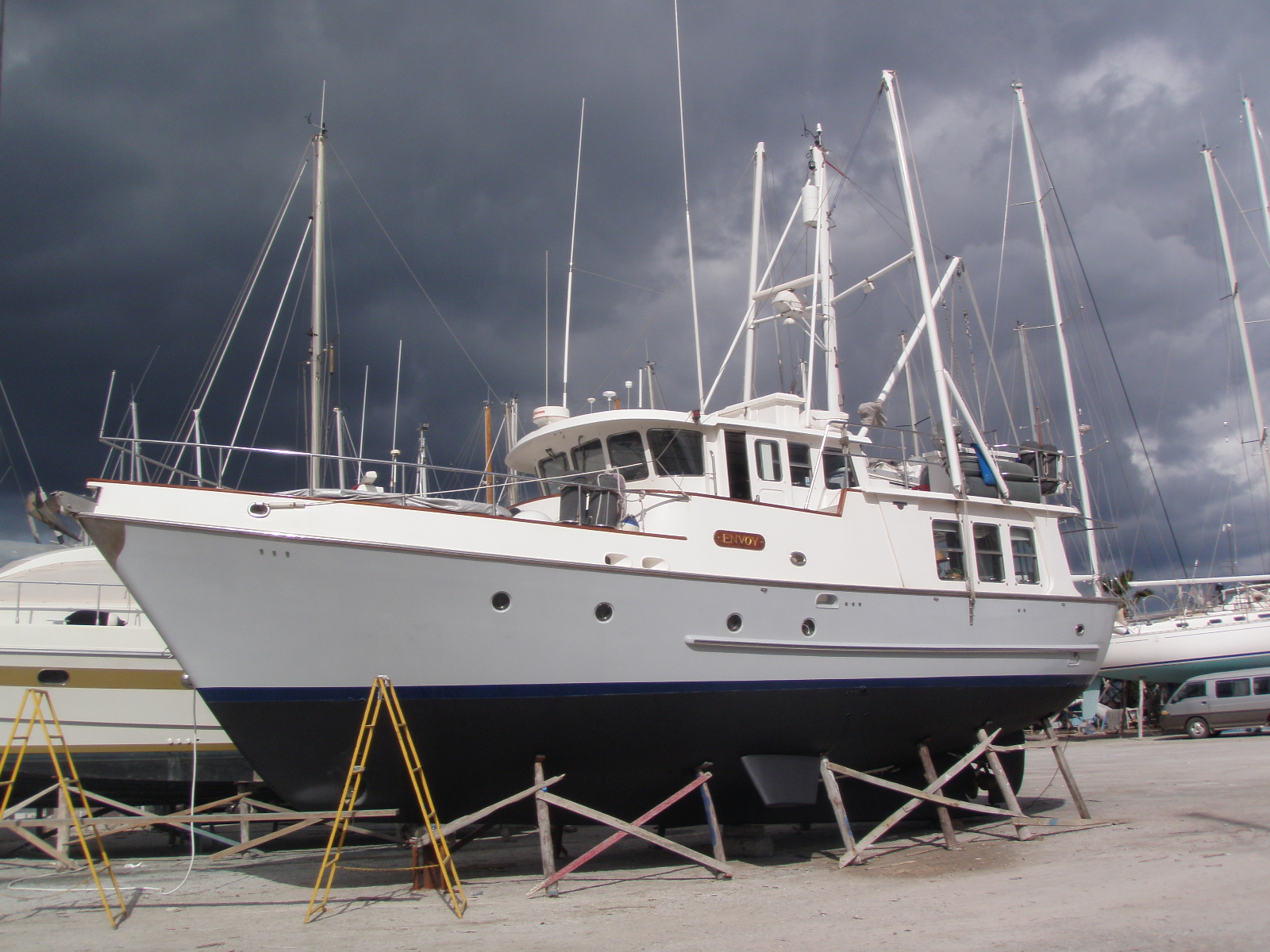
On the hardstand
When your boat needs to be slipped for anti-fouling and below water maintenance it’s a big advantage to continue living aboard and most Med marinas allow this.
Ensure your ladder is stable, securely tied top and bottom, and used very carefully as serious injury-causing accidents involving ladders are common.

It’s a good idea to check your boat’s hull supports periodically, particularly wooden ones, as we have found they can move and need adjustment.

When wooden hull supports are used they can move and need regular checking

Most marina hardstand areas are very dusty and turn muddy during rain, so ensure your cockpit is well protected from dirty footwear and you have a mat at the bottom of your ladder. Keep an old hose especially for use on the hardstand as hoses generally can’t be cleaned sufficiently for normal use after being used there. The power cable also gets very dirty and needs a thorough clean after use.
Grey water cannot be discharged directly onto the hardstand so we place bowls in the galley and head sinks, and empty them periodically into marina storm water drains. In case we get caught short during the night we place a bucket in the head and empty it first thing in the morning.
Although living aboard on the hardstand is probably the least enjoyable aspect of the Med cruising life, it’s often improved by the fact that you’re probably looking up at some nearby ancient temple or castle, and after that time comes the great consistent weather, fascinating historical destinations and wonderfully interesting cultures and cuisines.
The next Blog posting will discuss boating etiquette.

Catching Up

The last part of last season was a leisurely trip to Malta and then stops in Siracusa, Sicily, Taormina, the Aeolian islands and a few rolly nights at anchor on the southwest coast of Italy before crossing over to Sardinia and Corsica. After that we crossed over to Elba, a pretty island between Corsica and the northwestern coast of Italy. Details?  Ummmm…….. Unfortunately, it was almost a year ago and I have been negligent in my duties as the Chief Blogging Officer aboard Seabird. Had this been 500 years ago, I would have had to walk the plank! 

Map of our Journey last Season

Just to get you close to being up to date, here is a brief summary of what we did after the last blog to this season:

Elba is where Seabird and Sans Souci sadly departed. Ken and Roberta had made plans to winter in San Remo in Northern Italy and, although we had originally planned the same, we fell victim to the lure of southern Sicily (Marina Di Ragusa) and the incredible value. Wintering the boat in San Remo was going to cost $22,000. Sicily was a fraction of that at $2500 for the winter. In addition, we would be only a hop, skip and a jump from Tunisia, where fuel was $1.50 per gallon vs $8 in Italy!  We needed approximately 1500 gallons, so do the math! 

We had a great solo cruise south from Elba. We stopped in the Port of Rome, which is actually about 40 miles from the marina by train. We spent one long day in Rome visiting the Vatican and St Peters.

On our cruise south, we passed close by the port of Giglio. Many of you remember the cruise ship Costa Concordia hit a reef there and sank in 2012. Cruising by there, it was hard for us to believe that the captain actually cruised that close to the land. Seeing where it was first hand, I can tell you that I would not be comfortable cruising that close even in OUR boat! 

This is where the  Cruise Ship Costa Concordia Went Down

There was no place to anchor there so we found a marina in Calla Gallera. While we were there, I remembered that two friends, Diane and Carlo, were vacationing nearby and we emailed them hoping that we could say hello. It turns out that they were staying about 3 miles from where we were and came over with their family.

After returning to Marina di Ragusa with the boat, we prepared here for the winter, rented a car and drove (via car ferry) to the mainland where we met my sister Diane and brother in law Mike in Tuscany, where we had rent a small villa for a few weeks in the countryside. We used it as a base for touring about. It is a complete departure from the boating lifestyle, but we had lots of fun.

Back to Marina di Ragusa……..

Marina di Ragusa turned out to be a wonderful, vibrant little Sicilian town with friendly people and great, reasonably priced restaurants. Our boat was well taken care of by a fellow named George Rizzo, who also arranged for repairs and the haul out after we returned, as well as an apartment to stay in while the work was being done. The marina itself is fairly new and the boatyard had first class equipment.

Haulout at Marina di Ragusa

We took the opportunity while the boat was hauled to take care of a few items:

Our Dinghy Davit, which is basically a hydraulic crane that lifts the inflatable dinghy off of the deck and lowers it into the water. Unfortunately, towards the end of last season, the system “sprung a leak”.  We just barely had gotten the dinghy into the water when it gave out. I love hydraulic systems, but they operate under 3000 pounds of pressure and they don’t really just leak.. They blow out in spectacular fashion, leaving an oily mess, and, in our case, all over the deck!  Fortunately we were able to isolate that valve and still use the hydraulics for the bow thruster and anchor windlass. Anyway, it needed a complete overhaul and George arranged to have his mechanic, Leonardo, take it apart, bring everything back to his shop about two hours north of Marina di Ragusa, and fix it. He also drained and replaced the coolant in my many systems on board and installed a new ( but noisy) fresh water pump. He also installed some new parts in our stabilizer system.  The area he had to work in was absolutely tiny and I was afraid to show it to him on his first visit, figuring he might not take the job. Both of these guys are larger than me, but somehow squeezed into  a place that I could never get into.

Leo turned out to be a great mechanic, something you do not often find. He is what is referred to as a “Shade Tree” mechanic. He is a REAL mechanic who can diagnose and fix things as opposed to a “parts changer”, a guy who keeps changing parts until he finds the problem. Leo is the best.

We also got a new outboard motor to replace our dying, 18 year old Yamaha. Italy has an unusual system. Anything over a 40 HP on a boat requires a special license. I wanted a 60 hp. The response was “so you want a 40/60?” Huh?  Well, evidently, you can buy a 40, a 50, a 60 or a 70 hp, all with a 40 hp motor cover. I decided it best not to question it further. I have a dinghy with a VERY fast 40hp.

I mentioned fuel cost savings by going to Tunisia. Unfortunately, we had to change our plans because of the Terrorist incident there. We decided that it was not worth the risk and ended up buying our fuel in Malta, which was more expensive than Tunisa, but cheaper than Italy.

Having everything completed, we were back in the water and ready to go.

Also, if you want to track us in real time, go to the main web page at www.seabirdlrc.com and click the “Current Location” button on the left.  When you get to the tracking page, just scroll down to the larger chart.  Our location is accurate to within 10 minutes! 

Next up…….cruise to Malta

Miscellaneous Pics from our late summer and early fall cruising.

Havent seen this one before? A dinghy with wheels and a separate engine to power them!
Bet you have not seen this before!  A dinghy with three 
wheels and a separate engine to power them on land!

World famous Tropea Onions at a roadside stand


Swordfish boat at the Messina Straites in Sicily
Look closely at the far right of the picture and you can make
out the guy on the bow platform waiting to stab a fish! the platform 
is longer than the boat!!!!


After our hydraulic Dinghy davit broke we had to have 
these kind folks at the shipyard load it for us.  Price?
They actually did it for free!


This is the city of Pompei. It was covered in Lava after a 
Mount Vesuvius Volcano eruption in 79 AD and recently discovered.

This is Malta.  You can see why we loved it


Here we are anchored near the Blue Lagoon in Malta

Tropea (the place with the onions) at night

Seabird at Ponza, another of our favorite anchorages in Italy

Here is the marina we stayed at in Tropea

And, last but not least, there is a rumor that in Corsica,
when the wind reaches 43 mph…..strange things happen

HUH?!?!?!?!

Catching Up

The last part of last season was a leisurely trip to Malta and then stops in Siracusa, Sicily, Taormina, the Aeolian islands and a few rolly nights at anchor on the southwest coast of Italy before crossing over to Sardinia and Corsica. After that we crossed over to Elba, a pretty island between Corsica and the northwestern coast of Italy. Details?  Ummmm…….. Unfortunately, it was almost a year ago and I have been negligent in my duties as the Chief Blogging Officer aboard Seabird. Had this been 500 years ago, I would have had to walk the plank! 

Map of our Journey last Season

Just to get you close to being up to date, here is a brief summary of what we did after the last blog to this season:

Elba is where Seabird and Sans Souci sadly departed. Ken and Roberta had made plans to winter in San Remo in Northern Italy and, although we had originally planned the same, we fell victim to the lure of southern Sicily (Marina Di Ragusa) and the incredible value. Wintering the boat in San Remo was going to cost $22,000. Sicily was a fraction of that at $2500 for the winter. In addition, we would be only a hop, skip and a jump from Tunisia, where fuel was $1.50 per gallon vs $8 in Italy!  We needed approximately 1500 gallons, so do the math! 

We had a great solo cruise south from Elba. We stopped in the Port of Rome, which is actually about 40 miles from the marina by train. We spent one long day in Rome visiting the Vatican and St Peters.

On our cruise south, we passed close by the port of Giglio. Many of you remember the cruise ship Costa Concordia hit a reef there and sank in 2012. Cruising by there, it was hard for us to believe that the captain actually cruised that close to the land. Seeing where it was first hand, I can tell you that I would not be comfortable cruising that close even in OUR boat! 

This is where the  Cruise Ship Costa Concordia Went Down

There was no place to anchor there so we found a marina in Calla Gallera. While we were there, I remembered that two friends, Diane and Carlo, were vacationing nearby and we emailed them hoping that we could say hello. It turns out that they were staying about 3 miles from where we were and came over with their family.

After returning to Marina di Ragusa with the boat, we prepared here for the winter, rented a car and drove (via car ferry) to the mainland where we met my sister Diane and brother in law Mike in Tuscany, where we had rent a small villa for a few weeks in the countryside. We used it as a base for touring about. It is a complete departure from the boating lifestyle, but we had lots of fun.

Back to Marina di Ragusa……..

Marina di Ragusa turned out to be a wonderful, vibrant little Sicilian town with friendly people and great, reasonably priced restaurants. Our boat was well taken care of by a fellow named George Rizzo, who also arranged for repairs and the haul out after we returned, as well as an apartment to stay in while the work was being done. The marina itself is fairly new and the boatyard had first class equipment.

Haulout at Marina di Ragusa

We took the opportunity while the boat was hauled to take care of a few items:

Our Dinghy Davit, which is basically a hydraulic crane that lifts the inflatable dinghy off of the deck and lowers it into the water. Unfortunately, towards the end of last season, the system “sprung a leak”.  We just barely had gotten the dinghy into the water when it gave out. I love hydraulic systems, but they operate under 3000 pounds of pressure and they don’t really just leak.. They blow out in spectacular fashion, leaving an oily mess, and, in our case, all over the deck!  Fortunately we were able to isolate that valve and still use the hydraulics for the bow thruster and anchor windlass. Anyway, it needed a complete overhaul and George arranged to have his mechanic, Leonardo, take it apart, bring everything back to his shop about two hours north of Marina di Ragusa, and fix it. He also drained and replaced the coolant in my many systems on board and installed a new ( but noisy) fresh water pump. He also installed some new parts in our stabilizer system.  The area he had to work in was absolutely tiny and I was afraid to show it to him on his first visit, figuring he might not take the job. Both of these guys are larger than me, but somehow squeezed into  a place that I could never get into.

Leo turned out to be a great mechanic, something you do not often find. He is what is referred to as a “Shade Tree” mechanic. He is a REAL mechanic who can diagnose and fix things as opposed to a “parts changer”, a guy who keeps changing parts until he finds the problem. Leo is the best.

We also got a new outboard motor to replace our dying, 18 year old Yamaha. Italy has an unusual system. Anything over a 40 HP on a boat requires a special license. I wanted a 60 hp. The response was “so you want a 40/60?” Huh?  Well, evidently, you can buy a 40, a 50, a 60 or a 70 hp, all with a 40 hp motor cover. I decided it best not to question it further. I have a dinghy with a VERY fast 40hp.

I mentioned fuel cost savings by going to Tunisia. Unfortunately, we had to change our plans because of the Terrorist incident there. We decided that it was not worth the risk and ended up buying our fuel in Malta, which was more expensive than Tunisa, but cheaper than Italy.

Having everything completed, we were back in the water and ready to go.

Also, if you want to track us in real time, go to the main web page at www.seabirdlrc.com and click the “Current Location” button on the left.  When you get to the tracking page, just scroll down to the larger chart.  Our location is accurate to within 10 minutes! 

Next up…….cruise to Malta

Miscellaneous Pics from our late summer and early fall cruising.

Havent seen this one before? A dinghy with wheels and a separate engine to power them!
Bet you have not seen this before!  A dinghy with three 
wheels and a separate engine to power them on land!

World famous Tropea Onions at a roadside stand


Swordfish boat at the Messina Straites in Sicily
Look closely at the far right of the picture and you can make
out the guy on the bow platform waiting to stab a fish! the platform 
is longer than the boat!!!!


After our hydraulic Dinghy davit broke we had to have 
these kind folks at the shipyard load it for us.  Price?
They actually did it for free!


This is the city of Pompei. It was covered in Lava after a 
Mount Vesuvius Volcano eruption in 79 AD and recently discovered.

This is Malta.  You can see why we loved it


Here we are anchored near the Blue Lagoon in Malta

Tropea (the place with the onions) at night

Seabird at Ponza, another of our favorite anchorages in Italy

Here is the marina we stayed at in Tropea

And, last but not least, there is a rumor that in Corsica,
when the wind reaches 43 mph…..strange things happen

HUH?!?!?!?!

PREPARING YOUR GRAB BAG

Envoy is currently in Lefkas marina, western Greece, while we are home in New Zealand.
We plan to return to Envoy in September.
You’re cruising along the coastline enjoying idyllic conditions and keeping watch as your autopilot does its work. Your boat has a gentle motion in the slight seas and you sniff the aroma from your mug of fresh coffee, ever hopeful of hearing the screaming zing of your trolling line’s reel.
The last thing on your mind is having to suddenly abandon your vessel, but at sea the unexpected can and does occur, especially during night time, and you should always be prepared for dealing with emergencies such as collision with another vessel, hitting a heavy floating or semi-submerged object, striking a rock or reef, going aground, fire, capsize, or taking on water. It’s easy to say these situations couldn’t happen to me, but Coastguard incident records tell a different story, and whether you’re aboard a high speed trailer boat or a 20 metre cruiser a little forethought and preparation will improve your chances of success in dealing with an emergency.
Most emergency situations are either resolved or kept under control until assistance arrives using your own safety equipment:
– Correctly installed and regularly tested bilge pumps of adequate capacity
– Fire fighting equipment including an engine room extinguishing system, strategically located high capacity fire extinguishers and fire blankets
– A comprehensive tool kit including tools to quickly make and secure emergency patches
– A repair kit including a selection of soft wooden plugs to use as bungs, small sheets of plywood and aluminium to make patches, sealant, duct tape, hose repair kit and hose clamps

Abandoning ship is an action taken only after all other options are exhausted – as old salts say – you step up into a life raft not down into one. It’s safer to stay aboard your boat even half-full of water than taking to a dinghy in open waters, and you will be easier to locate and rescue; many vessels have been found floating long after being abandoned.
However situations arise, particularly serious fires and imminent sinking, where there is no option but to leave the vessel. Most vessels over about seven metres in length carry a tender, and as few coastal cruisers carry certified life rafts the tender is the primary means of escape and survival. Most tenders used today are RHIBs and will stay afloat even in very adverse conditions, but if your tender is aluminium or wooden consider installing watertight, foam-filled compartments.
If your tender is being towed or carried on a boarding platform it should be possible to deploy quickly. However towing tenders is unwise in rough or potentially rough conditions as they can overturn or become swamped. Larger tenders requiring a crane to lift them are difficult to launch quickly in the event of fire, sudden sinking, power failure or rough seas, and it’s worth having a second smaller tender available for rapid manual launching in event of an emergency.

Our larger RHIB shown below would be impossible to launch using the crane from Envoy’s boat deck quickly in an emergency, so we also carry a smaller RHIB that can be launched by hand

All boats should have a Grab Bag (or Ditch Bag) in case you have to abandon ship quickly, and these are available from most chandlers. It should be immediately recognisable, and have a line attached to reduce the chance of loss while abandoning ship. Although you are most likely to be rescued within a short time, victims sometimes spend overnight or longer in their RHIB, so Grab Bags typically have the following contents (packed in individual plastic bags to keep them dry):
– Hand-held VHF radio in a waterproof case with spare batteries
– Fully-charged mobile phone in waterproof case, preferably with spare battery
– EPIRB
– Hand bearing compass
– Binoculars
– Orange safety square
– First aid kit
– Fresh water
– Snack food
– Hand held searchlight and waterproof torches with spare batteries
– Strobe light and spare batteries
– Flares kit
– Air horn
– Whistle
– Signaling mirror
– RHIB repair kit
– Sharp knife
– Length of line
– Rescue quoit with floating line
– Sun hats, sunglasses, sun block, lip screen
– Notebook and pencil
– Thermal blankets
– Toilet roll

This list assumes that the crew is already suitably dressed for the conditions, including life jackets and footwear in case of landing on a rocky shore.
Some Grab Bag items such as your mobile phone may be in regular use – so keep these conveniently located to add later if necessary.
When we do passages at night, or in heavy weather or a long distance offshore we keep our Grab Bag, lifejackets, RHIB pump and all other necessary items together in the saloon or cockpit so they’re available immediately if needed.

These comments are related to coastal, not offshore cruising – for which considerably more extensive preparation and equipping is required.
The next posting will be about living aboard your vessel in marinas.

THE CRUISING LIFE – FIXING YOUR BOAT IN EXOTIC LOCATIONS

Envoy is located at Lefkas Marina, Greece.
Cruisers have a popular saying: “the cruising life is fixing your boat in exotic locations” and this carries a lot of truth – during our several months of cruising the Med each year we meet many fellow cruisers – mostly with sailing yachts, and inevitably conversation soon turns to the subject of what equipment needs fixing. Regardless of the type of boat or its age we have yet to meet a cruiser who says nothing on his boat needs attention.

Anchoring in great bays like these is a major part of cruising but not without some technical work too

Most cruisers are very pragmatic about this and don’t let a technical problem spoil their cruising. For example we’ve cruised for a whole season without a working water maker and another without our hydraulic stabilisers. Of course there was some irritation about these circumstances but we didn’t let them interfere with our cruising plans – if you become overly pedantic about non mission-critical problems you may never cast off from the marina to start your adventures.
In New Zealand we’re fortunate in having a tremendous infrastructure of qualified and competent marine technicians and spare parts availability, but this is often not the case when cruising overseas and can be further complicated by a lack of knowledge of the local situation and by different languages. Cruisers like us, who mostly relied on service contractors when boating in home waters, soon learn to become independent and try to tackle as much as possible themselves.
Fortunately there are many sources of technical information available to assist the cruiser, and at various times we’ve used most of the following:
– Our own boat’s technical manual originally prepared by the manufacturer and added to by owners
– On board instruction manuals and spare parts lists from original equipment suppliers
– Contact with the boat’s manufacturer, previous owners and owners’ associations
– Contact with the manufacturer of the equipment in question
– Technical reference books carried aboard (such as Nigel Calder’s “Boatowners Mechanical and Electrical Manual”)
– Technical articles copied from boating magazines
– Talking with other skippers
– Local marine engineering companies
– Agents for the equipment in question both locally and back in New Zealand
– Internet searches for information
– The many available You Tube videos showing how to perform numerous technical tasks

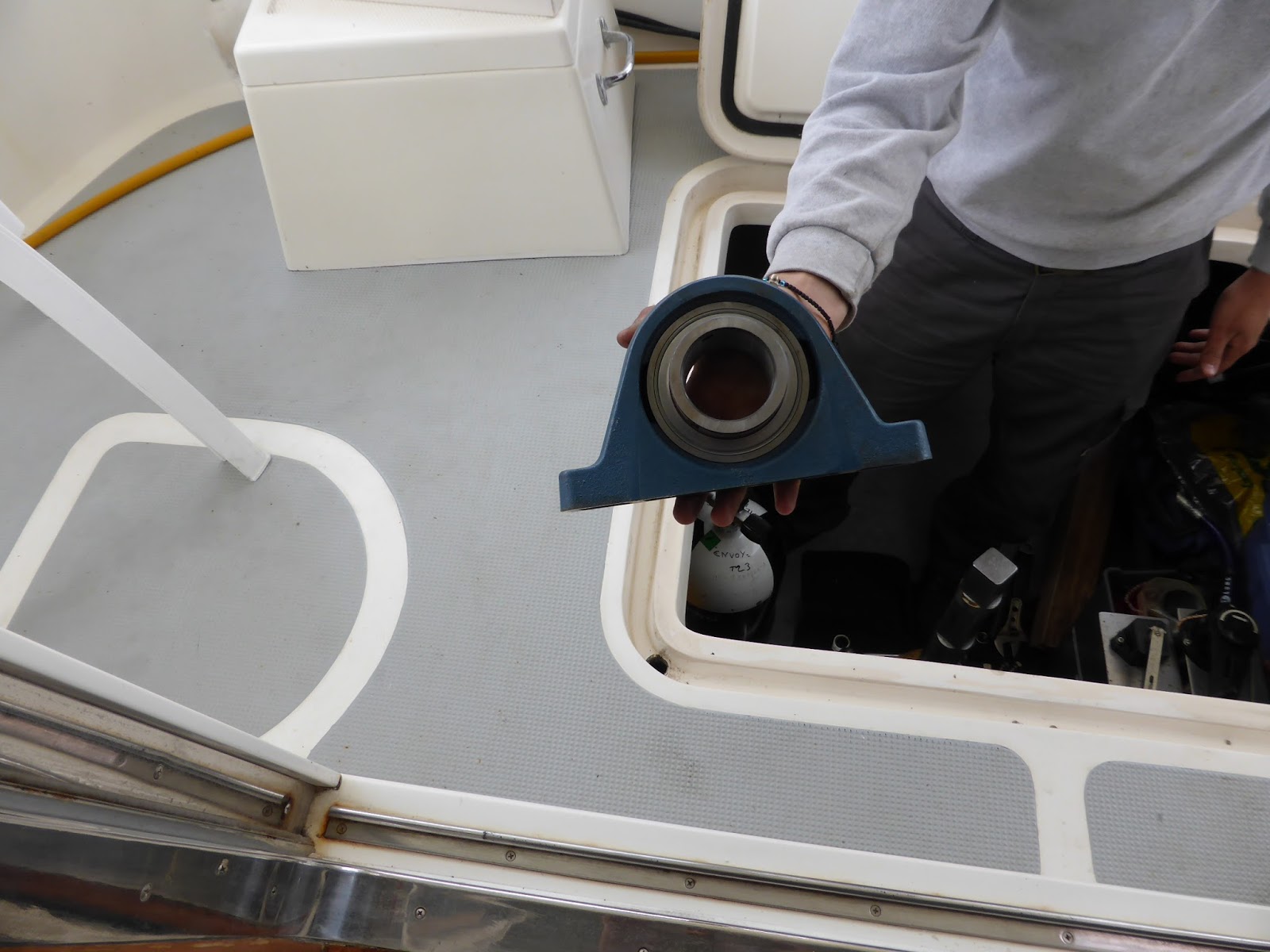
Among many other tasks during 2015 our main rudder bearing needed replacement

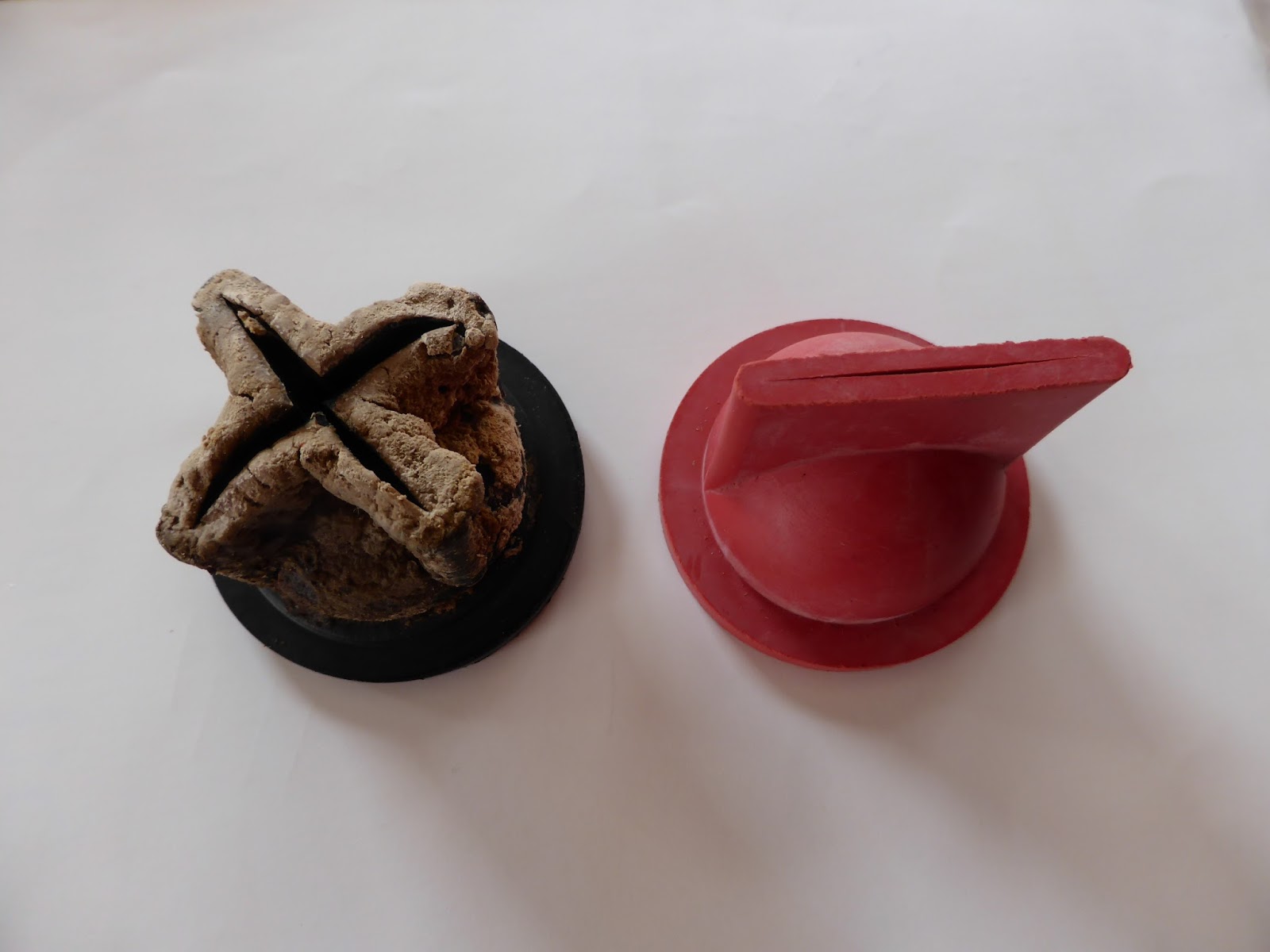
…………as did our toilet’s joker valves

But we inevitably need to have work done by contractors when we don’t have the knowledge or skills to carry out a task and recent examples have been changing injectors, setting valve clearances and reconditioning a starter motor and alternator.
When we need a contractor we try to find out who the best ones are by talking with other cruisers, and we always remain on board while the job is done. This is necessary because contractors normally arrive without any manuals or information, and often without even adequate tools to complete the task – recently an electrician arrived for a fault-finding job on our electric head and needed to borrow our multimeter! Working alongside contractors is also a great way to increase our technical skills.
Contractors in some overseas regions often don’t deliver the service we expect and mostly receive in New Zealand; example – an Italian service agent for a well known European engine brand “fixed” an engine oil leak by placing a plastic container under the leak to catch the drips. On the positive side we have found many skilled and resourceful contractors very adept at repairing failed components rather than replacing them with expensive and difficult-to-source new ones.
To maximize your technical security and independence it’s essential to carry onboard a comprehensive toolkit, complete spare parts and manuals for all installed equipment, and an extensive range of chandlery items.
It’s often said that the cost of maintaining a cruising boat is about ten per cent of the boat’s capital value each year, but over six years we’ve found between five and six per cent to be closer to the mark (not including fuel and oil). Our philosophy is to maintain our boat in tip-top condition mechanically, better than average condition cosmetically and to strike a balance between preventative maintenance and “if it ain’t broke don’t fix it.”
You can have new Envoy blog postings immediately emailed to you by entering your email address under “Follow by Email” located above, and hitting the Submit tab.

LOOKING BACK ON THE UNIQUE PLEASURE OF OUR VERY FIRST BOAT

Envoy is currently located at Lefkas marina, Greece.
We have fond memories of all six power boats we’ve owned, each one being a great experience and serving us well during different phases of our lives. But one stands out in our minds as extra special; our very first boat purchased in 1982, a 5.3 metre Seacraft Valencia powered with a Mercruiser 140hp petrol sterndrive. We still remember seeing this boat for the first time in the Seacraft showroom, thinking how big she looked sitting high on her tandem-axle trailer and admiring her rugged no-nonsense GRP clinker-hull styling.

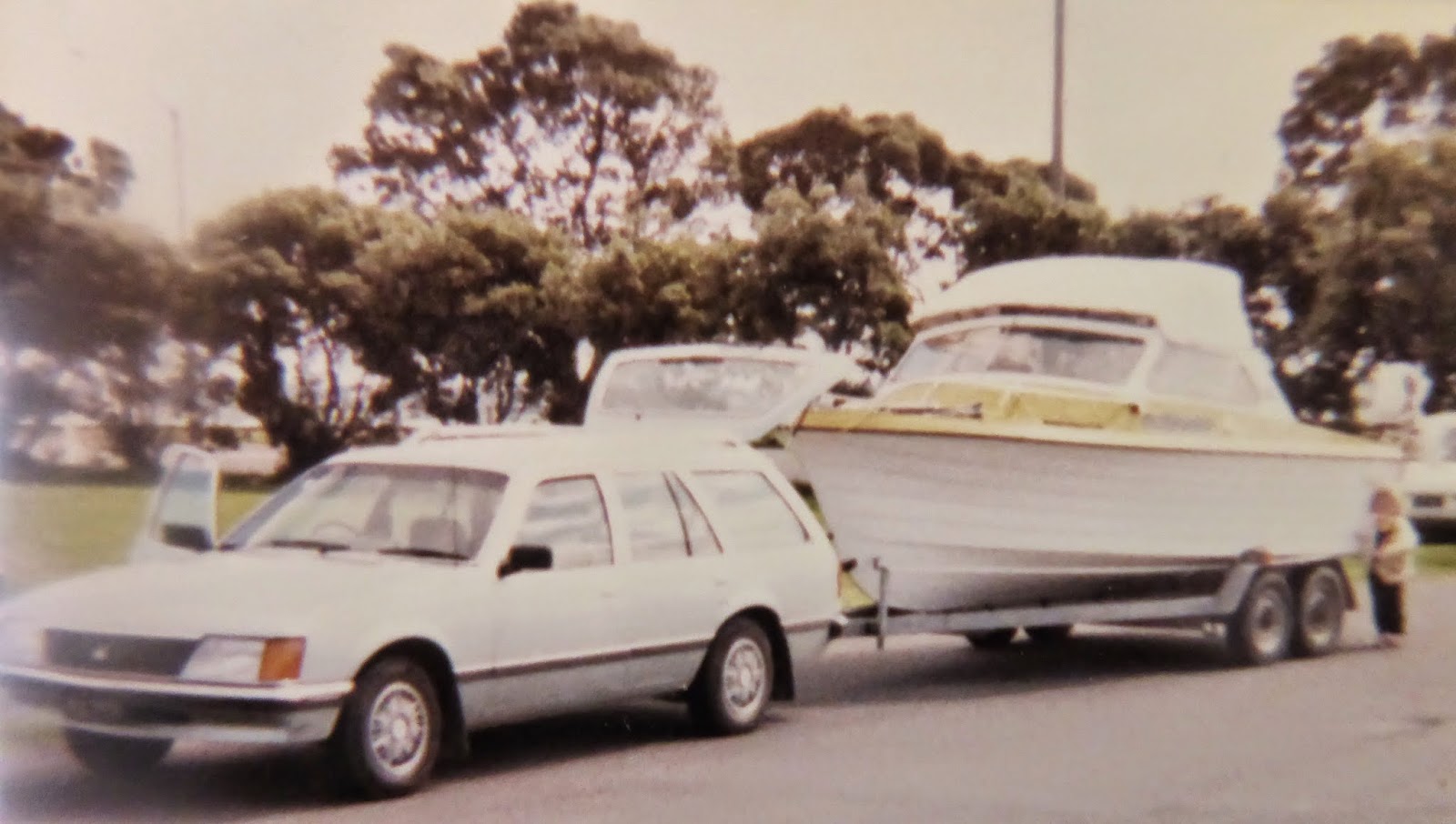
Mokruiser on trailer

Then we met Seacraft director Lionel Sands and discovered this boat was special as she’d been built for his family use and included many optional extras. The boat was called Mokruiser, and Lionel explained the unusual name was based on the contraction of Mercruiser and Moko Hinau Islands (off the north-east coast of New Zealand’s North Island), where Lionel made regular fishing and diving expeditions from the family beach house near the Whangarei Heads. These Moko Hinaus, some 35 miles out from the Heads, can be a rough trip but the rewards are excellent fishing for snapper and kingfish as well as diving in the clear waters for large crayfish.
Mokruiser’s pedigree was sufficient to convince us that she would meet all our needs at that time, and during the two-year-long steep learning curve we owned her we logged 154 days cruising Auckland’s greater Hauraki Gulf, as well as trailering Mokruiser north to explore the incomparable Bay of Islands.
Most of our leisure time with our two kids was spent boating, our son introduced to boating from just a few months old strapped into a car safety seat adapted for use aboard Mokruiser. John obviously got a healthy dose of salt water into his veins as he later became first mate on a super yacht cruising Mediterranean and North American waters. After our skills and confidence grew we joined Coastguard’s volunteer Search and Rescue Group, and Mokruiser became a familiar volunteer “Rescue Cutter” back in the days before dedicated rescue craft.
We remember a day when our kids were building sand castles on a beach in Northland as we chatted with an older and wiser man who advised us to make the most of these special boating days as you don’t get a second chance. How right he was, and we never forget those early boating days and our various firsts – our first cruise around Kawau Island, the first time our kids rowed the dinghy and the first time they caught a fish with infectious excitement.

A family day out with Mokruiser in the early 1980s

Mokruiser on the right – we wouldn’t be doing this with Envoy

Thirty two years later we meet Lionel again. Of course time changes us all, but there is instant mutual recognition and we express our gratitude to Lionel for putting us on course for lives which have largely revolved around boating, logging thousands of days skippering various boats in seven different countries. Lionel proudly guides us around Seacraft (now called Seacraft Miller Moyes), and explains the various stages in the production procedure for the highly respected Haines Hunter range of outboard-powered GRP trailer boats consisting of six core models ranging from 4.85 metres up to the flagship 7.25 metres.
This is an occasion for some reflection, and Lionel recounts how they started producing wooden boats. All the early boat shows he attended comprised only wooden boats. Then GRP boats first appeared during the mid-1960s, and within a short time there were few wooden boats to be seen. Later along came the rise of aluminium boats and RHIBs, so that today’s market has a wide diversity of offerings including imported boats.
These days Lionel goes to sea in a Haines Hunter SP725 and still sometimes ventures to the Moko Hinaus, but showed us some recent photos proving that he can always catch plenty of excellent snapper much closer to the Whangarei Heads largely negating the need for such a long round trip.
We enjoyed our time with Mokruiser so much that our next two trailer boats retained the same name, and it was both satisfying and intriguing for us to meet Lionel again to be reminded of our boating roots which have stood us in good stead for many years.

ENVOY’S FUTURE CRUISING PLANS

Envoy is currently in Lefkas marina, Greece while we’re home in Auckland, New Zealand.
Although we had planned to continue our Med cruising aboard Envoy this year, circumstances are keeping us home until late August. Bearing in mind it takes around two weeks to prepare Envoy for the cruising season and that the weather turns wintry during November, we’ve decided to skip cruising this year. However we plan to visit Lefkas for a few weeks from September to check on Envoy, do some maintenance and explore some of the nearby Greek mainland by car – something we’ve not had time to do during normal cruising years. Meanwhile our friends at Sailand have arranged to lift Envoy from the water onto the hardstand where they will continue regular inspections, battery charging and dehumidifying.
We plan to keep the blog updated every 10 days or so with material related to cruising and to Envoy, so keep watching this space meantime.
Next year we’re planning to spend from late February to late November aboard Envoy, a longer period than usual, We’re intending to cruise up to Corfu, cross to southern Albania and cruise the Albanian coastline north (bypassing Montenegro) to Croatia, fairly quickly transit the southern half of Croatia’s coastline that we’ve already visited to explore the northern half, visit Venice and other areas of Italy’s north-east coast, call in at Montenegro on the return journey to take advantage of tax-free diesel and end up back at Lefkas once more.
If you’ve got a dream to go cruising, do it sooner than later while circumstances allow. As Mark Twain said: “Twenty years from now you will be more disappointed by the things that you didn’t do than by the ones you did do. So throw off the bow lines, sail away from the safe harbour, catch the trade wind in your sails. Explore, dream, discover.”
Fortunately, from our home we look out across Auckland’s constantly changing Manukau Harbour, so are constantly reminded of our strong connection with the sea.

May 2015 Update on Us

Finally, an update!!!! Today is the six year anniversary of completing our circumnavigation (May 1, 2009). It’s been eight years since we left on our circumnavigation (April 28th, 2007). Where is time going? We can’t believe that we’ve let more than a … Continue reading