
Reader Note: I published two articles today. You will want to read “Yellow Light on the Hudson” before reading this one.This was an article that I had hoped that I would not have to write. As of Tuesday at 11:00 PM, we have been down for maintena…
Archive | Guided Discovery RSS feed for this section
Life in the Fast Lane: Yellow Flag on the Hudson
A yellow flag, or caution flag in NASCAR racing, requires the driver to slow down (due to an accident or hazards of the track). We got a yellow flag in the form of a yellow engine alarm late in the day that slowed us down and required a pit stop….
Life in the Fast Lane: Green Light to Norfolk
“Life in the Fast Lane” is proving a perfect name for this series. Things are happening so quickly and often we are moving so fast (40 MPH) on rough or bumpy water that it is difficult to blog. That said, I always seem to be in a catch up m…
Life in the Fast Lane: No Wake, Hit the Brake!
When we finished our amazing 212 nautical (243 statute) mile run on the ICW from Fernandina Beach to Charleston I was optimistic that we could make Beaufort today (268 statute miles) on the ICW. Turns out I was overly optimistic. I remember…
Life in Fast Lane: Fort Lauderdale to Charleston in Two Days – Part 2
I awoke early (5:00 AM) on Thursday morning to access the weather. The question we went to bed with was whether we would run outside to Georgetown South Carolina or continue north on the ICW. Now it was time to gather the information that w…
Life in Fast Lane: Fort Lauderdale to Charleston in Two Days – Part 1
Did I mention that a Pershing 64 is the yacht equivalent of a Lamborghini? Well in fact I did (see my last article( Life in the Fast Lane: Italian Style”) and it truly is!As I started to write this article at 12:36 PM on Thursday we had just enco…
Life in the Fast Lane – Italian Style
The Pershing 64 could easily be characterized the Lamborghini of the waterways.
 |
| 2014 Pershing 64 – Estremo |
 |
| lamborghini |
This is a spectacular high speed express cruiser that as I said in the previous article, was “born to run.” She is capable of a top speed of 47.5 knots (55 MPH). To put that in perspective, there are very few boats that can run at 55 MPH let alone a 79,145 pound displacement express cruiser.
Here the Pershing’s vital statistics (repeated from the previous article):
- · Overall Length: 65.7 feet
- · Beam: 16.4 feet
- · Draft: 4 feet 4″
- · Power: Two MTU 1623 HP diesels
- · Displacement: 79,146 pounds (empty)
- · Maximum Speed: 47.5 knots (55 MPH)
- · Cruise Speed: 42 knots (49 MPH)
- · Fuel Burn at Maximum Speed: 168 GPH
- · Fuel Burn at Cruise Speed: 142 GPH
- · Fuel Capacity: 925 gallons
- · Available Fuel: 832 gallons (10% reserve)
- · Type of hull: Modified V (planning hull
The Pershing 64 is a perfect boat for entertaining and long weekend cruises to a wide range of distant destinations. She can gets there fast and gets home just as fast (weather permitting). For example, Charlevoix Michigan at 300 miles north of Chicago was one of our favorite destinations. It took two days to get there on the 48 Sundancer, which cruised at 30 MPH. The Pershing 64 gets there in just under 6 hours. When time is a consideration, a five day “holiday” gives you four days on the ground in Charlevoix.
In the plan photos below you can see some of the 64’s unique features. Starting with profile notice the shafts and propellers, which extend “way” out under the swim platform. These are surface drives that turn left to right to aid steering and up and down to maximize the boat’s trim (and therefore its speed).
 |
| Pershing 64 Plan |
The center image shows the 64’s main deck. Working from the stern forward almost 60% of main deck is outdoor space. There is a spacious sun pad on the bow and a spectacular sun deck on the stern over the garage (technically the lazarette).
 |
| Estremo at Ferretti’s Fort Lauderdale Headquarters |
Forward of the stern sunpad is a starboard settee and table under a roof that retracts into the hardtop for full sun exposure. On the port side is a sink and electric barbecue grill.
 |
| Barbecue Grill |
The salon is easily 12 by 12 with an Italian leather sofa that wraps 270 degrees around an adjustable table (that expands into a dinner table). In the photo below you can see a glass wall aft. That wall lowers making the entire salon open.
 |
| Salon looking aft |
Along the port side are cabinets with 6 doors. From forward to aft: Door 1: Refrigerator; Door 2-3 Glassware; Door 4 Shelves; Door 5-6 Open storage.
 |
|
Doors 2-3: Glassware comes with the boat and TV on lift
|
Forward of the salon to starboard is the control station. The 64 has one multifunction 12 inch screen (a Furuno Navnet 3D) flanked by a Furuno autopilot and Furuno RD 33 display. The “business end” includes digitized engine and drive train displays, the latter enables the operator to fine tune the angle of the surface drives and “flaps” (trim tabs) to optimize the boat’s performance.
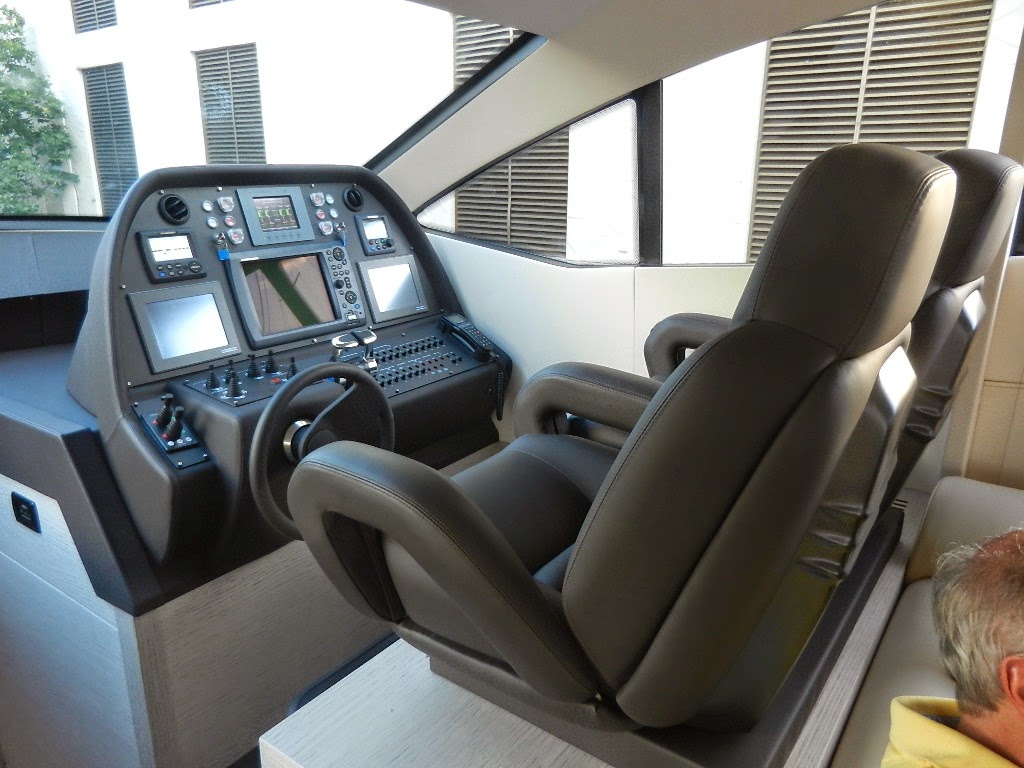 |
| Control station |
The galley is located to port and down four stairs. Appliances include a refrigerator & freezer, a small microwave, electric stove top and dishwasher. Up in the salon under the port settee is a complete set of fine china, silver and glassware; service for six that comes as standard equipment.
 |
| Port settee with four drawers containing silver and china |
 |
| Galley down |
Below decks there are three staterooms. The master and V-berth have ensuite heads
 |
| Master stateroom looking aft |
 |
| Master stateroom looking to starboard |
 |
| Master head |
 |
| V-berth stateroom with queen size bed |
 |
| Guest stateroom with side by side bunk beds |
 |
| Guest head |
The engine room is located in the stern. It is chockablock full of equipment.
 |
| Starboard MTU V10 1,623 HP Diesel |
 |
| Kholer 23KW Generator |
 |
| Chilled Water HVAC system |
The 64 has crew quarters that is accessed from an 8 step ladder under the aft deck settee. It has one bunk that sits atop of the ship’s washer and dryer. It also has it’s own head. The crew’s quarters is located just forward of the engine room. Note: The location of the washer and dryer is perfect if you have a captain. It’s not so perfect when you do not (i.e., you have to climb the ladder to switch from washer to dryer and then transport the dry clean clothes up the ladder).
 |
| Ladder down to crew quarters |
 |
| Washer and dryer in crew quarters |
Finally, we come to the garage and the passerelle. A passerelle is a ramp that extends from the transom to permit boarding in a stern-in tie to a quay, which is very common in Europe. On the 64 the passerelle is configured to work as a crane for lifting a tender or jet ski into the garage.
 |
| Passerelle that doubles as a lifting crane for the tender or jet ski |
 |
| The garage will house an 11 foot jet driven tender or a jet ski |
.
Written by Les.
 |
| One very happy new owner |
Written by Les.
The Next Adventure: Fort Lauderdale to Chicago on a 64 Pershing
My friend decided that he needed a new boat and proceeded to buy a spectacular new 2014 64 feet Pershing. He asked if I would help him move the boat from Fort Lauderdale, where she currently lays, to her new home in Chicago, a distance of 2,460 nautical miles. Of course I said “yes.”
 |
| Pershing 64 (stock photo) |
Here the Pershing’s vital statistics:
- · Overall Length: 65.7 feet
- · Beam: 16.4 feet
- · Draft: 4 feet 4″
- · Power: Two MTU 1623 HP diesels
- · Displacement: 79,146 pounds
- · Maximum Speed: 47.5 knots (55 MPH)
- · Cruise Speed: 42 knots (49 MPH)
- · Fuel Burn at Maximum Speed: 168 GPH
- · Fuel Burn at Cruise Speed: 142 GPH
- · Fuel Capacity: 925 gallons
- · Available Fuel: 832 gallons (10% reserve)
- · Type of hull: Modified V (planning hull)
This is the quintessential high speed luxury express cruiser and a very different boat than the Guided Discovery. Guided Discovery’s basic statistics (length, beam, draft and displacement) closely match the Pershing’s but that where it ends. The Outer Reef is a semi displacement hull with two 503 Caterpillar diesels. Her optimum cruise speed is 8.4 knots (9.7 MPH) at 1,400 RPM. Her maximum speed of 13.4 knots is for “rare” occasions with its inefficient with a fuel burn of 50 GPH . The Pershing moves fast but has limited range, 280 nautical miles mile with 10% reserve. The Outer Reef moves slow but can cover 1,638 nautical miles with a 10% fuel reserve at optimum cruise. Drop the 63’s RPMs to 1,200 and the speed drops to 7.6 knots while the range increases to 2,208 nautical miles.
The other major difference is that the Outer Reef 63 is stabilized allowing her to cruise slowly with stability in seas. The Pershing’s planning hull is not stabilized so that in a sea she has to run at speed to maintain stability. Further, she does gain any benefit from running at her hull speed, 10.8 knots, as her fuel consumption at 1,200 RPM is 45 GPH. Essentially that translates into 18.6 hours of run time (with a 10% reserve) or 200 nautical miles. Even at idle (9.4 knots) she burns 23 GPH producing a range of 340 miles. This baby was born to move.
Note: Guided Discovery at idle (700 RPM) has a 2,925 nautical mile range at 4.5 knots. She is capable of crossing the Atlantic Ocean (in 20 some days).
Note: Guided Discovery at idle (700 RPM) has a 2,925 nautical mile range at 4.5 knots. She is capable of crossing the Atlantic Ocean (in 20 some days).
Here’s some perspective. Guided Discovery needed 57 hours to cover 480 nautical miles between Norfolk and Hingham Mass. She burned 383.6 gallons. The Pershing could do that trip in just over 10 running hours. However, her fuel burn at just over 1,200 gallons requires a fuel stop enroute. Still, she would be able to complete the trip in one day.
My friend asked me to construct a preliminary route based on his goal to reach Chicago ASAP. This translates into a coastal run from Fort Lauderdale to the mouth of the Hudson (at New York City). From there we cruise up the Hudson to Waterford where we pick up the Erie Canal and cruise west to the Oswego Canal with a destination of Oswego, NY. From Oswego we head west on Lake Ontario to the Welland Canal, which connects Lake Ontario to Lake Erie. Again we head west on Lake Erie to Lake Saint Clair at Detroit, connect to Lake Huron, where we head north to the Straights of Mackinac and Lake Michigan. From there it’s 300 nautical miles to Chicago.
Below is the tentative cruising plan:
|
In constructing this plan I used a conservative 15% reserve (786 gallons) and chose stops where the marina could accommodate a 64 footer. A total of 12 runs are required with run times of 5 to 6 hours. With daylight savings at this time of year we have at least 14 hours of daylight each day and the potential to make two runs per day including up to two hours for refueling.
Explanatory Note: Passagemaker used a 10% reserve when they calculated Guided Discovery’s range at different speeds. I chose a 15% reserve to account for the fact that the fuel consumption charts supplied by Pershing were for MAN rather than the MTU engines installed on the boat and we have not measured actual fuel usage by running a distance and topping off.
Now to the weather. As of Sunday (May 11) when I started this article it did not look good for offshore running. A strong cold front associated with a deep low pressure center over northern Lake Michigan that trailed south to Texas was forecasted to move east slowly. NOAA was forecasting for each of the preceding four days winds out of the southeast at 15 to 20 knots with seas of 4 to 6 feet and a chance of thunderstorms each day. Of concern was our inexperience with the 64. How would she handle the range of seas (head, quartering, beam and following) that we would surely encounter on a 2,460 nautical mile run.
Now to the plan: Three of us were going to meet in Fort Lauderdale on Sunday evening, participate in the new boat delivery process on Monday and with the cooperation of the weather, unlikely based on the forecast, and the boat (i.e., making it through an orientation and sea trial with no deficiencies – also unlikely) we would be on our way on Tuesday.
I departed Hinghan Shipyard Marinas for Boston’s Logan Airport at 1:00 PM on Sunday to catch a 3:10 flight. Diana and Kodi drove me. After a very short 35 minute ride I was at the airport. Since completion of Boston’s Big Dig getting to the airport is considerably easier. Things were going well until I got to the gate where a 15 minute delay ultimately turned into a two hour and 15 minute delay resulting in a 5:25 PM pushoff. Oh well, “if you have time to spare, go by air.”
Written by Les.
57 Hours at Sea – Hampton Roads, VA to Hingham, MA
We departed Norfolk at 6:08 AM on Saturday, May 3, and arrived in Hingham Massachusetts at 3:00 PM EST on Monday, May 5, after running continuously for 57 hours and covering 474.7 nautical (545.9 statute) miles. 57 of hours of continuous running …
Our Weather Window – Hampton Roads, VA to Boston Harbor, MA
My friend Cliff on Oasis, a 70 foot Delta ocean going trawler, currently heading north called it three days ago (Monday) when he said that Friday will be the start of a weather window. Cliff has 20 plus years of cruising experience.That said, whe…
