Happy Birthday Jerry!


It has been 18 years since Jerry Garcia joined God’s rock band and i have thought of him every day since. For the last few years i have been alone at this sacred time of year away from the tribe of fans he created.

This year i was far from alone, surrounded by thousands of kindred spirits at the Gathering of the Vibes Festival. This event was created by the vacuum Jerry left, the grieving tribe yearned for a congregation, a place to be with ourselves.

with the “Ferries” the official keepers of the children

So now we are at one of the best run, most coveted of all music festivals. Dead Heads of four generations are here all to love the music and all to collective wish Jerry Happy Birthday. Unlike the seemingly pagan heathenish festivals i attended in the 70’s, this was a festival of families, music and love.

The Wharg Rat becones to all who desire sobriety

One of the phenomena’s of the Dead Heads was the forming of the Wharf Rats in the early 80’s. Those striving to stay clean and sober but also enjoy the Grateful Dead shows, not necessarily compatible goals, Took AA to the Dead. So named for a Dead song about a drunk, the Wharf Rats have had a strong presence at all the shows since. They have enjoyed the strong support of the band and all the event promoters. One who is struggling can easily spot the yellow balloons and “Another Dopeless Hope Fiend” stickers and find support.

Arriving at the “Vibes” on the Furthur bus was simply the ultimate experience, none could be better. The festival site was perfect along the New Jersey shore, i walked to the shoreline completing my “Sea To Shining Sea” saga. The band list played like a FM radio show of 1968, original Grateful Dead members, many Dead tribute bands, Ziggy Marley and the sensational revival of the master of Credence Clearwater Revival, John Fogarty.

I will attend two weddings, entertain children with the event sponsored winged “Ferries” in the spacious family area, making friends from 4 to 64 years old. All here because of the love for family, music and the love of one man. Thank you Jerry, Happy Birthday!  

Start your own blog now! Free!

Let there be paint

even if it is primer. Thank Gawd it’s not BLUE either! :-)I decided awhile back to give this Bluewater Marine epoxy paint a try. It’s $40 cheaper than the Interprotect 2000 I’ve used in the past. It’s also a barrier coat like Interprotect. I figur…

Our Old House

We’ve had several of you write us wondering about the history of our house in Maine. It is an interesting house – at least we think so. The house is somewhere around 175 years old – there are several different dates “on record” about when it was built….

Alaska 2014 – East Side of Baranof Island to Wrangell

July 27, 2014

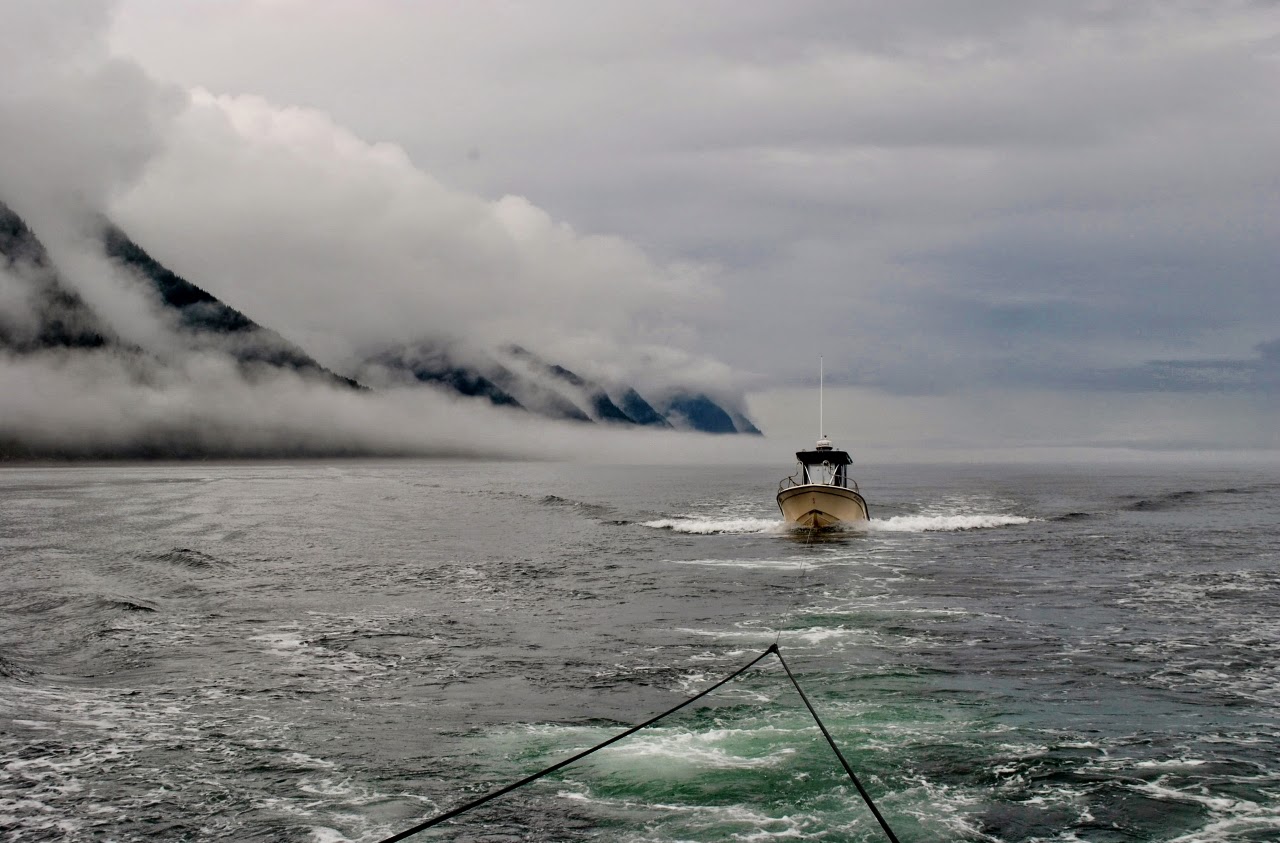
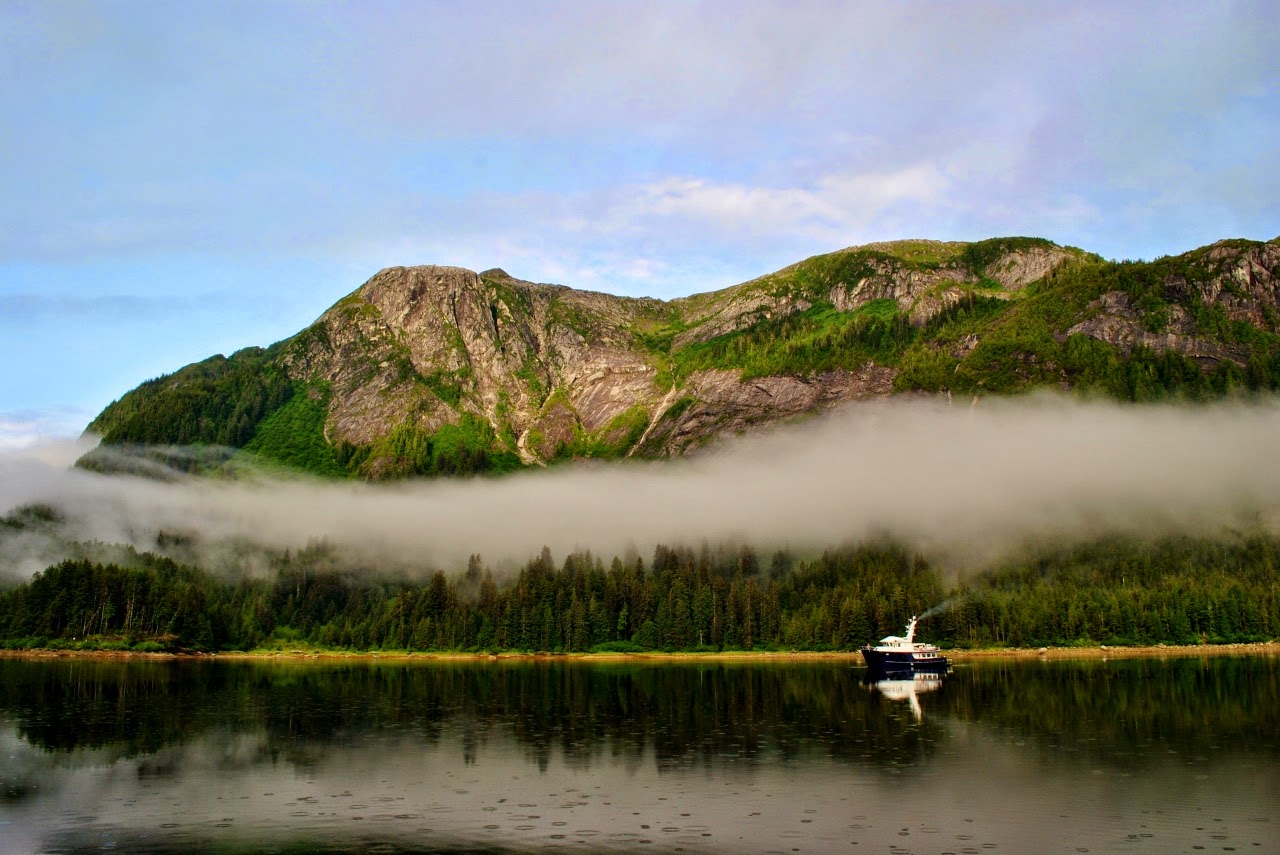
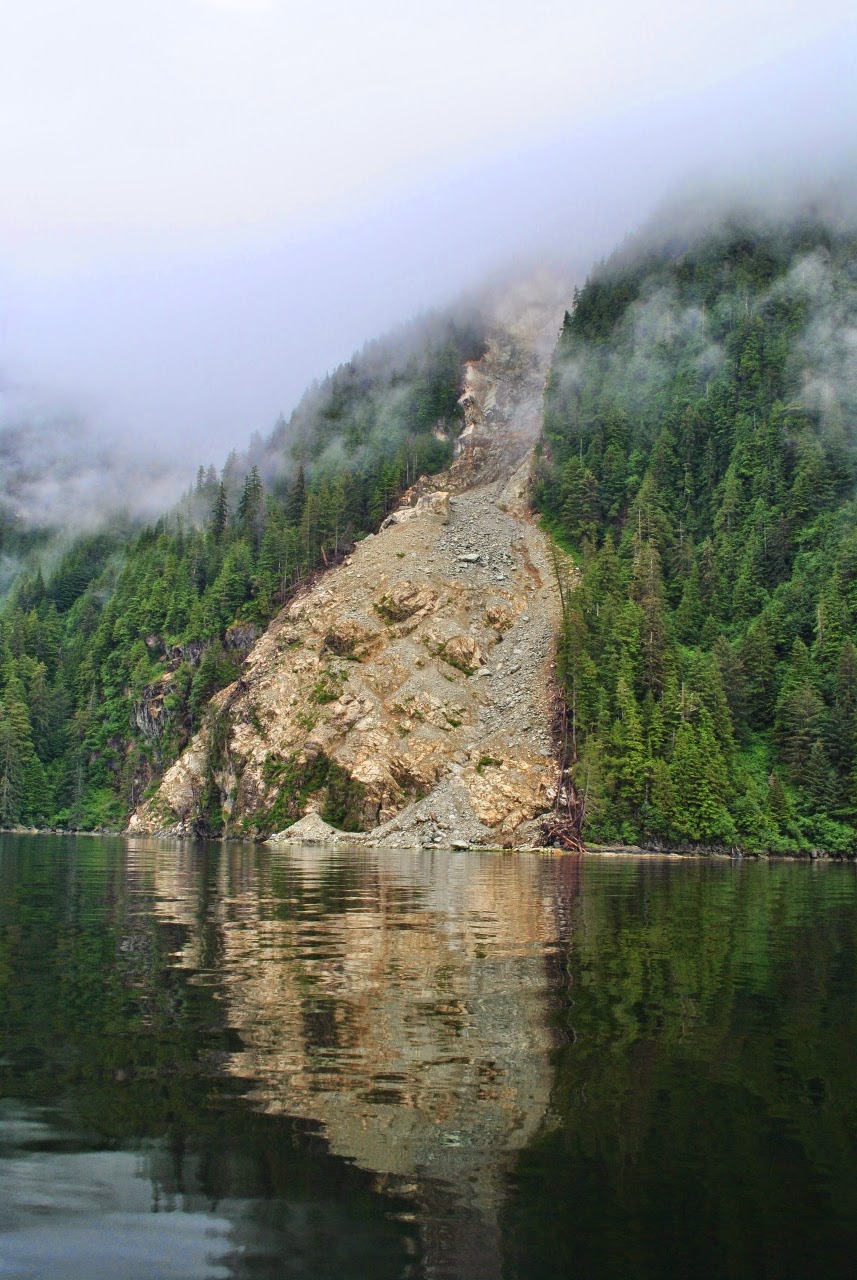
Underway at 0745 in fog and rain, we followed “Salty Dawg” south along the shoreline of Baranof Island, passing Warm Springs Bay.  Just north of Red Bluff Bay we stopped to fish, since Salty Dawg had stopped and already landed a Coho salmon.  In just a few minutes we had also landed a nice Coho.  The action slowed down, so we continued south to Patterson Bay.  The visibility deteriorated and we entered dense fog, with only a few hundred yards visibility.  As we rounded Patterson Point we picked up “Maximo” on AIS, and then as the fog lifted we could see them deep in Patterson Bay.  Proceeding up the 6 mile long bay we could see the remnants of a huge landslide, which was new since our last visit in 2012.

Landslide in Patterson Bay

Looking up Patterson Bay

Fog rolling in along Baranof Island
We anchored near the head of Patterson Bay in 100 feet of water, in the lee of a small point which protected us from the SE wind blowing up the inlet.  Naturally, the rain returned in intensity as we anchored.

July 28, 2014

We pulled the anchor at 0800 to hit low slack tide at a possible halibut fishing location.  Anchoring in 200 feet of water we put down the lines, but only got a few nibbles, so we headed back up the east side of Baranof Island towards Gut Bay, a new location for us.  We saw Salty Dawg headed south and they told us that the Coho were thick in an unnamed cove south of Gut Bay.  We stopped and within 90 minutes had 8 Coho salmon in the cooler.  We stopped only because we were running out of freezer space.

Heading into Gut Bay we found out how bad the charts are.  None of our electronic charts had the correct land contours or correct depths.  We were glad that Maximo was familiar with Gut Bay and guided us into an anchorage that was in the uncharted section on Jeppeson C-Map and on dry land on the Navionics charts.  We ended up anchoring in 125 feet of water near the stream at the head of the bay a few hundred feet from Maximo at 1415.

Processing the 8 fish took several hours, and we finished just in time to have dinner on Maximo.  While eating dinner, Steve Oberto’s rod hooked up a halibut from the anchored boat.  Suspending dinner briefly and landing the halibut was a team effort; it was a 60 pound fish from 140 feet of water.  Steve said they have caught halibut at anchor in Gut Bay on numerous occasions.

Gut Bay anchorage, the rain quit for awhile
July 29, 2014

Sometime overnight the rain ceased and we could see most of the hills surrounding Gut Bay.  This is definitely a place to return to on future trips.  Moving our anchor location west would put us on a mud bottom, more to a halibut’s taste, rather than the rocky bottom where we were anchored.

At 0715 we departed Gut Bay.  It takes 45 minutes at our speed to reach the entrance where we were greeted by light fog and calm seas as we headed diagonally across Chatham Strait to the entrance of Frederick Sound.

The low visibility was replaced by heavy rain as we headed to another possible halibut location.  Arriving, we anchored in 210 feet of water and after about 30 minutes hooked a small 14 pound halibut.  That fish totally filled the freezer, so we will be looking for an additional small freezer when we get to Petersburg.  After several more nibbles, but no takers, we headed across Frederick Sound to Portage Bay on Kupreanof Island where we anchored at 1750 for the night.  The entrance appears to be shallower than indicated on the charts, so we will have to watch low tide in the morning.  We have now covered 236 nautical miles since leaving Sitka.

July 30, 2014

The wind calmed overnight and the rain finally stopped.  We are getting less enchanted with Portage Bay, even though the scenery is good.  The current, even deep in the bay runs at several knots, and with the rocky bottom in much of the bay the noise of the chain dragging is annoying.  The entrance depths are definitely less than charted.  We pulled the anchor at 0515 to minimize the ebb tide currents in the entrance, as did several other boats.  With the tide at zero feet, there is actually only 10 feet minimum at the entrance rather than 21!

Our alternate halibut location had too swift a current due to the minus tide later in the morning, so we slowly motored the 21 miles to Petersburg, docking at 1000 in the midst of many vessels unloading fish at the fish companies.  The smell was indescribable, but according to the local people it is the smell of money when lots of fish are coming in.

As we docked, it became apparent that all the anchoring has taken its toll in the forward battery bank.  Load testing showed one of the two batteries is failing, so we will judiciously use the pathmakers when docking to increase the battery capability until we can replace the batteries in the fall after we return.  We have a fallback solution when we get to Ketchikan if the one weak battery totally fails in the next week.

Across the dock was 49 foot Nordic Tug, “Scarlet Lady”, which moors right next us to at Anacortes Marina.  That now makes four boats from “A” dock which we have met up with in SE Alaska this season.  We also talked to the Millers on the Selene 60 “Hathor”, who we met for the first time, even though our vessels were delivered close to the same time in 2009.

July 31, 2014

The sun returned, finally after a period of fog that lifted by 0800.  After some last minute grocery shopping we got underway from Petersburg for the final time in 2014 at 1330 and headed south through Wrangell Narrows into Sumner Strait and eastward to Wrangell.  We managed to time the currents so that we had an adverse current from the middle of Wrangell Narrows to Vank Island, where we once again had favorable currents.  As we approached Vank Island, the water color changed to milky gray/green from the outflow of the Stikine River.  Arriving at 2000 in Heritage Basin we enjoyed the last of the sun as we barbequed flank steak on the flybridge without having to wear raingear.

We moored just behind Doug and Kaen Dance on “Peregrine”, who were also enjoying an al fresco dinner with guests on their flybridge.  Also in Heritage basin were “Seeker” and “Tranquility”, two more Selenes.  Wrangell seems to be a gathering place for Selene Trawlers.  In past years there have been as many as seven here at one time.

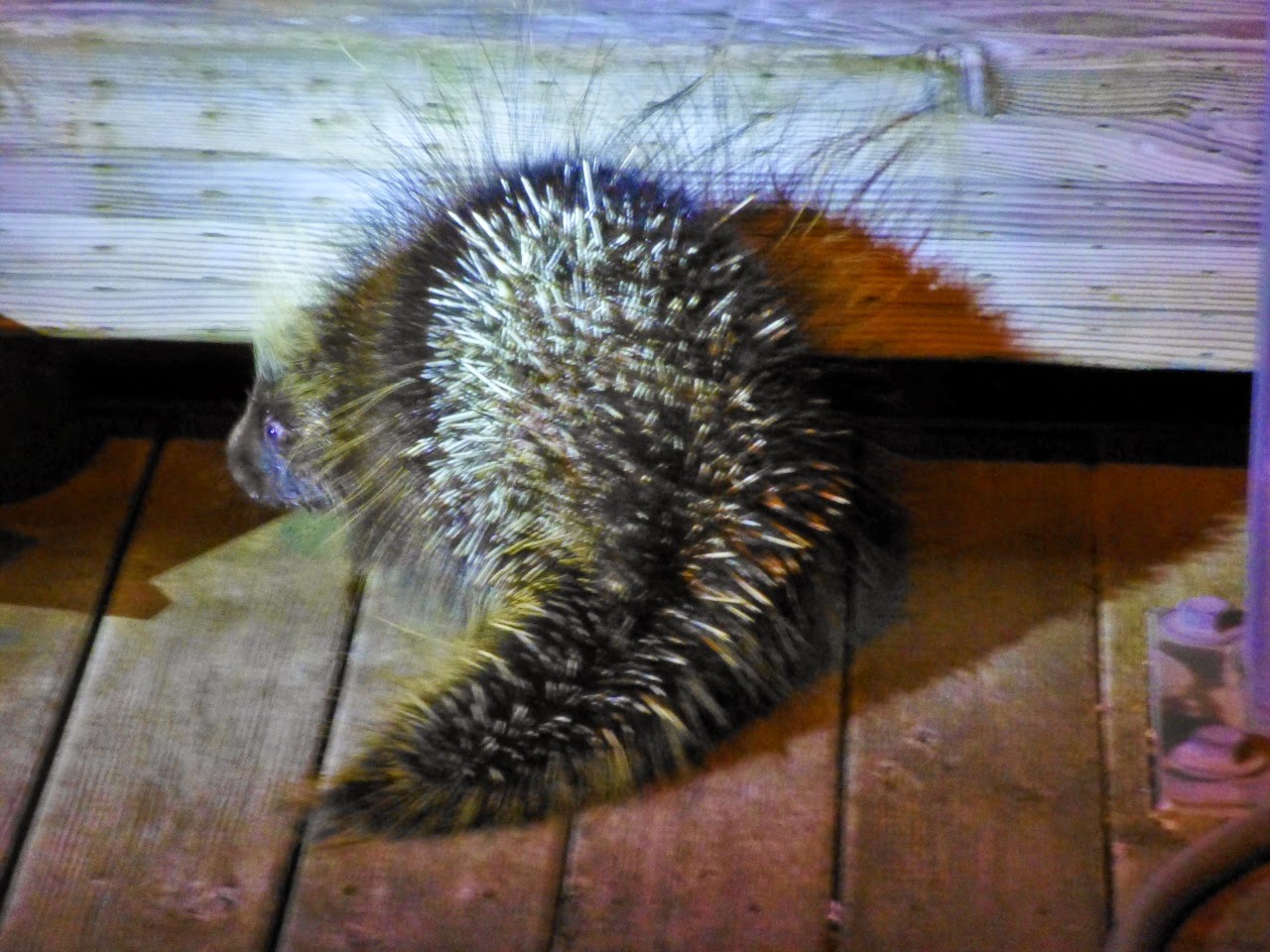
Later that evening we were surprised that a porcupine joined us on the dock.  What will we see next?

Porcupine on the dock in Wrangell
Our strategy for managing bow thruster and windlass battery power appears to be working, but there are still a lot of days to anchor before we return to Anacortes.

Belgrade Morning Tour 2

Oryahovo, Bulgaria
This is part 2 of the mourning tour.  I’m not so interested in fortresses or military history but it was a lovely place to walk around in and it’s a big part of Belgrade history.
Ru

Silicon (e) Valley
Our guide asked us why we though this area was called Silicon Valley.  Rick guessed it had […]

The ARGONAUT June 29 to August 6, 2014 Bora Bora

CAPTAIN’S LOG                                                              The Society Islands 

                                                         Tahiti, Moorea, Huahine, Raiatea, Tahaa, Bora Bora

                                                                                June 29 to August 6, 2014 

Preface

The September issue of PassageMaker magazine has been published and includes a feature article and pictures of our passage through the Panama Canal.  We are very complimented that PassageMaker syndicates our newsletter letter The Argonaut and publishes it on their website.  http://www.passagemaker.com/category/destinations/cruiser-blogs/the-argonaut/

  Rebecca and I have been accepted as members of the Ocean Cruising Club, which isn’t an honor of any sort except that you have to log of miles on the high seas.  It’s just fun to be part of a group of people who have made long open ocean passages.  Members often display their burgees in port so we can identify them and learn of their adventures.

So far we have traveled 10,500 miles on this Pacific trip.

The Society Islands

Tahiti:  We enjoyed a lovely 22 hour cruise down to Papeete from Tikehau.  The sea was calm, we cruised before a light 5 knot breeze, and the sky was blue and clear.  It couldn’t have been more beautiful; perfect for deploying our fishing gear and Father Neptune gave us two Mahi-Mahis and one huge Skip Jack for our effort.  The skip jacks are a type of tuna, and in these waters they grow to twenty-five or thirty pounds.  It was a picturesque passage in every way.

Geography:  Tahiti is located in the middle of the Pacific Ocean about 3,300 miles due south of Hawaii and 2,000 miles northeast of New Zealand.  It is an island formed about two million years ago by ancient volcanos.  Tahiti is made up of two mountains joined by an isthmus to form Tahiti Nui and Tahiti Iti.   Mt. Orohena is the highest peak at about 7,000 ft. above sea level, but it began its ascent over 11,000 ft. below the sea’s surface on the ocean floor.  Its peaks are often surrounded by clouds, and its rugged mountain tops encircle what used to be the volcano’s crater.  Mt. Orohena is composed of basaltic rock, which is soft and has eroded over the centuries into spires and carved edges that delight the eye and the imagination.  Its mountain tops yield to valleys that are covered by jungle vegetation of every description. Papeete sprawls around the northwest edge of the island and flows down the lava slopes.  As we approached the island, we could see lovely homes perched precariously on the hillsides, and the town itself nestled inside the lagoon at the harbor.  The island is surrounded by a coral reef.  Large rollers meet the coral with thunderous roars and white surf.  The coral ring is easily seen as a pale blue circle­­ of water around the island punctuated by rocks that pierce the surfa­­ce and then submerge on the inside of the lagoon to form a dark blue navigable waterway between the island and the reef.  Every so often there is an opening that permits passage over the reef and into the lagoon.

Shortly after we arrived, Rebecca arranged a tour of the island by car; other than in Papeete there is essentially one road around the island.  The island is very steep, so most of the homes and gardens are located near the lagoon that surrounds the island.  It is very lush and verdant providing a high standard of living for Tahitians.  At the southeast end of Tahiti Nui is an isthmus that joins the bigger portion of the island to the smaller Tahiti Iti.   We drove up the side of the mountain on Tahiti Iti to see the view of the isthmus and its surrounding lagoon.  This was one of the most beautiful geographic sights I have ever seen.  Tahiti is also a world renowned surfing location. 

Arriving at Papeete:  Papeete was a welcomed sight to us because we hadn’t been to a town bigger than a few thousand people for several months.  We were looking forward to provisioning and other benefits of civilization.  We entered the lagoon at Passe de Taapuna, about seven miles south of Papeete.  The pass was a little tricky as it is shallow, subject to the effects of the surf and requires several turns in the shallow area, but we negotiated it with only a slightly elevated pulse.  We proceeded north up the lagoon’s channel to Marina Tiana, the largest marina in French Polynesia and home to several hundred boats.  We stern tied to the so-called super yacht wharf and within a few hours we had rented a car, dined at the restaurant on the pier, and began shopping.

Shopping in Papeete was relatively easy.  French is the national language, but English is taught in school and most people are happy to converse in English.  A half mile walk from the marina was a shopping center that was stocked with virtually everything on our provisioning list.  Argo was in need of some oil filters and a couple of extra impellers, and this proved a bit of an adventure to find a heavy equipment parts supplier on the wharf at Papeete.  Driving in alleys and around ships being broken apart for scrap was interesting, and the supplier we found was staffed by knowledgeable and friendly people who were very excited and interested to learn of our adventure. 

The downtown area of Papeete is not particularly memorable from an architectural point of view.   Most of its buildings are of a 60’s vintage that surround a busy, working harbor, but to us it was a welcome respite of civilization after several months in places with few people.  Papeete is the capitol of French Polynesia, which is a protectorate of France.  The French support the country by paying for most of the cost of government (teachers’ salaries, the Gendarmeries, customs and immigration services, and many other government functions – $18 billion), yet there is an active, if ill-advised political movement to separate from France.  Without French subsidies, however, the Confederation of French Polynesia would not enjoy its relatively high standard of living, so I cannot imagine that the majority of Polynesians would be willing to give up French support.  Economic activity here peaked in the 1990’s, with cheap airfares appealing to tourists and black pearls fetching a very high premium.  Today however, the Chinese are selling black pearls cheaper than they can be produced here, and the tourist industry has not recovered from the Great Recession; tourist revenue is below 1997 values.   Papeete is home to the CFP government and offices of the French government.  Students over the age of fifteen from all the seven archipelagoes that make up the CFP come here for high school.  There are universities and a sophisticated medical center here.   Papeete is the main distribution center for all the islands.


The money here is the CFP franc.  Its conversion value varies from day to day; on some days we received as little as $1 equals 0.83 francs less a commission of 1% plus a fixed charge of $17.50.  Only some bank offices convert dollars, and their hours of operation are hard to predict what with holidays, the equivalent of a siesta in the afternoon, and local factors.  Banks will only convert $500 at a time, netting us considerably less when all is said and done.  Prices are generally higher than we pay in the U.S., particularly for food and restaurants.  These factors have us relying on our credit cards.  The CFP government waives its tax on fuel and parts purchased by transient yachts, making things more affordable for yachters.  We purchased fuel here for $4.53 a gallon (which I didn’t think was too bad); a hamburger with fries, on the other hand, costs about $20 (which I thought was pretty expensive).

Local Customs:  In talking with our guide, she told us that people in Polynesia do not find it necessary to get married in order to live together or raise a family.  Instead they move in with each other and maintain separate financial dealings and ownership of property.  Women maintain their own name and are free to leave the man or vice versa without legal squabbling.  Sometimes they marry in the church, but often this is done later in life.  I assumed wrongly that people were free to be promiscuous, but she told me that if her partner went wondering, that would be the end of their relationship.  If there is a breakup, the children go with whom they wish, and there are often children from many liaisons living under one roof.  So what’s new?

One thing that is apparent here is that life is slower paced.  The climate is so agreeable and the temperature is never cold, so the cost of housing and clothing is much lower than in the northern hemisphere.  A lot of fruits and vegetables are grown in family gardens, and fish is cheap and plentiful.  People don’t seem to be in much of a hurry, cars are available and expensive, but with only ten miles of road are not the status symbol that they are elsewhere.  Many people live on an island their entire life and are buried with their ancestors on the family homestead.  There is a rich connection to the ancient past.  Land ownership here can be tricky since much of the land is subject to tribal-family claims (requiring perhaps tens if not hundreds of people to approve the sale of their rights), while at the same time the same piece of land may be subject to ownership under subsequent colonial and church claims. The legal system, particular where property ownership is concerned, favors those who look Polynesian. 

Europeans here are primarily from France, and from what I can gather, are people who have opted out of the rat race.  Many own small businesses, shops, or restaurants here.


HeivaFrench Polynesians celebrate the “Festival of Life” or Heiva each year in July.  All the islands that we visited had something going on such as out-rigger canoe races, coconut husking competitions, cookouts, and above all dance and singing competitions.  Canoe clubs are popular and easy for us to identify as an athletic event, but the dance groups are something entirely different.  The biggest Heiva is held at Papeete, where dance and choral groups from all over the hundreds of Polynesian islands come to perform and compete. 

Dance groups are formed as a social club in many villages or islands such as the Huahine Island group that we saw perform one evening.  Dance groups have a membership of perhaps 150 people with about 20 of them being orchestra members and the rest being dancers.  They practice for six or eight months before the Heiva begins each summer, readying themselves for the competition.   The orchestra is predominately a percussion orchestra comprised of several different size drums, a ukulele chorus, and other unusual instruments.  The performance begins when the orchestra creates a primitive, pulsating, loud, rhythmic sound that will soon send the dancers into an erotic frenzy.  At other times during the performance they sound like a Kabuki orchestra, making it all the more exotic.  A narrative in the Tahitian language is given by what appears to be a chief or shaman who relates a mythical story of how the islands were formed by Maui or Pele or some other god or goddess, or perhaps the story of a great battle between tribes in ancient times; the dancers then interpret the story in dance.  When the narrative is over the dancers swing into action.  The dance is viewed by the audience in an arena setting, so that they can appreciate the choreography and precision movements of this tribe of people.  The dancers are dressed in costumes made of grass, leaves and flowers.   They are quite beautiful and very colorful.  The females move their hips with amazing rapidity that is clearly intended to be erotic, while the men move their thighs in a way that reminds me somehow of spawning or reproduction in the animal world.  In any case, it is a spectacle to behold.   The dance lasts about an hour and closes when the males and females pair off, all the while shaking and quivering as they and the audience reach a point of ecstasy as the drum beat intensifies.  It seems to evoke ancient tribal customs, sometimes savage, sometimes erotic.  If you allow yourself to get caught up in it, you can almost smell a missionary roasting on the spit!

The Credit Card Debacle:  We have had a devil of a time with our VISA cards.  We carried two of them from different banks as insurance against having one cancelled, but as fate would have it they were both canceled in the course of our travels because of fraud issues with participating stores.  After literally hours and hours of phone time, repeatedly answering the same security questions over and over and talking with all levels of incompetence, having the phone blank out after talking to the third tier in their hierarchy and having to start all over at the bottom rung again, we sweated out having new cards sent to Marina Tiana.  In the course of trying to track them and find out if they made it here, we discovered that the lame brain in the Bank of America’s VISA office sent it to “Tamiti”.  Of course there is no such place.  To make matters worse, the UPS form doesn’t have enough lines on the computerized address label to accommodate addresses here, so this increased our anxiety.   As the days ticked off, we finally got a tracking number and learned that the cards actually got to Papeete.  UPS uses a private vender here.  The phone system here is adding two digits to all phone numbers, so once we found the right number, we contacted them and arranged to drive over to their offices and pick up our cards since they had no idea of the final address to which they should have been delivered.  All’s well that ends well, I suppose, but our AT&T bill was over $1,400 largely due to calls to the credit card companies!

New Friends:  One of the greatest pleasures of traveling on a yacht is meeting new and interesting people.  In the Tiana Marina we met several couples that we really enjoyed.  One was Don and Laurie aboard True Blue: he was a prominent plastic surgeon and she an interior designer.  Don told me that last year they sold everything: the house in Sausalito, the helicopter, the motorcycle, the cars …everything, and bought their Oyster 66 and began their odyssey.  They’re having a wonderful time and dealing with a few bumps here and there, like their captain and his girlfriend (the cook) getting into a terrible row leading to their departure and the emergency hiring of a replacement captain, and don’t forget the failed generator that took three weeks to get parts for.

Johnny and Veronica and their three kids moored next to us on Walkabout, a Nordhavn 62; they have been spending the three summer months when the kids are out of school sailing as far as possible.  They leave their yacht in the last port they reach for nine months until next season.  They have traveled up the west coast to Alaska, then across the Aleutian Islands and down to Japan, then to Korea, Shanghai, Vietnam, and other places including Borneo, where they sailed up a river and saw orangutans, pigmy elephants and other exotic creatures. 

Julie and Mike: My sister and her husband, Mike, flew into Papeete for a two week visit with us.  They are sharing all the experiences that I am describing, particularly the Heivai Dance festivals and snorkeling. 

Moorea: After almost two weeks in Papeete we shoved off for Moorea, a gorgeous island just twelve miles away. Our passage was a little rough, as wind speeds reached around 25 knots and seas were in the six foot range.  Julie gets sea sick easily and this little jaunt was no exception.  She is a good sport and after getting sick she just came back up on deck for more.

The passage across the reef into Cook’s Bay was easy.  We anchored in 60 ft. of water near boats that we had seen in other anchorages.  Cook’s Bay is one of the most beautiful places I have ever been.   Like other Polynesian ports of call, the bay is the remnant of an ancient volcano with the eroded sides of the crater forming the peaks of the mountains.   Like Tahiti, Moorea is surrounded by a coral reef that is teeming with all types of colorful tropical fish.  It wasn’t long before we arranged for a scuba dive on the reef, the big attraction of which was the sighting of a huge 9 ft. lemon shark.  Unfortunately it was a rainy day, and underwater that didn’t make any difference except that it was rather low light and a little chilly after two dives

The next day we toured the island with our charming Polynesian guide, Paulina, and saw the vista from Belvidere, went to the local distillery, saw the ruins of her ancestors, and had lunch at Snack Mahana.  The place occupied a beautiful waterfront location and served up gourmet fare known far and wide, including its featured dish, Poisson Cru lait coco Tahiti, a raw tuna salad in coconut milk that was simply delicious.  It is made with slices of raw blue or yellow fin tuna marinated in coconut milk and lime and served with cucumber slices and onion.

Of course no tour would be complete without a little shopping, and Moorea had some very nice artisan shops that Julie and Mike took advantage of including the black pearl jeweler. 

That afternoon Julie, Mike and I took the tender on a snorkeling expedition.  This proved interesting in that we saw quit a few sting rays and managed to get stuck in shallow water in the labyrinth of the coral reef, but otherwise all was fine and it was a lot of fun. 


Huahine:  We decided to do a night cruise to Huahine so that Julie and Mike could see the ocean and sky at night.  It was almost 100 miles from Moorea to Huahine and it was a lovely evening for a cruise.  We left Moorea at 1700 and by the time we transited the pass into the open ocean the sun had nearly set.   The cruise was everything I had hoped it would be for them: the sky was pitch black and the stars twinkled in the firmament with a brilliance of clarity and in numbers that bewitch the mind.  The Milky Way appears as a cloud of star dust extending from one horizon to the other.  The waves peeling back from ARGO’s bow revealed stars in the water – star light like bursts from the plankton rising from thousands of feet below.

We made Huahine the following morning and put in at the little village of Fare, and fair it was.  We anchored in 90 feet of water and laid out 450 feet of chain; it’s a good thing I ordered 650 feet of chain on this boat!  Tyler secured Argo and gave her a bath after our cruise.  Everyone else but me went ashore for shopping and reconnoitering while I laid low with very bad cold.  That evening I managed to join the family for a really great happy hour and dinner at the beach front restaurant, which we later found out is known to boaters far and wide.   After dinner we went to the local Heiva, which was very provincial compared to the more professional performances in Papeete.  We stayed overnight and the next day we cruised down the lagoon to another anchorage that was not only a visual knockout, but had some of the most beautiful coral formations we had seen.  The troupe went snorkeling while I nursed my cold.  After they returned and dined on one of Rebecca’s fabulous meals, we took the dingy through a passage to another bay that connected to the other side of the islands.  There we found a little tavern.  We enjoyed a libation in a very rural and authentic setting, and it gave Mike a chance to pick up the bill as I forgot my wallet. 

Raiatea and Tahaa:  The next morning we hoisted the anchor and departed for Raiatea, a couple of hours away.  It was a beautiful day, but the fish weren’t at all interested in what we had to offer.  We moored at the town dock at Uturoa and dined at the little French restaurant on the dock.  We were all anxious to get to Bora Bora because of all we had heard about it.  That evening Harry Smith, an Australian that we meet in Jamaica and who had made the crossing during the same time period that we had, came by for a visit.  He offered us some advice on Tahaa, the next island, and reported a phenomenal coral garden there.  He also helped me plan our 2016 trip down the coast of Australia to Tasmania.  The next morning we left Raiatea and moved over to Tahaa, which was only a few miles away.  After we anchored in a secluded bay, we launched the tender and spent two days floating in the fabulous wonder of its coral garden.  It was located in a channel between two motus with the sea water from the outer reef flowing through rather briskly to keep things fresh for all sorts of fish, corals and other creatures.  We anchored our tender at one end of the channel and walked up the motu to the head water about ¼ mile away, and then floated down the channel to our boat, all the while watching the fabulous aquatic scenery as we floated by.  Among the hundreds of brightly colored tropical fish swimming about their business oblivious to us, were two particularly interesting creatures that I hadn’t seen before.   One was a sea anemone that was a beautiful red color with sticky tan tentacles and beautiful little fish weaving in and out.  The other were maxima clams or small giant clams with the curved edges that have beautifully blue, red or brown colored lips.  It was so fabulous it can’t be described.

Bora Bora:  We reluctantly left Tahaa but looked forward to coming into Bora Bora, which is a seminal experience for a captain; it’s like coming into New York or San Francisco harbors.  The pass channel is wide and easily navigated, but the bay is full of coral heads and reefs.  As we entered we saw the beautiful rollers breaking on the reef on both sides, the reef awash with turquoise water, and the deep blue lagoon inside the reef.  Dominating the whole scene is a huge megalith of a receding mountain named Mt. Otemanu that was once a mighty volcano.  The caldera beneath the volcano has cooled and the mountain has eroded and collapsed over the centuries; it sinks about a centimeter a year into the sea.   Eventually it will be like the Tuamotus. i.e., a ring of motus surrounding a lagoon.

 We expected a bustling island with lots to do and see, but in reality it is a small and quiet place with only a few restaurants.  Most of the activity here is at the famous hotels and resorts scattered about the motus that surround the island.  The room prices are an unbelievable $2- 3,000 per night.  A friend of ours went to a cheap $1,200 place where they got the third night free.  We have been told that the resorts are all full, yet you don’t see many tourists about as they are locked away behind the gates of their resort. 

Julie and Mike had a few more days with us so we planned an island tour that proved to be fantastic.  We were picked up by a four wheel drive open back Range Rover pickup truck with bench seats in the bed.  I must say I wasn’t very enthusiastic at first, but in a few minutes I was having a lot of fun.   This thing climbed 500 slopes: it was fantastic.  We climbed all over the mountain including a place where the Americans had placed gun mounts during the Second World War.  We examined the guns, which had a legend marked with the name of the manufacturer and the date of manufacture: 1907.  I asked our guide about this and he told me that they were taken from ships that were sunk at Pearl Harbor on December 7th.  Later they were removed from the sunken ships and brought here as defensive weapons.  They were probably part of the weaponry on the Battleship Texas or some other old ship that wasn’t salvaged after the attack.  The guns looked like they were cut from the ship’s deck plate, moved here, and then cemented into position on the top of the hill, deck plate and all. 

One of the interesting things we found on the tour aside from the fabulous views from the mountain peaks, was the fact that people here bury their dead next to their homes.  As we drove up the mountain side we could see that almost all the homes had small, roofed tombs in the yard near the home with colorful plastic flowers to memorialize their ancestors who were buried there. 

Life on the Dock:  During the last few days Tyler, handsome and youthful as he is, has been the object of attention from at least two young women who have found themselves stranded on the dock here in Bora Bora.  It seems they were crewing on sailboats that are crossing the Pacific.  Usually these women offer to cook, clean, and perhaps stand watch in exchange for free passage across the ocean.  As you can imagine, people often get annoyed with one another while being in close quarters over such a long time period, so it isn’t unusual to see people leave a boat and look for other arrangements.   Sometimes they fall in love, dare I say?  In the two cases this week, the captains put it to them bluntly.  The ladies took great offense and in their righteous indignation immediately left their boats, penniless and without an apparent means of support.  We fed one hungry young women (a 30 year old Chilean on her way to New Zealand for a job)) a healthy meal, and both found temporary accommodations on other sailboats until some stability in their lives could be arranged.  After a brief period of time during which strangers rallied to extend a helping hand,  both have now moved on to new arrangements and the dock has return to the its normal tranquil and bucolic state.    

One of the sailors hold up in Bora Bora waiting on the weather reported that one of the men associated with the hassle with the ladies mentioned above, left port without the permission of the gendarmes and without a clearance to the next port.   At his next port of call he could face a stiff fine, perhaps as much as $10,000 and/or be required to retrace his steps back to the last port and obtain a clearance there.   He is now 800 miles out at sea, in seas of 14 ft. and winds over 30 knots, having lost his mainsail and his engine.  

Getting Underway:  After Julie and Mike left we planned to get underway for American Samoa.  We found out from our fuel agent that American Samoa requires a customs agent for motor yachts (but not sailboats) to enter American Samoa.   The agent’s fee is $500, plus a bunch of other government fees, so we decided to skip the islands and their hospitality.  Instead we decided to move along to independent Samoa about 100 miles further west, which as far as I know is more reasonable.  The passage is 1,200 miles that will take about six days.  The weather will be less than ideal, but we are looking forward to the trip.  In the course of preparing ARGO we discovered a few problems.

 Mechanical Problems:  In preparing for any long voyage we check the yacht thoroughly.  This time Tyler found the unwelcomed presence of hydraulic fluid in our bilge, which is not a good sign.  As you know the hydraulic system has been a repeated source of difficulties.  We began to hunt around for the source of the leak and found that the actuator on our port stabilizer had begun to seep oil, but it was a small and slow leak, not enough to cause us to lose two gallons of oil.   Up forward however, we found two more leaks at the manifolds of the windless and thruster.  Apparently two seals had failed and oil under 3,400 lbs. of pressure was spraying everywhere.   It was a mess and a very big concern. 

Lucky for us we bought Argo from Nordhavn, which subcontracts the hydraulic system from American Bow Thruster, Inc.   Once we notified them, parts were in the FEDX system within 24 hours and a technician in New Zealand was organized to come here.  Despite the disappointment and concern over the failures, we are grateful for the fast and wonderful service we are getting from Nordhavn and ABT.  However it will delay us by almost ten days.


Meeting Garrick Yrongi:  We are staying at the Mai Kai Marina in Bora Bora.  Here we are Med-moored or stern tied to a dock that is attached to the outside terrace of the restaurant.   The main business of the marina is the restaurant and a small hotel that’s part of the little complex.  The restaurant is quite good and is run by Teiva and his wife Jessica (she is a Californian).  Teiva is not only the chef, but also runs the marina and everything else.  He is a very energetic, happy Polynesian who has been extremely helpful to us 

In the restaurant are hung several interesting paintings that I was immediately attracted to.  Rebecca says, they “speak to us”.  They are humorous, bright, and colorful pieces of modern art.  I asked Teiva to introduce us to the artist, Garrick Yrongi.  He is the fourth generation of his family to be artists and sculptures, and he is widely known.   Garrick came by the marina and invited us to his Tuscan style villa, a sprawling compound built on the hillside overlooking the sapphire blue bay and Mt. Otemanu.   On the living room terrace is a life size sculpture in bronze of a gorgeous, nude young woman sculpted by Garrick’s father.  As we were looking at this beautiful woman, Garrick told us it was his mother.  After he told us, I was a little embarrassed to continue looking at her, but she was so beautiful!

We had lunch at his home and he showed us his studio and collection of pottery, sculpture, and paintings.  Our lunch was Poisson Cru accompanied by a fine bottle of Kistler Chardonnay that we brought along for the occasion.  At lunch we discovered that we were both born on the same day, which made for a lovely coincidence and a lot of fun.  The most interesting subject of our conversation evolved around his vision of the world and how he has developed his style of painting and sculpture to express it.  He sees the Polynesians as people with a wonderful spontaneity unfiltered by the psychological defenses necessary in a more complex society.  He sees them as people possessing an innocence of an earlier time.  He loves the light here in Bora Bora, a light that is warm, but changing and pure.  His paintings reflect the dominance of the sea and its creatures, but also the beauty of the flora as it meets the sea, all expressed with his intrinsic good humor and optimism.

Next Stop:  We will be in Bora Bora until at least August 6.  In the meantime, the nasty weather to our west will abate and we will hopefully be on our way soon.  Next stop, Apia, Samoa about 1,200 miles of open ocean to the west.

I will try to [post new pictures on the website before we get underway.

Start your own blog now! Free!

[KensBlog 2014-Entry 6] We’re having a SWELL time

Welcome to Ken’s Blog! (top)

Greetings all!

First off, I would like to apologize for the length of this blog entry. We’ve been busy traveling and I haven’t found time to work on my blog. Going forward, I’ll try to produce shorter blog entries, and send them more frequently. That said, it never seems to work out that way. One tip for this issue of the blog: make sure you read the section on Scario. It describes a scary event!

As I am typing this, Sans Souci is on the west coast of mainland Italy, in Salerno (about 150 miles south of Rome)

Here’s an index to this issue of Ken’s Blog:


Journey Map (top)

This map shows Sans Souci’s route over the two-week span covered in this blog entry. As you can see, we’ve been moving!


Taormina (top)

At the end of my last blog entry Sans Souci and Seabird were working our way north along the east coast of Sicily. We had expected nice calm seas but were instead pushed around by lumpy seas. Our problem wasn’t as much the rough seas, as it was that we had no idea what would be waiting for us at arrival. The east coast of Sicily has only a few anchorages, and other than Siracusa none offer protection from rough seas or swell.

The major topic of discussion was, “What happens when we get there?” The cruising guides are quite explicit in saying that there is no anchorage at Taormina except in “settled conditions.” We could see on the chart that the anchorage was exposed to the sea and that there were no other anchorages. Nor were there any others anywhere close. We identified one that “might” work, right at the Messina Strait (the narrow channel between Sicily and Italy) but that would mean getting beat up for an additional two hours, only to arrive at a dubious anchorage.

Another Nordhavn owner had recommended we try the mooring buoys at Taormina, which were placed in the most protected possible location. We were aware of these, but had written them off as impractical. Generally, it is impossible to know what is under the water on these mooring buoys, or the condition of the line that attaches the buoy to the bottom. However, with a bit of googling I found a website that had this to say:

“… Taormina Moorings are situated at the south side of Capo Taormina and are sheltered from North, North East, South West, West and North West winds and swell. The 11,000 square metre area is private and offers 20 dead weight moorings. Each concrete block weighs 5000 kg to which large orange fender buoys are attached via a 26mm rope and a 30mm chain at the base. These moorings offer a perfectly safe day and overnight anchorage for yachts up to 43 meters (140′) in length. …”

(http://www.yachthotel.it/index.php?option=com_content&view=article&id=47%3Ataormina-moorings&catid=72%3Ayacht-hotel )

Interesting! I didn’t like the idea of being in what was effectively a “boat parking lot” but we were in no position to be picky. If the mooring buoys could hold us, we wanted them! The price looked outrageous – 120 euros (about $180 USD) to tie to a little orange ball for the night, but…what was our other option?

The seas stayed rough up to within a mile of the moorage, then suddenly flattened out. Just short of the mooring buoys we saw water flat enough to drop our anchors, and probably could have, but we were in the mood for a “sure thing” and the mooring buoys had captured the best possible (most protected) location.

About the time we finished tying up the wind dropped. Suddenly it was flat in every direction. Our moods brightened and we were instantaneously transported to paradise! A flood of other boats came in and we looked around and realized we were in a great place under a very cool, cliff-hugging town .

The best of all: Taormina is near the base of Mt Etna, an extremely active volcano. We were close enough to easily see the lava flow – at night. How many people can say they had dinner on the back of their boat while being entertained by an active volcano at the base of cliffs, holding a hillside city?

Taormina Moorings. An incredible place to be! George, who runs the place takes good care of you, and is always available to run you to the town for exploring, help you with taxis or restaurant reservations, make deliveries and take away your garbage.

Imagine this: dinner on the back deck watching the lava flow on an active volcano. How great is that?

Looking down at our boats from the hilltop town of Taormina.


Taormina — fun to explore, and we even discovered a really good sushi restaurant.


The Messina Strait (top)

After a few spectacular days at Taormina the time had come to head north. To do this we would be passing through the Messina Strait.

The Messina Strait is a narrow channel separating mainland Italy from Sicily. If you think of Italy as a leg with a boot at the bottom, then Sicily would be like the soccer ball that is about to be kicked by the “toe.” We’d be passing in the narrow gap between the toe and the ball.

I was nervous about the strait, and kept googling it on the internet, trying to figure out whether there would be heavy currents. The Messina Strait turned out to be anti-climactic. I had expected a narrow channel, like the Corinth Canal (Note: If you haven’t seen our video of going through the Corinth Canal, check it out by clicking this link: http://www.youtube.com/watch?v=l6KjXNYiXfo), but whereas the Corinth Canal was only 75′ wide, the the Messina Strait is 1.5nm wide at the narrowest. There were currents, but with so much maneuvering room they were a non-factor.

There are a few interesting things worth noting:

  • In the narrowest part of the channel, fishermen were everywhere in little (Approx. 4 meter) fishing boats. They were hard to see at times and I have to believe one gets hit from time to time. At one point I was dodging two ferries zig-zagging around them, while being passed by a cruise ship!
  • The currents were strange. I had downloaded a program for my iphone which was a current table for the Messina Strait. It claimed the current would be 1 knot with us, but for most of the run it was three knots AGAINST us.
  • Apparently the area is known as a place where swordfish boats hang out. Sadly, we weren’t able to see one.

    Here’s a fun article talking about why these boats are SO interesting:

    http://tinyurl.com/osk4jbx

    Swordfishing boat at the Messina Strait. Look at the length of the bowsprit!


The Aeolian Islands – Vulcano (top)

Anyway, the real excitement didn’t begin until we reached the Aeolian Islands (north of Sicily). They are a series of volcanic islands, and we wanted a spot to drop anchor for the night. Unfortunately, there aren’t many places, and on a nice Sunday afternoon in high season, room to anchor is rare.

The islands drop vertically into the sea. By the time you are 100 yards offshore the depth is easily 300 feet or more. At Porto Levante, on Vulcano Island, which was our first anchoring effort, the closest I could come to anchoring was a narrow shelf in 124 feet of water. We searched for an hour for a place to drop the anchors, and finally found a very nice place in 50 feet of water on the west side of Lipari Island.

Sans Souci and Seabird at anchor on the west side of Lipari Island. The anchorage was crowded during the day, but by the evening we were almost alone. You can see the volcano on the right side, on nearby Vulcano Island.

While sitting at anchor I was shocked to see the strangest looking airplane I had ever seen land in the water right next to Sans Souci. Or, at least that’s what I thought! It appeared out of nowhere, and was HUGE. I immediately ran to the radio to tell Steven (on Seabird). “Steven! You aren’t going to believe this. A plane just landed next to me!”

Steven took a look and immediately recognized the strange beast. It was a solar-powered boat! Steven had seen it in Thailand as it was circumnavigating the planet. Take a look at it, and you’ll see why I was confused:

http://www.planetsolar.org/

After one calm night at anchor, we had no choice but to move around to the east side of Lipari and go into a marina at Lipari Town. There would be a strong west wind coming for the next 48 hours, and we needed to be somewhere safe.

Sans Souci approaching the Aeolian Islands

You should see a video above. That said, if you received this blog entry via email you may need to click this link to see the video:

http://player.vimeo.com/video/102115657


Lipari (top)

As we were on route to the town of Lipari Roberta once again grabbed the video camera, and shot this video of us following Seabird around the island:

Sans Souci circumnavigating Lipari Island

You should see a video above. That said, if you received this blog entry via email you may need to click this link to see the video:

http://player.vimeo.com/video/102115657

A marina had been recommended to us in Lipari Town (the main town on the island of Lipari.) We knew that Lipari was a small island, and weren’t expecting much for a marina, but the marina was even smaller than expected. It was just a large pontoon, with no breakwater, open to the sea. We knew bad weather was coming, but weren’t too worried. The wind would be coming from the west, and we were on the east side of the island inside a bay. We would be protected from the wind and swell by the island.


I had heard that the restaurants in Lipari weren’t very good, but Roberta and I had great luck and went to two different restaurants we thought were very good: La Conghilia, and La Anfora.

There’s one “cultural detail” that should be mentioned about restaurants here in Italy. People eat late! Roberta and I usually eat early, like 6:30 or 7:00 pm. In Italy, restaurants don’t even start opening until 8 pm. Above are before and after pictures showing the restaurant La Anfora: Roberta and I at 8:30 pm, dining alone. The “after” picture shows the restaurant full at 10 pm when we were leaving.

Our “marina” at Lipari was actually a long pontoon. We were tied up at the end of it. I worried we were too heavy for it. Overall though, it was a very nice place, and the owner, Pierro, took very good care of us.

Seabird and Sans Souci were tied, side by side, at the end of a pontoon. With the high winds we were constantly moving side to side. Sans Souci uses inflatable fenders, and at times there was so much pressure between the two boats that I expected a fender to pop at any time. We had twelve large fenders separating our boats. Even this wasn’t enough and Steven purchased a large “ball fender” at a local marine store for extra protection.

We spent one afternoon exploring the streets of Lipari with the dogs.

As Roberta and I were walking up our dock I noticed that many of the boats were charter sailboats (flying a banner that said “Yacht Week”). I mentioned to Roberta that I felt sorry for the people who rented the boats after flying many miles to enjoy a week in the sunshine, only to find themselves pinned down by weather for several days and being bounced around in the wind. Sans Souci is an extremely heavy boat. We were moving somewhat, but nothing like the little sailboats tied to the dock. They were moving so much that I could envision almost anyone getting seasick just sitting at the dock!

As the evening went on, the weather didn’t improve, but a “spring break” atmosphere took over the dock. No one looked like they were suffering too bad, making the best of it, although I bet there were some people who had headaches the next morning.

During the worst of the wave action I noticed a couple of young ladies swimming in the tight space between their sailboat and the dock. I was afraid that one of them was going to get badly hurt should the sailboat (or the dock) crash into them. I was probably overly sensitive because of an incident Steven and Carol witnessed in May while in Sibenik, Croatia, waiting for us to arrive. During a wild party at a nearby dock someone went overboard, only to be fished out of the water next to Seabird the next morning. A very sad, mortal event. Although I didn’t say anything to the girls I couldn’t stop myself from approaching the captain the next day to warn him to keep a closer eye on his passengers. He didn’t stop them swimming, but did move his boat farther off the dock creating a larger area behind the dock, so that his passengers could swim safely.

A VERY short, but very interesting, video showing our pontoon moving in strong wind

You should see a video above. That said, if you received this blog entry via email you may need to click this link to see the video:

http://player.vimeo.com/video/102115657


Panarea (top)

After three days hiding from weather at the dock on Lipari the weather improved and we were able to move the short distance to another island in the Aeolian group: Panarea.

Panarea is a tiny island with a huge anchorage in front of Panarea Town. The enormous size of the anchorage has made it popular with the megayacht and jetset crowd. There’s kind of a St Tropez ambiance on the island, with the nightlife to match.

Sans Souci at anchor at Panarea. We anchored farther than I liked from town, but it was BEAUTIFUL!

As much as I was looking forward to visiting Panarea, there was another reason to be there. We had been trying to cross paths with Nordhavn 76 owners, Laust and Monika Sondergaard, who had been cruising further north and were working their way south. We had never met, but had corresponded from time to time.

Nordhavn 76 – L’Adagio

Owners, Laust and Monika, were kind enough to give us a tour of their beautiful boat. We invited them over to Sans Souci for a tour, but after seeing how perfectly clean their boat was we asked them to give us a couple of hours to tidy things up first. We’ve been living on the boat full-time for more than two months without crew, and, though we are tidy people, it sometimes comes down to: do we take much of our time cleaning the boat inside and out – or go sightseeing and have fun? Fun often wins! We have decided that one important thing that crew does (“crew” meaning one or more persons) is to keep the boat constantly clean while the owners get to go out and have fun! Roberta envied the fact that L’Adagio had one crew member.

In this picture Laust is trolling for sharks with his son and son’s friend, beer bottles in hand. The young men joined us for dinner later in the evening, so the sharks must not have been biting.

Party on Sans Souci!

Sans Souci’s upper aft deck is a wonderful place for an afternoon gathering. Here you see the guys huddled at one end of the table looking at their phones (Laust from L’Adagio, and Steven from Seabird) while the ladies are at the other end of the table gossiping about us (Carol from Seabird, Roberta from Sans Souci and Monika from L’Adagio).

Ken and Roberta Williams with the Sondergaards. One of the sad things about boating is that you meet amazing people for a day, then you sail on and may never meet again.

Panarea is famous for its nightlife. Roberta and I bailed early wanting to get back to the dogs waiting for us on the boat. The tender ride to town, which, in the light of the early evening, took only 15 minutes, lasted over 30 minutes for the return trip. By then, it was pitch black, with many boats to zig-zag around, plus a large area with blinking mooring balls, some lit and some not. We were very happy we weren’t trying it after a longer evening spent enjoying the nightlife.


Nordhavn 76 – Nordhavn 68 – Nordhavn 62

This picture took some work to make happen. L’Adagio (Monika and Laust’s N76) was anchored a mile away. In order to take this picture Laust re-anchored his boat in a cramped location near our two boats. We then had to be creative in maneuvering the tenders in order to get the three boats lined up.


Stromboli – Dinner beneath an active volcano (top)

Seabird and Sans Souci share a common desire for short-distance cruising on flat, calm seas. We’re in a part of the world where the seas and winds can quickly turn nasty. The Aeolian Islands are beautiful, but they are very exposed to high wind and swell. It was time to move on.

Our next stop after Panarea would be the another of the Aeolian islands: Stromboli. Stromboli is an active volcano, and can apparently put out quite a fireworks show at night, viewed mostly from the NW of the island. The problem is that there is virtually no protection from the winds and waves at the one anchorage at the NE of the island. There also isn’t much space to anchor, and what little there is forces the boats to anchor much closer to each other than they normally would. As we were approaching the anchorage I noticed that I was still reading 350 feet of depth within 100 feet of a sailboat to which I’d be anchoring next to. But the bottom came up quickly and I was able to drop the anchor in 38 feet of water.

We never did get to see the fireworks; the crater points to the NW while we were anchored at the NE. Though we were anchored at the volcano, in order to see the show you need to wait until the early morning while it’s still dark, pull your anchor and drive around to the northwest side of the island. We felt lazy and decided to pass on that, figuring that we saw Mt. Etna in all of her glory from the wonderful viewpoint of our upper aft deck at Taormina! That doesn’t mean we didn’t have a magical time, though. From where we were sitting we could see constant smoke at the top of the volcano, and an endless stream of people hiking the switchback trail to the top of the volcano. Apparently tourists hike for hours to reach a viewing point at the edge of the crater, watch the fireworks, and then, after dark, hike back down, flashlights in hand. We were watching them through the binoculars, and, while sitting in the hot tub, we could see what looked like a lit-up snake crawling down the mountain. And to add to the surrealness, though we never personally viewed the eruptions, about every 30/40 minutes or so, we’d hear it: a loud sound like a huge jet engine!

Aeolian Islands – Stromboli

Here we are approaching Stromboli. The anchorage is on the northeast corner, where the town is located.


Seabird and Sans Souci at anchor on Stromboli

Roberta cooked an amazing dinner anchored in front of Stromboli. We spent the evening watching, through the binoculars, the hikers working their way to the top, only to hike back down a few hours later.

Stromboli – Viewed from north side


Scario – Sometimes you get lucky, and sometimes you don’t (top)

Apologies, but I have no pictures for this section of the blog, and I have a REALLY good excuse. In fact, Steven (Seabird) and I were debating whether this was our worst cruising day ever, or second worst. We couldn’t decide, but are confident it ranks high on the “day from hell” scale.

Our journey from Stromboli to Scario (a village on the west coast of southern, mainland Italy) began at 5am, as we prepared the boats for departure. We had a perfect weather forecast for a 75nm (nine hour) trip to an anchorage we had heard good things about.

The trip was every bit as calm as predicted. Zero wind and dead-calm seas.

On arrival I noticed ten or so boats anchored below some cliffs just outside of town. We had planned to drop our anchors just outside of the town but were curious why all the boats had chosen a place a couple miles out of town to anchor. (It was a great place to swim!) As we approached we could see that it was a fairly tight location without much room to anchor, but incredibly beautiful. We could drop our hooks and feel like we were in the middle of nowhere, but be an easy tender ride into town. At around 5:00 pm all of the other boats pulled their anchors, leaving our two boats alone at the anchorage.

The anchorage turned out to be perfect. We floated in the calm water and had dinner on the upper back deck. The evening was predicted to be no more than five knots of wind, and we would be moving to a city (Salerno) 70nm farther north the next day, so Roberta and I put away our flopper stoppers (the giant poles that hang out the sides to help keep the boat from rolling side to side while at anchor).

Roberta and I turned in for the night at 10:30 pm. At 11:00 pm we felt the boat roll with a swell, and assumed some big boat had passed by and we were feeling its wake. But then, the boat rolled again, and then again, and again and…

The boat kept rolling side to side making sleep impossible. By 12:30 we were rolling so that I had to lay down chairs (so they wouldn’t fall) and move computers off table tops. At 1:00 am the swell was absolutely unacceptable. It was virtually impossible to move inside the boat without falling. The strangest thing was that there was no wind. The forecasters had been right about that. But there was a HUGE swell entering the bay; perhaps seven to eight feet of swell.

I used the radio to call over to Seabird. No answer. I tried the phone and woke Steven and Carol up. “Should we move?” I asked. Steven answered, “It’s bad, but we’re able to sleep. I think this is going to calm down.” Roberta and I tried to sleep.

The swell continued to worsen and was becoming frightening. At 1:30 am Steven called, “Let’s get out of here!” He then asked, “Are you sure we can get our anchors up in this?” Our bows were bobbing dramatically by this time.

It was a very good question. The bows were pitching through a five to ten foot arc every few seconds. As soon as the anchor cleared the water it could fly up like a missile.

My answer, “We really don’t have a choice, do we?” We were close to shore and I could hear waves crashing. Things were getting worse quickly. We knew we were in trouble where we were, and thought we might be in trouble out at sea. We had to pick between two bad solutions to our problem: stay, or go. We knew we couldn’t stay, so, in reality, it was an easy decision.

Pulling the anchor was not fun. It was pitch black and we didn’t want to mess up our night vision by turning on the deck lights. Roberta managed the helm as I went to the bow to try to retrieve the anchor.

The bow was pitching more than I had expected. Although I had no light, our anchor light was illuminating the waves around us, and I could finally see how much we were rising and falling. Raising the anchor went reasonably well until the end. We were apparently well stuck with the anchor buried. We had dropped the anchor in 70 feet of water. When I was on the last 70 feet of chain, the anchor stuck and wouldn’t pull up. I started pulling in chain as the bow descended, and then let the weight of Sans Souci’s upward momentum help unstick the anchor as the bow lurched up. I was worried the anchor would be trapped under some rock and that by lifting chain as the bow plummeted I’d be ripping off the bowsprit when the wave pushed the boat higher.

Suddenly, the anchor freed and went neatly into its position on the bow. I looked over at Seabird, and their anchor had come up backwards. He and Carol were on the bow using a boat hook to rotate the anchor into a proper position for lifting the last few feet onto the bowsprit. Steven mentioned later that he had been nervous hearing the waves crashing nearby. His worry was that the boat would be blown onto shore while he was away from the helm helping to spin the anchor. Once again, there were no other options. In situations like this you do what you have to do.

Finally…the boats were free! We assumed that as soon as we were moving, and got out into deeper water, the rolling would stop. Our first thought was that we had anchored in a bad location, but we quickly discovered that it wouldn’t have made a difference. I did a quick check of the weather and the report had been updated to reflect the swell being two meters (nearly seven feet) rather than the previously forecast calm.

But, now what? We were in heavy seas, with strangely no wind, and a seventy mile passage ahead of us — and, we hadn’t slept in almost 24 hours!

There was nowhere we could have anchored. It was just a surprise swell due to some unexpected weather event far away. It was what it was, and our boats are solid, so we just kept going. While underway, Roberta logged onto the internet to search for a marina further north, where we could go and safely dock.

It was a rough ride, but we’ve had rougher. The wind was only in the 5 to 15 knot range, it was the unexpected swell that was causing the problems. What made this run particularly bad was that it was pitch black out, and we had seen fish pots when we came in. Also, our exhaustion was complicating the situation. We decided that both Roberta and I would drive until the sun came out (three hours later) and then we’d take turns while one rested.

We decided to shift our route farther offshore. Originally we had routed ourselves fairly close to land, but now wanted to stay in the deep water (over 1,000 ft depth), to avoid any fish pots. We were also concerned there might be some poorly lit fishermen. We wanted as far from other traffic as we could get. The extra distance caused by rerouting turned our nine hour run into a twelve hour run.

The story does have a happy ending. The ride was miserable the whole way, and even entering the marina ( Marina D’Arechi, in Salerno) was tricky, but we were finally tied up, and ready for well-earned sleep.

And…that’s why there are no pictures! (Both Roberta and I were too busy and exhausted!)

Keeley and Toundra

The puppies have their own doghouses. When the seas are rough we need to convince them all is well and give them special attention.


Salerno – And a visit to an ancient city (top)

Our journey to Salerno was a challenge, but overall a good experience. Roberta made the comment at dinner that “It’s amazing what you can do when you have to.”

Roberta had her own personal battle bringing the boat into the marina. She had shoulder surgery a year ago and now doesn’t like to work the lines, fearing to hurt her shoulder again. These days, I’m the one who fenders the boat, handles the lines or lowers the anchor. As we approach marinas or anchorages, she drives while I work outside. Entering would normally be easy, but that big swell was relentlessly pushing us through the marina entrance with a tight turn just inside. There were a couple of boats exiting the marina at the same time and she had to dodge them just as the surge was pushing Sans Souci toward them. She isn’t accustomed to driving the boat in those conditions — but, she rose to the occasion and stayed calm. We entered the marina perfectly. When I took over, the Med-mooring went smooth. It’s always a bit of a struggle to convince the marina staff that I need someone on the boat to help work lines as this is a big, heavy boat and there is no way I can get it Med-moored without someone helping Roberta. Normally Roberta drives while I fender, but then I take over driving for the actual docking. Roberta is proving she can maneuver the boat more than she thinks she can, so…my next goal is to get her to drive while Med-mooring, so that I can assist the marina staff with lines while tying up.

Marina D’Arechi

Sans Souci and Seabird, at Marina D’Arechi, a huge new marina near Salerno, Italy. I can’t say we really loved the town of Salerno, but it was a convenient place for land touring.

Salerno

This is my favorite picture of the trip! It was taken at the small town of Vietri Sul Mare, near Salerno, while Roberta and I were exploring. It looks like a painting.

Our primary reason for visiting Salerno was to see Herculaneum, a town which was destroyed by Mt. Vesuvius at the same time as its more famous counterpart, Pompeii (79 AD.)

Herculaneum had been a port town where the wealthy lived. Roberta and I toured Pompeii years ago, and had heard that Herculaneum, though much smaller than Pompeii, was much better preserved.

I’ve seen more than my fair share of historic sites (pyramids, many ancient walled cities, ancient temples, etc.). I’d say that I am tough to impress these days. That said, Herculaneum blew me away. The place is well enough preserved that you feel like you are really in a town, walking the streets. You can go into houses and actually feel like you’re in someone’s home, and know where the gardens were, where the fountains were, where the bathroom was, etc. You could also sense how the city was laid out; the streets are all there and very well made. For example, there was a “restaurant row,” and streets with shops and a couple of bakeries where the oven is still there…and probably still usable.

Click this link to see a 3d picture of just one room of one building:

http://photosynth.net/view/bff5e224-dfb4-4832-834e-caff9e9583ed


Herculaneum

A wealthy waterfront town, destroyed by the eruption of Mt Vesuvius in 79 AD.

After a couple of hours of exploring Herculaneum we came across a particularly sad sight: At the front of the town are the boat storage areas (this was a waterfront town, now set back from the water by about a thousand feet due to all the tremendous ash fall.) Where boats or marine equipment would have been stored are a series of arched vaults. There, many of the town’s inhabitants went and huddled while waiting to be evacuated by boat or to hope that the large vaults would provide some protection from the eruption. They didn’t make it. Three hundred exceptionally preserved skeletons were found in those boat storages– mostly women and children. Quite a few men were found outside on the beach, not far from those boat storage vaults. It is theorized that the men had the women and children go into those large, protected storage areas, then went to the beach to….die????


Herculaneum

Over 300 skeletons were discovered huddled together in vaults at the waterfront. One poignant scene: a mother, clutching her little boy, who, in turn, was holding his dog in his arms.


And, something for the techies… (top)

This has been a fairly calm time for mechanical problems with the boat.

Watermakers – New Membranes

In Lipari (Aeolian Islands) our mechanic from Siracusa drove for hours and took a ferry, to bring new watermaker membranes. They seem to have been part of the problem, but were not the total solution I had hoped for. Four new membranes were installed, and my salinity numbers got better, but were running in the 700s (too high!) rather than the 300s I had hoped for.

His and my best guess as to what is happening: There are O-rings which seal the membranes. Paolo (the tech) believes that the O-rings have failed and are letting seawater pass, contaminating the filtered water. My next step will be to replace the O-rings at the end of the season and hope that the situation improves.

Marina Shorepower

At Marina D’Arechi in Salerno, electricity was a challenge. Steven (Seabird) needed an electrician to come to his boat to figure out the power. And, I had a problem that sent me back to the office a few times.

The marina issued me a “key” (a computer chip basically) that I could use to activate the electricity. I then purchased 50 euros (about $65 USD) of credit that was put onto my chip. Back at my boat I selected a nearby meter (pictured) and turned on the electricity by transferring the 50 euros of credit from the key to the meter. Finding a meter (power pedestal) was not easy. The marina seems to have different connectors at each pedestal. I found four different connectors at the nearby pedestals, none of which matched my cable, and none of which matched any of the various adapters I carry. I almost gave up but then found a pedestal I could stretch my cord to that had the 63 amp connector I wanted.

This was just after our hellish arrival into Salerno, and I was not in the mood for problems. All I could think about was going to sleep.

About 90 minutes after going to bed I woke sweating. The air conditioning had gone off. Shore power had quit.

I went out to look at the meter and it was showing no electricity. I pressed my key to the meter and it said “no credit.” It had been a long day and I was not in the mood for more problems. I started the generator on the boat and hiked back to the marina office.

They explained that I needed to buy more credit. I explained that my 50 euros had been used in 90 minutes. The office staff wanted to help me, but cross language the message wasn’t getting through. One person asked if I was running air conditioning, and when I said yes, everyone nodded like, “Well, there’s the problem.”

Sans Souci is a power pig. We do use a lot of electricity. But, that said, I run the boat with a 20kw generator, which is under-loaded most of the time. And, that includes watermakers, laundry, air conditioning, electric stove, etc. Most of the time the boat uses only 5kw, with spikes to 18kw when everything is running at once. On average we run somewhere around 8kw per hour.

I asked the office staff what the price per hour, per kw, is. Back came the answer: “.27 euros” (around 40 cents). So, if Sans Souci averages 8kw, at 40 cents per hour per kw, then we should be spending $3.20 USD per hour on electricity. That’s a bunch of money, but it would be 50 euros a day, not 50 euros an hour. I was being charged ten-fold what I should be.

I just explained all of that to you in written English, and it took a couple of sentences. Try explaining it to a rookie office staff who speaks Italian, in pigeon verbal English, hastily sketched diagrams, and hand gestures. Not easy. And, perhaps impossible.

They did suggest a solution: “Buy 100 more euros and try again.” I did that and hiked back to the boat. In 10 minutes, 5 euros were gone. Over the next two hours, 25 euros more had bitten the dust. I was spending about $30 USD per hour for electricity. Being a long day, I turned off shorepower, turned on the generator and went to sleep.

After a day running the generator, I decided to try a different power pedestal. I wanted to give the local electricity another chance. I bought 250 euros MORE electricity, bringing my total to 400 euros! The marina said they’d send an electrician.

An hour later, back on the boat, Roberta shouted, “The electrician is here!”

This began a long session (spanning over an hour) with the electrician, with him trying to convince me that I was being correctly charged. We did a variety of experiments, turning on and off the electricity, wholly and partially. Roberta was cooking dinner at the time, and was not happy that we kept turning off the power. We were also turning on and off the air conditioning while she was working at a hot stove and oven, which was further dropping my popularity.

Finally, the marina electrician decided I was being billed correctly, and that I was consuming 49kw! I knew this was hogwash, but didn’t know how to communicate it. We average only 8kw, with air conditioning. At 49kw my shorepower cable would melt, and 99% of the time I run the boat on my 20kw generator, which is under-loaded 99% of the time. I liked that the marina electrician had at least now settled upon a ludicrous position.

The electrician backed down fairly quickly when I got out my calculator and started multiplying amps times voltage and computing kilowatts. One of the marina staff was watching as we worked and finally conceded that I was being billed incorrectly.

I don’t think the marina was being sneaky. It’s just a new marina and they had their billing algorithms wrong in the power pedestals. To make it fair, the marina gave me free electricity for the balance of my stay, two more days.


And in closing… (top)

And, that’s it for this issue of KensBlog… Thank you for following along on our big voyage!

If you missed my prior blog entries from this season, you may view them here:

If you aren’t receiving my blog entries via email, click this link to register:

http://www.kensblog.com/register

I should also mention that this is one of two blogs that I do. My other blog is on Facebook, although you do not need to register with Facebook to view the blog. Just click on this link:

http://www.facebook.com/kensblogdotcom

My other blog is very different than this blog. I post to it almost every day, and post whatever I happen to be thinking about, without editing or filtering. I also tend to respond instantly to any questions. Check it out!

Thank you!

Ken and Roberta Williams
ken(at)kensblog.com
MV Sans Souci
Nordhavn 68
PS – In case you haven’t figured it out, clicking on any of the pictures above will give you a higher-resolution (bigger) version of the picture.

Start your own blog now! Free!
The ARGONAUT June 29 to August 6, 2014 Bora Bora

CAPTAIN’S LOG                                                              The Society Islands 

                                                         Tahiti, Moorea, Huahine, Raiatea, Tahaa, Bora Bora

                                                                                June 29 to August 6, 2014 

Preface

The September issue of PassageMaker magazine has been published and includes a feature article and pictures of our passage through the Panama Canal.  We are very complimented that PassageMaker syndicates our newsletter letter The Argonaut and publishes it on their website.  http://www.passagemaker.com/category/destinations/cruiser-blogs/the-argonaut/

  Rebecca and I have been accepted as members of the Ocean Cruising Club, which isn’t an honor of any sort except that you have to log of miles on the high seas.  It’s just fun to be part of a group of people who have made long open ocean passages.  Members often display their burgees in port so we can identify them and learn of their adventures.

So far we have traveled 10,500 miles on this Pacific trip.

The Society Islands

Tahiti:  We enjoyed a lovely 22 hour cruise down to Papeete from Tikehau.  The sea was calm, we cruised before a light 5 knot breeze, and the sky was blue and clear.  It couldn’t have been more beautiful; perfect for deploying our fishing gear and Father Neptune gave us two Mahi-Mahis and one huge Skip Jack for our effort.  The skip jacks are a type of tuna, and in these waters they grow to twenty-five or thirty pounds.  It was a picturesque passage in every way.

Geography:  Tahiti is located in the middle of the Pacific Ocean about 3,300 miles due south of Hawaii and 2,000 miles northeast of New Zealand.  It is an island formed about two million years ago by ancient volcanos.  Tahiti is made up of two mountains joined by an isthmus to form Tahiti Nui and Tahiti Iti.   Mt. Orohena is the highest peak at about 7,000 ft. above sea level, but it began its ascent over 11,000 ft. below the sea’s surface on the ocean floor.  Its peaks are often surrounded by clouds, and its rugged mountain tops encircle what used to be the volcano’s crater.  Mt. Orohena is composed of basaltic rock, which is soft and has eroded over the centuries into spires and carved edges that delight the eye and the imagination.  Its mountain tops yield to valleys that are covered by jungle vegetation of every description. Papeete sprawls around the northwest edge of the island and flows down the lava slopes.  As we approached the island, we could see lovely homes perched precariously on the hillsides, and the town itself nestled inside the lagoon at the harbor.  The island is surrounded by a coral reef.  Large rollers meet the coral with thunderous roars and white surf.  The coral ring is easily seen as a pale blue circle­­ of water around the island punctuated by rocks that pierce the surfa­­ce and then submerge on the inside of the lagoon to form a dark blue navigable waterway between the island and the reef.  Every so often there is an opening that permits passage over the reef and into the lagoon.

Shortly after we arrived, Rebecca arranged a tour of the island by car; other than in Papeete there is essentially one road around the island.  The island is very steep, so most of the homes and gardens are located near the lagoon that surrounds the island.  It is very lush and verdant providing a high standard of living for Tahitians.  At the southeast end of Tahiti Nui is an isthmus that joins the bigger portion of the island to the smaller Tahiti Iti.   We drove up the side of the mountain on Tahiti Iti to see the view of the isthmus and its surrounding lagoon.  This was one of the most beautiful geographic sights I have ever seen.  Tahiti is also a world renowned surfing location. 

Arriving at Papeete:  Papeete was a welcomed sight to us because we hadn’t been to a town bigger than a few thousand people for several months.  We were looking forward to provisioning and other benefits of civilization.  We entered the lagoon at Passe de Taapuna, about seven miles south of Papeete.  The pass was a little tricky as it is shallow, subject to the effects of the surf and requires several turns in the shallow area, but we negotiated it with only a slightly elevated pulse.  We proceeded north up the lagoon’s channel to Marina Tiana, the largest marina in French Polynesia and home to several hundred boats.  We stern tied to the so-called super yacht wharf and within a few hours we had rented a car, dined at the restaurant on the pier, and began shopping.

Shopping in Papeete was relatively easy.  French is the national language, but English is taught in school and most people are happy to converse in English.  A half mile walk from the marina was a shopping center that was stocked with virtually everything on our provisioning list.  Argo was in need of some oil filters and a couple of extra impellers, and this proved a bit of an adventure to find a heavy equipment parts supplier on the wharf at Papeete.  Driving in alleys and around ships being broken apart for scrap was interesting, and the supplier we found was staffed by knowledgeable and friendly people who were very excited and interested to learn of our adventure. 

The downtown area of Papeete is not particularly memorable from an architectural point of view.   Most of its buildings are of a 60’s vintage that surround a busy, working harbor, but to us it was a welcome respite of civilization after several months in places with few people.  Papeete is the capitol of French Polynesia, which is a protectorate of France.  The French support the country by paying for most of the cost of government (teachers’ salaries, the Gendarmeries, customs and immigration services, and many other government functions – $18 billion), yet there is an active, if ill-advised political movement to separate from France.  Without French subsidies, however, the Confederation of French Polynesia would not enjoy its relatively high standard of living, so I cannot imagine that the majority of Polynesians would be willing to give up French support.  Economic activity here peaked in the 1990’s, with cheap airfares appealing to tourists and black pearls fetching a very high premium.  Today however, the Chinese are selling black pearls cheaper than they can be produced here, and the tourist industry has not recovered from the Great Recession; tourist revenue is below 1997 values.   Papeete is home to the CFP government and offices of the French government.  Students over the age of fifteen from all the seven archipelagoes that make up the CFP come here for high school.  There are universities and a sophisticated medical center here.   Papeete is the main distribution center for all the islands.


The money here is the CFP franc.  Its conversion value varies from day to day; on some days we received as little as $1 equals 0.83 francs less a commission of 1% plus a fixed charge of $17.50.  Only some bank offices convert dollars, and their hours of operation are hard to predict what with holidays, the equivalent of a siesta in the afternoon, and local factors.  Banks will only convert $500 at a time, netting us considerably less when all is said and done.  Prices are generally higher than we pay in the U.S., particularly for food and restaurants.  These factors have us relying on our credit cards.  The CFP government waives its tax on fuel and parts purchased by transient yachts, making things more affordable for yachters.  We purchased fuel here for $4.53 a gallon (which I didn’t think was too bad); a hamburger with fries, on the other hand, costs about $20 (which I thought was pretty expensive).

Local Customs:  In talking with our guide, she told us that people in Polynesia do not find it necessary to get married in order to live together or raise a family.  Instead they move in with each other and maintain separate financial dealings and ownership of property.  Women maintain their own name and are free to leave the man or vice versa without legal squabbling.  Sometimes they marry in the church, but often this is done later in life.  I assumed wrongly that people were free to be promiscuous, but she told me that if her partner went wondering, that would be the end of their relationship.  If there is a breakup, the children go with whom they wish, and there are often children from many liaisons living under one roof.  So what’s new?

One thing that is apparent here is that life is slower paced.  The climate is so agreeable and the temperature is never cold, so the cost of housing and clothing is much lower than in the northern hemisphere.  A lot of fruits and vegetables are grown in family gardens, and fish is cheap and plentiful.  People don’t seem to be in much of a hurry, cars are available and expensive, but with only ten miles of road are not the status symbol that they are elsewhere.  Many people live on an island their entire life and are buried with their ancestors on the family homestead.  There is a rich connection to the ancient past.  Land ownership here can be tricky since much of the land is subject to tribal-family claims (requiring perhaps tens if not hundreds of people to approve the sale of their rights), while at the same time the same piece of land may be subject to ownership under subsequent colonial and church claims. The legal system, particular where property ownership is concerned, favors those who look Polynesian. 

Europeans here are primarily from France, and from what I can gather, are people who have opted out of the rat race.  Many own small businesses, shops, or restaurants here.


Heiva:  French Polynesians celebrate the “Festival of Life” or Heiva each year in July.  All the islands that we visited had something going on such as out-rigger canoe races, coconut husking competitions, cookouts, and above all dance and singing competitions.  Canoe clubs are popular and easy for us to identify as an athletic event, but the dance groups are something entirely different.  The biggest Heiva is held at Papeete, where dance and choral groups from all over the hundreds of Polynesian islands come to perform and compete. 

Dance groups are formed as a social club in many villages or islands such as the Huahine Island group that we saw perform one evening.  Dance groups have a membership of perhaps 150 people with about 20 of them being orchestra members and the rest being dancers.  They practice for six or eight months before the Heiva begins each summer, readying themselves for the competition.   The orchestra is predominately a percussion orchestra comprised of several different size drums, a ukulele chorus, and other unusual instruments.  The performance begins when the orchestra creates a primitive, pulsating, loud, rhythmic sound that will soon send the dancers into an erotic frenzy.  At other times during the performance they sound like a Kabuki orchestra, making it all the more exotic.  A narrative in the Tahitian language is given by what appears to be a chief or shaman who relates a mythical story of how the islands were formed by Maui or Pele or some other god or goddess, or perhaps the story of a great battle between tribes in ancient times; the dancers then interpret the story in dance.  When the narrative is over the dancers swing into action.  The dance is viewed by the audience in an arena setting, so that they can appreciate the choreography and precision movements of this tribe of people.  The dancers are dressed in costumes made of grass, leaves and flowers.   They are quite beautiful and very colorful.  The females move their hips with amazing rapidity that is clearly intended to be erotic, while the men move their thighs in a way that reminds me somehow of spawning or reproduction in the animal world.  In any case, it is a spectacle to behold.   The dance lasts about an hour and closes when the males and females pair off, all the while shaking and quivering as they and the audience reach a point of ecstasy as the drum beat intensifies.  It seems to evoke ancient tribal customs, sometimes savage, sometimes erotic.  If you allow yourself to get caught up in it, you can almost smell a missionary roasting on the spit!

The Credit Card Debacle:  We have had a devil of a time with our VISA cards.  We carried two of them from different banks as insurance against having one cancelled, but as fate would have it they were both canceled in the course of our travels because of fraud issues with participating stores.  After literally hours and hours of phone time, repeatedly answering the same security questions over and over and talking with all levels of incompetence, having the phone blank out after talking to the third tier in their hierarchy and having to start all over at the bottom rung again, we sweated out having new cards sent to Marina Tiana.  In the course of trying to track them and find out if they made it here, we discovered that the lame brain in the Bank of America’s VISA office sent it to “Tamiti”.  Of course there is no such place.  To make matters worse, the UPS form doesn’t have enough lines on the computerized address label to accommodate addresses here, so this increased our anxiety.   As the days ticked off, we finally got a tracking number and learned that the cards actually got to Papeete.  UPS uses a private vender here.  The phone system here is adding two digits to all phone numbers, so once we found the right number, we contacted them and arranged to drive over to their offices and pick up our cards since they had no idea of the final address to which they should have been delivered.  All’s well that ends well, I suppose, but our AT&T bill was over $1,400 largely due to calls to the credit card companies!

New Friends:  One of the greatest pleasures of traveling on a yacht is meeting new and interesting people.  In the Tiana Marina we met several couples that we really enjoyed.  One was Don and Laurie aboard True Blue: he was a prominent plastic surgeon and she an interior designer.  Don told me that last year they sold everything: the house in Sausalito, the helicopter, the motorcycle, the cars …everything, and bought their Oyster 66 and began their odyssey.  They’re having a wonderful time and dealing with a few bumps here and there, like their captain and his girlfriend (the cook) getting into a terrible row leading to their departure and the emergency hiring of a replacement captain, and don’t forget the failed generator that took three weeks to get parts for.

Johnny and Veronica and their three kids moored next to us on Walkabout, a Nordhavn 62; they have been spending the three summer months when the kids are out of school sailing as far as possible.  They leave their yacht in the last port they reach for nine months until next season.  They have traveled up the west coast to Alaska, then across the Aleutian Islands and down to Japan, then to Korea, Shanghai, Vietnam, and other places including Borneo, where they sailed up a river and saw orangutans, pigmy elephants and other exotic creatures. 

Julie and Mike: My sister and her husband, Mike, flew into Papeete for a two week visit with us.  They are sharing all the experiences that I am describing, particularly the Heivai Dance festivals and snorkeling. 

Moorea: After almost two weeks in Papeete we shoved off for Moorea, a gorgeous island just twelve miles away. Our passage was a little rough, as wind speeds reached around 25 knots and seas were in the six foot range.  Julie gets sea sick easily and this little jaunt was no exception.  She is a good sport and after getting sick she just came back up on deck for more.

The passage across the reef into Cook’s Bay was easy.  We anchored in 60 ft. of water near boats that we had seen in other anchorages.  Cook’s Bay is one of the most beautiful places I have ever been.   Like other Polynesian ports of call, the bay is the remnant of an ancient volcano with the eroded sides of the crater forming the peaks of the mountains.   Like Tahiti, Moorea is surrounded by a coral reef that is teeming with all types of colorful tropical fish.  It wasn’t long before we arranged for a scuba dive on the reef, the big attraction of which was the sighting of a huge 9 ft. lemon shark.  Unfortunately it was a rainy day, and underwater that didn’t make any difference except that it was rather low light and a little chilly after two dives

The next day we toured the island with our charming Polynesian guide, Paulina, and saw the vista from Belvidere, went to the local distillery, saw the ruins of her ancestors, and had lunch at Snack Mahana.  The place occupied a beautiful waterfront location and served up gourmet fare known far and wide, including its featured dish, Poisson Cru lait coco Tahiti, a raw tuna salad in coconut milk that was simply delicious.  It is made with slices of raw blue or yellow fin tuna marinated in coconut milk and lime and served with cucumber slices and onion.

Of course no tour would be complete without a little shopping, and Moorea had some very nice artisan shops that Julie and Mike took advantage of including the black pearl jeweler. 

That afternoon Julie, Mike and I took the tender on a snorkeling expedition.  This proved interesting in that we saw quit a few sting rays and managed to get stuck in shallow water in the labyrinth of the coral reef, but otherwise all was fine and it was a lot of fun. 


Huahine:  We decided to do a night cruise to Huahine so that Julie and Mike could see the ocean and sky at night.  It was almost 100 miles from Moorea to Huahine and it was a lovely evening for a cruise.  We left Moorea at 1700 and by the time we transited the pass into the open ocean the sun had nearly set.   The cruise was everything I had hoped it would be for them: the sky was pitch black and the stars twinkled in the firmament with a brilliance of clarity and in numbers that bewitch the mind.  The Milky Way appears as a cloud of star dust extending from one horizon to the other.  The waves peeling back from ARGO’s bow revealed stars in the water – star light like bursts from the plankton rising from thousands of feet below.

We made Huahine the following morning and put in at the little village of Fare, and fair it was.  We anchored in 90 feet of water and laid out 450 feet of chain; it’s a good thing I ordered 650 feet of chain on this boat!  Tyler secured Argo and gave her a bath after our cruise.  Everyone else but me went ashore for shopping and reconnoitering while I laid low with very bad cold.  That evening I managed to join the family for a really great happy hour and dinner at the beach front restaurant, which we later found out is known to boaters far and wide.   After dinner we went to the local Heiva, which was very provincial compared to the more professional performances in Papeete.  We stayed overnight and the next day we cruised down the lagoon to another anchorage that was not only a visual knockout, but had some of the most beautiful coral formations we had seen.  The troupe went snorkeling while I nursed my cold.  After they returned and dined on one of Rebecca’s fabulous meals, we took the dingy through a passage to another bay that connected to the other side of the islands.  There we found a little tavern.  We enjoyed a libation in a very rural and authentic setting, and it gave Mike a chance to pick up the bill as I forgot my wallet. 

Raiatea and Tahaa:  The next morning we hoisted the anchor and departed for Raiatea, a couple of hours away.  It was a beautiful day, but the fish weren’t at all interested in what we had to offer.  We moored at the town dock at Uturoa and dined at the little French restaurant on the dock.  We were all anxious to get to Bora Bora because of all we had heard about it.  That evening Harry Smith, an Australian that we meet in Jamaica and who had made the crossing during the same time period that we had, came by for a visit.  He offered us some advice on Tahaa, the next island, and reported a phenomenal coral garden there.  He also helped me plan our 2016 trip down the coast of Australia to Tasmania.  The next morning we left Raiatea and moved over to Tahaa, which was only a few miles away.  After we anchored in a secluded bay, we launched the tender and spent two days floating in the fabulous wonder of its coral garden.  It was located in a channel between two motus with the sea water from the outer reef flowing through rather briskly to keep things fresh for all sorts of fish, corals and other creatures.  We anchored our tender at one end of the channel and walked up the motu to the head water about ¼ mile away, and then floated down the channel to our boat, all the while watching the fabulous aquatic scenery as we floated by.  Among the hundreds of brightly colored tropical fish swimming about their business oblivious to us, were two particularly interesting creatures that I hadn’t seen before.   One was a sea anemone that was a beautiful red color with sticky tan tentacles and beautiful little fish weaving in and out.  The other were maxima clams or small giant clams with the curved edges that have beautifully blue, red or brown colored lips.  It was so fabulous it can’t be described.

Bora Bora:  We reluctantly left Tahaa but looked forward to coming into Bora Bora, which is a seminal experience for a captain; it’s like coming into New York or San Francisco harbors.  The pass channel is wide and easily navigated, but the bay is full of coral heads and reefs.  As we entered we saw the beautiful rollers breaking on the reef on both sides, the reef awash with turquoise water, and the deep blue lagoon inside the reef.  Dominating the whole scene is a huge megalith of a receding mountain named Mt. Otemanu that was once a mighty volcano.  The caldera beneath the volcano has cooled and the mountain has eroded and collapsed over the centuries; it sinks about a centimeter a year into the sea.   Eventually it will be like the Tuamotus. i.e., a ring of motus surrounding a lagoon.

 We expected a bustling island with lots to do and see, but in reality it is a small and quiet place with only a few restaurants.  Most of the activity here is at the famous hotels and resorts scattered about the motus that surround the island.  The room prices are an unbelievable $2- 3,000 per night.  A friend of ours went to a cheap $1,200 place where they got the third night free.  We have been told that the resorts are all full, yet you don’t see many tourists about as they are locked away behind the gates of their resort. 

Julie and Mike had a few more days with us so we planned an island tour that proved to be fantastic.  We were picked up by a four wheel drive open back Range Rover pickup truck with bench seats in the bed.  I must say I wasn’t very enthusiastic at first, but in a few minutes I was having a lot of fun.   This thing climbed 500 slopes: it was fantastic.  We climbed all over the mountain including a place where the Americans had placed gun mounts during the Second World War.  We examined the guns, which had a legend marked with the name of the manufacturer and the date of manufacture: 1907.  I asked our guide about this and he told me that they were taken from ships that were sunk at Pearl Harbor on December 7th.  Later they were removed from the sunken ships and brought here as defensive weapons.  They were probably part of the weaponry on the Battleship Texas or some other old ship that wasn’t salvaged after the attack.  The guns looked like they were cut from the ship’s deck plate, moved here, and then cemented into position on the top of the hill, deck plate and all. 

One of the interesting things we found on the tour aside from the fabulous views from the mountain peaks, was the fact that people here bury their dead next to their homes.  As we drove up the mountain side we could see that almost all the homes had small, roofed tombs in the yard near the home with colorful plastic flowers to memorialize their ancestors who were buried there. 

Life on the Dock:  During the last few days Tyler, handsome and youthful as he is, has been the object of attention from at least two young women who have found themselves stranded on the dock here in Bora Bora.  It seems they were crewing on sailboats that are crossing the Pacific.  Usually these women offer to cook, clean, and perhaps stand watch in exchange for free passage across the ocean.  As you can imagine, people often get annoyed with one another while being in close quarters over such a long time period, so it isn’t unusual to see people leave a boat and look for other arrangements.   Sometimes they fall in love, dare I say?  In the two cases this week, the captains put it to them bluntly.  The ladies took great offense and in their righteous indignation immediately left their boats, penniless and without an apparent means of support.  We fed one hungry young women (a 30 year old Chilean on her way to New Zealand for a job)) a healthy meal, and both found temporary accommodations on other sailboats until some stability in their lives could be arranged.  After a brief period of time during which strangers rallied to extend a helping hand,  both have now moved on to new arrangements and the dock has return to the its normal tranquil and bucolic state.    

One of the sailors hold up in Bora Bora waiting on the weather reported that one of the men associated with the hassle with the ladies mentioned above, left port without the permission of the gendarmes and without a clearance to the next port.   At his next port of call he could face a stiff fine, perhaps as much as $10,000 and/or be required to retrace his steps back to the last port and obtain a clearance there.   He is now 800 miles out at sea, in seas of 14 ft. and winds over 30 knots, having lost his mainsail and his engine.  

Getting Underway:  After Julie and Mike left we planned to get underway for American Samoa.  We found out from our fuel agent that American Samoa requires a customs agent for motor yachts (but not sailboats) to enter American Samoa.   The agent’s fee is $500, plus a bunch of other government fees, so we decided to skip the islands and their hospitality.  Instead we decided to move along to independent Samoa about 100 miles further west, which as far as I know is more reasonable.  The passage is 1,200 miles that will take about six days.  The weather will be less than ideal, but we are looking forward to the trip.  In the course of preparing ARGO we discovered a few problems.

 Mechanical Problems:  In preparing for any long voyage we check the yacht thoroughly.  This time Tyler found the unwelcomed presence of hydraulic fluid in our bilge, which is not a good sign.  As you know the hydraulic system has been a repeated source of difficulties.  We began to hunt around for the source of the leak and found that the actuator on our port stabilizer had begun to seep oil, but it was a small and slow leak, not enough to cause us to lose two gallons of oil.   Up forward however, we found two more leaks at the manifolds of the windless and thruster.  Apparently two seals had failed and oil under 3,400 lbs. of pressure was spraying everywhere.   It was a mess and a very big concern. 

Lucky for us we bought Argo from Nordhavn, which subcontracts the hydraulic system from American Bow Thruster, Inc.   Once we notified them, parts were in the FEDX system within 24 hours and a technician in New Zealand was organized to come here.  Despite the disappointment and concern over the failures, we are grateful for the fast and wonderful service we are getting from Nordhavn and ABT.  However it will delay us by almost ten days.


Meeting Garrick Yrongi:  We are staying at the Mai Kai Marina in Bora Bora.  Here we are Med-moored or stern tied to a dock that is attached to the outside terrace of the restaurant.   The main business of the marina is the restaurant and a small hotel that’s part of the little complex.  The restaurant is quite good and is run by Teiva and his wife Jessica (she is a Californian).  Teiva is not only the chef, but also runs the marina and everything else.  He is a very energetic, happy Polynesian who has been extremely helpful to us 

In the restaurant are hung several interesting paintings that I was immediately attracted to.  Rebecca says, they “speak to us”.  They are humorous, bright, and colorful pieces of modern art.  I asked Teiva to introduce us to the artist, Garrick Yrongi.  He is the fourth generation of his family to be artists and sculptures, and he is widely known.   Garrick came by the marina and invited us to his Tuscan style villa, a sprawling compound built on the hillside overlooking the sapphire blue bay and Mt. Otemanu.   On the living room terrace is a life size sculpture in bronze of a gorgeous, nude young woman sculpted by Garrick’s father.  As we were looking at this beautiful woman, Garrick told us it was his mother.  After he told us, I was a little embarrassed to continue looking at her, but she was so beautiful!

We had lunch at his home and he showed us his studio and collection of pottery, sculpture, and paintings.  Our lunch was Poisson Cru accompanied by a fine bottle of Kistler Chardonnay that we brought along for the occasion.  At lunch we discovered that we were both born on the same day, which made for a lovely coincidence and a lot of fun.  The most interesting subject of our conversation evolved around his vision of the world and how he has developed his style of painting and sculpture to express it.  He sees the Polynesians as people with a wonderful spontaneity unfiltered by the psychological defenses necessary in a more complex society.  He sees them as people possessing an innocence of an earlier time.  He loves the light here in Bora Bora, a light that is warm, but changing and pure.  His paintings reflect the dominance of the sea and its creatures, but also the beauty of the flora as it meets the sea, all expressed with his intrinsic good humor and optimism.

Next Stop:  We will be in Bora Bora until at least August 6.  In the meantime, the nasty weather to our west will abate and we will hopefully be on our way soon.  Next stop, Apia, Samoa about 1,200 miles of open ocean to the west.

I will try to [post new pictures on the website before we get underway.

Day 202…Historic Octagon House

Welcome to day 202 of  365 photos…This is the historic Octagon House in Cedar Point, NC.  From the “The Octagon House Inventory Book” (who knew there was such a thing?) – “Octagon house. The Hill-Jones house. Built about 1855. The Octagon House known as Swansboro was completed circa 1856, built by a plantation owner named… Continue Reading

The post Day 202…Historic Octagon House appeared first on Moosetique Musing.

Great Loop II Date: 3 Days and Counting !!!

Day #-3 (Monday): 0 total miles (0 miles)
Port #0: Marblehead, Ohio

Some things just don’t change.  Prepping for the Loop is one.  Just as before, the beginning of the prep was slow and steady.  These last ten days have brought it to a roaring crescendo.  Woven in and around the prepping has been some wonderful moments spent will good friends over some great food and drink. 
OB (short for Ocean Breeze) has gone from organized to completely disorganized to darn near new again.  All her life blood has been changed (oil and filters, transmission fluids and filters, fuel filters, antifreeze exchange, and new fuel filters as well as a fill up with $1000 of diesel).  Our 7 year old Dometic refrigerator was changed out for a new Norcold.  Two days later our stove died and a new Princess electric with cooktop installed.  We had a new 1000 Watt inverter installed in a cabinet in my galley so I can use my crockpot underway.  It will also operate our TV and coffeepot.  Our port valance in the salon needed replacing.  The new valance will be installed tomorrow.  We always save the carpet cleaning to just before departure and that will occur tomorrow, as well.  Currently, our maintenance man (Clay from Mike’s Dockside) is calking everything in the upper station and bridge that looks like it might leak into our lower living quarters.  Our generator just received a face lift and the new panels were put in place today complete with new sound proofing.  Genny will never go unnoticed when she’s running but she sure looks a heck of a lot better!

Valance out for refurb…searching and finding the illusive leaks!

OB’s repaired valance back in place!

New Norcold refrigerator…dead stove removed.

New Princess stove….

…with a cooktop

Generator panels removed, new insulation added and new paint.

Clay caulking OBs areas for water leaks.

Todd and I have been busy with trip planning, watching all of the problem zones in the early part of the Cal-Sag and Illinois Rivers and estimating destinations with calendar dates.  The current weather fronts are bringing to mind the possibilities of weather days.

We’ve enjoyed some great food and conversation with our long time friends here at Bay Point as well as Rory and Laurel Peram (Mike’s Dockside) and our friends in Findlay.  Food and libation is a way of life here at Bay Point combined with a lot of laughter and good times.  With their help I have successfully started my onboard herb garden.

Rory and Laurel at their home away from home…Mike’s Dockside.

This is what was smoking away at home!

Rory has one big smoker…and that Boston Butt was AMAZING.

The Broken Oar Bar…at Rory and Laurel’s home.
Lunch with our wonderful neighbors from Findlay.

Gotta love our wait-staff at Bay Point!
My new herb garden.

We have some new blog followers from docks throughout Bay Point, as well as Cape Coral and Findlay.  I will make an honest effort not to let any of you down.