
Our final leg along the ICW brought us to Beaufort, NC. South of here, the ICW is shallower than the section we just ran from Portsmouth, Virginia and has more bridges, current and shoaling issues. So we’ll be making a direct run offshore to our next stop in Charleston, South Carolina. A major weather system…
Tag Archives | Nordhavn
ICW Miles 84 through 161
South of Albermarle Sound, the ICW continues south through the Alligator River. The swing bridge there, at mile 84, is the last of four bridges that we needed to have opened on our run between Portsmouth, Virginia and Beaufort, NC. The bridge won’t open in high winds of 35kts or more, which can be a…
STABILISERS PART 1
Envoy is in Lefkas Marina for the northern hemisphere winter and we are home for the New Zealand summer returning to Lefkas during April.

This posting is based around an article I’ve written for Pacific MotorBoat magazine.
In pre-Envoy days boating around Auckland’s Hauraki Gulf we owned several planing boats culminating in a 40 ft Oliver Royale GRP planing boat with twin Yanmar diesel shaft drives. We never then considered rolling to be an issue, however we realised very soon after buying our Nordhavn 46, Envoy, that full-displacement hulls are another matter, definitely requiring stabilisation to provide acceptable levels of comfort and safety when cruising moderate distances in beam seas higher than about one metre. I’m sure there are reasons for this that a boat designer could properly articulate. As much as I know is that in slight to moderate seas the flatter hull sections of a planing boat resist rolling to a greater extent than the rounded sections of a displacement boat. Also I have found that a fast boat on the plane seems to sit quite comfortably on beam waves without too much roll. On the negative side I understand that planing boats can roll dangerously in heavy beam seas and are more prone to capsize than ballasted displacement hulls like the Nordhavn. Additionally planing hulls pound when their flat sections hit waves, whereas the rounded sections of displacement hulls rise and fall more gracefully with greatly reduced noise and violent motion.
In our experience a planning boat like our previous 40 ft Oliver Royale doesn’t roll under way to the extent that a displacement hull does
What follows isn’t a technical treatise but comments based on cruising thousands of miles using Envoy’s three stabilisation systems.
Stabilisers have been used for many years aboard commercial vessels but aboard pleasure craft only for about the last 40 years, considerably reducing rolling motion in beam seas, but with minimal effect on pitching caused by seas on the bow or stern.
Now some reader is bound to think “buy a catamaran and you won’t have a problem” and I’d be the first to agree you’ve got a lesser problem, but we’ve met many folks who complain about their cat’s motion both under way and at rest. Of course this is either better or worse depending on their design, as with monohulls.
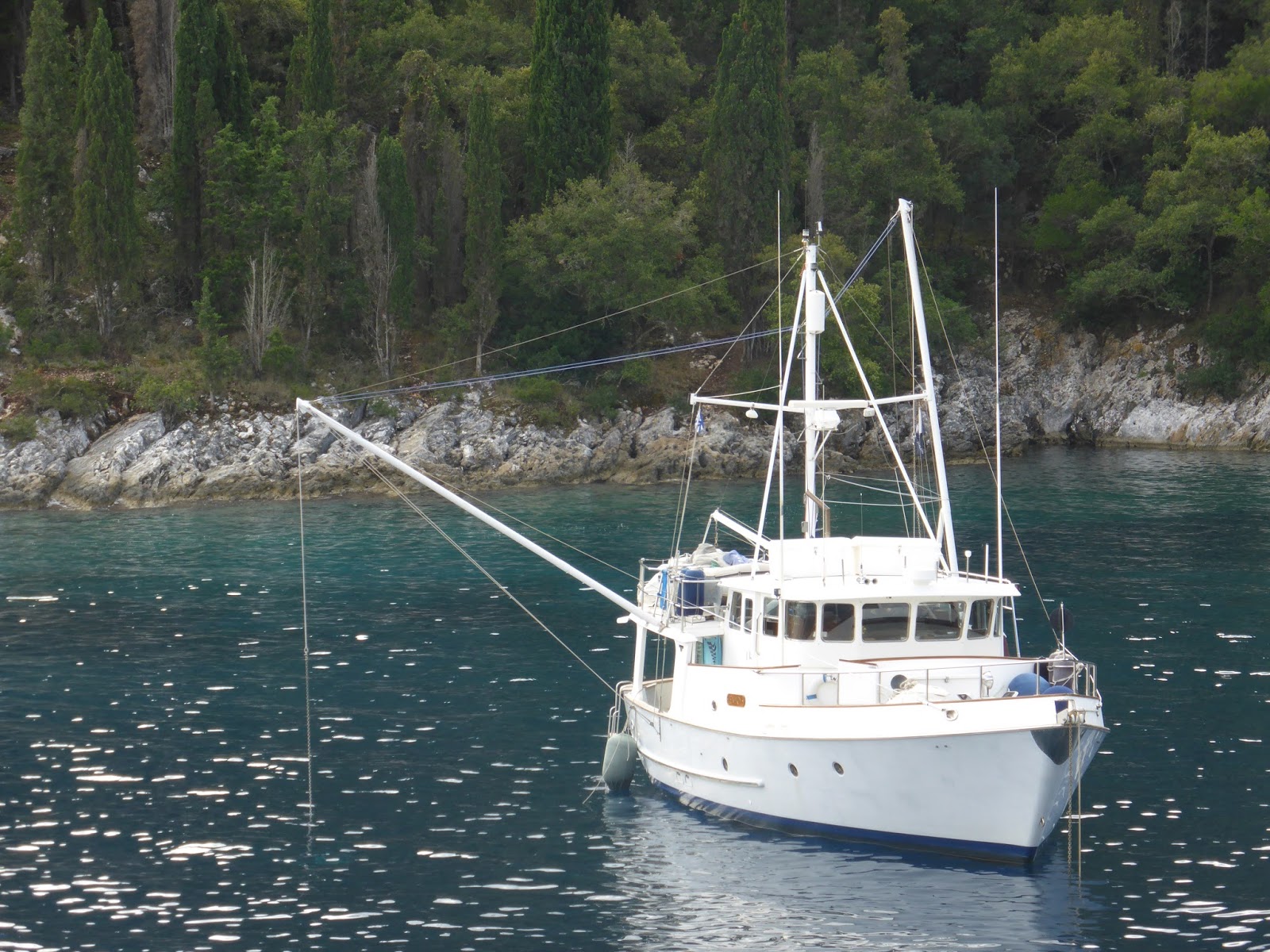
Envoy at anchor with starboard stabiliser pole deployed with flopper-stopper to reduce roll from slight swell. The port pole can be seen in the vertical position
A web search shows many variations of stabilisers, but the mainstream systems fall into three basic types; passive, active and rotary.
We have no experience with rotary stabilisers, which are a more recent development utilising a flywheel contained in a vacuum chamber to provide a gyro effect, but they’re reportedly highly effective in roll reduction both under way and at anchor with the advantages of having no protruding parts to cause speed-reducing drag or become fouled. They are able to be retrofitted either amidships or offset to one side, but have a significant investment cost. Presumably, if used for long periods such as overnight at anchor a generator would be needed to provide sufficient power – something we would not want to do.
Envoy has both passive and active stabilisers providing effective stabilisation under way and at anchor.
Envoy with both poles deployed with flopper stoppers to reduce roll at an exposed anchorage with ferry wakes

Next posting will discuss passive stabilisers in detail.
Pocosin Lakes National Wildlife Refuge
The Pocosin Lakes National Wildlife Refuge includes 111,106 acres of wetlands south of Albermarle Sound. The refuge is home to over 300 different wildlife species including otters, muskrat, turtles, and the endangered red wolf, plus tens of thousands of migratory birds in the winter. Sponge-like peat soil in the wetlands retain water and hold it…
Pasquotank River
TCOM manufacturing has a major airship manufacturing facility in North Carolina up the Pasquotank River, with a 1,000ft-long hangar that can accomodate airships up to 150ft tall. We were lucky to arrive in the area during a test flight of a smaller model, and got a glimpse of a much larger ship when the massive…
ICW Mile 12 to 50: Great Bridge, VA to Coinjock, NC
In our second day along the ICW we travelled 38 miles from Great Bridge, Virgina to Coinjock in North Carolina. We passed five bridges, but only needed to have two opened for us. Depths generally were at least 10ft, with a few brief drops to about 8.5ft. A video of our transit between Great Bridge…
ICW Mile 0 to Mile 12: Portsmouth to Great Bridge
Except for a brief transit around the Palm Beach area, we’ve not traveled the Intracoastal Waterway (ICW) in Dirona. In our first leg along the ICW, we headed 12 miles south from Portsmouth, Virginia to the town of Great Bridge. Depths were at least 10 feet all the way, except for about 8.5ft at Great…
Norfolk, Virginia
Norfolk is home to the world’s largest naval base with ships ranging from aircraft carriers to destroyers to nuclear submarines. Navy ships are moored on both sides of the the channel into Norfolk, with security patrol craft in the air. The city also has a large and busy shipping port. As a fitting envoy, we…
Winter Cruising in Chesapeake Bay
We found winter boating in Chesapeake Bay to be surprisingly similar to the Pacific Northwest, with the same advantages and disadvantages. The main disadvantage of course is the weather. Storms are more frequent and fierce, so we need to watch the forecasts more carefully, the days are shorter, and the temperature is colder. The temperature…
On Board the CS Responder
In this 21st edition of the Dirona Technology Series, we get an opportunity to explore the CS Responder, a trans-ocean cable-laying ship operated by TE SubCom. TE Connectivity is $13.3B global technology company that specializes in communication cable, connectors, sensors, and electronic components. Their subsidiary TE SubCom manufactures, lays and maintains undersea cable. TE SubCom has a base in Baltimore…
