
Sky Garden is a public space at the top of the “Walkie Talkie” with a fabulous 360-degree views of London and the Thames. Several restaurants and a bar also are within—we had a memorable dinner at the Darwin Brasserie, the room jutting out from the left above the gardens in the picture above. Below are…
Tag Archives | Nordhavn
HMS Belfast
The HMS Belfast was launched in 1938 and saw action in World War II, including firing some of the first shots on D-Day. The ship also was part of the United Nations naval forces during the Korean War. In 1971, the retired ship was brought to London and moored along the Thames by Tower Bridge…
New Tender for Dirona
Tender selection on a small boat can be complex. Big tenders don’t fit and it’s more challenging to make multiple tenders work without giving up prohibitive amounts of deck space. Finding the “just right” compromise can be challenging. Back in 2009, we bought an AB 12VST and have used it for the intervening 9 years….
Stratford City
Stratford City, on the outskirts of London, has seen some some major construction in the current millenium. The city played host to the 2012 summer Olympics one year after the opening of Westfield Stratford city, the third largest shopping mall in the UK and one of the largest in Europe. We’d built up a big…
Westminster
The most well-known portion of the Changing of the Guard ceremony takes place on the Buckingham Palace grounds. But this is just the middle part of the ceremony, and the hardest to watch due to the crowds that form well in advance. Better views can be had of the guards marching to and from St….
ANCHORING IN STRONG WINDS WITH SAFETY AND CONFIDENCE
Envoy is berthed in Greece’s Lefkas Marina while Diane and are home in Auckland. We’re not planning any major Med cruising this year, but now hope to visit Lefkas around mid August to check on Envoy and do a few weeks cruising.
Pacific Passagemaker magazine recently published an article we’d written on anchoring in strong winds.
Here’s the first of two parts of an edited version of that article.
Having done extensive coastal cruising for over 35 years in New Zealand, Australia, and the Mediterranean, we’ve anchored for literally thousands of nights, most of which have been calm, peaceful and uneventful. But we’ve often encountered winds over 30 knots (Beaufort Force 7), and occasionally encountered gusts up to 70 knots. Remember that the Beaufort Scale registers the mean wind speed, for example Force 7 represents a mean wind speed of 28-33 knots, while gusts of up to about 45 knots (or greater) can be expected. Adverse weather conditions and fronts can also bring along thunder storms, which are often accompanied by extremely gusty conditions as well as rapid changes in wind direction. It is probably these changes in direction that represent the biggest challenge to secure anchoring.
There are almost as many theories on the subject of anchoring as there are skippers on the water and these suggestions are mostly based on experience with our Nordhavn 46 trawler, Envoy.
With time to prepare, a reliable and tested plan plus some anchoring experience with your own vessel, you can select a suitable location and anchor in strong winds with safety and confidence.
The process starts with awareness and normally there’s a period of at least several hours to prepare for arrival of the forecast adverse conditions. Always write down the forecast and subsequent updates so you can accurately monitor how the weather pattern is developing.

In an unexpected storm a serene anchorage can quickly become problematic
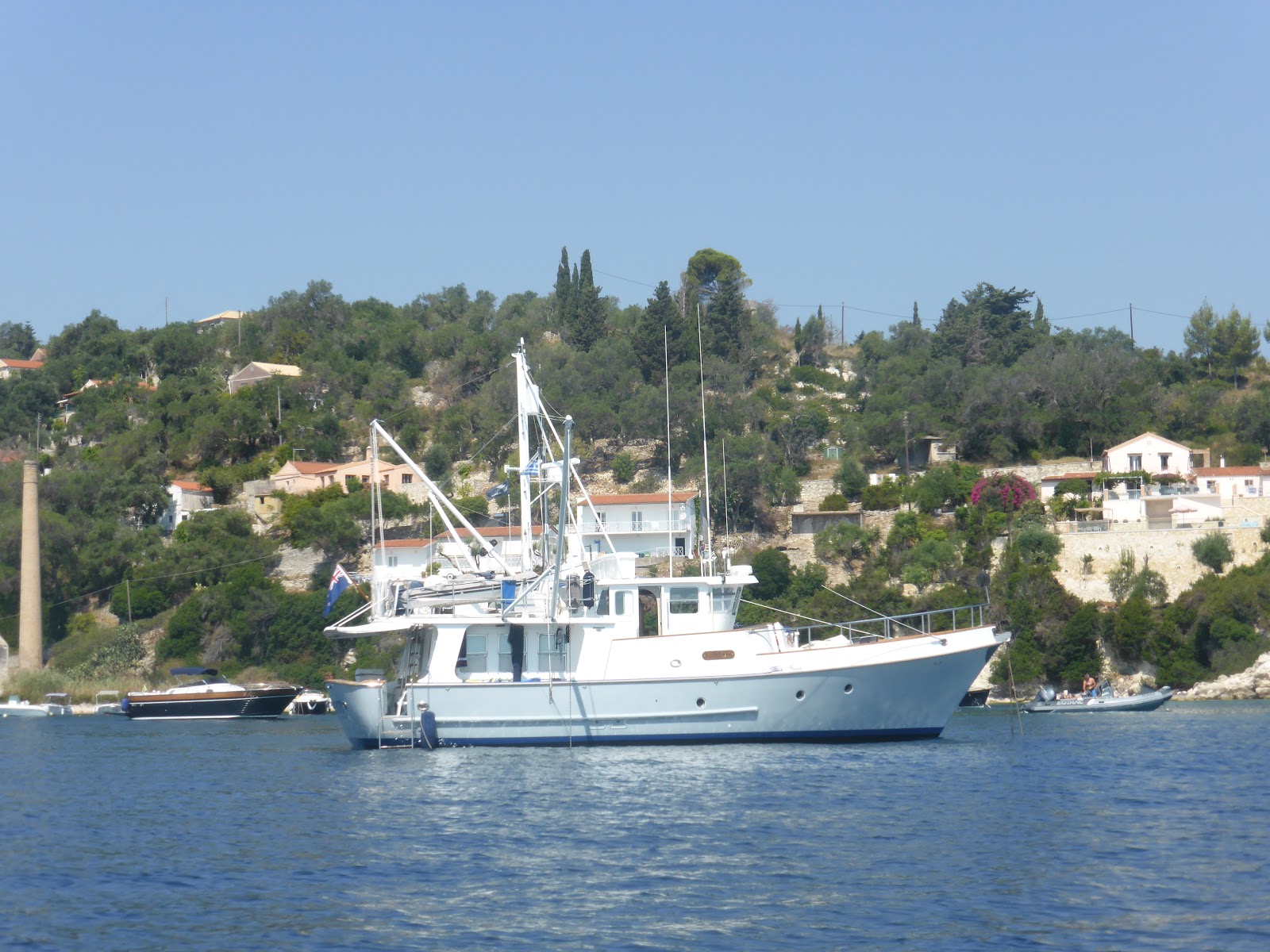
This article does not cover the options of continuing a passage (as may be forced upon a vessel far from the coast), or of heading to the closest secure marina or harbour, but is about safe anchoring in a coastal situation.
A safe and comfortable anchorage is dependent on finding an inlet or bay largely protected from the ocean swell and seas. If the wind is forecast to blow directly off the coastal shoreline and there is no significant swell or sea, an option is to simply anchor close to shore, but a major disadvantage of this strategy is the possibility of a wind shift occurring and placing your vessel on a lee shore with waves whipped up by the wind shift. We prefer to pick the most secure anchorage we can find, free of swell or seas, suitable for a possible wind shift and clear of reefs, rocks, moorings or other obstructions. It needs a low tide depth ideally about three to fifteen metres and ideally should also have an easily navigable exit and a nearby alternative bolthole to go to if necessary. The ideal time to find your anchorage is during low tide when minimum depths are known and possible hazards can be more easily identified.

An ideal sheltered bay to weather a blow

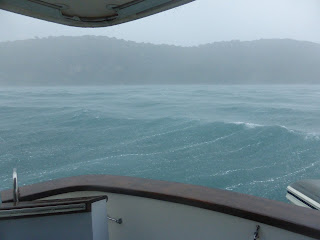
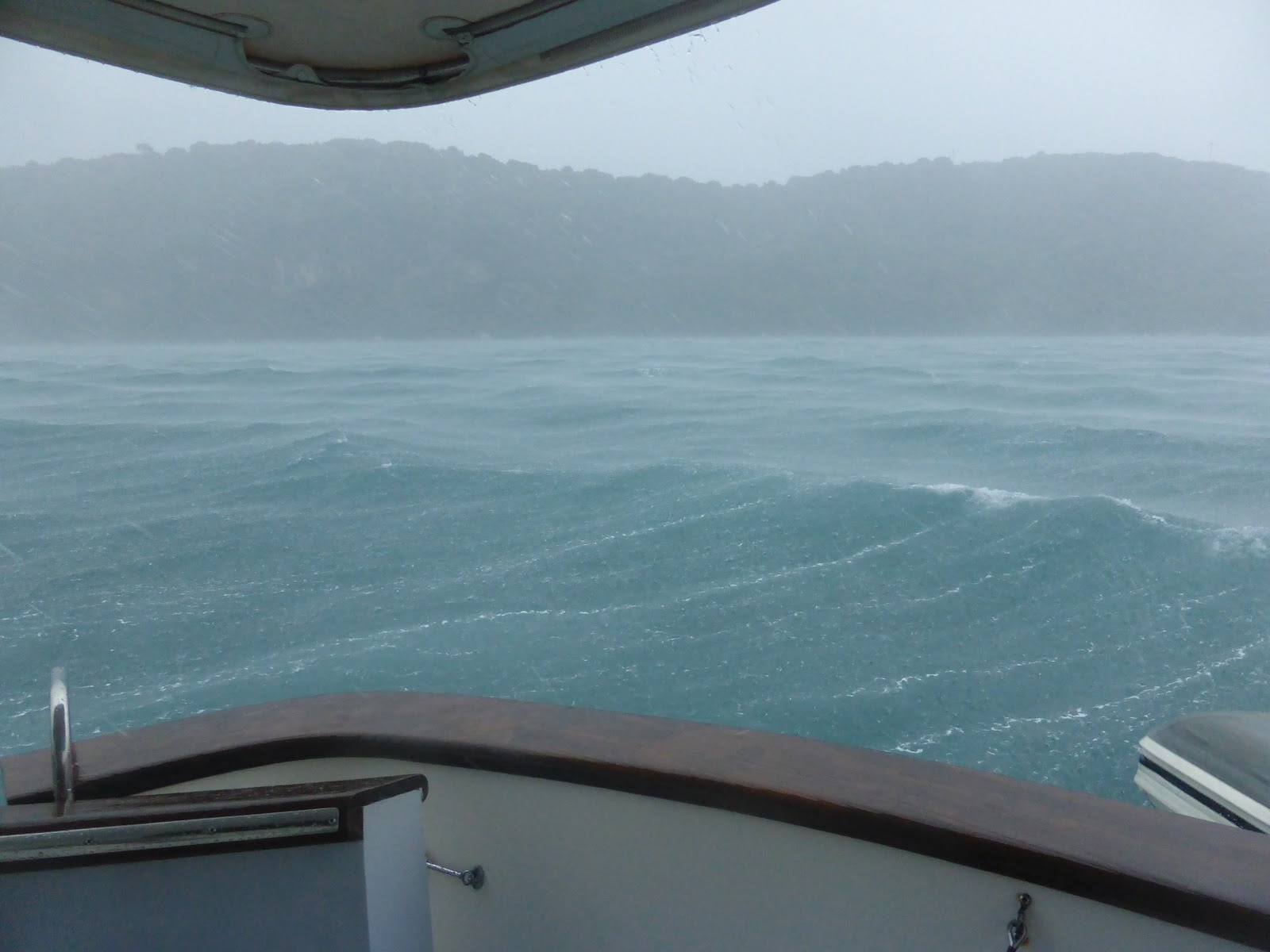
This is the same bay during a storm with gusts to 50 knots
Another issue to consider is the placement of other vessels in the anchorage. A safe distance from other vessels must be maintained when anchoring in strong winds because other vessels dragging and fouling your anchor or hitting your vessel is usually the greatest danger to be faced.

Heavy towering clouds like this indicate storms

Before dropping your anchor it‘s a good idea to explore the general area and get a good understanding of its approaches, layout, depths etc. Use this opportunity to record GPS positions, compass courses and a chart plotter track line to assist exiting the bay in case of adverse visibility.
Although some skippers prefer to use two anchors we prefer to use one. A single anchor is easier to deploy and set, avoids issues of one anchor chain becoming twisted around the other during wind shifts when your vessel may turn around several times and is far easier to retrieve in an emergency.
However a situation where I would consider using two anchors is mooring stern-to-shore when the additional anchor helps resist your bow being blown sideways by beam winds (the main cause of problems when mooring stern-to).
Part two will be posted in about a week.
Paris
In mid-February we took the high-speed train from London through the Channel Tunnel for a 2-night trip to Paris. It seems kind of amazing that we could get up in the morning, do some work on the boat in London and later have lunch by the Eiffel Tower, all without leaving the ground. This was…
April 2018 Update on Us
This weekend, Nordhavn is throwing an event at their corporate office in Dana Point to celebrate their 40 year anniversary. Unfortunately, we won’t be able to attend. Its extra-sad because Saturday, April 28 is the 11 year anniversary of when we left on our circumnavigation. It would have been so fitting to celebrate our anniversary … Continue reading April 2018 Update on Us
Greenwich
The famed Royal Observatory in Greenwich is the location of the Prime Meridian and the origin of “Greenwich Mean Time”. The observatory has an excellent museum detailing the search for an accurate means of calculating longitude at sea, plus sweeping views from its hilltop perch. Other Greenwich attractions include the old Royal Naval College grounds,…
Tower of London
We’d always thought the Tower of London was just that, a tower. But it’s actually a castle, with 22 towers in total, that was the royal residence for England’s medieval monarchs and also is where the Crown Jewels are currently kept. The complex is right next to St. Katharine Docks where we are moored, so…
