
The National Weather Service recorded peak wind gusts at 88 mph 5-10 miles off Hilton Head Island on October 8th, 2016 during Hurricane Mathew. We saw the resulting damage from those winds first-hand after an 86nm run from Charleston to Hilton Head Island. Palmetto Bay Marina, pictured, was completely destroyed. Many of the docks along…
Tag Archives | Nordhavn
AHOY THERE CAPTAIN
Envoy is in Lefkas Marina for the northern hemisphere winter and we’re home for the New Zealand summer, returning April – not too far away now!


This is an article we wrote published by Pacific MotorBoat magazine – not to be taken too seriously!
Boating is one of the few freedoms left, a hugely relaxing pastime and as such we shouldn’t allow many things out there on the water to annoy us. I don’t easily get annoyed and even smile and wave when high-powered speedboats towing water skiers pass within a few metres of Envoy at anchor – that’s how it is in the Med.
But I’m not perfect by any means so I do find the odd thing irritating.
High on the list is boats at anchor displaying incorrect lights – I mean Rules are Rules. I must admit it tends to be mostly sailing yacht skippers who display white or coloured flashing strobe lights instead of the regulation all-round continuous white light. They justify this by saying the white light is not clearly visible to other vessels, especially against a background of lights ashore and /or high above eye level aloft the mast, whereas a flashing strobe is more visible. This is probably true, but if they’re going to display strobe lights they should also display the legally-required light. It would be interesting to see what liability was attached to a skipper whose boat was accidentally hit while displaying incorrect lights and whether he/she would be covered by insurance. Incidentally it is illegal to display any anchor light, other than an all-round white light, that could be mistaken for another navigation light such as a nearby channel marker.
Another on my list is inconsiderate skippers laying out stern anchors and/or buoying their anchors in busy anchorages.
Stern anchors are useful in exposed anchorages to keep your boat aligned with the swell to reduce rolling, but they cause problems in normal anchorages when boats swing to changing wind or tide, except of course the one with the stern anchor.
Anchor buoys can be useful in very rocky anchorages when the buoy’s line can be used to lift a fouled anchor (sometimes this works but not always), but some skippers also use them to mark the position of their anchor in an effort to discourage other skippers from anchoring anywhere nearby. There is a common misconception that a newly arriving boat should not anchor in a position where it ends up over another boat’s anchor. There’s actually nothing wrong with this practice – it could all change with the slightest wind shift, but what you shouldn’t do is lay your anchor chain over that of another boat, making it difficult for them to retrieve their anchor. These anchor buoys and their lines can be a menace when boats move with wind and tide and I have no hesitation in removing any buoy that threatens to snag our running gear and politely returning it to its owner.
Stern anchors and anchor buoys should not be used in busy anchorages like this one at Knidos, Turkey

Then there is the incorrect use of the title “Captain”. When tradesmen come aboard Envoy they usually greet me and then carry on referring to me as “Captain” which always strikes me as rather ridiculous aboard a 14 metre vessel with mostly only two people on board.
In most navies including the US, British, Australian and New Zealand the rank of Captain is very senior, in fact equating to that of Colonel in the army, whereas an army Captain equates to a navy Lieutenant (three ranks down from a navy Captain).
You don’t have to hold the rank of Captain to command a navy ship and often they are commanded by lesser ranks such as Commanders, Lieutenant Commanders or even Lieutenants on smaller vessels. By tradition in these cases he or she in command is referred to as “Captain” aboard the vessel regardless of actual rank.
Whereas “Captain” is a rank in the Armed Services, in the Merchant Navy the term “Master” describes the person in command and “Captain” is a courtesy title that correctly used applies to those marine professionals holding an internationally recognised Master’s certificate of competency and who command or have commanded a seagoing merchant ship. Those who command pleasure vessels should be referred to as the “Skipper”.
A naval Captain is a higher rank than that of Captain in the army or air force
Sometimes in boating magazines you find letters to the editor or advertisements for services signed by somebody prefixing their name with the title “Captain”. This is fine if the person concerned is or has been a Captain in the Navy or a Master in the Merchant Navy, but should not be used by for example a pleasure boat skipper, a charter boat skipper or someone who has completed a course, even those offered by leading providers such as CoastGuard and the Royal Yachting Association. Some other marine education providers call their offering a “Captain’s Course” but a graduate cannot correctly be called a Captain; this is about as ridiculous as the local Darts Team Captain using the title outside of the pub.
Charleston, SC
We enjoyed our time in Charleston, SC so much that we twice extended our stay. We loved the view to the Ashley River from our Charleston City Dock outside berth and had a great time exploring the city by tender, bicycle and on foot. The city lived up to its reputation for excellent food and…
Charleston By Water
The Intracoastal Waterway continues south past Charleston through Wappoo Creek. We returned briefly to the ICW on a tour of the area by tender that included a run up the Ashley River beyond our marina, and a pass by the Port of Charleston where we watched the tugs Moira McAllister and Patrick McAllister assist the…
Historic Charleston
Charleston, SC was founded in 1670 and has done an excellent job of preserving its heritage and historic sites and buildings. On a surprisingly cold and frosty morning, we did a bicycle tour along the city’s historic waterfront. Trip highlights from January 8th, 2017 in Charleston, SC follow. Click any image for a larger view,…
STABILISERS PART 3
Envoy is in Lefkas Marina for the northern hemisphere winter while we’re home for the New Zealand summer returning to Greece in April.

Our last Post discussed passive stabilisers.
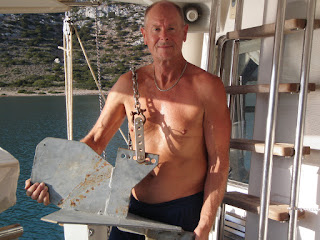
This shot shows Laurie holding a bird, connected to a winch for lowering into the water. You can see the holes on top of the bird for adjusting the stabilising effect

Active stabilisers consist of a fin mounted below the waterline extending out each side of the hull using mostly hydraulics but in some systems electric motors to move them like aircraft ailerons to counteract rolling motion.
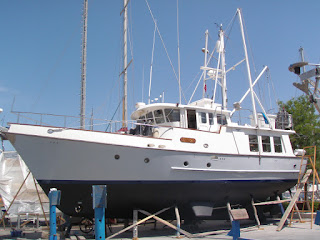
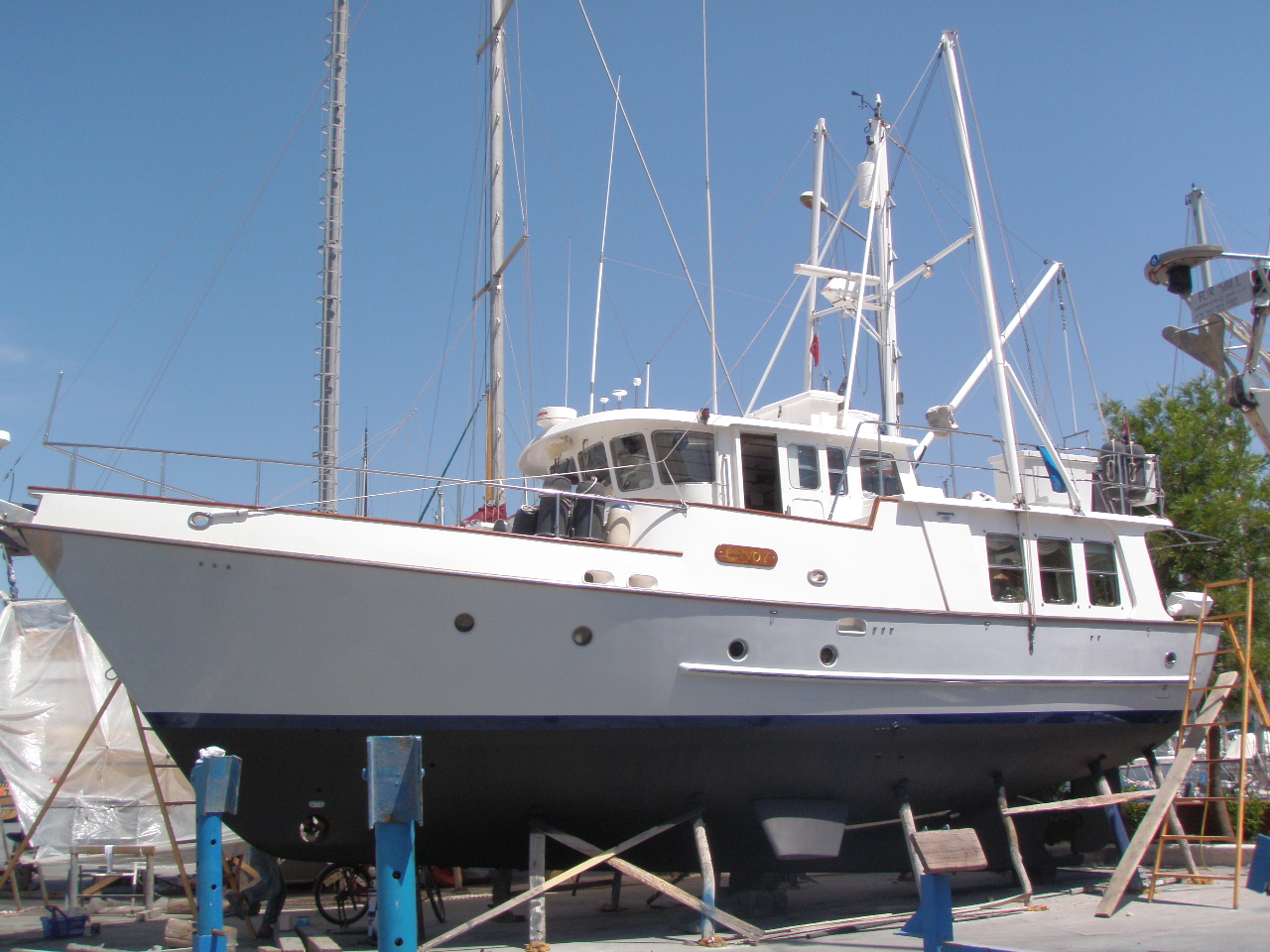
Envoy out of the water with stabilising fin visible
Envoy has hydraulically driven fins with the hydraulic pump powered by vee-belts from the main engine crankshaft and a 12 volt DC pump providing a constant flow of sea water to cool the hydraulic fluid. An electronic motion detector signals the hydraulics to move the fins to suit differing sea conditions with adjustment available via two thumb wheels in a pilot house control box.
The main advantages of this active system are that it’s more effective than passive stabilisers providing 80-90 per cent roll reduction (compared to about 70 per cent), it deploys quickly with no physical effort required, it’s easily adjustable using the electronic control system and causes negligible speed reduction.
However on the negative side the initial and ongoing cost of active stabilisers is expensive and during ten years we’ve spent several thousands of dollars replacing seals, sea water cooling pumps, vee-belts, filters, a hydraulic pump with its load adaptor, a servo valve and electronic components. Another issue is that they are highly specialised equipment and generally require trained and authorised engineers to provide service.
We’re just about to make another significant investment to remove the fins and replace the through-hull seals, something which is required about every five years. This is a job the majority of owners including ourselves wouldn’t attempt do themselves and special equipment is needed to remove the fins.
Set of through-hull seals

We’re also going to make a modification so that when the system is not in use the fins hydraulically lock in the centre position. Currently the fins move at rest (which is noisy and potentially damaging) in all but the most sheltered of anchorages, so when necessary we secure them in the centred position through a fiddly process of using manual locking bolts. The actions of locking them and then unlocking them takes about 15 minutes.
An active stabilisation system also requires a significant investment in spare parts and we carry a spare sea water pump, hydraulic motor, load adaptor, set of vee belts and oil filter. The fins can potentially be fouled by flotsam or lines although this has only happened to us once in a marina. Although some active stabilisation systems can be used at anchor with a generator running to provide power ours cannot, in any case we wouldn’t want to have an engine running overnight.
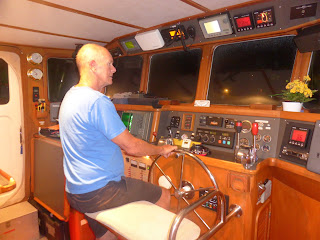
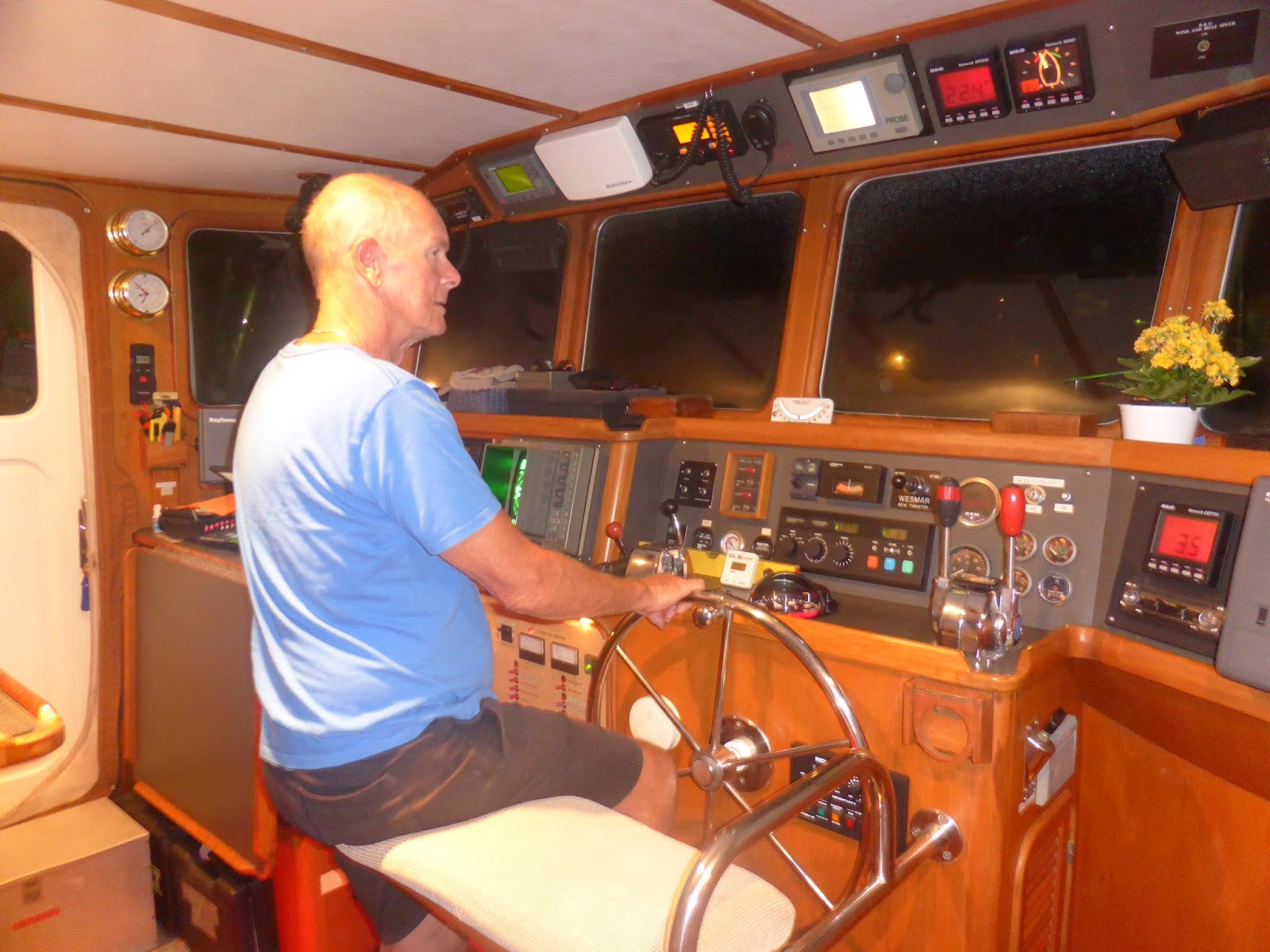
Partially hidden by the starboard side of the wheel is the stabilisers’ control system
Using both systems we’ve occasionally found it necessary to alter course by about 30 degrees to “tack” and take the waves more on Envoy’s bow when encountering closely-spaced, steep waves over about two and a half metres breaking directly on our beam.
A full displacement hull like Envoy definitely requires some form of stabilisation and the vast majority if not all Nordhavns have a system fitted. We’re pleased to have both active and passive systems aboard Envoy but if restricted to one would undoubtedly select the passive system for its reliability, economy and ability to use at anchor.
Next Post will take a light-hearted look a the use of the title “Captain”.
USS Yorktown
The USS Yorktown is the second of twenty-four Essex-class aircraft carriers launched during World War II. The Yorktown served in World War II and Vietnam and was the recovery ship for Apollo 8, the first manned spacecraft to orbit the moon. Today the Yorktown is a National Historic Landmark and open for tours as part…
Arthur Ravenel Jr. Bridge
The three-mile-long Arthur Ravenel Jr. Bridge crosses the Cooper River between Charleston and Mt. Pleasant. The bridge has a pedestrian and cycle lane with fabulous views to the city, the river and out to sea. We got the bikes down and spent a great day riding through Charleston and across the bridge, and explored a…
Charleston Arrival
As we neared Charleston City Marina from sea, we’d started to wonder if we were heading in the right direction. The marina was supposed to be walking distance from downtown, but where were the tall buildlings? The city, it turns out, looks different from other downtowns due to zoning restrictions that limit building heights. We’d…
STABILISERS PART 2
Envoy is in Lefkas Marina for the northern hemisphere winter and we are home for the New Zealand summer, heading back in April.
Upcoming Posts – Stabilisers Part 3, Cruising in Auckland’s Hauraki Gulf aboard 48ft motor yacht Moritz, Using the title Captain, Envoy’s 2017 cruising plans.


Upcoming Posts – Stabilisers Part 3, Cruising in Auckland’s Hauraki Gulf aboard 48ft motor yacht Moritz, Using the title Captain, Envoy’s 2017 cruising plans.
Our last Posting introduced the subject of stabilisers, now we’ll talk more about passive stabilisers.
A passive stabilisation system consist of two poles each about seven metres long mounted near amidships on the vessel’s beam, which are stored vertically and when in use lowered to be deployed out from the vessel’s side using a downhaul, topping lift and fore and aft guy-wires to keep them in position. They are mostly made from aluminium or steel though less commonly using laminated timber.
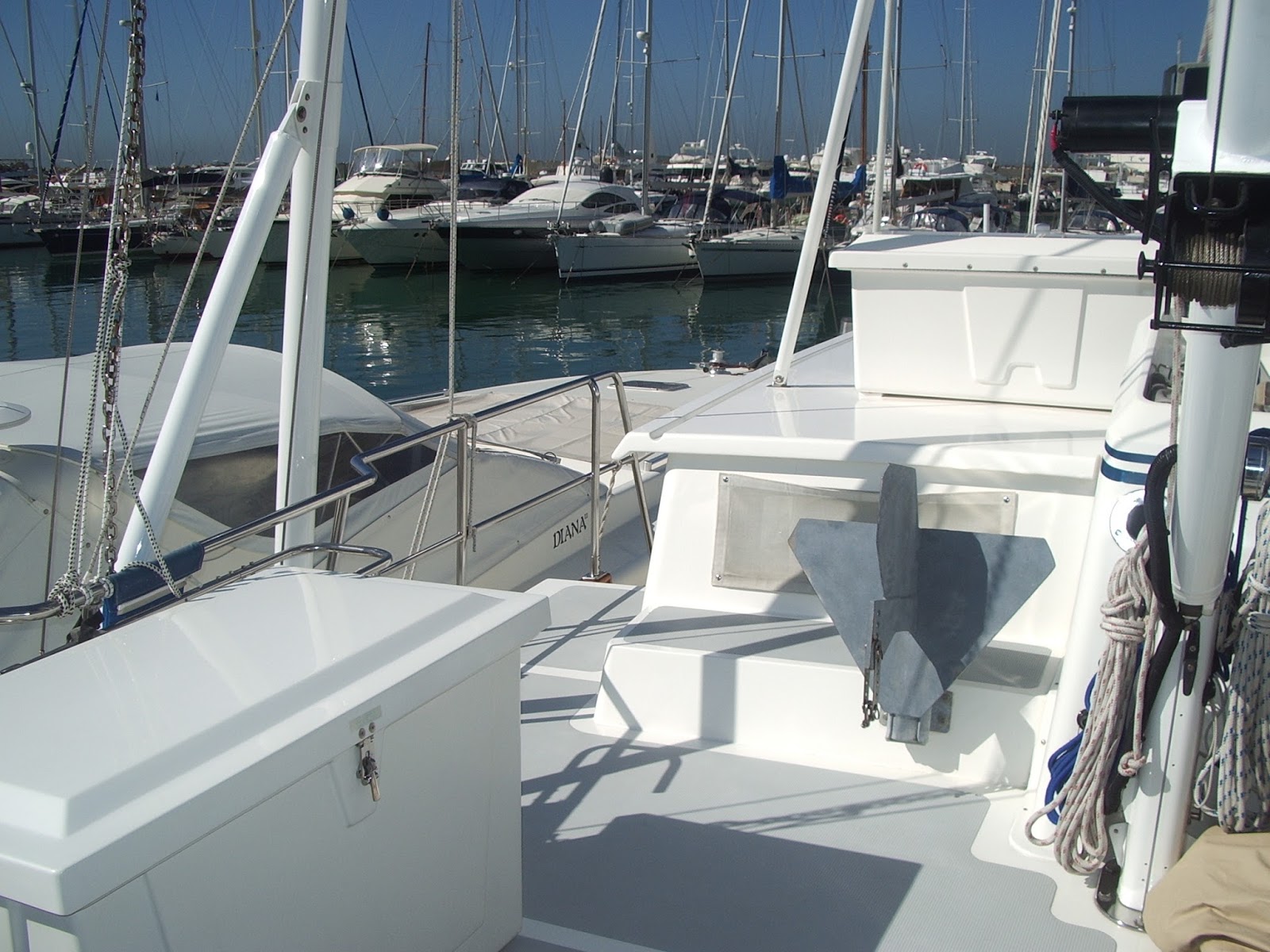
A large metal plate weighing about 25kg and shaped like a delta-winged aircraft, known as a “paravane”, “bird” (the term we use) or “fish” suspends from the end of the pole using a combination of chain and nylon line, the latter providing some spring to reduce shock loads. The front of the bird is weighted to make it “fly” through the water in a nose-down position approximately five metres below the surface and the top of the bird has several chain attachment points to adjust the bird’s angle through the water. The further aft you attach the chain the more the bird tends to dive deeper and the more aggressive becomes the bird’s stabilising action at the expense of increased drag.
This image shows the port pole and bird deployed with the downhaul, topping lift and fore and aft guy-wires

Due to the birds’ weight and large awkward shape some form of winch is used to deploy and retrieve them (we use a light block and tackle) and with familiarity this process takes about 15 minutes.
When not in use we store the birds well out of the way on the boat deck, but if intending to use them we move them down to the cockpit so they’re ready for immediate use.
Centre-right is a bird stored on Envoy’s upper deck
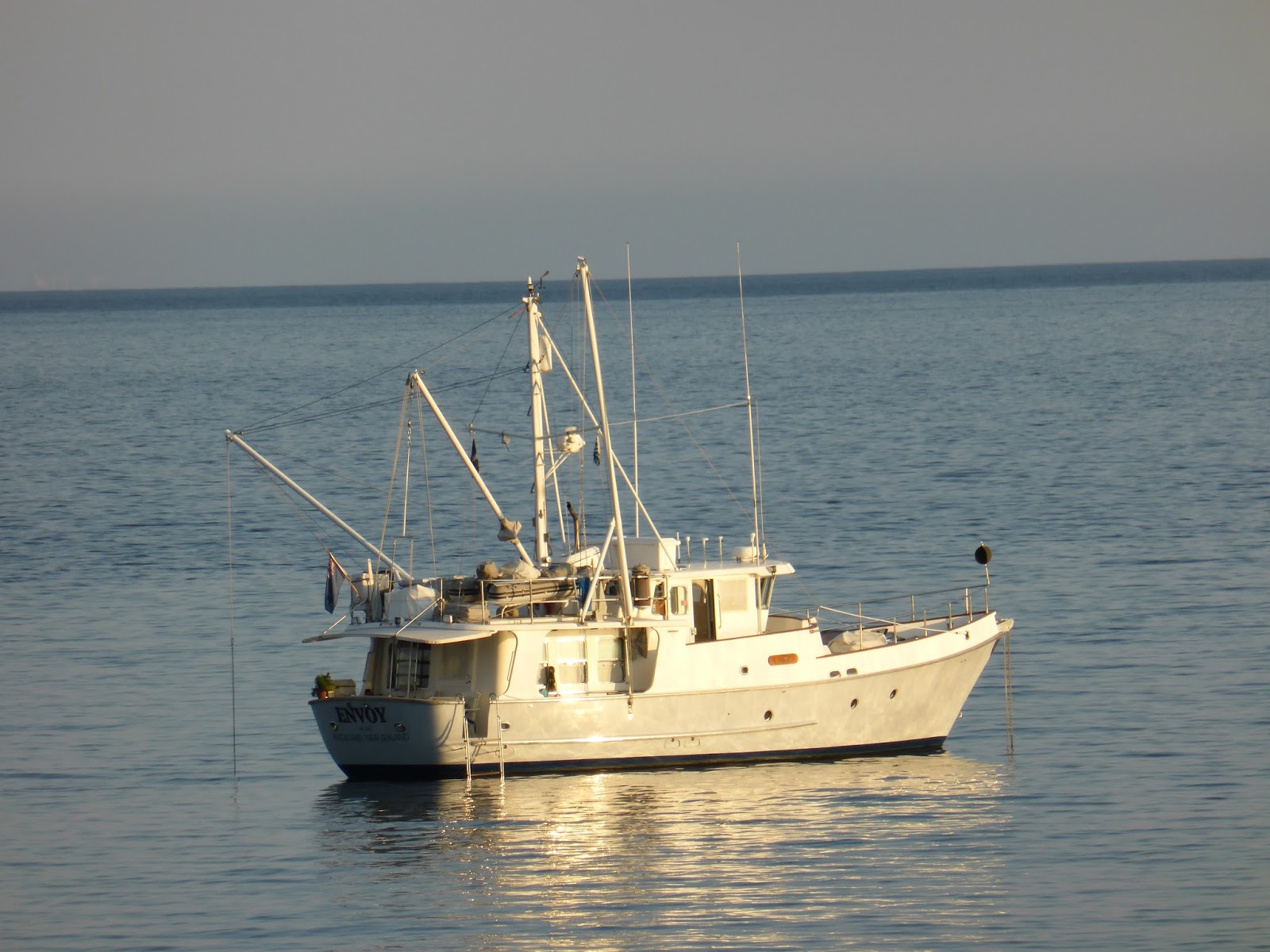
The poles provide a distinctive fishing-boat-like appearance that won’t suit everybody but certainly creates interest among other cruisers.

Stabiliser poles provide a distinctive appearance – love it or hate it! Port deployed, starboard raised
On some boats the poles are stored in a near horizontal position along the superstructure and this probably makes for a tidier appearance.
This system’s big advantages are effectiveness – reducing roll by about 70 per cent, low initial and ongoing cost and reliability since there are no mechanical or moving parts – in the ten years we’ve owned Envoy no part of the system has needed replacement or maintenance. Just now we’re having the birds epoxy-painted over the galavanising which is rusting slightly.
It’s disadvantages are that it slows your boat down by about 10 per cent, there is some risk of the birds fouling flotsam or lines in the water (although ours never have) and the system cannot be rigged and de-rigged in shallow water or confined spaces.
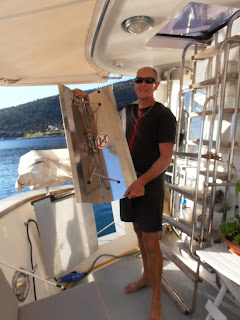
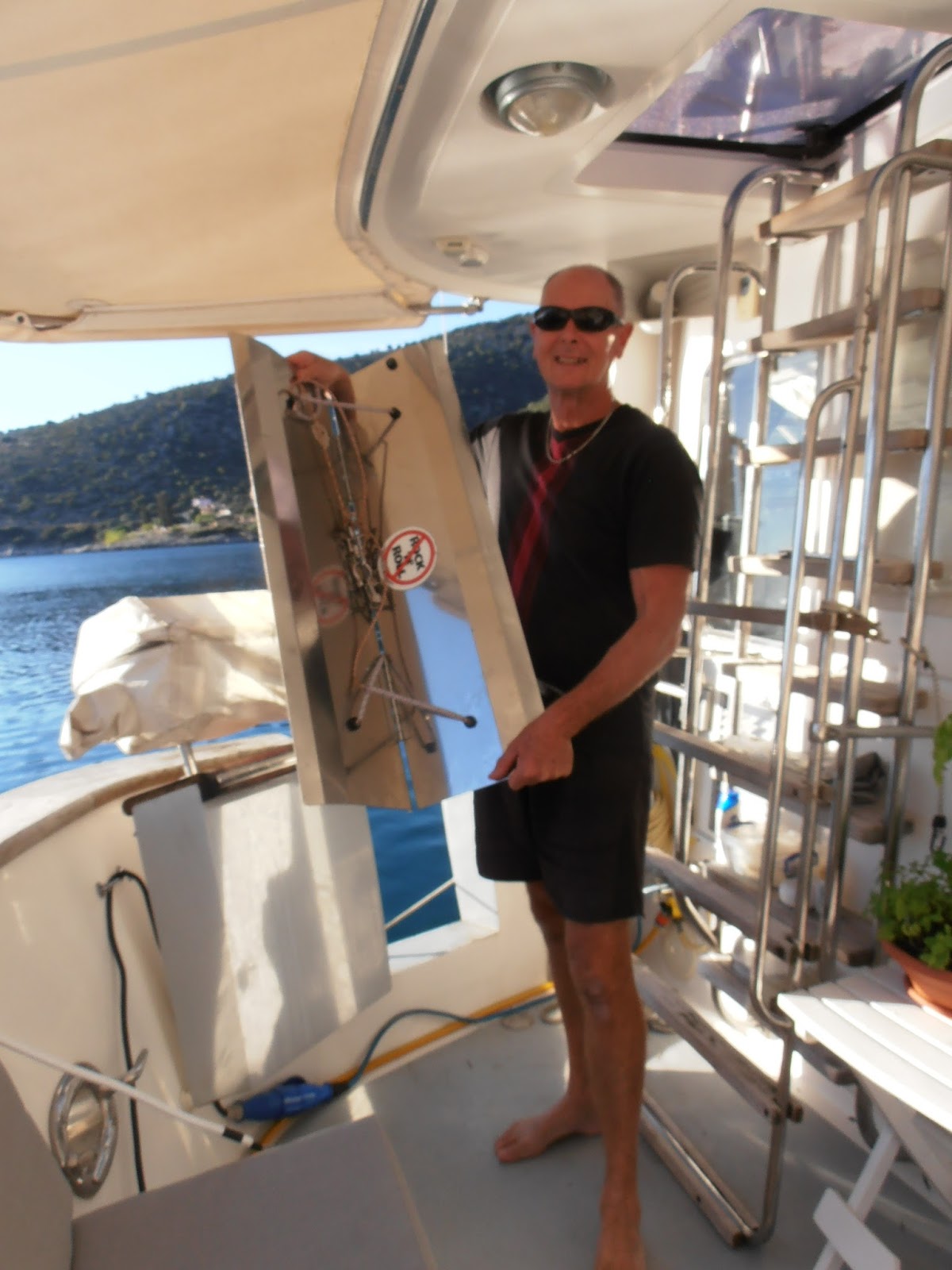
Another huge benefit of this system is that by suspending a different type of metal plate the system provides highly effective stabilisation at anchor. Envoy’s plates, known as “flopper-stoppers”, each consist of two flat plates of stainless steel plate joined together along one side with a hinge. When the boat rolls downward the hinge allows the plates to close together and drop rapidly and when the boat rolls upwards the hinge allows the plates to open and resist upward pressure. This system is extremely effective enabling us to anchor in places where roll or wakes would normally make it too uncomfortable. Flopper stoppers are comparatively light and easily deployed and retrieved by hand.
They can be used in depths over four metres.
Laurie holds a flopper-stopper
Here the port flopper-stopper has been deployed alongside a jetty to reduce the effects of a side-swell during a gale in Cephalonia

Next posting will look at ACTIVE stabilisers and our view on what is the “best” option.
