Tag Archives | Nordhavn

Milazzo to Cefalu, Sicily

I am kind of waiting for the shoe to drop. We have had nothing but flat calm water and perfect temperatures since leaving Marina di Ragusa. We have not even used the air conditioning once yet. On top of that, the boat is running just perfectly. I hope I am not jinxing myself.

 This was our course to Cefalu, still on the island of Sicily

We had yet another perfect trip of 64 miles to Cefalu. The water out here is so clear and calm.  Schools of Dolphin who seem to spot our boat from a great distance do an about face from wherever they are going and do a beeline for our bow. For the next ten minutes or so, between 2 and 10 of them will swim just under the surface a few feet on either side of our bow. Every so often, one or more will turn sideways and look up at you with that smirk that Dolphins seem to have. Watching them do that and then leaping out of the water convinces you that they are intelligent and very aware, almost trying to show off. 


 Dolphins – for some reason they seem to be attracted to our bulbous bow on Seabird

We were getting close to the our final waypoint on the trip and Carol quipped “uh, where is this marina?”  We were very close and it was not what we were expecting, at all. The course pointed us to a cement pier with a few raggedy, bobbing, floating docks off of it. The whole place was exposed directly to the open water and if a wind were to come out of the Northeast, Seabird would turn those puny would be docks into floating mush. Carol actually thought we should leave, but it was later in the day and we really did commit to staying there. I thought that as long as the weather experts stayed expert, we would not have a problem. 


 The dock you see in the photo is the hefty one.  Where Seabird is, it drops down to 
a flimsy floating dock.

The docking situation was a classic Med Moor, where you back into the allotted space, tie two lines to the dock and then pick up the “slime line”.  For those of you who are unfamiliar with the term, a slime line is really a mooring line that you attach to the bow of the boat to keep the stern away from the dock. That line is tethered to a cement block some distance from the bow of the boat, and you need to pull it piano wire tight. The “slime” part comes from the way the line is attached to the dock from the cement mooring. It usually has been lying in the mud and God knows what else before you pick it up in the slip. It is handed to you by the dock hand and you then work your way up to the bow with it to secure it to the cleat. By the time you are done, you are usually spotted with mud and water. This is why we prefer the side tie with conventional dock lines.

So….we finish tying up to the saddest excuse for a dock we have ever been to and go to the marina office to check in. Marinas around here are usually categorized by “Charge Bands”.  We usually see Charge Band 4, 5 and 6, the 6 being the most expensive and usually reserved for exclusive marinas or special destinations. This place was neither.  It was advertised in the guide we used as a Charge Band 5, but, that was a very optimistic rating. I would have given it a 2, but the town was so charming, I raised it to a 4.  At a 5, the nightly rate should have been $125, but I was shocked to find that he wanted $200!  Since we were already tied up, I begrudgingly accepted it but said we would leave in the morning. 

Shortly after that, our friends Bill and Janet called. They were about an hour behind us. I asked him what they were charging for his 42 foot sailboat and he said “$50”.  What??!! I stomped up to the office and asked why I was being charged 4x as much as a boat that was only 25% smaller than Seabird. He responded “seabird is BIG boat”. I said “yeah, but not 4x as big”. He then went to the owner and voiced my complaints and the owner agreed that if I stayed 3 nights, he would lower two of the nights to $100 per night. Ok….I was still getting fleeced, but it was now a low level fleecing and I left the office with some of my pride intact, sort of. 

The town of Cefalu, as I mentioned, is charming. It was about a 10 minute walk from the marina and I guess you could call it a “typical” Sicilian seaside village, if there is such a thing. It was built on a hill with narrow streets barely wide enough for one car to skim by you, brushing your clothing as casually as could be. Walkers generally have the right of way, but even those tiny little cars they drive weigh 2000 lbs, so we generally yield! In addition, per usual, it seems that every other business on the street is a restaurant or a cafe.

Trying to pick a restaurant in a place like this is difficult. The menus all look so good and the aromas coming out of each place make you want to choose them all. It is especially difficult for me because Italian food is kind of my thing. So, we usually end up choosing, as we did this time, a place with exceptional atmosphere, overlooking the beach and a good rating on Trip Advisor. 


Of course, the food was spectacular and, as in the case of everywhere in Sicily, a relative bargain!  I suspect one of the reasons for the low pricing might be their food transportation costs. The last photo in the blog is an example of their innovative thinking…..

We spent a good part of each day walking through the narrow streets of Cefalu. You always find something new that you have not seen before. All of these towns in Sicily seem to have a large town square, a grand cathedral being the centerpiece surrounded by cafe’s and outdoor restaurants. The cathedral, in this case, was just this week named a Unesco Heritage Site. Pretty spectacular. 


 The Cathedral in Cefalu

Our last day at the marina proved the weather gurus wrong. There was not a huge amount of wind, but a good size swell started to develop from the Northeast. With no protection from any sort of breakwater, our boat started to pitch a bit in the berth, stretching the slime line and our swim platform started creeping perilously close to the dock. In addition to that, our passarelle,  basically a fancy name for a boarding plank, started dancing on the dock, threatening to pulverize the electrical post next to it or detach itself from the boat and then deep sixing  itself. We decided it best that we disconnect the electrical cord from the dock and pull up the passarelle. Having done that, my only fear left was that the slime line would give out, sending the 70 ton Seabird into the flimsy floating dock. So, since we had no intention of getting off of the boat again, we loosened the two stern lines, giving us an additional 4 feet of slack, then tightened up the greasy slime line as taught as we could make it. We were now a minimum of 8 feet away from the dock with no more worries. 

We had 225 miles to our next destination, Villasimius, Sardinia, so we scheduled our departure from Cefalu at 7am the following morning. At 8.5 knots, we can usually cover up to 110 miles on a day trip.  This was going to be a 17 hour trip and an overnighter. We actually enjoy an overnighter with a full moon and calm seas. You don’t always get what you want…..

Next Blog:  Cefalu to the island of Sardinia

a few more pics from Cefalu…….

 
Italy seems to have lots of wild cats.  Every once in a while we find these 
kittens that have not learned to be skittish yet.


this is a very common sight from this season.  Calm seas and beautiful 
sunsets


Our morning walk usually resulted in spectacular views


Seaside view of Cefalu.  Just around the corner is a beautiful beach


this was taken during our departure from Cefalu in the morning

And last but not least…….

You now know the secret to low fish prices in the restaurants in Sicily.  Normally, from the dock to the restaurants
means wholesalers, agents, refrigerated delivery trucks etc.  Not is Cefalu. We watched this guy make several
trips from the fishing boat at the pier that caught these to the individual restaurants. Notice there is no 
Wide Load” sign on the bike……


Captain’s Log New Zealand to Fiji July 20, 2015

CAPTAINS LOG JULY 20, 2015 – FIJI #1

BULA!  From Fiji. 

Our last blog was posted from Lake Taupo as we were heading back to Auckland on the last leg of our five week tour of New Zealand.  After driving on two lane roads through the beautiful farmland of the central North Island, passing the thermal fields, volcanos, and geologic wonders of the island, we drove back to Auckland and spent a week walking the city and enjoying the Chinese New Year’s Festival held in the center city.  Hundreds of students from China come to New Zealand over this holiday to enjoy a respite from the Chinese winter, like their American counterparts in Ft. Lauderdale.  These are rich, young and “beautiful” people of the People’s Republic; Prada, Gucci, and Versace are on full display along with a certain arrogant aloofness that seems common to the young and privileged regardless of the state of their origin.  In Auckland City Center the Chinese government sponsors a huge cultural festival featuring colorful classical dances, ancient traditional puppet shows, and food from all over China; it was all very interesting.

We flew back to the U.S. on March 2 to attend the wedding of the daughter of two of our dearest friends.  The wedding was held in Beaver Creek, Colorado, and attended by many of our lifelong friends.  It was quite an adjustment having traveled across many time and altitudinal zones.  We shared a luxurious apartment with our daughter and son-in-law, spent a day or two skiing, dined at beautiful restaurants, and spent an afternoon snowmobiling in the alpine splendor of the Rocky Mountains.  It was a great time. 

After the wedding we returned to Ann Arbor to attend to the renovation of our home and to file our tax returns.  On the bright side, we had been invited to speak to the historic Detroit Yacht Club on Belle Isle, and our Rotary Club in Ann Arbor.  These events were a lot of fun for us, as it gave us a chance to meet other boaters and to show our friends in Ann Arbor exactly what we had been doing over the past year.  Unfortunately in the midst of a hurried visit home, Rebecca’s father began to quickly fail; two weeks later he regrettably passed away.

I returned to New Zealand on April 9 to move Argo about 25 miles north of Auckland to Gulf Harbor Shipyard at Whangarparaoa, and to oversee the maintenance work that was scheduled.  She was slow and not very agile on her short passage north after six months in the Viaduct Marina.  As we latter leaned, Viaduct Harbor is notorious for heavy marine growth and when Argo was pulled out of the water it was evident that she had become home to a shocking amount of crusty bivalves.  This is all to be expected as boats need to be hauled about every 18 months to remove marine growth from their bottom and through-hulls.  After she was cleaned up, Argo received a new coat of bottom paint and her propellers were coated with a special paint to inhibit marine growth and make them more slippery.  At the same time other repairs were made including waxing the hull.  We also had to clean the two forward fuel tanks of a silicone sealing substance that had fallen into the tanks during the boat’s construction and posed the potential of clogging the fuel lines.  This required a technician to remove the access covers from the tanks, don a hazmat suit, crawl inside the tanks and scrub all the surfaces.  After he was done, all the fuel onboard was removed and polished in special centrifugal filters.  At this point Argo was beautiful from top to bottom, and the travel hoist came to lift her off her supports and put her in the water, ready for our trip north to Fiji.   All of this took a couple of weeks. 

As the work was coming to an end, I escaped to the Lake Taupo Lodge for a few days of fly fishing in one of the world’s greatest trout habitats.  The area is designated a UNESCO World Heritage Site because of its beauty and geological importance.   Three cone shaped volcanoes lie on a flat plain made of ancient volcanic debris.  The largest volcano is snowcapped most of the year, and the other two lie on a path a few miles apart in line with Lake Taupo.  Lake Taupo is a fresh water lake about 240 square miles in size, and occupies the sunken caldera of an extinct volcano that exploded 26,500 years ago.  The eruption, perhaps the largest in history, is known as the Oruanui eruption and ejected about 1170 CC kilometers of material into the atmosphere.  Scientists speculate that this eruption may have started the last ice age.  Today the lake is the tranquil home to huge brown and rainbow trout (put there about 100 years ago from stock obtained in Scotland and California) that feast on crayfish and spawn in the Waitahanui, Tongariro, and the Tauranga Taupo Rivers.  My fishing adventure began on the Tauranga Taupo River; my guide drove us to his cabin on the river that he leased from the Maori, then we put on waders and spent the day tramping along the banks and in the river casting for elusive trout.  It was a beautiful day spent in a rocky, forested area that is as pristine as second growth forests can be.  The old growth forests of New Zealand with their huge Kauri trees were chopped down during the last century, and the current forest is only a fraction of what it once was, but it was nevertheless quite lovely and the trout seem to flourish here.  We fished using wet flies and strike indicators, casting out to deep pools where the big fish lie. Unlike our ocean fishing practice of using heavy line and steel leaders to bring big, toothy fish aboard Argo,  here we used very light line and tackle to give the fish a fighting chance.  These fish are big and strong, and put up quite a fight as they try to escape by dance down the river on their tail.  It is easy for them to break the line or throw the hook, so some measure of skill is required to sense their taking of the fly and to gently bring them to the net.  It didn’t take long before I had a 5-6 pound rainbow on the line. Getting it to the net and then removing the hook so that it could be released to go about its life unharmed required a fair degree of finesse.

The next day we drove about ninety minutes to the mountains above Napier to the Waipawa River.  This river is also a very famous trout stream that we fished using a raft to transport us to various spots along the river.  Our float lasted for about six hours.   Our fishing was very productive; I caught at least 15 large fish, all educated and then released.  The river worked its way toward the ocean cutting a gorge through limestone cliffs that hundreds of millions years ago were part of the ocean floor on the Pacific tectonic plate, and before that, part of the original continent of Pangea.  As we passed the cliffs, we could see fossils and large volcanic rocks embedded in the limestone from ages past.  Above the cliffs were sheep and cattle station pastures; here grass is grown as a crop as earnestly as we grow corn.  The largest sheep and cattle ranch in New Zealand (75,000 acres) that had been owned by a prominent family for generations was recently sold to a Chinese person.

The next day I drove back to Auckland, past huge stainless steel pipes glittering in the bright sunshine carrying geothermal energy that the Kiwis’ use for heat and electricity.  On the way I picked up Rebecca at the airport.  She had remained for an extra two weeks in Michigan to help her mother following her father’s death.  Tired but anxious to see Argo again, we drove the fifty or so miles to back to Whangarparaoa. 

The next morning I arose to complete my ADL’s; I was shocked to find blood in my urine.   Alarmed, we went to the local hospital (of course it was a three day holiday), but nothing could really be diagnosed there.  The next morning the same thing, so we quickly arranged to return home and scheduled an examination at the University of Michigan.   There we learned that I had bladder cancer, an excision of the lesion was performed within ten days and followed by six weeks of immunotherapy.  After the last dose, we have a six week break until the next biopsy, so we had Tyler, our New Zealand friend Ted Dixon, and a professional captain, Paul Mabee, bring Argo up to Fiji where we met her after an 11 hour flight from LAX.

Fiji is an island nation made up of 322 islands, a hundred of which are inhabited.  Most of the population (under 900,000) lives on the largest two islands, Viti Levu and Vanua Levu.  The islands are volcanic in origin and lie 1,100 miles directly north of New Zealand and 400 miles west of Tonga.  The smaller, more remote islands of the Lau Group lie 200 miles east of Viti Levu and are sparsely populated.  People of the Lau Group live a traditional way of life.    Visiting these islands requires permission of the village chief, which can be obtained after completing “Savusavu”, a ceremony of respect and supplication requiring the presentation of Kava, which comes from the Yaqona bush.  Kava is a root that when washed and pressed by hand in a large bowl produces a magenta, muddy colored drink that yields a numbing, relaxing effect.  Kava is reputed to be an aphrodisiac for women, but it puts men to sleep.  West of Viti Levu lies the Yasawa Islands, where fancy resorts accommodate the tourists of Australia, New Zealand and increasingly China.  Between two of the islands lies the Blue Lagoon, made famous by the Brooke Shields’ movie bearing its name.  In the old days Fijians were warriors with a fierce reputation.  Aside from cannibalism, Fijian warriors practiced “fire-walking”,  an historic ritual wherein young men actually walked on hot stones heated by a fire that may have been used to roast human beings!  Today only chicken and pork are roasted, but young men still fire-walk for the entertainment of tourists. 

Argo is now moored next to Dragonfly, a large yacht owned by the founders of Google (not sure if it is one or both owners) at Denarau Marina near Nandi.  We must be in the high rent district.  Anchored out in the bay is an even larger yacht owned by a Russian.  Eli, our agent here who is handling the formalities of that yacht too, told us that the couple lives aboard with a dog.  They have two veterinarians, two nurses, and a security detail on board for the dog.  Recently the dog had some sort of eye problem and they flew the thing to Honolulu in a private jet with its full entourage!  Nice to know how the other .0000000000001% of the population lives!   

Thanks for reading our blog and keeping in touch with us.  We’ll update our blog and load some new pictures next month after we are back in the land of bandwidth.

Randy and Rebecca

Captain’s Log New Zealand to Fiji July 20, 2015

CAPTAINS LOG JULY 20, 2015 – FIJI #1

BULA!  From Fiji. 

Our last blog was posted from Lake Taupo as we were heading back to Auckland on the last leg of our five week tour of New Zealand.  After driving on two lane roads through the beautiful farmland of the central North Island, passing the thermal fields, volcanos, and geologic wonders of the island, we drove back to Auckland and spent a week walking the city and enjoying the Chinese New Year’s Festival held in the center city.  Hundreds of students from China come to New Zealand over this holiday to enjoy a respite from the Chinese winter, like their American counterparts in Ft. Lauderdale.  These are rich, young and “beautiful” people of the People’s Republic; Prada, Gucci, and Versace are on full display along with a certain arrogant aloofness that seems common to the young and privileged regardless of the state of their origin.  In Auckland City Center the Chinese government sponsors a huge cultural festival featuring colorful classical dances, ancient traditional puppet shows, and food from all over China; it was all very interesting.

We flew back to the U.S. on March 2 to attend the wedding of the daughter of two of our dearest friends.  The wedding was held in Beaver Creek, Colorado, and attended by many of our lifelong friends.  It was quite an adjustment having traveled across many time and altitudinal zones.  We shared a luxurious apartment with our daughter and son-in-law, spent a day or two skiing, dined at beautiful restaurants, and spent an afternoon snowmobiling in the alpine splendor of the Rocky Mountains.  It was a great time. 

After the wedding we returned to Ann Arbor to attend to the renovation of our home and to file our tax returns.  On the bright side, we had been invited to speak to the historic Detroit Yacht Club on Belle Isle, and our Rotary Club in Ann Arbor.  These events were a lot of fun for us, as it gave us a chance to meet other boaters and to show our friends in Ann Arbor exactly what we had been doing over the past year.  Unfortunately in the midst of a hurried visit home, Rebecca’s father began to quickly fail; two weeks later he regrettably passed away.

I returned to New Zealand on April 9 to move Argo about 25 miles north of Auckland to Gulf Harbor Shipyard at Whangarparaoa, and to oversee the maintenance work that was scheduled.  She was slow and not very agile on her short passage north after six months in the Viaduct Marina.  As we latter leaned, Viaduct Harbor is notorious for heavy marine growth and when Argo was pulled out of the water it was evident that she had become home to a shocking amount of crusty bivalves.  This is all to be expected as boats need to be hauled about every 18 months to remove marine growth from their bottom and through-hulls.  After she was cleaned up, Argo received a new coat of bottom paint and her propellers were coated with a special paint to inhibit marine growth and make them more slippery.  At the same time other repairs were made including waxing the hull.  We also had to clean the two forward fuel tanks of a silicone sealing substance that had fallen into the tanks during the boat’s construction and posed the potential of clogging the fuel lines.  This required a technician to remove the access covers from the tanks, don a hazmat suit, crawl inside the tanks and scrub all the surfaces.  After he was done, all the fuel onboard was removed and polished in special centrifugal filters.  At this point Argo was beautiful from top to bottom, and the travel hoist came to lift her off her supports and put her in the water, ready for our trip north to Fiji.   All of this took a couple of weeks. 

As the work was coming to an end, I escaped to the Lake Taupo Lodge for a few days of fly fishing in one of the world’s greatest trout habitats.  The area is designated a UNESCO World Heritage Site because of its beauty and geological importance.   Three cone shaped volcanoes lie on a flat plain made of ancient volcanic debris.  The largest volcano is snowcapped most of the year, and the other two lie on a path a few miles apart in line with Lake Taupo.  Lake Taupo is a fresh water lake about 240 square miles in size, and occupies the sunken caldera of an extinct volcano that exploded 26,500 years ago.  The eruption, perhaps the largest in history, is known as the Oruanui eruption and ejected about 1170 CC kilometers of material into the atmosphere.  Scientists speculate that this eruption may have started the last ice age.  Today the lake is the tranquil home to huge brown and rainbow trout (put there about 100 years ago from stock obtained in Scotland and California) that feast on crayfish and spawn in the Waitahanui, Tongariro, and the Tauranga Taupo Rivers.  My fishing adventure began on the Tauranga Taupo River; my guide drove us to his cabin on the river that he leased from the Maori, then we put on waders and spent the day tramping along the banks and in the river casting for elusive trout.  It was a beautiful day spent in a rocky, forested area that is as pristine as second growth forests can be.  The old growth forests of New Zealand with their huge Kauri trees were chopped down during the last century, and the current forest is only a fraction of what it once was, but it was nevertheless quite lovely and the trout seem to flourish here.  We fished using wet flies and strike indicators, casting out to deep pools where the big fish lie. Unlike our ocean fishing practice of using heavy line and steel leaders to bring big, toothy fish aboard Argo,  here we used very light line and tackle to give the fish a fighting chance.  These fish are big and strong, and put up quite a fight as they try to escape by dance down the river on their tail.  It is easy for them to break the line or throw the hook, so some measure of skill is required to sense their taking of the fly and to gently bring them to the net.  It didn’t take long before I had a 5-6 pound rainbow on the line. Getting it to the net and then removing the hook so that it could be released to go about its life unharmed required a fair degree of finesse.

The next day we drove about ninety minutes to the mountains above Napier to the Waipawa River.  This river is also a very famous trout stream that we fished using a raft to transport us to various spots along the river.  Our float lasted for about six hours.   Our fishing was very productive; I caught at least 15 large fish, all educated and then released.  The river worked its way toward the ocean cutting a gorge through limestone cliffs that hundreds of millions years ago were part of the ocean floor on the Pacific tectonic plate, and before that, part of the original continent of Pangea.  As we passed the cliffs, we could see fossils and large volcanic rocks embedded in the limestone from ages past.  Above the cliffs were sheep and cattle station pastures; here grass is grown as a crop as earnestly as we grow corn.  The largest sheep and cattle ranch in New Zealand (75,000 acres) that had been owned by a prominent family for generations was recently sold to a Chinese person.

The next day I drove back to Auckland, past huge stainless steel pipes glittering in the bright sunshine carrying geothermal energy that the Kiwis’ use for heat and electricity.  On the way I picked up Rebecca at the airport.  She had remained for an extra two weeks in Michigan to help her mother following her father’s death.  Tired but anxious to see Argo again, we drove the fifty or so miles to back to Whangarparaoa. 

The next morning I arose to complete my ADL’s; I was shocked to find blood in my urine.   Alarmed, we went to the local hospital (of course it was a three day holiday), but nothing could really be diagnosed there.  The next morning the same thing, so we quickly arranged to return home and scheduled an examination at the University of Michigan.   There we learned that I had bladder cancer, an excision of the lesion was performed within ten days and followed by six weeks of immunotherapy.  After the last dose, we have a six week break until the next biopsy, so we had Tyler, our New Zealand friend Ted Dixon, and a professional captain, Paul Mabee, bring Argo up to Fiji where we met her after an 11 hour flight from LAX.

Fiji is an island nation made up of 322 islands, a hundred of which are inhabited.  Most of the population (under 900,000) lives on the largest two islands, Viti Levu and Vanua Levu.  The islands are volcanic in origin and lie 1,100 miles directly north of New Zealand and 400 miles west of Tonga.  The smaller, more remote islands of the Lau Group lie 200 miles east of Viti Levu and are sparsely populated.  People of the Lau Group live a traditional way of life.    Visiting these islands requires permission of the village chief, which can be obtained after completing “Savusavu”, a ceremony of respect and supplication requiring the presentation of Kava, which comes from the Yaqona bush.  Kava is a root that when washed and pressed by hand in a large bowl produces a magenta, muddy colored drink that yields a numbing, relaxing effect.  Kava is reputed to be an aphrodisiac for women, but it puts men to sleep.  West of Viti Levu lies the Yasawa Islands, where fancy resorts accommodate the tourists of Australia, New Zealand and increasingly China.  Between two of the islands lies the Blue Lagoon, made famous by the Brooke Shields’ movie bearing its name.  In the old days Fijians were warriors with a fierce reputation.  Aside from cannibalism, Fijian warriors practiced “fire-walking”,  an historic ritual wherein young men actually walked on hot stones heated by a fire that may have been used to roast human beings!  Today only chicken and pork are roasted, but young men still fire-walk for the entertainment of tourists. 

Argo is now moored next to Dragonfly, a large yacht owned by the founders of Google (not sure if it is one or both owners) at Denarau Marina near Nandi.  We must be in the high rent district.  Anchored out in the bay is an even larger yacht owned by a Russian.  Eli, our agent here who is handling the formalities of that yacht too, told us that the couple lives aboard with a dog.  They have two veterinarians, two nurses, and a security detail on board for the dog.  Recently the dog had some sort of eye problem and they flew the thing to Honolulu in a private jet with its full entourage!  Nice to know how the other .0000000000001% of the population lives!   

Thanks for reading our blog and keeping in touch with us.  We’ll update our blog and load some new pictures next month after we are back in the land of bandwidth.

Randy and Rebecca

Malta to Siracusa, Taormina and Milazzo


Our Stay in Malta was brief and we did not do much in the way of exploring other than taking a taxi a few times to town for groceries. The grocery stores in Malta are completely unlike the European ones in that they stock more American goods. Cereals, potato chips, condiments, REAL roast beef, you name it. We really stocked up. After that, we had nothing more to do except to set out for Siracusa, Sicily and then on to Taormina, a picturesque anchorage on the eastern side of Sicily within viewing distance of Mt Etna and with a romantic mountaintop village. 


Sunset in Siracusa Harbor

The trip from Malta to Siracusa was pleasantly uneventful. Seas were flat calm for the entire 85 mile trip. We arrived at the anchorage mid afternoon and actually dropped our anchor in the exact spot that we did last year. Siracusa is a near perfectly protected anchorage if you pick the right spot. We dropped anchor in 25 feet of water and spooled out 175 feet of chain, which is way too much, but I sleep well at night that way. 

Last Christmas, Carol bought me a drone with a built in video camera. I had used it quite a bit over land but for some reason I was hesitant to try it over the water. The wind was at 0 knots and I figured if I was ever to do it, now was the time. It was fun, but I was so nervous that the video was kind of crappy, so, I won’t post the link here. I tend to get braver as time goes on,  so stay tuned!

Our friends Bill and Janet on Airstream, who we met while in Turkey a few seasons back, were also anchored in Siracusa. Through them we were introduced to another family, Bill and Judy on BeBe, who had their Granddaughter Elizabeth along with them for a few months. They in turn introduced us to yet another couple, Suzanne and Bob, which gave us a perfect excuse for a party aboard Seabird!


 The Cocktail Party


That lead to dinner the following night at our favorite Siracusa restaurant, La Tavernetta da Piero. It really is nice meeting new cruising friends. It is interesting, because back in Connecticut, our former home cruising grounds, sail boaters and power boaters were like the Hatfields and the McCoys! They had their marinas and we had ours. I have no idea how that started, but it was long before we got into boating. It may have been the tendency of power boaters to pass sailboats close by at 25 kts and sailboaters tendency to cut us off in a channel. When we started cruising, things changed. Most of our friends that we met along the way owned sailboats and we have had a lot of fun. Of course, at Seabird’s cruising speed of 8 knots, I would be hard pressed to throw a 6 inch wake!

Taormina 

The Cruise to Taormina was a short one at 48 miles. I had mentioned before that we had no mechanical issues. I had forgot about the battery issue. Toward the end of last season, the battery that starts our generator and emergency wing engine was starting to fail. On my list of springtime repairs was to replace it. As it turned out, getting a large 8D size battery was an issue and we had to settle for two smaller ones connected together. After the repairs were done and the mechanics had left Marina di Ragusa, the engines still barely turned over and started. I decided that I probably never had a bad battery and it was probably something else. After tracing the wires I found the problem. One of the tiny wires connected to the starter was chafed and touching the oil filter, causing a partial short circuit. I felt really stupid for not having checked that out initially but I repaired it and it was working fine now so not to dwell on it………

Taormina is a special place. It is a mildly protected anchorage as long as the wind is not coming from the South, Southeast or East with a beautiful mountaintop ancient city towering above you and an active volcano just off in the distance. While there, we rented a mooring from our friend George, who operates his business “Yacht Hotel” from his sailboat in the mooring field. Yacht Hotel is not a hotel at all, but a mooring field for small and large boats. It is aptly named, however, because of the price (gulp!) he charges per night.  For a mooring ball in the most spectacular anchorage in all of Sicily, it costs 80 Euros per night. Well guess what? In prime season, you need to call well in advance to secure a spot there and just after our departure from Taormina he was planning on adding more mooring balls to meet demand. This is truly capitalism at its best. Supply and demand sets the price. I recommend it wholeheartedly as a stop. 

 The City of Taormina on the hill

Straits of Messina

After staying in Taormina for two nights, it was on to our next stop, Milazzo after passing through the Messina Straits.

Traversing the Messina straits is VERY interesting. First of all, you have ferry boats going back and forth all day from Sicily to the Italian mainland, crisscrossing your path all the way up. Secondly, and most important, is the current, which can run 4 to 5 knots in either direction. You might think it is a tidal situation, but since the Mediterranean has very little tide, it has to be something else. To make a point, the tide is ALWAYS flowing into the med from Gibraltar. That seems strange, but the Med is such a large area that the evaporation rate is huge, so water from the Atlantic is always pouring into the Med. slowly at low tide and fast at high tide to replenish what is lost.  

On one side of the Messina Straits is the Tyrrhenian Sea and on the other side is Colder and saltier Levantine intermediate water. The explanation gets very complex and wordy, but in short, the small changes in tide from Gibraltar cause huge current variations that are difficult to predict and have been studied since the days of Homer.  

If you are interested in a more thorough explanation of this phenomenon, this link below will take you to an explanation:

http://www.internalwaveatlas.com/Atlas2_PDF/IWAtlas2_Pg199_StraitofMessina.pdf

We have been fortunate going through three times and had at least most of the trip going with us. It is a very wild ride for sure! You would think it would be fun getting a 4-5 knot push from the current, but it is not!  The current is not always straight and you encounter counter currents and whirlpools intermittently, which creates havoc with the steering system. 

Milazzo

We arrived in Milazzo in late afternoon. We arrived in the harbor and called the harbor master on channel 9 as directed. He motored out in his small inflatable and directed us to enter the basin between two boats. Seabird is 19 feet, two inches wide. I have never been afraid to squeeze through a tight space, but it looked to me like he was directing me through an opening about 17 feet wide. I know a little bit of Italian, but not the words for “Too narrow!!,”.  Finally, after 10 minutes of Carol and my sign language, a light bulb went off in his head and he directed is around the outside corner to, for us, docking heaven: a side tie!


 Seabird with our treasured Side Tie against the dock in Milazzo

It was a nice, but expensive marina.  I don’t know what else to say about the place.. The town was a nice stopover and we had dock water to wash the boat. The guy in front of us on a gorgeous 80 foot sailboat asked for a tour of the boat and he told us that If we wanted to sell it to him, he would buy it. I don’t know what his infatuation with Seabird was, especially coming from his beautiful, sleek sailboat. That just NEVER happens to us when we actually WANT to sell a boat.  

Our plan was to stay for a couple of nights, then move on to another small port on northern Sicily, Cefalu.


Next blog….Seabird gets fleeced…….

A few more pics…


Our friends Bill and Janet aboard Airstream in the Messina Straits


A cliffside home in Milazzo, Sicily

Periodically, during the month, in Siracusa, they close an entire street
and cover it with artwork made of flowers.  It is a huge project, very
beautiful, and sadly, gone the next day.


Mt Etna as seen from our boat while moored in Taormina


This is a view from the harbor we anchored in
while in Taormina


On the streets of Taormina, Sicily. To get to the
top from the harbor, the road meanders back and
forth and the houses are terraced.

Siracusa in the Background

You can cruise the world this way…or that way……

 This ship is called “The World”, aptly named because that is all it does. It continuously circles the globe.  It is basically a huge floating condominium complex with homes starting at over $1,000,000 each. On top of the purchase price you pay a large maintenance fee.  The Sicilian Coast 
Guard kicked us out of our favorite anchoring spot here in Siracusa harbor because this
beast was arriving and wanted our spot.  I didnt argue…

 And last but not least…….


While our boat was out of the water being worked on in Marina di Ragusa,
The marina was kind enough to rent us one of their apartments at a 
bargain price! This picture was taken from our balcony.  There were some-
times as many as 8 of these bulls in the yard at any given time. This was
as close as I wanted to get. It was the way that they stared at you…..

Malta to Siracusa, Taormina and Milazzo


Our Stay in Malta was brief and we did not do much in the way of exploring other than taking a taxi a few times to town for groceries. The grocery stores in Malta are completely unlike the European ones in that they stock more American goods. Cereals, potato chips, condiments, REAL roast beef, you name it. We really stocked up. After that, we had nothing more to do except to set out for Siracusa, Sicily and then on to Taormina, a picturesque anchorage on the eastern side of Sicily within viewing distance of Mt Etna and with a romantic mountaintop village. 


Sunset in Siracusa Harbor

The trip from Malta to Siracusa was pleasantly uneventful. Seas were flat calm for the entire 85 mile trip. We arrived at the anchorage mid afternoon and actually dropped our anchor in the exact spot that we did last year. Siracusa is a near perfectly protected anchorage if you pick the right spot. We dropped anchor in 25 feet of water and spooled out 175 feet of chain, which is way too much, but I sleep well at night that way. 

Last Christmas, Carol bought me a drone with a built in video camera. I had used it quite a bit over land but for some reason I was hesitant to try it over the water. The wind was at 0 knots and I figured if I was ever to do it, now was the time. It was fun, but I was so nervous that the video was kind of crappy, so, I won’t post the link here. I tend to get braver as time goes on,  so stay tuned!

Our friends Bill and Janet on Airstream, who we met while in Turkey a few seasons back, were also anchored in Siracusa. Through them we were introduced to another family, Bill and Judy on BeBe, who had their Granddaughter Elizabeth along with them for a few months. They in turn introduced us to yet another couple, Suzanne and Bob, which gave us a perfect excuse for a party aboard Seabird!


 The Cocktail Party


That lead to dinner the following night at our favorite Siracusa restaurant, La Tavernetta da Piero. It really is nice meeting new cruising friends. It is interesting, because back in Connecticut, our former home cruising grounds, sail boaters and power boaters were like the Hatfields and the McCoys! They had their marinas and we had ours. I have no idea how that started, but it was long before we got into boating. It may have been the tendency of power boaters to pass sailboats close by at 25 kts and sailboaters tendency to cut us off in a channel. When we started cruising, things changed. Most of our friends that we met along the way owned sailboats and we have had a lot of fun. Of course, at Seabird’s cruising speed of 8 knots, I would be hard pressed to throw a 6 inch wake!

Taormina 

The Cruise to Taormina was a short one at 48 miles. I had mentioned before that we had no mechanical issues. I had forgot about the battery issue. Toward the end of last season, the battery that starts our generator and emergency wing engine was starting to fail. On my list of springtime repairs was to replace it. As it turned out, getting a large 8D size battery was an issue and we had to settle for two smaller ones connected together. After the repairs were done and the mechanics had left Marina di Ragusa, the engines still barely turned over and started. I decided that I probably never had a bad battery and it was probably something else. After tracing the wires I found the problem. One of the tiny wires connected to the starter was chafed and touching the oil filter, causing a partial short circuit. I felt really stupid for not having checked that out initially but I repaired it and it was working fine now so not to dwell on it………

Taormina is a special place. It is a mildly protected anchorage as long as the wind is not coming from the South, Southeast or East with a beautiful mountaintop ancient city towering above you and an active volcano just off in the distance. While there, we rented a mooring from our friend George, who operates his business “Yacht Hotel” from his sailboat in the mooring field. Yacht Hotel is not a hotel at all, but a mooring field for small and large boats. It is aptly named, however, because of the price (gulp!) he charges per night.  For a mooring ball in the most spectacular anchorage in all of Sicily, it costs 80 Euros per night. Well guess what? In prime season, you need to call well in advance to secure a spot there and just after our departure from Taormina he was planning on adding more mooring balls to meet demand. This is truly capitalism at its best. Supply and demand sets the price. I recommend it wholeheartedly as a stop. 

 The City of Taormina on the hill

Straits of Messina

After staying in Taormina for two nights, it was on to our next stop, Milazzo after passing through the Messina Straits.

Traversing the Messina straits is VERY interesting. First of all, you have ferry boats going back and forth all day from Sicily to the Italian mainland, crisscrossing your path all the way up. Secondly, and most important, is the current, which can run 4 to 5 knots in either direction. You might think it is a tidal situation, but since the Mediterranean has very little tide, it has to be something else. To make a point, the tide is ALWAYS flowing into the med from Gibraltar. That seems strange, but the Med is such a large area that the evaporation rate is huge, so water from the Atlantic is always pouring into the Med. slowly at low tide and fast at high tide to replenish what is lost.  

On one side of the Messina Straits is the Tyrrhenian Sea and on the other side is Colder and saltier Levantine intermediate water. The explanation gets very complex and wordy, but in short, the small changes in tide from Gibraltar cause huge current variations that are difficult to predict and have been studied since the days of Homer.  

If you are interested in a more thorough explanation of this phenomenon, this link below will take you to an explanation:

http://www.internalwaveatlas.com/Atlas2_PDF/IWAtlas2_Pg199_StraitofMessina.pdf

We have been fortunate going through three times and had at least most of the trip going with us. It is a very wild ride for sure! You would think it would be fun getting a 4-5 knot push from the current, but it is not!  The current is not always straight and you encounter counter currents and whirlpools intermittently, which creates havoc with the steering system. 

Milazzo

We arrived in Milazzo in late afternoon. We arrived in the harbor and called the harbor master on channel 9 as directed. He motored out in his small inflatable and directed us to enter the basin between two boats. Seabird is 19 feet, two inches wide. I have never been afraid to squeeze through a tight space, but it looked to me like he was directing me through an opening about 17 feet wide. I know a little bit of Italian, but not the words for “Too narrow!!,”.  Finally, after 10 minutes of Carol and my sign language, a light bulb went off in his head and he directed is around the outside corner to, for us, docking heaven: a side tie!


 Seabird with our treasured Side Tie against the dock in Milazzo

It was a nice, but expensive marina.  I don’t know what else to say about the place.. The town was a nice stopover and we had dock water to wash the boat. The guy in front of us on a gorgeous 80 foot sailboat asked for a tour of the boat and he told us that If we wanted to sell it to him, he would buy it. I don’t know what his infatuation with Seabird was, especially coming from his beautiful, sleek sailboat. That just NEVER happens to us when we actually WANT to sell a boat.  

Our plan was to stay for a couple of nights, then move on to another small port on northern Sicily, Cefalu.


Next blog….Seabird gets fleeced…….

A few more pics…


Our friends Bill and Janet aboard Airstream in the Messina Straits


A cliffside home in Milazzo, Sicily

Periodically, during the month, in Siracusa, they close an entire street
and cover it with artwork made of flowers.  It is a huge project, very
beautiful, and sadly, gone the next day.


Mt Etna as seen from our boat while moored in Taormina


This is a view from the harbor we anchored in
while in Taormina


On the streets of Taormina, Sicily. To get to the
top from the harbor, the road meanders back and
forth and the houses are terraced.

Siracusa in the Background

You can cruise the world this way…or that way……

 This ship is called “The World”, aptly named because that is all it does. It continuously circles the globe.  It is basically a huge floating condominium complex with homes starting at over $1,000,000 each. On top of the purchase price you pay a large maintenance fee.  The Sicilian Coast 
Guard kicked us out of our favorite anchoring spot here in Siracusa harbor because this
beast was arriving and wanted our spot.  I didnt argue…

 And last but not least…….


While our boat was out of the water being worked on in Marina di Ragusa,
The marina was kind enough to rent us one of their apartments at a 
bargain price! This picture was taken from our balcony.  There were some-
times as many as 8 of these bulls in the yard at any given time. This was
as close as I wanted to get. It was the way that they stared at you…..

Marina di Ragusa, Sicily to Gozo, Malta


After launching the boat, we waited a few days to get things straightened out and it was time to move on to our next destination, Malta, which is a small island nation about 60 miles due south of Sicily.

Our exit from Marina di Ragusa got complicated when we went to get money from an ATM in town.  It was closed.  All of them… We then went to recharge our phones and found that they could not do it.  We then went to pay our bill at the marina by credit card and found that they could not do it either. We then went to the grocery store to buy food and they could not take our credit card….. Evidently, all the internet was down in the area because there was some construction going on involving digging a hole in the street and some local enterprising “businessmen” took the opportunity to steal the copper cable normally buried in the ground which carried all of the internet for the area! Finally, the office manager, who did not live in the area, was kind enough to do our billing from her home! Off we went…

Carol loves to read the various guides and books about our destination, so she does a VERY thorough study of everything to do with our destination.  This is a good thing because I just hate reading the stuff myself.  I get through about two pages and then I am bored. Don’t get me wrong…. I love our destinations….I just dislike reading about them before we get there.

Anyway, as you might guess, I knew little about Malta.  I do recall as a child cheering for this guy pictured below.  He was known as “Baron Mikel Sicluna From The Island Of Malta” who was a “Professional” wrestler on TV along the likes of Haystack Calhoun, George “the animal” Steele and Mr. Fuji.


Baron Mikel Scicluna from the Island of Malta (RIP)


Here is our route from Sicily to Malta: 60 miles

Back to our Journey. We did our normal 6 ways from Sunday weather checks.  We used Passageweather.com, Ocens Weather, seaweather.net and a few more.  Sometimes it is hard to believe that you will be encountering 10 knot winds on your voyage when it is blowing 30 knots at the dock. None of the reports  really conflicted and it looked like 10 kts on the beam with 2-3 foot swells.  Fortunately, this time,  they were right on target. It was a beautiful ride with no mechanical issues.  Actually, my biggest worry was that the desalination system (watermaker), would not work properly.  We were intentionally low on water when we left with the idea that we would be able to make a few hundred gallons during the trip.  I had just de-winterized the system and you never know how it will run for the first time in the season. It worked flawlessly, which was a good omen for the trip itself.

We plugged on at about 8.5 kts and in about 7 hours we pulled into Gozo, the smaller island on Malta’s west side.


Look how tiny Seabird appears after the ferry starts moving.


Mgarr marina is a small boat basin within the harbor at Gozo.  upon entering, you are supposed to dock at the end of one of the T’s and check in with customs and immigration.  It was one of the more pleasant check ins that we have had, because of the side tie docking and the very pleasant authorities.  Check in took about 15 minutes.   In the Med, a side tie floating dock is EXTREMELY rare and a pleasure for us.  With only two of us on each boat, med mooring, while doable, is a bit of work, especially if there is little help at the dock.  Anyway, we were on a side tie at the end of a T, with good electricity.

The first order of business was……you guessed it…….finding 3G internet SIM cards!  Unfortunately, it was late when we arrived and the next day everything was closed by the time we got to town. Since we were only going to be there a few days, we decided to go the ancient route and use free wifi signals around the restaurant on our iPads.

We had done most of our touring in Malta last season so we didn’t do much touring other than our normal daily morning walks along the cliffs, which we loved. The views of the Blue lagoon across the channel and the spectacular crystal clear water was worth the trip.


 We did this walk nearly every day along the coast of Gozo

The chief purpose of our visit was to fill up with cheap(er) fuel. As I mentioned in my previous blog entry, the original plan was to head from Malta to Tunisia and fill up with cheap fuel. I think the latest price there was around $1.50 per gallon and we needed about 1500 gallons. Because of the recent problems with security there, we decided to skip the place and fuel up in Malta.

It is more expensive there (about $4.65/gal) but cheaper than the rest of Europe and as a bonus we add another 30 years or so to our lives.

I hate adding fuel to the boat. Number one, it is expensive and time consuming as well as boring. The second thing is, while I love most things about our boat, the tank venting system is a bit undersized.  If you add much more than 25 gallons per minute, it overwhelms the tiny vents and you end up with a geyser made of diesel fuel blowing 3 or 4 feet into the air, landing on me, the deck and, if I don’t move quickly, into the water, creating a potentially nasty situation with the authorities. To minimize the risk, I listen very closely to the gurgling in the tank as I fill it. When the noise changes, I stop.

Here was the problem in Malta:  they really don’t have a fuel dock. You need to bring the boat to the side of a concrete pier and a truck pulls up with a tankful of diesel fuel and a very LOUD pump, making it difficult to hear the tank on board gurgling.

Actually, I did fine on the first three tanks. My problem happened on the fourth tank. Since I KNEW that tank was empty and it held 200 gallons, I told the fuel truck operator to stop at 190 gallons. Shortly after adding 100 gallons, that nasty diesel just burst out of the tank fill, all over me and all over the deck rapidly heading for the (gulp) overboard drain!  Crap!  I shut the hose off immediately and covered the drain with a small piece of absorbent cloth that I had nearby. Carol quickly ran to the engine room and got a bunch more and I was able to sop most of it up. The problem is that I actually had 100 gallons already in the tank when I started  and had not verified it before refueling. The other thing was, with the loud pump on the truck running, I could not hear the gurgling sound when it was filling up.

I would probably write that up as one of my most miserable experiences on Seabird but I need to remind myself of the time the same sort of thing happened to me years ago in San Diego, but that time it was my sewage holding tank that blew up all over me and the deck……  Don’t ask……

I guess that is not a perfect segue into the subject of food, but anyway….we actually found a REAL Thai restaurant in Gozo.  We had read that they served Thai food at this place up on the hill above the marina, but the big surprise came when we discovered that the chef was from Thailand.  The food was so good that we asked to meet him and he came out to say hello.  We had a nice conversation with him and he was very excited that we had spent two years in Thailand on the boat.

We stayed in Malta for a few more days and then headed back to Sicily for our next two stops which were Siracusa and Taormina.

A few more pictures of Malta……


This is an anchorage close to the Blue Lagoon and one of our favorites


This is from last season in Malta. It was a beautiful
small anchorage surrounded by rock formations.


The two images above are from the harbor that we
spent fourth of July last season.


A view from up top in Gozo


And….Last but not least….

This was a photo  from one of our road trips in Italy.  I wonder 
what they named the roll…..?


Marina di Ragusa, Sicily to Gozo, Malta


After launching the boat, we waited a few days to get things straightened out and it was time to move on to our next destination, Malta, which is a small island nation about 60 miles due south of Sicily.

Our exit from Marina di Ragusa got complicated when we went to get money from an ATM in town.  It was closed.  All of them… We then went to recharge our phones and found that they could not do it.  We then went to pay our bill at the marina by credit card and found that they could not do it either. We then went to the grocery store to buy food and they could not take our credit card….. Evidently, all the internet was down in the area because there was some construction going on involving digging a hole in the street and some local enterprising “businessmen” took the opportunity to steal the copper cable normally buried in the ground which carried all of the internet for the area! Finally, the office manager, who did not live in the area, was kind enough to do our billing from her home! Off we went…

Carol loves to read the various guides and books about our destination, so she does a VERY thorough study of everything to do with our destination.  This is a good thing because I just hate reading the stuff myself.  I get through about two pages and then I am bored. Don’t get me wrong…. I love our destinations….I just dislike reading about them before we get there.

Anyway, as you might guess, I knew little about Malta.  I do recall as a child cheering for this guy pictured below.  He was known as “Baron Mikel Sicluna From The Island Of Malta” who was a “Professional” wrestler on TV along the likes of Haystack Calhoun, George “the animal” Steele and Mr. Fuji.


Baron Mikel Scicluna from the Island of Malta (RIP)


Here is our route from Sicily to Malta: 60 miles

Back to our Journey. We did our normal 6 ways from Sunday weather checks.  We used Passageweather.com, Ocens Weather, seaweather.net and a few more.  Sometimes it is hard to believe that you will be encountering 10 knot winds on your voyage when it is blowing 30 knots at the dock. None of the reports  really conflicted and it looked like 10 kts on the beam with 2-3 foot swells.  Fortunately, this time,  they were right on target. It was a beautiful ride with no mechanical issues.  Actually, my biggest worry was that the desalination system (watermaker), would not work properly.  We were intentionally low on water when we left with the idea that we would be able to make a few hundred gallons during the trip.  I had just de-winterized the system and you never know how it will run for the first time in the season. It worked flawlessly, which was a good omen for the trip itself.

We plugged on at about 8.5 kts and in about 7 hours we pulled into Gozo, the smaller island on Malta’s west side.


Look how tiny Seabird appears after the ferry starts moving.


Mgarr marina is a small boat basin within the harbor at Gozo.  upon entering, you are supposed to dock at the end of one of the T’s and check in with customs and immigration.  It was one of the more pleasant check ins that we have had, because of the side tie docking and the very pleasant authorities.  Check in took about 15 minutes.   In the Med, a side tie floating dock is EXTREMELY rare and a pleasure for us.  With only two of us on each boat, med mooring, while doable, is a bit of work, especially if there is little help at the dock.  Anyway, we were on a side tie at the end of a T, with good electricity.

The first order of business was……you guessed it…….finding 3G internet SIM cards!  Unfortunately, it was late when we arrived and the next day everything was closed by the time we got to town. Since we were only going to be there a few days, we decided to go the ancient route and use free wifi signals around the restaurant on our iPads.

We had done most of our touring in Malta last season so we didn’t do much touring other than our normal daily morning walks along the cliffs, which we loved. The views of the Blue lagoon across the channel and the spectacular crystal clear water was worth the trip.


 We did this walk nearly every day along the coast of Gozo

The chief purpose of our visit was to fill up with cheap(er) fuel. As I mentioned in my previous blog entry, the original plan was to head from Malta to Tunisia and fill up with cheap fuel. I think the latest price there was around $1.50 per gallon and we needed about 1500 gallons. Because of the recent problems with security there, we decided to skip the place and fuel up in Malta.

It is more expensive there (about $4.65/gal) but cheaper than the rest of Europe and as a bonus we add another 30 years or so to our lives.

I hate adding fuel to the boat. Number one, it is expensive and time consuming as well as boring. The second thing is, while I love most things about our boat, the tank venting system is a bit undersized.  If you add much more than 25 gallons per minute, it overwhelms the tiny vents and you end up with a geyser made of diesel fuel blowing 3 or 4 feet into the air, landing on me, the deck and, if I don’t move quickly, into the water, creating a potentially nasty situation with the authorities. To minimize the risk, I listen very closely to the gurgling in the tank as I fill it. When the noise changes, I stop.

Here was the problem in Malta:  they really don’t have a fuel dock. You need to bring the boat to the side of a concrete pier and a truck pulls up with a tankful of diesel fuel and a very LOUD pump, making it difficult to hear the tank on board gurgling.

Actually, I did fine on the first three tanks. My problem happened on the fourth tank. Since I KNEW that tank was empty and it held 200 gallons, I told the fuel truck operator to stop at 190 gallons. Shortly after adding 100 gallons, that nasty diesel just burst out of the tank fill, all over me and all over the deck rapidly heading for the (gulp) overboard drain!  Crap!  I shut the hose off immediately and covered the drain with a small piece of absorbent cloth that I had nearby. Carol quickly ran to the engine room and got a bunch more and I was able to sop most of it up. The problem is that I actually had 100 gallons already in the tank when I started  and had not verified it before refueling. The other thing was, with the loud pump on the truck running, I could not hear the gurgling sound when it was filling up.

I would probably write that up as one of my most miserable experiences on Seabird but I need to remind myself of the time the same sort of thing happened to me years ago in San Diego, but that time it was my sewage holding tank that blew up all over me and the deck……  Don’t ask……

I guess that is not a perfect segue into the subject of food, but anyway….we actually found a REAL Thai restaurant in Gozo.  We had read that they served Thai food at this place up on the hill above the marina, but the big surprise came when we discovered that the chef was from Thailand.  The food was so good that we asked to meet him and he came out to say hello.  We had a nice conversation with him and he was very excited that we had spent two years in Thailand on the boat.

We stayed in Malta for a few more days and then headed back to Sicily for our next two stops which were Siracusa and Taormina.

A few more pictures of Malta……


This is an anchorage close to the Blue Lagoon and one of our favorites


This is from last season in Malta. It was a beautiful
small anchorage surrounded by rock formations.


The two images above are from the harbor that we
spent fourth of July last season.


A view from up top in Gozo


And….Last but not least….

This was a photo  from one of our road trips in Italy.  I wonder 
what they named the roll…..?


MARINAS IN THE MED ARE VERY DIFFERENT TO THOSE IN NEW ZEALAND

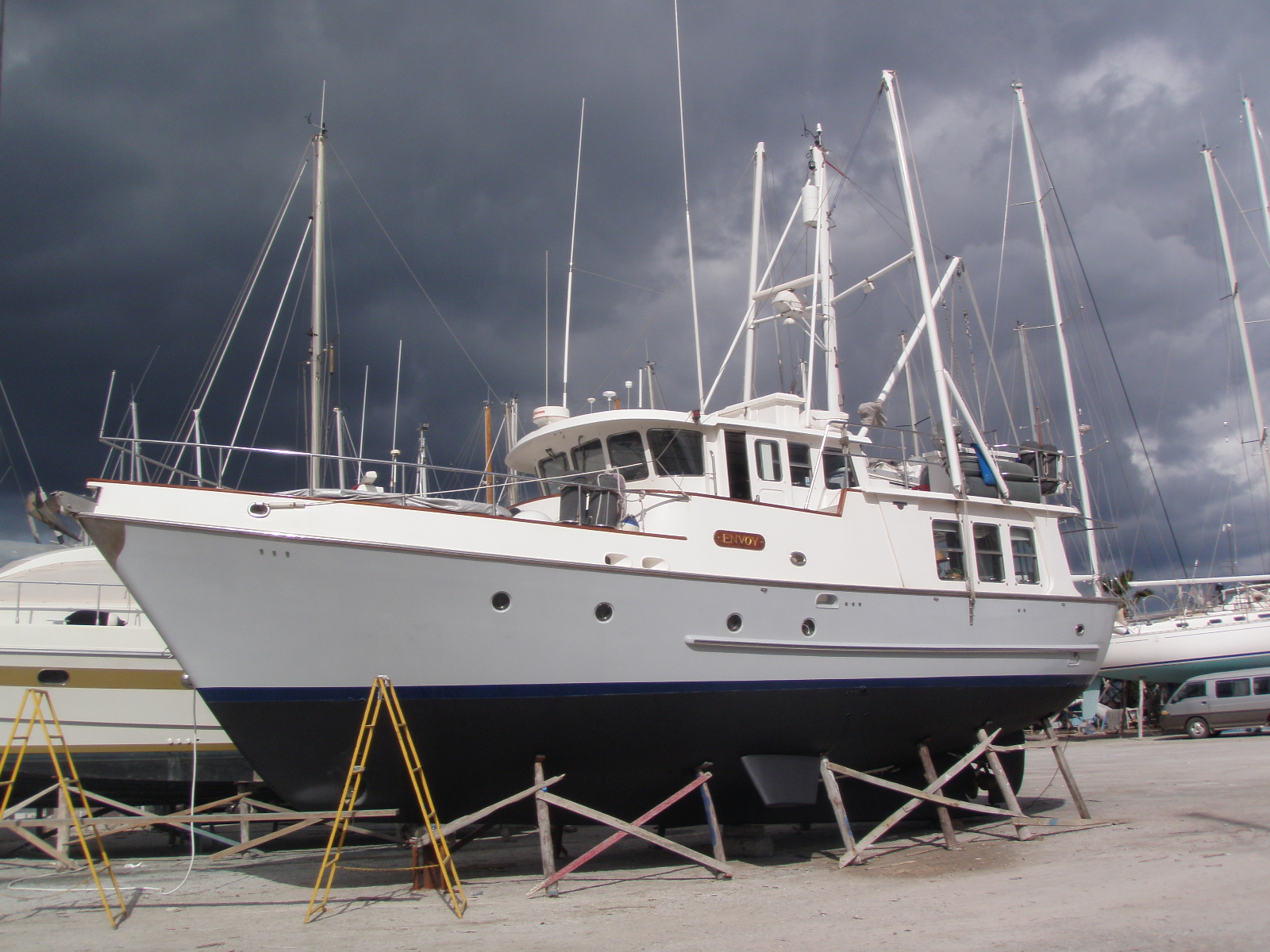
Envoy is still in Lefkas Marina, Greece and we plan to return there in September.
Marinas in the Med are totally different to what we are used to in New Zealand, and some of them can be quite a daunting experience. Ironically the only two boating-related injuries we’ve ever sustained have been in Med marinas.
The first one occurred while sheltering from a storm in a marina in Turkey. We were enjoying a cup of coffee in a local taverna when a horrendous gust of wind imploded its large sea-facing window, showering us with shards of glass and requiring us both to have a few stitches in hospital.

My ear was half ripped off by broken glass from the window

The second one happened just last year in a Sicilian marina when I stepped on a concrete paving stone that collapsed under me, lacerating my foot.
In the Med many marinas are not well-protected from the open sea, so during strong winds, especially during winter storms, swells and surge can make them uncomfortable and in some cases untenable with large waves cascading over their protective seawalls. For example, one day in Italy’s Ostia marina there was such a large surge that we couldn’t safely disembark from Envoy and the boat next to us broke its stern lines and went adrift dragging its power cable and water hose astern.

Huge waves crashing against a seawall. One boat on hardstand to left has been knocked from its supports. Concrete blocks weighing several tonnes were moved more than 5 metres. Even if waves don’t come over the wall (and they do!) they can cause a heavy surge inside the marina

Med marinas don’t have pontoons or poles between the boats, which are moored stern-to the dock protected only by their fenders, and with a lazy line or sometimes your own anchor to secure your bow.

In six years cruising this is the only time we had a berth with a pontoon on our side

If a blow with some surge is expected it’s a good idea to use two bow lines, or at least ensure the one you have is strong enough to hold. Also to use additional long spring lines secured from amidships back to the jetty, as surge can easily break short stern lines and damage cleats, or indeed pull them out of your deck. Most marinas provide staff to assist with docking and to help make boats more secure if strong winds and surge are expected.
Apart from surge, wakes from ferries and fishing boats passing nearby or through marinas can be problem too.
Access to your boat in a marina is generally by passarelle (boarding plank) from your stern to the dock, and these should be used with care as accidents are common. We generally rig a safety line to hold onto while using the passarelle, especially when we have guests who are not used to this procedure.
Most marinas provide water, but it’s rarely potable and most cruisers buy bottled water for drinking. It’s a good idea to regularly fill your water tank in case of any problems with the marina water supply. Sometimes the water supply can be a considerable distance from the boat so long hoses should be carried.
Electricity is also commonly provided, but maintenance levels are poor – many power sockets don’t work or have low voltage, and power outages are particularly common during heavy rain and thunderstorms. Often the power outages are not just on the marina but for the whole local area. Power costs are mostly included in the marina berth charge, but in other cases it’s charged extra, normally using a pre-pay card. It’s a good idea to maintain a large selection of plugs and extension leads as the power sockets vary and sometimes there are not enough for each boat. In these cases a neighbouring skipper will generally agree to share his power socket with you, or the marina staff will make that decision for him.
We have always found security in marinas good and theft is rarely an issue provided that normal sensible precautions are taken.
Many cruisers in the Med don’t anchor at all, simply travelling from marina to marina without ever removing and stowing their fenders. This is particularly the case with chartered yachts, which are often poorly equipped with ground tackle, and with crew who aren’t confident in their anchoring ability and want to enjoy the marina’s action, restaurants and atmosphere. We try to avoid marinas as much as possible because they’re expensive (typically about $70 to $130 per night). It’s also time-consuming to set up mooring lines, power cord and passarelle, and many marinas and harbours require you to go through the inconvenience of reporting to the authorities to have your ship’s documents checked. Another factor is we like to swim as much as possible, which is generally not possible in marinas (not only forbidden but potentially dangerous to swim in areas close to poorly maintained shore power terminals).
Much as we prefer not to, during a typical year we inevitably spend some weeks in various marinas – preparing our boat for cruising at the beginning of the season and for winter at season’s end, when guests arrive and depart, in locations where there are no safe anchorages, for maintenance, for shelter from adverse weather (above Force 7) and when we want to leave our boat unattended for inland travel.
All marinas allow living aboard your boat in the water, and most allow living aboard on the hardstand (even if their advertised terms and conditions say this is not allowed).
Most marinas provide clean toilets and hot showers, but few have facilities to empty holding tanks so it’s a good idea to pump them out at sea before entering a marina.
It’s rarely a problem to discharge grey water or to use a washing machine in marinas. Laundry facilities are common in larger marinas but tend to be very expensive. Cheaper options can often be found in nearby villages.
Shops and markets for most supplies are generally plentiful.

On the hardstand
When your boat needs to be slipped for anti-fouling and below water maintenance it’s a big advantage to continue living aboard and most Med marinas allow this.
Ensure your ladder is stable, securely tied top and bottom, and used very carefully as serious injury-causing accidents involving ladders are common.

It’s a good idea to check your boat’s hull supports periodically, particularly wooden ones, as we have found they can move and need adjustment.

When wooden hull supports are used they can move and need regular checking

Most marina hardstand areas are very dusty and turn muddy during rain, so ensure your cockpit is well protected from dirty footwear and you have a mat at the bottom of your ladder. Keep an old hose especially for use on the hardstand as hoses generally can’t be cleaned sufficiently for normal use after being used there. The power cable also gets very dirty and needs a thorough clean after use.
Grey water cannot be discharged directly onto the hardstand so we place bowls in the galley and head sinks, and empty them periodically into marina storm water drains. In case we get caught short during the night we place a bucket in the head and empty it first thing in the morning.
Although living aboard on the hardstand is probably the least enjoyable aspect of the Med cruising life, it’s often improved by the fact that you’re probably looking up at some nearby ancient temple or castle, and after that time comes the great consistent weather, fascinating historical destinations and wonderfully interesting cultures and cuisines.
The next Blog posting will discuss boating etiquette.

Catching Up

The last part of last season was a leisurely trip to Malta and then stops in Siracusa, Sicily, Taormina, the Aeolian islands and a few rolly nights at anchor on the southwest coast of Italy before crossing over to Sardinia and Corsica. After that we crossed over to Elba, a pretty island between Corsica and the northwestern coast of Italy. Details?  Ummmm…….. Unfortunately, it was almost a year ago and I have been negligent in my duties as the Chief Blogging Officer aboard Seabird. Had this been 500 years ago, I would have had to walk the plank! 

Map of our Journey last Season

Just to get you close to being up to date, here is a brief summary of what we did after the last blog to this season:

Elba is where Seabird and Sans Souci sadly departed. Ken and Roberta had made plans to winter in San Remo in Northern Italy and, although we had originally planned the same, we fell victim to the lure of southern Sicily (Marina Di Ragusa) and the incredible value. Wintering the boat in San Remo was going to cost $22,000. Sicily was a fraction of that at $2500 for the winter. In addition, we would be only a hop, skip and a jump from Tunisia, where fuel was $1.50 per gallon vs $8 in Italy!  We needed approximately 1500 gallons, so do the math! 

We had a great solo cruise south from Elba. We stopped in the Port of Rome, which is actually about 40 miles from the marina by train. We spent one long day in Rome visiting the Vatican and St Peters.

On our cruise south, we passed close by the port of Giglio. Many of you remember the cruise ship Costa Concordia hit a reef there and sank in 2012. Cruising by there, it was hard for us to believe that the captain actually cruised that close to the land. Seeing where it was first hand, I can tell you that I would not be comfortable cruising that close even in OUR boat! 

This is where the  Cruise Ship Costa Concordia Went Down

There was no place to anchor there so we found a marina in Calla Gallera. While we were there, I remembered that two friends, Diane and Carlo, were vacationing nearby and we emailed them hoping that we could say hello. It turns out that they were staying about 3 miles from where we were and came over with their family.

After returning to Marina di Ragusa with the boat, we prepared here for the winter, rented a car and drove (via car ferry) to the mainland where we met my sister Diane and brother in law Mike in Tuscany, where we had rent a small villa for a few weeks in the countryside. We used it as a base for touring about. It is a complete departure from the boating lifestyle, but we had lots of fun.

Back to Marina di Ragusa……..

Marina di Ragusa turned out to be a wonderful, vibrant little Sicilian town with friendly people and great, reasonably priced restaurants. Our boat was well taken care of by a fellow named George Rizzo, who also arranged for repairs and the haul out after we returned, as well as an apartment to stay in while the work was being done. The marina itself is fairly new and the boatyard had first class equipment.

Haulout at Marina di Ragusa

We took the opportunity while the boat was hauled to take care of a few items:

Our Dinghy Davit, which is basically a hydraulic crane that lifts the inflatable dinghy off of the deck and lowers it into the water. Unfortunately, towards the end of last season, the system “sprung a leak”.  We just barely had gotten the dinghy into the water when it gave out. I love hydraulic systems, but they operate under 3000 pounds of pressure and they don’t really just leak.. They blow out in spectacular fashion, leaving an oily mess, and, in our case, all over the deck!  Fortunately we were able to isolate that valve and still use the hydraulics for the bow thruster and anchor windlass. Anyway, it needed a complete overhaul and George arranged to have his mechanic, Leonardo, take it apart, bring everything back to his shop about two hours north of Marina di Ragusa, and fix it. He also drained and replaced the coolant in my many systems on board and installed a new ( but noisy) fresh water pump. He also installed some new parts in our stabilizer system.  The area he had to work in was absolutely tiny and I was afraid to show it to him on his first visit, figuring he might not take the job. Both of these guys are larger than me, but somehow squeezed into  a place that I could never get into.

Leo turned out to be a great mechanic, something you do not often find. He is what is referred to as a “Shade Tree” mechanic. He is a REAL mechanic who can diagnose and fix things as opposed to a “parts changer”, a guy who keeps changing parts until he finds the problem. Leo is the best.

We also got a new outboard motor to replace our dying, 18 year old Yamaha. Italy has an unusual system. Anything over a 40 HP on a boat requires a special license. I wanted a 60 hp. The response was “so you want a 40/60?” Huh?  Well, evidently, you can buy a 40, a 50, a 60 or a 70 hp, all with a 40 hp motor cover. I decided it best not to question it further. I have a dinghy with a VERY fast 40hp.

I mentioned fuel cost savings by going to Tunisia. Unfortunately, we had to change our plans because of the Terrorist incident there. We decided that it was not worth the risk and ended up buying our fuel in Malta, which was more expensive than Tunisa, but cheaper than Italy.

Having everything completed, we were back in the water and ready to go.

Also, if you want to track us in real time, go to the main web page at www.seabirdlrc.com and click the “Current Location” button on the left.  When you get to the tracking page, just scroll down to the larger chart.  Our location is accurate to within 10 minutes! 

Next up…….cruise to Malta

Miscellaneous Pics from our late summer and early fall cruising.

Havent seen this one before? A dinghy with wheels and a separate engine to power them!
Bet you have not seen this before!  A dinghy with three 
wheels and a separate engine to power them on land!

World famous Tropea Onions at a roadside stand


Swordfish boat at the Messina Straites in Sicily
Look closely at the far right of the picture and you can make
out the guy on the bow platform waiting to stab a fish! the platform 
is longer than the boat!!!!


After our hydraulic Dinghy davit broke we had to have 
these kind folks at the shipyard load it for us.  Price?
They actually did it for free!


This is the city of Pompei. It was covered in Lava after a 
Mount Vesuvius Volcano eruption in 79 AD and recently discovered.

This is Malta.  You can see why we loved it


Here we are anchored near the Blue Lagoon in Malta

Tropea (the place with the onions) at night

Seabird at Ponza, another of our favorite anchorages in Italy

Here is the marina we stayed at in Tropea

And, last but not least, there is a rumor that in Corsica,
when the wind reaches 43 mph…..strange things happen

HUH?!?!?!?!

Catching Up

The last part of last season was a leisurely trip to Malta and then stops in Siracusa, Sicily, Taormina, the Aeolian islands and a few rolly nights at anchor on the southwest coast of Italy before crossing over to Sardinia and Corsica. After that we crossed over to Elba, a pretty island between Corsica and the northwestern coast of Italy. Details?  Ummmm…….. Unfortunately, it was almost a year ago and I have been negligent in my duties as the Chief Blogging Officer aboard Seabird. Had this been 500 years ago, I would have had to walk the plank! 

Map of our Journey last Season

Just to get you close to being up to date, here is a brief summary of what we did after the last blog to this season:

Elba is where Seabird and Sans Souci sadly departed. Ken and Roberta had made plans to winter in San Remo in Northern Italy and, although we had originally planned the same, we fell victim to the lure of southern Sicily (Marina Di Ragusa) and the incredible value. Wintering the boat in San Remo was going to cost $22,000. Sicily was a fraction of that at $2500 for the winter. In addition, we would be only a hop, skip and a jump from Tunisia, where fuel was $1.50 per gallon vs $8 in Italy!  We needed approximately 1500 gallons, so do the math! 

We had a great solo cruise south from Elba. We stopped in the Port of Rome, which is actually about 40 miles from the marina by train. We spent one long day in Rome visiting the Vatican and St Peters.

On our cruise south, we passed close by the port of Giglio. Many of you remember the cruise ship Costa Concordia hit a reef there and sank in 2012. Cruising by there, it was hard for us to believe that the captain actually cruised that close to the land. Seeing where it was first hand, I can tell you that I would not be comfortable cruising that close even in OUR boat! 

This is where the  Cruise Ship Costa Concordia Went Down

There was no place to anchor there so we found a marina in Calla Gallera. While we were there, I remembered that two friends, Diane and Carlo, were vacationing nearby and we emailed them hoping that we could say hello. It turns out that they were staying about 3 miles from where we were and came over with their family.

After returning to Marina di Ragusa with the boat, we prepared here for the winter, rented a car and drove (via car ferry) to the mainland where we met my sister Diane and brother in law Mike in Tuscany, where we had rent a small villa for a few weeks in the countryside. We used it as a base for touring about. It is a complete departure from the boating lifestyle, but we had lots of fun.

Back to Marina di Ragusa……..

Marina di Ragusa turned out to be a wonderful, vibrant little Sicilian town with friendly people and great, reasonably priced restaurants. Our boat was well taken care of by a fellow named George Rizzo, who also arranged for repairs and the haul out after we returned, as well as an apartment to stay in while the work was being done. The marina itself is fairly new and the boatyard had first class equipment.

Haulout at Marina di Ragusa

We took the opportunity while the boat was hauled to take care of a few items:

Our Dinghy Davit, which is basically a hydraulic crane that lifts the inflatable dinghy off of the deck and lowers it into the water. Unfortunately, towards the end of last season, the system “sprung a leak”.  We just barely had gotten the dinghy into the water when it gave out. I love hydraulic systems, but they operate under 3000 pounds of pressure and they don’t really just leak.. They blow out in spectacular fashion, leaving an oily mess, and, in our case, all over the deck!  Fortunately we were able to isolate that valve and still use the hydraulics for the bow thruster and anchor windlass. Anyway, it needed a complete overhaul and George arranged to have his mechanic, Leonardo, take it apart, bring everything back to his shop about two hours north of Marina di Ragusa, and fix it. He also drained and replaced the coolant in my many systems on board and installed a new ( but noisy) fresh water pump. He also installed some new parts in our stabilizer system.  The area he had to work in was absolutely tiny and I was afraid to show it to him on his first visit, figuring he might not take the job. Both of these guys are larger than me, but somehow squeezed into  a place that I could never get into.

Leo turned out to be a great mechanic, something you do not often find. He is what is referred to as a “Shade Tree” mechanic. He is a REAL mechanic who can diagnose and fix things as opposed to a “parts changer”, a guy who keeps changing parts until he finds the problem. Leo is the best.

We also got a new outboard motor to replace our dying, 18 year old Yamaha. Italy has an unusual system. Anything over a 40 HP on a boat requires a special license. I wanted a 60 hp. The response was “so you want a 40/60?” Huh?  Well, evidently, you can buy a 40, a 50, a 60 or a 70 hp, all with a 40 hp motor cover. I decided it best not to question it further. I have a dinghy with a VERY fast 40hp.

I mentioned fuel cost savings by going to Tunisia. Unfortunately, we had to change our plans because of the Terrorist incident there. We decided that it was not worth the risk and ended up buying our fuel in Malta, which was more expensive than Tunisa, but cheaper than Italy.

Having everything completed, we were back in the water and ready to go.

Also, if you want to track us in real time, go to the main web page at www.seabirdlrc.com and click the “Current Location” button on the left.  When you get to the tracking page, just scroll down to the larger chart.  Our location is accurate to within 10 minutes! 

Next up…….cruise to Malta

Miscellaneous Pics from our late summer and early fall cruising.

Havent seen this one before? A dinghy with wheels and a separate engine to power them!
Bet you have not seen this before!  A dinghy with three 
wheels and a separate engine to power them on land!

World famous Tropea Onions at a roadside stand


Swordfish boat at the Messina Straites in Sicily
Look closely at the far right of the picture and you can make
out the guy on the bow platform waiting to stab a fish! the platform 
is longer than the boat!!!!


After our hydraulic Dinghy davit broke we had to have 
these kind folks at the shipyard load it for us.  Price?
They actually did it for free!


This is the city of Pompei. It was covered in Lava after a 
Mount Vesuvius Volcano eruption in 79 AD and recently discovered.

This is Malta.  You can see why we loved it


Here we are anchored near the Blue Lagoon in Malta

Tropea (the place with the onions) at night

Seabird at Ponza, another of our favorite anchorages in Italy

Here is the marina we stayed at in Tropea

And, last but not least, there is a rumor that in Corsica,
when the wind reaches 43 mph…..strange things happen

HUH?!?!?!?!