
Tag Archives | Nordhavn

UPDATING RAPPORT WITH A NEW DECK CRANE, RHIB AND OUTBOARD (PART 1)

Cruising update

It’s been great to get cruising again and with summer now underway this can only get better. 

It’s now official that La Nina weather conditions are expected this summer, bringing warmer than average sea and air temperatures (the seatemperature off Kawau is already 20.5d). The downside is La Nina also brings NE winds, increased rain and potentially some cyclonic conditions with the probability of increased thunderstorms. Thesecan be problematic due to sudden and sometimes severe wind direction shifts, so anchor with care to allow for this.

We’ve done two week-long cruises recently, one to the Ponui area and one to Mahurangi and Kawau.

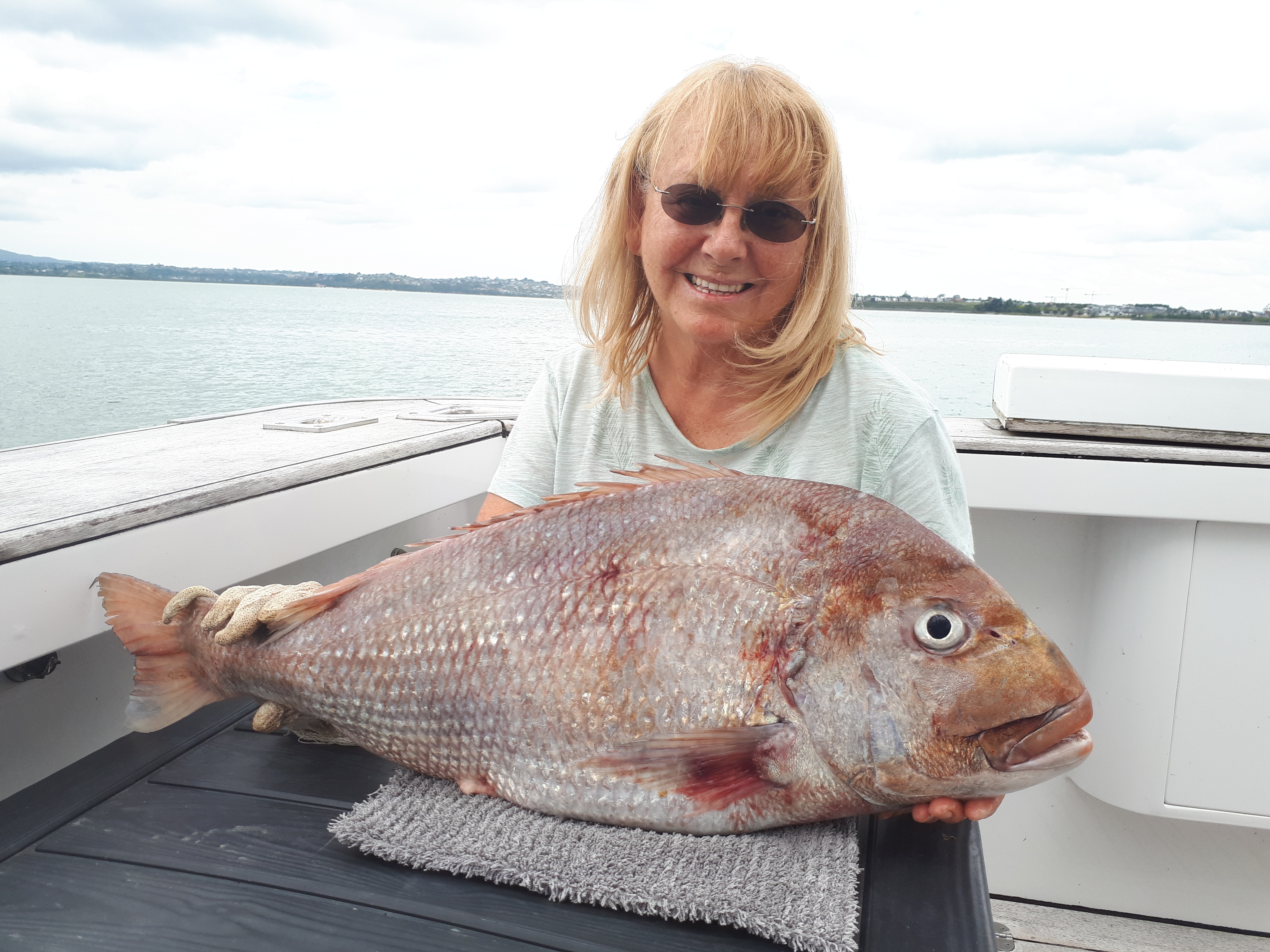
Diane landed this monster 72cm snapper in 35 metres SE of Kawau


You can’t always get what you want

We’ve owned our 16 metreSalthouseSportFisher, Rapport, for two yearsnowand after 177nights aboard find her a capable and comfortable cruiser. But when you buy a pre-owned boat you inevitably make some compromises and a major one for us was not having a large RHIB. We really enjoy exploring areas around our anchorage and ideally wanted a RHIB at least three metres longwith a 15hp 4-stroke outboard and able to be lifted aboard usinga crane. Rapport came without a crane andwith an old Chinese built Takacatinflatable that we rubbished after a few weeks as it had toomany pontoon air leaks to be economically repaired. In any case we didn’t like the Takacat’s inflatable floor limiting movement in the RHIB.

It was December and we urgently needed a dinghy that two of us could easily lift onto ourforedeck cradle, sobought a new lightweight (33kg) Aquapro SLR 2.6m rigid-hulled inflatable andHonda 2.5hp 4-strokeair cooled outboard. We usedthe same outboard during our Med cruising years and found it very reliable and easy to start and lift.But for Rapport this was always a temporary solution and so aided by our best friend and long time boating companion, Frank, we started researching deck cranesand larger inflatables.

We knew this was going to be an expensive project and that making improvements to a boat doesn’t necessarily add value. Atrusted marine broker’s thoughts were that future potential buyers of Rapport would expect a vessel of this size to carry a substantial RHIB and crane, so adding these would increase her sales appeal and value. We didn’t need too much convincing and reassured byhis advice and the prospect of lots morefun ahead decided to proceed.

Finding a suitable crane

It would be possible to lift the new outboard fromthe RHIB using a simple transom-mounted hand-operated winch, unload the other gear and then pull the empty RHIB onto the foredeck by hand, but we’re getting a bit long in the tooth for that and want to be able to launch and retrievethe whole rigwith minimal effort.

The RHIB with its outboard, fuel and gear willweigh about 150kg so we need a24V DC powered crane with a safe working load of at least that. We find plenty of options for large cranes but few for smaller units.

Motor Yacht Services (MYS) are theNew Zealandagent for Brisbane-based Australian Davits and Cranes (ADC)and we find them very helpfulhaving fitted many ADCs with good results. MYS’s owner Dean Ryder checks Rapport and quotes $13,973 plus installation for their 350kgcapacity crane mounted on our starboard side with its standpipe passing through our master berth’s wardrobe down to the keel to support the load. Delivery was quoted as 8 weeks ex factory.

Oceanlift cranes are produced on a bespoke basis in Rotoruaand we find owner Mark Thomson also provides lots of information. Coincidentally the boat owner next to us in the marina is very happy with hisOceanlift. Mark visits Rapport andquotes $13,711 plus installation for his200kg capacitycrane with 6 weeks delivery.

Both units will suit us however the ADC’sadditional capacity will provide an extra safety margin, more future flexibility and enhancedresale value. These factorscombined with the fact that MYS install their ADC craneswhereas we need a separatecontractor to installthe Oceanlift lead us to choose ADC. We expect the installation to take around three days and to costto around $6-8,000.

Which RHIB will suit us best?

We’re looking for a rugged rigid-hulled RHIB about 3 metresin length with room for four adults,able to plane with at least two adults aboard using a 15hp outboard, with generous beam for lateral stability, a snub rather than pointed bow for greater internal space forward, a false flat deck for easier internal movement and to keep contents dry, a high bow to deflect spray, robust pontoons with three separate air compartments, paddles rather than oars and rowlocks,internal lifting points, rubbing strakes, storage for anchor and accessories and handles on the pontoons and bow. We’ll also fit top-of-the-line Beachmaster pneumatic wheels and two rod holders. We have a preference for a powder coatedalloy hull (being lighter and easier to repair), but will accept GRP all other things being equal.

We eliminate centre console optionsas in our view theytake up too much room in a 3 metre RHIB and add too much weight, complexity and expense.

I’ve had good experiences with Aquapro and Frank has with Quicksilver, so we make a short list including these plus Southern Pacific and Zodiac. Initially we weren’t aware ofAB and Seafarer and later add these to our list. All sellers we speakto are able to provide a complete package including outboard and are willing to negotiate deals.

Frank and I discuss design with Neil at Seafarer


Ruggedness largely relatesto selection of pontoon material and the current fourmainstream offerings are plasticised polyvinyl chloride (commonly known as pvc orvinyl), blends of pvc with thermoplastic polyurethane (TPU), blends of polychloroprene (commonly known as Neoprene) with chlorosulphonated polyethylene (commonly known as Hypalon) and lastly straight TPU.

In each case these materials are used to coat a polyester or polyamide (commonly known as nylon) fabric.Although there’s lotsof debate about the pros and cons of each material due to different product qualities and variations in design, manufacture and quality control,the above list represents anascending order of technical excellence. Manufacture and quality control are vitally important andwe’re aware of two successful New Zealand brands that encountered major problems when they switched production to China, eventually reverting to New Zealand manufacture.

Until recently the Neoprene/Hypalon blend was considered the gold standard, but opinion has largelyturnedtowards TPU taking that spot, in fact the US Navy conducted a study of pontoons in 2001 concluding “tubes constructed of TPU exhibit better key physical properties than tubes constructed of Hypalon … better tensile strength, tearing strength, puncture resistance and abrasion resistance.” It also has superior air retention, chemical (ie fuel) resistance and seams can be welded whereas Hypalon can only be glued.

Despite the above Frank and I have both experienced good results previouslywithRHIBs havingpvc pontoons and their life can be maximised by always using a storage cover and fitting chaps to provide the pontoons with extra ultra violet, abrasion and puncture resistance.

Wed been inclined towards Zodiac, their brand being synonymous with RHIBs, butthey only offered us RHIBs builtin Indonesia with GRP hulls and pvc pontoons and availability appeared to be an issue. Of the imported brands we’remost impressed by AB, produced in Belgium with an alloy hull and using a Neoprene/Hypalon blend for tubes. However wantinga few custom features addedwevisit local producer Seafarer Inflatables, based in Dairyflat north of Auckland where we’reimmediately impressed by owner Neil Curtling’senthusiasm and willingness to share his extensive knowledge based on 35 years in the industry. Seafareruse a unique hot air welding process and their productincorporatesall of the features we’re looking for and more, such as U-Deck providing a great cosmetic appearance and underfoot feel. They also produce for another well-known brand as well as repairingall types of inflatables and can produce pontoons using either a PVC/TPU blend, Hypalon or TPU. We’re also impressed by their 10 year warranty. Afterdiscussions with Neil wedecide to go a little larger than 3 metresand buy their SF340R, 3.4 metreslong with a generous beam of 1.8 metres. Although wewould have been happy with pontoons made from PVC/TPU we decide to go with the top of the line TPU, largely because this is the ultimate in durability and our RHIB is our life boatin a worst case scenario. This costs an additional $755 bringingthe price to $6,992. Neil’s attention to detail continues to impress, for example suggesting that he drill the mounting holes for wheels and rod holders in the alloy hull prior to its powder coating to minimise future corrosion.

Look for Part 2 shortly covering outboard and ancillary equipment selection and then Part 3 covering crane installation and RHIB performance.

UPDATING RAPPORT WITH A NEW DECK CRANE, RHIB AND OUTBOARD (PART 1)

Cruising update

It’s been great to get cruising again and with summer now underway this can only get better. 

It’s now official that La Nina weather conditions are expected this summer, bringing warmer than average sea and air temperatures (the seatemperature off Kawau is already 20.5d). The downside is La Nina also brings NE winds, increased rain and potentially some cyclonic conditions with the probability of increased thunderstorms. Thesecan be problematic due to sudden and sometimes severe wind direction shifts, so anchor with care to allow for this.

We’ve done two week-long cruises recently, one to the Ponui area and one to Mahurangi and Kawau.

Diane landed this monster 72cm snapper in 35 metres SE of Kawau


You can’t always get what you want

We’ve owned our 16 metreSalthouseSportFisher, Rapport, for two yearsnowand after 177nights aboard find her a capable and comfortable cruiser. But when you buy a pre-owned boat you inevitably make some compromises and a major one for us was not having a large RHIB. We really enjoy exploring areas around our anchorage and ideally wanted a RHIB at least three metres longwith a 15hp 4-stroke outboard and able to be lifted aboard usinga crane. Rapport came without a crane andwith an old Chinese built Takacatinflatable that we rubbished after a few weeks as it had toomany pontoon air leaks to be economically repaired. In any case we didn’t like the Takacat’s inflatable floor limiting movement in the RHIB.

It was December and we urgently needed a dinghy that two of us could easily lift onto ourforedeck cradle, sobought a new lightweight (33kg) Aquapro SLR 2.6m rigid-hulled inflatable andHonda 2.5hp 4-strokeair cooled outboard. We usedthe same outboard during our Med cruising years and found it very reliable and easy to start and lift.But for Rapport this was always a temporary solution and so aided by our best friend and long time boating companion, Frank, we started researching deck cranesand larger inflatables.

We knew this was going to be an expensive project and that making improvements to a boat doesn’t necessarily add value. Atrusted marine broker’s thoughts were that future potential buyers of Rapport would expect a vessel of this size to carry a substantial RHIB and crane, so adding these would increase her sales appeal and value. We didn’t need too much convincing and reassured byhis advice and the prospect of lots morefun ahead decided to proceed.

Finding a suitable crane

It would be possible to lift the new outboard fromthe RHIB using a simple transom-mounted hand-operated winch, unload the other gear and then pull the empty RHIB onto the foredeck by hand, but we’re getting a bit long in the tooth for that and want to be able to launch and retrievethe whole rigwith minimal effort.

The RHIB with its outboard, fuel and gear willweigh about 150kg so we need a24V DC powered crane with a safe working load of at least that. We find plenty of options for large cranes but few for smaller units.

Motor Yacht Services (MYS) are theNew Zealandagent for Brisbane-based Australian Davits and Cranes (ADC)and we find them very helpfulhaving fitted many ADCs with good results. MYS’s owner Dean Ryder checks Rapport and quotes $13,973 plus installation for their 350kgcapacity crane mounted on our starboard side with its standpipe passing through our master berth’s wardrobe down to the keel to support the load. Delivery was quoted as 8 weeks ex factory.

Oceanlift cranes are produced on a bespoke basis in Rotoruaand we find owner Mark Thomson also provides lots of information. Coincidentally the boat owner next to us in the marina is very happy with hisOceanlift. Mark visits Rapport andquotes $13,711 plus installation for his200kg capacitycrane with 6 weeks delivery.

Both units will suit us however the ADC’sadditional capacity will provide an extra safety margin, more future flexibility and enhancedresale value. These factorscombined with the fact that MYS install their ADC craneswhereas we need a separatecontractor to installthe Oceanlift lead us to choose ADC. We expect the installation to take around three days and to costto around $6-8,000.

Which RHIB will suit us best?

We’re looking for a rugged rigid-hulled RHIB about 3 metresin length with room for four adults,able to plane with at least two adults aboard using a 15hp outboard, with generous beam for lateral stability, a snub rather than pointed bow for greater internal space forward, a false flat deck for easier internal movement and to keep contents dry, a high bow to deflect spray, robust pontoons with three separate air compartments, paddles rather than oars and rowlocks,internal lifting points, rubbing strakes, storage for anchor and accessories and handles on the pontoons and bow. We’ll also fit top-of-the-line Beachmaster pneumatic wheels and two rod holders. We have a preference for a powder coatedalloy hull (being lighter and easier to repair), but will accept GRP all other things being equal.

We eliminate centre console optionsas in our view theytake up too much room in a 3 metre RHIB and add too much weight, complexity and expense.

I’ve had good experiences with Aquapro and Frank has with Quicksilver, so we make a short list including these plus Southern Pacific and Zodiac. Initially we weren’t aware ofAB and Seafarer and later add these to our list. All sellers we speakto are able to provide a complete package including outboard and are willing to negotiate deals.

Frank and I discuss design with Neil at Seafarer


Ruggedness largely relatesto selection of pontoon material and the current fourmainstream offerings are plasticised polyvinyl chloride (commonly known as pvc orvinyl), blends of pvc with thermoplastic polyurethane (TPU), blends of polychloroprene (commonly known as Neoprene) with chlorosulphonated polyethylene (commonly known as Hypalon) and lastly straight TPU.

In each case these materials are used to coat a polyester or polyamide (commonly known as nylon) fabric.Although there’s lotsof debate about the pros and cons of each material due to different product qualities and variations in design, manufacture and quality control,the above list represents anascending order of technical excellence. Manufacture and quality control are vitally important andwe’re aware of two successful New Zealand brands that encountered major problems when they switched production to China, eventually reverting to New Zealand manufacture.

Until recently the Neoprene/Hypalon blend was considered the gold standard, but opinion has largelyturnedtowards TPU taking that spot, in fact the US Navy conducted a study of pontoons in 2001 concluding “tubes constructed of TPU exhibit better key physical properties than tubes constructed of Hypalon … better tensile strength, tearing strength, puncture resistance and abrasion resistance.” It also has superior air retention, chemical (ie fuel) resistance and seams can be welded whereas Hypalon can only be glued.

Despite the above Frank and I have both experienced good results previouslywithRHIBs havingpvc pontoons and their life can be maximised by always using a storage cover and fitting chaps to provide the pontoons with extra ultra violet, abrasion and puncture resistance.

Wed been inclined towards Zodiac, their brand being synonymous with RHIBs, butthey only offered us RHIBs builtin Indonesia with GRP hulls and pvc pontoons and availability appeared to be an issue. Of the imported brands we’remost impressed by AB, produced in Belgium with an alloy hull and using a Neoprene/Hypalon blend for tubes. However wantinga few custom features addedwevisit local producer Seafarer Inflatables, based in Dairyflat north of Auckland where we’reimmediately impressed by owner Neil Curtling’senthusiasm and willingness to share his extensive knowledge based on 35 years in the industry. Seafareruse a unique hot air welding process and their productincorporatesall of the features we’re looking for and more, such as U-Deck providing a great cosmetic appearance and underfoot feel. They also produce for another well-known brand as well as repairingall types of inflatables and can produce pontoons using either a PVC/TPU blend, Hypalon or TPU. We’re also impressed by their 10 year warranty. Afterdiscussions with Neil wedecide to go a little larger than 3 metresand buy their SF340R, 3.4 metreslong with a generous beam of 1.8 metres. Although wewould have been happy with pontoons made from PVC/TPU we decide to go with the top of the line TPU, largely because this is the ultimate in durability and our RHIB is our life boatin a worst case scenario. This costs an additional $755 bringingthe price to $6,992. Neil’s attention to detail continues to impress, for example suggesting that he drill the mounting holes for wheels and rod holders in the alloy hull prior to its powder coating to minimise future corrosion.

Look for Part 2 shortly covering outboard and ancillary equipment selection and then Part 3 covering crane installation and RHIB performance.

Gear We Like: LL Bean Rolling Duffle

In the decade we spent travelling the world in Dirona, we typically returned to Seattle two-three times a year. And on every one of those trips (when international), we brought back a lot of boat parts and spares in checked luggage. The gear usually weighed at least 200 lbs (90kg) in aggregate, and sometimes as…

Exercising on a Boat

After a decade of living aboard, one of the few aspects of our cruising lifestyle that we weren’t satisfied with, and hadn’t found a good solution for, was exercise. A few years ago, we tried Mark Lauren’s You Are Your Own Gym bodyweight program and it’s worked out very well for us. We enjoy the…

Fall in Seattle

It’s been several years since we’ve lived somewhere that we can catch major league sporting events, and it’s one of several aspects of living in Seattle that we’re really enjoying. The fall brought the return of two of our favorite sports, football and ice hockey. We watched several live Seattle Seahawks NFL games, and also…

Gear We Like: Laser Rangefinder

This installation of “Gear We Like” covers the Nikon Forestry Pro Laser Rangefinder. This tool allows us to quickly and accurately measure a bridge clearance and other vertical or horizontal distances. We first discovered a need for this device in East London, South Africa, where we stopped to ride out a storm en route from…

Dual Shorepower System

One of the things we really like about our more flexible power system is it allows us to run on shore power connections that deliver less than our peak power requirements. The shore power charges the house bank and 6 kW, 240V 60 Hz inverter supplies the peak capacity needed to run larger appliances such as the…

Gear We Like: Non-Contact Voltage Detector

This installment of the “Gear We Like” series features the Klien NCVT-2 non-contact voltage detector. This inexpensive tool makes it super-easy to ensure that power actually is available at the shore power pedestal before plugging in. There are many ways to check for power at a pedestal, but none faster than using a non-contact sensor….

LIFE IN THE SLOW LANE – SLOW CRUISING ABOARD TWIN-ENGINE PLANING VESSELS PART 2

Ourlast posting detailed how cruising at around displacement speed dramatically decreases fuel consumption and increases cruising range. It also highlighted the problems which can be encountered through cruising consistently at low rpm. Running diesel engines for long periods at idling speed is particularly detrimental and engine “wear” is said to occur at about double the ratecompared to running them under normal loading. Ideally for that reason engines should only have 3-5 minutes of idling followingstart up and then be brought up to around 1,200 rpm withsome load applied.

Not only can idling cause a build-up of carbon in the engine but also causes mirror glazing, which is the creation of a mirror-like surface finish on cylinder bores, eventually allowing more oil to pass the rings and creating more blow-by (the adverse effects of which were detailed in Part 1 of this article). Mirror glazing can also be caused by constantly running engines at the same rpm, so this should be avoided. Before shut down a diesel should also be idled for 3-5 minutes to allow the turbo to cool down. In practice this is catered for when entering your marina or approaching your anchorage.

Now let’s consider someoptions for low speed cruisingand their relative merits.

Option 1 – run both engines at low rpm

If you’re wanting to do this, avoid running below 1,200 rpm andit’s recommended to at least run at 60-75 per centof WOTfor about 30 minutes after reaching full operating temperature, then again for about15 minutes every 4 hours and then for about 30 minutes about 1 hour before shutdown. This last one is considered to be especially important to reduce soot formation and to clean the turbocharger andit’s better to spend less than optimal time at higher rpm than none at all.

Pros 

There will be a considerable reduction in fuel usage and increase in range.

All ancillary equipment driven by the engines such as power steering, refrigeration compressors, hot water manifolds will operate (unlike Option 2).

Both gearboxes and drive trains will be cooled (unlike Option 2).

Full maneuverability is maintained and there is no rudder bias (unlike Option 2).

There is no potential problem with prop shaft couplings (unlike Option 2).

In practical terms this option is easy to manage.


Cons 

Somemonitoring and planning is required for the periods at higher rpm and it is difficult to achieve on short cruises.

May cause issues with alternators.

Hours-based service costs may increase because you are using more engine hours to run a given distance.


Option 2 – run on one engine at a time at higher rpm

Underthis system only one engine is used at a time, alternatingperiodically(eg every one to two hours).


Pros 

It will take more rpm on the one selectedengine to reach your chosenspeed than it would be using two, therebyeliminatingor at least minimisingthe problem of light loading.

Fuel saving and range increase will be considerably less than Option 1, but still in the order of 10 to 15 per cent.

Higher rpm will make your in-use alternator run more efficiently.

The process is relatively east to manage.

The frequency of hours-based engine servicing is reduced thus saving service costs.

Cons 

Maneuverability is considerably reduced using one engine, particularly at low speedso this option should only be considered in open waters and not for example coming into or out of marinas.

There will be a slight steering bias in the direction away from the in-use engine ie using only the port engine the vessel will veer slightlytowardsstarboard.

The not-in-use engine’s prop will still turn or “windmill” causing drag and the gearbox to operate.The inactive engine’s gearboxmust be kept in neutral so that the engine doesn’t turn over. Most gearboxes are water-cooled using its engine’s heat exchanger, so without the engine running this cooling will be lost and gearbox damage can potentially occur. Consult your installations Owners’ Manual to ascertain for how long you can windmillThey normally suggest running your engine for about five minutes before wind milling and will advise the allowed time interval before it needs to be started again to activate the heat exchanger and circulate gearbox oil. My Caterpillar manual recommends idlingthe engine every 12 hours for five minutes, however the Twin Disc gearbox manual recommends idling the engine for a few minutes every hour, so I willfollow that guideline.

If initiating this procedure it would be a good idea to check the temperature atthe rear of the wind milling prop’s gearbox using an infra-red thermometer to see how long it takes for the temperature to rise. The lower the boat speed, the less the wind milling engine’s gearbox temperature will rise. Bear in mind there’s a good chance that some time in the future you’ll have a problem with one engine and need to run just on the other one, so this is not a wasted exercise.

Take into account that engines often run ancillary equipment, for example Rapport’s port engine runs our refrigeration compressor while her starboard engine runs our power steering and heats our hot water supply.

Some stuffing boxes have no cooling system beyond the sea water coming into it, others have oil or grease lubrication to keep temperatures down, while others and more particularly most dripless shaft seals are cooled with sea water supplied from the engine’s sea water pump, so for this latter category no cooling will be supplied if the engine is not running.

Note that some vessels have a system where either engine can supply cooling water to both shafts. However if this is not the case it is best to comparethe temperaturesof the not-in-use shaft seals with the in-use shaft seals using an infra red thermometer to determine for how long you can allow wind milling. A temperature up to about 40dC should be OK, in fact as a general rule mechanics say if the stuffing box is nottoo hot to touch it’s OK (be careful doing this though). Another measure is that stuffing box temperature should be 7-22dC above sea water temperature.

Note that some cruisers have adopted measures to eliminate wind milling. At an extreme level one cruiser crossing the Pacific decided to remove oneprop until half way across, then replacethe prop and removethe other one so the in-use engine could be changed. This was done at sea using a block and tackle to support the prop’s weight. At a less extreme level it’s not uncommon for long distance cruisers to install a mechanical or hydraulic system enabling either prop shaft to be locked so it cannot rotateI have discounted the use of such a system based on the inconvenience and practicalityof changing over engines and the compromise to maneuverability in the event of an emergency.

When an engine is driving your vessel it is trying to push the prop shaft and coupling flangetowards the engine, therefore not putting any load on the securing boltsWhen the prop shaft’s wind milling it’strying to pull away fromthe engine and therefore your coupling flange, soconnections should be checked initially and at regular intervals thereafter.

Option 3 – run both engines with one engine at higher rpm than the other

Another option isto run one engine at high rpm and the other at low rpmso that all engine-driven equipment is operating, then interchange every couple of hours or so. If adopting this option avoid running the low rpm engine below1,200 rpm for the reasons outlined in the opening comments.

Pros 

The issue of light loading is eliminated.

Economy gains similar to running two engines at low rpm are achieved and range is increased.

There is littleloss of maneuverability.

There is no issue with cooling of gearboxes and shaft seals.

There is no issue with prop shaft flange connections.

The process is easy to manage.

All engine-driven ancillary equipment will operate.

Cons 

Both engines are stillrampingup engine hours, so no servicing costs are saved.

There will be a very slight steering bias in the direction away from engine operating at higher rpm.

The alternator’s efficiency is compromised for the engine running at low rpm.


Conclusion

As mentioned early on Di and I prefer to cruise much of the time off the plane, even when cruising long distances,so considering all of the above options here’s a practical solution based on Option 2 for Rapport.

-Start both engines and leave the marina using bothat low rpm (although preferably above 1,200 rpm wherever possible)providingmaximum maneuverability.

-When in openwatersshut down the starboard engine and as temperatures rise, gradually increase rpm on port to about 1,850 = 66 per cent of WOT. This will operate refrigeration and efficient alternator operation and battery charging at higher rpm. The power steering willnot operateso hand steering will be necessary, however this is not much of an issue in open waters. Any time that power steering and autopilot is wanted I can start the starboard engine.

-When the freezer reaches its operating temperature (after roughly three hours on first day outand on subsequent daysafter about an hour), runthe starboard engine at about 1,850 rpm and shut down port

Then continue to alternate engines as required about hourly.

For subsequent days wenormally use the genset every morning so the batteries are fully charged at that time and the alternators don’t need to run at high outputs. Every several engine hours I’ll run both engines at about 2,200-2,400rpm for 15 minutes or so as well as doing this for about half an hour an hour before shutdown.

Happy Slow Cruising

LIFE IN THE SLOW LANE – SLOW CRUISING ABOARD TWIN-ENGINE PLANING VESSELS PART 2

Ourlast posting detailed how cruising at around displacement speed dramatically decreases fuel consumption and increases cruising range. It also highlighted the problems which can be encountered through cruising consistently at low rpm. Running diesel engines for long periods at idling speed is particularly detrimental and engine “wear” is said to occur at about double the ratecompared to running them under normal loading. Ideally for that reason engines should only have 3-5 minutes of idling followingstart up and then be brought up to around 1,200 rpm withsome load applied.

Not only can idling cause a build-up of carbon in the engine but also causes mirror glazing, which is the creation of a mirror-like surface finish on cylinder bores, eventually allowing more oil to pass the rings and creating more blow-by (the adverse effects of which were detailed in Part 1 of this article). Mirror glazing can also be caused by constantly running engines at the same rpm, so this should be avoided. Before shut down a diesel should also be idled for 3-5 minutes to allow the turbo to cool down. In practice this is catered for when entering your marina or approaching your anchorage.

Now let’s consider someoptions for low speed cruisingand their relative merits.

Option 1 – run both engines at low rpm

If you’re wanting to do this, avoid running below 1,200 rpm andit’s recommended to at least run at 60-75 per centof WOTfor about 30 minutes after reaching full operating temperature, then again for about15 minutes every 4 hours and then for about 30 minutes about 1 hour before shutdown. This last one is considered to be especially important to reduce soot formation and to clean the turbocharger andit’s better to spend less than optimal time at higher rpm than none at all.

Pros 

There will be a considerable reduction in fuel usage and increase in range.

All ancillary equipment driven by the engines such as power steering, refrigeration compressors, hot water manifolds will operate (unlike Option 2).

Both gearboxes and drive trains will be cooled (unlike Option 2).

Full maneuverability is maintained and there is no rudder bias (unlike Option 2).

There is no potential problem with prop shaft couplings (unlike Option 2).

In practical terms this option is easy to manage.


Cons 

Somemonitoring and planning is required for the periods at higher rpm and it is difficult to achieve on short cruises.

May cause issues with alternators.

Hours-based service costs may increase because you are using more engine hours to run a given distance.


Option 2 – run on one engine at a time at higher rpm

Underthis system only one engine is used at a time, alternatingperiodically(eg every one to two hours).


Pros 

It will take more rpm on the one selectedengine to reach your chosenspeed than it would be using two, therebyeliminatingor at least minimisingthe problem of light loading.

Fuel saving and range increase will be considerably less than Option 1, but still in the order of 10 to 15 per cent.

Higher rpm will make your in-use alternator run more efficiently.

The process is relatively east to manage.

The frequency of hours-based engine servicing is reduced thus saving service costs.

Cons 

Maneuverability is considerably reduced using one engine, particularly at low speedso this option should only be considered in open waters and not for example coming into or out of marinas.

There will be a slight steering bias in the direction away from the in-use engine ie using only the port engine the vessel will veer slightlytowardsstarboard.

The not-in-use engine’s prop will still turn or “windmill” causing drag and the gearbox to operate.The inactive engine’s gearboxmust be kept in neutral so that the engine doesn’t turn over. Most gearboxes are water-cooled using its engine’s heat exchanger, so without the engine running this cooling will be lost and gearbox damage can potentially occur. Consult your installations Owners’ Manual to ascertain for how long you can windmillThey normally suggest running your engine for about five minutes before wind milling and will advise the allowed time interval before it needs to be started again to activate the heat exchanger and circulate gearbox oil. My Caterpillar manual recommends idlingthe engine every 12 hours for five minutes, however the Twin Disc gearbox manual recommends idling the engine for a few minutes every hour, so I willfollow that guideline.

If initiating this procedure it would be a good idea to check the temperature atthe rear of the wind milling prop’s gearbox using an infra-red thermometer to see how long it takes for the temperature to rise. The lower the boat speed, the less the wind milling engine’s gearbox temperature will rise. Bear in mind there’s a good chance that some time in the future you’ll have a problem with one engine and need to run just on the other one, so this is not a wasted exercise.

Take into account that engines often run ancillary equipment, for example Rapport’s port engine runs our refrigeration compressor while her starboard engine runs our power steering and heats our hot water supply.

Some stuffing boxes have no cooling system beyond the sea water coming into it, others have oil or grease lubrication to keep temperatures down, while others and more particularly most dripless shaft seals are cooled with sea water supplied from the engine’s sea water pump, so for this latter category no cooling will be supplied if the engine is not running.

Note that some vessels have a system where either engine can supply cooling water to both shafts. However if this is not the case it is best to comparethe temperaturesof the not-in-use shaft seals with the in-use shaft seals using an infra red thermometer to determine for how long you can allow wind milling. A temperature up to about 40dC should be OK, in fact as a general rule mechanics say if the stuffing box is nottoo hot to touch it’s OK (be careful doing this though). Another measure is that stuffing box temperature should be 7-22dC above sea water temperature.

Note that some cruisers have adopted measures to eliminate wind milling. At an extreme level one cruiser crossing the Pacific decided to remove oneprop until half way across, then replacethe prop and removethe other one so the in-use engine could be changed. This was done at sea using a block and tackle to support the prop’s weight. At a less extreme level it’s not uncommon for long distance cruisers to install a mechanical or hydraulic system enabling either prop shaft to be locked so it cannot rotateI have discounted the use of such a system based on the inconvenience and practicalityof changing over engines and the compromise to maneuverability in the event of an emergency.

When an engine is driving your vessel it is trying to push the prop shaft and coupling flangetowards the engine, therefore not putting any load on the securing boltsWhen the prop shaft’s wind milling it’strying to pull away fromthe engine and therefore your coupling flange, soconnections should be checked initially and at regular intervals thereafter.

Option 3 – run both engines with one engine at higher rpm than the other

Another option isto run one engine at high rpm and the other at low rpmso that all engine-driven equipment is operating, then interchange every couple of hours or so. If adopting this option avoid running the low rpm engine below1,200 rpm for the reasons outlined in the opening comments.

Pros 

The issue of light loading is eliminated.

Economy gains similar to running two engines at low rpm are achieved and range is increased.

There is littleloss of maneuverability.

There is no issue with cooling of gearboxes and shaft seals.

There is no issue with prop shaft flange connections.

The process is easy to manage.

All engine-driven ancillary equipment will operate.

Cons 

Both engines are stillrampingup engine hours, so no servicing costs are saved.

There will be a very slight steering bias in the direction away from engine operating at higher rpm.

The alternator’s efficiency is compromised for the engine running at low rpm.


Conclusion

As mentioned early on Di and I prefer to cruise much of the time off the plane, even when cruising long distances,so considering all of the above options here’s a practical solution based on Option 2 for Rapport.

-Start both engines and leave the marina using bothat low rpm (although preferably above 1,200 rpm wherever possible)providingmaximum maneuverability.

-When in openwatersshut down the starboard engine and as temperatures rise, gradually increase rpm on port to about 1,850 = 66 per cent of WOT. This will operate refrigeration and efficient alternator operation and battery charging at higher rpm. The power steering willnot operateso hand steering will be necessary, however this is not much of an issue in open waters. Any time that power steering and autopilot is wanted I can start the starboard engine.

-When the freezer reaches its operating temperature (after roughly three hours on first day outand on subsequent daysafter about an hour), runthe starboard engine at about 1,850 rpm and shut down port

Then continue to alternate engines as required about hourly.

For subsequent days wenormally use the genset every morning so the batteries are fully charged at that time and the alternators don’t need to run at high outputs. Every several engine hours I’ll run both engines at about 2,200-2,400rpm for 15 minutes or so as well as doing this for about half an hour an hour before shutdown.

Happy Slow Cruising