
On the second leg of our road trip to Seattle from Charleston we traveled 202 miles (325 km) from Pensacola, FL to New Orleans, LA bringing our total trip distance to 800 miles (1286 km) across sixstates (South Carolina, Georgia, Florida, Alabama, Mississippi, and Louisiana). In New Orleans we stayed in a 43rd-floor room with…
Tag Archives | Nordhavn
THIS IS ADVENTUROUS BOATING
I’m always impressed with
people living their adventurous boating dreams in small vessels.
My
younger brother Charles is a yachtsman who’s done lots of daunting
sailing adventures. Among others he cruised from Perth around the
northern coast of Australia to Sydney, sailed from Sydney to Lord
Howe Island and back and then sailed from Brisbane to Scotland via
the Med over
several years while altogether racking up 14
years living
aboard his 34ft van de Statd sloop, Acrobat, with his then partner,
later wife Marie for.
Charles
was our inspiration to embark on our own Med adventures following a
visit to Turkey and
a short
cruise aboard Acrobat. He’s
a very practical guy being
a qualified builder, cabinet maker and shipwright as well as being
able to undertake many mechanical and electrical projects.
Consequently Acrobat is immaculately fitted out to the high standard
needed for ocean passages. But she’s quite basic by our standards
having only hand-pumped fresh water, no hot water, no refrigeration
and only a cockpit shower. I can’t imagine how Charles and Marie
spent all those years living aboard in the Med without cold beer! He
jokes that with Scotland’s cold climate lack of refrigeration is
not a problem. As Marie is still working Charles does solo voyages
from his home port of Lossiemouth in the Firth of Forth
(close to Loch Ness and the Culloden battlefield) and
is currently on a month long trip North
Sea cruise
north to the
Orkney and Faroe Islands. This is serious sailing – The Orkneys are
about half way from Scotland’s north coast to Iceland and
the Pentland Firth between Scotland and the Orkneys has
some of the planet’s strongest tides – up to 16kn.
Quote “the
force of the tides gives rise to overfalls and tidal races …. and
often give rise to extremely violent sea conditions …. the races
are highly visible with overfalls and whirlpools.”
Imagine
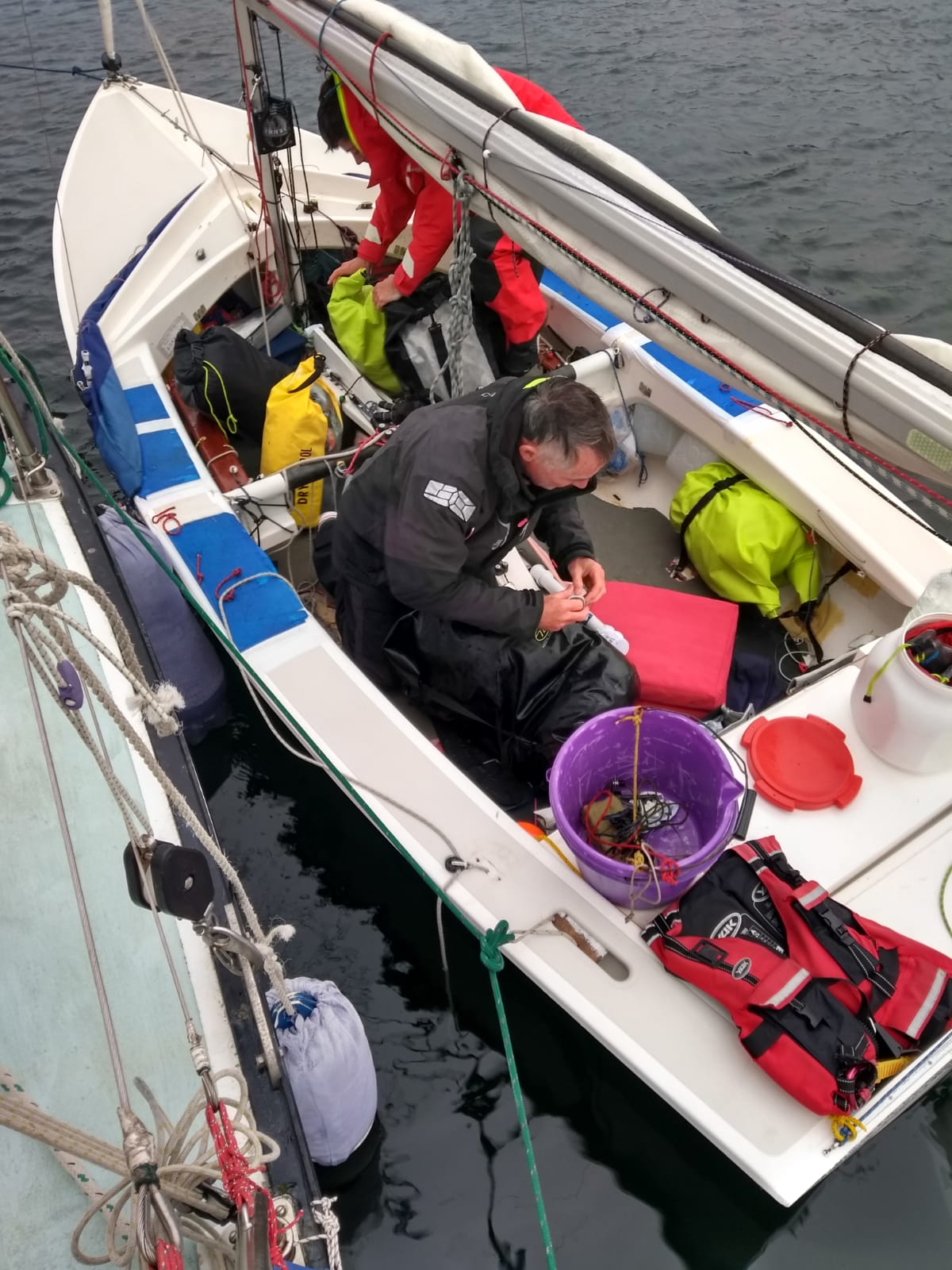
Charles’s surprise when anchored at Fair Isle a Wayfarer sailing
dinghy with two POB comes alongside for a chat. A Wayfarer is a
popular UK
4.8m open
sailing
dinghy and they had sailed about 70nm from Wick to Fair Isle. Then
they sailed about another 40nm north in open seas to Lerwick in the
Shetland Islands.
That’s
what I call adventurous boating. As I write this we’re sitting
aboard Rapport on a very chilly but fine Saturday morning, safely
anchored at Waiheke’s
Owhanake
Bay
– and that’s adventurous enough for me.
THIS IS ADVENTUROUS BOATING
I’m always impressed with people living their adventurous boating dreams in small vessels.
My younger brother Charles is a yachtsman who’s done lots of daunting sailing adventures. Among others he cruised from Perth around the northern coast of Australia to Sydney, sailed from Sydney to Lord Howe Island and back and then sailed from Brisbane to Scotland via the Med over several years while altogether racking up 14 years living aboard his 34ft van de Statd sloop, Acrobat, with his then partner, later wife Marie for.
Charles was our inspiration to embark on our own Med adventures following a visit to Turkey and a short cruise aboard Acrobat. He’sa very practical guy beinga qualified builder, cabinet maker and shipwright as well as being able to undertake many mechanical and electrical projects. Consequently Acrobat is immaculately fitted out to the high standard needed for ocean passages. But she’s quite basic by our standards having only hand-pumped fresh water, no hot water, no refrigeration and only a cockpit shower. I can’t imagine how Charles and Marie spent all those years living aboard in the Med without cold beer! He jokes that with Scotland’s cold climate lack of refrigeration is not a problem. As Marie is still working Charles does solo voyages from his home port of Lossiemouth in the Firth of Forth (close to Loch Ness and the Culloden battlefield) and is currently on a month long trip North Sea cruisenorth to the Orkney and Faroe Islands. This is serious sailing – The Orkneys are about half way from Scotland’s north coast to Iceland and the Pentland Firth between Scotland and the Orkneys has some of the planet’s strongest tides – up to 16kn.Quote “the force of the tides gives rise to overfalls and tidal races …. and often give rise to extremely violent sea conditions …. the races are highly visible with overfalls and whirlpools.”
Imagine Charles’s surprise when anchored at Fair Isle a Wayfarer sailing dinghy with two POB comes alongside for a chat. A Wayfarer is a popular UK 4.8m open sailing dinghy and they had sailed about 70nm from Wick to Fair Isle. Then they sailed about another 40nm north in open seas to Lerwick in the Shetland Islands.
That’s what I call adventurous boating. As I write this we’re sitting aboard Rapport on a very chilly but fine Saturday morning, safely anchored at Waiheke’s Owhanake Bay– and that’s adventurous enough for me.
Road Trip to Seattle: Florida
In early June, we loaded Spitfire and our luggage into a rental car and set off on a 4,200-mile (6,760 km) road trip from Charleston, SC to Seattle, WA. We spent the first two nights in Florida, first in Jacksonville and then in Pensacola, after passing from South Carolina through Georgia and traveling 598 miles…
Charleston
We really enjoyed our first week back in the US at Charleston City Marina after our month-long passage from Dublin via Horta. It was hard to believe that a few months earlier we were in Farsund, Norway and frozen in with ice so thick we could walk on it and now we were in Charleston,…
ENJOY YOUR WINTER CRUISING
We’ve owned Rapport now
for a year and a half, finding her to be a great cruising vessel,
however
when you
buy a pre-owned boat you inevitably make compromises compared to your
perfect desired boat. In our case there were three compromises, which
I’ll discuss.
1.
Rapport has
a large flybridge with full headroom and our compromise here was
having plastic clears as opposed to glass. Particularly facing
forward, glass is a big plus especially in heavier seas when there’s
a lot of spray reducing visibility. However Rapport’s clears are
exceptionally good being polycarbonate which
appears to retain its clarity for longer than vinyl and
we’re
just about to treat these with RainX-Plastic which should
considerably increase visibility with rain or spray. In general we’re
pretty happy with these clears and won’t consider glass as an
option until it’s time to replace the clears.

2.
We prefer gas cooking to electric. There’s a lot said about gas
safety
issues, but we’re perfectly comfortable with professionally
installed lpg systems with gas detectors. The main plus with lpg is
you can cook without running a generator. Rapport has electric bench
top hobs and a convection microwave. It took a while to get used to
the convection microwave
and while
Di says she would still prefer a “proper oven” we find it
adequate, supplemented by an electric frying
pan. To
avoid
having
to start the generator just to make a morning
cup of tea
or coffee we bought a small bench top single hob “Gasmate” stove.
This uses disposable lpg bottles which only cost $1.35 and last one or two
days. We also use this for boiling vegetables etc. There’s
no problem using electric cooking while the main engines are running
and charging the batteries, in fact for any electrical device that uses heat like kettles, toasters and hair driers an engine or generator needs to be running due to high current draw. Using
the generator for cooking in the evening is also
not a
problem as we often need to run it to charge our house battery bank,
particularly if we haven’t run the main engines that day. In the
summer most of our cooking is on a lpg BBQ and we really enjoy using
that. So in conclusion we’ve adapted and will continue with the
present system.
3.
As you will have read in our last posting we really enjoy using our
dinghy and ideally wanted a 3m rigid-hulled inflatable with a 15hp
4-stroke outboard, lifted
on board by crane. Rapport came with an old TakaCat inflatable that
after a few weeks we literally threw away as it had so many air
leaks. In
any case its 6hp Mercury outboard was too heavy for us to comfortably
lift on and off the dinghy.
Our current small Aquapro

As
came without
a crane and
we needed something in a hurry that the two of us could lift onto the
foredeck cradle we bought a very lightweight (33kg) Aquapro SLR 2.6m
rigid-hulled inflatable with a Honda 2.5hp air cooled outboard. We
had one of these Hondas in the Med and found it to be super – very
reliable and nearly always starting first pull. This package has
worked well but was always a temporary solution. We’re now going to
sell the Aquapro/Honda and upgrade to an approx 3m rigid hulled
inflatable with a 15hp 4-stroke outboard. This will give us planing
ability with at least two adults, more
room when we have often have four adults aboard, longer
range and better rough water capability. Not
to mention much more fun! Bear in mind that on a typical coastal
cruiser your inflatable is also your life raft in a worst case
scenario. In order to lift this dinghy
aboard Rapport we’ll need to install an electric crane and we’re
researching whether we can store the dinghy on a new rack to be built
behind the flybridge (preferred option) or on the existing foredeck
rack. Also
researching which inflatable to buy and whether to fit a Honda,
Suzuki, Mercury or Yamaha outboard. However our choice may be be influenced by what is actually available – watch
this space.
ENJOY
YOUR WINTER CRUISING
In
many European and North American boating locations Autumn is time to
winterise
your boat and leave it until Spring, however in Auckland
there’s
no reason not
to swap
shorts and tee-shirts for jeans and sweatshirts and enjoy
most of what cruising has to offer throughout
our
winter.
Average
weather statistics will
surprise you. For
example Auckland’s average daytime winter temperature is 14-15dC
while by
comparison popular
cruising destination Scotland has an average
summer
temperature
of only
15-17dC.
Also
surprisingly, on
average January is Auckland’s windiest month while the least windy
are March and May through
August. In
Auckland showers
are more prevalent than constant rain and the weather out among the
Gulf
islands is
invariably sunnier than on the mainland. For
example we often look back from Waiheke basking in the
sunshine to
see the mainland shrouded by cloud.
Auckland
is New
Zealand’s most populous boating area where
the Hauraki Gulf’s
Mahurangi
Harbour and Kawau Bay to the north-west, Great Barrier Island to the
north-east and the string of islands from Rangitoto to Ponui in the
south offer
safe shelter in most weather conditions all year round.
Cruising
in winter offers
less crowded anchorages, good fishing and
also means
using your boat regularly, thereby reducing the chances of unexpected
problems. I often see owners starting their diesel engines at the
marina during winter, however engineers tell
me there’s
no substitute for using your boat regularly and working
your
engines under load at normal operating temperature, which can’t be
achieved in the marina. In
fact I’ve been told that starting your engines without loading them
can do more harm than good.
The
winter nights are of course longer from around 1800 to 0700 hours.
We find keeping warm not an issue with heat from the galley, an
electric fan heater powered from our generator and a portable gas
heater. Other
systems such as diesel heaters are also available. Ensure adequate
ventilation when
using gas heaters to avoid dangerous build ups of carbon
monoxide.
We
had planned a ten day family cruise for late May and as departure
approaches
we watch the
forecast with some consternation. The approaching weather system
is
so unusual that the media describes
it as a
“weather bomb,” caused by a ridge of high pressure in the eastern
Tasman Sea combining with a deep low pressure trough north-east
of the North Island to cause south-easterly winds in excess of 40
knots and exceptionally high swells in excess of four metres. A
gale
warning is
issued for
the Hauraki Gulf, but only a strong wind advisory for
the Waitemata harbour, so we modify
our plans to avoid the outer
Gulf and
enjoy the Waiheke area.
We
leave on
a Friday
afternoon in a light south-easterly breeze and cruise to Owhanaki Bay
on Waiheke’s north-west-coast. Here
is perfect
for the
forecast strong
south-east
winds and we find only a handful of boats anchored here
providing
us with plenty of all-important
swinging room.
We’re
cautious about this as having
anchored many nights over the years in adverse conditions our only
problems have ever been caused by other anchored vessels coming
adrift and hitting us.
The rocks
either side of the bay’s entrance are awash with a larger than
normal swell, but where
we’re anchored there’s just a gentle lift. With the wind
predicted to increase to 25 knots we elect to stay here for the next
couple of days finding it perfectly comfortable and secure.
Winter rainbow in Chamberlin’s Bay, Ponui

By
Tuesday it’s a beautiful sunny day, albeit a bit colder as the wind
increases
and temporarily
shifts a bit to the south. We anchor off Oneroa Bay, slightly further
east, where our family members join us having arrived by ferry at
Matiatia. We
want to cruise east to the Waiheke Channel and it’s decision time.
Do we take the route to the north of Waiheke enjoying the sheltered
northern coast, but risking heavy south-east seas when we turn south
into the Firth of Thames, or do we cruise east along the Tamaki
Strait on the
southern side of Waiheke expecting a large
wind-driven
chop for most of the way but no heavy seas? We elect the latter and
cruise south
down
the
west coast of Waiheke in tranquillity before turning east at Park
Point into the full brunt of a steady 35 knot south-easterly gusting
into the 40s. Although the wind-driven chop is about two metres high
it’s
directly on our bow so Rapport’s 16 metre hull handles the
conditions well at about 8 knots with plenty of spray but little
discomfort and with
conditions
gradually improving
as we approach the Waiheke Channel.
Normally
with a south-east wind we’d anchor in Ponui
Island’s Chamberlin’s
Bay, but with
the exceptionally strong winds we
find residual
swell from the Firth
of Thames so anchor slightly further to the east in the more
sheltered Te Kawau Bay.
During
the next few days
the south-easterly is
far too strong to venture out into our favoured fishing areas of the
Firth so we seek out
new fishing spots in the more
sheltered waters of
the Waiheke Channel finding
two locations
that provide
plenty of action.
Faced
with the “weather bomb” it would have been all too easy to cancel
our cruise, but we enjoy ten great days away confirming that winter
cruising even in poor weather can be enjoyed.
ENJOY YOUR WINTER CRUISING
We’ve owned Rapport now for a year and a half, finding her to be a great cruising vessel, however when you buy a pre-owned boat you inevitably make compromises compared to your perfect desired boat. In our case there were three compromises, which I’ll discuss.
1. Rapport has a large flybridge with full headroom and our compromise here was having plastic clears as opposed to glass. Particularly facing forward, glass is a big plus especially in heavier seas when there’s a lot of spray reducing visibility. However Rapport’s clears are exceptionally good being polycarbonate which appears to retain its clarity for longer than vinyl and we’re just about to treat these with RainX-Plastic which should considerably increase visibility with rain or spray. In general we’re pretty happy with these clears and won’t consider glass as an option until it’s time to replace the clears.
2. We prefer gas cooking to electric. There’s a lot said about gas safety issues, but we’re perfectly comfortable with professionally installed lpg systems with gas detectors. The main plus with lpg is you can cook without running a generator. Rapport has electric bench top hobs and a convection microwave. It took a while to get used to the convection microwaveand while Di says she would still prefer a “proper oven” we find it adequate, supplemented by an electric frying pan. To avoidhavingto start the generator just to make a morning cup of tea or coffee we bought a small bench top single hob “Gasmate” stove. This uses disposable lpg bottles which are cheap and last one or two days. We also use this for boiling vegetables etc. There’s no problem using electric cooking while the main engines are running and charging the batteries. Using the generator for cooking in the evening is also not a problem as we often need to run it to charge our house battery bank, particularly if we haven’t run the main engines that day. In the summer most of our cooking is on a lpg BBQ and we really enjoy using that. So in conclusion we’ve adapted and will continue with the present system.
3. As you will have read in our last posting we really enjoy using our dinghy and ideally wanted a 3m rigid-hulled inflatable with a 15hp 4-stroke outboard, lifted on board by crane. Rapport came with an old TakaCat inflatable that after a few weeks we literally threw away as it had so many air leaks. In any case its 6hp Mercury outboard was too heavy for us to comfortably lift on and off the dinghy.
As Rapport came without a crane and we needed something in a hurry that the two of us could lift onto the foredeck cradle we bought a very lightweight (33kg) Aquapro SLR 2.6m rigid-hulled inflatable with a Honda 2.5hp air cooled outboard. We had one of these Hondas in the Med and found it to be super – very reliable and nearly always starting first pull. This package has worked well but was always a temporary solution. We’re now going to sell the Aquapro/Honda and upgrade to an approx 3m rigid hulled inflatable with a 15hp 4-stroke outboard. This will give us planing ability with at least two adults, more room when we have often have four adults aboard, longer range and better rough water capability. Not to mention much more fun! Bear in mind that on a typical coastal cruiser your inflatable is also your life raft in a worst case scenario. In order to lift this dinghyaboard Rapport we’ll need to install an electric crane and we’re researching whether we can store the dinghy on a new rack to be built behind the flybridge (preferred option) or on the existing foredeck rack. Also researching which inflatable to buy and whether to fit a Honda, Suzuki, Mercury or Yamaha outboard – watch this space.
ENJOY YOUR WINTER CRUISING
In many European and North American boating locations Autumn is time to winteriseyour boat and leave it until Spring, however in Auckland there’s no reason not to swap shorts and tee-shirts for jeans and sweatshirts and enjoy most of what cruising has to offer throughoutourwinter.
Average weather statistics willsurprise you. For example Auckland’s average daytime winter temperature is 14-15dC while bycomparison popular cruising destination Scotland has an averagesummertemperature of only 15-17dC. Also surprisingly, on average January is Auckland’s windiest month while the least windy are March and May throughAugust. In Auckland showers are more prevalent than constant rain and the weather out among the Gulf islands is invariably sunnier than on the mainland. For example we often look back from Waiheke basking in the sunshine to see the mainland shrouded by cloud.
Auckland is New Zealand’s most populous boating area where the Hauraki Gulf’sMahurangi Harbour and Kawau Bay to the north-west, Great Barrier Island to the north-east and the string of islands from Rangitoto to Ponui in the south offer safe shelter in most weather conditions all year round.
Cruising in winter offersless crowded anchorages, good fishing and also means using your boat regularly, thereby reducing the chances of unexpected problems. I often see owners starting their diesel engines at the marina during winter, however engineers tell me there’s no substitute for using your boat regularly and working your engines under load at normal operating temperature, which can’t be achieved in the marina. In fact I’ve been told that starting your engines without loading them can do more harm than good.
The winter nights are of course longer from around 1800 to 0700 hours. We find keeping warm not an issue with heat from the galley, an electric fan heater powered from our generator and a portable gas heater. Other systems such as diesel heaters are also available. Ensure adequate ventilation when using gas heaters to avoid dangerous build ups of carbon monoxide.
We had planned a ten day family cruise for late May and as departure approacheswe watch theforecast with some consternation. The approaching weather system isso unusual that the media describesit as a “weather bomb,” caused by a ridge of high pressure in the eastern Tasman Sea combining with a deep low pressure trough north-eastof the North Island to cause south-easterly winds in excess of 40 knots and exceptionally high swells in excess of four metres. A gale warning is issued forthe Hauraki Gulf, but only a strong wind advisory forthe Waitemata harbour, so we modifyour plans to avoid the outer Gulf and enjoy the Waiheke area.
We leave on a Friday afternoon in a light south-easterly breeze and cruise to Owhanaki Bay on Waiheke’s north-west-coast. Here is perfect for the forecast strong south-east winds and we find only a handful of boats anchored here providing us with plenty of all-important swinging room. We’re cautious about this as having anchored many nights over the years in adverse conditions our only problems have ever been caused by other anchored vessels coming adrift and hitting us. The rocks either side of the bay’s entrance are awash with a larger than normal swell, but where we’re anchored there’s just a gentle lift. With the wind predicted to increase to 25 knots we elect to stay here for the next couple of days finding it perfectly comfortable and secure.
ByTuesday it’s a beautiful sunny day, albeit a bit colder as the wind increases and temporarily shifts a bit to the south. We anchor off Oneroa Bay, slightly further east, where our family members join us having arrived by ferry at Matiatia. We want to cruise east to the Waiheke Channel and it’s decision time. Do we take the route to the north of Waiheke enjoying the sheltered northern coast, but risking heavy south-east seas when we turn south into the Firth of Thames, or do we cruise east along the Tamaki Strait on thesouthern side of Waiheke expecting a large wind-driven chop for most of the way but no heavy seas? We elect the latter and cruise south down the west coast of Waiheke in tranquillity before turning east at Park Point into the full brunt of a steady 35 knot south-easterly gusting into the 40s. Although the wind-driven chop is about two metres high it’s directly on our bow so Rapport’s 16 metre hull handles the conditions well at about 8 knots with plenty of spray but little discomfort and with conditions gradually improvingas we approach the Waiheke Channel. Normally with a south-east wind we’d anchor in Ponui Island’s Chamberlin’s Bay, but with the exceptionally strong winds we find residual swell from the Firth of Thames so anchor slightly further to the east in the more sheltered Te Kawau Bay.
During the next few daysthe south-easterly isfar too strong to venture out into our favoured fishing areas of the Firth so we seek out new fishing spots in the more sheltered waters ofthe Waiheke Channel finding two locationsthat provide plenty of action.
Faced with the “weather bomb” it would have been all too easy to cancel our cruise, but we enjoy ten great days away confirming that winter cruising even in poor weather can be enjoyed.
Charleston Arrival
We completed the final leg of our passage from Horta to Charleston in the same conditions as we started, with light winds, calm seas and great speed. In the middle, we had two weather systems to contend with, including the first named storm of the year, tropical storm Ana. Photo courtesy Pierce and Janet Guyer…
Into the Storm
In determining our route from Ireland to Charleston this May, we had a number of choices. The naive option was to proceed directly from Ireland to Charleston, taking roughly the opposite route to our 2017 passage from Newport, RI to Kinsale, Ireland almost four years earlier to the day. But a near-steady procession of intense…
Azores High
The most direct route from the Azores to the US is an 1,800-mile great circle route to Bermuda (the red dashed line above), then a 600-800-mile run to the US, depending on our landing choice. The problem with that routing is that the winds predominately blow from the west, on the bow, and we would…
