Archive | Envoy RSS feed for this section

CRUISING ABOARD MORITZ – PART 2

CRUISING ABOARD MORITZPART 2

Envoy is in Lefkas Marina for the northern hemisphere winter while we’re home for the New Zealand summer – but not for much longer as in early April we start our journey back end of next week.

First we’ll be spending 10 days in the Orkney Islands off Scotland’s north-west coast, where I’m sure there will be plenty of boating-related material to write about. Then we head to Athens for the six hour bus trip to Lefkas Marina and Envoy.

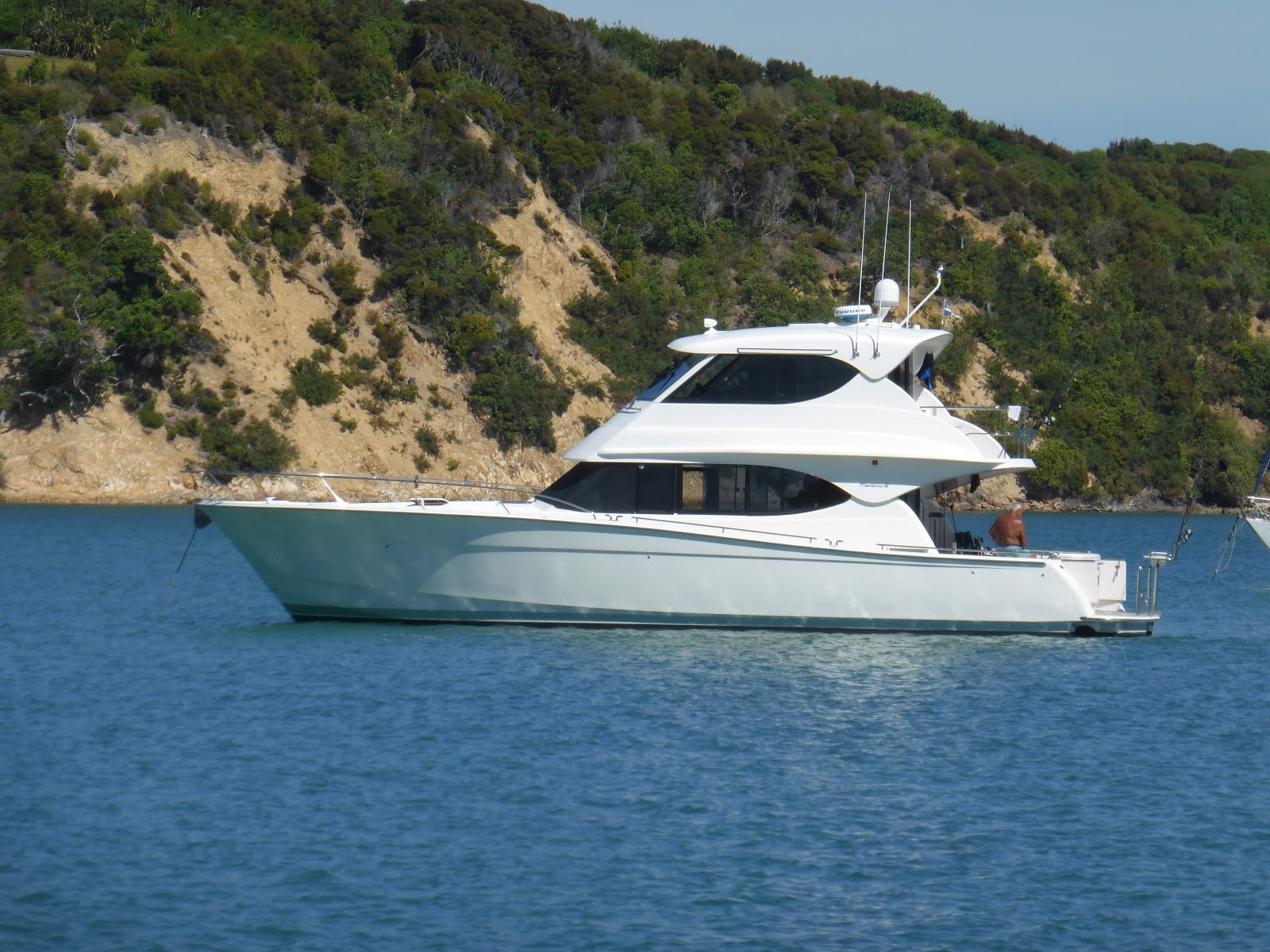
Continuing on from our last Blog posting we’re aboard stunning Maritimo 48 foot motor yacht, Moritz,  owned by our friends Morris and Gail.

On day two we wake up well-refreshed and while eating breakfast quietly cruise across to Waiheke Island to anchor in Matiatia Bay. 

Matiatia Bay wharf from Moritz at anchor


Here we go ashore to walk around the headland overlooking Matiatia while culturally enriching ourselves by viewing the Sculpture on the Gulf Exhibition supported by about 50 sponsors including respected international names like Jaguar, Sothebys and Mazda.

The 30 or so sculptures are spread along a hilly coastal track about two miles long and range from “is that art? Gosh a five year old could do that” to incredibly clever. Sedately viewing them amongst stunning landscapes is a great way to enjoy our morning walk.

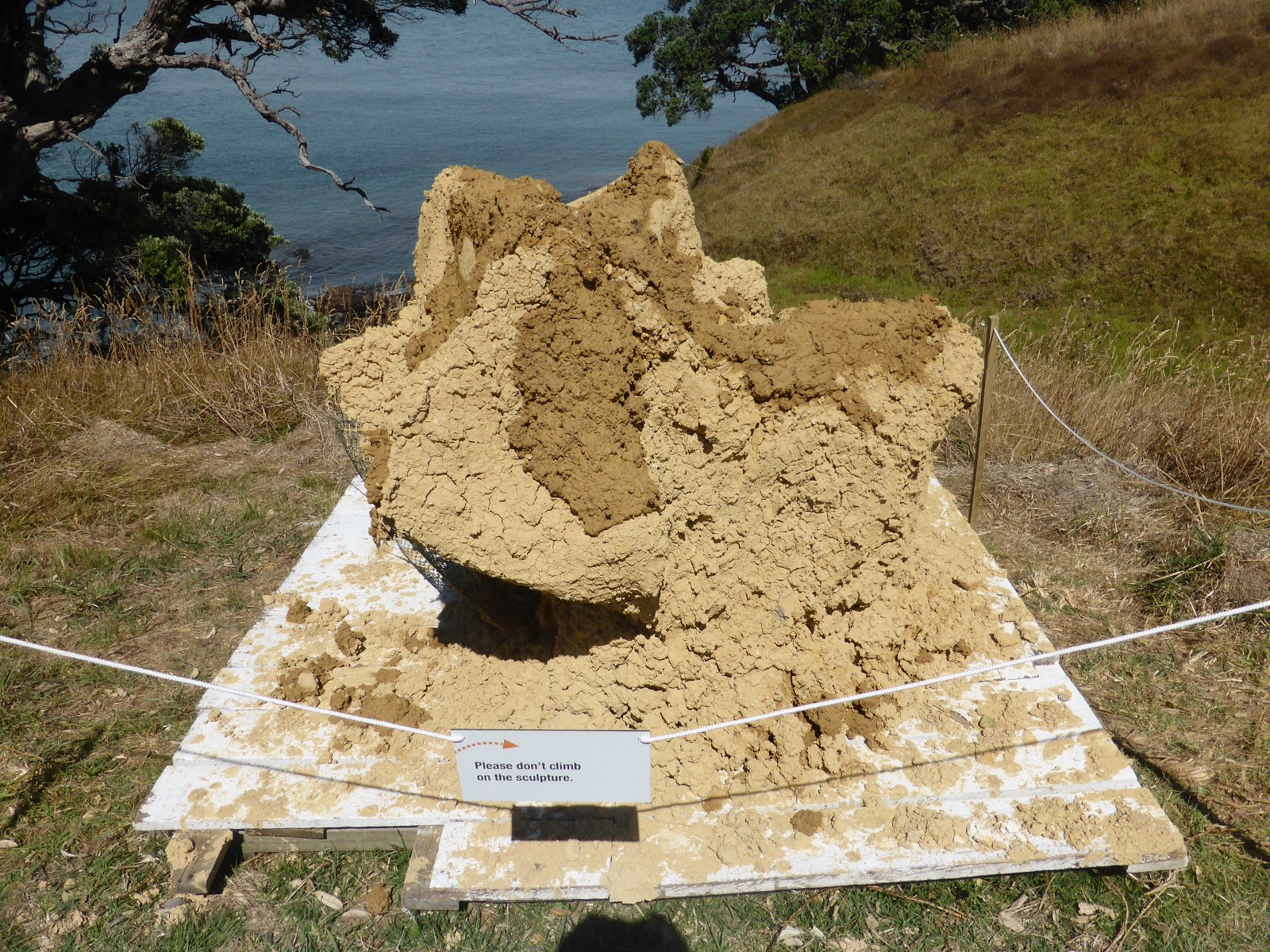
This “sculpture” has us scratching our heads

But we liked this one

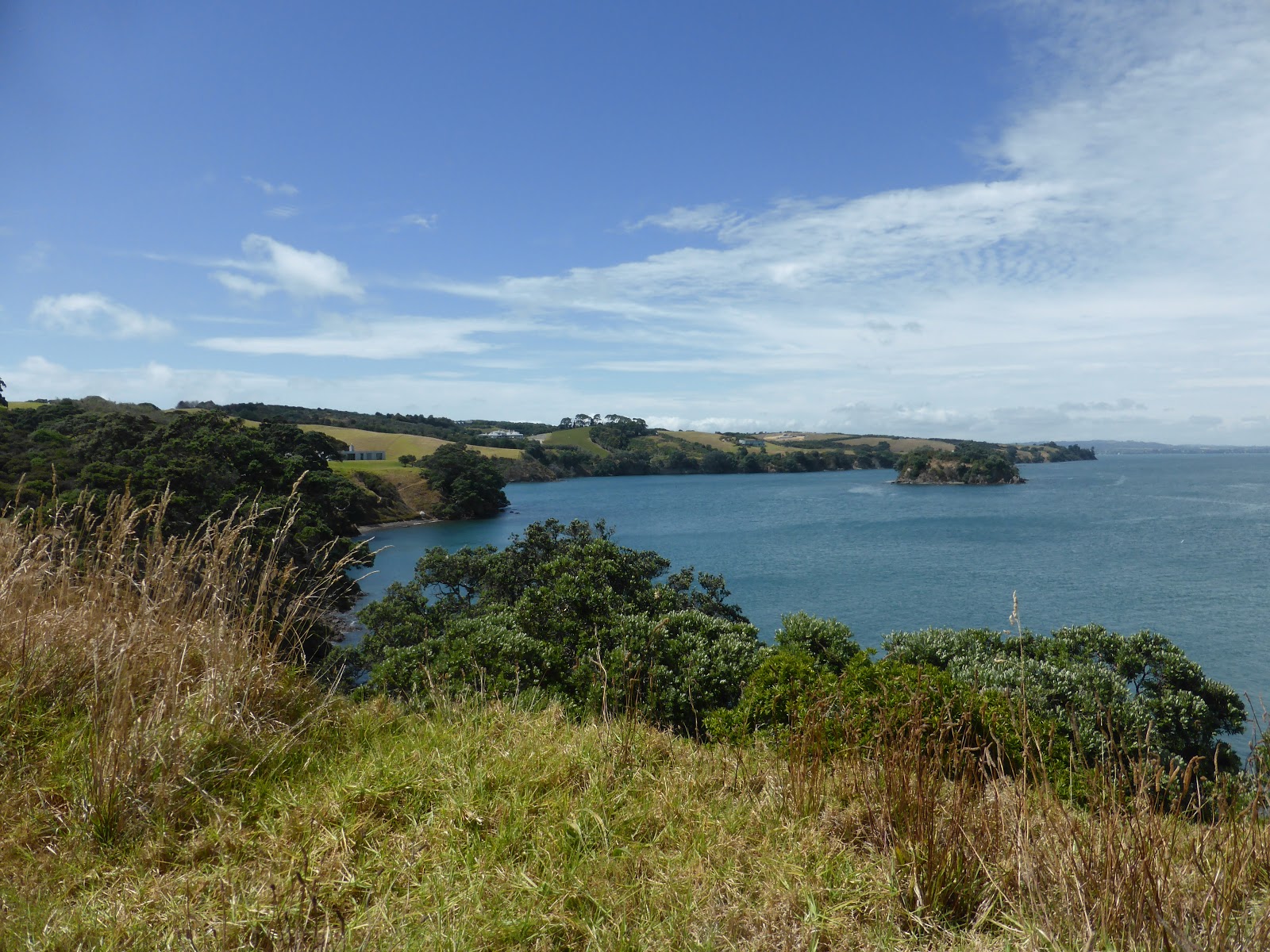
And the views along the walk are great

Looking down on Matiatia Bay

Later we cruise along Waiheke’s northern shore and across a flat-calm Firth of Thames to Elephant Cove (so-named as the imposing rocks on its northern entrance look like an elephant’s head) on Motukahaua Island.

Inside Elephant Cove

There’s not much anchoring room in the small cove with two boats already there, but Morris finds a great spot still leaving room for two more boats that come in later.

Fishing is a huge part of the New Zealand boating scene and next morning we try several spots down the coast, but without success. For some reason Auckland’s summer sea temperature at 19 degrees is about two degrees cooler than usual and the snapper don’t like it, but we see a nearby school of kahawai and manage to catch several in just a few minutes with trolling lures.

Morris then takes us to his “secret spot X” where a rock awash at low tide has a surprisingly abundant supply of green-lipped mussels, so that night we’re anchored on the eastern side of Waimate Island just north of Coromandel Harbour having a great feed of fresh sashimi and mussels.

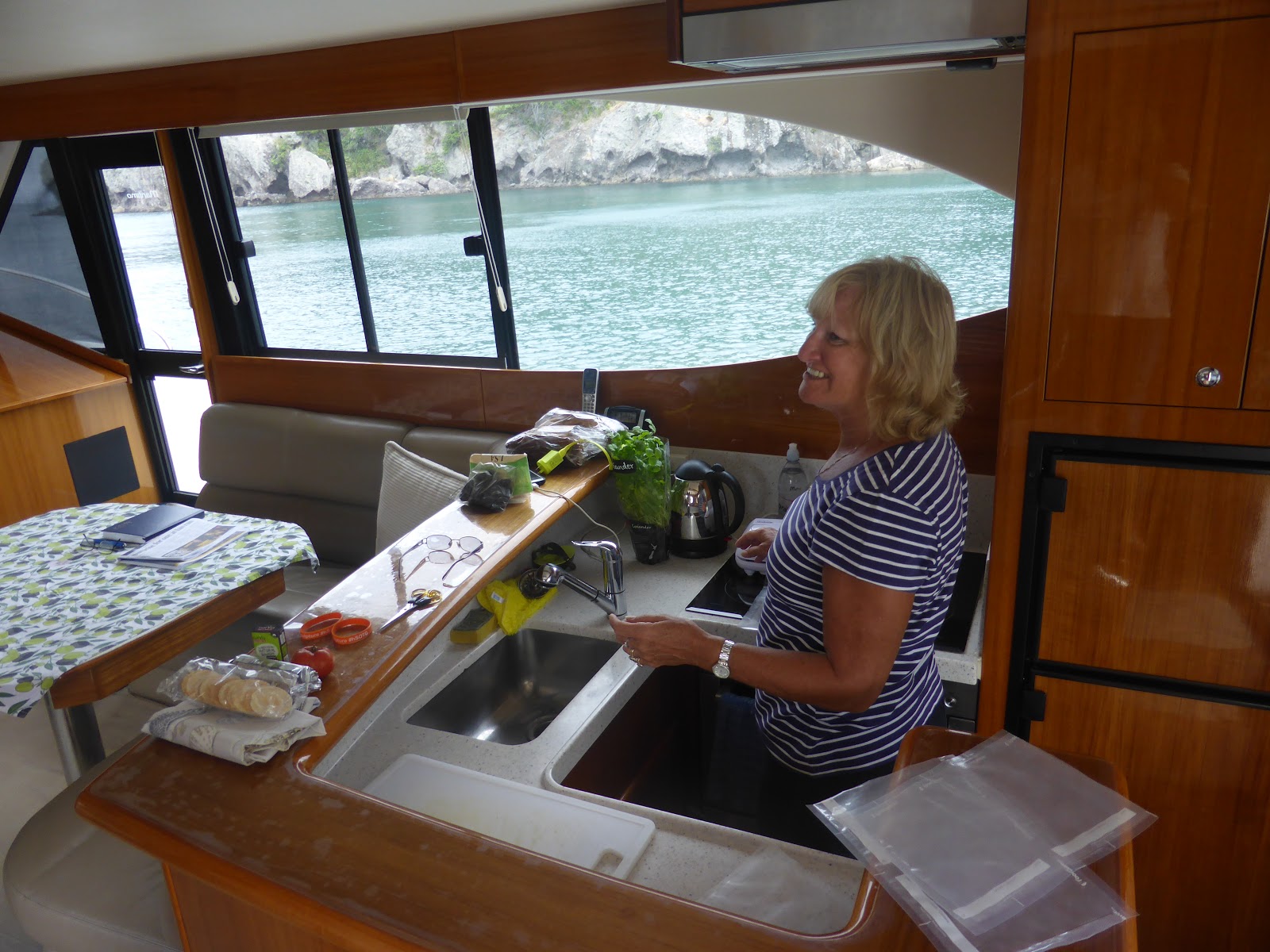
Gail in Moritz’s galley
The village of Coromandel is quirky and arty, embracing what you might call “alternative culture” and just before next day’s high tide we anchor off the shallow creek heading to the town. We don’t really need any supplies but it’s a tradition to head up the creek in your dinghy while high tide allows and sample pies or doughnuts from the bakery and a beer from the pub, though on this occasion we opt for coffees.

Morris guides us up the very tidal Coromandel Creek
 

New Zealand regulations sensibly require all boats to carry correctly-sized life jackets for all people, while on those boats under six metres they must be worn unless the skipper determines it is safe not to do so. For example crossing a bar is dangerous and they should be worn but perhaps the’re not necessary (except for non swimmers) if you’re simply going a few metres from one boat to another. However Coromandel comes under a different jurisdiction requiring jackets to be worn at all times and we’re pleased to have complied when the harbourmaster’s boat passes nearby.

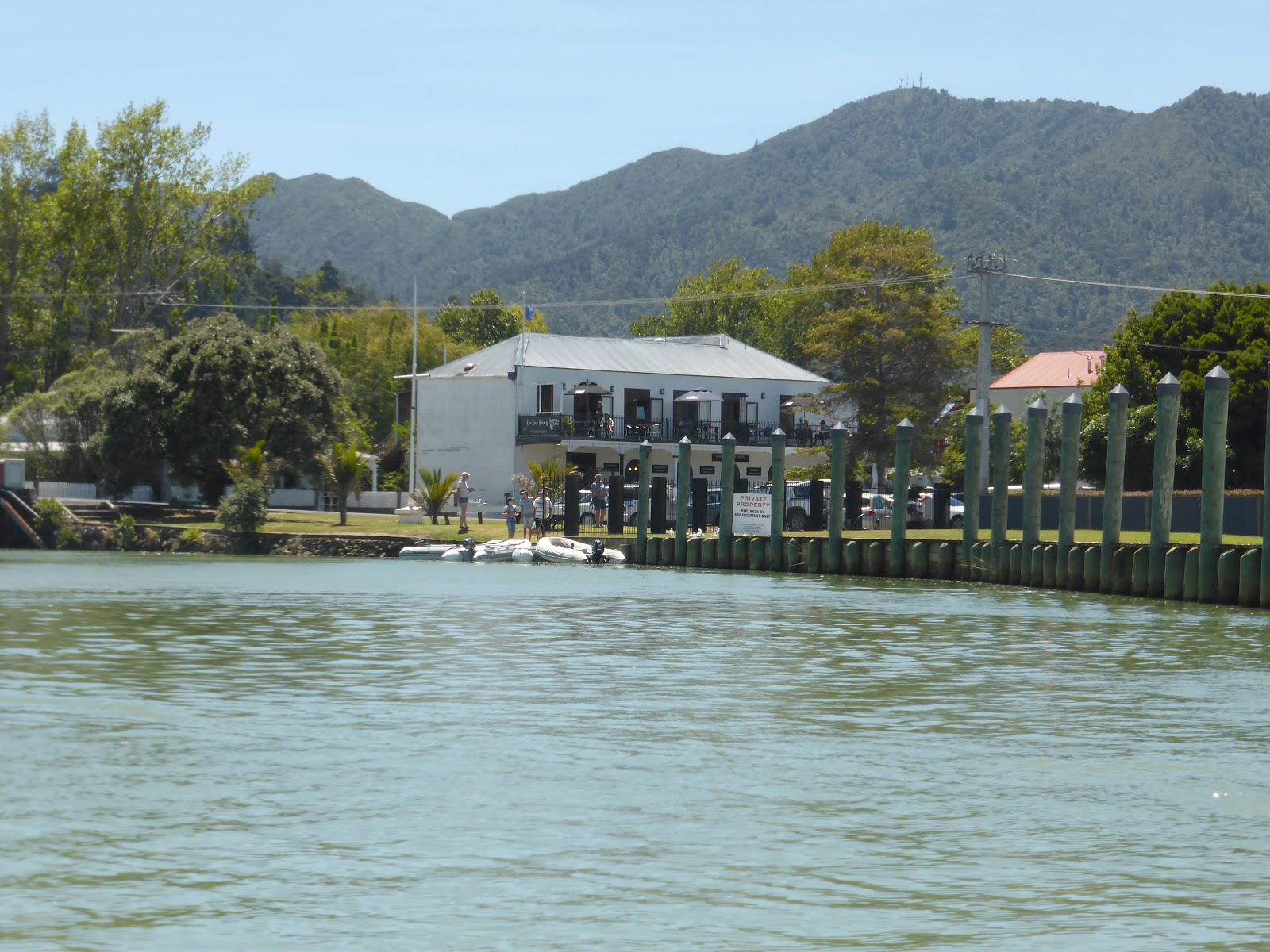
Coromandel village is at the creek’s head

After a night anchored in serene Te Kouma harbour we’re heading back across the Firth of Thames to Hooks Bay on the eastern side of Waiheke to meet mutual friends for brunch aboard their boat.

Next day we pull the fishing rods out again without landing a single fish, then anchor off Rotorua Island which used to be an alcohol rehabilitation centre run by the Salvation Army off-limits to the public. Recently the centre moved and the island has been opened up to the public, also making available some stunning formerly inaccessible beaches. Ashore there’s an interesting museum documenting the valuable work done by the “Sallies” with addicts over several decades.

Rotoroa’s stunning beaches like this one are now accessible

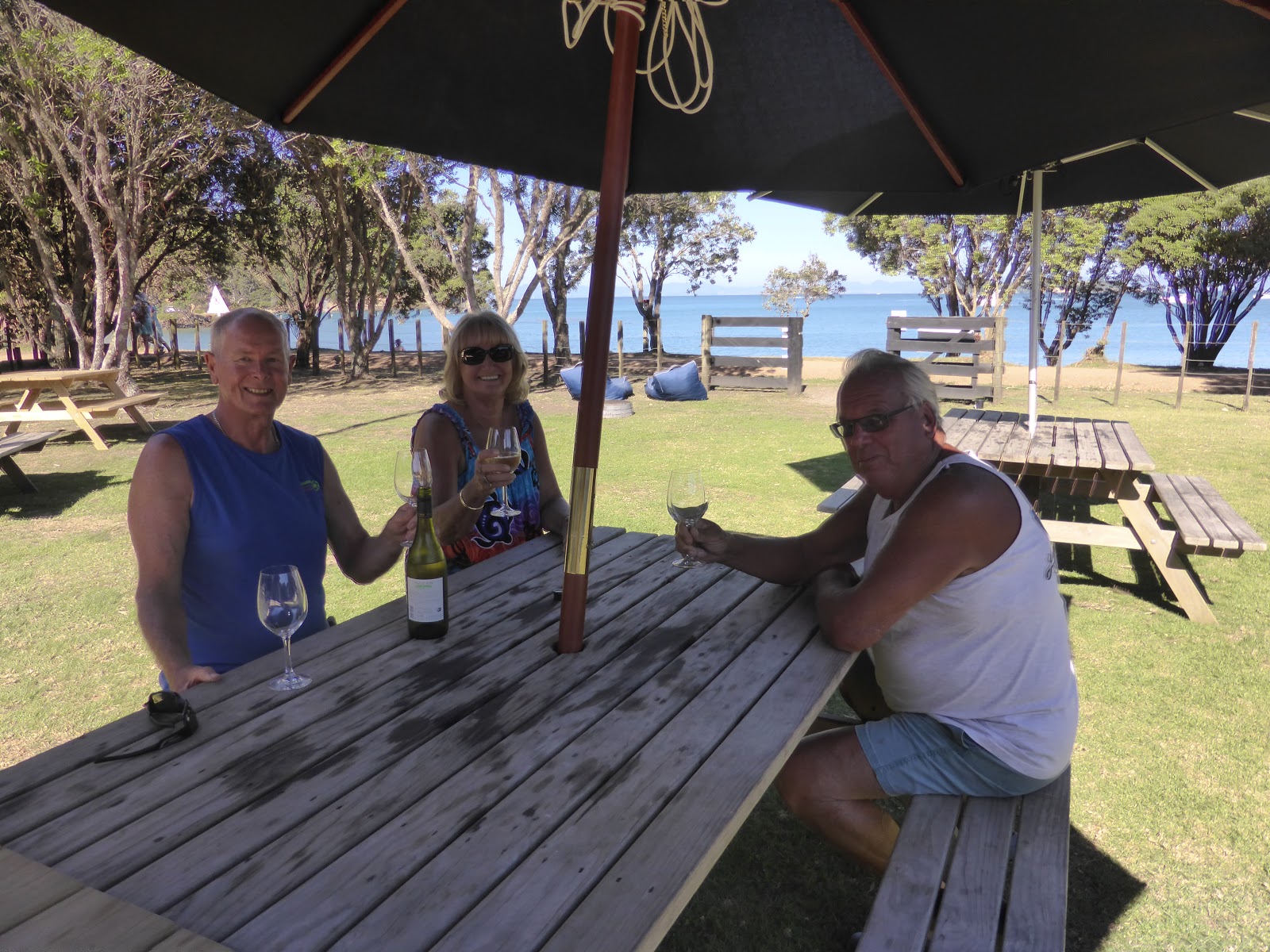
Our last night is spent nearby anchored off Waiheke’s Man O’War Bay where we visit the Man O’War Vineyard – an excellent place to enjoy a pre-dinner glass of wine or three.

Laurie, Di and Morris enjoy a wine at the vineyard

Thanks very much to our hosts Morris and Gail and the good ship Moritz.

CRUISING ABOARD MORITZ – PART 1

Envoy is in Lefkas Marina for the northern hemisphere winter while we’re home for the New Zealand summer, returning next month.

It’s early February, nearly three months since we left Envoy and after such a break from boating we’re ready for some more, happily accepting an invitation to join long-time friends Morris and Gail Watson for a few days aboard “Moritz”, a Maritimo 48 motor yacht in Auckland’s superb Hauraki Gulf.

Maritimos are upper end of the market planing motor yachts built in Queensland’s Gold Coast. 
The company’s owner, Bill Barry-Cotter, is well experienced in the marine industry and formerly owned Riviera – also builders of popular planing motor yachts. We presume the name is inspired by Maritimo Island, one of the Egadi Islands located off the north-west coast of Sicily where coincidentally we visited in 2014.

Moritz is a big volume luxury boat

We meet Morris and Gail at Half Moon Bay Marina and quickly settle on Moritz – not only have we been aboard previously but Morris and Gail have cruised aboard Envoy with us in the Aegean Sea. In fact they’re also meeting us this year for a week in Sicily.

Being a weekday there are no other boats around and the sun is shining with little wind as we cruise sedately down the Tamaki River sipping a cold welcome-aboard beer.

Moritz is a luxuriously appointed big-volume boat with three staterooms, two having en-suite heads and bathrooms. The saloon has plenty of seating and a generous sized dining area while access to the huge flying bridge area is by an easily manageable staircase rather than the glorified ladder that many boats have.

The staircase to Moritz’s flybridge is way better than the ladder we had on our last boat

Full walk-around decks give great access for crew duties, while a huge cockpit and boarding platform give ample space for outdoor entertaining and fishing. Previously I’ve been one of about 18 people aboard Moritz for a day’s fishing without the boat feeling over-crowded.

Apparently there’s a trend away from flybridge vessels to sedan style, but I honestly find this difficult to understand unless a buyer is really particular about a sportier appearance or has an issue with air draft. Flybridges work really well on larger boats providing much greater usable space and storage space for the same length, vastly improved unobstructed visibility and reduced engine noise at the helm. Advocates of the sedan style say it’s nice to have all the crew in the same space, but I believe it’s a much greater plus to have an additional and separate area of space. Another factor is that when seas are a bit rough, it’s less claustrophobic and all looks a bit better looking down on the waves from on high.

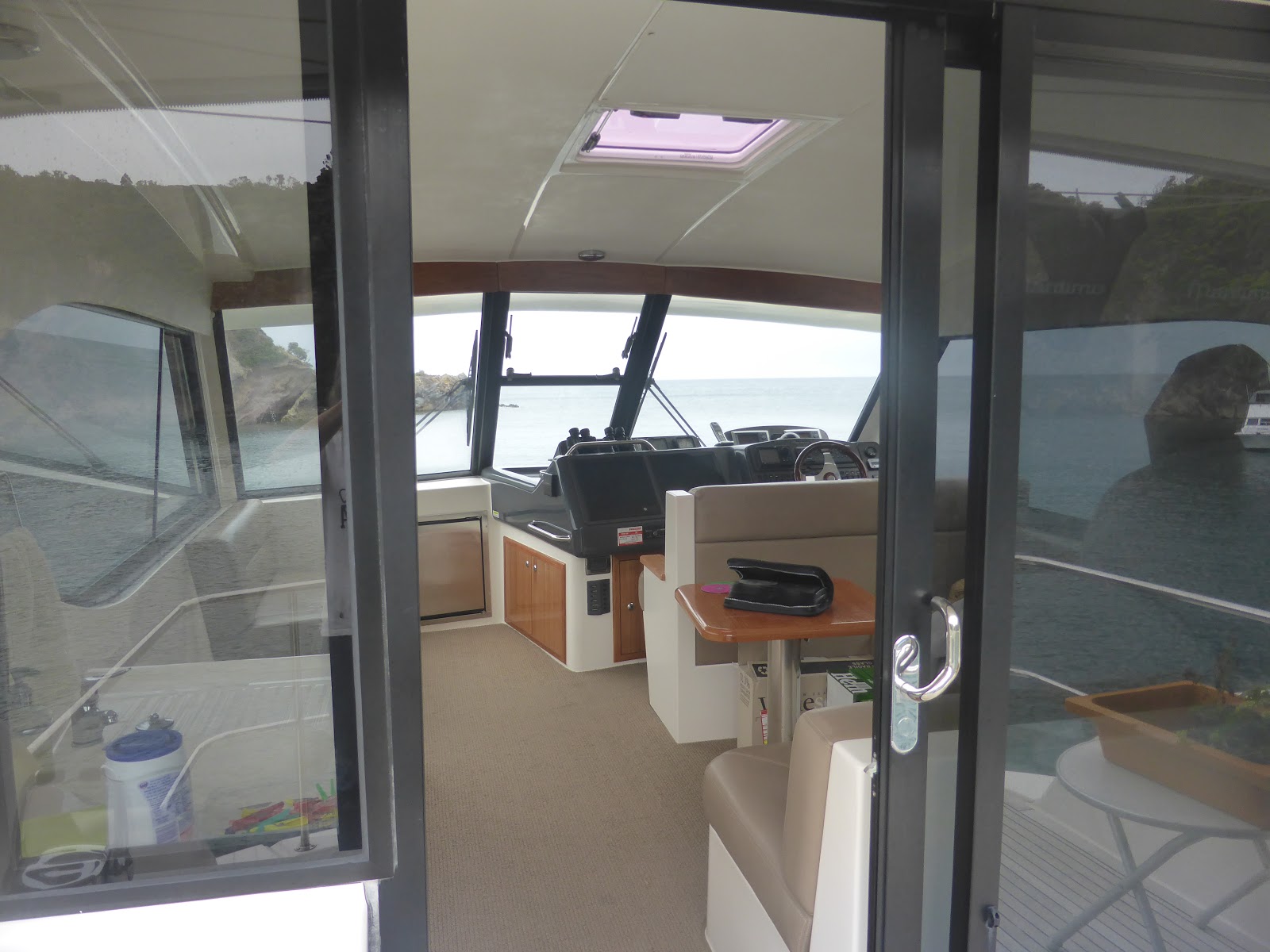
Moritz’s flybridge is perfect with full headroom, just the single helm position (in my opinion additional helm stations below add unnecessary expense and take a lot of space), glass windows (vinyl clears have restricted visibility in rough conditions and don’t stay pristine for more than a couple of seasons), plenty of comfortable seating, a small fresh water sink and refrigerator, and easy staircase access.

With a flybridge like this who’d want a sedan style cruiser?

Some critics of flybridges also cite their additional windage, but in fact windage is generally not a problem applicable to boats (it has negligible effect compared to the drag caused by water) except perhaps for some inexperienced skippers encountering high beam winds in marinas and let’s face it – most boats like this have twin engines and bow thrusters making maneuverability a breeze. Moritz even has stern thrusters! Incidentally for the technically minded hull drag caused by water increases at a phenomenal square of the increase in speed.

I do agree that flybridges don’t work so well on smaller vessels (less than about 40ft) as their seating and headroom is too low, access is more difficult and vessel stability can be impaired by a higher centre of gravity.

This trip is also interesting to us for another reason. We’re starting to think about what sort of boat we may buy back in Auckland when our Med adventures aboard Envoy are completed and so far all motor vessel options are on the table including conventional shaft-driven planing boats.
Moritz’s twin 670hp Cummins diesel engines purr away driving their shafts with minimal vibration as we clear the channel and increase rpm slightly to 930 giving a still-sedate speed of 9.2 knots and fuel consumption of 4 litres/hour for each engine.
We’re in no hurry and like many owners of fast planing boats Morris sees no benefit in going very much above displacement speed and then getting a bumpier ride and greatly increased fuel consumption. Later we’re cruising at 1090 rpm providing 10 knots and 18 litres/hour.

First stop is Motutapu Island’s Station Bay which is perfectly calm with only three other boats swinging at anchor. For me it makes an enjoyable change to be crew rather than skipper and not have tough decisions like deciding where to drop the anchor and how much chain to deploy. Morris and Gail are long time cruisers, originally aboard sailing yachts and we have the utmost confidence in them.

Leaving Motutapu Island’s Station Bay

Planing boats tend to have a different sound at night compared with their displacement cousins as wind-driven wavelets hit their planing strakes and make a little bit of noise, but we’re used to this from our former days of owning planing boats so it’s no problem.

Next Blog we cruise to Waiheke Island and the Coromandel Peninsula.

AHOY THERE CAPTAIN

Envoy is in Lefkas Marina for the northern hemisphere winter and we’re home for the New Zealand summer, returning April – not too far away now!

This is an article we wrote published by Pacific MotorBoat magazine – not to be taken too seriously!

Boating is one of the few freedoms left, a hugely relaxing pastime and as such we shouldn’t allow many things out there on the water to annoy us. I don’t easily get annoyed and even smile and wave when high-powered speedboats towing water skiers pass within a few metres of Envoy at anchor – that’s how it is in the Med.

But I’m not perfect by any means so I do find the odd thing irritating.

High on the list is boats at anchor displaying incorrect lights – I mean Rules are Rules. I must admit it tends to be mostly sailing yacht skippers who display white or coloured flashing strobe lights instead of the regulation all-round continuous white light. They justify this by saying the white light is not clearly visible to other vessels, especially against a background of lights ashore and /or high above eye level aloft the mast, whereas a flashing strobe is more visible. This is probably true, but if they’re going to display strobe lights they should also display the legally-required light. It would be interesting to see what liability was attached to a skipper whose boat was accidentally hit while displaying incorrect lights and whether he/she would be covered by insurance. Incidentally it is illegal to display any anchor light, other than an all-round white light, that could be mistaken for another navigation light such as a nearby channel marker.

Another on my list is inconsiderate skippers laying out stern anchors and/or buoying their anchors in busy anchorages.

Stern anchors are useful in exposed anchorages to keep your boat aligned with the swell to reduce rolling, but they cause problems in normal anchorages when boats swing to changing wind or tide, except of course the one with the stern anchor.

Anchor buoys can be useful in very rocky anchorages when the buoy’s line can be used to lift a fouled anchor (sometimes this works but not always), but some skippers also use them to mark the position of their anchor in an effort to discourage other skippers from anchoring anywhere nearby. There is a common misconception that a newly arriving boat should not anchor in a position where it ends up over another boat’s anchor. There’s actually nothing wrong with this practice – it could all change with the slightest wind shift, but what you shouldn’t do is lay your anchor chain over that of another boat, making it difficult for them to retrieve their anchor. These anchor buoys and their lines can be a menace when boats move with wind and tide and I have no hesitation in removing any buoy that threatens to snag our running gear and politely returning it to its owner.

Stern anchors and anchor buoys should not be used in busy anchorages like this one at Knidos, Turkey

Then there is the incorrect use of the title “Captain”. When tradesmen come aboard Envoy they usually greet me and then carry on referring to me as “Captain” which always strikes me as rather ridiculous aboard a 14 metre vessel with mostly only two people on board.

In most navies including the US, British, Australian and New Zealand the rank of Captain is very senior, in fact equating to that of Colonel in the army, whereas an army Captain equates to a navy Lieutenant (three ranks down from a navy Captain).

You don’t have to hold the rank of Captain to command a navy ship and often they are commanded by lesser ranks such as Commanders, Lieutenant Commanders or even Lieutenants on smaller vessels. By tradition in these cases he or she in command is referred to as “Captain” aboard the vessel regardless of actual rank.

Whereas “Captain” is a rank in the Armed Services, in the Merchant Navy the term “Master” describes the person in command and “Captain” is a courtesy title that correctly used applies to those marine professionals holding an internationally recognised Master’s certificate of competency and who command or have commanded a seagoing merchant ship. Those who command pleasure vessels should be referred to as the “Skipper”.

A naval Captain is a higher rank than that of Captain in the army or air force

Sometimes in boating magazines you find letters to the editor or advertisements for services signed by somebody prefixing their name with the title “Captain”. This is fine if the person concerned is or has been a Captain in the Navy or a Master in the Merchant Navy, but should not be used by for example a pleasure boat skipper, a charter boat skipper or someone who has completed a course, even those offered by leading providers such as CoastGuard and the Royal Yachting Association. Some other marine education providers call their offering a “Captain’s Course” but a graduate cannot correctly be called a Captain; this is about as ridiculous as the local Darts Team Captain using the title outside of the pub.

STABILISERS PART 3

Envoy is in Lefkas Marina for the northern hemisphere winter while we’re home for the New Zealand summer returning to Greece in April.

Our last Post discussed passive stabilisers.

This shot shows Laurie holding a bird, connected to a winch for lowering into the water. You can see the holes on top of the bird for adjusting the stabilising effect

Active stabilisers consist of a fin mounted below the waterline extending out each side of the hull using mostly hydraulics but in some systems electric motors to move them like aircraft ailerons to counteract rolling motion.

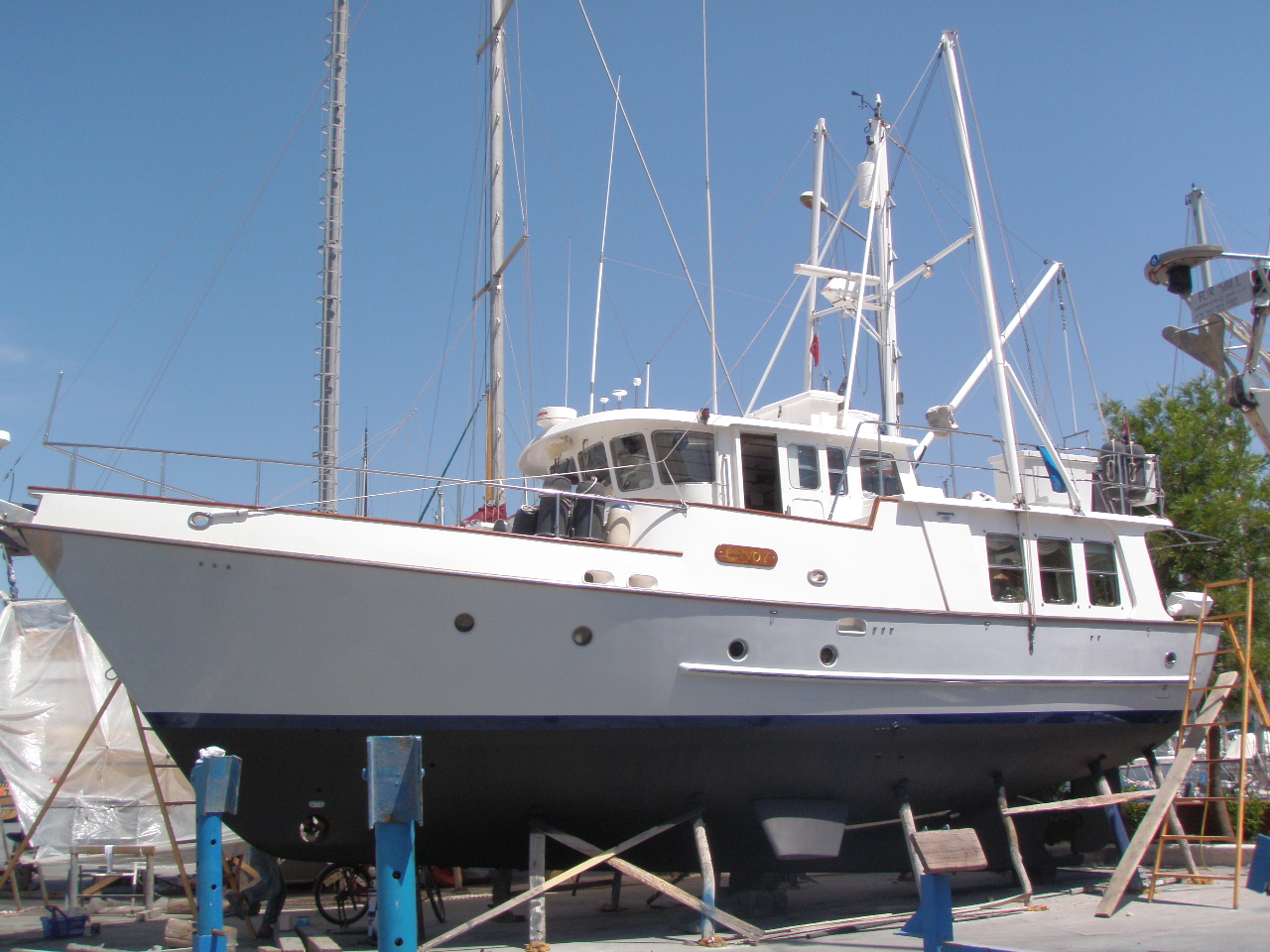
Envoy out of the water with stabilising fin visible

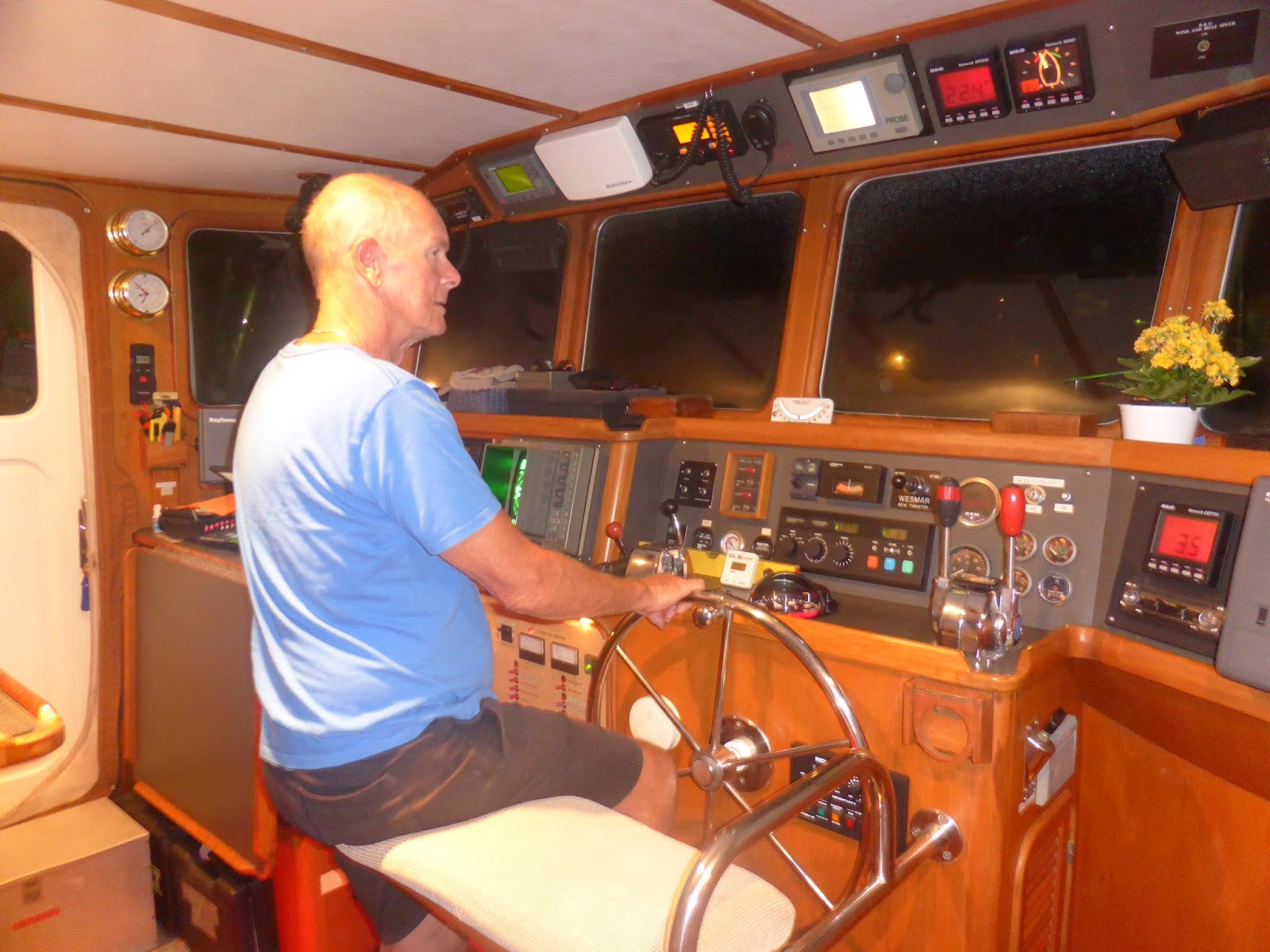
Envoy has hydraulically driven fins with the hydraulic pump powered by vee-belts from the main engine crankshaft and a 12 volt DC pump providing a constant flow of sea water to cool the hydraulic fluid. An electronic motion detector signals the hydraulics to move the fins to suit differing sea conditions with adjustment available via two thumb wheels in a pilot house control box.

The main advantages of this active system are that it’s more effective than passive stabilisers providing 80-90 per cent roll reduction (compared to about 70 per cent), it deploys quickly with no physical effort required, it’s easily adjustable using the electronic control system and causes negligible speed reduction.

However on the negative side the initial and ongoing cost of active stabilisers is expensive and during ten years we’ve spent several thousands of dollars replacing seals, sea water cooling pumps, vee-belts, filters, a hydraulic pump with its load adaptor, a servo valve and electronic components. Another issue is that they are highly specialised equipment and generally require trained and authorised engineers to provide service.
We’re just about to make another significant investment to remove the fins and replace the through-hull seals, something which is required about every five years. This is a job the majority of owners including ourselves wouldn’t attempt do themselves and special equipment is needed to remove the fins.

Set of through-hull seals

We’re also going to make a modification so that when the system is not in use the fins hydraulically lock in the centre position. Currently the fins move at rest (which is noisy and potentially damaging) in all but the most sheltered of anchorages, so when necessary we secure them in the centred position through a fiddly process of using manual locking bolts. The actions of locking them and then unlocking them takes about 15 minutes.

An active stabilisation system also requires a significant investment in spare parts and we carry a spare sea water pump, hydraulic motor, load adaptor, set of vee belts and oil filter. The fins can potentially be fouled by flotsam or lines although this has only happened to us once in a marina. Although some active stabilisation systems can be used at anchor with a generator running to provide power ours cannot, in any case we wouldn’t want to have an engine running overnight.

Partially hidden by the starboard side of the wheel is the stabilisers’ control system

Using both systems we’ve occasionally found it necessary to alter course by about 30 degrees to “tack” and take the waves more on Envoy’s bow when encountering closely-spaced, steep waves over about two and a half metres breaking directly on our beam.
A full displacement hull like Envoy definitely requires some form of stabilisation and the vast majority if not all Nordhavns have a system fitted. We’re pleased to have both active and passive systems aboard Envoy but if restricted to one would undoubtedly select the passive system for its reliability, economy and ability to use at anchor.

Next Post will take a light-hearted look a the use of the title “Captain”.

STABILISERS PART 2

Envoy is in Lefkas Marina for the northern hemisphere winter and we are home for the New Zealand summer, heading back in April.
Upcoming Posts – Stabilisers Part 3, Cruising in Auckland’s Hauraki Gulf aboard 48ft motor yacht Moritz, Using the title Captain, Envoy’s 2017 cruising plans.

Our last Posting introduced the subject of stabilisers, now we’ll talk more about passive stabilisers.

A passive stabilisation system consist of two poles each about seven metres long mounted near amidships on the vessel’s beam, which are stored vertically and when in use lowered to be deployed out from the vessel’s side using a downhaul, topping lift and fore and aft guy-wires to keep them in position. They are mostly made from aluminium or steel though less commonly using laminated timber.

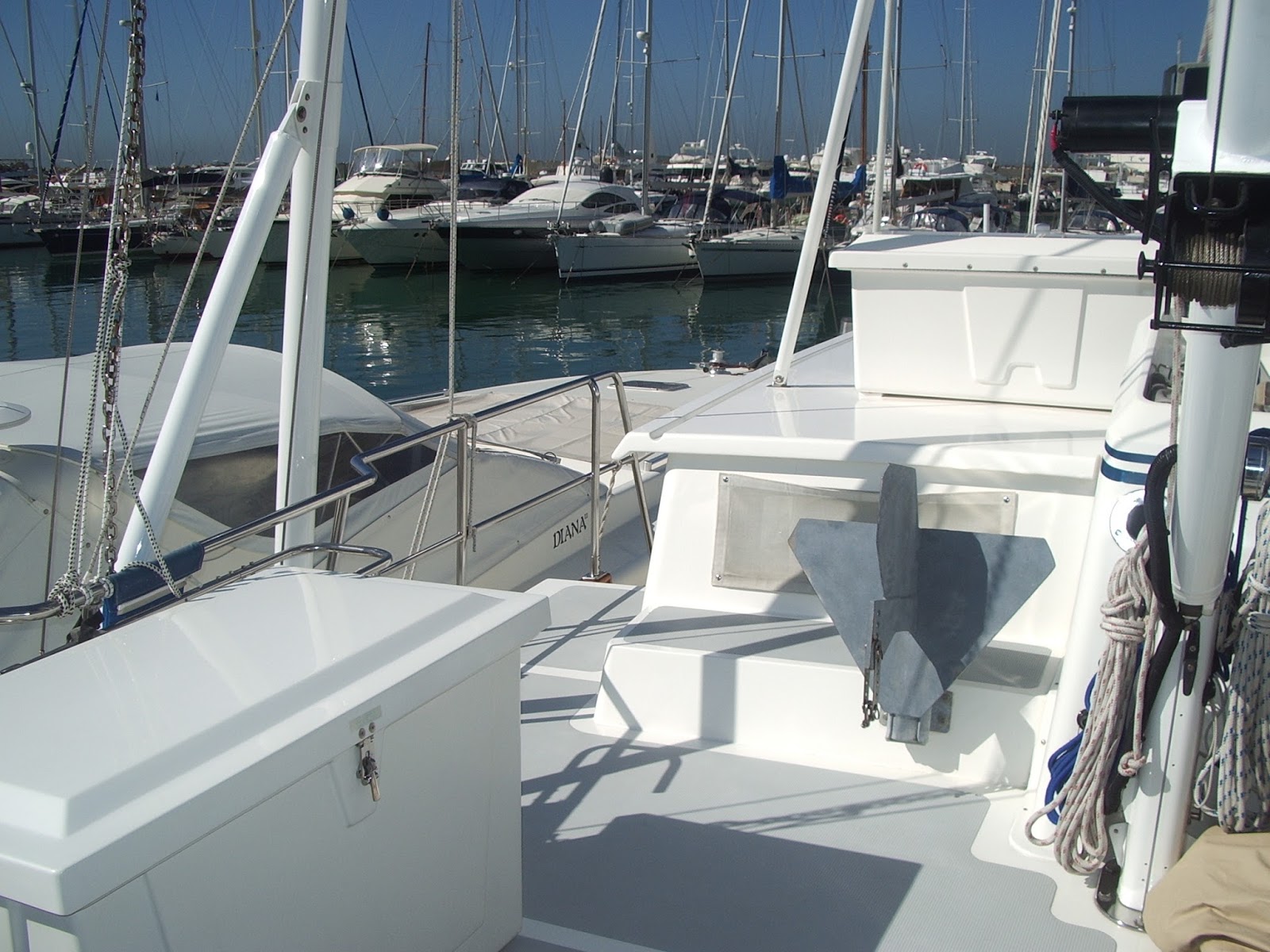
A large metal plate weighing about 25kg and shaped like a delta-winged aircraft, known as a “paravane”, “bird” (the term we use) or “fish” suspends from the end of the pole using a combination of chain and nylon line, the latter providing some spring to reduce shock loads. The front of the bird is weighted to make it “fly” through the water in a nose-down position approximately five metres below the surface and the top of the bird has several chain attachment points to adjust the bird’s angle through the water. The further aft you attach the chain the more the bird tends to dive deeper and the more aggressive becomes the bird’s stabilising action at the expense of increased drag.

This image shows the port pole and bird deployed with the downhaul, topping lift and fore and aft guy-wires

Due to the birds’ weight and large awkward shape some form of winch is used to deploy and retrieve them (we use a light block and tackle) and with familiarity this process takes about 15 minutes.
When not in use we store the birds well out of the way on the boat deck, but if intending to use them we move them down to the cockpit so they’re ready for immediate use.

Centre-right is a bird stored on Envoy’s upper deck

The poles provide a distinctive fishing-boat-like appearance that won’t suit everybody but certainly creates interest among other cruisers.

Stabiliser poles provide a distinctive appearance – love it or hate it! Port deployed, starboard raised

On some boats the poles are stored in a near horizontal position along the superstructure and this probably makes for a tidier appearance.

This system’s big advantages are effectiveness – reducing roll by about 70 per cent, low initial and ongoing cost and reliability since there are no mechanical or moving parts – in the ten years we’ve owned Envoy no part of the system has needed replacement or maintenance. Just now we’re having the birds epoxy-painted over the galavanising which is rusting slightly.

It’s disadvantages are that it slows your boat down by about 10 per cent, there is some risk of the birds fouling flotsam or lines in the water (although ours never have) and the system cannot be rigged and de-rigged in shallow water or confined spaces.

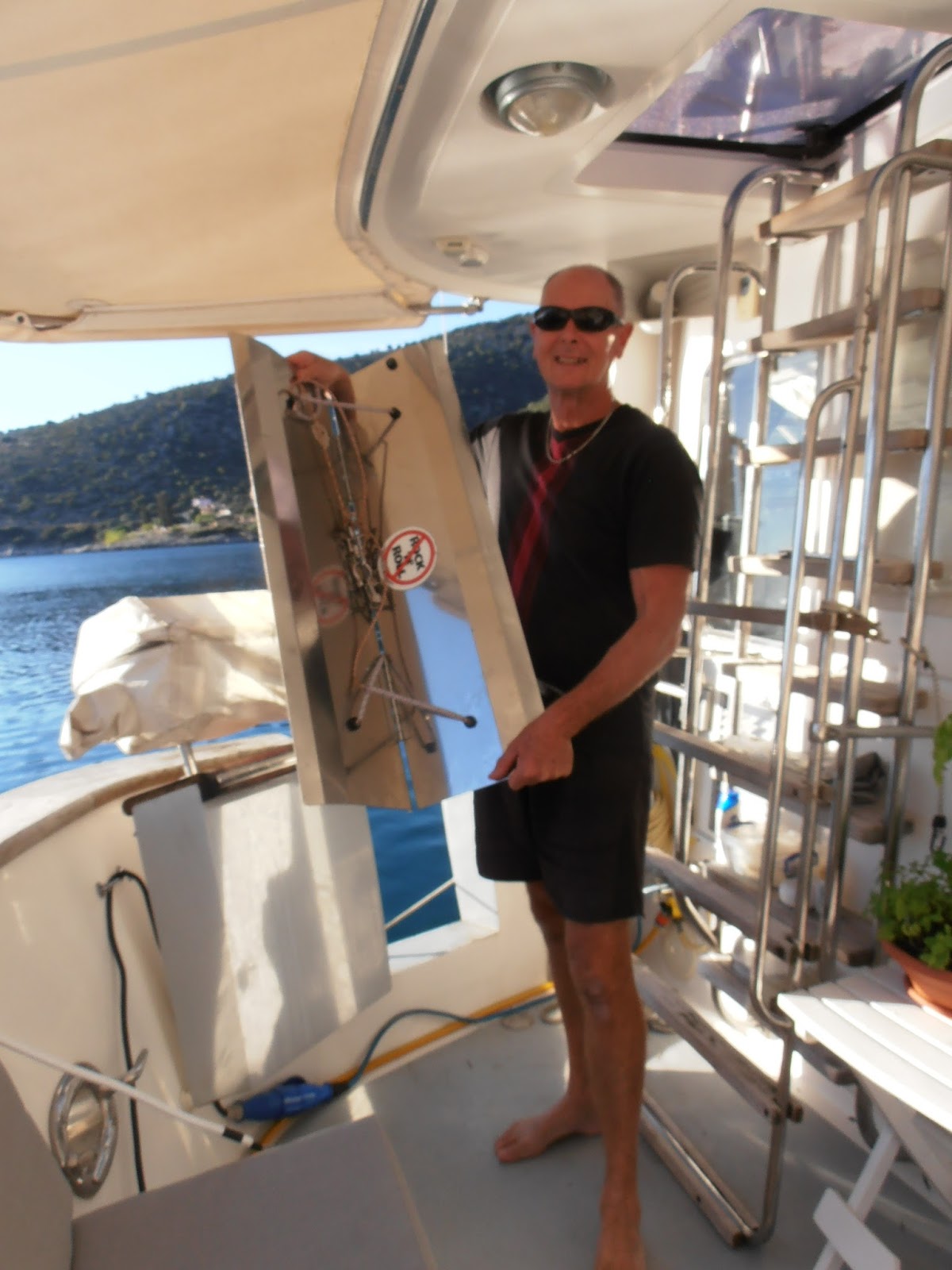
Another huge benefit of this system is that by suspending a different type of metal plate the system provides highly effective stabilisation at anchor. Envoy’s plates, known as “flopper-stoppers”, each consist of two flat plates of stainless steel plate joined together along one side with a hinge. When the boat rolls downward the hinge allows the plates to close together and drop rapidly and when the boat rolls upwards the hinge allows the plates to open and resist upward pressure. This system is extremely effective enabling us to anchor in places where roll or wakes would normally make it too uncomfortable. Flopper stoppers are comparatively light and easily deployed and retrieved by hand.
They can be used in depths over four metres.

Laurie holds a flopper-stopper

Here the port flopper-stopper has been deployed alongside a jetty to reduce the effects of a side-swell during a gale in Cephalonia

Next posting will look at ACTIVE stabilisers and our view on what is the “best” option.

STABILISERS PART 1

Envoy is in Lefkas Marina for the northern hemisphere winter and we are home for the New Zealand summer returning to Lefkas during April.

This posting is based around an article I’ve written for Pacific MotorBoat magazine.

In pre-Envoy days boating around Auckland’s Hauraki Gulf we owned several planing boats culminating in a 40 ft Oliver Royale GRP planing boat with twin Yanmar diesel shaft drives. We never then considered rolling to be an issue, however we realised very soon after buying our Nordhavn 46, Envoy, that full-displacement hulls are another matter, definitely requiring stabilisation to provide acceptable levels of comfort and safety when cruising moderate distances in beam seas higher than about one metre. I’m sure there are reasons for this that a boat designer could properly articulate. As much as I know is that in slight to moderate seas the flatter hull sections of a planing boat resist rolling to a greater extent than the rounded sections of a displacement boat. Also I have found that a fast boat on the plane seems to sit quite comfortably on beam waves without too much roll. On the negative side I understand that planing boats can roll dangerously in heavy beam seas and are more prone to capsize than ballasted displacement hulls like the Nordhavn. Additionally planing hulls pound when their flat sections hit waves, whereas the rounded sections of displacement hulls rise and fall more gracefully with greatly reduced noise and violent motion.

In our experience a planning boat like our previous 40 ft Oliver Royale doesn’t roll under way to the extent that a displacement hull does

What follows isn’t a technical treatise but comments based on cruising thousands of miles using Envoy’s three stabilisation systems.

Stabilisers have been used for many years aboard commercial vessels but aboard pleasure craft only for about the last 40 years, considerably reducing rolling motion in beam seas, but with minimal effect on pitching caused by seas on the bow or stern.

Now some reader is bound to think “buy a catamaran and you won’t have a problem” and I’d be the first to agree you’ve got a lesser problem, but we’ve met many folks who complain about their cat’s motion both under way and at rest. Of course this is either better or worse depending on their design, as with monohulls.

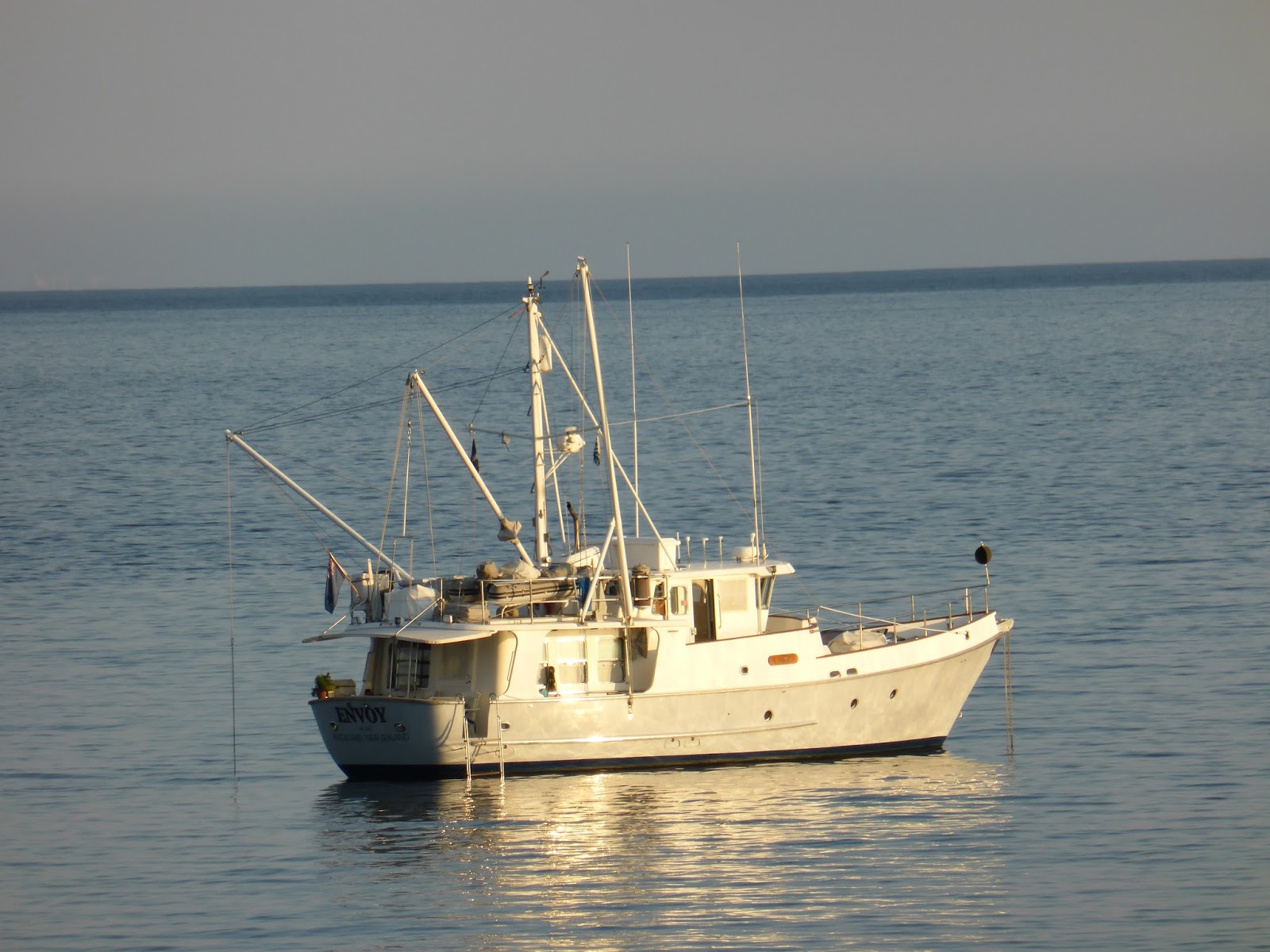
Envoy at anchor with starboard stabiliser pole deployed with flopper-stopper to reduce roll from slight swell. The port pole can be seen in the vertical position

A web search shows many variations of stabilisers, but the mainstream systems fall into three basic types; passive, active and rotary.
We have no experience with rotary stabilisers, which are a more recent development utilising a flywheel contained in a vacuum chamber to provide a gyro effect, but they’re reportedly highly effective in roll reduction both under way and at anchor with the advantages of having no protruding parts to cause speed-reducing drag or become fouled. They are able to be retrofitted either amidships or offset to one side, but have a significant investment cost. Presumably, if used for long periods such as overnight at anchor a generator would be needed to provide sufficient power – something we would not want to do.
Envoy has both passive and active stabilisers providing effective stabilisation under way and at anchor.

Envoy with both poles deployed with flopper stoppers to reduce roll at an exposed anchorage with ferry wakes

Next posting will discuss passive stabilisers in detail.

ATHENS

Happy New Year to our readers from around the world.Envoy is in Lefkas Marina for the northern hemisphere winter and we are home enjoying the New Zealand summer. Back to early November and after a very scenic five hour bus trip from Lefkas we stop over…

FINAL DAYS IN GREECE FOR 2016

Envoy is in Lefkas Marina for the northern hemisphere winter while we’re home in New Zealand enjoying summer.

Back to late October and it’s always much more fun getting any boat ready to cruise for the summer than to store for the winter, but we get stuck into Envoy’s winter storage process. We have this well documented and it’s simply a case of spending a few days doing all the jobs and ticking them off.

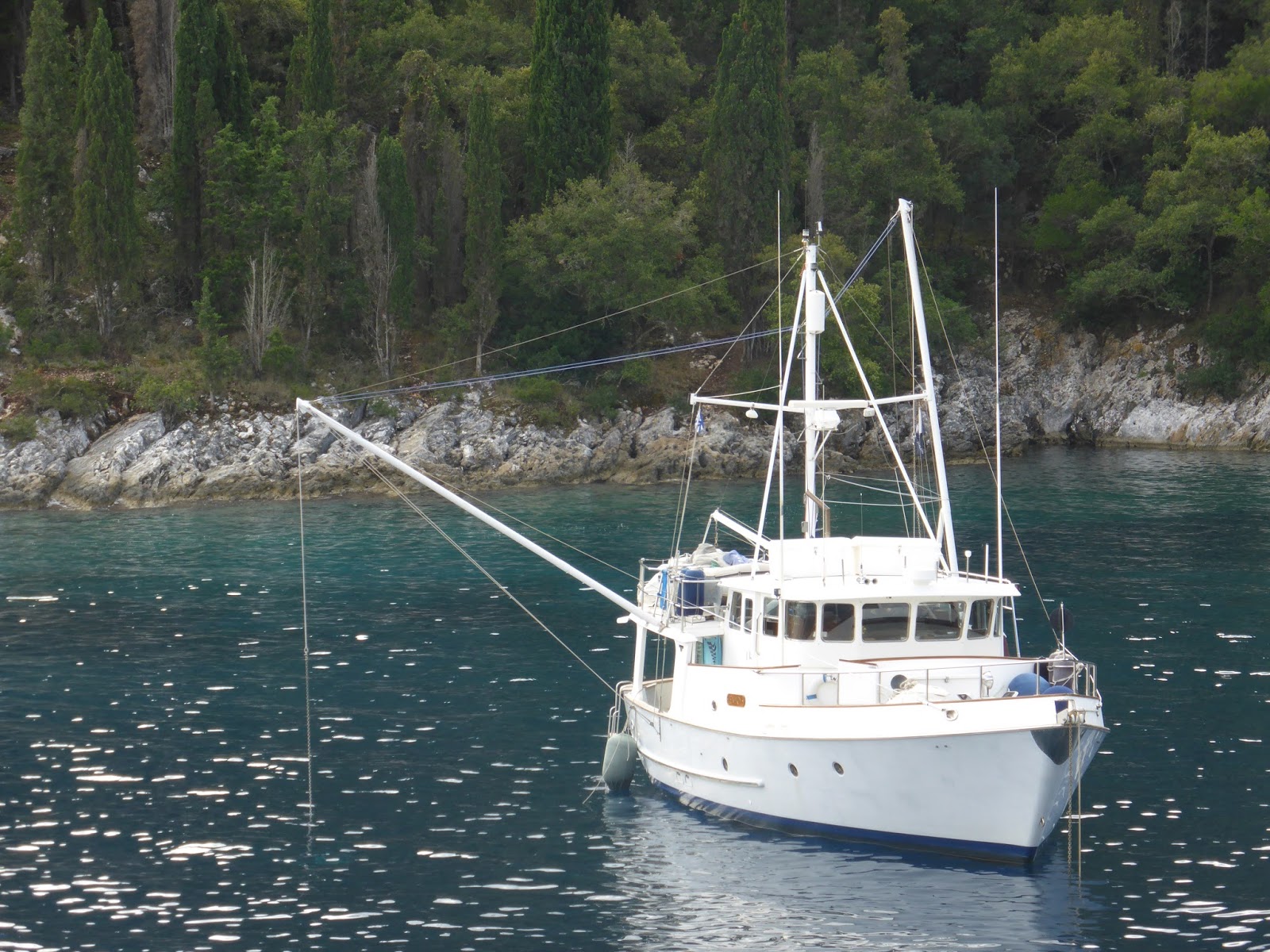
On the way back to Lefkas we spotted a Diesel Duck trawler. These are a rugged no-nonsense go anywhere passagemaker that we’ve often admired.

Diesel Duck

At this time of the year there are frequent squally fronts passing over like the one depicted below that chased Envoy down the coast.

Squally front

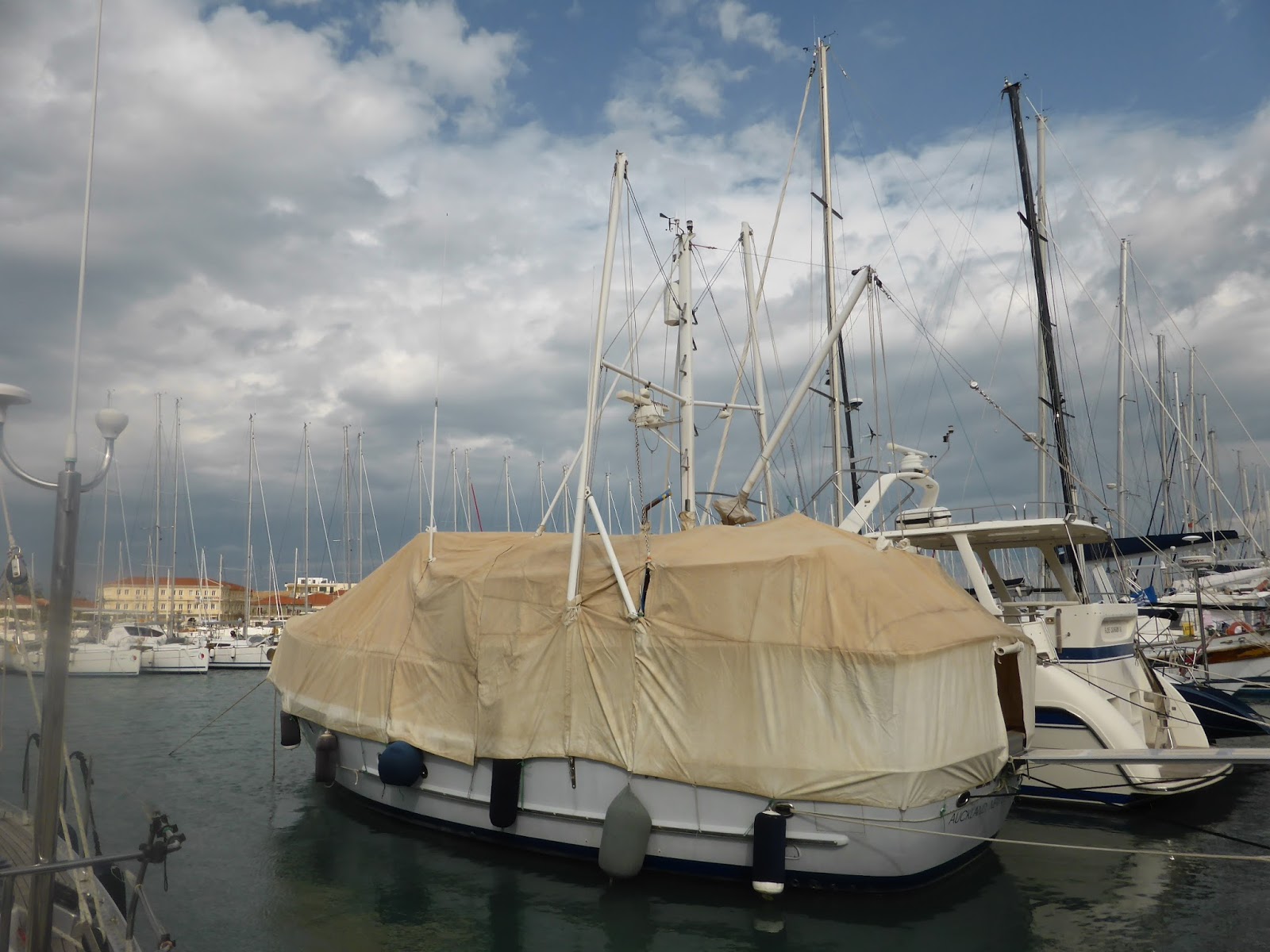
Envoy in Lefkas marina with winter cover fitted

After a couple of days a cat befriends us and becomes a regular visitor, boarding Envoy in the mornings for a feed. We’re very happy to see plenty of cats around any marina as it keeps the rodent population down.

TECHNICAL
Our end of season jobs include running the generator, wing engine and all sea water pumps for about 15 minutes with a mixture of fresh water and Saltoff, then introducing glycol to replace the water in order to reduce corrosion during the period of non-use. This is time consuming as we need to remove the top from each equipment item’s water strainer and feed it using a fresh water hose.
We fit Envoy’s storage cover, now nine years old, which has been reconditioned during the summer with patches sewn over areas of thinning fabric, plus new velcro and zips. It goes on easily and will keep Envoy dry and clean during winter.

Apart from other routine season-end procedures we:
-Get a RHIB specialist, Nikos, to visit and replace two air valves on our large Nautica RHIB. A special tool and some practice is needed to do this. These valves have been marginal for a while and Nikos says they were close to failure.
Nikos also takes away our smaller Valiant RHIB and during the winter will repair a pontoon’s slow air leak and a transom sea water leak.
-Sailand’s Velisaris visits to review several jobs to be done during winter.
The dual trumpet air horn has failed due to water ingress and needs repair or replacement.
One of two domestic fresh water supply filters has a leaking filter housing which needs replacement. Our “Water Fixer” U/V water purifying lamp needs a check to see if it’s working.
Our Lugger’s alternator and Maxwell windlass electric motor need removal and checking.
Our main Raritan Atlantes head needs investigation to determine why it won’t discharge through its seacock, but only via the holding tank, which has a different outlet overboard.

-Sailand will also do several other jobs for us during winter:
Our stabiliser paravanes or “birds” as we call them (the metal plates that go under water) need maintenance as the galvanising is starting to corrode. Sailand advise the quality of galvanising in Greece is not good so recommend an epoxy primer and top coat instead which will enable easier future maintenance.
Two Plexiglas deck hatches in the guest cabin need re-sealing into their frames.
Our Lugger main engine, Yanmar wing engine and Northern Lights generator will have all cooling hoses checked and replaced where necessary, coolant drained and replaced, air filters cleaned and a complete visual check.
The generator will also have its mountings checked, fresh water circulating pump checked and sea water pump serviced.
The Yanmar will also have its sea water pump checked and impeller replaced.
Before we return to Lefkas Sailand will lift Envoy from the water to prepare the hull for anti-fouling, clean and check the running gear and remove and clean the keel cooler.

With all complete it’s goodbye Envoy until we return in April … but the Blog continues.

ENVOY CRUISES BACK TO LEFKAS MARINA

Envoy is in Lefkas Marina for the northern hemisphere winter while we’re home in New Zealand to enjoy the summer.

Now back to mid-October. As we leave Gouvia Marina we load another 400 litres of diesel to top up our fuel tanks as it’s best to leave them full to reduce condensation during long absences from any boat. This brings our total diesel purchase this year to a very reasonable 4,025 litres, which has been sufficient for six months cruising most days.
One of the hugely compelling qualities of a full-displacement boat like Envoy is her economy at about six to seven litres of diesel per hour. A similar sized planing vessel would use something like 150 litres per hour and even though it’d be covering around 20 miles in an hour we only need about 22 litres to cover the same distance – one seventh as much.

We cruise slowly south towards Lefkas visiting places we’ve mentioned previously in the Blog so won’t repeat.
Anchored off the town of Preveza we have a choppy night in 20 knot onshore winds and are woken early in the morning by fishermen who want to retrieve their net. It’s not uncommon for them to lay their nets and lines throughout recognised anchoring areas.
It’s late season and now there are few boats around except for a few hardy souls taking advantage of the off-peak yacht charter rates and cruisers on the way to winter berths. Ashore the beach umbrellas and deck chairs are stacked away, many tavernas and shops have closed their shutters until next year and the still open ones are largely deserted. During this time we have some fine weather but also more rain and thunderstorms leading us to decide that next year we’ll have a shorter season and return home around mid-October.
After anchoring for the last time we let out most of our chain and during retrieval wash the salt off with fresh water to reduce corrosion during winter storage. Pulling into the marina for winter on Sunday 23rd October gives us nine days before leaving for Athens – ample time to complete wintering procedures and a few remaining jobs. I say this every year – it’s great and very satisfying to return after living aboard for seven months and cruising over 2,000 miles with no accidents, injuries or more than minor technical issues.
We berth alongside Coco, a 52ft sailing yacht owned by a Scots couple, George and Anne, and hardly finish connecting water and shore power before they invite us aboard for a drink. They’re sprightly mid-70s who’ve visited NZ and we Scotland, so we find plenty in common resulting in several great evenings together during our short time in the marina.
That night I break a tooth munching on an olive. Although it’s not sore I decide to get it seen to in case of any problems occurring on the long journey home. The marina office recommends a dentist who sees me just an hour after my call. She’s highly qualified being a Doctor of Dentistry (dentists generally have a Bachelor degree) with a spotless surgery who charges just 50 Euros (about NZ$77) for a filling that takes about half an hour. At home the charge would be more like $300 – we’ve been well pleased by the high standard and low cost of medical treatment in Greece.
The marina costs 2,764 Euros (about NZ$4,252) being about $22 per day. Many cruisers go on the hard stand at nearby and cheaper Preveza, but we prefer the whole infrastructure, convenience and atmosphere of Lefkas.

Next post will discuss year-end maintenance issues.

ENVOY MAINTENANCE IN GOUVIA MARINA

Envoy is in Lefkas Marina for the northern hemisphere winter and we are home in New Zealand. Back to mid-October. After Charles departs we stay for a few days at Gouvia Marina to take advantage of its excellent technical infrastructure and technicians …