Archive | Envoy RSS feed for this section

BROTHER CHARLES VISITS ENVOY

Envoy is in Lefkas Marina for the northern hemisphere winter and we’re in London with our daughter Amy en route to New Zealand and home.

Back to early October and my brother Charles joins us at Corfu for his first visit to Envoy. It was Charles who first introduced us to Med cruising when we spent some time aboard his 34ft sailing yacht in Turkey. He’d sailed it from Australia with his now-wife Marie and after several years in the Med continued on to the far north-east of Scotland where they now lives and he works as Harbour Master in Lossiemouth, near Elgin. It was during our time with Charles and Marie that we decided to buy our own Med-based boat. Look what they started!

Still anchored off Corfu town we meet New Zealanders Alan and Tina from the yacht, Whisper. They’re the first NZers we’ve met this season and it turns out they know our NZ friends Bruce and Leslie from the catamaran, Midi.

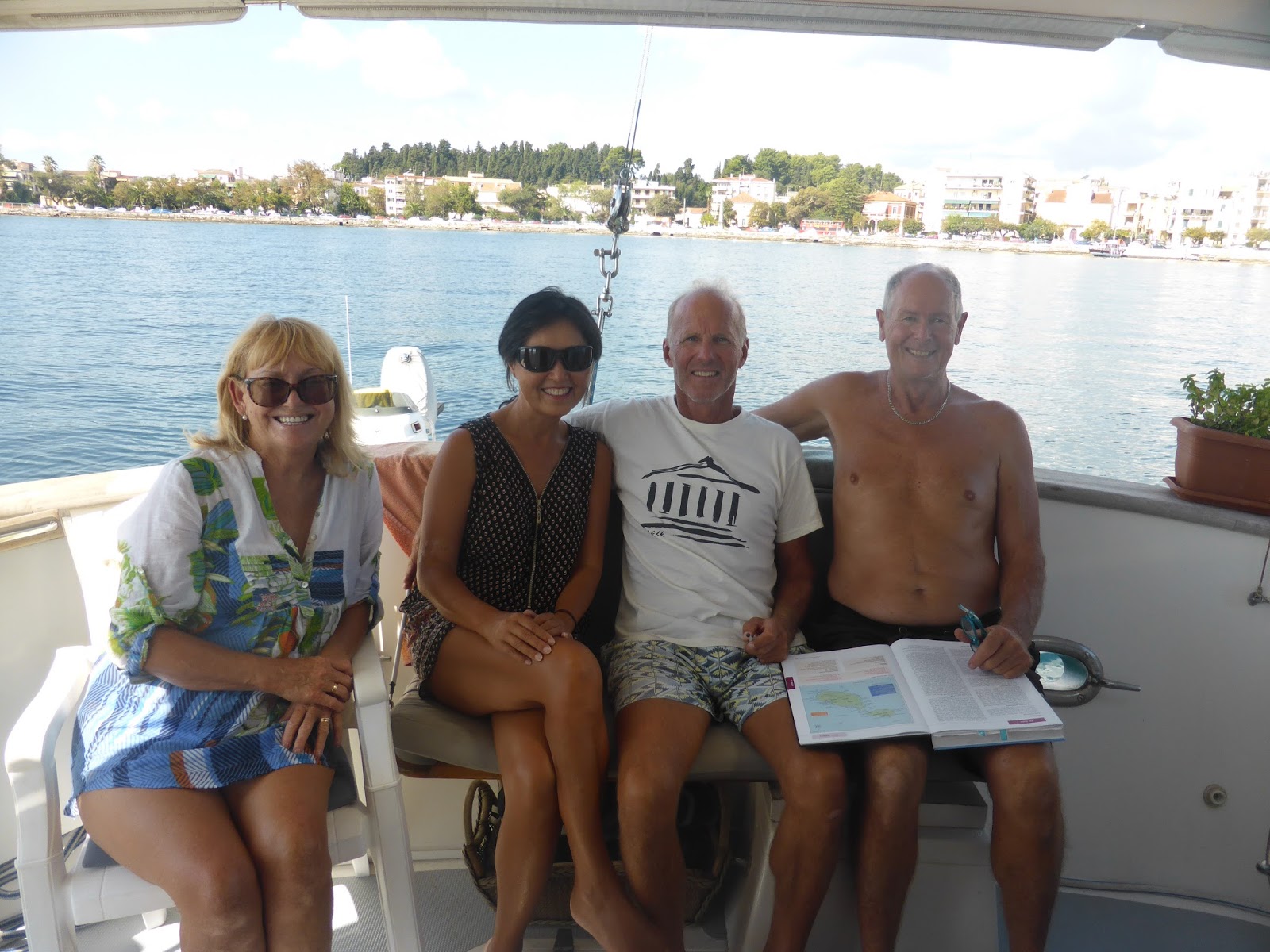
Di, Tina, Allan and Laurie in Envoy’s cockpit, Corfu
Visiting Malta has been on our minds for a while and Alan and Tina provide us with some more information about this interesting destination, making it a definite possibility for next year.

Checking my emails one morning I see an official-looking one mentioning the US Navy and my first thought is that I’m getting a telling off for including a photo in our Blog of a USN ship moored in Crete’s Soudha Bay.

Here’s that photo again

On reading the email though I’m delighted to find that it’s from a very senior officer of the USN’s 6th Fleet, Destroyer Squadron 60 saying that he’s very happy to see “one of my ships, USS Ross, appear in the Blog”. The officer and I have since had several exchanges of emails and it turns out that he has an interest in Nordhavns and follows our Blog. We’re even talking about possibly meeting up next year in Italy where he’s based – Diane and I haven’t exactly decided which of two cruising plans we’re going to adopt next year but both include Italy.

We spend a couple of nights of perfect tranquility anchored at Mourtos until the weather forecast predicts southerly winds over 30 knots with heavy rain, quickly turning to northerly winds over 30 knots. This is the kind of forecast it’s hard to find shelter from, but nearby Igoumenitsa Creek is perfect so we head there to anchor in a depth of about 14 metres (a bit deeper than we prefer) laying out 60 metres of chain. The bottom is mud and Envoy has a heavy (40kg) Delta anchor plus 3/8 inch chain and we rarely drag with this much chain out.
There’s plenty of thunder and spectacular lightning plus a choppy sea whipped up by over 40 knot gusts, but we’re perfectly safe.

Balmy evening in our anchorage before the storm

Wind-driven chop in Igoumenitsa Creek

Laurie and Charles at Koulara

Koulara Harbour

Charles leaves us at Corfu’s Gouvia Marina where we visit to get a few maintenance jobs done (details in next posting). Meanwhile summer seems to have come to a sudden end and we have several days below 20d with heavy showers and thunderstorms.

In Gouvia we meet some other New Zealanders – Trevor Giles from catamaran Kiwi and Chris and Michelle from yacht Endless Summer.
An Australian yacht Pablo Neruda berths next to us, formerly owned by Melbourne-based Rob and Kerry, who we met through recent visitors Simon and Bronwyn and who gave us a lot of cruising advice before we started in the Med.

SIMON AND BRONWYN CRUISE WITH US FROM CEPHALONIA TO CORFU

We’re aboard Envoy at Greece’s Lefkas Marina as we prepare to leave her for the winter and return home to New Zealand in just a few days.

Back to mid-September – with an overnight onshore wind change we’ve had an uncomfortable night anchored off Poros and shift in the early light of morning to Antisamos Beach for a calm and enjoyable day and night. From here it’s a short hop to Ay Eufemia where we spend three nights anchored in the harbour before meeting our Australian friends Simon and Bronwyn (SandB).

There’s a few wasps around and during this time having not long recovered from her sea urchin sting Diane get’s two wasp stings on a finger resulting in some painful swelling!
The night before SandB’s arrival we have a violent thunderstorm with heavy rain and winds well over 30 knots. A charter yacht anchored in front of us drags to only five metres abeam of us but her crew is alert and they safely re-anchor. This is common in strong winds as charter yachts often have light ground tackle and inexperienced crews.
Our plan is to cruise with SandB about 110 miles to Corfu and along the way we’ll be anchoring at some of our favourite places. This is SandB’s first Envoy cruise but they are experienced sailors having raced yacht, owned boats and cruised the Med with other friends, so are very quickly part of the crew with Simon sharing watches from day one.
First stop is just eleven miles away at Foki Bay from where it’s an easy walk or ride by dinghy to Fiskhardo, a great bay surrounded by tavernas and funky shops. Most yachts visiting here and similar harbours go stern-to the quay, but we prefer to anchor nearby so we can swim, enjoy some privacy and avoid the hassles of tangled anchor chains. It’s getting late in the season but there’s a surprisingly high number of boats around.

Great bougainvilleas adorn Fiskhardo house

Envoy anchored in Foki Bay

After a night at nearby Sivota we enter the Lefkas canal and refuel at the marina, taking on 1,325 litres which will be our last major refuel of the year, then anchor in the canal off Lefkas so we can show SandB around the village. After leaving the canal we head north to the mainland village of Parga, always quite special and this visit no exception.

Simon, Laurie and Bronwyn enjoy a coffee at a Parga taverna

Parga’s castle entrance and harbour below

Fiskhardo, Sivota and Parga have been featured in earlier blogs so not detailed here.
The weather is still fine with daytime temperatures in the mid 20s but by night it’s now cool enough to need a blanket on our beds and to wear sweatshirts. The wind is very light – mainly less than 10 knots which is great for motorboat cruising and for calm anchorages.

While anchored in Lakka Bay on Paxxos Island we meet some Australian cruisers – Peter and Colleen from Wild Passion who recently left Turkey. They tell us things are rapidly going downhill there, much worse than is reported in the press, that cruisers are leaving in droves and charter boat operators are moving their boats to other destinations. They were planning to stay another season at Kas Marina but so many cruisers have left that marina management have doubled the fees to maintain their income level, ironically forcing those hardy cruisers unworried by the political situation to leave because they can’t afford to stay.

We spend some time at the mainland anchorage of Mourtos and then Corfu.

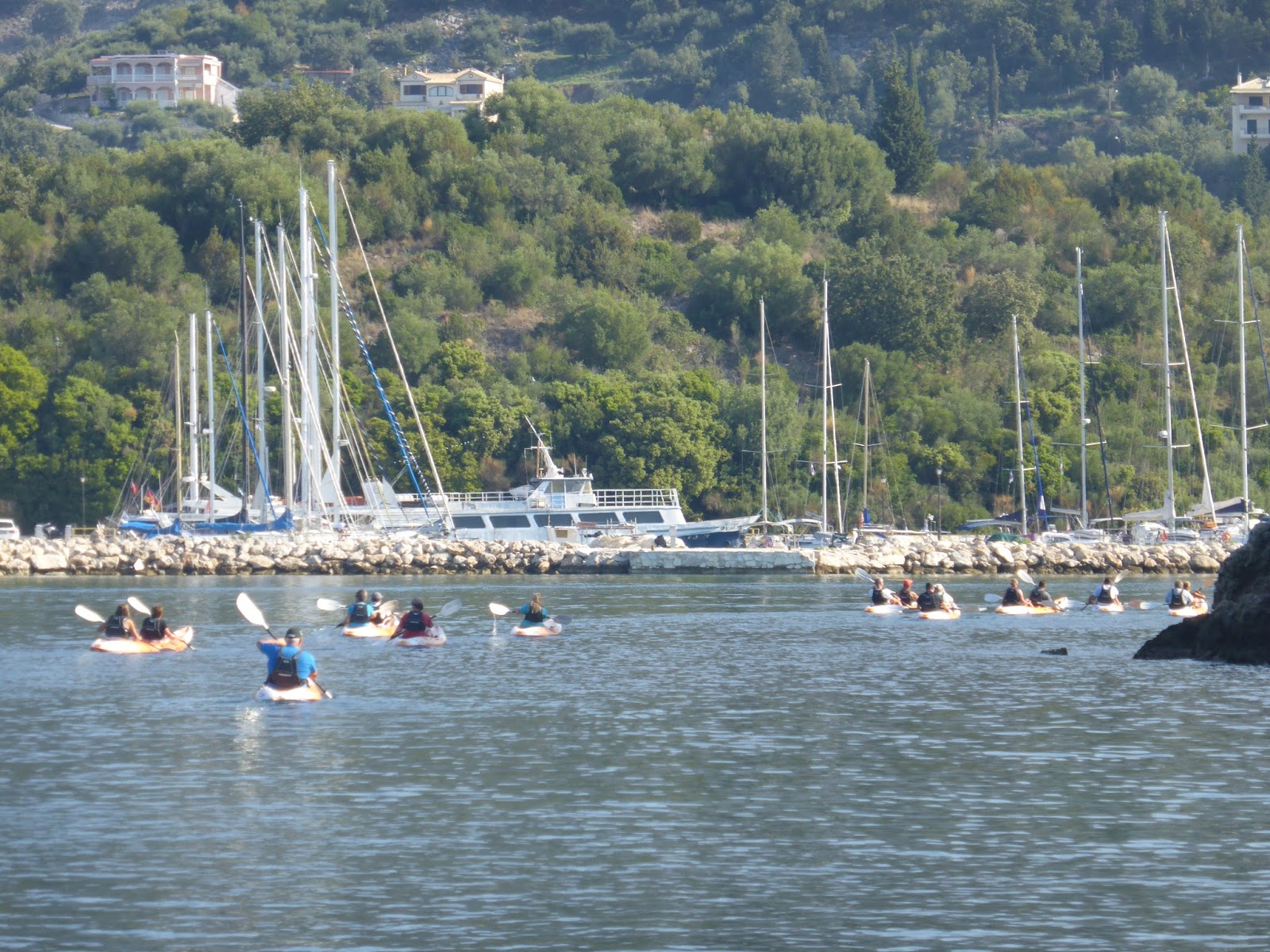
Kayakers pass our anchorage at Mourtos

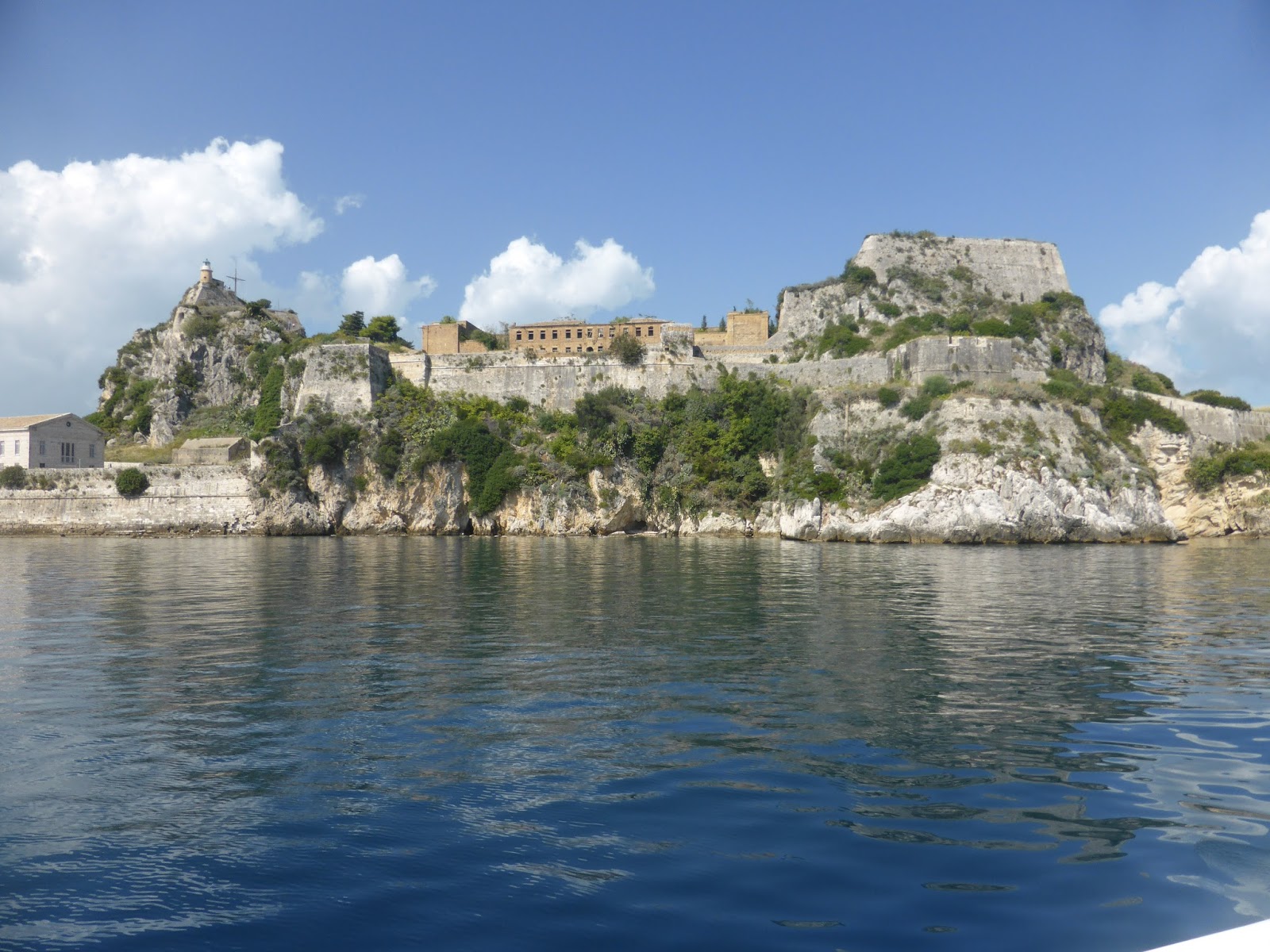
With Envoy safely anchored off Corfu Bronwyn and Di hit the shops while Simon and I explore the Old Fortress, one of two Venetian fortresses that guarded Corfu, an island of huge strategic importance protecting the trade route to the Adriatic Sea. The impressive rock was first fortified by Byzantines during the 6th century and later improved to withstand artillery by the Venetians in the 15th century. Corfu withstood three Turkish sieges in 1571, 1573 and 1716 and remained one of very few areas in the region never taken by Turks. Corfu became an English Protectorate from 1815-64 and the fortress became their garrison.

Corfu’s impressive Old Fortress

A parade of Greek sailors in Corfu although we don’t know what the occasion is

It’s serious enough to involve four priests though

A large cruise ship in the background – many visit Corfu

FOR FOODIES
Laurie, Diane, Bronwyn and Simon enjoying farewell dinner in Corfu at excellent Athos restaurant y discovered by Bronwyn in Trip Advisor

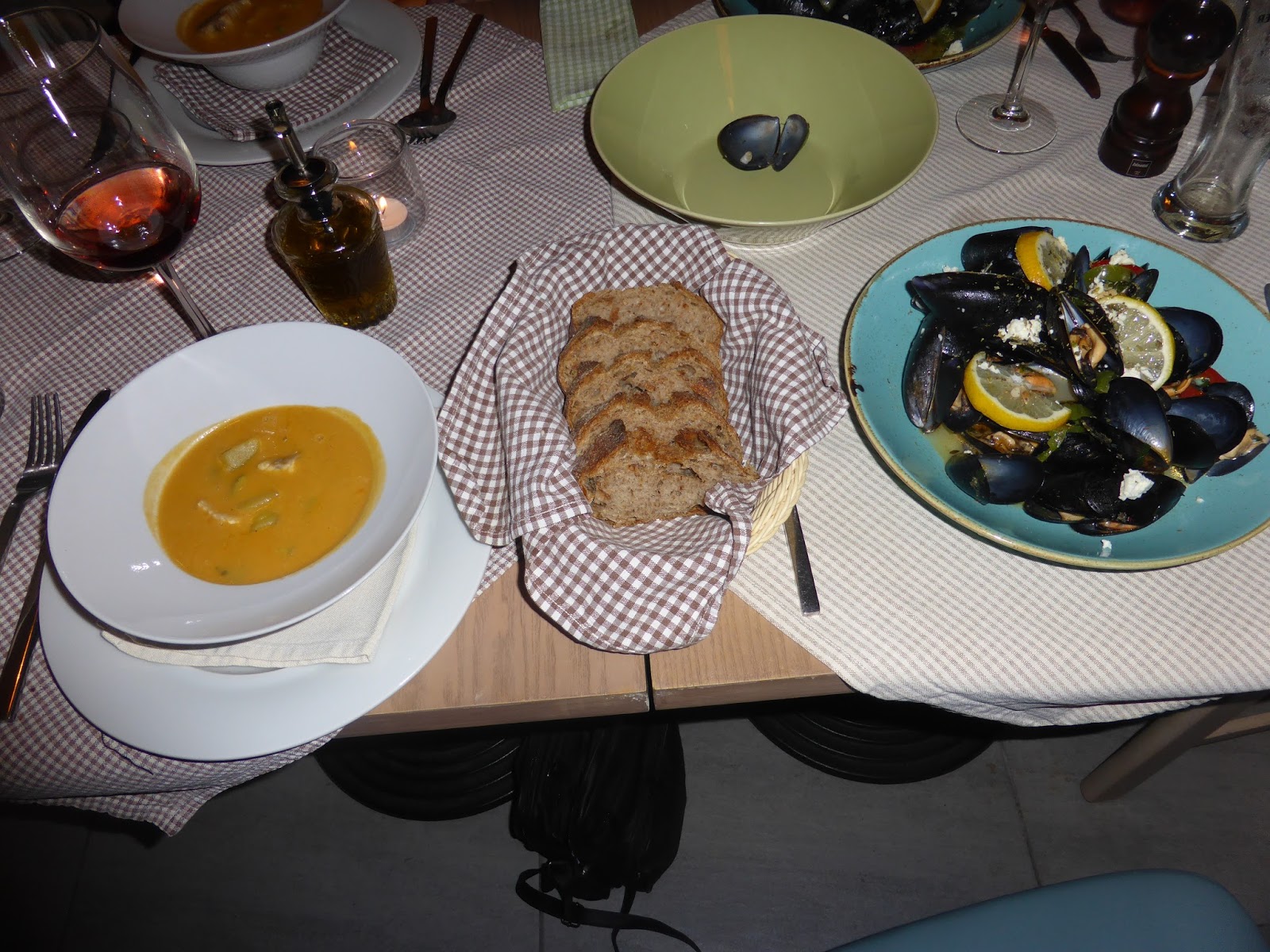
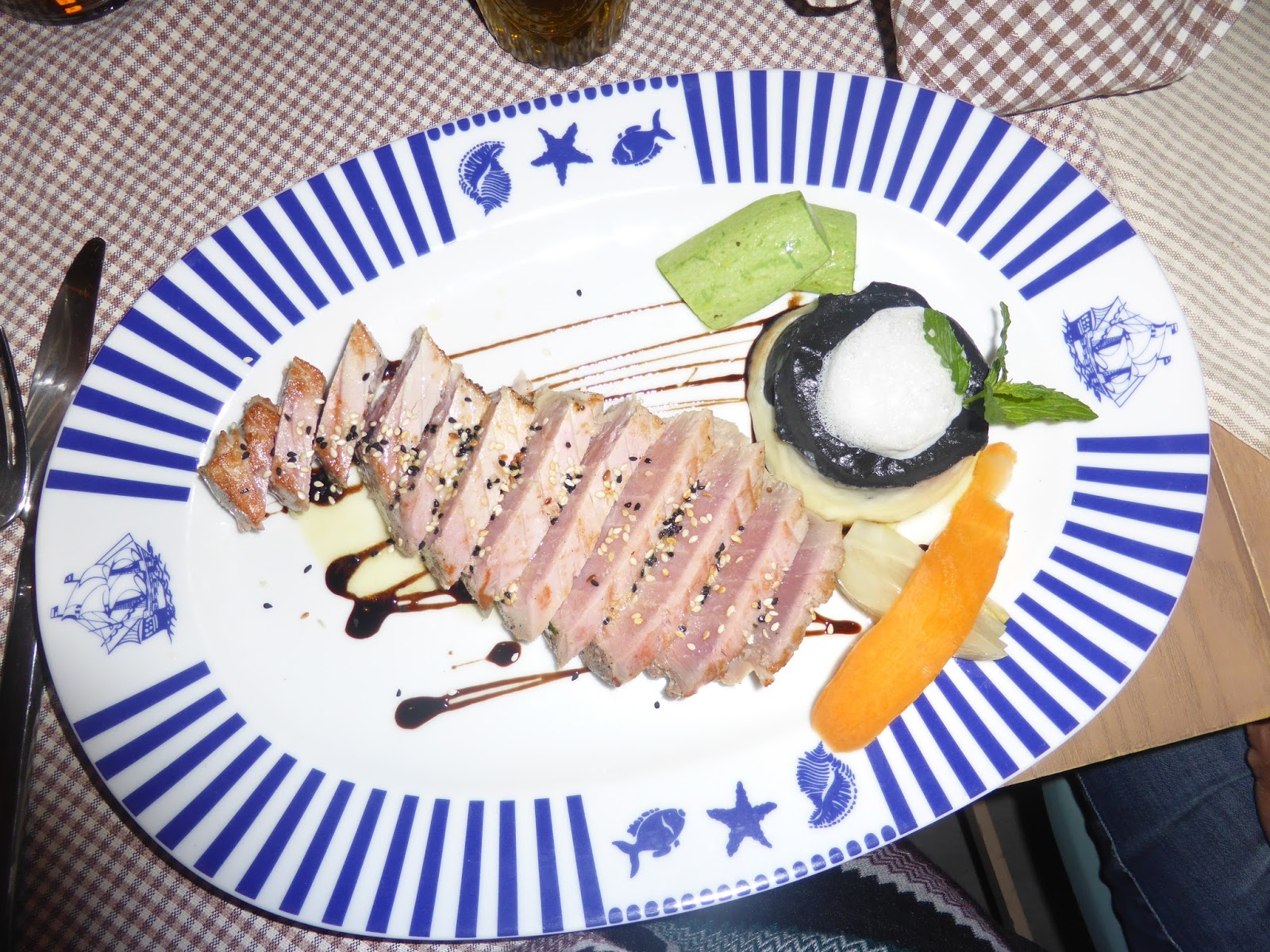
We enjoy an excellent fish soup, with crusty hot fresh bread, mussels and tuna washed down with a local rose wine. They also surprised us with small free tastings served between courses and a tasting tray of desserts. Altogether one of the nicest eateries we’ve been to

 Here SandB leave us after two great weeks with plans made to link up again soon in NZ.

ENVOY CRUISES WEST BACK TO THE IONIAN SEA

Envoy is currently at Lefkas Marina, our Greek home base as we prepare to leave her for the winter next week and return home for the NZ summer.

As Nikos Kazantzakis’s epic book Zorba the Greek says, “Happy is the man, who before dying, has the opportunity to sail the Aegean Sea.”
We’ve certainly had that opportunity, sharing hundreds of days there in one of the world’s greatest cruising grounds with family and special friends during 2007, 2010, 2011, 2012 and 2016.
Crete will always be a special place in our hearts. Spanning across the southern end of the Aegean Sea, Crete is a large island measuring some 260km from west to east and 50km from north to south with three mountain ranges towering to over 2,000 metres. Its topography is extremely rugged with few major inland roads and little traffic outside the main towns.
Talking of traffic, compared to what we are used to home in NZ the driving standard is certainly interesting – much like the rest of Greece. Few drivers seem content to sit behind you and will overtake on blind corners, double white lines or anywhere, often forcing oncoming traffic to move over to the verge. Speed limit signs seem to be a waste of space and there is little traffic law enforcement. Although the law requires helmets to be worn on motorcycles they seem rare and it’s common to see riders smoking a cigarette, talking on their mobile phone and drinking a balancing something on their lap all at the same time. This could also be happening while they ride the wrong way down a one-way street! Despite this we haven’t witnessed any anger, “road rage” or major accidents.
On every spare piece of Cretan land there are olive trees – over 21 million of them in fact and it’s hard to imagine how many trees with poor accessibility are harvested. Large nets are placed under the trees and then the branches are mechanically shaken to bring the olives down. This provides employment during the harvesting time of October to February when the summer tourists have gone.
Crete is very windy and windmills are still extensively used to pump water from bores. Wind farms provide much of the electricity and there are hundreds of these tall, silent wind towers around the island.

It’s now early September and we’re retracing our steps mostly to destinations we’ve already visited both in 2010 and this year, so our Blog postings will only cover any new destinations along with interesting events.
As a southerly wind increases we move to Dhiakofti, a great sheltered bay on the eastern side of Kithera Island with perfect shelter from the south. Later the two Australian couples we met at Soudha arrive in their catamarans during a deluge of heavy rain, part of the same weather system that caused massive floods, sadly with the loss of three lives in nearby Kalamata. Later a third Aussie cat arrives making this an exclusively Antipodean anchorage.

In company with one of the cats, Walanthea we cruise on to Mezapo on the mainland in a rising following easterly wind and when we pass one of the massive capes of the Peloponnisos we encounter strong katabatic winds up to 38 knots on our beam causing the seas to build in minutes from one to 2.5 metres with the top metre breaking. Sheets of spray cover Envoy and worried that our towed RHIB might capsize we turn into the seas until the squalls subside. Later our Australian friends say it’s the roughest sea they’ve ever encountered.

For the first time we anchor off Mezapo, which is rather bleak but offers good shelter from the east. Mezapo has several small coves suitable for shallow draught boats and used to be a haunt of pirates preying on the passing sailing ships. Nowadays it has one small shop doubling as a taverna, a church, a cemetery, and a few dozen houses, many of which are in ruins.

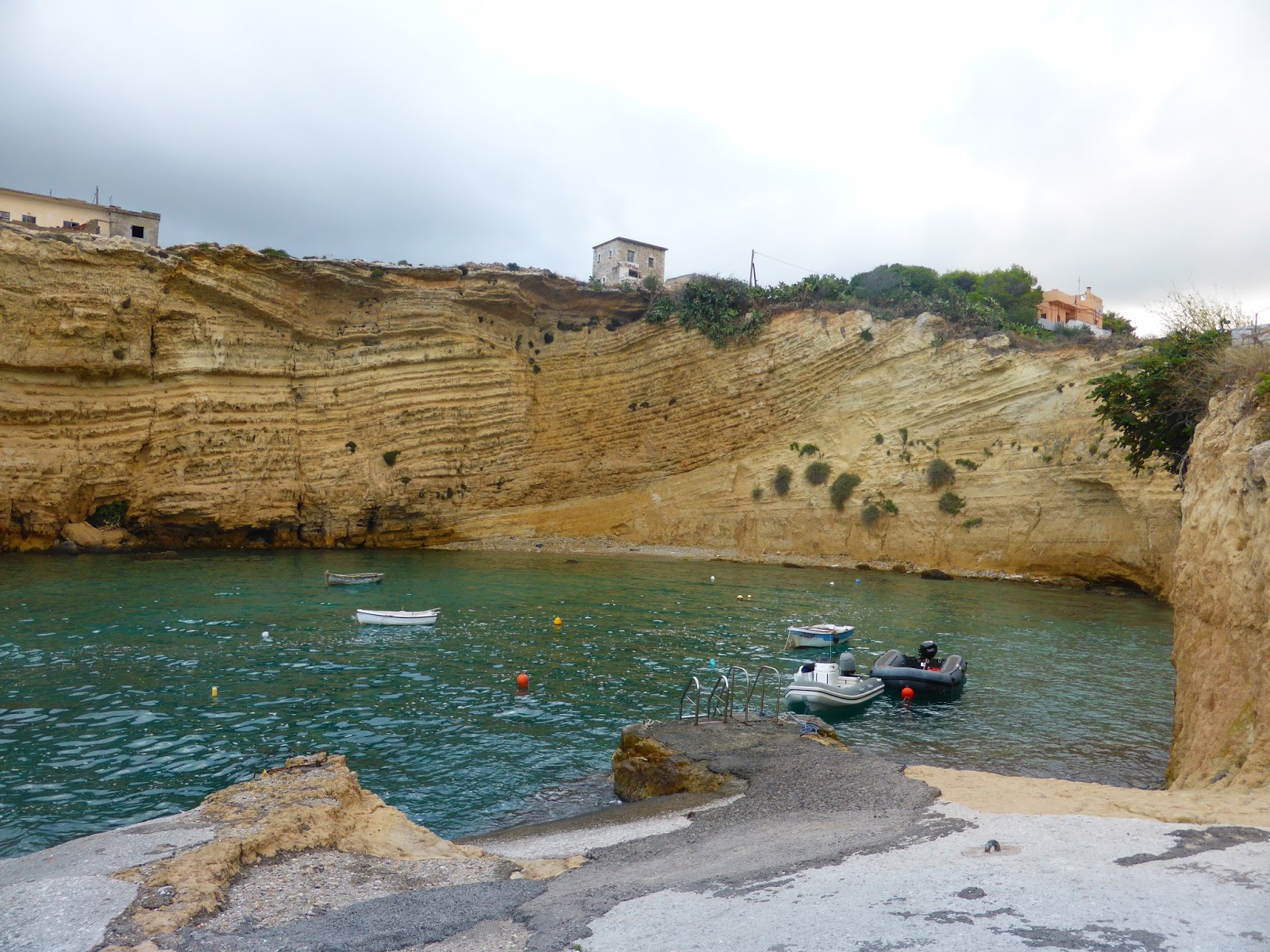
One of Mezapo’s small coves

Envoy and Aussie cat Walanthea anchored at Mezapo

Mezapo

Finakounda is another place we’d never visited before and we anchor here for a night. From the anchorage the village appears to consist only of tavernas lining the seafront but when we go ashore we’re pleasantly surprised to find an interesting main street and seeing a suckling pig roasting on a spit giving off great aromas we quickly can our on-board BBQ plans and enjoy delicious roast pork ashore.

Finakounda viewed from Envoy at anchor

The roast pork was too hard to resist

We’d visited Kiparissia in 2010 and head there again as it’s a convenient safe anchorage more or less half way to Cephalonia. This is not a tourist town and its fairly large harbour only has three other boats in it, but we need a Vodafone shop and find one here where our internet connection problem is sorted out in minutes (throughout Greece we’ve always found Vodafone shops have extremely competent and helpful English-speaking staff).

Kiparissia’s large but quiet harbour

Normally you’re not allowed to anchor within a harbour, but nobody seemed to mind here

We leave the Peloponnisos region cruising north-west to Cephalonia in perfect conditions to find another previously unvisited village – Poros and anchor off its beach. It’s a picturesque place but in the early hours of the morning the wind increases, turns on-shore and we have an uncomfortable night requiring an early move the next morning.

Poros’s harbour

CRETE"S CAPTIVATING GRAMVOUSA ISLAND

Envoy is currently anchored in Ormos Vlikkho, Greece – a secure anchorage waiting for a front with heavy rain and 30 knot winds to pass over. It’s not always sunshine in the Med during Autumn.

Leaving Rethimno we cruise west again to visit another first-time destination – the village of Georgiopoli situated at the mouth of two rivers with the fresh water coming down from the mountains making the anchorage’s water temperature coolish for swimming.
We’re the only boat here and are able to stay one great night before the northerly swell kicks in again making the anchorage untenable. A few passing fishermen comment adversely about our anchoring position but there seems plenty of room for them to pass us safely to reach the river where they moor to the shore. We figure they’re just not used to seeing vessels of Envoy’s size anchored there.

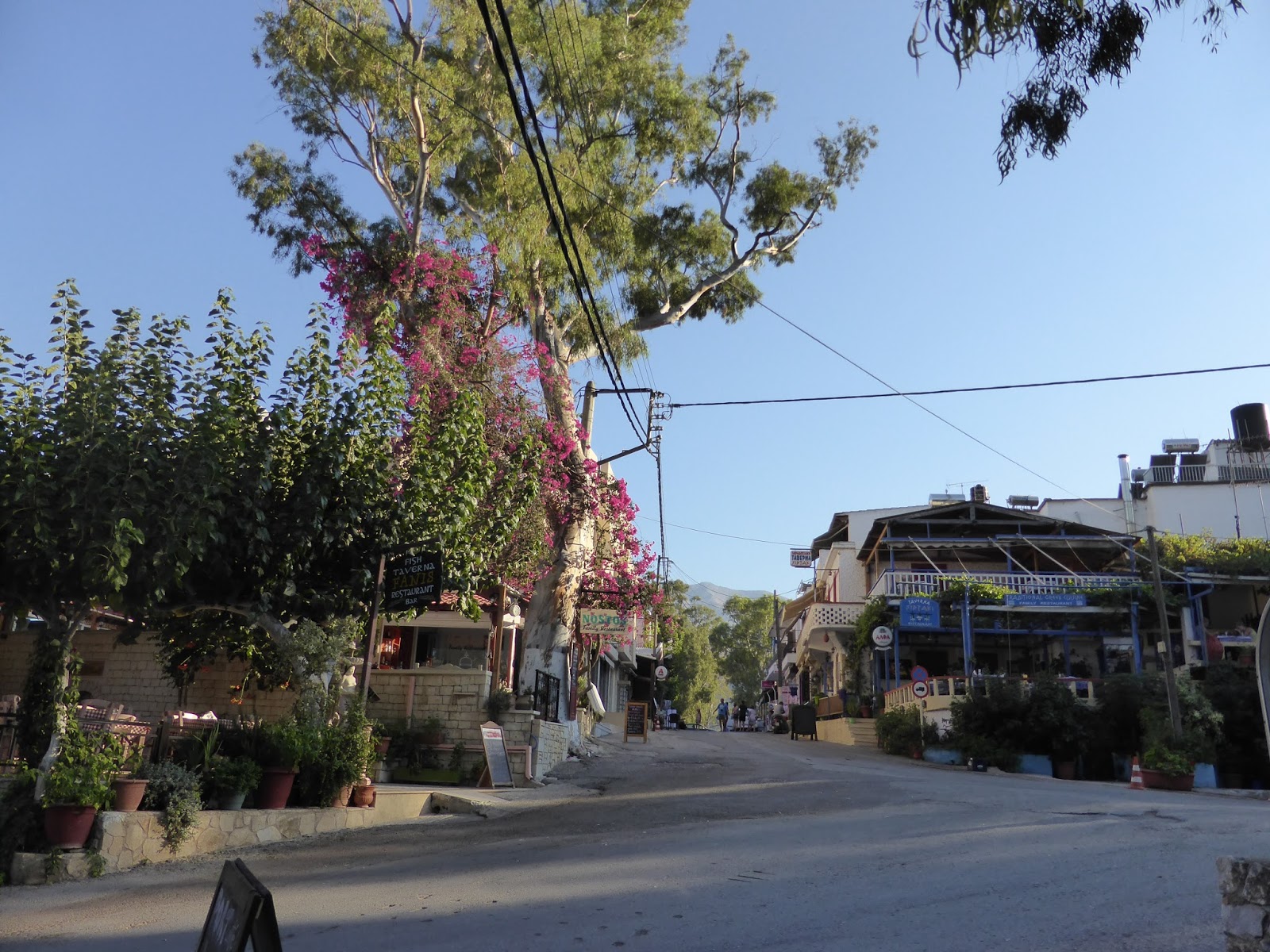
Beautiful tree-lined street in Georgiopoli

This taverna beckons you to come and have a cold beer

Amy and Laurie having breakfast in the courtyard of a shaded taverna

We set off for Ormos Milati, as described in a previous posting, and as usual Envoy is attracting a lot of attention with her distinct and unusual appearance, paravanes out, and flopper-stoppers gently rising and falling. Many people in small craft, and even people swimming come up to us to talk and ask questions.
One man in particular swims out and asks that we join he and his wife and friends for dinner – an invitation we happily accept. Over the next few days we have two great nights with Minoli Spanoucakis, his Greek-American wife Anne, and friends Constantine, Costas, Lilian and others. Minoli used to be Deputy Mayor of the region so is a mine of information. It turns out that Costas is the same guy we met here in 2010 and had dinner with he and his wife. A hospitable lot these Cretans. When we come to pay the bill a great dinner including beer and wine has cost us just 14 Euros (about NZ$22) per head.

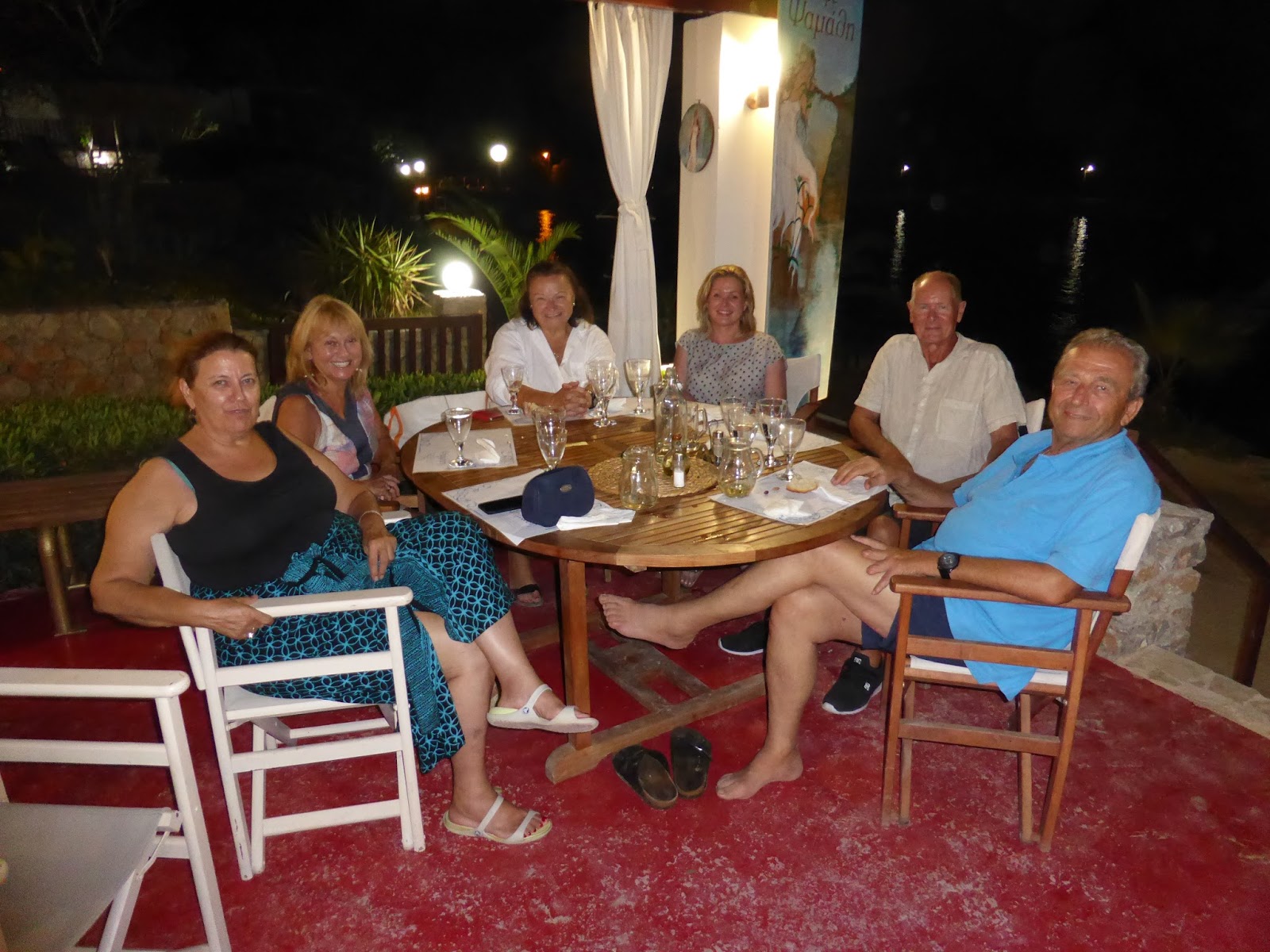
Dinner with our new-found Cretan friends

Also in Ormos Milati we meet two Australian couples cruising in their sailing catamarans: Campbell and Debbie from Fremantle aboard “Walanthea” and Brian and Lorraine aboard “Ki”.

Two Australian cats and Envoy anchored at O Milati

With Amy still aboard we cruise for seven and a half hours around the most westerly point of Crete’s north coast to the island of Gramvousa. This is a spectacular area and the island has a couple of bays on its south side, making it reasonably sheltered from the prevailing northerly winds, although at anchorages like this you don’t find perfect shelter.

Envoy anchored off Gramvousa with fortress ruins on top of hill

Crowning the island are the ruins of a huge Venetian fortress built in 1579, triangular in shape, with each side 1km long. It was the last Cretan stronghold to fall to the Turks in 1692, having been held for three years by 3,000 Cretans. In the early 19th century the area became a haven for pirates until an Anglo/French expedition rooted them out in 1828.

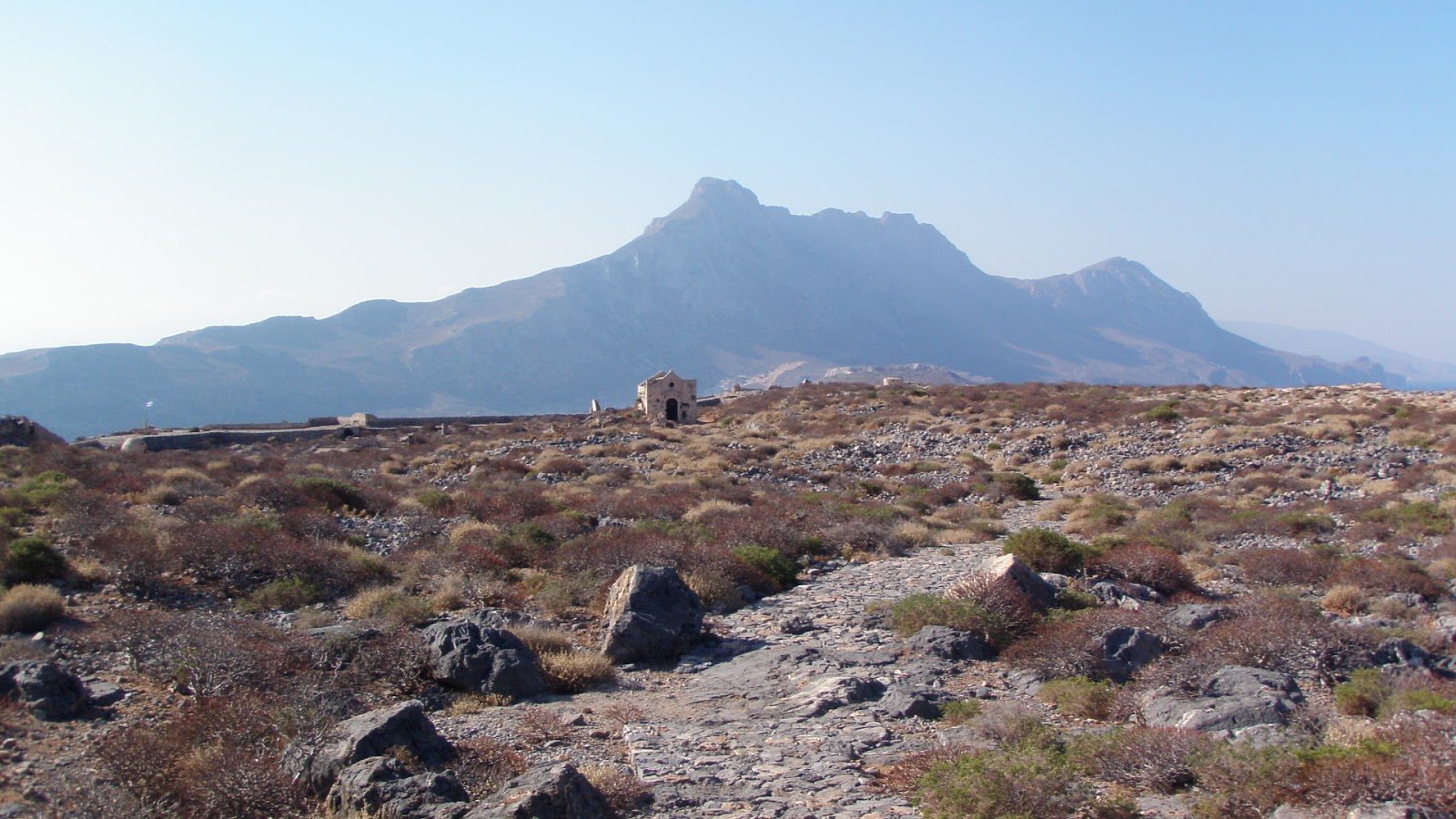
A view across the castle’s interior

Envoy at anchor viewed from track leading up to castle

On rocks separating the two bays is the wreck of the ship, Dimitrios P, about 40 metres long and wrecked during a storm in 1968 while carrying bags of cement to Africa. Amy and I snorkel around the wreck noting that hundreds of solidified bags of cement are still clearly visible along with the engine, drive train and huge bronze propeller. The wreck’s condition has deteriorated since our last visit in 2010 though, with large superstructure sections having collapsed.

Gramvousa’s shipwreck

Shipwreck with Envoy in background

We spent two nights there with mid-morning to late afternoon ferries bringing literally hundreds of day-trippers to the island, but after the last of the ferries leave it’s very peaceful, with only a fishing boat moored in the bay one night.
We go ashore for drinks on the deserted beach and Amy and Diane sit in a rock pool by the water’s edge. Di accidentally touches some kind of sea urchin that stings her, embedding dozens of extremly fine hairy prongs into her hand. It’s still sore after Amy and Di spend a couple of hours pulling the hairs out and takes several days to fully recover.

The scene of Di’s sea urchin sting

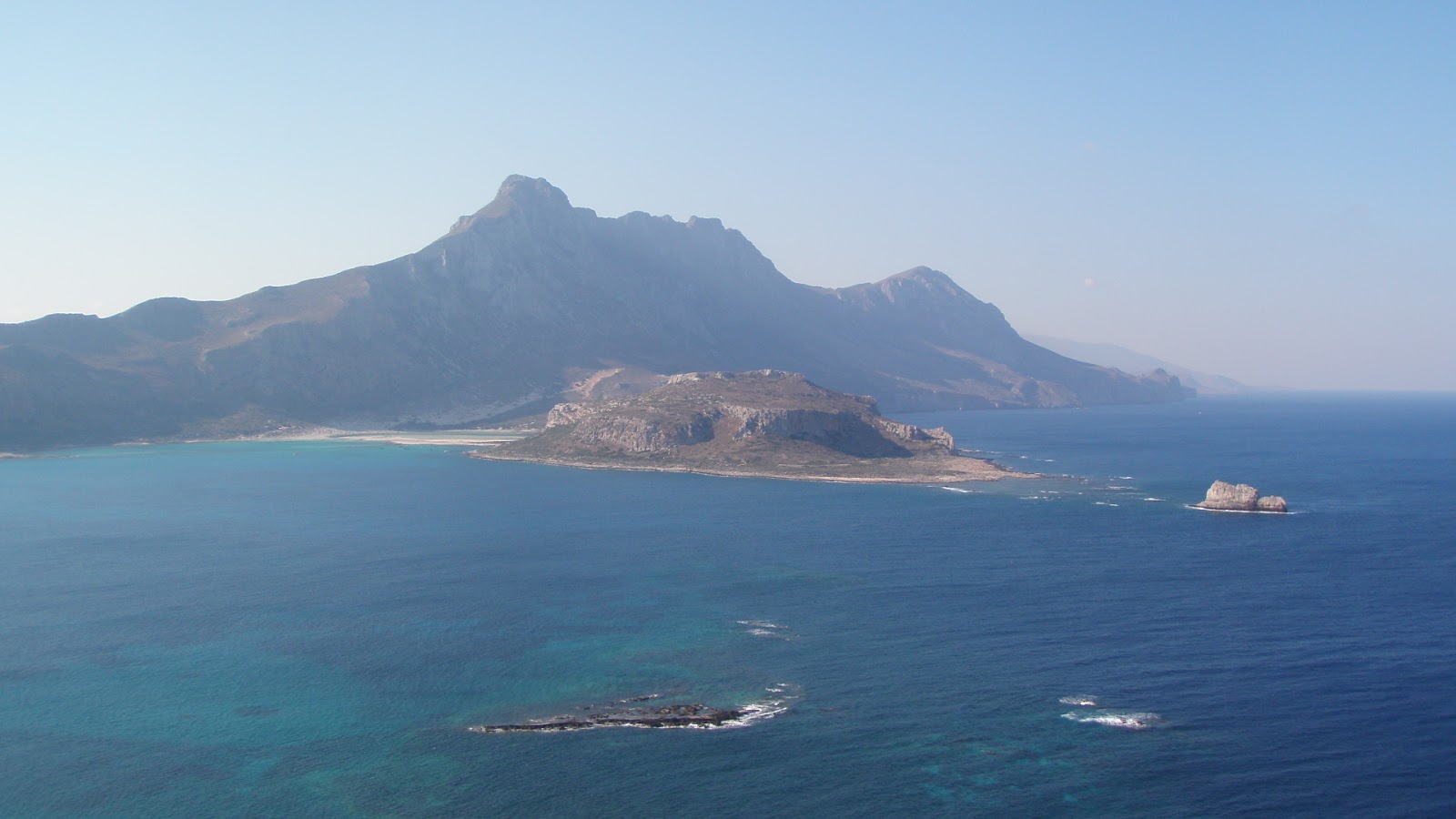
Looking across to Balos from Gramvousa’s summit

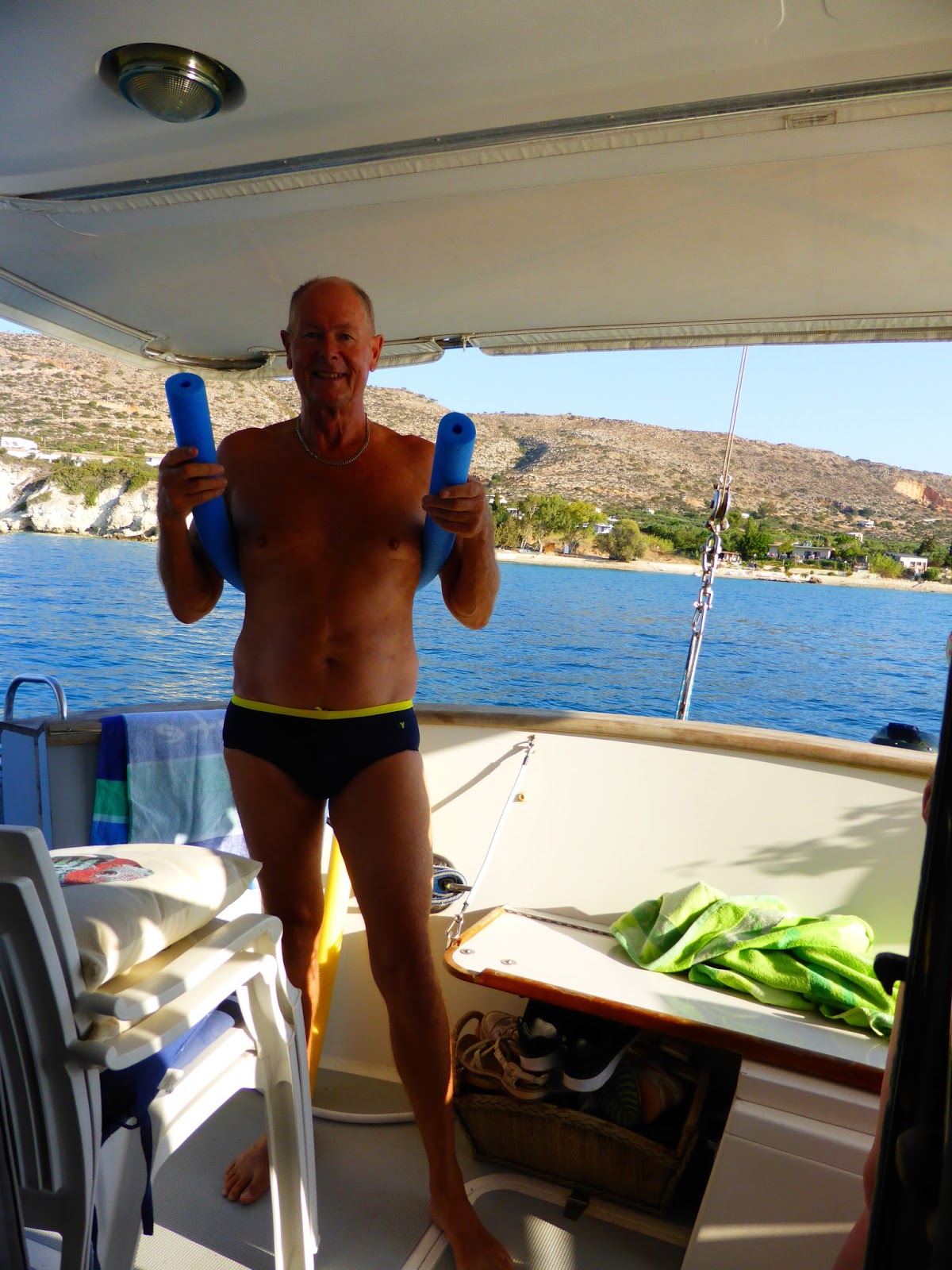
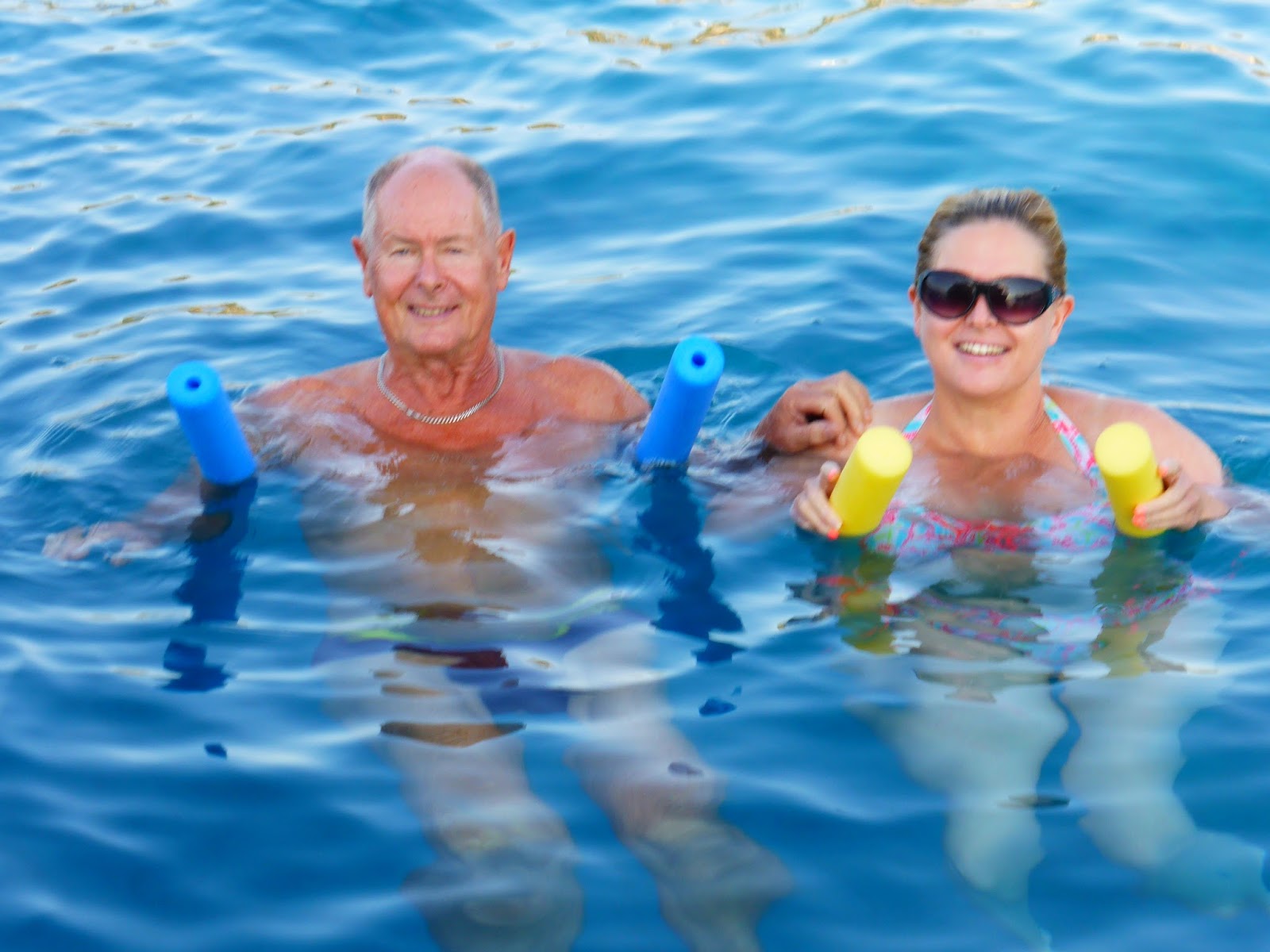
Amy had told us about a products called noodles that provide great flotation when swimming and we used these for the first time this season.

You can wrap the noodle around your chest to provide buoyancy in the water

Laurie and Amy swimming with noodles

It’s great to spend a couple of weeks of quality time with Amy and we enjoy lots of swims, walks ashore, candle-lit BBQ’s aboard Envoy, snorkelling.

Back at Soudha Bay we see some gypsies as we approach the shore in our RHIB. We know what’s coming and as soon as we reach the jetty, the gypsy children approach us with arms outstretched begging while their parents watch. We don’t give them anything, but are then worried about leaving our RHIB unattended there as the children start to crowd around it as we leave, so we play it safe and move the RHIB to a more secure location where there are fisherman nearby to keep an eye on it.

We leave Crete the day after Amy returns to London starting our 200 mile journey to Cephalonia where we’ll meet Australian friends Simon and Bronwyn in two weeks. That day we cruise 16 hours in great conditions to Ay Nikolau on the southern side of Kithera Island and do a partial night cruise, dropping the anchor at 0015 hours the next day.

RETHYMNO – TECHNICAL AND FOR FOODIES

TECHNICAL
At Rethymno our agent, A1 Yachting organises some servicemen to do a few jobs.
-One of our two 120V aircon units has a sea water cooling pump which is not working. An electrician confirms there is no power coming to the pump from the aircon unit but can’t fix it. His solution is to buy a new aircon unit! No success there and we decide to get it checked by someone we know in Corfu.
-Our washing machine’s water discharge pump, previously fixed by Chris and I fails again. Two servicemen come to inspect it and find it is simply a blocked impeller. A few days later it fails again and this time an AC wire has broken. This wire is too light for its function with the vibration of the machine. They fix it but a couple of weeks later the pump is no longer working. I have rigged up a hand vacuum pump to the machine pump’s water outlet so that we can still use the machine and will get the machine checked later by Miele servicemen in Corfu. Incidentally we are now recycling the machine’s water to clean the boat down, whereas this water normally discharges over the side.
-Our main toilet has had a problem all season. It will discharge into the holding tank (from where we can discharge waste overboard) but will not discharge directly over the side. Experienced servicemen already looked at this in Corfu finding nothing wrong with the toilet. This serviceman does much the same, finding nothing wrong and by a process of elimination the fault probably must be a partially blocked discharge hose to the seacock or a problem with the seacock itself. Since we can still use this toilet (and the forward toilet) this has not been a major problem and we’ll resolve it next time Envoy is on the hardstand.
Probably cruising’s only great frustration is when supposedly expert people come aboard to investigate a technical problem and can’t resolve it or provide a way forward to resolve it.

FOR FOODIES
In Rethymno we find a delightful restaurant called Veneto in a 700 year old building which has been a Dominican monastery, a Venetian mansion and a prominent Turk’s residence. This is open-air dining at its best on an ancient stone floor, surrounded by arches, shrubs and flowers in ceramic pots and a water feature built around an old well.

Ancient horse trough is now a feature at Veneto restaurant

The meals are sumptuous but reasonably priced and we share: -Marinated sardine fillets upon crispy bruschetta with freshly-ground pepper and secret herbs for 7.50 Euros (about NZ$12.50).
-Apakia smoked pork with whipped goat’s crème and sweet Vinsanto wine for 9 Euros (about NZ$15. -Stuffed vine leaves (Dolmades) and zuccini flowers with rice and yoghurt for 6.50 Euros (about NZ$11).

Our delicious platters served ready to enjoy

This is washed down with some local house white wine at 5 Euros (about NZ$8) for 500 ml, followed by a free dessert of fresh fruit and local schnapps.

ENVOY VISITS RETHYMNO

Envoy is currently at Gouvia marina in Corfu.

In Crete the wind increases again with large breaking swells in the open sea so we use the almost perfect shelter of Soudha Bay to leave Envoy safely anchored and visit the town of Chania, just about 20 minutes away by road. On arriving we see large seas breaking across the north-facing harbour entrance with tourists dodging residues of waves and spray coming up over the footpath and boats in the harbour surging back and forth to their mooring lines – we’re glad not to be moored here.
Chania is a great town, probably the prettiest in Crete with very quaint narrow streets and the ever present reminders of the Venetian fortress which once protected the harbour. Much of the fortress walls remain, and many more recent buildings are built into them.

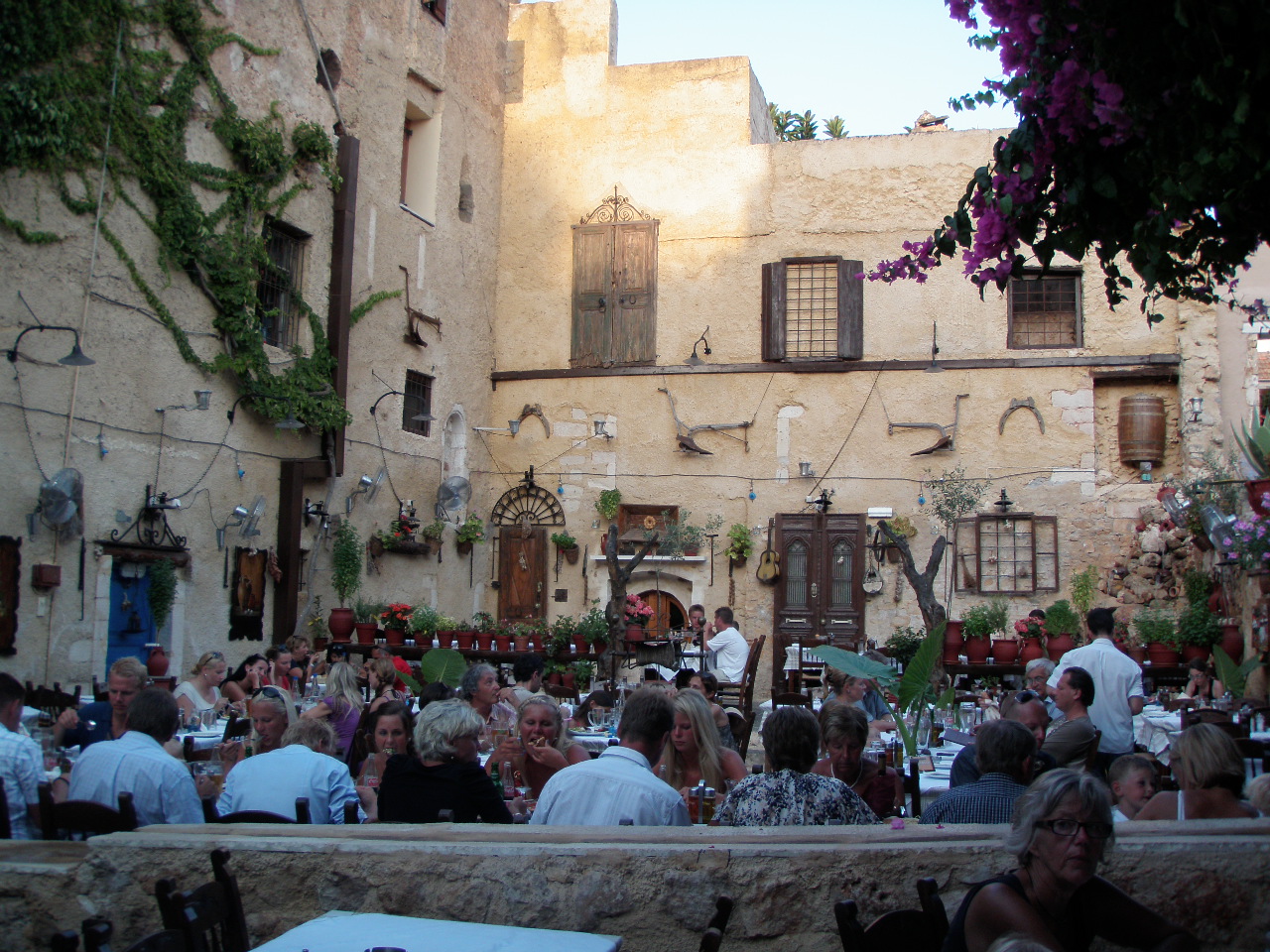
One of Chania’s many stunning open-air dining areas

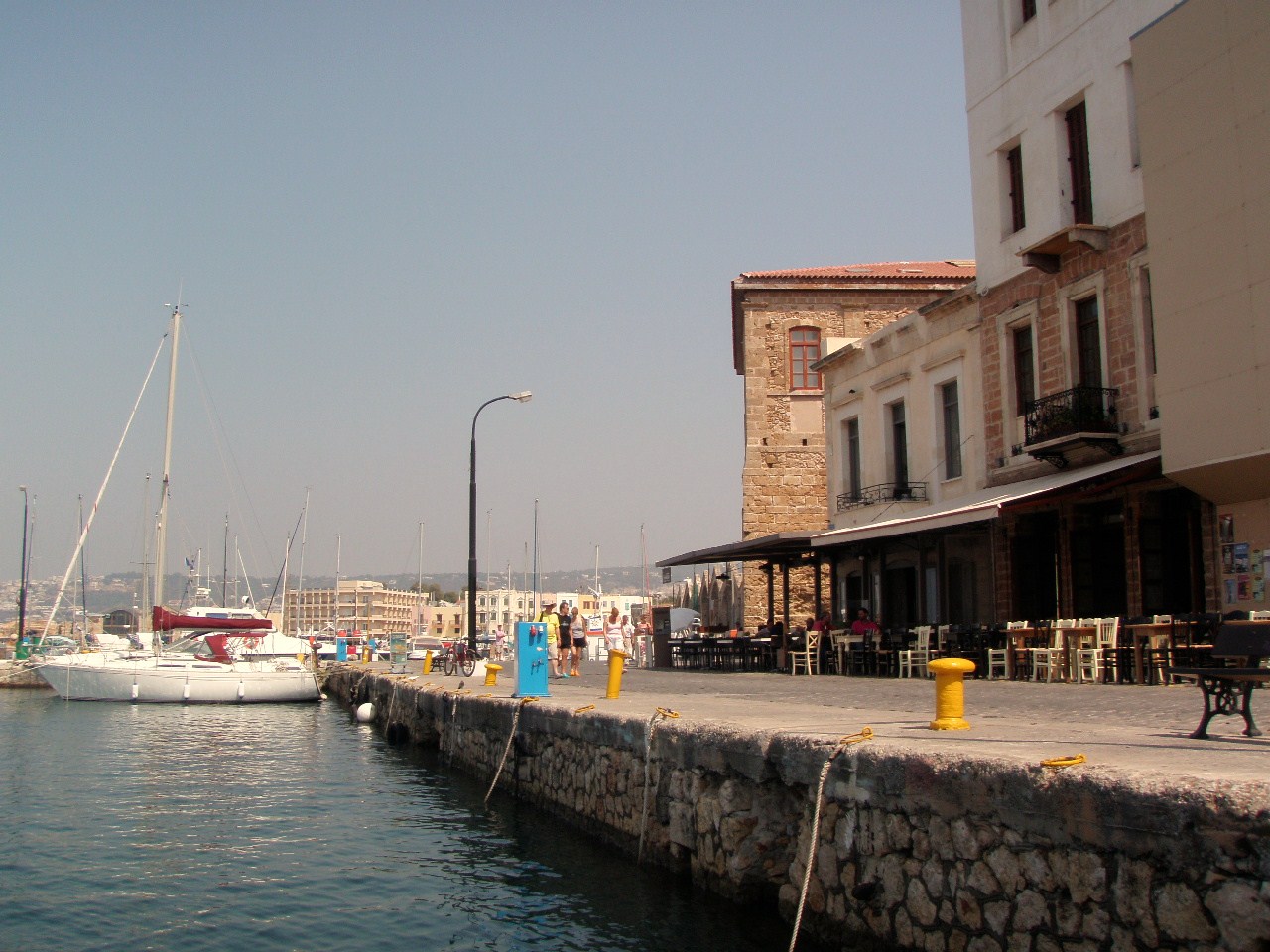
Chania’s quay for visiting yachts quiet now but bustling by night

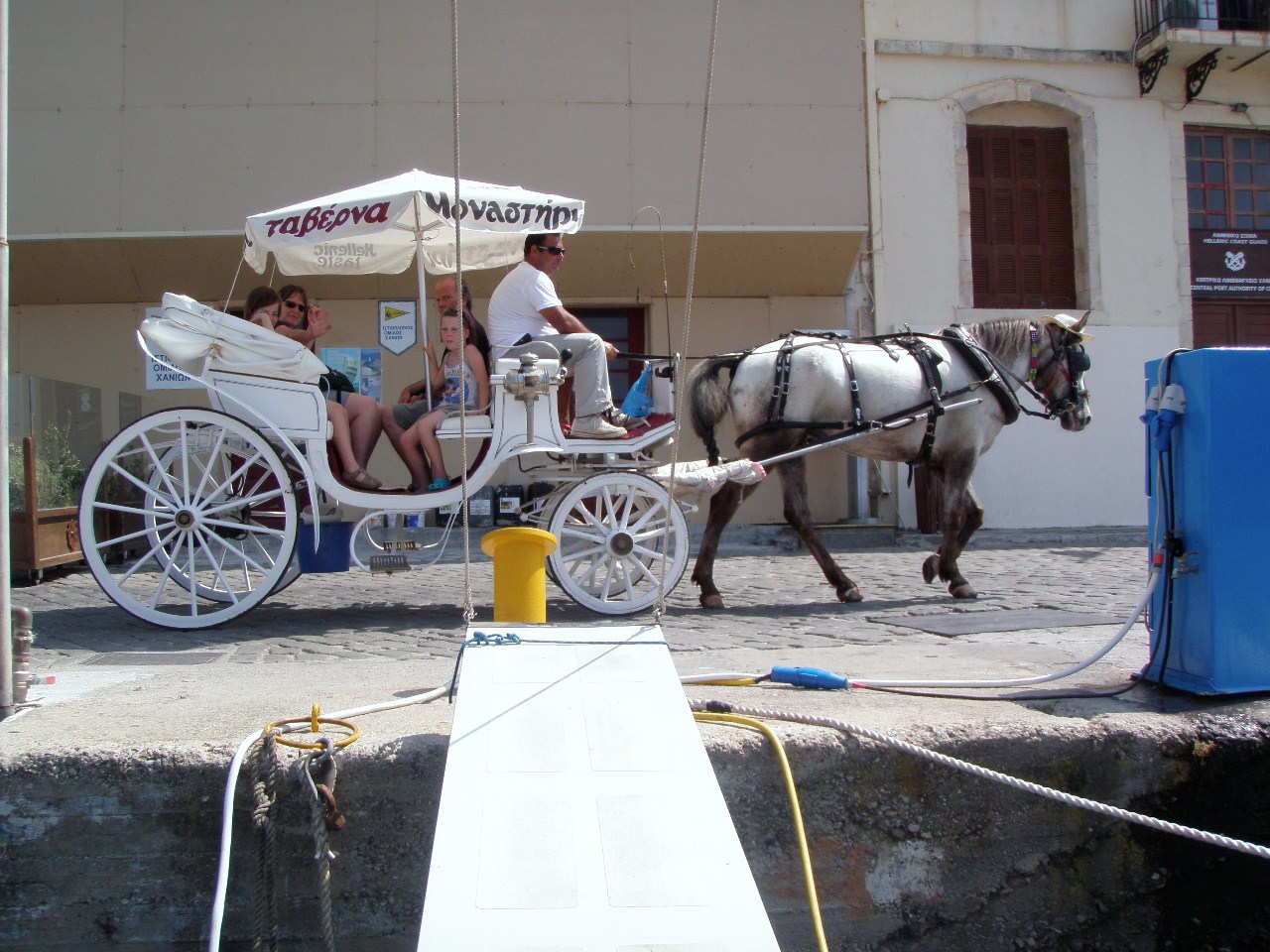
Tourists view Chania by romantic horse-drawn carriage

We also drive along the coast to the village of Kolimvari and again find large breaking seas about two metres high right where we had anchored Envoy during 2010. How the sea can change!

Rough seas pound the shore at Kolimvari

In 2010 Envoy was anchored right here for several days

It’s from here that Sharon and Doug leave us after three great weeks together and then we cruise back eastwards a little to Rethymno, mooring stern-to in the harbour to meet our daughter, Amy, joining us for two weeks. The mooring cost is a very reasonable 120 Euros (about NZ$200) for six days including water and power and close-by is a great ocean-facing sandy beach for our daily swims. Rethymno has an ancient harbour – filled with tour boats and local fishing boats, ringed with tavernas, and dominated by the 16th century Venetian Fortressa.

Rethymno’s Venetian harbour

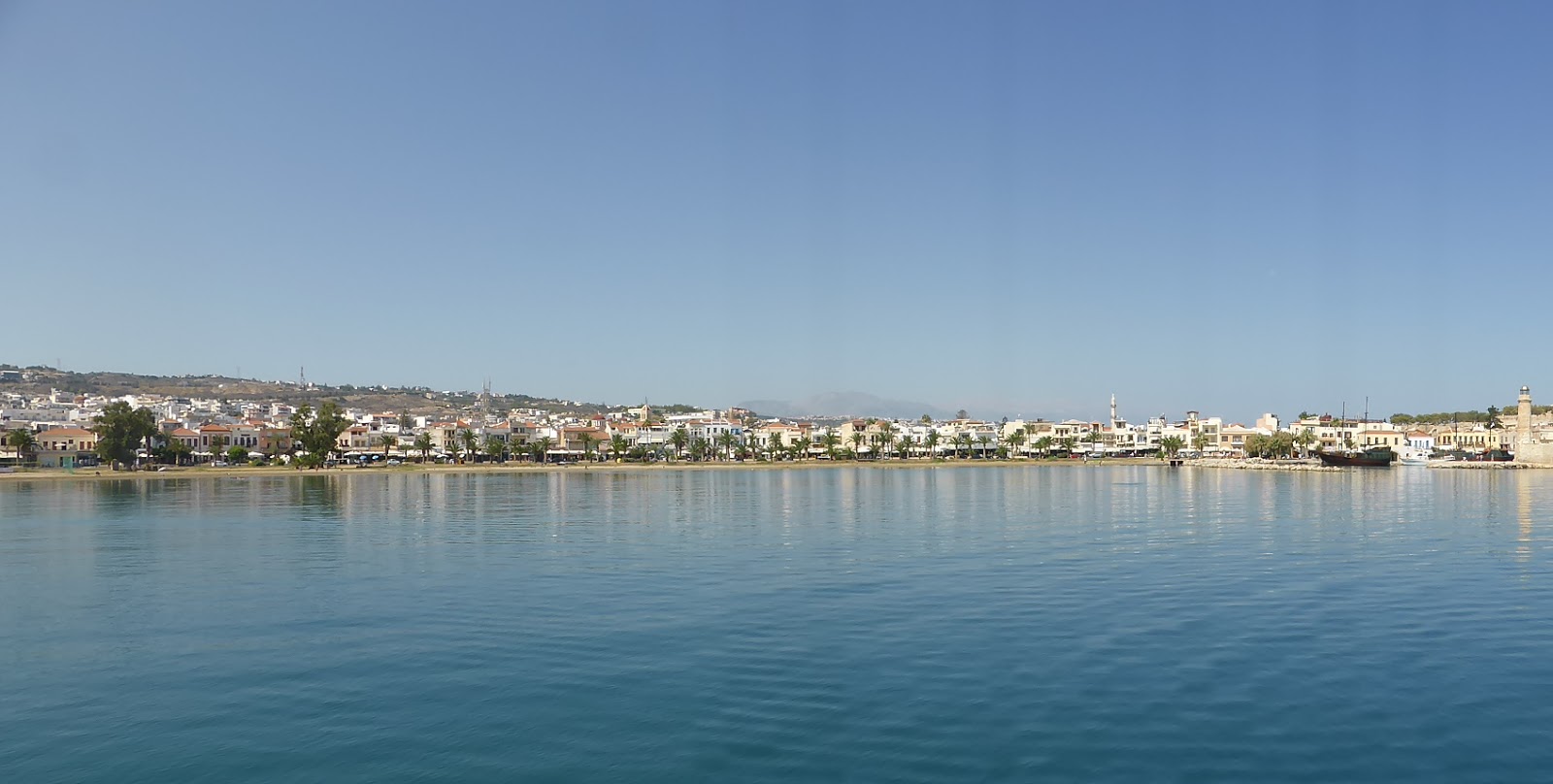
Panorama of Rethymno

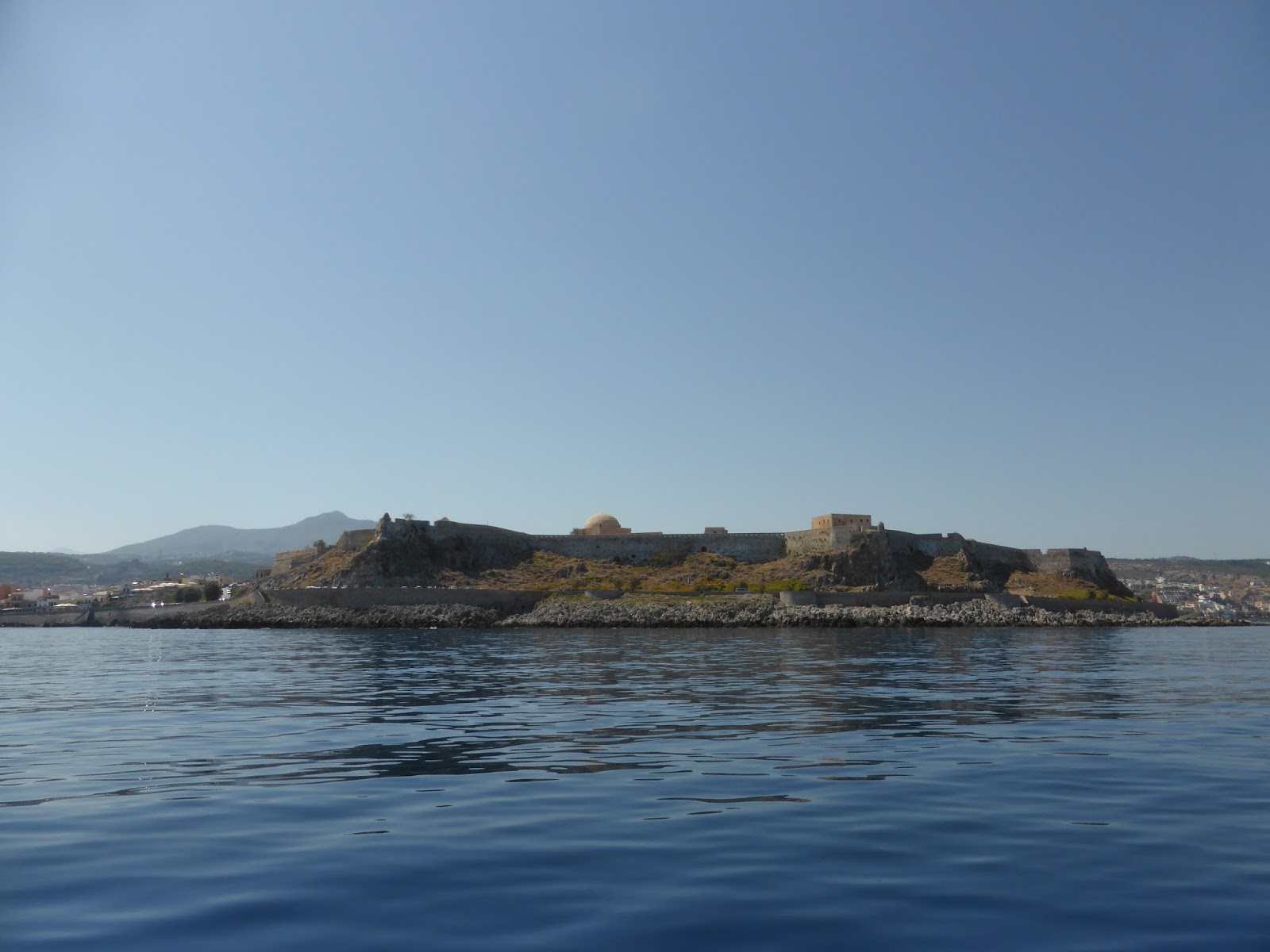
The Fortress viewed from seaward

While awaiting Amy’s arrival we meet Australians Kevin and Diane Horne from yacht Monastrell and share a couple of enjoyable nights. In fact nearly all the people we’ve met from other boats this year have been Aussies and no Kiwis so far. We always find Aussies to be very friendly and ready to enjoy some lively discussions about sport and social issues.

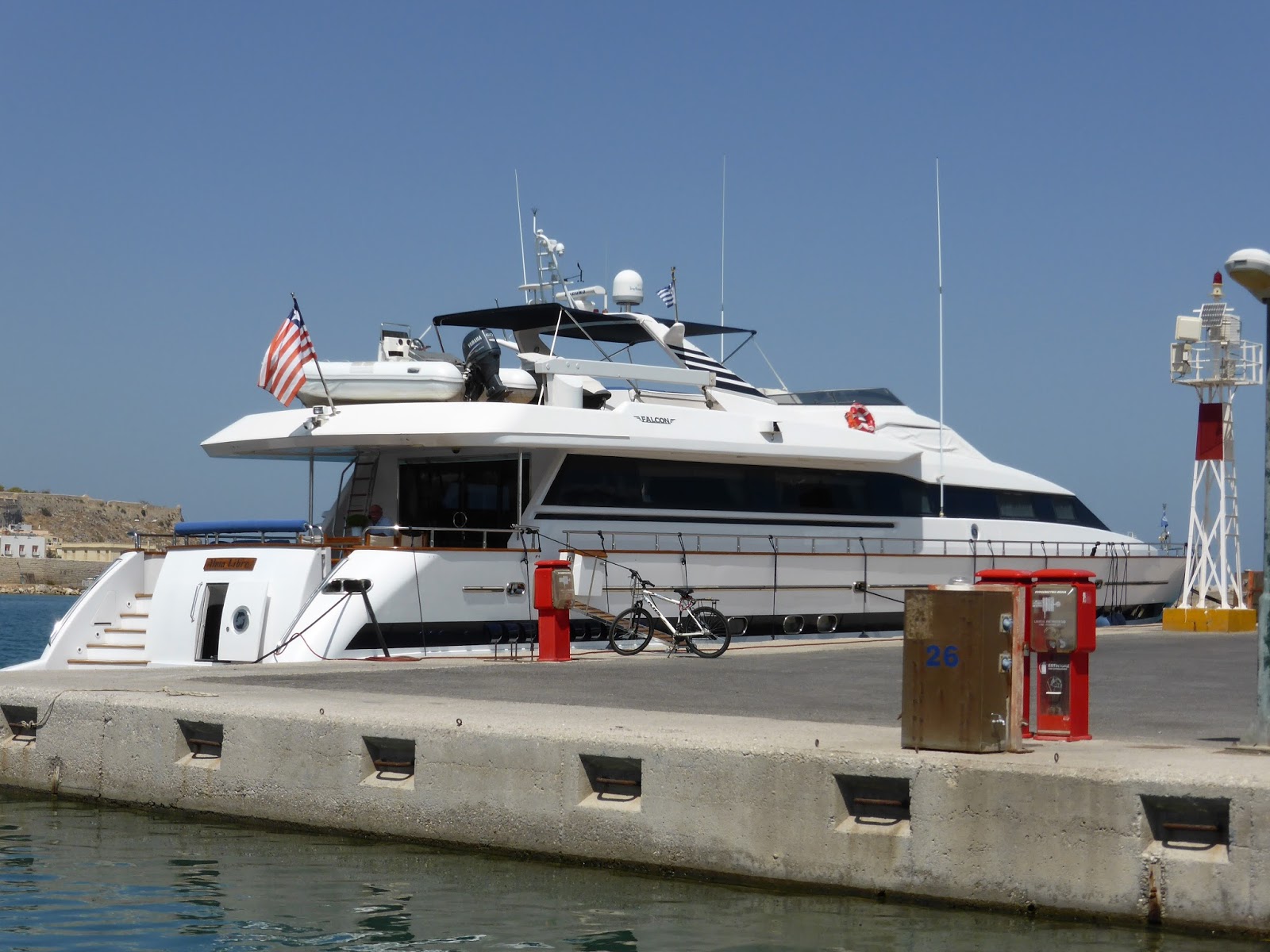
A large planing  motor vessel moored nearby uses 700 litres of diesel per hour!

We’re asleep aboard Envoy when we hear a Greek lady shouting “excuse me, excuse me”. We awake and go up on deck to hear that she’s from the boat opposite and has seen a mouse crawling up one of our mooring lines and on board Envoy. So we search around with a torch and a couple of times I see the mouse, which is in fact a large rat, but we can’t catch it or chase it off. Then we see several more rats running along the jetty. We put some rodent stoppers on our mooring lines, close all the windows hoping the rat can’t get inside the boat (there are horror stories of how much damage rats can do to boats) and lay some poison that the Greek lady gives us. In the morning the poison is untouched, but I find a couple of rat poo droppings on the foredeck. Our herb garden has also been attacked, not surprisingly since this is the only vegetation close by, so we put this ashore on the jetty until our departure so as not to attract the rats aboard. Next day we buy two rat traps and for the next few nights we bait them with cheese and leave them out overnight also leaving a few pieces of cheese around the boat. But we don’t catch any rats or see any further signs of them on board and the cheese is untouched, so hopefully that issue is resolved.

Di and Amy enjoy shopping in the atmospheric Old Town and getting lost in the usual maze of narrow cobbled lanes while I find a particularly atmospheric Irish music bar to enjoy a cold beer in.

A great bar in Rethymno

CRUISING TO HISTORIC SOUDHA BAY

CRUISING TO HISTORIC SOUDHA BAY
Envoy is currently anchored at Mourtos on the Greek mainland opposite Corfu with my brother Charles aboard.

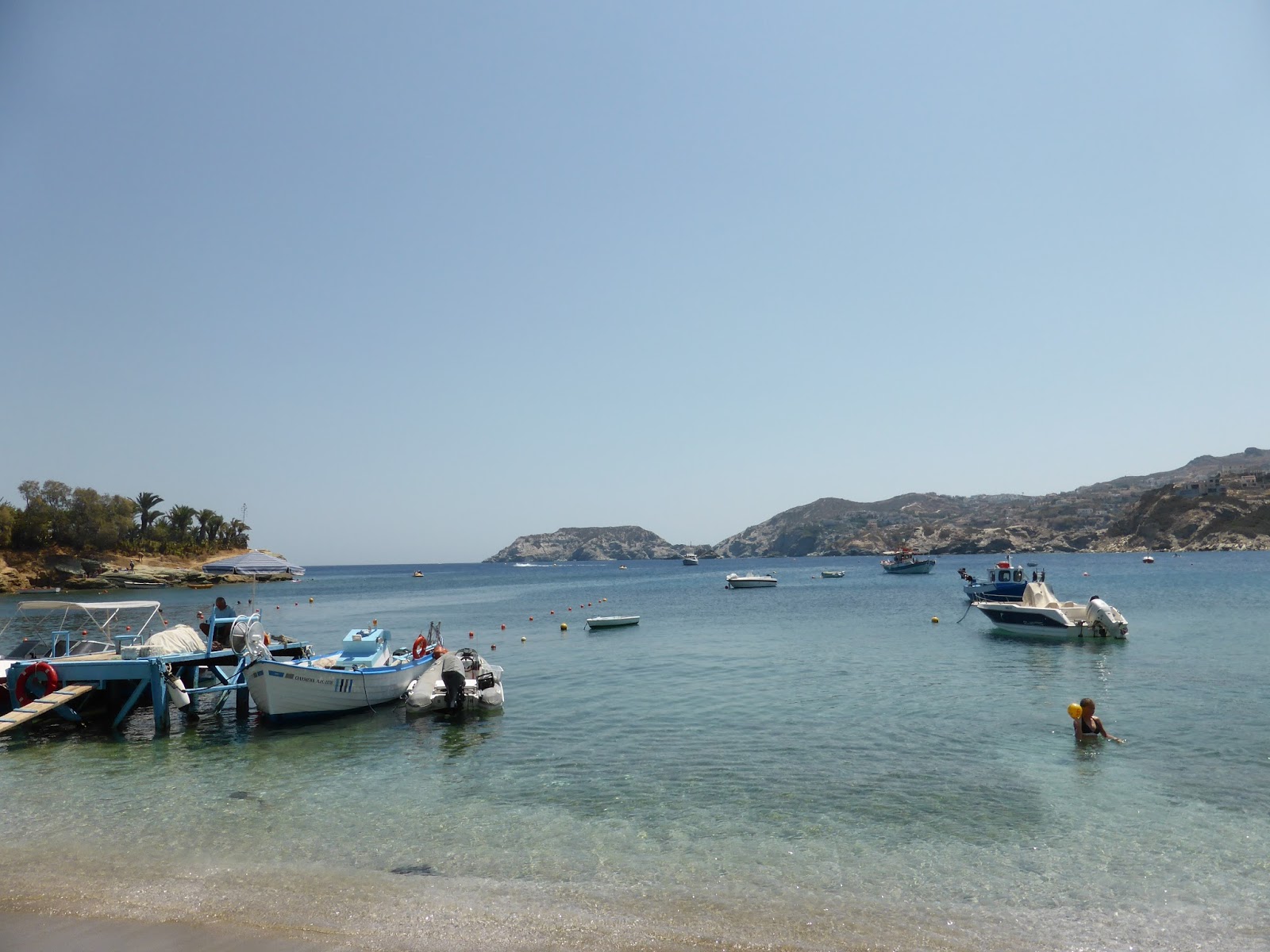
It’s great to visit destinations we missed during 2010 and we find one in Agia Pelagia – a spectacular beach in a great setting though ridiculously crowded ashore. We’re the only boat anchored here but like some other beaches an irritation is high-powered sports boats towing skiers, banana boats etc. To be fair they only seem to operate from about midday to 1700 (a good time to be ashore!) and the rest of the time is peaceful at anchor.

Agia Pelagia’s crowded narrow beach

At this location, like many, it’s difficult to find a place to put the RHIB when going ashore, but a fisherman kindly offers us a place and helps us moor alongside his boat.

Our RHIB is moored alongside a fishing boat in Agia Pelagia

The taverna owners tell us the tourists are mainly Greek on package tours and not spending much money. Many don’t have much to spend with the austerity measures, a 25 year-old qualified nurse saying she’d changed to waitressing as her nurse’s wages had reduced to 400 Euros (about NZ$670) per month – extremely low even per week. Her husband, a plumber, was told by his employer that he’d get paid when he could afford to pay him.

Next day we move further west to the small town of Ormos Bali, where often too much swell prevents anchoring but we find it calm this time and with no sports boat activity – bliss!

Ormos Bali’s beachfront

Ormos Bali viewed from Envoy at anchor

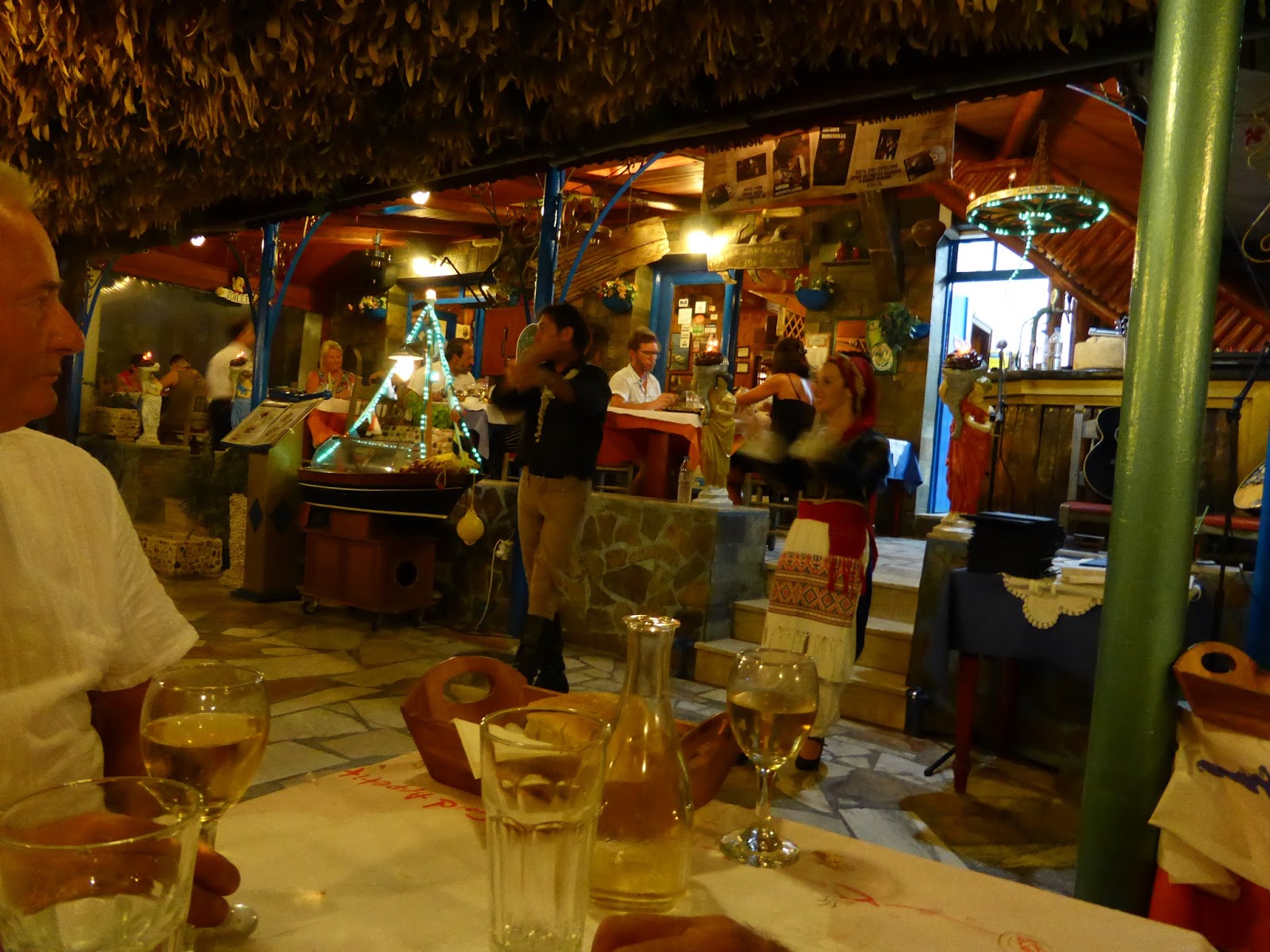
Later we have dinner ashore to the sound of live Greek music and traditional dancing, though the two performers seem mostly intent on getting the diners up to dance with them.

Dancers in traditional Cretan costumes

Like most overnight stops so far free fresh water is available from the small craft jetty and we replenish Envoy’s tanks using our portable containers and Chris’s pump.

One of our favourite destinations of all time is Ormos Milati on the northern side of the mouth of famous Soudha Bay, protected from all except rare easterlies and it’s here we anchor next.
Although it’s one of the best anchorages on the coast we’re the only boat anchored here. Ashore are excellent sandy beaches with clear water, although in typical Greek style large portions of the beach are covered with deck chairs and umbrellas. Here we have the first rain shower in many weeks.
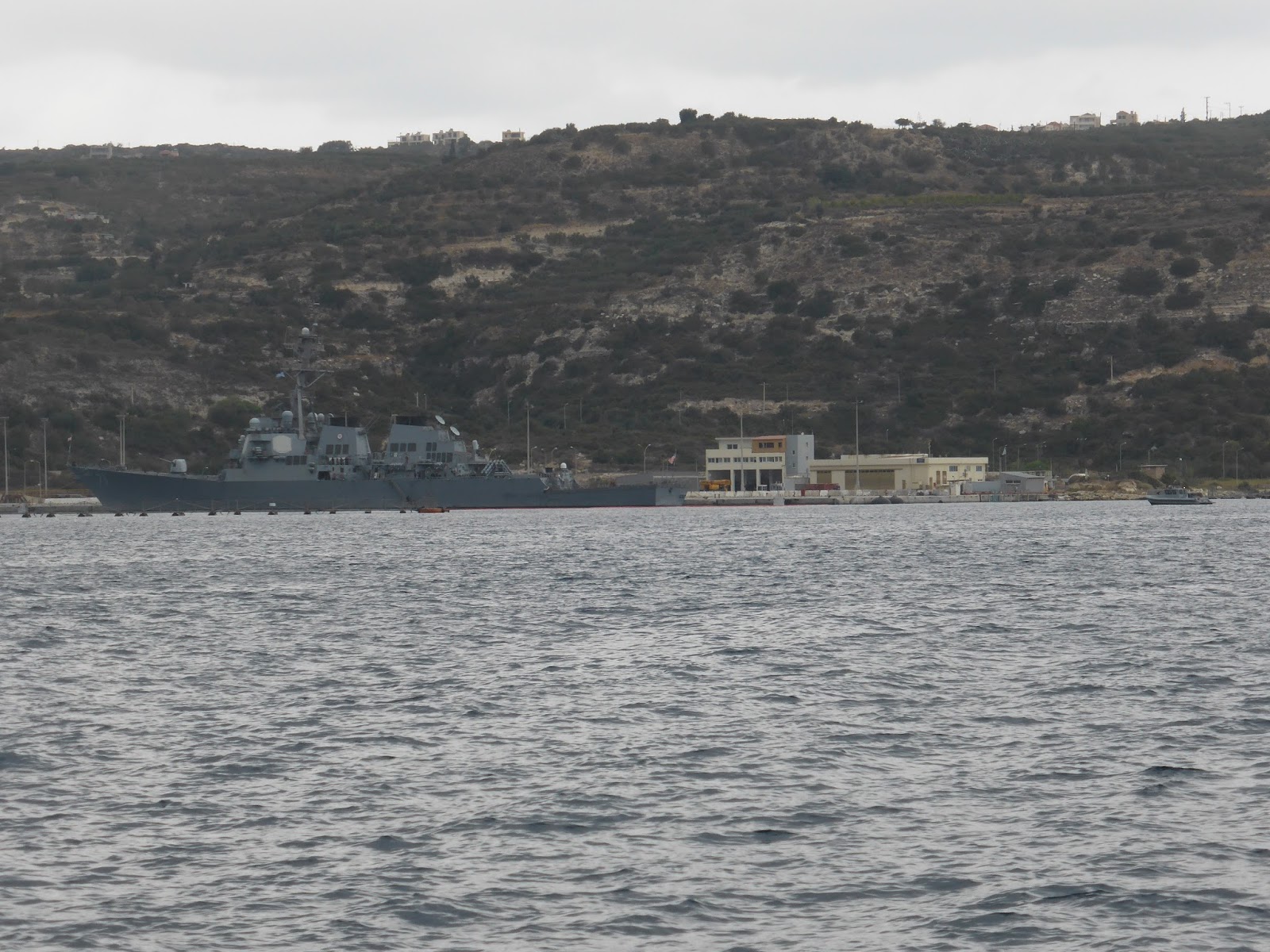
Soudha Bay itself is a four-mile long sheltered inlet running east-west containing a NATO naval base and the town of Soudha and a NATO naval base where we see several warships including a submarine. Tight security reigns here and armed patrol boats guard the warships. At one stage we approach too closely and a patrol boat roars over with blue lights flashing and siren sounding and instructs us to move further away.

Warship anchored in Soudha Bay

Artillery on the headland above the bay’s entrance still provides protection.
There is also a military airfield nearby, and jet fighters regularly roar over our heads.

During WW2 the Allies suffered heavy losses of ships in Soudha Bay at the hands of German bombers.
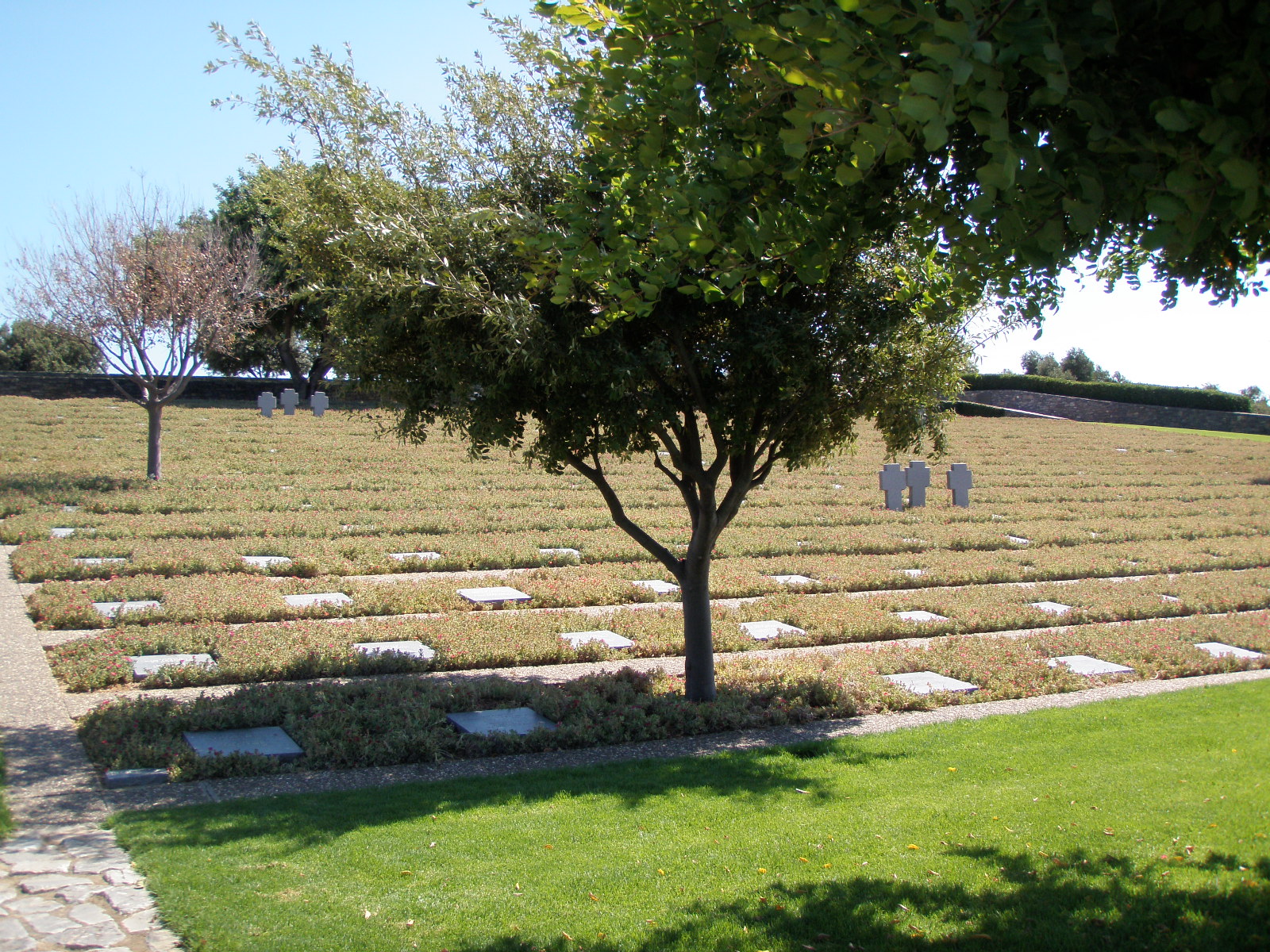
At the head of the bay is an Allied war cemetery, beautifully maintained in a wonderful setting, with the graves of 446 New Zealanders, mostly aged in their 20s, along with a lesser number of Australians who died during the German invasion of Crete.

Soudha Bay’s Allied war cemetery with Envoy anchored in background

The war graves are perfectly maintained and cared for

Although the battle was lost a big contribution to the war effort was made because the German paratroops were so decimated that Hitler never used them again. Also the invasion of Russia was delayed due to heavy German casualties in Crete, resulting in the freezing Russian winter taking a heavy toll and contributing to the eventual annihilation and capture of the German forces at Stalingrad – a critical turning point in WW2.

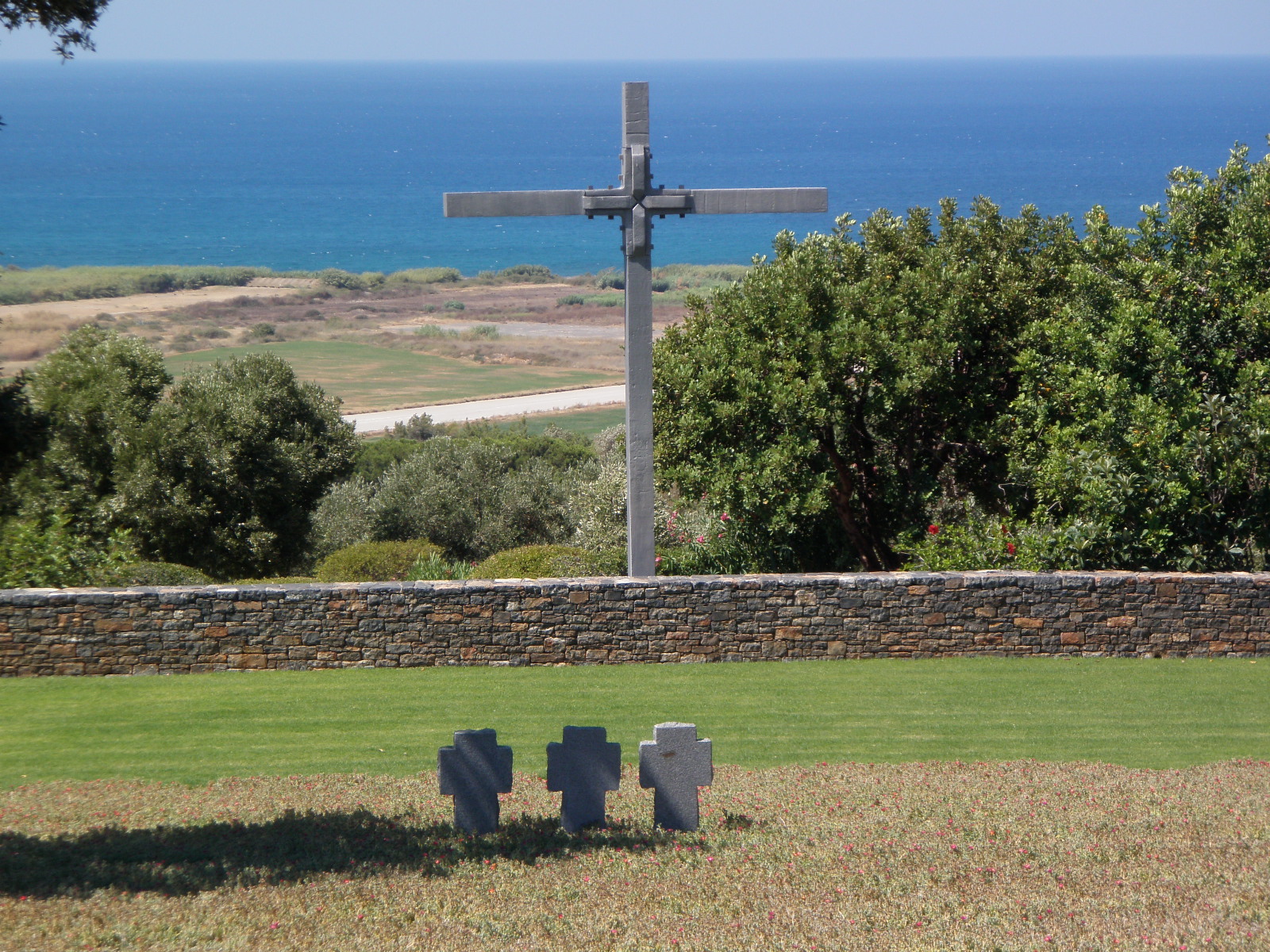
We also visit the German War Cemetery at Maleme, the scene of some of the fiercest fighting of the Battle of Crete. This is located on Hill 107 overlooking the airfield, and held by New Zealanders. They were decimating the German paratroopers on the airfield below until German aircraft arrived and wiped out most of the Kiwis. The cemetery is well designed and maintained, containing the remains of 4,460 young German men, disinterred from about 60 graveyards around Crete to be finally laid to rest in one location. It is typical of the generosity of the Cretans, that despite the appalling atrocities of the German soldiers to civilians during their occupation, they donated the land for the cemetery.

The German cemetery with Maleme airfield in background

The German graves are also in a peaceful and cared for setting

The Cretans fought very fiercely and bravely against the German occupiers eventually forcing them to retreat to the town of Chania, where they remained under virtual siege until surrendering to the British forces (not wanting to risk their chances with Cretan partisans) before the final collapse of Germany.

AGIOS NIKOLAOS

Envoy is currently anchored off the northern coast of Corfu Island.

In Crete it’s just a short cruise from Spinalongas to the marina at Agios Nikolaos where we’re berthing Envoy for a few days to do some inland touring with Sharon, Doug and our daughter, Amy (who has flown in from London for a long weekend).
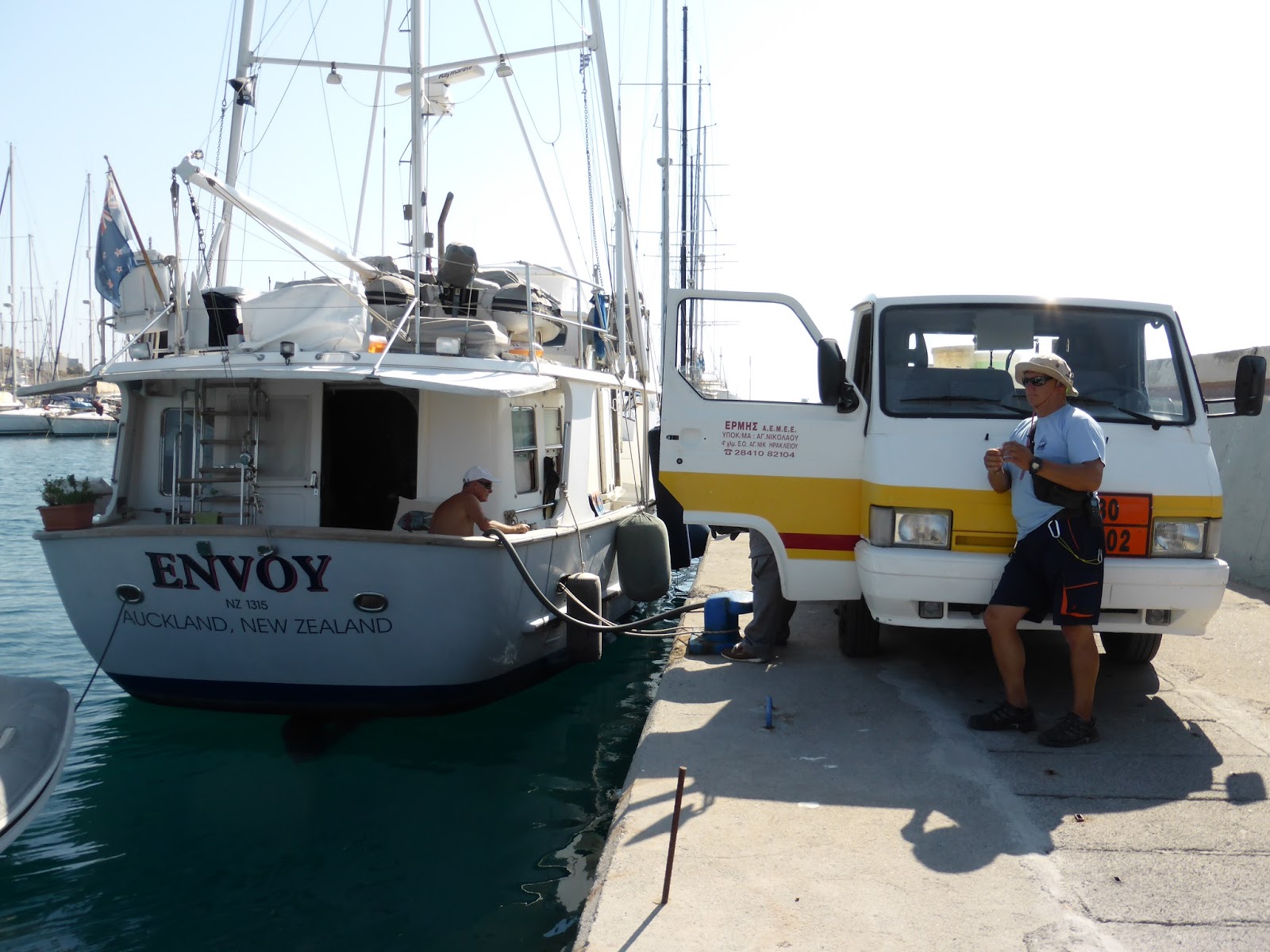
Here is the furthermost point we’ll be from our home base at Lefkas and we take on 1,500 litres of diesel from a tanker that pulls alongside costing 1.10 Euros (about NZ$1.83) per litre. This sounds like a lot of fuel but will enable Envoy to cruise more than 1,200 miles at our average consumption of 6-8 litres per hour.

Fuel tanker refuelling Envoy

We spend a day visiting some inland mountain villages and the Lasithi Plateau – an extremely fertile large green plain surprisingly located 900 metres high in the hills and where all manner of produce is grown. Water for cultivation used to be lifted from bores using windmills, in fact about 7,000 were constructed during the 17th century, some still used today.
The villages are exactly as you might picture them – narrow winding streets, where a car has to pull over to let an oncoming car through, ancient, rustic buildings, mostly in a poor state of repair and some derelict, peeling paint in white and blue, old men with waistcoats and moustaches sitting outside small tavernas looking up with interest as a car passes to ease their boredom, elderly hunched-over women dressed totally in black.
We stop at a taverna for a great lunch of roast wild pork with home-grown potatoes and vegetables followed by the inevitable free dessert of fresh fruit.
Next day we drive to Mochlos, a fishing village turned swimming beach surrounded by tavernas but retaining some natural charm, tranquility and character. Mochlos beach has several atmospheric tavernas

Laurie and Amy at Mochlos

Mochlos Beach

Agios Nikolaos itself is a great place to visit and we enjoy strolling through the many lanes, and sitting in waterfront tavernas watching the world go by.

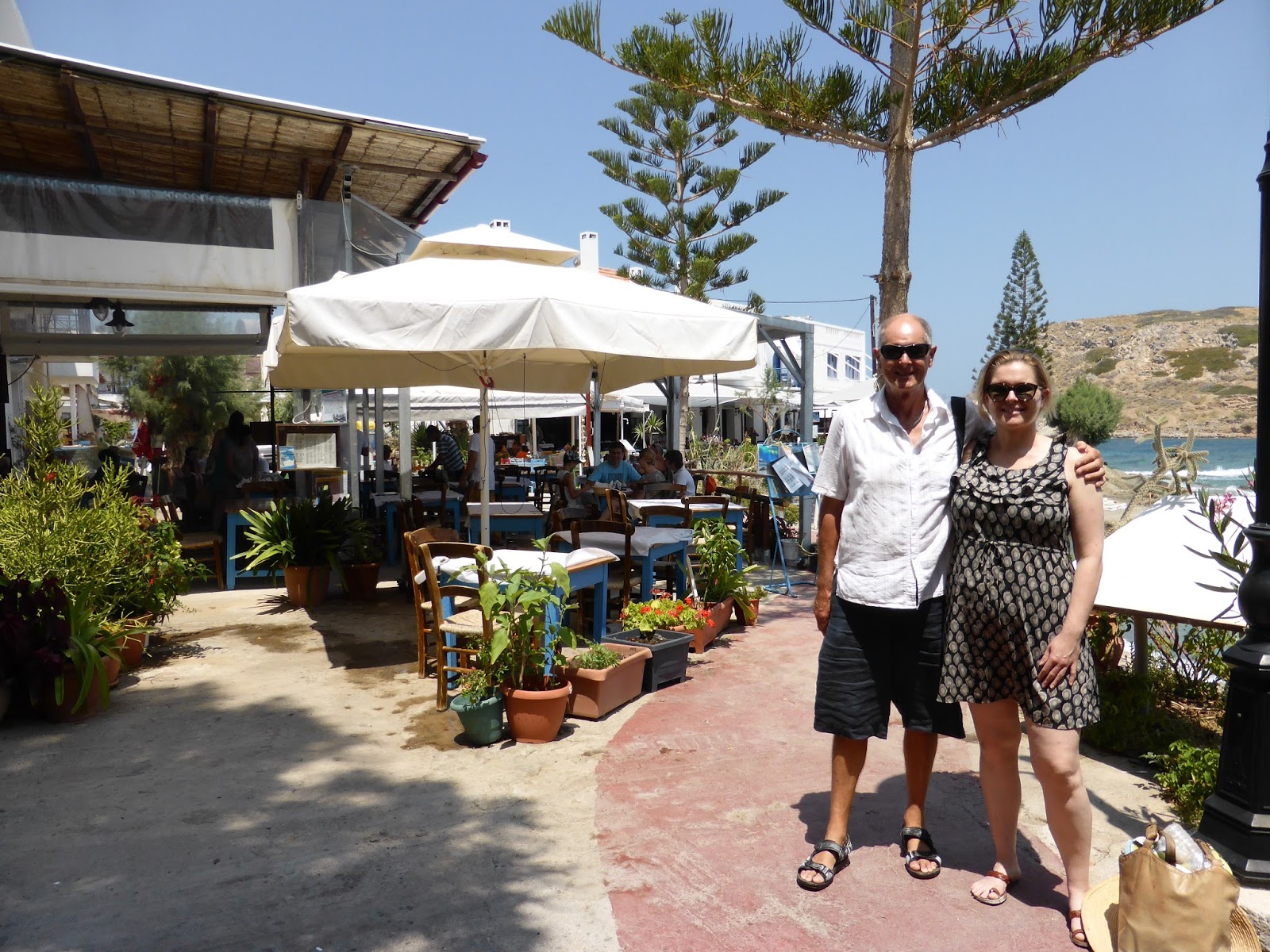
Doug, Sharon, Amy and Laurie enjoy evening drinks in a taverna at Agios Nikolaos

Here we also visit the Port Police to provide a new Crew List, required when different visitors (crew) join the vessel. There used to be a requirement to report to the Port Police in every port or marina you visit (except when anchoring), though this need has been abolished.

There are very few areas to anchor on Crete’s north coast offering good shelter, because the “Meltemi” wind is consistently from the NW or N generating a one to two metre swell. The coast is roughly 140 miles from east to west, but there are only about six harbours or marinas and five good most weather anchorages along its entire length. There are many more very small, shallow sheltered bays suitable for use by small shallow draught boats , but not for visiting cruising boats.

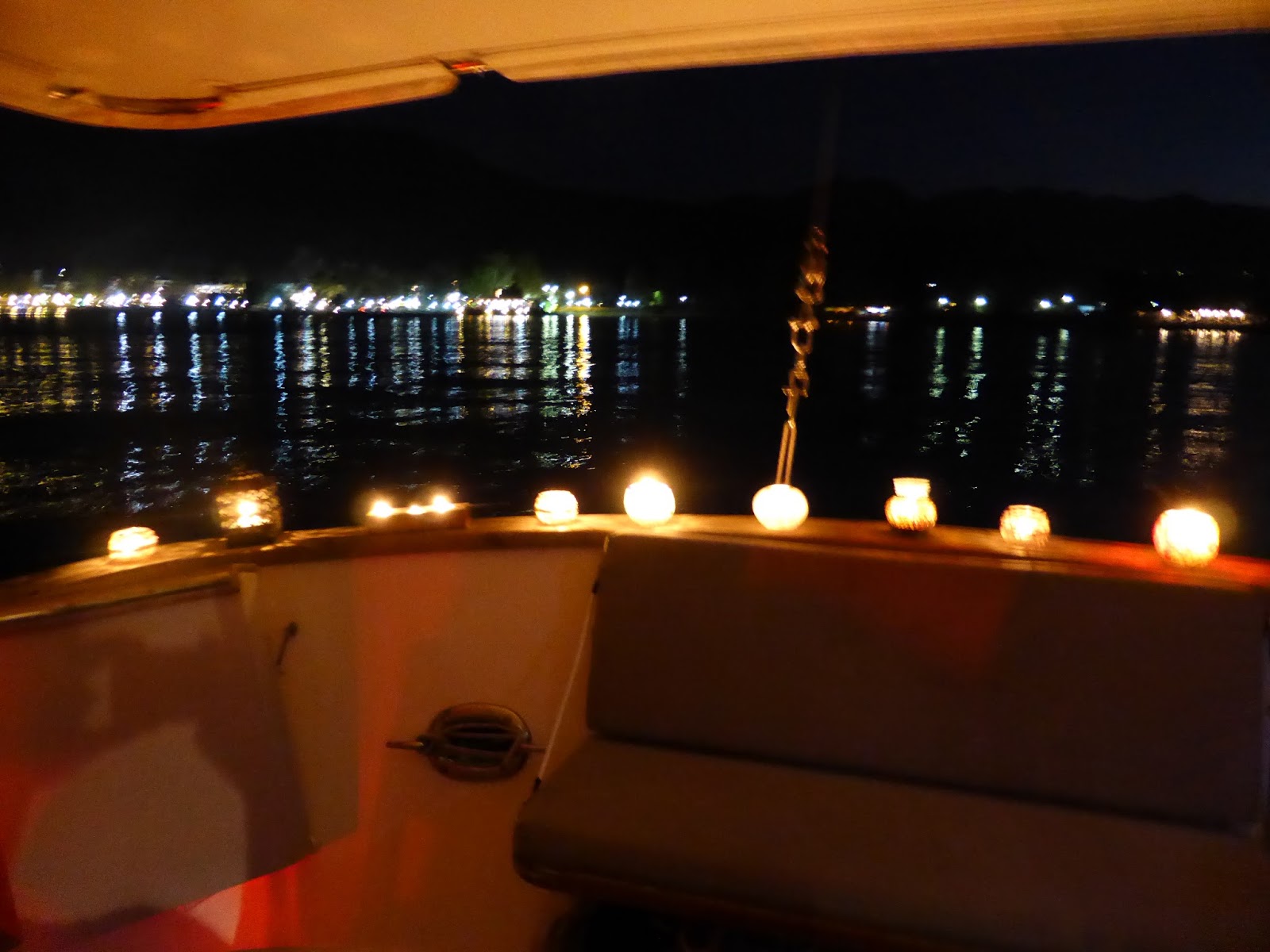
A BBQ by candlelight in Envoy’s cockpit

From Agios Nikolaos we cruise for about seven hours to the island of Nisos Dhia, correctly described as “bleak” in the Cruising Guide, though two south-facing bays offer reasonable shelter from the predominant northerly wind. We have a 20 knot headwind, choppy sea on the bow and easterly current reducing our speed to about 4.8 knots most of the way before sharing our anchorage with just two yachts and a fishing boat.

Anchorage at Nisos Dhia

THE ISLAND OF THE LIVING DEAD

Envoy is currently anchored off the Greek mainland village of Parga in the northern Ionian with our Australian friends Simon and Bronwyn aboard.

After a cruise of about 65 miles taking 12 hours from Santorini in great conditions seeing only a few ships on the horizon along the way we arrive at the fascinating lagoon of Ormos Spinalongas in north-east Crete. This is a perfectly sheltered bay measuring about two miles long by half a mile wide with very shallow depths ranging from about three to eight metres. It’s entrance at the northern end is protected by the island of Nisos Spinalongas though the steep surrounding hills regularly produce strong katabatic winds lifting sheets of spray and producing a small but lively chop.

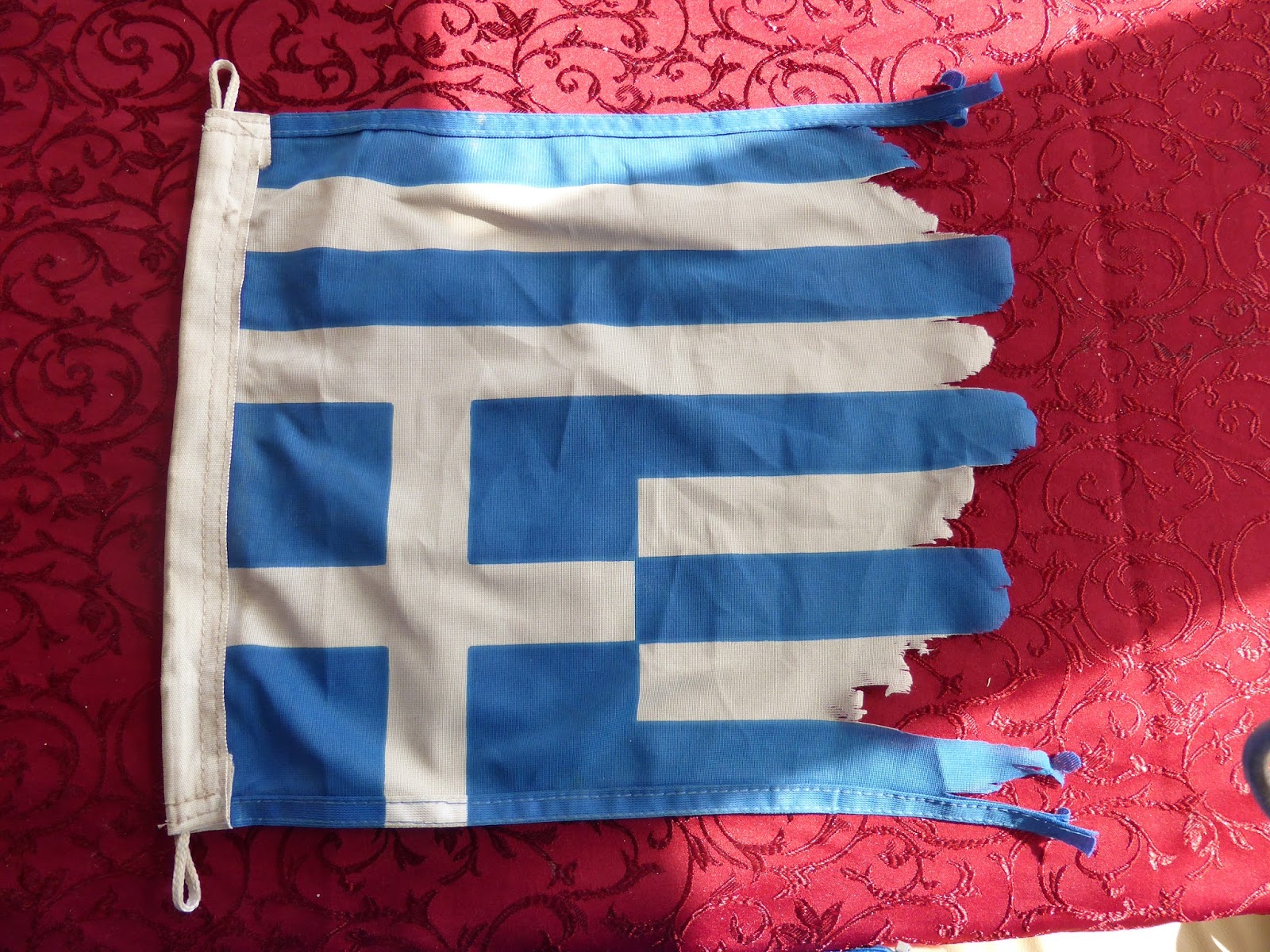
Our Greek courtesy flag has been battered by recent continuous strong winds. It’s upside down by the way.

The small village of Plaka and larger one of Elounda are interesting to wander around and good for obtaining supplies.

Plaka is a beautiful village

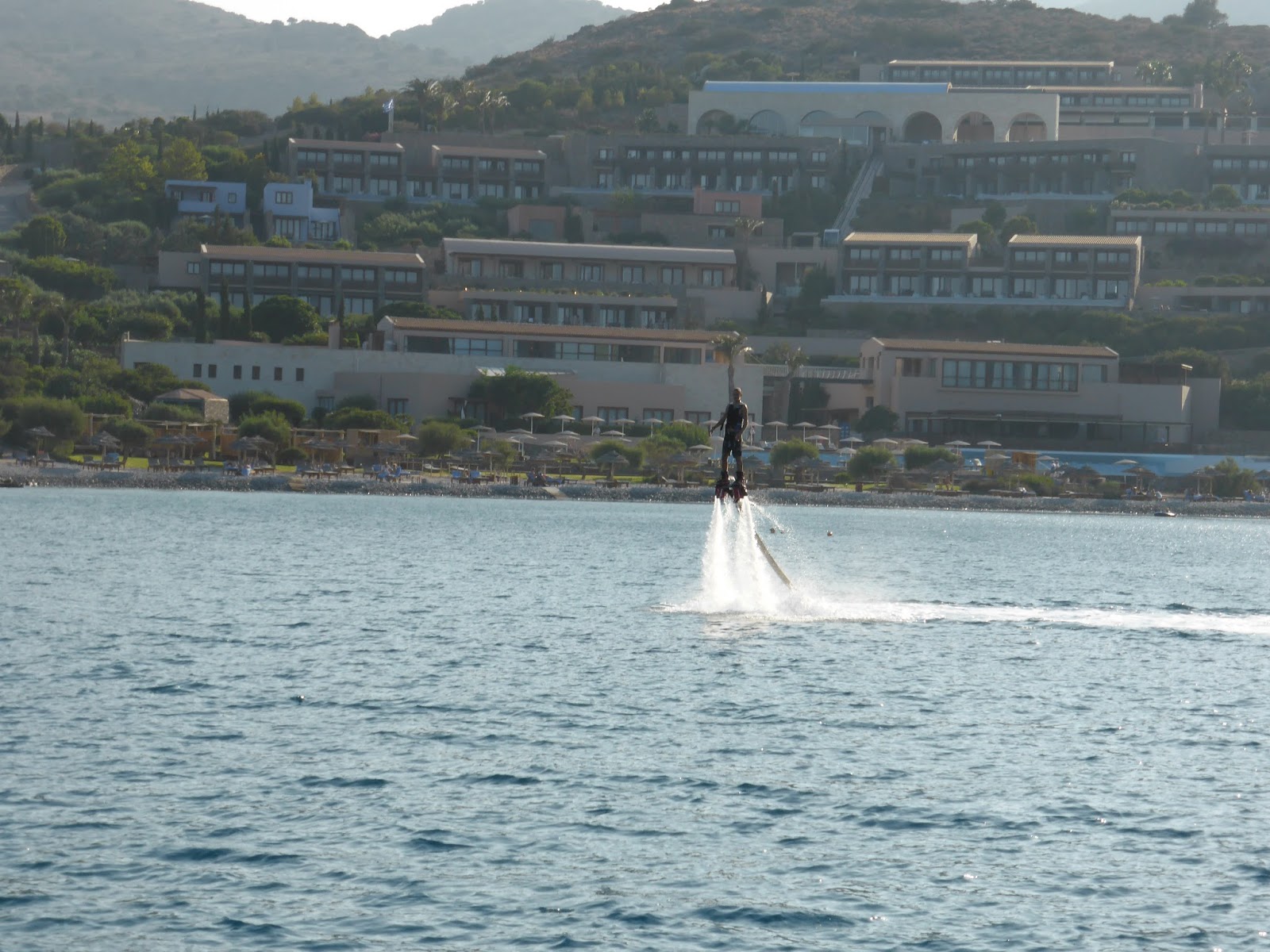
Off Plaka we have to do a double take when we see this water-powered hovering device

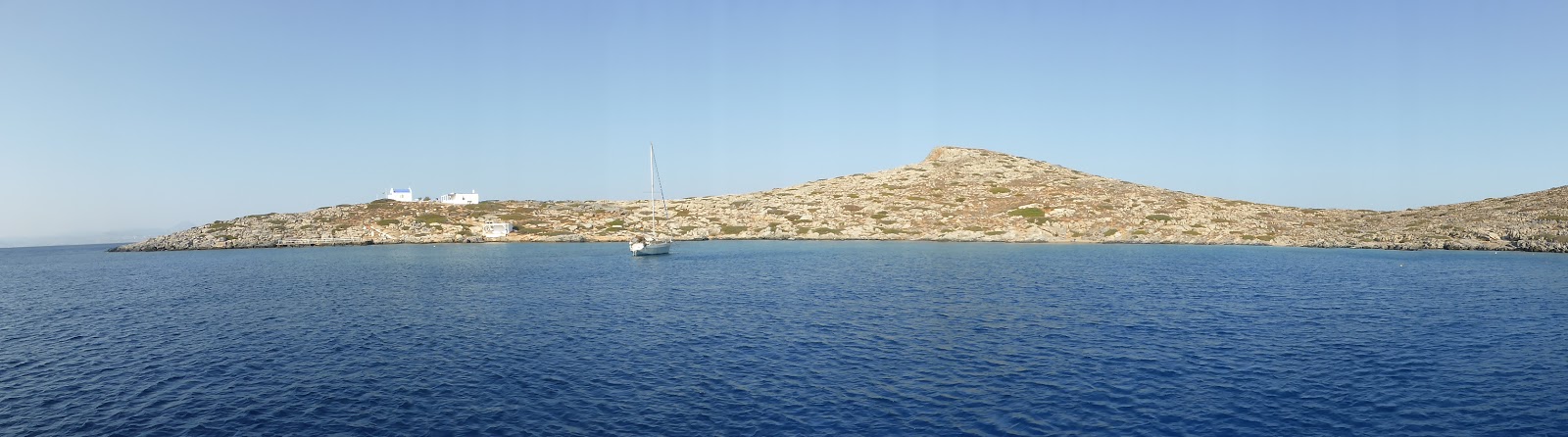
Spinalongas island viewed from Plaka

Another view of Spinalongas

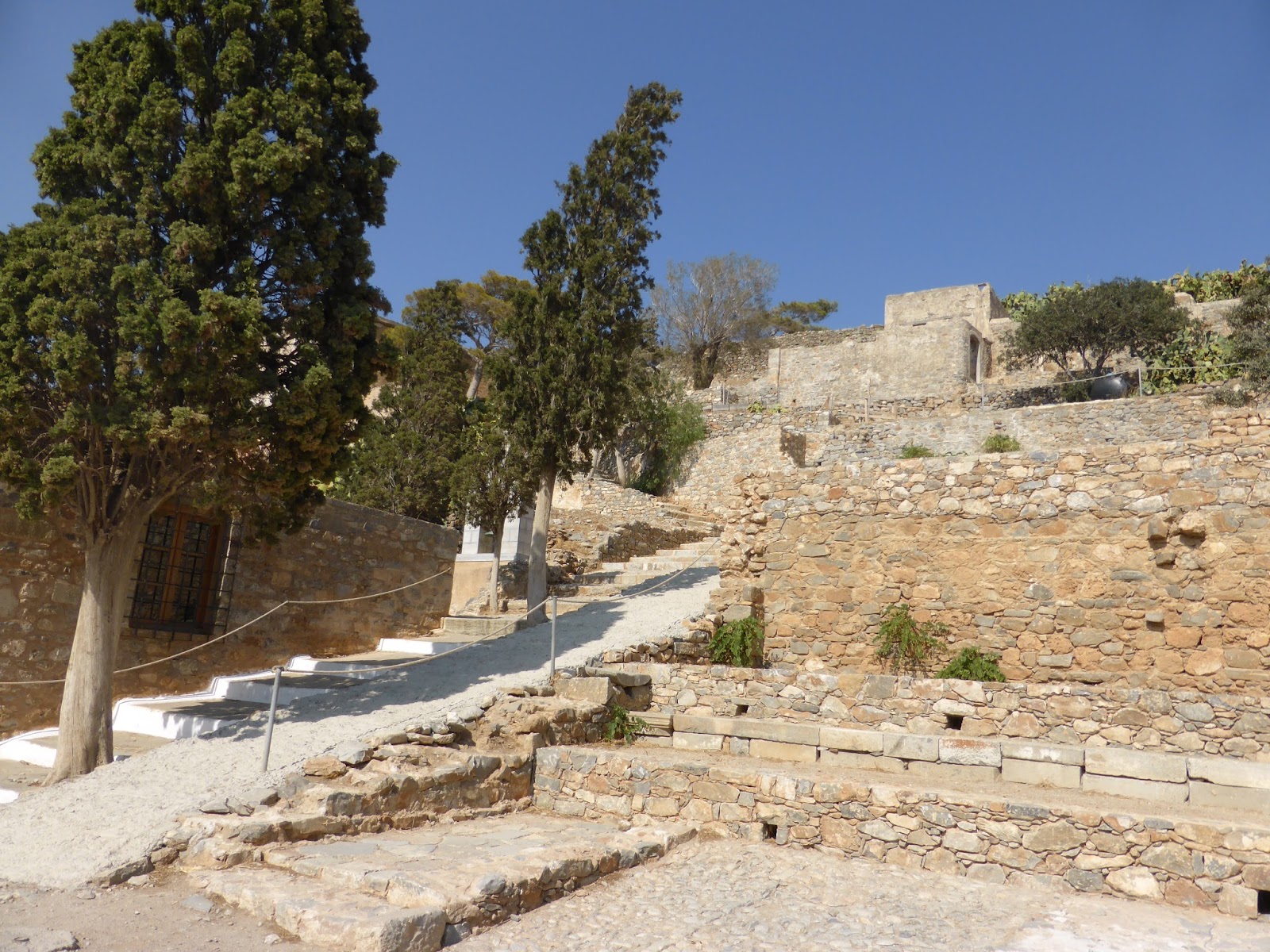
Apart from several tranquil anchorages the area’s highlight is the island with its Venetian Castle built in 1579 on the site of an older fortress and which later withstood a 25 year siege by Turkish invaders in the 16th century. Eventually the Venetian and Genoan defenders were allowed to leave while about six hundred Cretan co-defenders were enslaved. The castle is an interesting example of how several protective walls were commonly built so that defenders could retreat to higher protected ground if one wall was breached.
In 1903 the island became an infamous leper colony where Greek lepers from all stratas of society were rounded up by the police and forced to live it closed in 1957. Lepers were left isolated in appalling conditions mostly to fend for themselves and there are many touching stories of lepers helping each other as well as nurses, a priest and a doctor assisting them, ignoring the very real risk of contracting the disease. Despite the hardships the lepers provided for themselves by cultivating the land and fishing. Some fell in love, married and had children.
Anything leaving the island had to be sterilised in a high pressure steam chamber, even the money the lepers used to buy provisions from merchants who stayed on the beach outside the walls to avoid contact.

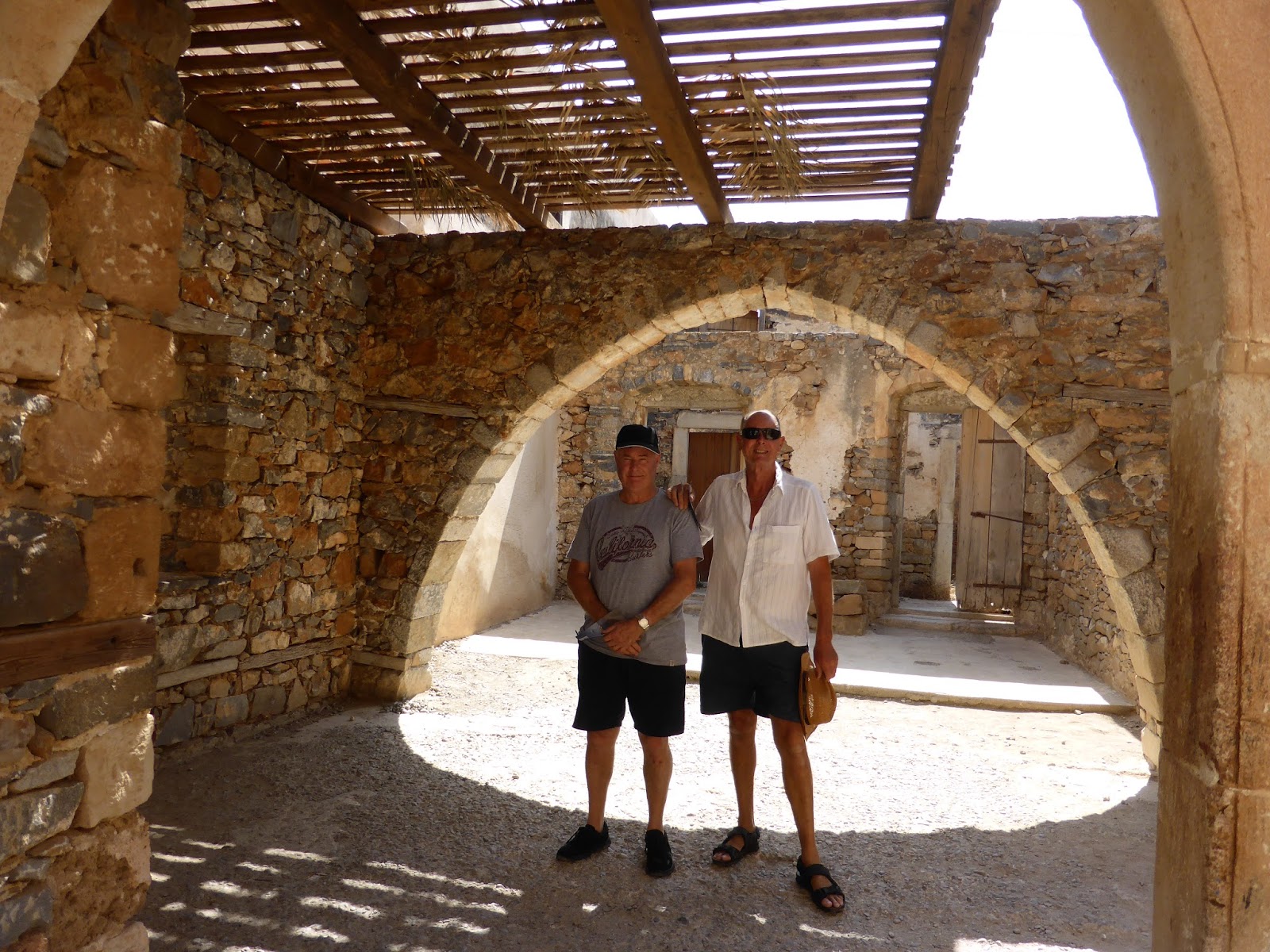
Doug and Laurie investigate a ruined house

More ruined houses

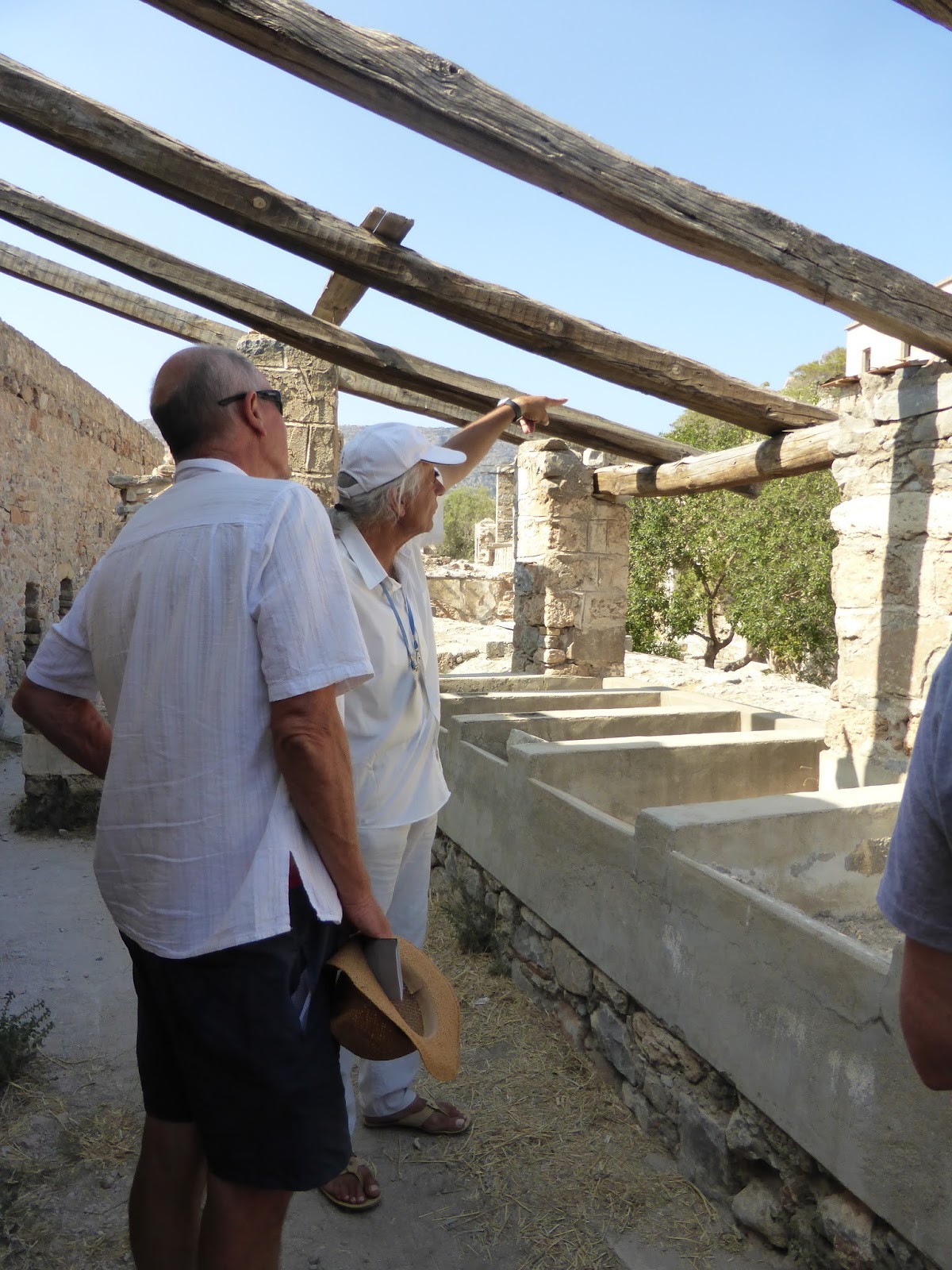
Our guide explains where the laundry tubs were used to wash contaminated clothes and dressings

Our enthusiastic guide shows us a macabre old stone building where a deep pit contains bones of the dead while their skulls are stacked on shelves around the walls. It’s often worth paying a guide (in this case 30 Euros – about $50) to get a full understanding of what you’re seeing.
The island is certainly eerie and although unlit at night radiates an unusual luminescent glow.
Locals call Spinalongas the island of the living dead.

TECHNICAL
Little mention has recently been made in the Blog on this subject simply because fortunately there have been few issues for several weeks now – just routine scheduled maintenance.

FOR FOODIES
Fresh seafood is plentiful and in Eloundra we have a delicious shrimp salad served with a local mayonnaise

Stunning view of waterfront from the restaurant

STUNNING SANTORINI

Envoy is currently still anchored at Ay Eufemia, Cephalonia Island.

Diane’s sister, Sharon, and her husband Doug are meeting us in Santorini (or Thira as Greeks call it) so we cruise about 20 miles southwards from Ios Island with the Meltemi wind behind us and anchor off Akrotiri Beach (in fact more of a rocky foreshore than a beach) on the southern side of Santorini.
On a previous visit this was sheltered but as the Meltemi has been blowing for so long the uncomfortable remnants of swell is finding it’s way here and although our flopper-stoppers help reduce its effect we still roll around too much for comfort.
Ashore is a great taverna with amazingly friendly owners and staff who allow us to moor our RHIB in their tiny sheltered harbour with room for just a few dinghies and provide us with fresh water to fill Envoy’s tanks.

Envoy’s RHIB safe in taverna’s small private harbour

We enjoy spending some time sitting in their taverna rather than rolling around at anchor and later they generously give us a bag of fresh fruit and vegetables from their garden.
When we catch the bus to a small supermarket several kilometres inland the owners offer us a lift back and take us in an old ute with three of us and a friendly dog jammed into the front bench seat. Santorini is romantic, mysterious, hugely impressive and the classic Greek postcard island. In 1440 BC it was the scene of one of the largest volcanic eruptions in recorded history when the entire centre of the island, comprising some 30 cubic km blew into the sky, leaving a crater some six miles long and four wide, which filled with seawater to form the present cliff-lined Caldera. Cruising into and later looking down on the Caldera we can only marvel at the size of an eruption that could cause such a crater and a series of tsunamis estimated 60 to 100 metres high, moving at 160 km/hr, devastating Crete 60 miles away to the south and totally destroying the Minoan civilization.

The Caldera has hugely impressive steep rugged cliffs

The volcano is nowadays not extinct but dormant, with the last eruption in 1925 and a 7.8 Richter Scale earthquake causing major damage and loss of life in 1956.
Some historians speculate that Santorini is the location of the mythical island of Atlantis, which according to Plato was “in a single day and night of misfortune disappeared in the depths of the sea” and it is the island on which the Jules Vernes classic Twenty Thousand Leagues Under The Sea is based.
Santorini has notoriously poor shelter for visiting yachts, and the Cruising Guide recommends leaving your boat in the marina at nearby Ios Island and catching a ferry across. The Caldera is mostly too deep to anchor, and the marina on the south side of the island is very crowded and not possible to book in advance.

Sharon and Doug’s first day with us at Santorini

THE HOWLING
After Sharon and Doug join us at Santorini we head back to the relatively sheltered anchorage of Ormos Manganari on Ios Island and the wind just doesn’t drop, in fact for 20 days out of 22 we have winds well into the 20 knots, gusting high 30s and one day into the mid 40s. Winds like this produce white-capped wavelets even just a couple of hundred metres from the shore while the stronger gusts lift sheets of spray off the sea’s surface. This frequently makes getting ashore in our RHIB a challenge and sometimes impossible and we are certainly over the howling noise the wind produces from about 15 knots.

We have excellent ground tackle so dragging our anchor isn’t an issue but we have to keep a close watch on other boats, particularly charter yachts anchored close by.

I see one yacht’s outboard-powered RHIB flip upside down in the strong wind (this is common so never leave an outboard on a small tender in strong winds). Later the yacht’s crew attempt to paddle ashore but are unable to make headway and get blown well downwind so Diane and I leap into our RHIB and “rescue” them.

Our destination is Crete in the southern Aegean and we finally see a break in the weather and head back to Santorini for an overnight stop on our way to Crete.

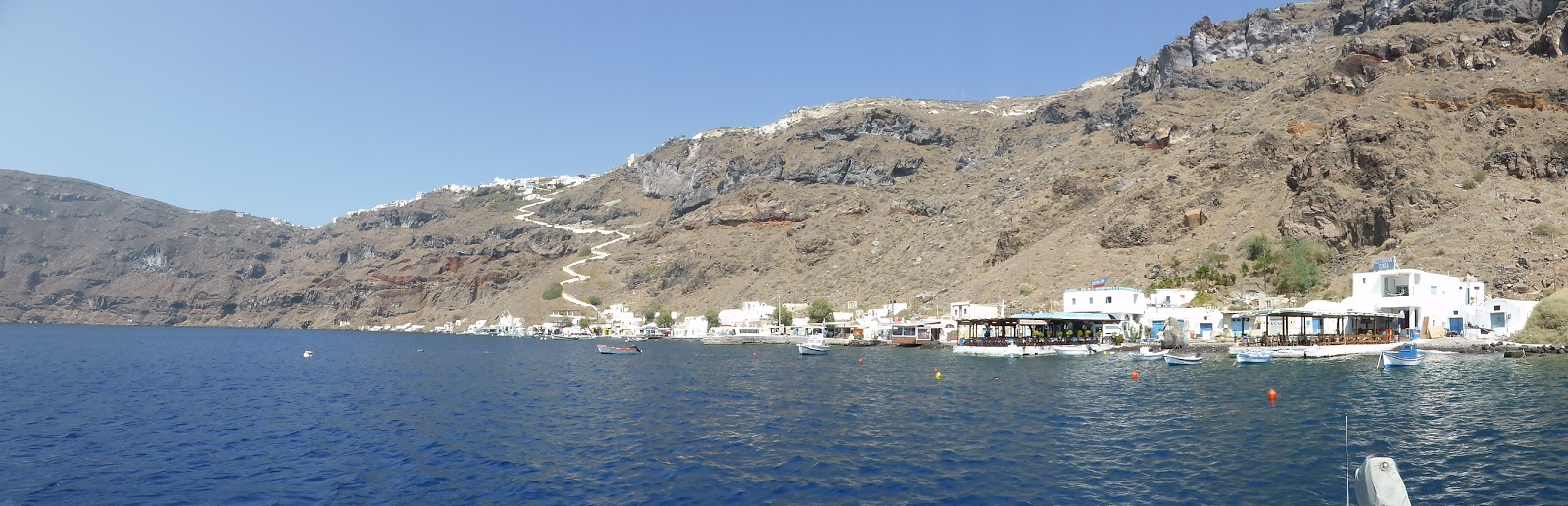
Santorini is a place everybody should visit and it’s great for stunning scenery, shopping and restaurants with lots of beaches to cool of and quieter parts of the island where you can avoid the large numbers of tourists and commercialism. It consists of a group of several islands very close together and other cruisers had told us that Captain John’s restaurant in Ormos Ay Nikolau bay on the eastern side of Thirasia Island provide free moorings, so we head there, not wanting to risk rolling around at anchor off the south coast’s Akrotiri Beach again.

This bay has little wind and is flat calm with only an occasional wake from passing boats and two of Captain John’s staff jump in their dinghy to help us moor Envoy’s bow and stern to buoys just a few metres from shore, the water being very deep. The best way of securing to a buoy is to pass a long line through the buoy’s holding point (usually a loop of line under the buoy attached directly to the buoy’s mooring chain) and make both ends fast aboard your vessel. Then you can easily remove your lines when you want to without having to leave your boat. These guys tied the end of our line to the buoy’s holding point making it impossible to remove except from a dinghy and although I intended to correct this later we have to hurry to catch a ferry across to the main island and I forget about it.

Envoy moored between two buoys outside taverna

Tavernas and mooring area at Santorini’s Thirasia Is

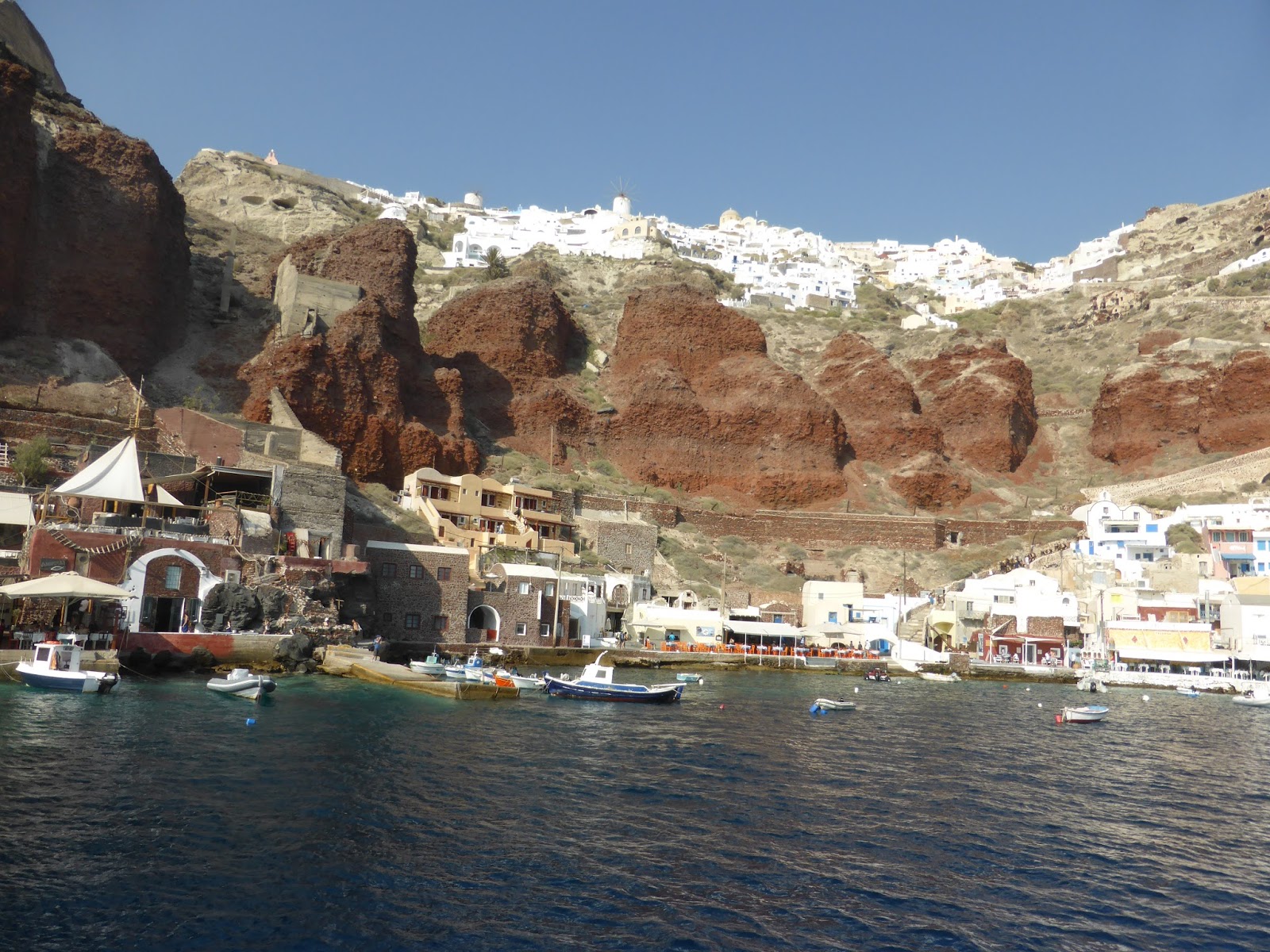
Picturesque village on Santorini where ferry from Thirasia takes us

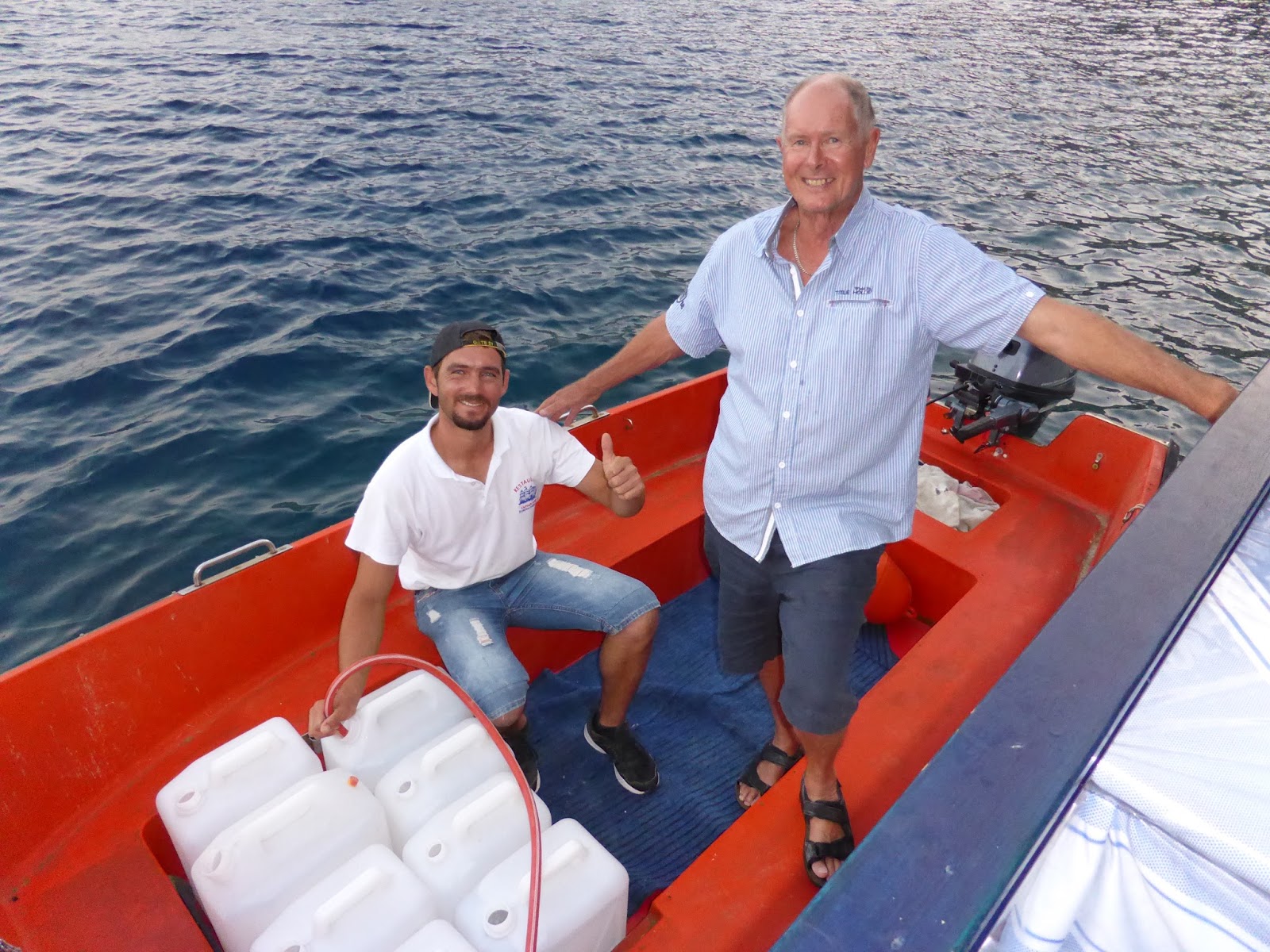
One of the taverna staff uses their dinghy to help load our water containers aboard Envoy. He’s much younger than me so the lifting help is appreciated

Next day we make an early start to cruise about 65 miles to northern Crete, but now the wind has increased a little to about 15 knots on our beam making it difficult to untie the less-than-professional knots in our lines. We retrieve the bow line by using a double-ended second line to take the strain so that the original line can be removed, but the stern line is secured to a smaller buoy which has been pulled underwater by the strain, so not wanting to delay our departure I have to cut the line as close as possible to the knot, losing about a metre of line in the process and learning a useful lesson about getting mooring lines deployed correctly in the first place.

We continue on to Crete taking about 12 hours in following winds up to just 15 knots and seas of one metre.