Archive | Envoy RSS feed for this section

IOS ISLAND – PACKAGED HEDONISM

Envoy is currently anchored at Ay Eufemia, Cephalonia Island back in the Ionian Sea.

From Sikinos it’s just five miles east to Ios, inhabited for thousands of years by Macedonians, Ionians, classical Greeks, Romans, Byzantine crusaders and Venetians – interspersed with pirates.
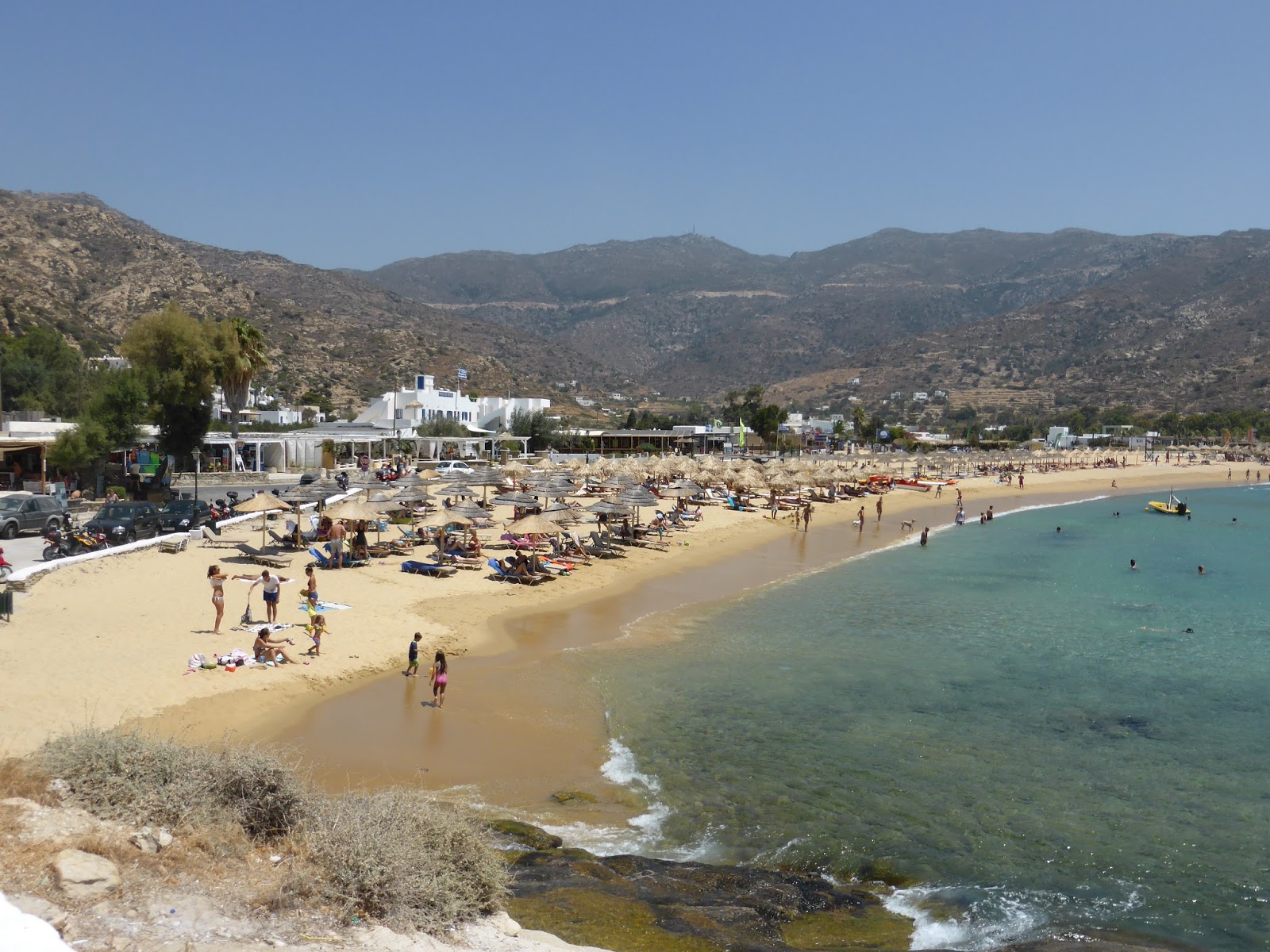
We anchor in a large sandy bay called Ormos Milopotamou offering near perfect shelter from the 25 knot gusting 35 knot winds forecast. Although the shelter is good it’s a real tourist mecca with hordes of sun-worshipers decorating the beach, high-powered motor boats towing skiers and banana boats around the anchorage and tavernas belting out loud monotonous music – it’s anything but quiet. We seem like the oldest people here and Lonely Planet describes Ios as “packaged Hedonism”.

Ios’s Ormos Milopotamou beach

The sports boats travel at high speed dangerously close to swimmers and other boats as their drivers give friendly waves, but nobody seems to care – it seems here in Greece rules are made to be broken.

Often it’s hard to find a place to leave our RHIB when going ashore. There’s no jetty to secure to and it’s not allowed to take your RHIB through the swimmers to the sandy beach.

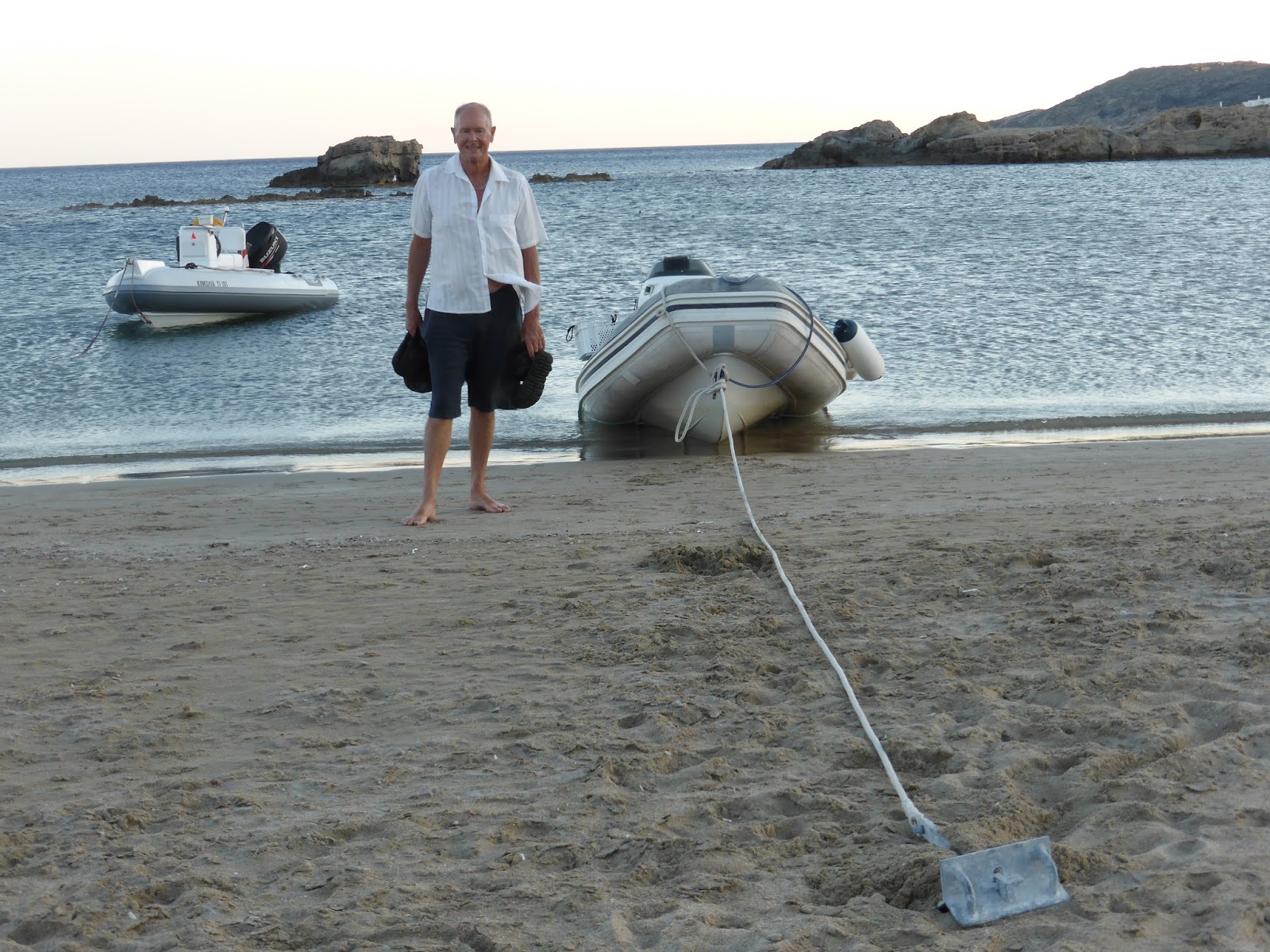
Here Laurie has laid a stern anchor and secured the RHIB’s bow to a rocky platform to get ashore.

Ashore there’s plenty of places to re-stock provisions and there’s a bus service to the hilltop Chora, which unlike recent ones we’ve visited is sizable and interesting with the usual whitewashed buildings and narrow cobbled lanes lined with shops, cafes and tavernas.

Below the Chora on the island’s north-western side is the ferry port, also lined with quaint tavernas and although this harbour has great shelter, yachts are not allowed to anchor here as large ferries need the turning space.

Just one hour’s cruise south is the more remote and quieter bay of Ormos Manganari and here we spend much of the next few days sitting out the Meltemi (strong northerly wind). The wind is so strong that there are sandstorms on the beach, water is lifted in sheets of spray off the sea’s surface and we can’t come ashore during squalls.

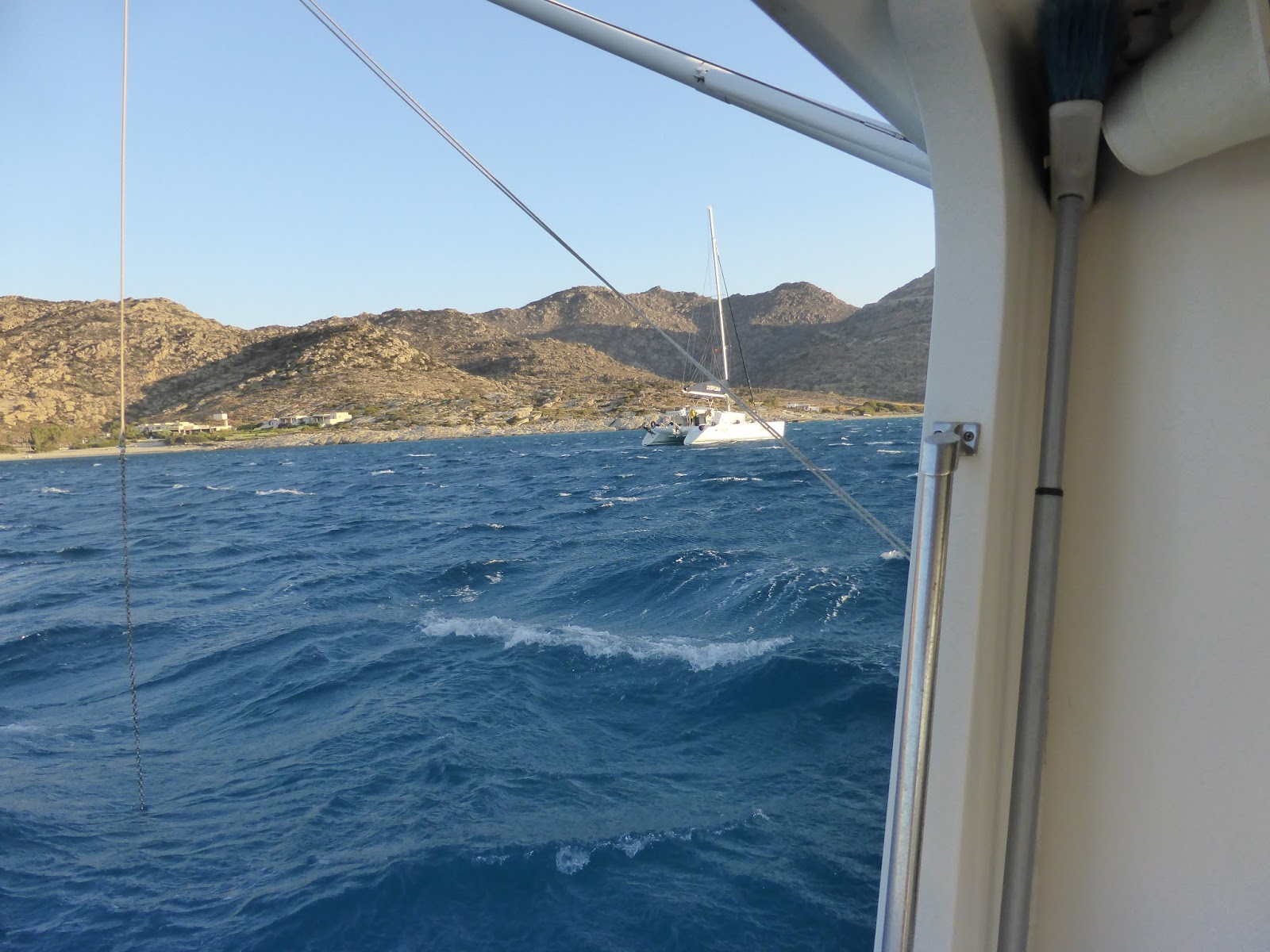
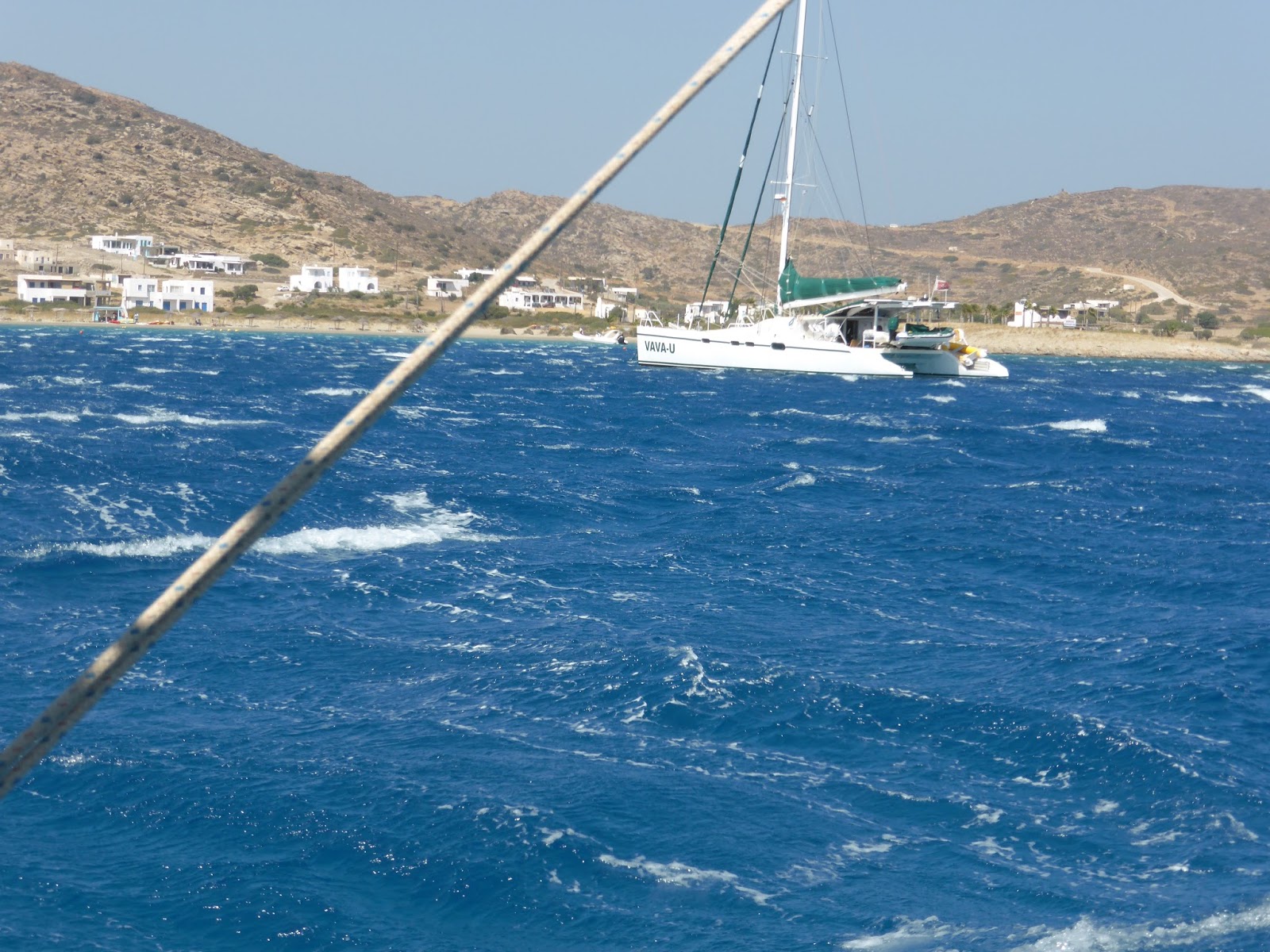
Photos of choppy seas often don’t come out that well, but these two may give an idea of the conditions at anchor close to shore with an offshore wind, taken from Envoy

Laurie relaxing with a glass of wine on a more settled day

Envoy anchored off Ormos Manganari few days later in settled weather

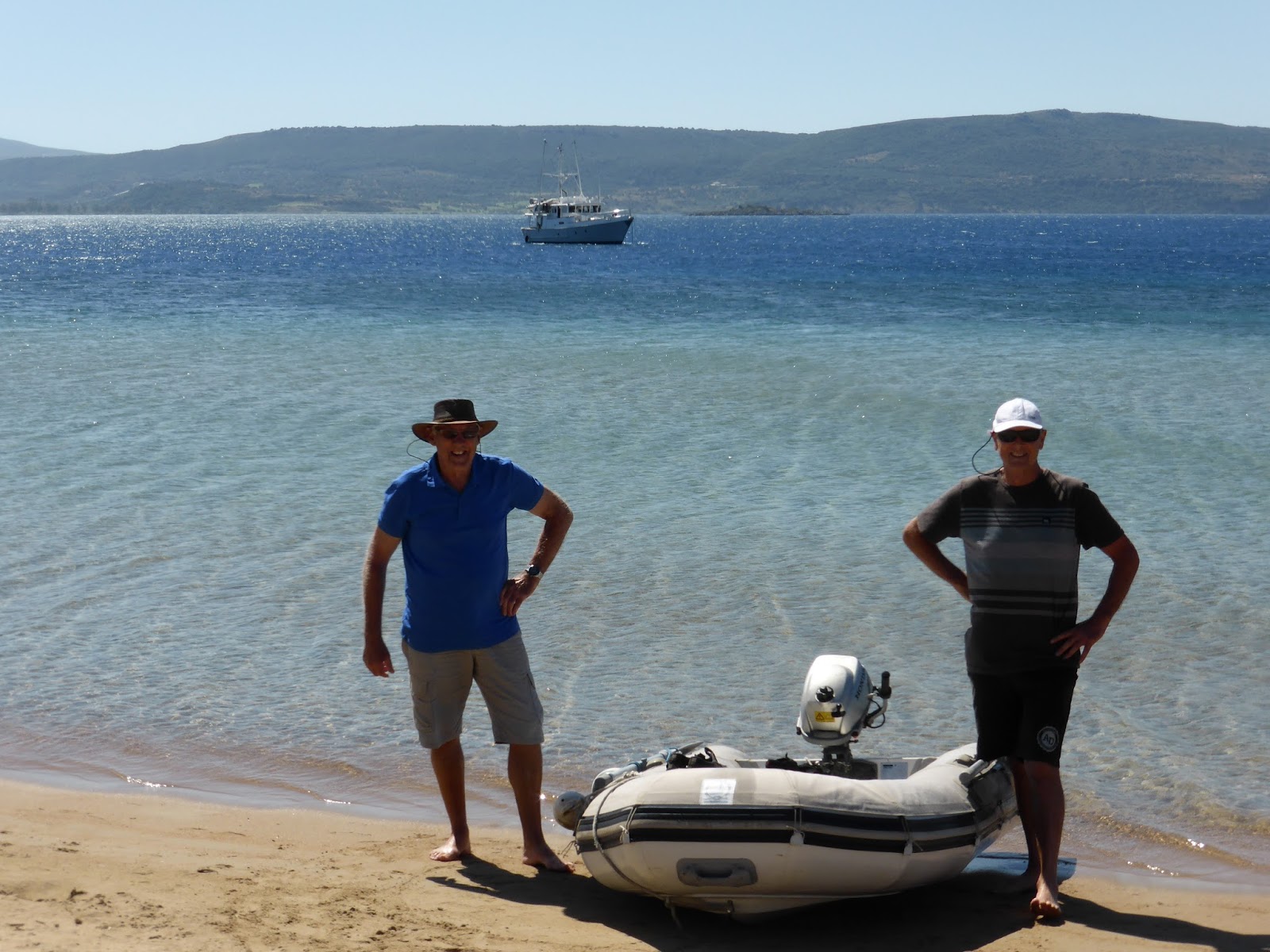
Beaching our RHIB ashore for an evening drink at Ormos Manganari

Ios is noted as the island nudists come to, but we haven’t seen any evidence of that so far.
From Ios it will be an easy “downhill” southerly cruise to Santorini where we meet our next visitors.

FOR FOODIES
Ios has some great local soft cheese made from goat’s milk, something between feta and yoghurt and used in Greek Salads.

The wine in this Greek salad photo is cheap locally produced house wine but has a superb colour and aroma, tasting quite reasonable too

MORE ISLANDS IN THE SOUTHERN CYCLADES

Envoy is currently anchored off Koroni on the way back to the Ionian Sea.

With the wind forecast to turn to a rare, comparatively light,  20 knot south-westerly (it’s mostly from the north) we cruise to shelter on the northern side of Milos island and find a delightful anchorage at Mandrakia. In total contrast to Adhamas this is just a secluded bay with several holiday villas and one atmospheric taverna ashore overlooking a beautiful tiny shallow harbour, suitable only for very shallow-draught boats and surrounded by rustic holiday homes, mostly built into sea caves.
We go ashore here to enjoy the spectacular view and a cold beer or two.

The Mandrakia harbour

A great cool place to sling a hammock

View from the taverna

Octopuses hang to dry outside taverna

Envoy in the Mandrakia anchorage

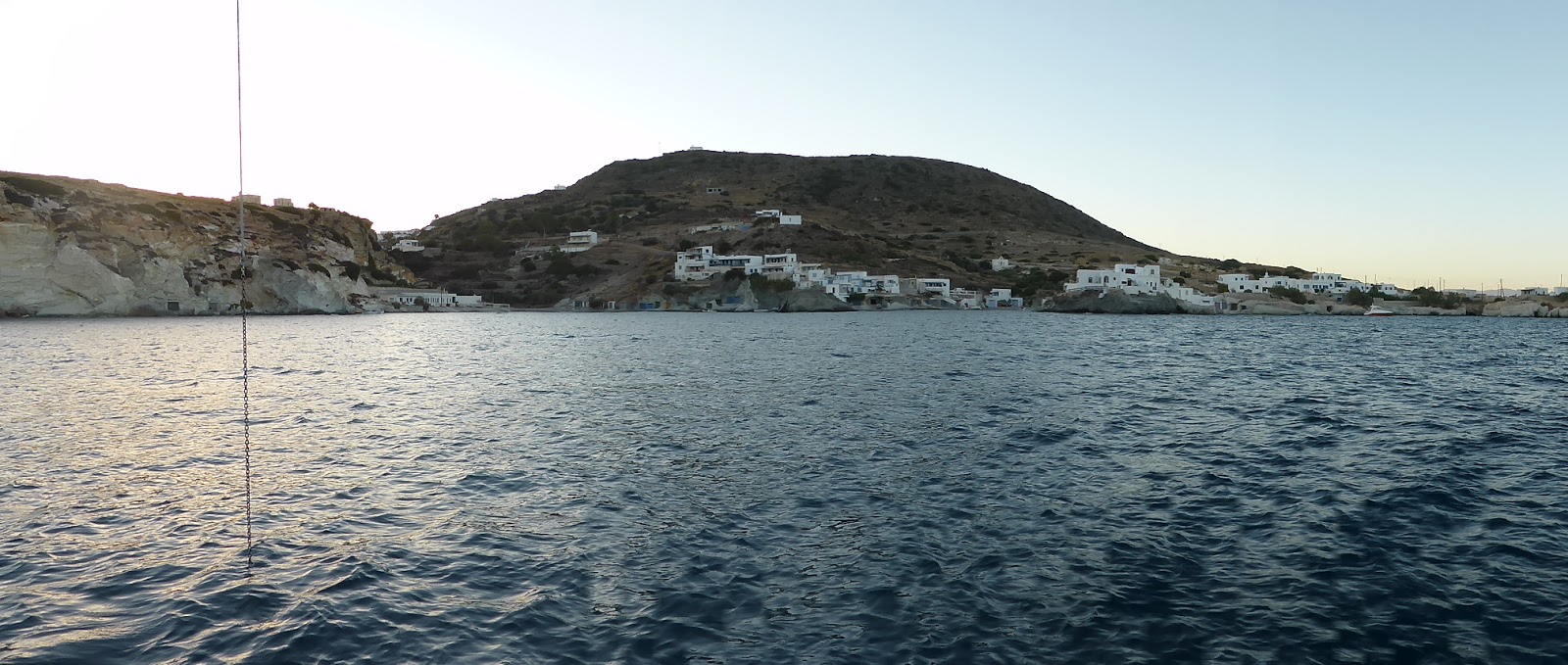
But the southerly change is only for one night and it’s back to strong northerlies again, so next day we cruise about an hour to anchor off Psathi on the island of Nisos Kimolos. The anchorage is interesting and quiet with only us there and a small hospitable village to explore.

Envoy at anchor in Nisos Kolomos

Two views of our anchorage

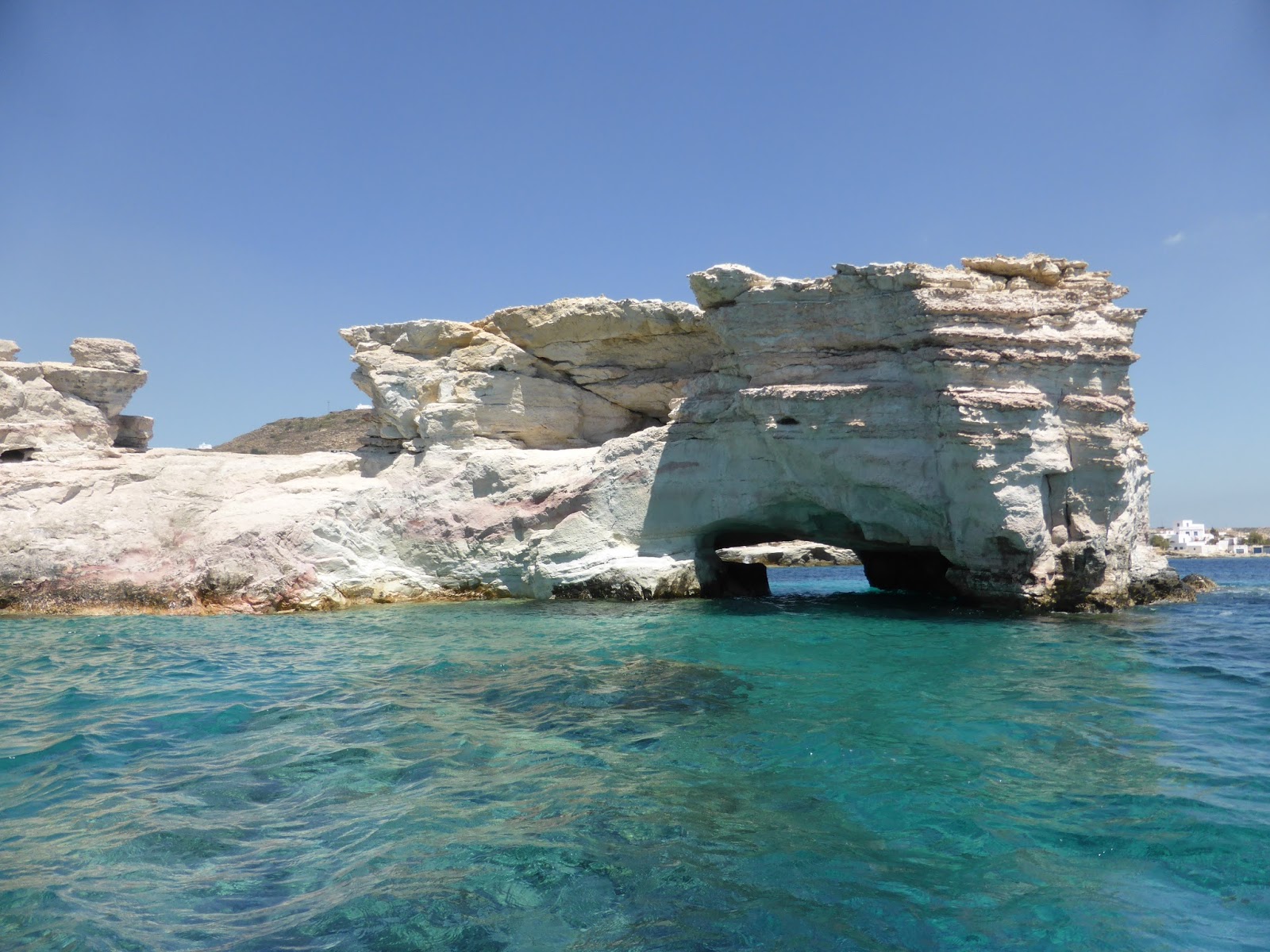
Interesting rock formations close to Envoy at anchor

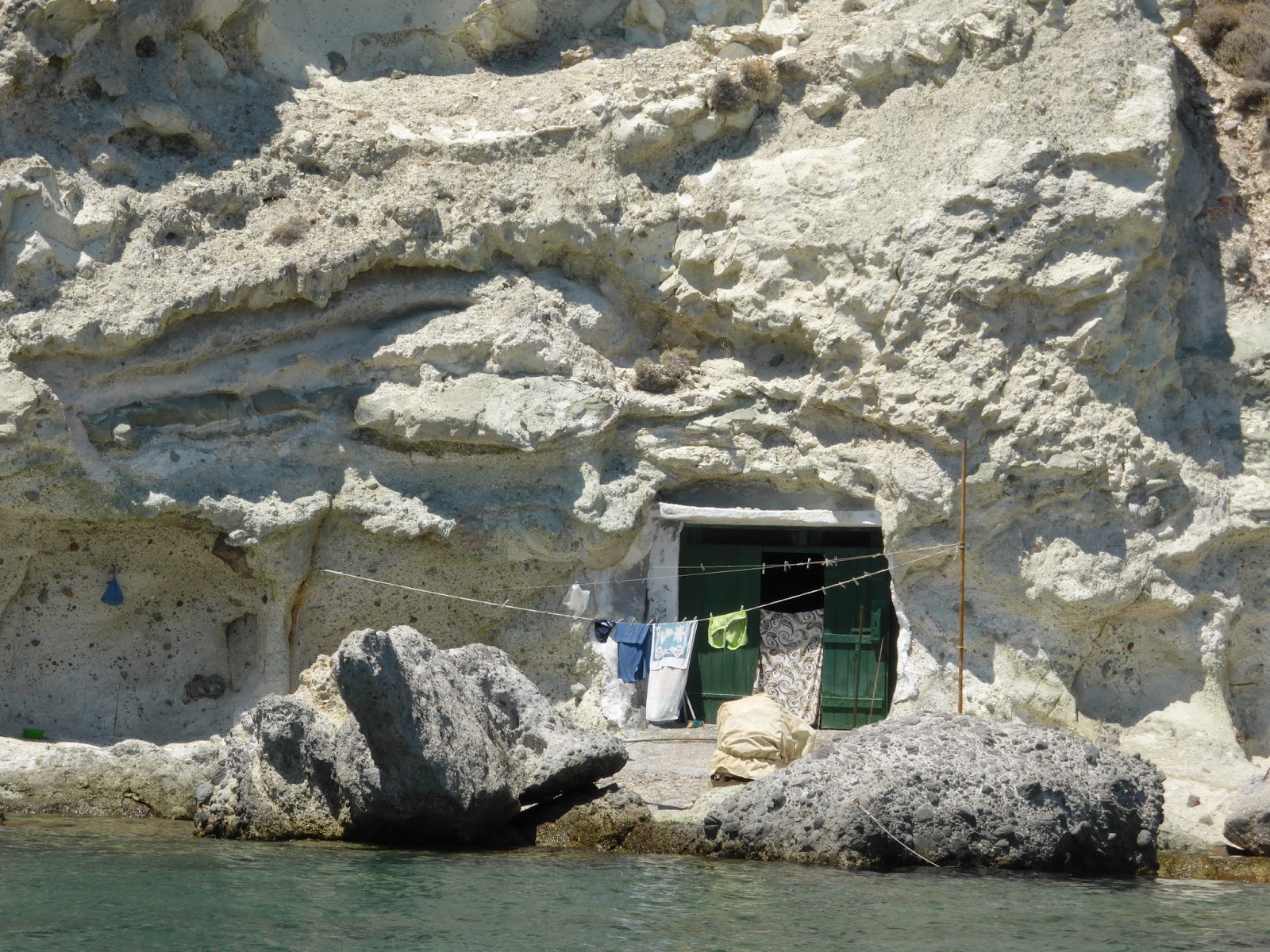
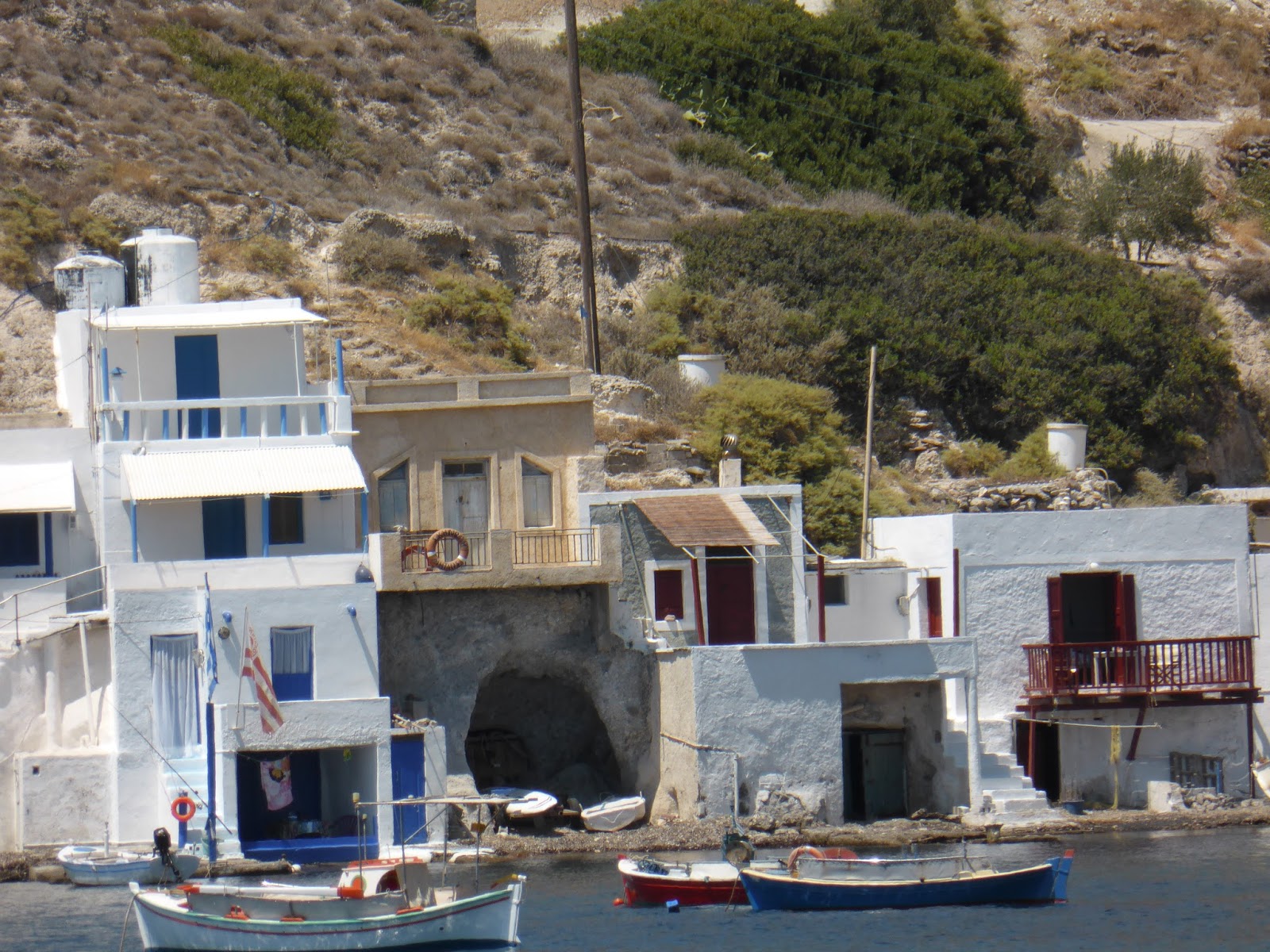
These holiday homes are built into sea caves – well it saves excavation costs!

Close-up of sea cave holiday home

Again we take a bus to visit the hilltop Chora and again find it disappointing. Maybe we’ve seen a few too many of these?
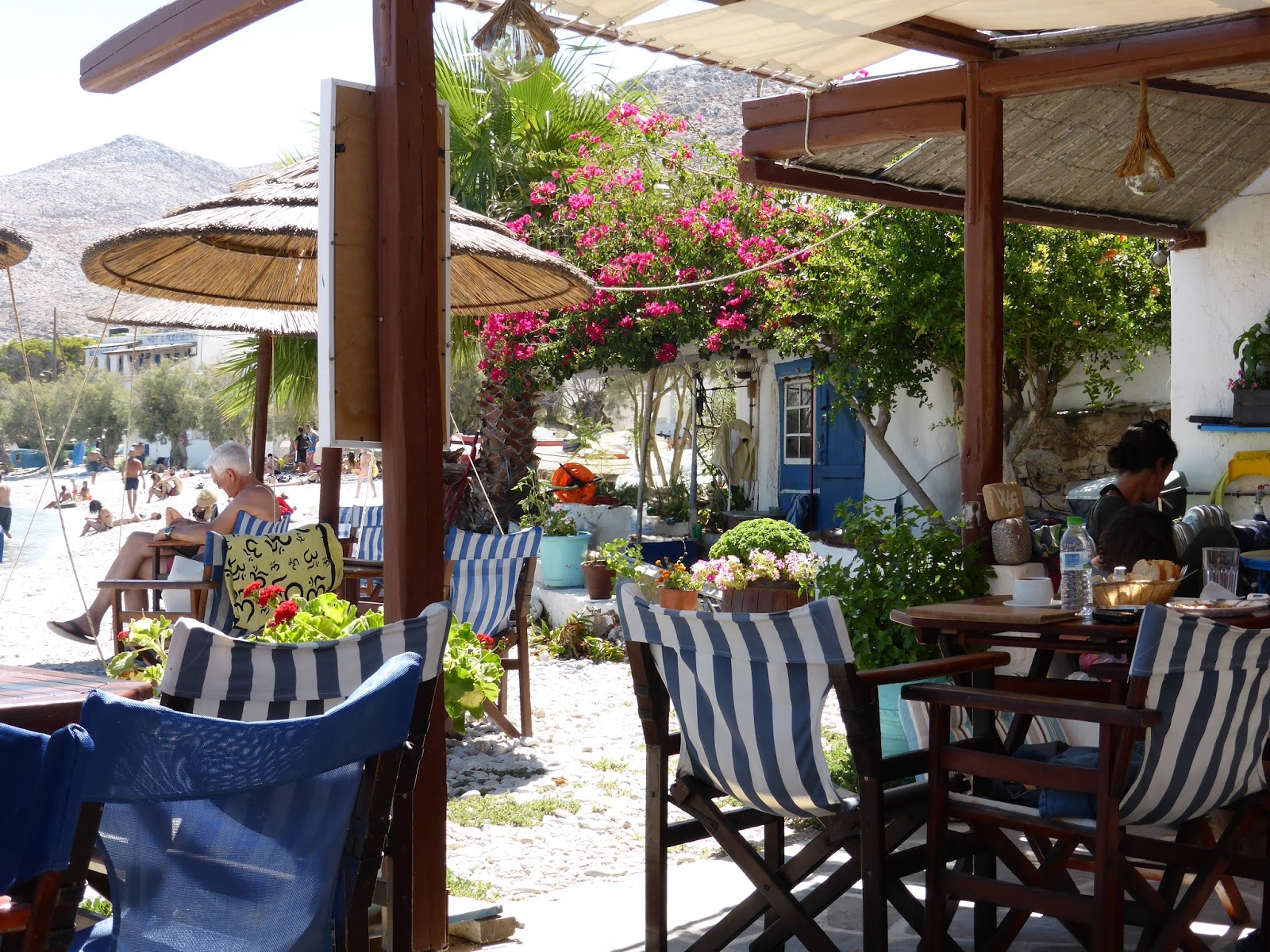
Still needing to head east we cruise to Karavostasi on the dry, barren island of Folegandros. The uncrowded anchorage is picturesque and ashore is interesting for a wander around followed by a cold beer in a quaint beachside taverna – now there’s a familiar story!

Folegandros harbour

Beachside taverna Folegandros harbour

The winds from the north have been exceptionally strong for the last few weeks and dictate our daily planning to a great extent. Here in Folegandros it has been sheltered with the 20 knot wind from the north-west but now it moves to the north and even this small change of direction sends an uncomfortable swell into our confined anchorage. Several boats depart followed shortly by us as we head for the island of Sikinos. The wind is now gusting 25 knots and the seas are much rougher than we expected – six to ten feet high, close together and breaking. We’re towing our RHIB and Di says she has never seen it on top of a wave that much higher than Envoy before.
The stabilisers are finding it hard to cope with the short, steep, breaking seas exactly beam-on and a few things fall out of their storage positions – something that rarely happens aboard Envoy, so we alter course away from the present direct line to our destination and take the seas at an angle of about 25 degrees to the beam, noticing an immediate and welcome improvement. These are not the conditions in which we’d want anything to go wrong or to have nervous guests aboard.
I haven’t put my finger on the reason why, but the seas in the Med can get more vicious than one would expect for any given wind strength.
We’re glad to reach the lee of Sikinos and anchor off the only shelter the island offers – Skala Sikinos. We’re the only boat here and the small village is great to wander around and peaceful with few tourists, however the anchorage is very small and close to a ferry turning area. Shortly after midnight I’m awoken by the sound of throbbing engines and a rattling anchor chain, and go on deck to look into the beam of a searchlight shining down from the bow of a ferry about 10 metres above me and only 20 metres away. Fortunately these ferry captains know what they’re doing but it’s a bit nerve-wracking and after the same thing happens soon after daylight and a ferry crew member politely hails down to us that we should move further from the jetty we decide to move on as there’s nowhere here for us to re-anchor safely in the strong winds.

Huge ferry looms close high above Envoy

CRUISING TO MILOS ISLAND IN THE CENTRAL AEGEAN SEA

Envoy is now anchored in Soudha Bay, western Crete.

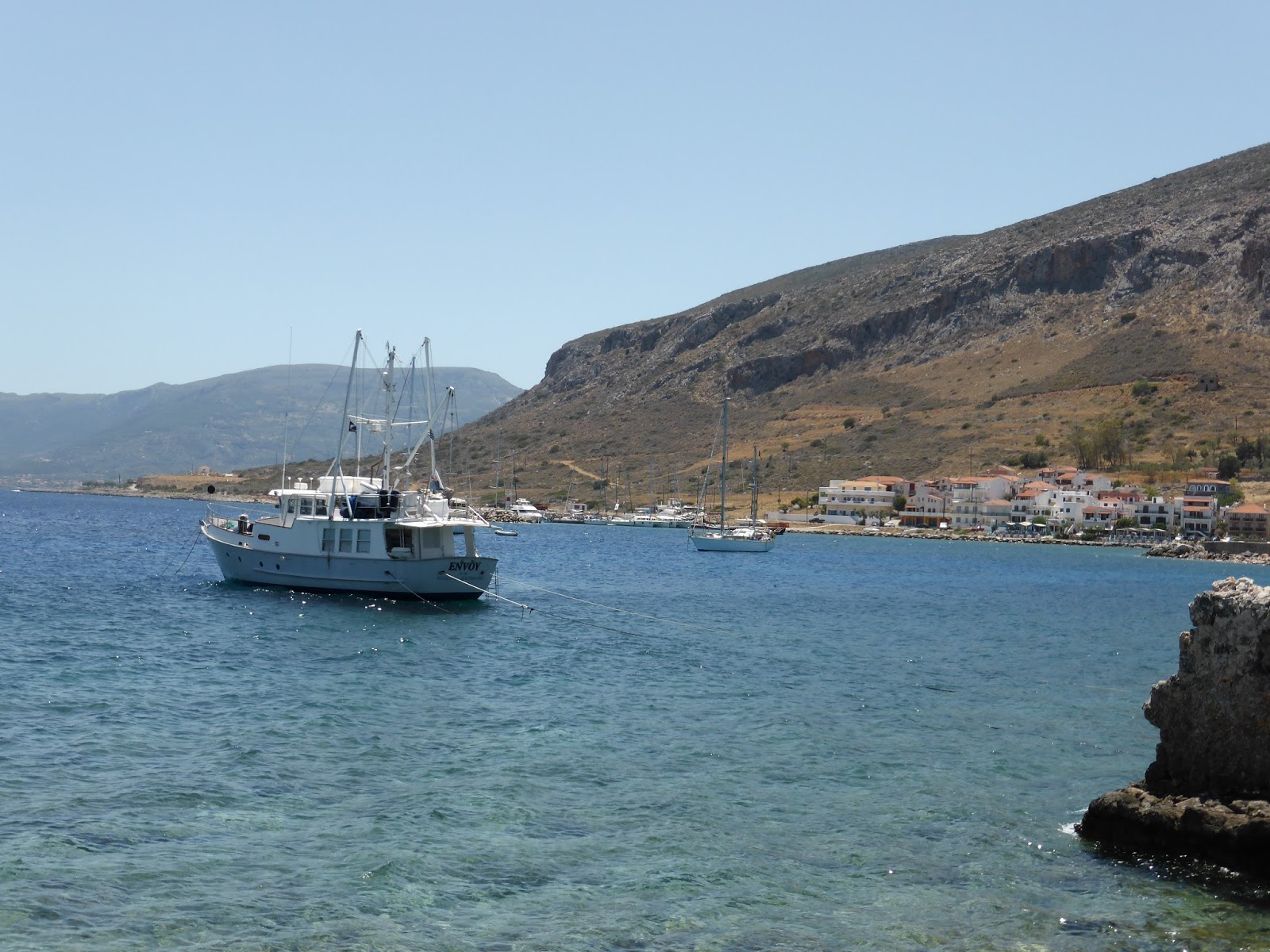
At Monemvasia we’re having strong northerlies of 20 knots gusting 30 and the seas outside our reasonably protected area are over two metres and breaking – not what we want for a 60 mile easterly crossing to Milos. But we see an improvement with the wind forecast to be 12-14 knots gusting 20 and seas of about one metre, so having removed our stern lines the night before to aid a speedy departure we leave Monemvasia at 0700 hrs. Thirteen hours later we pull into the welcome shelter of Ormos Provatas on the southern side of Milos Island – our first time here. This is a relatively long trip for us and it was on one course all the way – east with a 1–1.5m breaking sea on our port beam. The Naiad hydraulic stabilisers did their job perfectly and provided a comfortable trip with our roll being mostly about 5 degrees and sometimes 10. On the way we see only one yacht, one fishing boat but several large cargo ships and have to change course to avoid one approaching from starboard. Here’s a typical sequence of events when we see a vessel approaching:
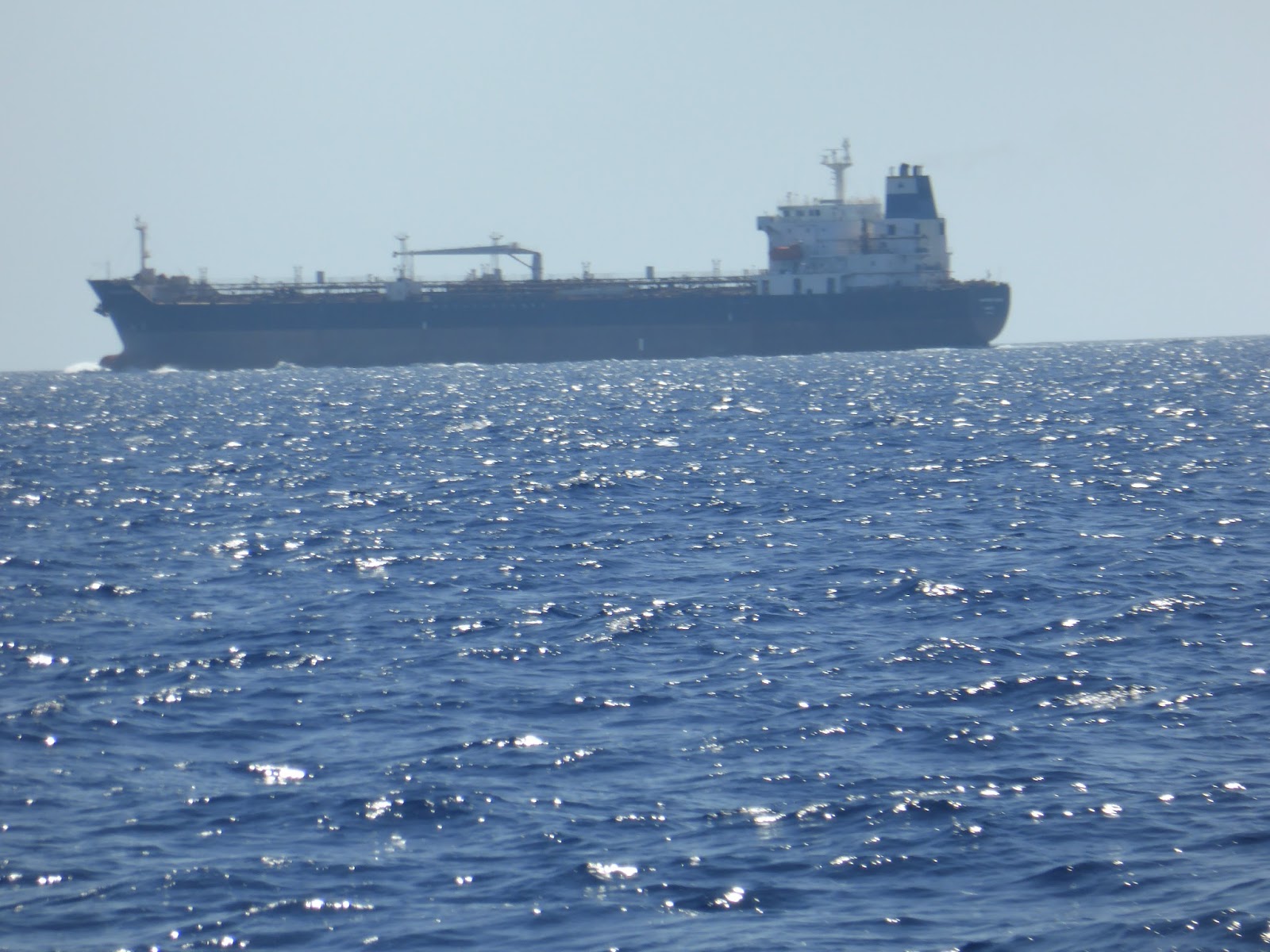
-I notice a speck on the starboard horizon and use the binoculars to identify it as a tanker on a converging course
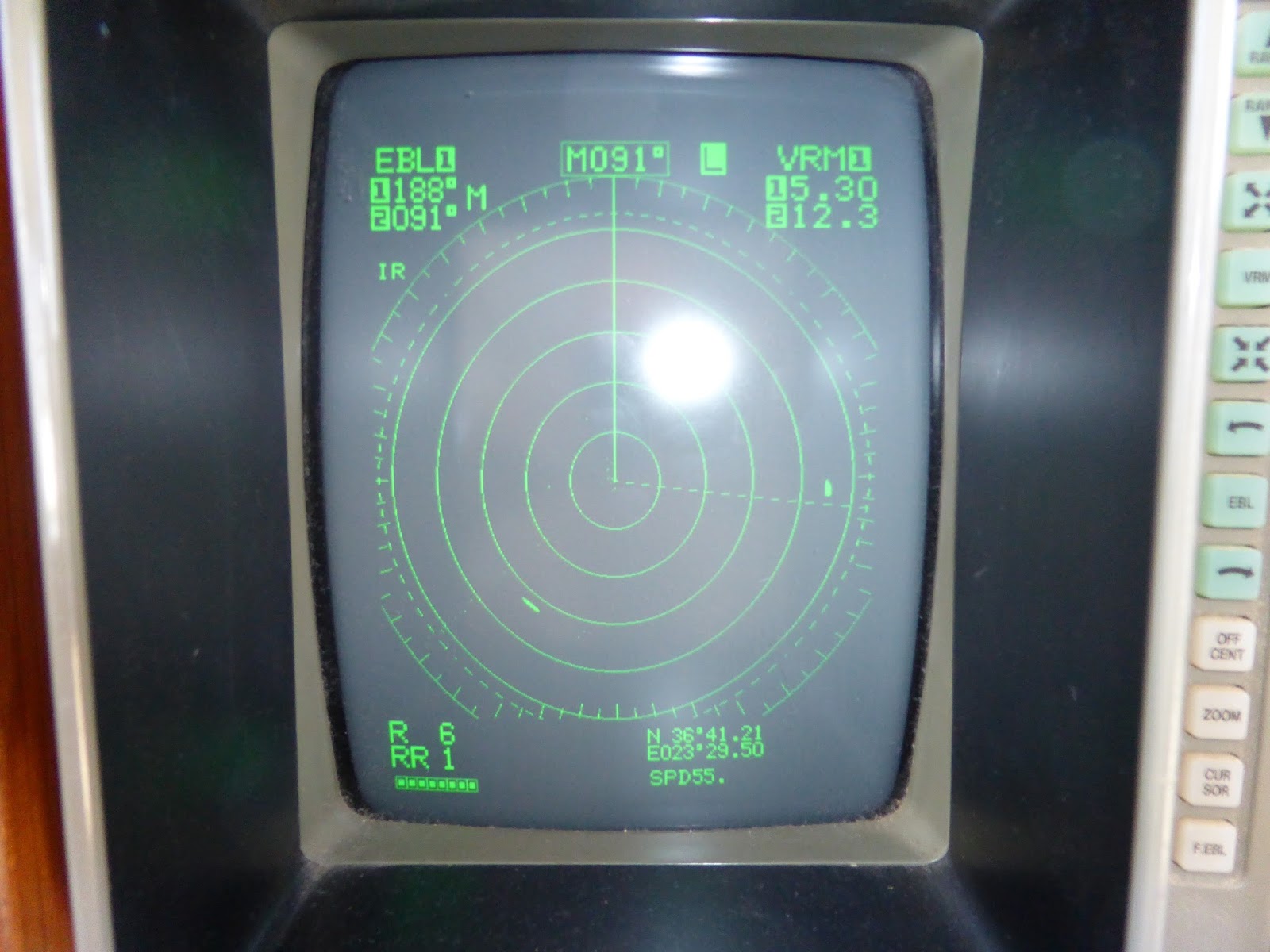
-Activating the radar I see it is 12.3 miles away heading towards us
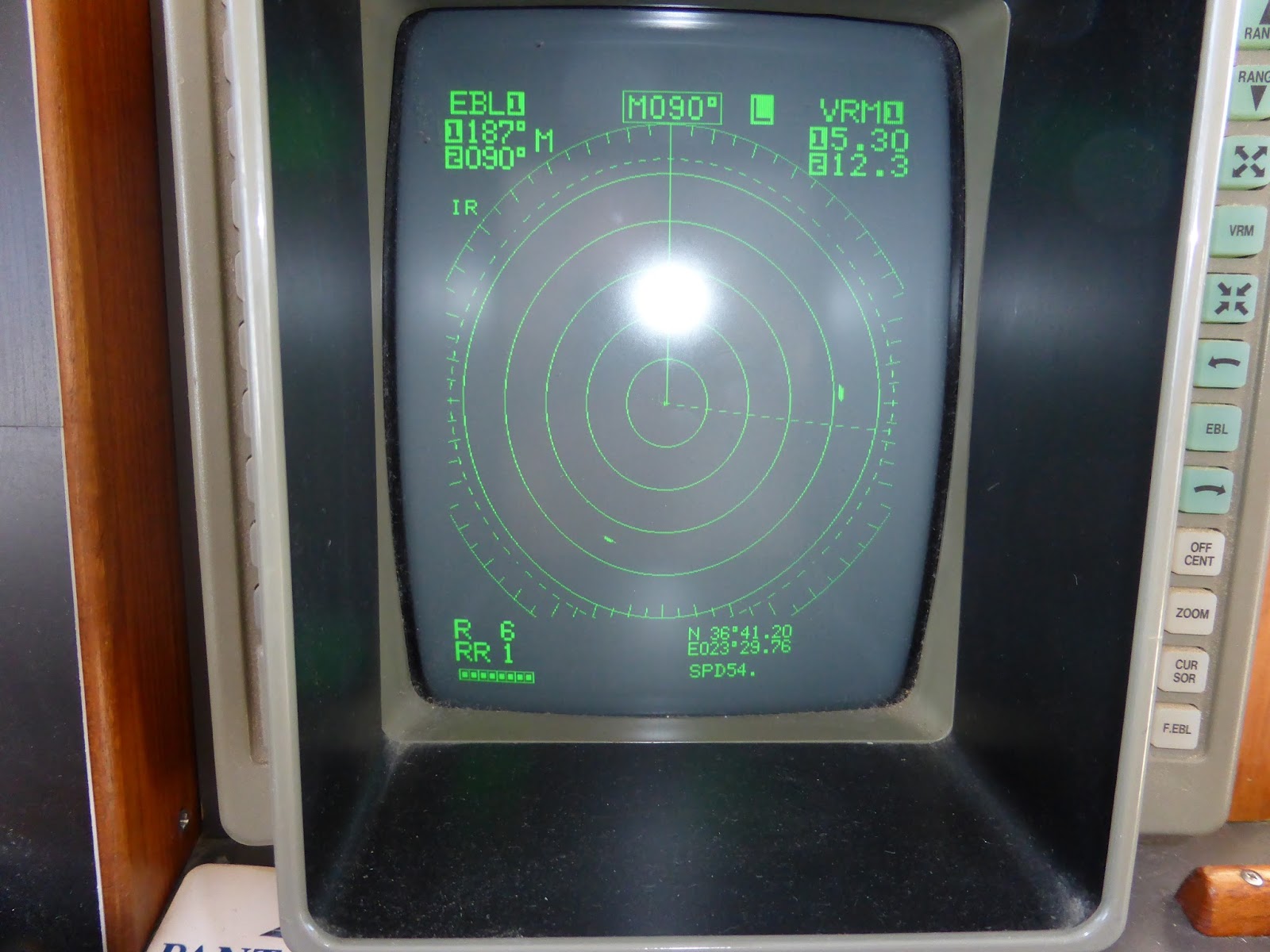
-I adjust the radar’s Electronic Bearing Line (EBL) so that it lies over the tanker and do the same with the Variable Range Marker (VRM)
-The EBL shows the bearing of the tanker from Envoy and if this remains constant we are on a collision course. If the tanker moves ahead of or behind the EBL by a safe distance no course change is needed
-The VRM shows the exact distance from the tanker to us

The approaching tanker in the distance

The tanker shows as a blip on the right side of our radar under the EBL (the white is reflection of camera’s flash). Another blip bottom left of radar is a vessel well behind us and not a threat.

The blip has moved ahead of the EBL showing that the tanker will pass safely ahead of Envoy

The tanker as it crosses Envoy’s bow at a safe distance of 1.8 miles

This gets to be great fun is at night time with more than one vessel approaching!
Apart from monitoring other shipping we do an hourly check recording engine temperature, oil pressure, battery charging voltage and AC and DC amps being drawn as well as a quick visual inspection of the engine room to detect any unusual smells, leaking hoses, fluids under the engine, suspect vee belts or water in the bilges.
We also took the opportunity of a lengthy cruise to check our fuel consumption and it worked out at just over eight litres per hour running between 1530 and 1640 rpm, but including three hours of generator running as well.

Ormos Provata is a great bay providing near perfect shelter for the next three days from mostly about 20 knots but up to 30 northerly winds. The seas are sufficiently rough that smaller local ferries and day tripper boats are canceled but the bay is well protected from the north and people are enjoying the sandy beach and nearby tavernas. Envoy is anchored about 300m offshore where there’s a 200mm wind chop so we take the RHIB ashore for our swims.
When the wind reduces and the seas abate we cruise to the northern side of the island noting that the rugged coastline indented with many sea caves has also been ravaged by both historical and current mining of sulpur, kaolin, alum and barium. In fact the first settlers came here in Neolithic times (7000 BC) in search of glass-like obsidian to make axes, knives and adzes. During the Bronze Age (about 2,800 to 1,100 BC) Milos became a prosperous centre of Cycladic culture. The Byzantines arrived later until the Turks took over in 1566.
But Milos is best known for the 4th century BC armless statue of Aphrodite – the Venus di Milo found by a farmer in an olive grove in 1820 and now in Paris.
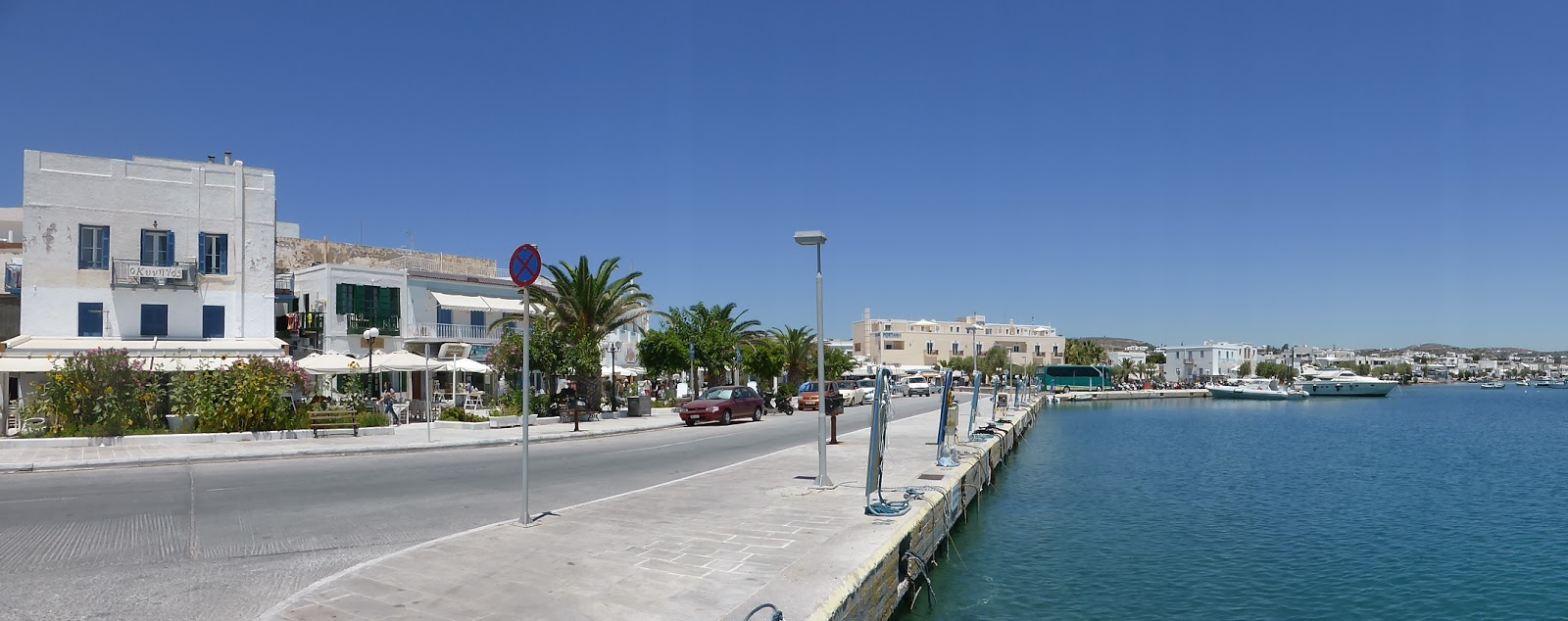
Milos is a volcanic island and in a huge bay formed by an eruption in 90,000 BC we anchor outside the marina off the island’s main town of Adhamas, a stunning village with typical whitewashed buildings on the bustling taverna-lined seafront, some interesting shops and excellent facilities to re-supply.

Kids sailing around Envoy at anchor off Adhamas

The Adhamas waterfront

Atop some steep hills behind Adhamas sits the Chora offering superb views over the island, although little else of interest compared with other Choras we’ve visited.

The hilltop Chora above a seaside village

Close up of very quaint village by the sea
Someone lives in this dwelling built into a sea cave – at least for the holidays

FOR FOODIES

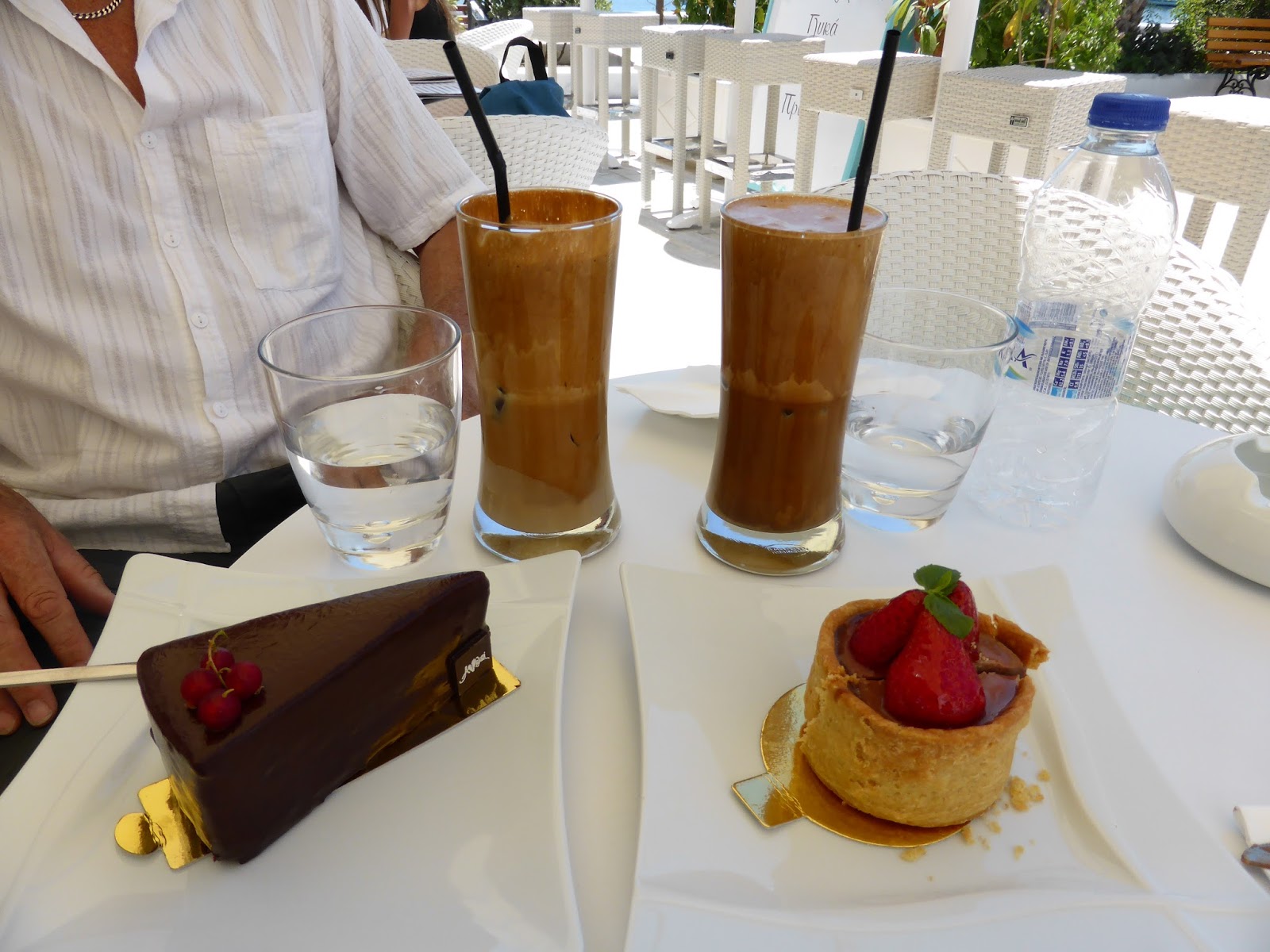
Di and I have become very partial to ice cold coffee Frappes accompnaied by a slice of the delicious cakes which are available from bakeries here

TECHNICAL
Most things are working well. I contact our Greek agent, A1 Yachting, as the RHIB’s auxiliary power supply to the depth sounder and VHF radio have failed. Their electrician fixes this in about 15 minutes charging 25 Euros (about NZ$42).
One of our two aircon units has failed, tripping the circuit breaker on powering up. I will need to find some specialised help on this later. We only use the two aircons to provide an electrical load for the generator as the refrigerator and battery charger don’t load it up sufficiently.

THE ENCHANTING MEDIEVAL VILLAGE OF MONEMVASIA

Envoy is still in the marina at Rethymno, northern Crete.

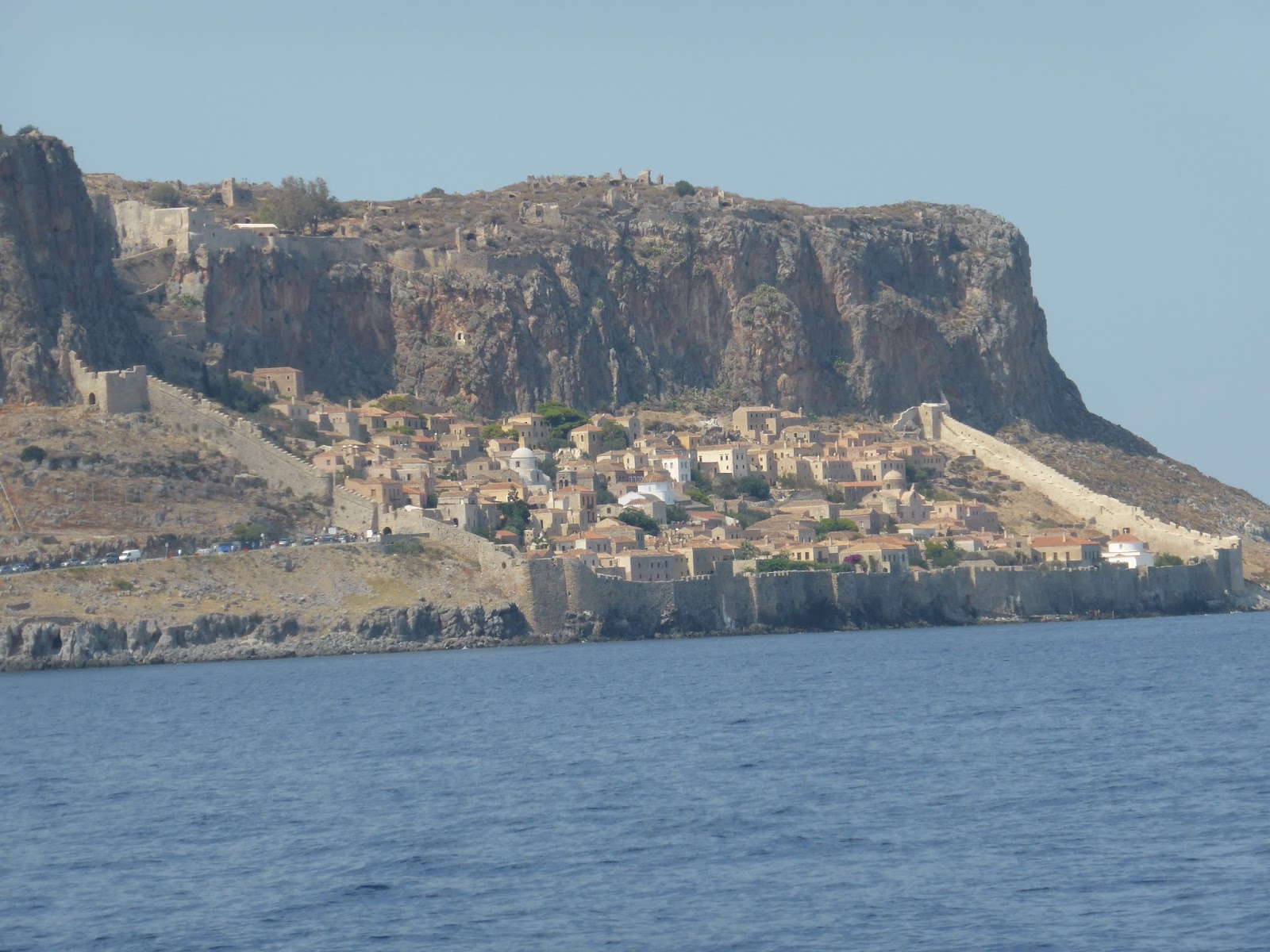
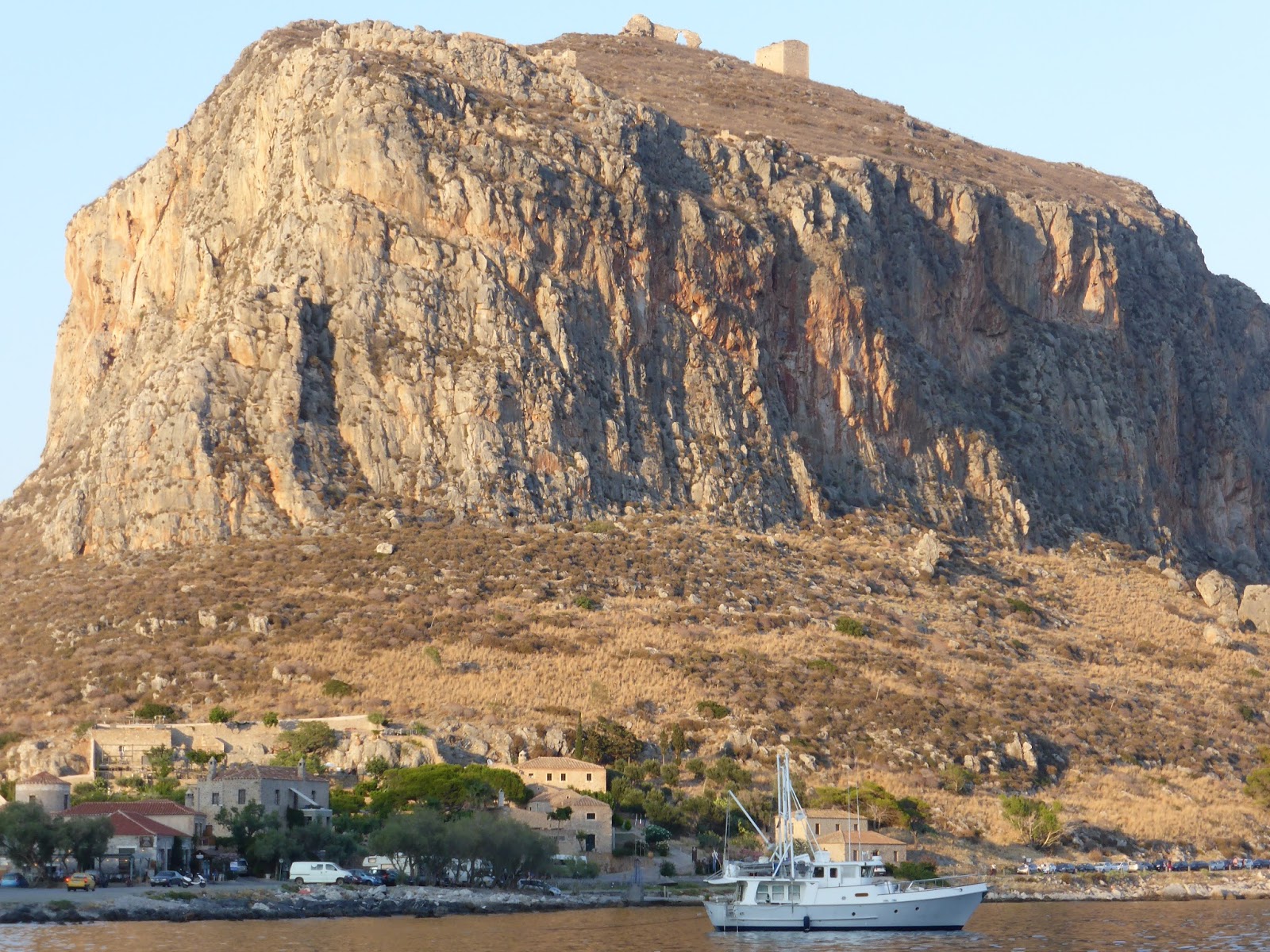
Monemvasia is a particularly interesting and romantic medieval Byzantine town located on a steep fortified island rising dramatically from the sea and connected by a causeway to the village of Yefira on the mainland.
Local inhabitants first moved to the natural rock fortress in the 6th century to resist raids by pirates and by the 13th century Monemvasia was an important Byzantine commercial and cultural centre of about 40,000 people before being taken over by the Turks. Several churches here were built in the 12th century and still in-use, although during the long period of Turkish occupation they were used as mosques. Now many formerly ruined houses in the narrow cobbled lanes have been rebuilt as holiday homes, small hotels, tavernas and shops, while retaining much of their former charm and character.

Impressive gateway through the walled town of Monemvasia

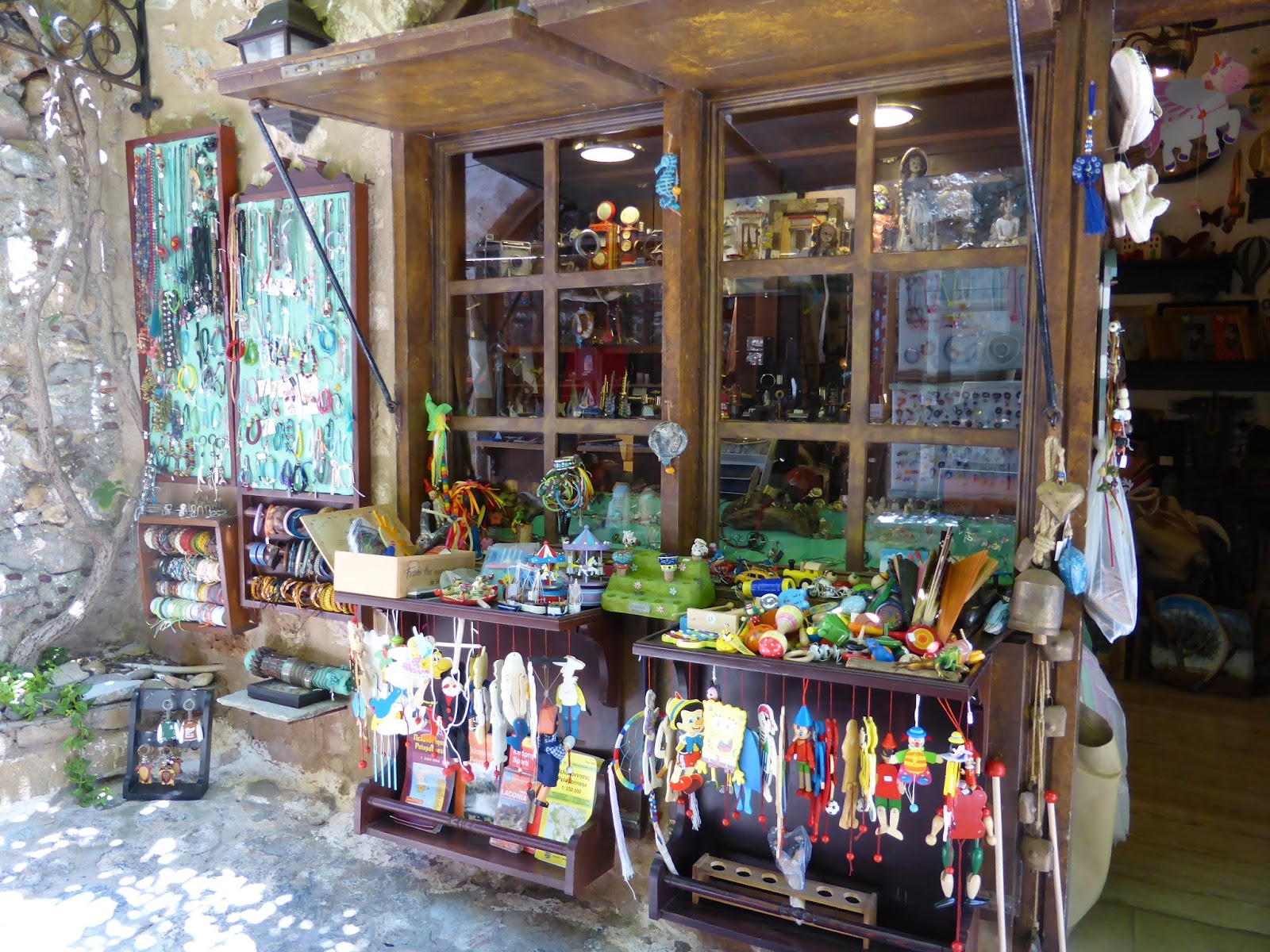
There’s lots of quirky shops in the narrow cobbled lanes

Part of the town’s violent history is that its Turkish inhabitants were massacred when they surrendered to the Greeks after a three month siege during the War of Independence.
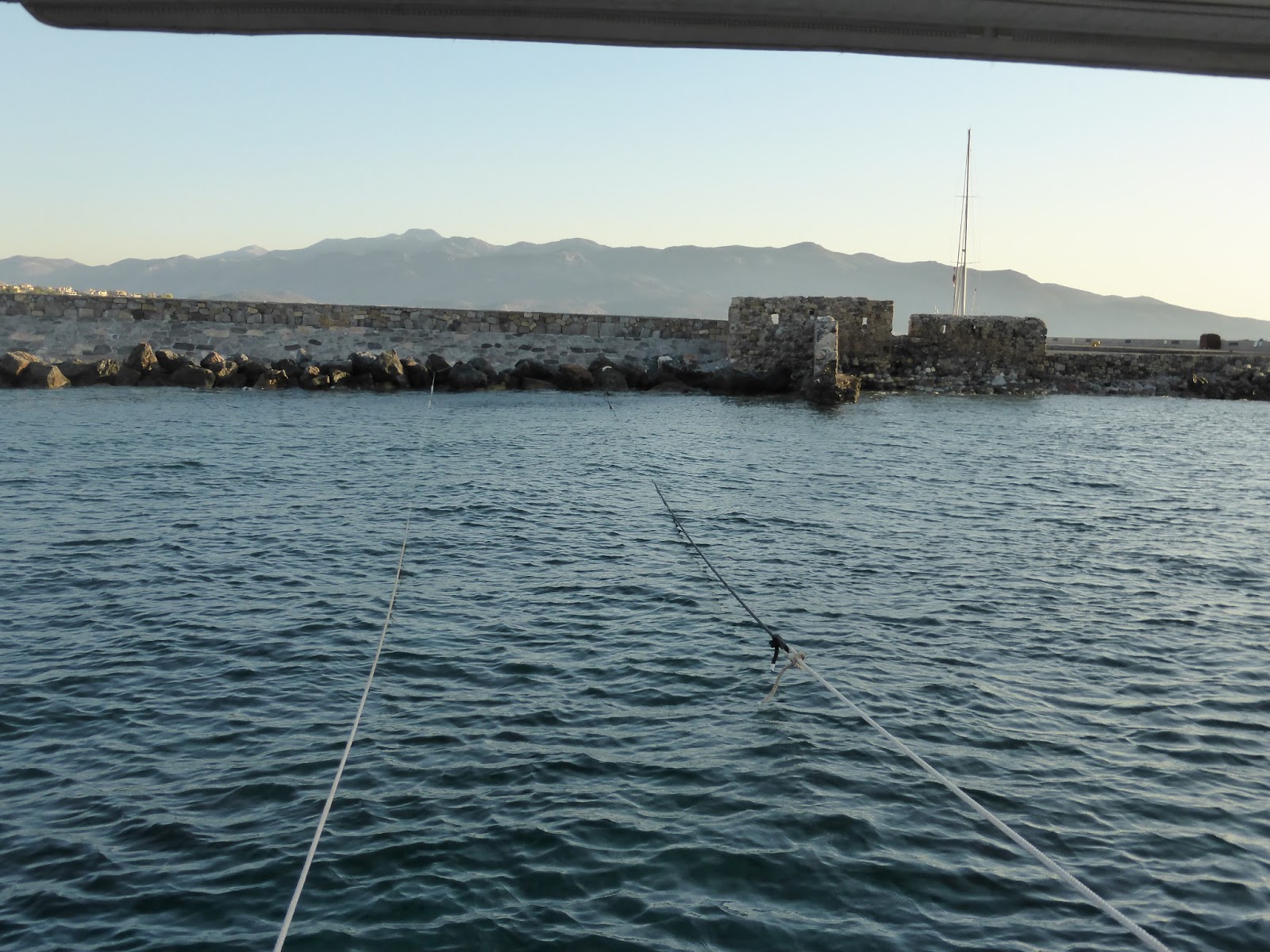
In former times the causeway had a drawbridge and fortified gatehouse and we anchor off the ruins of the gatehouse and use long lines to tie stern-to the shore.

Impressive Monemvasia Island is known as the “Gibraltar of Greece”

It’s rare to tie stern-to shore in New Zealand although it is done around Port Fitzroy at Great Barrier Island. As this is our first time to tie stern-to this season it brings to mind some of the pros and cons of using this system:
-You keep your stern to shore and bow to sea so that if there’s any swell you minimise rolling motion and only have to contend with more comfortable pitching.
-With your stern tied securely to shore its very safe in strong winds coming over the stern and with your anchor laid well out (with typically 50 metres of chain deployed) in deeper water the bow is unlikely to move (anchors don’t drag uphill).
-You can tie stern-to shore in a tighter spot than you can anchor in as you don’t need to allow for swinging room during wind shifts.
-More boats can fit into a given anchorage area as they don’t need swinging room.
However:
-Lines to the shore can be a means of rodents and insects coming aboard and we thread the line through the neck of a plastic soft drink bottle with its bottom cut off to try to prevent this.
-It’s not so easy to leave in a hurry, especially at night, as stern lines need to be retrieved. Leaving when anchored is far easier.
-If the wind changes and becomes strong on the beam it can place a lot of pressure on stern lines and ground tackle. Boats are known to break inadequate lines or drag anchors sideways.
-Other vessels sometimes anchor close-by across your anchor chain or come right next to you stern-to the shore.
-At anchor the boat swings to the wind so the cockpit is always sheltered.
After spending two nights with lines ashore we concluded we’d not be in a hurry to do this again without special reasons. Incidentally if an emergency arises while tied stern-to, such as dragging sideways, it’s best to let your stern lines go and allow the boat to swing out into the wind to reduce strain on your anchor. Lines can be retrieved later.

Envoy moored stern-to shore

Detail of stern lines – ideally these should have been set at a wider angle to each othet

We’d not visited Yefira previously and enjoyed pottering around the village and the small, shallow, taverna-lined harbour for local fishing boats.

Yefiron’s harbour for small local boats

Here we find a fresh water tap and are able to replenish our supplies using Chris’s pumping system to discharge the water from jerrycans into Envoy’s tanks.

Envoy with Monemvasia in the background

It’s now a week since I went to have my ears treated and I was advised to see a doctor to check on them about now, so we find the one and only doctor in Yefira and drop in to see her. An examination confirms they are OK and she advises me to put three drops of pure alcohol in my ears if they get wet. Diane laughs saying she thinks I’ve generally got enough alcohol in my body without adding more. We ask how much we have to pay and she says the 15 minute consultancy is free.

ENVOY AT KITHERA ISLAND

Envoy is currently in Rethimno Marina, northern Crete.

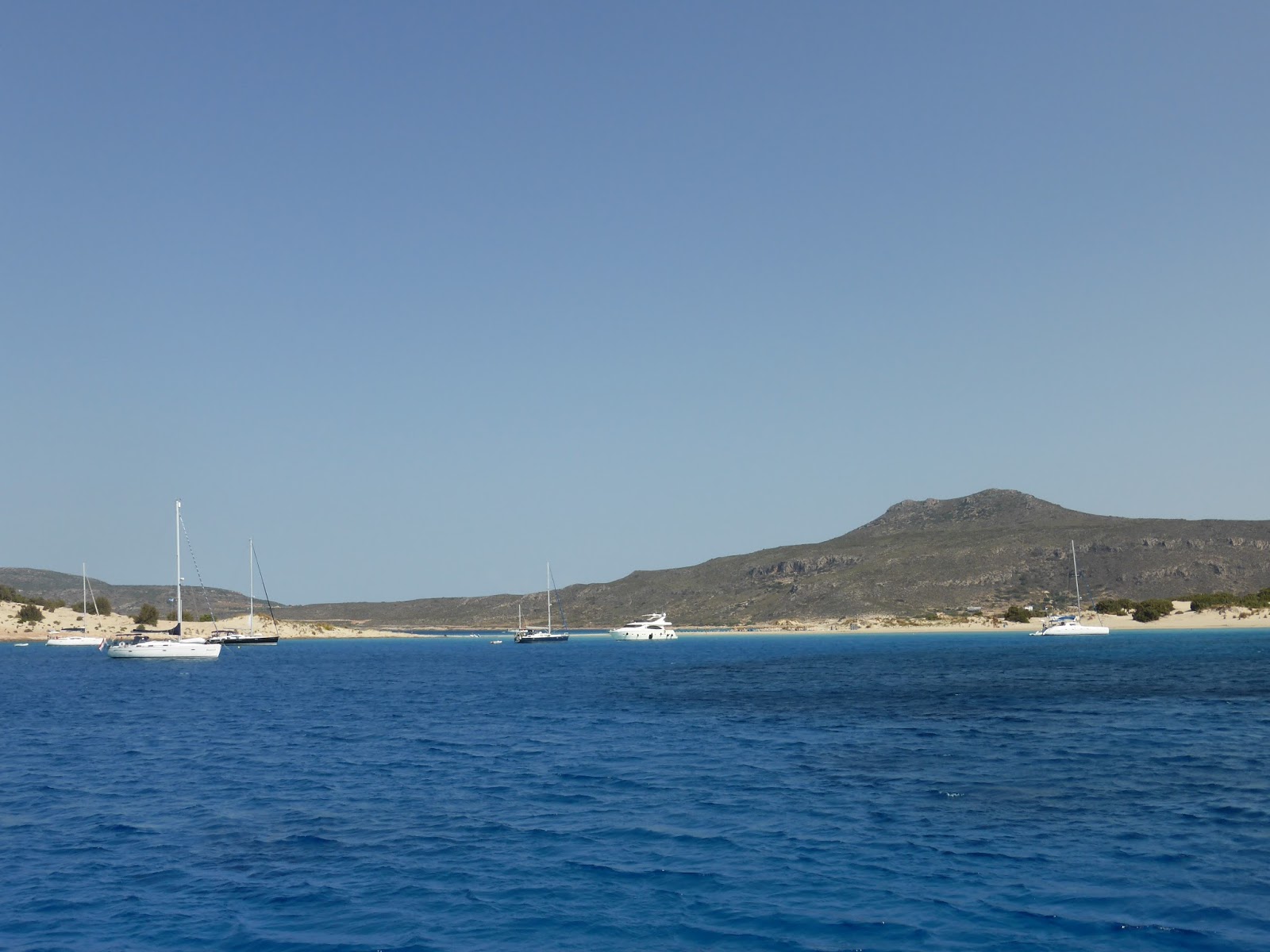
Next stop is the island of Nisos Elafonisos where we find a superb anchorage with sparkling clear waters on the NW side called Nisis Elli. We’re the only boat anchored here and we take the RHIB ashore to enjoy a swim off the sandy beach, followed by cheese, olives and cold shandy. This is not a taverna-lined beachfront but a deserted bay with just a few holiday apartments back from the stunning beach.

This is a bay on the south side of Nisos Elafonisos

From here it’s only about 10 miles to the island of Kithera, lying off the south-eastern coast of Peloponnisos and one of the most unspoiled of all Greek islands.
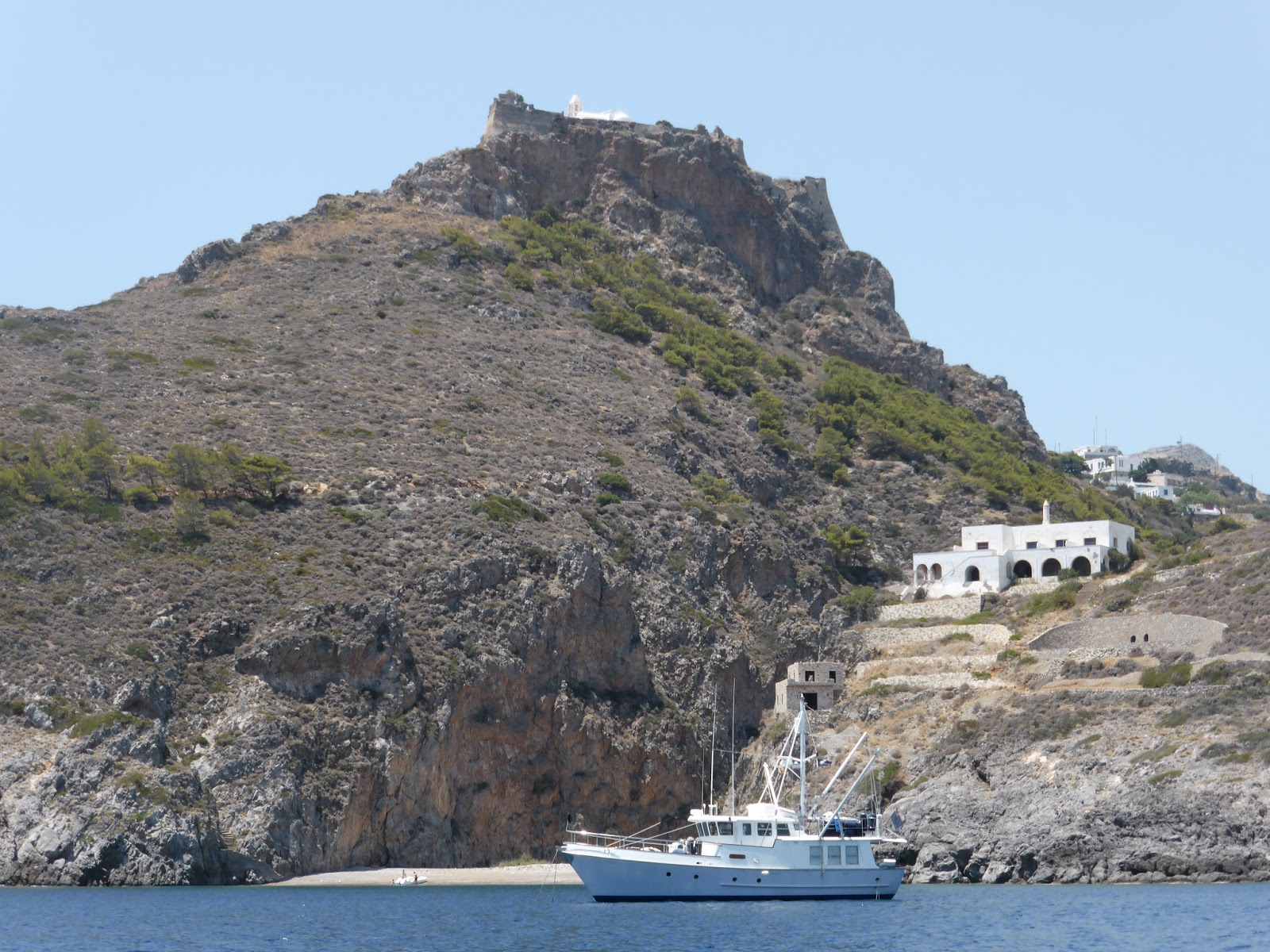
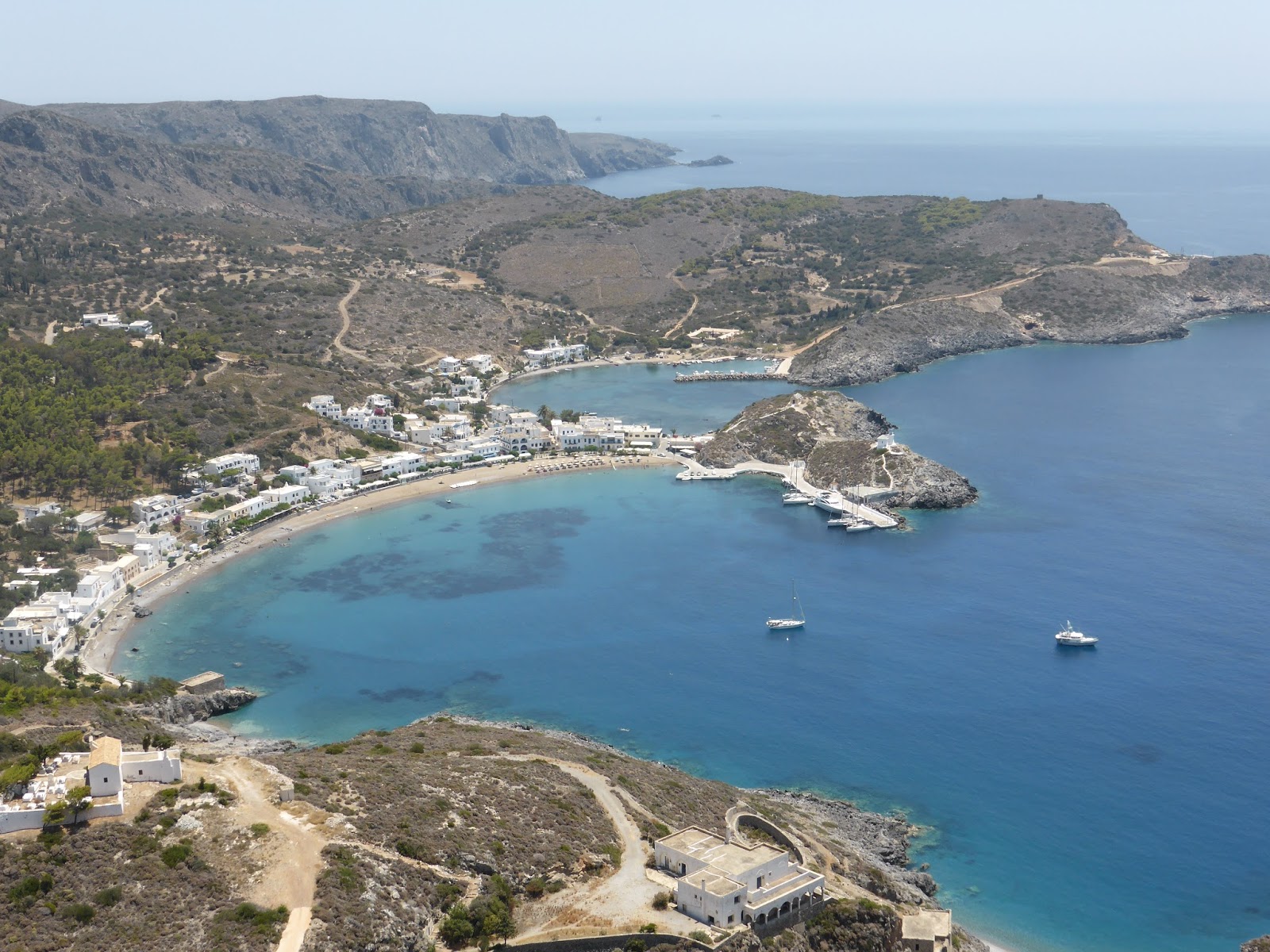
Its main port is Kapsali at the southern tip of the island – a beautiful bay to anchor in, surrounded by rugged cliffs and overlooked by the stunning hilltop fortress. The bay is exposed to the south so a bit rolly, but our flopper-stoppers do their job in reducing the effect of the swell.

Envoy at anchor with fortress behind

Kapsali harbour from the fortress with Envoy and just one other boat anchored

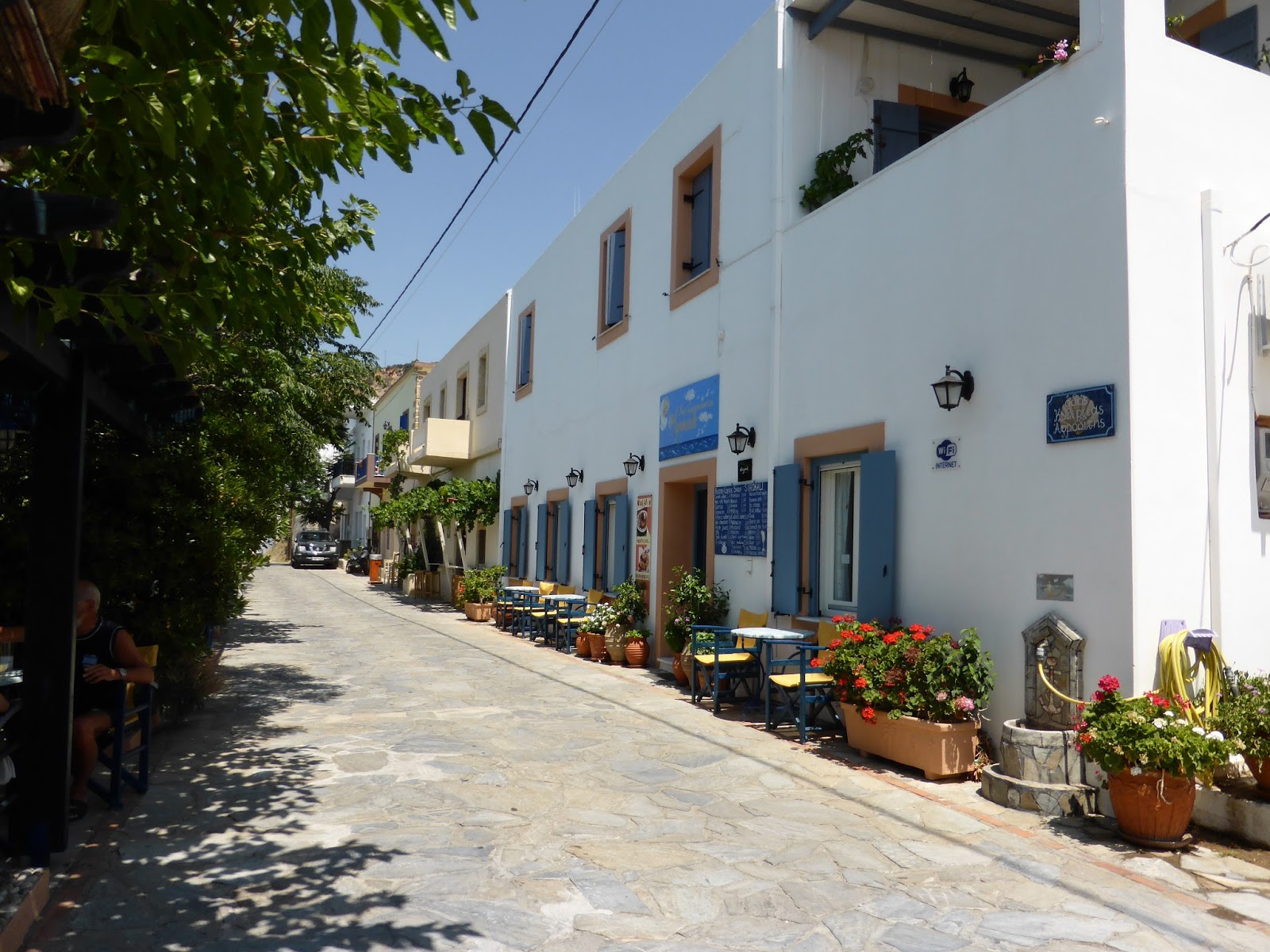
Ashore the old buildings are mostly painted with traditional whitewash contrasted with blue shutters, the seafront being lined with small tavernas. It’s still very quiet with only three or four other boats anchored here during our several day stop.

Kapsali’s taverna-lined foreshore

We liked these attractive steps and shrubbery

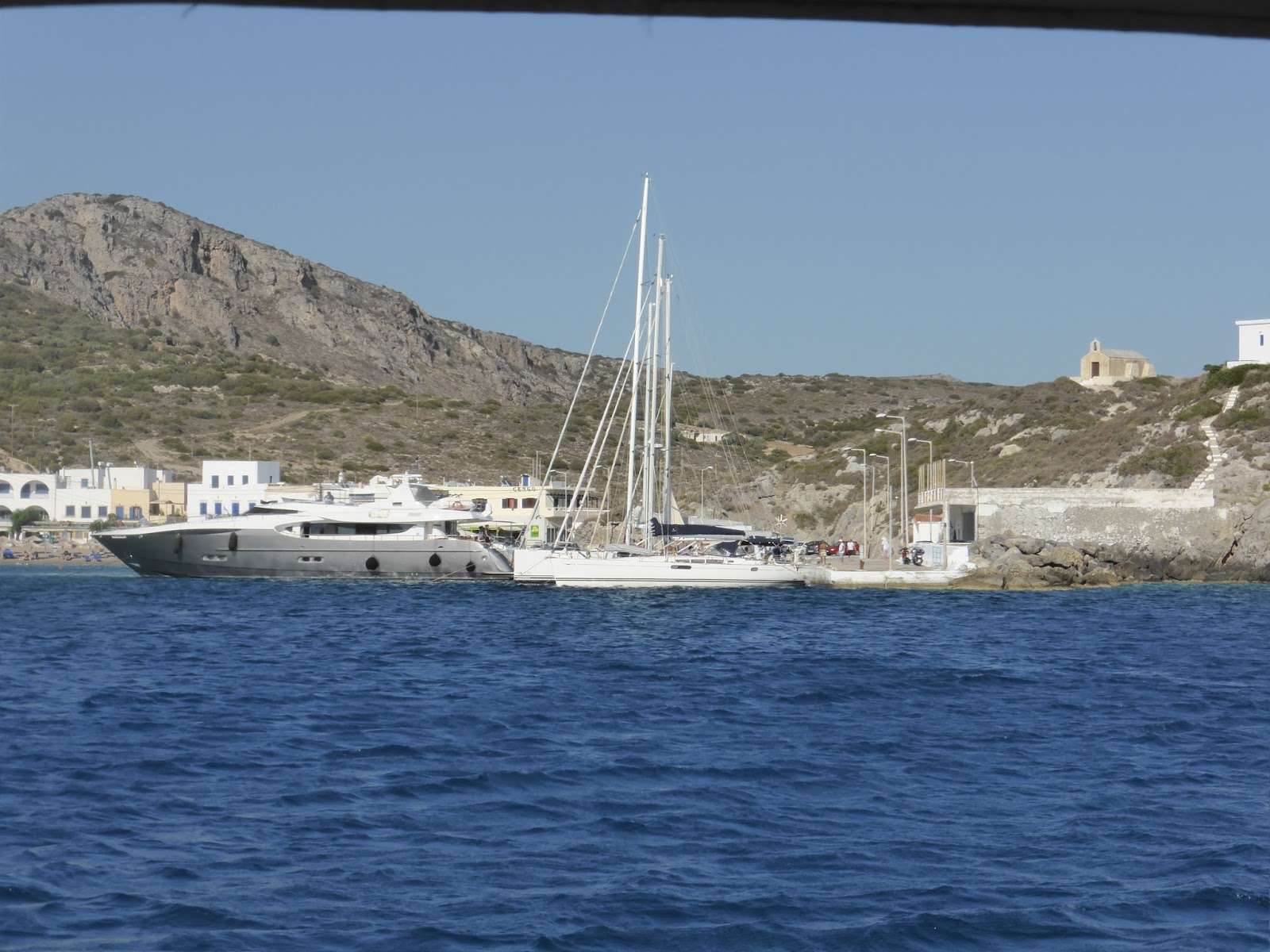
The bay has a small wharf and this is where most visiting boats want to go – why I don’t know as it’s much nicer to be anchored out in the bay. With the summer season getting under way we’re starting to see some very large planing motor vessels in the 20-30 metre range, of course all with about four to six uniform-clad crew. Some of these are seriously large vessels and it’s amusing to see them want to anchor right in close as if they are a small weekend cruiser.

Surely the wharf wasn’t intended for boats of this size

Many Greeks from Kithera emigrated to Australia and as we wander around we hear the accents of many of them back here enjoying holidays.
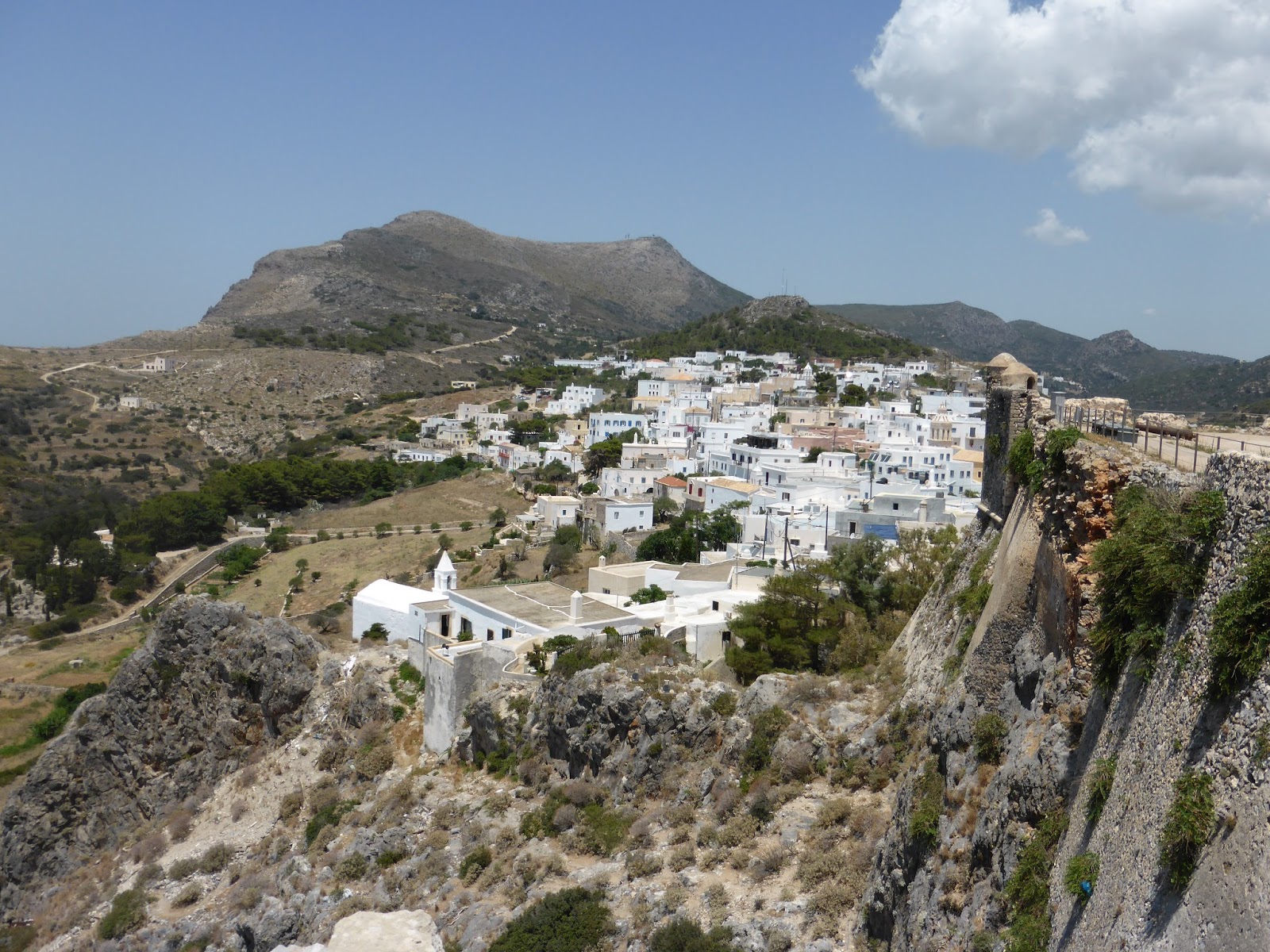
We take a taxi up the steep winding road to the fortress and chora (hilltop village) for some exploration and stunning views.

The Chora viewed from the fortress

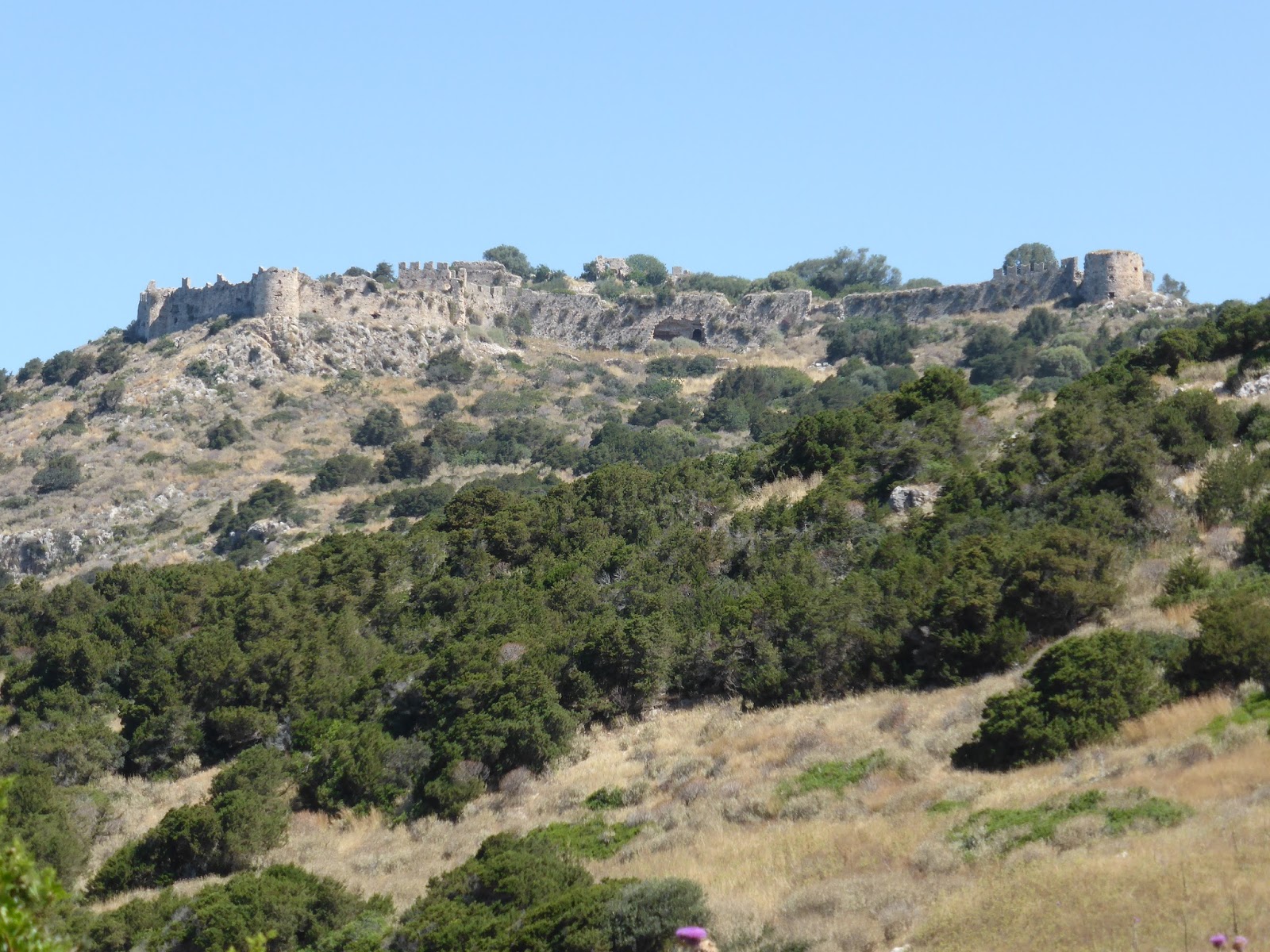
Built on a steep rocky promontory the fortress appears impregnable

Later we do some shopping at a small superette and find the owner to be extremely generous. It’s a hot day so he gives us free bottles of cold water, provides various cheeses for us to taste, gives me a free cold beer and then a healthy discount off the bill.

Our generous superette owner

My ears are slightly sore from constant exposure to seawater so we visit the small local hospital, finding it very modern and seemingly well-equipped. It’s under-staffed but the doctor and nurse we meet are very courteous and helpful, the doctor complaining that she’s rostered for 12 hours a day. Treatment is free but we have to pay for the medications provided.

We move on to anchor off the village of Avemolana which was new to us and a thoroughly delightful spot. This is not only sheltered from the consistent northerly winds but free from any swell, although there are wakes from fishing boats coming in and out of their harbour at all hours of day and night. As an aside fishing boats don’t make any concession to anchored visiting boats and pass close by making uncomfortable wakes. I guess they’ve been out for hours tending nets and keen to get home.
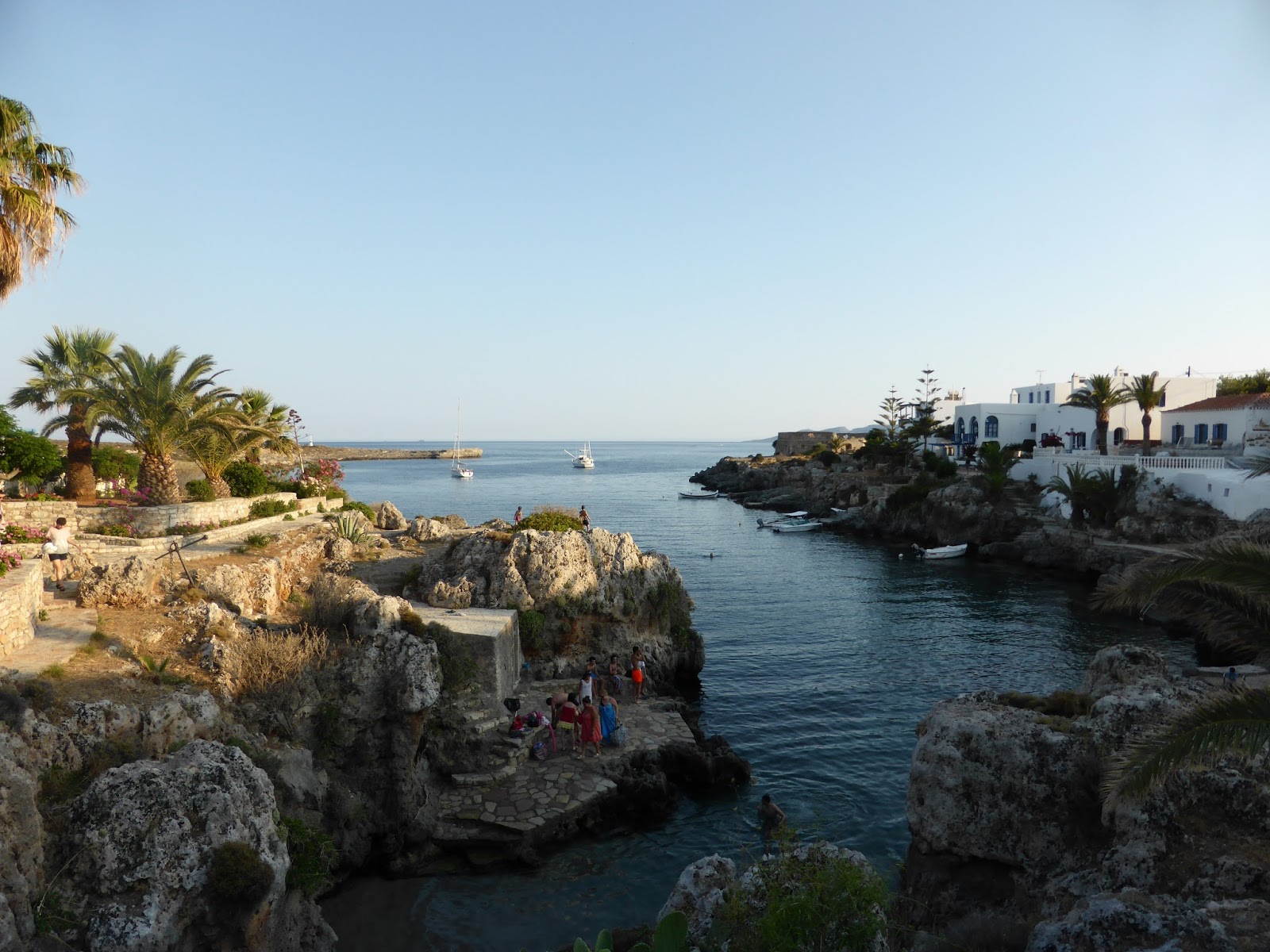
Ashore is a rocky cove where locals swim in crystal clear water from several small boat jetties and this whole scene is overlooked by several atmospheric tavernas.

Envoy is in distant background from this great inlet

Envoy anchored off Avemolana

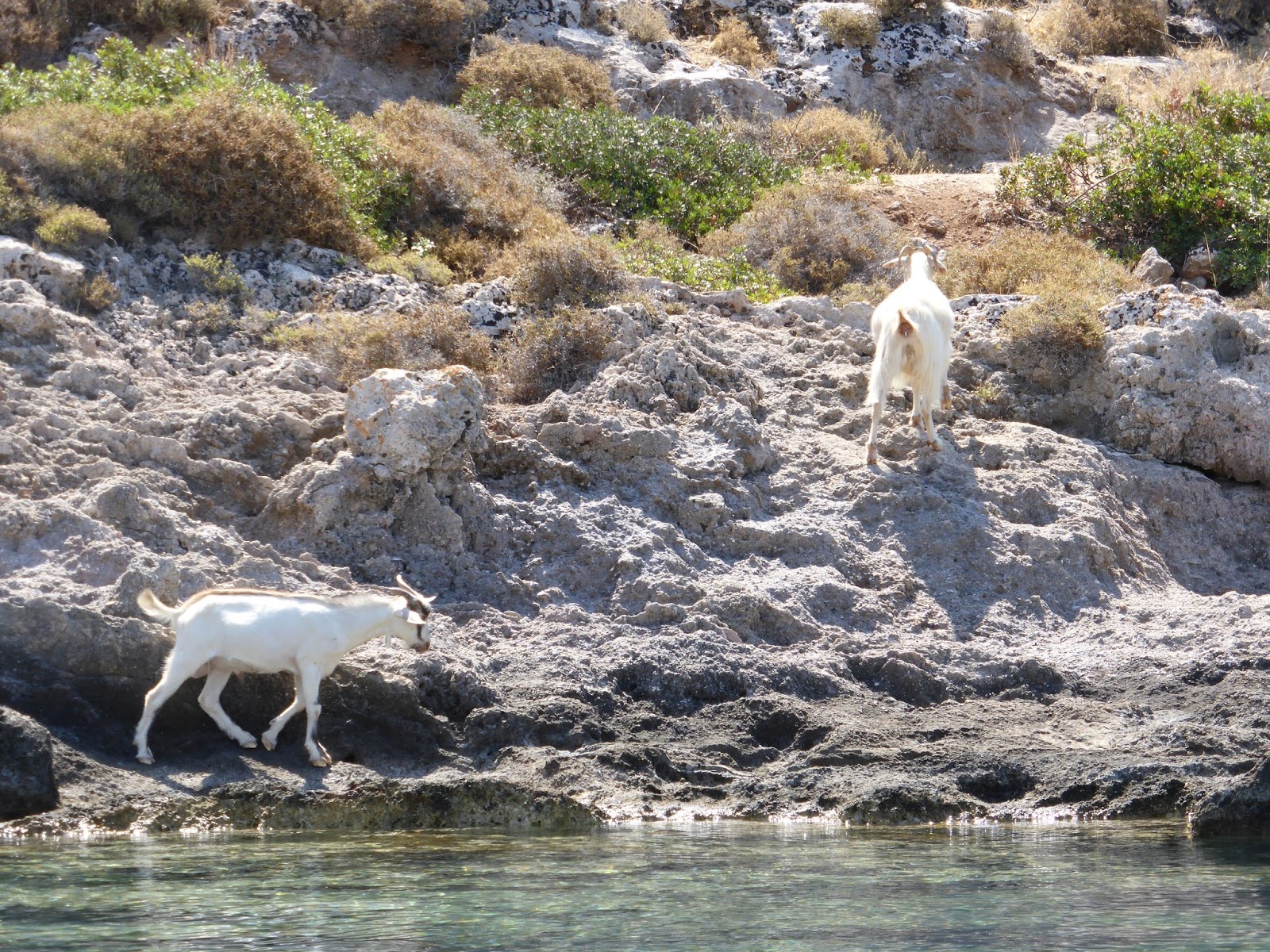
Even the goats enjoy Avemolana’s waters

There is no respite in the northerly wind and after two nights at Avemolana we move on in a 20 knot headwind and 1.5-2 metre head seas to Neapolis on the mainland. Unfortunately the steep seas and Envoy’s pitching motion tosses our herb garden overboard as we’d left it on the transom where it had so far safely sat for hundreds of miles. Diane had worked hard to get these mint, oregano and thyme plants into great shape so we’re a bit sad about this.

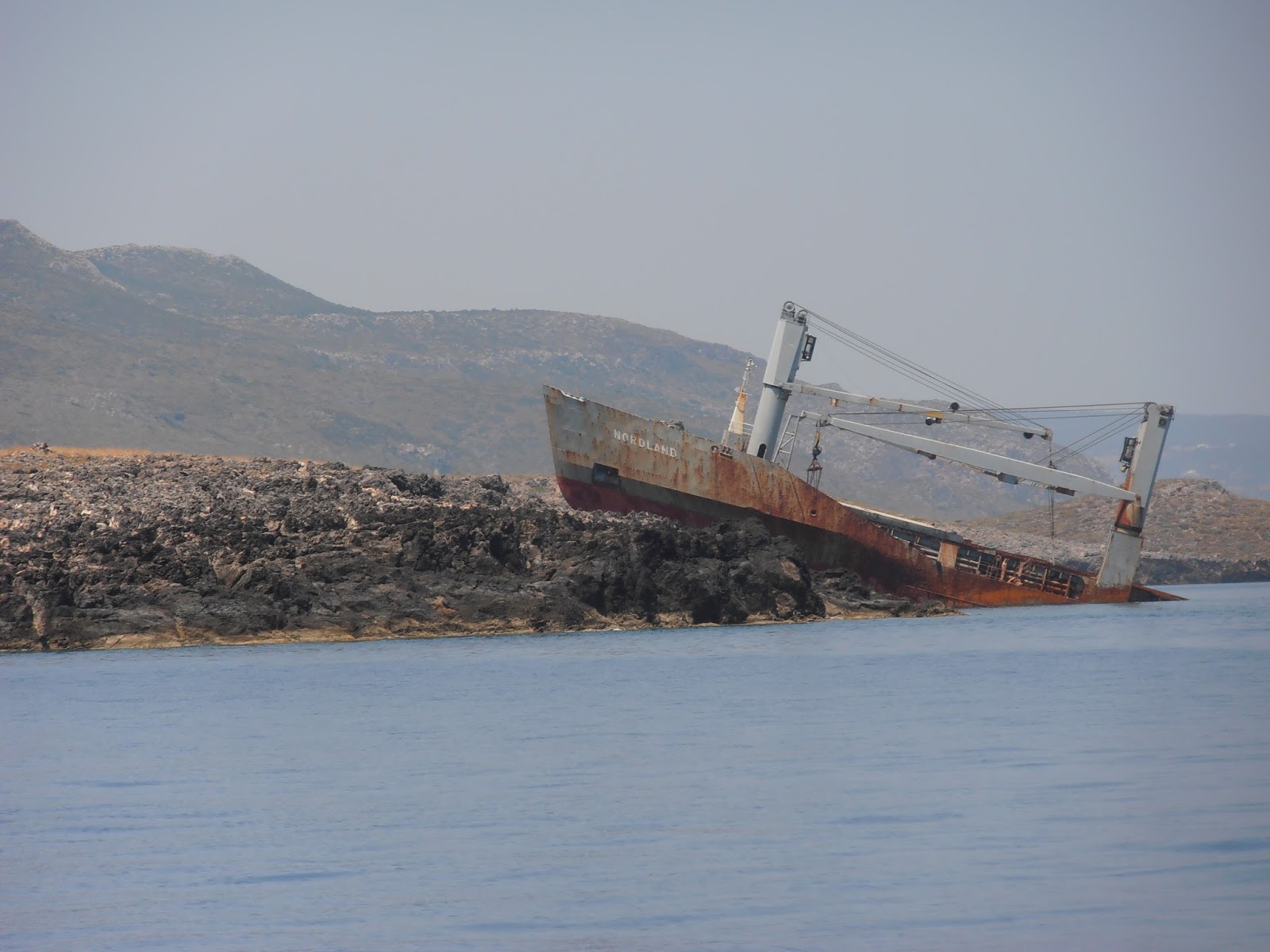
Just outside Dhiakofti is the wreck of the cargo ship Nordland, and as author Rod Heikell says it looks like her skipper attempted to perch her atop the islet.

Neapolis is on the eastern side of a large bay nearly four miles across called Ormos Vatika. As we approach land in late afternoon the seas gradually reduce until they diminish into wavelets and we anchor in a relatively flat sea. Half an hour later though the wind changes to the south and a fetch kicks in. Fortunately it only lasts until sunset and then the wind reverts to its forecast north and all is peaceful for the night.
Next day first priority is to replace our herb garden and from three different shops we find a planter, soil, and all three herbs. Now the planter is secured to the transom so it can’t fall overboard.
At this stage we’ve had over 20 knot northerlies for several days and they’re forecast to continue. In fact this is the “Meltemi” wind, notorious in the Aegean Sea that we’re now bordering and is not what we need when we have a 60 mile open sea crossing to make to Milos Island soon. The Meltemi often lasts for a week or longer keeping many cruising boats holed up in safe anchorages. It’s caused by high pressure areas in the eastern Aegean (with winds circling anti-clockwise) combining with low pressure areas to the west (with winds circling clockwise) to produce generally Beaufort Force 5-7 winds. Although this is not a particularly strong wind by New Zealand standards the resulting sea conditions are much more severe here than with the same wind level at home. I’m not sure why this is so, but all cruisers comment on the fact that while the waves are not overly large at typically two metres they are close together, steep and breaking.
We decide to position ourselves at Monemvasia, being about the closest mainland point to Milos, so we can make the crossing when the weather is suitable.

Yithion

Envoy is currently anchored at Ormos Manganari, Ios Island

Most of the places we’ve visited during the last few weeks we’d already cruised to in 2012, but now we move on to a new destination – Yithion, for a delightful surprise. Some places don’t live up to expectations but Yithion surpasses when we drop anchor behind the causeway linking the mainland to the tiny island of Nisos Kranai, mentioned in Homer’s Iliad as where Paris and Helen (of Troy) spent their first night together after eloping.

Envoy at anchor off Yithion

The island of N Kranai where Paris and Helen of Troy spent their first night together

Yithion has been inhabited since ancient times and was once the principal port of the Spartans. Now it’s a small town of about 5,000 working Greeks and although the waterfront is lined with tavernas it’s not a real tourist or cruising destination.

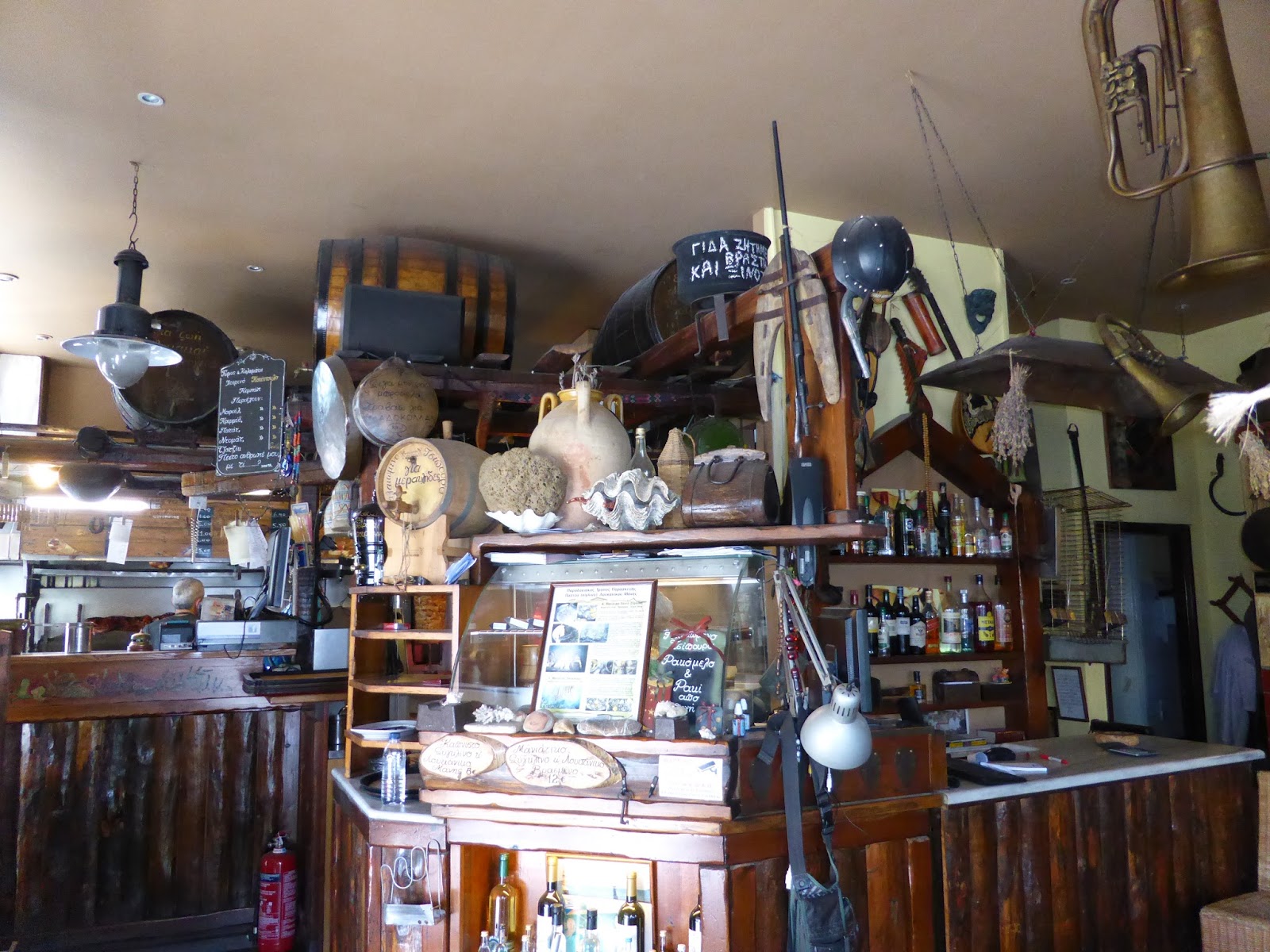
We enjoy a great lunch with Kevin and Diane at a really atmospheric tavern loaded with relics (including us!)

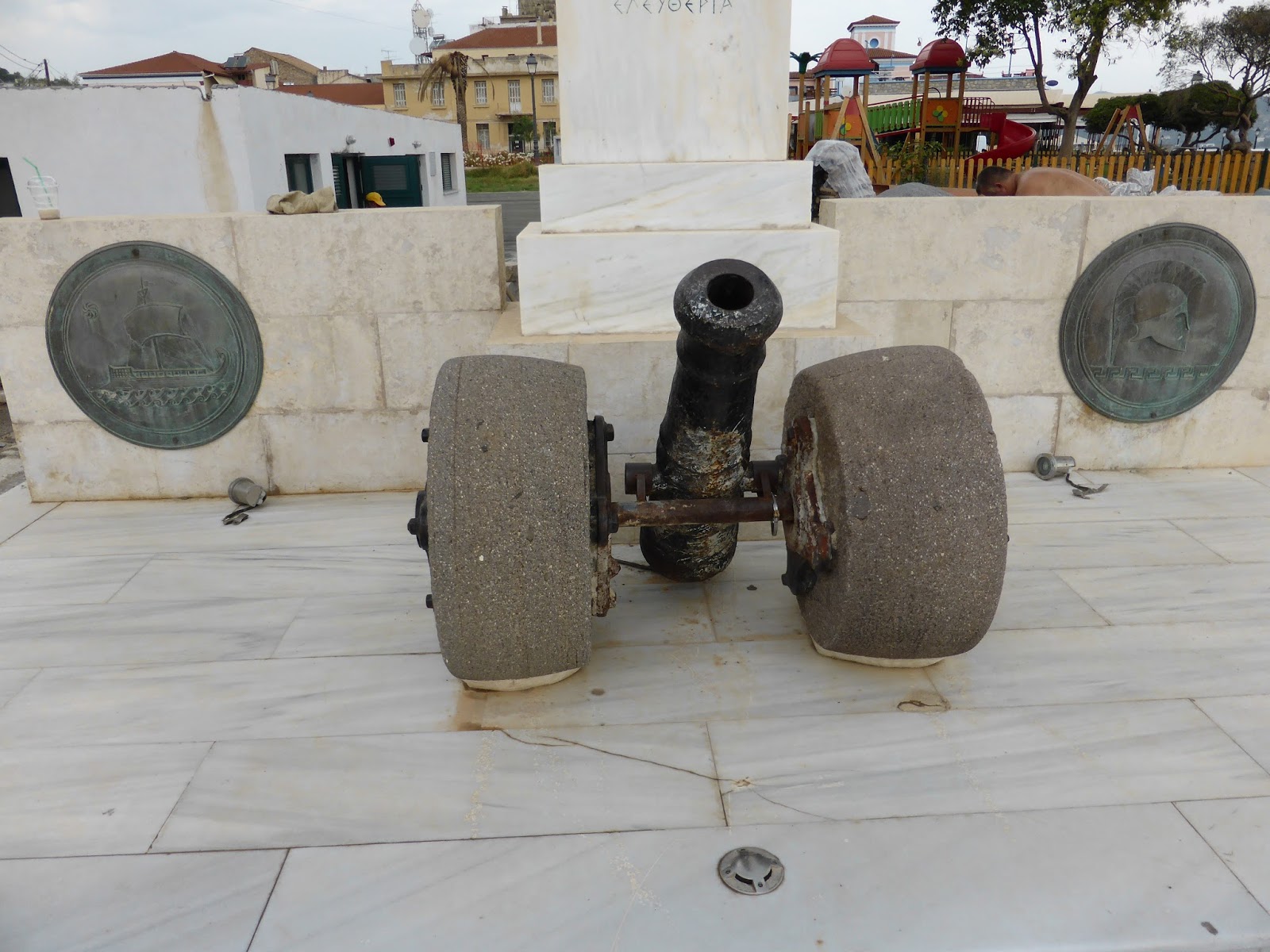
An interesting old cannon with huge stone wheels

Here Kevin and Diane catch a bus to Athens to continue their travels and while our general plan is to cruise east to Santorini to meet Doug and Sharon in about three weeks we stay on for a few days to soak up more of Yithion’s atmosphere.

This sledge is used to haul fishing boats from the water for maintenance – the same system as used for many hundreds of years.

We take our RHIB into the nearby well-protected harbour and meet a Dutch cruising couple, Marcel and Leena from the yacht Tomskii Kastan and it turns out they own a property in Kerikeri (New Zealand), where their son now lives and knows our friends Bruce and Leslie of catamaran Midi.
The next day we return to the harbour and find a very elderly American guy having real problems berthing his 9m sports style motorboat in a strong beam wind. His wife is in semi-shock and tears as their anchor has fouled another anchor and they can’t free it. As they are very close to Marcel’s boat I take him out in our RHIB to see if we can help. Marcel dons a face mask and pulls himself down the anchor chain six metres below to the seabed and on the third attempt frees their anchor. We feel very sorry for the extremely grateful American couple but it’s obvious from their next berthing attempts they’re a disaster waiting to happen as they get their angles of approach all wrong, don’t put out enough anchor chain and maneuver at excessive speed.

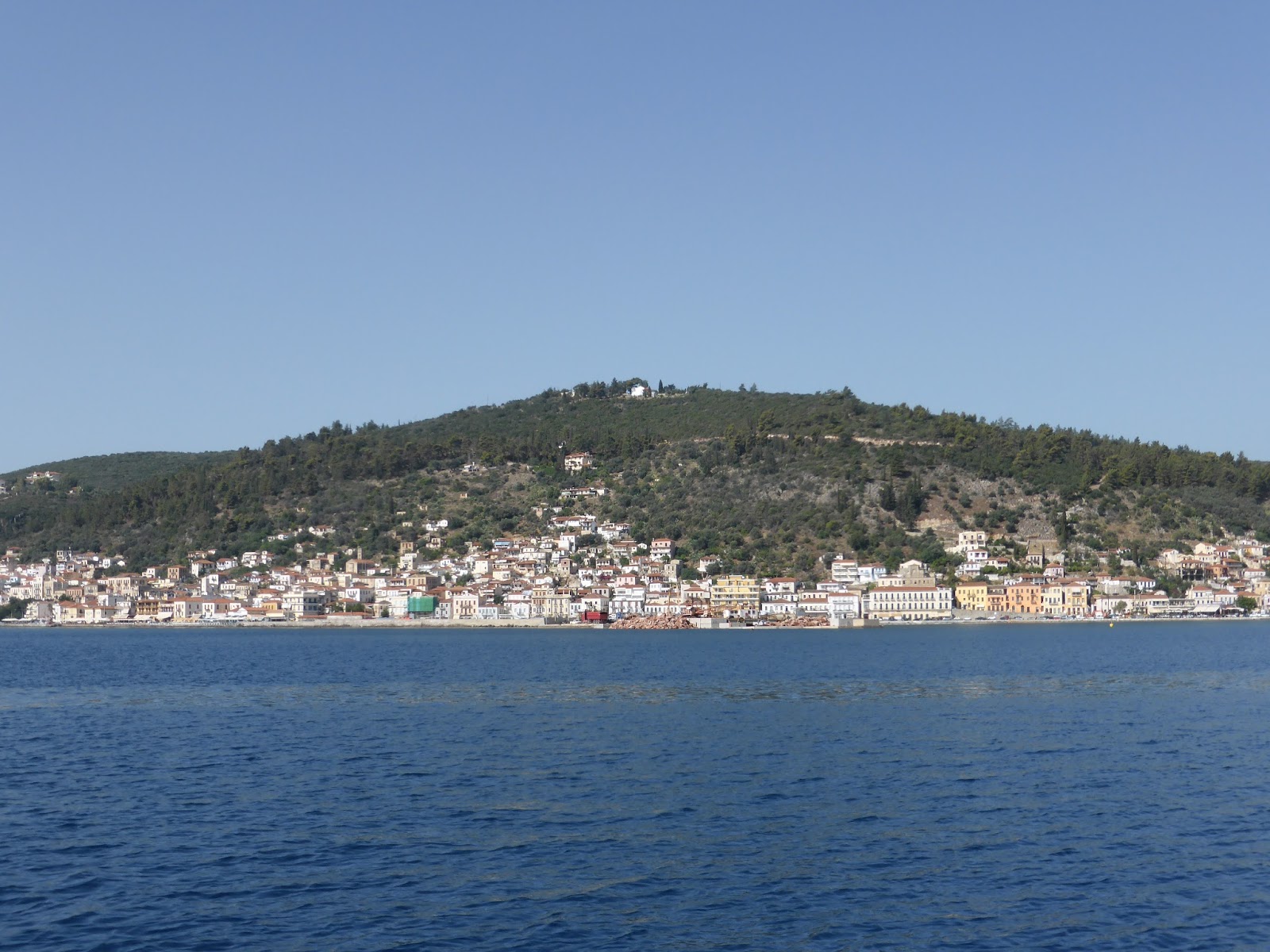
Vista of Yithion

Shipwreck on beach north of Yithion

In a rising northerly we cruise south-east to a large bay called Ormos Xilis which offers good shelter from the north. We no sooner anchor off a small village called Plitra at the head of the bay when the wind turns south gusting 25 knots and soon we have whitecaps rolling in. Envoy is well secure at anchor and reasonably comfortable bow on to the seas and with the forecast still saying the wind will turn to the north we stay on. Sure enough within a couple of hours the wind turns right around and the sea quickly calms again. We often find over here that in the couple of hours before sunset the wind does some strange things, often blowing quite strongly onshore and then settling offshore after sunset.
Early next morning I take our RHIB to a fishing boat jetty to find some fresh water and meet Alexander, who lived in Sydney for 40 years but moved back here to retire. He now does casual commercial fishing and time for both of us is no issue so we shake hands and enjoy a long chat about life in general. I find water from a dripping tap on the end of an ancient pipe and find the right hose connection from the large selection I took ashore with me.
Later Diane and I go ashore for a look around and Plitra is virtually deserted, but we have coffee frappes at Jimmy’s Taverna. Jimmy is a Canadian who tells us that about 250,000 Greeks ancestry live in Canada. After chatting for a while we ask for our bill but Jimmy won’t accept payment and says the coffee is free.

TECHNICAL
Replacing incandescent or halogen lights with LED lights is a current topical subject in boating and technical magazines.
Until recently it has been necessary to replace the light fitting in order to use LED bulbs, but now LED drop-in replacements are available for most types of conventional bulbs.
LED lights use less power, last longer and generate less heat, but they are more expensive and their light is not as “warm” as conventional lights (although this situation is improving). Incidentally LED bulbs are not rated in watts like conventional bulbs but in lumens (lm) – a measure of the light produced from a lamp.
Envoy has mostly halogen lights and we did an exercise in replacing a bulb with an LED in a light above our galley sink where the amount of heat generated is excessive. We bought a Chinese-made “Dixplay” brand bulb and it fitted the socket with no problem. The cost was 10.80 Euros (about NZ$18) compared with 2.50 Euros (about NZ$4.17) for a standard bulb. This purchase was made at a chandler and both bulbs would have been cheaper in a specialist lighting shop.
The result was the light was bright enough, was not excessively bluish and did solve the heat issue – but would we use LEDs generally? No – LEDs are great for an application where power saving is all important, for example in a sailing yacht or freedom caravan, but aboard Envoy we generally run the engine for several hours daily as well as the generator for three hours daily (to power the refrigerator) so electrical power and battery charge is not an issue. In addition we have a considerable number of spare conventional bulbs aboard and we cannot see any advantage in paying the considerable additional cost to go LED. How’s that for being a Luddite!

THE MANI REGION OF PELOPONISSOS

Envoy is currently anchored at Ormos Manganari on the south coast of Ios Island in the Aegean.

A few days after Chris departs our Kiwi friends Kevin and Diane join us at Kalamata Marina for their fourth visit to Envoy. Kevin and Diane have been boating for many years, own a sailing yacht in Auckland and Kevin has been active in all sorts of other boating activitiess ranging from a long association with Auckland Coastguard (of which he is a former President and current Patron), to boating education and writing books on knots.

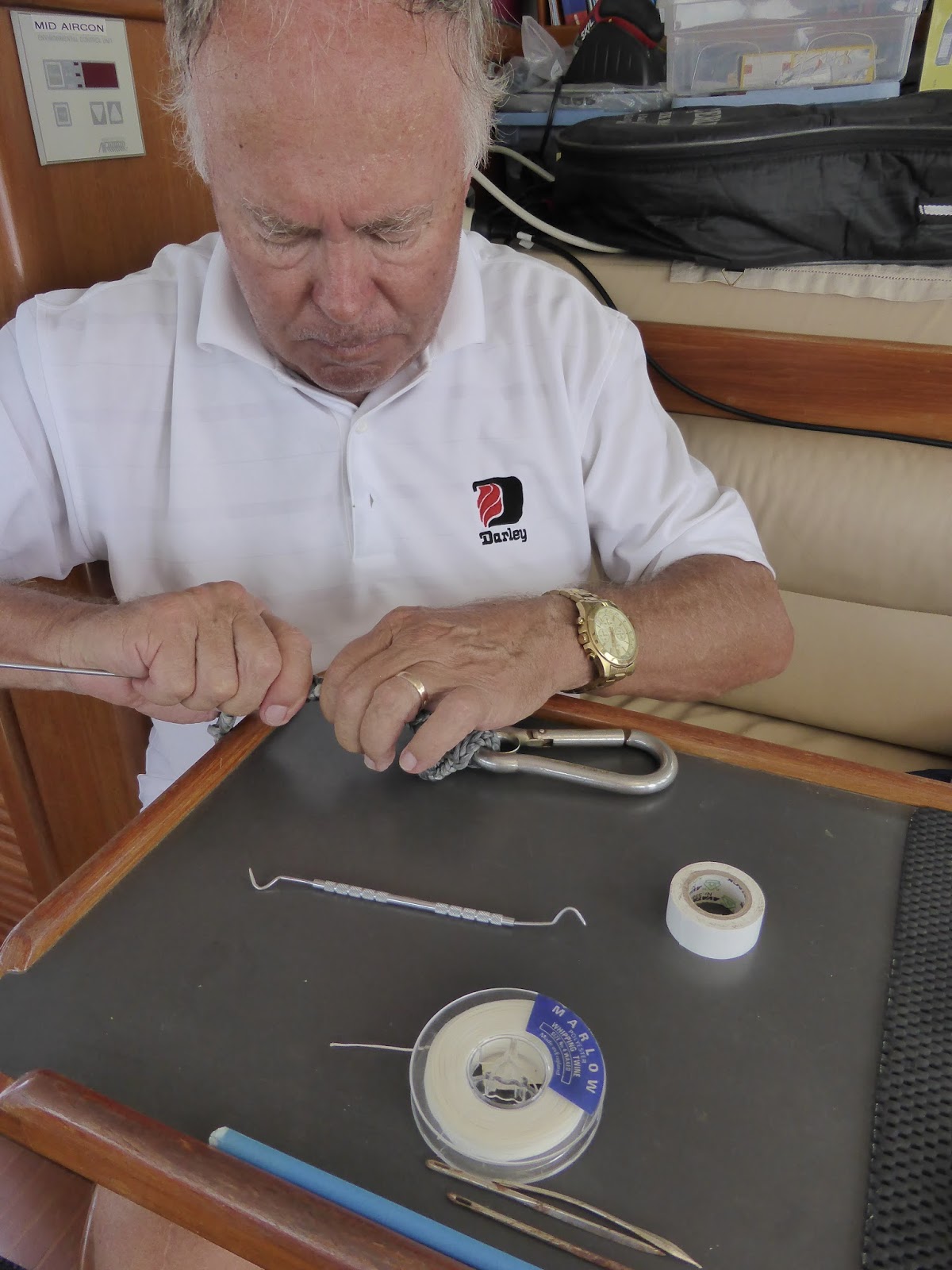
Kevin repairing a splice in our Dyneema RHIB hoist

Kevin and I visit the Port Police to have Kevin and Diane added to our Crew List – this is necessary whenever new crew join a boat cruising in Greece.

First thing one morning I ask Kevin’s Diane if she’d had a good sleep and she answers with a laugh “yes I had several good sleeps”.
This is a very good point to ponder as sleeping on a boat is quite different to home. There’s nothing as great as sleeping on a boat is there? Well maybe!
Firstly very few anchorages here are perfectly calm, in fact even most of the marinas and harbours have some surge. So you’ve got constant movement to some degree and this causes various noises – a creaking of the hull, a groaning of the anchor rode, a rattle in a cupboard, a drink can rolling in the fridge, the sound of the sea outside the open porthole, the occasional wavelet on the hull and in most places fishing boats and ferries moving around during the night making exhaust noise and causing small wakes. Then you have wavelets lapping against the RHIB moored alongside or astern. In a boat fresh water is circulated to the sink taps by a 12V electric pump which makes a humming noise every time any tap, shower or head is used as well as periodically for a few seconds even if not in use. We have four sinks aboard Envoy and three of them make gurgling noises as the boat moves to wave motion. In nearly every anchorage (but not in marinas) we use a GPS anchor position alarm to warn us if Envoy moves from her originally anchored position. It’s quite normal for a boat to move around a bit with wind changes but we do want to know about it so the anchor alarm beeping is yet another noise to add to the list. Often we can hear tavernas playing music until the early hours and this is worse in harbours often continuing until 0300 plus the traffic noise, particularly motor scooters with their loud exhaust. So Diane is spot on with her assessment that what you get is a series of short sleeps.

NIGHT CRUISING
With Kevin and Diane we retrace our steps to show them Koroni and Methoni and then with about nine hours cruising eastwards ahead of us to reach Porto Kaiyo we decide on a night cruise. Although Diane and I have done night cruising several times it’s much easier with someone of Kevin’s experience aboard to share the watches and Kevin was also keen to do this.
So what’s so special about night cruising? The first is safety and nobody can go for’ard of the Portuguese bridge after dark – it’s extremely difficult to locate a man overboard at night. If it were necessary to go for’ard the person would need to wear a life jacket with strobe attached and be under observation the whole time.
Other main issues are navigation and avoiding other vessels. During daytime it’s easy to see approaching vessels and their courses and to take avoiding action in plenty of time. By night we pick up other vessels first on radar and plot their course on screen to determine if they will come too close – if so a course change may be required to maintain a safe distance (see an upcoming Posting with more detail on this).
Another issue is that while it’s easy to leave your current familiar location in darkness it’s not so easy to arrive at a strange location by night, so we choose to leave Methoni after dinner at 2100 hours to arrive at Porto Kaiyo in daylight at 0600. It’s important to conserve your night vision by having very dim lighting (Envoy has red interior lights for night cruising) as if you inadvertently shine a bright light in your eyes it takes up to 30 minutes for good night vision to return.
Most days I enjoy a beer and wine or two after Envoy is safely anchored but when we cruise during the night we become a dry ship. We enjoy a smooth, uneventful but enjoyable trip under a full moon with the two Dianes sleeping all the way and Kevin and I standing 1-2 hour watches with some rest in between. We only see one sailing yacht, several fishing boats including some with no navigation lights, and several large ships at safe distances away.

THE MANI REGION
The central of the three peninsulas of the Peloponnisos is called the Mani, and the local Maniote people are very hardy, independent and isolated, and claim to be direct descendants of the Spartans. Historically many of them were pirates, operating from the region’s many hidden coves, riddled with caves. It’s from the Maniotes that our words mania and maniac derive.
The Manis have different clans who used to live in fortified castle-like houses with large central towers from where they conducted clan wars from the 17th century. Many of these are still used as hotels or Greek holiday homes.
Porto Kaiyo is a quaint small hamlet with a horseshoe-shaped bay providing reasonable shelter and several tavernas lining the shore.

Kevin and Laurie at monument to Maniote pirate and freedom fighter, Katsonis at Porto Kaiyo

Porto Kaiyo

An intriguing assemblage made from driftwood. This tavern owner was really friendly and helpful


KALAMATA AND THE HILLTOP FORTRESS OF MYSTRAS

Envoy is now anchored at Ormos Milopotamou, Ios Island in the central Aegean Sea.

We made a conscious decision to use our Yanmar wing engine more this year as last season only used it for about two hours in total.
Engines must be used regularly and for periods of an hour or more so they reach full operating temperature. It is our emergency engine so we do want it to start easily if required. It’s called a “wing”engine as it’s installed to the port side of the main engine and has its own propeller shaft and folding prop. With such low power it only pushes Envoy along at a sedate three knots or so, but being not in any hurry we’ve now completed several short bay-to-bay trips under the wing engine alone with the Yanmar’s alternator charging the battery banks and powering the inverter.
It’s not suitable for rough weather due to its low power and the fact that only the main engine drives the hydraulic stabilisers, but it’s perfectly OK in calm conditions.

We move on to the village of Koroni, again dominated by a Venetian fortress. It’s an interesting village to wander around in with plenty of friendly locals to talk to and not over-spoiled by tourism. The water is superbly clear and we can easily see our anchor and chain seven metres below with a few small fish swimming by.

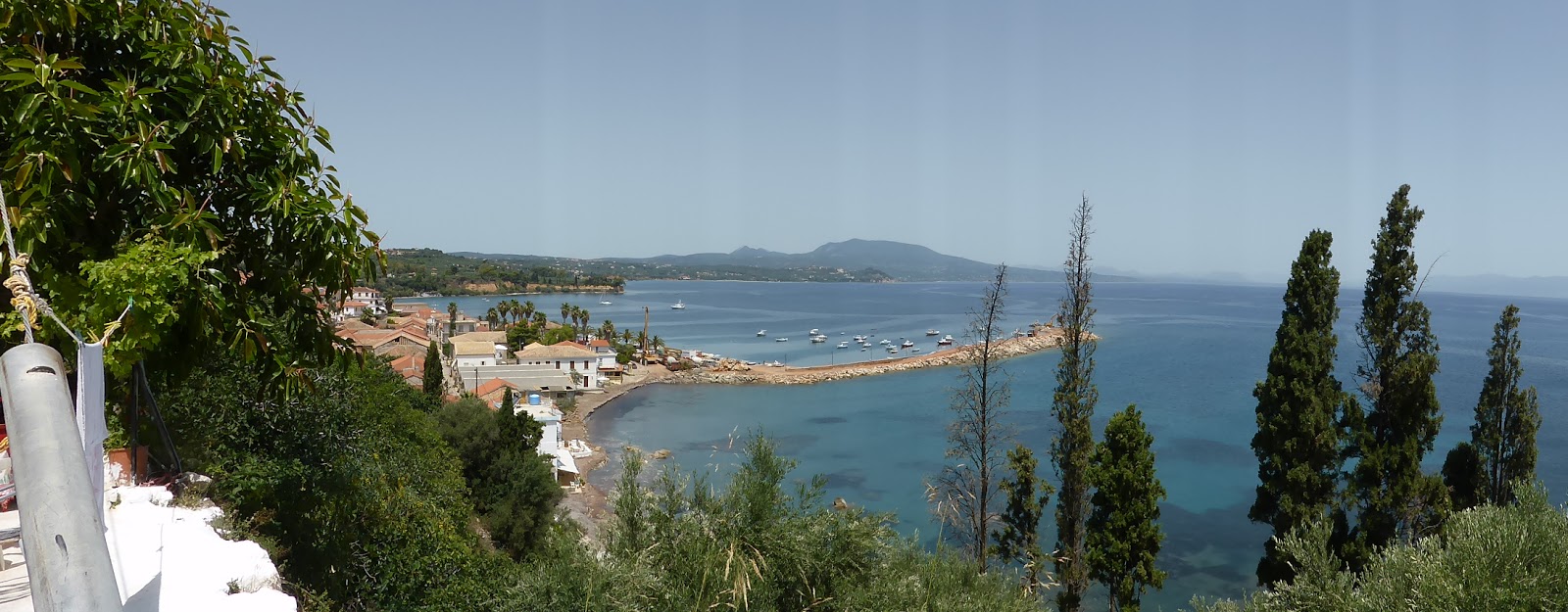
View of Koroni anchorage

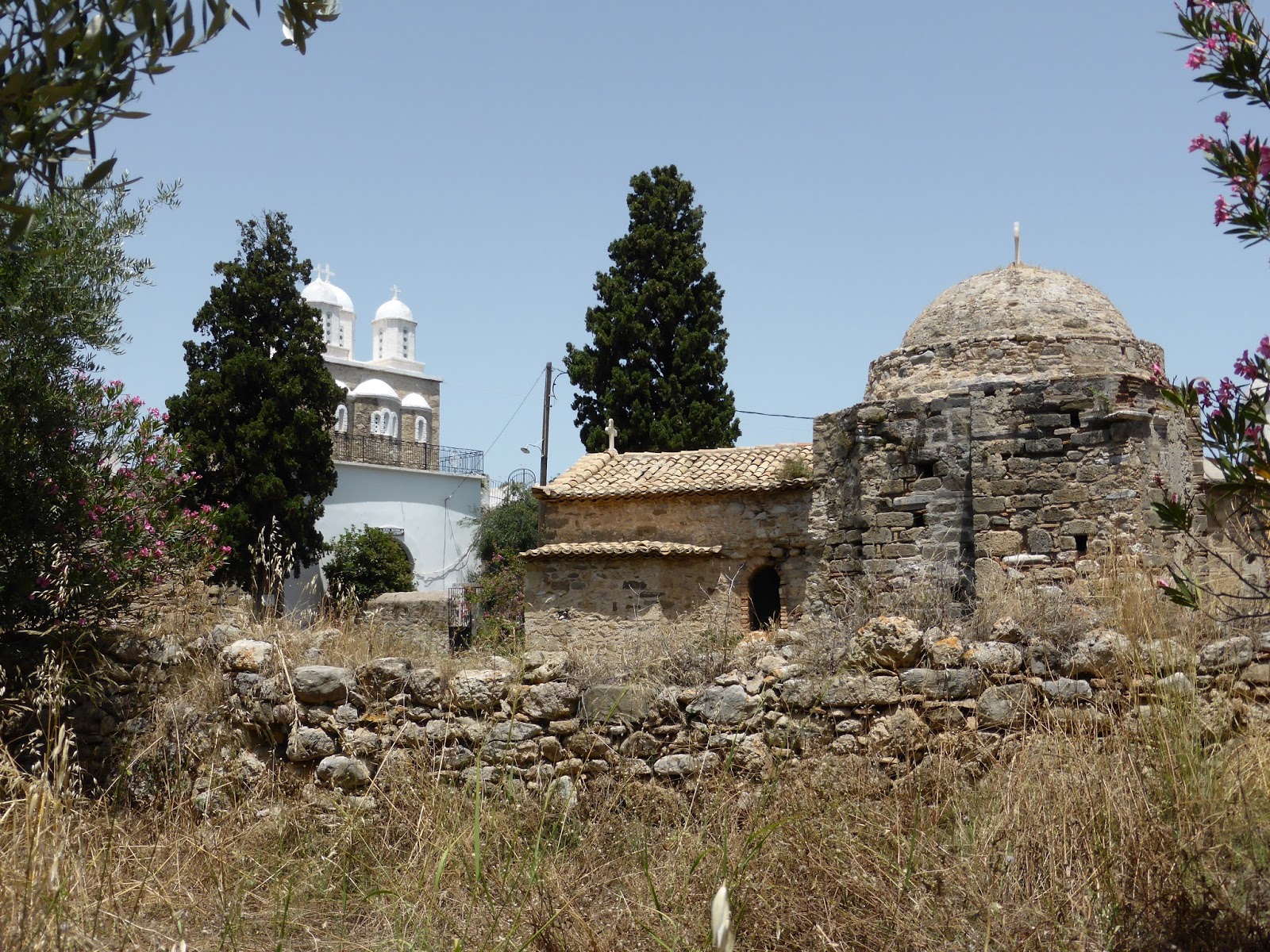
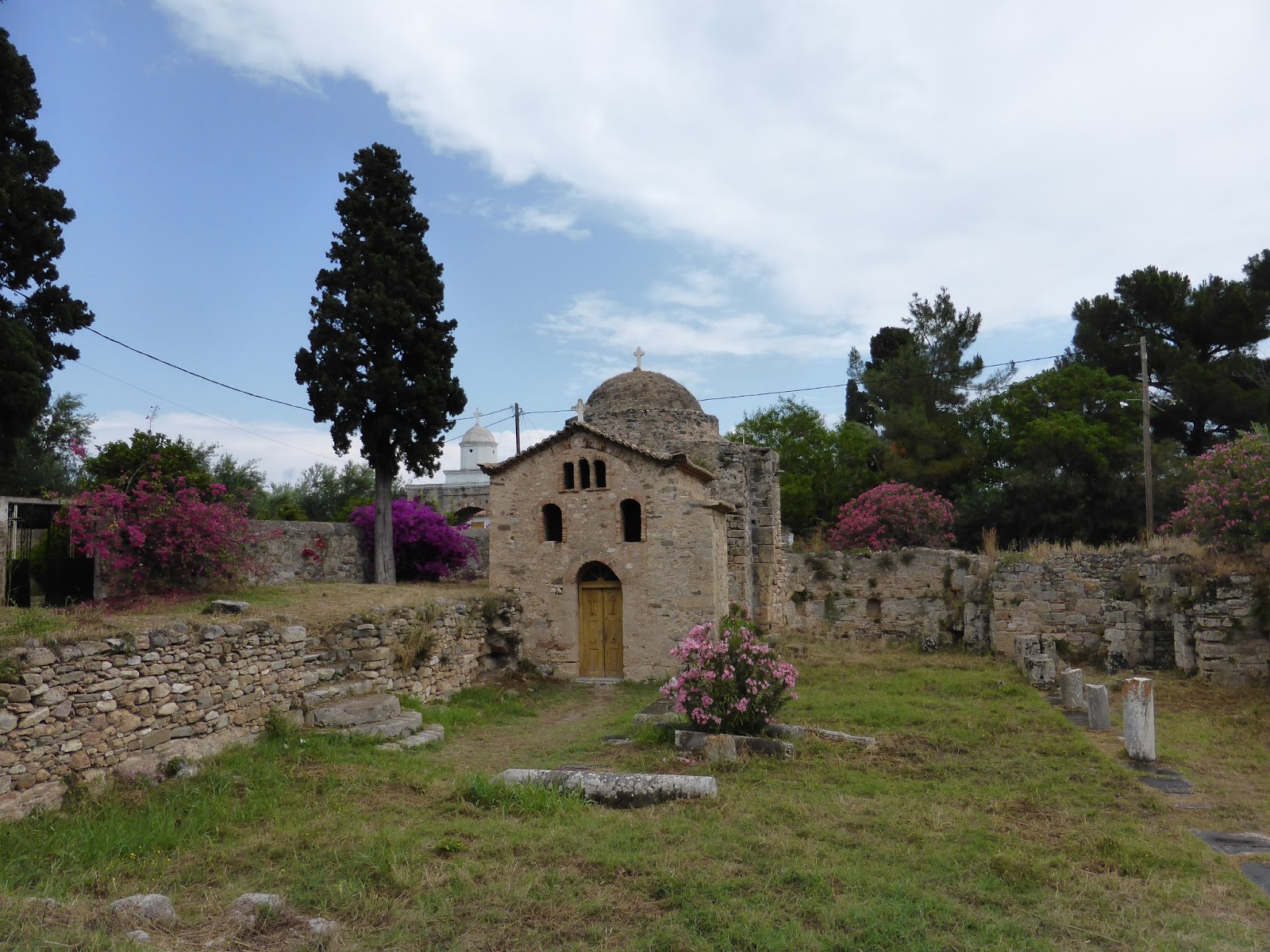
We enjoy exploring some still operational churches and a monastery in the castle grounds, and one of the small churches is built on the site of an ancient temple where we can see the foundations and remnants of marble pillars.

Old church and monastery

Chapel with ancient temple pillars

Inside the chapel

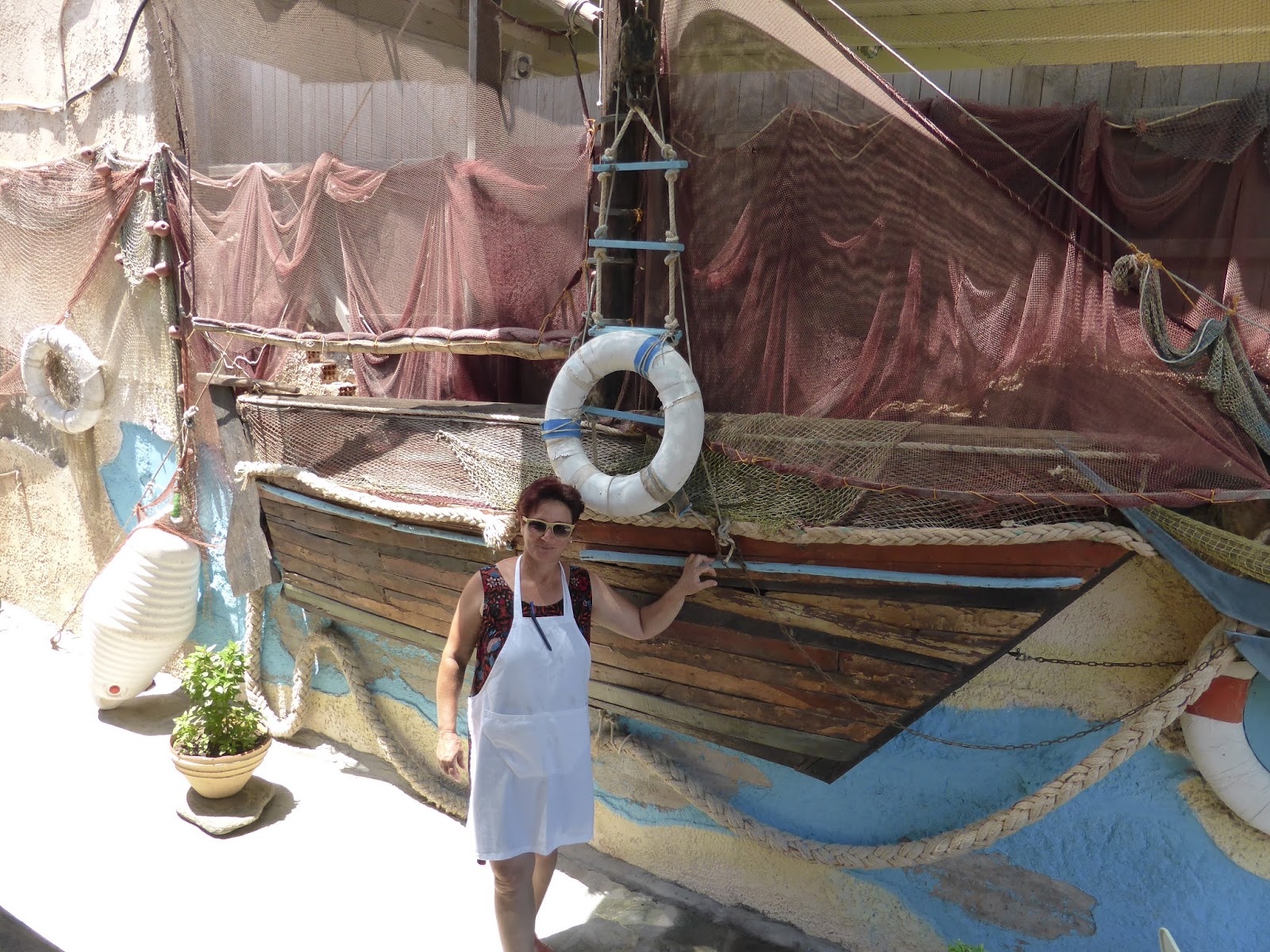
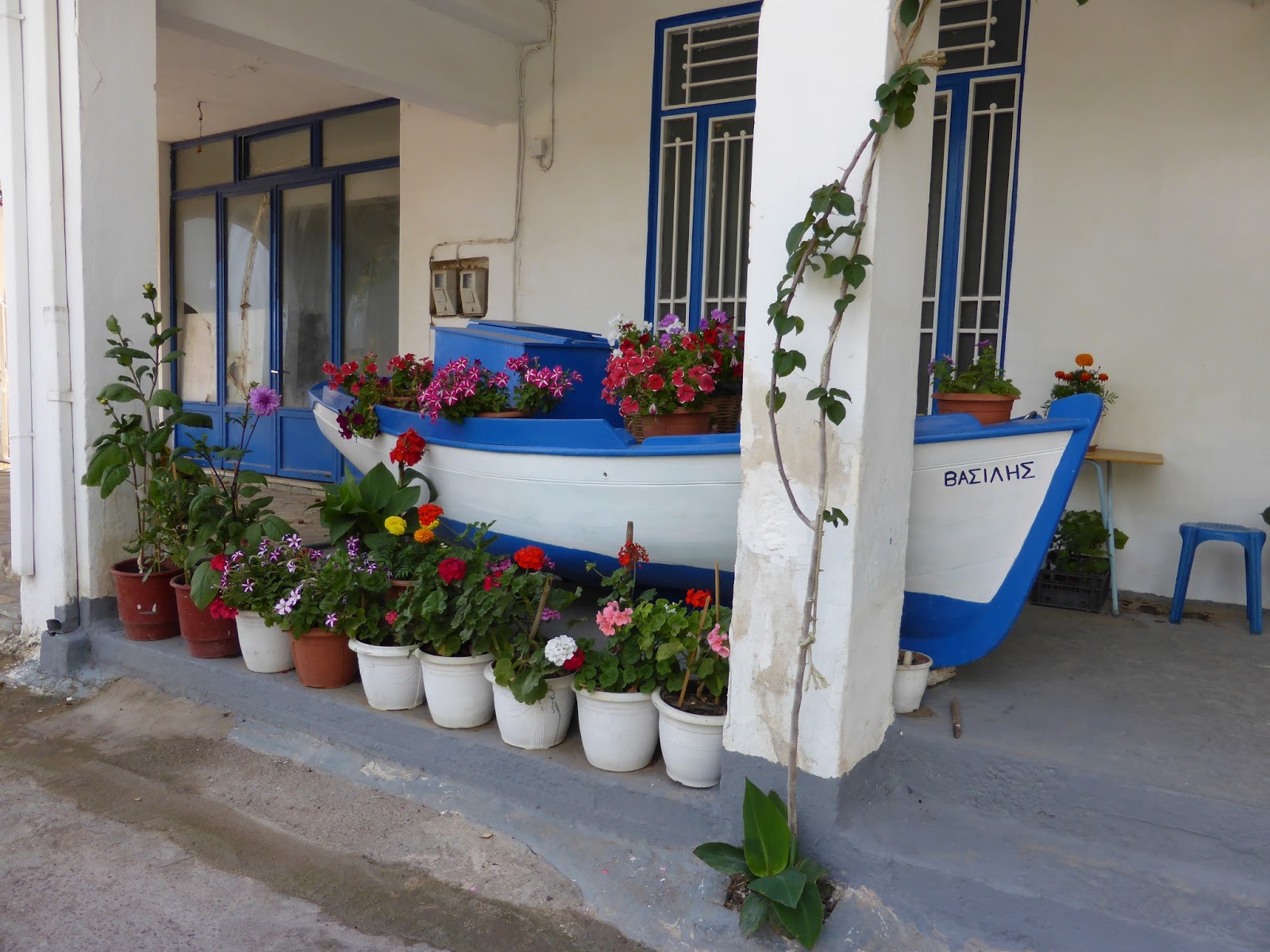
An excellent use for an old boat

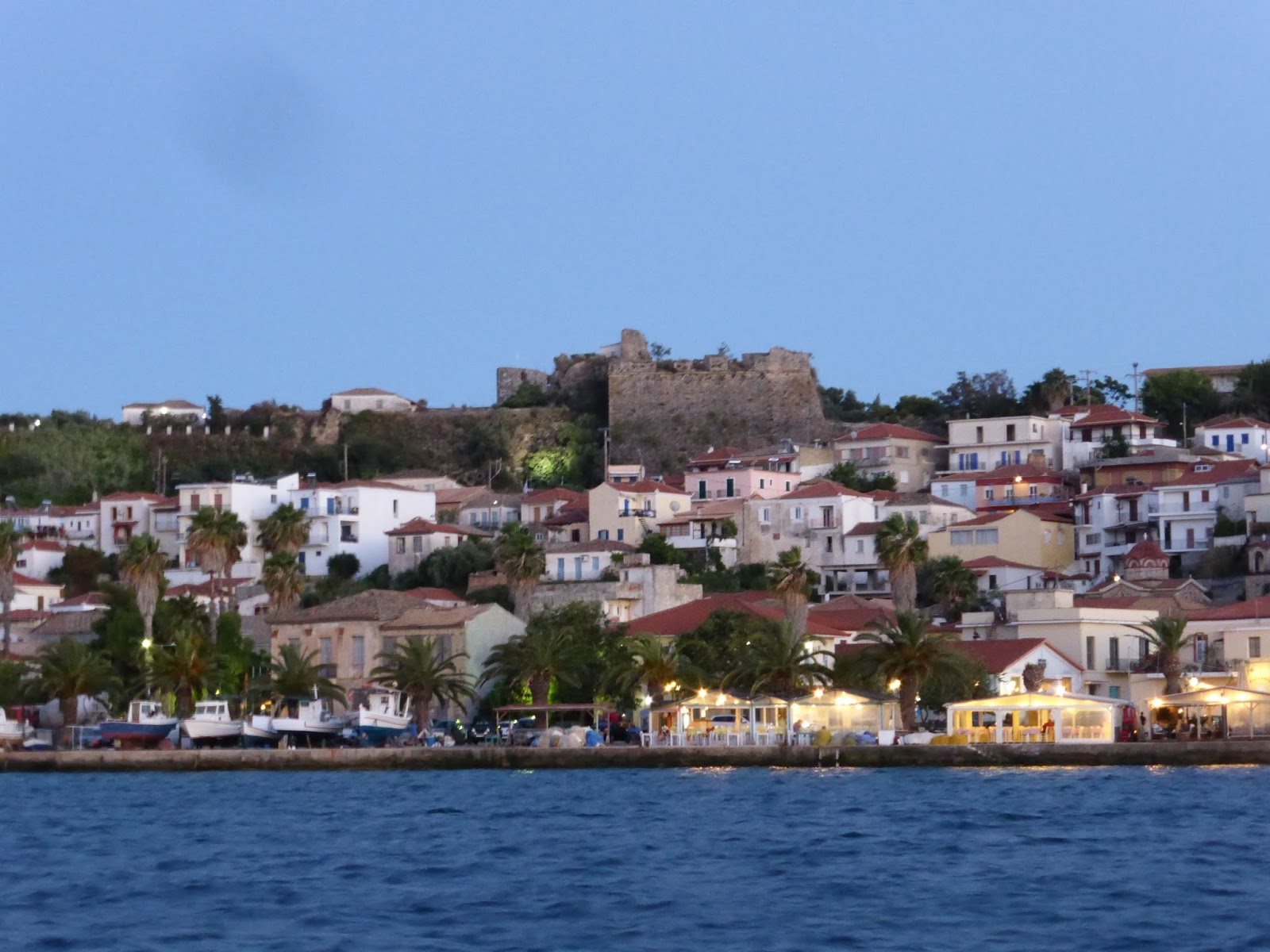
Castle at night viewed from Envoy at anchor

This “Quality House Construction” sign took our fancy

We spend one night anchored off the small village of Petalidhion and going ashore for dinner notice ominous black clouds looming before dusk. Later we just get back to the boat before a 20 knot squall and heavy rain descends on us. This is no problem for Envoy but would have made a tough trip for the three of us in our smaller RHIB.

Rain clouds loom in Petalidhion

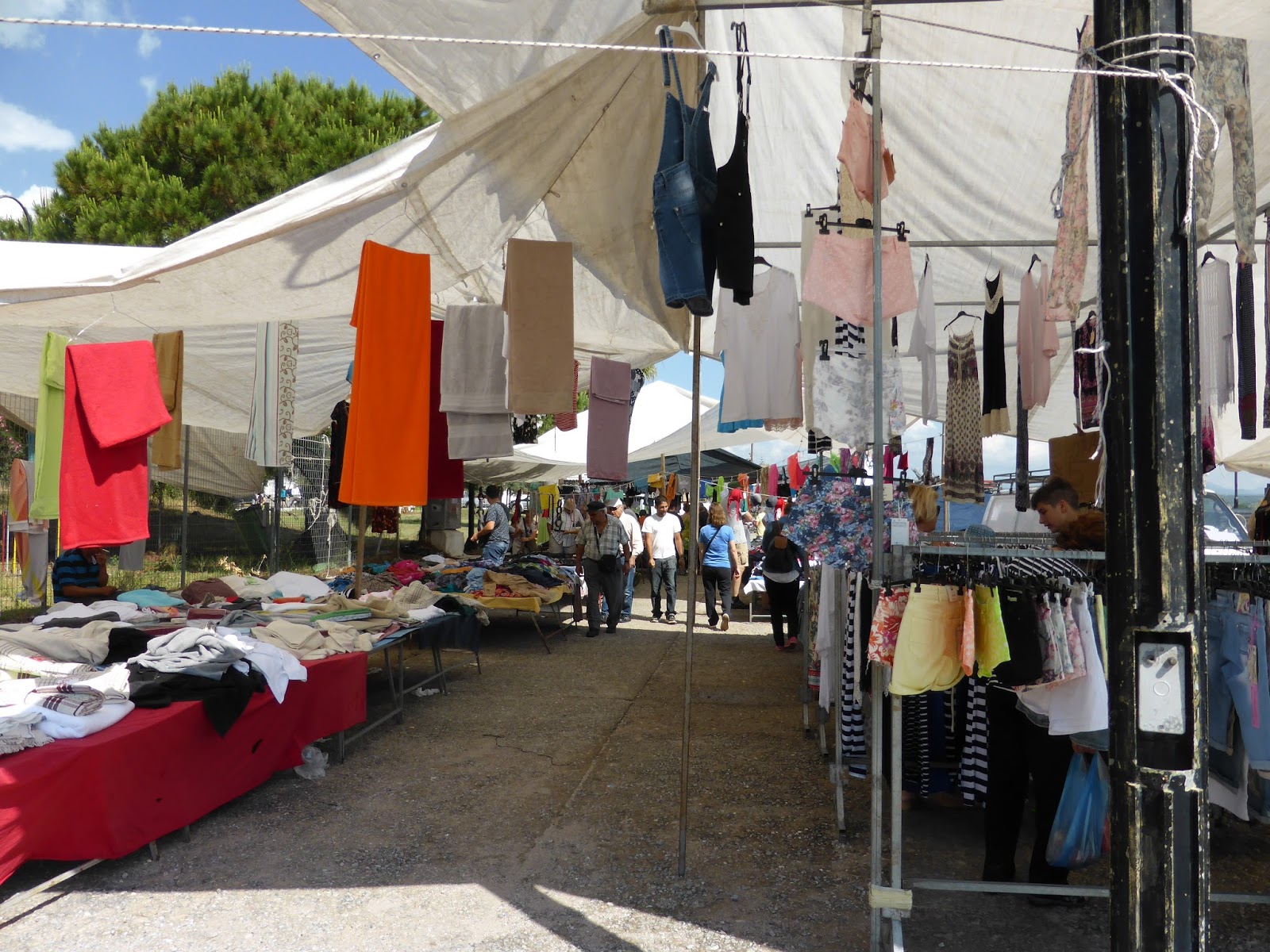
Market day in Petalidhion

Chickens destined for the table in the market

From here it’s a short cruise to the marina at Kalamata, a large town where 50,000 Greeks live and work, with little tourism and which of course is famous for olives. The town centre is about 20 minutes walk from the marina through a park containing a museum of old trains. Kalamata has a hilltop castle too but little remains of it and it’s not worth a visit.

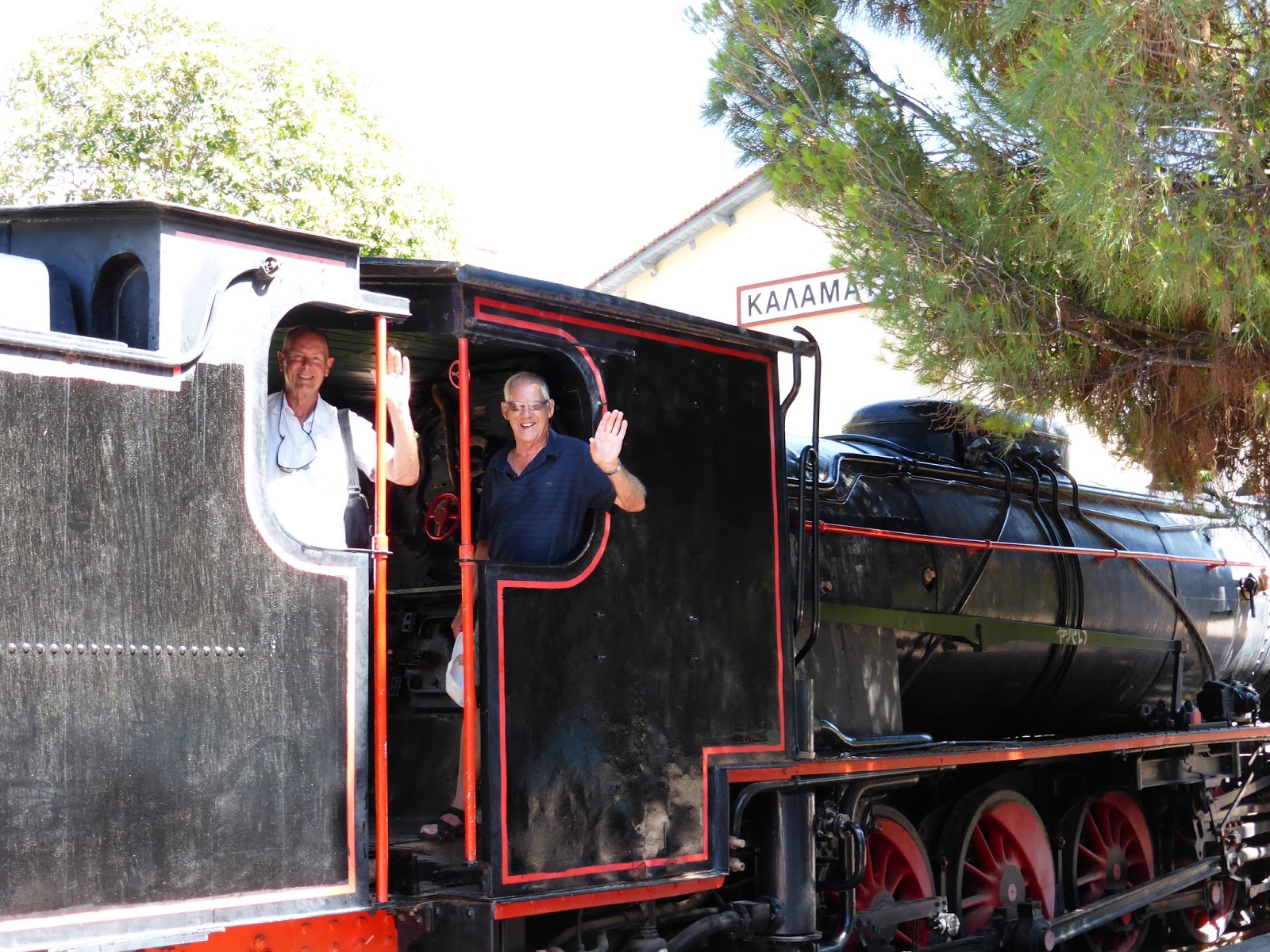
Laurie and Chris play engine drivers

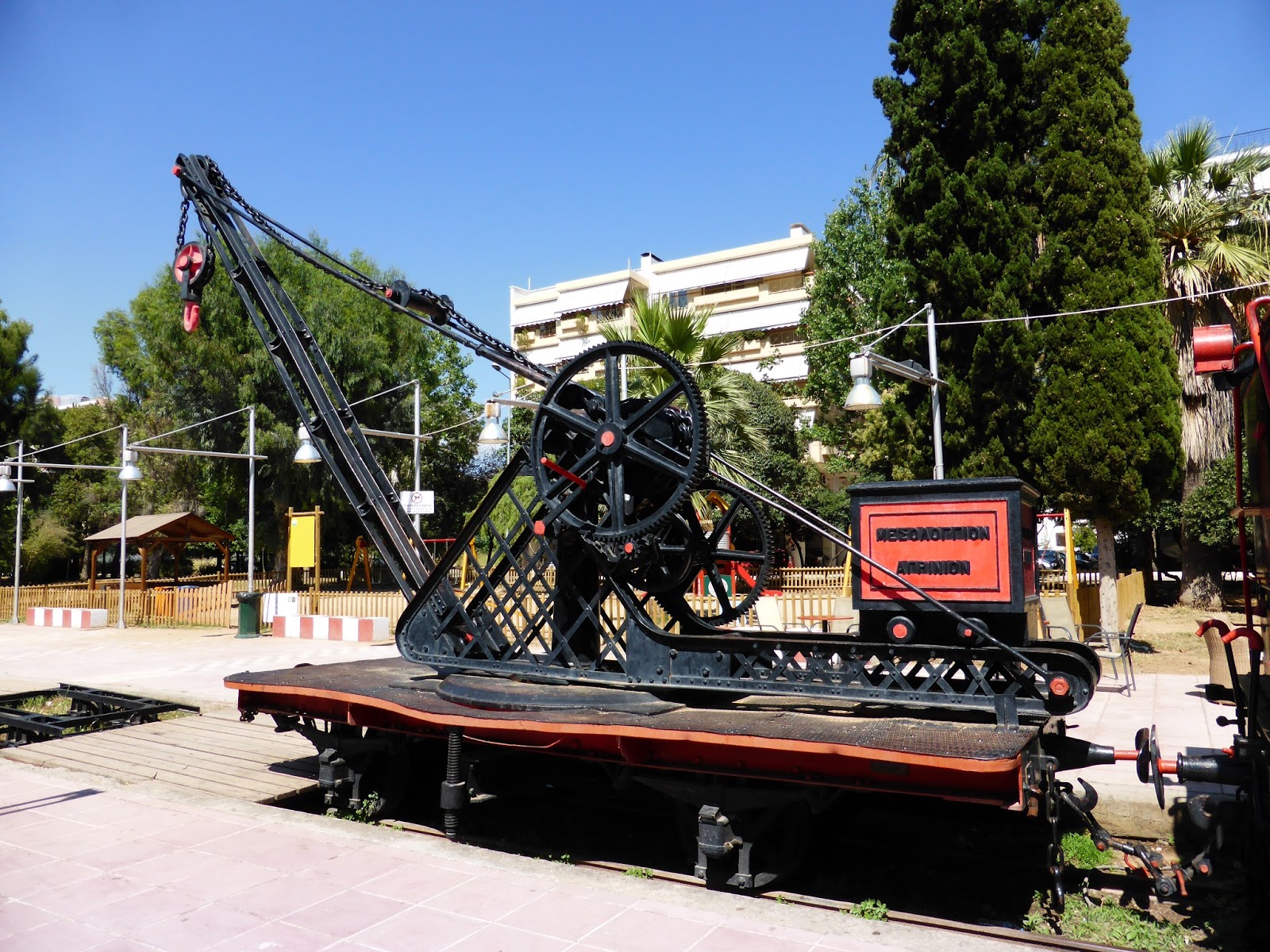
An old hand-operated rail crane

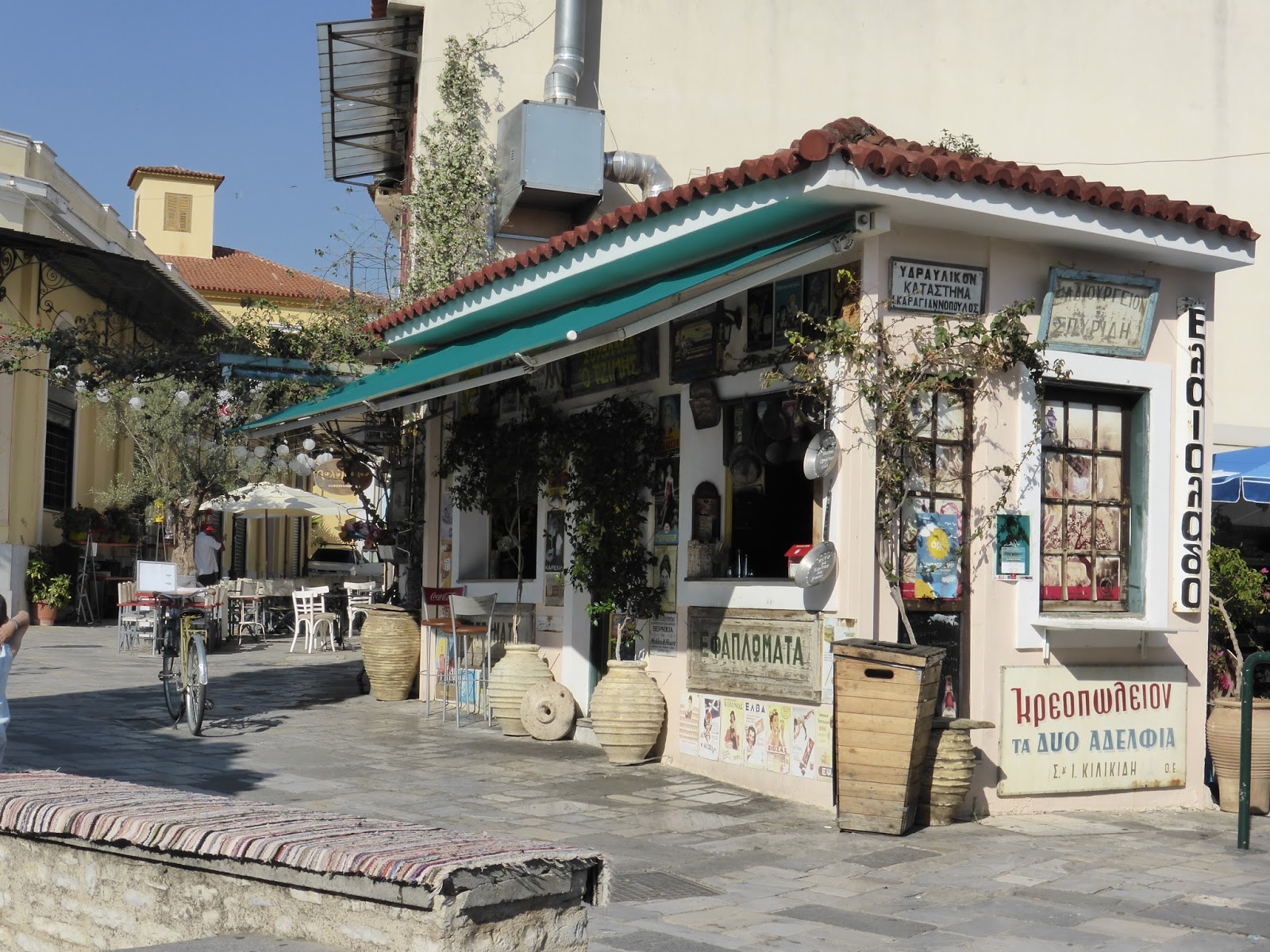
This rustic taverna caught our eye

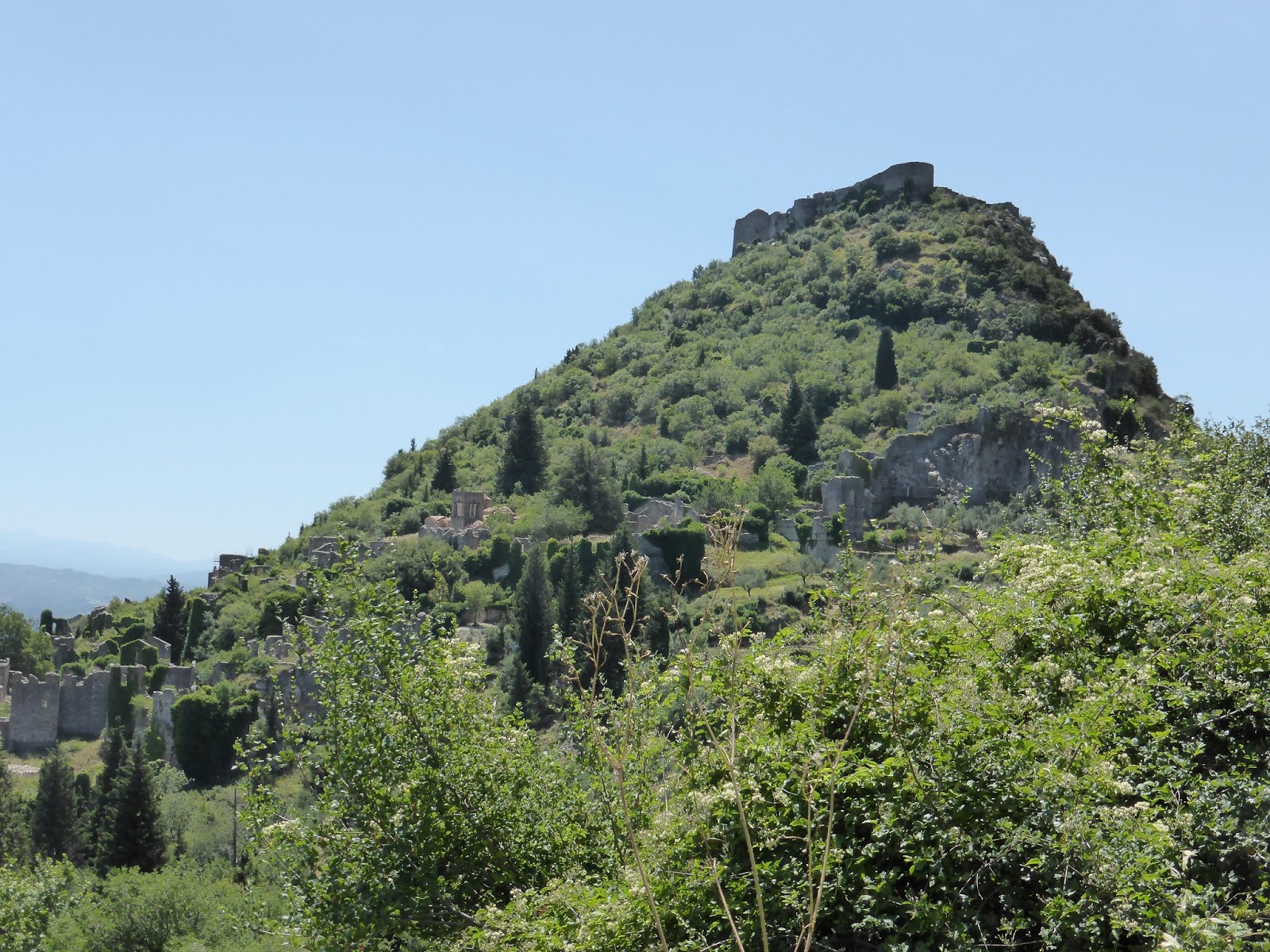
Here we rent a car and visit the World Heritage fortress of Mystras, near the town of Sparta, named after the legendary, militaristic Spartans who dominated this entire region from around 850BC, although little remains to be seen from their time.
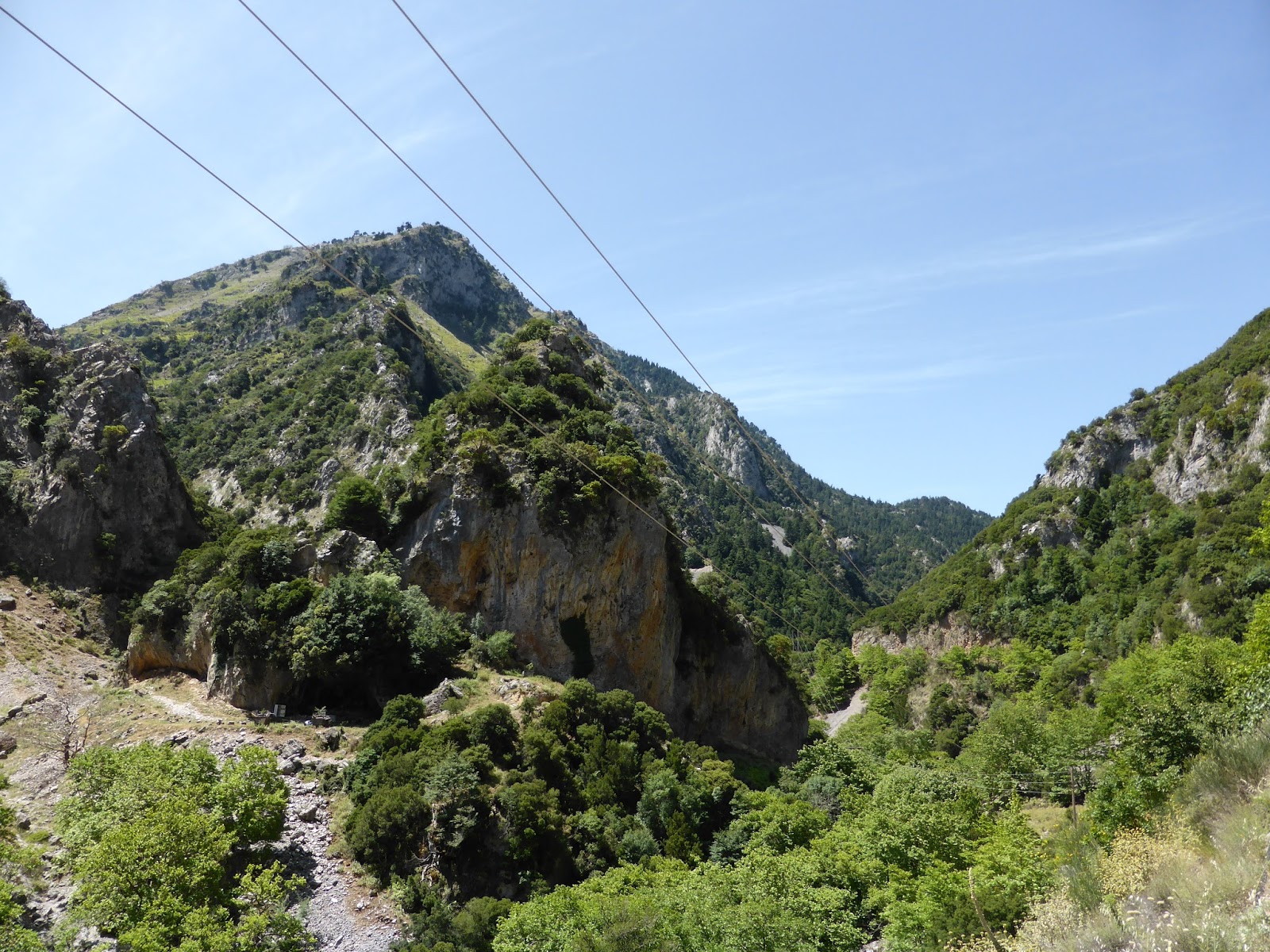
We pass through the spectacular rugged Langada gorge, about 50km long, climbing to 1,524m, where the Spartans are reputed to have left any children too weak or unfit for military service to die.

The Langada gorge is extremely rugged with many caves

The Mystras fortress was built much later in 1249 by the Frankish Principate of the area, William 11, although the Byzantines took it over soon afterwards and ownership passed back and forth between them and the Turks. The castle looks impregnable, built upon the steep, craggy, natural fortress hilltop of Myzithra and in times of attacks the villagers living outside the castle and farmers tending the fertile valley would move inside.
We visit many castles like this and on hot days its exhausting enough walking up to them in shorts and t-shirts as we wonder how did soldiers walk the same steep paths laden with weapons and armour and avoiding spears, arrows, stones and hot oil poured down on them by the defenders.
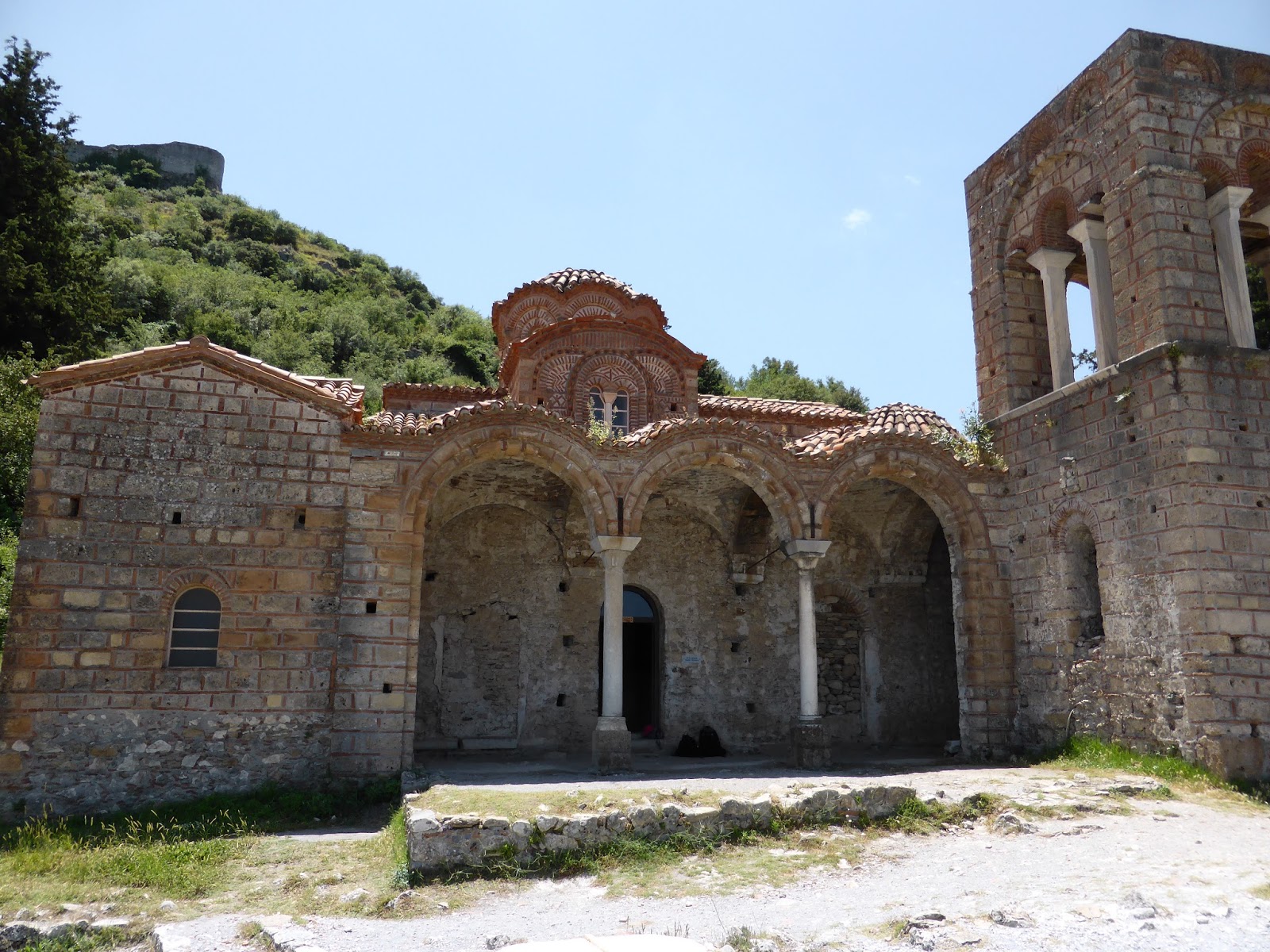
Like Koroni the site has churches dating from the 13th or 14th centuries still in use.

Mystras fortress

The fertile valley that supported the populous with produce

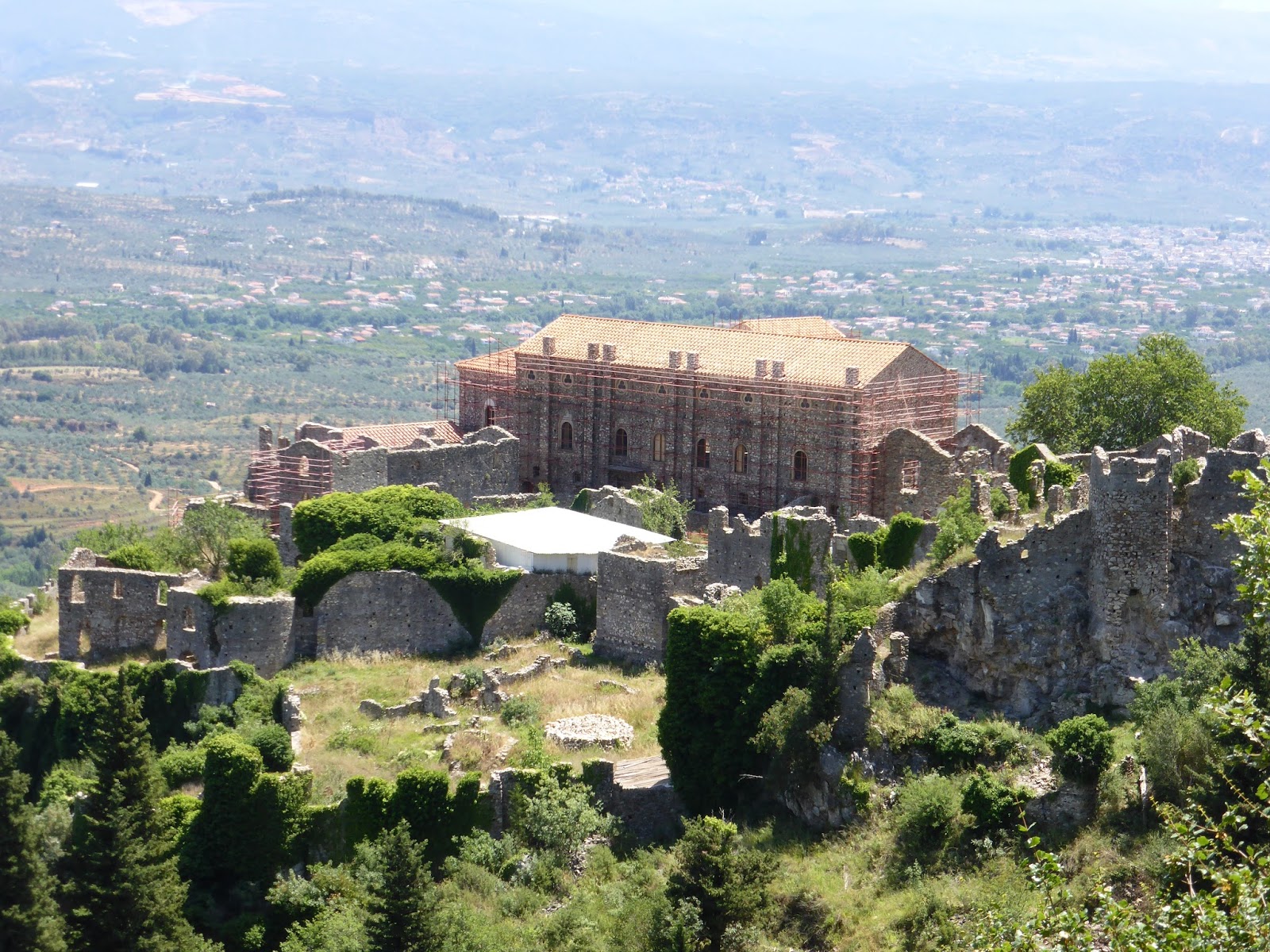
The Despot’s palace currently being restored

This 14th century church is still in use

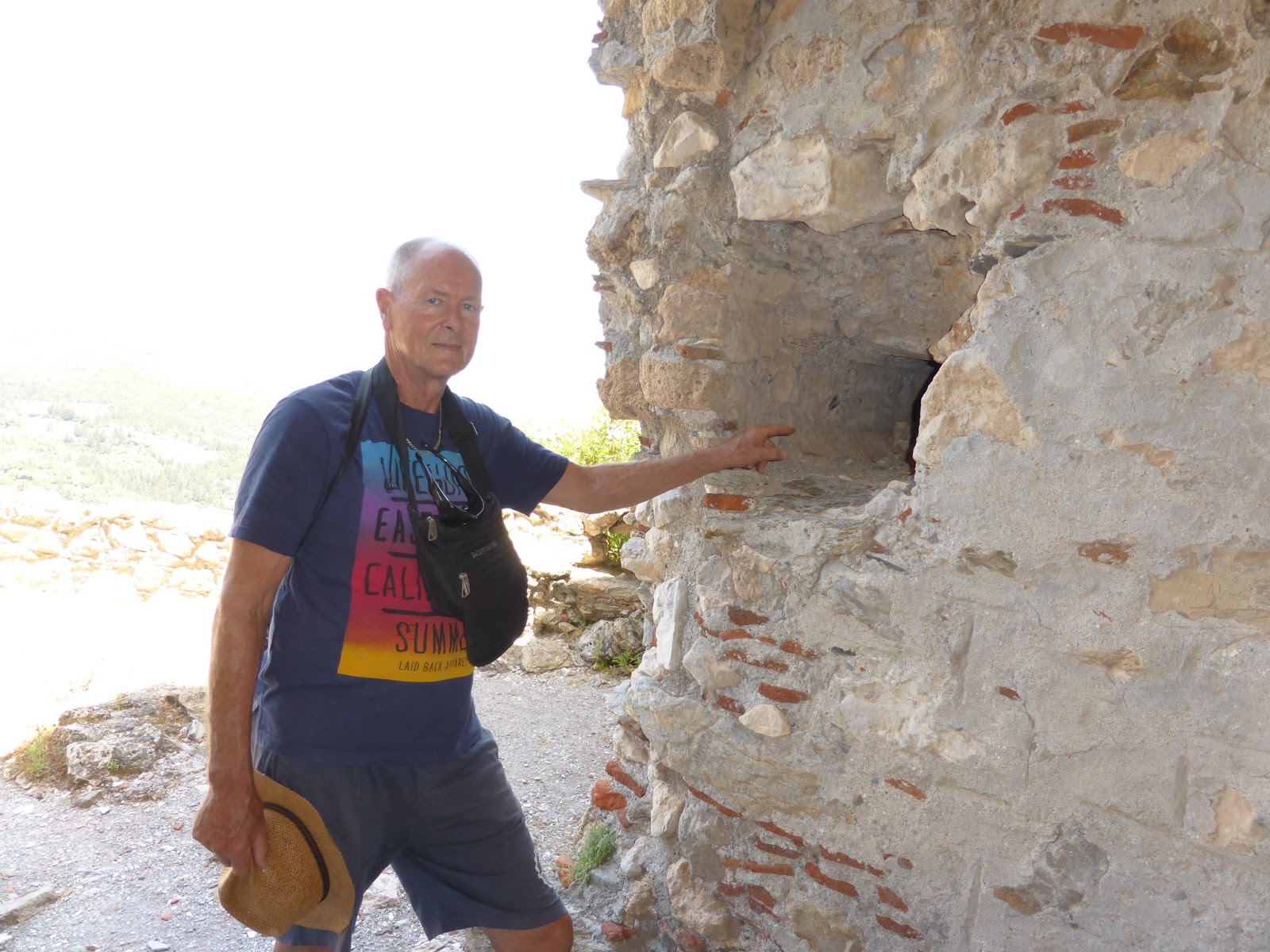
Laurie points out a recess used for heavy wooden beams to secure the main gate against attackers

As Envoy only uses about 8 litres of diesel per hour we don’t refuel often but Kalamata Marina was a convenient spot to do so as a tanker comes right up to the boat, so we take on 400 litres of diesel.

Here Chris departs for further travels leaving us grateful for his excellent company and tremendous contribution to Envoy’s maintenance, only a small part of which has been detailed in the Blog.

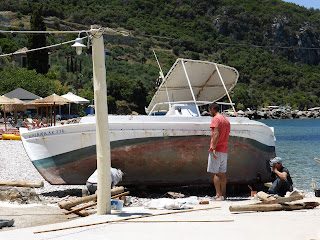
Fishermen repair the hull of their boat pulled up on rollers at Ormos Kitries
TECHNICAL
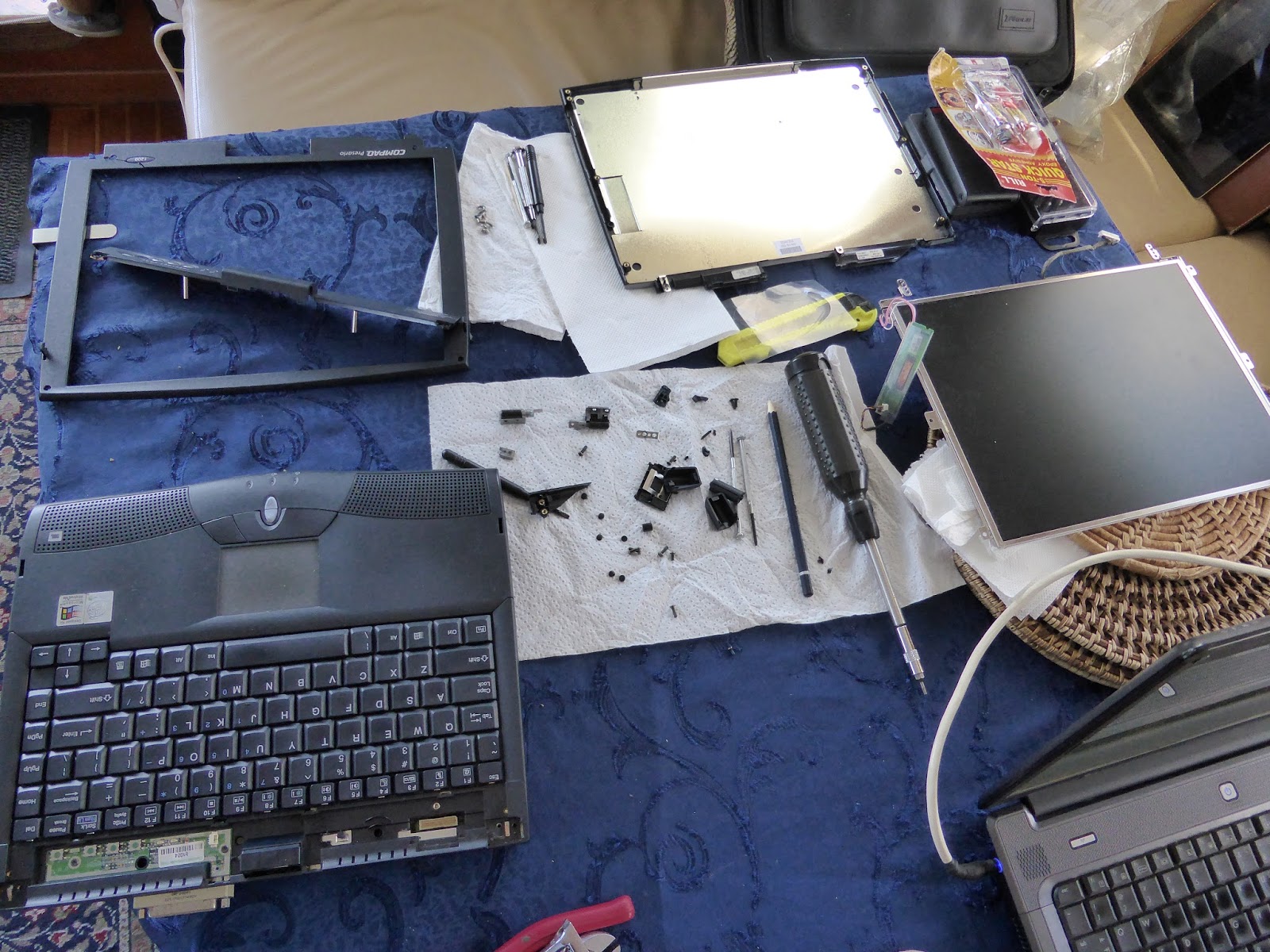
For navigation we use a Toshiba laptop loaded with MaxSea C-Map, receiving a position signal from a Raymarine GPS. In case of a problem with the Toshiba we have a spare Compaq laptop, but this has not been working properly. On screen is an icon in the shape of a boat representing your position and pointing in the direction of travel. On the Compaq the icon was pointing to the north rather than the direction of travel and our course over ground (COG) and speed over ground (SOG) wasn’t being displayed. So Chris takes a look at this.
On pulling the spare computer from storage we find another more physical problem – it must have somehow got crushed by something heavy in storage, the hinges were damaged and the screen won’t open. So first Chris spends several hours pulling the case to pieces to remove the hinges. I confess there were so many pieces of the computer on the table I wondered if it would ever be in one piece again, but Chris’s patience and expertise together with Supa-Glue and epoxy prevails and he rebuilds the case. After a couple of attempts to resolve the icon issue Chris changes a setting to resolve it, so it’s now comforting to have a spare navigation computer that works properly.

Our dismantled Compaq laptop spread over the saloon table

One of our two engine room ventilation blowers had failed and while in Kalamata we remove it and Chris dismantles the motor and determines that one of the motor brushes was badly worn. Kalamata’s only chandler doesn’t have a replacement so I ask them to use their local knowledge to find an electrical shop to replace the faulty brush. “Oh no my friend you can’t repair these” is the answer (in Greece and Turkey conversations often start with the opening remark ‘my friend’). I say very politely something like, “my friend let me tell you that virtually every town of this size in the world has electrical repair shops that can replace brushes on electric motors, all we need to do is find one. Please help me by finding someone who services auto starter motors and alternators.”
A few days later the unit has been repaired for 30 Euros (about NZ$50) and the chandler is delighted he now has someone to use for marine electrical repair.

AT THE PELOPONNISOS

Envoy is anchored at Avelomona on the SE coast of Kithera Island.

Leaving the remote and inhospitable Nisidos Strofadhes Islands we cruise west to the mainland region of southern Greece known as the Peloponnisos. Now there’s a spelling challenge!
We cruised this area in 2012 but are happy to return to favorite spots and spend time at other places we missed.
The Peloponnisos is the southernmost mainland area of Greece. Strictly speaking it’s not an island, but separated from the rest of Greece by the Corinth Canal with its eastern side on the Aegean Sea and its western side on the Ionian. This area is quite sizable being roughly 350 miles from NE to NW and contains many historic sites including the famous areas of Sparta and Olympia.
On the southern side are three peninsulas, each about 24 miles long, forming two large gulfs. The tips of these peninsulas are known as the “Cape Horns of the Med”, due to strong winds and rough seas often encountered here but so far we’ve had only had moderate winds and slight seas. The strong winds are very often katabatic, descending from the mountains that rise to 2,400 metres.

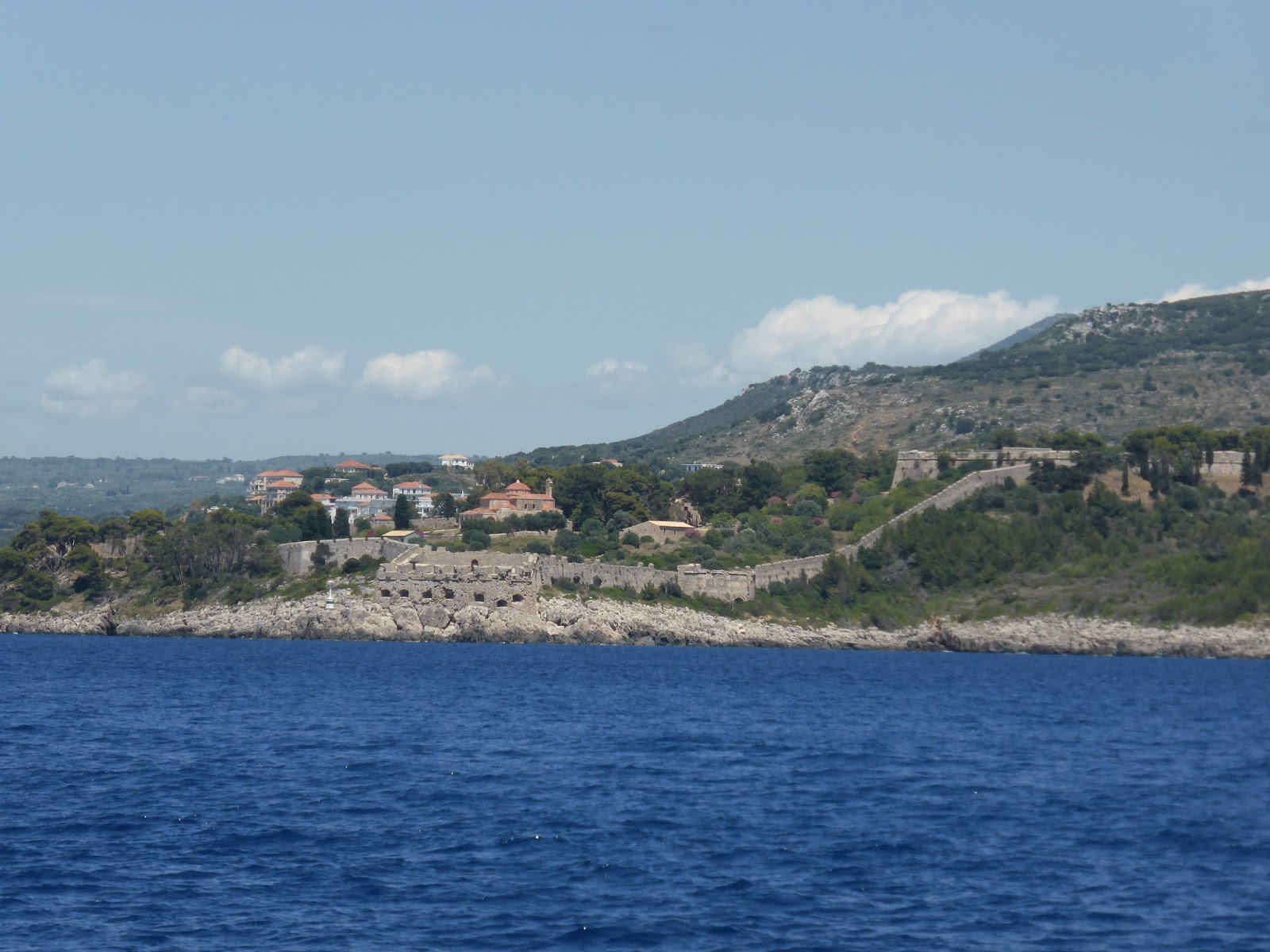
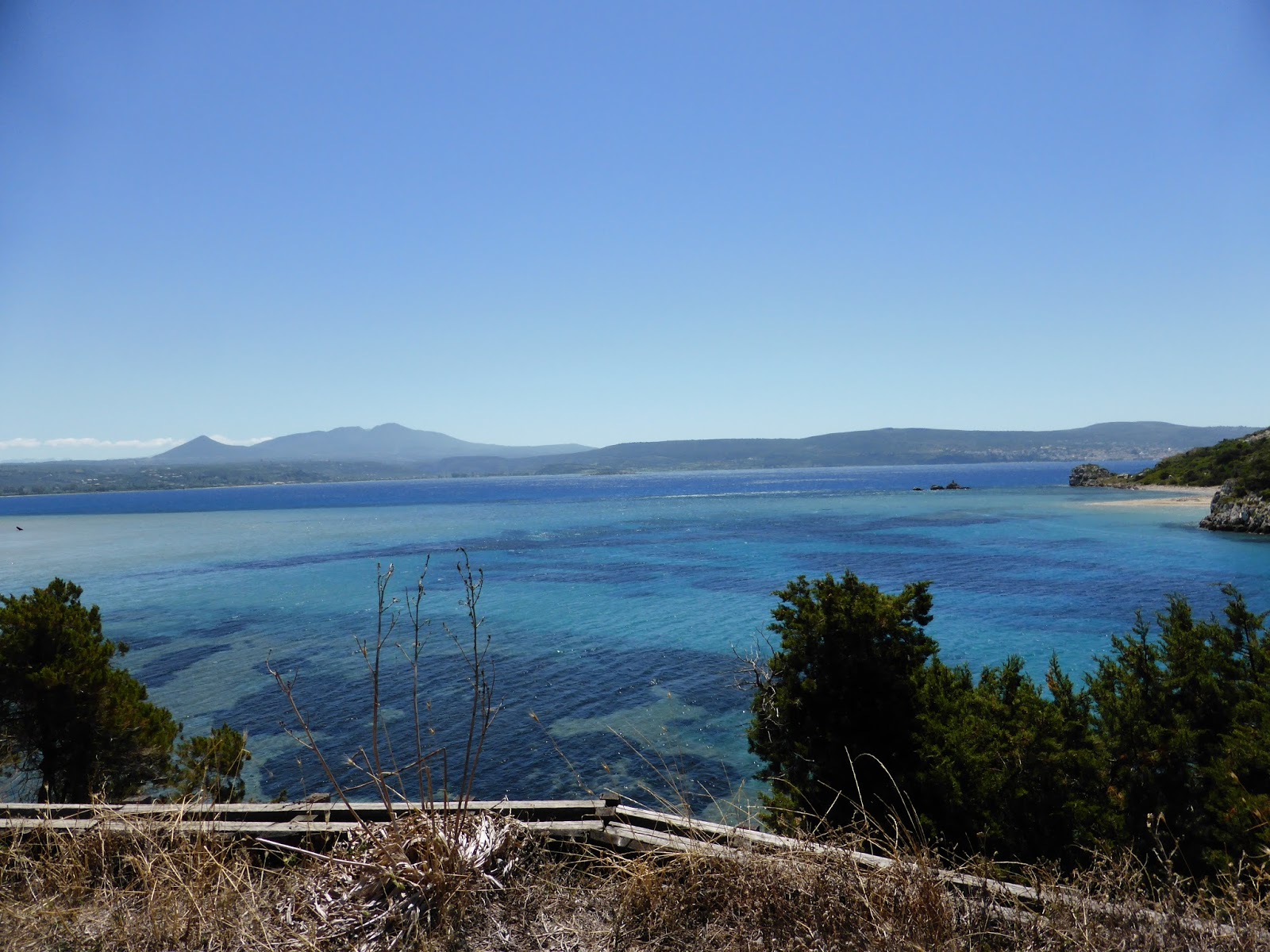
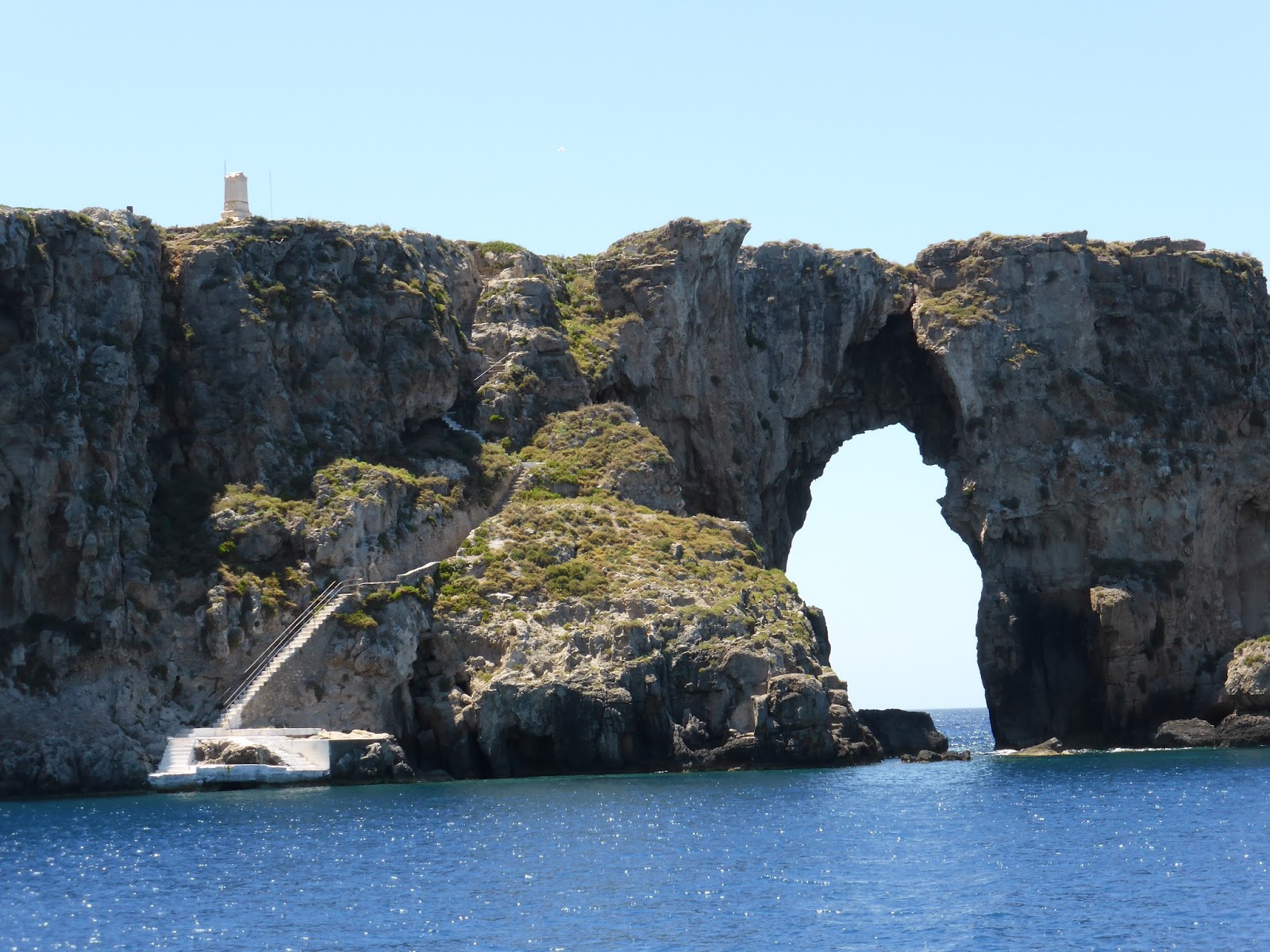
We anchor in Ormos Navarinou, a sheltered natural harbour some 5km long and 3km wide with castles at both north and south ends and where in 1827 a famous battle took place between combined fleets of 26 British, French and Russian ships against 78 Turkish, Egyptian, Tunisian and Algerian ships. The Turkish-led fleet was decimated with all but eight ships sunk and a loss of about 3,000 lives while only 181 Allied lives were lost and no ships were sunk. This was the last battle fought entirely by sailing ships and the beginning of the end of the Turkish domination of Greece.

Castle at southern end of bay

The whole bay looking south

Memorial to battle atop spectacular cliffs with archway

We spend a great morning walking up to and exploring the spectacular ruins of the Palaiokastro Castle overlooking the anchorage. This is just one of a string of castles along this once strategic coastline.

Chris and Laurie ready for exploration with Envoy in background

In ancient times galleys were rowed in these areas and would usually be beached at night or anchored in very shallow water.
Castle at northern side of bay

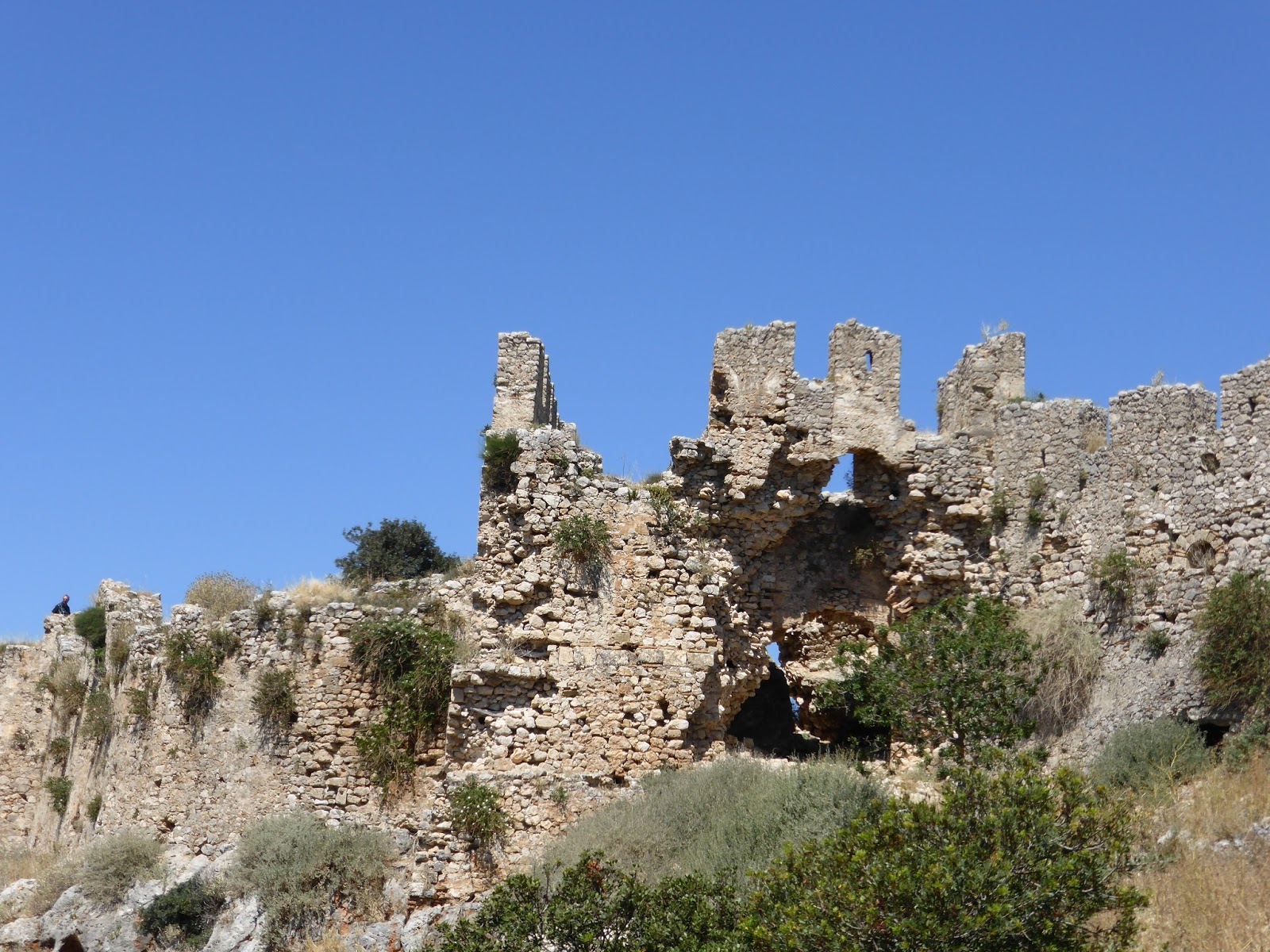
Signs warn of falling masonry from the fragile ruins

We look down on an ideal shallow water galley stopover area and try to imagine how the scene might have looked.
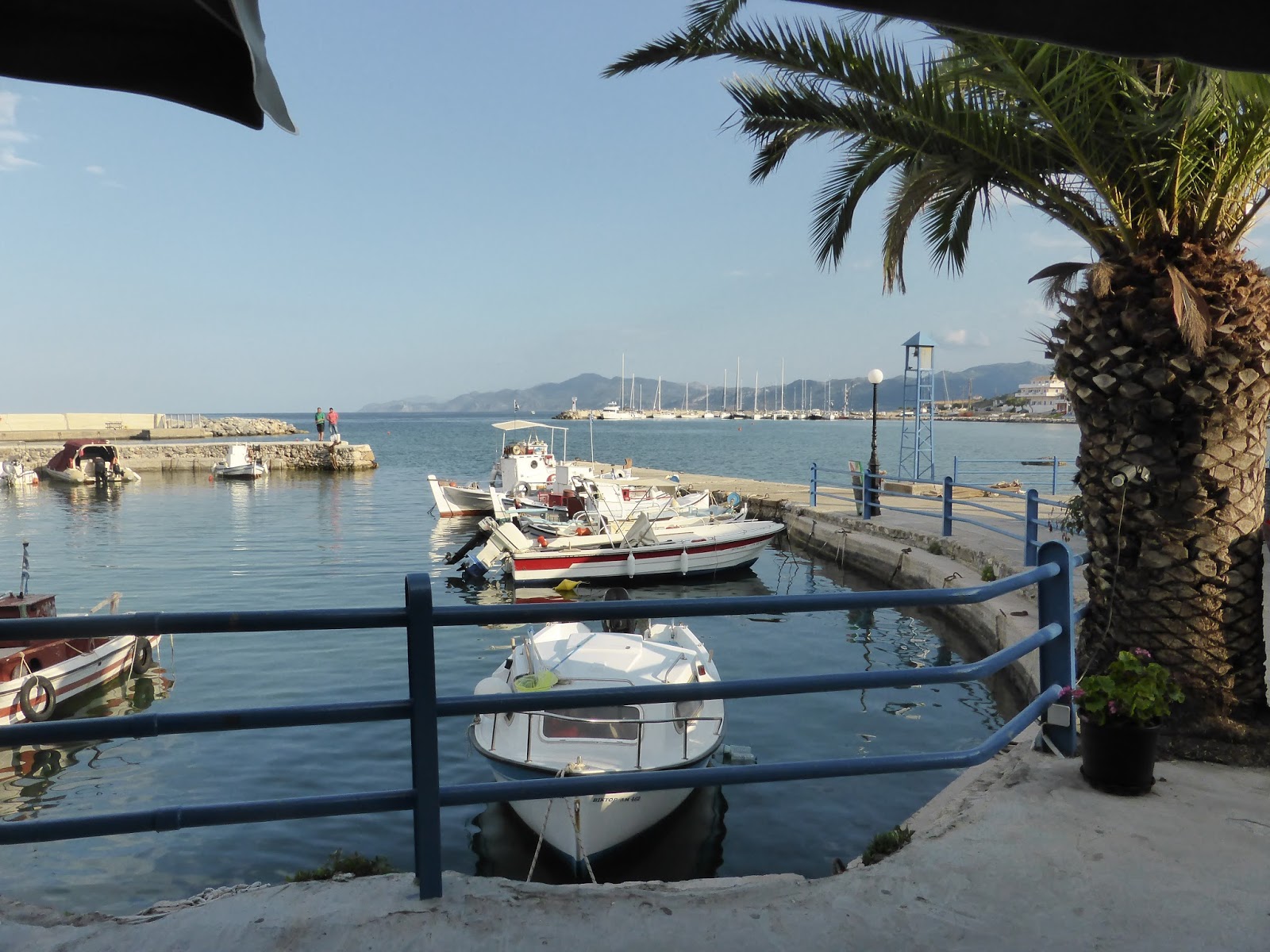
The only problem here was a huge invasion of mosquitoes after dusk and although we were protected by our insect screens there were hundreds of dead mosquitoes littering our deck the next morning. We won’t overnight here again.

Our next stop Methoni, has another spectacular castle, this time right down at sea level once protecting the strategic harbour. Although we’ve been here previously we enjoy showing Chris around and finding some new sights.
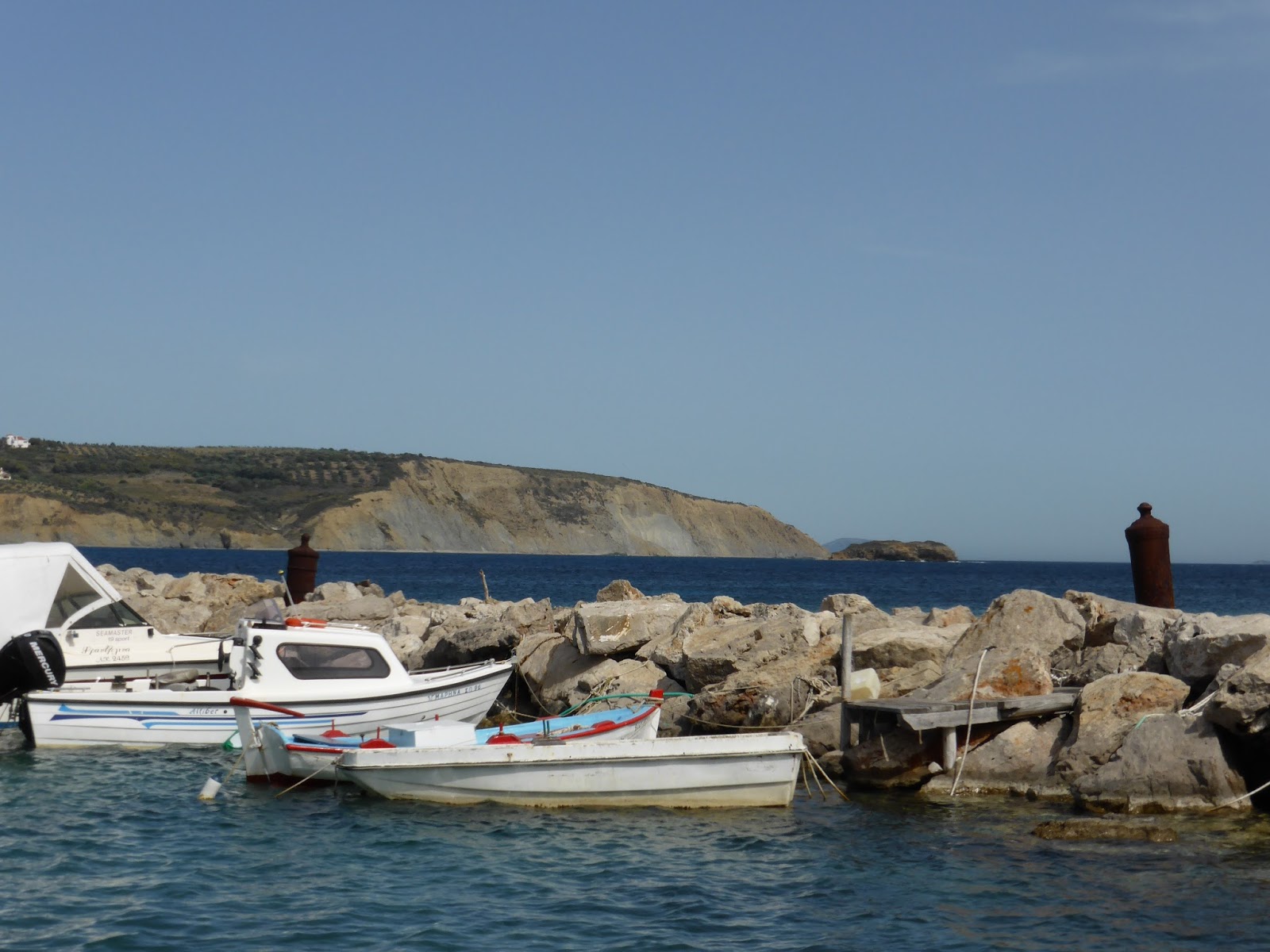
Chris and Laurie at entrance to Methoni Castle

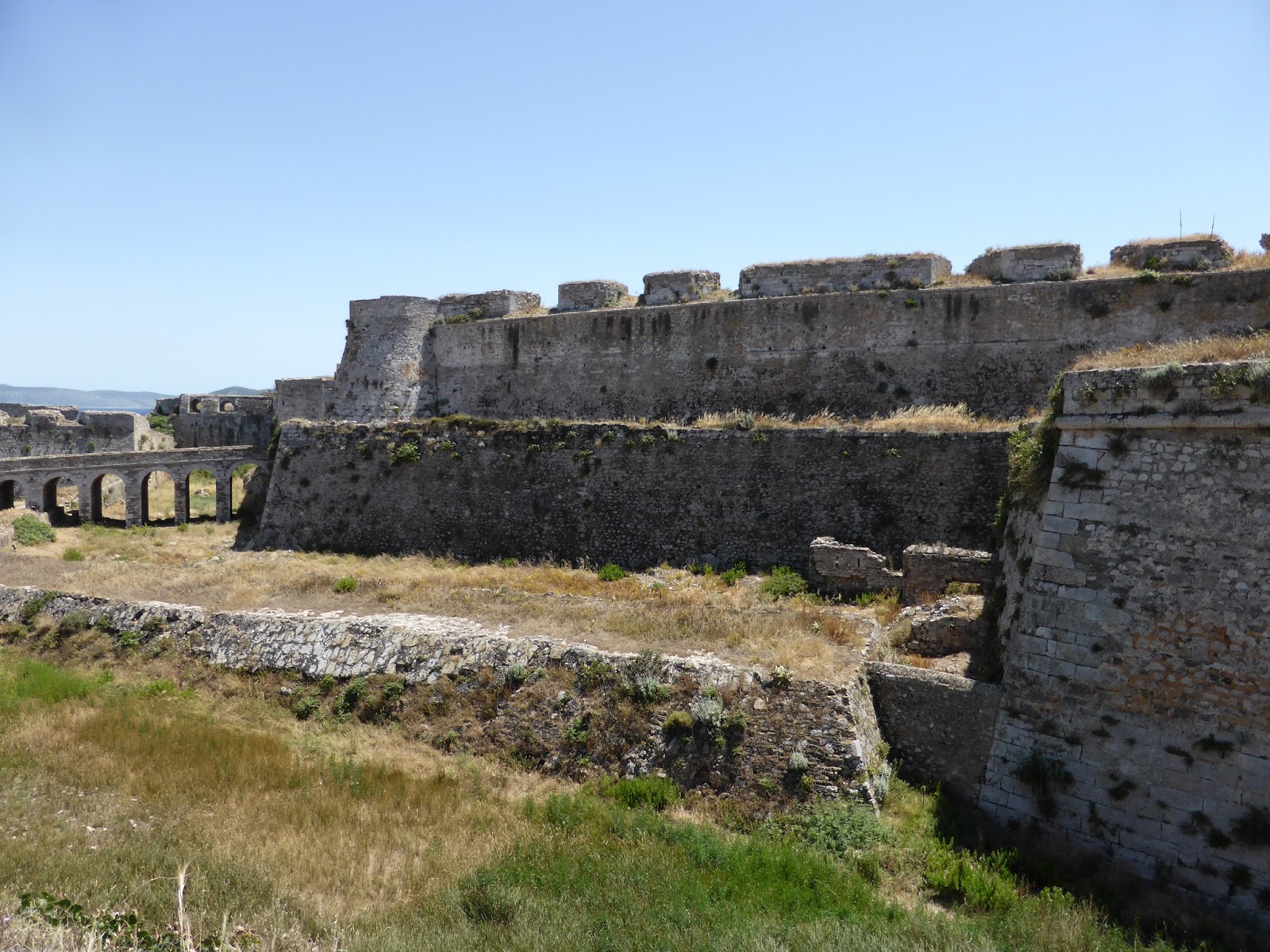
Solid impressive Methoni castle

Di and Chris on bridge over dried-up moat

This castle and the one at Monemvasia to the east (we’ll be there in about three weeks) were two of the most important Venetian towns and castles as they protected the trade route from the Ionean to the Aegean, and for that reason these towns were called “the eyes of the Republic”.

When the Turks conquered Methoni they added this Turkish-style tower to the fortifications

Envoy anchored among fishing boats in Methoni harbour

Cannons embedded in Methoni’s sea wall

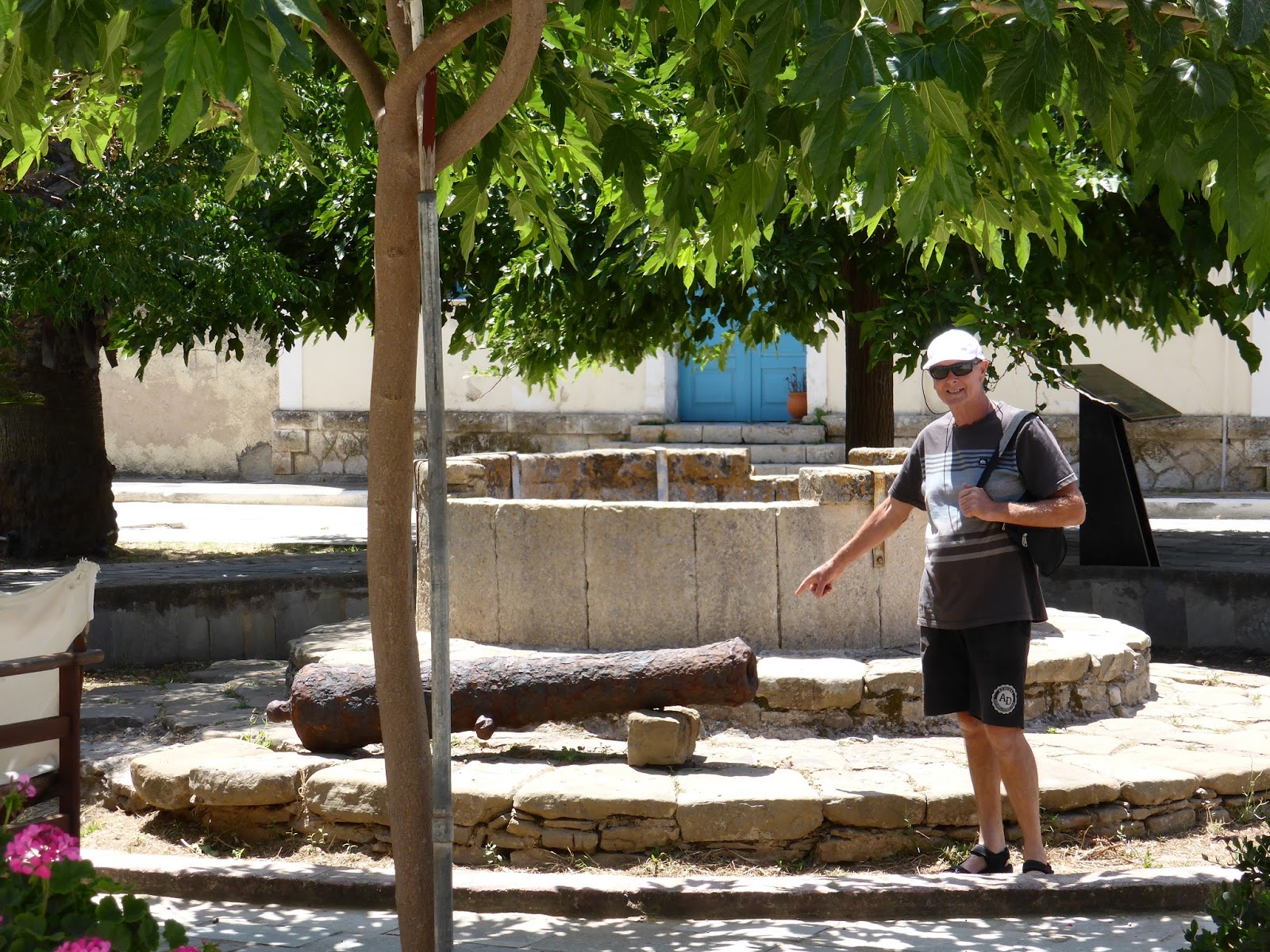
Rusting old cannon beside village well

TECHNICAL
Last cruising season we had problems with our washing machine, resulting in Corfu-based Miel servicemen replacing the water discharge pump. We thought and hoped that would be the end of our washing machine problems but this was not to be when one day it didn’t complete its cycle. Fortunately I had been involved in removing the machine from its difficult-to-access position last time and we still had Chris aboard to help resolve the problem.
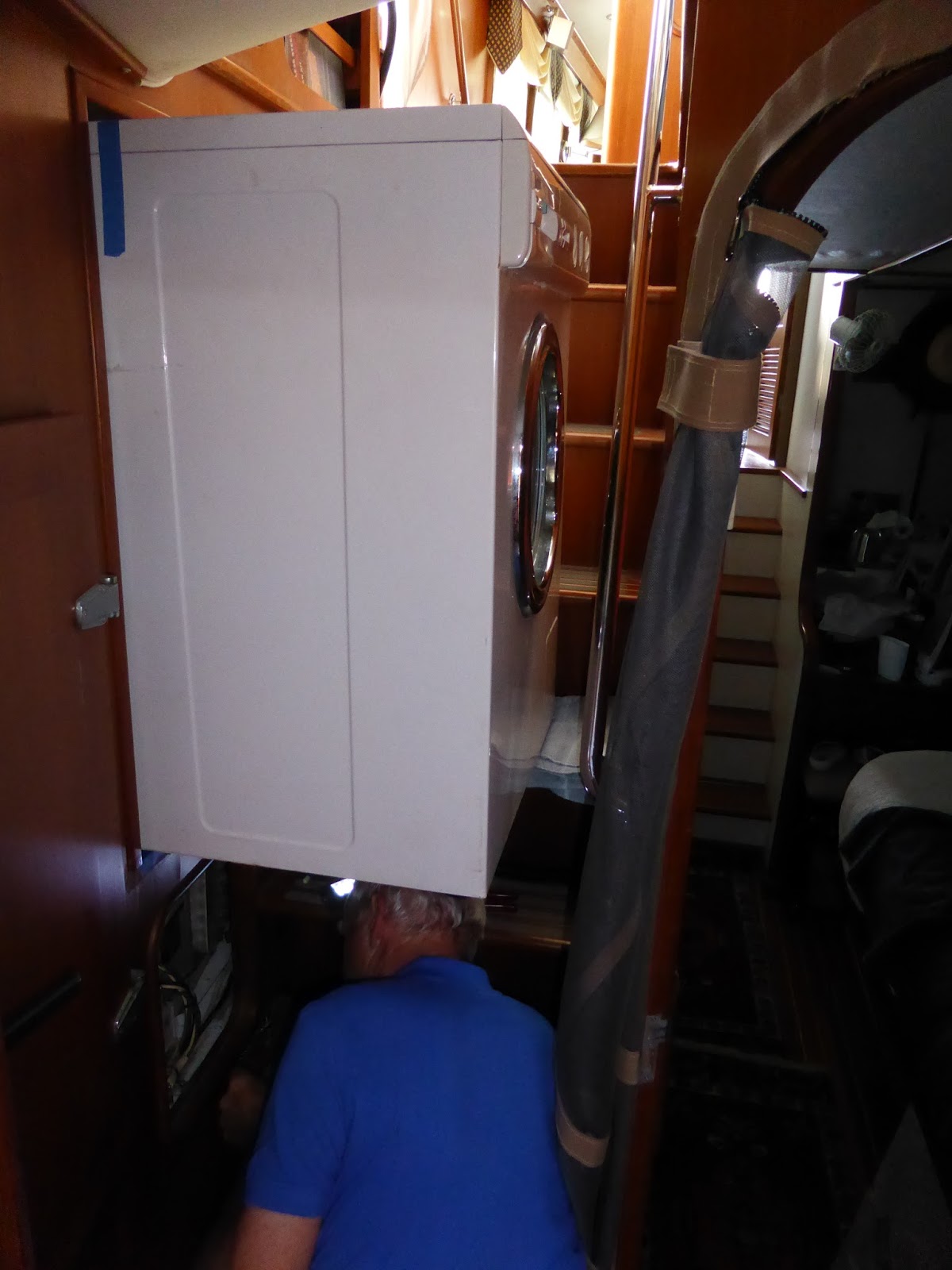
Chris was sure it was the discharge pump not working as the water hadn’t drained out – it’s normal on automatic washing machines that the water needs to drain before the spin cycle. So we siphoned the water into a bucket, pulled the machine forward in its cavity and removed the metal base plate. We had an “aha” moment when Chris immediately saw that a extremely thin AC power wire to the discharge pump had broken loose, probably due to the high vibration levels normal in washing machines. The area was too difficult to access for soldering so Chris crimped the connection and this solved the problem. Two days later the same thing happened as the crimp was really too large for the very fine wire. But now we were “experts” at pulling the machine forward and removing its base plate and Chris modified some crimps to make them more suitable for the fine wire and we took a belt and braces approach making sure that all the wiring was secured and unlikely to shake loose again.

Chris underneath the washing machine re-wiring the discharge pump

ENVOY CONTINUES CRUISING SOUTH

Envoy is currently anchored off Yiyhion on the mainland Greek southern coast with our friends Kevin and Diane aboard.

After leaving Lefkas Marina we cruise south to Argostoli, the port capital of Cephalonia, and anchor in the harbour seeing turtles for the first time this season as they pop their heads out of the water, take a look around and dive back to the depths. It’s a quaint town that suffered considerable damage during an earthquake in 1953 and was then largely rebuilt in its original Venetian style.

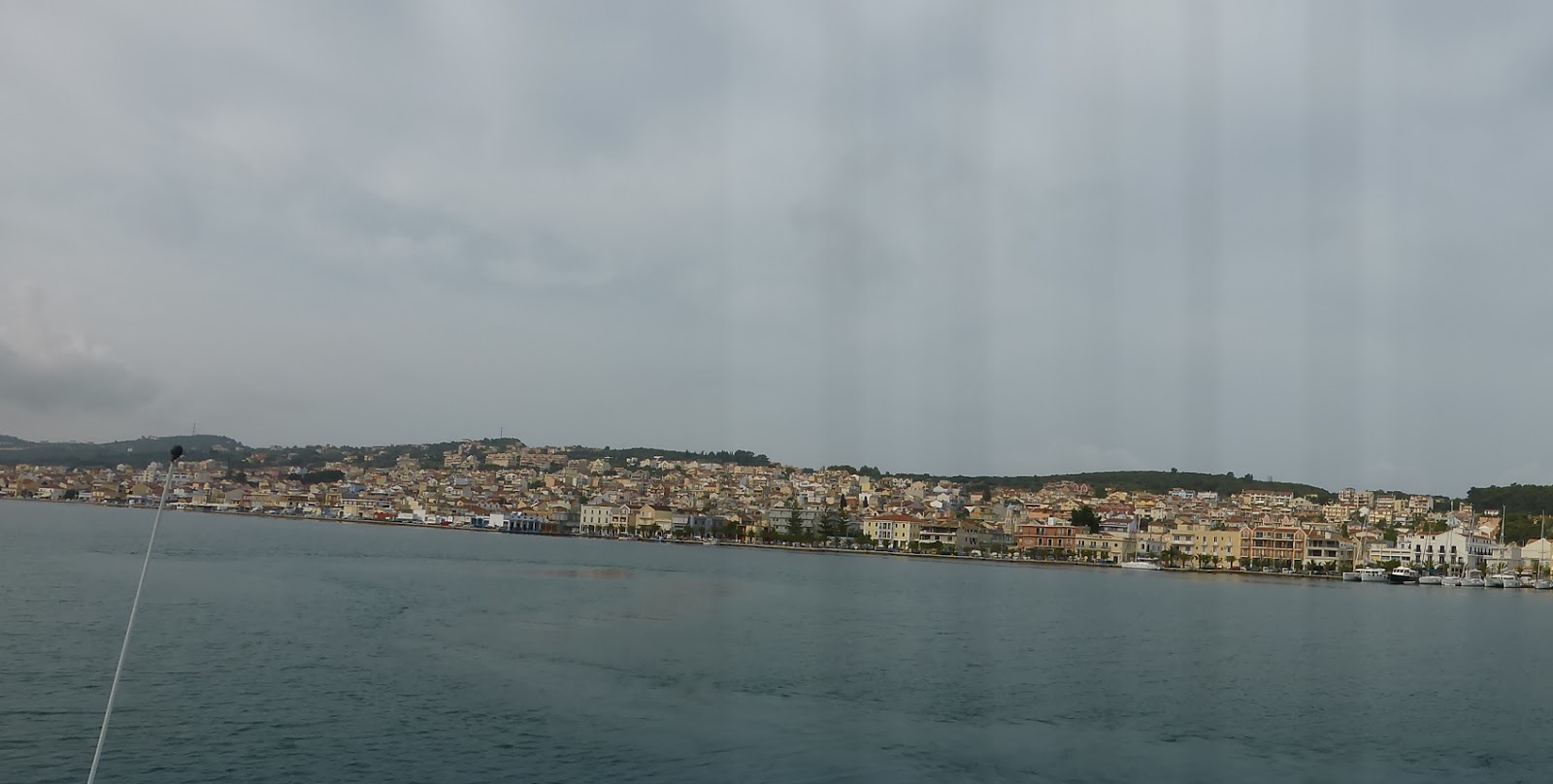
Vista of Argostoli from Envoy at anchor

Chris and Laurie enjoy ice cold Mythos beers at Argostoli – someones gotta do this!

For the first time we visit the island of Zakynthos and anchor one night off a great beach at Alykanas before going into Zakynthos harbour so that Envoy will be safe while we hire a car to look around the island. The marina cost is a reasonable 35 Euros (about NZ$58) per night including power and water.

Envoy in Zakynthos Marina

Alykanas is a great settled weather anchorage

In Zakynthos we have a rare bad dining experience with poor quality and over-priced food costing 100 Euros (about NZ$167) for the three of us. To be fair this is partially our fault for not checking the price of off-menu specials so that we end up paying 50 Euros (about NZ$83) for a small snapper that we’d throw back in New Zealand. After Chris makes our complaints known on behalf of all of us, they offer free meals for the following night although get off lightly as we don’t take up their offer.

We loved this rustic old stone building

On the south side of Zakynthos is a marine reserve where turtles return to sandy beaches to nest and breed. Understandably boats are not allowed in most of this area but are allowed at nearby Ormos Keri where we spend two nights and we’re able to replenish our fresh water supplies from a tap at the local small boat harbour.

Gathering fresh water is a regular activity

Ormos Keri and its local boat harbour

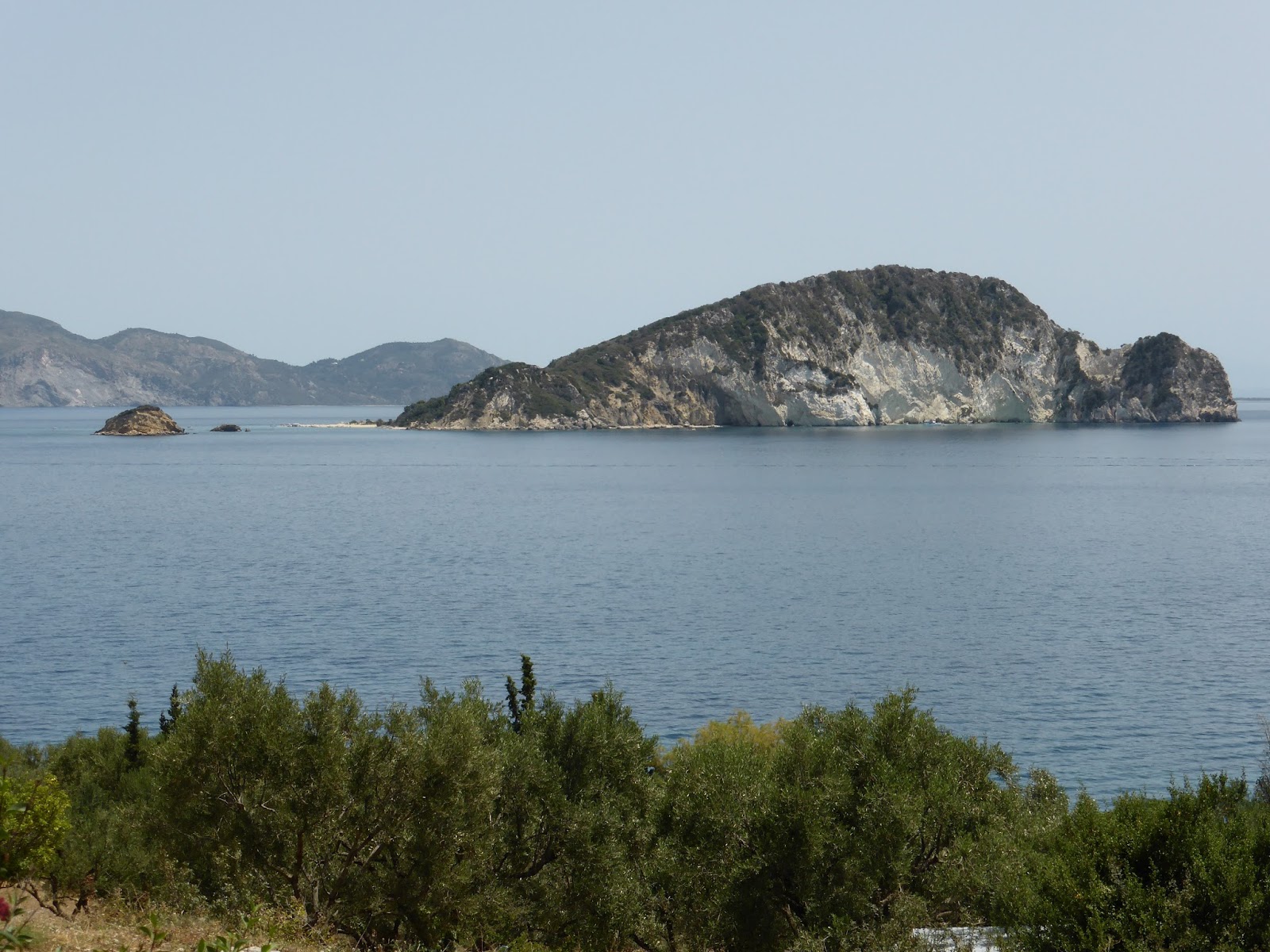
Two miles off the anchorage the island of Marathonisi has numerous sea caves that we are able to explore taking our RHIB completely inside.

Marathonisi Island looks like a giant turtle

The sea caves of Marathonisi have exceptionally clear water

We are inside the cave looking out at Envoy

From here it’s about 50 miles east to the mainland Peloponnese coast where we ‘ll spend the next several weeks, so we break the journey about halfway at the remote and lonely Nisidhos Strofadhes Islands. We are the only vessel here and the cruising guide says gales from any direction cause the seas to be like a giant washing machine swirling around.
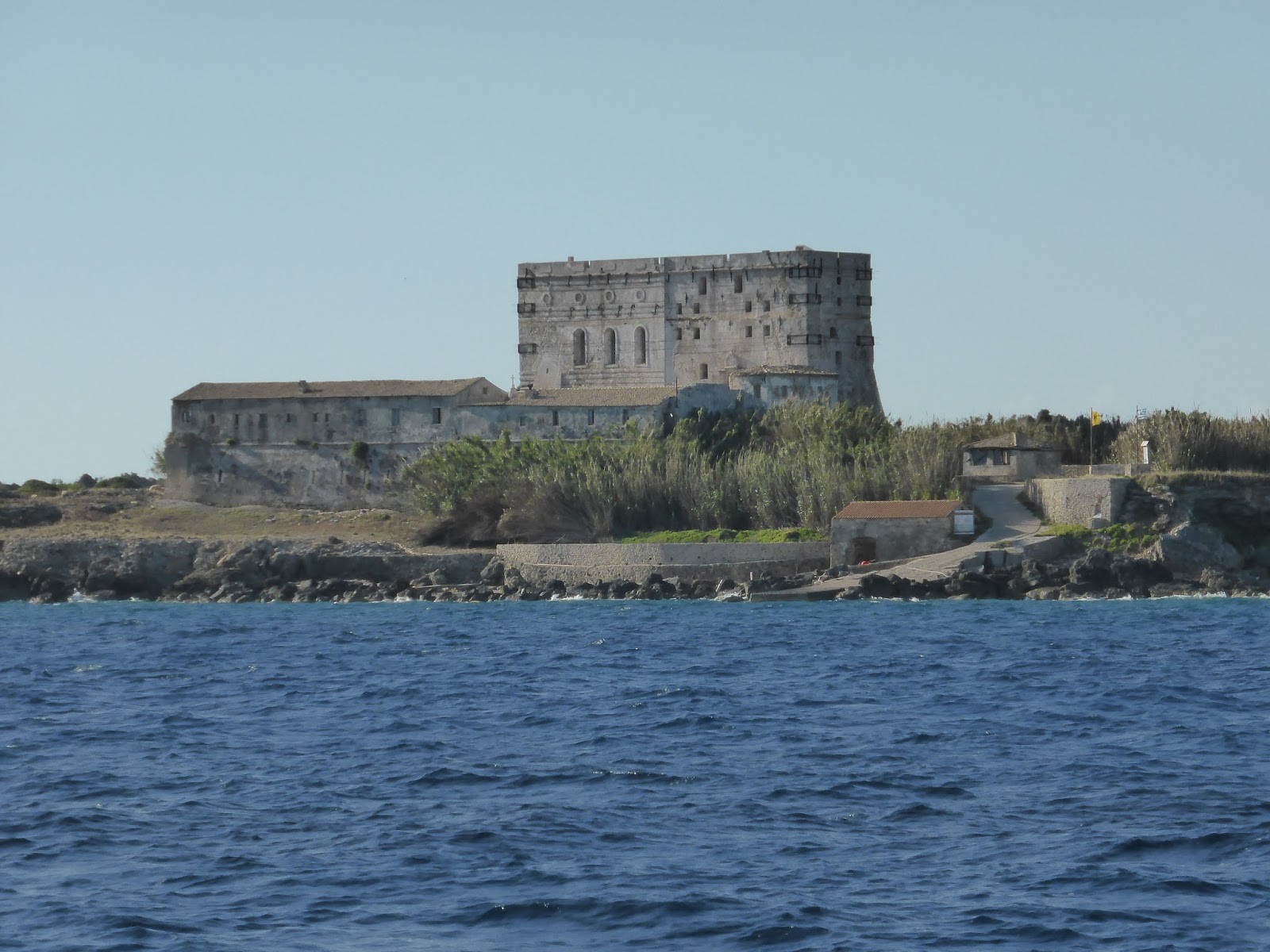
We don’t encounter a gale but even the 15 knot winds causes an uncomfortable swell to enter our anchorage making our flopper-stoppers necessary. The islands are inhabited by a solitary monk who looks after the 13th century Ay Panayis monastery, built like a fortress to withstand historic pirate attacks.

The fortress-like 13th century monastery

TECHNICAL
All fuel used by Envoy is filtered (or “polished”) using a 7 litres/min !2 volt pump feeding a 2 micron Racor filter and a magnetic DeBug unit into our in-use fuel tank before being used by any of the engines. Before if gets to the engine it then goes through a Racor primary filter and secondary on-engine filter. Shorty after leaving Lefkas Marina the 12V polishing pump fails, emitting just a faint clicking noise, so we replace it with our on-board spare – a simple exercise except for the time required to remove the pipe fittings from the failed pump and refit them to the new pump. As a new pump costs about US$500 and there was nothing to loose we decide to utilise Chris’s expertise and attempt to repair the failed pump, which consists of three separate parts – a rotary vane pump, a 12V DC motor and an electronic controller – any one of which could be at fault.

Chris fixing the failed polishing pump motor in Envoy’s pilothouse

We dismantle the vane pump and find no broken parts or blockages so dismantle the motor and find the armature and its associated brush housing in poor shape. We clean it up with white spirit and carefully clean the commutator grooves with a sharp blade and fine emery paper, then reassemble the motor without the pump and test it on a 12 volt power supply, but it still doesn’t run and makes the original clicking sound. However when we remove the motor from its electronic controller it runs perfectly. We take the controller apart and find two relays hard-wired onto a circuit board – by elimination probably the cause of failure. We consult the specs to find these relays simply enable the pump to be switched for forward or reverse operation. Our use is for one direction only, so we remove the relay board and hard-wire the motor using its existing switch and fuse, reattach the vane pump and it works perfectly.
We finally confirm the cause of the seawater leak to the guest cabin bilge. The outlet hose from the aircon’s seawater cooling system discharges out of a through-hull fitting (without a seacock) just above the waterline. This hose is not visible or accessible for its complete length and must have a split or developed a small leak so that when sea water has been splashing into this hose it’s been leaking into the bilge. We fit an in-line gate valve near the through-hull and when closed the leak soon stops. Normally gate valves aren’t recommended, but this is an above-waterline and non-critical application so we’re comfortable with it. The hose will need replacement.