The Sexiest Women in Game of Thrones
Underway!
Got the boat back last weekend after five or six (who’s counting) weeks in the yard. We went straight from the yard to Devil’s Isle for a work party. This weekend we’re heading to Grindstone Joe’s for fun with Ox Bow Yacht Club. I keep meaning to post …
Underway!
Got the boat back last weekend after five or six (who’s counting) weeks in the yard. We went straight from the yard to Devil’s Isle for a work party. This weekend we’re heading to Grindstone Joe’s for fun with Ox Bow Yacht Club. I keep meaning to post …
April 11 – Sixmile Creek, FL
Outback Crab Shack
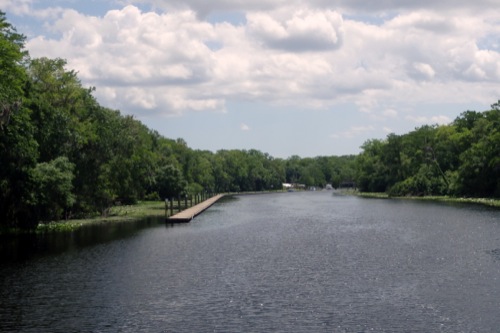
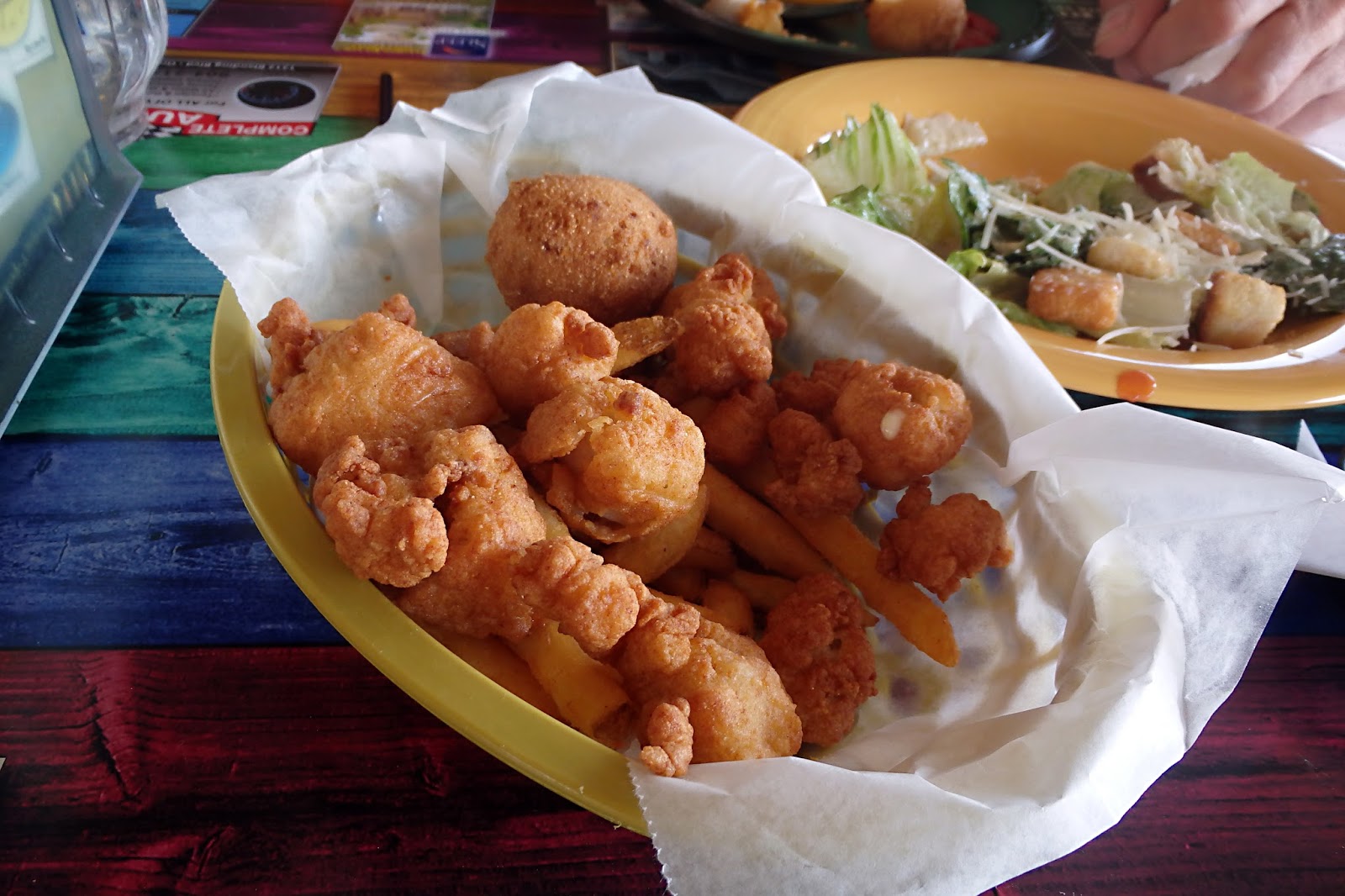
We enjoyed a slow morning…sleeping in a little, taquitos for breakfast and coffee on the flybridge. I think we’re going to like this slower pace cruising. Our destination today was a small creek on the eastern shore of the St. John’s called Sixmile Creek. It’s a stop everyone seems to make, because the Outback Crab Shack offers a nice free floating dock to anyone who eats at the restaurant. The dock is 1/4 mile long…not that it was needed today. There were only a few day boats docked when we arrived. We thought we’d see a few more boats this evening since it was a beautiful Friday, but no one showed up. We decided to have a late lunch…catfish and shrimp was the days lunch special and it wasn’t too bad. The place seems to be known for its fried seafood, which we aren’t a big fan of any longer. I was excepting to find a cute little fish camp on the river, much like the one we were at yesterday, but this place is a very run down and you can’t even see the river from their tables. It definitely looks a little different from their website…but for the nice dock on this quiet secluded creek it’s a good deal.
After lunch we took the dinghy up the creek in search of wildlife. It’s a beautiful remote area, but all we saw were a few turtle and two birds…no alligators yet. We spent the evening on the boat visiting with people who strolled down the dock from the restaurant and listening to the serenade of a million frogs in the surrounding swamp.
Good morning!

Our morning view

The 1/4 mile dock of Outback Crab Shack
The Outback Crab Shack


Scenes from our ride up the creek


A turtle

A Limpkin

Just a few seconds for the serenade going on outside our boat last night.
Day 91 – 365 Project…Spanish Moss
Welcome to day 91 of 365 photos…I took these two photos yesterday in Jacksonville, NC. The daily photos that I took today were not all that interesting so I decided to post these two instead. I was in Jacksonville quite early in the morning and the Spanish Moss in the cemetery caught my attention. Amongst… Continue Reading
The post Day 91 – 365 Project…Spanish Moss appeared first on Moosetique Musing.
A Game Of Thrones Map Essos
Game of Thrones Gallery World Map 01
Camouflage in the Underwater World – By Emily
Gaze at a reef and
you’ll see a vivid habitat- tan fire coral, purple gorgonians, red lacy-looking
lionfish, and millions of other colors and corals. But what is more interesting
is what you can’t see… and what’s in clear view telling you “don’t touch me”.
In reefs all animals drape themselves in color or camouflage to entice mates,
catch prey, or even hide in plain sight.
you’ll see a vivid habitat- tan fire coral, purple gorgonians, red lacy-looking
lionfish, and millions of other colors and corals. But what is more interesting
is what you can’t see… and what’s in clear view telling you “don’t touch me”.
In reefs all animals drape themselves in color or camouflage to entice mates,
catch prey, or even hide in plain sight.
 |
| Butterfly Fish (Ref 5) |
There are many
types of camouflage, many of which we have seen in our travels. The most common
is coloring that resembles surroundings. Many wrasses and parrotfish are blue
or brown to mimic the color of the water or coral. Most young parrotfish look a
lot like coral, so that when they move it seems like the coral has come to
life. The most amazing example is the frogfish, a creature even I have not seen,
but still hope to. One that we have seen is the devil scorpion fish.
 |
| Scorpianfish (Ref 10) |
Most of the
angelfish and butterfly fish use disruptive coloring to break up their distinct
shape and become more like the reef. Non-repetitive designs like spots or
stripes may stand out in open water, but they become part of the menagerie of
shapes in a reef. Queen and Emperor Angelfish are blue and yellow striped to
blend in, and Threespot Flounder have eyes on their body to confuse predators.
angelfish and butterfly fish use disruptive coloring to break up their distinct
shape and become more like the reef. Non-repetitive designs like spots or
stripes may stand out in open water, but they become part of the menagerie of
shapes in a reef. Queen and Emperor Angelfish are blue and yellow striped to
blend in, and Threespot Flounder have eyes on their body to confuse predators.
Yet other
creatures find different ways to hide. Toad fish, stargazers, and rays lie
close to the bottom to eliminate their shadow, making them almost invisible to
predators; they’re just a lump in the sand. Fish like lizardfishes and garden
eels even bury themselves or dig holes. One rare fish that we have seen is the
shortnose batfish that looks basically like a pancake with two legs, a tail,
and a snoot. Many shells bury themselves in sand; the only giveaway is their
track that weaves through the ripples of sand. Wobbegongs are flat and colored
to the bottom, and they’re so confident in their camouflage they won’t move
unless touched.
creatures find different ways to hide. Toad fish, stargazers, and rays lie
close to the bottom to eliminate their shadow, making them almost invisible to
predators; they’re just a lump in the sand. Fish like lizardfishes and garden
eels even bury themselves or dig holes. One rare fish that we have seen is the
shortnose batfish that looks basically like a pancake with two legs, a tail,
and a snoot. Many shells bury themselves in sand; the only giveaway is their
track that weaves through the ripples of sand. Wobbegongs are flat and colored
to the bottom, and they’re so confident in their camouflage they won’t move
unless touched.
 |
|
| Long Nose Batfish (Ref 4) |
The most
breathtaking form of camouflage is self-decoration. Hermit crabs carry a heavy
shell, Decorator Crabs load themselves with massive amounts of debris, and
Carrier Shells glue on shell fragments in a spiral pattern. Many shells are
smooth to repel such growths, but others, like the Atlantic Thorny Oyster give
lots of protrusions to attract algae and coral.
breathtaking form of camouflage is self-decoration. Hermit crabs carry a heavy
shell, Decorator Crabs load themselves with massive amounts of debris, and
Carrier Shells glue on shell fragments in a spiral pattern. Many shells are
smooth to repel such growths, but others, like the Atlantic Thorny Oyster give
lots of protrusions to attract algae and coral.
 |
| Carrier Shell (Ref 6) |
Trumpet fish and seahorses
display cryptic behavior, mimicking the reef, whether that may be swaying soft
corals or waving grasses. Razorfish and trumpetfish are long and skinny to look
like a floating branch. Groupers and many other fish stay very still, relying
on their coloring to stay inconspicuous. Trumpet fish are the funniest, for
when they are approached, they stay very still, only moving to sway back and
forth. Suddenly they start to change color and dart away to safety.
display cryptic behavior, mimicking the reef, whether that may be swaying soft
corals or waving grasses. Razorfish and trumpetfish are long and skinny to look
like a floating branch. Groupers and many other fish stay very still, relying
on their coloring to stay inconspicuous. Trumpet fish are the funniest, for
when they are approached, they stay very still, only moving to sway back and
forth. Suddenly they start to change color and dart away to safety.
 |
| Trumpetfish (Ref 8) |
What I think of as
the best camouflage is changing color; the octopus, flounder, and squid do it
well. Octopi not only use it to camouflage, they also use it to hunt. They
drift over a patch of coral when they’re dark brown, and then stop and make
their webbing white. Fish in the rocks think it’s an opening and dart into the
octopus’s hungry mouth. When they’re still they change color rapidly to suit
the coral, which is impressive considering they’re colorblind. Once we saw an
octopus eating a conch, a few tentacles in and around it, but when he saw us he
stopped and hastily changed color, not moving even when we were a few inches
away, as if to say, “it’s mine, go away!”
the best camouflage is changing color; the octopus, flounder, and squid do it
well. Octopi not only use it to camouflage, they also use it to hunt. They
drift over a patch of coral when they’re dark brown, and then stop and make
their webbing white. Fish in the rocks think it’s an opening and dart into the
octopus’s hungry mouth. When they’re still they change color rapidly to suit
the coral, which is impressive considering they’re colorblind. Once we saw an
octopus eating a conch, a few tentacles in and around it, but when he saw us he
stopped and hastily changed color, not moving even when we were a few inches
away, as if to say, “it’s mine, go away!”
 |
| Octopus Eating Conch, can you spot him? (Ref 9) |
Open-ocean fish
are often silvery or transparent to color themselves like the sea. Moon jellyfish are almost entirely clear; the
only giveaway is their faint outline and slight shimmer. Fish like tuna are
silvery to reflect light and appear blue from a distance. Some squid illuminate
their underside with sparkles so as not to appear as a dark shape when viewed
from below.
are often silvery or transparent to color themselves like the sea. Moon jellyfish are almost entirely clear; the
only giveaway is their faint outline and slight shimmer. Fish like tuna are
silvery to reflect light and appear blue from a distance. Some squid illuminate
their underside with sparkles so as not to appear as a dark shape when viewed
from below.
 |
| Squid (Ref 7) |
Some
animals have light-colored underbellies because they are
“counter-shaded.” They are darkest on their backs, which are most
often in direct sunlight, and lightest on their undersides, where a predator
would see against the sun. An effectively camouflaged prey may appear flat and
insubstantial.
animals have light-colored underbellies because they are
“counter-shaded.” They are darkest on their backs, which are most
often in direct sunlight, and lightest on their undersides, where a predator
would see against the sun. An effectively camouflaged prey may appear flat and
insubstantial.
Some sea creatures
use motion dazzle. Motion dazzle may degrade predators’ ability to estimate the
prey’s speed and direction accurately, giving the prey an improved chance of escape.
Motion dazzle distorts speed perception, and is most effective at high speeds;
stripes can also distort perception of size (and so, perceived range to the
target). One example is a school of moving striped fish, such as razor fish and
striped catfish.
use motion dazzle. Motion dazzle may degrade predators’ ability to estimate the
prey’s speed and direction accurately, giving the prey an improved chance of escape.
Motion dazzle distorts speed perception, and is most effective at high speeds;
stripes can also distort perception of size (and so, perceived range to the
target). One example is a school of moving striped fish, such as razor fish and
striped catfish.
 |
| Striped Catfish (Ref 13) |
Underwater, the
most complicated disguise is the art of using depth and color. As you may know,
colors disappear with the reds and oranges fading first. Longer wavelengths of
reds and oranges are quickly absorbed by the water. Damselfish, angelfish, and
wrasses decorate themselves with these colors so that their color fades and blends,
with depth, into the colors of the background, blue, green, and yellow
dominating. Clouds of angelfish, and damselfish would blend their colors into a
collage of multi shaded masses, stripes and spots helping to weave the pattern
of the busy reef habitat. The more fish,
the merrier, with such an excess of pattern and color, no one creature stands
out. You can easily imagine how a predator would have trouble picking a single
fish from a school of similar color, constantly moving.
most complicated disguise is the art of using depth and color. As you may know,
colors disappear with the reds and oranges fading first. Longer wavelengths of
reds and oranges are quickly absorbed by the water. Damselfish, angelfish, and
wrasses decorate themselves with these colors so that their color fades and blends,
with depth, into the colors of the background, blue, green, and yellow
dominating. Clouds of angelfish, and damselfish would blend their colors into a
collage of multi shaded masses, stripes and spots helping to weave the pattern
of the busy reef habitat. The more fish,
the merrier, with such an excess of pattern and color, no one creature stands
out. You can easily imagine how a predator would have trouble picking a single
fish from a school of similar color, constantly moving.
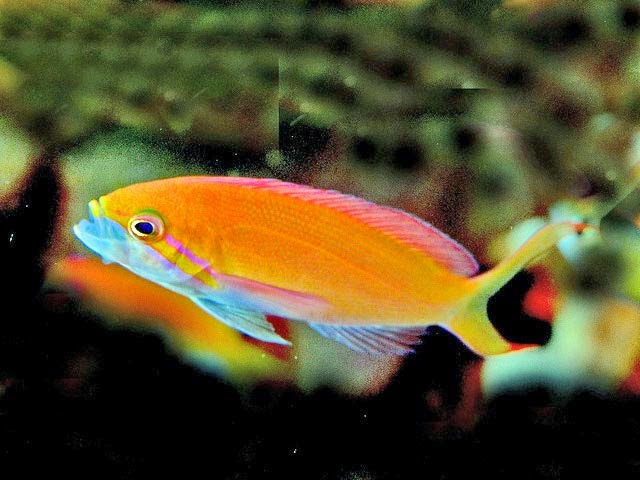 |
| Anthias Normal (Ref 11) |
But, the color so
useful in fading away can also be used to stand out. Fish use vivid displays of
color to communicate their love to mates… or to warn away unwanted guests. Masters
of beauty, Athias, appear drab normally, but erect their dorsal fins and blare
their colors to attract a mate. The show doesn’t last for long though, the
colorful performance exposing them to great risk from predators. The ability to
change color is a class of skin cells
useful in fading away can also be used to stand out. Fish use vivid displays of
color to communicate their love to mates… or to warn away unwanted guests. Masters
of beauty, Athias, appear drab normally, but erect their dorsal fins and blare
their colors to attract a mate. The show doesn’t last for long though, the
colorful performance exposing them to great risk from predators. The ability to
change color is a class of skin cells
called chromatophores that show color
through light manipulation or pigmentation. Chromatophores can instantly mark
their bearer as terrifying, invisible, or irresistible.
through light manipulation or pigmentation. Chromatophores can instantly mark
their bearer as terrifying, invisible, or irresistible.
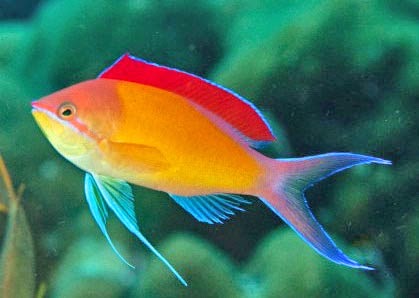 |
| Anthias Courting (Ref 12) |
Some other
colorful examples are Stonefish, who use their brown exterior to be invisible,
but when frightened, open their colorful pectoral fins to warn off predators, “Stay
away, I’m poisonous!”, and cleaner shrimp, who are not only colorful, but at a
depth seem black and white, where red turns black.
colorful examples are Stonefish, who use their brown exterior to be invisible,
but when frightened, open their colorful pectoral fins to warn off predators, “Stay
away, I’m poisonous!”, and cleaner shrimp, who are not only colorful, but at a
depth seem black and white, where red turns black.
In the underwater
world, those who stand out and stay still clearly have a meaning. Bold colors
can advertise danger. Clown fish sit in stinging anemones, lionfish are
poisonous, and scorpion fish are too.
world, those who stand out and stay still clearly have a meaning. Bold colors
can advertise danger. Clown fish sit in stinging anemones, lionfish are
poisonous, and scorpion fish are too.
Fire urchins are red, yellow, purple and
blue, able to stand out at any depth, and blast the message: toxic. One day I saw a ray that was
unfamiliar to me. It was sitting on the bottom innocently covered with sand,
and stupid me wanted to see what color it was. I dove down to the bottom and
touched it to make it move, since it clearly wasn’t afraid- bad mistake.
Zzzzzzt! I received an electric shock; I
later learned it was a lesser electric ray. I never did see its color, but
lesson learned, and I didn’t try to touch it again. Just yesterday, we saw an
Atlantic Torpedo, able to produce enough electricity to stop a man’s heart.
blue, able to stand out at any depth, and blast the message: toxic. One day I saw a ray that was
unfamiliar to me. It was sitting on the bottom innocently covered with sand,
and stupid me wanted to see what color it was. I dove down to the bottom and
touched it to make it move, since it clearly wasn’t afraid- bad mistake.
Zzzzzzt! I received an electric shock; I
later learned it was a lesser electric ray. I never did see its color, but
lesson learned, and I didn’t try to touch it again. Just yesterday, we saw an
Atlantic Torpedo, able to produce enough electricity to stop a man’s heart.
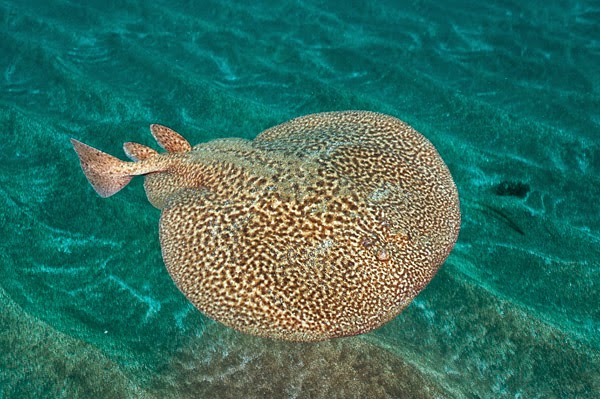 |
| Torpedo Ray (Ref 14) |
But, if a fish
wanted to attract a mate without being seen, how would he do it? To solve this
problem Damselfish use reflectors to flash UV signals to communicate with
others, and predators can’t see it. A male Squarespot Anthias is red and orange
in normal light, at eighty feet is blue and purple, but in UV light is dark
with a brilliant white spot, an easily seen signal to others of his kind, but
not predators.
wanted to attract a mate without being seen, how would he do it? To solve this
problem Damselfish use reflectors to flash UV signals to communicate with
others, and predators can’t see it. A male Squarespot Anthias is red and orange
in normal light, at eighty feet is blue and purple, but in UV light is dark
with a brilliant white spot, an easily seen signal to others of his kind, but
not predators.
Normal
0
false
false
false
EN-US
X-NONE
X-NONE
/* Style Definitions */
table.MsoNormalTable
{mso-style-name:”Table Normal”;
mso-tstyle-rowband-size:0;
mso-tstyle-colband-size:0;
mso-style-noshow:yes;
mso-style-priority:99;
mso-style-parent:””;
mso-padding-alt:0in 5.4pt 0in 5.4pt;
mso-para-margin-top:auto;
mso-para-margin-right:0in;
mso-para-margin-bottom:auto;
mso-para-margin-left:0in;
mso-pagination:widow-orphan;
font-size:11.0pt;
font-family:”Calibri”,”sans-serif”;
mso-ascii-font-family:Calibri;
mso-ascii-theme-font:minor-latin;
mso-hansi-font-family:Calibri;
mso-hansi-theme-font:minor-latin;}
Every creature is exceptional
in its own way, a majority amazing in camouflage. Others have found a way to
stand out, extraordinary and bathed in color.
in its own way, a majority amazing in camouflage. Others have found a way to
stand out, extraordinary and bathed in color.
Emily
References:
1. en.wikipedia.org/wiki/Camouflage
2.
National Geographic Vol. 209 NO. 5
May 2005
National Geographic Vol. 209 NO. 5
May 2005
3.
Reef Fish Identification, Tropical
Pacific
Reef Fish Identification, Tropical
Pacific
6. http://www.zymoglyphic.org/exhibits/xenophora/images/4.jpg
7. a-z
animals.com
animals.com
9.
emilygwestonphotography.com
emilygwestonphotography.com
10. http://www.divevietnam.com/
11. www.kudalaut.eu
12.
www.flickr.com
www.flickr.com
14.www.elasmodiver.com
Camouflage in the Underwater World – By Emily
Gaze at a reef and you’ll see a vivid habitat- tan fire coral, purple gorgonians, red lacy-looking lionfish, and millions of other colors and corals. But what is more interesting is what you can’t see… and what’s in clear view telling you “don’t touch me”. In reefs all animals drape themselves in color or camouflage to entice mates, catch prey, or even hide in plain sight.
|
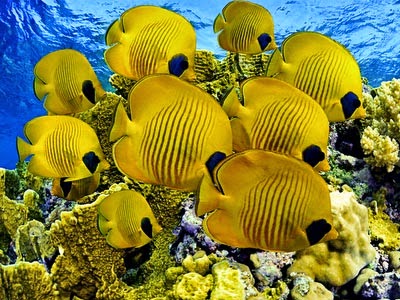
| Butterfly Fish (Ref 5) |
There are many types of camouflage, many of which we have seen in our travels. The most common is coloring that resembles surroundings. Many wrasses and parrotfish are blue or brown to mimic the color of the water or coral. Most young parrotfish look a lot like coral, so that when they move it seems like the coral has come to life. The most amazing example is the frogfish, a creature even I have not seen, but still hope to. One that we have seen is the devil scorpion fish.
|
| Scorpianfish (Ref 10) |
Most of the angelfish and butterfly fish use disruptive coloring to break up their distinct shape and become more like the reef. Non-repetitive designs like spots or stripes may stand out in open water, but they become part of the menagerie of shapes in a reef. Queen and Emperor Angelfish are blue and yellow striped to blend in, and Threespot Flounder have eyes on their body to confuse predators.
Yet other creatures find different ways to hide. Toad fish, stargazers, and rays lie close to the bottom to eliminate their shadow, making them almost invisible to predators; they’re just a lump in the sand. Fish like lizardfishes and garden eels even bury themselves or dig holes. One rare fish that we have seen is the shortnose batfish that looks basically like a pancake with two legs, a tail, and a snoot. Many shells bury themselves in sand; the only giveaway is their track that weaves through the ripples of sand. Wobbegongs are flat and colored to the bottom, and they’re so confident in their camouflage they won’t move unless touched.
|
|
| Long Nose Batfish (Ref 4) |
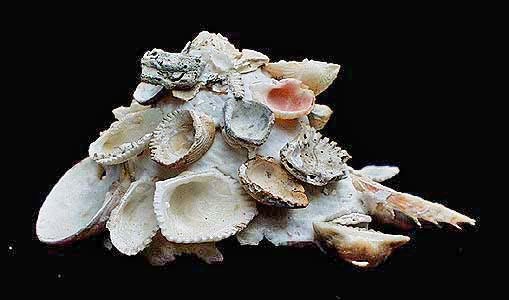
The most breathtaking form of camouflage is self-decoration. Hermit crabs carry a heavy shell, Decorator Crabs load themselves with massive amounts of debris, and Carrier Shells glue on shell fragments in a spiral pattern. Many shells are smooth to repel such growths, but others, like the Atlantic Thorny Oyster give lots of protrusions to attract algae and coral.
|
| Carrier Shell (Ref 6) |
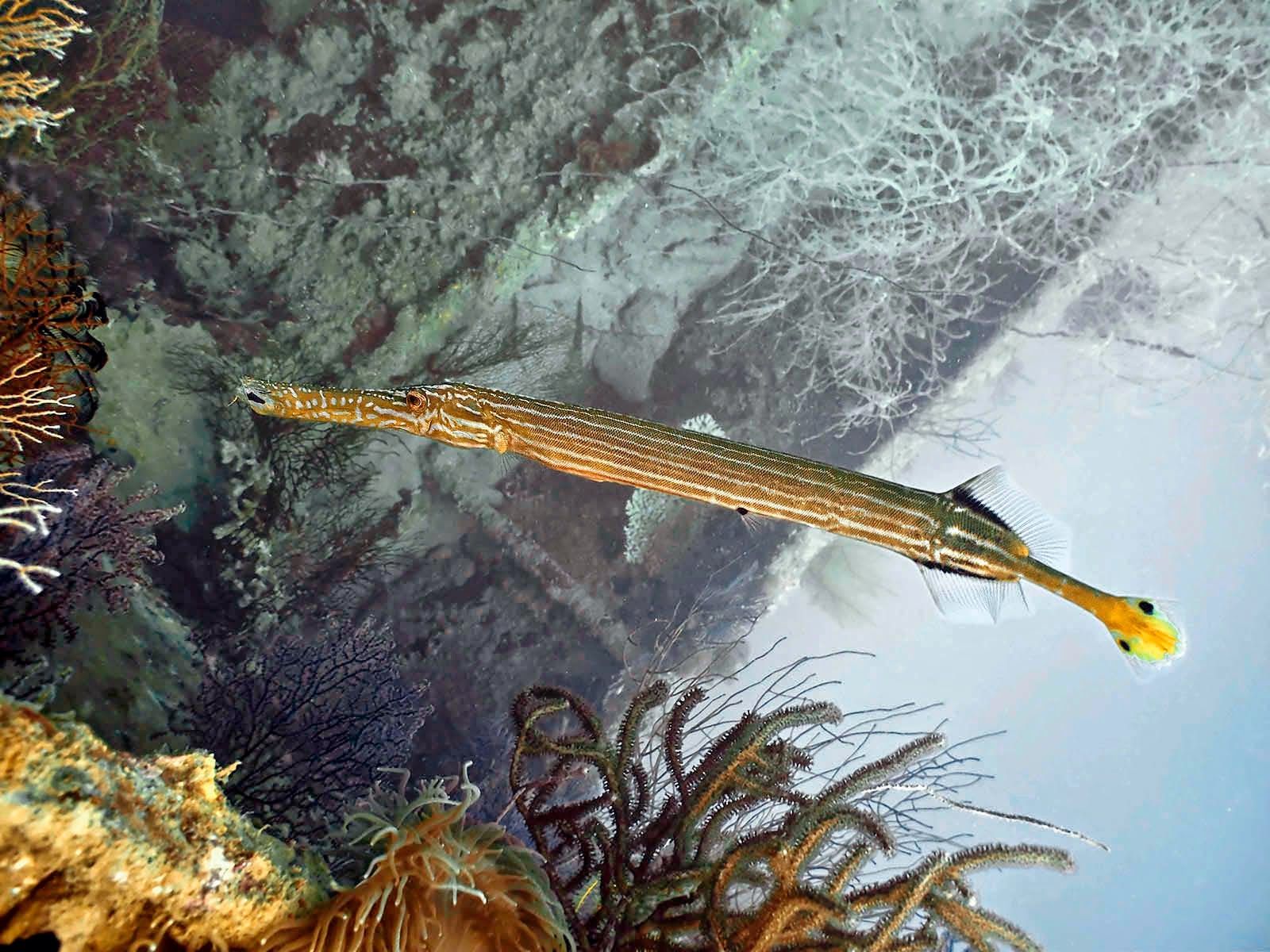
Trumpet fish and seahorses display cryptic behavior, mimicking the reef, whether that may be swaying soft corals or waving grasses. Razorfish and trumpetfish are long and skinny to look like a floating branch. Groupers and many other fish stay very still, relying on their coloring to stay inconspicuous. Trumpet fish are the funniest, for when they are approached, they stay very still, only moving to sway back and forth. Suddenly they start to change color and dart away to safety.
|
| Trumpetfish (Ref 8) |
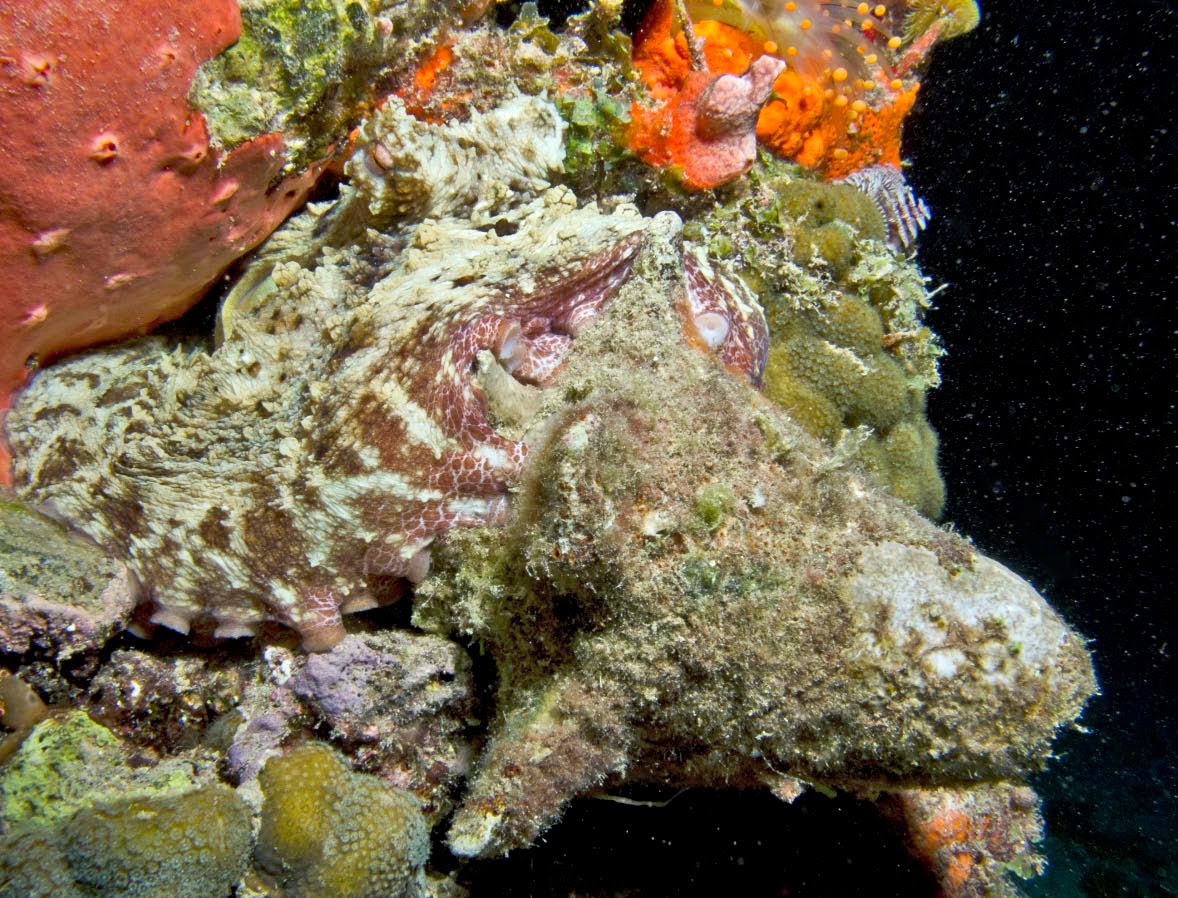
What I think of as the best camouflage is changing color; the octopus, flounder, and squid do it well. Octopi not only use it to camouflage, they also use it to hunt. They drift over a patch of coral when they’re dark brown, and then stop and make their webbing white. Fish in the rocks think it’s an opening and dart into the octopus’s hungry mouth. When they’re still they change color rapidly to suit the coral, which is impressive considering they’re colorblind. Once we saw an octopus eating a conch, a few tentacles in and around it, but when he saw us he stopped and hastily changed color, not moving even when we were a few inches away, as if to say, “it’s mine, go away!”
|
| Octopus Eating Conch, can you spot him? (Ref 9) |
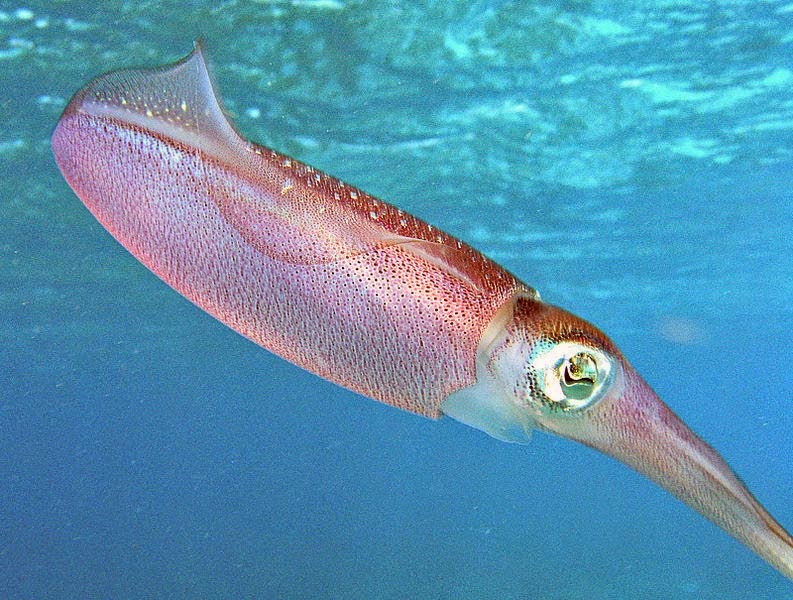
Open-ocean fish are often silvery or transparent to color themselves like the sea. Moon jellyfish are almost entirely clear; the only giveaway is their faint outline and slight shimmer. Fish like tuna are silvery to reflect light and appear blue from a distance. Some squid illuminate their underside with sparkles so as not to appear as a dark shape when viewed from below.
|
| Squid (Ref 7) |
Some animals have light-colored underbellies because they are “counter-shaded.” They are darkest on their backs, which are most often in direct sunlight, and lightest on their undersides, where a predator would see against the sun. An effectively camouflaged prey may appear flat and insubstantial.
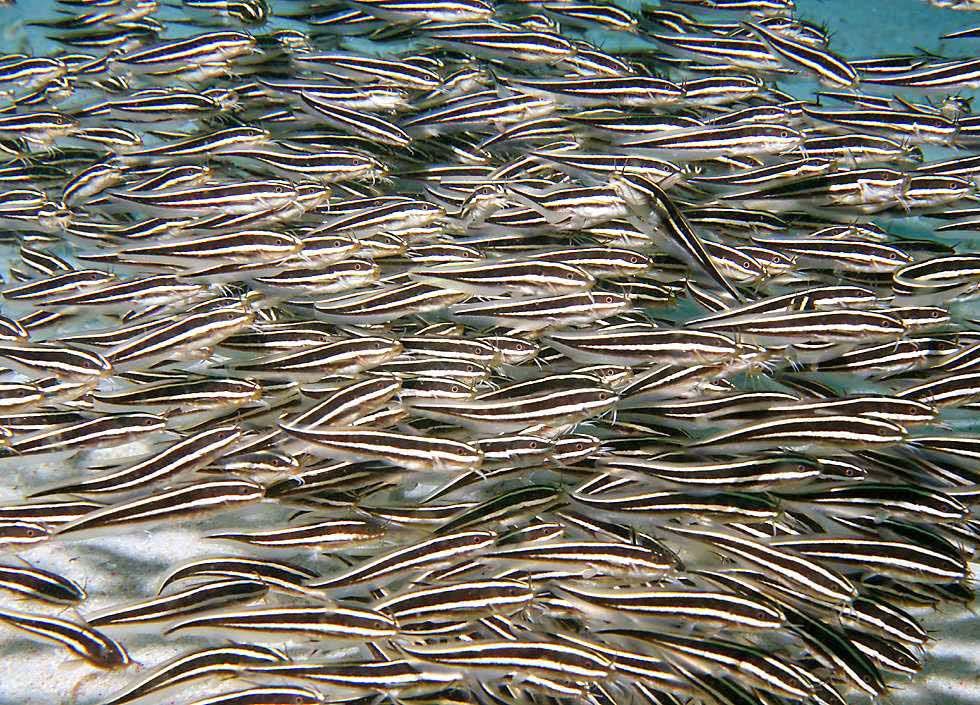
Some sea creatures use motion dazzle. Motion dazzle may degrade predators’ ability to estimate the prey’s speed and direction accurately, giving the prey an improved chance of escape. Motion dazzle distorts speed perception, and is most effective at high speeds; stripes can also distort perception of size (and so, perceived range to the target). One example is a school of moving striped fish, such as razor fish and striped catfish.
|
| Striped Catfish (Ref 13) |
Underwater, the most complicated disguise is the art of using depth and color. As you may know, colors disappear with the reds and oranges fading first. Longer wavelengths of reds and oranges are quickly absorbed by the water. Damselfish, angelfish, and wrasses decorate themselves with these colors so that their color fades and blends, with depth, into the colors of the background, blue, green, and yellow dominating. Clouds of angelfish, and damselfish would blend their colors into a collage of multi shaded masses, stripes and spots helping to weave the pattern of the busy reef habitat. The more fish, the merrier, with such an excess of pattern and color, no one creature stands out. You can easily imagine how a predator would have trouble picking a single fish from a school of similar color, constantly moving.
|
| Anthias Normal (Ref 11) |
But, the color so useful in fading away can also be used to stand out. Fish use vivid displays of color to communicate their love to mates… or to warn away unwanted guests. Masters of beauty, Athias, appear drab normally, but erect their dorsal fins and blare their colors to attract a mate. The show doesn’t last for long though, the colorful performance exposing them to great risk from predators. The ability to change color is a class of skin cells
called chromatophores that show color through light manipulation or pigmentation. Chromatophores can instantly mark their bearer as terrifying, invisible, or irresistible.
|
| Anthias Courting (Ref 12) |
Some other colorful examples are Stonefish, who use their brown exterior to be invisible, but when frightened, open their colorful pectoral fins to warn off predators, “Stay away, I’m poisonous!”, and cleaner shrimp, who are not only colorful, but at a depth seem black and white, where red turns black.
In the underwater world, those who stand out and stay still clearly have a meaning. Bold colors can advertise danger. Clown fish sit in stinging anemones, lionfish are poisonous, and scorpion fish are too.
Fire urchins are red, yellow, purple and blue, able to stand out at any depth, and blast the message: toxic. One day I saw a ray that was unfamiliar to me. It was sitting on the bottom innocently covered with sand, and stupid me wanted to see what color it was. I dove down to the bottom and touched it to make it move, since it clearly wasn’t afraid- bad mistake. Zzzzzzt! I received an electric shock; I later learned it was a lesser electric ray. I never did see its color, but lesson learned, and I didn’t try to touch it again. Just yesterday, we saw an Atlantic Torpedo, able to produce enough electricity to stop a man’s heart.
|
| Torpedo Ray (Ref 14) |
But, if a fish wanted to attract a mate without being seen, how would he do it? To solve this problem Damselfish use reflectors to flash UV signals to communicate with others, and predators can’t see it. A male Squarespot Anthias is red and orange in normal light, at eighty feet is blue and purple, but in UV light is dark with a brilliant white spot, an easily seen signal to others of his kind, but not predators.
Every creature is exceptional in its own way, a majority amazing in camouflage. Others have found a way to stand out, extraordinary and bathed in color.
Emily
References:
1. en.wikipedia.org/wiki/Camouflage
2. National Geographic Vol. 209 NO. 5 May 2005
3. Reef Fish Identification, Tropical Pacific
6. http://www.zymoglyphic.org/exhibits/xenophora/images/4.jpg
7. a-z animals.com
9. emilygwestonphotography.com
10. http://www.divevietnam.com/
11. www.kudalaut.eu
12. www.flickr.com
14.www.elasmodiver.com
Land O’Lakes & Feeding America…
So what does Land O’Lakes have to do with Feeding America? From now until May 31, 2014, the Land O’Lakes Foundation is sponsoring the “Pin A Meal, Give A Meal“campaign. For those of us that love Pinterest, this couldn’t be easier. All you have to do is pin or repin a Land O’Lakes recipe which… Continue Reading
The post Land O’Lakes & Feeding America… appeared first on Moosetique Musing.
April 10 – Orange Park, FL
Doctors Lake – Anchorage
“I travel not to go anywhere, but to go. I travel for travel’s sake. The great affair is to move.” —Robert Louis Stevenson
We have finally pulled away from Jacksonville and started up the St. John’s River on our slow adventure to explore every little creek and tributary we can get into. Our destination today was only 17 miles to Doctor’s Lake. It’s a body of water located off the St. John’s River that is actually an inlet…not a lake. We’ve read that the St. John’s is old Florida, the way things use to be before the hustle bustle of tourism arrived to soak up the sun on the beaches, shop in fancy boutiques and visit the Mouse. Towns are small along the river and every creek seems to have a fish camp that serves the needs of the fisherman, plus serves up great seafood and entertainment. We look forward to visiting as many as we can find.
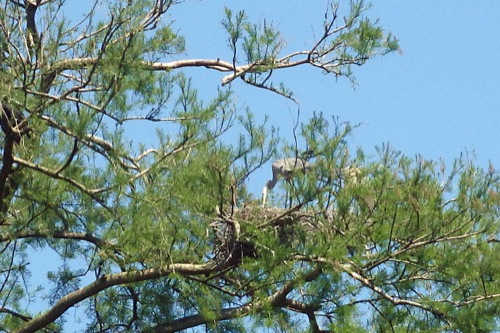
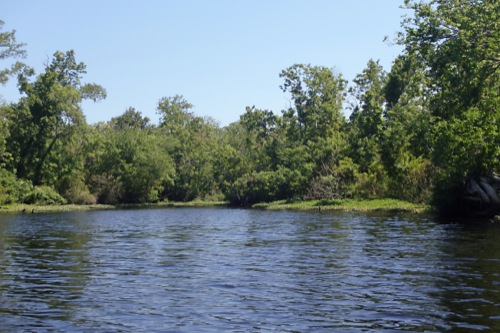
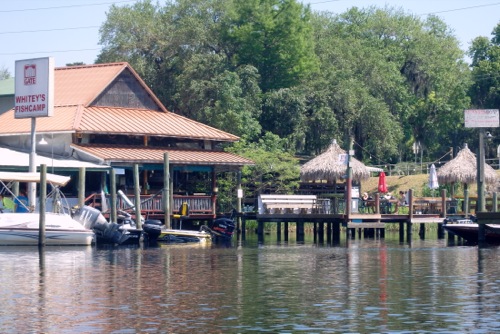
After dropping the anchor and relaxing a little, we took the dinghy up Swimming Pen Creek to do a little exploring. We saw lots of birds, but no alligators yet. On our way out of the creek we stopped at Whitey’s Fish Camp to enjoy a beer, the view and some fried alligator tail. Our adventure this summer is going to be very laid back…up late, coffee on the flybridge, start cruising late and stop early and take in everything we can. No hurries, no worries this summer.
One last look of Jacksonville
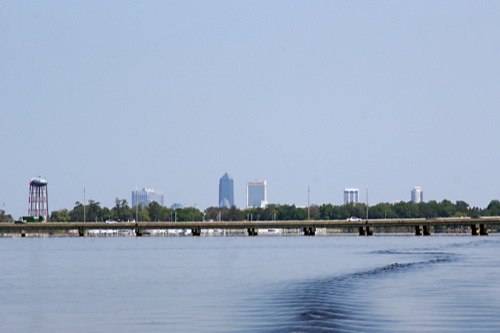
A few of the houses in Doctor’s Lake

Exploring the creek
Whitey’s Fish Camp
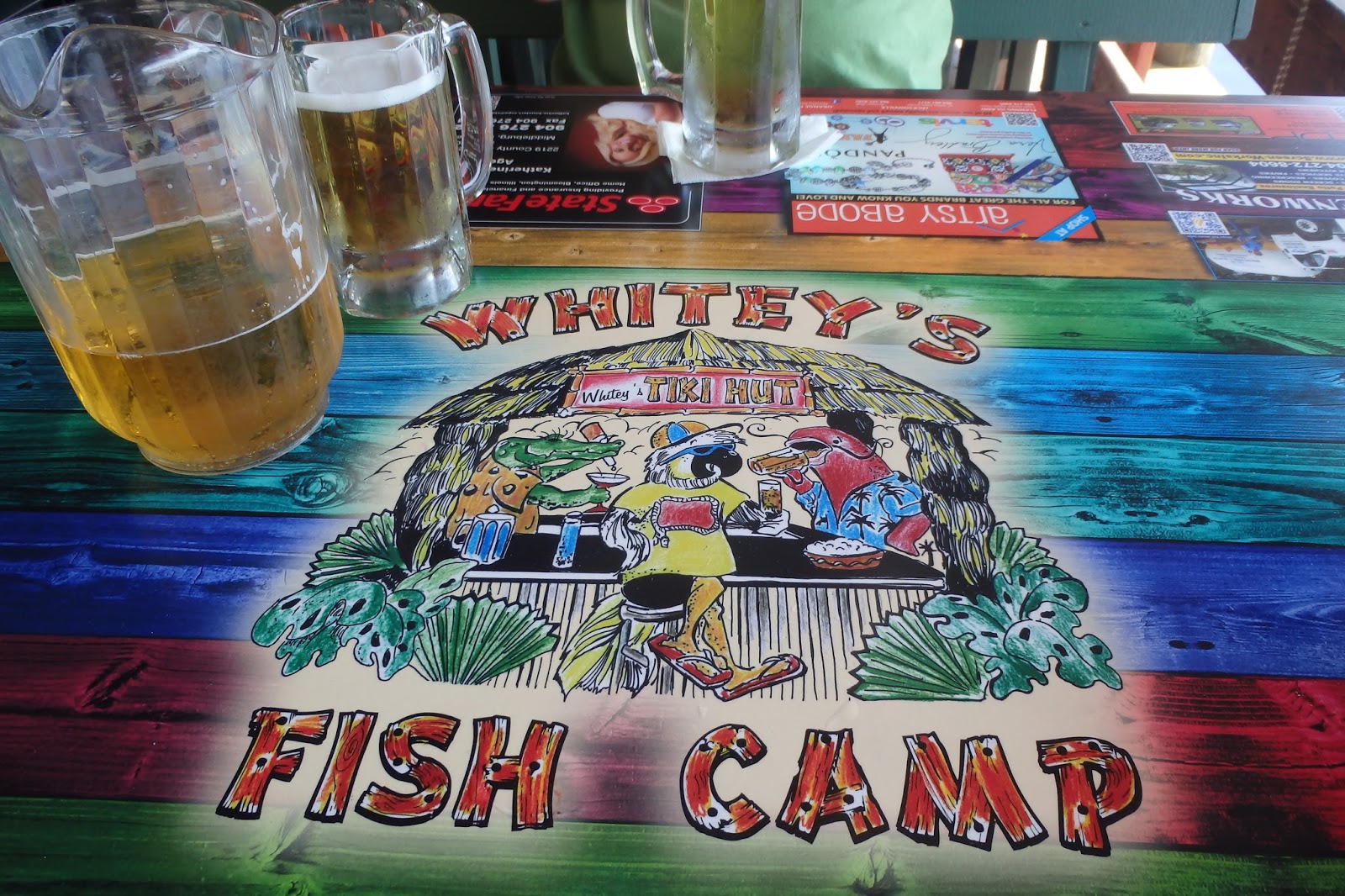
Alligator Tail Basket
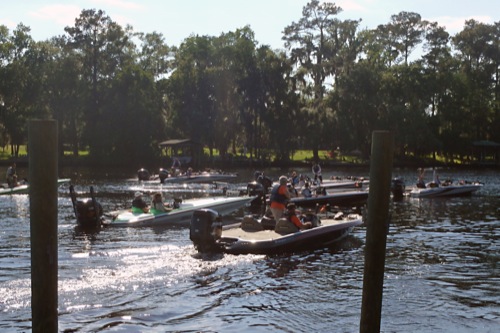
The start of a bass tournament that leaves from Whitey’s every Thursday evening. Can you see the size of those motors…these boats can fly!