I am happy to report that Sans Souci will soon be back on the water!

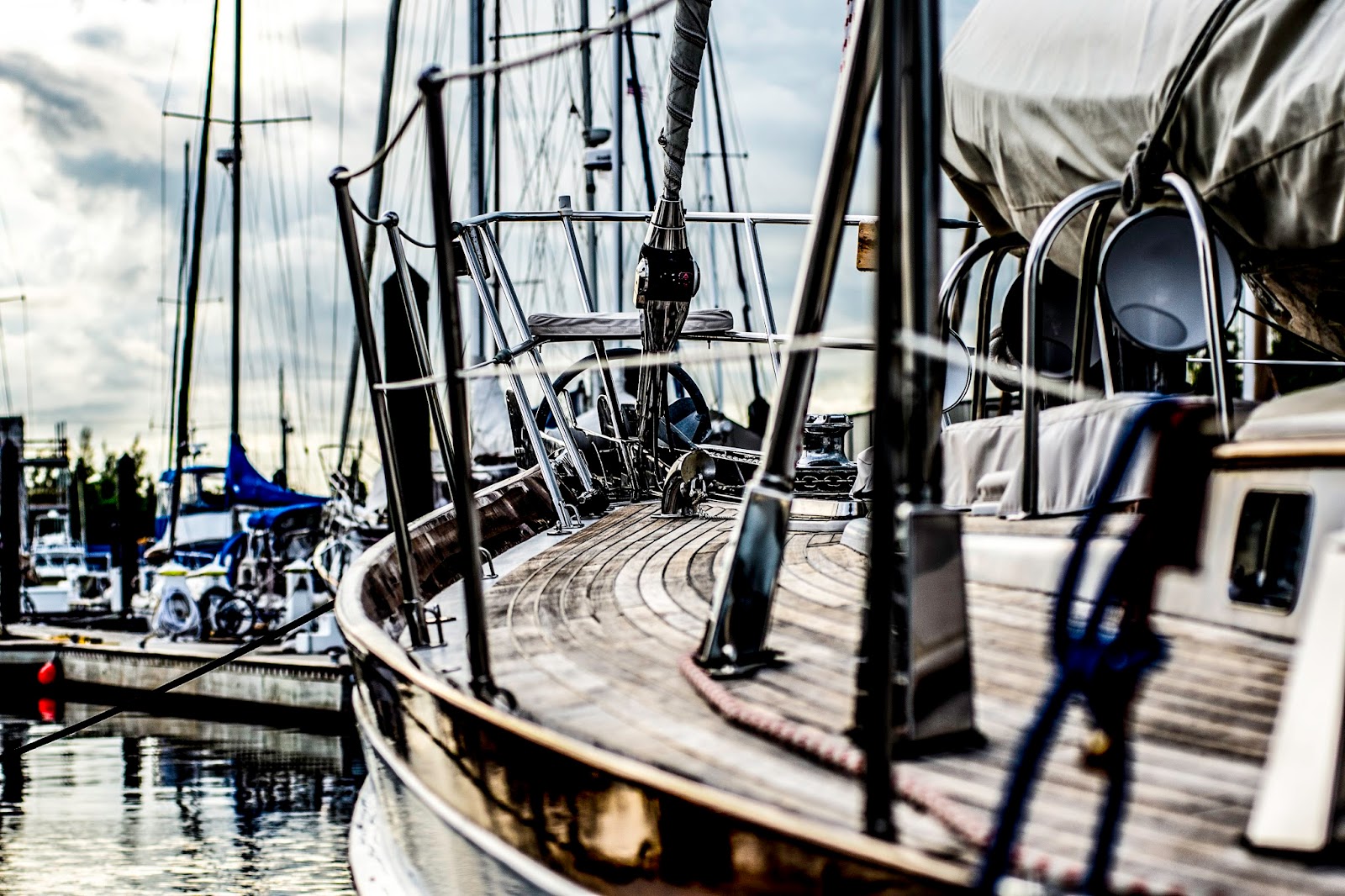
Sans Souci sitting at the dock in Seattle
A quick recap:
Last December we shipped Sans Souci from Mallorca Spain to Seattle. This was the final chapter in what was loosely intended as a circumnavigation. From Spain we had planned to cross the Atlantic and cruise the Caribbean, but Sans Souci had been away from home for seven years and was starting to send us subtle messages that it was time for some extensive maintenance.
We still think of Sans Souci as a new boat, but she wasn’t looking so new anymore. Over the nine years we have owned her she has taken us (and our pups) to twenty countries while running nearly 40,000 miles.
Sans Souci was running fine, but was she ready for another ocean crossing? And, more importantly, were Roberta and I ready for another ocean crossing? We knew the answer to that one. We were both eager to get home. There were some big things happening in our personal lives, and we knew that it was time for a return to reality.
When not on the boat we have lived most of the past twenty years dividing our time between Seattle and Mexico. We had decided to put our home in Mexico for sale and had a lot of work to do to prepare for the sale. We needed to get focused on readying the home for sale. (NOTE: I am happy to report that our home sold quickly and easily.)

Another great reason to bring the boat home to Seattle! We have a boat slip at one of the greatest marinas on earth: Roche Harbor. We have been paying the moorage for a decade but Sans Souci has never been in its own slip. We’ve been too busy exploring the world. But, as Dorothy once said, “There’s no place like home!”
All of which is the long way of saying, Sans Souci has been going through a major renewal for the past eight months. But, within a few days we get her back!
The balance of this article describes the work that was done. Those of you not interested in technical details may wish to stop reading now.
The largest project was the installation of American Bow Thruster’s At Rest (STAR) stabilization system.
Regular readers of my blog might recall that we spent a lot of miserable nights in the Med this past summer. The southern coast of France and Spain are incredible, but there are very few good places to anchor. And those that are good are so crowded that the wakes from all the boats — during the daylight hours — make for very choppy water.

We have large plates, called Flopper Stoppers, that we hang off the side of the boat. These giant plates dampen the motion of the boat while sitting at anchor. However, the waves were frequently so strong that the flopper stoppers were rendered useless. In this picture the swell off Cap Ferrat France was strong enough to tear apart the clips used to hold our flopper stoppers.

The Flopper Stoppers are only used while we are at anchor. When the boat is underway we use giant fins that sit beneath the boat, called “Stabilizers”. They work by pivoting to counteract the waves as the boat moves through the water.

The stabilizer fin, which is outside the boat, is pivoted by a large hydraulic-piston driven disk, called an actuator, that is inside the boat.
When I first heard about the STAR (STabilization At Rest) system I thought it was a simple software upgrade to my system.
But, as I started doing research, I quickly realized that without the main engines running there would be no hydraulic pressure to move the pistons that control the actuators (that move the fins). Unfortunately, the main engines can’t be used to power the stabilizers at anchor, because the stabilizers don’t require much horsepower to move back and forth. Running the main engines for hours with virtually no load would be hard on my main engines and shorten their life.
And, so began the slippery slope…
Making a VERY long story short, I discovered that I needed an alternate source of hydraulic power. There were two options:
A) An electrically driven pump (powered by my generator)
Or B) a hydraulic pump attached directly to the end of my generator.
I chose Option A, even though it was the less efficient and costlier method. The decision for me was based on where I could place the pump within the engine room. If I had put a pump directly on the generator it would have required space in a part of the engine room where no space was available. It would have blocked the door to the lazarette.
Powering the fins was only one piece of the puzzle. The fins required for ABT’s STAR system are slightly longer and skinnier than those required for stabilization while running. ABT advised me that for the best result I would need to upgrade to larger and differently shaped fins. I would be moving up from 12 square foot fins to 16 square foot fins.
And, bigger fins would mean bigger actuators.
The slippery slope gets steeper…
Installing the new larger actuators created more challenges than expected. Because of the tight place they’d be going, the new actuators had to be custom made in order to fit my boat. We then had to add a larger hydraulic tank to handle and cool the extra hydraulic fluid, and a hydraulic accumulator tank to help smooth pressures in the hydraulic system.

My new larger hydraulic tank
We also discovered we needed a large electric box called a Variable Frequency Drive (VFD) to convert the single phase electricity coming from my generator to the three-phase electricity required by the hydraulic pump, and to smoothly phase-in the load on the electrical system when starting the pump.

A cardboard cutout was made, to show where the new actuator would reside, so we could look at the clearances around it

Here you can see how thick the hull is: Four inches thick of fiberglass! As thick as it was, we still hired an engineer to determine whether or not the new larger actuators and fins could be so strong as to rip apart my hull. The result was that the hull had to be reinforced.

I can’t claim that I understand this process, but the mechanics used a large tennis ball to get everything nicely centered.

My new stabilizer fins being fitted to the boat

My new fin partially painted. Looking up, I noticed the captain of a passing 747 aircraft looking down jealous of my new wings
Another large project was replacing all of the air handlers (air conditioning units)…

I asked that Jeff (my mechanic) replace the air handlers in the main salon and gallery as they were very noisy. This lead to inspections of all the air handlers, all of which were discovered to be near failure. We’ve been running in hot humid places for most of the last nine years and my directive to the mechanics was to get me ready for another nine years of adventure. Here you see some of my air handlers sitting on the ground.
Our project to replace the air handlers became much larger than originally planned. What started as replacing the two that we knew were failing became a project to replace all of the air handlers in the boat AND MORE.
For those of you who have no idea what an air handler is, I’ll give the briefest of explanations.
Sans Souci’s air conditioning and heating system is comprised of four major parts:
– Chillers: These are refrigeration units that sit at the back of the boat and provide the cooling
– Kabola: This is a diesel furnace (a furnace powered by diesel) that provides heat to the boat
– The Loop: There is a loop of water which constantly is circulated around the boat. This loop is full of cold or hot water, depending on if we want to cool or heat the boat
– Air Handlers: These look like old-fashioned heating radiators, and function exactly the same way. Air is blown across the cold (or hot) loop and into the room.

While replacing the a/c air handlers on my boat the mechanics took a look inside the ducting. This is one of the wood grates through which cooled or heated air is delivered into a stateroom

While swapping out the air handlers we hit a scary surprise. Mold!!!! We had no idea that mold was growing. Yuck! Another of the “pleasures” that comes from cruising for years in hot humid places. This discovery meant we would need to replace or clean all of the ducting and grills throughout the boat.

Our new thru-hulls!
Each year during the off-season one of the many tasks I give my mechanics is to “exercise” my thru-hulls. These are the holes drilled into the hull through which cooling water flows into the boat or out of the boat.
I remember in Captain’s school that one of our projects was to write down a list of thru-hulls on our boats. There are more than one might think. Here’s a list of the thru-hulls on Sans Souci:
Intakes
– two intakes for the sea chest (to reduce the total number of thru-hulls a common “chest” is used to distribute raw water to the generators, hydraulic cooling and a/c chiller cooling)
– An intake for each of my two watermakers
– Two intakes for each of my two main engines
Exits (these are all smaller)
– Two exits for the watermakers (above the water line)
– An exit for gray water (beneath the water line)
– An exit for black water (beneath the water line)
– Two exits for the watermakers (above the water line)
– An exit for the a/c chiller cooling water (above the water line)
– Two exits for the generators (above the water line)
As you can see, there are a bunch of them! And, I’ve probably forgotten some….
If a hose ever bursts that leads to any of the below water thru-hulls it could be a bad day. And in fact, hoses do burst or spring leaks from time to time. Also, when equipment is bring worked on, hoses often need disconnected. This is where the valves on the thru-hulls come into play. Each thru-hull has a lever which can be used to open or close the thru-hull.
I’ve never asked a boat surveyor (inspector) but I’d bet that they frequently find thru-hulls that are rusted and inoperable on the boats they inspect. Should a water leak occur while at sea, closing the thru-hulls is the first line of defense against water flowing into the boat. I’ve tried from time to time to close a thru-hull and found it almost impossible. I avoid doing so because the thru-hulls typically have popsicle stick sized handles. If one were to snap off while half-open water would be flowing into the boat and stopping it would be difficult.
We decided to address this issue pro-actively. Sans Souci’s thru-hulls were replaced with the butterfly-valve based thru-hulls used on large commercial vessels. I haven’t had an opportunity to try yet, but the mechanics assure me that they can be opened or closed with fingers. Much better!
And.. Another project; one that I knew would be difficult but needed to be done
I have been fighting for years a nagging overheating problem with my engines. To be technically accurate, the engines have never overheated, but that’s because I have been babying them, and babying should not be required.
My main engines are what they call “continuous duty” engines, meaning they are supposed to be able to run continuously at their full rated output (340hp per engine.) However, I’ve never been able to run them at more than about a 50% load without the temperature climbing precipitously.
I’ve asked about it to the manufacturer over the years, and taken a long series of steps meant to improve the situation, but nothing has been effective. I haven’t considered it a major issue, in that my boat was designed to be run with a single engine. Having two of them at half the output works just fine. But, I’ve known for years that it was something that would need fixed when the boat got back to the US. There are times when I need to be able to “run up” the engines without having to worry about them overheating. For example, once a day when on long passages I should run my engines up to maximum throttle for 15 minutes. It’s good for the engines, and I’ve done it, but it is spooky to see the engine temperatures climb into the red zone even if only for a few minutes.
Because my boat has been in out-of-the-way places, I’ve not been able to get representatives from Northern Lights (maker of the engines) onto the boat to look at the problem. We’ve been emailing each other from time to time.
This time, with the boat in Seattle, I said “I want it fixed once and for all.” In the past we tried to address it by focusing on ventilation in the engine room. I beefed up the fans, with no improvement.
Our latest idea was to focus on the cooling water to the engines. Essentially every piece of plumbing was removed from the boat and replaced with beefier hardware and larger pipes. Places where the hoses made sharp turns, or where water runs were longer than necessary were looked at and fixed. Effectively, we started over and designed a whole new raw water cooling system.

Various bits and pieces of my raw water cooling system that were removed from the boat

My original sea chest. They had to break it apart to get it out of the boat. Not only did I want something larger, I never liked where it was located. Some of the valves were in impossible to get at locations, and others were running through a loom of wiring.

The new sea chest! Much larger!
Virtually the entire raw water cooling system on the boat was replaced and upgraded. We just did a sea trial, and for the first time since I’ve owned the boat we were to run both engines at 90% load (I didn’t have the courage to push them to 100% load) without overheating. Yay! We nailed it.

My props, newly straightened and painted with propspeed (a slippery substance to stop crud from growing)

New Furuno displays — more than just color vs b/w
I replaced the Furuno displays around the boat with the newer model color displays. I haven’t tested this yet, but allegedly this display has a feature which I badly wanted. I want to be able to set an alarm based on wind speed. Specifically, I want to be able to set an alarm that says something like, “Wake me up if the wind speed exceeds 30 knots.”
I know my anchor and have confidence in it. But, there is always some maximum wind speed above which I’d want to be awake and at the helm. Traditionally, I have set anchor watch alarms (alarms that are based on the distance the boat moves from the point at which it was anchored.) But the problem with those is that they only wake you if there is a problem. I want woke earlier in the process; when there is a situation (high wind) that might lead to a problem.

New carpets, dings removed from wood, etc
The boat is just starting to be put back together as I am typing this, so there isn’t much to show, but we are repairing all the fiberglass dings, wood dings, replacing the carpets, refinishing the tables, replaced the non-skid on the bow, fixed dings in the teak deck. My instructions were that I wanted the boat back “better than new.” I have no doubt it will be.

I’ve never seem fiberglass repaired. It looks much different than I expected. I’m guessing they put this putty on, sand it down and then paint it.

In addition to patching all the dings, we replaced the

This is something I’ve wanted to do for years. We added a new rubber bumper at the back of the boat. When approaching the stern on a tender in rough seas it is VERY common to bang the swim step. I am tired of taking dings out of the stern year after year. This bumper should help me improve on that situation.

Sans Souci’s AV system is hubbed by a 16 input, 16 output Crestron HDMI Matrix Switcher. Any monitor anywhere on the boat can pull up any video/audio stream.
I should start this discussion of what we did to the audio/visual system on Sans Souci with a brief bit of history.
When our boat was first being built I decided to have all of the navigation, communications and entertainment hardware specified and purchased from a company in Florida called “Larry Smith Electronics.” (LSE) I chose them because I wanted a first tier company and at the time LSE was doing a lot of the east coast high-end yachts. They were an impressive company and delivered proposals to me that were very expensive but I felt confident I would have the best.
However…. what I didn’t know was…
Behind the scenes LSE was struggling financially. I gave them a large chunk of money and they shipped the wiring for my boat off to Taiwan to be installed. Taiwan installed what was literally a ton of wiring.
At which point LSE went belly up, taking my money with them, and that wasn’t the worst of the problems it created.
I quickly contacted Nordhavn’s normal electronics company (Alcom) to have them take over the project. They worked with the builders in Taiwan and did a great job.
Except…
Each electronics company has their own way of doing things. In some cases they used the wiring LSE installed, but in many cases they did their own wiring. My boat finished with two sets of wires.
Then add to it that over the past eight years I have upgraded the boat’s electronics several times, with each new effort resulting in another set of wires.
The final result was that I had lots of wiring much of which went nowhere, and no up to date schematic showing how the system worked. We had reached the tipping point.
So, I had the mechanics rip all of the wires out of the boat and start fresh. This alone was an enormous but much needed project.
My regular mechanic, or a better description would be ‘Yacht Management and Maintenance Guy,’ (Jeff Sanson, Pacific Yacht Management) used his own people to do much of the work, but this phase of the project was driven by a third party company out of Seattle that Jeff introduced me to. They are incredible and VERY recommended. I worked with another Jeff, this time named Jeff McMillan, at Fastclock.net to completely bring up to date all of the electronics on the boat.

I had an M9 satellite tv system but it wouldn’t do HD, so … it was replaced by the newer HD7 system
What I did and what decisions were made is a very long story. But, the diagram above gives a quick overview.
The design goals were:
– Any TV or monitor on the boat can access any video source
– Maximum quality everywhere (HD) That said, I told them not to worry about 4k video. I might regret that decision someday, but it felt premature at this time.
– Gigabit internet everywhere
– Separate VLNs (networking) for the navigation system, monitoring system, and entertainment systems. I didn’t want any slowdown anywhere on the boat for internet.
– Wifi everywhere on the boat, at full speed, with no dead spots
– No risk of failure. Should the Crestron “brain” at the center of my new system die, I needed redundancy such that I would still have the essential gear (chart plotter, radar)
– Simple to use. I’ve decided I don’t like video based remotes. They make sense to me, but non-geeks on the boat always prefer something with real push buttons. We ultimately went with a combination of push button panels and physical remotes

The computers, Apple TVs, network switches and file server – hiding under the chart table in the pilot house
As long as everything was torn apart I did something which was considered crazy at first, but which I am convinced was the right answer.
I rely on Nobeltec, running on a Windows PC, as my primary chart plotting system. As a backup I used Furuno’s Navnet 3d. Both are good systems, but they are different systems, and I’ve had problems with reliability on the Navnet 3d system.
For simplicity I wanted to standardize at the helm.
So, after thinking about it, I said, let’s rip out Navnet 3d and just give me two identical computers running Nobeltec. This raised the issue that my backup radar had been dedicated to Navnet 3d. Thus I said, let’s just get a duplicate of my primary radar (A Furuno BB 2127 amazing radar.) My thought was to use my older 2127 as my backup radar and make the new 2127 my primary radar.
I now have two identical systems that are fully redundant, that can be brought up on any monitor or tv on the boat, and they work exactly the same way.
And finally, we had some decorating maintenance done: new fabric on outside settees with new decorative pillows, all new canvas covers, including the bimini, sanding and resealing all exterior wood, a new table for the stern cockpit, renewing the exterior granite counter, new carpet for the staterooms, and a brand-new sofa as the old one was falling apart.
The test drive!
After eight months in the shop, last Thursday, we were finally ready for a sea trial. I could not wait to try out my new stabilizers.

The Ballard Locks

Salt water! For the first time ever I was disappointed to see flat water. How was I going to try my new stabilizers with no waves?
There are a couple things to note in this picture. The tender on the port side is brand new! After years of thinking about what to replace our existing tender with we decided to just get a brand new version of exactly the same tender. It is a 15′ ABT DLX. We beat the heck out of our prior tender and it just kept running. We never had a problem with it, but as I look down the road, its time had come. On the starboard side was a smaller tender that never got used. We replaced it with some fun “paddle by foot” kayaks.
Check out this video about the new kayaks:
http://www.hobiecat.com/miragedrive/

me (Ken Williams), Rich Barnes from Pacific Yacht Management and Dave Wright from ABT. Rich is smiling because he was the key player in getting all the nav gear to speak to each other, and it was working fine!

Doug Janes – Doug, along with Micky Smith (Pacific Yacht Management) were the lead architects on my new electrical, hydraulic and raw water cooling systems. At Doug’s knee you see the front of my new sea chest and get a sense of how large it is.

Jeff McMillen, from Fastclock (and, me!) We are just returning from the successful sea trial. Note how happy we look!

The famous Mickey Smith! Mickey (Pacific Yacht Management) and I have a long history dating back to when I made video games and he was our liaison at Intel. Mickey went on to designing the electrical systems for Nordhavn, and was a Nordhavn 62 owner himself. Most recently he was in China designing electrical systems for yachts and now works in Seattle for Jeff (Pacific Yacht Management.) Jeff really did assemble a triple-a team to work on my boat!
The sea trial was a huge success!
That said, it was a success in a lot of areas, but not in the area where I was the most curious. I have no idea how these stabilizers will perform when running in heavy seas, or even when sitting at anchor while trying to sleep in a heavy swell. I am 99% certain the new stabilizers are a huge step forward but our test drive was thwarted by calm seas. We did what we could to generate a little excitement, by zigzagging and trying to run over our own wake, but nothing we did provoked much action from the stabilizers. They are set to counter an angry ocean, not to wobble their way through six inch seas. Earlier today Jeff and his team tried rocking the boat from side to side at the dock to see how the boat would behave, but it really accomplished very little. The real test will come only when I take the boat out in real-world conditions.
On Friday of this week I will recover the boat from the mechanics and start this year’s cruising.
All of this took time and money … but … we don’t know when the boat will be back in the United States again and we wanted to do everything on our wish list before setting out on our next big adventure.
Which raises the question, what cruising?
We have no idea where we’ll cruise next!!!! We have discussed Latin America, the Caribbean, Bermuda, Hawaii, the East Coast of the US, the West Coast of the US and more.
We had originally thought that we would be cruising around the Pacific Northwest this summer, but the work has taken longer than we thought. Our plans are completely unknown at this point, with the probable case probable case that we’ll stay here in the Pacific Northwest — next summer season as well. We want some time to cruise our beautiful islands and coast before setting off on another lap around this planet we call home.
Until next time,
Ken and Roberta Williams (and the pups: Toundra and Keeley)
N6805, Sans Souci
PS If you have questions or comments about this blog entry, the best place to post them is on Facebook at: http://www.facebook.com/kensblogdotcom