Tag Archives | Nordhavn

ENVOY NOW IN THE WATER AND PROGRESSING TOWARDS CRUISE MODE

Envoy has now moved to Gouvia Marina, Corfu.
We enjoyed the process of getting Envoy prepared for cruising having decided not to worry about meeting any time schedule and take each day as it comes – not becoming frustrated when as often happens contractors don’t turn up on time or at all. In 2014 preparation took us four weeks and this year just a day over three so we thought we’d done pretty well.
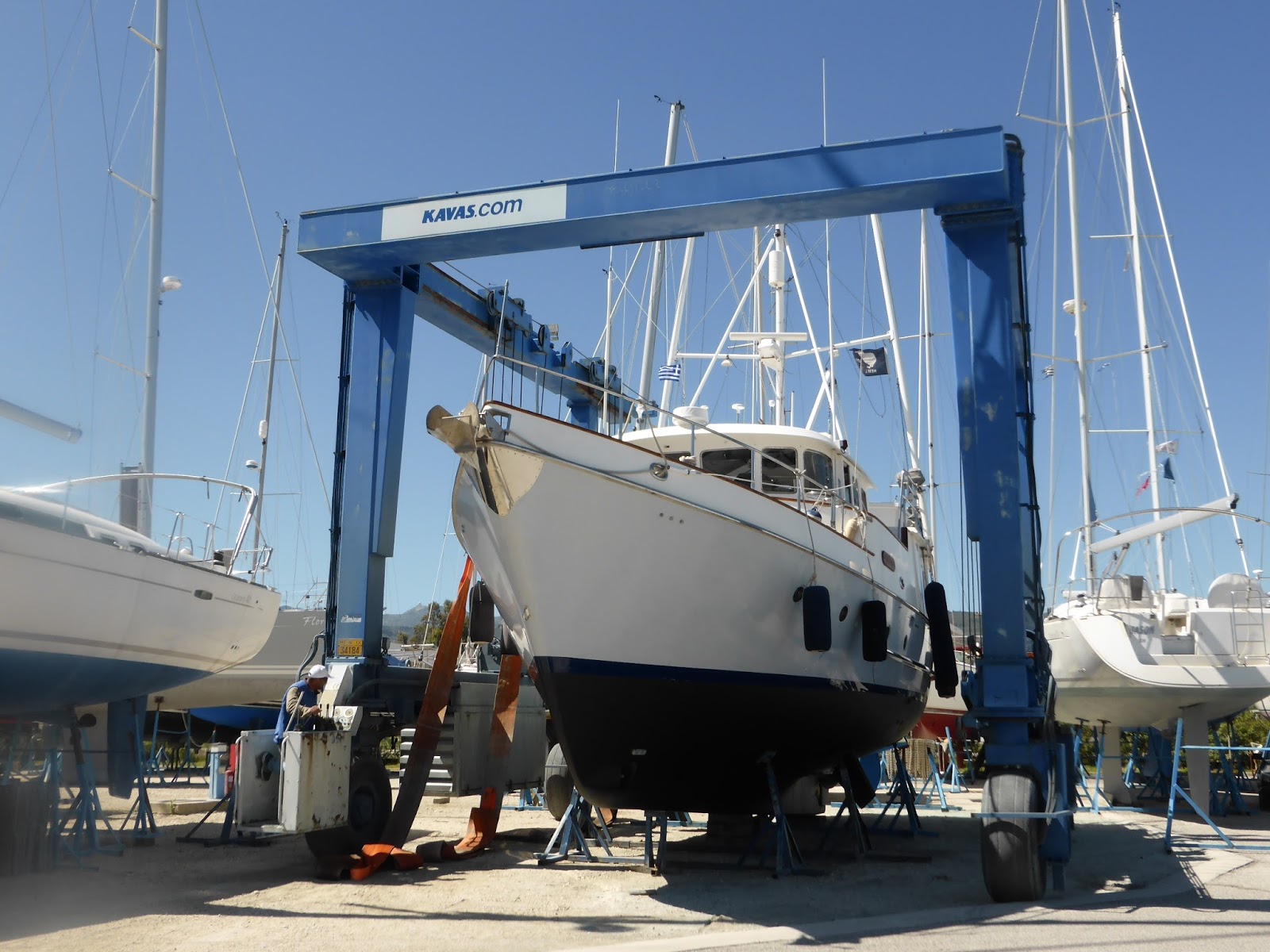
Envoy went into the water nearly two weeks ago on a beautiful sunny day with great excitement on our part. The travel lift operators always give you plenty of time to check for sea water leaks and after half an hour we had none. But when we checked again after docking into our marina berth we had a couple of minor leaks, both of which have been resolved.

Envoy going back into the water

We’ve not had good results with various propeller antifouls over the years so took them back to gleaming bare metal and coated them with lanolin to see how that goes.

Envoy’s propellers

The weather here has been great with light winds and temps in the low-mid 20s.
During the first days here we visited Vodafone to sort out both phone and internet connections and always find them incredibly helpful. Using our Mobile Broadband Device we can connect using our iPad and laptops simultaneously. Di’s laptop wouldn’t start up so she took it to a local repair shop who not only fixed it but upgraded it to Windows 7 – all for 30 Euros (about NZ$50). Now it’s working great and much faster.
Although there are no obvious signs of economic issues here, locals tell us that unemployment is a real issue particularly in the big cities, and that many young people are leaving to get jobs overseas. While people are stoic about the situation they don’t see it getting better any time soon.

Di’s on-board herb garden

We had to spend about three hours with our agent – A1 Yachting visiting the Port Police, Customs and regular Police to get our documentation sorted out for cruising here. Although in Greece it’s possible to do this without using an agent, we’ve found A1’s assistance over the years to be invaluable, saving a lot of time, hassle, heartache and cost – especially this year as some new laws come into effect on 1 May and nobody is totally clear on how they will work.

The day of our sea trial in the Lefkas canal was stunning and not much of a test for our stabilisers

There’s been some progress on items mentioned in our last Envoy blog:
1.The domestic fresh water heater’s water leak is fixed and it’s feeding hot water to all the right places. The mechanic who removed and reconditioned the unit hadn’t connected it back correctly, but now all good.
2.Our large RHIB and Yamaha 25hp outboard has been finished and sea-trialed. The sounder is working well and a wiring fault which caused the auxiliary power supply (to sounder and vhf) to shut down has been fixed. Here in the EU there is a requirement that fuels must have 10% ethanol content for so-called environmental reasons. While the environmental grounds for doing this are very dubious the practical result is very negative for the boating community because ethanol is hygroscopic and the Yamaha mechanic told us many of the problems he resolves are directly related to this – particularly moisture and “sugar-like” deposits in fuel systems. It’s not so bad in cars because the fuel is used more quickly and doesn’t have time to attract moisture, but outboard motor fuel for example is often kept for many months or even carried from one season to the next. The advice now is not to keep petrol more than a few months, never from one season to the next and to add fuel conditioner – we are now using a “Wurth” product. It’s also an issue in diesel and we are now using Stanadyne as recommended by Lugger and several industry gurus.
3.The boom winch which I reported as not operating is actually fine – I’d just forgotten how to operate it correctly.
4.Two new Deka bow thruster batteries have been installed along with a new circuit breaker as the previous one failed (after doing its job) when the short circuit occurred that caused the battery problem.
5.The Naiad stabiliser’s hydraulic rams have had new seal kits installed and are working well. The 12 volt pump providing sea water for cooling the hydraulic oil didn’t work so we’ve replaced that with our onboard spare. We also changed the hydraulic fluid filter and I had wanted to change the fluid as recommended by Naiad to do every two years, but the mechanics talked me out of this as the current fluid, has only been used for a few hundred hours, is filtered, looks perfect and – as they said “heavy hydraulic equipment is frequently operated nearly every day for many years without the need for fluid changes”.

Most equipment has now been tested and working OK but I still have to test the watermaker – I didn’t want to do that while in the marina with dubious water quality.
Other issues which have arisen are:
The Yanmar wing engine wouldn’t start and following analysis by Sailand’s mechanic a new fuel lift pump was installed and all now OK. The Genset wasn’t starting easily so the electrician tested the glow plug and found there was no current reaching it. A new relay fixed that.
The Lugger engine wasn’t starting easily so Sailand’s electrician measured the voltage at the starter finding it to be very low. He suggested making and installing a heavy duty earth cable between the engine and the battery bank’s negative earth busbar. This has been done and starting is now excellent. At the same time he checked the battery bank’s parallel switch for emergency starting and considered it to be too light for the amps involved, so sourced and fitted a new one for us.
The Lugger’s throttle cable jammed just as we were manoeuvring out of the marina for a sea trial – which was disconcerting to say the least, so Sailand recommended fitting a new control unit and throttle and gear cables (none of which had been replaced in at least 10 years). This installation took most of a day as the lengthy cables travel between decks and it’s very hard to access some of these spaces and then feed the cables through.

Laurie with old throttle and gear cables

The only job Sailand ran out of time to do was to machine polish the superstructure gelcoat so this is one that Diane and I will have to roll up our sleeves and do ourselves.

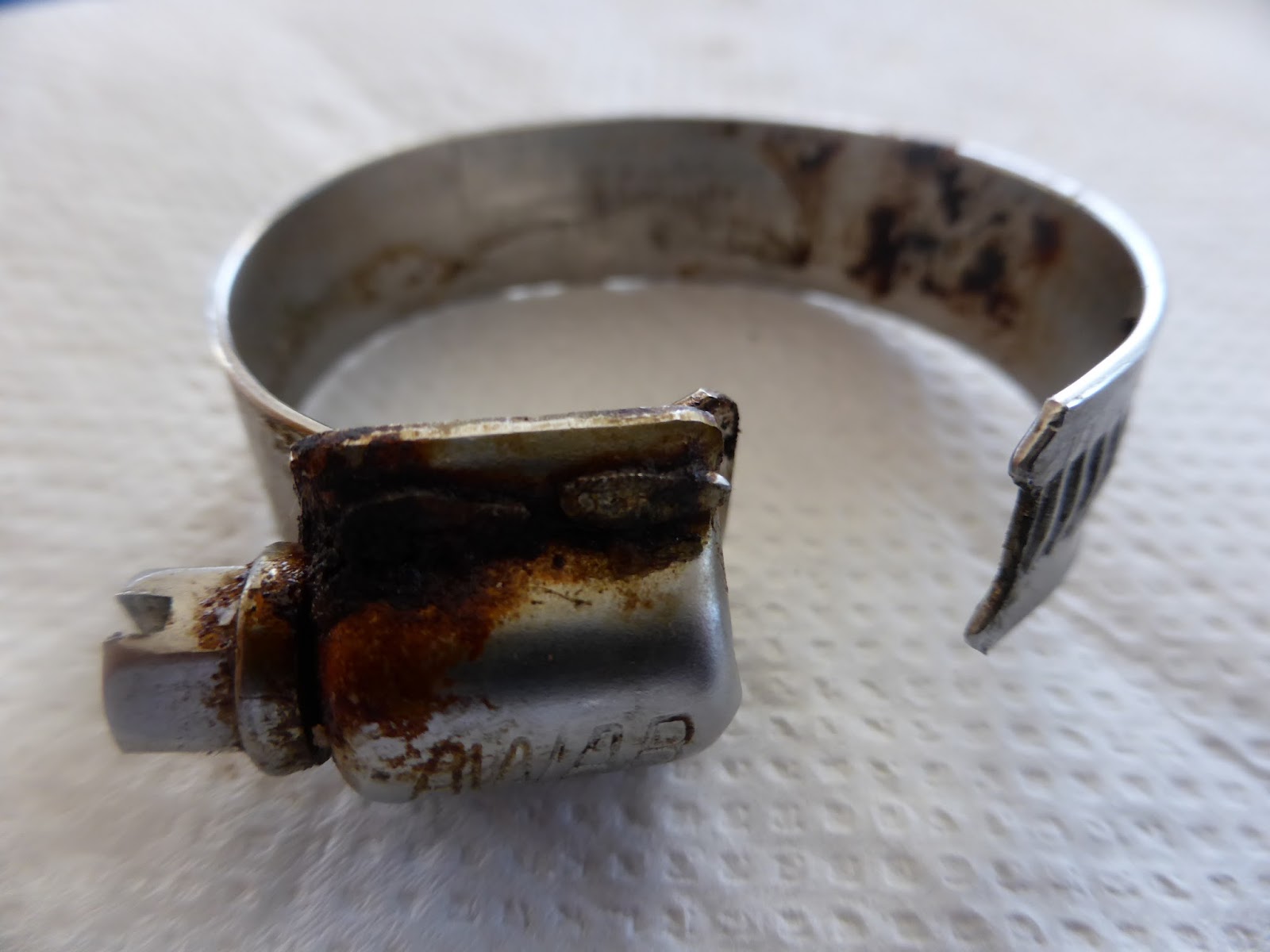
Rust never sleeps! Throughout Envoy are many dozens or possibly a few hundred hose clips. Any rusted ones need to be replaced. They should always be installed with the tightening bolt on the top side of the clamp so that any drips of water don’t contribute to rust. This one was installed bolt down on a bilge pump hose.

Our “To Do List” always looks pretty daunting to begin with and I must say it’s very satisfying to look at our list and see 79 items ticked off with only a few non-urgent ones remaining.

[kensblog] Sans Souci gets a new life

Sans Souci, Nordhavn 68
[kensblog] Sans Souci gets a new life 5/4/2016 2:53:21 PM

Sans Souci is in Seattle!

I still think of Sans Souci as our “new boat.” It replaced a smaller boat from the same manufacturer (a Norhavn 62 which bore the same name.) I remember when she was built and all the excitement of customizing her, traveling to Taiwan to watch her built, waiting anxiously as she was delivered to the US aboard a freighter, and finally starting the engines for the first time.

That was only about eight years ago, but since that time she has taken us over thirty thousand miles, south to Costa Rica, north to Alaska, then across the Bering Sea, through Japan, Taiwan and Hong Kong. In the Eastern Med we explored Turkey, Greece, Malta, Croatia, Montenegro. Then to the Med where we explored Sardinia, Italy, Spain and France. It has been an amazing journey.

Sailors (and, us power boaters) have been known to claim that the true definition for the word “cruising” is “Fixing your boat in exotic places.”

Salt water is corrosive. It may be pretty, but the same sea spray which feels so good as you move through it is constantly eating away at everything on the boat. Plus, think about the toll that bouncing over ocean waves takes on a boat. Imagine even the best-built of homes, and what would happen were you to dangle it from a giant bungie cord rising and falling every few seconds for months at a time. And, then think about all the systems on a boat; four different electrical systems (12v, 24v, 120v, 240v) with electricity that we make ourselves, water that we make ourselves, satellite communications equipment, navigation equipment, satellite tv positioning systems, grey water system, black water system and much more. Boats are comprised of dozens of intricate systems which live in a highly corrosive environment.

The bottom line: Those of you who are reading this particular blog entry hoping I’ll talk about sexy and exciting places to go may as well stop reading now. Sans Souci has put on a lot of miles over the past eight years and the time has come to “make her new again” before we set out on our next big adventure.

I’d also say that if you are someone hoping to buy a boat, hide this article from your significant other. It is best if she or he doesn’t figure our what boats really cost, or how much work they are, until later.

The rule of thumb on boats is that one should estimate about 10% of the purchase price for a boat as the annual maintenance budget. I could never understand how people could spend that much, but … as you’ll see reading this blog entry, I’m doing a few years of “catch up” this year!

Each season as we cruise I make a list of things that need fixed. This has meant shipping spare parts around the world.

During the off-season, Jeff my Seattle based mechanic and his team fly to wherever I’ve left the boat and start working on the annual maintenance. This has meant getting work done in dozens of countries, each with their own import regulations, access to parts, and languages. Some countries, where you would think it would be easiest turned out to represent a serious challenge. In Japan we struggled even to find engine oil. Jeff did a fantastic job, but the fact is that getting the right people and the right parts, while traveling internationally, is not easy and in some places it is impossible.

There are many projects which we decided were best handled when the boat returned to Seattle.

This past season Roberta and I really started sensing that the time had come to bring Sans Souci home. The boat was running fine, and if we had needed to cross an ocean, I have no doubt we’d have made it without having to pull out the oars. But, there were dozens of little ways in which Sans Souci was sending us a message that she wanted some loving of the sort Jeff could only give her back home in Seattle.

We had planned to cruise this past summer in the Caribbean along with our GSSR partner boats Seabird and Ocean Pearl. However, there were lots of reasons why it just didn’t happen. In addition to our sensing that Sans Souci needed serious maintenance, we had some personal issues that pulled us home.

Some of you might know that we have lived, when not on the boat, in Mexico for the last seventeen years. Last year we decided to build a home in the California Desert and sell our home in San Jose Del Cabo, Mexico. We were working with an architect to design our new home, plus needed to get our home in Mexico ready for sale. Our home in Cabo took a direct hit from a hurricane a couple years ago. We had made most of the repairs but there was still some work to do to get the home ready for sale, and the toughest was to break the news to our friends and neighbors that we’d be moving. This was particularly rough in that we had created a life so good that no one understood why we’d be willing to blow it up. All we could say in response is that we did it because at the core we are wandering nomads. The perfection of our lives in Cabo was part of what we wanted to change. We like new places, new things, new challenges, new restaurants, etc. It’s why we cruise the world. Our life in Cabo was too comfortable and we wanted to shake things up.

It was time to send Sans Souci home and focus on events at home.

Anyway .. this all brings me to the work that is now well underway.

Like all boat repair lists, ours started small and grew.

Initially, all we wanted was to update the boat cosmetically. The carpet was worn. Our doggies had put some scratches in the wood floors, there were dings in the cabinetry, fiberglass that had been bumped by the tender, the couch in the living room was starting to sag and the outside cushions had faded.

No decision has been made on where we will be cruising next. We don’t know if it will be in the continental United States or if we’ll be heading somewhere off the grid. We have discussed heading back to Alaska, but we have also discussed Hawaii, the Caribbean and South America. Our assumption is that we’ll go somewhere and that it probably means that this is our last bite at the apple for major boat repairs before we start another five to ten years of having the boat away from home. Whatever we do next we know that we want the boat made new before we begin, so that our next thirty thousand miles are as trouble free as those that have already passed beneath our keel.

There was only one really big project we were discussing…

Those who read my blog this last season were frustrated by reading me whine in virtually every blog entry about our inability to find a calm peaceful anchorage. We have “flopper stoppers” – giant trays we hang off the side of the boat which help keep the boat from being tossed around when our anchorage isn’t calm. Normally these do a great job, but they were inadequate for the unprotected anchorages we found in the Med. We ripped the trays off the boat on a couple of occasions and were miserable at anchor for most of the season.

Thus, I started researching “at rest” stabilization.

When Sans Souci is underway we have giant wings under the water that look like stubby aircraft wings. As we move through the water they pivot in an effort to keep the boat flat. If you’ve ever put your hand out the window while driving you know how they work. But when sitting still, they do nothing to keep the boat from moving with the waves.

The first option I explored was the gyro based systems, like Seakeeper. These work by spinning a giant ball at very high speed to stabilize the boat. Remember the tops and gyroscopes we had as kids? It’s the same principal, and they do work.

But, unfortunately, a gyro based system wouldn’t be possible on Sans Souci. The gyros grow in size based on the weight of the vessel they are trying to stabilize. A gyro sufficient in size to stabilize Sans Souci would weigh two tons, and be nearly four feet across. I simply couldn’t find room to place it anywhere. A single-engine boat like ours “might” find a place, but our twin engines fill the engine room.

I had heard about another system which would use the boat’s existing stabilizers to provide at rest stabilization but have had doubts about whether or not it really works. Basically, all it does is flap the stabilizer fins even though the boat is sitting still. By moving the fins rapidly the movement of the waves is counteracted. The company that made my stabilizers has pitched me on it a few times over the years but I’d never heard of anyone successfully using their system. I hadn’t heard anything bad, but I didn’t know of any boats as heavy as mine using the system successfully.

I posted a message to all the owners of large Nordhavns to see whether anyone else had experimented with the system, and received a response from only one Nordhavn owner, who had upgraded to the system, but then partially uninstalled the system. The stabilizer fins required are larger than the normal stabilizer fins. I spoke with the owner of the boat and he didn’t like how the boat felt while underway with the over-sized fins. He went back to the normal sized fins, reducing the effectiveness of the at-rest stabilization. His experience was an exception though. I spoke with other boat owners (all lighter boats, and non-Nordhavn) who said the system did work and was very effective. And, I convinced myself that the larger fins would be fine on my boat. The other Nordhavn was single engine, and my dual engine, twin skeg, boat would track much better through the water. I’m confident that having larger fins will not be an issue on my boat.

As I got deeper into the project I discovered the project wouldn’t be as simple as I first thought. For example, my stabilizers are powered by a hydraulic system that runs off my main engines. I would need a way to power the hydraulic system without the main engines running. This would mean a large electrically-powered hydraulic pump, which I’d need to find space for. I then realized that the “actuators” (the big piston-driven mechanism inside the boat that pivots the stabilizers) would need replaced with larger units. I’d also need to replace the computer brain that powered the stabilizers. And as the project became reality we hit other surprises. Jeff recommended we hire a nautical engineer to verify that the hull was strong enough to handle the larger stabilizers, and then the engineer recommended beefing up the fiberglass.

At this point, if I had it to do over again, I probably wouldn’t. But – I haven’t tried out the new stabilizers yet and won’t until we put the boat in the water in June. If the system does its job it will have all been worth it. I am optimistic, but the jury is still out.

For more information: CLICK HERE

How to turn a little project into a big project

There is a gentleman named Steve D’Antonio who offers marine consulting services. His reputation is legendary and I’ve always wanted an excuse to have him look at Sans Souci. One of the many services he offers is boat inspection. Steve has a reputation for finding EVERYTHING wrong on a boat. One fellow boater I spoke to, when I mentioned wanting Steve to survey my boat, said, “Ken, don’t do it. Steve will find so much wrong with your boat that when he is finished you’ll take one look at his report and then sell the boat.” I am very confident in Sans Souci’s seaworthiness, but that’s a challenge I could not resist. When we head to sea with Sans Souci we are literally betting our lives on the boat getting us to our destination safely. I have absolute confidence in my normal mechanic Jeff, but .. there’s nothing wrong with getting a second opinion. If there is even a remote possibility that something somewhere might need fixed, I want it found. A thousand miles offshore is the wrong place to discover that a bolt should be tightened.

It would be an understatement to say that Steve did an amazing job. His reputation is well deserved. To be fair, arguably, most of the items he found are things that would be fine without fixing, or that Jeff would have caught and fixed. But .. Steve spent two long days crawling everywhere on Sans Souci and came up with hundreds of items and SIX HUNDRED and FIFTY pictures of things that he felt merited attention.  Sans Souci is a carefully maintained boat. It has been difficult getting the repairs exactly the way I want them given all the frustrations of international travel. But… we now have the time and the right team to get things made new. Between Steve and Jeff, I have zero doubt that Sans Souci will be better than new when she comes back from the shipyard. If you ever hear a boat has been through a Steve D’Antonio inspection and the repairs made, you can feel comfortable taking that boat to sea.

In addition to everything else going on, here are a few samples of other projects…

I decided to overhaul the navigation system on Sans Souci. 

First, a bit of background…

We have been running two different pieces of software for chart plotting: Nobeltec Odyssey (on a Windows PC) and Furuno Navnet 3d (which is a proprietary hardware system.) The two systems have very different interfaces, and I’ve never really used the Navnet 3d system. I use it as a backup, but even as a backup it has seemed unreliable and awkward to use. In BOTH Turkey and Spain it died completely and had to be replaced. If you think it is frustrating to spend money replacing equipment you use, imagine spending money on equipment that is a never-used backup.

Actually, there is one minor piece of Navnet 3d that I do use. Whereas I haven’t been impressed with Navnet 3d as a chart plotting system, it comes in handy as a second radar from time to time.

When Jeff called to say, “You need new charts for your Navnet 3d system,” I responded, “You know. I don’t use anything but the radar. Why don’t I just install a cheap radar, PLUS get a second computer running Nobeltec?” At first Jeff thought I was crazy. I sent him a link to a cheap radar, and he wrote back, “Ken. That is a piece of crap. You don’t want it on the boat.” I reminded Jeff that I was just looking for a backup radar, not my primary radar. Given that it was a piece of equipment that might never be used, why would it being a piece of fecal matter make a difference?

I don’t remember if it was Jeff or I who had the winning idea…

I wanted Navnet 3d off the boat. We discussed going with something called TZ Touch, that to be honest I still don’t completely understand. What I knew was that I liked Nobeltec and didn’t really want to learn something new, and I was not giving up Nobeltec as my primary system. Not happening. And, as we looked at cheap radars, I started thinking about training Roberta or any crew, on using the backup radar. And.. the toughest one to train would be – me! Don’t let anyone tell you that it is easy to use radar. On a clear day with only a few boats around, radar is easy. But .. when running in rough seas, with ugly weather, with lots of boats around, knowing how to make the radar do magic is absolutely critical. And, as I thought about this ..the solution was obvious. What I really wanted was to have my backup be the same as my primary. I wanted TWO copies of Nobeltec, and two of my “good” (Furuno 2127 BB) radar. If I’m at sea, and my radar or my chart plotter flakes out, I want to press a button and go. I don’t want to futz around learning a new system that I never use.

Thus … the decision was made that:

– Navnet 3d would go
– My pre-existing primary radar would become my backup
– I’d get a second computer to run Nobeltec
– I’d get a new radar as my primary, that would be just like what my old radar was

To make a very long story short, I ultimately decided that the right answer was to have twin computers, each running Nobeltec, with two identical radars. My primary radar has been a Furuno Black box 2127 unit. It’s a high-end commercial unit and has been bulletproof.  My existing 2127 will now be my backup and the new 2127 will be my primary. The beauty of this is that whereas before everyone needed to learn two different radar packages and two different chartplotter packages I now have two identical systems on tap at all times.

Here’s a quick summary of some other projects:

Carpeting – Roberta and I disagree on what to do with carpeting on the boat. She is focused on pretty, and I am focused on “lasts forever.” Every time we walk into some high-traffic location (like an airport) and I see carpet, I immediately say, “Why can’t we have this carpet?” Roberta always says, “Don’t worry. I will choose something durable.” Fingers are crossed that she does.

Wood dings – Someone once told me that scratches and dings are “personality.” If you see an eight year old boat that has zero scratches, the odds are it has been a marina queen, or owned by someone who was afraid to take it out into rough seas. We’re going to make Sans Souci new again, but anyone going on board today would instantly know that Sans Souci has lots of personality.

Annual Maintenance – I subscribe to a service called “Wheelhouse Technologies.” They have a database with all of the equipment on my boat. Each piece of equipment has recommended maintenance at different intervals. Bearings need greased. Pumps need replaced, rebuilt, or new bearings. Engines need oil changes, new oil filters and new fuel filters. Hoses need replaced. The list is endless. Even on a normal year there is plenty to be done on Sans Souci. As a bit of a side story, in one of my first jobs as a computer programmer I was assigned to programming software to keep track of maintenance on the DC-10 aircraft. I remember the stacks of paper that we would generate showing work to be done. They now seem small!

Steve D’Antonio – Steve’s “fix it” list on Sans Souci is a full-time job. Steve did exactly what I wanted. He dug deep, and focused on the small details. He crawled into places I never knew existed. Jeff will be assigning a full time mechanic just to “work Steve’s list.”

Mickey Smith – Sometimes cool things happen. The original designer of my boat’s electrical system was an engineer named Mickey Smith. He worked for Nordhavn designing their electrical systems, and then went to a competitor, followed by retiring. Recently Mickey decided to “drop back in” and Jeff scooped him up. No one is more prepared to look at my electrical system and verify that it is exactly right than Mickey Smith. There are some projects that I will be speaking to Mickey about. In particular, how we designed Sans Souci is different than how we use Sans Souci. I remember adding tremendous battery and inverter capacity to Sans Souci thinking we’d want to survive overnight at anchor without running a generator. I have an amazing 14kw of inverter power and over 2,000 amp hours of battery capacity! That is two or three times what most boats my size have. And, what is really strange is that we just don’t use it. Sans Souci’s electrical requirements are such that we always run a generator. We like cruising in warm places, running the air conditioning constantly, and we like our satellite tv, satellite internet … and even running the hot tub. Sans Souci is a very comfortable boat. We have the creature comforts of a boat many times our size and also the electrical requirement. The inverters and batteries are not used, but take up a lot of space, put out a lot of heat, add complexity to the boat, and need maintained. My #1 lesson from our 10s of thousands of miles of cruising is that “simple is good.” Anything I can do to simplify the boat is a good thing. Having anything on the boat that is complex and unused is not smart. I’m not ready to say that I want to remove this stuff from the boat, but I am looking forward to talking with Mickey about what he thinks I should do (and, having him tweak my system.)

Bumper on the back – One of Jeff’s more interesting projects is to experiment with adding a rubber bumper to the back of my boat. Every year, one of Jeff’s projects is to re-fiberglass the swim step at the back of the boat. Year after year we bump the swim step with the tender and take out chunks of the fiberglass, as well as pieces of the teak. It’s not that we’re bad drivers of the tender, but there are times when the tender arrives at the back of Sans Souci and the swim step is moving through a six foot arc. On those days the focus is on getting passengers onto the swim step safely. No one cares about whether the tender or swim step takes a little abuse. I have done experiments with putting large fenders at the back of the swim step and last year had a custom wide fender made that exactly matched the swim step, but nothing works. This year I want Jeff to find a way to put rubber around the swim step that won’t come off. It’s a trickier task than it sounds.

Rewiring the boat – Sans Souci was born with messed up wiring. When we were early in construction on Sans Souci I hired a top company out of Florida (Larry Smith Electronics) to install all of the entertainment, communications and navigation electronics. They developed fancy wiring diagrams and sent the wire over to Taiwan where the boat was built. They then went bankrupt taking my money with them. I then hired a new company who had their own way of doing things and produced their own fancy wiring diagrams, and shipped a lot more wire to Taiwan. My boat wound up with two sets of wiring, much of which went nowhere! This left an undocumented mess which has haunted the boat over the years and which I decided needed cleaned up. Thus, we’re pulling both sets of wires; trash bag after trash bag of wires, completely off the boat and rewiring. While we’re going we are updating to the latest standards; things like HDMI to all the TVs, an HDMI switcher allowing any video to be routed anywhere, NMEA 2000, etc.

Anchor watch – This is a small project, but one that could have tremendous benefit. We tend to anchor for most of the nights in a season. On a calm night anchoring is wonderful, but when the wind kicks up anchoring can become a challenge. We’re spent many long nights sitting in the pilothouse watching the wind gauge hoping that the anchor would hold and the boat wouldn’t wind up on shore. I also use a series of “apps” on my ipad and iphone to track where we are in our “circle” (the circle that we swing around our anchor.) What I’ve always wanted is a simple alarm that would wake me if the wind goes past a certain velocity. When we drop anchor, we tend to have a very good idea what it would take to cause the boat to break anchor. If it is shallow water and sand, with lots of room to put out chain, we’re in better shape than when on hard pack or weeds and not much scope. We usually have a pretty good idea what speed wind could potentially be a threat. What if I could simply have an alarm that wakes me if the wind passes a certain speed? Over time at an anchorage confidence builds. If on our first night in an anchorage we see 30 knots of wind and the boat holds solid, 25 knots won’t be moving us on subsequent nights. Each night I can set the threshold higher as we sit in the anchorage. On the first night I might say “Wake me at 25 knots.” And, if I was woken and we the wind were to leap to 40 knots, I would feel safe in setting the “wake alarm” to 35 knots on the second night. It’s just a way of avoiding being woke up unnecessarily.

Kayaks – Sans Souci has two tenders on the bow; a 15′ tender and an 11′ tender. The small tender is never used. A couple years back I swapped the engine on the small tender to electric, figuring it would be easier to maintain, and I was right. But.. the tender still isn’t being used. So .. we decided that perhaps we should dump the small tender completely and replace with a couple of kayaks. We bought a couple of fun looking Hobie Kayaks that you paddle with your feet (or, oar by hand.) They seem like they will be good exercise, fun to goof off with, plus easier to beach when we need to get to shore and there are waves. They are fairly light — but, not light. Each weighs around 80 pounds, and our bow sits about 10′ in the air. I’m not sure if I’ll need to use the davit to lower them into the water, or if I can pitch them over the side. It will be a learning experience.

New tender – Roberta and I spent last season taking pictures of the tenders from other boats. We knew our tender was getting old and tired and were trying to decide what to replace it with. Many readers of my blog sent suggestions. Ultimately, we decided that we’d just re-order a new version of what we already had (an AB Inflatables 15DLX.) You can’t beat up a tender or run it in rougher conditions than we have, and our tender runs great. It is fast and reliable. What more could we want?

Stabilizers – I already mentioned the huge project to replace my stabilizers. I had lunch with a friend who flew 747 aircraft for many years and mentioned to him that my new fins would make his wings look small. I was only partially joking! The new fins are shaped differently and are much larger. And, what I didn’t appreciate at first was that everything needs upsized. The “actuator;” the piston driven mechanism that drives the fins needs replaced and my hydraulic system needs upsized to handle the hydraulic needs. It’s a bunch more work than I expected.

Seachest – Much of the equipment on Sans Souci uses seawater for cooling. Rather than each of these items (the generators, the hydraulic system, the a/c chillers) having their own sea water intakes, all of the water comes into a single “box” and is distributed to the equipment from this single box (which has two intakes and six outflows.) The problem is that the box (chest) is tough to clean and loses effectiveness when it needs cleaning. We’re moving the seachest where it can be made larger, and the new seachest will be lined with copper, which sounds wrong to me, but allegedly will collect crud much slower.

Exhaust – This season, I had problems with Sans Souci overheating at higher RPMs. We discovered some leaks in the exhaust system and hopefully this was the issue…

Air Handlers – Sans Souci uses a “chilled water” air conditioning system. This means that the boat has machines (called chillers) which refrigerate water (or, heat water) and distribute it throughout the boat in a giant plastic loop. In each of the rooms of the boat there are little machines called “air handlers” that look like car radiators. The piped water goes into the air handlers which have fans that blow heated or cooled air into the room. Some of Sans Souci’s air handlers are noisy and annoying as a result of being operated non-stop in hot humid environments for nearly a decade. We are replacing the air handlers, which means in some cases doing woodwork, as the air handlers are buried deep in cabinetry.

HD 7 – Sans Souci has not been in the mainland of the United States since 2009. For the first part of our world cruise we had no television. But in the Western Med we were able to obtain satellite tv from the UK. Coming back to the US we had to replace parts of the satellite positioning unit to obtain US tv. We also had to replace the satellite tv receivers. Well … given that all of this work was happening, when Jeff called to say, “Ken. Are you sure you want to continue with your eight year old sat tv receiver? It is now obsolete and your unit is near the end of its life. If you get a new one you’ll get HD.” What could I say?

New auto pilot – Sans Souci’s exterior controls are starting to show their age, and needed replaced. As Jeff was looking into replacing them, he discovered my auto-pilot (the system that I use to drive Sans Souci) is now obsolete and hard to get parts for. “Crap,” I said and approved upgrading to the latest autopilot system. Remember — the goal is to get Sans Souci back BETTER than when new.

Anyway… that’s it so far, but .. there are still a couple of months ahead of work, and the list could grow. Although, I don’t see how it could! Other than the hull it really will be a new boat!

As to this year’s cruising…

The current plan is that we won’t be cruising this year! I apologize to readers of my blog, but we’ve been cruising every year since buying our Nordhavn 62 in 1997. This may change, but our current plan is to spend plenty of time on the boat, but sitting at the dock. We haven’t ruled out the possibility that we’ll get bored and fire up the engines, but … spending a year just sitting at the dock in the Pacific NW, zipping around the bay with the kayaks and tender, sounds pretty darn good!

As to future cruising…

I am typing this from on an airplane as we travel to Hawaii. Our current idea (and, keep in mind that all cruising ideas are written on sand at low time) is that we’ll take the boat to Hawaii. That said, we have friends who say there is no good cruising in Hawaii, and other friends saying it is a wonderful place to have a boat. We figure we’ll check it out for ourselves and then decide. Alternately, we might head to the Caribbean, or back to Alaska, or I’d like to go back to Croatia, or Roberta would like South America, or ..

We have lots of choices!

Thank you,
Ken Williams
N68 Sans Souci



You can access the blog entry
here.

Start your own blog now! Free!

An Interesting Read — Cuba’s South Coast

Lengthy, but a good read.

Cuba’s South Coast

Americans Sailing to Cuba: Should I stay or should I go.
It would be easy to say that President Obama’s move to normalize relations brought us to Cuba in our Island Packet 38. Truth is, 6 months ago we began planning to tour the western Caribbean. The original route was Key West to Isla Mujeres, and to move south from there. Thoughts of visiting Cuba were entertained during the planning, but no decision was made until a week prior to departure, when the end to a 56 year embargo was proposed.
It’s difficult to say no to the President. Reports that naval patrols had been reduced or eliminated eased our reluctance, and the fact that we usually take the road less traveled meant that we never had any interest in going to Havana. Following our original plan gave a perfect opportunity to simply turn left a little early and enter Cuba at the western tip of the island, Cabo San Antonio. Marina Los Morros at Cabo San Antonio is truly a frontier outpost, and the officials there are very serious about identifying vessels in their waters. We were hailed on VHF 16 (in very good English) when we were still 7.5 miles away from the marina, with nothing but a coastline visible. (We later learned that neither the marina staff nor the guarda have binoculars or radar. They REALLY are vigilant!) After several questions (last port, persons on board, and whether anyone had been in contact with persons from Africa or with exposure to ebola), we were invited to approach within 1 mile of the marina, and stop there. The conversation was ended with a very hearty “Welcome to Cuba!” We dropped canvas at 1 mile off and the same gentleman told us to approach the entrance markers, and enter the marina (but not to tie up until the medical authorities had visited the boat). Prior to our journey we read various stories about clearing into Cuba. Tales included confiscation of alcoholic beverages and food (particularly meat from the freezer) , and boardings by up to 8 dinghies full of officials (each seeking gifts). Our check-in experience was quite different. First, the doctor, wearing latex gloves, was brought to ULLR by the marina’s dinghy. He climbed aboard with a big smile, and a kiss for the admiral (which he asked permission for). This boarding was unique among our 12 Cuban boardings: it was the only time that a Cuban official boarded without first removing (or offering to remove) his shoes. Our medical “inspection” involved a visual review of food storage and sanitary facilities, which he evaluated by commenting “Looks better than mine!” The doctor then began completing his paperwork, and when offered a beverage, suggested coffee, or water, or cerveza…..it’s 10:30 AM, and the local officials are quite willing to have a beer with you? I can take a hint, provided a cold Sam Adams, and joined him (it WAS an overnight passage, after all.) He REALLY wanted to exercise his English (telling stories of his family in Miami, and discussing the anticipated change in Cuban-American relations), but the marina staff called on the VHF to find out if we were fit to visit the country, and if so, what the holdup was. The doctor returned to shore on the marina’s dinghy (with a new bar of Irish Spring, a gift which was NOT requested, but was offered), and we tied up to the dock. The dock here (9 foot depth) is a substantial concrete structure, with huge rusty chains covered by industrial sized rubber tubes. It looks scarier than it is; just be sure to use the west side of it; the east side is usually too exposed to waves. The marina manager, the Guarda (border patrol) captain of the port, and the dockmaster assisted our tie up, and the young Guarda officer came aboard. Other than identity of persons and boat, and whether we had guns, his paperwork was completed without asking us any of the questions on the form. There were no questions about declarations, and no reference to the 4 cases of beer visible under the chart table. Because the agricultural officer was out diving, the Captain also covered the restrictions (typical to any island) against import of vegetables by handing me an official warning form. Note: the Captain took a $35US “boat entry fee”. It is fairly certain that this went into his pocket, because no official Cuban fees are ever paid in US currency, and no receipt was issued. We were then invited to proceed to the marina offices to finish the process. Since we had brought Canadian dollars for use in Cuba (US dollars are charged a 10% tariff), we had to go to the resort office (3KM distant) to change money. The marina van (complete with NTSB approved plastic patio chairs) took us there and back, and payment of 55 CUC for Port services and 30 CUC for two 30 day visas was made. Total time for check in: 2 hours (including transit). Total cost: 120 CUC (about $135US), one bar of soap, and one pocket knife. (I purchased 100 knives for $100 on HSN for this purpose). The fact that this marina is a frontier outpost probably explains much of our treatment over the next few days…the staff is here 24/7, and simply LOVES having visitors (boredom?). (The marina and resort seem to have a perennially low occupancy rate.) We were consistently invited to join marina staff for rum at happy hour (we contributed American cerveza), offered use of the staff quarters showers (hot water in the men’s shower, but not the women’s), and traded war stories in the evening (which often devolved into charades: it is a rare Cubano who speaks more than a few words of English.) In the men’s shower was the Irish Spring soap I had given the doctor. Happy hour rum was furnished by the Captain (from his $35 “skim”, I assume.) I mention these facts because most Cubans (including doctors) make something like 30CUC ($35US) a month. For the doctor to contribute a new bar of soap, for the captain to put one month’s salary toward drinks for everyone…these acts seem alien to an American. It was our first example of the culture of sharing we saw during our entire stay on the south coast. It would be easy to resent that it came out of my pocket, but by the end of our 5 day stay we had been fed no less than 4 delicious meals by the staff (whose poor opinion of the resort restaurant was the same as ours). For our part, we gave gifts of soap, pocket knives and some batteries….but always as gifts among friends, not barter. And hugs all around at final departure….what a phenomenal first taste of Cuba. 30 miles east lies Maria la Gorda, named for a woman stranded there by pirates (who then turned to prostitution). The full name of the area is Las Tetas de Maria la Gorda, or “the bosom of fat Maria”. Maria la Gorda lies on the southeastern shore of the Bay of Currents. Protection is good for prevailing easterlies. Check in here was a 15 minute process (the coastal despachio must be completed by Guarda officials on arrival and departure at every “official” stop). This was the only “official” stop where the boat was not boarded and inspected by Guarda. The requirement to check in and check out at every port sounds like a pain in the neck (and I fully expected it to be so). It’s not bad, and is not blindly applied. Although the Guarda takes their job seriously, and only wants you going ashore at marinas, we were NEVER questioned about why it took 5 days to cover 100 miles, or whether we stopped at any cays along the way. All the Guarda cares about is knowing that you are willing to play (mostly) by the rules, and that you are not here to smuggle any drugs in, or people out. So, yes, you have to check into (and out of) each marina, and get an entry on your “despachio” every time, but they make it easy. You want to leave at 4 AM on Tuesday? Let them know ahead of time, they will do what it takes (either do the paperwork Monday night, or show up Tuesday at 4 AM WITH A SMILE ON THEIR FACE). If the weather makes an anchorage untenable, the Guarda are first to suggest a nearby spot that is calmer. Maria la Gorda is a resort dive center. Even snorkeling in the anchorage (8-30 feet in coral and sand) was nominally interesting, but…..well, it’s a resort. Frankly, ULLR did not come to Cuba to hang out with Europeans on vacation (and this resort had a higher occupancy rate; no way to achieve the previous level of friendship with staff). Besides, after the meals we got from a guy working on a hibachi and a hot plate, we know there is better food and company to be found than is offered by the government resorts. While in Maria la Gorda we saw another example of Cuban hospitality. A fellow cruiser, in desperate need motor oil, found an employee who was headed for the nearby (25 miles) town. Two gallons of motor oil were delivered back the next day, WITH receipt and refusal to accept any compensation for time, gasoline….nada. Not what one expects to find in a resort. Moving east into easterly trade winds, even on days when they moderate, the passage is tough. The National Park of Cayos San Felipe is halfway to Islas Juventud (our next “official” stop, 100 miles away and too far to reach before the next blow). Although Nigel Calder specifies Cayos Juan Garcia (site of Park headquarters) “is no place to be in a Norther”, any port in a storm, right? Instructions for the entrance to the anchorage proved to be spot on, and we dropped hook in 8 feet with a sandy bottom and excellent holding. Protection was quite good for the 30k NNE that arrived later. The Park Superintendent (not Guarda) speaks no English (none), but we managed to answer his questions when he rowed out to welcome us: how long will you stay, how deep is your draft, you are welcome to come ashore, please show an anchor light (for the fishermen who sometimes anchor here overnight). In the morning we took our dinghy to shore and were welcomed like royalty…a package of four disposable razors offered as a gift, and countered with a gift of 3 very good Cuban cigars (after they saw me light one of my own.) Their research is counting sea turtle eggs, and shepherding the turtles to sea after they hatch. They also stand guard against poachers (both of the eggs and the hatchlings), as these are highly prized delicacies. We were invited (and promised) to return in the evening for coffee, but strong wind prevented us. Hopefully they understood our wish to avoid capsizing a dinghy on a 1 foot deep coral bed. Next morning was an excellent opportunity to sail, so we were not able to convey our regrets. I hope that our behavior will not sour the park staff’s treatment of the next cruising vessel to visit this beautiful island. A slight change in our rhumbline, and a shift in wind from east to northeast gave us a wonderful sailing leg from Cayos San Felipe to Islas Juventud. The port is Siguanea, the entrance is shallow, and the bugs are ferocious for an hour every evening. Thankfully, a brisk 7+ knot reach put us at anchor early enough to dinghy the Guarda out to ULLR and back to the dock before the clouds of mosquitos rose out of the swamp that covers the southern half of “La Isla”. We studiously made plans for our visit to Nuevo Gerona, our first real city in Cuba, the next morning. The marina at Siguanea is fully 40 KM by road from Gerona, and the harbor can be entered by vessels drawing less than 1.7 meters. The entrance is formed by 2 sets of very visible outer markers, followed by a line of PVC pipes marking the south (red) side of the channel. Keep CLOSE to those pipes for the best water; depths inside are 8 feet throughout. La Isla was first a pirate hideout and inspired Stevenson’s Treasure Island. Through the 19th and early 20th centuries this was a place of exile for political undesirables (including Fidel Castro). Following la revolucion, tens of thousands of young people volunteered to study here in specially built rural “live-work” schools, creating vast citrus plantations, and prompting the island to be renamed from the Isle of Pines to the Isle of Youth. Parts of Nuevo Gerona (like the pedestrian market through the center of town) are notably well kept and clean, but once one strays from those areas, it’s pretty rustic…but it was our first chance to provision since arriving. A dozen eggs cost about 60 cents, with a loaf of cuban bread going for a dime. Add GOOD rum for $8 a liter, and beer for $1 a bottle (I’ll take 24!), and we were ready to catch a taxi back to the marina. We moved to the northern coast of Las Isla (Ensenada de los Barqos, where we saw only fishermen) and waited a day for wind. A leisurely afternoon cruise brought ULLR to the northwest tip of the island, anchoring in sight of Presidio Modelo (where Castro was imprisoned) behind Punta Bibi Jagua. Next morning was a reach to the scientific station at Cayos Cantilles, one of two islands in Archipelago de los Cannareos that are given over to monkeys. The 3 staff members on Cayos Cantilles are stationed there for a month at a time, and LOVE visitors. This was another opportunity to see the kindness that is so evident among the Cubans. They are truly the most generous people I have ever met; in general, they have nothing, but anything they have is quickly shared. The staff there is given 15-20 lobsters daily by the local fishermen (completely under the table). We dinghied ashore, and I brought a 6 pack of beer to enjoy with the staff. Shortly after that, the lobster boat stopped by….and the staff passed their unfinished beers to the fishermen, who were thrilled to get cold Americano beer. When I pulled the last two beers out of my pack, the island staff IMMEDIATELY threw them to the boat. Out here in the boonies (away from the cities), it was always “I have some, you don’t, so here you go.” We left that island with 17 lobster tails….we would have had more, but I finally said “enough”. (Each TAIL was around 1.5 lbs, which the island staff not only separated from the rest of the beast, but also used a barbed antenna to extract the vein). I think we gave them soap, fish hooks, a little rum, and toothbrushes. And beer. (Hint for other visitors: out in the cays, they go gaga over fish hooks, rum, and cigarettes. And Cuban cigarettes are cheap!) And once again, it NEVER felt like barter…it’s just gifts from/to new friends. We departed in the afternoon, bound 80 miles for Cienfuegos overnight, and had a glorious sail for the first 30 miles. The katabatic winds came up on the nose just after dark and began punishing us. At the half way point of this passage sits Cayos Guano de l’Este, described by guide books as a terrible anchorage, subject to wrap around swell in any wind. And it’s true…but the hook set easily in 20 feet, and sleep was welcome by that time (2300 arrival). Next morning we finished our run in rapidly moderating conditions, and arrived at the well protected Cienfuegos harbor in time to check in with La Guarda. Cienfuegos is a city of over 100,000, and an industrial center. It’s an easy entrance to the port in ANY conditions, and an easy 15 foot anchorage off the marina. Anchor set after one bounce and held through 20 knots of wind. The more frenetic pace of a real city was a little overwelming at first (especially with our masterful command of 100 Spanish words), but it became easier with each passing day. One thing does not change from the boonies to the cities: when the Cubans see that you are making an effort to speak Spanish, they will return the favor. Not knowing Spanish is no excuse for not visiting Cuba…and ALWAYS carry a pen, to agree on prices in writing. It took us two days to find the farmers’ market, but well worth it. Armed with pesos (worth about 4 cents US each), any fruit or vegetable (in season) can be acquired for next to nothing. The real prize was on our second visit, when a large Cuban greeted us with loud announcements of “papas, papas!” After being propositioned on the street multiple times for “good cigars at a great price” (which means that you can buy banana peels that look like cigars), I ignored him. The admiral had the presence of mind to realize “papas” are potatoes (we ran out a week ago), and acquired 3 pounds of VERY tasty potatoes for 70 pesos, or just under $3 US (too expensive for most Cubans). Tomatoes, onions, plantains, pineapple, breadfruit, even lettuce…all for minimal cost. As well as good provisioning, Cienfuego is a great base for shore excursions to other cities in Cuba. We took a 1.5 hour bus trip to Santa Clara, a much older city. (Cuban buses are very comfortable and very cheap, but make sure to get the right bus. We damned near went to Havana ride back to Cienfuegos.) Among other things, this was the site of the battle which ended Batista’s rule, and signaled the success of the revolucion, led by Che Guevarra. Once Santa Clara fell, Batista left Cuba, and the outcome was certain. To this day, Che’s image is everywhere, and while US history vilifies him, it’s difficult to fault his wish to end the extreme poverty he saw in Central and South America. Fidel Castro may have been the face of Cuba for decades in the US, but Che was and (continues to be) the heart of Cuba. Santa Clara has several monuments to this battle that are well worth visiting. The Cubans we have met sincerely appreciate the three things that the revolucion provided: Universal education, universal healthcare, and virtually no crime. They also are very sincere about wanting something more than a subsistence standard of living, with the end to the US embargo. (There is a saying that the three triumphs of the revolucion are education, healthcare, and lack of crime, and the three tragedies are breakfast, lunch, and dinner.) We met several Cubans who were old enough to remember Batista, and no matter what else they would like to change, they universally despise him. As we worked to reprovision in Cienfuegos, layers of the Cuban onion kept peeling back. Cubans smoke cigars, but with monthly incomes of 30 CUC, I knew they were not paying 1CUC for cheap ones, let alone the 15 CUC that Cohibas cost. Hmmm…..enter a new friend, a marina employee that I will call Mac, who gave us the scoop. Cubans pay 1 peso per cigar. Finding them is another matter; Mac found a pack of 25 for me, so I didn’t have to leave Cuba without getting cigars (and they are everything Cuban cigars are famous for, except the price). Next comes beer: I know the Cubans are not paying 1CUC per beer, but that was the price for me. Mac explained that Cubans purchase a case of beer for 10 pesos a bottle, but they must return a case of empties to get this price, and it is not the beer a tourist gets. Cubans drink beer that is almost like a home brew…..except that the 3 varieties of “home brews” we tried were remarkably similar to the best Belgian White Ale produced by microbreweries in the US. Mac was kind enough to furnish two cases of empties and purchase full ones on our behalf, and refused to accept anything but gifts, saving me $50US on cigars and beer! Mac also arranged a cheap taxi to Trinidad for us, as the bus schedule did not allow a day trip. And Trinidad is beautiful! Cobblestone streets, several town squares, a 400 year old church…..we easily could have spent several days here, and many cruisers do. Trinidad’s scenic qualities make it a strong destination for tourists. Unfortunately, our visas were running short, and a very attractive weather window was developing for us to cross to Jamaica, so we had to be content with one afternoon in Trinidad. The distance between Cienfuegos and the next “Port of Entry” forced us to check out of Cuba at Cienfuegos. The original plan was a noon departure and an all night run to Cuervo Cay, about 100 miles distant. In addition to being mosquito free, Cuervo Cay is a good spot to find shrimp fishermen…so I settled up with the Marina ($.2 CUC a foot for the privilege of landing the dinghy, and access to their showers, which rarely had hot water. This was the only marina where we were charged for anchoring.) The Guarda captain said “10 minutes”. Unfortunately, a boat with a case of dengue fever arrived, and 4 hours later he got back to us. In the meantime, the afternoon sea breeze had blown up (a strong daily event here), and we now faced 20 knots on the nose to get out of Cienfuegos harbor. After departing the marina, and getting to the harbor entrance, we clearly would not proceed until the wind died out. I decided to drop anchor just inside the entrance to wait. We have freely anchored several times on passage since arriving in Cuba, so I didn’t think anything of it, but….an hour later, we were approached and boarded by a Guarda patrol boat, and (very politely) informed that we either had to return to the marina, or continue onto our next destination. Make note: in a Cuban location with a marina, the only place to anchor, and to go ashore, is at the marina. Returning to the marina with our tail between our legs (“Honest, officer, I didn’t know!”), we re-anchored. Marina staff was very understanding (no need to go through the paperwork again), and at 0100 the next morning we proceeded to Cuervo, arriving just after sunset….to find that the single navigation aid to the entrance was extinguished. Finding it was critical, because north of the mark is a sand spit 1 foot deep (and the light is slightly south of the charted position). Radar picked up the light, and after a few tense moments we were in the safety of this very protected anchorage, populated by 3 fishing boats and 3 sailboats. We dined on grilled salmon and slept like babies. During the night, 4 additional shrimp/fishing boats arrived and in the morning I could see a parade of 7 more shrimp boats arriving….??? Then it occurred to me: it was Sunday. For time immemorio, men of the sea have observed this tradition: Sunday is a day of rest. As we watched, all these shrimp boats (each is about 100 feet long) rafted into groups of 3, and the music started playing….and what else did they need? Well… RUM! Which we provided, in exchange for the biggest prawns I’ve ever seen. Much as we would have liked to stay, we had a weather window coming for the crossing to Jamaica, and couldn’t afford to burn another day playing charades. We and our cache of seafood ran another 50 miles to Cayos Grenada (which is shown on some charts as Cayos Grande), arriving just before sunset….which was lucky, because SOME light is absolutely necessary for making this anchorage. There is a coral head (accurately reported by Nigel Calder) just to the north of the entrance with no water over it…and some seagulls perched there proved its existence. Making Cuervo is possible in the dark, but I would not want to try Grenada in the dark. Another good night’s sleep and we were underway for our final staging point for Jamaica: Cabo Cruz. Entrance here is easy, and the anchorage is SUBSTANTIALLY more sheltered than it appears to be on the chart. Anchor set well on the first try, and we started looking around for the Guarda boat that we had been told to expect a visit from. A large patrol boat came past us almost immediately, but showed no interest in us (except to wave happily). We left the radio on for an hour to be contacted, but….nada. A wonderful meal of grilled prawns was consumed, and just as the sunset was fading and I was shutting down lights, I noticed a rowboat approaching the other sailboat anchored here. After another 20 minutes, we heard some voices so I lit up the deck light and looked outside. (In other parts of the Caribbean, the first concern would be for pirates, but not in Cuba. No matter how poor a neighborhood we found ourselves in, we never, ever had a concern for our safety in Cuba. Cuba’s low level of crime is no exaggeration, probably a result of the disincentive provided by Cuba’s jails.) Four men in a boat were close by, and they immediately identified themselves as Guarda. We invited them aboard and explained that we were already checked out of the country and bound for Jamaica in the morning. They reviewed our international despachio, performed the usual walk through, and then we all shared some… rum. Next morning we checked to confirm a favorable weather forecast and departed for Jamaica, sailing downwind most of the way (until it died completely at 0400). A great stay in a great country…and the best times, as has been our experience, are had in the smallest places.
Nordhavn Exumas Abacos Bahamas trawler Caribbean Pickwick Boat dogs
Memphis Downtown

Remember That Little WiFi Company?

https://onspotwifi.com/Nordhavn Exumas Abacos Bahamas trawler Caribbean Pickwick Boat dogs
Memphis Downtown

   Istaboa’s Waypoints 2016-04-25 04:30:00

Nordhavn Exumas Abacos Bahamas trawler Caribbean Pickwick Boat dogs
Memphis Downtown

Balancing alternator outputs

In our charging configuration, we parallel the house and start alternators to charge the house battery bank. Each alternator has its own individual Balmar Max Charge MC-624 regulator and we’ve been asked a few times if we balance the outputs using a product such as the Balmar Centerfielder.  This is one of those issues where…

Metal Shark Aluminum Boats

Jeanerette, Louisiana isn’t a massive metropolis, so why were us boaters and technology lovers excited to spend a day there? Admittedly the oysters, crawfish, and local beer are all excellent, but that wasn’t the motivation behind the trip. The reason was to visit Metal Shark Aluminum Boats. If you have ever been just a bit…

TOP CRUISING SPOTS OF THE EASTERN MED (PART 10) – SICILY’S TOWN OF TRAPANI AND THE EGADI ISLANDS

We are now back aboard Envoy in Lefkas Marina, Greece, preparing for cruising.This is the last of our 10 part series on favourite cruising destinations in the Med.Destination 10: Trapani and the Egadi Islands Where is it?: Trapani is a town is on Sicil…

Soverel Harbour Marina

We’ve spent the month since arriving in Palm Beach at Soverel Harbour Marina in Palm Beach Gardens. We selected this marina mainly because they had space for us on short notice–most of the others we’d been recommended were full up. Now that we’ve been here a while, Soverel Harbour has turned out to be an…

BACK ABOARD ENVOY

During our break from cruising last year we shared some wonderful times with family and friends, but at times during the last 14 months I sure tired of typing the words for the blog “while Envoy is in Lefkas Marina we are home in Auckland.” So it’s great to be finally able to say here we are back in Lefkas aboard Envoy with six months of cruising ahead of us -whatever your dream is do it now if you can while you can, as you never know what circumstances may lurk around the corner.

We arrived here in brilliant sunny conditions with temps in the low 20s which made for a great nearly six hour bus trip from Athens, mostly on the southern shore of the Gulf of Corinth, and on our arrival it was ideal conditions for getting our gear aboard. Nothing worse than starting off with miserable weather and everything getting wet.
As before there is no refugee issue either in Athens or anywhere on the south and west coast – it’s pretty much confined to the Greek Aegean islands near Turkey and to the northern mainland.
Also as before there is no real sign of any “Greek crisis” – most people are smiling and the cafes are full.

Before we arrived Sailand had already removed our huge storage cover and arranged for it to be pressure washed prior to storage. This cover has been amazing – made of “Stamoid” fabric in late 2007 and used every winter since including continuously for three years, it’s still in reasonable condition and will only need some minor repairs done while we’re cruising so it’s ready for service next winter. Sailand say that although very few boats have storage covers, they are a huge advantage in keeping your gelcoat in good condition providing good protection not only from the weather but also from all the dust from sanding etc around the marina hardstand.

An early priority has been to buy some supplies as we leave very little aboard from the end of one season to the next. A simple matter back home driving the car to the supermarket, but here we have to walk about a kilometer round trip carrying everything and the need to buy bottled water adds considerably to the load.

Aboard Envoy everything is pretty much how we left it and we’ve started on a list of about 70 jobs to be done before we start cruising. Having arrived here on Wednesday last week we hope to be in the water the coming Friday.
Apart from routine things like filter changing, anode replacement and anti-fouling a few issues have emerged.
1. In our absence Sailand removed and successfully reconditioned the domestic fresh water heater, but weren’t able to test it until we returned. It’s working but has a slight water leak and is not feeding hot water to all outlets so more work to be done.
2. The pump which drains our bathroom sink and shower has a sheared-off plastic fitting at the outlet where the hose clamps on so we’re organising a new one. Coming from the plastics industry this annoys me as I know very well that fittings like this can be made using materials like glass-fibre  reinforced polyamide that would make them virtually unbreakable, but some manufacturers cut costs and use inferior polymers that cause annoying failures down the track.
3. One of our two interchangeable domestic fresh water pumps has failed and is being removed for overhaul.
4. Our large RHIB and Yamaha 25hp outboard is being serviced (even though we gave it to them in late 2014 it’s only being done now). One issue is the depth sounder giving faulty readings due to a suspected faulty transducer. The mechanic, Spiros, informed me it’s definitely faulty now as his dog has chewed it to pieces! Fortunately he still has the spare one we gave him when he took on the job. 5. The boom winch is not operating and I suspect an electrical wiring problem.
6. New Deka bow thruster batteries have arrived from Italy and will be installed next week – a major job as they’re incredibly heavy.
7. Our Naiad stabiliser hydraulic rams have been removed for fitting new seals ex USA to hopefully eliminate some slight hydraulic fluid leaks. These are due to go be put back next week.
8. We have four diesel tanks totaling about 3,800 litres storage capacity and with about 2,400 litres aboard left over from late 2014. By the way 2,400 litres would carry us well over 2,000 miles. To reduce the chance of any “diesel bug” issues we’re using our fuel polishing system to filter all of this fuel through a 2 micron Racor running in combination with a “DeBug” brand magnetic device that kills the fungal spores which comprise “diesel bug” correctly known as Hormoconis resinae (H.res). All seems to be good as we’re not seeing any water in the Racor filter bowls or any evidence of H.res – which thrive more readily with water present. The polishing system runs at about 500 litres/hr so the process requires close supervision to avoid over-filling a tank.

This just gives a flavour of what we’re working through currently – more to follow soon including a review of our 8 day visit to Sardinia on the way here.