
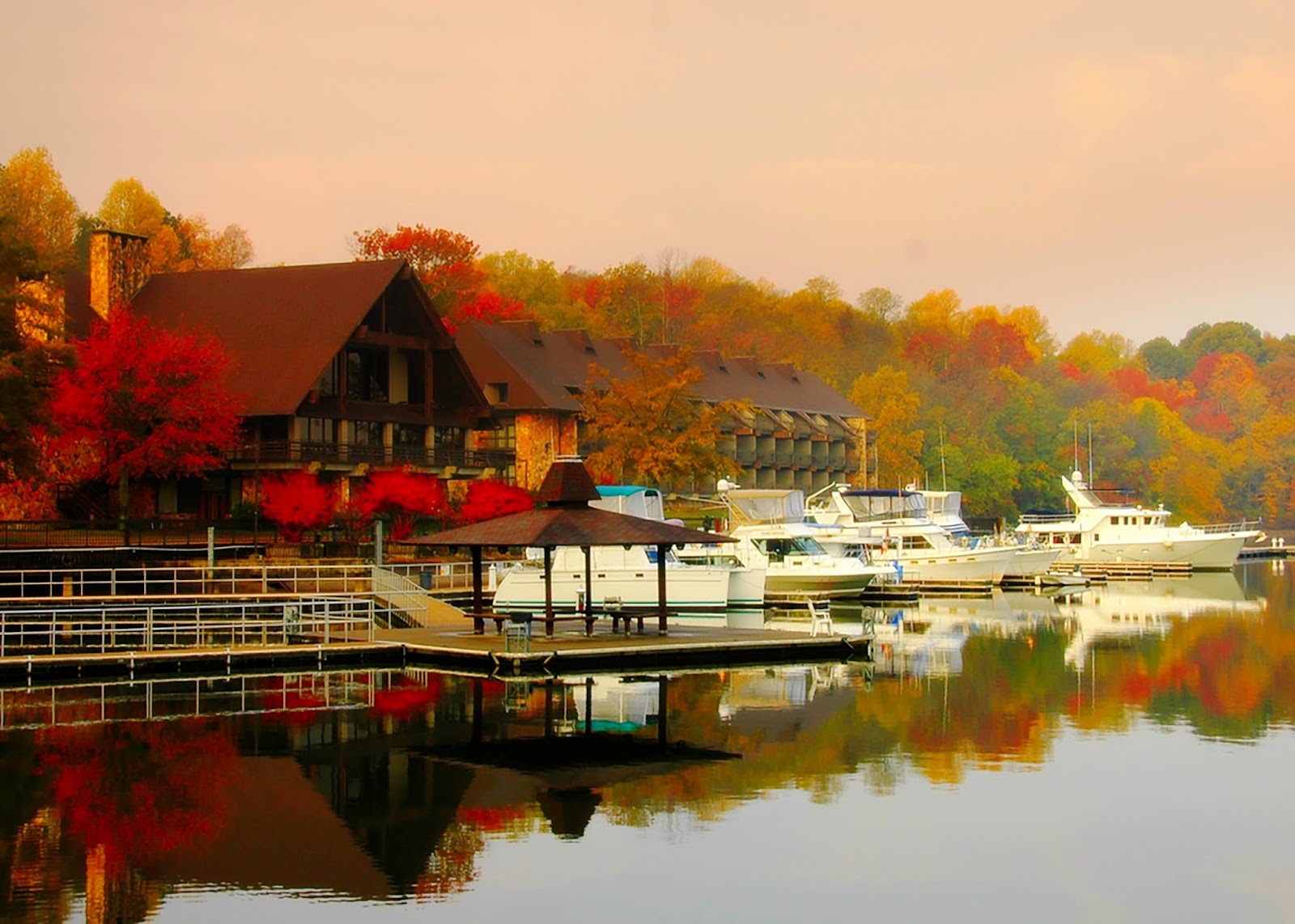
Joe Wheeler State Park — Alabama
The Tennessee River


Nordhavn Exumas Abacos Bahamas trawler Caribbean Pickwick Boat dogs
Memphis Downtown
Memphis Downtown
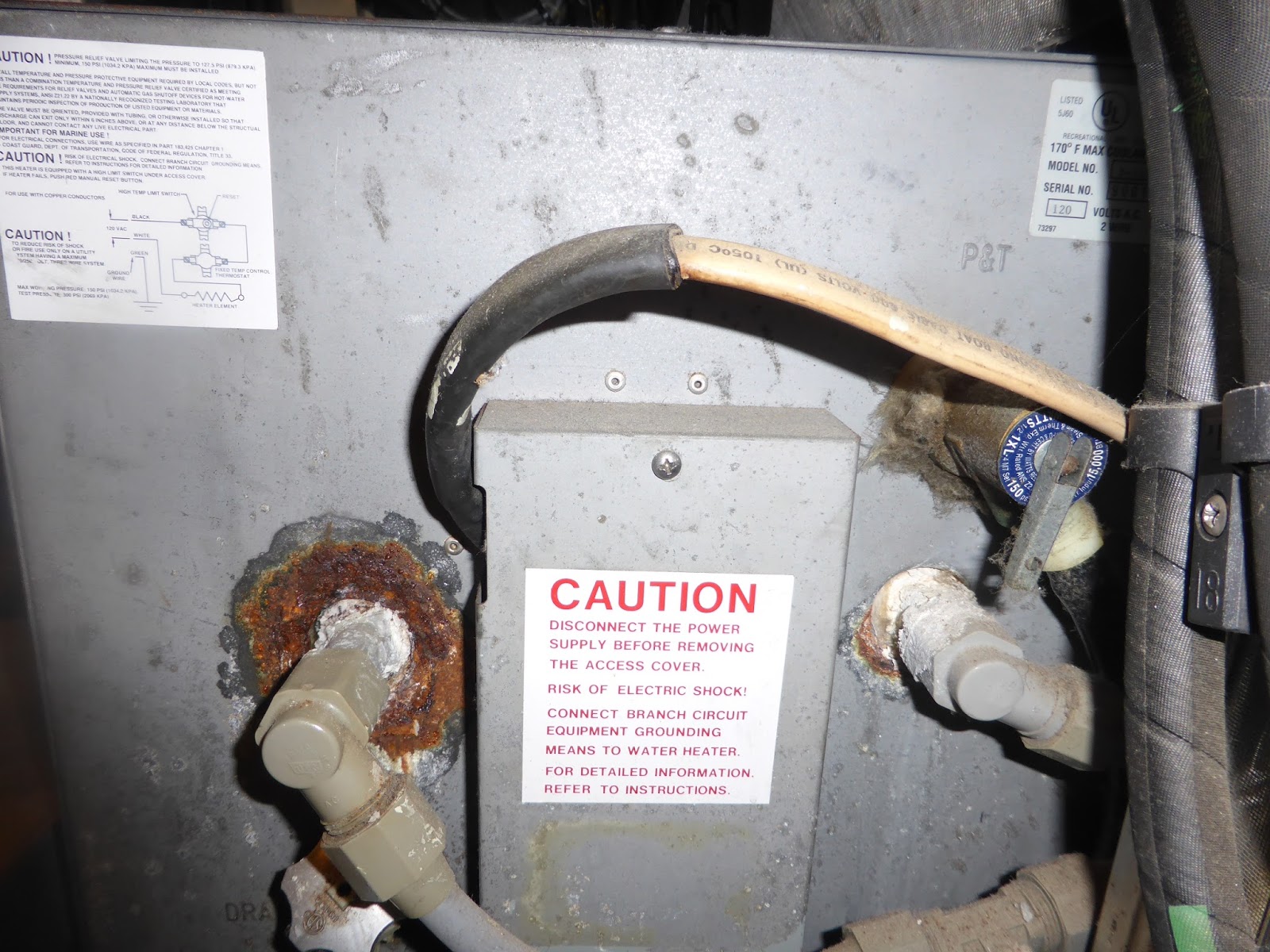
Corrosion and calcification build-up on the cover of our water heater

– Last year we took our Toshiba laptop used for navigation back to New Zealand for repair as it kept shutting down. We got it repaired in Auckland and there it seemed to be OK, but now it’s doing the same again – it gets hot real quick and its two cooling fans aren’t working. So it’s back to NZ for repair once again!
– When leaving your boat for the winter the fuel tanks should ideally be over 80% full to reduce the chance of water ingress through condensation. Our four tanks are 25%, 46%, 70% and 90% full – so not ideal, especially considering our longer than expected absence. Envoy has a fuel “polishing” (ie filtration) system based on a 12V, 7L/min pump passing fuel through a magnetic DeBug device and a Racor filter. If any water or “bug” is present this should show up in the Racor’s clear bowl. I’ve polished a portion of the fuel from each tank, over 1,000L in total, being careful to avoid cross contamination and all seems to be OK.
While we were away from Envoy the local service company, Sailand did some work for us and I’ll detail that in another post, but next post we’ll skip the technicalities and talk about our road trip to the Greek mountains.
FOR FOODIES: Greek Salad – a salad sans greens.
Every single taverna and restaurant we’ve been to here offer a delicious Greek salad and they all seem to follow much the same formula. Normally the salad seems to be eaten before the main course.
A Greek salad is based on lots of coarsely chopped tomatoes. Greek and Italian tomatoes are big, sweet and juicy. Next in volume is medium thicknesses of sliced cucumber. Then add slices of red onions and green pepper. Fetta cheese is generally added as one large thick slice on top of the salad rather than as cubes mixed in. Lastly add some ground oregano, a generous quantity of olive oil and a little balsamic – there you have it.
A mouth-watering Greek salad

This 16th century church is nestled in the basement of a new multi-story building in Athens

So far we haven’t seen any refugees or any visible signs of the crisis. We’ve no doubt that a lot of hardship does exist, but people are out and about, tavernas are bustling and several Lefkas shop owners told Di it has been one of their best seasons ever. But we have heard that Greeks can only withdraw six Euro per day from banks or ATMs. The areas where refugees are flooding into Greece are the islands adjacent to Turkey, such as Kos and Lesvos – a long way from here.
We hired a rental car for eight days to explore some inland areas we’ve not visited previously and will mention that in our next posting.
FOR FOODIES Yes “foodie” is a real word and refers to a person having an enthusiastic interest in the preparation and consumption of great food. During our unexpected sojourn home in New Zealand I took on three months consultancy work with some old friends. One of them, Vivienne, told me she regularly reads our blog, is not particularly interested in the technical stuff, but when we mention going into this or that “taverna” would like to hear more about what we eat. So this new section is dedicated to Viv, and we’ll get it going properly when we come back to the Med next year.
While staying in the village of Papingo high on the slopes of Mt Astraka looming 2,436m above sea level we stayed in a traditional inn.
Papingo is set high in rugged mountains

We weren’t particularly hungry and opted for a simple three-course organic vegetarian dinner, which turned out to be stunning with all of the ingredients coming from the inn’s garden and surrounding fields:
– Zucchini salad: smallish light green zucchini sliced lengthways very thinly with a potato peeler, doused with finely-chopped phenyl, whole red pepper corns, olive oil mixed with lemon juice and garnished with sliced lemon
– Fried porchini mushrooms: porchini mushrooms are the ones with very ragged edges. Our host, Kostas, said they gather about 100kg of mushrooms every third day from the fields around the inn. These were served fried in olive oil and garlic, and garnished with rocket leaves and ground pepper.
– Green beans: coarsely sliced lengthways and lightly cooked in a tomato pasta sauce heavily diluted in olive oil. We’re definitely going to try and replicate this back home.
Of course this was complimented by obligatory glasses of passable local red and white wines at ridiculously low prices.
Our traditional taverna served organic vegetables fresh from their own garden

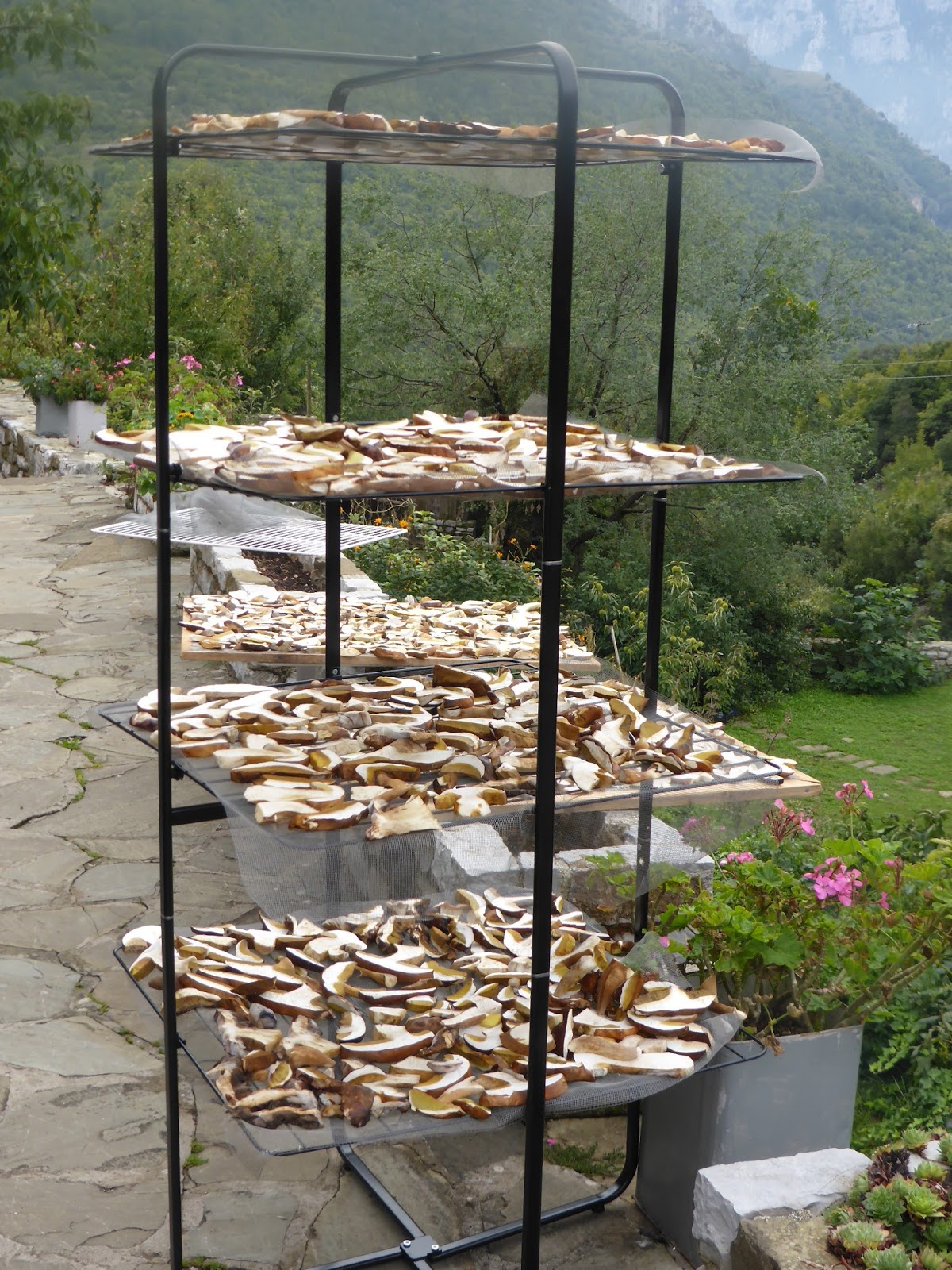
Trays of porchini mushrooms drying in the sun
|
|||||||||
|
|||||||||

The first thing I need to say is that there is a huge difference between visiting a city and living there. If we “visit” any city for, even, two weeks, we spend nearly every moment touring sites, eating at restaurants or sleeping. Don’t get me wrong. We love doing that and we have done that quite a bit. Living there, to us, is much more enjoyable because you proceed at much less of a hurried pace and you get to know the people and surroundings in a more intimate fashion.
After our scheduled month here in Barcelona we were finishing up the last day of our reservation. All of the normal boat checks were done and all that was left to do before our next day departure was to go over to the marina office to check out and pay our bill. After paying, the marina representative asked us how we enjoyed Barcelona. We quickly responded by telling her how much we loved it in great detail. It was all true. We then both said ” I am not sure why we are leaving” to which she responded “Well, the berth is available until November”. Oh-oh. We told her that we would let her know.
There is an old saying about boaters: “All plans are written in sand at low tide”. This has been especially true for us over the years. One time we were preparing to leave Seattle within two weeks with Seabird, planning on cruising to the Mexican Baja. We had dinner with our friends Ken and Roberta (Sans Souci) who tried to convince us to cruise instead with them to Alaska and Japan. They were indeed successful so we changed our plans and off we went.
Our decision to stay on for a second month was based on a few things:
First, we had heard that the Ballearic islands anchorages were very crowded in August and marinas were outrageously expensive and difficult to get into. In September, everyone disappears and the cruising there is much more enjoyable.
Secondly, our original plan from a year ago was to winter this year in Barcelona where we would have had months to get to know the city. That all changed when Sans Souci, Seabird and Ocean Pearl decided to instead cruise back across the Atlantic to the Virgin Islands. For one reason or another, that plan morphed into loading all three boats onto a ship and sending them that way.
So, in order to get in our “quality time” here, we booked for an additional month, leaving our cruising to the Ballearics until September.
As I mentioned in my previous blog, Barcelona is an exceptional city. Okay, now fast forward. We have been here for over a month now ( yeah, I know, my blog is SERIOUSLY behind schedule!) and we are nowhere near becoming tired of it. As far as large cities go, it is exceptionally clean and well run. They have acres of underground parking, so you don’t see the double and triple parking that you see in some other countries. It makes for a less chaotic environment.
Being young here doesn’t hurt either (not meaning us!). The evenings for most start with dinner at between 9 and 10pm. After that, there are the bars, the beach and all-around partying and hell raising. I mentioned how clean it is here. Well, it is, but sometime between 11pm and 4am, the beaches and boardwalk begin to look like they were hit by a garbage tornado! Cans, beer bottles, papers and half eaten food strewn just everywhere.


At 7 am every morning, the cleanup starts. Huge garbage trucks and platoons of workers appear with brooms and scoops, and by 9am, everything, save a few malicious odors, is cleaned up. On the malicious odor topic, the Barcelona Clean Team is trying to help that part of it too. Their thought is: if you cannot make it to the toilet, the toilet will come to you (see below).

I imagine that you would have to have a momentary dulled sense of modesty to use these, but, when you gotta go……
Fortunately for us, we are long ago asleep while the hoards slither about in the streets at night.

We are more of the daytime slithering breed. Barcelona has much to offer in the way of cultural activities. We have tried to visit something of interest at least every two days and being that the Metro (Barcelona’s subway system) is only a few minutes walk from our boat, everything is easily accessible.
One of the first and most interesting sites was the Sagrada Famiglia, or Church of the Holy Family. It was designed by Antoni Gaudi, one of Spain’s most famous architects.


What makes it most interesting (other than it’s striking design) is that the construction commenced in 1882 and has been ongoing ever since. The estimated completion date is now set at the year 2026 or 100 years after Gaudi’s death. The design is unlike anything I have seen before and it takes on the appearance of partially melted wax. To me, it is incredible that someone could design something like this so long ago and without (obviously) the aid of modern computer software. Gaudi’s influence is extensive in Barcelona and his many structures are easily identified, even to the untrained eye.
One day, we also visited the site of the 1992 Olympic Games, held here in Barcelona. In recent years, we have been fortunate enough to be able to visit several of the Olympic Games sites in different countries. The Athens, Greece site is a dilapidated disgrace, overgrown with weeds and its buildings covered in graffiti. The Bejing, China site, while not as bad as Athens by a long shot, is still a sad place to visit, with the government using the facilities for whatever cheap commercial attraction they can find.
Barcelona is different. It is treated like a huge museum. While visiting the pristine grounds, you get the feeling that if the Olympic Committee decided that they wanted to hold the Games next week, Barcelona would be ready.


 Three photos of the ’92 Olympic site in Barcelona
In Barcelona at night, you have your choice of music in the area of our marina. One night you will see them setting up 1000 chairs and a stage next to the beach for an outdoor opera performance. On any given night you will see impromptu performances of musicians and bands on the boardwalk, with something for everyone’s taste and it goes on until the wee hours of the morning. Beach goers seem to have no special hours. We see them on the beaches staking out their spots at 7 am and their are still crowds there at midnight under the bright light of the powerful flood lights that the city provides to keep it safe for everyone.
Safety is not too much of an issue here, as far as I can tell. Pickpockets and unarmed thieves seem to be the biggest annoyance. One morning at around 9am, Carol and I were doing our morning walk next to the beach when we saw a disturbance. Three somewhat out of shape beach goers were screaming and running toward the boardwalk. We then saw why. It looked to us like a guy pretending to be a beach jogger snatched the belongings of some poor woman as he went by them. He then immediately headed for the stairs to the road and was gone in a flash.
Did I mention that we feel kind of old in the city here because of all the young people? Well, to make matters worse, Carol and I went to the maritime museum situated near the marina. It did have quite a display of very old marine related items, but what upset Carol was that a good part of the museum was dedicated to “artifacts” like outboard motors and small boats that we used to have as CHILDREN!!
While we spent a good deal of time in Barcelona, we did do some land traveling on Spain’s AVE high speed train system, which travels at nearly 200 mph. We traveled from Barcelona to Madrid, Seville and Valencia on separate trips, which I will get into in my next blog….
A few more pics….
 “The Black Madonna” at a church in Monserrat


Guell (pronounced Gway) was designed by Gaudi for a developer who envisioned a high priced housing community. The centerpiece of the complex was to be the public area for the designed city. It was unfortunately canceled because of cost and proximity to the city so it was turned into a park, and a stunning one at that. Only a few houses were ever built but the grounds remain as a tourist site and many times you need to make reservations in advance to get in.

I am always available to help those in distress

Carol said this woman did not appear to be in distress and therefore did not need my help

The beginning of the Barcelona Triathlon
And last but not least……..


From what I understand, this boat that was docked a few away from us had a collision with a freighter (notice the mast is missing). I understand that part. What I can’t figure out is if the boat was named before or after the incident……
The first thing I need to say is that there is a huge difference between visiting a city and living there. If we “visit” any city for, even, two weeks, we spend nearly every moment touring sites, eating at restaurants or sleeping. Don’t get me wrong. We love doing that and we have done that quite a bit. Living there, to us, is much more enjoyable because you proceed at much less of a hurried pace and you get to know the people and surroundings in a more intimate fashion.
After our scheduled month here in Barcelona we were finishing up the last day of our reservation. All of the normal boat checks were done and all that was left to do before our next day departure was to go over to the marina office to check out and pay our bill. After paying, the marina representative asked us how we enjoyed Barcelona. We quickly responded by telling her how much we loved it in great detail. It was all true. We then both said ” I am not sure why we are leaving” to which she responded “Well, the berth is available until November”. Oh-oh. We told her that we would let her know.
There is an old saying about boaters: “All plans are written in sand at low tide”. This has been especially true for us over the years. One time we were preparing to leave Seattle within two weeks with Seabird, planning on cruising to the Mexican Baja. We had dinner with our friends Ken and Roberta (Sans Souci) who tried to convince us to cruise instead with them to Alaska and Japan. They were indeed successful so we changed our plans and off we went.
Our decision to stay on for a second month was based on a few things:
First, we had heard that the Ballearic islands anchorages were very crowded in August and marinas were outrageously expensive and difficult to get into. In September, everyone disappears and the cruising there is much more enjoyable.
Secondly, our original plan from a year ago was to winter this year in Barcelona where we would have had months to get to know the city. That all changed when Sans Souci, Seabird and Ocean Pearl decided to instead cruise back across the Atlantic to the Virgin Islands. For one reason or another, that plan morphed into loading all three boats onto a ship and sending them that way.
So, in order to get in our “quality time” here, we booked for an additional month, leaving our cruising to the Ballearics until September.
As I mentioned in my previous blog, Barcelona is an exceptional city. Okay, now fast forward. We have been here for over a month now ( yeah, I know, my blog is SERIOUSLY behind schedule!) and we are nowhere near becoming tired of it. As far as large cities go, it is exceptionally clean and well run. They have acres of underground parking, so you don’t see the double and triple parking that you see in some other countries. It makes for a less chaotic environment.
Being young here doesn’t hurt either (not meaning us!). The evenings for most start with dinner at between 9 and 10pm. After that, there are the bars, the beach and all-around partying and hell raising. I mentioned how clean it is here. Well, it is, but sometime between 11pm and 4am, the beaches and boardwalk begin to look like they were hit by a garbage tornado! Cans, beer bottles, papers and half eaten food strewn just everywhere.
At 7 am every morning, the cleanup starts. Huge garbage trucks and platoons of workers appear with brooms and scoops, and by 9am, everything, save a few malicious odors, is cleaned up. On the malicious odor topic, the Barcelona Clean Team is trying to help that part of it too. Their thought is: if you cannot make it to the toilet, the toilet will come to you (see below).
I imagine that you would have to have a momentary dulled sense of modesty to use these, but, when you gotta go……
Fortunately for us, we are long ago asleep while the hoards slither about in the streets at night.
We are more of the daytime slithering breed. Barcelona has much to offer in the way of cultural activities. We have tried to visit something of interest at least every two days and being that the Metro (Barcelona’s subway system) is only a few minutes walk from our boat, everything is easily accessible.
One of the first and most interesting sites was the Sagrada Famiglia, or Church of the Holy Family. It was designed by Antoni Gaudi, one of Spain’s most famous architects.
What makes it most interesting (other than it’s striking design) is that the construction commenced in 1882 and has been ongoing ever since. The estimated completion date is now set at the year 2026 or 100 years after Gaudi’s death. The design is unlike anything I have seen before and it takes on the appearance of partially melted wax. To me, it is incredible that someone could design something like this so long ago and without (obviously) the aid of modern computer software. Gaudi’s influence is extensive in Barcelona and his many structures are easily identified, even to the untrained eye.
One day, we also visited the site of the 1992 Olympic Games, held here in Barcelona. In recent years, we have been fortunate enough to be able to visit several of the Olympic Games sites in different countries. The Athens, Greece site is a dilapidated disgrace, overgrown with weeds and its buildings covered in graffiti. The Bejing, China site, while not as bad as Athens by a long shot, is still a sad place to visit, with the government using the facilities for whatever cheap commercial attraction they can find.
Barcelona is different. It is treated like a huge museum. While visiting the pristine grounds, you get the feeling that if the Olympic Committee decided that they wanted to hold the Games next week, Barcelona would be ready.
Three photos of the ’92 Olympic site in Barcelona
In Barcelona at night, you have your choice of music in the area of our marina. One night you will see them setting up 1000 chairs and a stage next to the beach for an outdoor opera performance. On any given night you will see impromptu performances of musicians and bands on the boardwalk, with something for everyone’s taste and it goes on until the wee hours of the morning. Beach goers seem to have no special hours. We see them on the beaches staking out their spots at 7 am and their are still crowds there at midnight under the bright light of the powerful flood lights that the city provides to keep it safe for everyone.
Safety is not too much of an issue here, as far as I can tell. Pickpockets and unarmed thieves seem to be the biggest annoyance. One morning at around 9am, Carol and I were doing our morning walk next to the beach when we saw a disturbance. Three somewhat out of shape beach goers were screaming and running toward the boardwalk. We then saw why. It looked to us like a guy pretending to be a beach jogger snatched the belongings of some poor woman as he went by them. He then immediately headed for the stairs to the road and was gone in a flash.
Did I mention that we feel kind of old in the city here because of all the young people? Well, to make matters worse, Carol and I went to the maritime museum situated near the marina. It did have quite a display of very old marine related items, but what upset Carol was that a good part of the museum was dedicated to “artifacts” like outboard motors and small boats that we used to have as CHILDREN!!
While we spent a good deal of time in Barcelona, we did do some land traveling on Spain’s AVE high speed train system, which travels at nearly 200 mph. We traveled from Barcelona to Madrid, Seville and Valencia on separate trips, which I will get into in my next blog….
A few more pics….
“The Black Madonna” at a church in Monserrat
Guell (pronounced Gway) was designed by Gaudi for a developer who envisioned a high priced housing community. The centerpiece of the complex was to be the public area for the designed city. It was unfortunately canceled because of cost and proximity to the city so it was turned into a park, and a stunning one at that. Only a few houses were ever built but the grounds remain as a tourist site and many times you need to make reservations in advance to get in.
I am always available to help those in distress
Carol said this woman did not appear to be in distress and therefore did not need my help
The beginning of the Barcelona Triathlon
And last but not least……..
From what I understand, this boat that was docked a few away from us had a collision with a freighter (notice the mast is missing). I understand that part. What I can’t figure out is if the boat was named before or after the incident……
Having owned Envoy since late 2006 we’ve now left her unattended for periods ranging from about 5 months to 27 months, mostly on the hardstand but sometimes in the water so what are the pros and cons of each for boats in general?
Next week when we rejoin Envoy she’ll have been out of the water for about 6 months so then we’ll report more on this subject.
Envoy on the Ostia marina hardstand, Italy

Firstly it’s much more pleasant in a marina living aboard while your boat is in the water. You still get gentle boat movement (sometimes not so gentle during gales) and it’s much easier and safer to get aboard your boat and load supplies using the passarelle from the dock compared to a ladder from the ground.
In most marinas we can use our own shower rather than the shore facilities and empty the galley sink, neither of which we can do on the hardstand.
Marina hardstand areas are generally rather litter-strewn and dusty so we always find it easier to keep Envoy clean while in the water. But of course below waterline areas are a different story and while your boat is sitting unused in the water your hull will suffer more marine growth than usual.
So far as safety of the vessel is concerned each option is probably neutral. While in the water there is the risk of damage to mooring lines, cleats and hulls during storms, as well as the risk of taking on water if a leak develops. This is very dependent on the location of the marina since many are subject to surges during adverse winter weather.
On the hardstand there is some risk of damage during travel lift operations or from the vessel falling or being knocked over during earthquakes or severe storms, both of which are prevalent in the Med.
Personal safety is better with your vessel in the water as many accidents occur with people falling from their vessel or ladder onto the hardstand below.
In most marinas security is better on marina piers than it is on the hardstand where there are more people coming and going and public access is less restricted.
Cost is another factor to take into account and this depends on the individual marina and their ratio of berths to hardstand area. Sometimes it’s cheaper in the water and sometimes not. Seasonality also affects this with considerable more hardstand area being available during summer months.
Envoy’s refrigeration system has the option of air or seawater cooling but the latter is more efficient so that’s another plus for being in the water.
There are some repairs and maintenance which can only be performed out of water (for example servicing seacocks and running gear) but on balance there is more that can be achieved in the water.
Another negative for staying in the water is the possibility of galvanic corrosion and/or stray current electrolysis.
Osmosis is another risk for GRP hulls and a spell of several months out of the water can only assist its prevention.
Our last posting introduced the technical seminar held aboard Nordhavn 68, Karajas, in Akuna Bay Marina north of Sydney.
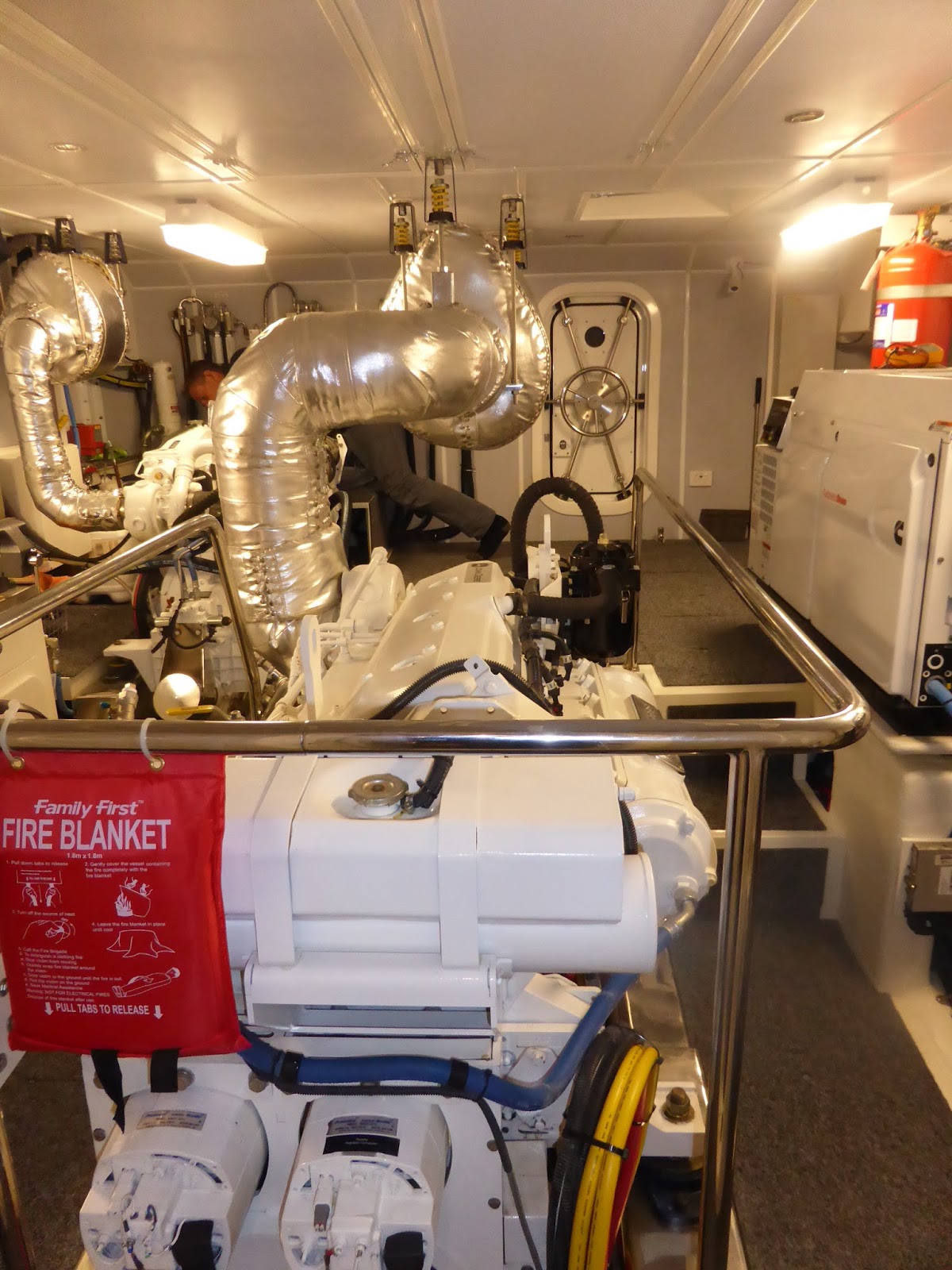
View of Karaja’s engine room with single John Deere main plus Northern Lights wing engine
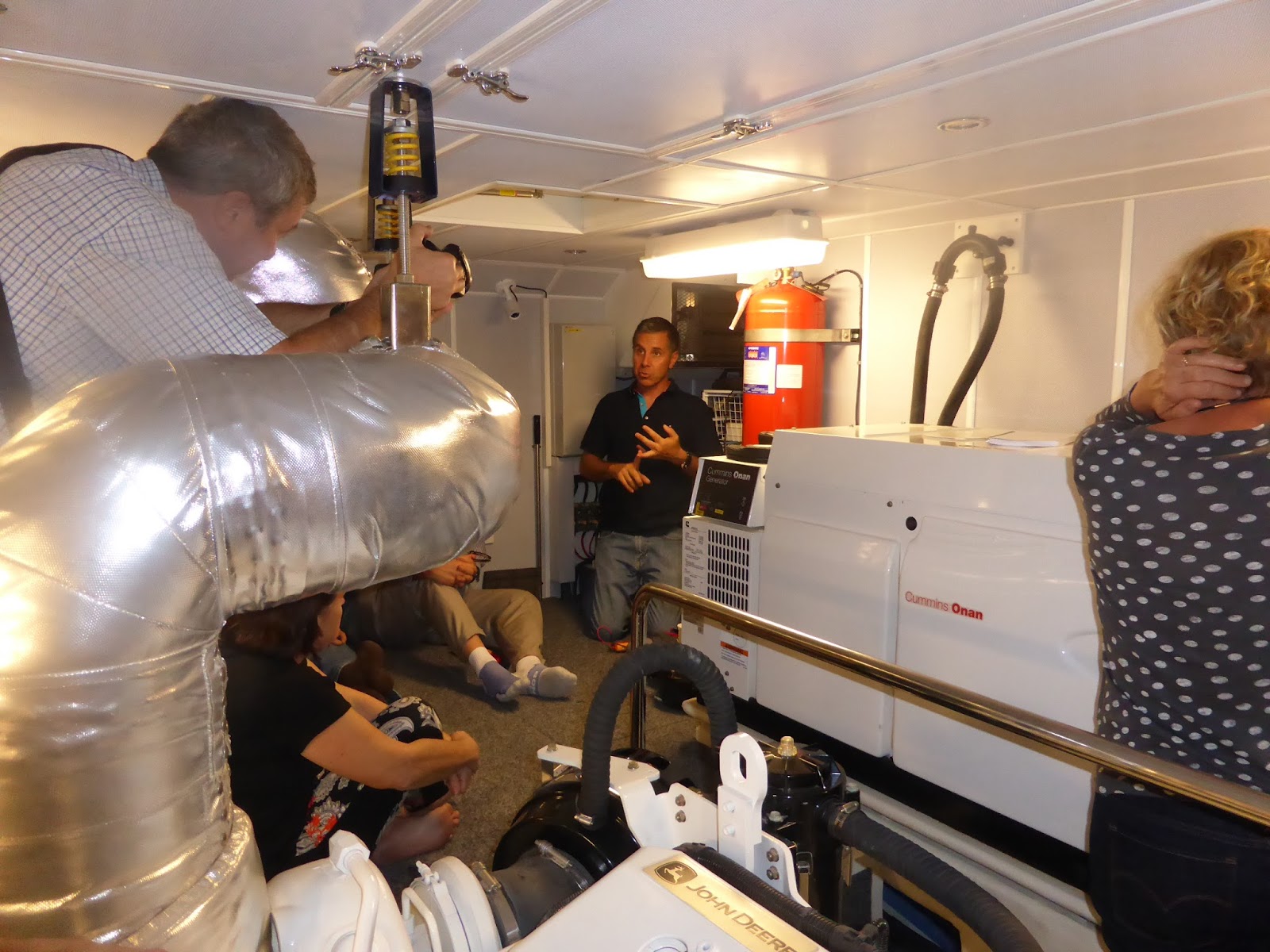
Steve d’Antonio talks to course attendees in engine room
So what are a few key points others can learn from? Here is a flavour of some specifics.
– Always install equipment according to the manufacturer’s guidelines and insist that contractors do so,
as well as supplying a schematic diagram where needed.
– No AC power connections should be exposed or able to be accidentally touched.
– When working on AC power systems always totally isolate the inverter and remove the shore power
cable.
– Stainless steel bolts, nuts and washers should not be used in demanding applications like prop shaft couplings, steering couplings or engine mounts. Nor should they be used in electrical situations due to
the low conductivity of stainless steel.
– Although two hose clamps are supposed to be used for all raw water plumbing applications it is better
to use one properly than two improperly. Ensure hose clamps are marine grade stainless steel and have
solid not perforated bands. To avoid cuts and injuries use “Clamp-Aid” silicone covers on the sharp
exposed tail of the clamp.
– Only use correctly rated and marked hose for raw water plumbing and exhaust systems.
– Operate seacocks regularly to avoid them seizing up.
– Hydraulic steering rams and tiller arms should be regularly checked both at rest and under way while steering lock-to-lock to check for significant leaks and movement in fastenings.
– Test your emergency steering tiller before you need to use it.
– To reduce corrosion on aluminium masts, paravanes, booms, door frames etc bed fittings and hardware
in a PU bedding compound. This can be done retrospectively.
– In the event of engine room fire stop all engines and blowers (to maximise the effect of the extinguishing agent) and isolate the batteries (in case the fire is caused by a short circuit or overload).
– The prop shaft stuffing box temperature should not exceed about 30dF above the ambient sea water temperature.
– There is no need to change primary fuel filter cartridges too often, but as dictated by your vacuum gauge
(at about 5 inches of vacuum). Use 10 or 30 micron cartridges – finer is not better in the primaries.
– Bleeding of the fuel system should not be necessary if the primary and secondary filters are bled
correctly when changed. To ensure any air remaining in the system is passed through run the engine for
about 5 mins at 1200-1440 rpm, not at idle. This rpm range will reduce the chance of the engine stalling while passing air.
– Dry exhaust thermal insulation should be regularly checked using the pyrometer and for potential fire
and safety reasons no section should exceed 200dF. Wet exhaust system hoses should not exceed about 160dF.
– To maximise AGM battery life normally discharge to about 50% of its capacity and don’t routinely start charging much above that level.
I would certainly recommend any serious cruiser to attend a course run by Steve or a similarly qualified industry expert both to learn specifics and to stimulate thought.


