
We’d been monitoring our fuel levels with the hopes of waiting until we return to Ireland in November to refuel since the prices are better there. We succeeded, and arrived at Dun Laoghaire with only 310 total gallons (1,178L) of fuel on board and needing 1,438 gallons (5,443L). Dun Laoghaire Marina has an easy-to-use fuel…
Tag Archives | Nordhavn
STARTING THE LIVE-ABOARD CRUISING LIFE – PART 1
Envoy is berthed in Greece’s Lefkas Marina and we’re home in Auckland.
Unfortunately circumstances prevent us returning to cruise in the Med this year.

Unfortunately circumstances prevent us returning to cruise in the Med this year.
We recently wrote an article published in Pacific PassageMaker magazine about starting the live-aboard cruising life. Over the next few weeks we’ll be psting this article to our Blog in several parts.
PART 1: THE LIVE-ABOARD CRUISING LIFE – HOW MANY GOOD SUMMERS DO YOU HAVE LEFT?
The live-aboard life isn’t for everyone; there are many competent, dedicated weekend cruisers who wouldn’t want to spend more time at sea than ashore. But for those who have the live-aboard passion there is generally nothing to stop you.
As famed cruiser and circumnavigator Scott Flanders advises, “tick…tick…tick… the clock is ticking, get the picture … do it now!”
Regardless of whatever your future dream life happens to be if you can’t literally do it now, at least make a plan now and work towards achieving it.
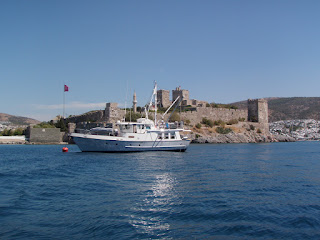
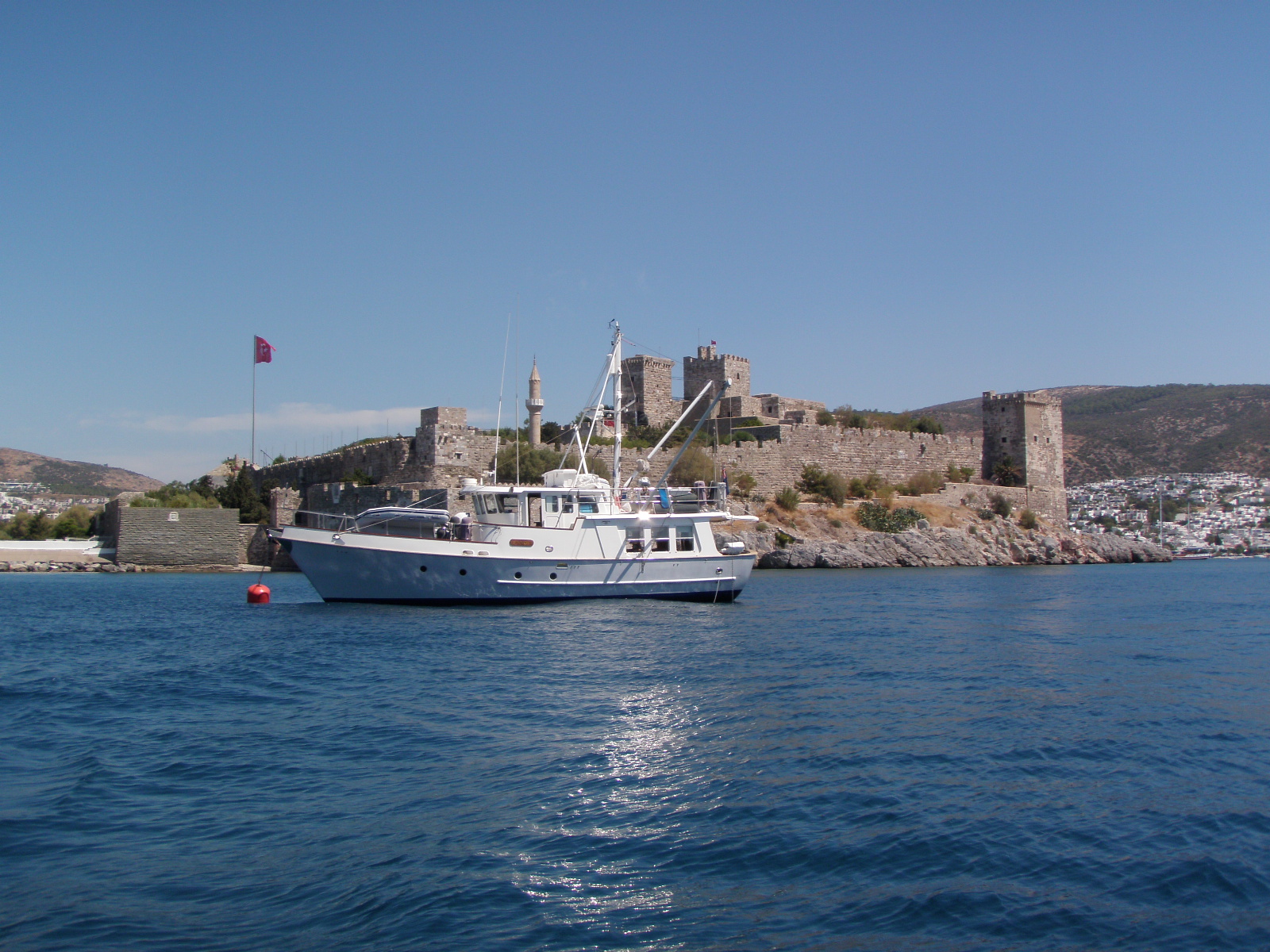
Plan your dreams now – Envoy moored by Bodrum’s castle, Turkey
When I turned 50 I expected to have about 20 good summers left, meaning that barring major illnesses or accidents I expected to enjoy our cruising passion until I was about 70 years old.
Now I’m nearly 68 and believe most people could enjoy live-aboard cruising into their mid-70s.
The main issue which could prevent this is health. Whatever the upper age limit may be one thing’s for sure – you certainly don’t meet many cruisers in their 80s.
The main issue which could prevent this is health. Whatever the upper age limit may be one thing’s for sure – you certainly don’t meet many cruisers in their 80s.
Here’s a little exercise to help you visualise how many good summers you have left. Take a tape measure showing inches and stretch it out. Note where 75 inches is representing age 75 and where your age is (e.g. age 60 would be 60 inches). The sobering message is the huge length of tape up to 60 inches represents your life up to now and the short length of tape from your age to 75 (or thereabouts) represents the time you have left to do relatively demanding things like live-aboard cruising.
We had cruised extensively during weekends and holidays and dreamed of enjoying great destinations until we tired of them rather than meeting timetables. We had adult children living overseas, no health issues and wanted to cruise while circumstances permitted. Experience wasn’t an issue and we’d always worked well as a team on four power boats we’d owned during 30 years to that time.
After two years’ planning we bought our Nordhavn 46 Passagemaker, Envoy, in 2006 and I took a year’s leave of absence from work so we could live-aboard during 2007. Then I went back to work leaving Envoy in a Turkish marina for two years before retiring in early 2010 at age 59.
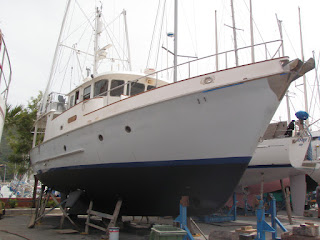
Envoy on the hard stand at Maramaris, Turkey
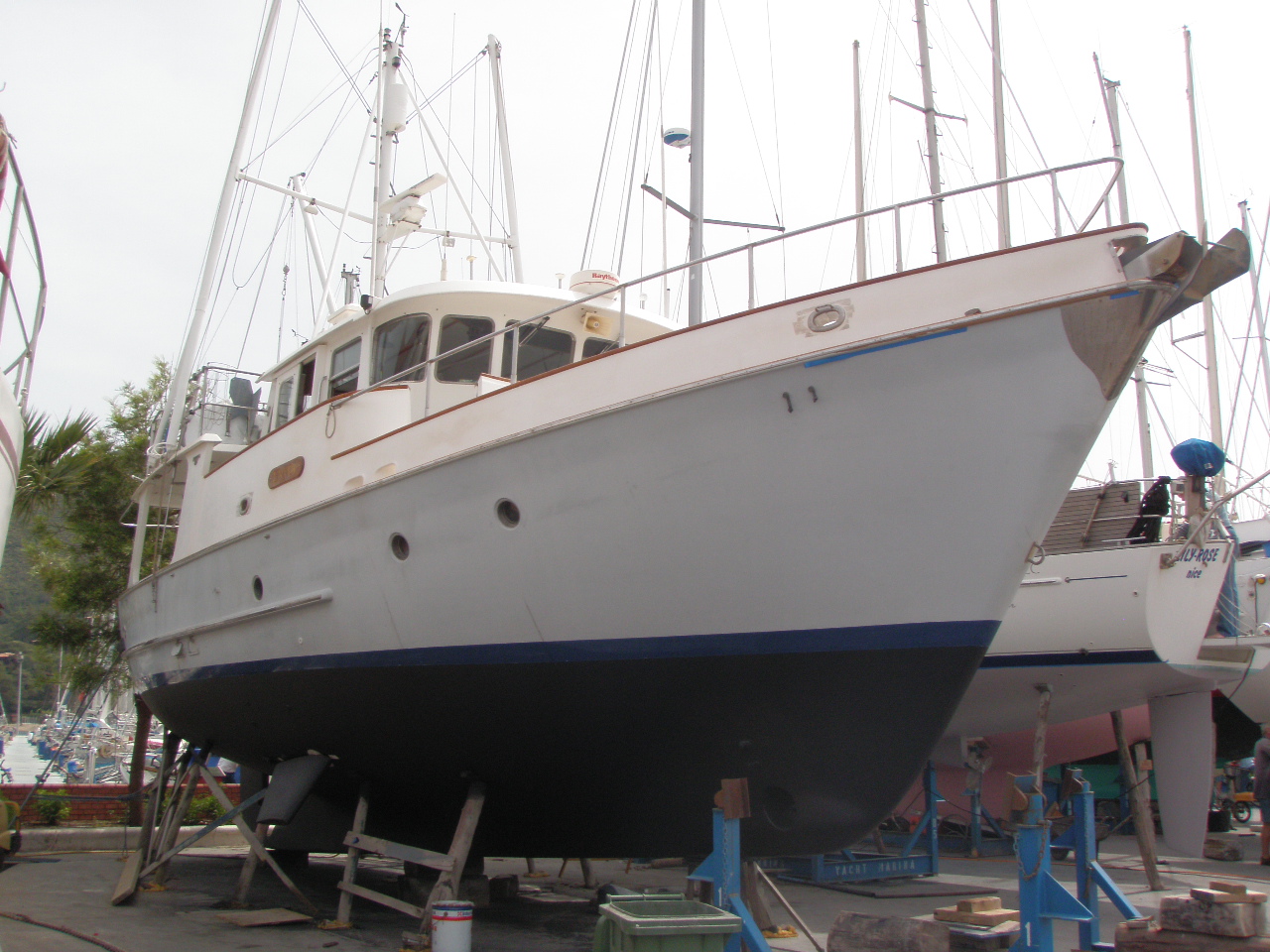
By the time I reached the “traditional” retirement age of 65 we’d enjoyed six years of the live-aboard life and now we’ve had eight cruising in exotic places like Greece, Turkey, Italy, Albania, Croatia, Montenegro as well as hundreds of surrounding islands.
Something you wouldn’t see while boating in New Zealand

The live-aboard life doesn’t have to involve crossing oceans and we’ve cruised over 16,000 miles in the Med rarely being over 40 miles from the nearest land. There are thousands of people living aboard all manner of boats in various parts of the world enjoying adventurous coastal cruising. While it’s a great feeling to have a boat that is ocean-capable a large number of cruisers elect to ship even these vessels aboard purpose-built freighters rather than traverse the oceans on their own hulls and the two options are considered to be similar in cost.
THE MAJOR FEARS
Scott Flanders wrote an excellent article in 2011 outlining potential cruisers’ common concerns and some solutions. This is equally valid today.
Experience levels – everyone starts somewhere so take small steps first and learn from your mistakes. Coastguard and the Royal Yachting Association run excellent courses to gain practical and theoretical skills and as most countries require some evidence of proficiency when clearing-in it’s a good idea to gain some certifications.
Mechanical ability – it isn’t the big things that fail and you will learn to deal with handling the smaller problems. Most countries have competent mechanical assistance available. Carry a comprehensive range of tools, spare parts, equipment manuals and chandlery aboard.
Most technical issues can be easily resolved – in Marmaris we had the stabiliser through-hull seals replaced

Handling rough seas – becomes easier with practice and although this is a concern for many one study reports 80 per cent of the time wave heights are less than 3.7m explaining how many cruisers travel thousands of ocean miles over many years rarely if ever encountering dangerous seas.
Navigation – is not difficult with today’s electronic equipment. Sextants are long gone and this is an area where courses will greatly assist.
Seasickness – many cruisers start off getting seasick but wean themselves out of it and medications can assist.
Weather and tides – there is ample reliable information for coastal cruising while offshore cruisers often pay for professional forecasting. The internet hugely improves forecast availability. There is negligible tide in the Med.
Manoeuvring and docking – practice makes perfect, but don’t worry about minor scratches on your gelcoat – they won’t ruin a great experience. A bow thruster will greatly assist docking.
Another concern is piracy off the north-east coast of Africa making it dangerous to traverse these waters. Circumnavigators who include the Med in their route mostly ship their boats across the Indian Ocean. Piracy is not a major issue in other waters and the website www.noonsite.comprovides regular updates.
Read PART 2 in about a week.
Exploring Dublin
We spent our first couple of days in Dun Laoghaire exploring the area, including a visit to the nearby National Maritime Museum of Ireland and a late-afternoon walk around downtown Dublin. We strolled along statue-filled O’Connell Street, Dublin’s main thoroughfare, and along the River Liffey that runs through town, where the many bridges are beautifully…
GREECE – ARGUABLY THE WORLD’S GREATEST CRUISING AREA
Envoy is berthed in Lefkas Marina for the winter while we’re home in Auckland enjoying the exceptionally hot southern hemisphere summer.
Our future cruising plans aren’t clear at this point and we’ll have a better idea shortly.
This is an edited version of our article recently published in Pacific PowerBoat magazine.
The north-east coast of New Zealand’s North Island’s offers incredible cruising, particularly within its prime area ranging from Whitianga in the south to Whangaroa in the north, a distance of around 250 miles following the coast with about 50 offshore islands suitable for overnight anchoring along the way, a handful of which are virtually all-weather. Imagine an area many times this size with hundreds of offshore islands offering not only spectacular safe anchorages, but interesting atmospheric villages, welcoming rustic tavernas and historic ruins dating back thousands of years.
This is Greece, offering incredible cruising particularly from April through October with mostly stable warm weather, spectacular natural scenery, clean waters, areas of great historical interest, friendly and honest people, a high level of personal safety and reasonable costs. What about their economic crisis and the refugees? Well for the visitor there’s little sign of any crisis and we’ve not yet seen a single refugee as they’re mainly confined to a few islands close to Turkey.
Envoy moored stern-to in Rhodes harbour

Although thousands of boats cruise Greece during summer the area is so vast that even the popular anchorages are no more crowded than Auckland’s Kawau or Waiheke islands during holiday weekends.
You don’t need to own a boat to cruise here as there are many charter boats offered to high standards at reasonable costs. Depending on your experience level you can charter skippered or bareboat and cruise independently or as part of a flotilla. This is a great way to check out whether Med cruising is for you.
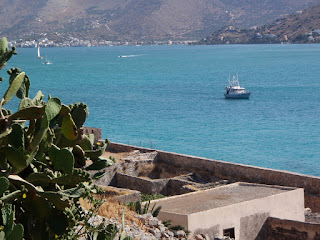
Envoy anchored off Spinalonga

July and August are hot by our standards often reaching mid 30s, although the humidity is low and the sun doesn’t have New Zealand’s high U/V level so it doesn’t seem uncomfortable. Although Envoy has air conditioning we never find conditions warrant using it, in any case preferring fresh air flowing through open windows and portholes.
It’s easy to leave your boat in a marina and travel around Greece for sightseeing using high quality and regular coaches and ferries as well as rental cars (foreign licenses accepted). Motorways connect most of the major cities, but rural roads can be pretty basic. Many people speak passable English, particularly younger ones and most people are very polite and helpful.
Supplies are readily available with most prices cheap by our standards at supermarkets, markets and smaller shops while fuel and water are widely available dockside. Interestingly fuel pumps are not common and fuel is often delivered in small road tankers.
The main convenient international airports are Athens, Corfu and Iraklion, although there are others.
Greece is a natural gateway to other destinations as it’s relatively easy to cruise north-east to Albania, Montenegro and Croatia, west to Italy and east to Turkey.
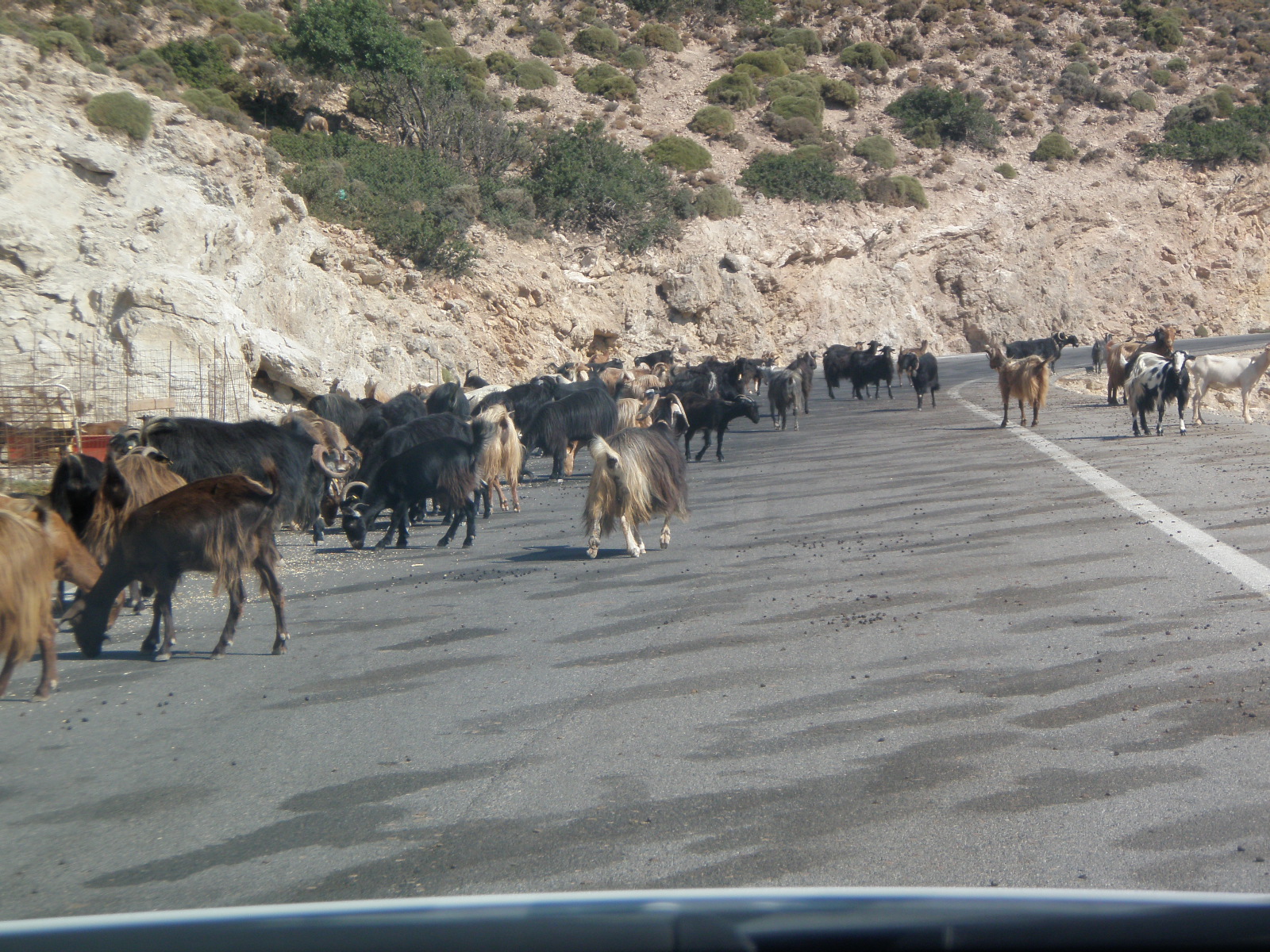
It’s not unusual to encounter wandering stock on rural roads
Greece can be broadly divided into the four main regions mentioned below:
1 Mainland including Peloponnisos
Athens can be accessed from the port of Piraeus. A guided walking tour will show you most sights with the Parthenon atop the Acropolis and its adjacent museum of particular interest.
From the port of Itea in the Gulf of Corinth you can visit Delphi’s many spectacular ruins, where in ancient times wealthy people paid a fortune to have the oracle interpreted, supposedly predicting their future.
Cruising around the Peloponnisos coast is a great experience visiting historic towns such as (west to east) Pilos, Methoni, Koroni, Kalamata, Yithion, the island of Kithera and Monemvasia.
2 Western side – Ionian Sea islands
Preveza on the mainland is a great place to rent a car to visit Meteora with its amazing ancient monasteries perched atop originally impregnable rock formations and accessed using rope ladders. Nearby Mystras has a great castle set upon a craggy hilltop. On the way you will pass through Ioannina, an historic Turkish town with an impressive lakeside castle
Anchor off the village of Parga with its narrow cobbled lanes, great waterfront and castle. Slightly further north is Mourtos with several spectacular anchorages set among several uninhabited islands.
Further north is the island of Corfu with its historic city, castles and spectacular seaside villages such as Ormos Agni, Ormos Kalami, Kassiopi and Palaiokastrita.
Just south of Corfu the island of Paxoi has great anchorages at Lakka, Longos and Gaios.
3 Eastern side – Aegean Sea islands
By far the most famous island is Santorini. Yes it’s a bit crowded, but the Caldera is unforgettable.
There are many other stunning islands contained within the Northern and Eastern Sporades, the Cyclades and Dodecanese. Watch for the Meltemi – the strong north-westerly which often blows in the afternoon and can last several days.
4 Crete
You could easily cruise a few weeks here with plenty to see. Of particular interest from east to west are Ayios Nikolaos, Rethimno, Khania, Soudha Bay (visit the New Zealand war cemetery) and stunning Gramvousa Island with its spectacular hilltop castle.
NZ war cemetery at Soudha Bay


Envoy anchored off Dia Island

Because a place isn’t mentioned in this article doesn’t mean it’s not great – there are just too many to mention! The only negatives to cruising in Greece are that the fishing is lousy (locals mostly fish using nets) and scuba diving is mostly not allowed except as part of a guided dive group (to prevent theft of artifacts).
Very shortly we’ll post an article about preparing yourselves for the live-aboard cruising life.
Fendering Take Three
When you travel the world, the boat sometimes has to be docked in less than optimum conditions. Nobody wants to med moor against a concrete wall in a large swell and without protection. But, if you want fuel in Nuku Hiva, you’ll need to be able to safely dock in these conditions. Nobody wants to…
Dublin Arrival
We returned to the Republic of Ireland at Dublin after four months in the UK. Conditions on the overnight run from Liverpool were rougher than predicted, with winds blowing 30-40 kts on the bow and a maximum pitch of 21.9°. But the winds eventually settled down and we had calm weather for the last part…
Racor CCV
I’ve never been happy with the RACOR CCV (Closed Crankcase Ventilation) system on our Deere engine so I decided to dig in and learn more. To meet emission requirements, the CCV (the black housing circled above) separates oil from the crankcase vapors, drains the oil back to the sump and sends the vapors back to…
Liverpool Marina
Liverpool Marina was a great base for exploring the city and surrounding area—it’s an easy easy walk from the marina to the waterfront attractions at Royal Albert Dock and downtown. We spent nearly two weeks there, enjoying beautiful Liverpool and particularly the spectacular Bonfire Night fireworks display. Liverpool also is the home of KVH Media…
York
York Minster, built mainly between 1220 and 1480, is one of the largest medieval cathedrals in Northern Europe and among the most beautiful Gothic buildings in the world. While it is a real highlight of a visit to York, the city has a number of other attractions, including the superb National Railway Museum, the largest…
Diesel Engine Load Profile
Electronic diesel engines track usage data to help engine manufacturers and service personal understand causes of different fault conditions and evaluate how well the engine is performing in that specific application. Generally this data isn’t available to end users but, if a service technician is on your boat, it’s worth asking for the engine load…
