Tag Archives | Nordhavn

MORE ABOUT ABOARD ENVOY IN LEFKAS MARINA

CORRECTION of last posting; Greeks can withdraw 60 Euros from the bank per day not 6 as mentioned.
I mentioned last posting there were no great technical surprises coming back aboard Envoy, but there’s a few things to mention:
– Normally when we return to Envoy the interior is exactly how we left her, but this time she was a bit dustier than usual as we’d had some fibre-glassing work done to repair a crack in the floor of the main shower, and a bit of grinding dust had spread through the boat – not bad though.
– We’d had a short circuit in our bow thruster 24V battery bank caused by cable connections working loose. This has resulted in one of the two Deka AGM batteries not holding charge and although these batteries are only a bit over three years old we’re needing to replace both of them as it’s not recommended to replace just one battery in a bank. Fortunately we can get these from the Deka dealer in Italy.
– For all of the time we’ve owned Envoy the aft stainless steel fresh water tank has leaked a little (less than 1 L/day) when filled above about half capacity. I removed an inspection hatch in the top of the tank and found its general condition to appear OK. Being empty, I gave the exposed surfaces of the tank a clean.
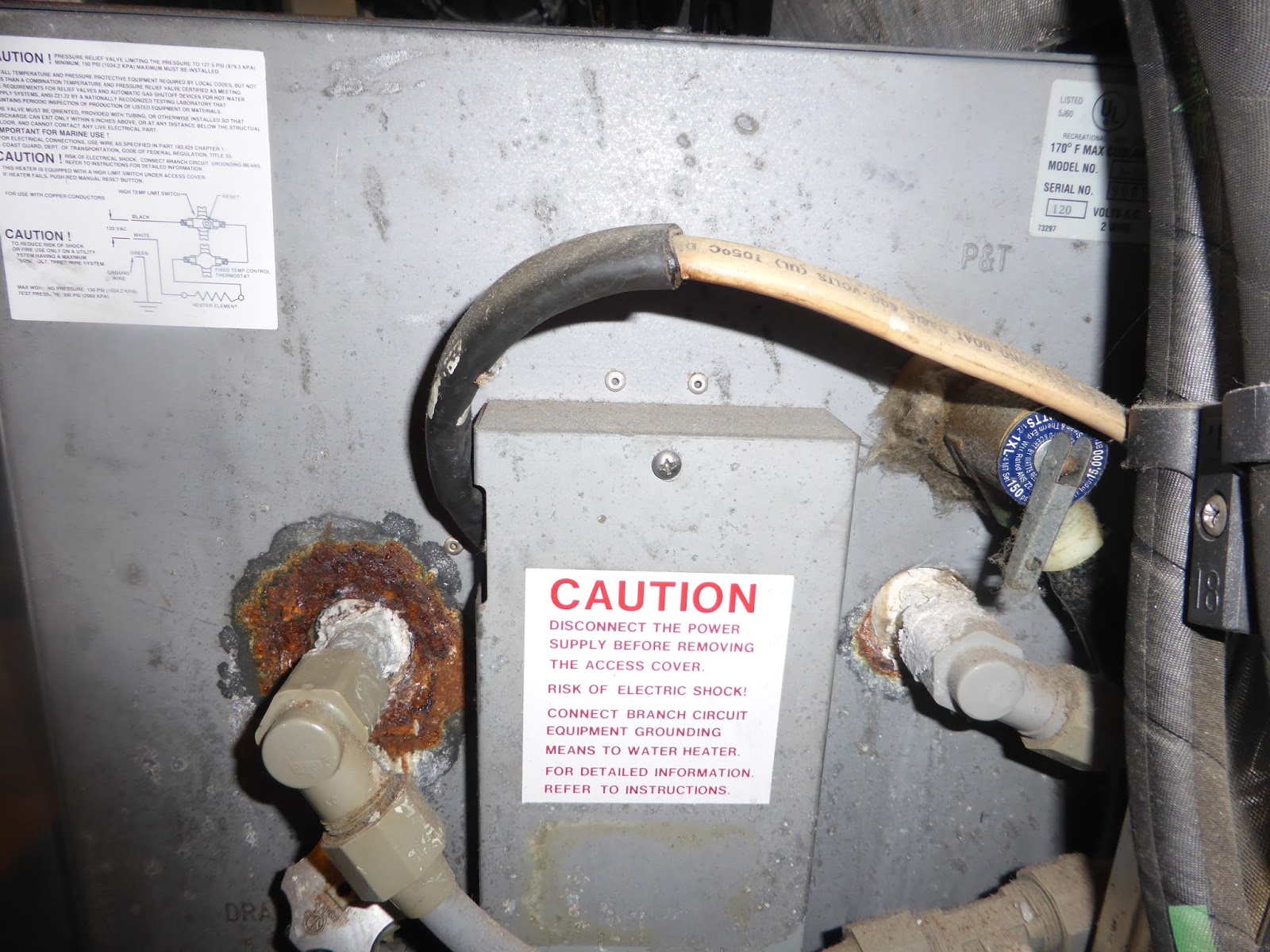
– Our domestic hot water tank has signs of corrosion on its outer galvanized steel protective cover (as opposed to the aluminium alloy water tank). This seems to have been caused by tiny leaks of fresh water from the input tap running onto the cover over a period of several years. The difficult to access exterior of the tap itself is coated with a thick layer of calcification resulting from the leak. The tank is working fine but Sailand are going to remove it for refurbishment.

Corrosion and calcification build-up on the cover of our water heater

Close up of corroded area – this has since been removed and reconditioned
t

– Last year we took our Toshiba laptop used for navigation back to New Zealand for repair as it kept shutting down. We got it repaired in Auckland and there it seemed to be OK, but now it’s doing the same again – it gets hot real quick and its two cooling fans aren’t working. So it’s back to NZ for repair once again!
– When leaving your boat for the winter the fuel tanks should ideally be over 80% full to reduce the chance of water ingress through condensation. Our four tanks are 25%, 46%, 70% and 90% full – so not ideal, especially considering our longer than expected absence. Envoy has a fuel “polishing” (ie filtration) system based on a 12V, 7L/min pump passing fuel through a magnetic DeBug device and a Racor filter. If any water or “bug” is present this should show up in the Racor’s clear bowl. I’ve polished a portion of the fuel from each tank, over 1,000L in total, being careful to avoid cross contamination and all seems to be OK.
While we were away from Envoy the local service company, Sailand did some work for us and I’ll detail that in another post, but next post we’ll skip the technicalities and talk about our road trip to the Greek mountains.

FOR FOODIES: Greek Salad – a salad sans greens.
Every single taverna and restaurant we’ve been to here offer a delicious Greek salad and they all seem to follow much the same formula. Normally the salad seems to be eaten before the main course.
A Greek salad is based on lots of coarsely chopped tomatoes. Greek and Italian tomatoes are big, sweet and juicy. Next in volume is medium thicknesses of sliced cucumber. Then add slices of red onions and green pepper. Fetta cheese is generally added as one large thick slice on top of the salad rather than as cubes mixed in. Lastly add some ground oregano, a generous quantity of olive oil and a little balsamic – there you have it.

A mouth-watering Greek salad

BACK IN LEFKAS ABOARD ENVOY

Read our new Blog section below – FOR FOODIES.
Last November 2014 when we left our second home – our Nordhavn 46 “Envoy” in Greece’s Lefkas Marina, we expected to be back cruising by April this year. Unexpected circumstances prevented that and just last week we returned to Lefkas to check on Envoy, as part of a wider trip to visit our daughter in London and my brother and his wife in Scotland. We knew it was too late in the season to do any cruising – winter weather generally arrives by early November and it normally takes about two to three weeks to prepare Envoy and a week to winterize her after cruising. So this trip we’re using Envoy like a motel unit – to do some land-based exploration.
On arriving aboard Envoy up on the marina’s hardstand we found everything OK with no surprises – more on Envoy technically in next post.
Obviously Greece has featured a lot in the news recently with their financial crisis and the refugee issues. We arrived into Athens, spent one night there and then made the five hour bus trip to Lefkas.

This 16th century church is nestled in the basement of a new multi-story building in Athens

So far we haven’t seen any refugees or any visible signs of the crisis. We’ve no doubt that a lot of hardship does exist, but people are out and about, tavernas are bustling and several Lefkas shop owners told Di it has been one of their best seasons ever. But we have heard that Greeks can only withdraw six Euro per day from banks or ATMs. The areas where refugees are flooding into Greece are the islands adjacent to Turkey, such as Kos and Lesvos – a long way from here.
We hired a rental car for eight days to explore some inland areas we’ve not visited previously and will mention that in our next posting.

FOR FOODIES Yes “foodie” is a real word and refers to a person having an enthusiastic interest in the preparation and consumption of great food. During our unexpected sojourn home in New Zealand I took on three months consultancy work with some old friends. One of them, Vivienne, told me she regularly reads our blog, is not particularly interested in the technical stuff, but when we mention going into this or that “taverna” would like to hear more about what we eat. So this new section is dedicated to Viv, and we’ll get it going properly when we come back to the Med next year.
While staying in the village of Papingo high on the slopes of Mt Astraka looming 2,436m above sea level we stayed in a traditional inn.

Papingo is set high in rugged mountains

We weren’t particularly hungry and opted for a simple three-course organic vegetarian dinner, which turned out to be stunning with all of the ingredients coming from the inn’s garden and surrounding fields:
– Zucchini salad: smallish light green zucchini sliced lengthways very thinly with a potato peeler, doused with finely-chopped phenyl, whole red pepper corns, olive oil mixed with lemon juice and garnished with sliced lemon
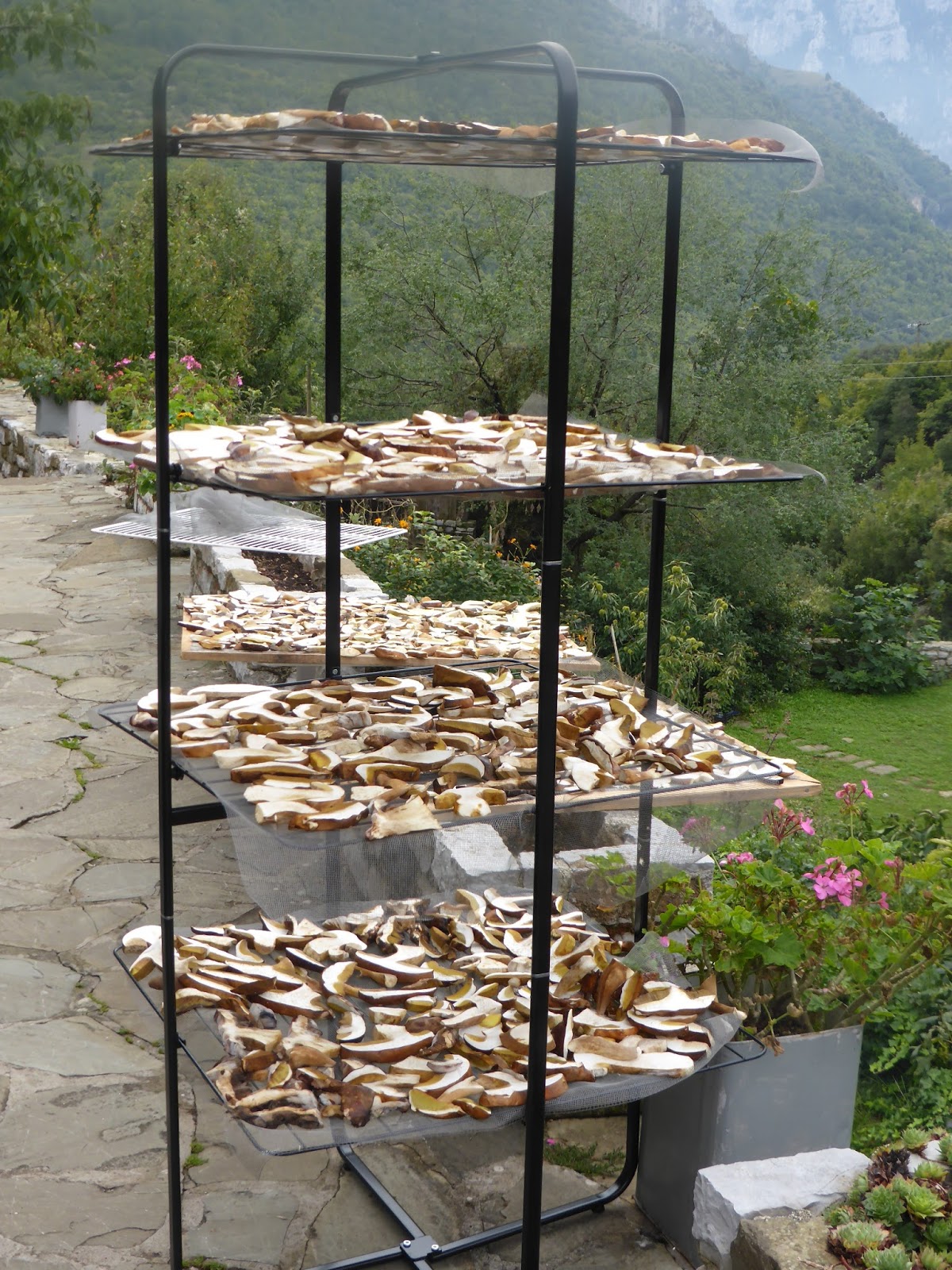
– Fried porchini mushrooms: porchini mushrooms are the ones with very ragged edges. Our host, Kostas, said they gather about 100kg of mushrooms every third day from the fields around the inn. These were served fried in olive oil and garlic, and garnished with rocket leaves and ground pepper.
– Green beans: coarsely sliced lengthways and lightly cooked in a tomato pasta sauce heavily diluted in olive oil. We’re definitely going to try and replicate this back home.
Of course this was complimented by obligatory glasses of passable local red and white wines at ridiculously low prices.

Our traditional taverna served organic vegetables fresh from their own garden

Trays of porchini mushrooms drying in the sun

[KensBlog] End of the Road

Sans Souci, Nordhavn 68
[KensBlog] End of the Road 10/2/2015 12:26:29 PM

It’s the end of a very long road.

The journey that began in May 2009 when three boats — Grey Pearl, Seabird and Sans Souci — departed Seattle has now concluded. We covered over 20,000 miles visiting Canada, Alaska, the Bering Sea, the Aleutian Islands, Siberia, Japan, Taiwan, Hong Kong, Turkey, Greece, Montenegro, Croatia, Italy, Sicily, Malta, France and Spain.

It was the trip of a lifetime.

We met incredible people, cruised places off the beaten path, experienced a wide variety of cultures, witnessed history being made and history long past, and learned more about the world and boating than we’d ever imagined.

As mentioned in prior blog entries, this year, Roberta and I decided to ship the boat home to Seattle aboard a freighter. We flew to Seattle with the dogs a couple of weeks ago, and sent the Seattle-based mechanic/Captain (Jeff Sanson), who maintains our boat, over to Mallorca, Spain, to prepare Sans Souci and load her onto a freighter.

Loading the boat onto a freighter isn’t as easy as it sounds. Roberta, Jeff and I each made lists of things to do before the boat would be loaded onto the freighter.

Here’s a small sampling of the items on Jeff’s list:

1. Call customs guy and pay
2. Pickup euros
3. Throw away dog stuff
4. Clean out freezers and refers setup for shipping.
5. Clean out holding tank
6. Stash all outside cushions
7. Roll up fly bridge Bimini top
8. Tie down all chairs in salon
9. Make sure all cabinet locks are pushed in before leaving boat
10. Store table chairs in side of vessel from top deck
11. Make sure tenders are tied down properly
12. Put fresh baking soda in refers and freezer’s after shutdown
13. Remove all items off counters and store
14. Run Water makers
15. Clean out shower sump with bleach
16. Bleach Gray water tank and pump down
17. Pump down fresh water tank
18. Pump down black water tank
19. Move boat to Palma prior to loading 9/29/15
20. Have diver clean bottom and replace zincs
21. Secure engine room & Lazerette
22. Go through the order of shutting down systems.
23. Last thing is to store dock lines and fenders and once the boat is loaded on the ship.
And more!

Jeff flew to Mallorca thinking he’d have a few days to prepare before the freighter would arrive, and that after its arrival there would be a few days delay. Both he and I were surprised when just a day after his arrival he received this message from the customs agent in Mallorca:

“Jeff:

Saimaagracht arrived today. Loadmasters preparing deck to load smaller yachts this afternoon.

The plan is to load you tomorrow at 8 am.

Please confirm ok

Toni Horrach
Miguel Puigserver, SA
Since 1876″

We shouldn’t have been surprised. I shipped once before with the same yacht transport company, and they were excellent to deal with (Sevenstars.)

Jeff still had a few tasks to complete, but got them all done. The last of the tasks was to get the bottom cleaned. Amazingly, he (and Richard, a local guy I had hired to watch over the boat) persuaded a diver to go under the boat, in driving rain and lightning, to clean the boat.

Loading a boat onto a freighter can be disastrous. I know of two Nordhavns that were destroyed while being lifted, and have had some dicey liftings of my own boat. In addition to those times where the lift seemed barely able to lift the boat, I had a real mess in Costa Rica when I was shipping the boat home to Seattle. The freighter appeared and the Captain took one look at my boat, declared it too heavy, and refused to attempt lifting it. That mess took years to sort out and ultimately resulted in a miserable run up the coast in horrible conditions.

Adding to my sense of nervousness was that our boat was nearing the end of the 18 month period we were allowed to be in Europe without being assessed a huge import tax (VAT). We had been watching the calendar closely and I had carefully preserved the paperwork showing we were in the country legally and had not overstayed our dates, but… should anything go wrong, and some major delay creep in, or some tax authority declare my paperwork insufficient, it could be a nightmare. I had everything well organized, and knew there was nothing to worry about, but… having nothing to worry about has never hindered my worrying.

Thus, the hours before loading were tense. And, with the time zone difference, the action in Spain would be happening while I would be Sleepless in Seattle.

At 11pm I spoke with Jeff Sanson. Sans Souci was to be loaded on the freighter at 8:30am Spain-time (11:30pm Seattle-time.) Jeff was busy doing the final preparations to load the boat  and was waiting for a call from the freighter’s load-master to start the loading. I told Jeff I was going to sleep and he should just text me when the boat was loaded onto the freighter.

At 2:30am the phone rang. I expected it to be Jeff, and that I was about to hear that something had gone wrong. I jumped to answer the phone, fearing the worst, but it was a lady’s voice with a thick Spanish accent. She was from the Port Adriano Marina, where Sans Souci had been moored awaiting departure for the U.S. They had noticed that my boat was gone and wondered if it were coming back. I was half-asleep and did a poor job explaining that the boat was loading onto a freighter. I confused her, leading her to seek her boss, who I further confused. But, the message finally got through, and she said they would email me an invoice.

I had no word from Jeff, so I checked my email and there was a picture of Sans Souci in the slings! The email had just arrived moments before. We were loading! I didn’t want to pester Jeff, so I decided to go back to sleep.

Sleep was impossible. After a bit of tossing and turning I phoned Jeff. No answer. I figured he was busy and tried to sleep again.

At 3:45am, the phone rang. It was Jeff, “Did you call me?” he asked. He went on to say that the boat was still in the water. “But, I saw a picture of it lifted from the water!” I exclaimed. He explained that they had lifted the boat, but then noticed it was coming up at a strange angle, and lowered it back to the water to readjust the straps. Divers were under the boat as we spoke. I was nervous but said, “I’m going back to sleep. Call me if there are problems.”

At 5:45am, after hours of tossing and turning, I texted Jeff to ask how it was going. He texted back a picture of Sans Souci on the deck of the freighter! All was good. Jeff said that all had gone smoothly on the second lifting, and that he had met the captain of the freighter.

The captain gave Jeff, as well as the other two guys with Jeff (Richard, a local person I hired to watch over the boat in my absence, and Steven Argosy, from Seabird) a tour of the freighter, which is loaded with boats bound for the Fort Lauderdale boat show in Florida.

Jeff and I briefly discussed next steps. The freighter will cross the Atlantic in just 11 days.

Things are happening faster than planned. Jeff will return to Seattle and then almost immediately fly to Florida.

Sans Souci was loaded Spain, but will offload in Florida. Jeff will need to put the boat in a marina for some indeterminate amount of time. Then, return home, and fly back again to load the boat onto another freighter where it will probably offload in Canada. After which Jeff will bring it back to Seattle.

 And… then, I’ll relax.

I’ve received a lot of email asking, “What went wrong?” As many of you know, our original plan was to spend almost eight months on the boat this year, including a trip to the Caribbean this coming winter. Instead we spent around four months on the boat and made the decision to ship the boat home, bypassing some great cruising in the Caribbean and the entire east coast of the United States.

There were lots of reasons but it really comes down to: It sounded more fun to be at our home in Cabo San Lucas, Mexico, this winter than to be on the boat. We were missing our family and friends in Seattle, and wanted some time at home there, and we thought about how much we missed our life and friends in Cabo, and decided we would rather be there as well. We were also looking forward to cruising with our GSSR co-conspirators in the Caribbean, but… a tough decision had to be made, and we were homesick.

We did have some issues with weather this year (too much wind, and too much swell accompanied by unprotected overly-crowded anchorages) but I don’t think that better weather would have made a difference. It really just came down to, “We love the boat, but we love it for four months a year, not eight months a year.”

We thought about shipping the boat to the east coast, and then cruising there next summer, and came close to doing that. But, we just decided that Sans Souci needed some attention. We’ve run the boat over 30,000 miles and it is time to make her new again. There’s nothing major, but the upholstery is starting to wear, the carpets are looking worn, there are some fiberglass dings, there are some wood dings, etc. We’re looking forward to having the boat at home, and getting her looking perfect again. Also, we have had a slip for nearly a decade at one of our favorite marinas in the world, Roche Harbor, and Sans Souci has never even been in her own slip. We are looking forward to spending some time in the Pacific NW, which is one of the greatest cruising grounds in the world.

So, as we look ahead, and think about “what comes next” the answer is a firm, “Darned if we know.” We haven’t the foggiest idea of what comes next for Sans Souci. We know that she’ll get fixed up, and we know we’ll spend some time next summer in Seattle. But, after that? Who knows? There is some momentum for taking her to Hawaii, and we’re going there soon to check out that option. But.. we don’t know.

Anyway, I thought I’d close out the year with a quick look back at some pictures that aren’t particularly the best pictures or most interesting pictures, but they are ones that reminded me of the good times we had.

That’s it for KensBlog for 2015. Thank you for accompanying Roberta, Keeley, Toundra and I on this amazing journey!

-Ken Williams


You can access the blog entry
here.

Passagemaking with a Nordhavn 2015-10-02 04:26:29

Sans Souci, Nordhavn 68
[KensBlog] End of the Road 10/2/2015 12:26:29 PM

It’s the end of a very long road.

The journey that began in May 2009 when three boats — Grey Pearl, Seabird and Sans Souci — departed Seattle has now concluded. We covered over 20,000 miles visiting Canada, Alaska, the Bering Sea, the Aleutian Islands, Siberia, Japan, Taiwan, Hong Kong, Turkey, Greece, Montenegro, Croatia, Italy, Sicily, Malta, France and Spain.

It was the trip of a lifetime.

We met incredible people, cruised places off the beaten path, experienced a wide variety of cultures, witnessed history being made and history long past, and learned more about the world and boating than we’d ever imagined.

As mentioned in prior blog entries, this year, Roberta and I decided to ship the boat home to Seattle aboard a freighter. We flew to Seattle with the dogs a couple of weeks ago, and sent the Seattle-based mechanic/Captain (Jeff Sanson), who maintains our boat, over to Mallorca, Spain, to prepare Sans Souci and load her onto a freighter.

Loading the boat onto a freighter isn’t as easy as it sounds. Roberta, Jeff and I each made lists of things to do before the boat would be loaded onto the freighter.

Here’s a small sampling of the items on Jeff’s list:

1. Call customs guy and pay
2. Pickup euros
3. Throw away dog stuff
4. Clean out freezers and refers setup for shipping.
5. Clean out holding tank
6. Stash all outside cushions
7. Roll up fly bridge Bimini top
8. Tie down all chairs in salon
9. Make sure all cabinet locks are pushed in before leaving boat
10. Store table chairs in side of vessel from top deck
11. Make sure tenders are tied down properly
12. Put fresh baking soda in refers and freezer’s after shutdown
13. Remove all items off counters and store
14. Run Water makers
15. Clean out shower sump with bleach
16. Bleach Gray water tank and pump down
17. Pump down fresh water tank
18. Pump down black water tank
19. Move boat to Palma prior to loading 9/29/15
20. Have diver clean bottom and replace zincs
21. Secure engine room & Lazerette
22. Go through the order of shutting down systems.
23. Last thing is to store dock lines and fenders and once the boat is loaded on the ship.
And more!

Jeff flew to Mallorca thinking he’d have a few days to prepare before the freighter would arrive, and that after its arrival there would be a few days delay. Both he and I were surprised when just a day after his arrival he received this message from the customs agent in Mallorca:

“Jeff:

Saimaagracht arrived today. Loadmasters preparing deck to load smaller yachts this afternoon.

The plan is to load you tomorrow at 8 am.

Please confirm ok

Toni Horrach
Miguel Puigserver, SA
Since 1876″

We shouldn’t have been surprised. I shipped once before with the same yacht transport company, and they were excellent to deal with (Sevenstars.)

Jeff still had a few tasks to complete, but got them all done. The last of the tasks was to get the bottom cleaned. Amazingly, he (and Richard, a local guy I had hired to watch over the boat) persuaded a diver to go under the boat, in driving rain and lightning, to clean the boat.

Loading a boat onto a freighter can be disastrous. I know of two Nordhavns that were destroyed while being lifted, and have had some dicey liftings of my own boat. In addition to those times where the lift seemed barely able to lift the boat, I had a real mess in Costa Rica when I was shipping the boat home to Seattle. The freighter appeared and the Captain took one look at my boat, declared it too heavy, and refused to attempt lifting it. That mess took years to sort out and ultimately resulted in a miserable run up the coast in horrible conditions.

Adding to my sense of nervousness was that our boat was nearing the end of the 18 month period we were allowed to be in Europe without being assessed a huge import tax (VAT). We had been watching the calendar closely and I had carefully preserved the paperwork showing we were in the country legally and had not overstayed our dates, but… should anything go wrong, and some major delay creep in, or some tax authority declare my paperwork insufficient, it could be a nightmare. I had everything well organized, and knew there was nothing to worry about, but… having nothing to worry about has never hindered my worrying.

Thus, the hours before loading were tense. And, with the time zone difference, the action in Spain would be happening while I would be Sleepless in Seattle.

At 11pm I spoke with Jeff Sanson. Sans Souci was to be loaded on the freighter at 8:30am Spain-time (11:30pm Seattle-time.) Jeff was busy doing the final preparations to load the boat  and was waiting for a call from the freighter’s load-master to start the loading. I told Jeff I was going to sleep and he should just text me when the boat was loaded onto the freighter.

At 2:30am the phone rang. I expected it to be Jeff, and that I was about to hear that something had gone wrong. I jumped to answer the phone, fearing the worst, but it was a lady’s voice with a thick Spanish accent. She was from the Port Adriano Marina, where Sans Souci had been moored awaiting departure for the U.S. They had noticed that my boat was gone and wondered if it were coming back. I was half-asleep and did a poor job explaining that the boat was loading onto a freighter. I confused her, leading her to seek her boss, who I further confused. But, the message finally got through, and she said they would email me an invoice.

I had no word from Jeff, so I checked my email and there was a picture of Sans Souci in the slings! The email had just arrived moments before. We were loading! I didn’t want to pester Jeff, so I decided to go back to sleep.

Sleep was impossible. After a bit of tossing and turning I phoned Jeff. No answer. I figured he was busy and tried to sleep again.

At 3:45am, the phone rang. It was Jeff, “Did you call me?” he asked. He went on to say that the boat was still in the water. “But, I saw a picture of it lifted from the water!” I exclaimed. He explained that they had lifted the boat, but then noticed it was coming up at a strange angle, and lowered it back to the water to readjust the straps. Divers were under the boat as we spoke. I was nervous but said, “I’m going back to sleep. Call me if there are problems.”

At 5:45am, after hours of tossing and turning, I texted Jeff to ask how it was going. He texted back a picture of Sans Souci on the deck of the freighter! All was good. Jeff said that all had gone smoothly on the second lifting, and that he had met the captain of the freighter.

The captain gave Jeff, as well as the other two guys with Jeff (Richard, a local person I hired to watch over the boat in my absence, and Steven Argosy, from Seabird) a tour of the freighter, which is loaded with boats bound for the Fort Lauderdale boat show in Florida.

Jeff and I briefly discussed next steps. The freighter will cross the Atlantic in just 11 days.

Things are happening faster than planned. Jeff will return to Seattle and then almost immediately fly to Florida.

Sans Souci was loaded Spain, but will offload in Florida. Jeff will need to put the boat in a marina for some indeterminate amount of time. Then, return home, and fly back again to load the boat onto another freighter where it will probably offload in Canada. After which Jeff will bring it back to Seattle.

 And… then, I’ll relax.

I’ve received a lot of email asking, “What went wrong?” As many of you know, our original plan was to spend almost eight months on the boat this year, including a trip to the Caribbean this coming winter. Instead we spent around four months on the boat and made the decision to ship the boat home, bypassing some great cruising in the Caribbean and the entire east coast of the United States.

There were lots of reasons but it really comes down to: It sounded more fun to be at our home in Cabo San Lucas, Mexico, this winter than to be on the boat. We were missing our family and friends in Seattle, and wanted some time at home there, and we thought about how much we missed our life and friends in Cabo, and decided we would rather be there as well. We were also looking forward to cruising with our GSSR co-conspirators in the Caribbean, but… a tough decision had to be made, and we were homesick.

We did have some issues with weather this year (too much wind, and too much swell accompanied by unprotected overly-crowded anchorages) but I don’t think that better weather would have made a difference. It really just came down to, “We love the boat, but we love it for four months a year, not eight months a year.”

We thought about shipping the boat to the east coast, and then cruising there next summer, and came close to doing that. But, we just decided that Sans Souci needed some attention. We’ve run the boat over 30,000 miles and it is time to make her new again. There’s nothing major, but the upholstery is starting to wear, the carpets are looking worn, there are some fiberglass dings, there are some wood dings, etc. We’re looking forward to having the boat at home, and getting her looking perfect again. Also, we have had a slip for nearly a decade at one of our favorite marinas in the world, Roche Harbor, and Sans Souci has never even been in her own slip. We are looking forward to spending some time in the Pacific NW, which is one of the greatest cruising grounds in the world.

So, as we look ahead, and think about “what comes next” the answer is a firm, “Darned if we know.” We haven’t the foggiest idea of what comes next for Sans Souci. We know that she’ll get fixed up, and we know we’ll spend some time next summer in Seattle. But, after that? Who knows? There is some momentum for taking her to Hawaii, and we’re going there soon to check out that option. But.. we don’t know.

Anyway, I thought I’d close out the year with a quick look back at some pictures that aren’t particularly the best pictures or most interesting pictures, but they are ones that reminded me of the good times we had.

That’s it for KensBlog for 2015. Thank you for accompanying Roberta, Keeley, Toundra and I on this amazing journey!

-Ken Williams


You can access the blog entry
here.

Barcelona

The first thing I need to say is that there is a huge difference between visiting a city and living there. If we “visit” any city for, even, two weeks, we spend nearly every moment touring sites, eating at restaurants or sleeping. Don’t get me wrong.  We love doing that and we have done that quite a bit. Living there, to us, is much more enjoyable because you proceed at much less of a hurried pace and you get to know the people and surroundings in a more intimate fashion.

After our scheduled month here in Barcelona we were finishing up the last day of our reservation. All of the normal boat checks were done and all that was left to do before our next day departure was to go over to the marina office to check out and pay our bill. After paying, the marina representative asked us how we enjoyed Barcelona. We quickly responded by telling her how much we loved it in great detail. It was all true. We then both said ” I am not sure why we are leaving” to which she responded “Well, the berth is available until November”. Oh-oh.  We told her that we would let her know.

There is an old saying about boaters:  “All plans are written in sand at low tide”. This has been especially true for us over the years. One time we were preparing to leave Seattle within two weeks with Seabird, planning on cruising to the Mexican Baja. We had dinner with our friends Ken and Roberta (Sans Souci) who tried to convince us to cruise instead with them to Alaska and Japan.  They were indeed successful so we changed our plans and off we went.

Our decision to stay on for a second month was based on a few things: 

First, we had heard that the Ballearic islands anchorages were very crowded in August and marinas were outrageously expensive and difficult to get into. In September, everyone disappears and the cruising there is much more enjoyable. 

Secondly, our original plan from a year ago was to winter this year in Barcelona where we would have had months to get to know the city. That all changed when Sans Souci, Seabird and Ocean Pearl decided to instead cruise back across the Atlantic to the Virgin Islands. For one reason or another, that plan morphed into loading all three boats onto a ship and sending them that way.

So, in order to get in our “quality time” here, we booked for an additional month, leaving our cruising to the Ballearics until September.

As I mentioned in my previous blog, Barcelona is an exceptional city. Okay, now fast forward. We have been here for over a month now ( yeah, I know, my blog is SERIOUSLY behind schedule!) and we are nowhere near becoming tired of it. As far as large cities go, it is exceptionally clean and well run. They have acres of underground parking, so you don’t see the double and triple parking that you see in some other countries. It makes for a less chaotic environment.

Being young here doesn’t hurt either (not meaning us!). The evenings for most start with dinner at between 9 and 10pm. After that, there are the bars, the beach and all-around partying and hell raising. I mentioned how clean it is here. Well, it is, but sometime between 11pm and 4am, the beaches and boardwalk begin to look like they were hit by a garbage tornado!  Cans, beer bottles, papers and half eaten food strewn just everywhere.


At 7 am every morning, the cleanup starts. Huge garbage trucks and platoons of workers appear with brooms and scoops, and by 9am, everything, save a few malicious odors, is cleaned up. On the malicious odor topic, the Barcelona Clean Team is trying to help that part of it too. Their thought is: if you cannot make it to the toilet, the toilet will come to you (see below).


I imagine that you would have to have a momentary dulled sense of modesty to use these, but, when you gotta go……

Fortunately for us, we are long ago asleep while the hoards slither about in the streets at night.

We are more of the daytime slithering breed.  Barcelona has much to offer in the way of cultural activities. We have tried to visit something of interest at least every two days and being that the Metro (Barcelona’s subway system) is only a few minutes walk from our boat, everything  is easily accessible.

One of the first and most interesting sites was the Sagrada Famiglia, or Church of the Holy Family. It was designed by Antoni Gaudi, one of Spain’s most famous architects.


What makes it most interesting (other than it’s striking design) is that the construction commenced in 1882 and has been ongoing ever since. The estimated completion date is now set at the year 2026 or 100 years after Gaudi’s death. The design is unlike anything I have seen before and it takes on the appearance of partially melted wax. To me, it is incredible that someone could design something like this so long ago and without (obviously) the aid of modern computer software.  Gaudi’s influence is extensive in Barcelona and his many structures are easily identified, even to the untrained eye.


One day, we also visited the site of the 1992 Olympic Games, held here in Barcelona. In recent years, we have been fortunate enough to be  able to visit several of the Olympic Games sites in different countries. The Athens, Greece site is a dilapidated disgrace, overgrown with weeds and its buildings covered in graffiti. The Bejing, China site, while not as bad as Athens by a long shot, is still a sad place to visit, with the government using the facilities for whatever cheap commercial attraction they can find.

Barcelona is different. It is treated like a huge museum.  While visiting the pristine grounds, you get the feeling that if the Olympic Committee decided that they wanted to hold the Games next week, Barcelona would be ready.


Three photos of the ’92 Olympic site in Barcelona


In Barcelona at night, you have your choice of music in the area of our marina. One night you will see them setting up 1000 chairs and a stage next to the beach for an outdoor opera performance. On any given night you will see impromptu performances of musicians and bands on the boardwalk, with something for everyone’s taste and it goes on until the wee hours of the morning. Beach goers seem to have no special hours. We see them on the beaches staking out their spots at 7 am and their are still crowds there at midnight under the bright light of the powerful flood lights that the city provides to keep it safe for everyone. 

Safety is not too much of an issue here, as far as I can tell. Pickpockets and unarmed thieves seem to be the biggest annoyance. One morning at around 9am, Carol and I were doing our morning walk next to the beach when we saw a disturbance. Three somewhat out of shape beach goers were screaming and running toward the boardwalk. We then saw why. It looked to us like a guy pretending to be a beach jogger snatched the belongings of some poor woman as he went by them. He then immediately headed for the stairs to the road and was gone in a flash.

Did I mention that we feel kind of old in the city here because of all the young people? Well, to make matters worse, Carol and I went to the maritime museum situated near the marina. It did have quite a display of very old marine related items, but what upset Carol was that a good part of the museum was dedicated to “artifacts” like outboard motors and small boats that we used to have as CHILDREN!! 

While we spent a good deal of time in Barcelona, we did do some land traveling on Spain’s AVE high speed train system, which travels at nearly 200 mph. We traveled from Barcelona to Madrid, Seville and Valencia on separate trips, which I will get into in my next blog….


A few more pics….

“The Black Madonna” at a church in Monserrat


 Guell (pronounced Gway) was designed by Gaudi for a developer who envisioned a high priced housing community. The centerpiece of the complex was to be the public area for the designed city. It was unfortunately canceled because of cost and proximity to the city so it was turned into a park, and a stunning one at that. Only a few houses were ever built but the grounds remain as a tourist site and many times you need to make reservations in advance to get in.


I am always available to help those in distress


Carol said this woman did not appear to be in distress and therefore did not need my help

The beginning of the Barcelona Triathlon

And last but not least……..


From what I understand, this boat that was docked a few away from us had a collision with a freighter (notice the mast is missing).  I understand that part. What I can’t figure out is if the boat was named before or after the incident……

Start your own blog now! Free!

Barcelona

The first thing I need to say is that there is a huge difference between visiting a city and living there. If we “visit” any city for, even, two weeks, we spend nearly every moment touring sites, eating at restaurants or sleeping. Don’t get me wrong.  We love doing that and we have done that quite a bit. Living there, to us, is much more enjoyable because you proceed at much less of a hurried pace and you get to know the people and surroundings in a more intimate fashion.

After our scheduled month here in Barcelona we were finishing up the last day of our reservation. All of the normal boat checks were done and all that was left to do before our next day departure was to go over to the marina office to check out and pay our bill. After paying, the marina representative asked us how we enjoyed Barcelona. We quickly responded by telling her how much we loved it in great detail. It was all true. We then both said ” I am not sure why we are leaving” to which she responded “Well, the berth is available until November”. Oh-oh.  We told her that we would let her know.

There is an old saying about boaters:  “All plans are written in sand at low tide”. This has been especially true for us over the years. One time we were preparing to leave Seattle within two weeks with Seabird, planning on cruising to the Mexican Baja. We had dinner with our friends Ken and Roberta (Sans Souci) who tried to convince us to cruise instead with them to Alaska and Japan.  They were indeed successful so we changed our plans and off we went.

Our decision to stay on for a second month was based on a few things: 

First, we had heard that the Ballearic islands anchorages were very crowded in August and marinas were outrageously expensive and difficult to get into. In September, everyone disappears and the cruising there is much more enjoyable. 

Secondly, our original plan from a year ago was to winter this year in Barcelona where we would have had months to get to know the city. That all changed when Sans Souci, Seabird and Ocean Pearl decided to instead cruise back across the Atlantic to the Virgin Islands. For one reason or another, that plan morphed into loading all three boats onto a ship and sending them that way.

So, in order to get in our “quality time” here, we booked for an additional month, leaving our cruising to the Ballearics until September.

As I mentioned in my previous blog, Barcelona is an exceptional city. Okay, now fast forward. We have been here for over a month now ( yeah, I know, my blog is SERIOUSLY behind schedule!) and we are nowhere near becoming tired of it. As far as large cities go, it is exceptionally clean and well run. They have acres of underground parking, so you don’t see the double and triple parking that you see in some other countries. It makes for a less chaotic environment.

Being young here doesn’t hurt either (not meaning us!). The evenings for most start with dinner at between 9 and 10pm. After that, there are the bars, the beach and all-around partying and hell raising. I mentioned how clean it is here. Well, it is, but sometime between 11pm and 4am, the beaches and boardwalk begin to look like they were hit by a garbage tornado!  Cans, beer bottles, papers and half eaten food strewn just everywhere.


At 7 am every morning, the cleanup starts. Huge garbage trucks and platoons of workers appear with brooms and scoops, and by 9am, everything, save a few malicious odors, is cleaned up. On the malicious odor topic, the Barcelona Clean Team is trying to help that part of it too. Their thought is: if you cannot make it to the toilet, the toilet will come to you (see below).


I imagine that you would have to have a momentary dulled sense of modesty to use these, but, when you gotta go……

Fortunately for us, we are long ago asleep while the hoards slither about in the streets at night.

We are more of the daytime slithering breed.  Barcelona has much to offer in the way of cultural activities. We have tried to visit something of interest at least every two days and being that the Metro (Barcelona’s subway system) is only a few minutes walk from our boat, everything  is easily accessible.

One of the first and most interesting sites was the Sagrada Famiglia, or Church of the Holy Family. It was designed by Antoni Gaudi, one of Spain’s most famous architects.


What makes it most interesting (other than it’s striking design) is that the construction commenced in 1882 and has been ongoing ever since. The estimated completion date is now set at the year 2026 or 100 years after Gaudi’s death. The design is unlike anything I have seen before and it takes on the appearance of partially melted wax. To me, it is incredible that someone could design something like this so long ago and without (obviously) the aid of modern computer software.  Gaudi’s influence is extensive in Barcelona and his many structures are easily identified, even to the untrained eye.


One day, we also visited the site of the 1992 Olympic Games, held here in Barcelona. In recent years, we have been fortunate enough to be  able to visit several of the Olympic Games sites in different countries. The Athens, Greece site is a dilapidated disgrace, overgrown with weeds and its buildings covered in graffiti. The Bejing, China site, while not as bad as Athens by a long shot, is still a sad place to visit, with the government using the facilities for whatever cheap commercial attraction they can find.

Barcelona is different. It is treated like a huge museum.  While visiting the pristine grounds, you get the feeling that if the Olympic Committee decided that they wanted to hold the Games next week, Barcelona would be ready.


Three photos of the ’92 Olympic site in Barcelona


In Barcelona at night, you have your choice of music in the area of our marina. One night you will see them setting up 1000 chairs and a stage next to the beach for an outdoor opera performance. On any given night you will see impromptu performances of musicians and bands on the boardwalk, with something for everyone’s taste and it goes on until the wee hours of the morning. Beach goers seem to have no special hours. We see them on the beaches staking out their spots at 7 am and their are still crowds there at midnight under the bright light of the powerful flood lights that the city provides to keep it safe for everyone. 

Safety is not too much of an issue here, as far as I can tell. Pickpockets and unarmed thieves seem to be the biggest annoyance. One morning at around 9am, Carol and I were doing our morning walk next to the beach when we saw a disturbance. Three somewhat out of shape beach goers were screaming and running toward the boardwalk. We then saw why. It looked to us like a guy pretending to be a beach jogger snatched the belongings of some poor woman as he went by them. He then immediately headed for the stairs to the road and was gone in a flash.

Did I mention that we feel kind of old in the city here because of all the young people? Well, to make matters worse, Carol and I went to the maritime museum situated near the marina. It did have quite a display of very old marine related items, but what upset Carol was that a good part of the museum was dedicated to “artifacts” like outboard motors and small boats that we used to have as CHILDREN!! 

While we spent a good deal of time in Barcelona, we did do some land traveling on Spain’s AVE high speed train system, which travels at nearly 200 mph. We traveled from Barcelona to Madrid, Seville and Valencia on separate trips, which I will get into in my next blog….


A few more pics….

“The Black Madonna” at a church in Monserrat


 Guell (pronounced Gway) was designed by Gaudi for a developer who envisioned a high priced housing community. The centerpiece of the complex was to be the public area for the designed city. It was unfortunately canceled because of cost and proximity to the city so it was turned into a park, and a stunning one at that. Only a few houses were ever built but the grounds remain as a tourist site and many times you need to make reservations in advance to get in.


I am always available to help those in distress


Carol said this woman did not appear to be in distress and therefore did not need my help

The beginning of the Barcelona Triathlon

And last but not least……..


From what I understand, this boat that was docked a few away from us had a collision with a freighter (notice the mast is missing).  I understand that part. What I can’t figure out is if the boat was named before or after the incident……

Start your own blog now! Free!

This is a test article – ignore it

LEAVING ENVOY DURING THE WINTER IN THE WATER VS HARDSTAND

Envoy is on the hard in Lefkas marina, Greece and we will be back there early next week.

Having owned Envoy since late 2006 we’ve now left her unattended for periods ranging from about 5 months to 27 months, mostly on the hardstand but sometimes in the water so what are the pros and cons of each for boats in general?
Next week when we rejoin Envoy she’ll have been out of the water for about 6 months so then we’ll report more on this subject.

Envoy on the Ostia marina hardstand, Italy

Firstly it’s much more pleasant in a marina living aboard while your boat is in the water. You still get gentle boat movement (sometimes not so gentle during gales) and it’s much easier and safer to get aboard your boat and load supplies using the passarelle from the dock compared to a ladder from the ground.
In most marinas we can use our own shower rather than the shore facilities and empty the galley sink, neither of which we can do on the hardstand.
Marina hardstand areas are generally rather litter-strewn and dusty so we always find it easier to keep Envoy clean while in the water. But of course below waterline areas are a different story and while your boat is sitting unused in the water your hull will suffer more marine growth than usual.
So far as safety of the vessel is concerned each option is probably neutral. While in the water there is the risk of damage to mooring lines, cleats and hulls during storms, as well as the risk of taking on water if a leak develops. This is very dependent on the location of the marina since many are subject to surges during adverse winter weather.
On the hardstand there is some risk of damage during travel lift operations or from the vessel falling or being knocked over during earthquakes or severe storms, both of which are prevalent in the Med.
Personal safety is better with your vessel in the water as many accidents occur with people falling from their vessel or ladder onto the hardstand below.
In most marinas security is better on marina piers than it is on the hardstand where there are more people coming and going and public access is less restricted.
Cost is another factor to take into account and this depends on the individual marina and their ratio of berths to hardstand area. Sometimes it’s cheaper in the water and sometimes not. Seasonality also affects this with considerable more hardstand area being available during summer months.
Envoy’s refrigeration system has the option of air or seawater cooling but the latter is more efficient so that’s another plus for being in the water.
There are some repairs and maintenance which can only be performed out of water (for example servicing seacocks and running gear) but on balance there is more that can be achieved in the water.
Another negative for staying in the water is the possibility of galvanic corrosion and/or stray current electrolysis.
Osmosis is another risk for GRP hulls and a spell of several months out of the water can only assist its prevention.

INTERESTING INFORMATION FROM TECHNICAL TRAINING SEMINAR ABOARD NORDHAVN 68 – PART TWO

Envoy is currently in Lefkas marina, Greece and we’re home in New Zealand. But we arrive back in Lefkas late next week and soon after that will give an update on how Envoy’s faring having been left for 11 months.

Our last posting introduced the technical seminar held aboard Nordhavn 68, Karajas, in Akuna Bay Marina north of Sydney.

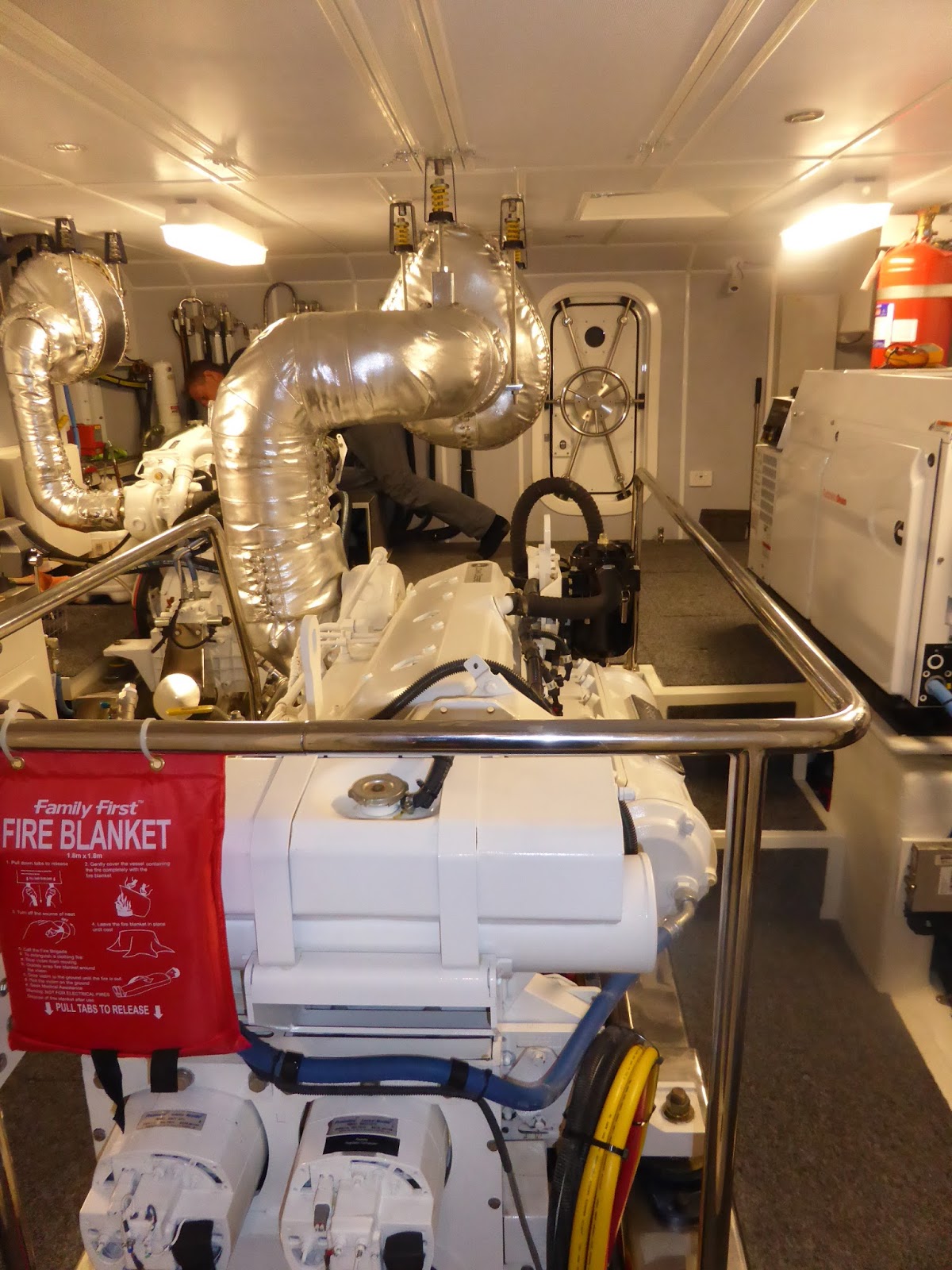
View of Karaja’s engine room with single John Deere main plus Northern Lights wing engine

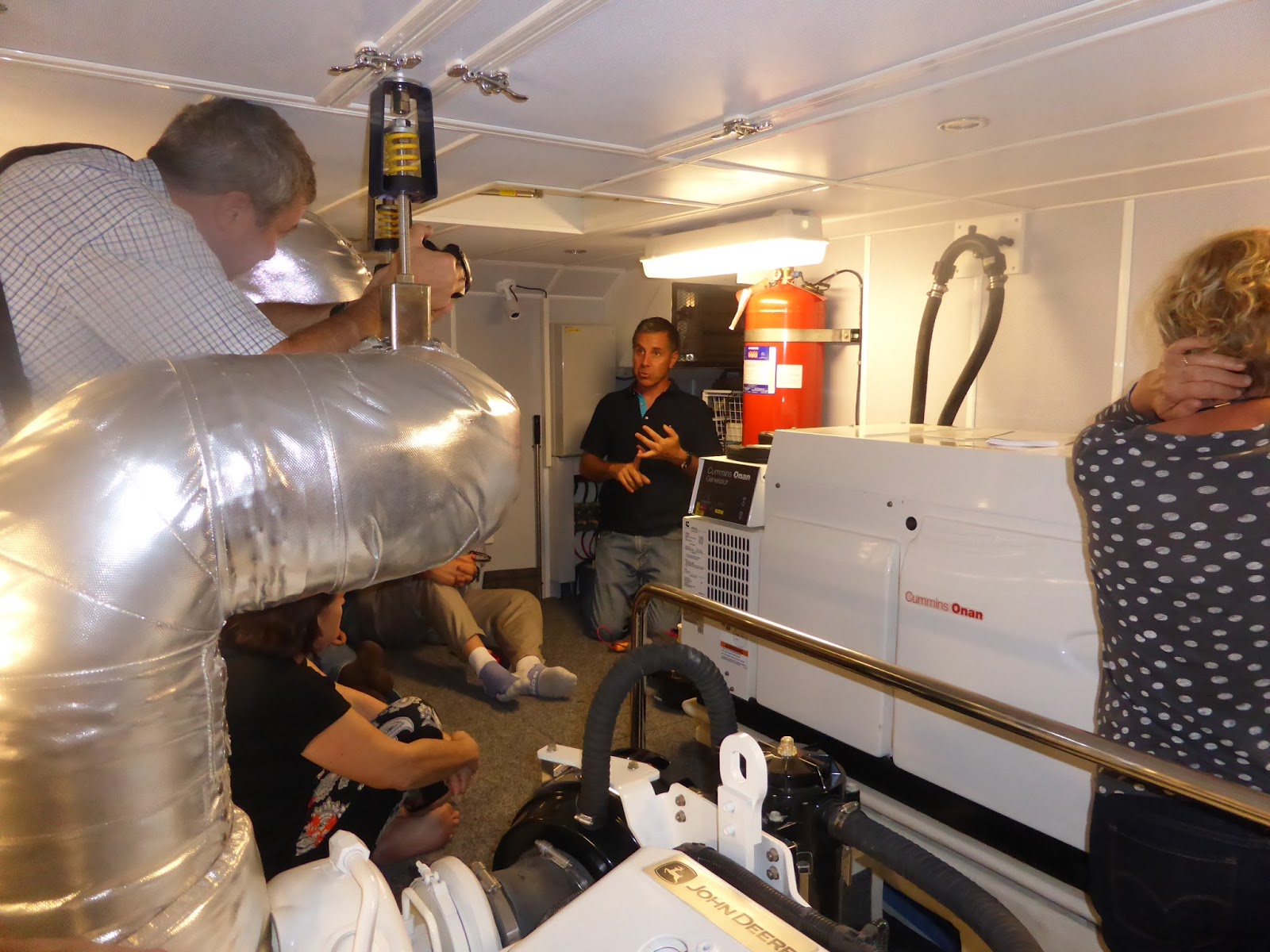
Steve d’Antonio talks to course attendees in engine room

So what are a few key points others can learn from? Here is a flavour of some specifics.
– Always install equipment according to the manufacturer’s guidelines and insist that contractors do so,
as well as supplying a schematic diagram where needed.
– No AC power connections should be exposed or able to be accidentally touched.
– When working on AC power systems always totally isolate the inverter and remove the shore power
cable.
– Stainless steel bolts, nuts and washers should not be used in demanding applications like prop shaft couplings, steering couplings or engine mounts. Nor should they be used in electrical situations due to
the low conductivity of stainless steel.
– Although two hose clamps are supposed to be used for all raw water plumbing applications it is better
to use one properly than two improperly. Ensure hose clamps are marine grade stainless steel and have
solid not perforated bands. To avoid cuts and injuries use “Clamp-Aid” silicone covers on the sharp
exposed tail of the clamp.
– Only use correctly rated and marked hose for raw water plumbing and exhaust systems.
– Operate seacocks regularly to avoid them seizing up.
– Hydraulic steering rams and tiller arms should be regularly checked both at rest and under way while steering lock-to-lock to check for significant leaks and movement in fastenings.
– Test your emergency steering tiller before you need to use it.
– To reduce corrosion on aluminium masts, paravanes, booms, door frames etc bed fittings and hardware
in a PU bedding compound. This can be done retrospectively.
– In the event of engine room fire stop all engines and blowers (to maximise the effect of the extinguishing agent) and isolate the batteries (in case the fire is caused by a short circuit or overload).
– The prop shaft stuffing box temperature should not exceed about 30dF above the ambient sea water temperature.
– There is no need to change primary fuel filter cartridges too often, but as dictated by your vacuum gauge
(at about 5 inches of vacuum). Use 10 or 30 micron cartridges – finer is not better in the primaries.
– Bleeding of the fuel system should not be necessary if the primary and secondary filters are bled
correctly when changed. To ensure any air remaining in the system is passed through run the engine for
about 5 mins at 1200-1440 rpm, not at idle. This rpm range will reduce the chance of the engine stalling while passing air.
– Dry exhaust thermal insulation should be regularly checked using the pyrometer and for potential fire
and safety reasons no section should exceed 200dF. Wet exhaust system hoses should not exceed about 160dF.
– To maximise AGM battery life normally discharge to about 50% of its capacity and don’t routinely start charging much above that level.

I would certainly recommend any serious cruiser to attend a course run by Steve or a similarly qualified industry expert both to learn specifics and to stimulate thought.

[KensBlog] Last Day In Paradise

Sans Souci, Nordhavn 68
[KensBlog] Last Day In Paradise 9/6/2015 2:06:02 PM

I am working on a final blog entry that will wrap-up and summarize our season. I should post that in the next few days.

In the meantime, here is a brief video I shot with my drone on our last day at Port Adriano. It doesn’t have much to do with boating, other than it begins by showing a bit of the squall that hit us while sitting in port.

The morning started fine and looked to be a nice day, but as I was sitting at my computer early in the morning I noticed the captain and stewardess (yes – they still call them that on yachts) from the next boat sitting on the front deck taking pictures. It made me curious what they were looking at so I went out to the bow and looked westward where their cameras were pointing.

There were dark storm clouds; some of the darkest I’ve seen and they were coming our way fast.

Within minutes the wind shot up to 20 knots, from nothing. Minutes later it hit 32 knots and we were besieged by rain. Pushed by the wind, the rain was coming sideways! I wanted to go outside to check our lines but I’d have been drenched in seconds.

And, then the lightning struck. It didn’t seem that bad, but it seemed incredibly close. Some of the strikes were really frightening the dogs.

As part of preparing for our departure, and in addition to all the packing, Roberta needed to do some final loads of laundry. As always, she called up the stairs to say, “Is it ok to start the dryer?” We were on shore power with all the power we could want, but it’s a rule on Sans Souci to alert me before starting any heavy appliances. I responded, “No problem” thinking that would be the end of it, but back came the reply, “Do you have the breaker off?”

Crap. I knew what this meant. The shorepower had gone out. I phoned Steven Argosy (Nordhavn 62, Seabird) to ask if his shorepower was out. It wasn’t. This meant it might just be our boat, so I headed down to the engine room.

We have an international shorepower converter called the Atlas. It allows our American boat to accept the 3-phase European power. I immediately noticed the bright red error light. On the LED was the message, “Voltage out of range.” That meant we had gotten some voltage surge due to the lightning and the Atlas had decided to shut down. I pressed reset and the error wouldn’t go away. “Why was this happening on our last day?,” I was thinking. I shut down the breaker right where the shorepower first enters the boat, powering down the Atlas completely. I waited a minute and powered it back up. It seemed to be coming up. Good! But, then it suddenly went black. Not good.

I checked the shorepower breaker. It was tripped. Double-crap. Normally this is an indication that the boat is drawing more amps than shorepower could provide. There was nothing running on the boat that required a significant amount of electricity. I flipped the breaker back on and started the power again. Seconds later, the power shut down again, but this time the breaker wasn’t tripped. It appeared I had blown the shorepower breaker.

We were connected to a 150 amp shorepower circuit. Tripping it should have been impossible. Something was definitely wrong. I decided that I should take a look at the power pedestal, and despite the driving rain went ashore to inspect it. Unfortunately, there were no breakers on it I could get at, and no indication of any sort as to whether the power was on or off.

I went up to the pilot house and called the marina, asking them to come reset the power pedestal. They, having common sense, said they wanted to wait for a break in the action and then send someone to check on our power. I knew this could take a while, so I used the time to type a note to the local gentleman (Richard) who I would be paying to look after our boat during the weeks until my guy Jeff, could fly over from Seattle to Mallorca to load Sans Souci onto a freighter.

“…
Richard:
CC: Jeff Sanson, Pacific Yacht Management

The storm today seems to have blown up Sans Souci’s shore power converter (the Atlas).

Richard – is there a time you could stop by today? (what time works for you?)

My plan is to:

– Run on the generator until we leave tomorrow
– Show you how to run the generator while we are gone
– Shut down everything on the boat to the bare minimum
– Have you run the generator twice a week for an hour (just to keep the batteries charged)
– Let Jeff figure out what to do when he gets here

Ken Williams
…”

I waited to hit send hoping for a miracle when the marina guy looked at the power pedestal. After about 30 minutes, there was a break in the rain, and someone did show up. I saw him look at the pedestal, open it, fiddle around, and then walk off. I walked out to the back deck to see what he’d found but he was already walking away. So, I went to my electric panel and seeing a green light shouted to Roberta, “The electricity is on! Yay!” The email above was never sent.

Anyway, this video shows just a brief bit of the rain. Steven (from Seabird) and I had made plans to fly our drones on the last day. However the rain was making it impossible. Plus, we were worried the marina would yell at us for taking up a drone in the marina. I called Steven to say, “It has stopped raining for a few minutes. Still want to fly? We can go up the hill to a playground I saw.” Steven said he didn’t want to take his drone out in the rain and I said I’d take a chance with mine.

As you’ll see in the video we did take the drone up, but the wind came back, and it started raining. The video is amazingly clear given that the drone was shaking trying to stabilize itself despite the wind. Had it been a clear day we’d have flown it over to the marina but I was too afraid of losing it. The rain was obscuring visibility and we shouldn’t have been playing at all .. but, what fun would that be? No guts, no glory. Plus, you know that old saying, “The primary difference between men and boys is the cost of their toys.” The best piece of the video is the part that unfortunately we lost. I was showing Steven how fast the drone could go and meant to stop it just before running into a fence, but … didn’t. Oops. The fence was fine and the drone was fine, but … it was a spectacular crash, and I wish the video hadn’t been lost. Anyway… this has very little to do with boating, but I think you’ll like it.

Click the link below in order to see the video. Don’t forget to click the little icon in the lower right corner of the video that makes it display full-screen.

http://www.kensblog.com/aspx/vimeoplayer.aspx?vimeo=138440035

Thank you!
Ken and Roberta Williams (with Keeley and Toundra)
Nordhavn 68, Sans Souci


You can access the blog entry
here.