
The Cirque du Soleil show Corteo came to Climate Pledge Arena this year, and we somehow managed to snag last-minute front-row seats. The show is about a clown, Mauro, who imagines his own funeral procession and is told in typical Cirque du Soleil fashion through skilled acrobats dressed in fantastic costumes. We had an excellent…
Tag Archives | trawler
April in Sidney
A few weeks turned into almost a month as we waited on Spring to arrive in Sidney. We needed just a few days of good weather to repair some small gel coat cracks but it has been cold and raining almost non stop. April usually sees some good weather here in Sidney but not this year. Now […]
April 24-27 Chicago, IL Part I
“If your absence doesn’t affect them, your presence never mattered.” – Suyog Potdar

My parents both grew up in the suburbs of Chicago and I spent a lot of time here as a child. My grandma would take us down to the Loop…making sure we got to ride on a bus, a train and the L (elevated train). We visited all the museums and the large department stores. It was a true experience for a young child from the country and I have wonderful memories of the time I’ve spent there. But it’s been over forty years since I’ve visited the area and things have changed a lot.
We’re staying at the Pendry Hotel on Michigan Avenue. It’s in The Carbide & Carbon Building that was built in 1929 as the regional office of Union Carbide and Carbon Co. The Art Deco building was designated a Chicago Landmark in 1996 and converted into a hotel in 2004. Stan worked for Union Carbide for over 30 years, so it’s kind of neat staying in this beautiful building. It’s located within the Loop in the heart of the city. This area comprises some of Chicago’s most iconic attractions, including historic architecture, river cruises, Millennium Park and the Chicago Riverwalk, which includes incredible dining and shopping.


Walking the streets in Chicago is like walking through a museum…the buildings are beautiful and the architecture is internationally renowned. We truly enjoyed taking in the sights.
Looking north on Michigan Ave. The Wrigley Building on the left and the Tribune building on the right.
 Looking south on Michigan Ave.
View from Lower Wacker Dr.

Plaza outside the Wrigley Building looking south to the London House Building on the corner of Lower Wacker Dr. and Michigan Ave.

Views from the London House rooftop bar. Looking north at the Wrigley and Tribune Buildings.

Looking west up the Chicago River.

Looking east on the Chicago River toward Lake Michigan.

The Chicago Water Tower was built in 1869 and is one of the only buildings to survive the Great Chicago Fire of 1871. The castle-like building houses a gallery that showcases the work of local artists and photographers.

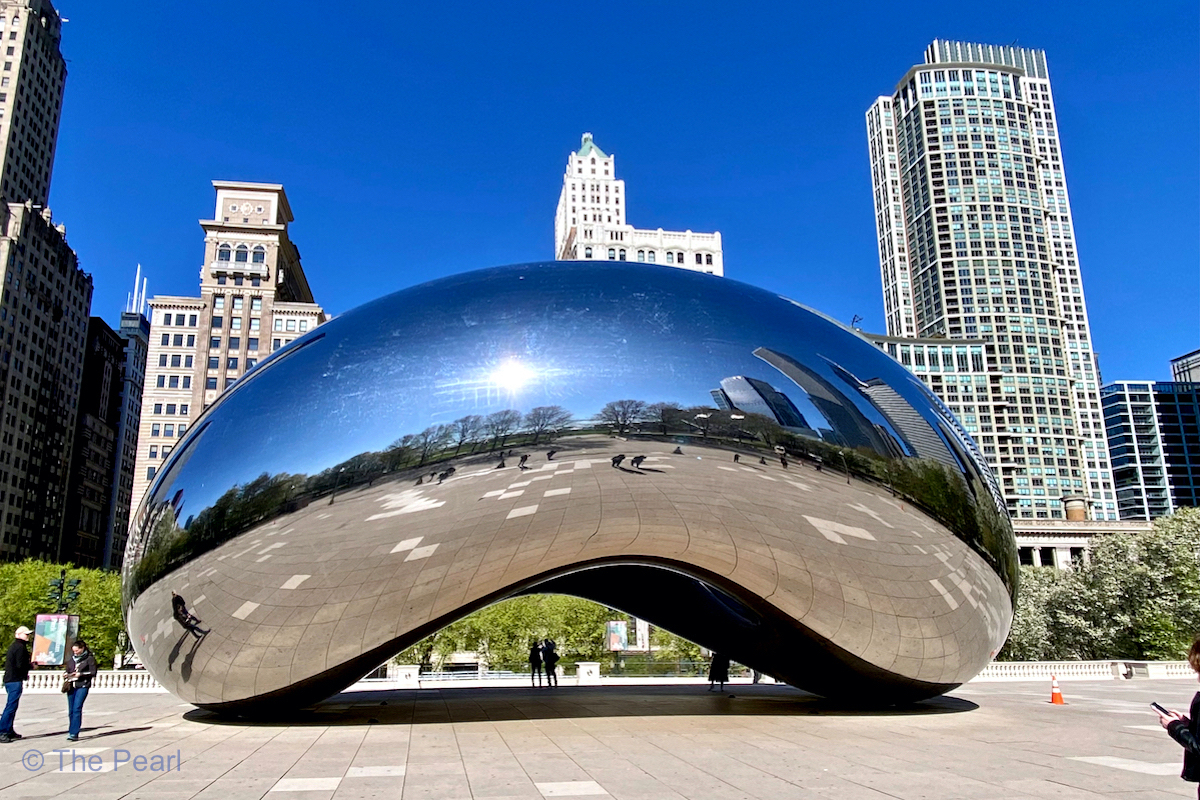
We had some rain and a lot of cold weather while we were in Chicago, but we also had a lot of clear blue skies that let us explore and take beautiful pictures of the area. One morning we enjoyed walking through Millennium Park. Cloud Gate affectionately known as The Bean is an elliptical sculpture forged of highly polished stainless steel plates that reflect Chicago’s skyline. A 12-foot-high arch provides a “gate” to the concave chamber beneath the sculpture, inviting visitors to touch its mirror-like surface and see their image reflected back from a variety of perspectives. Inspired by liquid mercury, the sculpture is among the largest of its kind in the world. It has become one of Chicago’s most iconic sights since opening in 2004.
Millennium Park


The Bean looking south.

The Bean looking east.

Reflections on the Bean.

The Bean looking west.
Along with beautiful architecture Chicago has wonderful places to eat and you can find any type of cuisine you’re looking for. Making a choice of where to eat was difficult. Here are some of the places we enjoyed.
Our first night we had a very favorable meal at Fisk & Co. Stan had the Roasted Faroe Island salmon with crispy potato gnocchi, oyster mushrooms, cherry tomatoes, asparagus, smoked tomato broth and arugula pesto. I had the Brick Amish chicken with roasted herb potatoes, grilled corn relish, feta cheese and a chicken reduction.

Lunch one day we decided we better have a Chicago deep dish pizza, so we went to Giordano’s. We each had a Caesar salad and a personal sized pizza. Both were delicious, but even their thin pizza was a little thick for us.

The second night we chose The Purple Pig and we were not disappointed. Each of our meals were the best of the trip. Stan again with the salmon served with potato gnocchi, green vegetables and pesto. Sounds a lot like what he had the first night, but the flavors were completely different and he enjoyed it. I had the Agnolotti with a mushroom ragu, black truffles and fried goat cheese. I have to say it was the best pasta dish I’ve ever had.

On our last night we decided to visit a place that was a little different. We went to an Indian Gastropub called Bar Goa. We enjoyed a couple of Gimlets and shared some small plates. We ordered the Avocado Pakoda (chickpea batter, smashed avocado chutney), Samosa Bomb (activated charcoal pastry, sweet corn, cheddar cheese) and the mushroom fried rice made with portobello and shiitake mushrooms, fried egg and madras curry aioli. All the dishes were very good.

Spring Migration 2023
“Wherever the journey takes you, as long as the earth is round, may your path lead home one day.” –The Downstairs Girl
It’s that time of year again. It’s beginning to warm up in South Texas, spring is over and summer is quickly arriving. The last few years we’ve been taking our time getting back to New York. It’s fun seeing new places and catching up with old friends. This year our first stop will be in Lockhart to visit Stan’s sister and family. From there we’ll drive straight north, first to see a friend in Iowa and then to Chicago to spend a few days exploring a place I used to visit as a child. From Chicago we’ll head east to our son’s home in Pennsylvania. We’re not in a hurry to get back to The Pearl since our marina doesn’t open till May 1 and spring is only beginning in upstate New York. Our migration lets us enjoy two springs. This blog is about our first two stops.
We had a wonderful time catching up with family we haven’t seen since 2020…lots of talking, laughter and food.

Iowa welcomed us with a little snow…luckily it didn’t last too long.

My friend Karen calls her beautiful property near Albia, IA Cabinland…it’s a little piece of heaven. We really loved the parts of Iowa we saw. It’s a beautiful part of our country.

Looking towards Karen’s home from her pond.


We visited Pella, Iowa, it was a little visit to the Netherlands. It’s a cute little Dutch town full of Dutch heritage, architecture and food. It also has the tallest working grain windmill in the United States and tulips…lots of tulips.

Just a few of the beautiful tulips in Pella…there are 180 flower beds of tulips throughout the town. In May they celebrate the tulip with an annual Tulip Festival.

Central Park in Pella.


We went to Jaarsma Bakery, which was founded in 1898 with family recipes brought from Holland. One of the most popular items they sell are Dutch letters cooked in a brick oven. They feature almond paste inside puff pastry. The sugar-coated treats usually come shaped like the letter “S” for Sinterklaasavond, the Dutch name for the night of gift-giving from Saint Nicolas. In the Netherlands, the holiday is much like Christmas, but celebrated with gifts on Dec. 5 or 6. Dutch immigrants who landed in Pella in 1845 brought the tradition to Iowa. Visitors to Pella’s Annual Tulip Time Festival stand in long lines to get a taste of their famous Dutch Letters.


The Sunken Gardens Park in Pella.

Karen and I had fun painting a few rocks and then hiding over 30 in the area. We love to spread a little kindness wherever we go. We even got to see white pelicans on the Miami Lake, which is behind her property. They are migrating north too.

What a treat it was to see these white pelicans…I wonder if they are the same ones that winter in Rockport.

Monroe County courthouse in Albia, IA.

This Monroe County’s Freedom Rock there is one in each of the 99 counties in Iowa. They are painted to honor America’s Veterans and to promote Iowa tourism.

The Welcome Home Soldier Monument is a public monument in Albia of national magnitude to honor all the United States Veterans, living or deceased, in the nation’s heartland. It was very impressive…I haven’t seen anything like it except in Washington DC.


Spring Migration 2023
“Wherever the journey takes you, as long as the earth is round, may your path lead home one day.” –The Downstairs Girl
It’s that time of year again. It’s beginning to warm up in South Texas, spring is over and summer is quickly arriving. The last few years we’ve been taking our time getting back to New York. It’s fun seeing new places and catching up with old friends. This year our first stop will be in Lockhart to visit Stan’s sister and family. From there we’ll drive straight north, first to see a friend in Iowa and then to Chicago to spend a few days exploring a place I used to visit as a child. From Chicago we’ll head east to our son’s home in Pennsylvania. We’re not in a hurry to get back to The Pearl since our marina doesn’t open till May 1 and spring is only beginning in upstate New York. Our migration lets us enjoy two springs. This blog is about our first two stops.
Annette Lake Sno-Park
In early March we made a snowshoe trip to the new Annette Lake Sno-Park just east of Snoqualmie Pass. We loved being out in the beautiful winter scenery with deep fresh powder everywhere, and had a great time. We first walked a portion of the Palouse to Cascades State Park Trail, a historic rail trail,…
February in Seattle
February was even colder than January, with Seattle setting a record low temperature for Feb 24th of 22°F (-5.5°C) and fountains and ponds freezing up throughout the city. We started the month at the Seattle Boat Show, where we presented a seminar on our the trip around the world and checked out some of the…
Cold Front
Front went through, we anchored at Green Turtle Cay. Weather ahead of the front brought squalls, lightning, risk of water spouts. It was actually not really dramatic, we have weathered worse at sea. Like Sylvianne said when we left the Caribbean to hea…
Cold Front
Front went through, we anchored at Green Turtle Cay. Weather ahead of the front brought squalls, lightning, risk of water spouts. It was actually not really dramatic, we have weathered worse at sea. Like Sylvianne said when we left the Caribbean to hea…
Trawlerfest Anacortes 2023
The seminar schedule for the 2023 Trawlerfest at the Anacortes Boat & Yacht Show 2023 has been posted. We’ll be presenting this year on Friday May 19th at 1:00pm on our trip around the world in Nordhavn 52 Dirona. We will describe some of the techniques we used to make the trip more safe and…
