Tag Archives | trawler

Sept. 29-Oct. 3 Cold Spring, NY

“Give the ones you love wings to fly, roots to come back, and reasons to stay.” –Dalai Lama


This weekend was our final salute to summer. We spent five wonderful days with our family in a little town on the Hudson River, just 50 miles north of Manhattan. Cold Spring is an unspoiled, charming village directly across from West Point, surrounded by the beautiful Hudson Highlands. The central area of the village is on the National Register of Historic Places due to its many well-preserved 19th-century buildings, constructed to accommodate workers at the nearby West Point Foundry and is full of eclectic boutiques, antique shops and farm-fresh eateries. 

CONTINUE READING HERE…»

LIFE IN THE SLOW LANE – SLOW CRUISING ABOARD TWIN-ENGINE PLANING VESSELS PART 1

 Although fiveof the six boats we’ve owned since the 1980s have been planing boatsa large chunk of ourcruising has been in the Med aboard Envoy at around 6 knots. During that time we really grew to enjoy life in the slow lane and now find that even though our current boat, Rapport, is capable of about 20 knots we prefer to cruise mostly around 8-10 knots.

Most our time aboard Envoy we cruised at about 6kn. Max speed was about 8kn


Most cruisers we speak to own twin-engine planing vessels and many of these choose to cruise on the plane when going some distance to their destination, but then cruise off the plane in the general area around their destination. There are some goodreasons for this philosophy including some of these:

– You’re on the water torelax so why not enjoy the journey as well as the destination

– Helming at slower speed needs less attention so you can leisurely enjoy the scenery at your leisure and have more time to navigate safely, especiallyin what may be an unfamiliar area

– Many skippers prefer to tow their RHIBs at slower than planing speeds

– You’re often close to shore where in any case speed is limited to 5 knots (within 200 metres)

– At slower speeds you generally don’t have to movegear aroundas you often need to in all but calm conditions when going on the plane

– At slower speeds you’re not generating so much engine noise or causing so much wake

– Slower speeds aregenerally more comfortable for crew and it’s easier to undertake activities like making cups of coffee, using the head or having lunch under way

– At slower speeds your journey will take longer allowing more time for battery charging, for engine-driven compressors to reduceyour refrigeration temperatures and for manifold hot water heaters to heat up. This is important because if for example we leave our marina for Oneroa and cruise at planing speed after the engines are up to temperature the journey will take about 90 minutes and this is insufficient time for the refrigeration to becomefully effective. At 8 knots or so the cruise will take about three hours which allows plenty of time. This is not so much of an issue on the following days when refrigeration is already cold

– At slower speeds you can troll and catch a kahawai or kingi on the way (good luck withthat one!)

– Due to lower rpm at slower speeds you’re saving a considerable amount in fuel costs and increasing your cruising range between fueling stops

In addition to these factors by nursing your engines along at low rpm you’re looking after them right? Actually NO – this is quite wrong so read on.


Although Rapport’s top speed is about 21kn fully-loaded, we prefer to cruise at 8-10kn


So let’s focus on reduced fuel consumption and increased rangeeven though weand most people we know aren’t greatlyconcerned about fuel costs, understanding this is one of the cheapest of boating costs.

Here are fourexamples of fuel savings and increases in range (taken from Pacific PowerBoat magazine boat reviews). Note that fuel usage expressed in litres per nm is more relevantthan litres per hr as the former takes into account the shorter distance traveled due to slower speeds.

1. Nimbus 405 13.3m LOA planing vesselwith twin 200hp Volvos and shaft drives:

At 3,000 rpm = 17kn, 95.9 litres/hr, 4.4 litres/nm, 200 nm range

At 1,000 rpm = 7.3kn, 6.5 litres/hr, 0.9 litres/nm, 1,000 nm range – sofuel usage per nm decreases and range increases by a factor of about 5x


2. Absolute Vavetta 14.9m LOA semi-displacementvessel with twin Volvo Penta IPS650 “Pods”, each 480hp:

At 3,000 rpm = 18.7kn, 112 litres/h, 6 litres/nm, 272 nm range

At 1,500 rpm = 7.3kn, 21 litres/hr, 2.9 litres/nm, 564 nm range

At 1,250 rpm = 6.1kn, 9 litres/hr, 1.4 litres/nm, 1,137 nm range – so fuel usage per nm decreases and range increases by a factor of about 4.2x

3. Maritimo S55 17m planing vessel with twin Volvo D13 each 400hp and shaft drives:

At 2,100 rpm = 23.8kn, 226 litres/hr, 9.5 litres/nm, 430 nm range

At 900 rpm = 8.1kn, 26litres/hr, 3.2litres/nm, 1,280nm range – so fuel usage per nm decreases and range also increases by a factor of about 3x


4. Circa 24 –26m LOAdisplacement vessel with twin Scania DI 090, each 250hp @ 1,800rpm and shaft drives:

At 1,500 rpm = 12.3kn, 39.2 litres/hr, 3.2 litres/nm, 3,234 nm range

At 1,000 rpm = 8.7kn, 13.3 litres/hr, 1.52 litres/nm, 6,809 nm range – so fuel usage per nm decreases and range increases by a factor of about 2.1x. Note that at 6.5kn the range increases to over 10,000nm

Theseexamples include displacement, semi-displacement and planing vessels and similar results apply to all standardvessels including single engine vessels and yachts under power(however I’m not sureif this applies with foils.)

The above resultsare based on running both engines and we can see that reducing rpm results in a substantial decrease in fuel consumed per nm combined with a substantialincrease in range as a result of cruising closerto the vessel’s displacement speed where the boat’s hull becomes wonderfully efficient. That’s why long distance cruisers are nearly always displacement vessels or faster vessels cruising at displacement speed. The figures would be even more impressive if I’d compared maximum rpm with idling rpm, but I wanted to compare realistic speeds.

Howeverthere are somedownsidestocruising at low rpm and I want to mentionthese as well as suggesting several alternative options to minimise their effects. These thoughts are based on our own experiences and some internet research as well as discussions with four diesel mechanics over the last several years.

Diesel engines are not designed to be run for long periods at light loading, which is defined as rpm less than 40 per cent of wide open throttle (WOT). On the contrary the suggestedrule of thumb is to run enginesat 60-75 per cent of WOT for 60-75 per centof the time,this 60-75 per centrange beingthe range of mechanics’ varying opinions.

So what happens if you do consistently run at light loading rpm?

At low rpm and therefore lower than optimum engine temperature the piston rings don’t seat so well resulting in faster wear, additional blow-by (more than double thenormal), oil fouling of components such as turbos and carbonisation.Blow-by is the phenomenon whereby combustion chamber gasses consisting of unburned fuel and water vapour as well assoot bypass the rings causing a harmful sludge to build up on the rings in the processand to enter the crankcase. Some blow-by is normal, but increased levels cancontaminate lubricating oil forming a sludge that can partially block lubrication feed lines as well asacids that attack engine parts,often resultingnot only in later engine problems but in significantly reduced engine life.

This is one of several reasons why engines used in commercial vessels generally have a longer life span than in pleasure vessels, that is theirengines are mostly selected according to their intended operationalspeed and therefore rpm.

Another cause of increased blow-by is over filling lubrication oil so never add oil beyond the dipstick marking.

Additionally alternators don’t operatesowell at low rpm. For example aboard Rapport which has24V battery banksour approx 50amp alternators charge at 23 amps at 1,170rpm and 36 amps at 1,510rpm – a 57 per cent difference. At low engine rpm alternators’ cooling fansalso run more slowly causing alternators to overheatparticularly in the early stages of charging when the battery banks need for charging is greatest and the alternators are working their hardest. Leaving the marina this should not be too much of a problem as most vessels have shore powered chargers.

A negative for running slower is it results in more engine hours accumulating for the same distance cruised theoreticallyresulting in an increase in service costs, though practically many vessels have an annual service without reaching their hours of service threshold.

But don’t despair as there are several options available to run vessels at lower speeds without compromising engine wear or longevity, each option having its own pros and cons. 

Read about these options in our next posting.

LIFE IN THE SLOW LANE – SLOW CRUISING ABOARD TWIN-ENGINE PLANING VESSELS PART 1

 Although fiveof the six boats we’ve owned since the 1980s have been planing boatsa large chunk of ourcruising has been in the Med aboard Envoy at around 6 knots. During that time we really grew to enjoy life in the slow lane and now find that even though our current boat, Rapport, is capable of about 20 knots we prefer to cruise mostly around 8-10 knots.

Most our time aboard Envoy we cruised at about 6kn. Max speed was about 8kn


Most cruisers we speak to own twin-engine planing vessels and many of these choose to cruise on the plane when going some distance to their destination, but then cruise off the plane in the general area around their destination. There are some goodreasons for this philosophy including some of these:

– You’re on the water torelax so why not enjoy the journey as well as the destination

– Helming at slower speed needs less attention so you can leisurely enjoy the scenery at your leisure and have more time to navigate safely, especiallyin what may be an unfamiliar area

– Many skippers prefer to tow their RHIBs at slower than planing speeds

– You’re often close to shore where in any case speed is limited to 5 knots (within 200 metres)

– At slower speeds you generally don’t have to movegear aroundas you often need to in all but calm conditions when going on the plane

– At slower speeds you’re not generating so much engine noise or causing so much wake

– Slower speeds aregenerally more comfortable for crew and it’s easier to undertake activities like making cups of coffee, using the head or having lunch under way

– At slower speeds your journey will take longer allowing more time for battery charging, for engine-driven compressors to reduceyour refrigeration temperatures and for manifold hot water heaters to heat up. This is important because if for example we leave our marina for Oneroa and cruise at planing speed after the engines are up to temperature the journey will take about 90 minutes and this is insufficient time for the refrigeration to becomefully effective. At 8 knots or so the cruise will take about three hours which allows plenty of time. This is not so much of an issue on the following days when refrigeration is already cold

– At slower speeds you can troll and catch a kahawai or kingi on the way (good luck withthat one!)

– Due to lower rpm at slower speeds you’re saving a considerable amount in fuel costs and increasing your cruising range between fueling stops

In addition to these factors by nursing your engines along at low rpm you’re looking after them right? Actually NO – this is quite wrong so read on.


Although Rapport’s top speed is about 21kn fully-loaded, we prefer to cruise at 8-10kn


So let’s focus on reduced fuel consumption and increased rangeeven though weand most people we know aren’t greatlyconcerned about fuel costs, understanding this is one of the cheapest of boating costs.

Here are fourexamples of fuel savings and increases in range (taken from Pacific PowerBoat magazine boat reviews). Note that fuel usage expressed in litres per nm is more relevantthan litres per hr as the former takes into account the shorter distance traveled due to slower speeds.

1. Nimbus 405 13.3m LOA planing vesselwith twin 200hp Volvos and shaft drives:

At 3,000 rpm = 17kn, 95.9 litres/hr, 4.4 litres/nm, 200 nm range

At 1,000 rpm = 7.3kn, 6.5 litres/hr, 0.9 litres/nm, 1,000 nm range – sofuel usage per nm decreases and range increases by a factor of about 5x


2. Absolute Vavetta 14.9m LOA semi-displacementvessel with twin Volvo Penta IPS650 “Pods”, each 480hp:

At 3,000 rpm = 18.7kn, 112 litres/h, 6 litres/nm, 272 nm range

At 1,500 rpm = 7.3kn, 21 litres/hr, 2.9 litres/nm, 564 nm range

At 1,250 rpm = 6.1kn, 9 litres/hr, 1.4 litres/nm, 1,137 nm range – so fuel usage per nm decreases and range increases by a factor of about 4.2x

3. Maritimo S55 17m planing vessel with twin Volvo D13 each 400hp and shaft drives:

At 2,100 rpm = 23.8kn, 226 litres/hr, 9.5 litres/nm, 430 nm range

At 900 rpm = 8.1kn, 26litres/hr, 3.2litres/nm, 1,280nm range – so fuel usage per nm decreases and range also increases by a factor of about 3x


4. Circa 24 –26m LOAdisplacement vessel with twin Scania DI 090, each 250hp @ 1,800rpm and shaft drives:

At 1,500 rpm = 12.3kn, 39.2 litres/hr, 3.2 litres/nm, 3,234 nm range

At 1,000 rpm = 8.7kn, 13.3 litres/hr, 1.52 litres/nm, 6,809 nm range – so fuel usage per nm decreases and range increases by a factor of about 2.1x. Note that at 6.5kn the range increases to over 10,000nm

Theseexamples include displacement, semi-displacement and planing vessels and similar results apply to all standardvessels including single engine vessels and yachts under power(however I’m not sureif this applies with foils.)

The above resultsare based on running both engines and we can see that reducing rpm results in a substantial decrease in fuel consumed per nm combined with a substantialincrease in range as a result of cruising closerto the vessel’s displacement speed where the boat’s hull becomes wonderfully efficient. That’s why long distance cruisers are nearly always displacement vessels or faster vessels cruising at displacement speed. The figures would be even more impressive if I’d compared maximum rpm with idling rpm, but I wanted to compare realistic speeds.

Howeverthere are somedownsidestocruising at low rpm and I want to mentionthese as well as suggesting several alternative options to minimise their effects. These thoughts are based on our own experiences and some internet research as well as discussions with four diesel mechanics over the last several years.

Diesel engines are not designed to be run for long periods at light loading, which is defined as rpm less than 40 per cent of wide open throttle (WOT). On the contrary the suggestedrule of thumb is to run enginesat 60-75 per cent of WOT for 60-75 per centof the time,this 60-75 per centrange beingthe range of mechanics’ varying opinions.

So what happens if you do consistently run at light loading rpm?

At low rpm and therefore lower than optimum engine temperature the piston rings don’t seat so well resulting in faster wear, additional blow-by (more than double thenormal), oil fouling of components such as turbos and carbonisation.Blow-by is the phenomenon whereby combustion chamber gasses consisting of unburned fuel and water vapour as well assoot bypass the rings causing a harmful sludge to build up on the rings in the processand to enter the crankcase. Some blow-by is normal, but increased levels cancontaminate lubricating oil forming a sludge that can partially block lubrication feed lines as well asacids that attack engine parts,often resultingnot only in later engine problems but in significantly reduced engine life.

This is one of several reasons why engines used in commercial vessels generally have a longer life span than in pleasure vessels, that is theirengines are mostly selected according to their intended operationalspeed and therefore rpm.

Another cause of increased blow-by is over filling lubrication oil so never add oil beyond the dipstick marking.

Additionally alternators don’t operatesowell at low rpm. For example aboard Rapport which has24V battery banksour approx 50amp alternators charge at 23 amps at 1,170rpm and 36 amps at 1,510rpm – a 57 per cent difference. At low engine rpm alternators’ cooling fansalso run more slowly causing alternators to overheatparticularly in the early stages of charging when the battery banks need for charging is greatest and the alternators are working their hardest. Leaving the marina this should not be too much of a problem as most vessels have shore powered chargers.

A negative for running slower is it results in more engine hours accumulating for the same distance cruised theoreticallyresulting in an increase in service costs, though practically many vessels have an annual service without reaching their hours of service threshold.

But don’t despair as there are several options available to run vessels at lower speeds without compromising engine wear or longevity, each option having its own pros and cons. 

Read about these options in our next posting.

Year End 2021

Summer is almost over here in Alaska.  The days are getting shorter and we are starting to see a change in the weather patterns. It seems every few days a new weather front moves in with blustery winds and rain.  Frederick Sound is a good place to be with several bomb proof anchorages to hide from the […]

Where We’ve been 2010 to 2021

Having been to Alaska eleven times, people will sometimes ask if we get tired going back to the same places.  First, we don’t always go back to the same places each year. It is about a thousand miles from our home port in Puget Sound and our furthest destination in Glacier Bay.  My logbook has 330 different anchorages/ports that we’ve visited, and even now each year we usually manage to add a few new sites to that list.  Additionally, even going to the same place is different each visit because the weather may be different, the time of year may be different and the local wildlife may be different.  So,”No”, we haven’t gotten tired of cruising to SE Alaska.

Below are two Google maps I’ve put together of where we’ve been.  The first map is our 2021 cruise log showing where we were on each day of the cruise.  The second map is compilation of all the places we’ve been in the eleven trips.  Clicking on a location shows the number of visits and in which year.

2021 Cruise Log

2010 – 2021 Anchorages/Ports

Where We’ve been 2010 to 2021

Having been to Alaska eleven times, people will sometimes ask if we get tired going back to the same places.  First, we don’t always go back to the same places each year. It is about a thousand miles from our home port in Puget Sound and our furthest destination in Glacier Bay.  My logbook has 330 different anchorages/ports that we’ve visited, and even now each year we usually manage to add a few new sites to that list.  Additionally, even going to the same place is different each visit because the weather may be different, the time of year may be different and the local wildlife may be different.  So,”No”, we haven’t gotten tired of cruising to SE Alaska.

Below are two Google maps I’ve put together of where we’ve been.  The first map is our 2021 cruise log showing where we were on each day of the cruise.  The second map is compilation of all the places we’ve been in the eleven trips.  Clicking on a location shows the number of visits and in which year.

2021 Cruise Log

2010 – 2021 Anchorages/Ports

Sandborn Canal

We delay our exit from Portage Bay for several hours to let the thick fog lift. Traveling up Stephens Passage,  we make a turn into the extensive bay of Port Houghton. Today we  are heading to Sandborn Canal.  We made a brief visit here earlier this year but the bugs were so bad we left without getting a […]

Gear We Like: Wireless Keyboard with Trackball

In the past twenty years, we’ve run a combined 16,400 engine hours and traveled over 120,000 miles on the two boats we’ve owned. On our first boat we spent a decade extensively exploring the Pacific Northwest and researching the material for our guide, Cruising the Secret Coast: Anchorages on British Columbia’s Inside Passage. In our…

Changing Plans, Again

Our plans are always fairly fluid, but the past couple of years have seen even more changes than normal. In 2020, we made three major itinerary adjustments: skipping the Mediterranean and instead heading to Scotland; crossing the North Sea to Norway while en-route to cruising the Scottish Orkney and Shetland island groups; and choosing to…

PONUI ISLAND MAGIC

As I write this we’ve been in Level 4lock down for nearly five weeks now and hopefully we’ll be going down to Level 3 next week and 2 the week after. So let’s hang on in there.                              

From a boating perspective we haven’t missed out on too much as until the last few days the weather has mostly been miserably wet, windyand chilly. Roll on Level 2, warmer weather and the resumption of boating – we can’t wait!

Here’s an edited version of an article to appear shortly in Pacific PowerBoat re cruising around the Ponui Island area.

In Auckland we’re spoiled for choice of great cruising destinations with about 1,200square miles of the mightyHauraki Gulf and dozens of islands on our doorstep, explainingwhy Auckland is said to have the largest number of boats per capita in the world.                                                                              

One of ourfavourite inner Gulf islands is Ponui. Maori were the island’s first inhabitants during the 1400s and evidence still remains of 23 separate pa sites. The island was purchased in 1853 by the Chamberlin family, who remained through the generations and still farm the island to this day. Ponui translatesas “long night” and judging from the number of cruisers who frequent this area we’resure there’s been many anenjoyableand long nightspent here.

Ponui is about four miles long in a north to south direction, one to two miles wide and indented with numerous bays and coves offering at least 20 good anchorages, wellspread around the island allowing cruisers tofind safe shelter in all wind conditions. The highly informativeRoyal Akarana Yacht Club Coastal Cruising Handbook (a must have on board for cruisers) provides excellentinformation on most of these anchorages, so we’ll focus on just threeof our favourite areas.

By far Ponui’s most popular anchorage is Chamberlains Bay (also called North Harbour) bordering the northern coast’s Ruthe Passage separatingPonui andRotoroa Islands. This large bay offers great shelter in westerlies through to southerlies and for light north-westerlies and south-easterlies, although in stronger south-easterlies an uncomfortablefetch comes into the bay from the Firth of Thames. You’ll notice that Coastguard have a mooring for their rescue vessels in the bay’s north-west corner.ChamberlainsBay (note spelling of this bay is different to that of the Chamberlin family name) has no particular hazards except for itsmuddy bottom gradually shoalingtowards the southern shoreline. Immediately to the east are two great sandy beaches easily reached by dinghy. If anchoring off these beacheswatch out for the rocky outcrop between the two beaches and monitor your depth. Part of Chamberlains Bay’s appeal is that if the wind shifts to the north or east boats can easily moveless than a mile across to Rotoroa’s South-West Bay to shelter. Thisbay also has three moorings available to rent by prior arrangement at $25 per night. The Salvation Army ran an alcohol addiction treatment centre here from 1911 until 2005 and during that time no landing was allowed. It’s reputed that sometimes desperate alcoholics swam out to boats moored here trying to score a drink. Nowadays visitors are encouraged, but no dogs are allowed as Rotoroa is a wildlife sanctuary with kiwi and weka abounding. It’s well worth visiting their interesting Exhibition Centre and your kids will certainly love the nearby brick jail house. You’ll have to avoid the temptation to leave them there! Takea walk over the island for spectacular views of the Firth of Thames and visit Men’s Bay and Ladies’ Bay on Rotoroa’s east coast – great anchorages in settled westerly conditions. Formerly cruisers could only gazeat these near-perfect beaches from afar, but can now enjoy their white sand, crystal clear waters and gnarly shade-providing pohutukawa trees.

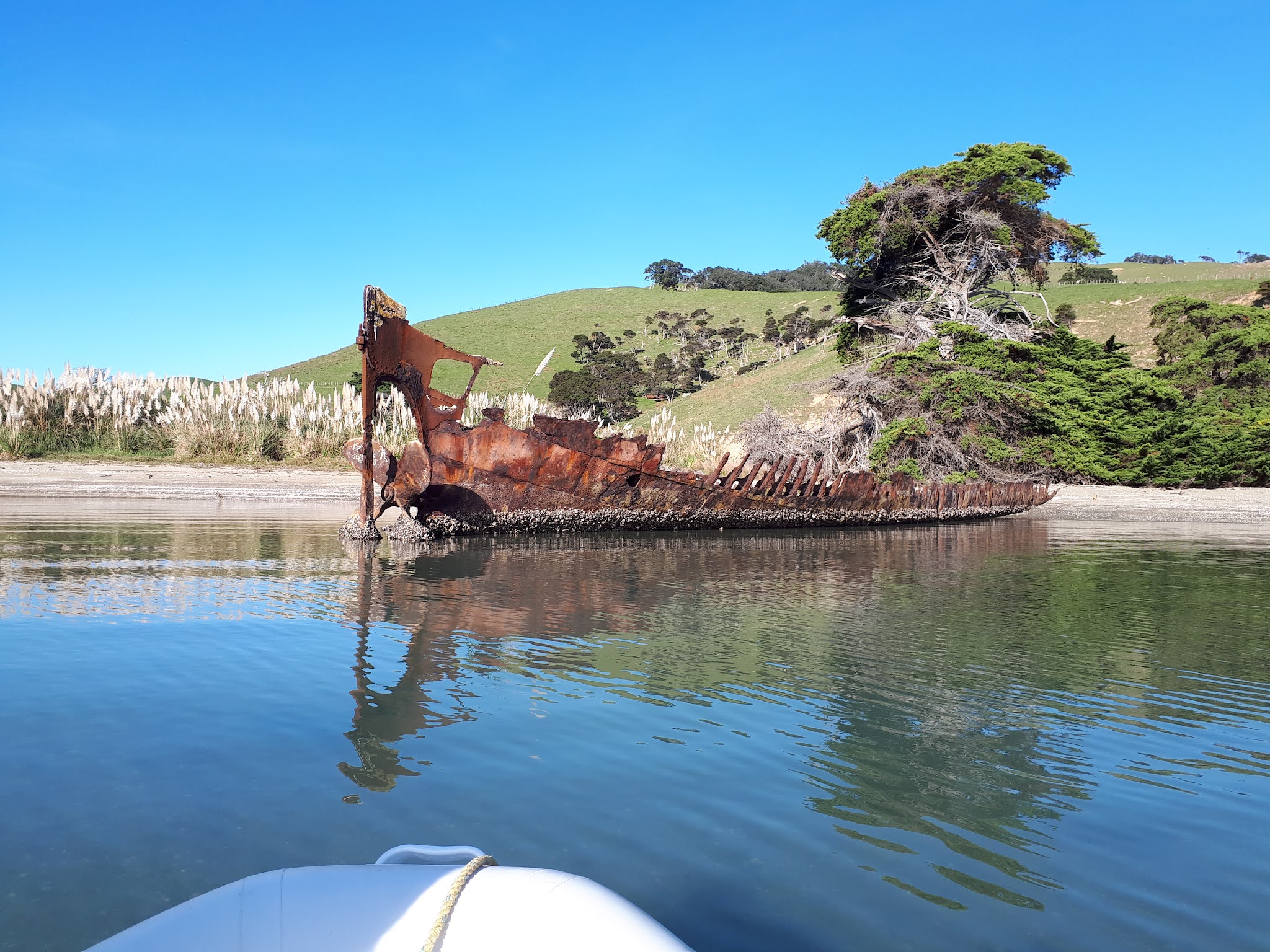
Shark Bay on the island’s western side bordering the Waiheke Channel isn’t mentioned on the NZ 5324Chart for this area, but it’s the bay to the north ofOranga and Poroaki Bays. Oranga Bay is too shallow for anchoring, but take your dinghy in to see the shipwreck on the shoreline with its impressivepropeller and the nearby remains of two boilers. You’ll also see plenty of rays gliding across the seabed searching for kai. 

Shipwreck in Oranga Bay on a great early July day


Close up showing the wreck’s huge propeller


Poroaki Bay can be recognised byits several homesteadsand protruding western headland providingprotection from the prevailing south-westerly wind. Very often there’s also a large powered barge moored close to shore. Between Shark Bay and Ponui Head to the north are two unnamed bays with excellent sandy beaches and shelter from southerly through to north-easterlywinds, but be aware of an unmarked rock south west of Ponui Head (marked on chart). The only negative for this area iswakes produced by large motor vessels travelling at speed through the Waiheke Channel.

Stunning unnamed bay south of Ponui Head


Barge at Poroaki Bay


Bryants Bay on Ponui’s north-east coast is a settled weather anchorage suitable for northerly through to south-westerly winds. It’s well protected by Scully Reef and consistsof three small bays, two of which are really stunning, together with a large anchoring area outside these bays. This is an area where we’re often happy to anchor for several days and holding is good, but be aware of close to shore rocks. About half a mile south is another well sheltered bay with a finesandy beach.

Fishing is generally good around Ponui, particularly on the eastern side in the Firth of Thames and we’re always able to feed ourselves,however on the north-western side be aware of the Te Matuki Marine Reserve extending across to Awaawaroa Bay on Waiheke Island’s south coast.

There are large signs on PonuiIsland’s foreshores advising the island is private property and that no dogs, fires or camping are allowed. I spoke to one of the island’s three farm owners who advisedboaties mayland on beaches provided they observe the above limitations.Ponui is home to nearly2,000 brown kiwi, descendants of just 13 released in 1964 anddogs and ferrets are theirmain predators so there’s good reason to ban dogs. While most dog owners are responsible a minorityapparently think leashed dogs are not a problem and that rules don’t apply to them. However even leashed dogscanupset farm animals andwildlife whiletheir scent is an issue in bird breeding areas sometimes causing birds to abandon their nests.

There is no fuel, water or supplies available in this area, except for wine at the very pleasant Man O’War Vineyard. On a fine summer’s day you’ll find dozens of inflatables ashore hereenjoying the sandy beach and the selection of winery beverages and snacks. Closest groceries are at Rocky Bay while for fuel and water you’ll have to make the eleven mile trip to Pine Harbour marina.

We really enjoy anchoring in these areas around Ponui and hope you will too, but remember if going ashore to act responsibly by taking no dogs, lighting no fires and taking your rubbish away with you.

Next Post will be about cruising at low rpm without compromising your engines’ performance and longevity.