Tag Archives | trawlers

Argentina and Uruguay

Uruguay and Argentina


Monday, February 20, 2023 – Montevideo, Uruguay


After leaving the Falkland/Malvinas Islands we sailed for two days to our first landfall in South America since departing Punta Arenas, Chile on February 2.  The first stop was Montevideo, Uruguay on Monday, a national holiday, part of Carnaval.  Many, if not most shops were closed, but restaurants and bars were open.  That also meant no crowds.  Montevideo sits on the north side of the Rio de la Plata, first discovered by European explorers in 1516 while searching for a route from the Atlantic to the Pacific ocean.  It is considered by some to be the widest river in the world, stretching some 140 miles at it’s widest point.


Montevideo and the River Plate (Rio de la Plata) is also the site of the first major naval battle of World War 2, which took place on 13 December 1939.  The German Battleship Graf Spee took sanctuary in Montevideo after a major battle with three British Cruisers, HMS Exeter, HMS Ajax and HMS Achilles.  Graf Spee heavily damaged both HMS Exeter and HMS Ajax and retired to the neutral port of Montevideo.  International rules dictate a warship can only remain in a neutral port for 24 hours, but Captain Hans Landsdorff extended the stay to 72 hours.  Fearing a major British fleet was waiting for him, Landsdorff took Graf Spee out into the Rio de la Plata and scuttled Graf Spee on 17 December 1939.  Fleeing to Buenos Aires, he took his own life four days later.  The wreckage was rediscovered in 2004 and the 27 ton optical rangefinder for the main gun turrets was recovered and is on display at the entrance to the port.


Optical gunsight recovered from Graf Spee

Montevideo is home to nearly half of the 3.5 million population of Uruguay, which became an independent nation in 1828.  Uruguay maintains strong ties with the UK, France and Italy.


The ship docks within walking distance of the central plaza in the old town so we were able to see many of the important sights without participating in a tour.


Most of the way from the port to the central plaza is closed to traffic and is a pedestrian walkway for about one mile from the port to the Plaza Independencia, or Independence Square, dominated by a large monument to General Jose Artigas (1764-1850), one of the political founders and heroes of Uruguay and the Rio de la Plata region.  The monument stands atop his mausoleum.  Along the way are several more plazas, a large cathedral and an imposing opera house.  Many of the older buildings are in ornate art deco style from early in the 1900’s.  Like many cities, there is graffiti and wall paintings everywhere.


Plaza Independencia

Produce Market

Main cathedral – Montevideo

Wall paintings and art deco 

Opera House

Monument and mausoleum to General Artigas in Independence Plaza

Derelict Fishing Vessels – Montevideo Harbor

The harbor is still home to many derelict fishing vessels, less than we saw in 2016.


Tuesday, February 21, 2023 – Buenos Aires, Argentina


After an overnight crossing of the Rio de la Plata, Seabourn Quest docked in Buenos Aires and by 0900 we were meeting the car, driver and guide that had been prearranged for us.  After a driving tour of some of the 26 neighborhoods which make up the city, as well as a shopping stop, we arrived at La Brigada restaurant in the San Telmo neighborhood.  La Brigada is famous for steaks that can be cut with a spoon.  There we met with two of Patrick’s classmates from the Stanford Sloan program who we had not seen since 2016 in Buenos Aires.  We reconnected during a leisurely delicious lunch, sampling several varieties of Argentine steaks.

Following lunch we returned to the port at 1600 and the ship sailed at 1700 for Punta del Este, Uruguay, our next destination.


Wednesday, February 22, 2023 – Punta del Este, Uruguay


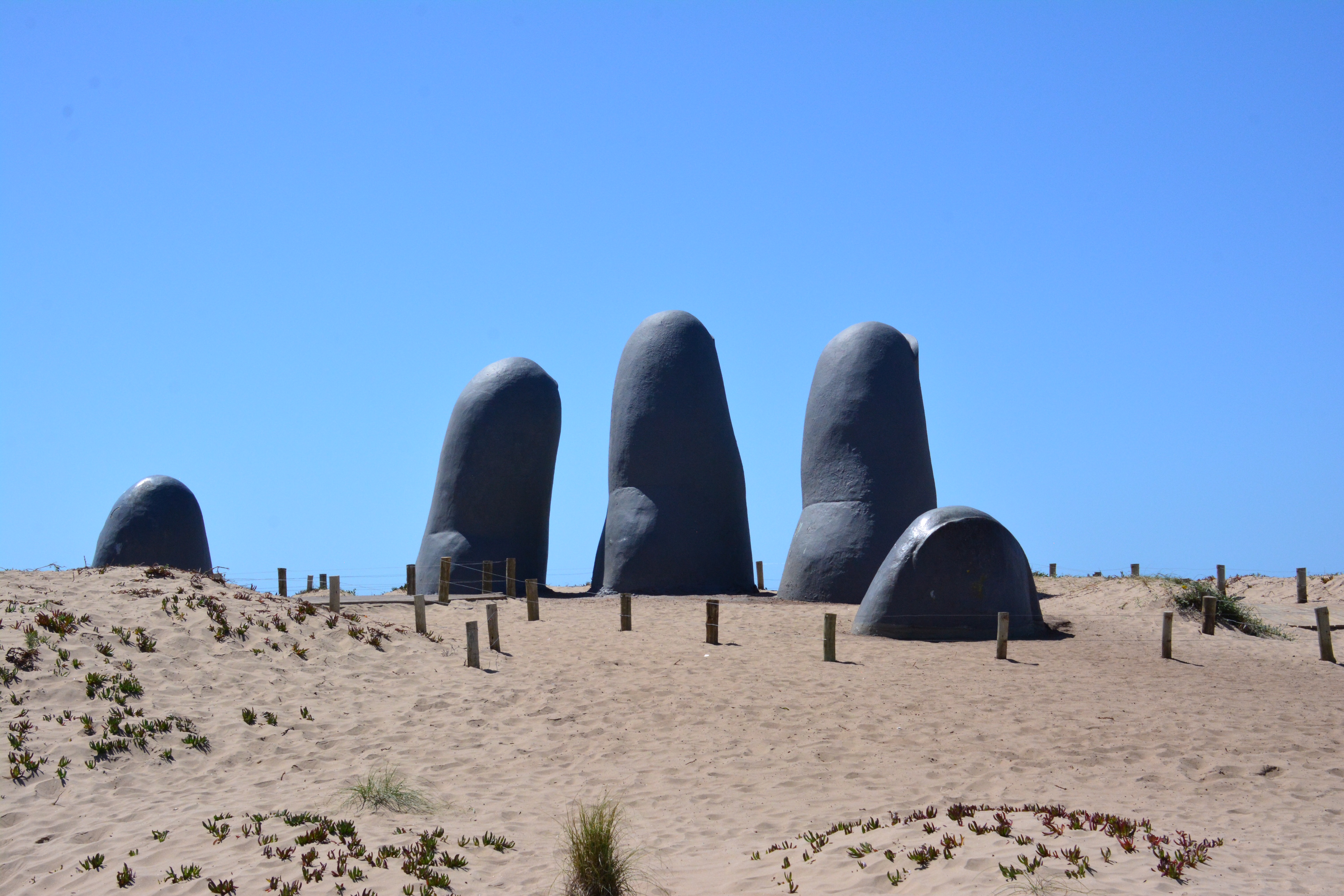
Punta del Este is both a city and municipality on the eastern tip of the Rio de la Plata, and is known as the Monaco of the South.  The year round population is only about 10,000, but that number triples during the summer season.  There are broad beaches, sculptures such as La Mano (or Los Dedos) on Playa Brava, many fine restaurants and a bustling but compact city center.  The city hosts music festivals, whale sightseeing and international education conferences.


Seabourn Quest anchored 2 miles from a large marina close to Isla Gorriti and we were tendered ashore. Isla Gorritti is now a playground for yachts, sheltered from the Atlantic Swells, but was a pirate stronghold in the 16th century.  The city is easy to walk around and nothing of interest was more than 2 miles away.  Patrick walked along the beachfront, past El Faro, the lighthouse, passing several of the busy beaches before reaching Los Dedos (or La Mano – the hand) which won an international award for sculpture in 1982.

Memorial to HMS Ajax 
Beaches in Punta del Este
El Faro lighthouse

Los Dedos or la Mano sculpture

Marina and fishing boats at Punta del Este

Private houses on the waterfront 


After an interesting, but warm day, with temperatures reaching 86 degrees, we weighed anchor and set out into the Atlantic, heading for our first Brazilian port of call, Ilhabela on San Sebastiao Island.


Second Trip to Marina Costa Baja, Day 18 — Carnival

Sunrise on Thursday, February 16. The crescent moon rose not long before the sun did, and was glowing brightly as the sun rose.  Wednesday had been a mellow day, but Thursday was the exact opposite – we went non-stop from … Continue reading

Argentina and Uruguay

Uruguay and Argentina


Monday, February 20, 2023 – Montevideo, Uruguay


After leaving the Falkland/Malvinas Islands we sailed for two days to our first landfall in South America since departing Punta Arenas, Chile on February 2.  The first stop was Montevideo, Uruguay on Monday, a national holiday, part of Carnaval.  Many, if not most shops were closed, but restaurants and bars were open.  That also meant no crowds.  Montevideo sits on the north side of the Rio de la Plata, first discovered by European explorers in 1516 while searching for a route from the Atlantic to the Pacific ocean.  It is considered by some to be the widest river in the world, stretching some 140 miles at it’s widest point.


Montevideo and the River Plate (Rio de la Plata) is also the site of the first major naval battle of World War 2, which took place on 13 December 1939.  The German Battleship Graf Spee took sanctuary in Montevideo after a major battle with three British Cruisers, HMS Exeter, HMS Ajax and HMS Achilles.  Graf Spee heavily damaged both HMS Exeter and HMS Ajax and retired to the neutral port of Montevideo.  International rules dictate a warship can only remain in a neutral port for 24 hours, but Captain Hans Landsdorff extended the stay to 72 hours.  Fearing a major British fleet was waiting for him, Landsdorff took Graf Spee out into the Rio de la Plata and scuttled Graf Spee on 17 December 1939.  Fleeing to Buenos Aires, he took his own life four days later.  The wreckage was rediscovered in 2004 and the 27 ton optical rangefinder for the main gun turrets was recovered and is on display at the entrance to the port.


Optical gunsight recovered from Graf Spee

Montevideo is home to nearly half of the 3.5 million population of Uruguay, which became an independent nation in 1828.  Uruguay maintains strong ties with the UK, France and Italy.


The ship docks within walking distance of the central plaza in the old town so we were able to see many of the important sights without participating in a tour.


Most of the way from the port to the central plaza is closed to traffic and is a pedestrian walkway for about one mile from the port to the Plaza Independencia, or Independence Square, dominated by a large monument to General Jose Artigas (1764-1850), one of the political founders and heroes of Uruguay and the Rio de la Plata region.  The monument stands atop his mausoleum.  Along the way are several more plazas, a large cathedral and an imposing opera house.  Many of the older buildings are in ornate art deco style from early in the 1900’s.  Like many cities, there is graffiti and wall paintings everywhere.


Plaza Independencia

Produce Market

Main cathedral – Montevideo

Wall paintings and art deco 

Opera House

Monument and mausoleum to General Artigas in Independence Plaza

Derelict Fishing Vessels – Montevideo Harbor

The harbor is still home to many derelict fishing vessels, less than we saw in 2016.


Tuesday, February 21, 2023 – Buenos Aires, Argentina


After an overnight crossing of the Rio de la Plata, Seabourn Quest docked in Buenos Aires and by 0900 we were meeting the car, driver and guide that had been prearranged for us.  After a driving tour of some of the 26 neighborhoods which make up the city, as well as a shopping stop, we arrived at La Brigada restaurant in the San Telmo neighborhood.  La Brigada is famous for steaks that can be cut with a spoon.  There we met with two of Patrick’s classmates from the Stanford Sloan program who we had not seen since 2016 in Buenos Aires.  We reconnected during a leisurely delicious lunch, sampling several varieties of Argentine steaks.

Following lunch we returned to the port at 1600 and the ship sailed at 1700 for Punta del Este, Uruguay, our next destination.


Wednesday, February 22, 2023 – Punta del Este, Uruguay


Punta del Este is both a city and municipality on the eastern tip of the Rio de la Plata, and is known as the Monaco of the South.  The year round population is only about 10,000, but that number triples during the summer season.  There are broad beaches, sculptures such as La Mano (or Los Dedos) on Playa Brava, many fine restaurants and a bustling but compact city center.  The city hosts music festivals, whale sightseeing and international education conferences.


Seabourn Quest anchored 2 miles from a large marina close to Isla Gorriti and we were tendered ashore. Isla Gorritti is now a playground for yachts, sheltered from the Atlantic Swells, but was a pirate stronghold in the 16th century.  The city is easy to walk around and nothing of interest was more than 2 miles away.  Patrick walked along the beachfront, past El Faro, the lighthouse, passing several of the busy beaches before reaching Los Dedos (or La Mano – the hand) which won an international award for sculpture in 1982.

Memorial to HMS Ajax 
Beaches in Punta del Este
El Faro lighthouse

Los Dedos or la Mano sculpture

Marina and fishing boats at Punta del Este

Private houses on the waterfront 


After an interesting, but warm day, with temperatures reaching 86 degrees, we weighed anchor and set out into the Atlantic, heading for our first Brazilian port of call, Ilhabela on San Sebastiao Island.


Ushuaia: End of the World

At latitude 54°48′ S, Ushuaia is the earth’s southernmost city and bills itself as the “end of the world”. (Port Williams in Chile is actually further south, but has a much smaller population and is classified as a town.) Ushuaia’s population initially was not Argentinian, but British. The city was founded in the 1800s by…

Second Trip to Marina Costa Baja, Day 17

On Wednesday morning (February 15), Christi and Keith finished washing the boat. They also went back over the parts they’d done on Tuesday to remove the layer of residue that had already formed.  We had a late lunch the Spanish … Continue reading

Feb. 17 – Old San Juan, PR

“Travel has a way of stretching the mind. The stretch comes not from travel’s immediate rewards, the inevitable myriad of new sights, smells and sounds, but with experiencing firsthand how others do differently what we believed to be the right and only way.” —Ralph Crawshaw
Like yesterday, we tried to visit places we didn’t see on our first visit. We wandered through town taking in the sights and history of the town. Today’s post is some of the history we learned.

Catedral Basilica Menor de San Juan Bautista is the second oldest church in the Western Hemisphere and the oldest church on U.S. soil. The history of the church dates to 1521 and the beginning of the Spanish colonization of the island. The original church was demolished by a hurricane and the current structure dates to 1540. The elegant gothic facade has evolved over centuries. It’s the final resting place of Juan Ponce de León, the first governor of Puerto Rico.
The church is located on Cristo Street, just a short walk from the San Juan Gate. It was the first stop for many travelers who landed on the island and walked into the city through its only seaside entry. Sailors and travelers visited San Juan Bautista as soon as they got off the boat so they could thank God for a safe voyage.

The sculpture La Rogativa (the procession) tells the story of Puerto Rican patriotism. The monument, located in Plazuela La Rogativa near the San Juan Gate, commemorates one of the most evocative legends of the island. When the British attacked Old San Juan in 1797, a quick-thinking priest took it upon himself to lead the outnumbered soldiers and civilians on a religious procession through the city. Apparently the British mistook the citizens’ prayer march for reinforcements and abandoned their attack.

Just one picture of the beautiful streets of OSJ.

Save A Gato (SAG) was created in 2004 to address the booming cat population around historic Old San Juan, particularly around the Paseo del Morro pathway. SAG is the only non-profit organization that has an agreement with The National Park Service to manage a colony of cats on national park land. Trap, neuter and return (TNR) has worked wonderfully to reduce the size of the cat colony around El Morro by 50% since 2004.

Views from the city wall. Looking south to the La Fortaleza and the governor’s mansion and looking north to the El Morro and Casa Rosa.

Quincentennial Square – built in honor of Columbus’ first voyage. 
La Perla (The Pearl) was named after a little Spanish fort that once stood there. It’s a historical shanty town astride the northern historic city wall of Old San Juan stretching about 650 yards along the rocky Atlantic coast immediately east of the Santa Maria Magdalena de Pazzis Cemetery. The community has a lot of history and perhaps the most unique on the island. It was originally the site of a slaughterhouse built in the 18th century. Slaves, the homeless and non-white servants were required to live outside the city walls, so that was the beginning of homes being built here. Back in those days, living on the water was for the poor and landless.

Even before Hurricane Maria hit Puerto Rico, La Perla started painting its houses in bright colors and adding murals to the squares to improve the looks of their community. The neighborhood has a history of crime and isn’t a place we would go after dark, but we felt very safe at the restaurant and walking along the waterfront. Locals don’t seem to bother tourists if they are respectful, stay close to the water and don’t take individual photos of their homes.

La Garita gives diners the best view in OSJ while enjoying a great meal.

It was a perfect day to enjoy a few Mojitos and a little seafood. I don’t think we could have found a better view anywhere on the island.

The colorful homes of La Perla.

The views from the waterfront.

Looking west to El Morro.

Feb. 17 – Old San Juan, PR

“Travel has a way of stretching the mind. The stretch comes not from travel’s immediate rewards, the inevitable myriad of new sights, smells and sounds, but with experiencing firsthand how others do differently what we believed to be the right and only way.” —Ralph Crawshaw
Like yesterday, we tried to visit places we didn’t see on our first visit. We wandered through town taking in the sights and history of the town. Today’s post is some of the history we learned.

CONTINUE READING HERE…»

Feb. 16 – Old San Juan, PR

“It is not the destination where you end up, but the mishaps and memories you create along the way.” ~Penelope Riley 

Old San Juan has a lot to see and do, and we covered a lot of it on our first trip in 2020. This time we’re wandering, at a slower pace, taking in some of the sites we didn’t see then.

This was our favorite place for breakfast on our first trip. It’s a little kiosk in Plaza de Armas just a block from the apartment.
Looking up our street early in the morning before the traffic and tourists arrived.
After breakfast we walked along the harbor. Taking in the views from the park that runs along the water. This is where the cruise ships dock. Luckily today there was only one ship in port. We saw this pretty seahorse statue, but there was no info on it.  

Casa Blanca was the first governor’s residence in Puerto Rico. It was built in 1521 and served as the first fortification of the San Juan islet. It was the residence for Juan Ponce de León and his family, although de Leon died in an expedition to Florida without ever getting to occupy the structure. It was used as the residence of his descendants, until the mid-18th century. This is the gate into the property.

This pretty home was built later and surrounded by beautiful gardens.

This was the original home. Parts of it have been restored and are open for viewing. It’s hard to believe the buildings in Old San Juan are so old. Even harder to imagine all the people who have spent time walking these same streets.

A few pictures of the inside of the original home.

Each room in the home had views like this of the San Juan inlet and harbor.

Part of the grounds close to the newer home.

Looking up at Casa Blanca from the city wall.

This is the Institute of Puerto Rican Culture. We were able to walk through the building. It’s full of government offices. The views from the upper patio were amazing.

From the top of the building looking towards Castillo San Felipe del Morro and it’s lighthouse. We visited this site in 2020.
Later in the afternoon I did a little shopping on Calle de la Fortaleza (Fortress Street).
We’ve been enjoying the fresh seafood and Puerto Rican specialties all week, but tonight we found a wonderful little Italian place for dinner. Bacaro has about ten tables, very intimate, and the food was amazingly good. I had the Spaghetti Carbonara and Stan had the special fish of the day.

Second Trip to Marina Costa Baja, Days 15 – 16

On Monday, February 13, the half-full moon rose not long before the sun did, and was shining brightly in the pre-dawn glow. We tried to catch the 1310 shuttle to town. We left Kosmos at 1302. We got to marina … Continue reading

Feb. 16 – Old San Juan, PR

“It is not the destination where you end up, but the mishaps and memories you create along the way.” ~Penelope Riley 

Old San Juan has a lot to see and do, and we covered a lot of it on our first trip in 2020. This time we’re wandering, at a slower pace, taking in some of the sites we didn’t see then.

This was our favorite place for breakfast on our first trip. It’s a little kiosk in Plaza de Armas just a block from the apartment.

CONTINUE READING HERE…»