
Tag Archives | trawlers

Falkland Islands

 Falkland Islands


The Falklands Islands are an archipelago off the southern tip of South America.  There are more than 740 islands, most of them uninhabited.  The population is less than 4,000, with more than half in the capital, Port Stanley.  Since there are so few people, many species of animals, mainly seabirds, breed on the islands.  The total land area is about 4500 square miles, most on East and West Falkland Islands.  The Falklands are a windy environment, with poor soil and few native trees, mostly low shrubs.  However, oil and gas have been discovered, but the cost of extraction compared to the price of oil has not justified exploitation to date.  Also, there is a water shortage on the islands, barely enough to support the current population.  There are some sheep farms, producing high quality wool and meat, but the sheep require more than double the acreage per sheep compared to other sheep producing areas, so it is not a large industry.


The isolation of the islands, and ongoing disputes over sovereignty between Argentina and the UK, including the infamous 74 day war in 1982, when Argentina invaded the islands, but were ultimately defeated by the UK, means there are few flights, only one per week at the current time.  The flight is staged out of Chile, since Argentina will not allow flights from Argentina to the Falkland Islands and sometimes flights to there are denied entry into Argentinian airspace.


Our reasons for stopping in the Falkland Islands included more wildlife encounters, with several new species of penguins possible, other species of seabirds, touring the city of Port Stanley, a little piece of Britain overseas, and learning about the history, including european discoveries and claims, settlements and ultimately disputes over who owns the archipelago.


Thursday, February 16, 2023 – Port Stanley


After two days at seas, with some rough seas and high winds, Seabourn Quest entered the anchorage off of Port Stanley at 0700 and anchored about one mile from the tender dock.  The inner harbor is too small for our ship, so were tendered in by the ship’s tenders.  Clearance took some time, so shore excursions were all delayed.  Miriam elected to remain on board while Patrick went on a 7 hour wildlife encounter via 4×4 vehicles.


The encounter took place at Seal Bay, on the north coast of East Falkland Island.  After a one hour drive we headed off road in seven 4×4 vehicles containing either 3 or 4 passengers.  The terrain was across extensive peat bogs and even across shallow lakes until we reached the cliffs along the coast.  Our first stop provided views of Rockhopper Penguins, Imperial Cormorants, Upland Geese, Caracara’s and Skuas.  The second stop was down on the beach where we visited a Gentoo Penguin colony and had a snack before heading back to the ship.  Due to the clearance delays and the length of the tour, we barely made the last scheduled tender back to the ship, so had limited views of Port Stanley.


Lonely Gentoo penguin chick on beach

Imperial Cormorant Chick being fed by parent

Rockhopper Penguin

Friday, February 17, 2023 – New Island


New Island is a nature conservancy on the far western edge of the archipelago.  It is home to more than 40 species of birds.   Seabourn Quest anchored in one of the eastern bays, sheltered from the wind and commenced operations at 0730, with both Zodiac tours ashore and kayaking.  Patrick went kayaking, seeing Magellanic Penguins, Gentoo Penguins, Imperial Cormorants, Peale’s Dolphins, Giant Southern Petrels, Prions, Caracara’s, and an abandoned whaling station and the group was even followed by an Elephant Seal.  Following the Kayak tour, the zodiac trip ashore to a beautiful sandy beach followed a 1 kilometer marked path to an incredible Black Browed Albatross rookery, with many young chicks.  Mixed in with the albatrosses were more Rockhopper Penguins, Caracara’s, Peregrine Falcons and several species of Shags, more Upland Geese and several other bird species such as Thrushes, Prions and Kelp Geese,

Black Browed Albatross Chick

Wreck on Beach at New Island

Rockhopper Penguin – New Island

Upland Geese – New Island

Rockhopper Penguin – New Island

Caracara – New Island

Albatross Chick – New Island

Kelp Goose – New Island

Kelp Gull – New Island


By noon everyone who wanted to go ashore had done so, the anchor was weighed and we set course for the 1000 NM voyage to Montevideo, Uruguay.  As we left, there were dozens of Sei whales close to the ship, more dolphins and many Southern Fur Seals.  


Falkland Islands

 Falkland Islands


The Falklands Islands are an archipelago off the southern tip of South America.  There are more than 740 islands, most of them uninhabited.  The population is less than 4,000, with more than half in the capital, Port Stanley.  Since there are so few people, many species of animals, mainly seabirds, breed on the islands.  The total land area is about 4500 square miles, most on East and West Falkland Islands.  The Falklands are a windy environment, with poor soil and few native trees, mostly low shrubs.  However, oil and gas have been discovered, but the cost of extraction compared to the price of oil has not justified exploitation to date.  Also, there is a water shortage on the islands, barely enough to support the current population.  There are some sheep farms, producing high quality wool and meat, but the sheep require more than double the acreage per sheep compared to other sheep producing areas, so it is not a large industry.


The isolation of the islands, and ongoing disputes over sovereignty between Argentina and the UK, including the infamous 74 day war in 1982, when Argentina invaded the islands, but were ultimately defeated by the UK, means there are few flights, only one per week at the current time.  The flight is staged out of Chile, since Argentina will not allow flights from Argentina to the Falkland Islands and sometimes flights to there are denied entry into Argentinian airspace.


Our reasons for stopping in the Falkland Islands included more wildlife encounters, with several new species of penguins possible, other species of seabirds, touring the city of Port Stanley, a little piece of Britain overseas, and learning about the history, including european discoveries and claims, settlements and ultimately disputes over who owns the archipelago.


Thursday, February 16, 2023 – Port Stanley


After two days at seas, with some rough seas and high winds, Seabourn Quest entered the anchorage off of Port Stanley at 0700 and anchored about one mile from the tender dock.  The inner harbor is too small for our ship, so were tendered in by the ship’s tenders.  Clearance took some time, so shore excursions were all delayed.  Miriam elected to remain on board while Patrick went on a 7 hour wildlife encounter via 4×4 vehicles.


The encounter took place at Seal Bay, on the north coast of East Falkland Island.  After a one hour drive we headed off road in seven 4×4 vehicles containing either 3 or 4 passengers.  The terrain was across extensive peat bogs and even across shallow lakes until we reached the cliffs along the coast.  Our first stop provided views of Rockhopper Penguins, Imperial Cormorants, Upland Geese, Caracara’s and Skuas.  The second stop was down on the beach where we visited a Gentoo Penguin colony and had a snack before heading back to the ship.  Due to the clearance delays and the length of the tour, we barely made the last scheduled tender back to the ship, so had limited views of Port Stanley.


Lonely Gentoo penguin chick on beach

Imperial Cormorant Chick being fed by parent

Rockhopper Penguin

Friday, February 17, 2023 – New Island


New Island is a nature conservancy on the far western edge of the archipelago.  It is home to more than 40 species of birds.   Seabourn Quest anchored in one of the eastern bays, sheltered from the wind and commenced operations at 0730, with both Zodiac tours ashore and kayaking.  Patrick went kayaking, seeing Magellanic Penguins, Gentoo Penguins, Imperial Cormorants, Peale’s Dolphins, Giant Southern Petrels, Prions, Caracara’s, and an abandoned whaling station and the group was even followed by an Elephant Seal.  Following the Kayak tour, the zodiac trip ashore to a beautiful sandy beach followed a 1 kilometer marked path to an incredible Black Browed Albatross rookery, with many young chicks.  Mixed in with the albatrosses were more Rockhopper Penguins, Caracara’s, Peregrine Falcons and several species of Shags, more Upland Geese and several other bird species such as Thrushes, Prions and Kelp Geese,
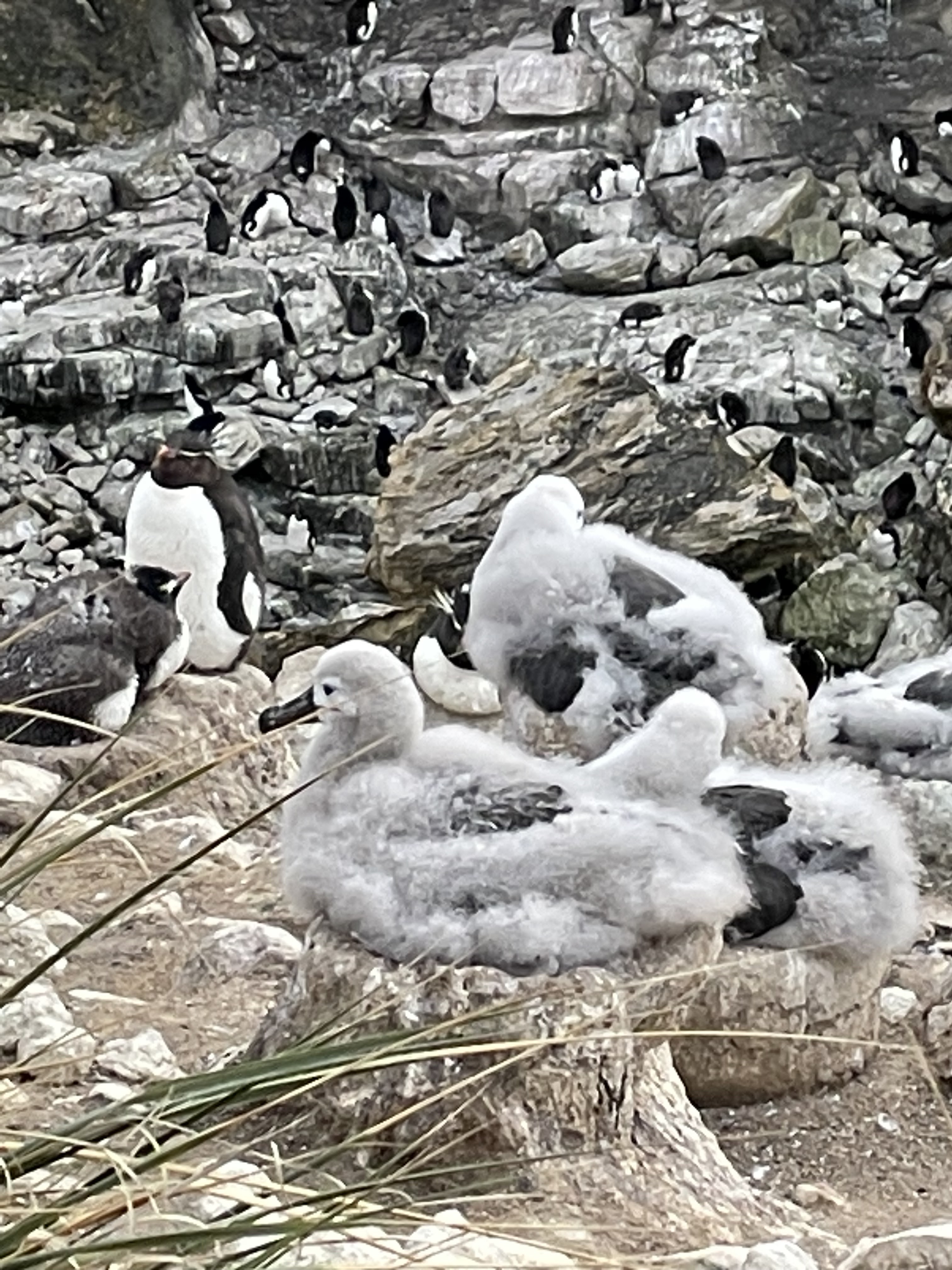
Black Browed Albatross Chick

Wreck on Beach at New Island

Rockhopper Penguin – New Island

Upland Geese – New Island

Rockhopper Penguin – New Island

Caracara – New Island

Albatross Chick – New Island

Kelp Goose – New Island

Kelp Gull – New Island


By noon everyone who wanted to go ashore had done so, the anchor was weighed and we set course for the 1000 NM voyage to Montevideo, Uruguay.  As we left, there were dozens of Sei whales close to the ship, more dolphins and many Southern Fur Seals.  


Antarctica Cruise Ship Accidents

In Choose Your Cruise Operator Carefully, we discussed the risks inherent in an Antarctic cruise, and described the three deaths that had occurred in the course of two weeks near the start of the 2022-2023 cruise season. It turns out there was actually four deaths in that period. The situation has become serious enough that…

Second Trip to Marina Costa Baja, Day 14 — Food and Art

Sunrise on Sunday, February 12 We were craving Italian food. We took the 1310 shuttle into town to get some. The shuttle was about 12 minutes late (relevant for Monday’s story).  Someone had recommended a place called Locos Por la … Continue reading

Feb 15 – Old San Juan, PR

“Travel…the best way to be lost and found at the same time.” ~Brenna Smith
Today we left the mountains and returned to the coast. We’ll spend the next three days in Old San Juan. It was one of our favorite places we visited in 2020. We just loved this old walled city. So many beautiful buildings and so much history. OSJ is actually an island connected to the main island by bridges on the eastern side and is the oldest city in the US and its territories. The Spanish built two huge forts and walled-in the city to protect it from the French, Dutch, and English. San Juan became Spain’s fortified door to the Americas. Today Old San Juan is a busy hub for tourism. We love to walk the city taking in the beauty of the century old buildings that are now used for museums, restaurants, stores and interesting places to stay.

Our last look at the mountains of central Puerto Rico.
Our apartment in OSJ is across the street from the Minor Basilica Cathedral of Saint John the Baptist and just a block inside the wall from the Puerta de San Juan (San Juan Gate). This gate was where dignitaries entered San Juan for centuries. It’s located on the Paseo de la Princesa which is a promenade that skirts the curved old city walls on the southern side of Old San Juan.

Fuente Raíces Fountain at the beginning of the Paseo de la Princesa.
Paseo de la Princesa. You can take this path all the way to San Felipe del Morro Castle.
Puerta de San Juan
The building we are staying in was built in the first half of the 16th century and used as a colonial Mansion. The first floor was for the servants, the owners  lived on the second floor and the third floor was used as an observatory tower to watch for invaders and pirates. We’re on the third floor, which you can’t see in this picture.

Our home for the next three days.

Looking down from our apartment at the stairs we had to use to get to our apartment.

The little plaza next to where we are staying.
The view from our patio.
We had dinner at Bari, which is on the first floor of the building we are staying in.
This little kitty came to visit.

Feb 15 – Old San Juan, PR

“Travel…the best way to be lost and found at the same time.” ~Brenna Smith

Today we left the mountains and returned to the coast. We’ll spend the next three days in Old San Juan. It was one of our favorite places we visited in 2020. We just loved this old walled city. So many beautiful buildings and so much history. OSJ is actually an island connected to the main island by bridges on the eastern side and is the oldest city in the US and its territories. The Spanish built two huge forts and walled-in the city to protect it from the French, Dutch, and English. San Juan became Spain’s fortified door to the Americas. Today Old San Juan is a busy hub for tourism. We love to walk the city taking in the beauty of the century old buildings that are now used for museums, restaurants, stores and interesting places to stay.

CONTINUE READING HERE…»

Second Trip tp Marina Costa Baja, Day 13

Sunrise on Saturday, February 11. It was another morning where the clouds mostly, but not completely, blocked the sun. We’d made an appointment at the fuel dock to get 250-gallons of fuel. As you can tell from the photo above, … Continue reading

Feb. 14 – Jayuya, PR

“Those who follow the crowd usually get lost in it.”  —Rick Watson

We traveled east out of Jayuya today to explore some popular tourist places and to find some pretty waterfalls. Our first stop was at La Piedra Escrita (the written stone). This beautiful park offers wonderful views of the mountains and a great place to swim in the tranquil water. But it’s best known for the large granite boulder that is covered in pictographs. The site was added to the United States National Register of Historic Places in 2003 due to its importance as a prime example of prehistoric rock art in Puerto Rico. 

La Piedra Escrita

Taino Symbols and means.

Some of the symbols on the rock at La Piedra Escrita.
We have found that the first of the week isn’t a good time to travel in this area. Most of the restaurants are closed and so are a lot of the popular places to visit. We knew that the Hacienda San Pedro coffee plantation wouldn’t be giving tours but we thought we’d be able to visit the café and gift shop, but no, they were closed. So our next stop was the El Cemi Museum. 

The museum is small, but nice. It has pieces of pottery, some tools and other artifacts from daily Taino life. The museum’s cemi shape was chosen to represent the Tres Picachos Mountain range. A cemi is a deity, ancestor or spirit.  
After our bit of education in the history of the Taino people we went in search of waterfalls. The first one we found was the Doña Juana Waterfall. It’s located right by the road, so we didn’t have to do any hiking to find it. The falls consist of three falls and were very impressive for a roadside falls. Our next stop was the highlight of the day. Cascada Las Delicias (Delights Waterfall). We could see it from the road and it was a series of three falls also. Climbing up the trail to the top fall treated us to a tropical paradise. The water was beautiful and the lush vegetation made us feel like we had left the busy world behind and were lost in the jungle. Our third waterfall was Charco El Morón. The surrounding area was pretty, but the waterfall was a bust…at least for us, because we couldn’t even get to it. We enjoyed a morning of exploring and returned to Patria Mia for a late lunch. We got back to the house just as the rain began to fall. We spent the afternoon relaxing, napping, reading and working on the blog. 

Doña Juana Waterfall
Walking up to Cascada Las Delicias from the road.

This is the middle falls.

The upper falls.

Looking down from the middle falls.

The scenery here was a bit different. It was in a nice valley, the water was pretty but we couldn’t get much further than this towards the falls.

Since nothing was open for dinner we decided to cook in again this evening at the house. The kitchen was very basic, only two burners, so the first night we had seasoned rice and meatballs and the second night we had spaghetti. We’ll have a nice Valentine’s dinner once we get to Old San Juan. 

Feb. 14 – Jayuya, PR

“Those who follow the crowd usually get lost in it.”  —Rick Watson

We traveled east out of Jayuya today to explore some popular tourist places and to find some pretty waterfalls. Our first stop was at La Piedra Escrita (the written stone). This beautiful park offers wonderful views of the mountains and a great place to swim in the tranquil water. But it’s best known for the large granite boulder that is covered in pictographs. The site was added to the United States National Register of Historic Places in 2003 due to its importance as a prime example of prehistoric rock art in Puerto Rico. 

CONTINUE READING HERE…»

Second Trip to Marina Costa Baja, Day 12 — La Paz and Black/Grey Water Tanks

On Friday (February 10), Christi had an appointment for another haircut, so we took the 0900 shuttle into town. From the cathedral (where we were dropped off), we walked a few blocks south to a bank to use the ATM. … Continue reading