
Sharry and I are preparing to take Starr from Hawaii to Kodiak, AK (2200nm) this May. We’ll then continue to Prince William Sound. Although we’ve been silent on this blog for too long, we’ve been busy cruising Hawaii! Here’s a bit from the last year….
Texas Pearl Haul Out
On August 25, 2017 Hurricane Harvey sat over Rockport, Texas for fourteen hours. Not only did it bring extremely high winds and A LOT of rain, it also produced over 60 tornadoes in the area that night. The damage to Rockport and Aransas County was catastrophic. In one night the beautiful little coastal town was turned into a war zone. We were truly lucky to find our boat still in her slip, with no major damage…but she didn’t come through the storm untouched. It’s been seven months since the storm roared ashore in south Texas and Texas Pearl is almost back to her beautiful self.
Here is the list of damage to Texas Pearl from Hurricane Harvey
THE LIVE-ABOARD CRUISING LIFE PART 3
Envoy is berthed in Greece’s Lefkas Marina and we’re home in Auckland. Circumstances prevent us returning to cruise in the Med this year.
This is the third part of an article we wrote published in Australasia’s Pacific PassageMaker magazine about starting the live-aboard cruising life.
From the last two articles you understand life’s time clock is ticking so do it now rather than later.
Also that most potential cruisers face some fears and how to overcome them as well as dealing with some of the practical issues that need to be considered.
BUYING YOUR LIVE-ABOARD VESSEL
The new and pre-owned boat market still favours buyers and there is ample choice available.
Most types of boat are suited to cruising the Med – we even met one German couple living on a six metre outboard-powered trailer boat which had cruised all the way from Germany down the Rhine and Danube rivers to the Black Sea and Turkey, then through the Dardanelles, across the Aegean Sea and through the Gulf of Corinth to Greece’s Ionian Sea.
Happy guitar playing skipper with his six metre live-aboard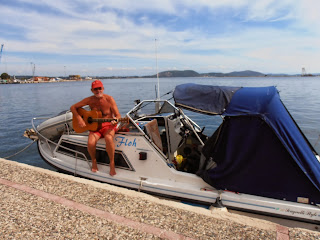
However the majority of live-aboards are found on sailing yachts or catamarans, mostly up to about 14 metres.
Generally the ideal vessel is the smallest one that will suit all of your needs. The larger vessel you have the greater will be the capital costs, the repairs and maintenance, fuel, insurance, berthage etc. In addition larger vessels are more restricted when it comes to what anchorages and harbours they can enter. From our observations many vessels over about 55 ft have some full time crew and in fact we see many boats well under that size professionally skippered and/or crewed.
Bigger isn’t necessarily better – this vessel uses about 700 litres/hr of diesel compared with Envoy’s 8 litres/hr

We opted to buy a heavy displacement monohulled passagemaker to provide future options for long-range cruising and after visiting Nordhavn in Dana Point decided on a 46, which in our view still has the best sleek and classic lines without the slightly “top-heavy” appearance of some subsequent models.
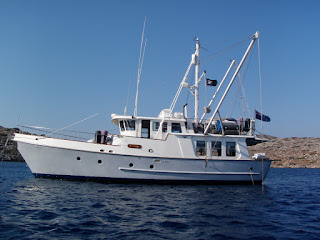
The N46 has sleek classic lines


But everybody’s tastes are different so do your own research by reading, visiting cruisers’ blogs, checking out different boats and talking with live-aboard cruisers.
Consider the location of vessels for sale relative to your intended cruising area. We wanted to use our boat in the Med so primarily looked at vessels located in Europe, in 2006 buying Envoy which had participated in the Atlantic Rally and was then located in Ostia, Italy.
Allied to the location issue is the complex one of port of registry, particularly if local taxes haven’t been paid. Envoy was USA registered with EU VAT unpaid and we changed her to New Zealand registered so she can remain in EU waters up to 18 months at a time without paying VAT. Before 18 months expires it’s only necessary to leave EU waters for a few days (the actual period is not defined) to re-set the 18 month clock, which can be extended by placing your vessel in Customs bond while wintering over. However specialist advice should be obtained for each set of circumstances ensuring the vessel is unencumbered and that correct documentary procedures are followed to minimise liabilities.
Familiarise yourself with other relevant regulations such as the Schengen Treaty which currently limits visits by New Zealand passport holders to three months in each treaty member country and most other non EU passport holders to three months total in all member countries (most EU countries are members). Of course if you hold an EU passport you won’t face this time restriction.
Turkey, Croatia and Albania require cruisers to use agents for clearing-in and out. Even where this is not required it’s a good idea to use agents as they have useful contacts and may be able to offer advice on extending your stay and minimising your obligations.
Spend some time with the boat’s previous owner to gain detailed knowledge of its operation, systems, maintenance and spare parts requirements.
Should I buy new or pre-owned?
Some owners prefer taking delivery of a brand new vessel for the pleasure of specifying a vessel suited exactly to their requirements; having a choice of engineering, layout, equipment brands and furnishings; having a manufacturer’s warranty and benefiting from lower maintenance costs.
However people purchasing new in expectation of having no problems are often disappointed as many new boats seem to need quite a few miles cruising and some months to resolve initial teething issues. How well such issues are eventually resolved depends on the commitment of the manufacturer and to some extent how far you are away from their home base.
Other buyers prefer to purchase a pre-owned vessel for the benefits of immediate availability (there is generally a wait for new vessels), lower investment cost, lower initial depreciation cost and the fact that she’s tried and tested with more equipment, spare parts, tools, chandlery, bedding, galley utensils etc included in the price.
Should I buy direct or use a broker?
The majority of pre-owned boats are listed with brokers. An experienced broker can provide valuable assistance in finding the ideal boat for your circumstances and negotiating a deal with the seller. The seller pays the broker’s commission so there’s no disadvantage for the buyer.
If you are not using a reputable broker be very cautious about paying money without robust safeguards in place as buyers have been known to transfer significant sums to scammers posing as vendors.
In a week we’ll publish the last part of this article dealing with equipment desirable for cruising.
Safety First
The Red Head crew always observes safety first whether we’re cruising the waterways or the highways. Dylan and Dee Dee are always secured to the car seat belt through their safety harnesses when they go for a ride in the car. Mom went to get one for Do…
Plymouth
While in Falmouth, we made a day-trip to Plymouth to visit our friends Jean and Matt Findlay and tour the town. We first met Jean and Matt in 2014 on their Beneteau 57 Superted V on Stewart Island in southern New Zealand and crossed paths an amazing number of times after, but haven’t seen them…
KVH V7-HTS: Twice the Speed & More Coverage
Frequent readers of this blog know we have become very dependent upon satellite communications. In fact, we have three different satellite technologies on board Dirona, as described in Communications at Sea. Here, we complete a quick survey of the satellite systems on Dirona, our experience with them, and why we upgraded to the KVH V7-HTS system four months ago. Our…
Dublin to Falmouth
We crossed 9,500 hours our John Deere 6068AFM75 main engine on the 243nm run from Dublin, Ireland to Falmouth, UK. This run would take us past the strong and sometimes dangerous currents off the most western tip of the UK at Land’s End, so we we left just before midnight to catch favourable tides. Conditions…
FPB Feature in CCA Chronicles
The following article by Linda and Steve Dashew appeared in Voyages, Chronicles of the Cruising Club of America, and puts …Read More
THE LIVE-ABOARD CRUISING LIFE – PART 2
Envoy is berthed in Greece’s Lefkas Marina and we’re home in Auckland. Unfortunately circumstances prevent us returning to cruise in the Med this year.
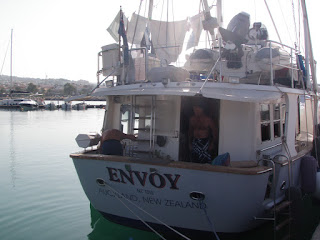


This is the second part of an article we wrote published in Australasia’s Pacific PassageMaker magazine about starting the live-aboard cruising life.
PRACTICAL ISSUES TO CONSIDER FOR THE LIVE-ABOARD LIFE
OK from Part 1 we realise life’s time clock is ticking and we’ve faced the common fears.
Once we decide to live the cruising life there are numerous practical issues to consider mostly falling somewhere into these categories:
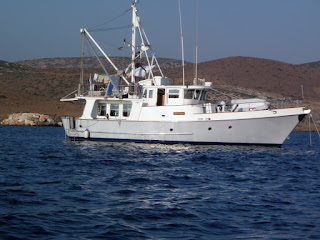
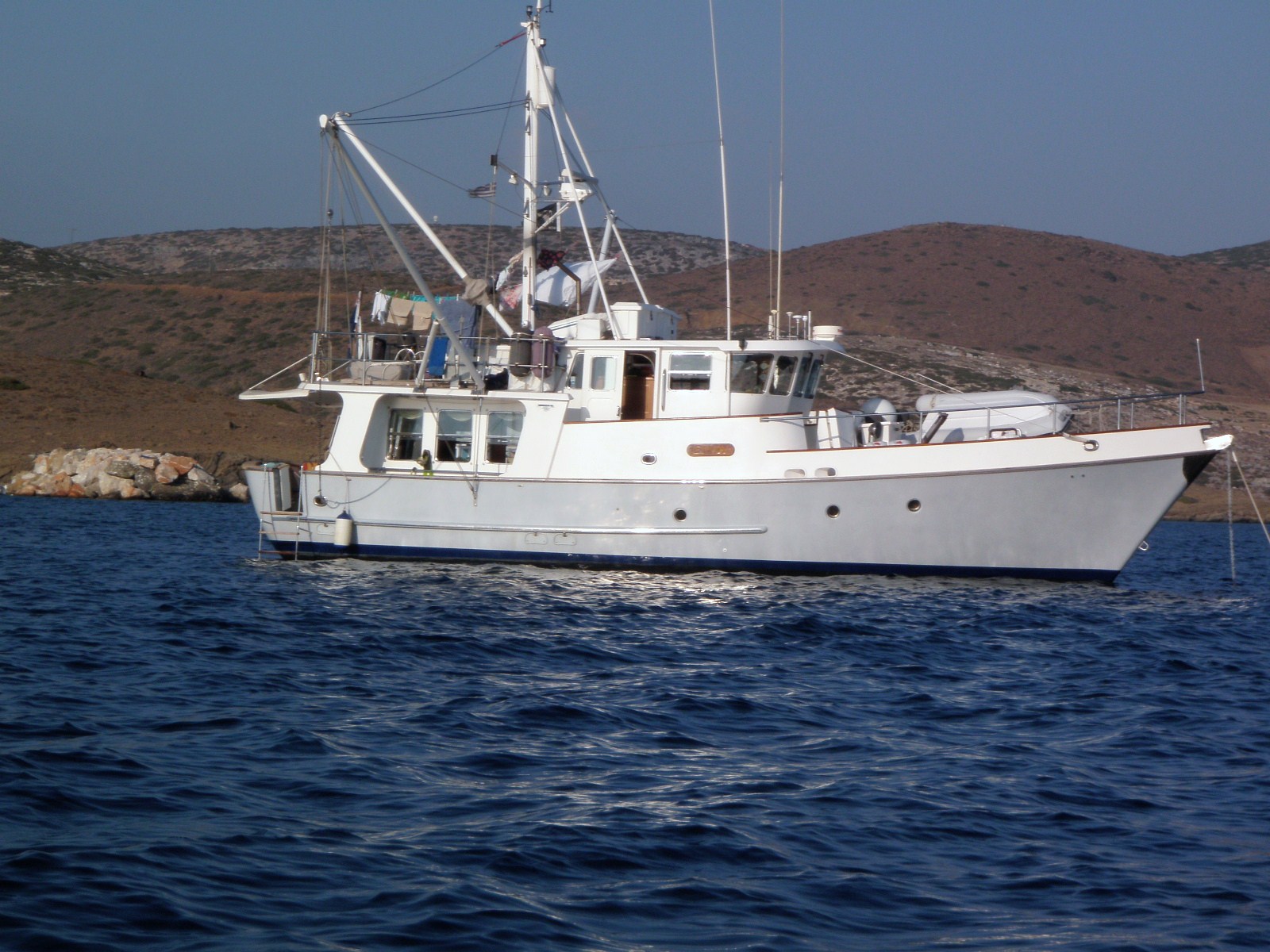
Envoy anchored in Vathi, Astypaelia
How long will you be away each year– the vast majority of cruisers (power and sail) see little point in sitting out the whole of their cruising region’s winter in a marina, particularly after doing it once, so they mostly return home to see their families and friends.An exception to this is that many European cruisers prefer the kinder winter weather in a location like the Med to that in their own country.
It’s great fun to be in a harbour or marina but we choose not to spend the whole winter there
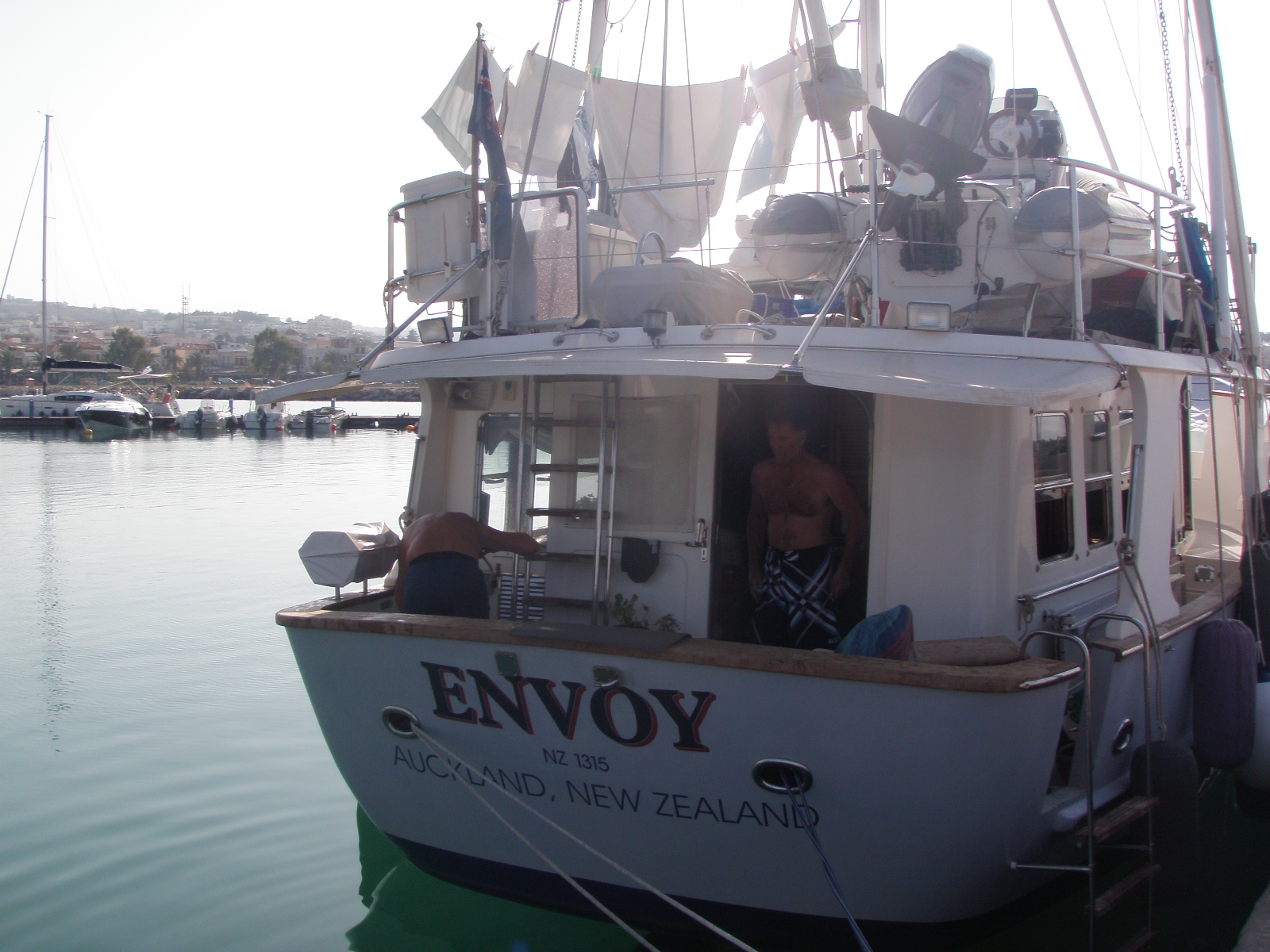
How many years will you cruise for– the short answer is as long as you are enjoying it and health, funds and other circumstances permit. About five years would be typical and we’ve rarely met cruisers who’ve lived aboard for more than ten.
Dependent family – most of the cruising community are in the age group mid-50s to mid-70s without school-age children and cruisers living aboard with children are rare. When we started cruising we each had an elderly parent who accepted we were living our lives to the full, appreciated our weekly phone call and enjoyed our home visits.
Family and Friends – ofcourse you miss your family and close friends, but some may be able to visit you and share in your cruising experience. Otherwise being able to see them for at least one period of a few months during the year keeps these relationships intact.
Your family and friends can visit to share your adventures

Work – most cruisers we meet are semi or completely retired. Some do consulting work remotely or are able to find some casual work if they choose to. A fewer number of younger cruisers take time out from the work force intending to rejoin it later.
Your home – some cruisers elect to sell their house to provide funds for cruising while most others rent it out, get house sitters or leave it vacant.
Compatibility and confidence – some people may speculate you won’t get on well together as a couple spending so much time in the confines of a boat. Only you will know if this is correct or not and we probably all know people where this lifestyle would be doomed to failure. Allied to this issue is one partner having a lack of confidence in the other’s ability. If you’re passionate you’re half way there and your confidence will grow through sharing experiences together.
Health – a reasonable but not perfect standard of general health and fitness is required for the live-aboard life reinforcing the case for starting the cruising life sooner than later. Travel insurance is essential as medical treatment can be extremely expensive overseas.
Pets – Overseas regulations concerning transportation and quarantine of pets are less strict than in New Zealand or Australia and some cruisers take their pets along. Similarly there are fewer restrictions on pets on beaches and in restaurants and cafes. Diane and I always had a dog or cat at home and loved them dearly, but prefer to avoid the hassles of having a pet aboard a boat.
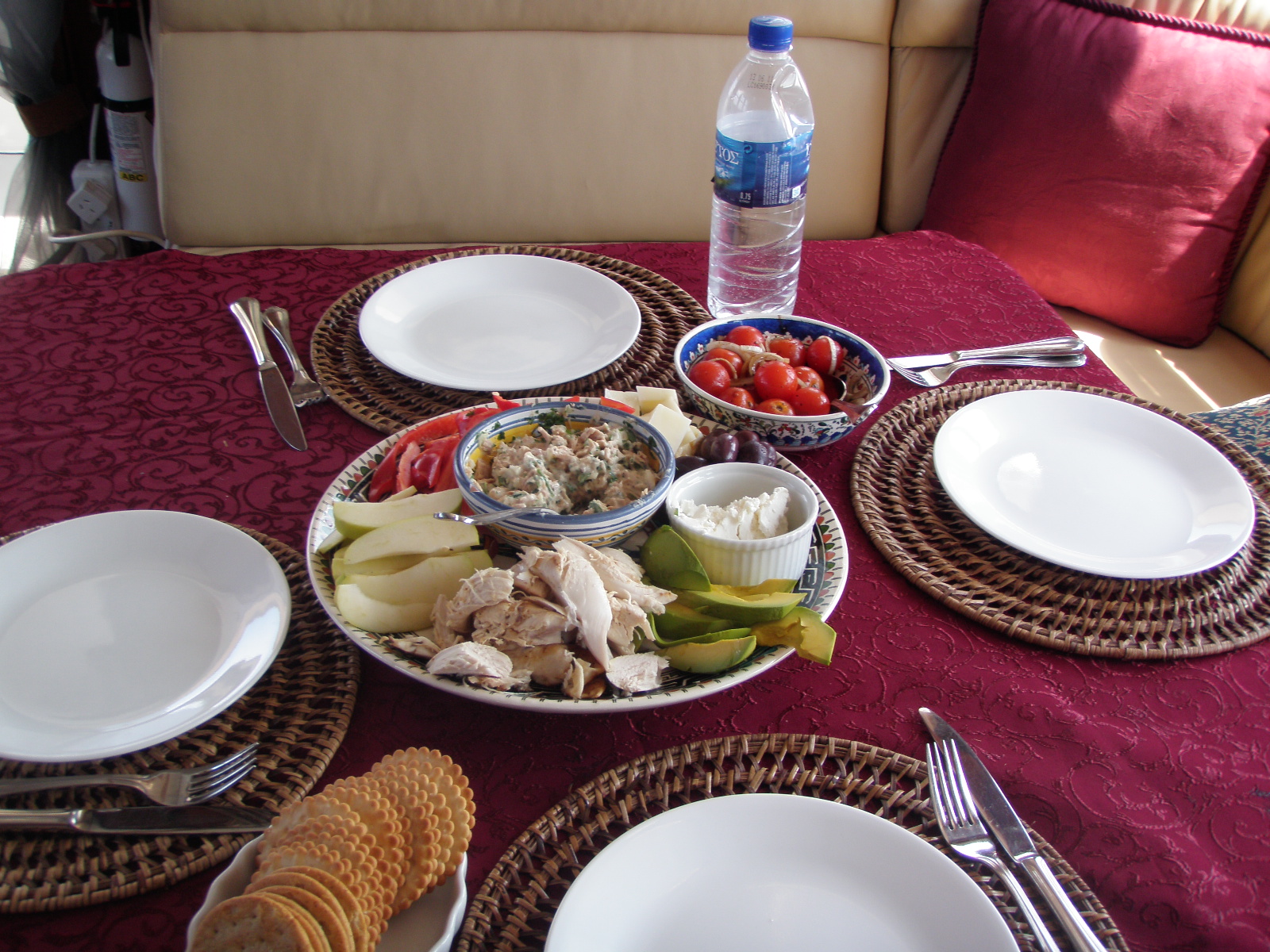
Comfort aboard – this will of course vary by vessel. When yachtsmen come aboard Envoy they are amazed at the living space available compared to sailing vessels of the same length. We don’t get wet, cold or wind-blown and with our stabilisers Envoy’s motion is rarely lively enough to spill a coffee.
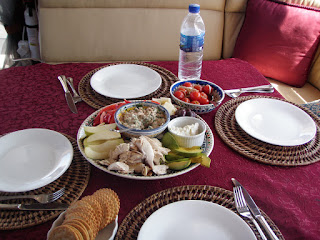
Comfort isn’t an issue aboard a well-found cruising boat – Envoy’s dinette and galley viewed from astern

Capital and living costs – the size, age and condition of your vessel determines its capital cost. Remember that bigger isn’t always better as larger vessels have dearer insurance, berthage and maintenance costs and can’t get into some of the smaller anchorages and harbours. Living costs such as food, beverages, household supplies and personal spending are about the same for us while cruising as when at home. Maintenance is dearer due to the higher cost of parts and greater distances travelled. There is also the cost of travel to and from our boat and additional fuel for the longer distances cruised. Casual marina prices are high in the Med so the best option is to anchor wherever possible, which is always free. Excluding living costs repairs and maintenance have been our largest cost averaging about six per cent of Envoy’s estimated value each year. Diane and I look at this not as “cost” but “investment in fun”.
Read PART 3 in about a week.
Dun Laoghaire
Two massive piers, built in the early 1800s, create a huge 250-acre (101-hectare) sheltered harbour at Dun Laoghaire (pronounced Dun Leary) near Dublin. Dun Laoghaire Marina is a large, 820-boat marina behind a second set of breakwaters within that protected harbour. Although the marina is outside Dublin proper, it has convenient train access to the…
