LONG TERM CRUISING – what do you do all day?

Envoy is currently in Lefkas marina while we are home in New Zealand.

Having spent most of the past six years cruising the eastern Med aboard our Nordhavn 46 passagemaker, Envoy, “what do you do all day?” is the question commonly posed by family and friends.

We don’t feel the need to be constantly “doing things”, sometimes it’s nice just to feed visiting ducks

Before going to the Med we spent over 25 years cruising the north-east coast of New Zealand’s North Island, mostly between Whitianga and Whangaroa, when many of our days were filled with fishing and diving. Even when setting off for a few weeks we’d only take meat for the first night out, knowing the rest of the time ample delicious bounty from the sea would feed us.
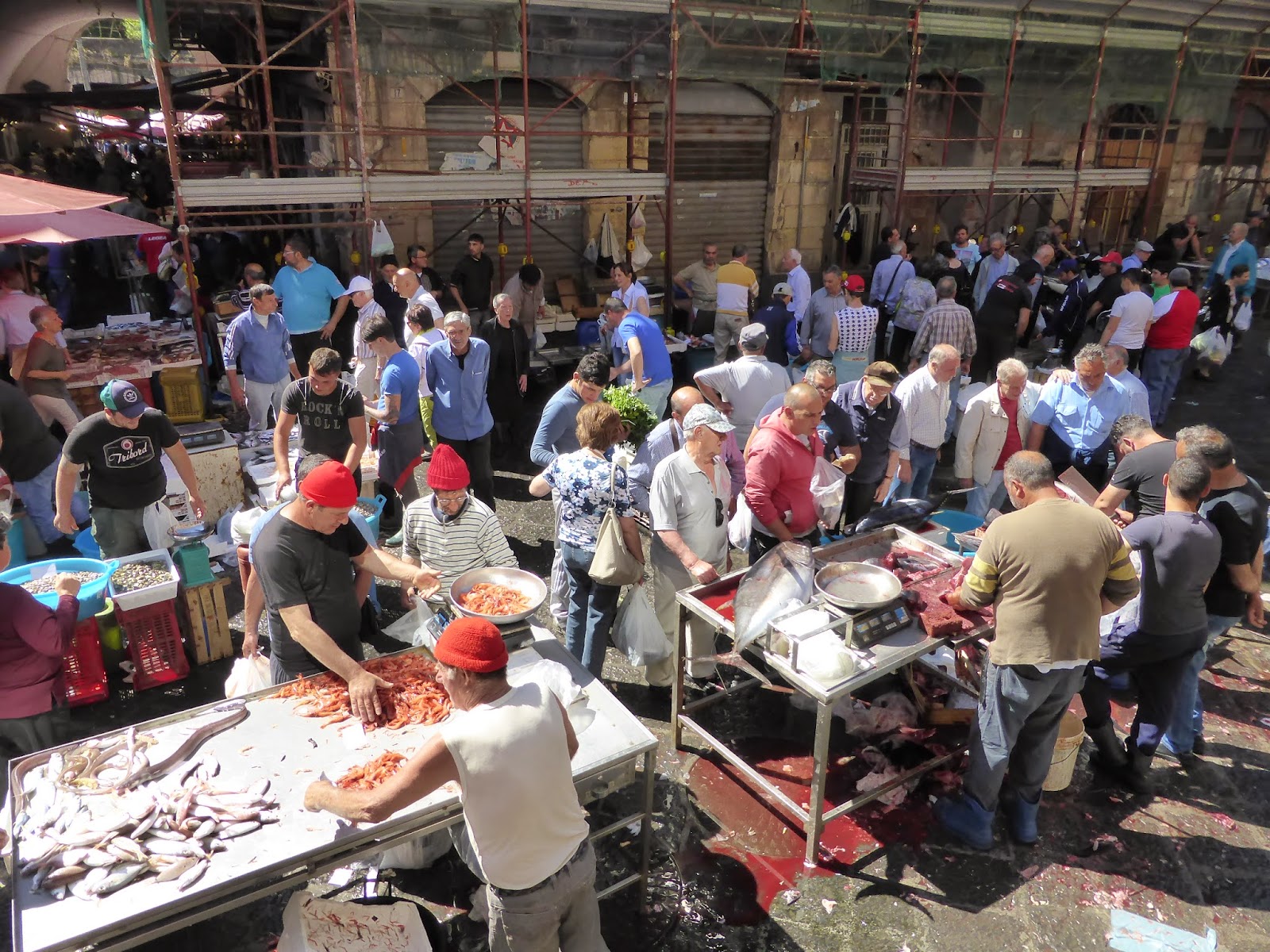
The Med seems to have plenty of fish. Now this seems a controversial statement, but virtually every coastal town or village we’ve visited has its own commercial fishing fleet and a fish market displaying species ranging from sardines to swordfish.

Most of the larger villages have a fish market
But we’ve observed very little leisure fishing in the Med and most fishing boats use long lines or nets, so we’ve mostly given up fishing except for trolling to put the occasional tuna on our table.

We don’t spend much time fishing, but our late friend Brian caught this small tuna, trolling a lure

We do plenty of snorkeling in the Med’s largely pristine clear waters, but in most areas you can only scuba dive in an organised group; this is to protect the many easily-accessible historic relics.
Get the picture? We have plenty of time on our hands compared with our NZ boating – how do we fill it?
So here’s another controversial statement. While the North Island’s north-east coast has some stunning coastal and offshore island natural scenery (as does much of the Med), in our opinion there are very few coastal towns or villages offering much of interest to see. Yes we enjoy visiting Whitianga, Coromandel, Oneroa, Tryphena, Warkworth, Whangarei and Russell, but even some of this pick of the crop are losing part of their olde worlde charm to over-development. On the contrary the northern Med coastline and offshore islands have countless delightful towns and villages, dripping with atmosphere and loaded with quirky shops, rustic tavernas and historical features to explore.

When you anchor off a Med village there’s always heaps to see ashore (off Cefalu, Sicily)

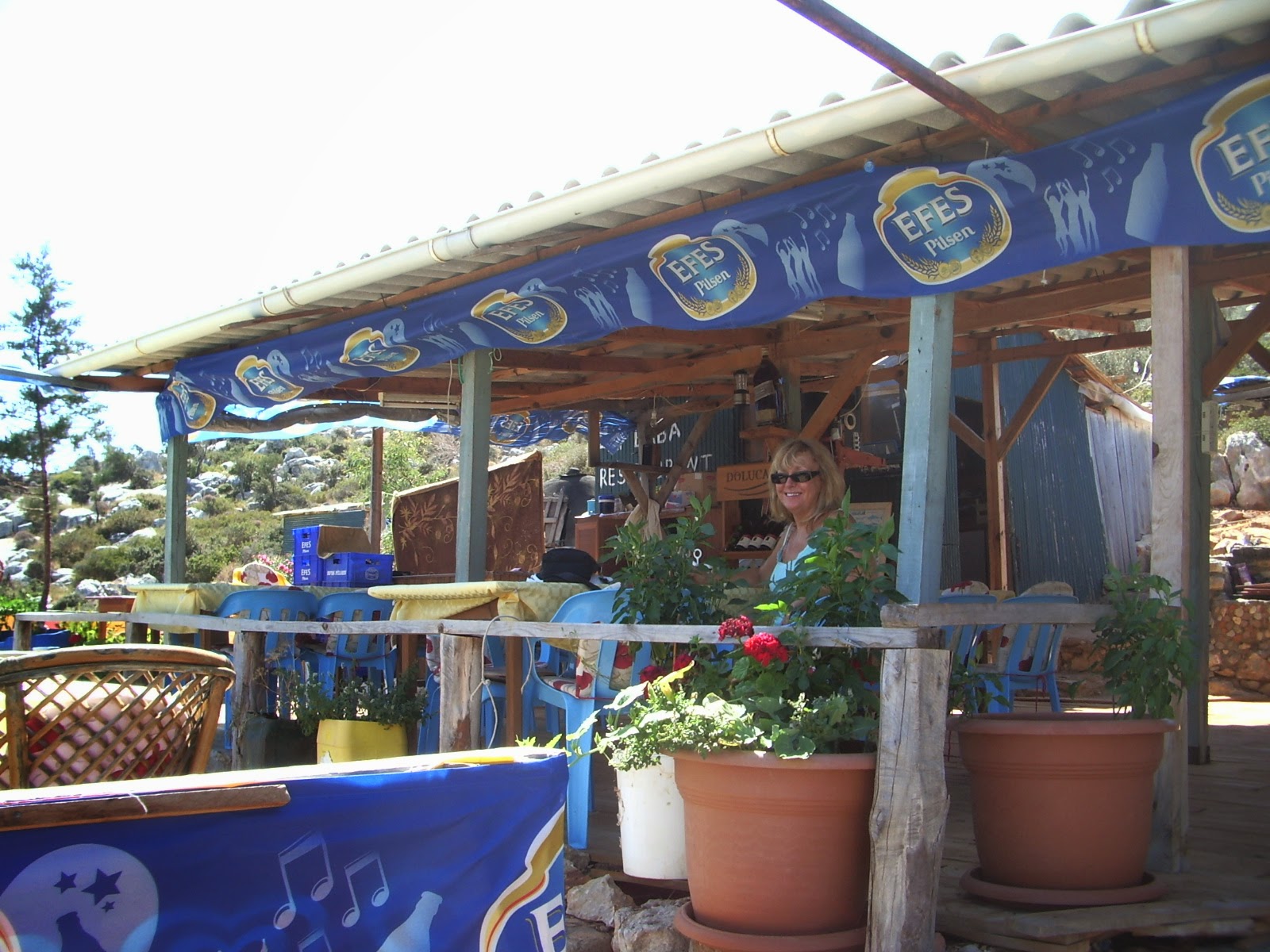
Tavernas don’t come more rustic than Alibaba’s in Turkey
The dynamics of living on a boat overseas are quite different to going away for a few days or for the summer holidays in your own country. For a start you have to navigate yourself safely through unfamiliar waters without the support structures we take for granted in NZ such as Coastguard, VHF-radio trip reports and weather Nowcasting. Then you need to do time-consuming routine things like replenishing stores, laundry and the maintenance that back home you’d leave until your return to the marina.
So what does a typical Med cruising day look like?
It always starts with checking the anchor, bilges, fresh water tank levels and engine room. This takes from 30 minutes to about an hour, depending on what needs attention; for example topping fluids, adjusting vee-belts or running our diesel polishing system to fill our day tank. After checking the latest weather forecasts online, next on the agenda is nearly always a swim. What we do next depends on whether we’re going to remain at anchor or cruise somewhere.
At anchor we run the generator for about 90 minutes to charge our batteries, run our refrigeration and heat our hot water tank. Sometimes we extend the generator’s running time to do some laundry and operate the water maker. After breakfast we usually spend several hours using our RHIB to explore the nearby coastline and interesting areas ashore.
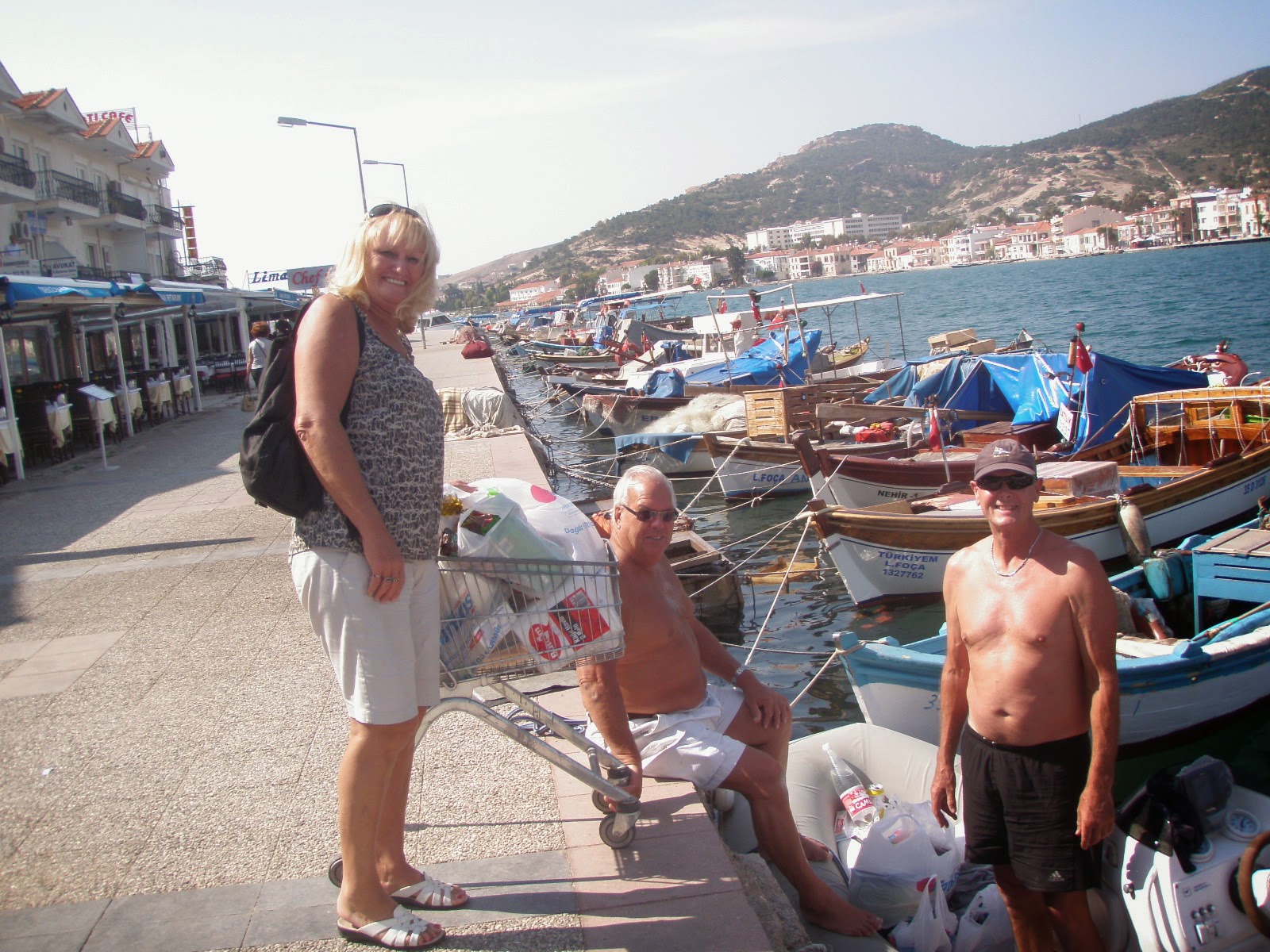
Buying supplies is very different overseas – you can’t drive your car to a familiar supermarket and load up! With our granny shopping cart in tow we first have to find a shop then locate the items we need among the unfamiliar and foreign-language printed goods. To complicate matters large supermarkets are rare so we generally have to visit several shops to buy all we need. In countries like Turkey, Greece and Italy the shopping process is regarded as one of life’s pleasures rather than a chore, and involves tasting different delights such as olives, cheeses and salamis while bantering with shop assistants and other customers.

In most Med countries food shopping is a pleasure rather than a chore

Very often the owner-operated shops will then offer a complimentary glass of wine in appreciation of your custom, and more discussion follows. Finally we have to hump our purchases to the RHIB and take them out to Envoy. To reduce the need for mammoth shopping expeditions we nearly always buy small quantities of heavy stuff like vegetables, milk, beer, coke and wine when going ashore.

Humping supplies back to Envoy using the RHIB – note all the small commercial fishing boats
Back on board we allow one or two hours daily for the ever-present maintenance, then 1800 hours will generally find us in the cockpit, cold beer or wine in hand reflecting on the day’s activities and making some plans for the next few days before we fire up the barbecue for dinner.
If moving on we up-anchor after our swim and get under way before we have breakfast – one of the advantages of a stabilised displacement hull is that you can do most everything underway except in particularly rough waters. We find the next exotic location, and do it all over again!
ADIEU BORA BORA

ADIEU BORA BORA

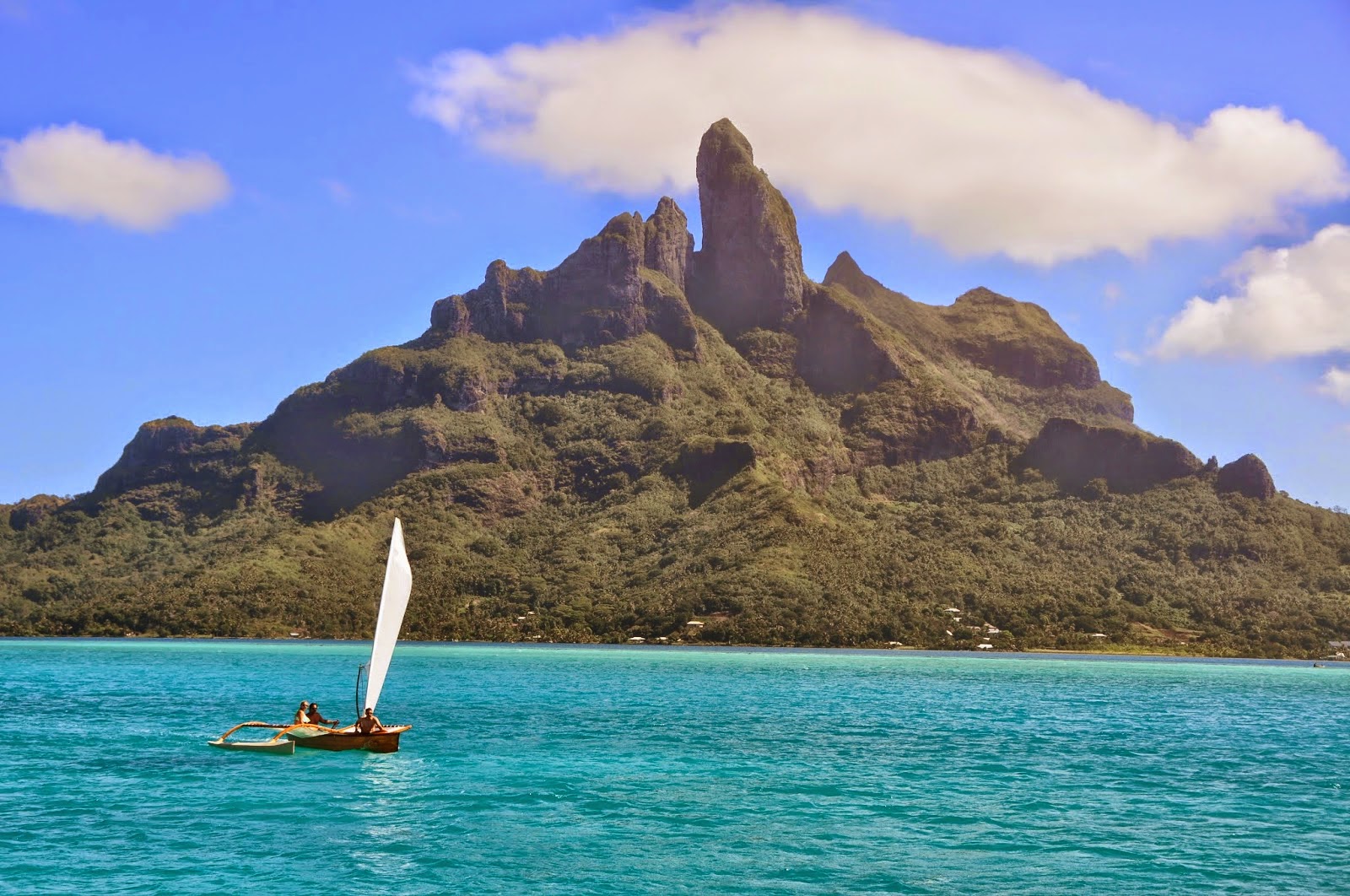
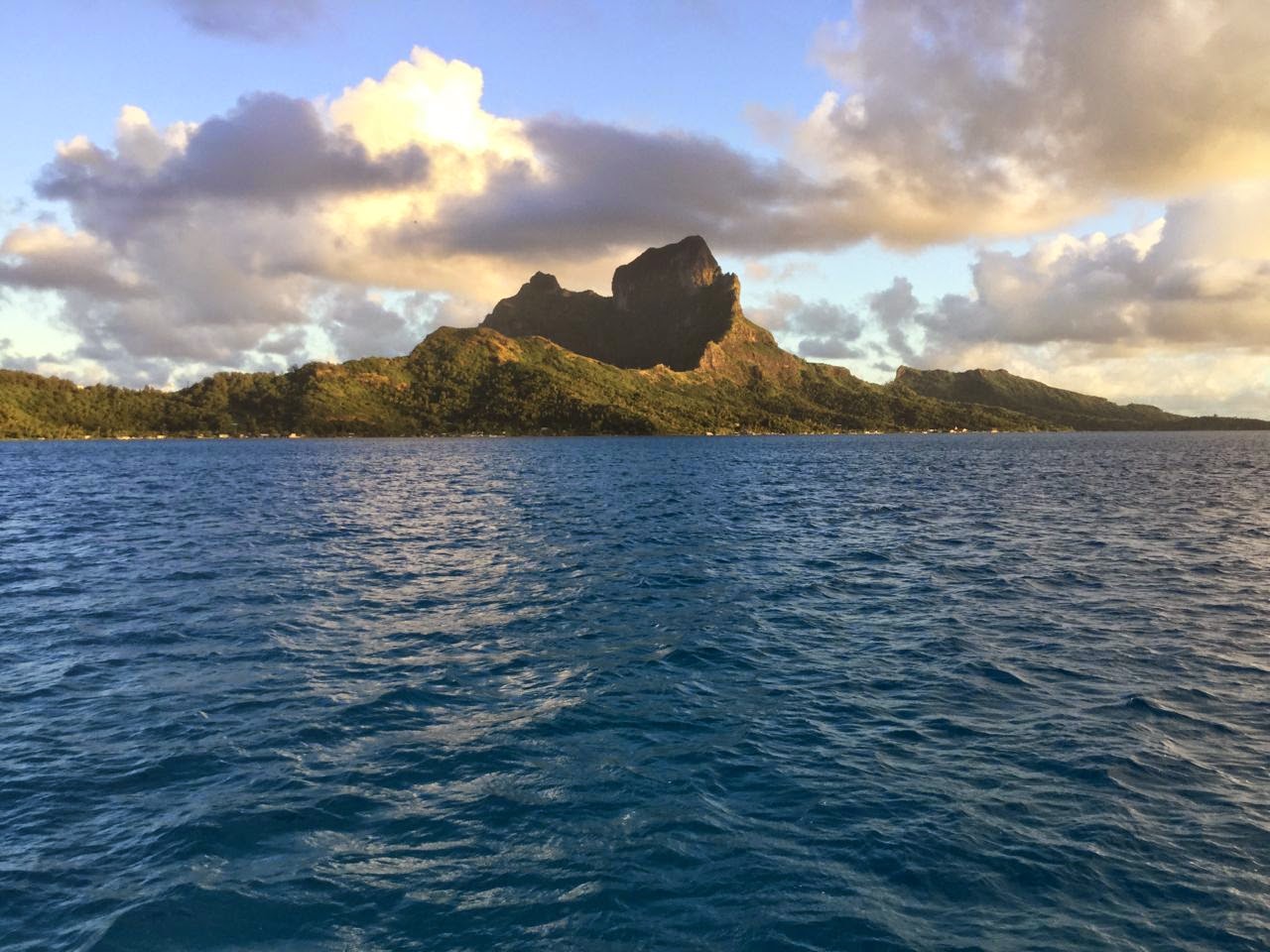
Bora Bora’s crater, viewed from the south
Mai Kai Marina – April 26, 2015 – On a mooring. 

–                    Note about moorings at the Mai Kai:  just grab one and don’t even try to anchor here!  It’s 30- meter deep with lots of coral at the bottom.  Nasty gusts constantly rush down the mountain, tossing boats around.  Just yesterday, some guy dropped anchor not far from us; an hour later, he was dragging into the mooring field, tried to raise his anchor (by hand) and snagged a mooring chain… big mess!

–                    Note about your dinghy:  There has been a rash of dinghy/motor theft, not only in Bora but also Huahine and Raiatea.  As I said before, LIFT it, LOCK it, or LOSE it!

–                    Happy Hour at the Mai Kai: 1700-1800 –

Well, this is it.  Tomorrow morning at 0100 we’re slipping our mooring lines and making off to Suwarrow (AKA “Suvarof”) –

Moorings at the Mai-Kai Marina – After our cruise to Motu Piti Aau (SE of the atoll)   

CLEARING OUT – Clearing out of French Polynesia is much easier here in Bora Bora than it would have been in Papeete.  The normal clearing procedure in Papeete starts 3 days before your intended departure, as follows:  you e-mail a notice of departure to the Port Captain (Ken Vernaudon), who emails it to Customs, who clear the document and email it to immigration, who notifies you that you are now able to pickup your clearance.  Then, you go to the Customs office to get your document, hand-carry it to the immigration office who stamps (or not) your passports, and you MUST leave Papeete before midnight THAT day, not to touch land anywhere in French Polynesia, lest you would be considered as a “drogue-trafiqueur” and be subject to fines and boat seizure.  IF you want detaxed “export” fuel (about 1cent/liter less than detaxed fuel), you must do it AFTER immigration gives you your clearance, but BEFORE leaving Papeete before midnight that night…  good luck!

What did we do?  Got our regular detaxed fuel document from customs, cleared out of Papeete with the Port Captain, destination “Iles sous le vent” (you must clear out with the Port Captain when you travel 50 miles from Tahiti and beyond) – Then, we fueled up in Raiatea and made for Bora Bora (with a detour by Maupiti) where we have been waiting for a weather window.  This morning, Sunday, we went to the “Gendarmerie” and cleared out (immigration, port and customs, all rolled into ONE gendarme) and have 24 hours to leave.  None of that “Before Midnight” nonsense. (The gendarmerie is open 7 days a week.)

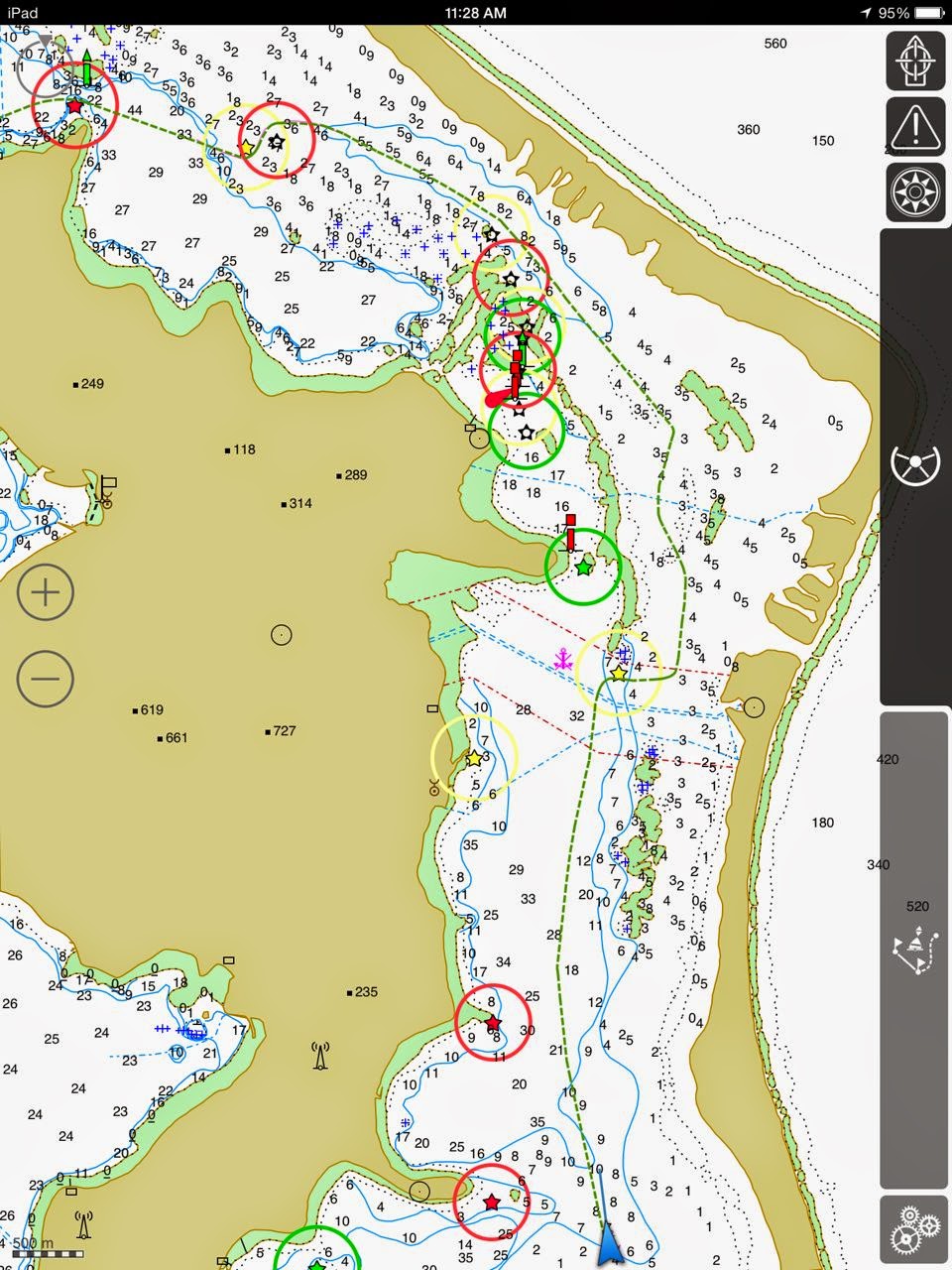
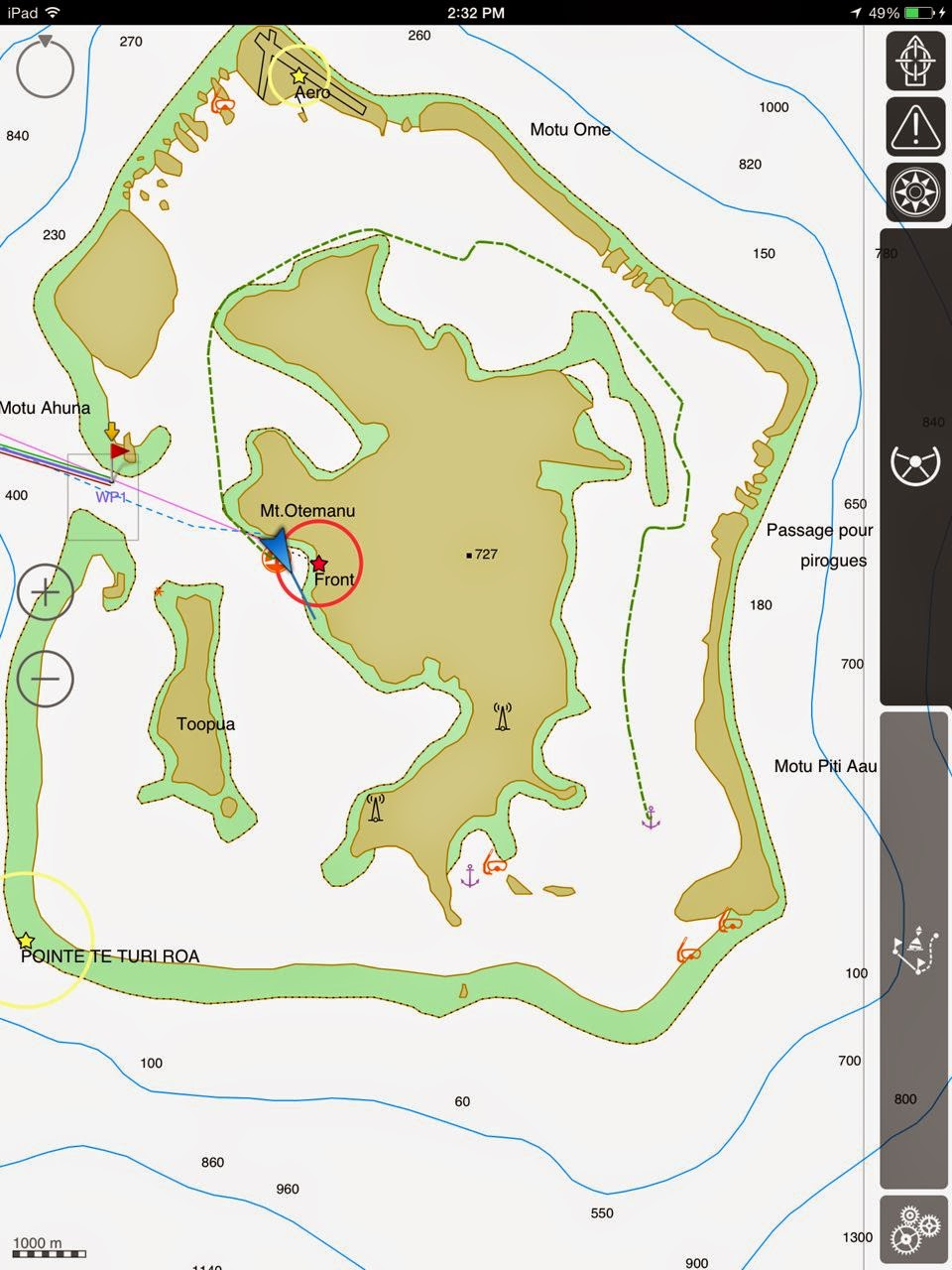
Going around Bora’s East end – Green track
But we had a few days to explore the SE end of Bora Bora’s lagoon, a bit further down than we did last time.  
Nasty S-turn, but well marked – Just don’t go to sleep!
As before, I found the “S” turns in the lagoon a bit unnerving, but we had great visibility and navigation was no problem.

Off to a little snorkeling
Motu Piti Aau – 16°31.95S – 151°42.595W –   We anchored in 8 meters of blue water, sand, right off the 2-meter sand shelf.  Many boats DO anchor on the sand shelf, all the way to the S end of the motu, in front of the little pension.  We try to stay further from land to avoid potential mosquitoes and “nonos.”

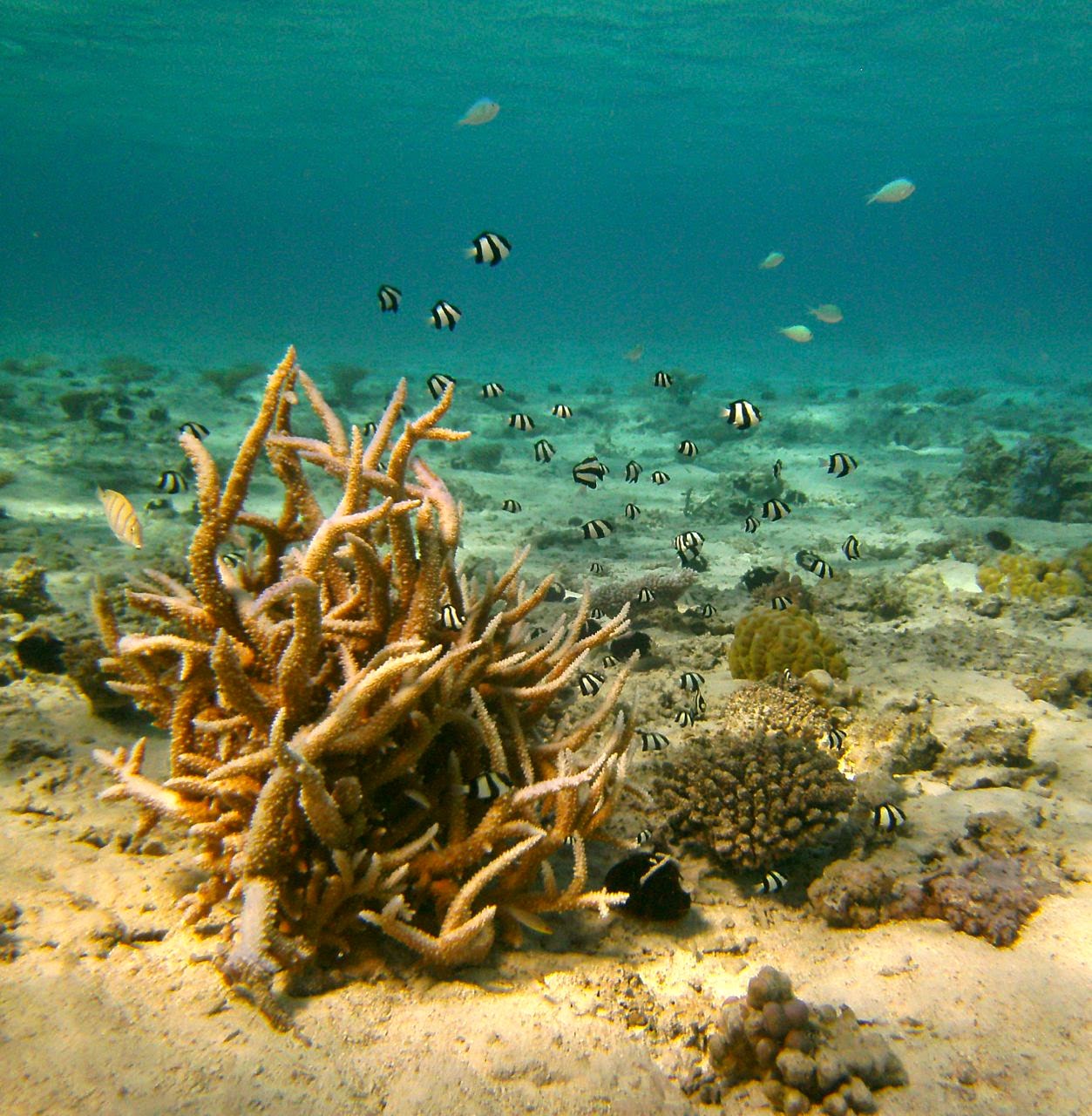
Stunning coral flowers in gin-clear water… and nothing else!
We were anxious to re-visit what had enthralled us 20 years ago, the “Coral Garden” at the southern point of Motu Piti Aau.  But what a disappointment!  Where were the 2-feet wide giant clams?  The multitude of fish?  The variegated coral formations?  All there is left is a desert of rocky formations, once live coral, with a few blooming coral flowers in iridescent pastels.  Stunning water clarity and beautiful coral blooms… BUT: hardly any fish remain; the bottom is littered with thousands upon thousands of giant clam shells, many smaller than 6”, a graveyard not only for the “Pahuas”but for the entire reef life.  Nothing made me sadder in this entire trip.  (Note: when you snorkel this area, watch out for the current, it’s very strong at that end of the lagoon.)
Impressive water clarity… and a harvested 6″ pahua…sad: pahuas used to reach 24″ here… no more!
Not far, local guides were conducting a shark feeding operation, a dozen tourists strung on a line, sharks circling freely, and I couldn’t stop wondering when these shark feeding operations would be outlawed.  This shark-feeding practice is a total nonsense to me.

Crystal clear view of… a whole lot of nothing left
To try and feel better, we checked out the snorkeling at Motu Piti Uu, on the land side of the island.  The fish population was plentiful, though the specimen were mostly juveniles.

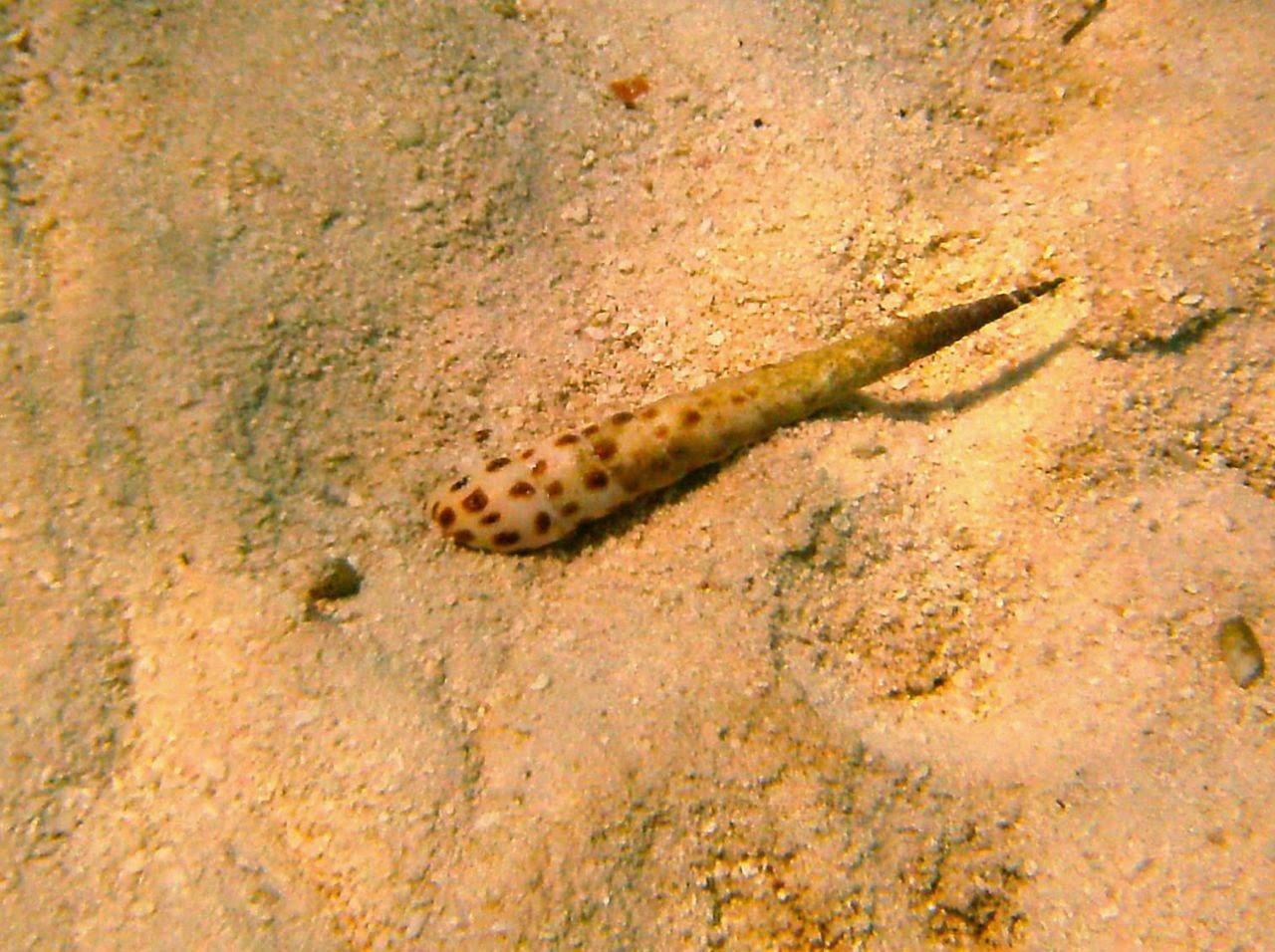
Auger
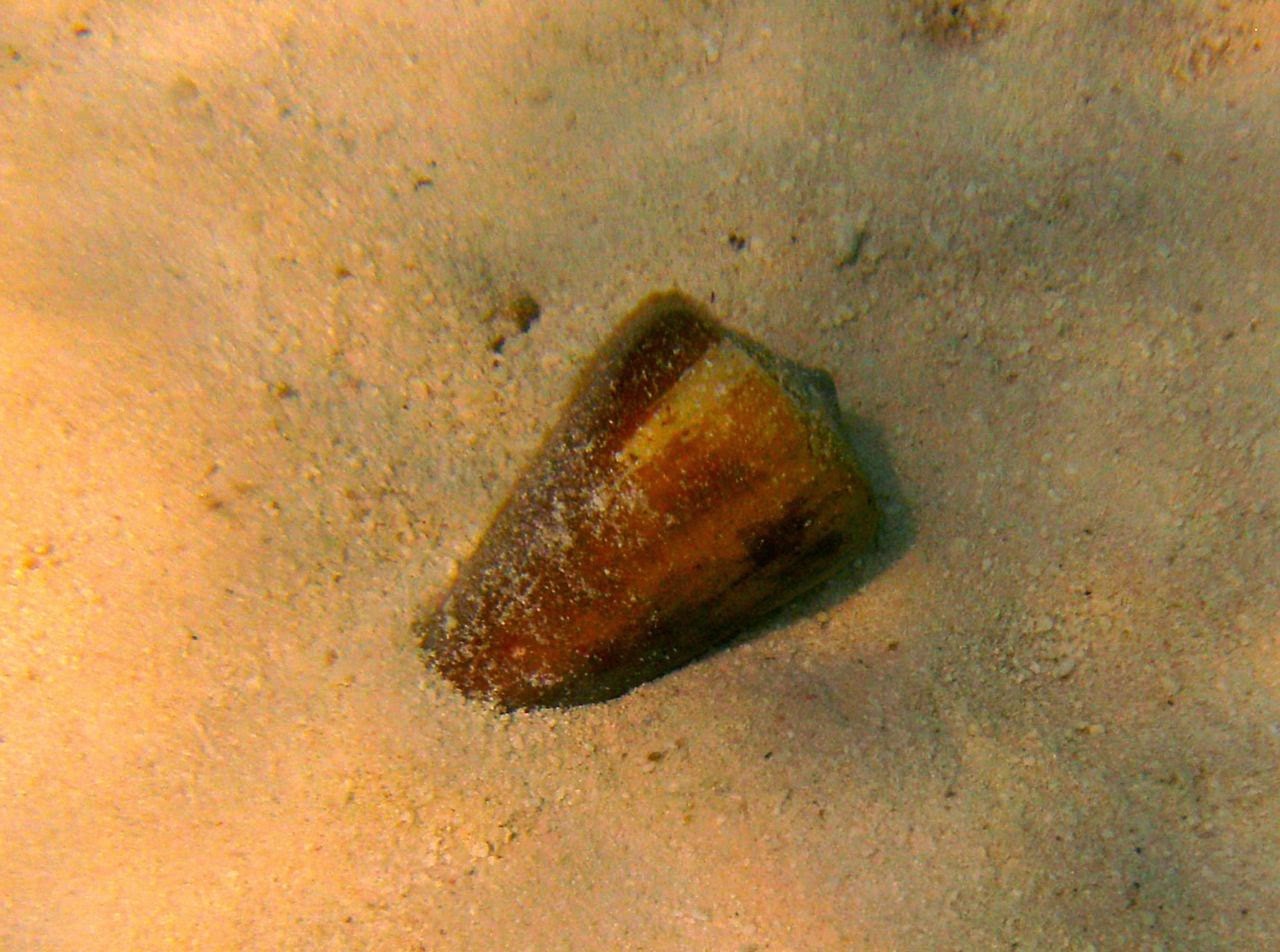
Some cone….
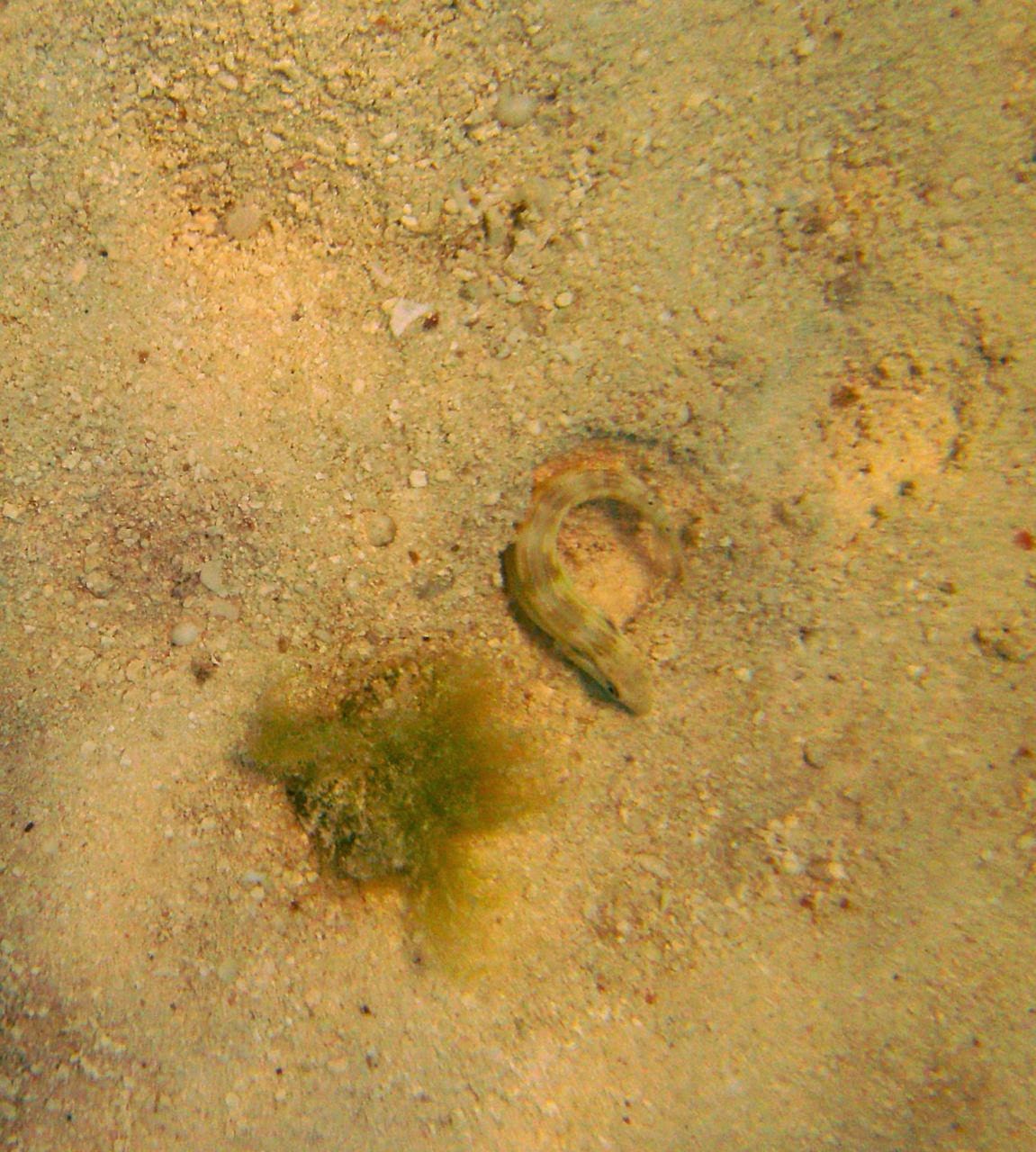
In despair, I decided to check out the sand shelf and found a few sand creatures: marlinspikes, augers, miters, cones, dartfish, and even a blenny… or was that a goby?  I’m still confused between them, especially when I can’t see the dorsal fin.  And, of course, lots of stingrays and eagle rays.

And a tiny little goby… or blenny, nestled in a tuft of stray algae
As we motored back up towards the town of Vaitape and the Mai Kai mooring field, we took a last look at the hundreds of luxury bungalows strung over the turquoise waters.  Bora Bora is no longer the “Pearl of the Pacific.”  It’s beauty has been sacrificed to the $$ god, its motus thrashed, its underwater treasures pillaged.

Cones are common here
Big marlinspikes are easy to find: just look for their trails and dig at the head of the trail… there they are!

Pearl of the Pacific?  We just got back from our provisioning trip.  It’s been raining and we’ve had to slog though mud in the streets, just like we did in Paraguay or Brazil or Guatemala, and we couldn’t help comment that, in spite of its thousand-dollar-a-night hotel rooms and the luxury ship Paul Gaugin anchored just a few yards from us and disgorging its white-dress –clad misses, Bora Bora reminds us of a third-world village, far from the classy, responsible, ecologic tourist spot it pretends to be.

The impressive volcano is still there; the lagoon is still blue in appearance; the sea life is depressingly absent.

And so we’re off to Suwarrow, hoping to catch some fish during our 3-day passage, because we have not caught a single fish in all our stay in the Society Islands.
Off to Suwarrow…

Until then…

dominomarie

ADIEU MAUPITI


ADIEU MAUPITI
Getting into Maupiti… mooring field to port, once passed the Cardinal marks

Maupiti – April 16th, 2015

            – Mooring balls: 6 at Pte Tamaupiti (just west of the pass) and 3 more in town

            – Town dinghy dock

Getting to the pass, coming from the south… this is as good as it gets
We had hoped to stay a short week in Maupiti.  But you don’t PLAN a stay in Maupiti, really.  You get there if there’s a good weather window and you get out like a bat out of hell if the swell is contrary.  Twenty years ago, we waited a whole week to get into the pass, but we never had a chance.  This time, we did make it… and rushed out 3 days later.

This was a good day to enter Maupiti!
            The trick in Maupiti is that the pass is very narrow and faces south.  Any swell from SE to SW creates breaking waves and sheer walls of water, making the pass impossible.  It goes without saying that the locals can be quite isolated from the rest of the world.  The commercial shuttle “Maupiti Express” has ceased its money-losing activities; the supply ship can’t always come in on schedule; the airport landing strip is too short for any plane larger than a 12-seater.  Isolation is the norm, here.

Any swell from the south makes entry/exit into Maupiti impossible
            But we were lucky this time and threaded through the infamous ‘Onoiau Pass with absolutely flat seas and no wind at all.  Still, even at mid-day (Solar tides here), the out-flowing current was strong.  But trust “Big-D”… she got us through smoothly.

            The area just west of the pass hosts 6 mooring balls, and that’s great.  There is nothing better to do than jump in the crystal-clear water and wait for the rays to show up.  Some are stingrays, but the majority are leopard rays (spotted eagle rays), bat rays and other specimen of the Myliobatis family.  I call them the little sand-pigs.  Just watch them bury their rounded snouts into the fine white sand and shake-shake-shake, like little piggies in mud.  I wish my Lumix underwater camera had not broken down on its 4th use… I have no underwater photo to show you, sadly.

Maupiti town
            Off to town, then!  There are 3 more mooring balls and a dinghy dock, to our great satisfaction.  For more snorkeling, we dinghied to the north end of the atoll and snorkeled the area west of Motu Paeao.  It’s worth a trip, even though it’s not the greatest coral or fish population. 

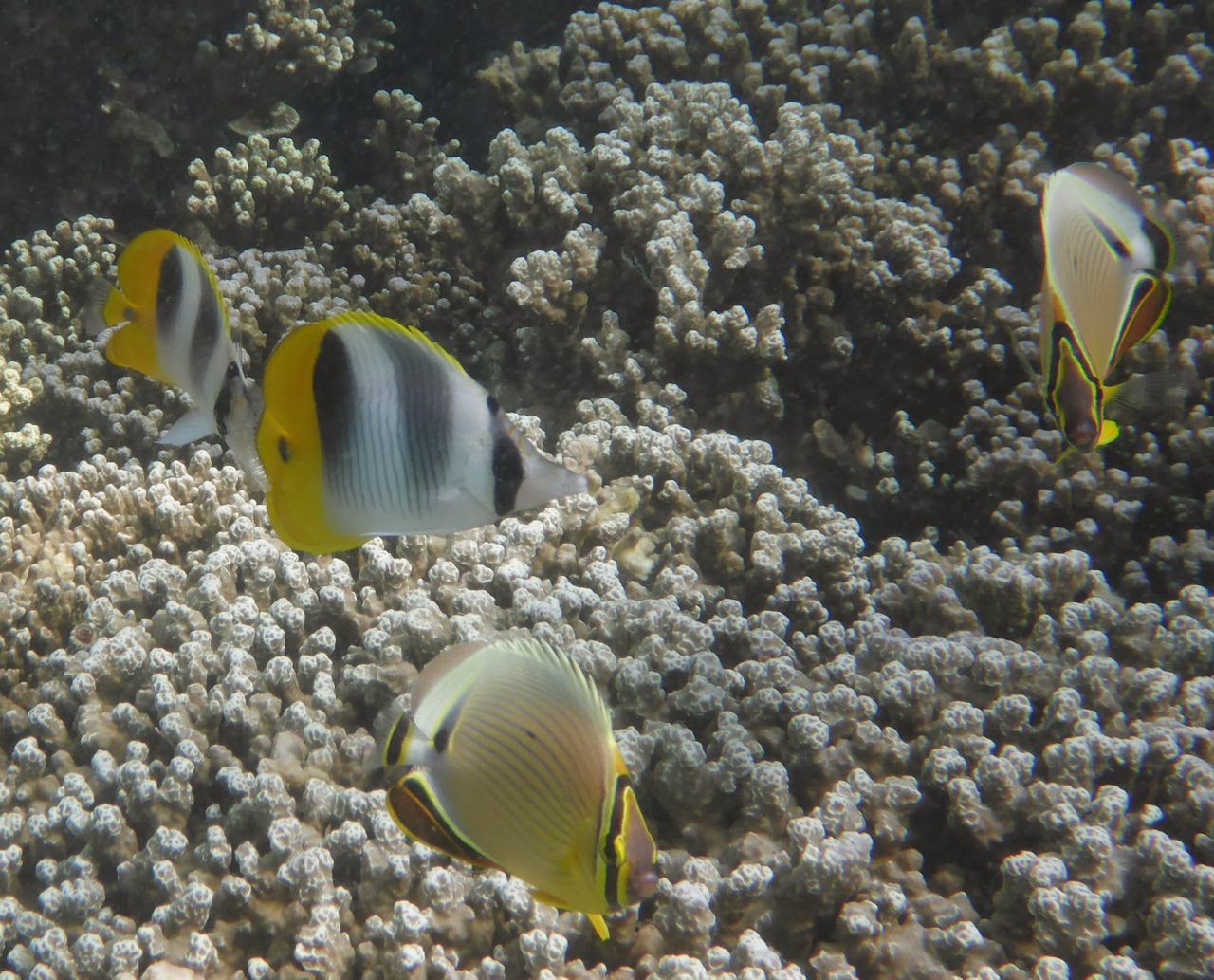
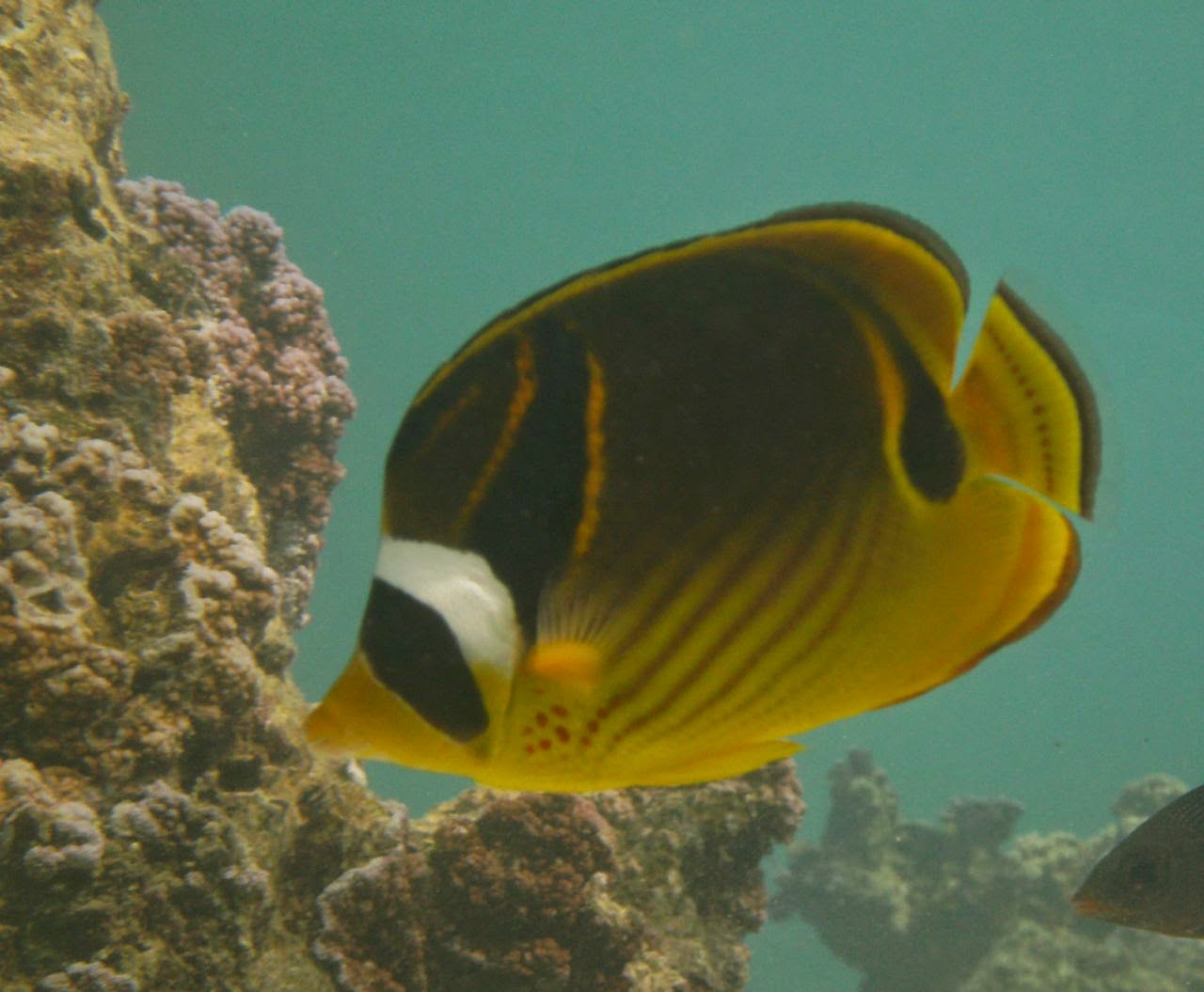
Varieties of butterfly fish are everywhere
Our trip to shore was quite a “raté”… we’re OK with water activity, not so good with land-based stuff.  The waterfront restaurant was closed: out of food and the supply ship, the red Teravao was just docking… no food till tomorrow!  So, let’s climb up the volcanic peak and have a view from the top, we hear it’s a spectacular 300-degree shot over the lagoon.  But we took the wrong trail (the one by the grocery store instead of the stairs) and I gave up after an hour, JP giving up shortly after.  So, let’s take the bikes out and explore around the island… tomorrow morning… and that’s when our mooring neighbor announced that the charter company had just ordered them to leave Maupiti IMMEDIATELY or they would be stuck in the lagoon for the next 5 days.

When all else fails, picking flowers and collecting shells can fill my days
Ten minutes later, we had slipped our mooring lines and were chugging towards the pass.  Just in time!  We were greeted by a 15-foot wave, thankfully well-rounded and not breaking yet.  It was quite impressive to watch “Big-D” climb to the top only to be greeted by a major mascaré beyond.  We were tossed around in that washing machine and were thankful to have a big, powerful boat that got us out of there quickly.  We felt a bit sorry for the 36’ sailing cat that was to follow us… mercy!

That’s how it is in Maupiti… you get what you get and are thankful for it.  Indeed, we are grateful to have had this opportunity, 20 years in the making.

Adieu, surprising Maupiti!

Next stop: Bora Bora.  Till then…

dominomarie

Adieu Raiatea

ADIEU RAIATEA

Motu Nao Nao – Day anchorage. or overnight by settled weather only

Motu Aito (Raiatea) – April 13, 2015

–       Mooring balls: 6 in Faaroa Bay (3 mid/bay, 3 at the entrance of the river)

–       UTUROA Fuel dock (fuel usually cheaper than in Marina Taina, detax accepted, fuel sampled and analyzed before being pumped) – Currently 70.5 CFP for detaxed fuel.
–       SHOPPING– Supermarket and town market steps off the dock, excellent provisioning.

–       UTUROA TOWN DOCK –  Very easy access, OK for a short time.

Motu Aito – 16°42.742S – 151°26.466W –  For the last time, we anchored at Motu Aito, the artificial motu across from Uturoa.  This has become somewhat of a controversial anchorage with the locals.  Long-term cruisers, especially the ones who have registered their children in Uturoa schools, have elected this site as their quasi-permanent anchorage.  The locals have a tendency to see them as “squatters.”  The main issue is with local water taxis and shuttles who use the channel north of Motu Aito, a channel often obstructed by the yachts at anchor.  Fed-up with the not-so-nice attitude of a few cruisers, the locals are asking for a ban on this anchorage.  It would be nice if the city installed mooring balls, just as they have in other places, or designate a safe anchorage for long-term cruisers.  But for now, we can still anchor at Motu Aito. 

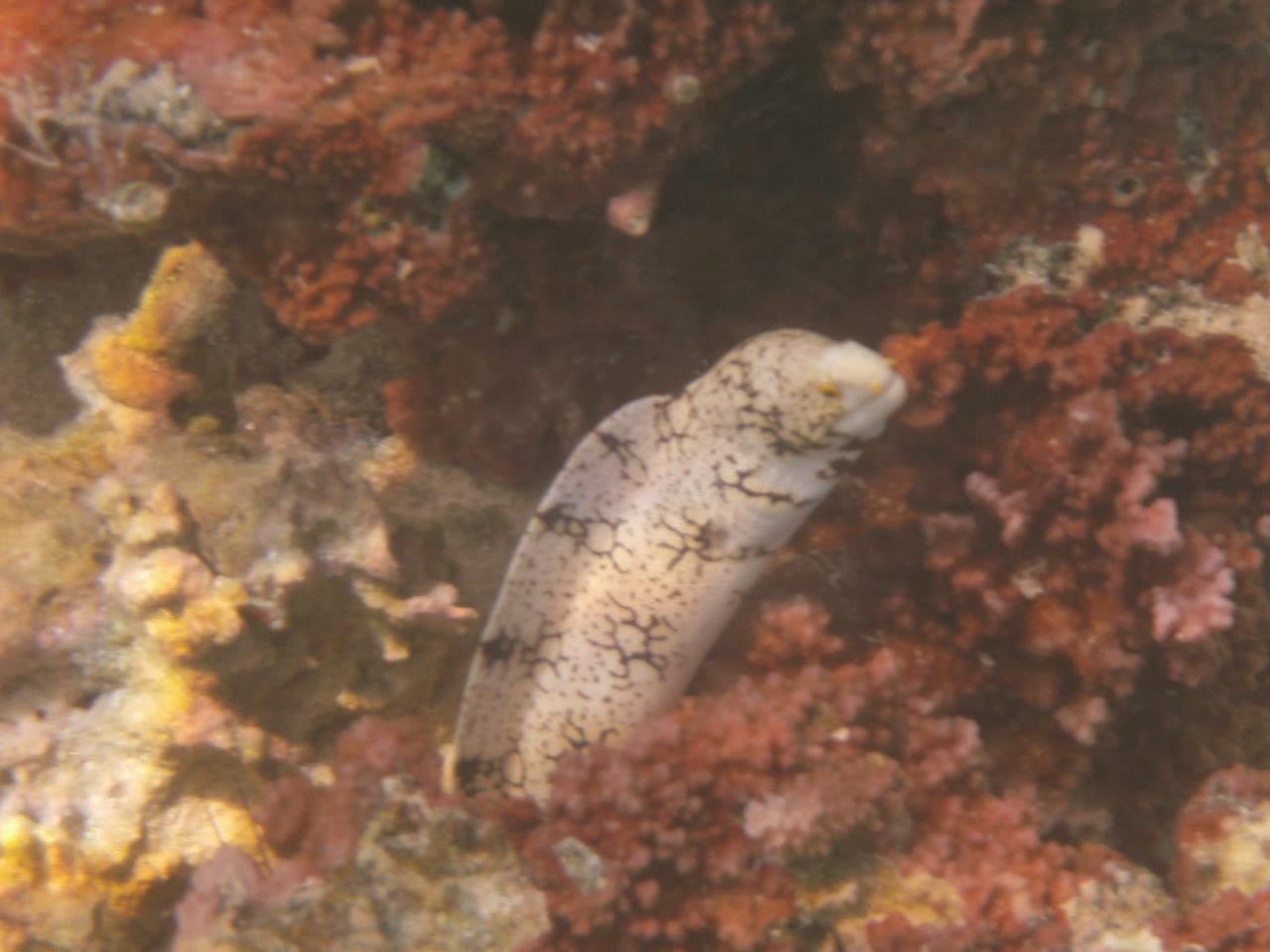
Snowflake eels are all over the place at Motu Aito
I like this anchorage a lot.  Snorkeling is always good, with plenty of eels and angelfish, and it’s a short swim to the reef where giant triggerfish are sure to cruise.  I’m still looking for the leaf fish supposed to hang around there, so far no luck.  We said goodbye to friends we’d been cruising with for the last 2 years: Spirit of Pontapreta and DigDoug –  But before leaving for good, we had to explore 2 more places.

My favorite angelfish: Racoon

Faaroa Bay and River Trip – 16°49.S – 151°24.9 W –   Twenty years ago, we started our first charter with Stardust in this bay.  We remember anchoring just NW of Pass Iriru, behind Motu Tipaemau.  Impossible now: the entire area is a pearl farm and you must be careful threading between the buoys.

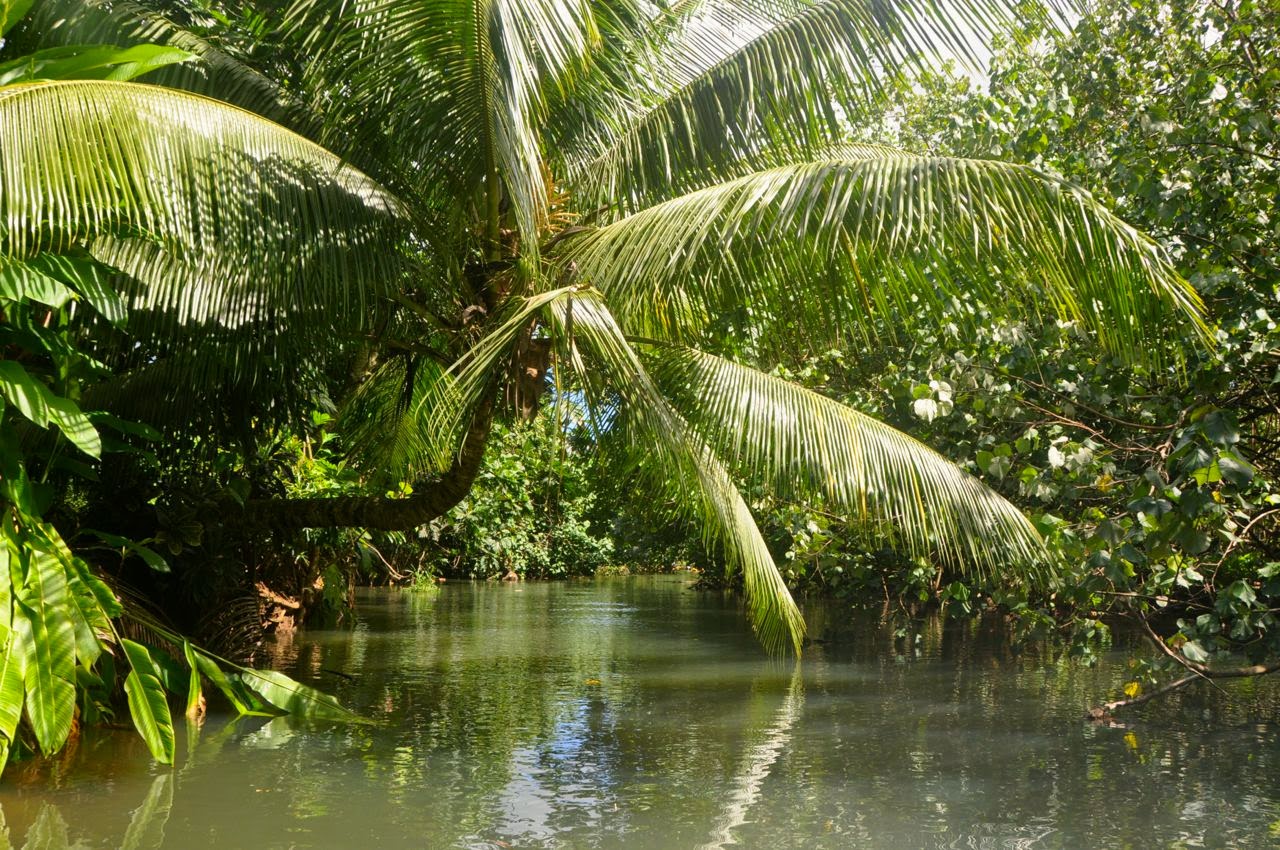
Up the river in Faaroa Bay
The charter base is long gone, but Faaroa Bay is a popular destination and there are now 3 mooring balls mid-channel (in front of the restaurant) and 3 more and a dinghy dock at the bottom of the bay.  Anchoring in mud is no problem either!

For once, we took Do-mini  for a river trip, threading between palm trees and a profusion of flowers.  This is a super-fertile area and home to a healthy agricultural activity.  There is even an egg farm… you may not find eggs in store in the other islands, but Raiatea always has eggs from Faaroa!


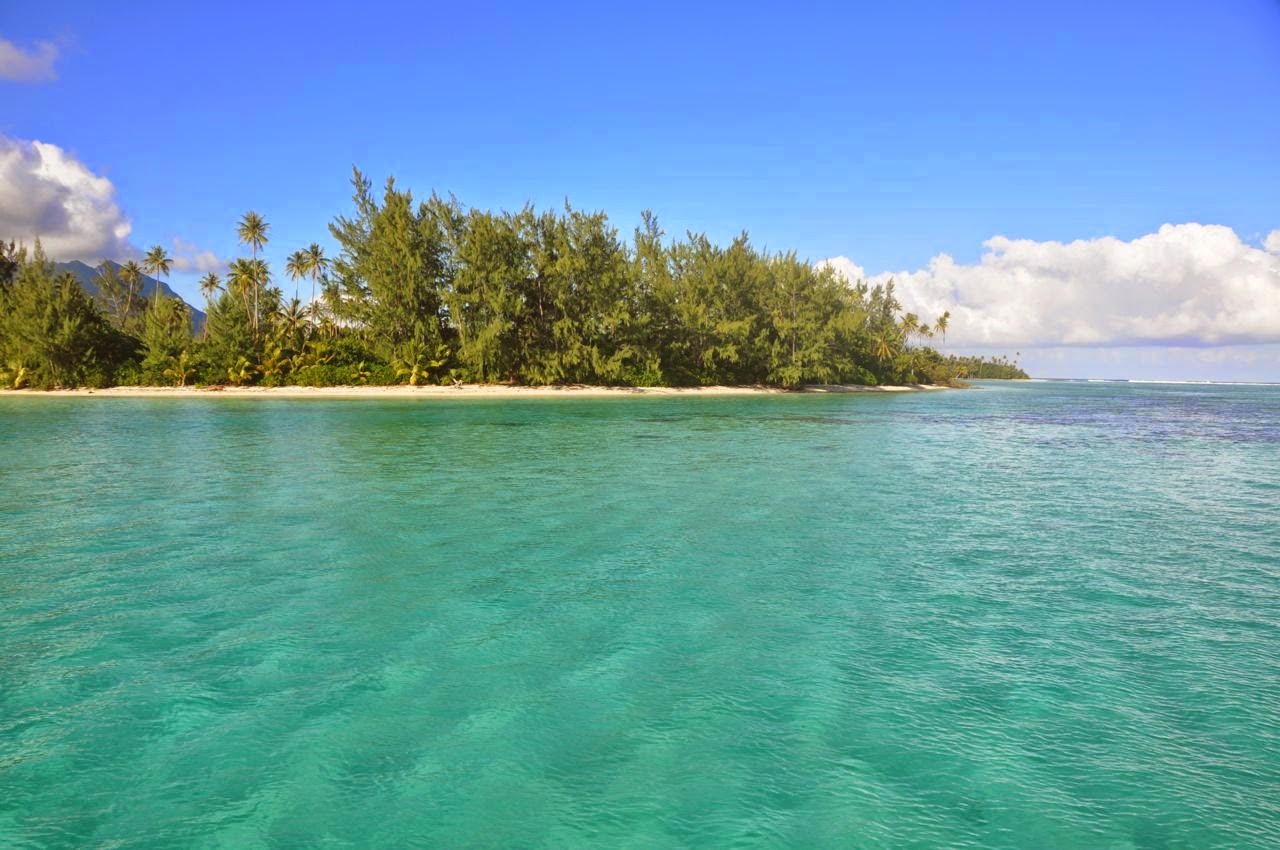
Motu NaoNao – 16°55.18S – 151°25.89W  – Motu NaoNao is considered one of the prettiest in the Society Islands.  No doubt, it’s very pretty.  The anchorage is small, surrounded with coral heads, so better put your heaviest anchor and keep a short leash.  We snorkeled all around and found that the best snorkel was on the south shore of the motu: dense coral hills, lots and lots of fish, and healthy anemones and their little Nemos.  We like this snorkeling spot a lot better than Bora Bora’s Piti Uu site.

Motu Nao Nao… snorkeling is better on the motu side than on the reef side

This may not seem like a lot of fun for those who like to walk and prefer land-based activities.  But for me (I’m not speaking for JP), this is HEAVEN!!!

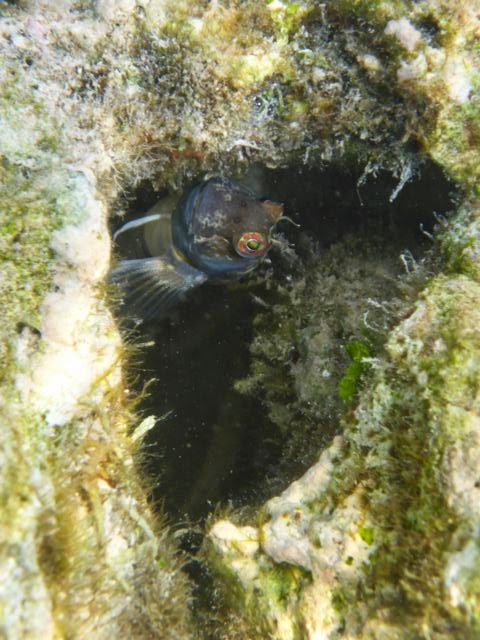
Blue-headed rockskipper
We are taking Pass NaoNao to exit: it’s wide and currently absolutely flat!

Next stop: Maupiti.

Till then…

dominomarie

Adieu Tahaa

ADIEU TAHAA

The small town of Haamene has become a welcome sight
 Haamene Bay – April 12, 2015

            3 mooring balls – Town dock


Behind the palm trees, our friends Marcel and Helene watch us moor.
If no mooring available, this is also a very good holding anchorage
           
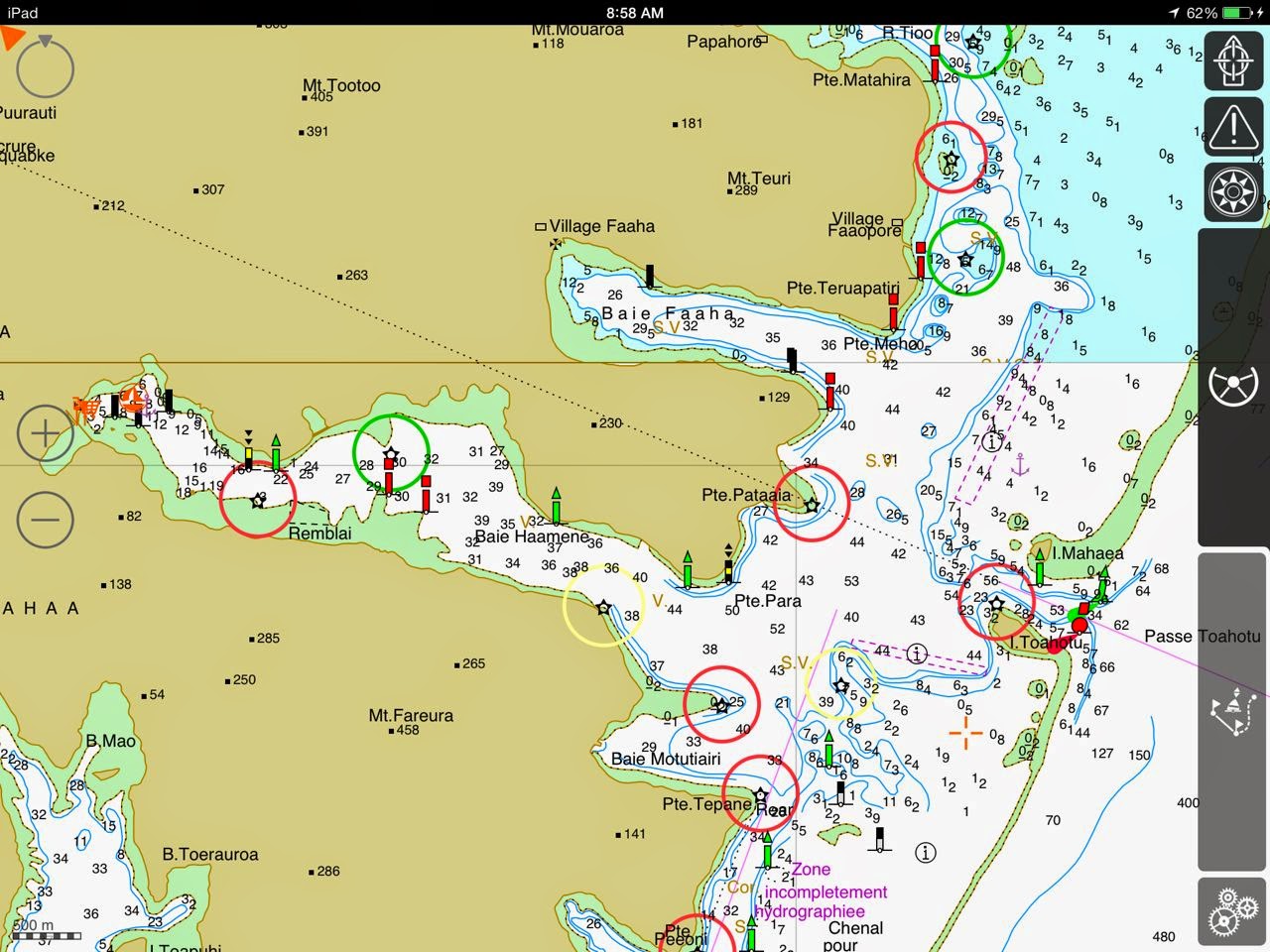
NOTE _   Mooring balls have also been installed on the west side of Taha, possibly Hurepiti or Vaiorea Bay, but not at the coral garden.  You still have to anchor SOUTH of the coral garden.
Haamene Bay – Our favorite hurricane hole in the Society Islands
With another storm system coming our way and 35-40kt wind forecast, we seeked shelter once more; this time, in the deep Haamene Bay.  To our great surprise –and delight—3 mooring balls have appeared close to town!

The red roof of Haamene’s church is a hallmark.
The little ice house to the right is where Marcel hangs out every morning at 6 AM
The library is just behind the ice house.
Do-mini at the town dock.      
  Tahaa is investing heavily in making its bays more attractive to the cruiser.  The new boardwalk is almost finished and the library (located behind the ice house) is happy to lend books to cruisers… and accepts books as well!

Every morning, JP takes Do-mini to town for fresh baguette
            
Our friends Marcel and Helene who run the ice house greeted us with smiles and shell necklaces: no hiding from them since we were moored right in front of their house!  We decided to take them for a farewell picnic at Motu Mahaea.

Motu Mahaea – 16°38.327S – 151°25.6 W


Motu Mahaea is the islet bording the northern end of Pass Toahotu.  North of that motu is a very large shallow anchoring in good sand.  Just make sure you don’t anchor in the path of the seaplane track, although we’ve never seen a seaplane around here, it could happen…

Can you say, “blue water anchorage?”
            It’s a lovely place for a picnic, kayaking and just fooling around in the water, and a respite from the bay where the water is always murky.  
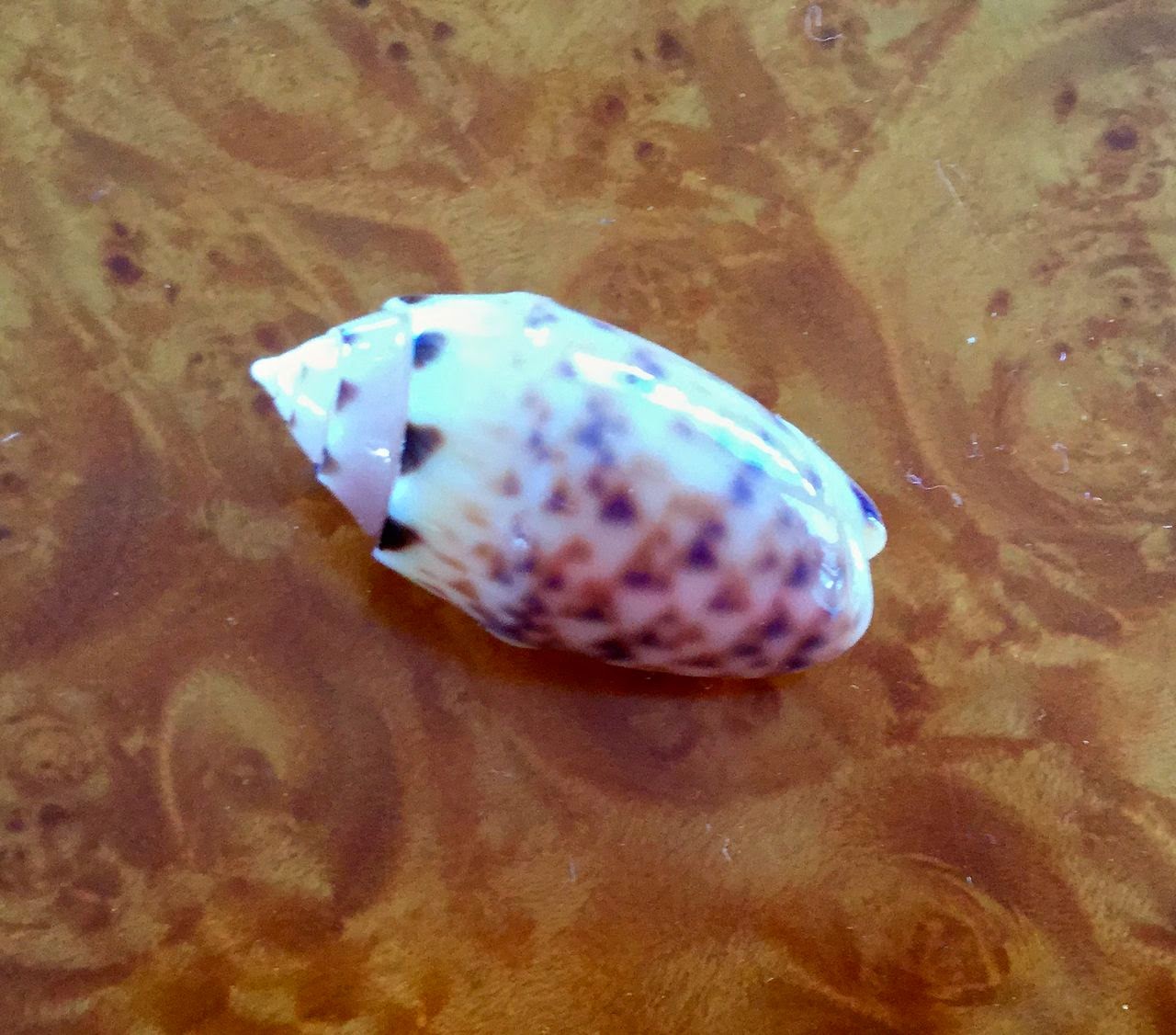
Amethyst Olive
Our friends and their motuas (granddaughters) enjoyed the day, and Marcel even found some nice shells: marlinspikes and turrids and even a splendid Amethyst Olive.

            
After a last trip to buy vanilla, it was soon time to say goodbye and it was with heavy hearts, though loaded with grapefruits, coconuts and bananas, that we kissed our friends Nana.
            
Adieu, beautiful Tahaa… next stop: Raiatea.

Until then…

dominomarie


Papeete’s New Marina

PAPEETE’s New Marina

Photo Jean-Baptiste Calvas

April 24, 2015 – Bora Bora

Big news in French Polynesia!  At long last, Papeete has a downtown marina.  It opened yesterday, just in time for the ARC Rally to inaugurate.

To summarize:

–       80 spots: 60 for regular sailboats, 20 for mega-yachts, long-term stay OK

–       60 day-use spots for small boats (poti marara, small outboards), no overnight

–       Live aboard: 10% of the spots, max.

–       Local boat owners’ spots: fewer than 10

This is, obviously, a marina dedicated to international cruisers.  Locals will remain at Marina Taina, Arue, or even Moorea.

Cost?  Pretty international.  I have converted the prices from CP Francs to USD (US $1 = 100 CP approx..)

–       Day use for small boats: $5/day (no overnighting).  This is where you would leave your dinghy if coming to town from Marina Taina.

–       Monohulls:

o   12 meters: $15/day, $350/month (low season); $35/day, $800/mo (high season)

o   16 meters: $20/day, $460/mo (low season); $50/day, $1,100/mo (high season)

o   20 meters: $25/day, $600/mo (low season); $65/day, $1,500/mo (high season)

–       Multihulls:

o   12 meters: $22/day, $520/mo (low season); $52/day, $1,250/mo (high season)

o   16 meters: $30/day, $700/mo (low season); $70/day, $1,700/mo (high season)

o   20 meters: $38/day, $900/mo (low season); $98/day, $2,350/mo (high season)

o  


–       Docks are equipped with electricity (220) and water.  Supposedly, a pumping station (I have not verified)

A new 1-km long boardwalk follows the docks.  Permanent facilities to welcome cruisers have not been built yet, but have been budgeted.

This is a marvelous improvement and we congratulate the new government for having, at last, seen the marina project to completion.

Enjoy Papeete!

s dominomarie

ADIEU HUAHINE

ADIEU HUAHINÉ

April 11, 2015 – Motu Murimahora, Huahiné

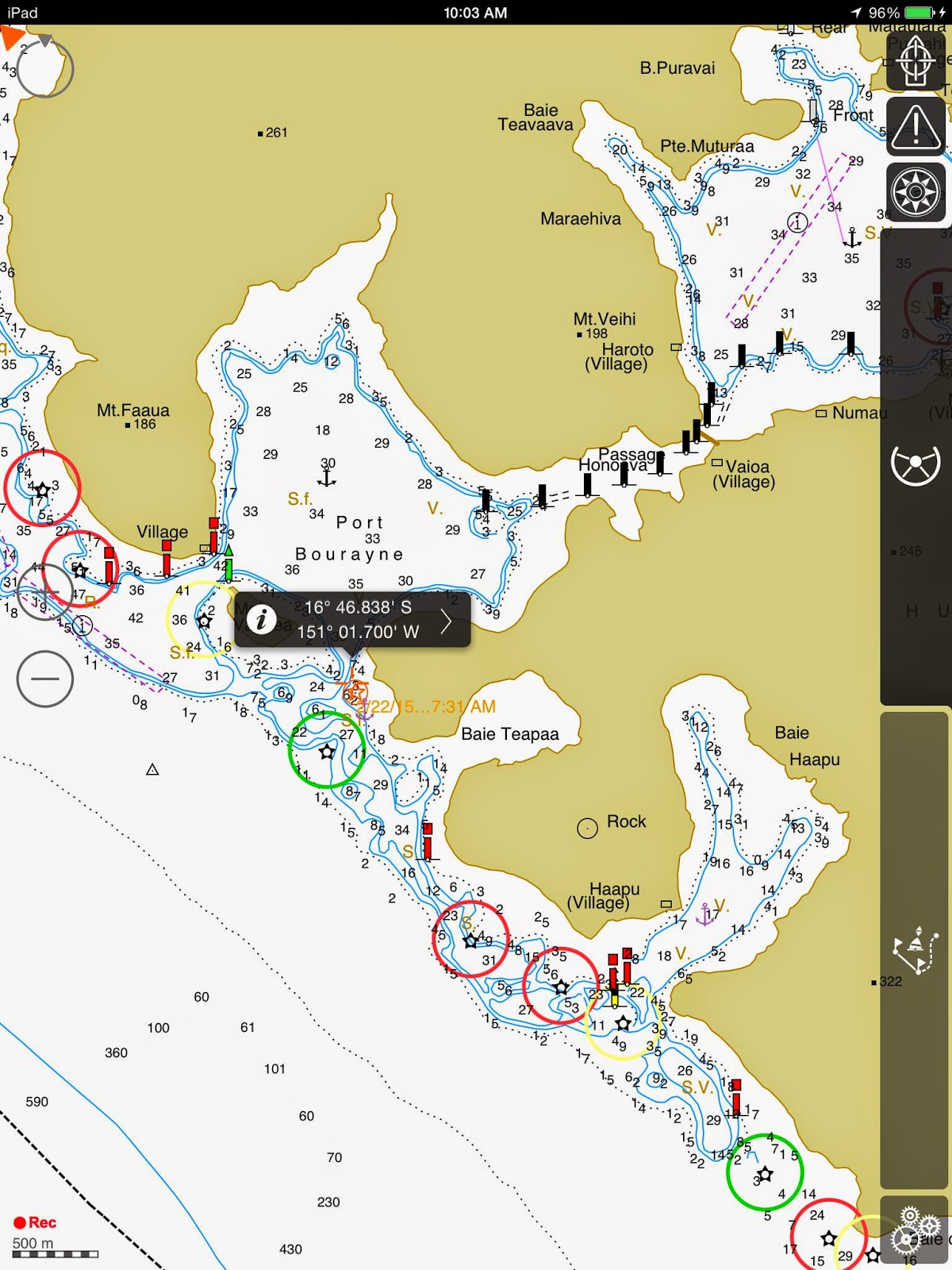
This is where our love cruising was born, 20 years ago: Huahiné.  At the time, we anchored our chartered Jeanneau 42’ in the 30-meter deep Port Bourayne (probably using just 40 meters of chain, inexperienced as we were) and we just fell in love with everything: the view, the peace, the lifestyle, the isolation, the water, the people.  Things have changed in Huahiné, some for the better, some not, but it remains our favorite of the Society Islands.  And since I haven’t written about it yet, I’ll indulge in a lengthy report.

NAVIGATION NOTE –  Be super extra careful at the south end of Huhine … The reef extends farther than on th charts.  One of our friends lost his Oceanis 43 on the reef a month ago.  Last week a chartered catamaran was destroyed on that reef… Watch out!!!!

Be careful at the southern point!!!
The reef extends way out.
Keep an eye on the Western end as well!!!!

NEW MOORINGS– When we breezed through a year ago, we had to drop anchor everywhere.  In the last year, the Ministry of Tourism — in partnership with the islands of Huahiné, Raiatea and Tahaa– has installed very strong moorings in the most popular anchorages.  In addition, floating docks have appeared in many places, again with cruisers in mind.  We love the sight of those yellow diamonds and have no problem catching their long pennants, even with our 14-foot boat hook!

2 mooring fields: in front of the village of Fare
and between the 2 passes 

FARÉ – 5 moorings in town; 5 moorings between the 2 passes.

Dinghy dock in front of the Huahiné Yacht Club. 

We are not surfers, but if we were, that’s where we’d hang out.  There is always some good surfing around here, according to American Surf Gypsy Liz Clark who is moored behind us.  She’s been here several months and plans on staying as long as she can!

            We came to town not only to provision at the Super-U, famed to be the best provisioning spot in the islands (we agree, except for the eggs) and to visit our friends Robert & Valerie.  Many years ago, JP spent a week vacation at their home; this time, they enjoyed a bit of cruising on DOMINO. 


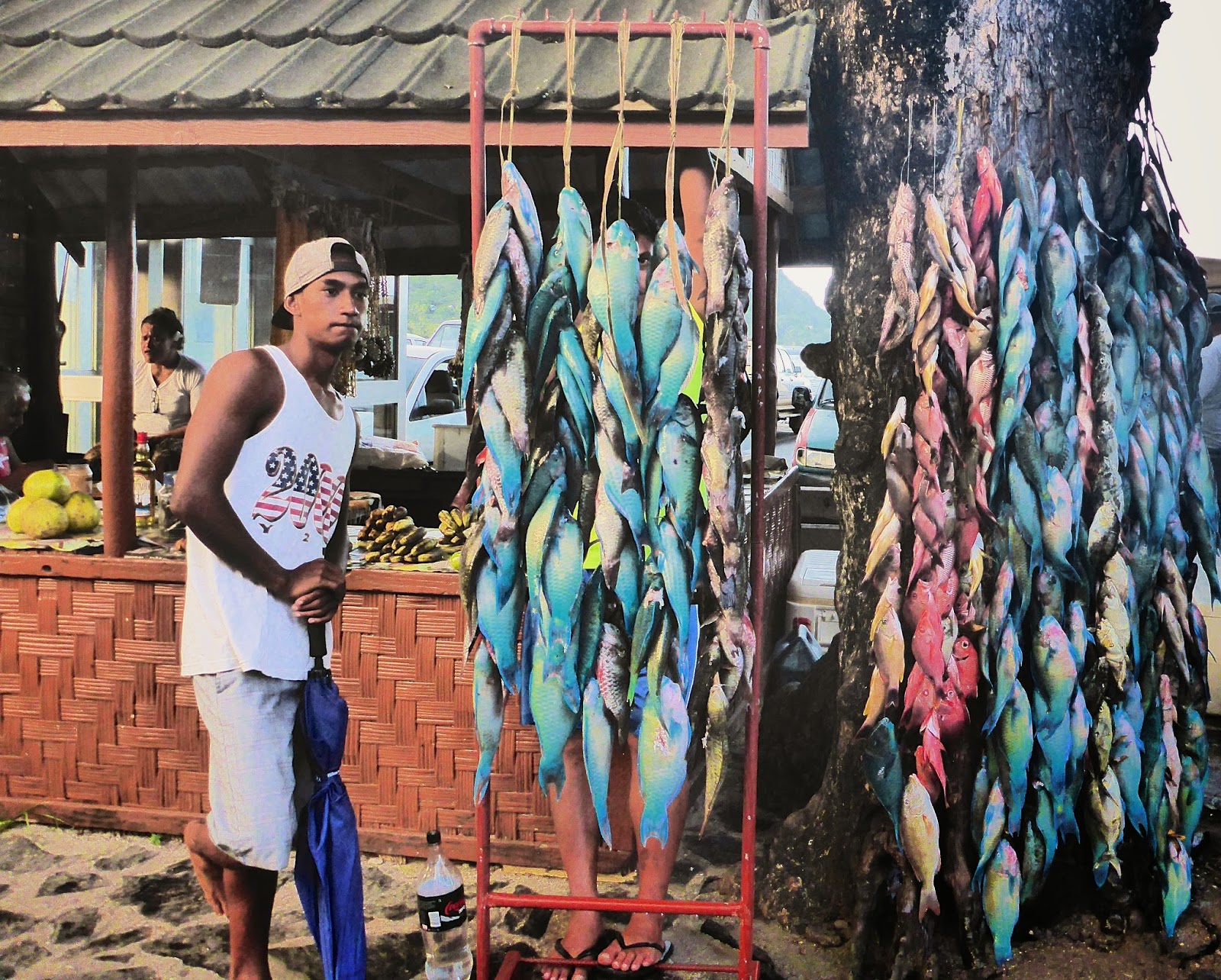
Lagoon fish grow on trees!
           What else goes on in Faré?  Friday night Happy Hour at the Yacht Club, bare feet in the sand; Saturday morning garage sale: lighten up your load and make a few bucks; Sunday morning town market along the waterfront: fri-fri (beignets), poi roti(roasted pig), nêmes (spring rolls), fresh fruits and vegetables, and the obligatory lagoon fish hanging from the tree.  Of course, on any afternoon, you can look out for a poti mara (local fishing boat) unloading at the town dock and ask for fish: Mahi mahi or tuna.
PORT BOURAYNE – 16°46.95S – 151°01.700W

                                    3 mooring balls SE of Motu Vaiorea (Beach)

The beach at the entrance of Port Bourayne… possibly my favorite snorkeling spot in all of FP
            This, of course, is my favorite spot in all of French Polynesia.  There is so much to see and do from here.  There used to be an American hotel in that spot, but it closed some 15 years ago and the structures got wiped out by Hurricane Ollie.  All that’s left is the beach and SIKI, the beach caretaker.  Great guy!  He’ll cure your marriage, your cancer, your hunger with whatever Juju and power he’s got.  If you don’t need his help, he’ll try to sell you shell necklaces (cheap and better-looking than at the Papeete Market.)  He’s always got fresh coconuts and will gladly bake an uru(bread fruit) for you on the fire.   You can even camp on the beach.  This is really a fun place.


Snorkeling here is also one of my favorites.  There are 2 distinct areas:

– the grass bed between the mooring balls and the beach where you’ll find all sorts of juveniles, gobies and blennies; and


– Motu Vaiorea (southeast end) where the fish population is incredibly varied and plentiful.  This is what the Society Islands used to be like, and unfortunately no longer is. 

Motu Vaiorea, at the entrance of Port Bourayne.  Spendid snorkeling, tons and tons of fish


You might even spot a cowrie: just look!


But Robert & JP preferred going hunting.  Just a quick dinghy ride to the outer reef and they came back with 2 nice jacks.  Yes, there is fish along the reef… and sharks too, so DO take a buddy with you and don’t stray far from your dink when you hunt.


The frisky lives of nematodes!
For a morning outing, we took Do-mini for a mini-cruise.  


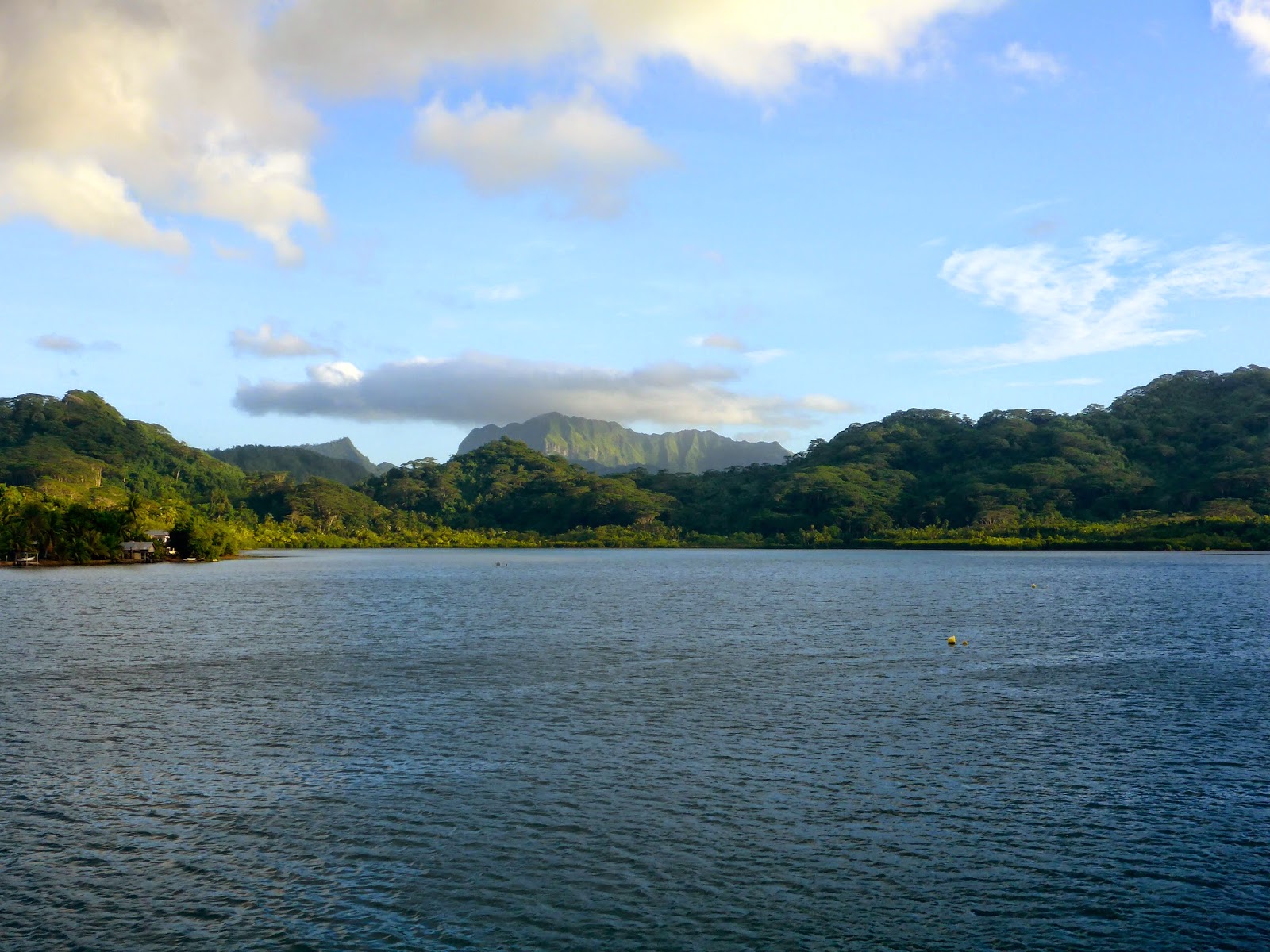
Inside Port Bourayne, Motu Vaiorea closes this hurricane hole
Once across the circular hurricane hole of Port Bourayne, we just followed the Passage Honoava, under the bridge, and entered Maroe Bay.  This is the large, deep bay where all the cruise ship drop anchor.  You just don’t want to be there on those days, since the bay is marred with spewing jetskis and annoying ship tenders.  (In doubt, ask Siki: he knows the ships’ schedules.)  But this was a quiet day and we anchored “Little D” on the sand shelf. 
Yellow goatfish

We were curious about the 2”-wide round holes in the muddy sand and about the girl sitting in the sand, waist-deep in the water, keeping an eye on a makeshift fishing pole.  “Fishing the varo,” she said.  

Fishing for Varo
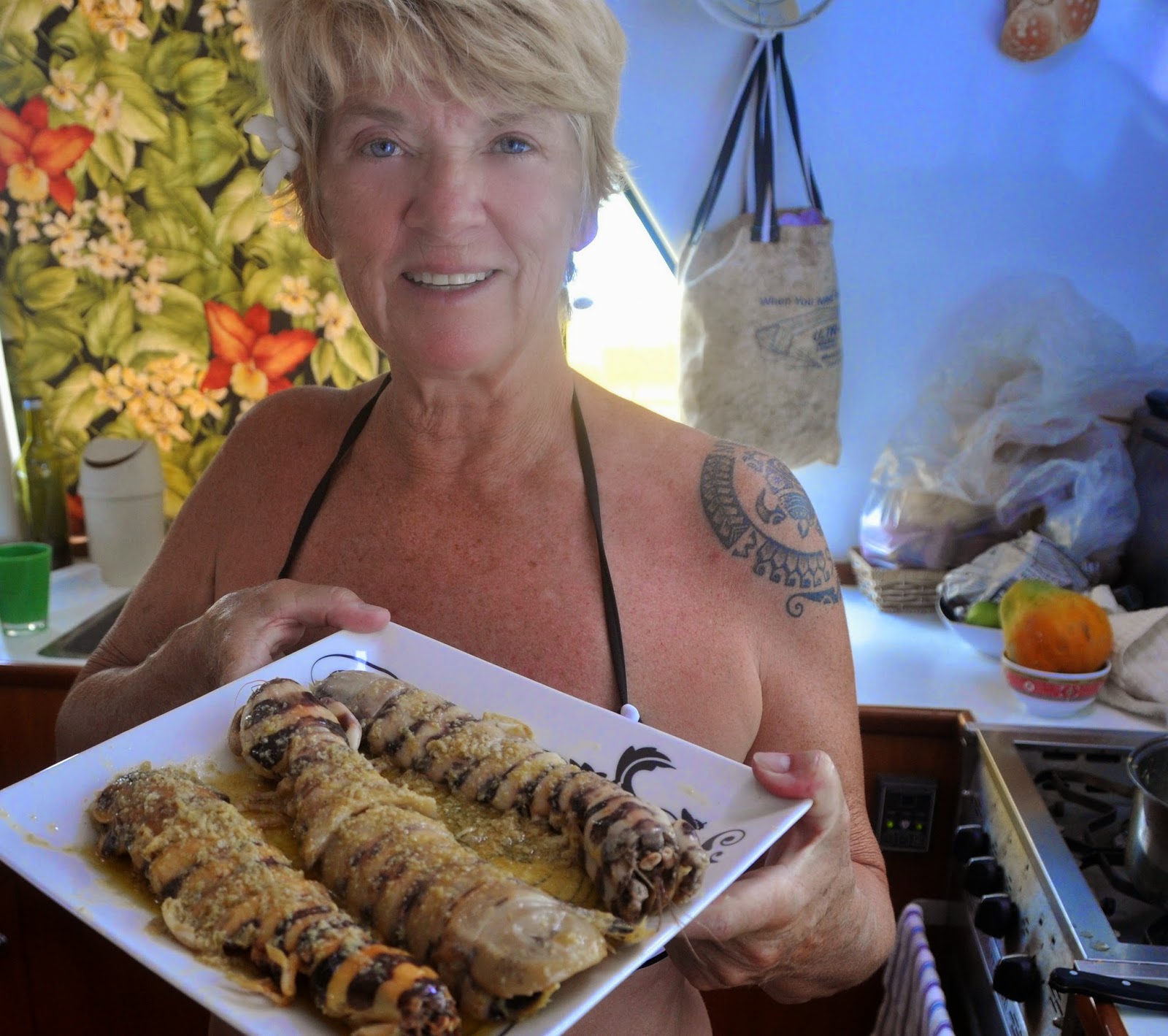
A cross between a shrimp and a big caterpillar, with a bit of lobster in it, the varo –or “ski” – (Lysioquilina Maculata) is a prized food.  At $10 apiece on the market (you can bargain…,) it’s a delicacy.  But don’t venture to capture it yourself; its front legs are razor-sharp and many a fisherman have suffered deep slices into their fingers.  The tail peduncles are pretty sharp and nasty as well.  Just buy them and make the locals happy!  Varos are excellent simmered in butter (garlic and Pastis if you like, too!) –

Lunch is served!

For a different snorkeling experience we dove the wall along the sand shelf, between the 2 red marks.  Although the water is not very clear, the drop is interesting and the fish population plentiful: royal angelfish galore!

Boxfish on the prowl

I could have stayed at this mooring forever, but nasty weather was upon us and we had to seek shelter.  Inside Port Bourayne would have been good (though 30-meter deep,) but we heard of new mooring balls in Haapu Bay, another hurricane hole.

Baby lionfish will grow and be nasty!

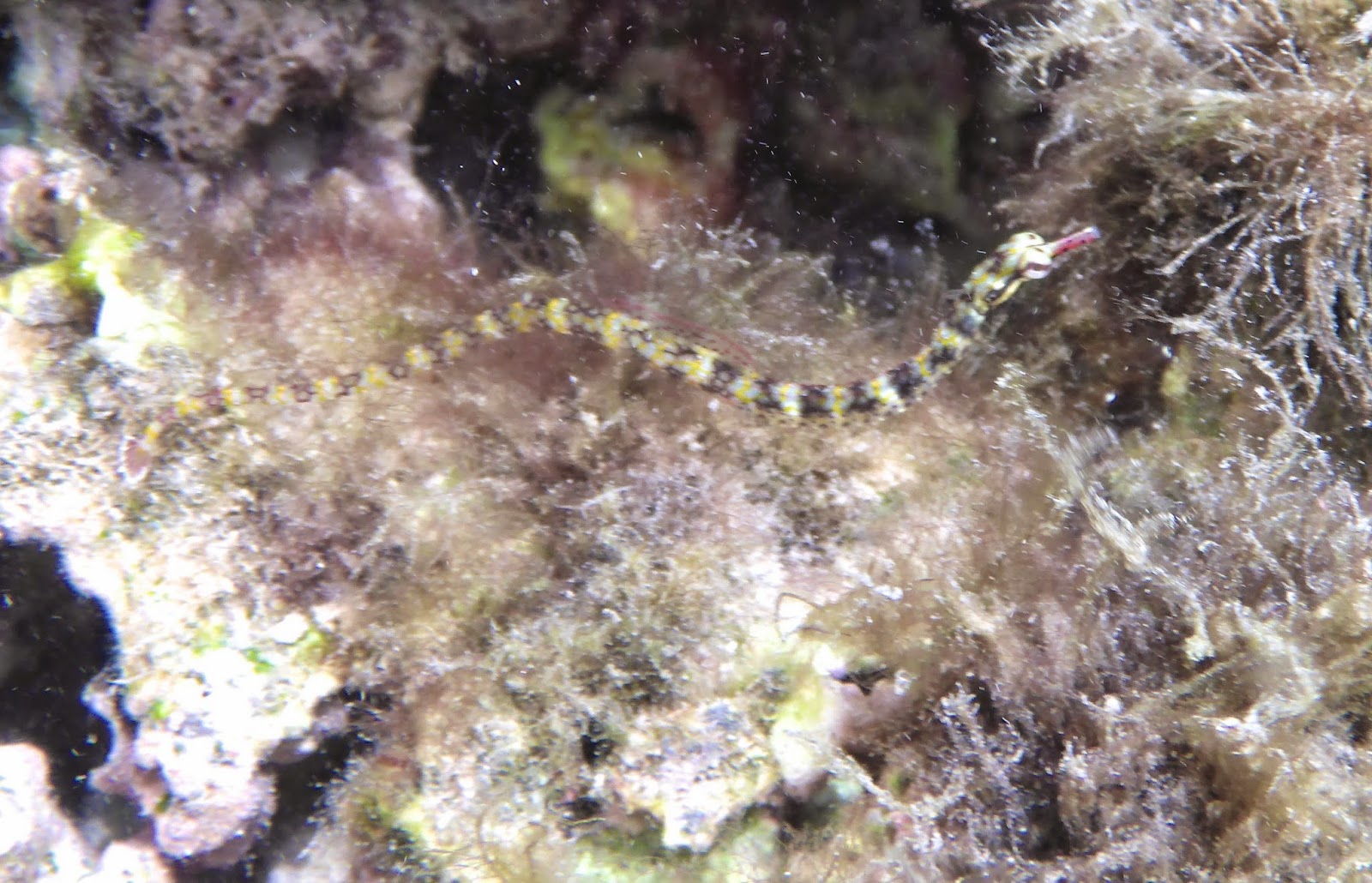
Yellow-banded pipefish

HAAPU BAY – 16°47.461S – 151°00.502W


The Beach at Port Bourayne, and the deep Haapu Bay


3 mooring balls


            We entered Haapu in whiteout conditions, 35 knots of wind, a deluge of rain and no visibility.  But the channel into the bay is well marked and our Furuno radar picked up every mark, so we made it carefully and safely into the bay.  What a lovely spot, like no other we’d seen so far.


            The village of Haapu is very small and, of course, fishermen wanted to befriend us first, take us to the store to find fresh baguettes and eggs next, and sell us some varo last.  We were only too happy to indulge them, making friends in the process.

            We spent a few days there, not just to wait-out the storm, but to finally repaint the aft deck.  The waters in Haapu are so protected and flat that it’s the perfect spot to work on the boat, especially to paint.  We finally have a no-skid, clean-white aft deck.  (Awlgrip Matterhorn White + Griptex coarse/fine + Accelerator X98, rolled.)

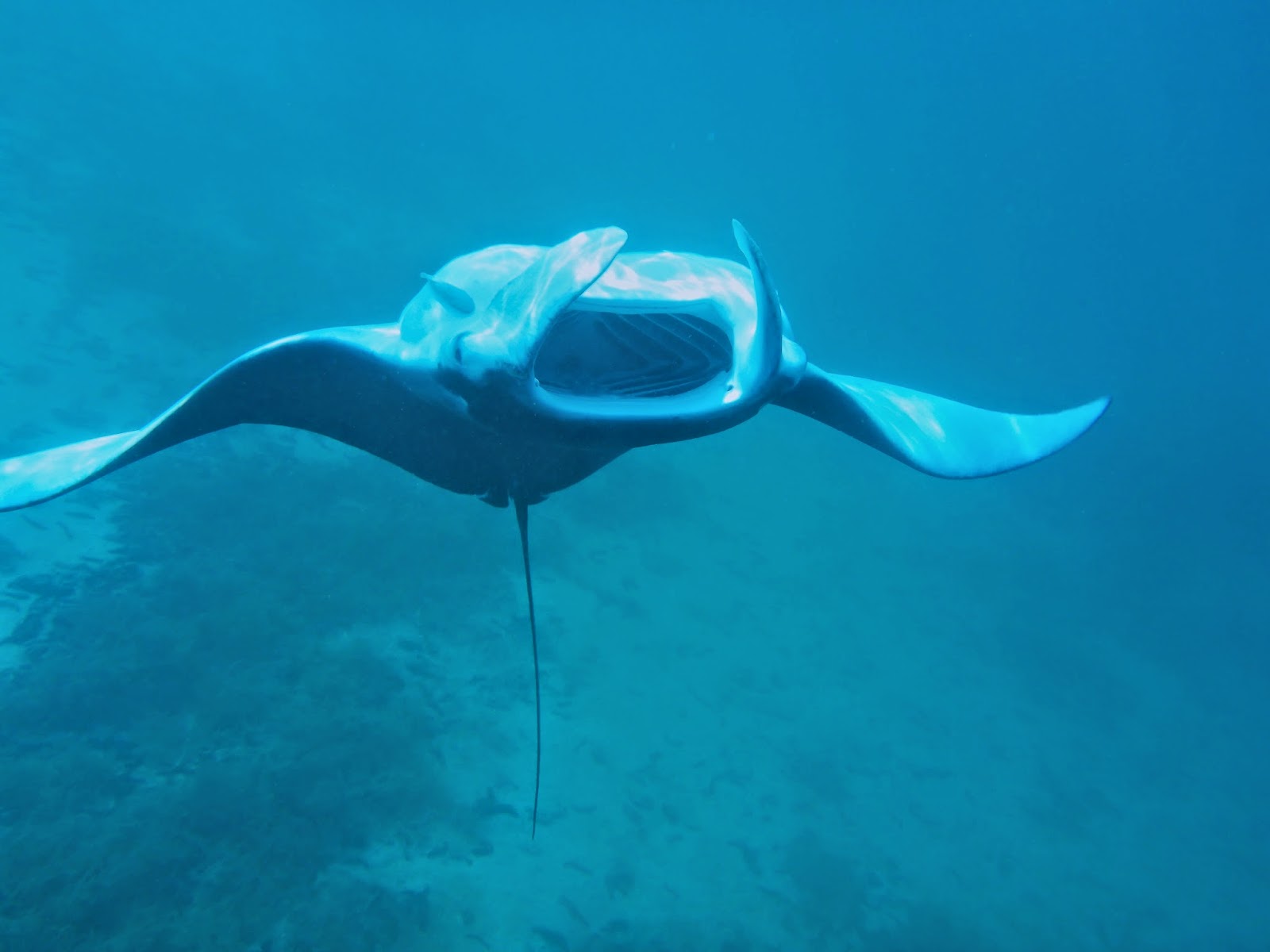
Upside-down Manta ray, feeding!!!!

AVEA BAY – 16°48.606 S – 150°59.777W

Avea Bay has no mooring balls, but a very large sandshelf.
            No moorings

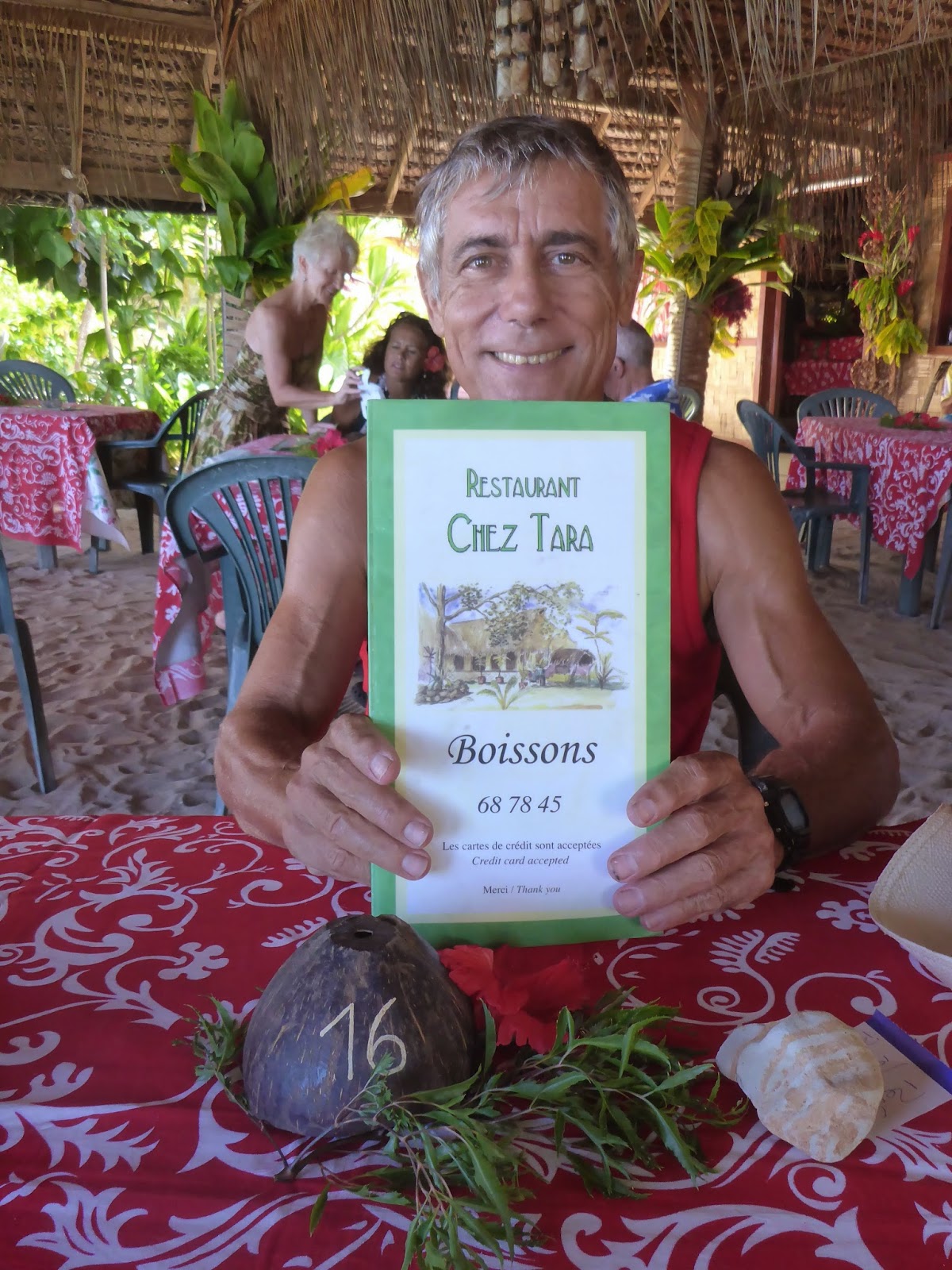
            Although we prefer to anchor in deep waters (13 meters in Avea) most yachts anchor on the sand shelf in 2 meters of water, in front of the restaurant Chez Tara.  That’s where we rejoined Irie for Mark’s birthday.

Happy Birthday Mark!
           
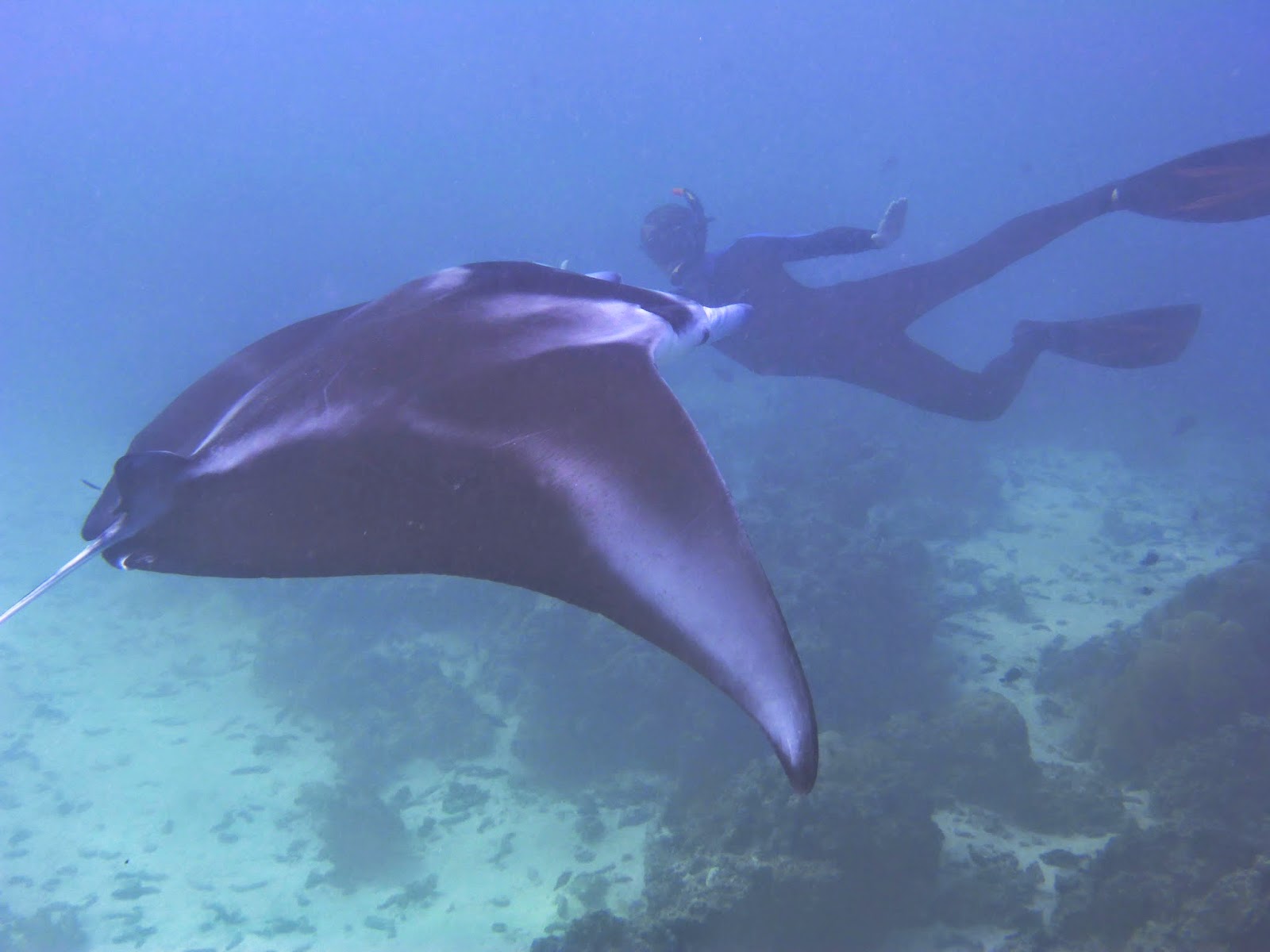
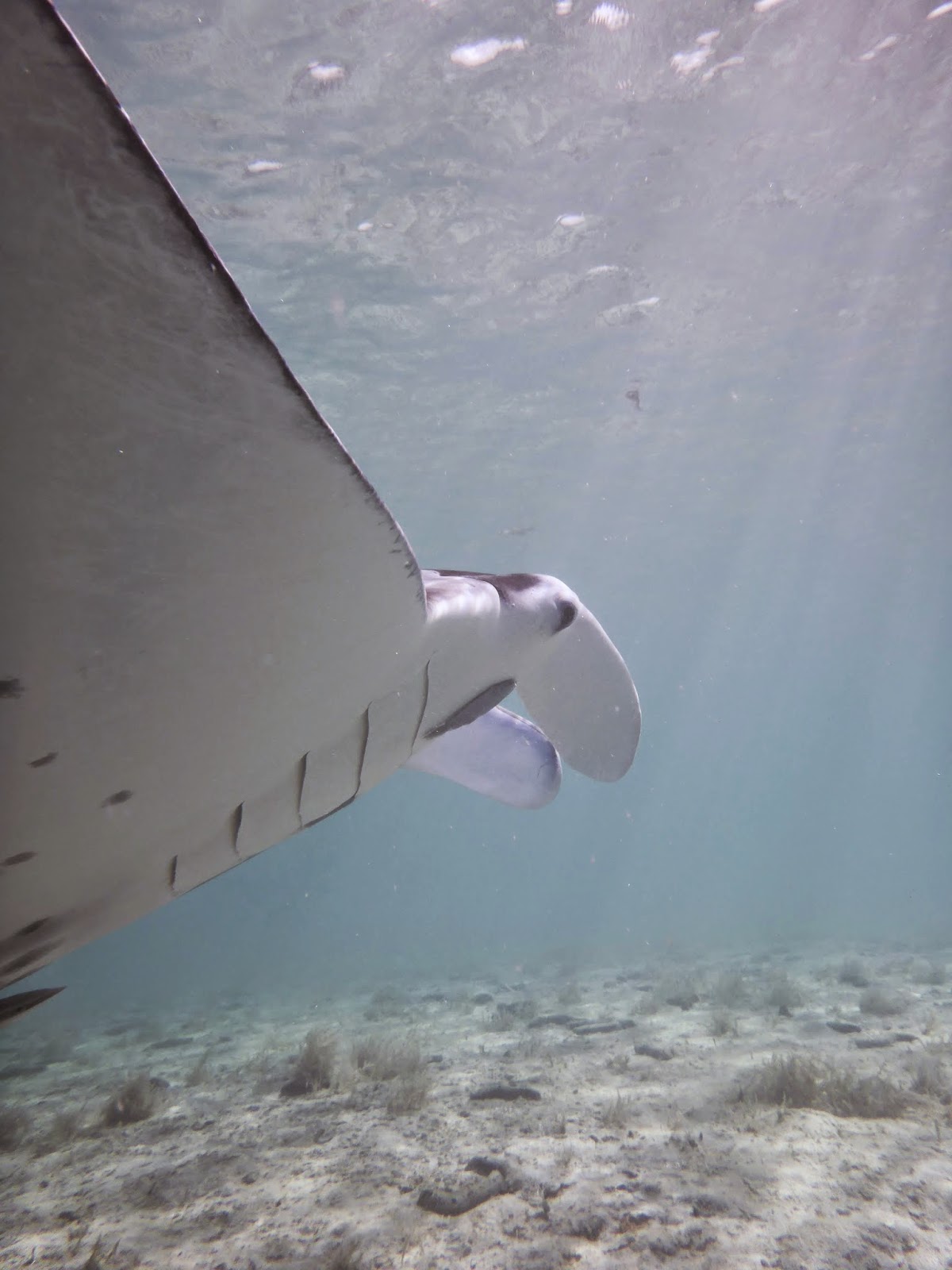
We had just tied Do-mini to Irie for a visit when we noticed a large white disk cruising along the drop just a few yards from us.  

This Manta surprised JP


MANTA RAY!!!  Pronto, mask, fins, cameras and hop in the water.  What a treat!!!  The rays kept cruising back and forth along the drop, doing back flips and coming so close to us we could have touched them (never touch a ray: your touch can remove their protective mucus and leave the ray open to skin infection and disease.) 


This one surprised me!
            The deeper part of the channel is home of enormous anemones and a good population of clown fish.  It’s a bit deep (5-6 meters) but well worth the free-diving effort!


            And check the sand shelf too!  Thousands of Rori (sea cucumbers) lay around, and it’s only when you take a much closer look that you notice the tiny snake-eels the roris feed on. 


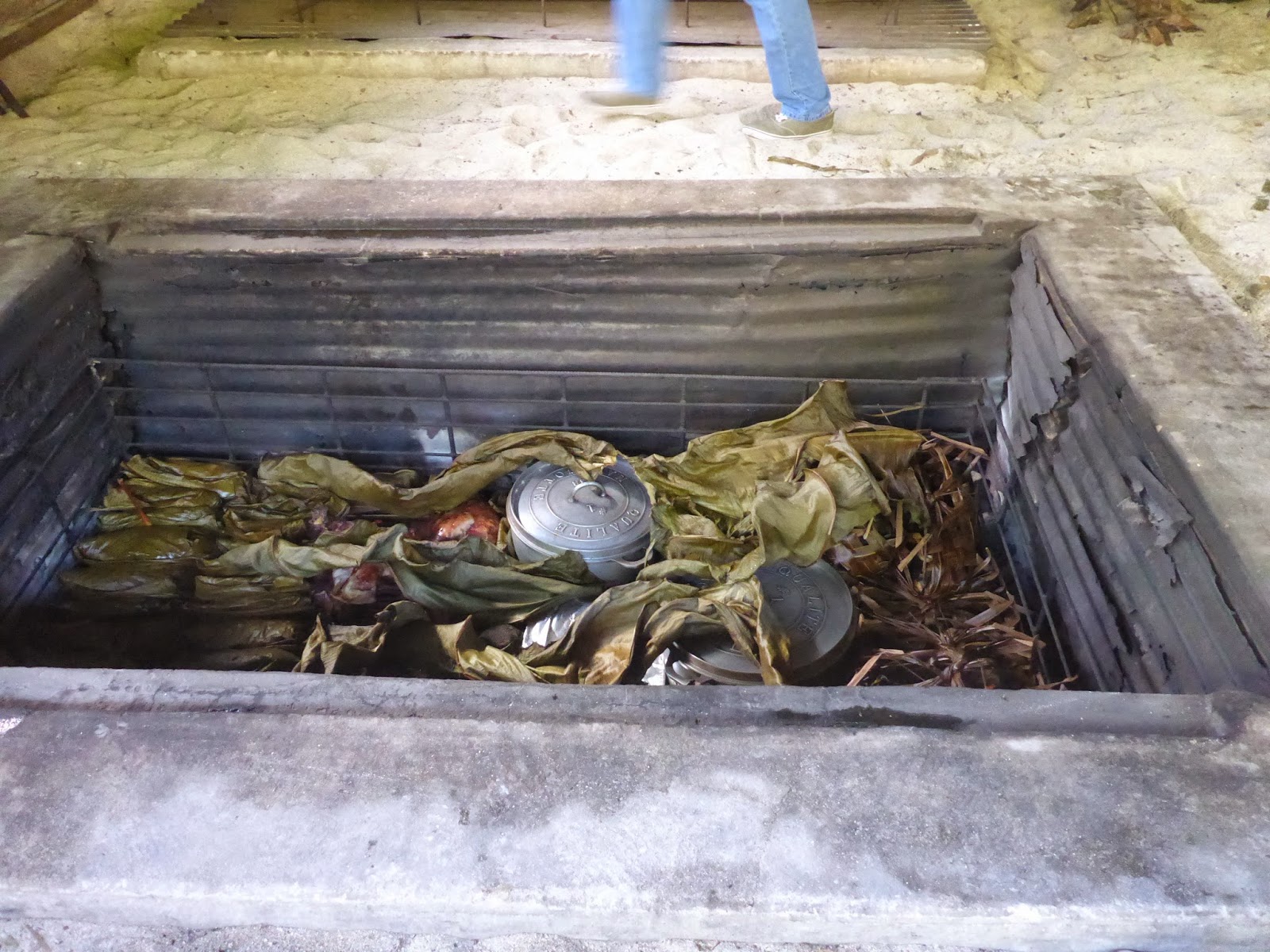
On Sundays, Chez Tara offers a traditional Ma’a Tahiti cooked in the traditional Ari Ma’a.  For about $30/person, you’ll enjoy a feast: Poisson cru (raw fish in coconut milk), Pahua (giant clams in curry sauce), roasted pig and veal, and the obligatory taro, Fafa (spinach), Uru(breadfruit), fei (banana) and all types of Poe desserts (tapioca-flour cooked with fruit pulp: banana, papaya, mango, passion fruit, coco…) 
Traditional Sunday fare
  Oh, were we ever full!!!  But totally happy, while Mama Tara crowned us with Tiaré necklaces (they don’t call them Leihere, but Couronne) and a duo of old guys kept pounding on their Ukuleles, singing traditional Tahitian tunes.  
Avea Bay, Huahine
What better way to celebrate Mark’s birthday?

Tahitian oven

 MOTU MURIMAHORA – 16°45.72 S – 150°57.732 W

           
On the east side of Huahine, at the entrance of Maroe Bay (that’s the bay where all the cruise ships go), you can find secluded anchorage behind Motu Murimahora in 3 to 5 meter of sand.  The channel is well marked and you can drop anchor about half way down the motu.  We only had one night to spend, so we didn’t do much else than snorkel around.  But there is plenty to do.


Can you say, BLUE ???

            – Paul, the local deaf-mute guide, is sure to approach you on his yellow Va’a and at least have you sign his guest book, if not selling you a tour.  And he’ll leave you with a fresh coconut, peeled and ready to drink!  Nice guy.

            – The locals on the motu are friendly and enjoy company… see if they’ll invite you over.

            – Dingy along the mark channel (black/white posts) and you can reach Parea Village.  We snorkeled the area off Passe Araara and found notably a few sea anemones and their symbiotic clown fish!

There is nothing like being able to see where you frop your anchor.
            There are trails too, but I’m not much of a walker and usually abstain from trekking… much happier in the water!

We just love Huahiné, its variety of snorkeling experiences, its hurricane holes and, of course, its new mooring balls!!!

Nana, Robert & Valerie
Now, it’s time to continue our farewell tour.  Next stop: Tahaa.

Until then…

dominomarie

88 Bridges

To position AVATAR for our ICW adventure, first we had to relocate from South Pacific waters to the continental United States. After accomplishing that in late 2013, it took another two seasons to transit from west coast to east, due … Continue reading →

We’re Home!

Olympia glided into her slip in Huntington at 12:43 pm on Sunday, April 19th.  My girl’s odyssey is over!Pictures and a wonderful story will follow shortly – I need to pull the many pictures together, unpack, catch up at work and pack up the apart…

We’re Home!

Olympia glided into her slip in Huntington at 12:43 pm on Sunday, April 19th.  My girl’s odyssey is over!Pictures and a wonderful story will follow shortly – I need to pull the many pictures together, unpack, catch up at work and pack up the apart…