
After a pretty good golf game tonight, just ahead of a ridiculous rain storm, including some awesome rumbles of thunder as I’m teeing off on the 9th hole, I’m feeling energetic. So, never mind it’s after 11 pm, I’m still going strong. That …
Doin' It!
(Continued…)
Day 174…Beak Bling
Welcome to day 174 of 365 photos…beak bling??? Weird way to lead into a photo of an egret, I know. First, I did not take this photo today. I waited most of the day for Time Warner to come to fix our cable and they never made it. *sigh* By the time I knew they… Continue Reading
The post Day 174…Beak Bling appeared first on Moosetique Musing.
Home At Last- And Celebrities at That!
v:* {behavior:url(#default#VML);}
o:* {behavior:url(#default#VML);}
w:* {behavior:url(#default#VML);}
.shape {behavior:url(#default#VML);}
Normal
0
false
false
false
false
EN-US
X-NONE
X-NONE
/* Style Definitions */
table.MsoNormalTable
{mso-style-name:”Table Normal”;
mso-tstyle-rowband-size:0;
mso-tstyle-colband-size:0;
mso-style-noshow:yes;
mso-style-priority:99;
mso-style-parent:””;
mso-padding-alt:0in 5.4pt 0in 5.4pt;
mso-para-margin-top:auto;
mso-para-margin-right:0in;
mso-para-margin-bottom:auto;
mso-para-margin-left:0in;
mso-pagination:widow-orphan;
font-size:11.0pt;
font-family:”Comic Sans MS”;}
We finally made it back to the same yacht club in
Groton, CT that we left in 2008. Life is
a chaos trying to re-establish all the things we will need to return to the
dirt dweller life. Just a quick blog to
reprint the article that the paper in Ocean City just printed. The link is below, but it will probably only
work until the next big story blows in.
Therefore, I pasted it directly below:
Groton, CT that we left in 2008. Life is
a chaos trying to re-establish all the things we will need to return to the
dirt dweller life. Just a quick blog to
reprint the article that the paper in Ocean City just printed. The link is below, but it will probably only
work until the next big story blows in.
Therefore, I pasted it directly below:
World-Traveling Lawler Family Stops in Ocean Pines
Posted on Ocean City Today newspaper
on Thursday, July 3rd, 2014 by Josh
Davis
on Thursday, July 3rd, 2014 by Josh
Davis
OCEAN PINES– After six long,
fascinating years at sea, the Lawler family is finally coming home.
fascinating years at sea, the Lawler family is finally coming home.
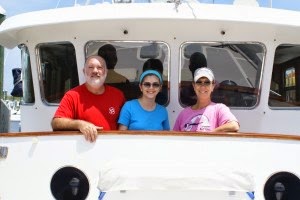
Tom Lawler posed with his wife Kim
and daughter Emily aboard their ship the Emily Grace following a 6-year cruise
around the world. The ship was docked at the Sunset Marina in West Ocean City
last week.
JOSH DAVIS/OCEAN CITY TODAY
and daughter Emily aboard their ship the Emily Grace following a 6-year cruise
around the world. The ship was docked at the Sunset Marina in West Ocean City
last week.
JOSH DAVIS/OCEAN CITY TODAY
In 2008 Tom, his wife Kim and their
then 8-year-old daughter Emily sold their home in Connecticut and began a
global cruising trek.
then 8-year-old daughter Emily sold their home in Connecticut and began a
global cruising trek.
Last month the Lawlers returned to
the U.S., docking first in Port Canaveral, Fla. then sailing to Georgia, on to
South Carolina and through Virginia in their Nordhavn 46 motor yacht named
“Emily Grace.” In early June the family arrived at Sunset Marina in West Ocean
City and spent a few days visiting Tom’s mother, Shirley, in Ocean Pines.
the U.S., docking first in Port Canaveral, Fla. then sailing to Georgia, on to
South Carolina and through Virginia in their Nordhavn 46 motor yacht named
“Emily Grace.” In early June the family arrived at Sunset Marina in West Ocean
City and spent a few days visiting Tom’s mother, Shirley, in Ocean Pines.
The Lawlers caught the cruising bug
years ago during a scuba diving vacation in Belize on a live-aboard boat.
years ago during a scuba diving vacation in Belize on a live-aboard boat.
“It was very luxurious and we all
came out thinking to ourselves, ‘why don’t we do this – just get a boat and go
wherever you want to go?’” Tom said. “So that was kind of the seed. We
developed a plan and saved as much as we could, and when we hit the right
number we left.”
came out thinking to ourselves, ‘why don’t we do this – just get a boat and go
wherever you want to go?’” Tom said. “So that was kind of the seed. We
developed a plan and saved as much as we could, and when we hit the right
number we left.”
Tom grew up in Annapolis and spent
every summer in Ocean City with his parents and two brothers. He learned to
pilot small boats on the Severn River as a child, but he had to do plenty of
research before setting sail across the world.
every summer in Ocean City with his parents and two brothers. He learned to
pilot small boats on the Severn River as a child, but he had to do plenty of
research before setting sail across the world.
“You need to know about the customs,
and you obviously have to know a lot about navigation,” Tom said. “I took some
classes before I left.”
and you obviously have to know a lot about navigation,” Tom said. “I took some
classes before I left.”
Kim, who has an extensive medical
background, took classes as well and became a certified HAM radio operator,
allowing the family to use a single sideband radio to transmit data and send
and receive emails through satellite technology while at sea.
background, took classes as well and became a certified HAM radio operator,
allowing the family to use a single sideband radio to transmit data and send
and receive emails through satellite technology while at sea.
The boat was stocked with spare
parts so the Lawlers could perform most repairs themselves. “You need to find
what parts are critical – what parts will shut down the trip – and those are
the ones you carry,” Tom said.
parts so the Lawlers could perform most repairs themselves. “You need to find
what parts are critical – what parts will shut down the trip – and those are
the ones you carry,” Tom said.
A broad range of medical supplies,
including antibiotics, was also packed. “Kim could do injections, and we had
controlled narcotics for pain,” said Tom. “We went to our doctor and explained
what we were doing and they were happy to fill up prescriptions for us. When we
left Emily was actually so young that she couldn’t take an adult dose, so we
had to carry powdered antibiotics that you mix up.”
including antibiotics, was also packed. “Kim could do injections, and we had
controlled narcotics for pain,” said Tom. “We went to our doctor and explained
what we were doing and they were happy to fill up prescriptions for us. When we
left Emily was actually so young that she couldn’t take an adult dose, so we
had to carry powdered antibiotics that you mix up.”
SETTING SAIL
After selling their home to fund the
trip, the family headed first to Maine, then south through the Caribbean and
Trinidad before heading west through Venezuela and Columbia.
trip, the family headed first to Maine, then south through the Caribbean and
Trinidad before heading west through Venezuela and Columbia.
Emily was homeschooled throughout
the trip using Baltimore-based Calvert School’s curriculum. Food was – for the
most part – bought during various stops along the way.
the trip using Baltimore-based Calvert School’s curriculum. Food was – for the
most part – bought during various stops along the way.
“Wherever you go they have food –
they just may not have your food,” Tom said. “So we learned to eat weird
things.”
they just may not have your food,” Tom said. “So we learned to eat weird
things.”
Sometimes the family would stop for
a day or two and gather supplies. Other times they would stay and set up camp
for several months.
a day or two and gather supplies. Other times they would stay and set up camp
for several months.
“We were in New Zealand for six
months,” Kim said. “It was always because of the weather or the season – having
to move – but that was the longest we stayed in any one place.”
months,” Kim said. “It was always because of the weather or the season – having
to move – but that was the longest we stayed in any one place.”
“You have to time all the places in
the world around the hurricane or cyclone seasons,” said Tom. “We entered the
Panama Canal in February, which gives you the most time in the Pacific before
the next hurricane season, but we only got as far as Tonga; if we stayed any
longer we could potentially encounter a hurricane. So what you do is you go
south.
the world around the hurricane or cyclone seasons,” said Tom. “We entered the
Panama Canal in February, which gives you the most time in the Pacific before
the next hurricane season, but we only got as far as Tonga; if we stayed any
longer we could potentially encounter a hurricane. So what you do is you go
south.
“At certain latitudes near the
equator there are no hurricanes,” Tom continued. “So you go down to New Zealand
and you wait, and while we’re down enjoying New Zealand there were hurricanes
swirling in the Pacific to the North of us.”
equator there are no hurricanes,” Tom continued. “So you go down to New Zealand
and you wait, and while we’re down enjoying New Zealand there were hurricanes
swirling in the Pacific to the North of us.”
While in Niuatoputapu, Tonga, the
Lawlers found a village virtually swept away by a tsunami. The Red Cross had
dropped two dozen kit homes on enormous pallets on the shore and then
disappeared.
Lawlers found a village virtually swept away by a tsunami. The Red Cross had
dropped two dozen kit homes on enormous pallets on the shore and then
disappeared.
The villagers, forced to live under
trees, had no idea how to build the homes. Tom, with the help of several other
fellow cruisers, met with the island elders to make a plan.
trees, had no idea how to build the homes. Tom, with the help of several other
fellow cruisers, met with the island elders to make a plan.
“There were six or seven cruising
boats and we all got out our hammers and came ashore,” he said. “We got a bunch
of the villagers together too so they would learn, and we all built a house
together in one day.
boats and we all got out our hammers and came ashore,” he said. “We got a bunch
of the villagers together too so they would learn, and we all built a house
together in one day.
“What was cool was this man that we
built it for was about 75 years old,” Tom continued. “We started very early in
the morning and at noon he comes riding up in this rusty, old bicycle, and he
has a basket and he made us lunch – all the guys. It was so sweet to watch him.
And at the end of the day it was his home, and we gave it to him and he just
had tears running down his face. And then, once the villagers knew how to do it,
they had another 20 kit homes and they could do it themselves.”
built it for was about 75 years old,” Tom continued. “We started very early in
the morning and at noon he comes riding up in this rusty, old bicycle, and he
has a basket and he made us lunch – all the guys. It was so sweet to watch him.
And at the end of the day it was his home, and we gave it to him and he just
had tears running down his face. And then, once the villagers knew how to do it,
they had another 20 kit homes and they could do it themselves.”
Tom said it was important to him –
and many of the other cruisers – to give back.
and many of the other cruisers – to give back.
“We visit these exotic places and
don’t want to be seen as typical tourists taking pictures and leaving trash on
the beach,” he said. “The personal interactions with the locals is what makes
each country special and is just as priceless to me as the help we give them.
At the end of the day we hope many of the locals will remember us as friends
and have fond memories of us just as we do of them.”
don’t want to be seen as typical tourists taking pictures and leaving trash on
the beach,” he said. “The personal interactions with the locals is what makes
each country special and is just as priceless to me as the help we give them.
At the end of the day we hope many of the locals will remember us as friends
and have fond memories of us just as we do of them.”
During a stop in Fiji Emily briefly
attended school with a friend she met on the island, wearing a loaned uniform
and carrying in stacks of peanut butter and jelly sandwiches and potato chips.
The local school children devoured the foreign delicacy, while Emily ate the
noodles the other children brought for lunch.
attended school with a friend she met on the island, wearing a loaned uniform
and carrying in stacks of peanut butter and jelly sandwiches and potato chips.
The local school children devoured the foreign delicacy, while Emily ate the
noodles the other children brought for lunch.
Showering could also an adventure.
“It was a tree trunk and two wooden
walls and a rack for a washcloth, and the only soap that they had was what we
brought,” Emily said. “The water was ice-cold, and if there was anybody out in
the woods they would have seen us.”
walls and a rack for a washcloth, and the only soap that they had was what we
brought,” Emily said. “The water was ice-cold, and if there was anybody out in
the woods they would have seen us.”
Emily learned to do origami to pass
the time, and would often make paper cranes to give away to native children.
the time, and would often make paper cranes to give away to native children.

Emily Lawler, 13, showed off her
intricate origami dragon. Lawler made origami creatures for natives in more
than a dozen country during her family’s 6-year cruise around the world.
JOSH DAVIS/OCEAN CITY TODAY
intricate origami dragon. Lawler made origami creatures for natives in more
than a dozen country during her family’s 6-year cruise around the world.
JOSH DAVIS/OCEAN CITY TODAY
“There would be 30 kids wanting a
little crane and I would make one for each of them and they would gasp,” she
said.
little crane and I would make one for each of them and they would gasp,” she
said.
“We would come into a village and
there would be a couple of kids and they would be shy and hiding behind a tree,
and then they’d come out and start talking to us and Emily would just start
folding without saying anything,” Tom said. “The kids started watching. Then
once you did the one and handed it to them that’s all it took; kids would come
out of the bushes and they would be all around her. In some cases she would
even stop and teach them how to do it. You should have seen the smiles on their
faces.”
there would be a couple of kids and they would be shy and hiding behind a tree,
and then they’d come out and start talking to us and Emily would just start
folding without saying anything,” Tom said. “The kids started watching. Then
once you did the one and handed it to them that’s all it took; kids would come
out of the bushes and they would be all around her. In some cases she would
even stop and teach them how to do it. You should have seen the smiles on their
faces.”
When they weren’t enjoying the lush,
tropical locales and dozens of fascinating cultures they encountered along the
way, the family would unwind on their boat watching movies stored on the
four-terabyte hard drive packed for the trip.
tropical locales and dozens of fascinating cultures they encountered along the
way, the family would unwind on their boat watching movies stored on the
four-terabyte hard drive packed for the trip.
That’s not to say things were always
peaceful. Swimming with sharks and interacting with local wildlife became
second nature, but mechanical failures – and the occasional run in with pirates
– threatened to derail the trip on several occasions.
peaceful. Swimming with sharks and interacting with local wildlife became
second nature, but mechanical failures – and the occasional run in with pirates
– threatened to derail the trip on several occasions.
In one instance the Emily Grace ran
into trouble when a small coolant leak led to a potentially disastrous problem
crossing from the Maldives to Chagos.
into trouble when a small coolant leak led to a potentially disastrous problem
crossing from the Maldives to Chagos.
“We thought we’ll just go – we’ll
limp along, I’ll keep adding coolant and hopefully we’ll get to a place where
we can have it fixed,” Tom said. “It was a 300-mile trip down to the
uninhabited atolls of Chagos and we were 60 miles into it, and there was a
little seal that was weeping – ‘drip, drip, drip’ – and suddenly it became a
catastrophic failure. It dumped all the coolant to the bilge and the engine
overheated and we had to shut it down; we didn’t have anything to fix it with.”
limp along, I’ll keep adding coolant and hopefully we’ll get to a place where
we can have it fixed,” Tom said. “It was a 300-mile trip down to the
uninhabited atolls of Chagos and we were 60 miles into it, and there was a
little seal that was weeping – ‘drip, drip, drip’ – and suddenly it became a
catastrophic failure. It dumped all the coolant to the bilge and the engine
overheated and we had to shut it down; we didn’t have anything to fix it with.”
Luckily, the family was able to use
their spare “wing engine.” They turned the boat around, slowly sputtered back
to the Maldives at half speed, and had new parts shipped from the United
States.
their spare “wing engine.” They turned the boat around, slowly sputtered back
to the Maldives at half speed, and had new parts shipped from the United
States.
Unable to find a mechanic, the
Lawlers performed the repairs themselves. “It’s about 100 degrees or more there
and we’re all in the engine room,” Kim said. “It was so hot.”
Lawlers performed the repairs themselves. “It’s about 100 degrees or more there
and we’re all in the engine room,” Kim said. “It was so hot.”
“It was a very big part and it was
awkward and very heavy,” Tom said. “Three of us in a cramped, little engine
room – it was a struggle. But if we hadn’t of had the wing engine we might have
died – we would have been lost at sea.”
awkward and very heavy,” Tom said. “Three of us in a cramped, little engine
room – it was a struggle. But if we hadn’t of had the wing engine we might have
died – we would have been lost at sea.”
Pirates also presented problems.
“We were going to come from India
and go up to the Red Sea and go through the Mediterranean Sea, but Somalia is
there and there were a lot of people that were being captured and held for
ransom,” Tom said. “That’s where we made the decision to go around South
Africa, and that added a lot of miles to our trip. But it was necessary.
and go up to the Red Sea and go through the Mediterranean Sea, but Somalia is
there and there were a lot of people that were being captured and held for
ransom,” Tom said. “That’s where we made the decision to go around South
Africa, and that added a lot of miles to our trip. But it was necessary.
“We ran dark – meaning we had no
lights,” Tom continued. “We turned off our radar; we turned off our Automatic
Identifying System. At night we were completely pitch black. If you so much as
left the radar on they could use that beam to find you.”
lights,” Tom continued. “We turned off our radar; we turned off our Automatic
Identifying System. At night we were completely pitch black. If you so much as
left the radar on they could use that beam to find you.”
Less life-threatening but no less
important, the family was constantly on the lookout for other children for
Emily to play with.
important, the family was constantly on the lookout for other children for
Emily to play with.
“When we left – at age 8 – mom and
dad were the world,” Tom said. “But as she got older, most kids want to play
with other kids. So we would seek out other boats that had kids and we would
cruise with them. The problem is that, after a while, she was always saying
goodbye. They make a friend and they make them quick, then a month or two later
they have to say goodbye again.”
dad were the world,” Tom said. “But as she got older, most kids want to play
with other kids. So we would seek out other boats that had kids and we would
cruise with them. The problem is that, after a while, she was always saying
goodbye. They make a friend and they make them quick, then a month or two later
they have to say goodbye again.”
Emily’s longest friendship began in
Madagascar and included a four-month stay in South Africa and stops in St.
Helena and Brazil.
Madagascar and included a four-month stay in South Africa and stops in St.
Helena and Brazil.
“It was a boy and a girl from
Tasmania – Zeke and Nina,” she said. “We met in Madagascar and we cruised with
them for about a year. That’s the longest I’ve ever been with another boat.”
Tasmania – Zeke and Nina,” she said. “We met in Madagascar and we cruised with
them for about a year. That’s the longest I’ve ever been with another boat.”
COMING HOME
Since returning to the states, the
family has enjoyed many of the comforts that were unavailable at sea.
family has enjoyed many of the comforts that were unavailable at sea.
“Ever since they got here they’ve
been in the bathtub,” Shirley said.
been in the bathtub,” Shirley said.
“Every night,” said Tom. “We really
missed that.”
missed that.”
Kim is relishing having a kitchen to
move around in. “I’m enjoying the space and all the pots and pans,” she said.
“The washing machine has been really nice too. We have a little washing machine
on the boat, but most of the time I was using a bucket. I have a new
appreciation for a lot of things.”
move around in. “I’m enjoying the space and all the pots and pans,” she said.
“The washing machine has been really nice too. We have a little washing machine
on the boat, but most of the time I was using a bucket. I have a new
appreciation for a lot of things.”
“We were in a restaurant the other
day and Emily came out and said, ‘I can’t believe there is automatic flush on
the toilet – automatic soap – automatic paper towels,” Shirley said.
day and Emily came out and said, ‘I can’t believe there is automatic flush on
the toilet – automatic soap – automatic paper towels,” Shirley said.
The Lawlers plan on returning to
Connecticut, unloading their “treasures,” and living in a small family owned
cottage in Massachusetts. Tom said they would sell the boat and build a new
home next spring.
Connecticut, unloading their “treasures,” and living in a small family owned
cottage in Massachusetts. Tom said they would sell the boat and build a new
home next spring.
Emily will attend school in the U.S.
for the first time since 2008, entering the ninth grade in late August. “I
can’t wait to meet some new friends, but I haven’t been to school in six years
so I’m a little nervous,” she said.
for the first time since 2008, entering the ninth grade in late August. “I
can’t wait to meet some new friends, but I haven’t been to school in six years
so I’m a little nervous,” she said.
Asked about her six years at sea
Emily said, “I think it takes a brave person; it was a good experience, but I wouldn’t
do it again.”
Emily said, “I think it takes a brave person; it was a good experience, but I wouldn’t
do it again.”
Kim was less diplomatic.
“I always said it takes a naïve or a
stupid person,” she said with a laugh.
stupid person,” she said with a laugh.
“When they first started out they
were down in the Bahamas, and every time they would see something or go scuba
diving and see some beautiful fish Emily would say, ‘OK, now we can go home?’”
said Shirley. “And her father would say, ‘but what are you going to see
tomorrow?’”
were down in the Bahamas, and every time they would see something or go scuba
diving and see some beautiful fish Emily would say, ‘OK, now we can go home?’”
said Shirley. “And her father would say, ‘but what are you going to see
tomorrow?’”

“And there were always new experiences or
discoveries,” said Tom. “Emily swam with dolphins in the Caribbean, sea lions
in Galapagos, sharks in Samoa, humpback whales in Tonga and got her full SCUBA
certification in Fiji. During the six years she has ridden an elephant, horses,
a camel and an ostrich.”
discoveries,” said Tom. “Emily swam with dolphins in the Caribbean, sea lions
in Galapagos, sharks in Samoa, humpback whales in Tonga and got her full SCUBA
certification in Fiji. During the six years she has ridden an elephant, horses,
a camel and an ostrich.”
Life – they all agreed – will be
simpler than it was before the trip.
simpler than it was before the trip.
“You come back and appreciate what
you have,” Kim said. “It’s amazing – the majority of people we saw are still
cooking on a wood fire and living in a hut.”
you have,” Kim said. “It’s amazing – the majority of people we saw are still
cooking on a wood fire and living in a hut.”
“I wanted Emily to see that,” Tom
said. “I wanted her to know that the United States is unusual in the way we
live and the things we have. There are a lot of things that kids get into –
little toys and gadgets – and they think that they have to have them. But they
really don’t. I think she knows enough now to make that distinction.”
said. “I wanted her to know that the United States is unusual in the way we
live and the things we have. There are a lot of things that kids get into –
little toys and gadgets – and they think that they have to have them. But they
really don’t. I think she knows enough now to make that distinction.”
“We won’t waste water or waste
energy like we used to,” Emily said.
energy like we used to,” Emily said.
Kim said the family intends to build
an environmentally friendly house where she hopes to have a vegetable garden.
an environmentally friendly house where she hopes to have a vegetable garden.
“But the first thing we’re going to
do is go out and get a puppy,” she said. “And we’ll have chickens and we’ll
have goats and we’ll live simply.”
do is go out and get a puppy,” she said. “And we’ll have chickens and we’ll
have goats and we’ll live simply.”
The Lawlers kept a blog during their
travels filled with hundreds of vivid photos and descriptions of the places
they saw and the people they met. Visit www.mvemilygrace.blogspot.com
to follow their journey.
travels filled with hundreds of vivid photos and descriptions of the places
they saw and the people they met. Visit www.mvemilygrace.blogspot.com
to follow their journey.
We may not post too much beyond this
since all my Dear readers already know all about living ashore…unless you beg…
since all my Dear readers already know all about living ashore…unless you beg…
Tom
Home At Last- And Celebrities at That!
We finally made it back to the same yacht club in Groton, CT that we left in 2008. Life is a chaos trying to re-establish all the things we will need to return to the dirt dweller life. Just a quick blog to reprint the article that the paper in Ocean City just printed. The link is below, but it will probably only work until the next big story blows in. Therefore, I pasted in directly below:
World-Traveling Lawler Family Stops in Ocean Pines
Posted on Ocean City Today newspaper on Thursday, July 3rd, 2014 by Josh Davis
OCEAN PINES– After six long, fascinating years at sea, the Lawler family is finally coming home.
Tom Lawler posed with his wife Kim and daughter Emily aboard their ship the Emily Grace following a 6-year cruise around the world. The ship was docked at the Sunset Marina in West Ocean City last week.
JOSH DAVIS/OCEAN CITY TODAY
JOSH DAVIS/OCEAN CITY TODAY
In 2008 Tom, his wife Kim and their then 8-year-old daughter Emily sold their home in Connecticut and began a global cruising trek.
Last month the Lawlers returned to the U.S., docking first in Port Canaveral, Fla. then sailing to Georgia, on to South Carolina and through Virginia in their Nordhavn 46 motor yacht named “Emily Grace.” In early June the family arrived at Sunset Marina in West Ocean City and spent a few days visiting Tom’s mother, Shirley, in Ocean Pines.
The Lawlers caught the cruising bug years ago during a scuba diving vacation in Belize on a live-aboard boat.
“It was very luxurious and we all came out thinking to ourselves, ‘why don’t we do this – just get a boat and go wherever you want to go?’” Tom said. “So that was kind of the seed. We developed a plan and saved as much as we could, and when we hit the right number we left.”
Tom grew up in Annapolis and spent every summer in Ocean City with his parents and two brothers. He learned to pilot small boats on the Severn River as a child, but he had to do plenty of research before setting sail across the world.
“You need to know about the customs, and you obviously have to know a lot about navigation,” Tom said. “I took some classes before I left.”
Kim, who has an extensive medical background, took classes as well and became a certified HAM radio operator, allowing the family to use a single sideband radio to transmit data and send and receive emails through satellite technology while at sea.
The boat was stocked with spare parts so the Lawlers could perform most repairs themselves. “You need to find what parts are critical – what parts will shut down the trip – and those are the ones you carry,” Tom said.
A broad range of medical supplies, including antibiotics, was also packed. “Kim could do injections, and we had controlled narcotics for pain,” said Tom. “We went to our doctor and explained what we were doing and they were happy to fill up prescriptions for us. When we left Emily was actually so young that she couldn’t take an adult dose, so we had to carry powdered antibiotics that you mix up.”
SETTING SAIL
After selling their home to fund the trip, the family headed first to Maine, then south through the Caribbean and Trinidad before heading west through Venezuela and Columbia.
Emily was homeschooled throughout the trip using Baltimore-based Calvert School’s curriculum. Food was – for the most part – bought during various stops along the way.
“Wherever you go they have food – they just may not have your food,” Tom said. “So we learned to eat weird things.”
Sometimes the family would stop for a day or two and gather supplies. Other times they would stay and set up camp for several months.
“We were in New Zealand for six months,” Kim said. “It was always because of the weather or the season – having to move – but that was the longest we stayed in any one place.”
“You have to time all the places in the world around the hurricane or cyclone seasons,” said Tom. “We entered the Panama Canal in February, which gives you the most time in the Pacific before the next hurricane season, but we only got as far as Tonga; if we stayed any longer we could potentially encounter a hurricane. So what you do is you go south.
“At certain latitudes near the equator there are no hurricanes,” Tom continued. “So you go down to New Zealand and you wait, and while we’re down enjoying New Zealand there were hurricanes swirling in the Pacific to the North of us.”
While in Niuatoputapu, Tonga, the Lawlers found a village virtually swept away by a tsunami. The Red Cross had dropped two dozen kit homes on enormous pallets on the shore and then disappeared.
The villagers, forced to live under trees, had no idea how to build the homes. Tom, with the help of several other fellow cruisers, met with the island elders to make a plan.
“There were six or seven cruising boats and we all got out our hammers and came ashore,” he said. “We got a bunch of the villagers together too so they would learn, and we all built a house together in one day.
“What was cool was this man that we built it for was about 75 years old,” Tom continued. “We started very early in the morning and at noon he comes riding up in this rusty, old bicycle, and he has a basket and he made us lunch – all the guys. It was so sweet to watch him. And at the end of the day it was his home, and we gave it to him and he just had tears running down his face. And then, once the villagers knew how to do it, they had another 20 kit homes and they could do it themselves.”
Tom said it was important to him – and many of the other cruisers – to give back.
“We visit these exotic places and don’t want to be seen as typical tourists taking pictures and leaving trash on the beach,” he said. “The personal interactions with the locals is what makes each country special and is just as priceless to me as the help we give them. At the end of the day we hope many of the locals will remember us as friends and have fond memories of us just as we do of them.”
During a stop in Fiji Emily briefly attended school with a friend she met on the island, wearing a loaned uniform and carrying in stacks of peanut butter and jelly sandwiches and potato chips. The local school children devoured the foreign delicacy, while Emily ate the noodles the other children brought for lunch.
Showering could also an adventure.
“It was a tree trunk and two wooden walls and a rack for a washcloth, and the only soap that they had was what we brought,” Emily said. “The water was ice-cold, and if there was anybody out in the woods they would have seen us.”
Emily learned to do origami to pass the time, and would often make paper cranes to give away to native children.
Emily Lawler, 13, showed off her intricate origami dragon. Lawler made origami creatures for natives in more than a dozen country during her family’s 6-year cruise around the world.
JOSH DAVIS/OCEAN CITY TODAY
JOSH DAVIS/OCEAN CITY TODAY
“There would be 30 kids wanting a little crane and I would make one for each of them and they would gasp,” she said.
“We would come into a village and there would be a couple of kids and they would be shy and hiding behind a tree, and then they’d come out and start talking to us and Emily would just start folding without saying anything,” Tom said. “The kids started watching. Then once you did the one and handed it to them that’s all it took; kids would come out of the bushes and they would be all around her. In some cases she would even stop and teach them how to do it. You should have seen the smiles on their faces.”
When they weren’t enjoying the lush, tropical locales and dozens of fascinating cultures they encountered along the way, the family would unwind on their boat watching movies stored on the four-terabyte hard drive packed for the trip.
That’s not to say things were always peaceful. Swimming with sharks and interacting with local wildlife became second nature, but mechanical failures – and the occasional run in with pirates – threatened to derail the trip on several occasions.
In one instance the Emily Grace ran into trouble when a small coolant leak led to a potentially disastrous problem crossing from the Maldives to Chagos.
“We thought we’ll just go – we’ll limp along, I’ll keep adding coolant and hopefully we’ll get to a place where we can have it fixed,” Tom said. “It was a 300-mile trip down to the uninhabited atolls of Chagos and we were 60 miles into it, and there was a little seal that was weeping – ‘drip, drip, drip’ – and suddenly it became a catastrophic failure. It dumped all the coolant to the bilge and the engine overheated and we had to shut it down; we didn’t have anything to fix it with.”
Luckily, the family was able to use their spare “wing engine.” They turned the boat around, slowly sputtered back to the Maldives at half speed, and had new parts shipped from the United States.
Unable to find a mechanic, the Lawlers performed the repairs themselves. “It’s about 100 degrees or more there and we’re all in the engine room,” Kim said. “It was so hot.”
“It was a very big part and it was awkward and very heavy,” Tom said. “Three of us in a cramped, little engine room – it was a struggle. But if we hadn’t of had the wing engine we might have died – we would have been lost at sea.”
Pirates also presented problems.
“We were going to come from India and go up to the Red Sea and go through the Mediterranean Sea, but Somalia is there and there were a lot of people that were being captured and held for ransom,” Tom said. “That’s where we made the decision to go around South Africa, and that added a lot of miles to our trip. But it was necessary.
“We ran dark – meaning we had no lights,” Tom continued. “We turned off our radar; we turned off our Automatic Identifying System. At night we were completely pitch black. If you so much as left the radar on they could use that beam to find you.”
Less life-threatening but no less important, the family was constantly on the lookout for other children for Emily to play with.
“When we left – at age 8 – mom and dad were the world,” Tom said. “But as she got older, most kids want to play with other kids. So we would seek out other boats that had kids and we would cruise with them. The problem is that, after a while, she was always saying goodbye. They make a friend and they make them quick, then a month or two later they have to say goodbye again.”
Emily’s longest friendship began in Madagascar and included a four-month stay in South Africa and stops in St. Helena and Brazil.
“It was a boy and a girl from Tasmania – Zeke and Nina,” she said. “We met in Madagascar and we cruised with them for about a year. That’s the longest I’ve ever been with another boat.”
COMING HOME
Since returning to the states, the family has enjoyed many of the comforts that were unavailable at sea.
“Ever since they got here they’ve been in the bathtub,” Shirley said.
“Every night,” said Tom. “We really missed that.”
Kim is relishing having a kitchen to move around in. “I’m enjoying the space and all the pots and pans,” she said. “The washing machine has been really nice too. We have a little washing machine on the boat, but most of the time I was using a bucket. I have a new appreciation for a lot of things.”
“We were in a restaurant the other day and Emily came out and said, ‘I can’t believe there is automatic flush on the toilet – automatic soap – automatic paper towels,” Shirley said.
The Lawlers plan on returning to Connecticut, unloading their “treasures,” and living in a small family owned cottage in Massachusetts. Tom said they would sell the boat and build a new home next spring.
Emily will attend school in the U.S. for the first time since 2008, entering the ninth grade in late August. “I can’t wait to meet some new friends, but I haven’t been to school in six years so I’m a little nervous,” she said.
Asked about her six years at sea Emily said, “I think it takes a brave person; it was a good experience, but I wouldn’t do it again.”
Kim was less diplomatic.
“I always said it takes a naïve or a stupid person,” she said with a laugh.
“When they first started out they were down in the Bahamas, and every time they would see something or go scuba diving and see some beautiful fish Emily would say, ‘OK, now we can go home?’” said Shirley. “And her father would say, ‘but what are you going to see tomorrow?’”
“And there were always new experiences or discoveries,” said Tom. “Emily swam with dolphins in the Caribbean, sea lions in Galapagos, sharks in Samoa, humpback whales in Tonga and got her full SCUBA certification in Fiji. During the six years she has ridden an elephant, horses, a camel and an ostrich.”
Life – they all agreed – will be simpler than it was before the trip.
“You come back and appreciate what you have,” Kim said. “It’s amazing – the majority of people we saw are still cooking on a wood fire and living in a hut.”
“I wanted Emily to see that,” Tom said. “I wanted her to know that the United States is unusual in the way we live and the things we have. There are a lot of things that kids get into – little toys and gadgets – and they think that they have to have them. But they really don’t. I think she knows enough now to make that distinction.”
“We won’t waste water or waste energy like we used to,” Emily said.
Kim said the family intends to build an environmentally friendly house where she hopes to have a vegetable garden.
“But the first thing we’re going to do is go out and get a puppy,” she said. “And we’ll have chickens and we’ll have goats and we’ll live simply.”
The Lawlers kept a blog during their travels filled with hundreds of vivid photos and descriptions of the places they saw and the people they met. Visit www.mvemilygrace.blogspot.comto follow their journey.
We may not post too much beyond this since all my Dear readers already know all about living ashore…unless you beg…
Tom
FPB 78 Exterior Update
With the design and engineering cycle for the FPB 78 Series nearing completion – it has been two years and over 16,000 man hours since we started this process – bandwidth is now available to bring you up to date. There are numerous refinements which we will discuss in a series of posts, starting here […]
Alaska 2014 Sitka Interlude Two
June 25, 2014
This was a maintenance day in Sitka, changing the oil on the generator, cleaning the watermaker plankton and pre-filters, doing laundry and cleaning Spirit in anticipation of Weedman’s arrival. Somehow the entire day just slipped away until afternoon, when Alex Benson arrived back in Sitka with his college friends, and later Mike & Susie Miner on the Selene 50 “Seeker”.
We had an informal potluck dinner on Spirit, with halibut chowder made from the scraps from the 56 pound halibut the day before, supplemented by adding smoked salmon and bacon to the chowder, salad and fresh baked sourdough bread. Steve Oberto from “Maximo” joined us, so we had nine people crowded around the table in the salon, serving the chowder in abalone shell bowls made by one of Alex Benson’s college friends.
June 26, 2014
The Sitka harbormaster moved us to a different dock in Old Thomsen Harbor about noon, just behind “Josie”, a Selene 53 which moors on the same dock as “Spirit” in Anacortes when not cruising during the summer. Jill and Vaughn Weedman arrived right on schedule at 1800. After unpacking bags and delivering spare parts for Spirit we grilled some steaks on the barbeque and prepared for fishing the next morning.
.jpg) |
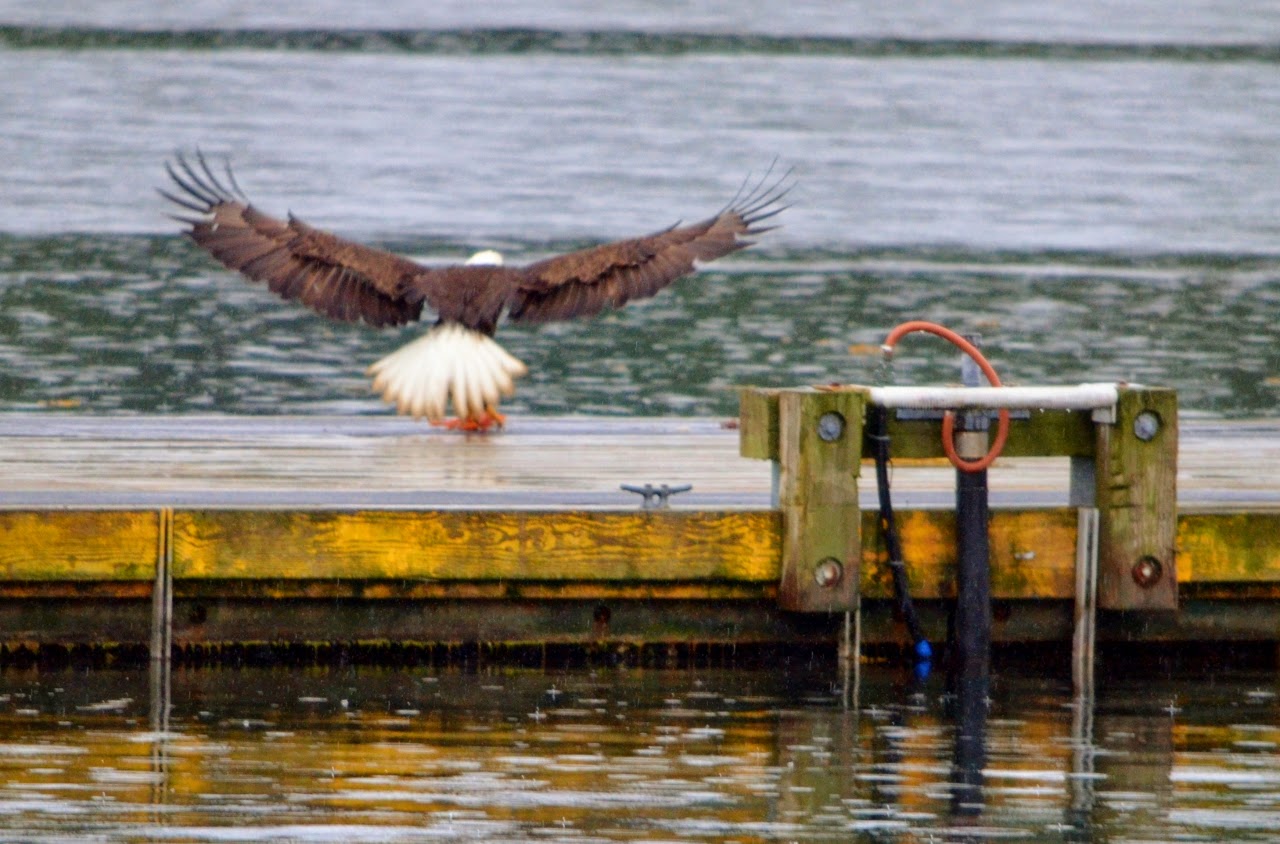
| The bald eagles provide constant entertainment |
.jpg) |
| Looking for food |
.jpg) |
| And finding it on the cleaning dock |
June 27, 2014
Spirit slipped the mooring lines at 0510, leaving the Grady White in the slip. We headed out to Viskari Rocks to try our luck fishing, but the southwest swell was running to 12 feet and we had no luck. Our guests were still developing their sea legs, so we headed over to Biorka Island, which is in the lee of the swells. The water was nearly flat calm, and we soon had 5 King salmon and 2 Coho salmon in the cooler.
Returning the 13 miles back to Sitka harbor, we cleaned the boat and met Alex and Pat Benson and Mike and Susie Miner for dinner at Agave Mexican restaurant before attending the grand finale concert of the Sitka Music Festival. After a great concert we re-connected with the members of the Cypress String Quartet, who had performed that evening. Making arrangements to take them fishing on in the morning, we decided that Miriam would join the string quartet and other performers on “Wild Blue”, taking over driving the boat while Alex helped the musician’s fish, while Patrick would take Vaughn and Jill Weedman fishing on “Spirit”, with Jill driving “Spirit” while Patrick & Vaughn fished. Complicated, but it worked!
June 28, 2014
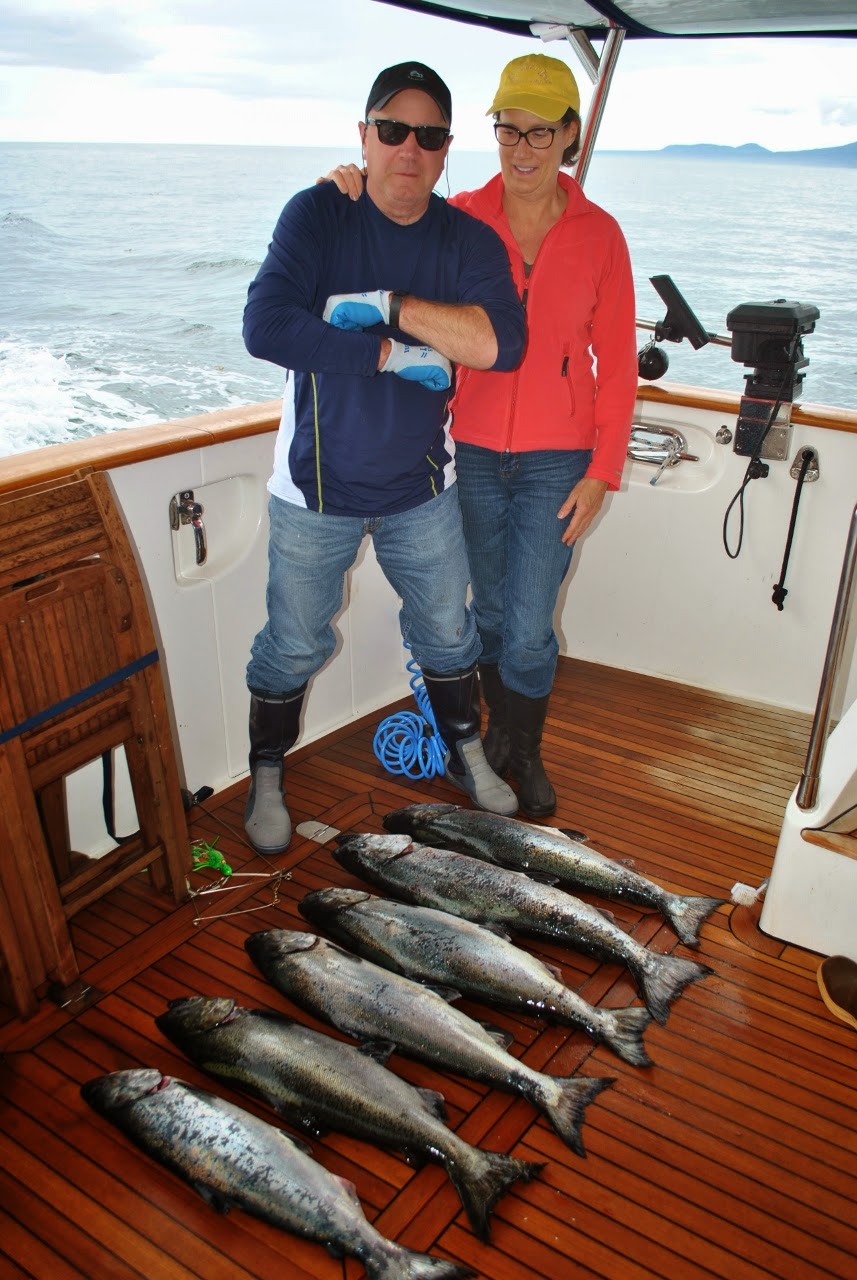
Spirit left the dock at 0500 and headed directly for Biorka Island. Arriving at the fishing location at 0630, downriggers were deployed and fishing lines were put in the water. By 0730 we had 3 King salmon in the boat. By noon we had 6 King salmon and called it a day, since we had reached our daily King Salmon allotment.
.jpg) |
| Weedman’s with King Salmon |
Returning to the dock at 1440 we rinsed the salt from the boat and headed to The Channel Club for dinner. Although the food was good, the service was not due to the number of people in the restaurant at the time.
June 29, 2015
The weather was relatively calm so Patrick and Vaughn took the Grady White fishing. After a late start (0930) and getting nearly to Biorka Island they discovered they had left the bait in the freezer on Spirit, so they returned to Sitka. Finally getting to Biorka Island at 1130 they discovered fishing was very slow, so they headed three miles offshore to Biorka Reef to try for halibut. There was a moderate SW swell at 6 feet. Finding a likely halibut hill the jigs were deployed. Patrick thought they had a bite on one rig, but it turned out they had snagged the bottom and the Grady White was anchored. While unsuccessfully trying to get free they snapped the line and broke the rod in half. Meanwhile, a Yelloweye Rockfish, also known as a Red Snapper had hooked up on the other jig. Patrick reeled in a nice Yelloweye. Heading back inshore Patrick & Vaughn decided to try one last time for salmon and picked up a nice King salmon. Heading back the 13 miles to Sitka in increasingly rough seas, our friend the rain returned in a deluge. The seas were rough enough that the VHF antenna mount on the Grady White failed, breaking the welded bracket.
.jpg) |
| Returning to Sitka Harbor the scenery is superb even in the rain! |
Dinner turned out to be fresh Yelloweye and mushroom risotto, preceded by spot prawns. Everyone was tired from the day’s activities, so the attempt to watch a movie was unsuccessful, with everyone falling asleep.
June 30, 2014
This was the last chance for the Weedman’s to catch more fish, to we slipped the mooring lines once again at 0500 and Spirit headed for Biorka Island. When we arrived at Biorka Island we were concerned over the weather, with the wind steady at 21 knots, gusting to 30 knots, and a moderate chop, even though we were out of the main swell. The wind pressure on Spirit was enough to provide ideal trolling speeds just by drifting. By 0630 our lines were in the water and by 0705 we had 3 King salmon in the cooler. The fishing slowed down slightly and we released 2 small King salmon before landing 2 more legal King Salmon. The Weedman’s had caught their annual non-resident limit of King salmon. We finally released another small King before heading back to Sitka. Spirit arrived at 1105 in the morning in light rain, which had started on our return. The balance of the day was spent shopping, replacing fishing tackle, lunch at the Bayview Pub and then a gala dinner on Maximo with the Oberto’s.
July 1, 2014
Since we were not fishing today, everyone slept in and then Patrick cooked his traditional biscuits and sausage gravy for a hearty breakfast before Vaughn and Jill departed for the airport at 1130. Patrick and Miriam spent the balance of the day repairing the broken VHF antenna on the Grady White, installing the satellite phone external antenna and doing laundry.
By early evening some Sitka residents were already setting off fireworks in anticipation of a noisy 4th of July. It sounded like a war zone for a while with the blasts for the aerial fireworks. The movie we had tried to watch several days before was finally watched to completion.
Meanwhile Back In The Bluff City
The old brewery is just next to our little loft in Memphis. We enjoy looking out our side windows and seeing it in all in funkyness.Hope it stays there.Nordhavn Exumas Abacos Bahamas trawler Caribbean Pickwick Boat dogs
Memphis Downtown
Day 173…Empty Nest
Welcome to day 173 of 365 photos…woke up this morning to an empty nest. We missed the youngsters leaving the nest so we don’t know if they left in the evening yesterday or early this morning. I cleaned the old nest out and hosed down the walls but will do a better job tomorrow. We… Continue Reading
The post Day 173…Empty Nest appeared first on Moosetique Musing.
The ARGONAUT July 3, 2014 The Tuamotus
CAPTAIN’S LOG The Tuamotus
June 3 to June 28, 2014
the Tuamotus
The Tuamotus is an archipelago made up of 77 atolls. Each atoll is composed of a circle of motus or islets made of coral sand and rock perched on the rim of an ancient volcano and enclosing a lagoon. The motus are barren except for coconuts and breadfruit trees, and have a maximum elevation of about ten feet above the sea. The only source of fresh water on these islets is rainwater. There are no fruits or vegetables on these atolls, nor are there any indigenous animals. There is almost no known history to these islands, but it is thought that human beings first came here from the Marquesas in 1000 AD. The motus enclose a lagoon, the largest of which is about 20 miles in diameter. The atolls are very beautiful and enclose a wealth of sea life that is relatively easy to access and provide some of the best dive sites in the world. In cruising near the Tuamotus one is struck by the contrasting color of the deep blue indigo ocean, the light sand the motu shore, the green of the coconut palms, the aqua color of the lagoons, and the clouds sailing across the light blue sky.
Passage to the Tuamotus
We left the beautiful anchorage at Fatu Hiva at 1030 headed for Fakarava 540 miles southeast, one of the more popular and larger atolls in the archipelago. The seas were calm for the first couple of hours, then we passed outside the shelter of Fatu Hiva and the swells built and built until we were in high, combing seas of ten to fifteen feet. Waves of this size are really large and quite intimidating. Argo did nicely, but Lyle was green and seasick and spent most of the next two days and nights on the couch in the salon trying to remain as quiet as possible. The rest of us had varying degrees of mal de mar, but we were in pretty good shape. After fifteen hours of somewhat miserable conditions, I began to consider alternatives to lessen our discomfort. After a group discussion, we decided to alter to a less strenuous course and go to the little atoll named Ahe. Just then the hydraulic alarm sounded indicating an overheating situation. This is a critical problem for Argo as she needs her stabilizers to maintain her posture, otherwise she would roll uncontrollably in these seas. It was pitch dark and the swells were huge. Gus and Rebecca stood by the doors to the pilothouse trying to see the exact direction of the waves so that I could be sure to point her into them and avoid as much as possible rolling violently from side to side. Tyler, who was now awake, rushed to the engine room to look at the impeller on the hydraulic cooling pump. We had changed it in Panama, so he knew exactly what to do. In an amazingly short period of time he had it replaced and we resumed our course in comfort and confidence. After things were repaired, he brought the defective impeller up to the pilothouse and I could see that it seemed to have over heated; strange for something that should be pumping water. On our new course to Ahe the angle to the swells improved and things got a little better. After a couple of hours Lyle started to come around and everyone seemed to perk up as the waves were still huge, but their moment lengthened allowing Argo to ride up and down rather than roll sideways off them.
On the third day we began to feel better and almost enjoy the cruise when the hydraulic alarm sounded again (36 hours later). This was an unwelcomed surprise. Once again we had a potentially serious problem on our hands. Thankfully it was daylight and the waves were somewhat better for dealing with this problem. I turned Argo into the waves again and Tyler and Gus flew to the engine room. Tyler checked out the strainer and then the impeller. The strainer was clear, but all the blades of the impeller had been sheared off. We looked for an obvious reason for this unusual part failure, but nothing seemed apparent. We replaced the impeller and things returned to normal, for a while. We talked about the problem and concluded that the sea water strainer had begun to rust. It looked as though small bits of it could have broken loose and made their way into the impeller shearing off the rubber blades, although this was unlikely. (Later, after consultation with experts, we learned that Globe Impellers can weaken over time. The impellers we recently purchased were probably defective, leading to their failure. No more Globe Impellers for us!). By 0630 we were close to Ahe and looking forward to anchoring in a calm harbor.
Ahe Atoll
Getting into atolls can be difficult and most have only one entry pass or channel. In the case of Ahe, its entry pass was very narrow (maybe 50 feet), very shallow (13 feet), surrounded by coral shelves, subject to very swift currents at tidal changes (9 knots), and requiring mid-channel turns. The ocean near Ahe is over 18,000 feet deep and rises almost straight up to the motus or islands that make up the atoll like beads on a necklace. Once inside the atoll the lagoon is comparatively shallow, crystal clear, and a beautiful turquoise color. The motus are white sand islands covered in coconut palms. Some of the motus have houses on them and the lagoon near them is dotted with buoys that are attached to oyster beds that are used to cultivate the famous Tahitian black pearls. The Ahe lagoon is about 16 miles long by 8 miles wide. At one end is a little village with a government dock at which we moored. It was the first time since leaving Shelter Bay Marina in Panama that Argo was in a calm anchorage.
The village was home to a couple hundred people. They started showing up at the dock when we arrived: kids in swimsuits or underwear, adults riding three wheeled bikes, men interested in boats, the local gendarme and several transvestites. The village had two streets and an intersection. The homes were small bungalows on paved streets surrounded by tropical plants and flowers, and each had a rainwater collection system for drinking water. There was a Catholic Church and a Mormon Temple of sorts and the only restaurant was a hamburger stand that for $13 provided fries, a burger, and a drink (the voracious flies were complimentary!).
The first day in port we rested and took a swim off our swim platform. Tyler dove Argo’s bottom to see if anything was clogging the water intake for the hydraulic cooling pump or the water maker. His report: all was in apple pie order! Our conclusion is that the problems with the water maker and the cooling pump are the result of cavitation caused by turbulent seas. This causes air to be sucked into the pumps, lessening their effectiveness. The proposed solution is to install scoop strainers to the hull at our next haul out, which would force water into the intakes when we are underway and lessen or eliminate the problem.
The second day we took an eight mile excursion across the lagoon to the lovely Pension Chez Riata for lunch. When we arrived, Riata was standing on the white sand beach, ukulele in hand singing Polynesian songs that she recorded in her youth (CDs anyone?). The scene was picture postcard perfect.
Lunch was served after a refreshment of fresh lemonade and fried banana chips. Riata and her husband, Willy, told us about their life on Ahe and their travels. They come to the United States each year to visit relatives and for shopping and skiing: she shops, he skis. Lunch began with an appetizer of thinly sliced pearl oysters marinated in garlic, oil, and lime served on an oyster shell. These shells are rather flat and about eight inches in diameter, not like the typical New England variety. The entre’ was fresh white fish sautéed in bread crumbs and coconut, accompanied with bread fruit, green beans, and a nice White Bordeaux. Dessert was a fabulous yellow cake with a vanilla cream center and chocolate glaze frosting. Rebecca doesn’t eat much, but she did eat that!
The next day, Sunday, we had hoped to move up the lagoon to anchor at Chez Riata, but unfortunately a squall line came through and it rained torrentially all day. We tried playing cards, but soon migrated to watching movies. The next day, Monday, the sky cleared and we got underway at 0630 for Rangiroa 75 miles to the south. We tried fishing, but only succeeded in losing a couple of lures and catching the fattest Skip-Jack we ever saw. It was a pleasant cruise, if not productive, and we arrived in Rangiroa about 1800.
Rangiroa
Prior to entering a harbor we study the navigation charts carefully, obtain tide information, and talk with others who have been there–sailors if possible. Prior to coming to Rangiroa we learned that the 125 foot French Customs Military boat (made of steel with a picture on www.tischtravels.com) hit a reef nearby and sank. This was very unsettling. Our charts showed the path to Rangiroa as a rhumbline course through the very narrow Tiputa Pass, which required several turns in a narrow channel to avoid reefs. We approached the pass at 1800 hours. The sun was setting, it was getting dark rapidly, and in order to make a safe passage we needed light to see the banks of the channel. Time was of the essence. From the pilot house we could see a channel between two motus with white water and high surf rolling in from the ocean to the mouth of the channel. The chart showed the channel to be surrounded by reefs and subject to strong currents. Because the surf was high I judged that the current was outflowing, which was favorable to our entry because it would aid our steering if it wasn’t too strong (more water flowing past the rudder makes the rudder answer up faster causing the yacht to turn more responsively). We proceeded nervously, judging that we still had enough light to see the banks of the channel. Argo’s bow began to lurch from port to starboard as the swells pushed her from one side to the other. She was pitching up and down about eight feet as the waves rolled under her. I didn’t fight the movement from the helm, but let her move in a natural manner. As we moved forward the side to side movement increased, but we seemed to have steerageway, so I maintained about 7 knots speed and hoped that we would stay online without exerting additional force which might result in a lot of unproductive maneuvering. Slowly we moved forward and finally we began to leave the swell zone, mindful of the waves crashing on the reef to either side. As the waves subsided our speed fell off rapidly; we had entered the narrow zone where the outgoing current is confined and focused. As our speed dropped I increased our RPMs so as to maintain steerageway. The current was so strong that 2100 rpms (which would normally move us at ten knots) was now propelling us at just under four and a half knots. This was another tense moment. We had the wing engine and thrusters ready to use if we lost headway, but after a very long two minutes we began to gain speed against the apparent six knot current. Tyler was on the bow pulpit looking for coral heads. When our speed reached six knots I began to ease back on the power so that we could make a 45o turn to port and not over run the turn and slide into the next reef. Argo didn’t turn easily because of the current and I couldn’t be sure of the accuracy of our charts in such a confined space, but in due course we made the turn, we were past the reef and safely inside the atoll. By then it was pitch dark. We could see the mast lights of several boats at anchor, and we began to look for a suitable place to drop our anchor. Not all sailboats turn on their masthead lights, so I turned on our night vision to try and see them in the dark.
Special skills are required when anchoring in an atoll or near coral formations. The sea floor can be spotted with coral heads and rock piles. If you anchor near any of these obstructions, the anchor chain can become entangled or wrapped around them as the boat turns in the wind. If a swell forms and rolls under the boat it can raise the forecastle and potentially damage the boat if the chain holds it firm and makes it impossible for the yacht to answer the sea state. In the case of Rangiroa there is a twenty mile fetch across the atoll, so large waves were possible under certain wind conditions. The recommended way of dealing with this problem is to lay out extra scope, buoyed by a float so as to isolate the boat from a chain that is caught on a coral head.
We used our sonar to identify an area without coral heads and wound up anchoring in 75 feet of water. We laid out 450 ft. of chain and then enjoyed one of Rebecca’s masterpieces of galley fare: a wonderful dinner of scallops, risotto and bok choy with a lovely White Bordeaux followed by rum bananas and ice cream for dessert.
The Rangiroa Atoll is about 75 miles in circumference and encloses the second largest lagoon in the world. It has the largest village in the Tuamotus and is also one of the world’s top dive sites. Many divers from around the world come here, particularly Japanese divers, to experience the coral reefs at the two passes, Tiputa and Avatoru. (The Japanese divers are the ones with large and exotic underwater cameras and multiple electronic gadgets attached to their arms and dive suits.) These reefs are large, in good condition, and home to an amazingly large variety of sea life including tuna, sharks and dolphins. Inside of Tiputa Pass is a large lagoon reef that we circled on our way into the atoll. It is situated in quiet water and perfect for beginner divers. The locals call it “The Aquarium”, and for good reason; it is full of colorful fish of many species including lemon sharks, barracudas, and moray eels. Gus, Lyle, Rebecca and I took our initial scuba qualification dives here shortly after we arrived.
The Tuamotus are coral motus or islets and have no native edible plants other than coconut and breadfruit. Fruits and vegetables are scarce. Onboard we have stored fruit found in other parts of French Polynesia including a grapefruit like fruit called a pamplemousse. This fruit is about two or three times the size of a grapefruit, but sweeter. It’s delicious. There are a few restaurants here that offer wonderful fresh fish and New Zealand lamb and beef. The one thing I have particularly enjoyed is tuna ceviche salad prepared in coconut milk. It is heavenly.
The beaches are coral rock and sand, not really suitable for swimming. They are lined with coconut palms. The water is crystal clear with the color ranging from turquoise to indigo to cerulean blue. It is absolutely gorgeous. Besides tourism, the Tuamotus are home to the black pearl industry. We toured a pearl farm located just west of us that has over two million oysters under cultivation. During our visit they operated on oysters and showed us how a blank seed (obtained from muscles raised in the Mississippi River) is inserted in the appendix of an oyster and how they graft another piece of an appendix from a sacrificial oyster to start the process of culturing a pearl. It was very interesting and of course they had a show room with plenty of inventory.
Tyler’s objective since beginning this voyage has been to become a Master Diver, and to that end he has been diving almost every day. One of his dives was on the outside reef at Tiputa Pass where a number of dolphins are known to come in from the sea every afternoon. During an afternoon dive, one of them approached Tyler, rolled onto its back and closed its eyes while he stroked its stomach. The dolphin stayed with him for a couple of minutes until an older dolphin, perhaps its mother, urged it back to the pack and they all swam out to sea together. While Rebecca and I were diving the reef earlier in the day, we saw several dolphins including one mother with baby, which was thrilling. That experience made us feel as though we were part of the whole panoply of sea life. While we were hovering in the current at a depth of about 75 feet and enjoying the dolphins, below us at 125 feet or so was a very large school of several hundred fish, perhaps Maori Perch or Bream. There we saw several beautiful, spectacular, silver darts in the sea; white and black tip sharks cruising outside the school of fish and occasionally darting through them. When a shark did so the whole school scattered like sparrows on the wind. As we drifted along and past this area of the reef, I must admit to looking behind and over my shoulder to see if any sharks were following; an unavoidable consequence of being part of the Jaws generation.
The nearest motu to our anchorage has a very nice hotel located on it, the Kia Ora, which features Polynesian style huts and bungalows with thatched roofs, some built over the turquoise blue lagoon, others in a village configuration. It is a Polynesian paradise for sure and just the sort of place that is featured in everyone’s dreams of the South Pacific. Our friends, Gus and Lyle, treated us to three days in one of these splendid over-the-water bungalows at the end of their visit on Argo. It was just what we needed after a long voyage, and a very generous gift indeed! We were particularly grateful to be at the Kia Ora as it had been about ten weeks since we had been in a first class restaurant with a bar. After three days at Kia Ora, we bade a fond farewell to our good friends and returned home to Argo. When we arrived back aboard Argo she was shinier than new. Tyler had taken this three day respite at anchor as an opportunity to wax and clean her after months of sea time. She looked beautiful. At this point, after five months underway she is the only motor yacht we have seen in the South Pacific.
We stood out from Rangiroa at 0730 Sunday morning June 22 bound for Tikehau, a small atoll about twenty miles west of Rangiroa. We made Tiputa Pass at slack tide and enjoyed a glorious passage to Tikehau. The sky was clear, the weather calm, and the day was perhaps the best of our cruise so far. A few minutes out of the pass we were joined by a pod of the largest dolphins we have ever seen. They swam toward Argo and jumped high in the air as if to celebrate finding us and to announce their presence. Several of them were perhaps eight or nine feet long and three or four hundred pounds. They were fabulous animals and a joy to see!
Tikehau
Tikehau is a small atoll like Ahe, but known as a great dive spot. Its most famous dive site is inside the lagoon and is a Manta Ray “cleaning station” where Mantas come to have resident fish clean them of parasites.
We made Passe Tuheiava at slack tide and the passage through it was straight forward and uneventful. We turned south in the lagoon, went about six miles to Village Tuherahera, home to a couple of pensions, a luxury hotel similar to Kia Ora, and a dive shop. We called the dive shop and arranged two dives at the pass for the following morning.
At 0830 sharp the next morning (Monday) a dive boat arrived and took Tyler and me first to the reef inside the lagoon to see if any Manta Rays were in for a cleaning; unfortunately they were not. Then we went outside the pass for two dives, one on each side of the channel. The water was 83 degrees with a brilliant blue sky overhead, no wind, and a sea as calm as a mill pond. We donned our scuba tanks and fell back off the aluminum boat into the sea. Suddenly we were practically weightless and enjoying the illusion of flying over the coral reef. As we descended to 93 feet we could see large schools of fish including Big Eye Tuna, Maori Perch, Jacks, Snappers, Barracuda, thousands of tropical fish of every imaginable color and configuration, a large White Tip Shark, and a huge emerald green and blue, domed head Napoleon fish that surely weighed in at 100 lbs and just casually floated past looking at us curiously. It was glorious. We arrived back at Argo at 1400 and enjoyed a lunch on the back deck. Rebecca had stayed aboard and accomplished most of the items on her list: doing six loads of laundry, baking a couple dozen cookies, cleaning the shower, and miscellaneous other tasks. She is a doer!
On Tuesday a squall line moved through and brought with it wind and rain, so we stayed onboard. On Wednesday cabin fever got the best of us and we took the tender to town despite the squalls. The Village Tuherahera covers most of a small motu. It looked like home to about 1,000 people. The roads are nicely paved, the homes are a sort of bungalow ranch style and placed on about a half-acre of land. Some have windows, others are just open to the breeze. Many are surrounded by beautiful tropical flowering plants. There are two Catholic churches with large buildings for social events. Everyone seems to have a car, truck, or motor bike which seemed surprising to us given that the motu couldn’t be more than two miles long and a few hundred yards wide. Anyway, everyone has a vehicle. Fanny, our dive instructor, told me that since there is no gasoline station on the motu, people ship their gasoline in from Tahiti in drums. They need a truck to carry the barrels from the dock to their boats. There are a couple of small restaurants, but they keep irregular hours so no one knows when they are open unless they call the proprietor on the phone (if it is working). The village has a tiny grocery, but it has no fresh vegetables or fruit. I don’t know what people eat here, but I do know that seafood gets a little boring after a couple of weeks. There are no shops or stores for any other products; I suppose people go to Papeete by plane if they need something, which is 170 mile due south of here. Maybe they order by phone or on the very slow internet and have it shipped via the weekly supply ship that comes here. Roosters strut about and crow all the time, and large eared dogs are everywhere. Vacationers from Europe are the most frequent visitors. There are no bars or other forms of entertainment, but there are a couple of pensions that cater to the tourists. So it isn’t much of a place for a single person; honeymooners on the other hand, flock here. The motu has three things going for it: beautiful pink coral beaches, magnificent sunsets, and lovely dive sights. If you are looking for a place to vacation that’s away from it all, and I mean all, Tikehau is it!
On Thursday another squall line was passing through. In the Tikehau Atoll, waves have a fetch of about ten miles, so they can build to a muscular size in 30 + knot winds. Winds reached 30 MPH on Thursday and the waves at this end of the atoll reached about four feet. Argo pitched and pulled, but her anchor held firm. Our dingy rode the surf behind Argo and rose above our transom on the waves, which is saying something.
Friday was our lucky day. The sun rose and presented us with a beautiful day; gone was the wind and rain. Fanny, the charming and pretty French dive instructor, came by around 0900 with a dive boat full of tourists. She picked us up from Argo and took us to two wonderful dive spots. The first one was a coral head in the lagoon that Manta Rays frequent to have parasites removed by Remoras and other fish. Rebecca and I fell off the boat into an amazing primordial scene: huge Manta Rays with wings eight or ten feet across were floating above us over the reef. Their top side is black and their underside is white. They have wide set eyes placed on the end of protruding limbs on either side of its mouth, and below the limbs and eyes are articulating flaps that they use to cover their mouth or guide food. In this case they guided juvenile fish of a specie common on the reef into their huge, gaping mouth, and the little fish went about their business of cleaning their mouth, eyes, and gills. The little fish formed a ball of dense black living organisms within the Manta Ray. The Manta moved slowly through the water so as not to dislodge the little critters. Under the great fish were Remoras, members of the shark family that have a sucker apparatus on the top of their heads. They were cleaning the Manta’s underside. Rebecca and I gazed transfixed at the scene we were privileged to witness and wondered: For how many millions of years has this been going on?
Our second dive was on Buoy Reef, just the outside of the pass. The water here is crystal clear and full of sea life, certainly among the best dive spots in the world. This was Rebecca’s first dive here. On today’s dive we saw a White Tip Shark, which was intimidating and attention getting as it swam close enough to give us a good look before abruptly turning and heading away (thank God). We also saw a Manta Ray on this reef, which was quit lovely. Two dangerous animals also got our attention. First was a Rock Fish, which was hiding in a hole on the reef. They are very difficult to see as they hide deep in a crevasse and are so well camouflaged that you can’t tell them from a rock. They sport deadly spines to keep unwelcomed visitors at bay, and they have a tongue that looks like a little fish to attract dinner guests to their table. The other animal we saw was a Morey Eel; always a little disturbing (I suppose because it is hard to relate to them and they have teeth)!
After the dive we returned to Argo and prepared to stand out for Papeete, Tahiti, 167 miles to the south. It was a beautiful day for a cruise; bright sunshine, a cloudless sky, a following 8 knot wind and 3 foot sea. We don’t get enough days like this! We started to raise the anchor, but the chain had apparently gotten caught on a coral head. We worked on it for ten or fifteen minutes and I thought Tyler might have to make a dive on the anchor, but by maneuvering the boat around and pulling as hard as seemed prudent, it eventually came loose and we were underway. On the way out we deployed our fishing lines in the hopes of catching something in the pass. Shortly after we cleared the pass and turned on our course, King Neptune offered up a beautiful Mahi-Mahi.
The passage to Papeete is an overnight run. Rebecca and I take the evening watch from 1800 to 0000. Tyler takes the night watch from 0000 to 0700. I take the 0700 to 1200, Tyler and I take turns as it suits us on the afternoon watch. We all enjoy the night sky at sea which is unlike any on land, and the night sky in the South Pacific is positively spellbinding. Out here the unobstructed vista, clear atmosphere, and lack of light pollution allows us to see things we would never otherwise see. For example you can see the whole Milky Way down the middle of the sky with the relatively less occupied parts of the universe on either side. The stars themselves are dazzling, brilliant and so clear as to light the heavens like an outdoor Christmas tree on a frosty winter’s evening. We always look for the beautiful Southern Cross. Often we see falling stars and satellites passing over. At Fatu Hiva Gus and I saw the International Space Station fly by at tremendous speed. Last night Rebecca and I laid on the forecastle and gazed aloft at the trillions of tiny and not so tiny bodies shining down on us. We saw several meteors entering our atmosphere, two in particular will stay in my mind’s eye; one was huge, like a comet that flashed across the sky with a tail and then disappeared, the other a streak that ended in a tiny red ball. Of course for the whole of human history up to about 1930 people looked at the night sky in wonderment and awe. Since the invention of electricity and television, no one looks anymore, and besides, it can hardly be seen given the light pollution. As Argo plies the water she rolls back the sea and atop the white foam are tiny star like sparkles of phosphorescent plankton spreading out around us. It is nights like this that I am so glad we made the decision to undertake cruising on Argo.
This morning, Saturday, we are at sea about 35 miles out of Tahiti. The sea is calm and it isn’t much of a day for sailboaters as the wind is only 5 knots. All our doors are open and a lovely breeze is blowing through the boat. I have two lines out, but the ocean is very deep here and since I do not see any birds, I doubt that there is anything to catch in these parts. We will make Papeete in a few hours and I can see the great mountains of Tahiti from here.
We will tie up at Marina Tiana, a focal point this time of year for sailors making the passage across the Pacific. If the internet has sufficient bandwidth in Papeete, I hope to upload some new photos of The Galapagos, The Marquesas, and The Tuamotus.
Rebecca and I hope you are having a lovely summer and that fair winds are to your backside.
Thanks for looking in on us.
Randy and Rebecca
CAPTAIN’S LOG The Tuamotus
June 3 to June 28, 2014
the Tuamotus
The Tuamotus is an archipelago made up of 77 atolls. Each atoll is composed of a circle of motus or islets made of coral sand and rock perched on the rim of an ancient volcano and enclosing a lagoon. The motus are barren except for coconuts and breadfruit trees, and have a maximum elevation of about ten feet above the sea. The only source of fresh water on these islets is rainwater. There are no fruits or vegetables on these atolls, nor are there any indigenous animals. There is almost no known history to these islands, but it is thought that human beings first came here from the Marquesas in 1000 AD. The motus enclose a lagoon, the largest of which is about 20 miles in diameter. The atolls are very beautiful and enclose a wealth of sea life that is relatively easy to access and provide some of the best dive sites in the world. In cruising near the Tuamotus one is struck by the contrasting color of the deep blue indigo ocean, the light sand the motu shore, the green of the coconut palms, the aqua color of the lagoons, and the clouds sailing across the light blue sky.
Passage to the Tuamotus
We left the beautiful anchorage at Fatu Hiva at 1030 headed for Fakarava 540 miles southeast, one of the more popular and larger atolls in the archipelago. The seas were calm for the first couple of hours, then we passed outside the shelter of Fatu Hiva and the swells built and built until we were in high, combing seas of ten to fifteen feet. Waves of this size are really large and quite intimidating. Argo did nicely, but Lyle was green and seasick and spent most of the next two days and nights on the couch in the salon trying to remain as quiet as possible. The rest of us had varying degrees of mal de mar, but we were in pretty good shape. After fifteen hours of somewhat miserable conditions, I began to consider alternatives to lessen our discomfort. After a group discussion, we decided to alter to a less strenuous course and go to the little atoll named Ahe. Just then the hydraulic alarm sounded indicating an overheating situation. This is a critical problem for Argo as she needs her stabilizers to maintain her posture, otherwise she would roll uncontrollably in these seas. It was pitch dark and the swells were huge. Gus and Rebecca stood by the doors to the pilothouse trying to see the exact direction of the waves so that I could be sure to point her into them and avoid as much as possible rolling violently from side to side. Tyler, who was now awake, rushed to the engine room to look at the impeller on the hydraulic cooling pump. We had changed it in Panama, so he knew exactly what to do. In an amazingly short period of time he had it replaced and we resumed our course in comfort and confidence. After things were repaired, he brought the defective impeller up to the pilothouse and I could see that it seemed to have over heated; strange for something that should be pumping water. On our new course to Ahe the angle to the swells improved and things got a little better. After a couple of hours Lyle started to come around and everyone seemed to perk up as the waves were still huge, but their moment lengthened allowing Argo to ride up and down rather than roll sideways off them.
On the third day we began to feel better and almost enjoy the cruise when the hydraulic alarm sounded again (36 hours later). This was an unwelcomed surprise. Once again we had a potentially serious problem on our hands. Thankfully it was daylight and the waves were somewhat better for dealing with this problem. I turned Argo into the waves again and Tyler and Gus flew to the engine room. Tyler checked out the strainer and then the impeller. The strainer was clear, but all the blades of the impeller had been sheared off. We looked for an obvious reason for this unusual part failure, but nothing seemed apparent. We replaced the impeller and things returned to normal, for a while. We talked about the problem and concluded that the sea water strainer had begun to rust. It looked as though small bits of it could have broken loose and made their way into the impeller shearing off the rubber blades, although this was unlikely. (Later, after consultation with experts, we learned that Globe Impellers can weaken over time. The impellers we recently purchased were probably defective, leading to their failure. No more Globe Impellers for us!). By 0630 we were close to Ahe and looking forward to anchoring in a calm harbor.
Ahe Atoll
Getting into atolls can be difficult and most have only one entry pass or channel. In the case of Ahe, its entry pass was very narrow (maybe 50 feet), very shallow (13 feet), surrounded by coral shelves, subject to very swift currents at tidal changes (9 knots), and requiring mid-channel turns. The ocean near Ahe is over 18,000 feet deep and rises almost straight up to the motus or islands that make up the atoll like beads on a necklace. Once inside the atoll the lagoon is comparatively shallow, crystal clear, and a beautiful turquoise color. The motus are white sand islands covered in coconut palms. Some of the motus have houses on them and the lagoon near them is dotted with buoys that are attached to oyster beds that are used to cultivate the famous Tahitian black pearls. The Ahe lagoon is about 16 miles long by 8 miles wide. At one end is a little village with a government dock at which we moored. It was the first time since leaving Shelter Bay Marina in Panama that Argo was in a calm anchorage.
The village was home to a couple hundred people. They started showing up at the dock when we arrived: kids in swimsuits or underwear, adults riding three wheeled bikes, men interested in boats, the local gendarme and several transvestites. The village had two streets and an intersection. The homes were small bungalows on paved streets surrounded by tropical plants and flowers, and each had a rainwater collection system for drinking water. There was a Catholic Church and a Mormon Temple of sorts and the only restaurant was a hamburger stand that for $13 provided fries, a burger, and a drink (the voracious flies were complimentary!).
The first day in port we rested and took a swim off our swim platform. Tyler dove Argo’s bottom to see if anything was clogging the water intake for the hydraulic cooling pump or the water maker. His report: all was in apple pie order! Our conclusion is that the problems with the water maker and the cooling pump are the result of cavitation caused by turbulent seas. This causes air to be sucked into the pumps, lessening their effectiveness. The proposed solution is to install scoop strainers to the hull at our next haul out, which would force water into the intakes when we are underway and lessen or eliminate the problem.
The second day we took an eight mile excursion across the lagoon to the lovely Pension Chez Riata for lunch. When we arrived, Riata was standing on the white sand beach, ukulele in hand singing Polynesian songs that she recorded in her youth (CDs anyone?). The scene was picture postcard perfect.
Lunch was served after a refreshment of fresh lemonade and fried banana chips. Riata and her husband, Willy, told us about their life on Ahe and their travels. They come to the United States each year to visit relatives and for shopping and skiing: she shops, he skis. Lunch began with an appetizer of thinly sliced pearl oysters marinated in garlic, oil, and lime served on an oyster shell. These shells are rather flat and about eight inches in diameter, not like the typical New England variety. The entre’ was fresh white fish sautéed in bread crumbs and coconut, accompanied with bread fruit, green beans, and a nice White Bordeaux. Dessert was a fabulous yellow cake with a vanilla cream center and chocolate glaze frosting. Rebecca doesn’t eat much, but she did eat that!
The next day, Sunday, we had hoped to move up the lagoon to anchor at Chez Riata, but unfortunately a squall line came through and it rained torrentially all day. We tried playing cards, but soon migrated to watching movies. The next day, Monday, the sky cleared and we got underway at 0630 for Rangiroa 75 miles to the south. We tried fishing, but only succeeded in losing a couple of lures and catching the fattest Skip-Jack we ever saw. It was a pleasant cruise, if not productive, and we arrived in Rangiroa about 1800.
Rangiroa
Prior to entering a harbor we study the navigation charts carefully, obtain tide information, and talk with others who have been there–sailors if possible. Prior to coming to Rangiroa we learned that the 125 foot French Customs Military boat (made of steel with a picture on www.tischtravels.com) hit a reef nearby and sank. This was very unsettling. Our charts showed the path to Rangiroa as a rhumbline course through the very narrow Tiputa Pass, which required several turns in a narrow channel to avoid reefs. We approached the pass at 1800 hours. The sun was setting, it was getting dark rapidly, and in order to make a safe passage we needed light to see the banks of the channel. Time was of the essence. From the pilot house we could see a channel between two motus with white water and high surf rolling in from the ocean to the mouth of the channel. The chart showed the channel to be surrounded by reefs and subject to strong currents. Because the surf was high I judged that the current was outflowing, which was favorable to our entry because it would aid our steering if it wasn’t too strong (more water flowing past the rudder makes the rudder answer up faster causing the yacht to turn more responsively). We proceeded nervously, judging that we still had enough light to see the banks of the channel. Argo’s bow began to lurch from port to starboard as the swells pushed her from one side to the other. She was pitching up and down about eight feet as the waves rolled under her. I didn’t fight the movement from the helm, but let her move in a natural manner. As we moved forward the side to side movement increased, but we seemed to have steerageway, so I maintained about 7 knots speed and hoped that we would stay online without exerting additional force which might result in a lot of unproductive maneuvering. Slowly we moved forward and finally we began to leave the swell zone, mindful of the waves crashing on the reef to either side. As the waves subsided our speed fell off rapidly; we had entered the narrow zone where the outgoing current is confined and focused. As our speed dropped I increased our RPMs so as to maintain steerageway. The current was so strong that 2100 rpms (which would normally move us at ten knots) was now propelling us at just under four and a half knots. This was another tense moment. We had the wing engine and thrusters ready to use if we lost headway, but after a very long two minutes we began to gain speed against the apparent six knot current. Tyler was on the bow pulpit looking for coral heads. When our speed reached six knots I began to ease back on the power so that we could make a 45o turn to port and not over run the turn and slide into the next reef. Argo didn’t turn easily because of the current and I couldn’t be sure of the accuracy of our charts in such a confined space, but in due course we made the turn, we were past the reef and safely inside the atoll. By then it was pitch dark. We could see the mast lights of several boats at anchor, and we began to look for a suitable place to drop our anchor. Not all sailboats turn on their masthead lights, so I turned on our night vision to try and see them in the dark.
Special skills are required when anchoring in an atoll or near coral formations. The sea floor can be spotted with coral heads and rock piles. If you anchor near any of these obstructions, the anchor chain can become entangled or wrapped around them as the boat turns in the wind. If a swell forms and rolls under the boat it can raise the forecastle and potentially damage the boat if the chain holds it firm and makes it impossible for the yacht to answer the sea state. In the case of Rangiroa there is a twenty mile fetch across the atoll, so large waves were possible under certain wind conditions. The recommended way of dealing with this problem is to lay out extra scope, buoyed by a float so as to isolate the boat from a chain that is caught on a coral head.
We used our sonar to identify an area without coral heads and wound up anchoring in 75 feet of water. We laid out 450 ft. of chain and then enjoyed one of Rebecca’s masterpieces of galley fare: a wonderful dinner of scallops, risotto and bok choy with a lovely White Bordeaux followed by rum bananas and ice cream for dessert.
The Rangiroa Atoll is about 75 miles in circumference and encloses the second largest lagoon in the world. It has the largest village in the Tuamotus and is also one of the world’s top dive sites. Many divers from around the world come here, particularly Japanese divers, to experience the coral reefs at the two passes, Tiputa and Avatoru. (The Japanese divers are the ones with large and exotic underwater cameras and multiple electronic gadgets attached to their arms and dive suits.) These reefs are large, in good condition, and home to an amazingly large variety of sea life including tuna, sharks and dolphins. Inside of Tiputa Pass is a large lagoon reef that we circled on our way into the atoll. It is situated in quiet water and perfect for beginner divers. The locals call it “The Aquarium”, and for good reason; it is full of colorful fish of many species including lemon sharks, barracudas, and moray eels. Gus, Lyle, Rebecca and I took our initial scuba qualification dives here shortly after we arrived.
The Tuamotus are coral motus or islets and have no native edible plants other than coconut and breadfruit. Fruits and vegetables are scarce. Onboard we have stored fruit found in other parts of French Polynesia including a grapefruit like fruit called a pamplemousse. This fruit is about two or three times the size of a grapefruit, but sweeter. It’s delicious. There are a few restaurants here that offer wonderful fresh fish and New Zealand lamb and beef. The one thing I have particularly enjoyed is tuna ceviche salad prepared in coconut milk. It is heavenly.
The beaches are coral rock and sand, not really suitable for swimming. They are lined with coconut palms. The water is crystal clear with the color ranging from turquoise to indigo to cerulean blue. It is absolutely gorgeous. Besides tourism, the Tuamotus are home to the black pearl industry. We toured a pearl farm located just west of us that has over two million oysters under cultivation. During our visit they operated on oysters and showed us how a blank seed (obtained from muscles raised in the Mississippi River) is inserted in the appendix of an oyster and how they graft another piece of an appendix from a sacrificial oyster to start the process of culturing a pearl. It was very interesting and of course they had a show room with plenty of inventory.
Tyler’s objective since beginning this voyage has been to become a Master Diver, and to that end he has been diving almost every day. One of his dives was on the outside reef at Tiputa Pass where a number of dolphins are known to come in from the sea every afternoon. During an afternoon dive, one of them approached Tyler, rolled onto its back and closed its eyes while he stroked its stomach. The dolphin stayed with him for a couple of minutes until an older dolphin, perhaps its mother, urged it back to the pack and they all swam out to sea together. While Rebecca and I were diving the reef earlier in the day, we saw several dolphins including one mother with baby, which was thrilling. That experience made us feel as though we were part of the whole panoply of sea life. While we were hovering in the current at a depth of about 75 feet and enjoying the dolphins, below us at 125 feet or so was a very large school of several hundred fish, perhaps Maori Perch or Bream. There we saw several beautiful, spectacular, silver darts in the sea; white and black tip sharks cruising outside the school of fish and occasionally darting through them. When a shark did so the whole school scattered like sparrows on the wind. As we drifted along and past this area of the reef, I must admit to looking behind and over my shoulder to see if any sharks were following; an unavoidable consequence of being part of the Jaws generation.
The nearest motu to our anchorage has a very nice hotel located on it, the Kia Ora, which features Polynesian style huts and bungalows with thatched roofs, some built over the turquoise blue lagoon, others in a village configuration. It is a Polynesian paradise for sure and just the sort of place that is featured in everyone’s dreams of the South Pacific. Our friends, Gus and Lyle, treated us to three days in one of these splendid over-the-water bungalows at the end of their visit on Argo. It was just what we needed after a long voyage, and a very generous gift indeed! We were particularly grateful to be at the Kia Ora as it had been about ten weeks since we had been in a first class restaurant with a bar. After three days at Kia Ora, we bade a fond farewell to our good friends and returned home to Argo. When we arrived back aboard Argo she was shinier than new. Tyler had taken this three day respite at anchor as an opportunity to wax and clean her after months of sea time. She looked beautiful. At this point, after five months underway she is the only motor yacht we have seen in the South Pacific.
We stood out from Rangiroa at 0730 Sunday morning June 22 bound for Tikehau, a small atoll about twenty miles west of Rangiroa. We made Tiputa Pass at slack tide and enjoyed a glorious passage to Tikehau. The sky was clear, the weather calm, and the day was perhaps the best of our cruise so far. A few minutes out of the pass we were joined by a pod of the largest dolphins we have ever seen. They swam toward Argo and jumped high in the air as if to celebrate finding us and to announce their presence. Several of them were perhaps eight or nine feet long and three or four hundred pounds. They were fabulous animals and a joy to see!
Tikehau
Tikehau is a small atoll like Ahe, but known as a great dive spot. Its most famous dive site is inside the lagoon and is a Manta Ray “cleaning station” where Mantas come to have resident fish clean them of parasites.
We made Passe Tuheiava at slack tide and the passage through it was straight forward and uneventful. We turned south in the lagoon, went about six miles to Village Tuherahera, home to a couple of pensions, a luxury hotel similar to Kia Ora, and a dive shop. We called the dive shop and arranged two dives at the pass for the following morning.
At 0830 sharp the next morning (Monday) a dive boat arrived and took Tyler and me first to the reef inside the lagoon to see if any Manta Rays were in for a cleaning; unfortunately they were not. Then we went outside the pass for two dives, one on each side of the channel. The water was 83 degrees with a brilliant blue sky overhead, no wind, and a sea as calm as a mill pond. We donned our scuba tanks and fell back off the aluminum boat into the sea. Suddenly we were practically weightless and enjoying the illusion of flying over the coral reef. As we descended to 93 feet we could see large schools of fish including Big Eye Tuna, Maori Perch, Jacks, Snappers, Barracuda, thousands of tropical fish of every imaginable color and configuration, a large White Tip Shark, and a huge emerald green and blue, domed head Napoleon fish that surely weighed in at 100 lbs and just casually floated past looking at us curiously. It was glorious. We arrived back at Argo at 1400 and enjoyed a lunch on the back deck. Rebecca had stayed aboard and accomplished most of the items on her list: doing six loads of laundry, baking a couple dozen cookies, cleaning the shower, and miscellaneous other tasks. She is a doer!
On Tuesday a squall line moved through and brought with it wind and rain, so we stayed onboard. On Wednesday cabin fever got the best of us and we took the tender to town despite the squalls. The Village Tuherahera covers most of a small motu. It looked like home to about 1,000 people. The roads are nicely paved, the homes are a sort of bungalow ranch style and placed on about a half-acre of land. Some have windows, others are just open to the breeze. Many are surrounded by beautiful tropical flowering plants. There are two Catholic churches with large buildings for social events. Everyone seems to have a car, truck, or motor bike which seemed surprising to us given that the motu couldn’t be more than two miles long and a few hundred yards wide. Anyway, everyone has a vehicle. Fanny, our dive instructor, told me that since there is no gasoline station on the motu, people ship their gasoline in from Tahiti in drums. They need a truck to carry the barrels from the dock to their boats. There are a couple of small restaurants, but they keep irregular hours so no one knows when they are open unless they call the proprietor on the phone (if it is working). The village has a tiny grocery, but it has no fresh vegetables or fruit. I don’t know what people eat here, but I do know that seafood gets a little boring after a couple of weeks. There are no shops or stores for any other products; I suppose people go to Papeete by plane if they need something, which is 170 mile due south of here. Maybe they order by phone or on the very slow internet and have it shipped via the weekly supply ship that comes here. Roosters strut about and crow all the time, and large eared dogs are everywhere. Vacationers from Europe are the most frequent visitors. There are no bars or other forms of entertainment, but there are a couple of pensions that cater to the tourists. So it isn’t much of a place for a single person; honeymooners on the other hand, flock here. The motu has three things going for it: beautiful pink coral beaches, magnificent sunsets, and lovely dive sights. If you are looking for a place to vacation that’s away from it all, and I mean all, Tikehau is it!
On Thursday another squall line was passing through. In the Tikehau Atoll, waves have a fetch of about ten miles, so they can build to a muscular size in 30 + knot winds. Winds reached 30 MPH on Thursday and the waves at this end of the atoll reached about four feet. Argo pitched and pulled, but her anchor held firm. Our dingy rode the surf behind Argo and rose above our transom on the waves, which is saying something.
Friday was our lucky day. The sun rose and presented us with a beautiful day; gone was the wind and rain. Fanny, the charming and pretty French dive instructor, came by around 0900 with a dive boat full of tourists. She picked us up from Argo and took us to two wonderful dive spots. The first one was a coral head in the lagoon that Manta Rays frequent to have parasites removed by Remoras and other fish. Rebecca and I fell off the boat into an amazing primordial scene: huge Manta Rays with wings eight or ten feet across were floating above us over the reef. Their top side is black and their underside is white. They have wide set eyes placed on the end of protruding limbs on either side of its mouth, and below the limbs and eyes are articulating flaps that they use to cover their mouth or guide food. In this case they guided juvenile fish of a specie common on the reef into their huge, gaping mouth, and the little fish went about their business of cleaning their mouth, eyes, and gills. The little fish formed a ball of dense black living organisms within the Manta Ray. The Manta moved slowly through the water so as not to dislodge the little critters. Under the great fish were Remoras, members of the shark family that have a sucker apparatus on the top of their heads. They were cleaning the Manta’s underside. Rebecca and I gazed transfixed at the scene we were privileged to witness and wondered: For how many millions of years has this been going on?
Our second dive was on Buoy Reef, just the outside of the pass. The water here is crystal clear and full of sea life, certainly among the best dive spots in the world. This was Rebecca’s first dive here. On today’s dive we saw a White Tip Shark, which was intimidating and attention getting as it swam close enough to give us a good look before abruptly turning and heading away (thank God). We also saw a Manta Ray on this reef, which was quit lovely. Two dangerous animals also got our attention. First was a Rock Fish, which was hiding in a hole on the reef. They are very difficult to see as they hide deep in a crevasse and are so well camouflaged that you can’t tell them from a rock. They sport deadly spines to keep unwelcomed visitors at bay, and they have a tongue that looks like a little fish to attract dinner guests to their table. The other animal we saw was a Morey Eel; always a little disturbing (I suppose because it is hard to relate to them and they have teeth)!
After the dive we returned to Argo and prepared to stand out for Papeete, Tahiti, 167 miles to the south. It was a beautiful day for a cruise; bright sunshine, a cloudless sky, a following 8 knot wind and 3 foot sea. We don’t get enough days like this! We started to raise the anchor, but the chain had apparently gotten caught on a coral head. We worked on it for ten or fifteen minutes and I thought Tyler might have to make a dive on the anchor, but by maneuvering the boat around and pulling as hard as seemed prudent, it eventually came loose and we were underway. On the way out we deployed our fishing lines in the hopes of catching something in the pass. Shortly after we cleared the pass and turned on our course, King Neptune offered up a beautiful Mahi-Mahi.
The passage to Papeete is an overnight run. Rebecca and I take the evening watch from 1800 to 0000. Tyler takes the night watch from 0000 to 0700. I take the 0700 to 1200, Tyler and I take turns as it suits us on the afternoon watch. We all enjoy the night sky at sea which is unlike any on land, and the night sky in the South Pacific is positively spellbinding. Out here the unobstructed vista, clear atmosphere, and lack of light pollution allows us to see things we would never otherwise see. For example you can see the whole Milky Way down the middle of the sky with the relatively less occupied parts of the universe on either side. The stars themselves are dazzling, brilliant and so clear as to light the heavens like an outdoor Christmas tree on a frosty winter’s evening. We always look for the beautiful Southern Cross. Often we see falling stars and satellites passing over. At Fatu Hiva Gus and I saw the International Space Station fly by at tremendous speed. Last night Rebecca and I laid on the forecastle and gazed aloft at the trillions of tiny and not so tiny bodies shining down on us. We saw several meteors entering our atmosphere, two in particular will stay in my mind’s eye; one was huge, like a comet that flashed across the sky with a tail and then disappeared, the other a streak that ended in a tiny red ball. Of course for the whole of human history up to about 1930 people looked at the night sky in wonderment and awe. Since the invention of electricity and television, no one looks anymore, and besides, it can hardly be seen given the light pollution. As Argo plies the water she rolls back the sea and atop the white foam are tiny star like sparkles of phosphorescent plankton spreading out around us. It is nights like this that I am so glad we made the decision to undertake cruising on Argo.
This morning, Saturday, we are at sea about 35 miles out of Tahiti. The sea is calm and it isn’t much of a day for sailboaters as the wind is only 5 knots. All our doors are open and a lovely breeze is blowing through the boat. I have two lines out, but the ocean is very deep here and since I do not see any birds, I doubt that there is anything to catch in these parts. We will make Papeete in a few hours and I can see the great mountains of Tahiti from here.
We will tie up at Marina Tiana, a focal point this time of year for sailors making the passage across the Pacific. If the internet has sufficient bandwidth in Papeete, I hope to upload some new photos of The Galapagos, The Marquesas, and The Tuamotus.
Rebecca and I hope you are having a lovely summer and that fair winds are to your backside.
Thanks for looking in on us.


