
We finally got all our stuff out of cupboards and hiding places and off the boat. What a job! Anyway, Serenity is now ready for some lucky person. We have so loved her! We are going to try to market her ourselves since we are no…
Tag Archives | Nordhavn
ENVOY BACK IN CORFU
Envoy is now cruising around the Lefkada area.
After leaving Greece’s northernmost Ionian islands of Othoni and Erikoussa we spend the next few days cruising down Corfu’s north-east coast enjoying stops at Ormos Stefanos, Kalami and Agri. Ormos means “bay”. There are some stunning tavernas in these bays and we enjoy an excellent lunch at Tusala’s Taverna in Agni as we overlook the beach and Envoy anchored just a short distance offshore.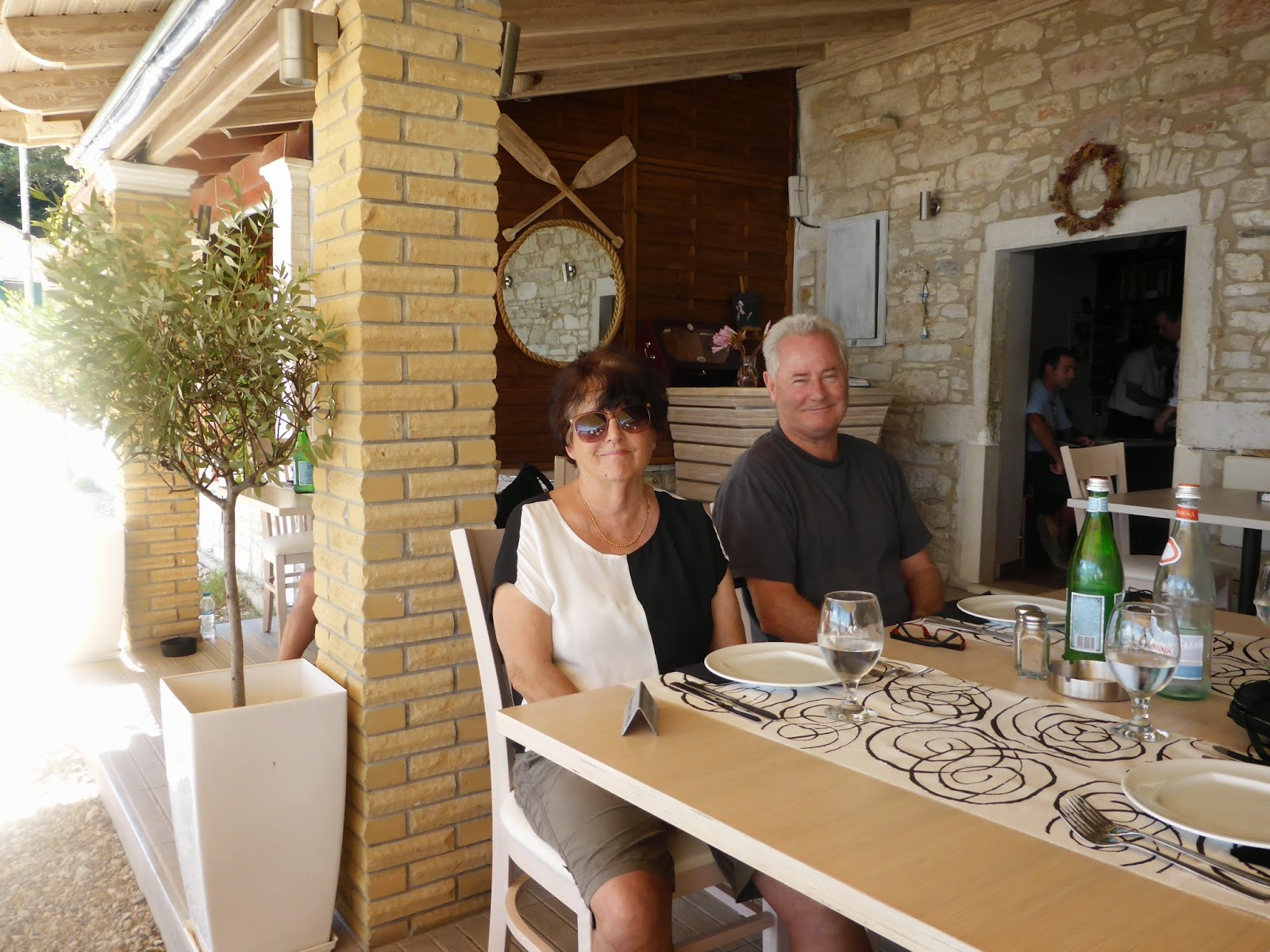



After leaving Greece’s northernmost Ionian islands of Othoni and Erikoussa we spend the next few days cruising down Corfu’s north-east coast enjoying stops at Ormos Stefanos, Kalami and Agri. Ormos means “bay”. There are some stunning tavernas in these bays and we enjoy an excellent lunch at Tusala’s Taverna in Agni as we overlook the beach and Envoy anchored just a short distance offshore.
Sharon and Doug enjoying lunch at Tusala’s Tavern
Then it’s into Gouvia Marina to spend Sharon and Doug’s last few days with us.
Gouvia Marina is great with excellent technical facilities, shops and tavernas close by and costs 68 Euros (NZ$106) per night.
One evening here we have dinner at a traditional Corfiot restaurant called Tripa’s Taverna, with all food and wines supplied, live Greek music and a dancing floorshow for a very reasonable of 30 Euro (NZ$47) each. We arrive at dusk to be greeted by hordes of hungry mosquitoes but soon the sun goes down and thankfully they all disappear (we rarely encounter more than the odd mosquito here in the Med).
Sharon, Doug and Laurie feasting on traditional Corfiot food at Tripa’s
Tavern Rustic Tripa’s Taverna complete with cobwebs
Our taxi for the ride back to the marina is a near-new Mercedes and our driver says his last passenger that night was the King of Belgium, whom he’d driven to a restaurant accompanied by two police escort cars and the King’s personal bodyguards. The driver also fills us in on local economics, explaining how hard it is for people to live on the average wage of about 550 Euros (NZ$900) per month when rent is around 400 Euros (NZ$656). Most people in Corfu are able to find jobs through the summer months, but it’s tough during winter. Many people on Greek islands own small areas of land and grow vegetables, fruit and olives, and keep a few goats and chickens to make life a bit easier.
Doug and I visit the main marketplace in Corfu where the prices seem very reasonable. Whole fish range from 3 Euros per kg (NZ$4.90) upwards with filleted salmon at 15 Euros/kg (NZ$24.60) and octopus at 12-14 Euros/kg (NZ$19.70-23.00). Most fruits are between 1-2 Euros/kg (NZ$1.64-3.28), potatoes 0.7 Euros/kg (NZ$1.15), tomatoes, peppers and grapes 1-1.50 Euros/kg (NZ$1.64-2.46), extra virgin olive oil 6 Euros/litre (NZ$9.80).
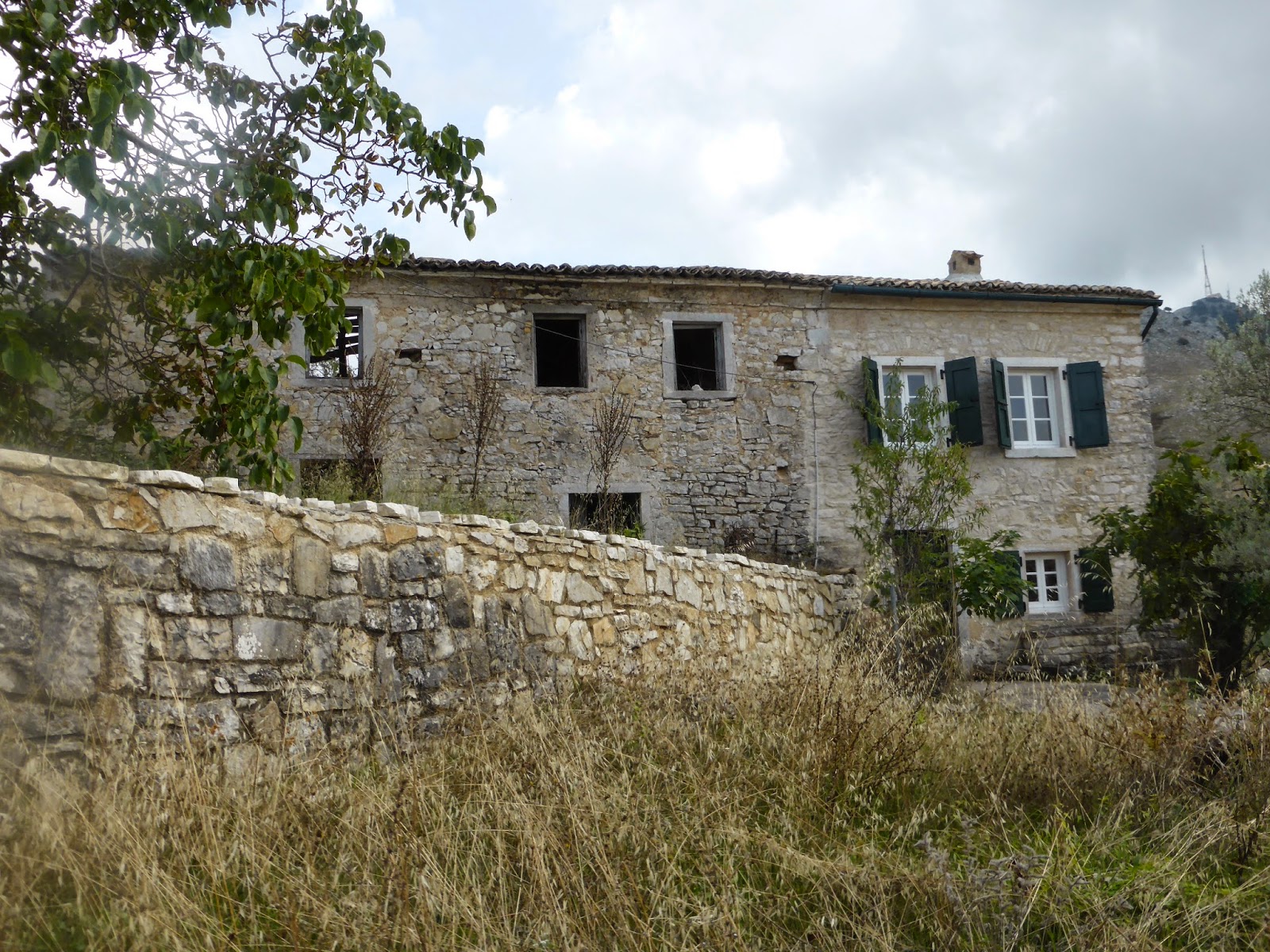
Our last adventure with Sharon and Doug is to hire a rental car to drive around northern Corfu including the ancient village of Perithia, we’d heard about while watching a Rick Stein documentary on TV. This village is perched up 700 metres in isolated mountains and spectacularly set among groves of olive and cypress trees. It dates from the 13th century and is still accessed only by a narrow paved track. Largely abandoned until recently, a few people now live here among the many ruined houses and churches and visitors have a choice of six rustic tavernas, the one where Rick Stein dined being the most popular.
Picture of Rick Stein at restaurant in Perithia
View of part of Perithia village
This photo shows one part of a building in ruins while the other has been restored and is in use
This old building is for sale
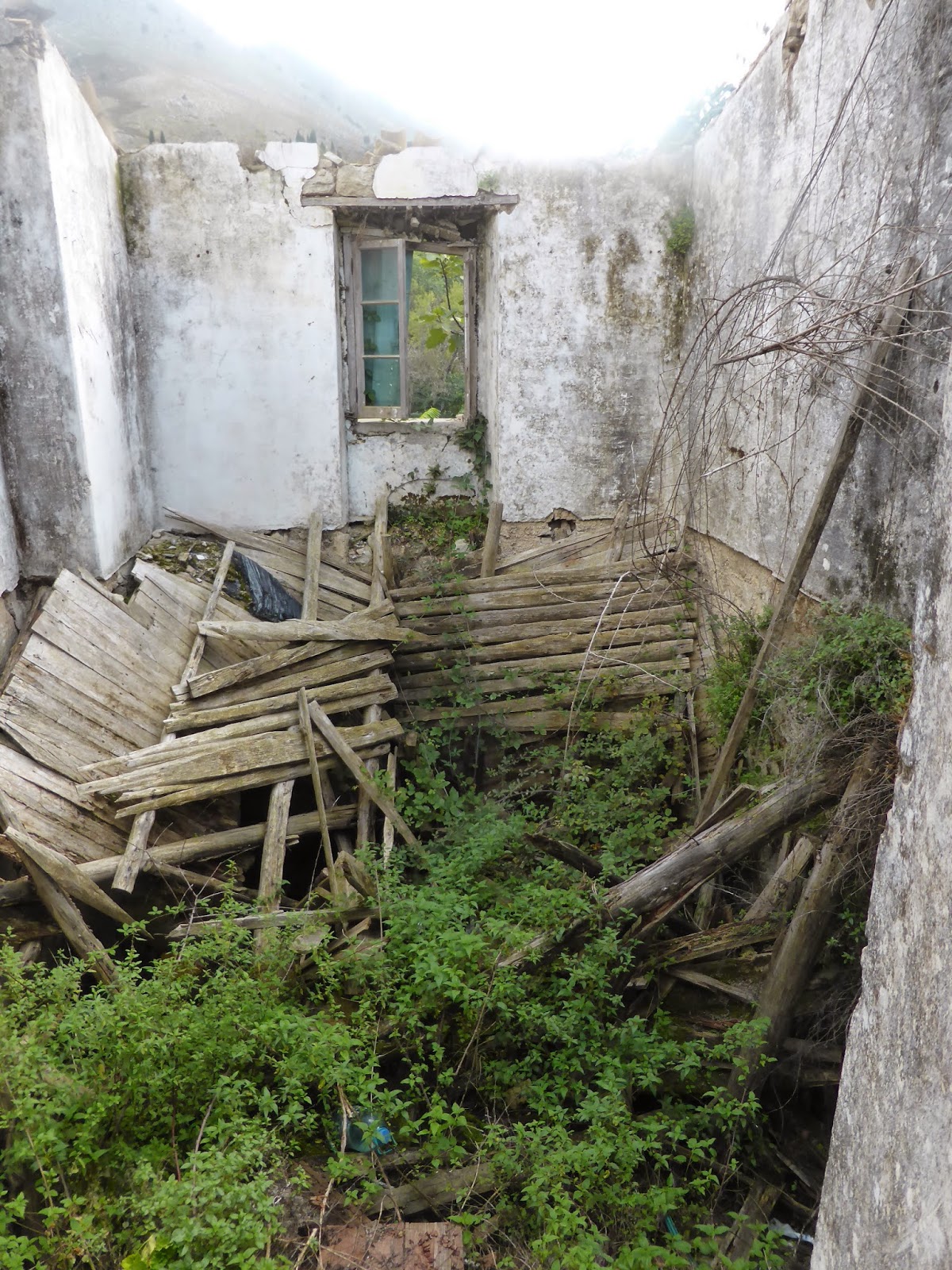
But look inside
At our final dinner with Sharon and Doug we monitor the New Zealand election results and celebrate not only a great time together, but a positive outcome for New Zealand with the re-election of John Key’s centre-right government.
After Sharon and Doug depart we stay on at Gouvia Marina for a few maintenance jobs – see below.
TECHNICAL Leon, an electrician well-known to us, diagnoses our autopilot motor problem as magnets inside the motor becoming detached from its casing. He removes the motor, confirms and fixes the problem and now all is working well. He also suggests that since we have two autopilots we interchange them every few hours, particularly in rough conditions, to make sure the motors don’t get too hot.
Leon also replaces a failed Racor gauge that connects to a water detection alarm in one of our two Racor filters for the Lugger engine.
The guest Vacuflush head has had a problem for several years – the vacuum pump switches on every 20 minutes or so to recharge, indicating a vacuum leak somewhere in the system. A couple of servicemen come aboard and first replace the four duckbill valves. The old ones hadn’t been changed in over eight years and apart from being a bit hard aren’t too bad. This makes no difference. Then the whole toilet bowl is removed and the three seals changed. Again there is no difference. Finally they replace the shaft and seals on the flushing lever and this does the trick. Now the head doesn’t recharge except after flushing, as it is supposed to do.
Some different servicemen investigate a water leak from our Splendide clothes washer, finding it’s from the 120 volt water circulation pump. It’s then a reasonably major operation to take out the machine so the pump can be removed for repair, and we’re still waiting to hear if they manage to repair it – watch this space.
ENVOY LOG As at 25/9/14, we’d spent 170 days aboard and cruised 1,725 miles for 306 engine hours.
He’s Back!
Nordhavn Exumas Abacos Bahamas trawler Caribbean Pickwick Boat dogs
Memphis Downtown
Thursday, October 16, 2014 LaConner Washington
Friday, September 5, 2014 – underway from Anacortes to Vancouver BC
It feels good to be back on Serenity again. She has spent the last two months in covered moorage with little company. Earl found someone to wash her while she sat there. It was a job to rival Fito’s in Mexico, for not quite twice as much, which is still not at all bad considering the work involved.
We are having a beautiful trip to Vancouver. We plan on overnighting in Coal Harbor. Depending on what we need to dispose of at customs, we will need to add to our stores, before leaving the dock with our dear friends John and Maria Luisa who are in Vancouver visiting John’s son Peter. We are looking to showing off the Coast of British Columbia to these friends from Mexico.
The US gillnet fleet is out in force. “Pushing the line” here means the international border. They have apparently not had a good season with most of the salmon entering Puget Sound from the north. The BC fleet is not fishing today. We are seeing lots of salmon jumping and I can’t help thinking of the thrill of setting out the net and seeing it light up with splashing fish. Those were some of the most memorable times of our gillnetting in Cook Inlet and I feel quite nostalgic!
 |
| Vancouver is a beautiful city |
Thursday, September 11, 2014 – Returning from Vancouver BC to Anacortes
After a lovely trip up the coast, we pulled into Coal Harbor Marina about 7 pm on Friday. This is a beautifully located marina, right in a downtown area near some big hotels and the cruise ship marina. My only complaint was the absence of WiFi at the docks. It was available at the office, but that is not the same.
The next morning we went to look at a new boat, a 38 foot Sabre Express. Knowing that our long range cruising is now behind us, we are looking for something that might be better suited to shorter trips around Puget Sound. Earl loved it.
Around noon, our friends John and Maria Luisa togerther with John’s son Peter and his wife Miriam and children Kevin and Kerstin arrived for a luncheon cruise. Kevin and Kerstin are delightful children. They moved up from Mexico two years ago and are thoroughly acclimated and doing beautifully in school. Kevin was the number 1 student in his class.
 |
| Kevin, Miriam, Peter and Kerstin |
We cruised inland, up Indian Arm and found a place to anchor. Being a Saturday and very much in the Vancouver area, it was relatively crowded, but Peter and family loved being out on the boat and we had a pleasant hamburger lunch. We returned to Coal Harbor in late afternoon and said goodbye to Peter and his family.
The next morning, we made an early start to head north to Princess Louisa Inlet. We were anxious to show John and Maria Luisa some of this beautiful country and have them experience our Trac stabilizers. Maria Luisa who is not an adventurous boater was thrilled with the stabilized ride and they are looking forward to installing stabilizers on the Viking Spirit when they return to Mexico.
 |
| Beautiful BC |
 |
| It doesn’t get much better than this |
There are few things as fulfilling as showing off an area you love to someone who has not seen it before. It makes you realize how very special something you have started to take for granted is. We could not have had lovelier day and made good time to our anchorage at McMurray Bay in Prince of Wales Inlet. It is a marginal anchorage with only a small shelf on which to put your anchor. It took us a couple a tries to get a secure hold.
 |
| Everyone was enjoying the warm weather |
The next morning we were up early to be sure to get to the inlet to Princess Louisa in time for the tide at Malibu rapids. John had never been through tidal rapids before and was very apprehensive. It is quite something to see a boiling stretch of water come to a halt. It was for us an uneventful passage into Princess Louisa. Although it was late summer and there had been little rain, there were still water falls. We motored up to Chatterbox Falls where we found two other Nordhavns and a couple of other boats and spent a wonderful day enjoy the peace of the special place. For the entire cruise we were blessed unseasonably warm weather – over 80 – and we loved it.
 |
||
| Slack water at Malibu Rapids |
 |
|||
| chatterbox Falls |
 |
|
| Making use of Earl’s ‘Pavillion” – lunch on the boat deck |
Dawn on Tuesday we were up and waiting for the tide at the Malibu Rapids. Once again, John was anxious, but, once again, it was needless. We cruised pleasantly down to Smuggler Cove, a delightful hidden anchorage where we spent a lazy afternoon and pleasant evening.
 |
|
| Smugglers Cove afternoon |
 |
|||
| Smuggler Cove sunset |
 |
| Northwest Light House |
From Smuggler it was a short trip back to Coal Harbor and another look at the Sabre Express. I don’t know how happy I would be to trade Serenity’s fuel consumption of less than 1.5 gallons per hour for something that takes 4 or 5 times as much.
With promises to see them in early 2015 in Mexico, we said goodbye to Maria Luisa and John and left early on Thursday September 11th for the return trip to Anacortes. This time the Canadian commercial fleet was out in front of the Frazer and we watched as they hauled in the salmon as we made our way south. It was a speedy trip as we had the tide with us and we were all tied up in by mid afternoon.
 |
| Catching salmon |
It has been quite a month since our cruise to Princess Louisa. We spent the next few days watching in horror as hurricane Odile slammed into Baja and devastated our beloved La Paz. The boats anchored out were heavily hit and three cruisers drowned. We are in sorrow for the lovely people that we lived among for five winters.
We also made the big decision to sell our beloved Serenity. We have spent the last month emptying her. I have come to realize that it is always low tide when I have a cartload of stuff to take up to the car. As we unloaded her, I was reminded by how much storage there is on a Nordhavn 43 and horrified at just how much we had accumulated in the time we had used her as a second home. Our garage is now stuffed and we have a job ahead of us to sort through all of it.
We will be trying to sell her ourselves using NordhavnFSBO. We are waiting for a sunny day to take some photos of her interior and I have the task of putting together the list of her equipment etc to list her. It will be a bittersweet day when we turn the keys over to someone else.
Thursday, October 16, 2014 LaConner Washington
Friday, September 5, 2014 – underway from Anacortes to Vancouver BC
It feels good to be back on Serenity again. She has spent the last two months in covered moorage with little company. Earl found someone to wash her while she sat there. It was a job to rival Fito’s in Mexico, for not quite twice as much, which is still not at all bad considering the work involved.
We are having a beautiful trip to Vancouver. We plan on overnighting in Coal Harbor. Depending on what we need to dispose of at customs, we will need to add to our stores, before leaving the dock with our dear friends John and Maria Luisa who are in Vancouver visiting John’s son Peter. We are looking to showing off the Coast of British Columbia to these friends from Mexico.
The US gillnet fleet is out in force. “Pushing the line” here means the international border. They have apparently not had a good season with most of the salmon entering Puget Sound from the north. The BC fleet is not fishing today. We are seeing lots of salmon jumping and I can’t help thinking of the thrill of setting out the net and seeing it light up with splashing fish. Those were some of the most memorable times of our gillnetting in Cook Inlet and I feel quite nostalgic!
|
| Vancouver is a beautiful city |
Thursday, September 11, 2014 – Returning from Vancouver BC to Anacortes
After a lovely trip up the coast, we pulled into Coal Harbor Marina about 7 pm on Friday. This is a beautifully located marina, right in a downtown area near some big hotels and the cruise ship marina. My only complaint was the absence of WiFi at the docks. It was available at the office, but that is not the same.
The next morning we went to look at a new boat, a 38 foot Sabre Express. Knowing that our long range cruising is now behind us, we are looking for something that might be better suited to shorter trips around Puget Sound. Earl loved it.
Around noon, our friends John and Maria Luisa togerther with John’s son Peter and his wife Miriam and children Kevin and Kerstin arrived for a luncheon cruise. Kevin and Kerstin are delightful children. They moved up from Mexico two years ago and are thoroughly acclimated and doing beautifully in school. Kevin was the number 1 student in his class.
|
| Kevin, Miriam, Peter and Kerstin |
We cruised inland, up Indian Arm and found a place to anchor. Being a Saturday and very much in the Vancouver area, it was relatively crowded, but Peter and family loved being out on the boat and we had a pleasant hamburger lunch. We returned to Coal Harbor in late afternoon and said goodbye to Peter and his family.
The next morning, we made an early start to head north to Princess Louisa Inlet. We were anxious to show John and Maria Luisa some of this beautiful country and have them experience our Trac stabilizers. Maria Luisa who is not an adventurous boater was thrilled with the stabilized ride and they are looking forward to installing stabilizers on the Viking Spirit when they return to Mexico.
|
| Beautiful BC |
|
| It doesn’t get much better than this |
There are few things as fulfilling as showing off an area you love to someone who has not seen it before. It makes you realize how very special something you have started to take for granted is. We could not have had lovelier day and made good time to our anchorage at McMurray Bay in Prince of Wales Inlet. It is a marginal anchorage with only a small shelf on which to put your anchor. It took us a couple a tries to get a secure hold.
|
| Everyone was enjoying the warm weather |
The next morning we were up early to be sure to get to the inlet to Princess Louisa in time for the tide at Malibu rapids. John had never been through tidal rapids before and was very apprehensive. It is quite something to see a boiling stretch of water come to a halt. It was for us an uneventful passage into Princess Louisa. Although it was late summer and there had been little rain, there were still water falls. We motored up to Chatterbox Falls where we found two other Nordhavns and a couple of other boats and spent a wonderful day enjoy the peace of the special place. For the entire cruise we were blessed unseasonably warm weather – over 80 – and we loved it.
|
||
| Slack water at Malibu Rapids |
|
|||
| chatterbox Falls |
|
|
| Making use of Earl’s ‘Pavillion” – lunch on the boat deck |
Dawn on Tuesday we were up and waiting for the tide at the Malibu Rapids. Once again, John was anxious, but, once again, it was needless. We cruised pleasantly down to Smuggler Cove, a delightful hidden anchorage where we spent a lazy afternoon and pleasant evening.
|
|
| Smugglers Cove afternoon |
|
|||
| Smuggler Cove sunset |
|
| Northwest Light House |
From Smuggler it was a short trip back to Coal Harbor and another look at the Sabre Express. I don’t know how happy I would be to trade Serenity’s fuel consumption of less than 1.5 gallons per hour for something that takes 4 or 5 times as much.
With promises to see them in early 2015 in Mexico, we said goodbye to Maria Luisa and John and left early on Thursday September 11th for the return trip to Anacortes. This time the Canadian commercial fleet was out in front of the Frazer and we watched as they hauled in the salmon as we made our way south. It was a speedy trip as we had the tide with us and we were all tied up in by mid afternoon.
|
| Catching salmon |
It has been quite a month since our cruise to Princess Louisa. We spent the next few days watching in horror as hurricane Odile slammed into Baja and devastated our beloved La Paz. The boats anchored out were heavily hit and three cruisers drowned. We are in sorrow for the lovely people that we lived among for five winters.
We also made the big decision to sell our beloved Serenity. We have spent the last month emptying her. I have come to realize that it is always low tide when I have a cartload of stuff to take up to the car. As we unloaded her, I was reminded by how much storage there is on a Nordhavn 43 and horrified at just how much we had accumulated in the time we had used her as a second home. Our garage is now stuffed and we have a job ahead of us to sort through all of it.
We will be trying to sell her ourselves using NordhavnFSBO. We are waiting for a sunny day to take some photos of her interior and I have the task of putting together the list of her equipment etc to list her. It will be a bittersweet day when we turn the keys over to someone else.
CRUISING UP THE “BOOT” OF ITALY TO THE GREEK ISLAND OF OTHONI
After our very early morning visit from Coastguard at anchor, we weren’t long back in bed before needing to get up to make an 0500 hours departure for a 12 hour cruise to Gallipoli (yes the Italians have one too), on the north-east side of the Gulfo di Taranto. We enjoy these early departures, drinking copious cups of tea while watching the sky gradually lighten and the sun rise, and when you’re cruising at under 6 knots it makes a big difference to cover 20 miles or so before breakfast.
By 1300 hours the wind had increased to over 20 knots and beam seas had built up to about two metres with breaking tops, the inevitable larger wave’s power causing Envoy to shudder as her stabilisers fought to keep her on an even keel. Sharon became seasick, but there was nothing we could do except grind on for another three hours until we reached the shelter of Gallipoli. As generally happens with sea sickness Sharon was fine again within about half an hour as we joked that it wasn’t the greatest way to spend her 70th birthday!
Interestingly along this whole stretch of coast we only spotted a handful of boats in five days – mostly local fishermen.
Gallipoli is a stunning medieval fortified town, much like Syracuse, with a well-preserved Byzantine castle last used to drive off a British fleet in 1809. The old town and its castle are built on what was once an island, but now connected with a causeway. It’s much more interesting than nearby Santa Maria di Leuca although more expensive at 90 Euros (NZ$141 per night). Here we “cleared-out” of Italy in preparation for arriving back in Greece.
Gallipoli street scene
Overview of Gallipoli old town (a photo of a picture)
We had one more long cruise of about 13 hours ahead of us to reach Othoni Island off Corfu’s north-west coast, so made an 0600 departure. Soon our towed fishing lure scored several strikes and we landed a small tuna which later made excellent sushimi after cutting off its tail to bleed it.
Doug and Laurie landing small tuna. In New Zealand I’d be embarrassed with a picture like this, but this is the first fish kept in two years and hundreds of miles of trolling
We also caught several other bright-coloured fish of edible size, but not knowing their species didn’t risk eating them.
By early afternoon the wind picked up to 15 knots on our starboard bow kicking up a 1.5 metre short chop. As if a still-healing broken kneecap wasn’t enough poor Sharon became seasick again for a few hours until we reached the shelter of Othoni Island to be greeted by a pod of dolphins leaping about. The main bay on Othoni’s north side is very isolated but offers superb shelter from all southerly winds, and we anchored hoping for a restful night after our long day – but it was not to be.
About 1900 we noticed a display of lightning in the distance, and this seemed to gradually increase in intensity and move towards us. After dark the sheet lightning lit up the whole sky like daylight, while the bolts of forked lightning looked like giant flaming spears thrust into the sea, leaving us imagining the consequences of being hit by one of them. About an hour after we went to bed the wind turned north and a medium chop quickly set in, causing quite a bit of pitching. Diane and I knew from experience this was the storm front approaching and immediately got up to investigate. The wind had suddenly increased to nearly 20 knots and the chop was already nearly a metre. Then torrential rain hit is and the thunder and lightning increased in intensity as the front passed over. The real problem in these Med storms is that the wind can increase to over 50 knots very quickly, and there was no alternate anchorage nearby. But the wind stayed around 20 knots for just a few minutes and then just as suddenly dropped completely, and soon the sea was calm again. “Panic” over – the storm front had passed and all was well.
Next day we went ashore at nearby Erikoussa Island and the effects of the storm were quite visible with lost electrical power and damage caused by flash floods.
TECHNICAL – Nothing to report. I do enjoy typing these words!
ENVOY LOG – as at 14/9/14 we’d spent 159 days aboard and cruised 1,692 miles for 300 engine hours.
What a week…
And it’s not over.Nordhavn Exumas Abacos Bahamas trawler Caribbean Pickwick Boat dogs
Memphis Downtown
Making Us Homesick —
But, after dealing with the South Florida sun all summer, we’re not about to leave just when the weather’s starting to turn beautiful again.This video makes me hungry and want to go back to Memphis for a few days. I can actually smell the place.Kelly E…
ENVOY STARTS RETRACING HER ROUTE "HOME" TO GREECE
Envoy is currently cruising around the Corfu Channel.
In Taormina we decided to put Envoy on a mooring so we could safely leave her while exploring ashore. The moorings are owned by a very helpful Maltese guy called George, who charges a rather expensive 45 Euros (NZ$70) per night for them, including rubbish collection, but also ferries people from boat to shore and back for 10 Euros (NZ$16) per trip. This is good because in this area it’s not easy to find a place to leave your own dinghy when going ashore, and you often have to pay to leave it in a safe place. Also George’s very large RHIB would make it easier for Sharron to get ashore with her very sore knee.
Next day George took Doug and I ashore, and we caught an open-topped red hop-on, hop-off tourist bus to Taormina. The guide / ticket-seller told us the return time and a couple of hours later we caught the red bus back, but half way through the trip we realised it was a similar looking bus but not the same one we’d caught before, and in fact operated by a different company. Fortunately the guide was engrossed in answering questions from another passenger and never asked to see our tickets, so we got back without any problem.
Doug has a big interest in cuisine so it was a must to hire a car and take him to see Catania’s La Pescherie – the fishmarket (as described in an earlier posting). As Lonely Planet says, this is the best show in town and not to be missed – anybody who thinks “the Med is fished out” needs to visit this huge market brimming with exotic fish species.
Doug with some large swordfish at La Pescherie
La Pescherie sells all kinds of food and here Doug is buying some nuts
It was time to leave Sicily and start heading up the boot of Italy and back to Corfu in Greece.
Map showing the boot of Italy
This journey takes five days cruising most of each day as there are very few anchorages along the coast and the marinas are widely spaced. First day was a pre-dawn departure for a nearly 12 hour cruise to Roccella marina. We could hear thunder and see lightning in the distance but didn’t encounter any, although at sunrise we saw some impressive storm clouds.
Storm clouds at sunrise
Roccella marina is an efficiently run operation costing 50 Euros (NZ$78) per night including power and water. For the first time in six years of Med cruising we had a berth with a finger, enabling us to disembark and board without using the passarelle. This was great for Sharron with her sore knee, and we went ashore to the one and only pizzeria for a one metre-long pizza.
Envoy berthed alongside a pontoon finger for the first time
Before sunrise next day we headed across the Gulfo di Squillace, so named as it’s notorious for sudden squalls, but we had perfect calm conditions. We had planned to overnight at a marina called Le Castella, but when we got there at 1600 hours we found it very small, shallow and with no assistance or direction available.
Wind generators above Le Castella marina
Le Castella marina has a very narrow shallow entrance
We headed further north towards a larger marina in a harbour called Crotone, hoping to arrive before dark – we don’t like arriving at unfamiliar places during darkness when you can’t see fishing nets, mooring lines in the water and other possible hazards. However the coast just south of Crotone was perfectly sheltered in the light wind so we were able to anchor off a beach after an eleven hour cruise, saving ourselves marina fees.
At 0330 hours the next morning we were awoken by the roar of powerful engines, a wake causing Envoy to roll and sweeping searchlights – the Coastguard had come to investigate us. I sleepily went up on deck and an officer politely asked where we were from and heading to, how many people on board, why we were anchored there and when we were leaving. Satisfied with my answers he thanked us and soon roared off again. Although in Italy we’ve seen many Coastguard, Polizia and other official vessels this is the first time any have questioned us.
TECHNICAL – Nothing to report
ENVOY LOG – as at 10/9/14 we’d spent 155 days aboard and cruised 1,526 miles for 274 engine hours.
The Argonaut FORCE TEN GALE September 28, 2014
CAPTAIN’S LOG September 21-29, 2014
Encountering a Force Ten Gale
At Sea in South Pacific off the coast of New Zealand: Leaving Tongatapu required negotiating the channel between the reefs and Eau Island to the east. The channel was boiling with an inrushing tidal current the severity of which we hadn’t seen since cruising Desolation Sound in British Columbia in 2011. Once outside the channel we could see the waves crashing on shore and the blow holes spouting huge mists of water in the air. After about an hour we reached the open sea and the real show began; the largest swells I have ever seen and only imagined came rolling toward us. They were somewhere around 20ft high on a moment of 12sec. They were massive mountains of water rolling at 30 mph under our keel. It was truly a spectacular, awesome, spellbinding sight! Argo was first lifted up by the waves, then she rolled over the top and came running down the backside. It really looked like a somewhat smaller version of the waves shown in the movie The Perfect Storm. Despite the size of the swells, our travel over them was pleasant due to their long moment. Swells of that size are both things of beauty and amazement, and at the same time, terrifying. As we moved along, the seas subsided to a more normal state; we had twenty knots of wind and 8 -12 ft. seas on the forward port quarter for the balance of the day. We all took meclizine to combat sea sickness and as a result we were all sleepy, but not sick. I slept like a baby as Tyler stood the night watch. My crew mates, however, reported not sleeping so well that first night.
The next day things began to calm down and by the second full day our passage was very pleasant. We downloaded a weather file from the satellite and confirmed that we were on track to avoid the worst of the storms that lay ahead. The current in this part of the ocean can be as high as 2 knots on our nose. It must be because of the upwelling of cold water from the Tongan Trench, which is one of the deepest parts of the ocean at 32,000 feet deep. We ramped up our RPMs to 1500 to try and maintain a speed of at least 8 knots, but often we would barely make 7 knots. We tried to maintain as much speed as possible to sneak past the rough weather emerging to our south; occasionally we made over 9 knots when the current slacked off. During the third, fourth, and fifth day the ocean was like a lake, but our weather files showed the potential for rough seas as we approached New Zealand. We made plans to alter our course for the northern port of Opua if things turned sour. Meanwhile Rebecca and Melanie were cooking up some fantastic meals in the galley. Before we made landfall in New Zealand, we had to eat all our meat and vegetables or the kiwis would confiscate it.
Force Ten Gale: Around 11:00 on September 29, with only 60 miles to go to Great Barrier Island, the radar picked up the image of a storm ahead. The seas were calm, the barometer was 1014, and the wind was only 10 knots. The forecasts had been very accurate during our passage and we were updating them four times a day via satellite. We anticipated seas of 10-12 ft., which is no big deal for Argo; as it turned out, the actual weather we confronted was twice that forecast. I put a picture of the weather chart on www.tischtravels.com so you can see what we wound up facing. By 12:00 the seas had changed direction and were building as expected, and the wind was nearly 20 knots. By 14:00 the wind was about 45 knots +/-, and the seas continued to build. By 15:00 the winds were sustained over 45 knots and mostly in the 50 to 60 knot range, with top winds at 63.3 knots. Seas became tremendous at 20 to 30 feet at 8 to 12 seconds. They were huge, steep; mountains of water stair stepped by the ferocious wind, rolling toward us at 30 mph, sucking the water up from beneath and leaving in their wake a deep and treacherous valley. The wind roared in a frightening howl, the ocean was a tumultuous, angry caldron. I tried to position Argo to quarter the waves. Suddenly a massive rogue wave slammed over our bow into the pilothouse windows. My adrenaline shot up. By now the wind was over 60 knots and I began to contemplate an emergency scenario. At this point everyone was in the pilothouse helping me evaluate options; lucky for us Curtis Hoff has a PhD in marine engineering and many years of boating experience. His council was very helpful. I asked Tyler to call the Coast Guard and report our position; ultimately we reported to Maritime Radio Great Barrier Island every hour until we reached safe waters nine hours later. In the meantime I focused on sea keeping issues; guiding Argo in a direction and speed that prevented her from being broadsided by one of those giant waves, or falling into a trough and pitch-polling. From the pilot house we could see the giants coming our way; at first we could look up to the waves’ crest above our roof line. It seemed as though they were going to crash into us, but then we would roll to starboard, be lifted to the top, see the combing crest and watch the crest flow under us. We would then fall off the back of the wave, roll modestly to our port side and slide down into the trough. Argo performed perfectly. After a half hour or so we became concerned that by quartering the waves on our bow we were inextricably moving into the storm. By this time we had been in the storm about 5 hours. We hoped the wind would subside and the storm would blow out to sea, but instead it was intensifying. We had to turn around and try to approximate a course toward land. We discussed the pros and cons of coming about in these dangerous seas, but in the end I decided to take the risk. Turning is perhaps the most dangerous maneuver a captain can execute in a storm of this severity, but we had to do it. The sun was setting and we didn’t want to lose the light. We looked for a softening of the waves and found a moment in which to bring her about and put her stern to the waves. Although we were afraid she might be breached over the stern or take a wave broadside, that never happened. In fact, after the turn, Argo road the seas more comfortably than before. We stayed on this course for about an hour. By now it was 1900 and we had been in the storm for 6 hours, but we were much more confident in Argo and our ability to survive and ride out the storm. At this point I decide we had to return to our original course, which would take us to the outer fringes of the storm and eventually to Auckland, but this required another turnabout. After executing the turn, we were finally on course for Auckland again. Argo was riding relatively well given the circumstances. The sun had set, it was pitch black outside and the wind was screeching; we had five hours to go! An hour or so later Tyler reported that the sea water pump for the hydraulic system had stopped functioning. Without this pump the hydraulic system would soon overheat, we would lose our stabilizers, and we would be in serious, perhaps catastrophic danger. Once again I had to turn Argo stern-to and position her so that we could turn off the stabilizers before they closed down due to overheating. I found that Argo was most stable in this position. So we turned on our spot light, determined the exact wave direction, waited for the right moment and initiated the turn with wide open throttle. She made the turn between waves quickly and we found a very stable position for her to assume. Tyler sprang into action: he removed the strainer and the cover plate to the impeller: everything was OK. Then he took the input hose off the heat exchanger thinking that perhaps it sucked in some air and became air locked; again everything seemed OK. So we turned the system back on and, thank God, it worked. At this point we needed to turn Argo back into the waves and resume our course toward Great Barrier Island and safe anchorage still five hours away. Now it was pitch dark on the ocean. We were in the middle of this terrible storm and waves were coming at us. Argo road the waves perfectly, up and down, up and down. Once in a while a rogue wave would slam us near the stern and spin us off course, but Argo took the pounding and we moved relentlessly toward safe harbor. Every hour we called Maritime Radio to report our position and to obtain permission to anchor before checking into customs. Finally, five hours later at 01:30, we made Great Barrier Island and Katherine’s Bay. With the storm raging around us, we dropped our anchor, had a drink, and fell into bed.
The next morning we got underway at 08:45 and headed for Auckland, 55 miles away. Winds in the protected channel and Auckland harbor were still in the 30 mph range. We hove to the customs dock at 16:22, cleared-in in an hour, and tied up at our final destination, Viaduct Harbor Marina, at 18:00. After 14,000 miles of travel and 8 months underway, we didn’t put so much as a scratch on this fantastic yacht! All of us are in awe of this boat. She took those huge seas with grace, and could take even more.
We were well prepared for the storm; we conduct engine room checks every hour during normal conditions and on the half hour during high seas (which permitted us to always discover problems before that became emergencies), we had installed storm plates on our large salon windows, we knew from experience how to deal with the problems and conditions we faced, everything was tied down and properly stowed. Nothing was broken. No one was hurt. The outside of Argo and all of equipment was undamaged and in perfect condition. It took a day or two for us to calm down, but we are all better seaman as a result of the experience. However, we do not want to experience it again!
Regarding the storm: it continued to rage for several days and intensified into a cyclone.
