Tag Archives | Nordhavn

MORE ABOUT SICILY’S STUNNING EGADI ISLANDS

Envoy is back at Favignana Island in the Egadi Group.
The Egadis are a marine park with all boats banned from some areas and motor boats from others.
Buoys are laid in many sheltered bays and these are in excellent condition costing a reasonable Euro 25 (NZ$39) per night or less for longer periods, during which you can use any of the moorings around the Egadis. Unlike Croatia anchoring is allowed near moorings at no cost. Friendly park staff patrol the islands regularly to collect fees as do Carabinieri to ensure rules are being followed.
The Egadis have no fresh water so this is regularly delivered by tanker.
One morning we awoke to find this tanker had moored just in front of us, and we never heard a thing when it arrived

A Scirocco (strong southerly wind) lasting three days, gave us plenty of time to explore the area around our sheltered anchorage. Like outer Gulf islands home in Auckland the Egadis have winds around 15 to 25 knots much of the time, and here we get a few days of NW-N, then a few of SE to S, so move our position accordingly. Rarely has the wind dropped below 10 knots.

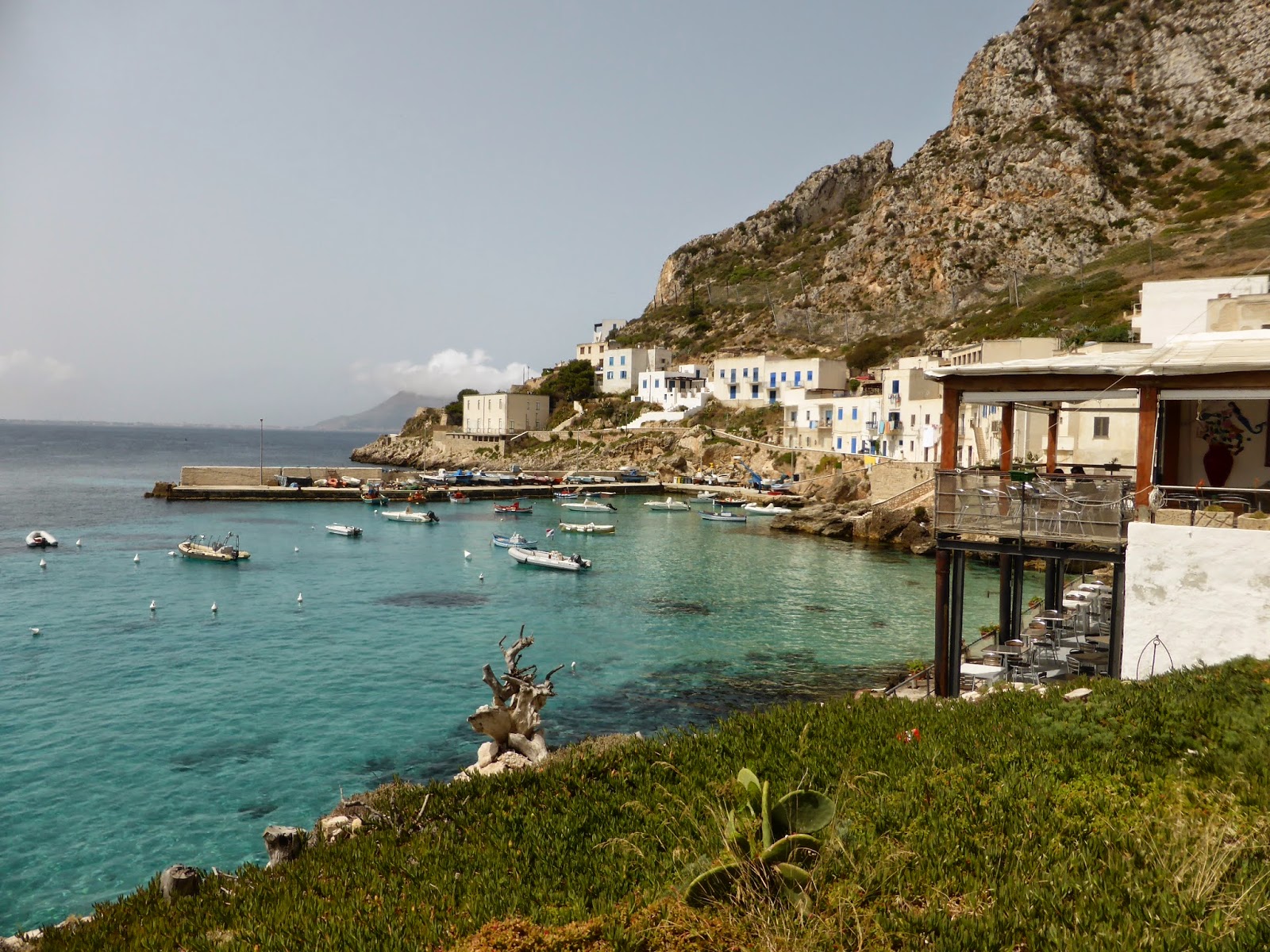
We visited one of the other islands, Isola Lovanzo, and picked up a park mooring in a bay called Cala Freddo. This island’s only village is in the next bay around, Carla Dogna.

Carla Dogna’s quaint harbour

Envoy on mooring in Cala Freddo

We reported earlier that Sicilian wine is great and well-priced – this extra large 1.5 litre bottle of excellent Nero D’Avola red cost only 5 Euros (NZ$7.80)

Back on the main island – Favignana there’s a great anchorage on the southern side where we spent several nights.

There are a few yachts around, mostly Italian and we’ve not seen many cruisers at all except for a couple of French and Germans. During daytime many locals cruise the area in their small powerboats but they’re mostly gone by about 1700 and then all is quiet.

TECHNICAL “Touch wood” for good luck we’ve not had any major issues, only routine things like changing the oil and filters on the Lugger and generator.
Our Lugger engine’s conventional dry exhaust never emits any smoke, and although the exhaust blows directly onto our white-painted mast I only need to clean soot stains off this area about once monthly. We even hang washing out to dry by the exhaust while under way with no risk of stains. One recent morning I started the engine, went on the foredeck to lift the anchor and saw clouds of white smoke coming from the exhaust. My heart missed a beat – what has happened? I checked our diesel handbook and it cites stuck thermostats, dirty air cleaners, or blocked crankcase vent tubes as possible causes. We were clearing a lee shore in a strong wind so proceeded on and the smoke gradually cleared. Later it occurred to me that we’d had a heavy shower of rain during the night and the exhaust cover wasn’t closed, so some rain must have gone down the exhaust and was now showing up as steam. Since then all fine – huge sigh of relief!

Every day I check the engine room bilges and under each engine for fluid leaks, and our bilges are dry so any drop of oil or water shows up. One day I found the paper towel under the Lugger stained with brown dried liquid. It wasn’t oily or smelly and I had no idea what it was – but out of the ordinary occurrences on a boat do prey on my mind. A couple of days later we decided to clean the freezer. Lo and behold we found a large plastic bottle of coke had exploded, and coke had gone through the freezer’s drain hole into the engine bilge – mystery solved. Up to then we would regularly freeze plastic coke bottles with no problems – but no more!

Although our large RHIB’s 25 hp 4-stroke Yamaha was serviced in Lefkas we only test ran it at idle – big mistake eh Frank? Since then we’ve found it runs OK up to 2,300 rpm and above 2,700 rpm but erratically in between. The Trapani shipyard was also the Yamaha dealer so after much persuasion we got them to take a look and test run. They said the carburetor needed a clean so pulled the RHIB out of the water to do that in their workshop. It was such a quick job they said there was no charge, but when we tested it there was no real change, and we ran out of time for them to look again. So far our experience dealing with Italian technicians has not been good (neither was it on our previous visit). They always say “we’re coming in half an hour”, and you wait all day but they just don’t show up!

Our washing machine has developed a slight water leak. I’m able to see the rear of the machine through an inspection hatch and it’s not leaking from loose supply hoses, but possibly from a discharge hose which can only be accessed by pulling the machine out, which is quite a major job, so we’ll leave this until Corfu where we know there are good technical resources. Meanwhile we place a towel around the leak to soak up the water.

The engine room has two 12 volt blowers to extract hot air. One of these is not working and has a wiring problem that I can’t resolve, but we have an electrician friend, Doug Gooch, arriving next month so hopefully he can help me on this.

ENVOY LOG As at 2/7/14, we’d spent 85 days aboard and cruised 757 miles for 136 engine hours.

[KensBlog 2014-05] Malta, Winds and High Seas

Welcome to Ken’s Blog! (top)

Greetings all!

Sans Souci is in Malta!

Here’s an index to this issue of Ken’s Blog:


Journey Map (top)

As you can see in this map, Malta is south of Italy, and centrally located in the Eastern Med. It’s location has been a mixed blessing. On one hand it’s a place with great natural beauty and warm weather, but limited natural resources. Malta’s problem has been that its central location makes it an attractive location for a naval base. Over the years Malta has been fought over, and captured, many times by a variety of countries.

It was even a battleground during World War II. During a two year period over 3,000 bombing raids were flown against Malta, earning this tiny country the dubious distinction of being one of the most heavily bombed locations during WWII. The Grand Harbor, where we moored Sans Souci received more bombs that all of London!

Map showing Malta’s location


St Julian’s Bay, on the island of Malta (top)

In my last blog entry we were concentrating on Gozo and Comino, the northern-most of the three islands that form Malta. We enjoyed the remoteness and “small town” feel, but wanted to journey south to the capital: Valletta, on the island of Malta itself.

As we were working our way south, along the east coast of Malta, we saw a small bay, just north of Valletta called “St Julian’s Bay” that looked good. In Valletta, the main city and capital, we would be going into a marina (the Grand Harbor Marina) and wanted another night or two of relaxation before hitting the big city.


St Julian’s Bay on the island of Malta. We didn’t realize it at the time but St Julian’s is the “party center” with rowdy bars, nightlife, and a multitude of restaurants. (NOTE: You can click on any of the pictures in my blog for a closer view)

Anchoring at St Julian’s didn’t match up with Roberta’s and my “style” at all. It was like being anchored in front of a major city. We were surrounded by condos and restaurants, in a fairly small, and somewhat rolly, bay. Later, we decided that St Julian’s was probably a fun town, with lots of great restaurants, but at that moment it wasn’t what we were seeking, so we prepared dinner and stayed on the boat. Steven and Carol on Seabird, the Nordhavn 62 that we are traveling with, dropped their tender and went into town, where they had a terrific dinner.

This picture of Sans Souci was taken at dusk from Seabird. It’s one of my favorite pictures of our boat, but I’m also somewhat amused by it. The picture shows how misleading photos can be at times. Had the camera been pointed the opposite direction you’d see all the condos, restaurants and bars – plus the disco lights which were just kicking in for the evening.

We had planned two nights at St Julian’s Bay, but after one night Roberta and I decided we would go on to Valletta, which was really just around the corner. Med-mooring (parking the boat stern-to the dock with nothing but other boats beside us) for the first time in a strange marina is always stressful for us. Roberta had shoulder surgery last year and is still fearful of putting too much load on her shoulder, so is not much help with handling lines and fenders (and we have some heavy lines and big fenders!). Although Roberta is good with driving and maneuvering Sans Souci – though not when coming into a Med-mooring situation in some tight areas – I am effectively single-handing the boat and need help with our lines and fenders. (We’re totally fine with side-tying anywhere, though.) Therefore, whenever we have something to do with which we’re uncomfortable the foremost thought on our minds is, “Well. Let’s just do it and get it behind us.” Thus, we made the decision to cut short our time at St Julian’s and head to the Grand Harbor Marina in Valletta the next day. Seabird, on the other hand, wanted one more relaxing day and night at anchor and headed back to Comino Island to a wonderful anchorage that they had discovered near the Blue Lagoon.


Valletta (top)

Here we are entering “The Grand Harbor” in front of Valletta for the first time. We knew it was a busy harbor with freighters, and every other type of boat, going in and out. We still have vivid memories of our wild approach to Hong Kong where we spent hours dodging other boats; however, it turned out to be a perfectly calm day with plenty of room to maneuver.

Upon entering the marina I radioed for assistance and asked if it would be possible to put a couple of guys on the boat to assist with working lines. The marina said, “No problem” and within five minutes we had two of the marina staff onboard, brought out to the boat by a tender. This made mooring the boat trivial, and in minutes we were tied up at the dock. We were happy campers!

Sans Souci tied up at the Grand Harbor Marina in Valletta, Malta.

As I stepped off the back of the boat the harbormaster was there to greet us. He mentioned that over the years many Nordhavns had been in the marina, but that ours was the first he had seen with a walkway on both sides of the boat. Nordhavn offers boats with an external walkway on one side, or both sides (called “symmetric” or “asymmetric.”) By eliminating one walkway running the length of the boat, the main salon and galley can be larger. However, as with everything on a boat, there are always trade-offs. It is convenient to have the walkway on both sides, especially with performing docking maneuvers, but it is also great to have more space in the salon and galley that would otherwise be taken up by the second walkway outside. In Europe the process of Med-mooring is often simpler by having the ability to quickly and easily move from the bow of the boat to the stern along either side. The dual walkway can also be an advantage when side-tied to a dock because you can thus exit the boat from either side, or dock on either side, whereas asymmetrical boats (single walkway boats) prefer being oriented to the one side with the external walkway. It’s one of those things where there is no one right answer; it’s a personal preference. The N68 has plenty of room in the salon, so we had no trouble giving up some internal space for the ‘option ability’ of docking and maneuvering.


The Grand Harbor viewed from high on the hill of Valletta, as well as the sunrise and sunset views from aboard Sans Souci. To reach Valletta we would take a water taxi, then ascend a cliff in a very tall elevator with windows looking out over the harbor as we rose.

Seabird in the process of Med-mooring. At the completion of the process there will be four lines attached to the boat: two at the bow, and two at the stern. The bow lines extend to the center of the marina basin, and the stern lines to the dock. To reach shore you need a gang plank of some sort (called a passarelle) that allows you to walk from the stern of the boat to the dock.

Valletta is the capital city of Malta and is across the channel from the marina. There is regular shuttle boat service there, but we preferred using these gondola-like water taxis. They were a little expensive (10 euros each way) but very convenient. They would pick us up directly from the boat and drop us a few minutes later very close to the base of the giant elevator which rose very high to the old city of Valletta. Our taxi driver mentioned that his water taxi business had been in his family for 155 years – and was still a family business.

Several times we took a water taxi into the city. Perhaps we just had a particularly colorful taxi driver, but we were always amused by our discussions with him. Over the days we were in Valetta we would meet his brother – also a water taxi driver — hear stories about his wife, trips to the doctor and even opinions on world politics. His English was far from perfect, and at times we would wonder if we had heard correctly, and at other times hope we hadn’t.


Streets of Valletta. There was much to see, and we saw about 10% of it. Being in the crowded city was hot, sweaty and miserable. We did a day of sightseeing, and attended a movie showing the history of Malta, but otherwise avoided downtown Valletta as we wanted to explore other areas as well.


St. John’s Cathedral is a gem of Baroque art and architecture. It was built in the 1500s as the church for the Knights of St John. The floor is paved with 400 inlaid marble tombstones (picture in lower left,) under which several generations of the great nobility of Europe, members of the Order of St. John, are buried.


From Wikipedia:

On 15 April 1942, King George VI awarded Malta the George Cross, the highest civilian award for gallantry in the Commonwealth, normally awarded to individuals: “to honour her brave people, I award the George Cross to the Island Fortress of Malta to bear witness to a heroism and devotion that will long be famous in history.” President Franklin Roosevelt, describing that wartime period, called Malta “one tiny bright flame in the darkness.”

On the tiny island of Malta, in the first six months of 1942, there was only one 24-hour period without air raids. Luftwaffe records indicate that between 20 March and 28 April 1942, Malta was subjected to 11,819 sorties and 6,557 tons of bombs. 1,493 civilians were killed and 3,674 wounded out of a population of 270,000.

The siege caused significant hardships for everyone on Malta. Bombs killed many and left even more homeless. Businesses and civil infrastructure were destroyed. The disruption of shipping caused food, fuel, and other commodities to be in very short supply. During the greatest times of starvation, it is said that foods were rationed to “three boiled sweets, half a sardine and a spoonful of jam a day”. Poor nutrition and sanitation led to the spread of disease. But they survived and have prospered. After observing the Maltese, Roberta and I agree that they are indeed a resilient, strong and very moral people – and industrious, to boot.

Steven (on Seabird) and I have a semi-ritual of heading to McDonalds for breakfast at least once when we are in a large city. This was the first McDonalds we had seen since Croatia so we had to check it out. To our surprise it really was…”McDonalds.” Just like at home! We’ve found more variation in the food at McDonalds than expected, as they adapt the food to match local tastes, and many McDonalds don’t serve breakfast at all (perhaps because the local country doesn’t eat the breakfast food as we habitually do in the United States – be that good or be it bad).

Once was enough, but one of the reasons I like to visit is just to look at the prices. In Malta an Egg McMuffin costs 3.25 euros ($4.40 US dollars) vs $2.79 in Seattle, or 58% more. Labor prices? Exchange rate? Higher food costs? I don’t know, and don’t know that it matters, but…I’m always curious about these things. I also tend to look in the window at real estate places, curious to see what home prices are like. Thus far, Europe may be overpaying for Egg McMuffins, but they make up for it on home prices (vs Seattle, where prices are, let’s say…high.)


Our marina, the Grand Harbor, is actually located in a town called Vittoriosa, and while exploring it the first evening we saw an advertisement for “Rolling Geeks,” a tourist business based at the marina. They rent you A beefed-up golf cart with a GPS-synched and automated tour guide. The GPS is programmed with a 17-mile route around three surrounding cities, including Vittoriosa. It seemed like something fun to do; a chance to explore outside the main tourist zone of Valletta, and without having to walk in the heat of the day to see things.

What I didn’t realize is that the business was just opening and we were only their second customer!

I also didn’t realize that we’d actually be on real roads driving in real car traffic – where they drive on the left instead of the right as we’re used to in the U.S. The GPS-talking-tour guide was supposed to intelligently guide us around, but the synchronization was off in some places, then halfway through our tour, we went over a small bump (not speeding, don’t worry!) and our GPS-talking tour guide went blank! Without it, we didn’t know where we were and what we were supposed to be seeing. We made our way back to the marina via my cellphone and Google Map! It’s a cool idea and we liked that we could move at our own pace (theoretically the tour guide would trigger its speech-tour based on our location.) But it obviously didn’t work out quite as it should. The lady who ran the business (who was REALLY nice and helpful) was monitoring us from back at her office, and was observing remotely as we went miles off course, and even went into a loop at one point, being guided around a two mile circle. When we finally returned the cart, she looked at us like we didn’t know how to read a map, or maybe didn’t understand GPS or computers! I tried to convince her that we had somehow cruised a boat from Seattle to Malta, and that maps and computers are our strengths. But she looked doubtful. All of that said, I like the idea, and people running a business, and wish them all the luck in the world – once they work out the bugs! Even though we deviated from time to time and missed one city out of the three, it was a really fun day! We even went back two days later to rent the cart again, this time to drive several miles to a well-stocked supermarket for provisions.

These pictures show one of the stops on our tour: Smart City. Malta is a tiny set of three islands out in the middle of the Mediterranean, with limited natural resources. As we travel the world, part of the fascination for me is to look at how different countries play the cards they are dealt, and how their economies respond. Smart City is a joint venture between Dubai and Malta to create a high-tech “city,” in an attempt to bring high-tech businesses to Malta. The project is early in development but big money is being spent to create an environment with residential, educational and commercial real estate, paired with massive bandwidth, restaurants, and amenities like beach walks and man-made lagoons. It’s a very long-term effort to try to bring high paying jobs to Malta. To some extent we’ve seen this in Seattle where Paul Allen (of Microsoft fame) has basically transformed the south Lake Union area of Seattle over the years by targeting high-tech companies like Amazon, and creating the kind of living/working environment that appeals to young well-educational professionals.

Another example of this same goal of proactively bringing jobs to Malta was a film studio that we drove past. Malta is trying to lure mainstream film production to Malta (emphasis on “trying”) with a combination of financial incentives and Malta’s excellent weather.

And, Malta also receives a boost to the economy from the many British who retire there or who buy second homes. They also encourage friendly tax policies and tourism.

There are probably many more examples. But, based on the little that I’ve seen, and the people with whom I’ve spoken, the Maltese seem to be entrepreneurial, religious, hardworking, family-oriented and exceptionally friendly!

After four days in the Grand Harbor Marina we decided it was time to move on.

Sans Souci carries 3,000 gallons of fuel, although I probably only started the trip with about 2,800. The Montenegro fuel dock had made it clear that personal disembowelment was a distinct possibility if I let one drop of fuel touch their pristine water! Thus I left some room at the top of each tank and we departed Montenegro with approximately 2,800 gallons. In Malta, I was now at 1,700 gallons remaining. With well over half of my fuel remaining I could almost certainly squeak by for the balance of the trip. However, my philosophy is to take fuel whenever I need more than 500 gallons and see an easily accessible fuel dock.

The Grand Harbor Marina doesn’t really have a fuel dock. To take fuel, you look for empty space amongst their super-yacht moorings, side-tie to the wall and make an appointment with a fuel truck.


Sans Souci, snuggled between two super-yachts taking fuel from a truck. There was plenty of room to go between the boats, but there was also 20 knots of wind, and I knew that if I scratched one of the big boats it would be an expensive mistake. The fuel was reasonably priced for being Europe: $7 per gallon.


Back to St Julians Bay (top)

I am not someone who believes in backtracking, but sometimes you have no choice. From Malta, our next destination would be back to Siracusa (Syracuse). From there, we would leave Sicily, traveling north through the Messina Strait, and start working our way through the Aeolian Islands, the west coast of Italy, Sardinia and Corsica.

We had an uncomfortable ride when coming south to Malta, and wanted a smooth ride for the trip back north. We all wanted at least one more night at anchor before heading north and thought a return to St. Julian’s Bay might be a good idea. We were expecting some wind, but St. Julian’s bay is open only to the northeast and the wind would be coming from the northwest. Roberta and I felt that we hadn’t given St. Julian’s Bay a fair shake and wanted to spend a night there and eat at one of the great restaurants for dinner. Specifically, we had heard the nearby Hilton Hotel had a high-end Thai restaurant, the Blue Elephant, that we wanted to visit.

Just after dropping the hook we realized that we should have stayed another night at the Grand Harbor Marina. Whereas on our first trip to St. Julian’s we’d had a relatively smooth night, this time, we could see a swell coming into the bay. We had predicted the wind direction correctly, so…there shouldn’t have been “much” of a swell, but…there was, and it was a strong one. Not only would we NOT be going out for Thai food, sleep was looking unlikely as well.

When anchoring conditions are less than perfect I usually head for the pilot house. Roberta never understands why, if all is safe – as it really was. I really have no good explanation. I just feel more comfortable when I’m where I can keep track of our swing circle and see what the wind is. If I’m not going to be sleeping anyway – I reason — why not be where I can at least monitor the situation?

In the middle of the night, as we were being rolled from side to side in a beam swell, I started thinking about my blog and what adjectives I’d use to describe it. Would I say it was a “moderate swell,” a “heavy swell,” or … an “extreme swell.” Ultimately, none of these words mean much of anything. They are too ambiguous. I decided to search the internet for an app that would quantify the amount of roll, and found one: “myGyrosope” for the iPad. I am not endorsing that particular app, it was just the one I found in the middle of the night. I wanted to be able to say something like, “We were rolling 5 degrees in each direction.” These are the things we retired software guys think about at 4 a.m. Was there ever any doubt?

Anyway…I ran the software and produced the graph below. The answer: We were rolling +/- 7 degrees. I’ll be darned. It felt a lot more than that!

We spent that miserable night anchored at St. Julian’s bay, rolling all night. This picture shows an attempt I made to “quantify” the amount of roll.


Return to Gozo (top)

With the weather not cooperating, all ideas of anchoring anywhere were off the table. We decided to make the short run back to Gozo, to position for the passage north, and just return to the Mgarr marina. It’s funny that a marina we had never planned to go into suddenly dominated our time in Malta, and that we went there on three separate occasions. Oh well…that’s boating for you. Ultimately, all cruising plans are “best written on sand — at low tide.”


Roberta and I wanted to give the dogs a walk and also wanted to get a picture of the Gozo Mgarr Marina from high up. During our walk, we discovered an old walled fort, dating back to the 1700s, which, after hundreds of years of decaying was being redeveloped as high-end condos.

Click this link to see a panoramic image of the view over the islands from the fort:

http://photosynth.net/view.aspx?cid=ff95350d-80af-45db-abfc-489b1ead0054


Although we were forced into port by the weather, we weren’t suffering. This is the four of us having dinner by the sea in Xlendi, a small seaside town on Gozo. Xlendi is a beautiful little place with a waterfront lined with restaurants. It was only about three miles from the marina, but a 20 minute drive by land. I considered using the tender to get to dinner, but as this picture shows, it would have been a bad idea, as the entrance to the bay looks rough because of the wind. Allegedly boats our size can enter the bay to anchor, but I don’t think I’d try it.

Both Seabird and Sans Souci were moored just across from where a large ferry arrives and departs every 45 minutes. Normally, the wake from the ferry is only a mild annoyance, but every once in a while the ferry does a spinning maneuver to move from one dock to the next, employing its giant thrusters. When it does this it passes so close to Seabird that Steven sitting on the back deck felt he could almost touch the ferry. The thrusters put out so much force you feel you are in a fast-moving river.

Roberta and I and the pups took the ferry one day, to visit the main island of Malta, rent a car and drive around. Here’s our view from the ferry as we departed.

http://photosynth.net/view.aspx?cid=a122e813-615f-4cf4-9971-ee7c59c11bc1

Driving around Malta was more of an adventure than expected. The Maltese drive on the left side of the road, like the British. That was a little difficult, but the worst was having the stick shift on the “wrong” side – for us Americans, that is.

While were driving around Malta I took this panoramic image of St. Paul’s Cathedral in the medieval walled city of Mdina. It is built on the site where governor Publius was reported to have met Saint Paul following his shipwreck off the Maltese coast.

http://photosynth.net/view.aspx?cid=54e67c27-dc28-4c9f-825c-9811657b9da2

And .. a story well worth reading about St. Paul’s shipwreck… http://www.cbn.com/cbnnews/world/2010/february/searching-for-pauls-shipwreck-on-malta/


Siracusa (top)

Our strategy of waiting in Malta until we had a nice clean weather window worked flawlessly. We were up at 4:30 a.m. for a departure at daybreak. The ride north was smooth, with us arriving back at Siracusa, Sicily by the afternoon.

Whereas on our first trip to Siracusa we wanted to explore the city and discover the sites and restaurants, this time we were just looking for a place to rest on our travels north. I was also hoping to get a mechanic on board to work on my watermakers, and I was also going to be effectively replacing my satellite internet system (more on these topics in my “boat geek” report).


Sans Souci and Seabird at anchor in Siracusa, Sicily. We sat at anchor for two days. On BOTH days we had mechanics on board, one for our watermakers and two for our V-Sat internet system. Those were busy days!


Never trust a weather report – the journey to Taormina  (top)

I’ll finish off this edition of the blog (except for those who want to read the boat-techy report below) with a video showing what happened on our passage north from Siracusa to the cliff-hugging town of Toarmina, which would be our last stop in Sicily. It was supposed to have been a totally calm day. We would have 60 nautical miles of the best cruising we could want, with a nice calm anchorage waiting at the other end.

But, it didn’t work out that way….

Instead, we had a solid six hours of nothing but lumpy, choppy seas with 20 knots of wind in our face. The waves weren’t that high (at the worst eight to ten feet), and it was never dangerous, but because the waves were so close together it was just a miserable ride.

Here’s a video which is perhaps too long, but will give you a small sense of what we encountered. Unfortunately, though, video never really captures how it really feels. The waves in this video appear much smaller than they looked at the time. Our two boats did perfectly fine, but it was definitely a day when I was happy that I own a Nordhavn. Really, the worst of it was wondering, “If it is this rough here, what will our anchorage look like on arrival?” And, “If the weather forecasters blew it this bad on forecasting the weather today, what happens when we are headed out on much longer passages?”

And, actually, it wasn’t the wave height that was an issue. We’ve been out in much bigger seas. It was the distance between wave crests that made it uncomfortable, and of course, the fact that it was so unexpected.

Here’s the video. I hope you enjoy it. And, I hope you’ll look forward to my next blog entry when I’ll explain the surprise that awaited us in Taormina!

IMPORTANT NOTE: If for some reason you don’t see a video above (some email programs filter the video out), try clicking on this link:

http://vimeo.com/101063390

Video showing Sans Souci caught in rougher than expected seas. It’s a good one! (albeit perhaps longer than it should be – but, we got to see it for six solid hours. This is just a two minute taste of the action.)


Boat Geek Report (top)

While in Siracusa I was able to find a technician to come on board and look at our watermaker. He had a great idea….

My watermaker has an LED showing the salinity of the water being produced. This LED is effectively an indication of the effectiveness of the membranes. If they are producing water in the 100-300 range, the membranes are virtually new. In the 400-600 range, either something is happening with the temperature or clarity of the water, or more likely the membranes are starting to die.

Once the watermakers start producing water over 700, unless there is something else going on, it’s time for new membranes.

One of my two watermakers (known as WM#2) had died completely. The technician felt the problem was the high pressure pump, but my theory was that the membranes were so clogged they were jamming up the whole system. The second watermaker (aka WM#1) was working, but producing water in the 700 to 800 range, and was randomly spiking to the 1200 range.
Paolo, the technician, felt that we should put the membranes from WM#2 onto WM#1. This would tell us once and for all of the problem was the membranes or the high pressure pump. And, actually, we went a step past that. We did some re-plumbing such that the watermaker (WM#1) could be run on a single membrane. We then ran WM#1 on one membrane at a time, trying each of the four membranes (my watermakers each had two.)

What we discovered was that three of my four membranes were completely dead, with one struggling, producing water in the high 300s and low 400s.

Paolo has ordered four new membranes, which will arrive on Monday. Our current battle is with logistics. It isn’t clear where we and Paolo will be able to hook up, so that he can install the new membranes. And, our other HUGE unknown is, “Why do I need four new membranes?” These were new just two years ago. I’m not sure I’ll ever solve that particular mystery.


For years I’ve been fighting with my KVH internet satellite.

I have a nasty tendency to want to be amongst the first with any cool new technology. That means I often have release 1.0 equipment, and that is certainly true with my VSAT unit. My VSAT unit (from KVH) was one of the first ones made. Over the past seven years my satellite internet has had non-stop problems. It has been awesome when it worked, but it has been prone to random failure. I’ve been on a first name basis with KVH’s Vsat support team and they have gotten to know me much better than any of us would like.

During a call last week I told them that if they could find a way to swap my unit in one day, while in Siracusa, it would make both our lives a lot better. They said they’d give it a try, and worked their system to get me the lowest possible price. I was in Malta when I made that call, but planning to be in Siracusa, Sicily a few days later. We were only scheduled to be in Siracusa for a day or two, but KVH said they could make it happen, and they did.

On our second day in Siracusa, two technicians started out from Messina, a two-hour drive away, and showed up at the boat by 8 a.m. I picked them up from shore in the tender, Steven (from Seabird) carried the new V7 dome on his tender, and the techs worked without stopping, except for lunch, until 10:30 p.m.

They did a great job! Sans Souci’s VSAT is now the latest technology and is locking onto the satellite in minutes. A very special thanks to KVH who worked hard to make this happen, and especially to the two guys who were on my boat (Giovanni and his son.) The project did come at a cost, but I wish I had done it years before.

P.S. If anyone needs electronics work done in Sicily, contact: Giovanni, at Elettromar (Elettromar di Lo Forte Rosalia, Tel./Fax. 0941 874000 (Portorosa) , Mobile +39 3385852034 , Mobile +39 3351045636 , e-mail elettromar.me@gmail.com , http://www.facebook.com/pages/Elettromar-Messina/323823081154) VERY highly recommended.

IMPORTANT NOTE: If you don’t see a video above, click this link:

http://vimeo.com/101162479

This is a short video showing Roberta and I up at 4:30 a.m. to ready the boat for departure. The bad thing about leaving so early is that no one is around to help with lines. Because of the earlier high winds I had nine lines onto the boat. They were tied to rings down at the water line, and had been tied by dock attendants who had created knots that were difficult to untie. I spent 20 minutes laying on my belly cursing at knots.

In the video, you hear Roberta mentioning that we want to “loop the lines” .. this is just us creating a simple loop at the front and the back of the boat to hold the boat in place, while all the other lines are removed, so that I can step back onto the boat at the end of the process and release the boat from shore by simply letting go of the ends of those two lines. It’s a way of leaving the dock with no one on shore to help.

The second part of the video shows Seabird running ahead of us. The last four hours of our ten-hour run were in following seas, with 20 knot winds, and the swell coming from exactly behind us. It doesn’t seem to happen very often that the waves are coming from the stern, but when it does, the auto-pilots don’t like it. The boats tend to zig-zag rather than going in a straight line. Both Seabird and Sans Souci were swinging +/- 5 degrees from our intended course. It bugged us inside the boats, but in actuality we didn’t lose more than a few minutes on our journey, and as you can see in this video, it isn’t obvious when watching from outside. I shot 10 minutes of Seabird zigzagging and trimmed it to this 10 second shot simply because there is nothing to see. Actually, I was convinced we weren’t zig-zagging at all, until I really studied it, and realized that we were – but, not much. No big deal.


And, in closing… (top)

And, that’s it for this issue of KensBlog… Thank you for following along on our big voyage!

If you missed my prior blog entries from this season, you may view them here:

If you aren’t receiving my blog entries via email, click this link to register:

http://www.kensblog.com/register

I should also mention that this is one of two blogs that I do. My other blog is on Facebook, although you do not need to register with Facebook to view the blog. Just click on this link:

http://www.facebook.com/kensblogdotcom

My other blog is very different than this blog. I post to it almost every day, and post whatever I happen to be thinking about, without editing or filtering. I also tend to respond instantly to any questions. Check it out!

Thank you!

Ken and Roberta Williams
ken(at)kensblog.com
MV Sans Souci
Nordhavn 68
PS – In case you haven’t figured it out, clicking on any of the pictures above will give you a higher-resolution (bigger) version of the picture.

Start your own blog now! Free!

ENVOY VISITS SICILY’S EGADI ISLANDS

Envoy is now in Trapani Harbour, north-west Sicily.
Leaving Sciacca we headed further west along the mainland coast in near-perfect conditions until several miles later we spotted a nice sandy bay, partially protected by the breakwater of a nearby marina. It looked idyllic with people swimming in the calm water, the sun shining down on golden sand and a good anchoring depth of four metres. Then the sulfurous smell of sewage hit us – how can people swim in this?
Unfortunately Sicily has a huge litter problem ashore – on roadsides and beaches as well as a sewage problem at many harbours, marinas and beaches.
We moved on to anchor under the protection of the breakwater outside Mazara del Vallo harbour, where it was flat calm, the water was clear, everything smelled good and it was the first time we’d anchored in 11 days – unusual for us as we normally mostly anchor. I wasted no time in getting in the water to inspect under Envoy’s hull, clean the RHIB and clear our speedometer impeller which had gotten fouled with something. It was great to be “on the pick” again and we had a calmer night than we’d mostly had in marinas.
The Egadi Islands beckoned and we’d had enough of towns and marinas so bypassed Marsala, the home of Marsala dessert wine, to visit another time. Marsala’s name comes from when the Arabs conquered it in 830 AD and named it “Marsa Allah” – Port of God.
We were cruising in glorious conditions with smooth seas for the first time in many days. The weather seems unsettled and summer is later this year – in mid-June the daytime temperatures are only reaching low to mid 20s.
There are three main islands in the Egadi group, about five miles off Sicily’s north-west coast. We headed to the largest called Favignana, about five miles long and two miles wide, roughly the shape of a butterfly, and found a great spot on the southern side called Lido Burrone to anchor off. Here are several small sandy coves set in between a rocky coastline, with crystal-clear water. Although Envoy was the only cruising boat there, the beaches were busy with land-based locals and tourists.
Being used to New Zealand’s stunning beaches it’s difficult to get hugely excited by those in the Med, but these were much better than average with the plus of the imposing fortress of Santa Caterina looking down on us from 300 metres above.

Envoy at anchor with castle (barely visible) on hill behind

The fortress was originally built by Normans in the 11th century, re-built by the Aragonese (Spanish) at the end of the 14th century, and over the centuries mostly used as a prison.
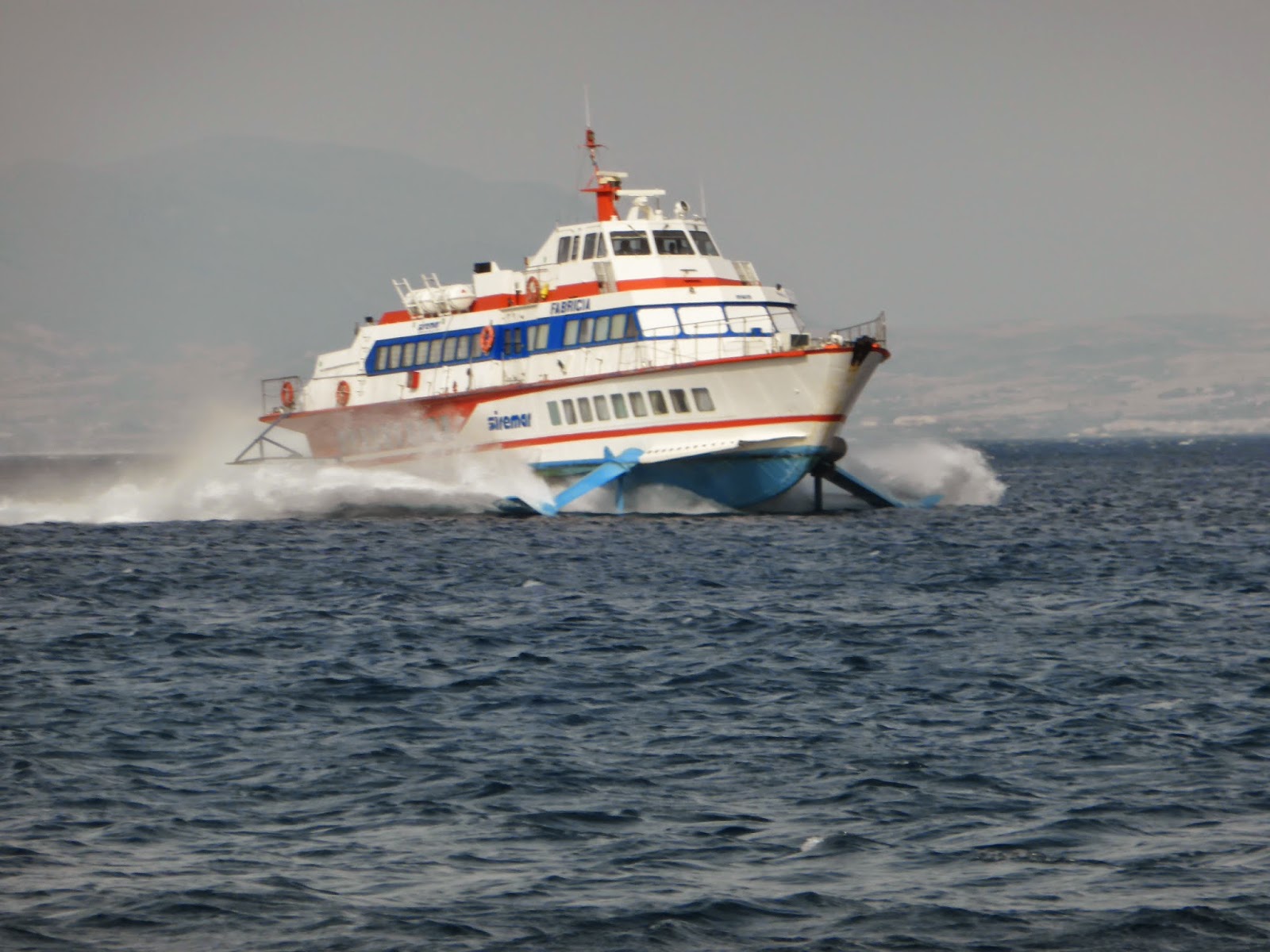
From late afternoon until late next morning we had the area pretty much to ourselves until the tourists arrived. They don’t call Sicily “the windy island” for nothing, and the forecast showed southerly winds up to 32 knots, so we moved to anchor off the island’s main village – Favignana. The biggest problem in strong winds is other boats dragging their anchors so we anchored outside the harbour, well clear of a throng of a dozen yachts anchored closely together in shallow waters inside, deploying our flopper stoppers to combat wakes caused by numerous hydrofoils and ferries.

Hydrofoil zooming in to Favignana harbour passes close to Envoy

Favignana is an attractive village, albeit centered on tourism.
The deep waters and strong currents of the Egadi Islands have always been a breeding ground for tuna and for centuries different conquering countries have fished here. This culminated in the late 19th century when mainland entrepreneur Ignazio Florio bought the islands from the Spanish, developed a fleet of 90 fishing boats and built two canning factories. Then they grossly over-fished anchoring large nets between the islands catching 5,000-10,000 tonnes of tuna annually. In those days many weighed 200-300 kg, and some up to 500 kg. But sadly man’s greed depleted the fish and the industry closed down in the early 1980s, although there has recently been a revival in tuna fishing on a smaller scale. The canning factory is now a museum. 

Over fishing of tuna caused the demise of the industry like elsewhere in the world

Favignana’s now-abandoned tuna canning factory

Open 18 metre wooden tuna fishing boat in museum 

These derelict trawlers laid-up ashore will never taste salt water again

Initially we couldn’t find a place to leave our RHIB as the fishermen and locals jealously guard their spots, but found a supervised jetty where we could leave it for 10 Euros (NZ$16 ) per day with no security concerns, and obtain water in our plastic jerry cans. Mostly this was free but one day they asked for 15 Euros (NZ$23) for 220 litres. Another day it was only 5 Euros (NZ$8) for 150 litres.

Loading supplies at jetty costing 10 Euros to leave our RHIB

Huge pile of discarded anchors formerly used for tuna nets

In one of Favignana’s piazzas is a statue of Ignazio Florio, who controlled tuna fishing in the 19th century

He must have done alright as he lived in this mansion, now a tourist office

This great atmospheric shop offered a combination of delicatessen delights and local crafts

Favignana’s harbour has a great sandy beach

Envoy anchored with flopper stoppers to reduce the roll caused by ferry wakes

TECHNICAL Nothing to report (that’s great!)

ENVOY LOG As at 24/6/14, we’d spent 77 days aboard and cruised 681 miles for 126 engine hours.

FISHING PORT OF SCIACCA

Envoy is now among the Egadi Islands, north-western Sicily.
At Porto Empedocle it was nearly time for Chris to leave us, and the marinara, Giuseppe, was a huge help during the five hour process of getting a stamp in Chris’s passport. First we went to the Customs office, and were directed to Coastguard. They were happy to record Envoy’s arrival, but directed us to the Border Police for Chris’s stamp. The officials are friendly, but everything takes time and patience is a must. Nothing seems to be computerized and information is hand-written into huge, heavy ledgers, reminding me of what we used in banks about 50 years ago. They wanted to photocopy some documents but their copier had broken down. It was a 15 minute drive to the other side of town to see the Border Police, and the first challenge was to get into the Police complex as it was fenced and gated and the intercom on the gate didn’t work. So we waited for a car to leave and bounded through the gate before it closed. After a 30 minute wait we explained what we wanted, but he Police weren’t going to make this easy and wanted to see all our passports, our ship’s papers, Chris’s flight ticket, details of how he would travel to Palermo to catch his flight, and a statutory declaration from me as Captain, stating why Chris was leaving Envoy. We assembled the required papers and a policeman came down to the harbour to check them, gave Chris the much needed stamp and made him 100 Euros (NZ$156) poorer. I offered to pay something to Giuseppe for his considerable time and help but he declined. Chris later said that when he went through emigration at Palermo Airport the official didn’t even look for an entry stamp.
Chris left us after six weeks and 625 miles of fun cruising, and holds the record as the guest who’s spent the most time aboard Envoy (and who’s done the most work!)
With a Scirocco (strong southerly wind) forecast, we decided to stay on at Porto Empedocle for a few days. Our neighbour, Michel, showed us his compact but stunning Fiat Rabath, with a 1.4 litre, 16 valve turbocharged engine capable of pushing the car to a cracking 200 km/hr. One night they drove us 25 km down the coast for dinner so we had a heart-stopping demonstration of the Fiat and Michel’s driving prowess!

Michel’s grunty Fiat Rabath is capable of 200 km/hr

Close to our position in the harbour was a sombre looking prison now turned into a museum. Here in 1848, the prison’s governor fearing a revolt had 114 prisoners moved into a pit accessible only through a narrow opening through the floor above. He also ordered that firecrackers be thrown down among the prisoners to quieten them down, and it was later found that all 114 had been asphyxiated by the sulfurous fumes. 

Sombre-looking prison where 114 prisoners tragically suffocated

The Scirocco didn’t eventuate and we cruised on to Sciacca. We had a wind up to 23 knots on the nose with 1.5m seas and a head current so could only made good about 5 knots at 1,600 rpm towing the big RHIB.
Sciacca doesn’t have a proper marina, but two yacht clubs rent berths to visitors. It’s not well-protected and numerous trawlers coming in and out of the harbour added to the swell causing Envoy to roll at her berth (it was too shallow to use a flopper stopper). The floating pontoons moved around so much it was even difficult to walk a straight line down them, and that was before our evening drinks!
Sicily is still a major fishing area and several dozen 15 to 25 metre trawlers are based in Sciacca, leaving and entering at all hours, and making no speed concession to the pleasure craft moored at the yacht club. 

Looking down on Sciacca harbour where there are many fishing boats. Envoy was moored right side of picture

Cost was 40 Euros (NZ$63) per night including water and power, but there was some problem with low voltage (190 volts) so we didn’t use it. It’s going to be fixed some day soon (yeah right …read some month or year).
Sciacca’s an interesting place to wander around, and here the wind really was blowing so we stayed three nights waiting for the wind and seas to drop.

Sciacca cathedral – we’ve seen more than a few similar but never tire of them

Stunningly ornate pipe organ in medieval Chiesa di Santa Margherita

Sciacca is famous for ceramics and mosaics and this stairway is adorned with them

Quirky ceramic chop in Sciacca

This Sciacca medieval courtyard drips atmosphere

Even small supermarkets have fantastic delicatessen areas

TECHNICAL – Nothing to report

ENVOY LOG As at 19/6/14, we’d spent 72 days aboard and cruised 649 miles for 114 engine hours.

Skip the ad

Watch the videoNordhavn Exumas Abacos Bahamas trawler Caribbean Pickwick Boat dogs
Memphis Downtown

Med 2014

Med 2014

The 2014 cruising season has finally begun. I will be the first to admit my negligence in not blogging our trip to Croatia toward the end of last season after Greece, but I think I was having such a good time I just never got around to doing it. I will get around to the details of it sooner or later, but for now I will be fast forwarding to this year!

Last season ended with a cruise on a cruise ship across the Atlantic. Why you say? First of all, a two week cruise is cheaper than a business class air ticket, if you can believe that. Secondly, it is very relaxing and lastly, the time zones change only once every few days and by the time you arrive in Florida, our home, you suffer no jet lag. We liked it so much that we decided to do the same trip coming back to Croatia this spring, via London. Oh, one more BIG advantage. There are no limitations on luggage on a ship so we brought 8 suitcases, two of which were filled with clothes and the other six with spare boat parts! See what that costs you on a transatlantic flight!

8 Suitcases!

                                                                                     The smaller 2 of the 8 had clothes in them

We ended up wintering at Mandalina Marina in Sibenik, Croatia, which turned out to be a wonderful place. They are in the process of building a 5 Star resort and it looks to me like it will be finished in about a year or two. Both Ken on Sans Souci and I employed a great guy named Ante Muic to look after our boats and he did a great job. In the past we have had both decent and absolutely HORRID experiences from our “winter watchers”. Many times the boats were neglected and in one instance the watcher was so negligent that we had damage to our boats. We generally are only there for one season and they know it. Ante was a different Breed. He really cared about the boats and did his best job. I highly recommend him.

I had three projects that were to be done over the winter. Two of them came out spectacular and the other, the varnish, just never got done, which was disappointing. It really looks horrible and will have to wait until the end of the season to get it done. My hope is that it gets really bad and just completely flakes off. I have zero patience for doing it myself and it would probably end up looking worse than it does now!

We had a new canvas cover made for the upper aft deck and it came out really nice. The only problem was that the guy who made it put a HUGE advertising sign attached to the canvas and I had to wait until we left to clip the stitches off and remove it. I did not want to hurt his feelings.

                                                                                                    New canvas aft top

A BIG PROBLEM FINALLY SOLVED

One day, about ten years ago, not long after we had purchased Seabird, we were docked at our marina in St Augustine, FL and the guy who was waxing our hull asked us to turn the boat around in the slip so that he could wax the other side. I backed out of the slip into shallow water and got stuck in the mud. I revved up the engine to free us and went back into the slip. Shortly after that, an angry, red faced little guy came charging down the dock, waving his arms, screaming and yelling at us. Evidently, when I revved the engine, a plume of greasy black soot came out of the exhaust pipe and landed on his wife, who was wearing a pure white cocktail dress, now covered with the innards of Seabird’s main beast of an engine. I looked over only to see this poor woman in tears, covered in black spots, looking sort of like a white Leopard. I apologized profusely and offered to pay for the cleaning or a new dress. Her husband was very gracious and did not want any payment. Since that day, we have periodically “dusted” other boats from Connecticut to Thailand, and maybe a few people too! All of these apologies in different languages were getting kind of old. Here is the story……

We have had this nagging exhaust problem on Seabird since we owned purchased the boat 11 years ago. Many, if not most Nordhavns have what is called a “dry exhaust”. Most pleasure boats have a seawater pump that sends water to a heat exchanger on the engine, cooling it and then sending the water, mixed with the exhaust, overboard. Most Nordhavns have my system which is similar to a diesel truck system that sheds the exhaust, without mixing in any seawater, high above the boat thorough a long pipe. The engine is cooled by a network of pipes that are attached to the outside of the hull on the bottom. The seawater cools the pipes with coolant running through them, which subsequently cools the engine by circulating it in a closed loop. It is a VERY reliable system with a negligible failure rate because there is no seawater coming into the boat for cooling.

The ONLY problem I have had with it is this horrible sooting periodically. When it rains, some water comes into the stack, washing any exhaust residue inside the 20 foot long pipe, collecting at the bottom. Once it dries and you start up the engine, your neighbors start to hate you as the black greasy dust bunnies blast out of the top of the exhaust pipe and settles on their boats. It only lasts for 10 seconds or so, but if you owned a white boat next to me, that was enough!

I decided to solve the problem once and for all over the winter and Ante said he had the right guy for the job. The result was what you see below. A custom made cover that is controlled by a line and pulleys. Before I start the engine, I pull on the rope from the aft deck and it opens for cruising. I have small velcro’d places over the start keys to remind me to uncover the stack before starting. It works absolutely great and I have not had a single speck of soot since then.

So, to whomever that poor woman was in St Augustine, know that my experience with you prompted a ten year search resulting in a solution and no one again will suffer your fate.

                                                                                 You can see the line in the center of the stack cover

                                                                                   We pull on the line and the stack cover opens

                                                                                It actually opens another 20 degrees from this.  So far 
                                                                                so good this summer!

As I get older and more forgetful…..I have this

HAULOUT

We decided to do a haulout while in Croatia to tend to some bottom issues and get some paint repairs done. We had a few dings and gouges on the hull and swim platform from previous seasons. We had also applied a special copper coating on the bottom called “CopperCoat” which is supposed to last 15 years. Unfortunately, we shipped the boat from Thailand and did not have the time or opportunity to “reactivate” the paint, which means a quick sanding if it has been out of the water for more than a few days. During this haulout, we would have that opportunity.

Kremik Service turned out to be a great service company. They did a good job for us repairing the swim platform, touching up the paint and cleaning our underwater hardware. I tried a new prop antifouling coating this year called Velox. It is a fraction of the price of Propspeed, a coating that I have used in the past with great disappointment.

                                                                              The sign says it is an 80 ton lift but when I told the guy we 
                                                                              only were 70 tons, he still grimaced after seeing the boat!

Our wing engine prop with an experimental coating. It
looks like a stick of deodorant. You rub it on and supposedly
the barnacles and worms hate it.  I will report later on the 
success or failure.

A SAD MOMENT

We had a sad occurrence after we arrived in Sibenik. There was a wild party on the dock next to us with a family of charterers. Sometime in the wee hours of the morning, the father tripped and fell overboard, drowning. They searched for the body all of the next day and in late afternoon, it surfaced in back of our boat! it was heartbreaking to see the grief of his family. We learned many years ago that boats can be dangerous places and partying needs to be done responsibly.

With all of the work completed, the boat was in good shape and ready to to our summer cruising. All that was missing was Sans Souci and her crew of four (Ken, Roberta and the two dogs, who arrived a few days after we returned from the shipyard.


Ken, Roberta, Keely and Toundra

                                                                              Sans Souci

The plan this year was to slowly work our way down to Montenegro, which is a fun stop with cheap fuel to boot. Ken and Roberta decided that they had seen enough of Croatia and would make a beeline to Montenegro, only stopping in Dubrovnik to clear out of the country. We continued with our plan and took a week to get there, stopping in Trogir, Hvar, Mjet and Cavtat, where we cleared out of Croatia.


Seabird from way up top in Hvar, Croatia

  In Cavtat, a bad storm decided to pick on this guy!
  Maybe its a sign that he needs to give more of his money to charity!


Trogir was one of our favorite stops in Croatia                 The main pier is against a huge walled city

                                                           For some reason, people do not think boats are private 
                                                            property.  Maybe in her country they are not!  Or, maybe 
                                                            she was just tired…… Now she is all over the internet!

We arrived in Montenegro about a week and a half behind Sans Souci. This was to be our launching point for the summer cruise to Italy, Malta, Sardinia and Corsica, with a plan to winter the boats in Imperia, Italy. 

                                                                                 This is our “projected” path this summer

At least, that was the plan……

Next up: Cruise to Italy. 

Start your own blog now! Free!

[KensBlog 2014-04] Southern Sicily and Malta

Welcome to Ken’s Blog! (top)

Journey Map (top)

Greetings all!

I am happy to report that two major milestones have been accomplished.

  • First, we have just passed one THOUSAND miles of the twenty-five hundred miles we’ll run this summer
  • And, more importantly, we have now reached the southern-most point of our journey. We have arrived in Malta.

This map shows our route so far. The red dots are portions covered in prior blog entries, and the blue dots are the portion of our journey covered in this blog entry.

Malta is one of the smallest, and most densely populated countries on earth.

Our next destination after Sicily would be the country of Malta; three tiny islands, south of Sicily, that form one of the smallest and most densely populated countries in the world.

Malta will be our last stop on our transit south. Once there, and with the exception of an overnight run to Sardinia or when the weather interferes, I hope to be sitting in beautiful anchorages, preferably admiring the view from Sans Souci’s rooftop hot tub.

But… I am skipping ahead. As of my last blog entry, we were in Siracusa, on the east coast of Sicily.

Marina Di Ragusa (top)

Another Nordhavn owner, whose path we crossed in Montenegro, mentioned that they had “wintered” their boat on the south end of Sicily at a marina called Marina Di Ragusa. They found it to be an inexpensive and great location to pass the winter. As I mentioned in a prior blog entry, we have already put deposits on moorage at the Imperia marina, near the French/Italian border. However, we have become nervous about Imperia after hearing they were in Bankrupcy and have been looking at other options.

My first reaction was that it would be impractical to winter at Ragusa. It is too far away from where we’ve planned to finish the season. Our plan has been to complete the season a thousand miles north of Sicily. That said, I’ve never let common sense come between me and satisfying my curiousity. So, we (Seabird and myself) wrote to Ragusa to find out what it would cost to moor our boats over the winter.

Back came the response. For Sans Souci it would cost only 2,760 euros (about $4,000 USD) to pass the winter at Marina Di Ragusa. By comparison, I’d be paying 21,000 euros (around $28,000) at Imperia. That’s a HUGE difference.

And, there are compelling reasons to winter at Ragusa….

  • If we winter in southern Sicily we’d be close to Tunisia. There are two reasons for visting Tunisia: 1) Duty free fuel And, 2) We would reset our 18 month clock for having the boats in the EU.
  • Marina Di Ragusa has a 160 ton lift. That’s large enough to lift my boat, and I’ll want fresh bottom paint to start the next season.
  • Marina Di Ragusa has the option for haul-out (storing the boat on land) for not much more cost than storing the boat in the water. Storing the boat on land is great when you are on the other end of the world. It is much less stressful than worrying about how the boat is holding up every time there is a winter storm.
  • Southern Sicily has reasonably good weather during the winter. We wouldn’t need to worry about the boat freezing.

The marina was only a short six hour run from Siracusa Sicily, and not too far out of our way for our run to Malta. So, we decided to drop in and check it out.

Sans Souci tied up at the dock at Marina Di Ragusa in Southern Sicily.

An extra benefit of the marina is that it is adjacent to a mile-long sand beach, loaded with restaurants.

Here you can see Sans Souci poking up over the marina wall at Ragusa. As usual, we are the tallest boat in the marina.

We were VERY impressed with the marina, and found some extra benefits we hadn’t expected. For instance, the marina seems to cater to the ex-pat community and prides itself on wintering boats for foreigners. Many of the restaurants stay open during the winter, and many of the ex-pats stay on their boats. It’s apparently a great place to be during the winter, with many owners staying on the boats and frequent events/parties.

Does all this mean Sans Souci and/or Seabird will be wintering at Ragusa this winter? I’m not sure. We would need to backtrack 500 miles or more, and I’m not so sure I want to do that. The current momentum is towards Seabird going to Ragusa and Sans Souci going north to France. That said, we’re keeping it loose and waiting to see where we finish the season. I liked Ragusa, and I certainly like saving money; but, there’s no part of me that ever believes in backtracking.

This screenshot from my chart plotter is a bit embarrassing! Notice the place where the little red line showing our track seems to have an extra squiggle right at the entrance? We exited the marina in the center of the entry channel, but the boat suddenly ground to a halt. When the boat stopped, my first reaction was that our engines had quit. I was outside bringing in fenders and Roberta was driving from one of the outside drive stations. I ran inside the boat to see why the engines had quit, and they were running! I knew we couldn’t possibly be aground. Perhaps we had snapped a line in the props or something? But, that also didn’t make sense. It really did seem we must be aground (sitting on the bottom,) but we had received no warnings from anyone about shallow water. We were in the middle of the entry channel, and I’d seen pictures of far larger boats than mine in the marina. All of that said, being aground was the only thing that made sense. Could the center channel entering the marina really be that shallow? I took over driving from Roberta and quickly realized we were indeed aground. Had we been driving from inside the boat we would have been watching the depth, but we were driving from outside the boat. I backed the boat up, pushing up the throttles to get us off the sand we were sitting on, then exited choosing a path much closer to the breakwater. Embarrassing, but otherwise, no problem.

The Lumpy Road To Malta (top)

There was a storm in Malta which was delaying our departure. We would have 50 miles of open ocean to cross and whenever we have the choice, our preference is for flat seas. After a couple days of waiting we had an “ok” but far from perfect forecast. We would have three to six foot seas, with 15 knots of wind, coming from our right side (starboard beam) throughout the run.

We knew our run south would be uncomfortable. And, that’s exactly how it played out. Sans Souci’s stabilizers worked hard the entire trip. The waves weren’t that tall, perhaps in the six to eight foot range, but they were incredibly close together (four second intervals) and exactly on our beam. They weren’t breaking, but always looked like they wanted to. Every four seconds we’d ride up a wave, then down the other side. At times like that I always wonder what would happen if our stabilizers (the giant fins beneath the boat that fight to keep the boat level) were to fail. We’d be fine, but we’d need to alter our course and slow down. Plus .. keep a supply of barf bags close by.

Our plan had been to stop at customs momentarily and then find a place to anchor. Because we were only staying long enough to clear
into Malta we were assigned a nice end-cap side-tie at the marina (Seabird also.) As you can see, Sans Souci looks big in the marina!

We were assigned temporary moorage at the dock at Mgarr Marina, on the island of Gozo, for the purpose of clearing customs. To our surprise both Seabird and Sans Souci had excellent end-of-dock sideties. We were fatigued after the day at sea, so I asked the marina guy tying our boats, “If we wanted to stay the night here, could we?” He said, “Sure.” I radioed to Seabird who also saw the wisdom, and a decision was made.

This was our first view of Malta looking out from the marina at Mgarr on the island of Gozo.

Each country we visit seems to have a specialty. In Italy it was pasta. In Malta it seems to be “Rabbit.” Every menu I’ve seen seems to have a rabbit dish.

Clearing into the country was both easier and harder than expected. Technically, I wouldn’t have thought we needed to clear in. Malta is part of the EU, and I wouldn’t normally expect to need to clear in and out of different countries within the EU.

Gozo, the northern-most island of Malta is the boondocks. I had been told that Gozo is less formal and that clearing in would be simpler, and indeed it was. The customs agents were extremely friendly and very curious about our boats and where we had been. The entire process took only a few minutes.

As this was my first trip to Malta I had many questions, and thought I’d ask the customs guys the most basic of them, “So, what language do they speak here?” Back came the answer, “Everyone speaks English and Maltese.” To which I asked, “So, what is Maltese like?” Being so close to Italy I was assuming that Maltese was some variation on Italian. Nope. “Maltese is very close to Arabic, but written using a Western alphabet.” Over the next few days I’d find that he was right on both counts. Malta has TWO official languages; English and Maltese. Although Maltese is the dominant language, everyone speaks good English and the road signs are either in English or both languages.

Malta has only recently become its own country (1974.) Most recently it was a British territory, which explains the english, and why the drivers drive on the left side of the road. Prior to Britain Malta was the territory of many other countries, including the Phoenicians, Romans, Moorish, Normans, Aragonese, Habsburg Spain, Knights of St. John, and the French.

Within minutes of tying the boats up and clearing customs, Steven (from Seabird) and I sought out a taxi to take us to town. We had a critical mission to accomplish! We needed internet SIM cards. Whenever we change countries we need to start the process over to figure out internet. We had already done research and knew that we wanted SIM cards from Vodaphone, which would give us 3g data for our computers. We drove about 15 minutes into the center of the island, to a large shopping mall, complete with a McDonalds, and a Vodafone store. We quickly purchased 3g dongles with sim cards, at 25 euros for 10 gigabytes of data, and returned to the boats.

After a nice evening in Mgarr, with dinner next to the marina, we were eager to see more of the island than just a marina, and decided to head to an anchorage Roberta had identified, but that I wasn’t sure was going to work.

This is our first look at the steep cliffs which form the Western shore of Gozo Island.

We’re Surrounded! (top)

Prior to our trip, Roberta had used the internet to identify potential anchorages. #1 on her list of places we needed to go was a small bay called Dwejra. It is only about 1,000 feet in width and surrounded by high rocks with the exception of a narrow entrance. To me it looked impossibly small. How could two Nordhavns possibly fit and have adequate room to swing at anchor?

After speaking with other Nordhavn owners I agreed that it was possible, and off we went.

As we approached the bay, I turned off the stabilizers. I always turn off the auto-pilot, stabilizers, and even take the throttles out of sync when approaching any type of maneuvering situation. I don’t want the boat doing anything creative. There was a bit of swell at the entrance, and Seabird was following close behind us. With the stabilizers off Sans Souci started rolling quite a bit. Seabird was immediately on the radio, “Is everything ok????” they wanted to know. I confirmed all was well, and pushed ahead.

Once into the bay I saw that there was plenty of room, and that it was incredibly beautiful. The bay was a perfect 25 feet deep, and given its small size, good protection, and the other boats around, I dropped only 100′ of chain. There were several other boats already in the bay, but we found room for both Sans Souci and Seabird with no problem.

Sans Souci, at anchor inside Dwejra bay.

This picture shows the cliffs surrounding where we were anchored.


Pictures of Seabird at Dwejra: At sunset, with Steven and Carol Argosy on the backdeck, and with Keely (one of our puppies) excitedly tendering over to visit Steven and Carol.

And, a panaramic picture of our anchorage can be clicking on this link:
http://photosynth.net/view.aspx?cid=ded42bdd-052e-4fb4-ba30-684aa5eb07d0

Adjacent to the “bowl” we had anchored in is this arch, called the “Azure Window.” We read on the internet that the giant arch is not safe to walk over, due to instability, but that didn’t seem to stop any of the tourists we saw walking above it.

As if the arch and Dwejra weren’t enough to make this one of the world’s great places to anchor, there was even more to see. From the Azure Window it is possible to tender back into many caves, one of which leads to an inland sea. Roberta and I tendered over with the puppies, but thought the passage looked too tight to do with so much swell. We decided to wait until the dead-calm of some early morning to give it a try. Steven and Carol (and their guest Tina) went for it one morning, and said that it was so tight that they barely fit, with craggy rocks on both sides of the narrow passage. We decided to pass, but if we go back to Dwejra, I hope to give it a try.

Anchoring at Ramla (top)

As great as it was at Dwejra, we wanted to see as much of Malta as possible, during our brief stay, and decided to move on. We had started circling Gozo clockwise, starting at the south end, and decided to keep going, to a beach we’d heard about on the north shore of Gozo. It was recommended to us by a waitress in response to my asking where the prettiest sand beach was.

Actually, the waitress recommended two beaches: Masalforn and Ramla. Normally we do a huge amount of planning when moving the boats, including identifying “bail outs” so that if we get somewhere, and don’t like it, we already have alternative destinations lined up. However, Malta is so small, and the distances so small, that we can get almost anywhere in a few hours. From Dwejra it was only about an hour’s run to Masalforn. On arrival it was a tiny bay, already filled with boats. The bay was lined with condos and restaurants, and looked fun, but .. it was just too tight. Thus, we ran another whole mile (I said the distances were tiny!) to the bay of Ramla.

We had arrived at Ramla on a beautiful Sunday afternoon, and were not the only ones with the idea. There were probably 100 boats at anchor with kids swimming, jet skiing and having fun in every direction. There was more activity than we wanted, but it was a BEAUTIFUL location, and the bottom was a wonderful 16 foot depth. The shallower the water, the less chain we have to put out to have good holding in strong winds.

A panaramic view of Masalform Bay can be viewed by clicking on this link:
http://photosynth.net/view.aspx?cid=6915d0a8-7768-45c5-9d5f-404baaa8b015

Ramla. When we arrived we were surrounded by boats and people. Hours later, when the wind kicked up, we had the place to ourselves.

We spent a nice day at Ramla, but in the afternoon the wind started rising. A windless day at the beach became a windstorm within minutes. Quickly, all the boats disappeared, and we were left alone. The forecast had been clean, but suddenly we were seeing 20-25 knots of wind. It was too much for the smaller boats, but not a problem for us. We had a nice night, and were ready to move on the next day.

Exploring Gozo (top)

We were having a great time anchoring around Gozo, but knew that we really should see all the standard “tourist stuff” before leaving. We called the Mgarr marina to ask if we could have our same parking places, and they welcomed us back.

To see the island, we hired a taxi cab for the day. He asked if we wanted the three hour or the four hour tour. We asked for the four hour, but told him to expect that we’d sidetrack him with many errands. I wanted to go back to Vodafone to purchase more SIM cards. Both Steven and I have routers (from Peplink) that will accept multiple sim cards, combining the bandwidth together. We wanted all the internet we could get! Roberta wanted some fresh vegetables, and we also wanted the driver to run us to a grocery store. In between the errands we also wanted to see anything the island had to offer.

One thing we quickly learned about Gozo, and perhaps all of Malta is that it is a very conservative catholic country. 98% of Malta’s residents are catholics, and there are over 300 churches for its 300,000 residents, making it a ratio of one church per thousand residents. I’m new to Malta, so I can’t say much of anything definitively, but my sense was that the church is central to the Maltese’s lives, and that there is a strong sense of community. At least on Gozo, it is a small town atmosphere. The customs guys had warned me, on arrival, to expect to hear cannon fire. They said not to worry, that it is just a local celebration. We were hearing cannon fire and seeing amazing fireworks shows every night! I asked our cab driver what the celebration was, and he said that each week a different village would hold a feast. Eveyrone in the village would turn out, and it would be a huge celebration. This webpage http://www.carnaval.com/malta/festivals/ shows the schedule, but the events are a much bigger deal than is evident from reading the description. The villages take the festivals seriously and compete on food, fireworks and more. It is quite a sight!

Various photos from inside the St John Church on Gozo. It is a modern church built with a significant amount of volunteer labor by the local people. It has the second largest rotunda in the world.

A hillside we passed while driving, with a cross on top.

The Citadel We toured an old fort, built in 1500 BC. From Wikipedia: “In July 1551 an Ottoman force under Dragut attacked the Citadel, which succumbed with little resistance. The entire population of Gozo, which numbered to about 5000 to 6000 people, had taken refuge within its walls, and they were all taken as slaves except for about 300 people who managed to climb down the walls and escape.”

I saw this ancient anchor in one of the many museums we visited. The technology has come a long way over the years!

Ggantija is a Neolithic, megalithic temple complex on the Mediterranean island of Gozo. The Ggantija temples are the earliest of a series of megalithic temples in Malta. The Ggantija temples are older than the pyramids of Egypt. Their makers erected the two Ggantija temples during the Neolithic Age (c. 3600-2500 BC), which makes these temples more than 5500 years old and the world’s second oldest manmade religious structures, after Göbekli Tepe.

During World War II Malta’s strategic location caused it to become one of the most bombed locations ever. Malta holds the record for the heaviest, sustained bombing attack: some 154 days and nights and 6,700 tons of bombs. (I’ll talk more about that in my next blog, after we have visited Valletta (capital of Malta.)

Malta is a popular retirement destination for the British due to its warm climate, tax system (eg. no property tax), english language, safety, and responsive/reasonably priced medical system. It is also very popular as a tourist destination, with over three times as many visitors as residents.

Anchoring at Gnejna (top)

Our next stop in Malta would be the large island of Malta itself, which we knew would mean putting the boats into a marina and doing more “land touring” for a week. We were excited about seeing Valletta, the large city on Malta, but wanted a little more time at anchor first.

Seabird jumped ahead of us by one day wanting to drop anchor at the famous “Blue Lagoon.” I had used binoculars to look at the blue lagoon earlier and knew that it was likely to be disappointing. Unlike the picture below, the vision I saw resembled a crowded public swimming pool on a hot summer sunday afternoon. There were dozens of tour boats wedged into a small bay with hundreds of swimmers elbow to elbow. Seabird quickly realized that anchoring at the Blue Lagoon was impossible, but then discovered a place to drop anchor about 1/4 mile away that they said was the prettiest bay they had ever anchored in. We were jealous.

The Blue Lagoon on Comino Island in Malta. This picture must have been taken during the off-season, because in summer the reality is much more cluttered with swimmers and boats.

We needed one more night at anchor before a week in civilization and dropped anchor in the a quiet bay on the west coast of Malta; Gnejna.

And, something for the boat geeks… (top)

Overall, there isn’t much to talk about on the technical side. This has been a VERY trouble-free trip so far. The boat has taken us over 1,000 nm and I’ve barely entered the engine room.

That said, I have a water maker problem that has been a major headache. Following is a video I sent back to my mechanics in Seattle showing the problems I was having.

After viewing the video the decision was made that I needed a new salinity probe as well as a new solenoid for the valve that decides if water should be routed overboard or into the fresh water tank on Sans Souci.

Unfortunately, after this video was made the watermaker died completely. I hired a local technician in Malta who spent hours with the watermaker and finally decided that the high pressure pump was the culprit. Getting a new pump is difficult, and getting it installed is probably more difficult. I have a rebuild kit onboard for the pump, but I don’t feel qualified to take apart a pump and rebuild it. I’ve been assured it is easy .. so, maybe. This is one of two watermakers, and my other one is also acting up, so learning to rebuild pumps may be in my future. We’ll see.

One way or the other, these watermakers have served me very well. I have never put dock water into Sans Souci’s fresh water tanks and we’ve kept the watermakers busy for over 30,000 miles of world travel. This is likely to be the year they retire from service.

My only other technical issue is that Sans Souci has a KVH Vsat satellite internet unit. When it works, it works very well. However, a couple of times during this trip it has lost internet and then taken days to reacquire the satellite. After discussions with KVH we have decided that my “firmware” is out of date and I have a local technician from Malta coming to the boat to assist me in installing new firmware. This is a project that is within my core competency, so I could easily upgrade the firmware. However, the upgrade requires a computer with a serial connector, and I don’t have one onboard. There are USB to Serial adapters that can be found in some computer stores, and I “might” be able to find one, and had there not been a local KVH dealer here in Malta, I’d be spending the day out hunting for an adapter.

And, something not related to us… (top)

James Ellingford, a Nordhavn 62 owner, posted an entry on his blog (http://www.pendanablog.com) talking about the amazing rescue of a sailboat by a Nordhavn 47 during a 1,300 nautical mile passage from Vanuatu to Australia. Click the image above to read it (Or, Click this link).

On a sadder note, this boat, named Polar Bear was destroyed by a fire recently (click the picture to read the story.) Polar Bear had the slip next to mine at my home port in Seattle (where I still pay my slip rental, but haven’t been back in many years.) It’s a particularly heatbreaking story because these boats represent lifelong dreams. People work for 50 years to achieve retirement then work hard to select someone to build their dream boat, then work for years to get it built, and then .. one error by a welder and its all gone up in flames. The insurance company might give the money back, but how do you ever get the time back? I can’t imagine what the owner will do. Does he start another five year build cycle? (at age 79?)

And, in closing… (top)

And, that’s it for this issue of KensBlog… Thank you for following along on our big voyage!

If you missed my prior blog entries from this season, you may view them here:

If you aren’t receiving my blog entries via email, click this link to register:

http://www.kensblog.com/register

I should also mention that this is one of two blogs that I do. My other blog is on Facebook, although you do not need to register with Facebook to view the blog. Just click on this link:

http://www.facebook.com/kensblogdotcom

My other blog is very different than this blog. I post to it almost every day, and post whatever I happen to be thinking about, without editing or filtering. I also tend to respond instantly to any questions. Check it out!

Thank you!

Ken and Roberta Williams
ken(at)kensblog.com
MV Sans Souci
Nordhavn 68
PS – In case you haven’t figured it out, clicking on any of the pictures above will give you a higher-resolution (bigger) version of the picture.

Start your own blog now! Free!

Happy 4th of July

Nordhavn Exumas Abacos Bahamas trawler Caribbean Pickwick Boat dogs
Memphis Downtown

Home At Last- And Celebrities at That!

v:* {behavior:url(#default#VML);}
o:* {behavior:url(#default#VML);}
w:* {behavior:url(#default#VML);}
.shape {behavior:url(#default#VML);}

Normal
0
false

false
false
false

EN-US
X-NONE
X-NONE

/* Style Definitions */
table.MsoNormalTable
{mso-style-name:”Table Normal”;
mso-tstyle-rowband-size:0;
mso-tstyle-colband-size:0;
mso-style-noshow:yes;
mso-style-priority:99;
mso-style-parent:””;
mso-padding-alt:0in 5.4pt 0in 5.4pt;
mso-para-margin-top:auto;
mso-para-margin-right:0in;
mso-para-margin-bottom:auto;
mso-para-margin-left:0in;
mso-pagination:widow-orphan;
font-size:11.0pt;
font-family:”Comic Sans MS”;}

We finally made it back to the same yacht club in
Groton, CT that we left in 2008.  Life is
a chaos trying to re-establish all the things we will need to return to the
dirt dweller life.  Just a quick blog to
reprint the article that the paper in Ocean City just printed.  The link is below, but it will probably only
work until the next big story blows in. 
Therefore, I pasted it directly below:
 
World-Traveling Lawler Family Stops in Ocean Pines
Posted on Ocean City Today newspaper
on Thursday, July 3rd, 2014 by Josh
Davis
OCEAN PINES– After six long,
fascinating years at sea, the Lawler family is finally coming home.

Tom Lawler posed with his wife Kim
and daughter Emily aboard their ship the Emily Grace following a 6-year cruise
around the world. The ship was docked at the Sunset Marina in West Ocean City
last week.


JOSH DAVIS/OCEAN CITY TODAY
In 2008 Tom, his wife Kim and their
then 8-year-old daughter Emily sold their home in Connecticut and began a
global cruising trek.
Last month the Lawlers returned to
the U.S., docking first in Port Canaveral, Fla. then sailing to Georgia, on to
South Carolina and through Virginia in their Nordhavn 46 motor yacht named
“Emily Grace.” In early June the family arrived at Sunset Marina in West Ocean
City and spent a few days visiting Tom’s mother, Shirley, in Ocean Pines.
The Lawlers caught the cruising bug
years ago during a scuba diving vacation in Belize on a live-aboard boat.
“It was very luxurious and we all
came out thinking to ourselves, ‘why don’t we do this – just get a boat and go
wherever you want to go?’” Tom said. “So that was kind of the seed. We
developed a plan and saved as much as we could, and when we hit the right
number we left.”
Tom grew up in Annapolis and spent
every summer in Ocean City with his parents and two brothers. He learned to
pilot small boats on the Severn River as a child, but he had to do plenty of
research before setting sail across the world.
“You need to know about the customs,
and you obviously have to know a lot about navigation,” Tom said. “I took some
classes before I left.”
Kim, who has an extensive medical
background, took classes as well and became a certified HAM radio operator,
allowing the family to use a single sideband radio to transmit data and send
and receive emails through satellite technology while at sea.
The boat was stocked with spare
parts so the Lawlers could perform most repairs themselves. “You need to find
what parts are critical – what parts will shut down the trip – and those are
the ones you carry,” Tom said.
A broad range of medical supplies,
including antibiotics, was also packed. “Kim could do injections, and we had
controlled narcotics for pain,” said Tom. “We went to our doctor and explained
what we were doing and they were happy to fill up prescriptions for us. When we
left Emily was actually so young that she couldn’t take an adult dose, so we
had to carry powdered antibiotics that you mix up.”
SETTING SAIL
After selling their home to fund the
trip, the family headed first to Maine, then south through the Caribbean and
Trinidad before heading west through Venezuela and Columbia.
Emily was homeschooled throughout
the trip using Baltimore-based Calvert School’s curriculum. Food was – for the
most part – bought during various stops along the way.
“Wherever you go they have food –
they just may not have your food,” Tom said. “So we learned to eat weird
things.”
Sometimes the family would stop for
a day or two and gather supplies. Other times they would stay and set up camp
for several months.
“We were in New Zealand for six
months,” Kim said. “It was always because of the weather or the season – having
to move – but that was the longest we stayed in any one place.”
“You have to time all the places in
the world around the hurricane or cyclone seasons,” said Tom. “We entered the
Panama Canal in February, which gives you the most time in the Pacific before
the next hurricane season, but we only got as far as Tonga; if we stayed any
longer we could potentially encounter a hurricane. So what you do is you go
south.
“At certain latitudes near the
equator there are no hurricanes,” Tom continued. “So you go down to New Zealand
and you wait, and while we’re down enjoying New Zealand there were hurricanes
swirling in the Pacific to the North of us.”
While in Niuatoputapu, Tonga, the
Lawlers found a village virtually swept away by a tsunami. The Red Cross had
dropped two dozen kit homes on enormous pallets on the shore and then
disappeared.
The villagers, forced to live under
trees, had no idea how to build the homes. Tom, with the help of several other
fellow cruisers, met with the island elders to make a plan.
“There were six or seven cruising
boats and we all got out our hammers and came ashore,” he said. “We got a bunch
of the villagers together too so they would learn, and we all built a house
together in one day.
“What was cool was this man that we
built it for was about 75 years old,” Tom continued. “We started very early in
the morning and at noon he comes riding up in this rusty, old bicycle, and he
has a basket and he made us lunch – all the guys. It was so sweet to watch him.
And at the end of the day it was his home, and we gave it to him and he just
had tears running down his face. And then, once the villagers knew how to do it,
they had another 20 kit homes and they could do it themselves.”
Tom said it was important to him –
and many of the other cruisers – to give back.
“We visit these exotic places and
don’t want to be seen as typical tourists taking pictures and leaving trash on
the beach,” he said. “The personal interactions with the locals is what makes
each country special and is just as priceless to me as the help we give them.
At the end of the day we hope many of the locals will remember us as friends
and have fond memories of us just as we do of them.”
During a stop in Fiji Emily briefly
attended school with a friend she met on the island, wearing a loaned uniform
and carrying in stacks of peanut butter and jelly sandwiches and potato chips.
The local school children devoured the foreign delicacy, while Emily ate the
noodles the other children brought for lunch.
Showering could also an adventure.
“It was a tree trunk and two wooden
walls and a rack for a washcloth, and the only soap that they had was what we
brought,” Emily said. “The water was ice-cold, and if there was anybody out in
the woods they would have seen us.”
Emily learned to do origami to pass
the time, and would often make paper cranes to give away to native children.

Emily Lawler, 13, showed off her
intricate origami dragon. Lawler made origami creatures for natives in more
than a dozen country during her family’s 6-year cruise around the world.
JOSH DAVIS/OCEAN CITY TODAY
“There would be 30 kids wanting a
little crane and I would make one for each of them and they would gasp,” she
said.
“We would come into a village and
there would be a couple of kids and they would be shy and hiding behind a tree,
and then they’d come out and start talking to us and Emily would just start
folding without saying anything,” Tom said. “The kids started watching. Then
once you did the one and handed it to them that’s all it took; kids would come
out of the bushes and they would be all around her. In some cases she would
even stop and teach them how to do it. You should have seen the smiles on their
faces.”
When they weren’t enjoying the lush,
tropical locales and dozens of fascinating cultures they encountered along the
way, the family would unwind on their boat watching movies stored on the
four-terabyte hard drive packed for the trip.
That’s not to say things were always
peaceful. Swimming with sharks and interacting with local wildlife became
second nature, but mechanical failures – and the occasional run in with pirates
– threatened to derail the trip on several occasions.
In one instance the Emily Grace ran
into trouble when a small coolant leak led to a potentially disastrous problem
crossing from the Maldives to Chagos.
“We thought we’ll just go – we’ll
limp along, I’ll keep adding coolant and hopefully we’ll get to a place where
we can have it fixed,” Tom said. “It was a 300-mile trip down to the
uninhabited atolls of Chagos and we were 60 miles into it, and there was a
little seal that was weeping – ‘drip, drip, drip’ – and suddenly it became a
catastrophic failure. It dumped all the coolant to the bilge and the engine
overheated and we had to shut it down; we didn’t have anything to fix it with.”
Luckily, the family was able to use
their spare “wing engine.” They turned the boat around, slowly sputtered back
to the Maldives at half speed, and had new parts shipped from the United
States.
Unable to find a mechanic, the
Lawlers performed the repairs themselves. “It’s about 100 degrees or more there
and we’re all in the engine room,” Kim said. “It was so hot.”
“It was a very big part and it was
awkward and very heavy,” Tom said. “Three of us in a cramped, little engine
room – it was a struggle. But if we hadn’t of had the wing engine we might have
died – we would have been lost at sea.”
Pirates also presented problems.
“We were going to come from India
and go up to the Red Sea and go through the Mediterranean Sea, but Somalia is
there and there were a lot of people that were being captured and held for
ransom,” Tom said. “That’s where we made the decision to go around South
Africa, and that added a lot of miles to our trip. But it was necessary.
“We ran dark – meaning we had no
lights,” Tom continued. “We turned off our radar; we turned off our Automatic
Identifying System. At night we were completely pitch black. If you so much as
left the radar on they could use that beam to find you.”
Less life-threatening but no less
important, the family was constantly on the lookout for other children for
Emily to play with.
“When we left – at age 8 – mom and
dad were the world,” Tom said. “But as she got older, most kids want to play
with other kids. So we would seek out other boats that had kids and we would
cruise with them. The problem is that, after a while, she was always saying
goodbye. They make a friend and they make them quick, then a month or two later
they have to say goodbye again.”
Emily’s longest friendship began in
Madagascar and included a four-month stay in South Africa and stops in St.
Helena and Brazil.
“It was a boy and a girl from
Tasmania – Zeke and Nina,” she said. “We met in Madagascar and we cruised with
them for about a year. That’s the longest I’ve ever been with another boat.”
COMING HOME
Since returning to the states, the
family has enjoyed many of the comforts that were unavailable at sea.
“Ever since they got here they’ve
been in the bathtub,” Shirley said.
“Every night,” said Tom. “We really
missed that.”
Kim is relishing having a kitchen to
move around in. “I’m enjoying the space and all the pots and pans,” she said.
“The washing machine has been really nice too. We have a little washing machine
on the boat, but most of the time I was using a bucket. I have a new
appreciation for a lot of things.”
“We were in a restaurant the other
day and Emily came out and said, ‘I can’t believe there is automatic flush on
the toilet – automatic soap – automatic paper towels,” Shirley said.
The Lawlers plan on returning to
Connecticut, unloading their “treasures,” and living in a small family owned
cottage in Massachusetts. Tom said they would sell the boat and build a new
home next spring.
Emily will attend school in the U.S.
for the first time since 2008, entering the ninth grade in late August. “I
can’t wait to meet some new friends, but I haven’t been to school in six years
so I’m a little nervous,” she said.
Asked about her six years at sea
Emily said, “I think it takes a brave person; it was a good experience, but I wouldn’t
do it again.”
Kim was less diplomatic.
“I always said it takes a naïve or a
stupid person,” she said with a laugh.
“When they first started out they
were down in the Bahamas, and every time they would see something or go scuba
diving and see some beautiful fish Emily would say, ‘OK, now we can go home?’”
said Shirley. “And her father would say, ‘but what are you going to see
tomorrow?’”

 “And there were always new experiences or
discoveries,” said Tom. “Emily swam with dolphins in the Caribbean, sea lions
in Galapagos, sharks in Samoa, humpback whales in Tonga and got her full SCUBA
certification in Fiji. During the six years she has ridden an elephant, horses,
a camel and an ostrich.”
Life – they all agreed – will be
simpler than it was before the trip.
“You come back and appreciate what
you have,” Kim said. “It’s amazing – the majority of people we saw are still
cooking on a wood fire and living in a hut.”
“I wanted Emily to see that,” Tom
said. “I wanted her to know that the United States is unusual in the way we
live and the things we have. There are a lot of things that kids get into –
little toys and gadgets – and they think that they have to have them. But they
really don’t. I think she knows enough now to make that distinction.”
“We won’t waste water or waste
energy like we used to,” Emily said.
Kim said the family intends to build
an environmentally friendly house where she hopes to have a vegetable garden.
“But the first thing we’re going to
do is go out and get a puppy,” she said. “And we’ll have chickens and we’ll
have goats and we’ll live simply.”
The Lawlers kept a blog during their
travels filled with hundreds of vivid photos and descriptions of the places
they saw and the people they met. Visit www.mvemilygrace.blogspot.com
to follow their journey.
We may not post too much beyond this
since all my Dear readers already know all about living ashore…unless you beg…
Tom