Tag Archives | Nordhavn

EUREKA – HISTORIC SYRACUSE

Envoy is now in western Sicily’s Egadi Islands.
Next stop was Syracuse – first settled 3,000 years ago, a major city by the 4th century BC, and once one of the most powerful in the Med, “rivaling Athens in prestige” to quote Lonely Planet. Here Archimedes was born in 287 BC, and lived until he was accidentally killed during a Roman invasion. Grand Harbour, protected by Ortygia Island, is sheltered in most conditions, and we anchored off the town to sit out an approaching front with winds expected up to 30 knots. In fact we got a few days of winds only in the low 20s with occasional gusts to 30, but it was very rough in the open sea and we were pleased to be safely in shelter with our floppers stoppers down to reduce roll.

Waves breaking on the shores of Syracuse as front passes 

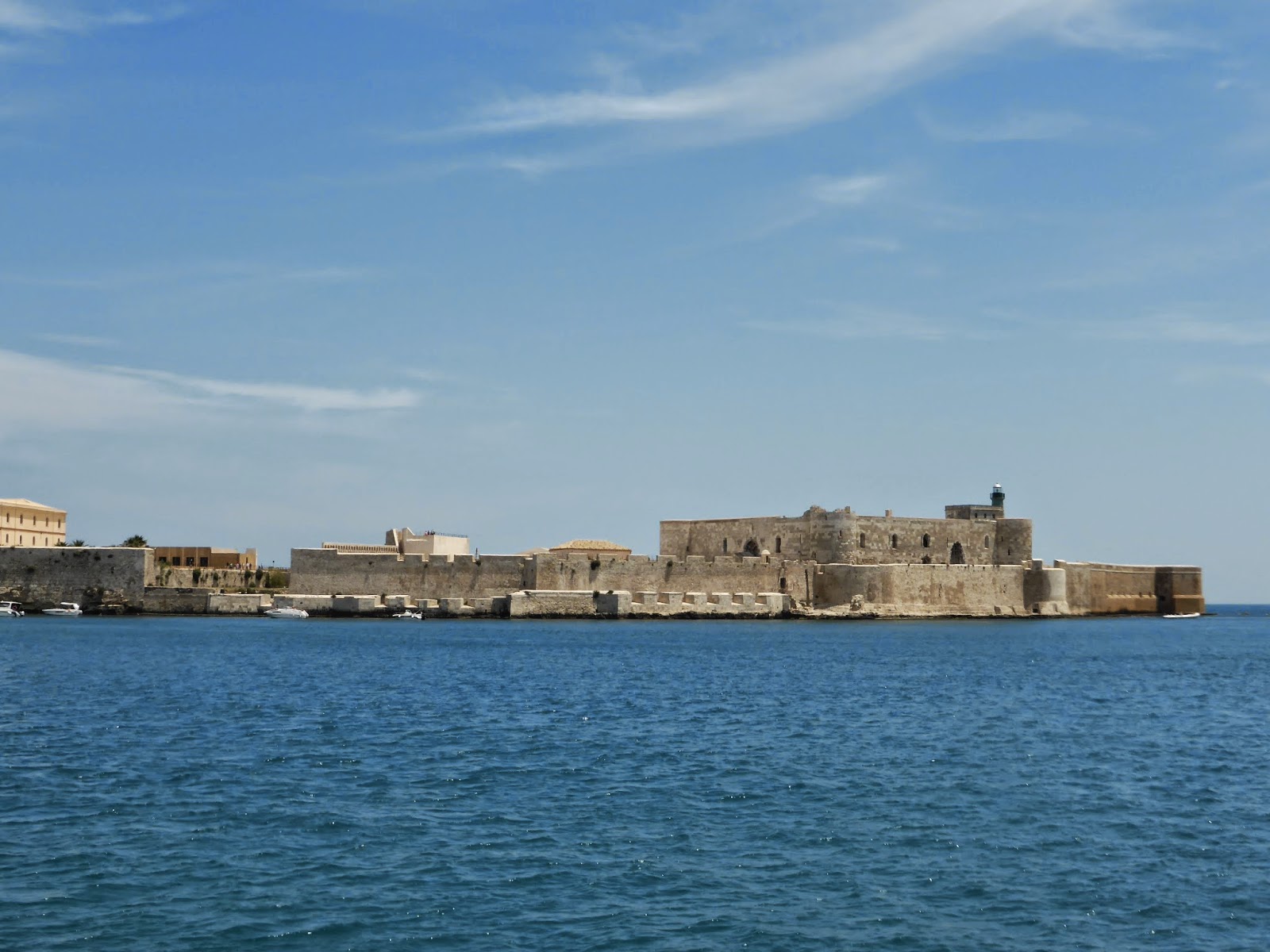
This fortress at the entrance to Syracuse is off-limits as still in use by the military

Sadly the sea is too polluted by sewage coming from the land for swimming or use of the water maker; in fact we’ve found sewage odours to be quite common in harbours so far – part of a wider problem of poor infrastructure quality in Sicily.
After the front passed it became fine and sunny with temps in the mid-high 20s; everybody says the Med summer is late this year – maybe it’s arrived at last!
One day we visited the dark and eerie Catacomb of San Giovanni, where passageways beneath the church have about 10,000 niches carved out of solid rock to hold the dead. These date from the 3rd century and were built into aqueducts dating from the classic Greek period several centuries earlier. No human remains are visible today, and these sites have been targeted by grave robbers throughout the centuries, who’ve long since taken items of value. You wouldn’t want to get lost in here!

Grave sites in the Catacomb of San Giovanni

Plan showing layout of the underground Catacombs

The cobbled lanes of Ortygia’s Old Town are fascinating to wander through, and history seems to have blended well with present day functionality.

Stunning courtyard of a Venetian mansion

Cathedral in Ortygia’s del Duomo Piazza

Sicily has a three-legged symbol, similar to the Isle of Man’s – apparently it came from the Normans who brought the symbol to both places

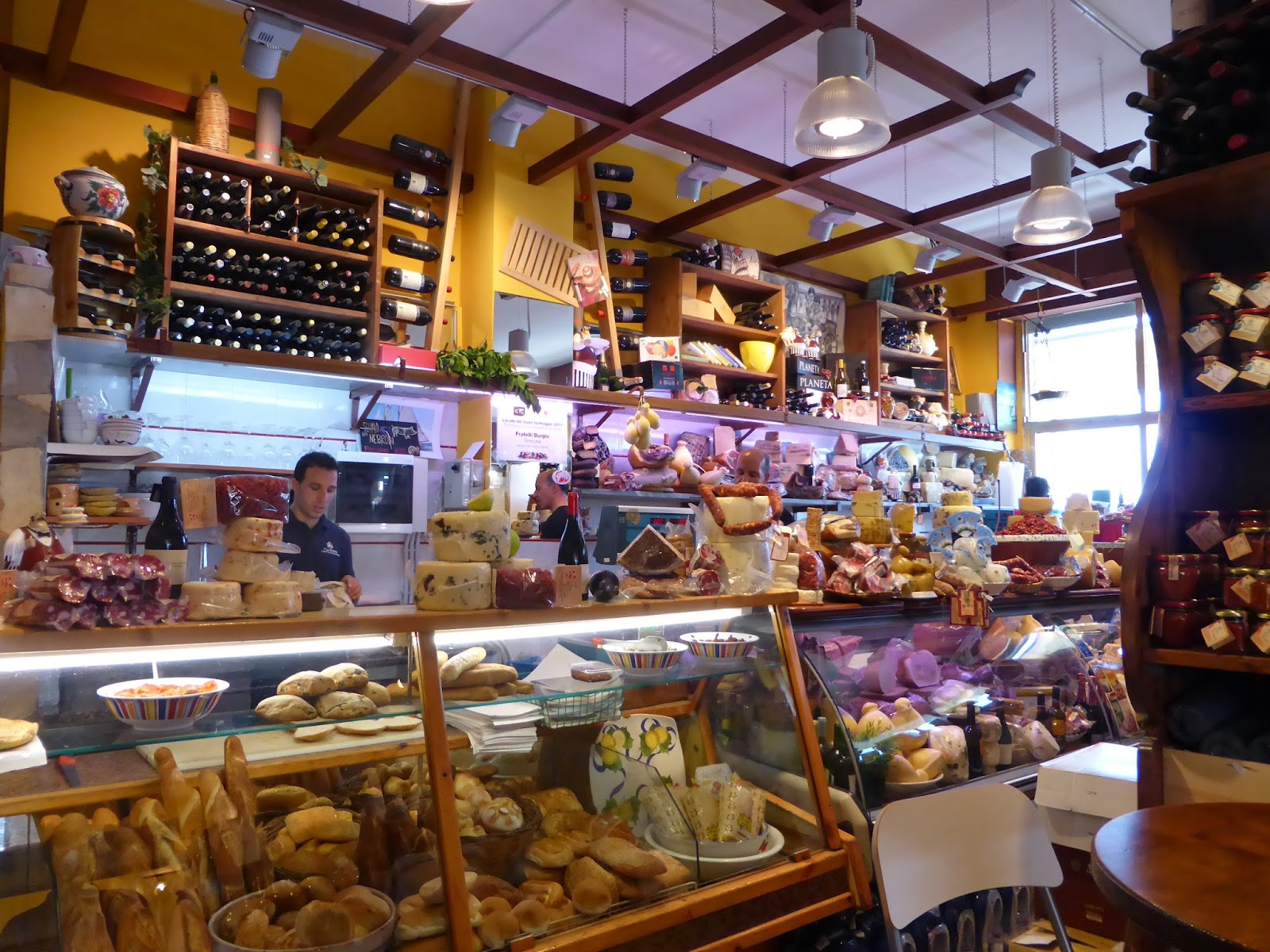
Syracuse has an interesting food market – far smaller and quieter than Catania’s but where it’s easier to wander around, smell the roses and chat with stallholders about their wares.

Fabulous delicatessen at Syracuse market

Hiring a car is expensive in Sicily at about 75 Euros (NZ$117) per day, but we explored the nearby countryside, finding it relatively quiet and traffic-free, with a huge amount and variety of agricultural activity including wheat, grapes (Sicily has stunning wine), olives and citrus fruits.

Church in village of Palazzo Acreide

We also stumbled across a fascinating typical Sicilian cemetery with numerous family mausoleums, some of the older ones being about the size of small houses.

Typical family mausoleum

One of the larger mausoleums

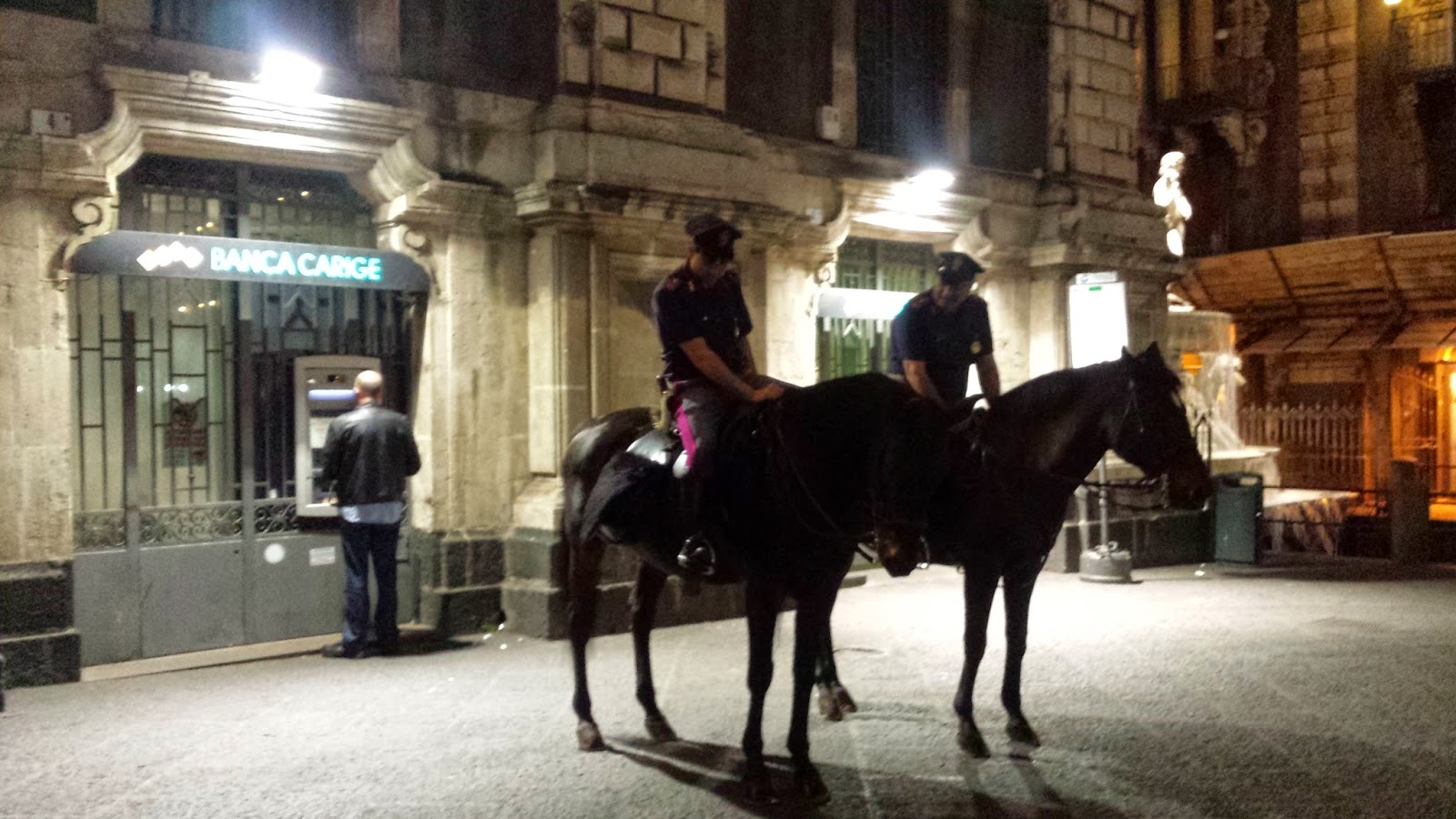
I felt safe withdrawing cash at this ATM with mounted police nearby

TECHNICAL – nothing to report
LOG – As at 8/6/14, we’d spent 62 days aboard and cruised 602 miles for 97 engine hours.

[KensBlog 2014-03] Rough Seas And A Visit to a Historic Town

Welcome to Ken’s Blog! (top)

Trip overview (top)

Greetings all!

Roberta just mentioned to me that we have now been on the boat for over a month, and have only anchored one night. The first half of our trip has been about readying the boat, provisioning the boat, cruising around the southern part of Italy and then heading south to Malta. The second half will be working our way north towards the western border of Italy with France, and Sardinia and Corsica.

A better way to phrase that might be that we’ve been working on moving the boat a thousand miles south, along the south coast of Italy so that we can get to the good stuff, and then spend the next two months working our way up the west side of Italy, mostly moving short distances, picking our way slowly from anchorage to anchorage.

I am not complaining, because we have found plenty of entertainment along the way, but this is not the part of the journey that explains why we own a boat.

That part is coming. We’re really looking forward to Malta!

Malta will be our last stop on our transit south. Once there, and with the exception of an overnight run to Sardinia or when the weather interferes, I hope to be sitting in beautiful anchorages, preferably admiring the view from Sans Souci’s rooftop hot tub.

This map shows our route so far. The red dots are portions covered in prior blog entries, and the other colors represent the legs of our journey covered in this blog entry.

Sta Maria Di Leuca (top)

Our next stop, after Brindisi, Italy, would be Santa Maria Di Leuca, a small town that if one thinks of Italy as a boot, forms the tip of the heel.

The run from Brindisi to Sta Maria Di Leuca was as unremarkable as they get. A short ride on flat seas. Our plan had been to anchor, but then as we read the various blogs talking about anchoring at Sta Maria Di Leuca we didn’t like what we were reading. Several bloggers indicated that the anchorage had a rocky bottom and that there could be problems with the anchor getting caught on the bottom in rocks.

On arrival we made a tour of the bay, and couldn’t find a place to drop anchor where there weren’t obvious rocks just beneath the surface. Plus, it looked rolly. This left us with no choice but to enter the marina. We called the marina staff who said they had a place for us, and that they would help us get the boats into the marina. All went smoothly.

We were shocked by the cost of this marina! My boat was 158 euros for the night (over $200 USD.) I joked to the marina guy that I only wanted to rent the slip, not buy it. He didn’t get the joke and whipped out a pricing sheet and pointed at the words “High Season.”

Here you see Sans Souci and Seabird at the marina of Sta Maria Di Leuca. Sans Souci was the tallest boat there! Roberta and I spent a fun afternoon on the back deck watching all the smaller boats returning from a lovely day out swimming and tanning. The lady you see on the boat behind us is trying to untangle the mooring line around one of her boat’s props. I admired her attitude. She smiled and chatted with people passing by throughout the process while trying a variety of tricks to untangle the line. We once wrapped a chain mooring line around one of Sans Souci’s (our prior N62) props while leaving a marina in France. Unlike her, I was not a good sport and did not smile.

Roberta and I and the pups hiked into town looking for a place to have dinner, but it was only 6:30pm. In Italy, the restaurants don’t open until 7:30pm and they don’t really expect anyone to appear until at least 8pm or later. We didn’t want to wait that late and finally found a pub that also served pizza. We sat outside under a large, shady tree. While we were eating the pub set up a huge outdoor projection screen, a projector and many tables and chairs around us. We asked if they’d be screening a movie, and received a look clearly intended to indicate that we were idiots. An hour later when they turned on the projector and people started arriving, we realized what it was: The World Cup was starting!

Relaxing on the back deck of Sans Souci

Crotone – A good place to stop (and, then go) (top)

Sta Maria Di Leuca was a cool little town and even though expensive, I think we could have happily stayed longer. However, at this point, we’d had nothing but great weather and wanted to keep moving while the weather was good. Our next stop would be a somewhat larger town called Crotone, a very convenient location with a very well protected marina, but according to the cruising guides not much else going for it. It would be a twelve-hour run getting there from Sta Marina di Leuca, so we wanted a place to stop and rest, and not much more.

Twelve hours to Crotone! A long day, but once again an easy ride. The seas were flat. During the ride we phoned our agent from Brindisi and asked if he could phone ahead to Crotone to get us into the “commercial port” on a side-tie. Crotone has two harbors: a tourist harbor where most tourist boats go, and a commercial harbor for freighter traffic. We needed into the commercial harbor because the tourist harbor shows in the guide as being only 2 to 2.5 meters deep; the same depth as Sans Souci. Theoretically, we would skim by, but when it is close I worry about scooping mud from the marina bottom into the raw water intakes on my engines. Crotone would just be a place to rest for the night, so nothing mattered except being able to get in and out easily, and protection from any winds.

We had dead-calm seas all the way to Crotone. I knew our luck would be running out sooner or later and checked the weather forecast. All looked good, but I was still nervous and got on the radio to say to the group as we were approaching Crotone, “What do you guys think? Should we consider to just keep going and head south to Siracusa?” But we were just completing a long ride and everyone was tired. The question came back, “What’s the forecast like?” “Fine,” I responded. “Why would we give up a night of comfortable sleep then?” came the reply. And, into Crotone’s commercial harbor we went.

We followed Seabird into the commercial harbor at Crotone.

Few commercial ports anywhere are charming, and Crotone’s commercial port is no exception. We side-tied to a concrete wall that rose over ten feet off the water. The worst part of it is that I had opened a side gate in Sans Souci’s lower deck in anticipation of using it to step onto the dock. When the gate encountered a giant black rubber bumper intended for cruise ships, the gate lost the competition. Its hinges were slightly bent and the gate could only be closed forcefully. It will be a winter repair. Crap!

Part of the “charm” of Crotone’s commercial harbor: the sunken boats in the marina.

Getting on or off the boats was not easy and had to be done stepping from the bow of the boats to the wall

When cruising in Italy you are issued a “Constitution” a document that must be stamped by every port you enter. At Crotone we could see the Coast Guard office where our document needed stamped only a hundred yards from the boats, on the other side of a tall fence. Tired, after our long cruise, we were not in the mood to walk over to the Coast Guard office, particularly after we realized that even though we were close, we would have to hike over a mile, in the heat, around the fence, exit the port, to get to the office that we could see — but not directly hike to.

Clearing into the port at the Coast Guard office took longer than expected. Crotone is a naval academy and we were being cleared in by a student who wasn’t 100% sure of the process. Several other people were called in to check that all was done correctly, and then we began the long hike back to the boats.

The overnight passage to Siracusa (top)

That night Roberta prepared a salad and hamburger fixings while I barbecued the patties on the grill. So even though we were berthed in an ugly port, we had a pleasant dinner! Before going to sleep we all planned our next passage, which would be a long one. It would be a twenty-hour journey to reach Siracusa on the eastern side of the island of Sicily. We wanted to arrive after daylight which would require leaving at noon for an 8am arrival.

As soon as I woke the next morning I checked the weather forecast. Double-crap! Our luck with calm weather had ended. There was a storm brewing over Malta, far to the south, that was working its way north. Winds were already rising and were projected to be in the 20-30 knot range around Siracusa by 2pm the next day. If we were to depart Crotone we would need to buck 15-20 knot headwinds for 20 hours, and if the storm moved faster the final hours before arrival would be absolutely miserable at a time when we would be fatigued from the passage.

Steven and Carol, from Seabird, had gone for a walk into town. Roberta and I discussed what to do, and Roberta said, “Perhaps we should just stay here.”

My read of the weather was that we needed to either go immediately or be stuck for several days.

Nordhavn boats are made to handle rough seas. There is no other production boat in this size range that is safer or more comfortable in bad weather. And truthfully, 15-20 knots of wind is not really considered bad weather by Nordhavn standards. That said, predicting the comfort and safety of a ride is not as simple as looking at how strong the wind is.

I remember a trip in 55 knot winds a few years back. That’s enough wind that trees can come unrooted, and yet Sans Souci was moving along just fine with a very comfortable ride. Why? The reason is that we were close to shore and the wind wasn’t able to stir up waves. There wasn’t much “fetch” (the distance that wind travels over open water). When the wind travels across water it forms waves. Generally speaking it isn’t really the wind that can wreck your day, it is the waves that are generated by the wind. In evaluating a prospective cruise, you need to look at a lot of different factors including: the strength of the wind, the direction of the wind, the height of the swell (waves), how close together the waves are, and the direction of the waves.

In this case, we would be going straight into the wind, and the wind was coming from offshore, so there would be no way to use the land to minimize fetch. Plus, there was the added risk-factor that the storm could arrive faster than planned. And the worst of all was that there were no “bail-outs.” If we didn’t like the seas there’d be no marinas or anchorages along our path. Whatever the weather would be, it would be, and we’d be in it.

When Steven and Carol returned from their walk around 10am, we discussed the upcoming trip. If we departed immediately we would arrive at 6am. That was plenty of margin for error. Steven and Carol were not impressed with Crotone after having walked there. They said the town had not much more charm than the port and if there was a weather window to leave, we should jump on it.

Within minutes we cast off.

About an hour into our run, we received a call on the radio. It was a large ship, identifying itself as “Italian Warship” asking that we give it at least one mile of clearance as it passed by. That sounded perfectly fine to us. We noticed a sailboat — which ignored the request via radio — on track to pass very close to the warship. The salboat must not have had their radio on. I was curious if the warship would torpedo the little sailboat, or alter course to provide the one mile separation. Neither occured, and the sailboat and the warship passed each other harmlessly.

About four hours into our run, the seas started turning nasty. A reader of my blog once told me that whenever I am photographing waves I should always photograph from as low on the boat as I can get. It gives a more exciting camera angle and a better sense of the wave height. The problem with that approach is that if there are waves outside, I’m staying in the pilot house. It just isn’t worth it to get a good picture!

If you look at the chart-plotter, you’ll notice that we are several miles off our plotted course. We were starting to get trashed by the waves and it would soon be dark. We decided to head towards land, to see if we could get a smoother ride, even though we had doubts it would make a difference. To our surprise, it worked! We altered course by about 15 degrees heading towards land, and even though it was a wind coming from offshore we found calmer seas. We never had a completely comfortable ride, but it became well into the acceptable category and actually started laying down a bit as the night progressed.

Here’s something you don’t see everyday. As we were moving along, Steven on Seabird radioed to ask that I zoom out the chart and tell him what I saw. Bizarre! I asked what it was and he asked me to check it’s “properties” (the details that the chart plotter knew about the object). It was moving at 260 miles an hour! I then realized that it was a airplane showing on my chart plotter – with a little airplane symbol. I’ve cruised a lot of miles and have never seen that before! As you might guess, it went out of range quickly.

The airplane wasn’t to be the last revelation of the night. At 3:30 am (just after Roberta had completed her four-hour watch and had gone to bed) I was back at the helm when Carol called on the radio from Seabird to ask me to look out the window towards the distant shore and tell her what I saw. We were about 20 miles offshore at the time and all I could see was an orange glow over the land. I radioed back to her that my best guess was that it was nothing more than some reflection from the sun starting to rise. A few minutes later she radioed back, “Use your binoculars and look again.” Maybe it because I was completely unprepared for it, but I was totally floored: With the binoculars you could clearly see bright lava flowing down the side of a volcano. A sight I had never seen! Wow!

I grabbed the camera, as they also did on Seabird, and thought about waking Roberta (but, didn’t – which greatly annoyed her). Unfortunately, the pictures I took turned out as total blackness. This picture is a stock photo of the volcano (Mt. Etna) erupting at night, the closest that I could find on the internet to the view that I saw through my binoculars.

On a vaguely related topic, I was reminded of a few weeks ago when we had a local captain cruising with us from Sibenik, Croatia, to Montenegro, Ante Muic, had who watched over Sans Souci during the off-season. As we were cruising along, we saw something floating just ahead of us in the water, and Ante went outside with the binoculars – although he didn’t need them as it turned out. As the object floated by, we could see that it was a sea turtle. Ante was outside watching it, then came back in with goose bumps on his arms. He was emotional! He exclaimed to Roberta, “I’ve been fishing these waters all my life and have never seen a sea turtle! We had to admit that we had never seen a sea turtle in the Mediterranean either, though we have seen lots of sea turtles in other oceans, especially along the western coast of Mexico. It actually was quite exciting, though, especially seeing how it clearly affected Ante. (As it turned out, we later saw another sea turtle when cruising along the southern coast of Italy. Maybe they’re coming back to the Mediterranean!)

Siracusa (top)

I’ve never been good at sleeping on a moving boat, meaning, when it’s traveling. When things are calm, I do ok. But, if there’s a lot of traffic around, or the seas are rough, I just can’t sleep, even when I’m supposed to on overnighters and Roberta is on watch. And it’s NOT because she doesn’t do a good job at the wheel; she does. And she does get annoyed at me for that, too! Thus, even though our trip to Siracusa during the night was calmer, it was far from perfect, and by the time we arrived there at six in the morning, I was physically exhausted. Roberta was in better shape, but also beat. As we entered the large bay there were quite a few boats at anchor. Rather than hunt for the “perfect” place to anchor we just took the first location we saw with ample room and dropped the hook, wanting to hit the sack as quickly as possible for a daytime nap.

Here’s Ken dropping the anchor. Note the headphones. These allow Roberta and Ken to talk as if they were standing next to each other, making docking or anchoring much easier. How did we live without them for SO long?

Our laziness in dropping the anchor came back to haunt us. The anticipated storm came right on schedule. It never struck Siracusa directly, but was close enough that it generated a large swell into the bay. Anyone anchored close to the entrance (like us) were rolled around from side to side. We should have immediately re-anchored deeper into the bay, but that would have required energy, something neither of us had. Instead, I had the headache from hell, and slept sporadically for the next 24 hours.

Seabird had anchored near us, and was also being pushed around by the swell. They also suffered through a rough night, though, the following morning the bay was much calmer. Thus, whereas Roberta and I had been looking forward to being at anchor, it was an easy decision to move into the marina along with Seabird.

Although I refer to Siracusa several times in this blog entry, our marina was actually on the island of Ortigia, which is also referred to as the “Old Town” of Siracusa. You see our marina in the middle-left side of this photo.

Wikipedia describes Siracusa (Syracuse) thusly:

“…[Siracusa] is a historic city in Sicily, the capital of the province of Syracuse. The city is notable for its rich Greek history, culture, amphitheatres, architecture, and as the birthplace of the preeminent mathematician and engineer Archimedes.[3] This 2,700-year-old city played a key role in ancient times, when it was one of the major powers of the Mediterranean world. Syracuse is located in the southeast corner of the island of Sicily, right by the Gulf of Syracuse next to the Ionian Sea.

The city was founded by Ancient Greek Corinthians and Teneans and became a very powerful city-state. Syracuse was allied with Sparta and Corinth and exerted influence over the entirety of Magna Graecia, of which it was the most important city. Described by Cicero as “the greatest Greek city and the most beautiful of them all”, it equaled Athens in size during the fifth century BC.[6] It later became part of the Roman Republic and Byzantine Empire. After this Palermo overtook it in importance, as the capital of the Kingdom of Sicily. Eventually the kingdom would be united with the Kingdom of Naples to form the Two Sicilies until the Italian unification of 1860.

In the modern day, the city is listed by UNESCO as a World Heritage Site along with the Necropolis of Pantalica. In the central area, the city itself has a population of around 125,000 people. The inhabitants are known as Siracusans. Syracuse is mentioned in the Bible in the Acts of the Apostles book at 28:12 as Paul stayed there….”

Archimedes, the famous mathematician and scholar was born, lived and died in Siracusa. This is a museum in his honor. His accomplishments included such breakthroughs as being the first to decypher the mathematical principals behind levers and even the computation of “pi.”

Even his death was remarkable:

From Wikipedia: “… Archimedes died c. 212 BC during the Second Punic War, when Roman forces under General Marcus Claudius Marcellus captured the city of Syracuse after a two-year-long siege. According to the popular account given by Plutarch, Archimedes was contemplating a mathematical diagram when the city was captured. A Roman soldier commanded him to come and meet General Marcellus but he declined, saying that he had to finish working on the problem. The soldier was enraged by this, and killed Archimedes with his sword. Plutarch also gives a lesser-known account of the death of Archimedes which suggests that he may have been killed while attempting to surrender to a Roman soldier. According to this story, Archimedes was carrying mathematical instruments, and was killed because the soldier thought that they were valuable items. General Marcellus was reportedly angered by the death of Archimedes, as he considered him a valuable scientific asset and had ordered that he not be harmed ….”

Roberta and the pups (Toundra and Keeley) on the stern deck of Sans Souci at Marina Yachting in Siracusa

I’ve always thought the whole concept of “selfies” was rather silly. However, not being one to let a fad pass without at least trying it once, this is our opus. We now have it out of our system and will not be burdening the world with more selfies.

Paul Allen, co-founder of Microsoft and owner of the Seattle Seahawks and the Portland Trailblazers owns this yacht, called Octopus. Being a Seattle-person, I’ve always been curious to see it. That wish was fulfilled when it anchored next to us. An amazing boat! Check out this presentation showing some pictures of it: CLICK HERE


We’ve been in Siracusa for a week as I type this, and have barely scratched the surface. Trip Advisor lists 381 restaurants in Siracusa. We did our best to work through them but only tested a hand-full. The ones we went to were excellent. There are playhouses everywhere, including a Greek theater we were told we “must” go to, and museums in virtually every direction. Paired with a great well-protected anchorage, Siracusa is a must-stop destination for all cruisers passing this way.

Sans Souci and Seabird at “Marina Yachting” in the town of Siracusa.

The Temple of Apollo, in Siracusa. This was near “the fruit, vegetable and fish market” which was the best open-air market we’ve seen anywhere.

I recognized this boat immediately when it entered the marina. It is a small cruiseship (Le Ponant) that hit the headlines in 2008 when it was captured by Somali pirates. At the time I was struggling to learn French and forcing myself to read the French press each day, so a story about a yacht captured by pirates, particularly at a time when we were contemplating a world circumnavigation, caught my interest.

The pirates captured the yacht, including 30 crew members (no guests onboard, though). France paid a $2 million ransom and the yacht and crew were freed. France then hunted down the pirates capturing six of them in a spectacular shoot-out and getting back $200,000 of the ransom money.

Malta is VERY difficult to enter with dogs. We were certain we had it under control, as they have their EU Pet Passports, but we then spoke with Jennifer and Mark Uhlmann, Nordhavn 46 owners whose path we crossed in Montenegro as they were headed to Croatia. They walked us through what they had to do getting into Malta with their two dogs, gave us the name of a great veterinarian in Siracusa, and even emailed to us the pet import forms we needed to fill out. One of the best things about owning a Nordhavn is that you have an owners group who have racked up an incredible four million miles of world cruising. A very special thank you to Mark and Jennifer!

Steven and I are standing on the dock, each holding a VPN router. We were trying to set up our boats to be able to get Netflix from the US. We were actually successful, except for one Samsung TV on Steven’s boat which was being stubborn. For some reason Carol thought we looked funny and took this picture. Don’t all boaters stand on docks holding routers?

After seeing Mt. Etna from a distance at sea, we were curious to see it “up close.” Thus, we rented a car and drove a couple hours to the volcano itself.

Mt. Etna, an active volcano in the distance.

The Mt. Etna tourist center at the base of the mountain: t-shirt shops, souvenirs and other tourist-stuff, fast-food eateries and a tramway which will take you to the top of the crater…if you dare!

If you look closely at this picture, you can see a tramway that takes you up the side of the volcano. Roberta, I, and the dogs didn’t take the ride, but Steven and Carol (and, Carol’s sister Tina) did ride up. They said you don’t get close enough to see molten lava within the crater (too much steam, anyway), but that the ground does get hot! Amazingly, the best view of the volcano was the one we had that night from 30 miles offshore.

The day before we were scheduled to leave Siracusa for Malta – yesterday — the wind suddenly started rising. I measured 26 knots at the dock. It wasn’t a problem except that the wind had not been in the forecast, and if it was 26 at the marina, what was it in open water? I don’t like being surprised by a high wind. (If you don’t see a video above, you can view it by clicking here:

http://player.vimeo.com/video/99006021

During the “surprise” wind storm, Steven decided to test the wind speed while we walking along the shore. I asked how he could do that and he whipped a little plastic propellor out of his pocket, attached it to his iphone — and showed me the true windspeed and direction! It’s a product from a company called Vaavud. Who would have thought you could do that with a cell phone?

That’s it for this issue of the blog. As I type this, we have departed Siracusa and are en route for Malta!!!!! (Although, we think we’ll stop for a night or two at Marina de Ragusa at the southern tip of Sicily; we’re expecting a storm tomorrow!)

And, in closing… (top)

If you missed my prior blog entries from this season, you may view them here:

I should also mention that Roberta and I were interviewed for another Nordhavn-owner’s blog (http://www.pendanablog.com/Guest-Interviews ) Additionally, he interviewed James and Jennifer Hamilton, who are currently in New Zealand as part of their own circumnavigation, and Jim Leishman, co-owner of Nordhavn, who recently brought the Nordhavn 120 across the Bering Sea. Check it out!

If you aren’t receiving my blog entries via email, click this link to register:

http://www.kensblog.com/register

I should also mention that this is one of two blogs that I do. My other blog is on Facebook, although you do not need to register with Facebook to view the blog. Just click on this link:

http://www.facebook.com/kensblogdotcom

My other blog is very different than this blog. I post to it almost every day, and post whatever I happen to be thinking about, without editing or filtering. I also tend to respond instantly to any questions. Check it out!

Thank you!

Ken and Roberta Williams
ken(at)kensblog.com
MV Sans Souci
Nordhavn 68

Start your own blog now! Free!

North Palm Beach to North Carolina

Calm seas for the most part and an amazing lightening and thunder storm entertained us up the coast to North Carolina. We traveled in a straight line from Palm Beach Florida to North Carolina forcing us to travel off shore about 150 miles. It was the farthest I have ever been from land. Generally we run about 20 miles off shore. 

The gulf stream pushed us north adding to our speed. We felt as if we where fly at 12.5 knots, most of the time 9.5 is our comfortable cruising speed. Luckily we managed to outrun a thunder storm that kicked up the waters off the coast of South Carolina. The lightening was so amazing with jagged bolts snapping down all around us and thunder that sounded as if it was directly overhead. Luckily all the excitement ended as quickly as it started. The stories we have heard throughout our travels thus far have included lightening strikes on boats. Thankfully, Anna Mae and crew traveled through without anything to add, other than seeing mother nature in all her glory giving us a show we will not soon forget. I was so amazed how quickly it started and stopped. I was laying on the front deck in calm seas one minute and the next watching salt water blow over the bow from the safety of our pilot house, it was incredible. 

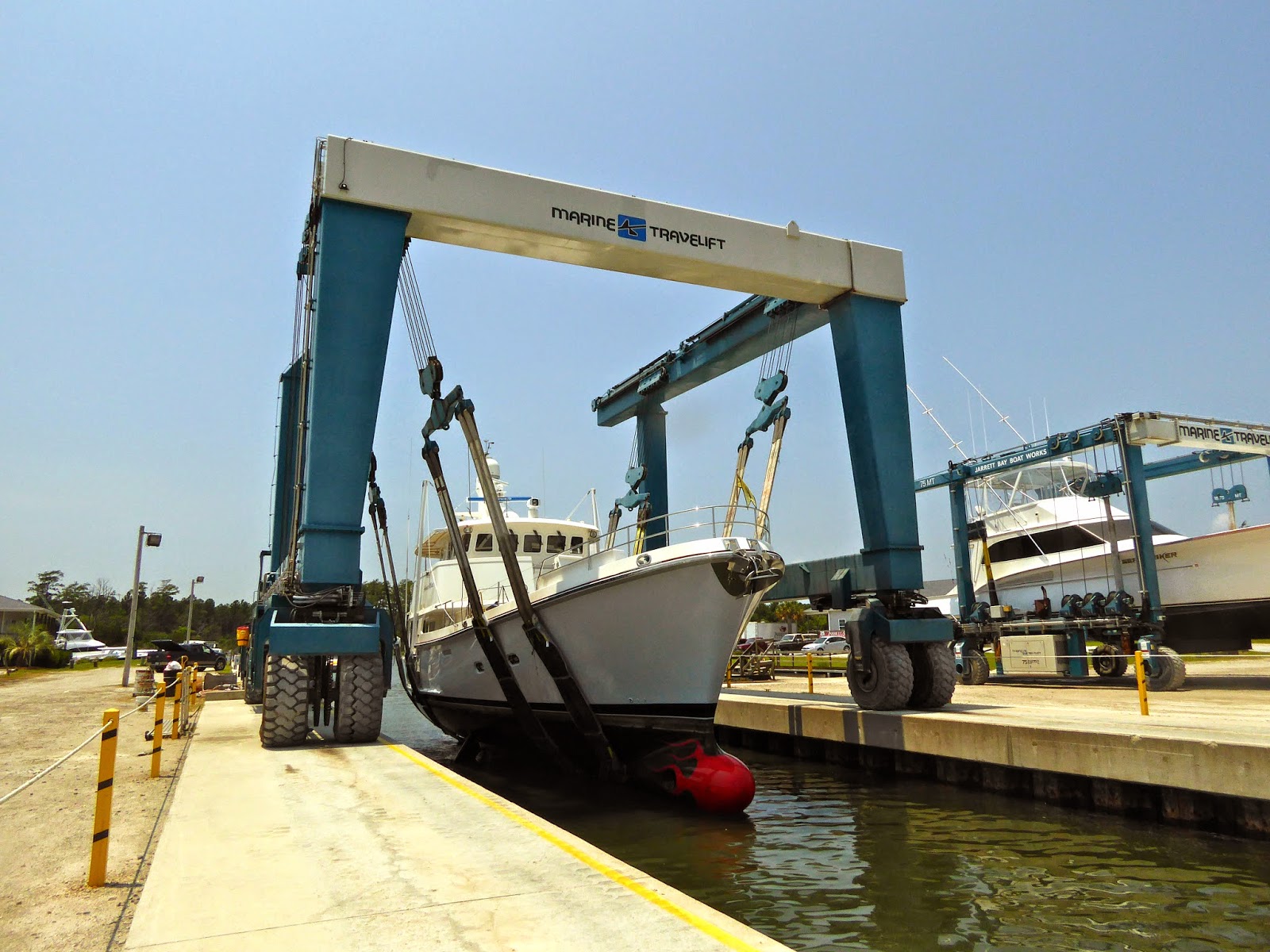
Entering The ICW again in North Carolina was another adventure in trying not to touch bottom. Unfortunately we arrived a few hours early and entered at low tide. The current was on our nose a couple of knots, but we pulled into Jarrett Bay Boat Works with no problem In Beaufort NC about 60 hours after leaving North Palm Beach. Anna Mae was hauled out and placed on the hard the next day for some minor repairs and a few upgrades. I am getting granite in the galley and so happy to have found the perfect slab for the job.


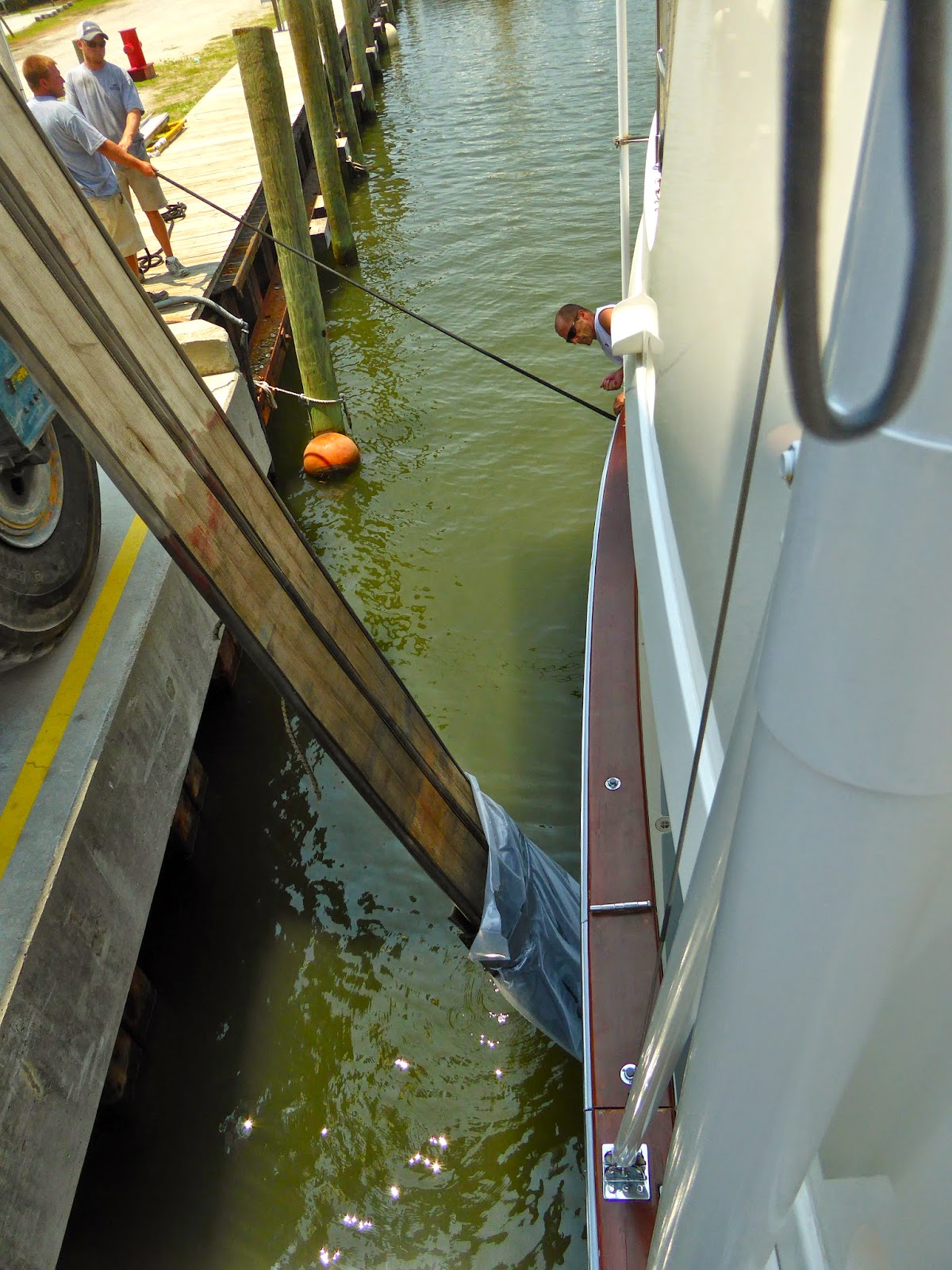
Bill was making sure the sling of the lift was in the correct placement and didn’t come in contact with our stabilizer.


The East Coast is so interesting with the enormous amount of history that we are not accustomed to on The West Coast. This weekend we took a road trip to visit historic Charleston South Carolina. I can’t wait to go back, we didn’t have enough time to see everything that wonderful town has to offer.

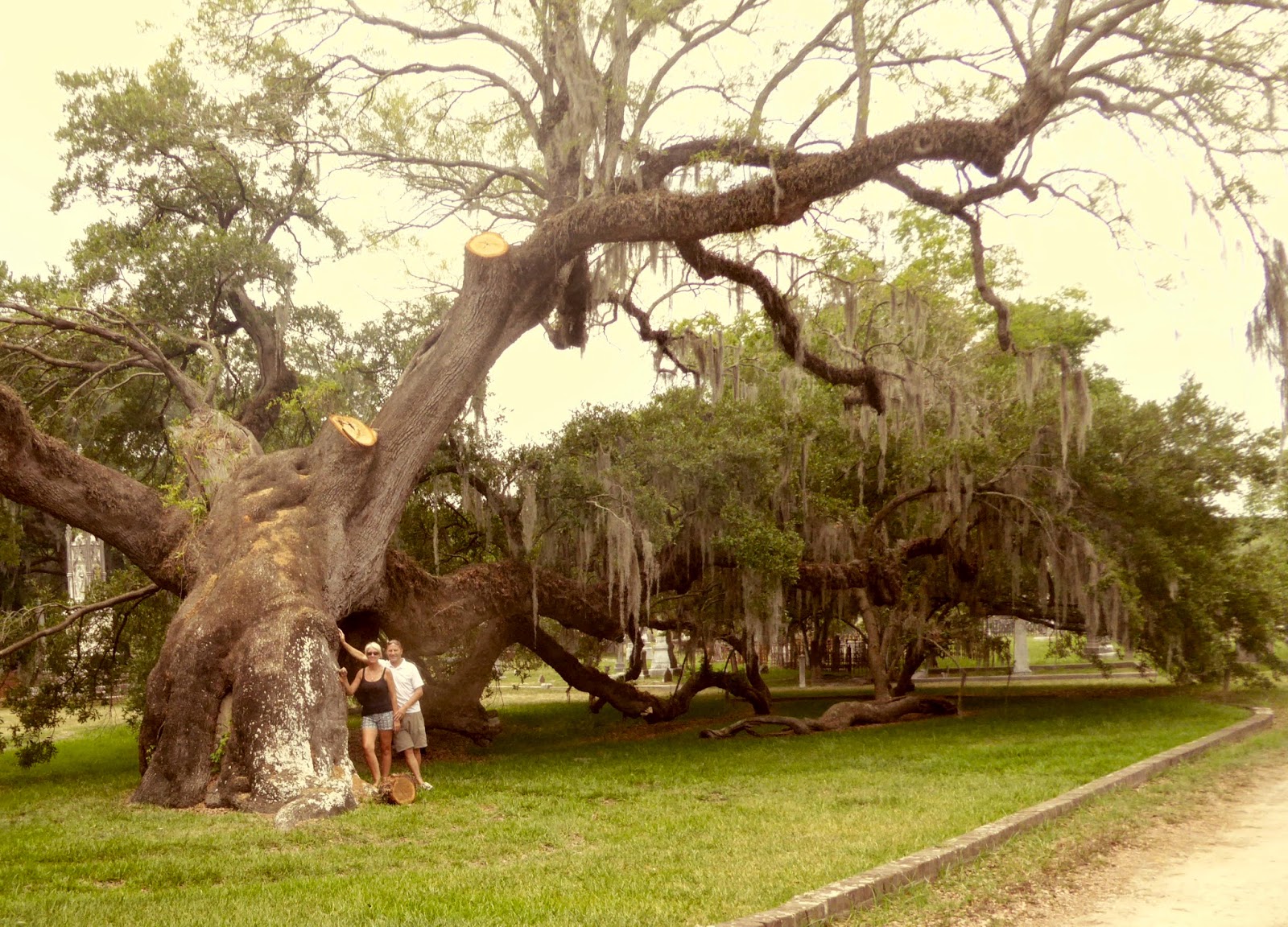
 I love to explore old cemetaries, this live oak is 700 years old and resides at The famous Magnolia Cemetary in Charleston.


Anna Mae will stay at Jarrett Bay for the hurricane season while we fly home to celebrate the arrival of our first grandchild. When we return in October our plan is to continue our travels and explore The East Coast and Caribbean.

North Palm Beach to North Carolina

Calm seas for the most part and an amazing lightening and thunder storm entertained us up the coast to North Carolina. We traveled in a straight line from Palm Beach Florida to North Carolina forcing us to travel off shore about 150 miles. It was the farthest I have ever been from land. Generally we run about 20 miles off shore. 

The gulf stream pushed us north adding to our speed. We felt as if we where fly at 12.5 knots, most of the time 9.5 is our comfortable cruising speed. Luckily we managed to outrun a thunder storm that kicked up the waters off the coast of South Carolina. The lightening was so amazing with jagged bolts snapping down all around us and thunder that sounded as if it was directly overhead. Luckily all the excitement ended as quickly as it started. The stories we have heard throughout our travels thus far have included lightening strikes on boats. Thankfully, Anna Mae and crew traveled through without anything to add, other than seeing mother nature in all her glory giving us a show we will not soon forget. I was so amazed how quickly it started and stopped. I was laying on the front deck in calm seas one minute and the next watching salt water blow over the bow from the safety of our pilot house, it was incredible. 

Entering The ICW again in North Carolina was another adventure in trying not to touch bottom. Unfortunately we arrived a few hours early and entered at low tide. The current was on our nose a couple of knots, but we pulled into Jarrett Bay Boat Works with no problem In Beaufort NC about 60 hours after leaving North Palm Beach. Anna Mae was hauled out and placed on the hard the next day for some minor repairs and a few upgrades. I am getting granite in the galley and so happy to have found the perfect slab for the job.


Bill was making sure the sling of the lift was in the correct placement and didn’t come in contact with our stabilizer.


The East Coast is so interesting with the enormous amount of history that we are not accustomed to on The West Coast. This weekend we took a road trip to visit historic Charleston South Carolina. I can’t wait to go back, we didn’t have enough time to see everything that wonderful town has to offer.


 I love to explore old cemetaries, this live oak is 700 years old and resides at The famous Magnolia Cemetary in Charleston.


Anna Mae will stay at Jarrett Bay for the hurricane season while we fly home to celebrate the arrival of our first grandchild. When we return in October our plan is to continue our travels and explore The East Coast and Caribbean.

nu-Déjà vu

Nordhavn Exumas Abacos Bahamas trawler Caribbean Pickwick Boat dogs
Memphis Downtown

CATANIA’S FABULOUS MARKET AND SPECTACULAR MT ETNA

Envoy is now in Sciacca (pronounced “Sharka”) harbour, south-west Sicily.
We soon discovered that eating out in Sicily is slightly dearer than Greece, although the restaurant fare is far more diverse and generally better. The Italian wine selection is of course superb, and very reasonably priced with good bottled wines available from about 2.30 Euros (NZ$3.60). Supermarket prices seem very reasonable, and with some real bargains; chicken legs 2.90 Euros (NZ$4.53) per kg, wings 1.90 Euros (NZ$3) per kg, pork chops 5 Euros (NZ$7.80) per kg, extra virgin olive oil from 3 Euros (NZ$4.70) per litre.
Sicily’s population is similar to New Zealand’s at about 5 million, buy locals tell us the economic situation is not good with over 20% unemployment, compared with 10% for Italy as a whole. The average wage in Italy is about 1,200 Euros (NZ$1,935) per month, whereas it is only half that in Eastern Europe. Consequently manufacturers have been shifting their plants – an example being the relocation of a major Fiat plant from Palermo to Poland.
Next stop was Catania where we berthed in the marina for 55 Euros (NZ$89) per night – this is one of the cheaper marinas! There was so much roll coming into the marina that we’ve had many calmer anchorages, but the marina was a good base for a tour of Mt Etna. Many marinas here are just walled-off sections of the open sea, and subject to swell and surge. Also they often have large fleets of fishing boats which move around at speed setting up wakes.

This cute, compact Twizy electric car parked in the marina has a 100km range before needing recharging

Catania’s 4th century elephant statue in Duomo Piazza

Catania’s gorgeous cathedral

Our Mt Etna tour was as part of a group of eight traveling by Land Rover with a passionate and knowledgeable guide, Sebastiano. The full-day tour cost 55 Euros (NZ$86) including lunch, so we thought it was pretty good value, and although we’ve seen several volcanoes home in New Zealand, Mt Etna has fascinating historical aspects. It’s too dangerous to visit the summit but the tour took us 2,000 metres up the 3,323 metre mountain, where despite the fine day it was about 5 dC. Europe’s largest live volcano’s changing moods have had a big impact on the history of eastern Sicily – a violent eruption with a mile-wide lava stream largely destroyed Catania in 1669. These days there are typically 25 eruptions each year, some resulting in loss of life and damage.

One of Mt Etna’s impressive lava flows

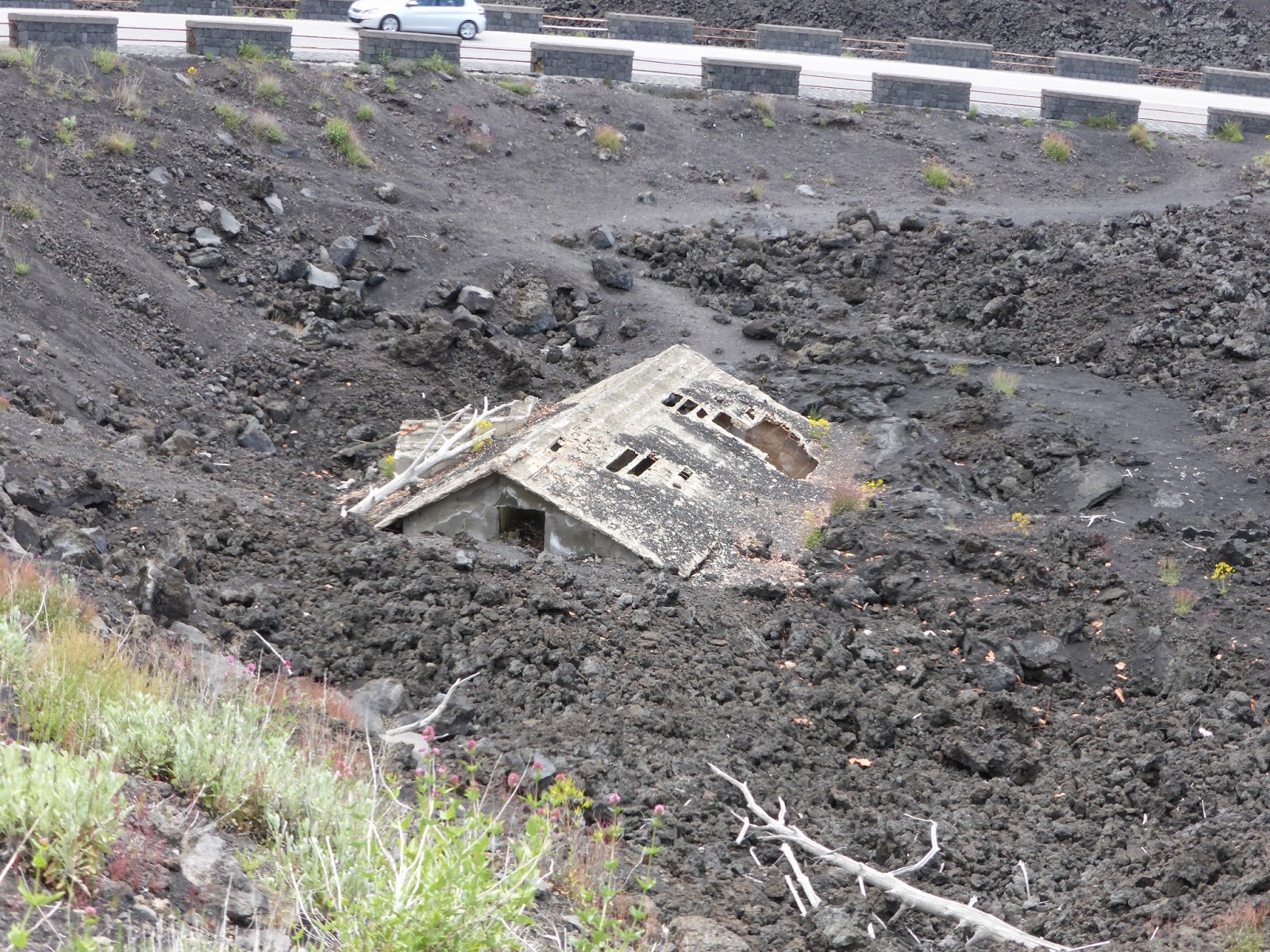
House buried in lava from recent eruption

Laurie and Chris wearing helmets needed for lava cave exploration

Lunar-like landscape of Mt Etna

One of Catania’s most famous features is La Pescheria – the fish market and adjoining food market.
Catania’s La Pescheria market

This is the most exciting and interesting market we’ve ever been to – a gastronomic delight where locals treat their shopping as a pleasure, not a chore. The market’s mayhem assaults all your senses – the bellowing of vendors advertising their wares, the chopping of fish fillets, the clink of ice and splash of water being cast over fish to keep them glisteningly moist, the angry yell of an accidentally splashed elderly lady dressed in black, the good-natured bargaining between sellers and buyers, the aroma of dozens of fish varieties, fresh breads, cheeses and cured meats, live octopuses slithering across the stalls, the kaleidoscope of colours and textures, and the whole experience set in an atmospheric spider’s web of cobbled lanes straight from a movie set. We see so many varieties of fish, including some very large tuna and swordfish, that we wonder why our fishing has been so unsuccessful.

The market sells every imaginable type of food

Large swordfish in La Pescheria

There are dozens of stands like this selling varities of seafood

Slabs of delicious cheeses abound

There are so many people here that we can only walk at a snail’s pace, and after buying what we need we find a small café with outdoor tables to enjoy a none-too-healthy breakfast of cappuccino and chocolate croissants.
TECHNICAL Chris has been helping us with a number of both maintenance jobs and improvements:
– Our refrigerator door stopped closing properly so Chris modified the gasket
– On the advice of another Nordhavn owner we checked the sealant around the base of the mast for water leaks, and Chris laid a new bead of 3M 5200 to keep it watertight. For this job we used an unopened sealant cartridge dating from 2005, and it worked perfectly (so much for 1-2 years shelf life!)
– Resolved a sound quality issue with our DVD player
– Modified our BBQ to make it easier to keep cooked food warm
– Repaired our guest shower nozzle and fitted a new adjustable mirror in the guest bathroom
– Repaired our port forward teak rubbing strake
– Fitted a protective cover around our guest head power switch
– Installed a new clock mechanism in our brass bedroom clock
– Made improvements to the dinette table
– Our main Raritan electric head is not working well and we’ve tried a few ideas to fix it. Next step is to replace the joker valve

LOG As at 30/5/14, we’d spent 52 days aboard and cruised 463 miles for 79 engine hours.

ARRIVING IN ITALY

Envoy is in Porto Empedocle, waiting for a Scirocco (southerly blow) to pass before cruising further westwards along the southern coast of Sicily.
Leaving the Albanian port of Sarande we sailed west to the Greek island of Erikoussa for an overnight stop, positioning ourselves for the next morning’s seven hour cruise to Santa Maria di Leuca, our port of entry for Italy. It wasn’t a great re-introduction to Italian marinas as there was no answer to our VHF radio calls and no sign of help available for berthing until a reluctant marinara eventually arrived to allocate a berth and take our stern lines as we backed into the pontoon. Again we used an agency – JLT Yacht Agency (affiliated to A1 Yachting) as we needed sound advice on meeting Italian documentary requirements in the best way. 1930s fascist dictator Mussolini and his cronies had their holiday villas at Santa Maria di Leuca, and many of these still remain. He was also responsible for the construction of an impressive stepped walkway to the lighthouse overlooking the harbour. 

Looking down Mussolini steps to the marina at Santa Maria di Leuca

Laurie and Chris pose with statue of Pope Beneditto 16th who visited here in 2008

There’s not a lot to see along this stretch of coastline, but we enjoyed berthing alongside the quay in the port of Ciro – a typical small Italian working town with few traits of tourism. Here we found a Vodafone shop and were able to get Italian SIM cards for phone and Internet connection. This process is always a bit of a hassle in a new country, and like at home the Vodafone shops are always busy, but they do try their best to help.

Laurie organizing Italian phone and Internet connection

Entering the port of Rocella, further south, can be daunting in a heavy swell as the entrance is only about three metres deep and a very shallow sandbar protrudes from the starboard side of the entrance. In 2004 a 37 ft yacht attempting to enter the harbour in Force 5 winds and large swells was rolled over by a wave estimated at six metres high, fortunately with no loss of life and only minor injuries. We saw a Spanish yacht hit the sandbar with a sudden stop, but conditions were good and she was able to maneuver her way off.

Map showing Rocella Harbour’s dangerous entrance

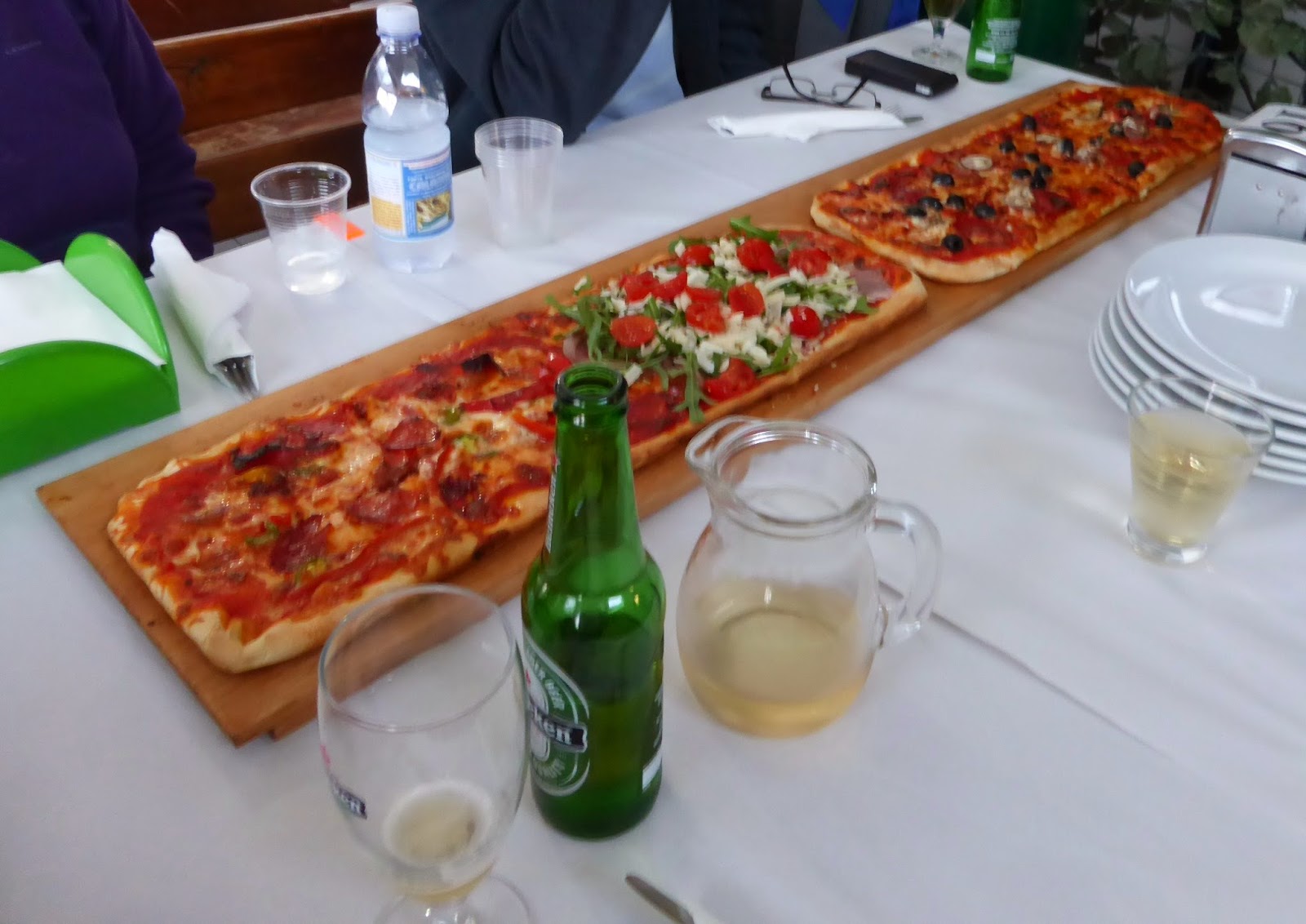
In the nearby taverna they sell mouth-watering pizza by the metre

SICILY
As we cruised down the “boot” of Italy, the island of Sicily gradually came into view and we spotted a mountain that we thought was Mt Etna. But as we came closer another mountain came into view, and at 10,700 feet high it dwarfed the one we’d seen. It’s sobering to view the mountain and realise it’s still very active with typically 25 minor eruptions annually.
Sicily is the largest Med island and the main focus of this year’s cruise, as we plan to spend about four months here. The wind had been light with glassy calm seas on a gentle swell as we approached the Strait of Messina. Looking ahead I observed whitecaps and closer inspection through binoculars showed an approaching squall. In about ten minutes we had 30 knot winds and breaking two metre seas on our beam. Our stabilisers were coping well, but Envoy still rolled up to 20 degrees each side. At one point our starboard side rolled downwards off a wave just as an extra large wave hit us, breaking over the starboard gunwale and filling the cockpit with water. The water drained out through the scuppers within about ten seconds, but not before some seawater came up over the 150 mm high lip into the saloon. Fortunately the carpet soaked up most of the water and later we found less than ten litres in the bilges.

Taormina
For the first three days we anchored off the town of Giardini Naxos, close to the enchanting medieval village of Taormina – playground of the rich and famous.

View of Taormina from Envoy’s anchorage

In Italy we have to be more careful about personal security as theft is a problem, and it’s always recommended to lock your dinghy to the quay, something we’ve never needed to do in Turkey or Greece. We wanted to leave the dinghy for the day to visit Taormina, and as we approached a jetty in Giardini harbour a young guy came to take our lines, introduced himself as Gabriel and said we could leave our dinghy there. He’d recently had a great holiday in Australia and took a shine to us antipodeans. Diane asked where we could find a butcher’s shop, and Gabriel immediately offered to drive her there.

Di with very helpful Gabriel at the pier we left the tender

Later that day I picked up Chris from the shore from a different jetty, and as he climbed into the RHIB a guy came running down the jetty, waving to us. He told us this was a private jetty and there’s a 10 Euro (NZ$16) fee for using it. We thanked the guy for letting us know and said if we use it again we’ll know to pay.

Chris and Laurie enjoy morning coffee by ceramics shop in Taormina

Taormina street scene

Beautiful Taormina church

There are many street vendors in Taormina selling everything from sunglasses to cheap toys. We had to laugh when it started to rain and immediately the sunglasses and hats disappeared and the same vendors were offering umbrellas and parkas!

This Taormina shop sells sweets and cakes to die for

One of several Taormina antique shops

TECHNICAL – nothing to report

LOG As at 26/5/14, we’d spent 48 days aboard and cruised 431 miles for 73 engine hours.

Welcome to Italy!

Greetings all!

Greetings all!

This summer’s cruising season is now officially underway, and our journey has begun. The last month was spent readying the boats for departure, and mostly just “waiting.” During our final week in Montenegro we were like racehorses before the start of a race, nervously pacing, impatient for the action to begin.

Schengen Rules

(top)

For immigration reasons we didn’t want to enter the European Union (EU) until around June the 15th. However, a few days ago we saw a weather window (a period of excellent weather) and decided to jump on it. There is a rule, called Schengen, that restricts non-EU residents to only 90 days inside the EU out of any rolling 180 day period. There are workarounds to this rule, but none that are easy. The usual workaround is to apply for residency in a Schengen country, but the application process is virtually impossible in some countries. Most cruisers find it easier to simply exit the EU within the 90 day period.

Because we have now entered the EU, our 90-day clock has started ticking. It’s really sad, because it adds a sense of time pressure, forcing us to constantly be thinking about the clock instead of leisurely cruising. There are rumors that rule-changes are coming which make it easier for world cruisers to spend time in Europe, but we are a tiny group and have little influence.

Montenegro

(top)

Our two boats (Seabird and Sans Souci) spent the winter moored in Croatia. As soon as the maintenance had been done on the boats we ran miles south to Montenegro for several reasons.

First, we deliberately tucked the boats away for the winter with empty fuel tanks. Montenegro offers fuel to visiting yachts tax-free as an incentive to bring the larger yachts into Montenegro. It’s an incentive that works! Instead of paying an equivalent $9 USD / gallon we would be able to take on fuel for under $4 USD per gallon. Sans Souci takes 3,000 gallons of fuel, so there was a powerful incentive to wait for Montenegro to take on fuel.

Second, Montenegro is outside the EU. I mentioned that there is a 90-day clock ticking on when Roberta and I need to leave the EU. There is another clock, which has an 18-month duration, that is ticking on our boat. Non-EU boats are permitted only 18 months for cruising within the EU before they are subject to VAT tax, which can represent 20% of the value of the boat. Our visit to Montenegro reset that 18-month clock as well. Sometime next year we’ll need to be thinking about where our next non-EU destination can be. My best guess is that we’ll be heading to Morocco.

And, another reason for going to Montenegro: We wanted to! It’s a spectacular place, with a wonderful marina.

Sans Souci’s home for the last two weeks. They describe themselves as, “The Mediterrean’s Leading Luxury Yacht Homeport and Marina Village.” We agree!

Other marinas should study the Porto Montenegro Marina and learn from it. They do things right, and that is attracting the big boats to Montenegro. I know how much money we spent while there, and when you add moorage, electricity, provisioning, meals and hiring of local technicians, it adds to a significant number. And we were a relatively small boat on our dock; there are docks with a lot bigger boats than ours! On a bigger scale, some percentage of the visitors are buying slips and the fancy condos that line the marina.

It isn’t just the cheap fuel that is drawing people to Porto Montenegro. The marina is world-class.

  • Fiber optic internet plumbed directly to the boat slips. I had a true 20mb download, and upload, speed that worked flawlessly throughout the two weeks we were there
  • There are five restaurants within the marina, including a sushi restaurant, an Italian restaurant and a wonderful gelato shop
  • A market, with high-end specialty items
  • The electricity was solid, and worked reliably
  • The marina team was exceptionally friendly and helpful
  • There are customs/immigration/police agents ALL based right at the marina. The marina staff stayed with us through clearing in and out of the country
  • Each slip is plumbed for black water pump-out
  • You can park your car right at your boat slip!
  • There’s an incredible swimming pool adjacent to the marina, which welcomes marina guests
  • A wide variety of upscale specialty stores in the marina: Wine, Ice Cream, Fashion, Realty
  • An easy walk into town, if you want “more.”

The pool at the Porto Montenegro marina, complete with a rooftop restaurant/bar.

We drove south about an hour to vist a small island with a quaint town connected to shore by a thin Isthmus, called Sveti Stefan. In ancient times, this was a monastery and small walled town. Nowadays this island and walled town is owned by the Aman company (of the famous Aman Hotels) and is called Aman Sveti Stefan. For Roberta and I this was important sightseeing because we had stayed in that very hotel in the late 80s (way before it was part of the Aman family of hotels) when Montenegro formed the southern tip of the now non-existent country, Yugoslavia. At that time Yugoslavia was communist, and there were already signs that the country was collapsing. This was just before the breakup of Yugoslavia when war broke out. At that time you could sense the tension everywhere. We remember having a hard time putting together a meal (unless at the hotel) and having to settle for sharing one box of Frosted Corn Flakes bought at a small mini-market during an all-day drive through the countryside. Why did we go to Yugoslavia then? We were young and naive, and it was an adventure. I remember that most housing at the time were big, identical run-down apartment buildings that we called rabbit hutches. Today, Montenegro has been reborn, and Aman Sveti Stefan is an ultra-luxury hotel.

The beach next to the hotel at Sveti Stefan.

We and the doggies have been on the boat for a month. We took them with us to Sveti Stefan and their eyes lit up at the chance to run – and pee — on REAL grass! Here we see Steven and Roberta, running with Toundra and Keeley.

Adjacent to Sveti Stefan is the summer home of Tito, former ruler of former Yugoslavia. Apparently, being dictator of a communist country paid well. It’s a grand place! It is now a luxurious hotel. Here we see Carol Argosy checking the place out.

The best thing about Europe is that our dogs are welcome anywhere there is outside dining, and often for inside dining (we’re not sure… I doubt we dine indoors more than a handful of times per season.) I missed taking the picture, but a tuxedoed waiter had just served the dogs each their own personal bowl of water seconds earlier.

On the way back from Sveti Stefan we stopped in the Montenegran town of Budva. Several people have described Budva as similar to St. Tropez, including one person who suggested that tripping over supermodels was a serious hazard while walking the beaches. However, we saw no indication of anything like that. Generally, we weren’t that impressed with Budva. We saw some indications that many tourists to Budva are Russian, and one restauranteur told us that the Russians are here in significantly lower numbers this year, due to the political situation in the Ukraine. Maybe we were just in the wrong part of town, or here in the wrong season, but overall, Budva was a bit of a let-down. Anyway… This picture shows the pups at a Thai Restaurant when we stopped to eat in Budva. It was awesome! The dogs weren’t sure what to make of their swinging chair though!

Leaving Montenegro

(top)

Finally! After what seemed an eternity of waiting, the time had come to depart Montenegro and start the summer’s cruising. Our first leg would be a 15-hour run across the Adriatic Sea to Brindisi, Italy. If you think of Italy as a leg, with a foot facing west at the bottom — we would be arriving at the ankle, on the east side.

The procedure on departing Montenegro is to take fuel and clear out of the country simultaneously. Once you have fuel you need to get out of the country immediately, and are not allowed to go to anchor. It is imperative to leave or hefty fines could be coming your way. One of the things that concerned me in the days prior to departure was that we needed to make our fuel reservation days in advance, and couldn’t easily bail on the trip if the weather turned bad. We heard stories of one boat that decided to drop their anchor, to hide from weather, and was caught doing so. They had to pay a large fine, PLUS pay the taxes on the fuel they had taken (an extra $5 per gallon.)

Luckily, the weather just got better and better, so there was no issue when departure time came.


The fuel dock at Montenegro has to be one of the busiest non-commercial fuel docks in the world. I tried to guess how much fuel the boat just ahead of us took (a 200′ yacht) and guessed 50,000 liters (around 15,000 gallons.) The attendant indicated that I was way low. Personally, I needed 2,000 gallons for Sans Souci. The process to take fuel is the most organized and planned out I’ve ever seen. There is a long checklist that you must sign off on before given fuel. I forget the items that were on it, but they centered around preventing spills. As we approached the fuel dock a tender circled our boat surrounding it with a floating ‘fence.’ This fence would contain any potential fuel spills. And, I was left with the definite impression that I wouldn’t want to find out what would happen were I crazy enough to try spilling fuel. Two large fire extinguishers were brought to me while I fueled, and a large bucket of soapy water, to instantly dilute any fuel I spilled on the deck. They require that I, as the Captain, do the fueling personally. I had prepared a detailed spreadsheet showing exactly how much fuel I wanted in each tank (three of them) which helped. For instance, I knew that I wanted 4,100 liters in the forward tank. I had them call off the liters every 500, and then slowed down the pump as we got close. Other than that it was a long (nearly two hour) painful process, it went smoothly and every drop went into the tank.

After fueling we had to clear out of the country. On entry each person is given a little white card; kind of a tourist card. Mine somehow got lost. This created some last minute confusion as everyone scrambled trying to think what to do. Luckily, the customs people didn’t make a big deal of it, and waved me through. We were free to go.

Our passage from Montenegro to Brindisi

(top)

We targeted leaving Montenegro for a departure at 5pm, knowing that with a 15-hour run this would put us into Brindisi around 7am. We were late getting to the fuel dock (stuck behind a megayacht that was very thirsty) but were able to get underway before 7pm.

The seas could not have been calmer. Roberta and I took three-hour turns at the wheel for what was a totally uneventful passage.

Our biggest challenge was staying awake during the overnight run. There are custom devices that are aids to keeping crew awake on long passages, such as the Watch Commander. It is a simple device which allows you to dial in a time interval, like 15 minutes, and unless the helmsman presses a button within the designated time a truly annoying alarm sounds. It’s a simple system, but works. On Sans Souci I just use my iphone and the alarm function. I dial in 15 minutes and press START. 15 minutes later an alarm sounds that I must clear. I clear it and start the process over. I’ve never fallen asleep while on watch, but I know people who have, sometimes with disastrous results.

Welcome to Italy!

(top)

As we approached Brindisi we called on the radio for “Brindisi Traffic Control.” I wasn’t sure exactly who to call, but could see on the chart that there were designated travel lanes for arriving and departing traffic, and figured the safe thing to do was to alert Italy to our presence. The person who answered welcomed us to Italy in a thick accent, and gave us a different person to contact on another channel as soon as we reached a certain point.

Italy! Arriving in a new country is a very cool experience, and we were all thinking the same thought: Dinner was going to be excellent! We had visions of plates piled high with pasta and thick slices of mozzarella and tomatoes for caprese salad!

As we travel from country to country, we usually use ship’s agents to handle the customs formalities. It is possible to do it yourself, and when we have been to a place before, and know the procedure, it is worth it. But generally, for the $100 to $300 that an agent typically charges it can make the process much easier. It also gives you someone who knows the local lay of the land, and speaks the language, who you can talk to. In this case we wanted moorage, and preferably wanted to be able to side-tie our boats instead of Med-mooring…never our favorite thing!

Normally in Europe most boats over about 50 feet in length have crew. Our two boats are unusual in that each is run by a couple, with NO crew. Med-mooring (parking the boat with the stern to a low concrete wall, using your anchor or a bow line extended to the bottom of the marina) is simple with three or four people but can be a challenge for two people alone, particularly in the off-the-beaten track marinas which do not offer people to help work lines (typically kids you throw a few dollars to after they help with your lines.) Seabird is at the grey-limit size for two people to Med-moor alone, and Sans Souci is well into the “it ain’t happening” category. We can do it when pushed, but .. it is best avoided.

I normally find agents just by googling on the internet. In this case I found this company:

Poseidone
Ph: +39 0831 524872 – Fax: +39 0831 564025
Branch Office: 70100 BARI (Italy)
E-mail: poseidone@poseidone.it
www.poseidone.com
Skype: Poseidone – Adriano Guadalupi

I phoned to ask if they would handle the clearing in and out of our boats. They said absolutely, and I asked about moorage – especially side-tie moorage — and he said he would find something for us. He informed us that a sailboat rally would be leaving as we were arriving, and that the public dock would be taken but that he could probably find us a place to park the boats for a fee of $100 euro a night. We agreed. Later he sent an email saying he had found us space on the public dock, but with no electricity or water. I said we might prefer the private dock, but he said there was no electricity or water there either.

Approaching Brindisi. Calm Seas!

One of the best things about using agents is that often they come to you, and handle everything in the nice air-conditioned salon of Sans Souci, rather than our standing in line at immigration, customs, and the local police. Here we see Antonio from Poseidone speaking with Steven. He is asking for our “green cards,” and we are saying, “What’s a green card?” Agents tend to speak significantly better English than the local authorities but sometimes communication can still be difficult. PS — That’s Roberta’s coffee grinder sitting in front of Steven. He had borrowed it and was bringing it back…

Clearing into Italy went smoothly until the agent asked for our green cards. We had no idea what he needed and he left frustrated by our inability to produce them. This led to a serious of confused emails between myself and the Poseidone main office. In the United States there is something called a green card, which is a form of a Visa that foreigners wanting to work in the US must obtain. We were confused about why we needed one. Then for a while we thought the agents were requesting that we have health insurance. Finally we figured out that all they needed was a summary of our insurance policy in Italian. Apparently it is common in Europe to carry a card, often printed by the insurance companies on green card-stock, summarizing the policy highlights. We could not clear into Italy until we had this.

I was nervous because this would need to be issued by my insurance company, Lloyds of London, who I think of as a large conglomerate. I couldn’t imagine them immediately issuing the document I needed. I sent an emergency email to my insurance agent, who contacted Lloyds. They knew exactly what to do, and mentioned a Hollywood celebrity who had also been caught in the same trap entering somewhere in Italy on their yacht. Within 24 hours we had the document in hand, and our agents were greatly relieved.

Our agents worked a miracle! We were able to side-tie on a cruise-ship dock, behind security, a few minute walk from downtown. And, the best part, when I asked what it cost, the price was FREE! It was perfect moorage in a perfect location.

Here we see Carol and Roberta enjoying our first dinner in Italy. Yay! We were exhausted after traveling all night, but excited to be here! In the picture you see that we were alone. We are early-eaters; usually having dinner around 6pm to 7pm. In Europe the restaurants don’t even open until 7pm, and most people dine at 8pm or later. I should also mention that we learned quickly that everything in town closes from 1pm to 5pm. Then, reopens for the evening. This will take some getting used to…

Boat Geek Report

(top)

With our smooth arrival into Brindisi I should have known things were going too well.

The day started with a hike into town to find the vegetable/fruit market. I then had to find an ATM machine to get some euros (EU money) to pay the boat-agent.

Finally, back on the boat I noticed the odor of diesel. Ouch! This sent me scurrying to the engine room where I lifted the floorboards.

Oh [censored]! There was several gallons of diesel fuel sitting in the bilge. I immediately killed the bilge pumps and looked overboard to see if any fuel had gone over the side. Thankfully, none did. Whew!

I then returned to the engine room to find the leak and didn’t have to look too hard. There is a sight-glass on the side of one of my fuel tanks. Fuel was streaming from it. I’ve never trusted those sight glasses and keep the valves shut, but one had been opened by someone unknown and not re-closed. It hadn’t been an issue while the tanks were dry, but we topped them off before leaving Montenegro.

I called Steven for advice on how to proceed. My first reaction was to get out the wet/dry vacuum. Steven thought that was a bad idea and brought over a hand-pump he uses for these jobs. Unfortunately, the fuel was everywhere, and clean-up became a much bigger job than either of us expected.

You never really know who your friends are until you dump 15 gallons of diesel into the bilge of your boat and need help cleaning up the mess. Here you see my VERY good friend Steven hard at work!

Ultimately, we filled three five-gallon buckets with diesel fuel, grabbed from various pockets in the bilge. Anyone who has ever laid on their belly for over three hours, on the floor of a tight engine room, trying to vacuum fuel from tiny crevices, will tell you that it isn’t a pleasent experience. Diesel fuel does not smell pretty.

On completion I had three 5-gallon containers of diesel fuel. We had poured cleaning solution into the bilge, so it couldn’t be poured back into the tanks. I then called our ship’s agent and said, “Where can I dump three five-gallon buckets of diesel?” The agent was awesome. He had an environmental truck on site within minutes of the phone call. They took the diesel giving me back my empty buckets (I need them for oil changes.) The cost: $140 euro — just over $200 USD. I was happy to pay it.

This was pretty embarrassing… Within a minute of hanging up the phone with our agent I saw this garbage truck driving along the dock. Both Roberta and I started waving our arms and shouting. I ran out with two large zip-tied bags of garbage. The driver looked confused but accepted them and threw them in the back. I asked him to wait while I went inside to get a tip (I had asked Roberta for five euros.) As I was returning with the coins I noticed him setting two ten-gallon fuel cans onto the dock. OOPS! This wasn’t a garbage truck. It was an environmental clean-up truck, and he was here to collect the fuel. How embarrassing. He was a very nice guy who didn’t speak a word of english, and I helped him pour the fuel from my containers to his. He drove away with the trash, the fuel AND, his tip – made larger!

Steven lost an entire afternoon helping me, and I now owe him a big favor… With my luck it will be his black water system that springs a leak. And that said, I almost think I’d rather spend a day shoveling black water than EVER spend another day in an engine room cleaning diesel fuel. It’s really nasty stuff…

And, finally…

(top)

Our next few days will be challenging ones. We were spoiled in Greece, Montenegro and Croatia where 99% of our passages were short day-trips. Over these next few days we will be venturing to Malta, which is another country. We’ll get to clear in and out all over again. We’ll also have a couple of overnight passages, and potentially some wind in our faces to deal with.

That said, as I am typing this, we have been at sea for several hours, and I’ve been in rougher swimming pools. We’re underway, and life is good on Sans Souci!

If you aren’t receiving my blog entries via email, click this link to register:

http://www.kensblog.com/register

I should also mention that this is one of two blogs that I do. My other blog is on Facebook, although you do not need to register with Facebook to view the blog. Just click on this link:

http://www.facebook.com/kensblogdotcom

My other blog is very different than this blog. I post to it almost every day, and post whatever I happen to be thinking about, without editing or filtering. I also tend to respond instantly to any questions. Check it out!

IMPORTANT:  If you received this blog entry via email and wish to respond, remove the blog entry itself from the email. Delete everything in the email before you start typing.

Thank you!

Ken and Roberta Williams
ken(at)kensblog.com
MV Sans Souci
Nordhavn 68 

Start your own blog now! Free!

[KensBlog 2014-02] Welcome to Italy!

Greetings all!

Greetings all!

This summer’s cruising season is now officially underway, and our journey has begun. The last month was spent readying the boats for departure, and mostly just “waiting.” During our final week in Montenegro we were like racehorses before the start of a race, nervously pacing, impatient for the action to begin.

Schengen Rules

(top)

For immigration reasons we didn’t want to enter the European Union (EU) until around June the 15th. However, a few days ago we saw a weather window (a period of excellent weather) and decided to jump on it. There is a rule, called Schengen, that restricts non-EU residents to only 90 days inside the EU out of any rolling 180 day period. There are workarounds to this rule, but none that are easy. The usual workaround is to apply for residency in a Schengen country, but the application process is virtually impossible in some countries. Most cruisers find it easier to simply exit the EU within the 90 day period.

Because we have now entered the EU, our 90-day clock has started ticking. It’s really sad, because it adds a sense of time pressure, forcing us to constantly be thinking about the clock instead of leisurely cruising. There are rumors that rule-changes are coming which make it easier for world cruisers to spend time in Europe, but we are a tiny group and have little influence.

Montenegro

(top)

Our two boats (Seabird and Sans Souci) spent the winter moored in Croatia. As soon as the maintenance had been done on the boats we ran miles south to Montenegro for several reasons.

First, we deliberately tucked the boats away for the winter with empty fuel tanks. Montenegro offers fuel to visiting yachts tax-free as an incentive to bring the larger yachts into Montenegro. It’s an incentive that works! Instead of paying an equivalent $9 USD / gallon we would be able to take on fuel for under $4 USD per gallon. Sans Souci takes 3,000 gallons of fuel, so there was a powerful incentive to wait for Montenegro to take on fuel.

Second, Montenegro is outside the EU. I mentioned that there is a 90-day clock ticking on when Roberta and I need to leave the EU. There is another clock, which has an 18-month duration, that is ticking on our boat. Non-EU boats are permitted only 18 months for cruising within the EU before they are subject to VAT tax, which can represent 20% of the value of the boat. Our visit to Montenegro reset that 18-month clock as well. Sometime next year we’ll need to be thinking about where our next non-EU destination can be. My best guess is that we’ll be heading to Morocco.

And, another reason for going to Montenegro: We wanted to! It’s a spectacular place, with a wonderful marina.

Sans Souci’s home for the last two weeks. They describe themselves as, “The Mediterrean’s Leading Luxury Yacht Homeport and Marina Village.” We agree!

Other marinas should study the Porto Montenegro Marina and learn from it. They do things right, and that is attracting the big boats to Montenegro. I know how much money we spent while there, and when you add moorage, electricity, provisioning, meals and hiring of local technicians, it adds to a significant number. And we were a relatively small boat on our dock; there are docks with a lot bigger boats than ours! On a bigger scale, some percentage of the visitors are buying slips and the fancy condos that line the marina.

It isn’t just the cheap fuel that is drawing people to Porto Montenegro. The marina is world-class.

  • Fiber optic internet plumbed directly to the boat slips. I had a true 20mb download, and upload, speed that worked flawlessly throughout the two weeks we were there
  • There are five restaurants within the marina, including a sushi restaurant, an Italian restaurant and a wonderful gelato shop
  • A market, with high-end specialty items
  • The electricity was solid, and worked reliably
  • The marina team was exceptionally friendly and helpful
  • There are customs/immigration/police agents ALL based right at the marina. The marina staff stayed with us through clearing in and out of the country
  • Each slip is plumbed for black water pump-out
  • You can park your car right at your boat slip!
  • There’s an incredible swimming pool adjacent to the marina, which welcomes marina guests
  • A wide variety of upscale specialty stores in the marina: Wine, Ice Cream, Fashion, Realty
  • An easy walk into town, if you want “more.”

The pool at the Porto Montenegro marina, complete with a rooftop restaurant/bar.

We drove south about an hour to vist a small island with a quaint town connected to shore by a thin Isthmus, called Sveti Stefan. In ancient times, this was a monastery and small walled town. Nowadays this island and walled town is owned by the Aman company (of the famous Aman Hotels) and is called Aman Sveti Stefan. For Roberta and I this was important sightseeing because we had stayed in that very hotel in the late 80s (way before it was part of the Aman family of hotels) when Montenegro formed the southern tip of the now non-existent country, Yugoslavia. At that time Yugoslavia was communist, and there were already signs that the country was collapsing. This was just before the breakup of Yugoslavia when war broke out. At that time you could sense the tension everywhere. We remember having a hard time putting together a meal (unless at the hotel) and having to settle for sharing one box of Frosted Corn Flakes bought at a small mini-market during an all-day drive through the countryside. Why did we go to Yugoslavia then? We were young and naive, and it was an adventure. I remember that most housing at the time were big, identical run-down apartment buildings that we called rabbit hutches. Today, Montenegro has been reborn, and Aman Sveti Stefan is an ultra-luxury hotel.

The beach next to the hotel at Sveti Stefan.

We and the doggies have been on the boat for a month. We took them with us to Sveti Stefan and their eyes lit up at the chance to run – and pee — on REAL grass! Here we see Steven and Roberta, running with Toundra and Keeley.

Adjacent to Sveti Stefan is the summer home of Tito, former ruler of former Yugoslavia. Apparently, being dictator of a communist country paid well. It’s a grand place! It is now a luxurious hotel. Here we see Carol Argosy checking the place out.

The best thing about Europe is that our dogs are welcome anywhere there is outside dining, and often for inside dining (we’re not sure… I doubt we dine indoors more than a handful of times per season.) I missed taking the picture, but a tuxedoed waiter had just served the dogs each their own personal bowl of water seconds earlier.

On the way back from Sveti Stefan we stopped in the Montenegran town of Budva. Several people have described Budva as similar to St. Tropez, including one person who suggested that tripping over supermodels was a serious hazard while walking the beaches. However, we saw no indication of anything like that. Generally, we weren’t that impressed with Budva. We saw some indications that many tourists to Budva are Russian, and one restauranteur told us that the Russians are here in significantly lower numbers this year, due to the political situation in the Ukraine. Maybe we were just in the wrong part of town, or here in the wrong season, but overall, Budva was a bit of a let-down. Anyway… This picture shows the pups at a Thai Restaurant when we stopped to eat in Budva. It was awesome! The dogs weren’t sure what to make of their swinging chair though!

Leaving Montenegro

(top)

Finally! After what seemed an eternity of waiting, the time had come to depart Montenegro and start the summer’s cruising. Our first leg would be a 15-hour run across the Adriatic Sea to Brindisi, Italy. If you think of Italy as a leg, with a foot facing west at the bottom — we would be arriving at the ankle, on the east side.

The procedure on departing Montenegro is to take fuel and clear out of the country simultaneously. Once you have fuel you need to get out of the country immediately, and are not allowed to go to anchor. It is imperative to leave or hefty fines could be coming your way. One of the things that concerned me in the days prior to departure was that we needed to make our fuel reservation days in advance, and couldn’t easily bail on the trip if the weather turned bad. We heard stories of one boat that decided to drop their anchor, to hide from weather, and was caught doing so. They had to pay a large fine, PLUS pay the taxes on the fuel they had taken (an extra $5 per gallon.)

Luckily, the weather just got better and better, so there was no issue when departure time came.


The fuel dock at Montenegro has to be one of the busiest non-commercial fuel docks in the world. I tried to guess how much fuel the boat just ahead of us took (a 200′ yacht) and guessed 50,000 liters (around 15,000 gallons.) The attendant indicated that I was way low. Personally, I needed 2,000 gallons for Sans Souci. The process to take fuel is the most organized and planned out I’ve ever seen. There is a long checklist that you must sign off on before given fuel. I forget the items that were on it, but they centered around preventing spills. As we approached the fuel dock a tender circled our boat surrounding it with a floating ‘fence.’ This fence would contain any potential fuel spills. And, I was left with the definite impression that I wouldn’t want to find out what would happen were I crazy enough to try spilling fuel. Two large fire extinguishers were brought to me while I fueled, and a large bucket of soapy water, to instantly dilute any fuel I spilled on the deck. They require that I, as the Captain, do the fueling personally. I had prepared a detailed spreadsheet showing exactly how much fuel I wanted in each tank (three of them) which helped. For instance, I knew that I wanted 4,100 liters in the forward tank. I had them call off the liters every 500, and then slowed down the pump as we got close. Other than that it was a long (nearly two hour) painful process, it went smoothly and every drop went into the tank.

After fueling we had to clear out of the country. On entry each person is given a little white card; kind of a tourist card. Mine somehow got lost. This created some last minute confusion as everyone scrambled trying to think what to do. Luckily, the customs people didn’t make a big deal of it, and waved me through. We were free to go.

Our passage from Montenegro to Brindisi

(top)

We targeted leaving Montenegro for a departure at 5pm, knowing that with a 15-hour run this would put us into Brindisi around 7am. We were late getting to the fuel dock (stuck behind a megayacht that was very thirsty) but were able to get underway before 7pm.

The seas could not have been calmer. Roberta and I took three-hour turns at the wheel for what was a totally uneventful passage.

Our biggest challenge was staying awake during the overnight run. There are custom devices that are aids to keeping crew awake on long passages, such as the Watch Commander. It is a simple device which allows you to dial in a time interval, like 15 minutes, and unless the helmsman presses a button within the designated time a truly annoying alarm sounds. It’s a simple system, but works. On Sans Souci I just use my iphone and the alarm function. I dial in 15 minutes and press START. 15 minutes later an alarm sounds that I must clear. I clear it and start the process over. I’ve never fallen asleep while on watch, but I know people who have, sometimes with disastrous results.

Welcome to Italy!

(top)

As we approached Brindisi we called on the radio for “Brindisi Traffic Control.” I wasn’t sure exactly who to call, but could see on the chart that there were designated travel lanes for arriving and departing traffic, and figured the safe thing to do was to alert Italy to our presence. The person who answered welcomed us to Italy in a thick accent, and gave us a different person to contact on another channel as soon as we reached a certain point.

Italy! Arriving in a new country is a very cool experience, and we were all thinking the same thought: Dinner was going to be excellent! We had visions of plates piled high with pasta and thick slices of mozzarella and tomatoes for caprese salad!

As we travel from country to country, we usually use ship’s agents to handle the customs formalities. It is possible to do it yourself, and when we have been to a place before, and know the procedure, it is worth it. But generally, for the $100 to $300 that an agent typically charges it can make the process much easier. It also gives you someone who knows the local lay of the land, and speaks the language, who you can talk to. In this case we wanted moorage, and preferably wanted to be able to side-tie our boats instead of Med-mooring…never our favorite thing!

Normally in Europe most boats over about 50 feet in length have crew. Our two boats are unusual in that each is run by a couple, with NO crew. Med-mooring (parking the boat with the stern to a low concrete wall, using your anchor or a bow line extended to the bottom of the marina) is simple with three or four people but can be a challenge for two people alone, particularly in the off-the-beaten track marinas which do not offer people to help work lines (typically kids you throw a few dollars to after they help with your lines.) Seabird is at the grey-limit size for two people to Med-moor alone, and Sans Souci is well into the “it ain’t happening” category. We can do it when pushed, but .. it is best avoided.

I normally find agents just by googling on the internet. In this case I found this company:

Poseidone
Ph: +39 0831 524872 – Fax: +39 0831 564025
Branch Office: 70100 BARI (Italy)
E-mail: poseidone@poseidone.it
www.poseidone.com
Skype: Poseidone – Adriano Guadalupi

I phoned to ask if they would handle the clearing in and out of our boats. They said absolutely, and I asked about moorage – especially side-tie moorage — and he said he would find something for us. He informed us that a sailboat rally would be leaving as we were arriving, and that the public dock would be taken but that he could probably find us a place to park the boats for a fee of $100 euro a night. We agreed. Later he sent an email saying he had found us space on the public dock, but with no electricity or water. I said we might prefer the private dock, but he said there was no electricity or water there either.

Approaching Brindisi. Calm Seas!

One of the best things about using agents is that often they come to you, and handle everything in the nice air-conditioned salon of Sans Souci, rather than our standing in line at immigration, customs, and the local police. Here we see Antonio from Poseidone speaking with Steven. He is asking for our “green cards,” and we are saying, “What’s a green card?” Agents tend to speak significantly better English than the local authorities but sometimes communication can still be difficult. PS — That’s Roberta’s coffee grinder sitting in front of Steven. He had borrowed it and was bringing it back…

Clearing into Italy went smoothly until the agent asked for our green cards. We had no idea what he needed and he left frustrated by our inability to produce them. This led to a serious of confused emails between myself and the Poseidone main office. In the United States there is something called a green card, which is a form of a Visa that foreigners wanting to work in the US must obtain. We were confused about why we needed one. Then for a while we thought the agents were requesting that we have health insurance. Finally we figured out that all they needed was a summary of our insurance policy in Italian. Apparently it is common in Europe to carry a card, often printed by the insurance companies on green card-stock, summarizing the policy highlights. We could not clear into Italy until we had this.

I was nervous because this would need to be issued by my insurance company, Lloyds of London, who I think of as a large conglomerate. I couldn’t imagine them immediately issuing the document I needed. I sent an emergency email to my insurance agent, who contacted Lloyds. They knew exactly what to do, and mentioned a Hollywood celebrity who had also been caught in the same trap entering somewhere in Italy on their yacht. Within 24 hours we had the document in hand, and our agents were greatly relieved.

Our agents worked a miracle! We were able to side-tie on a cruise-ship dock, behind security, a few minute walk from downtown. And, the best part, when I asked what it cost, the price was FREE! It was perfect moorage in a perfect location.

Here we see Carol and Roberta enjoying our first dinner in Italy. Yay! We were exhausted after traveling all night, but excited to be here! In the picture you see that we were alone. We are early-eaters; usually having dinner around 6pm to 7pm. In Europe the restaurants don’t even open until 7pm, and most people dine at 8pm or later. I should also mention that we learned quickly that everything in town closes from 1pm to 5pm. Then, reopens for the evening. This will take some getting used to…

Boat Geek Report

(top)

With our smooth arrival into Brindisi I should have known things were going too well.

The day started with a hike into town to find the vegetable/fruit market. I then had to find an ATM machine to get some euros (EU money) to pay the boat-agent.

Finally, back on the boat I noticed the odor of diesel. Ouch! This sent me scurrying to the engine room where I lifted the floorboards.

Oh [censored]! There was several gallons of diesel fuel sitting in the bilge. I immediately killed the bilge pumps and looked overboard to see if any fuel had gone over the side. Thankfully, none did. Whew!

I then returned to the engine room to find the leak and didn’t have to look too hard. There is a sight-glass on the side of one of my fuel tanks. Fuel was streaming from it. I’ve never trusted those sight glasses and keep the valves shut, but one had been opened by someone unknown and not re-closed. It hadn’t been an issue while the tanks were dry, but we topped them off before leaving Montenegro.

I called Steven for advice on how to proceed. My first reaction was to get out the wet/dry vacuum. Steven thought that was a bad idea and brought over a hand-pump he uses for these jobs. Unfortunately, the fuel was everywhere, and clean-up became a much bigger job than either of us expected.

You never really know who your friends are until you dump 15 gallons of diesel into the bilge of your boat and need help cleaning up the mess. Here you see my VERY good friend Steven hard at work!

Ultimately, we filled three five-gallon buckets with diesel fuel, grabbed from various pockets in the bilge. Anyone who has ever laid on their belly for over three hours, on the floor of a tight engine room, trying to vacuum fuel from tiny crevices, will tell you that it isn’t a pleasent experience. Diesel fuel does not smell pretty.

On completion I had three 5-gallon containers of diesel fuel. We had poured cleaning solution into the bilge, so it couldn’t be poured back into the tanks. I then called our ship’s agent and said, “Where can I dump three five-gallon buckets of diesel?” The agent was awesome. He had an environmental truck on site within minutes of the phone call. They took the diesel giving me back my empty buckets (I need them for oil changes.) The cost: $140 euro — just over $200 USD. I was happy to pay it.

This was pretty embarrassing… Within a minute of hanging up the phone with our agent I saw this garbage truck driving along the dock. Both Roberta and I started waving our arms and shouting. I ran out with two large zip-tied bags of garbage. The driver looked confused but accepted them and threw them in the back. I asked him to wait while I went inside to get a tip (I had asked Roberta for five euros.) As I was returning with the coins I noticed him setting two ten-gallon fuel cans onto the dock. OOPS! This wasn’t a garbage truck. It was an environmental clean-up truck, and he was here to collect the fuel. How embarrassing. He was a very nice guy who didn’t speak a word of english, and I helped him pour the fuel from my containers to his. He drove away with the trash, the fuel AND, his tip – made larger!

Steven lost an entire afternoon helping me, and I now owe him a big favor… With my luck it will be his black water system that springs a leak. And that said, I almost think I’d rather spend a day shoveling black water than EVER spend another day in an engine room cleaning diesel fuel. It’s really nasty stuff…

And, finally…

(top)

Our next few days will be challenging ones. We were spoiled in Greece, Montenegro and Croatia where 99% of our passages were short day-trips. Over these next few days we will be venturing to Malta, which is another country. We’ll get to clear in and out all over again. We’ll also have a couple of overnight passages, and potentially some wind in our faces to deal with.

That said, as I am typing this, we have been at sea for several hours, and I’ve been in rougher swimming pools. We’re underway, and life is good on Sans Souci!

If you aren’t receiving my blog entries via email, click this link to register:

http://www.kensblog.com/register

I should also mention that this is one of two blogs that I do. My other blog is on Facebook, although you do not need to register with Facebook to view the blog. Just click on this link:

http://www.facebook.com/kensblogdotcom

My other blog is very different than this blog. I post to it almost every day, and post whatever I happen to be thinking about, without editing or filtering. I also tend to respond instantly to any questions. Check it out!

IMPORTANT:  If you received this blog entry via email and wish to respond, remove the blog entry itself from the email. Delete everything in the email before you start typing.

Thank you!

Ken and Roberta Williams
ken(at)kensblog.com
MV Sans Souci
Nordhavn 68 

Start your own blog now! Free!

The ARGONAUT The Marquesas May 11 to June 3, 2014

CAPTAIN’S LOG                The Marquesas 

           May 11 to June 3, 2014 

The Islands and Their History

The Marquesas Archipelago consists of twelve islands lying in the middle of the Pacific Ocean 3,500 miles west of Peru and 3,500 miles southeast of Hawaii.  The Marquesas are volcanic islands formed approximately three million years ago of basalt and tuff rather than black lava.  Each island is different in appearance, yet they are all strikingly beautiful with very tall peaks that rise almost four thousand feet into the clouds.  On the south side the passing clouds are caught by the mountain peaks where they discourage their rain and provide moisture to lush, green, tropical jungles accented with brilliantly colored flowers.  On the north side, the islands are generally arid during the dry season.   

For millions of years the islands were uninhabited.  Human beings arrived sometime between 500 and 300 BC.  These adventurous people were probably from Taiwan or The Philippines and were making use of the outrigger canoe that was invented in that time and made open ocean sailing possible. The islands offered little to support human habitation other than sea birds, fish, rats, breadfruit and coconuts.  There were no large mammals or raptors.  Researchers have found the remains of dogs, chickens and pigs of Asian origin, so at some point the aboriginal discoverers must have brought these animals with them to the Marquesas.  (I have often wondered how ancient people found islands out in the middle of the ocean.  It is like finding a needle in a haystack.  One of our guides told us:  pigs carried onboard ships will smell its scent and become very agitated (and we know many ships did) when they smell land (as will dogs).  If the pig is released into the ocean it will swim toward land.   On the other hand, if a dog is thrown into the water it will return to the ship. It is theorized that the original discoverers brought these animals with them on their boats or rafts.  Marquesians venerate the pig because of its roll in discovering the islands (but this doesn’t keep them from having them for dinner on special occasions).  In language and customs the Marquesian people were closely related to Hawaiians.

The original Marquesians lived in hunter-gathering societies.  Families owned the rights to land, but if you were not part of a landed family you were disenfranchised and subject to harsh living conditions.  Each island had at least one tribe, and often more.  Like other hunter-gatherer societies around the world, each tribe claimed a territory and young men proved their manhood by making war on their neighbors.  Losing a battle could very well result in an invitation to dinner: cannibalism was practiced here well into the twentieth century.  Infanticide was also practiced as a means to control the population.  We were told by our guide that incest and rape are the most common serious criminal offenses; during our visit three men were in the tiny jail in Taiohae for these crimes.  About a third of the men are thought to be homosexual and/or effeminate but are not discriminated against.  These men in the ancient days did the cooking and household chores when the women were in the “red zone” and thought to be unclean.  Today these islands have many transvestites, which is readily apparent to the casual observer.  They love to party and the term “gay” is said to have originated here by GI’s during the WWII.    

There are many archeological sites in evidence on all the islands: paepaes (pie-pies), i.e., raised stone platforms on which a grass and wood hut was built are still easily seen everywhere.  Most have a pit in place to ferment pu-poi (breadfruit).  In some places they are grouped into villages with a ceremonial stage, marriage rock, and other platforms built around a central plaza about the size of a football field. The marriage rock was a large, flat stone about the size of a king size bed on which the nuptial ceremony was performed and the marriage consummated for all to witness.  Apparently this sparked a rather erotic celebration that went on for days, and was one of the first aspects of their culture that the missionaries sought to eliminate. On Nuku Hiva the ancient village we visited had a large, deep pit used for keeping prisoners.  Prisoners usually found their way to the BBQ!

Likewise the funeral ritual had a special twist to it; ancients believed that the brain was home to the soul and that the spirit of an ancestor would continue to assist the family when consulted during times of crisis.  Archeologists have found the heads from many generations of ancestors buried in paepaes. When a person died the head was severed, the eyes and brains eaten, and the skull placed under a rock in the family’s paepae.  The body was eaten, the skin used for drum heads and other purposes, the bones carved into ornaments and fish hooks.  Grandma apparently helped with fishing too!

The islands were discovered by the Spanish in 1595.  Like other aboriginal societies around the world, the Marquesasian population was devastated by European diseases.  When Commodore Perry arrived in 1813 he estimated the population at 80,000 people, but by 1920 the population had fallen to about 2,300.  At that time the government offered land to any male willing to marry a Marquesian woman and start a family and farm.   Today, there are no native pure Marquesians left, but the evidence of the racial mixture from the sailors of whaling ships taking up the offer of land and a family is evident everywhere.  There are now about 8,000 people living in the Marquesas.

The islands are named for the parts of a house, metaphorically, all islanders living under one roof; Hiva means roof, nuku as in Nuku Hiva means roof beam, Poa as in Ua Poa means standing pole, Oa as in Hiva Oa means lateral timber, etc.

The Islands Today

The weather here is lovely: there is a constant trade wind breeze between 15 and 20 knots, freshening the 85 degree air.  Most days are sunny, with an occasional rainy day.  Tsunamis are a concern, as Chilean earthquakes give rise to tidal waves that can sweep through the small coastal villages destroying houses and buildings. The islands are full of wild chickens and roosters, goats, and horses.    The roosters crow all the time.  They have very beautiful and varied colored plumage.  It is a lot of fun to watch them strut about crowing and demonstrating their prowess.  Dogs occasionally make a game of chasing the chicks about (perhaps for a snack if they can catch them), which sends the mother hen into a frenzy.  People here are heavy set; they like fruit and sugary foods that make them fat.  Diabetes is surely the number one public health concern.  They speak French, drive crew cab pick-up trucks, mostly Toyotas, but some Fords, they are by-and-large Roman Catholic and are family and community oriented. If they don’t work for the government, most islanders make a living selling carvings of wood or stone to the tourist stores in Tahiti, or by selling agricultural products like copra (coconut prepared for oil extraction) and other fruit. Unlike Jamaicans, Marquesasians bring their children to the beach for a swim frequently. Children are schooled in the village until eighth grade, then they are sent to Tahiti (600 miles south) for the later grades. Many never return and this is one reason why the Marquesas have such a low population. Men race outrigger canoes in the harbor every afternoon.  The out-riggers have a very thin beam, are about twenty feet long and are made of fiberglass.  There is a tiny compartment in the middle of the craft for the paddler to sit, much like a kayak.  The outrigger pontoon is rather small at about four feet long, one foot wide and deployed about four feet off to one side of the canoe on two curved rails. Some boats are designed for as many as six crew.  They are the fastest human propelled boats I have ever seen, in addition to being graceful and stable.

Our experiences

We visited five of the six inhabited islands: Nuku Hiva, Ua Poa, Tahuata, Hiva Oa, and Fatu Hiva. 


At Nuku Hiva we anchored in the bay near the village of Taiohae.  This is the largest town in the Marquesas with a population of 2,300.  The bay is formed by the crater of an ancient volcano with the sides of the volcano rising above the sea and enclosing the bay.  It is spectacular.  The walls of the volcano are covered in lush jungle, and the sun’s light changes the color and texture of the mountain every hour.  The bay is a turquoise blue, clean and deep.  When we arrived there were about twenty sailboats in the harbor.  The bay is open to the ocean, so the ocean’s swell rolled in and necessitated a stern anchor to hold Argo’s bow into the swell.  After seventeen days at sea and a very rough few hours getting into the harbor, we were anxious to go ashore.  After lowering the tender and securing Argo we went ashore.  There we found a dingy dock of sorts.  It was a stainless steel ladder attached to a quae wall about which ten or fifteen tenders were clustered.  The lower part of the ladder’s rails were unprotected, puncturing several rubber dinghies that got trapped under it during low tides during the week we were in Taiohae.  It was challenging to get ashore.  On shore we found our agent, an American named Kevin, who set us up and got us oriented. 


We spent a week here.  Argo needed a fair amount of cleaning and maintenance after our long passage.  We needed several days to walk around and stretch our legs.  Taiohae had several little restaurants, one of which was pretty good.  It offered several dishes including pizza that wasn’t too bad.  They also offered Peach Melba with homemade ice cream that I particularly liked.  We also shopped for food and souvenirs.  The most memorable thing we did on Nuku Hiva was to take a day long tour around the beautiful island.  Our tour guide was Phillip, a crusty English curmudgeon who arrived here sixteen years ago and never left.  Not many things were agreeable to Phillip, but he conducted an interesting tour and was very well informed about local customs and history.   The pictures that we will post on www.tischtravels.com when we get enough bandwidth will tell the story best, but in lieu of pictures I can say that Nuku Hiva was one of the most beautiful places on the planet.  The island has two volcanoes, one forming the bay and a larger one forming the high mountains and central plane about 1,000 feet above sea level.  It also has a number of interesting villages including Taipivai, the largest archeological site in the Marquesas’ that that had a hundred or so paepaes and ceremonial plazas, pu-poi pits and pits to store human prisoners.  We found it exceedingly interesting.  It was partially over grown with huge banyan trees and had been restored a few years ago.  Herman Melville lived in Tohua Teiviohou and wrote a novel here in 1843.  Nuku Hiva has several beautiful bays, lovely beaches, lush tropical jungles, and soring peaks that have been eroded by wind and rain into fascinating sculptures.  We shared the tour with Tom and Karen Lowe of Scottsdale, Arizona.  They are sailing these waters in a steel hulled sailing vessel.  We enjoyed their company very much. 


After six days in Nuku Hiva we bade her farewell and hoisted our anchor for Ua Poa.  It was a bumpy 28 mile passage against both wind and wave.  After about an hour at sea we could see the island at a distance; it was breathtaking.  It is an emerald green mountain island with twelve huge spires of basalt rising thousands of feet into the clouds.  Ua Poa dominates the sea and one’s imagination.  It looks like a Jurassic period gothic cathedral with spires all about, but of such an immense scale that it boggles and fascinates the mind.   We put in at Hakahau, a little bay and village of the same name on the northwest coast.  The bay was at the foot of the spires and made a fabulous view for the week we spent here. 


The harbor is tiny and had about 15 boats at anchor when we visited.  We didn’t think there was any place for us.  It has a seawall, but it’s short and doesn’t stop the swell from circling its way in.  We looked about for a place to anchor but had to settle for a spot between two sailboats that were about 50 yards apart.  We spilt the distance and anchored both fore and aft.  We were very close to these other boats, but that is the way it is done here as the harbors are often very small.  Lucky for everyone, our stern anchored worked like a charm.  For the next two days the wind blew and it was cloudy with rain, but we met several other sailors who were interesting, adventurous people that shared their stories and experiences.   


The second evening in port we dined at the Pension Puke’e’ high on a hill above the little village.  Owners Jerome and Elisa cooked up a delicious meal of sea bass (200+ lb. fish caught in 1,500 feet), yellow fin tuna prepared as ceviche in coconut milk, curried goat, scalloped breadfruit, rice, and topped off with French wine.  For desert; a lovely cake of mango and two other fruits.  Jerome and Elisa met in France where she was doing the hair of celebrities and going to the Cordon Blue School.  Jerome was a commando in the French armed forces.  Elisa is Marquesian and they married and returned to buy her mother’s pension and build the business.  The pension is an open building exposed to the wonderful breeze.  It is built in the Polynesian style and quite lovely.  After dinner we arranged with Jerome for a tour of the island.


Hakahau is a nice, clean little village that is home to about fifteen hundred people.  The streets are paved, the homes are bungalows, nicely kept, open to the breeze and surrounded by lush, flowering gardens.  The town has several little restaurants (that open when the cruise ship Ananui 3 comes in each month), four little grocery stores like we used to have in America on the corners of many streets before supermarkets became popular.   These stores have staples and processed food, some frozen meat, beer, wine and some fresh pastries.  They do not offer much in the way of fruits and vegetables because people grow them at home.  In the center of the town was an historic paepae that was formerly the home of the chief that founded Hakahau many hundreds of years ago. The paepae is now used as the stage for outdoor dances and other entertainment.  The little cruise ship came into the harbor when we were there so we got to see the Polynesian Dance show that they put on for the tourists onboard.  All the craftsmen come to town on this day and offer local goods to the few tourist who are there.  In the evening the town put on a BBQ and staged a band on the dock.  It was fun but they do not offer any beverages, only BBQ meats and rice. 


The island’s beauty is almost beyond description.  Most of the island is privately owned and there are very few roads.  In the morning we drove east to a little village and viewed an overlook of splendid beauty, and to a beach that required walking through a path sheltered by an arch of rosewood trees.  We have pictures of all this on www.tischtravels.com.  In the afternoon we doubled back on the road and went southwest past the little airstrip to the town of Hakahetau and had “dejune’ “at a little two table restaurant run by a retired French Navy Quartermaster named Perrot.  Perrot was a very jolly man and a wonderful chef.  Our menu was: a lovely French sauterne, smoked yellow fin tuna on brioche with crème fresh, barracuda in a Chinese wrap (like a spring roll), wahoo sautéed in lemon butter, rice over sautéed peppers.  Dessert was chocolate mousse.   It was delightful.  After lunch we visited the Tetahuna Archeological site and the bay at which you could see at least eight of the twelve peaks in a setting that was unbelievable.  The road back to Hakahau provided wonderful ocean vistas as well as an overview of the little town and bay.


The next morning we hoisted out anchor for the island of Tahauta, near Hiva Oa.  It had rained heavily overnight and it was a little windy in the bay, but we set out anyway.    After about two hours we had had enough; huge seas on the nose.  We decided that discretion was the better part of valor and headed back to Hakahau.  The government dock was empty so we ted up there.  As soon as we were secure, every person in town came down to the dock to look us over.  One gentleman in particular was very helpful and brought us fruit to add to our stores.  Jerome dropped down and gave us a car to use and invited us to dinner, which was very nice.  The car gave us a chance to see a little more of the island to buy some heavier items at the grocery. 


The following day an American doctor and his companion (Brian and Kim) came to the dock and said that someone had told him that I knew a lot about diesel engines and he wanted my advice.  He had run his engine out of fuel and had forgotten to change to a tank that had fuel in it.  He had been working on it for two days but couldn’t get the engine started and his sailboat was anchored in a terrible place that was exposed to the large sea swell.  We wondered how anyone managed to live on it considering how it was tossing about.   Trying to work in the boat’s tiny engine room must have been horrible.  Anyway, we volunteered to use our tender to haul his boat Albatross out of the swell and to a quieter place.  He went back to his boat and rigged a yoke that could be attached to our tender.  Once we were in place he then raised his anchor and I started to pull.  The sea swell was so large that it overwhelmed our tender’s ability to pull his much larger boat.  The wind pushed his boat around and my tender just sort of dug in at first, and then turned sideways to Albatross.  I thought we would have to abandon the project, but gradually Albatross began to move and we pulled it clear of the swell.  The next problem was to stop it before it ran into Argo.   The old saw, “No good deed goes unpunished” ran through my mind.  Brian dropped the anchor and we tugged on Albatross to stop, and it did.  The next day he got a mechanic onboard and by the afternoon he and Kim we on their way.


The next evening we were evicted from the government dock when the Navy Customs boat came into the harbor.  We had to get underway and decided to make a night passage to Tahuata.  The passage was 65 miles and at five knots we would be there at sunrise, so we set off hoping that the seas had calmed down.  Although the seas were better, it turned out to be a rough passage anyway with head seas and winds.


At sunrise we made Tahuata and beautiful Virgin Bay.  Tahauta is the baby sister of Hiva Oa.  Its main claim to fame is a trio of beautiful anchorages with beaches on the southwest coast.  We anchored there overnight to enjoy the scenery.  It was really like a page out of Robinson Crusoe; a long beautiful white sand beach lined with coconut palms and crystal clear turquoise water.    Rebecca and Tyler couldn’t resist a swim and snorkeling with the tropical fish. 


Next stop, Hiva Oa, seven and a half miles away.  This is the second largest island in the archipelago and one of two ports of entry.  Paul Gaugin is buried here as is singer Jacques Brel.  The harbor is the worst we have yet encountered.  It is very small.  The little village of Atuona is a one and one-half mile walk uphill.  There is a taxi sometimes, but it was atrociously expensive.  The harbor has no facilities other than a fuel dock.  The dinghy dock consists of steps carved in rocks or cement steps with exposed rebar (to puncture the tender) and no place to tie.  It was dangerous and damaging to our tender.  The harbor is so crowded that boats must often anchor outside the ineffectual sea wall.  The outer bay is very turbulent and the swell rolls right into the harbor.  Argo rolled around more at anchor than she does at sea!  When this harbor is full, you must anchor in the outer bay if conditions permit.  To compound matters, some of the sailors seem very inexperienced, adding to the hazards involved.  One wonders at how a port that is so necessary to sailors crossing the Pacific could have such poor services.  One can only conclude that the local people have no interest in serving the basic needs of the sailors who call here.  Today there are about thirty boats in the harbor.  About half of the boats are from European countries, the rest from the U.S. or Canada.  There are no boats from South America, India, China or most of the rest of the world.  

The little town of Atuona is much like the other villages we visited: it has a population of about 1,200. It has a couple of stores, a bank, post office, gendarmerie, two restaurants, a school, and a Catholic Church.  Tomorrow (Thursday) everything is closed because it is a religious feast day and the Friday a marathon is being conducted, so almost everything is closed.  This leaves Saturday (some businesses are open half a day) and Sunday (everything is closed).   The harbor is situated in the sunken cone of an ancient volcano.  From here you can see four other volcanoes.  It is very beautiful.  On the lush hillsides are perched lovely homes looking out on the bay and the ocean.  Our friends Gus and Lyle joined us here.  They brought 50 lbs. of parts and supplies for Argo with them.  Included were stabilizer parts needed for the repair of the port stabilizer.  Within an hour of their arrival, Gus was in shorts and working at full speed along with Tyler and me.  We were on the phone with the manufacturer’s technicians for about an hour ($2.50/minute), but finally we got things working. 

The next day we visited Atuona and its grocery store and watched the marathon being conducted that morning.  We visited the grave of Paul Gauguin and French singer Jacques Brel high on the hill overlooking the bay and Atuona.  Gauguin’s grave was macabre artistic and interesting.  During the day a small 36 ft. sailboat came into the harbor with three bedraggled young sailors aboard.  They had just made landfall after 36 days at sea!  After a day or two of rest and a couple of nice dinners at the Pearl Hotel, we took off for Fatu Hiva 45 miles away. 

Our cruise to Fata Hiva was tough; we were headed directly into the teeth of the dog, so to speak.  Although it was only 45 miles, it was a slog with waves in the ten foot range and winds up to 35 MPH.  Gus and Lyle were turning green, Rebecca, Tyler and I were in less than peak condition, but Argo pushed along, plowing through the waves at around 7 knots.  This was the first test of our recently repaired stabilizers, which thankfully were now working fine.  Once we got behind the lee of the island, things calmed own and within an hour we found the little bay of Hanavave and its fantastic cliffs and sculptured mountains.  The harbor was very deep and we laid out 450 feet of chain on a sand ridge 110 feet below.  We also deployed our flopper stoppers to dampen the roll.  The main concern for us in this harbor was the very high winds that blew down from the mountains; 45 knots were not uncommon, and the wind blew constantly.  I worried that the wind could cause us to drag our anchor and pull us off the sand shelf.  If that happened we would be in much deeper water, but our anchor held well and we didn’t move an inch over our three day visit.

The bay was bordered on three sides by huge cliffs that were covered in coconut palms on one side, a narrow rocky beach opening to a valley in the middle, and massive, high, wrinkled cliff on the third side.   Behind the sea cliffs were even higher ridges of the inside side cliffs of an extinct volcano.  The mountainsides were perhaps 3,000 feet straight up!  Above the little village were four or five tremendous rock formations; one looked like a carrot with its leaves pulled off but the stem intact, the second was a dead ringer for the largest penis I have ever seen, and one had a top that from a distance looked like a bust of George Washington. The scene was unbelievable.

We dropped out the tender and went exploring in the little village.  It was lovely and very isolated.  There were about 300 people living here in a sort of paradise.  The only way in or out of Fatu Hiva is by boat.  The village lies within a valley formed by very steep and beautiful mountains cliffs.  It was Sunday and things were pretty quiet, although Gus approached one women sitting on the stoop of her bungalow and inquired as to where there might be a restaurant.  Luckily she spoke a little English.  There aren’t any restaurants here in the sense they exist in a city, but people do cook for others in their homes.  The lady called her friend on her the cell phone who was known to make pizzas.  The pizza maker asked if we had French Polynesian Francs, what kind of pizza we wanted, how many of us were there, etc. and then said she would make a pizza for us.  We were directed down the road, past the chief’s home, around and across the bridge over the stream, and then back to that house painted blue with a corrugated steel roof… over there.  It was a very lush, green, verdant area.  When we arrived, there was a little sign out front advertising “Pizza to go” in French.  We sat in her utility room while she made our pizza in the kitchen.  Pigs were oinking in the back yard, roosters cock-a-doodled, dogs barked, and all was right with the world on Fatu Hiva.  She put a tropical fish colored oil cloth on the table and her husband brought out four plastic porch chairs.   We had wonderful, fresh, homemade lemonade to drink.  It was served in a previously used large Coke bottle.  We all enjoyed it.

That afternoon a couple we had met in Panama came cruising into the harbor on their lovely yawl named Amelit III.  Kaj and his friend Eva are from Sweden.  We entertained them on Argo in Panama, and now they returned the favor with an invitation for drinks.  It was a welcomed change from our normal routine.  Kaj showed us a video he had taken of his experience of being arrested in Venezuela.  He was cruising up a river and hit a power line.  An entire village lost its power.  He was arrested in short order and briefly put in jail.   The story was very interesting and too long for this journal, but the result was that the authorities spoke only Spanish and demanded $800,000 in damages.  He wound up settling for $5,000!  Pretty darn good negotiating I’d say.

We returned to Argo and grilled a beautiful Yellow Fin Tuna that we bought from a fisherman that morning for 10 CPF.  It was delicious.  The next morning we pulled the anchor for the Fakarava Atoll in the Tuamotu Archipelago 540 miles to the south.

Boating in the Marquesas

Fueling:  There are only two ports at which to take on fuel, Hiva Oa and Nuku Hiva.  It is necessary to make a reservation for the time and the amount of fuel needed.  In Nuku Hiva they were very low on fuel when we arrived and would only permit 200 liters of fuel per yacht until the supply tanker arrive a week later.  I would recommend using a fuel agent.  When checking into the country a tax free fueling certificate can be obtained for cruising yachts.  We had enough fuel to put off fueling for a couple of weeks, so we elected to take on fuel via a tanker truck in Hiva Oa.  This required a stern tie, which meant backing Argo to the dock after deploying the bow anchor, holding her into the swell until stern lines could secure her from moving side-to-side, and then tightening the whole thing up.  In our case there were two other yachts tied to the pier, so sidewise motion was a danger.  Rebecca went ashore first, Tyler manned the stern and threw lines to Rebecca, and I maneuvered Argo.  A fuel truck showed up in short order and we passed the hose via our tender to our stern and began filling our tanks.  In took about an hour to load 2,000 gallons and then we were full of fuel again. The price was about $1/gal higher than in the U.S.

Food and Other Supplies: Each island has several small grocery stores that carry the basics.  There is a limited selection of frozen veggies, only baguettes in the morning, small amounts of fruits and onions, carrots, and potatoes.  People here grow their own fruit and cultivate their own vegetables, so these items are not sold in stores.  In Nuku Hiva there was a fresh vegetable market that had tomatoes, lettuce and cucumbers as well as breadfruit and almost everything else we wanted.  Nuku Hiva is unusual in this regard because it is a large island that has a large fertile plain in the center where the volcanic crater once existed, and it is at a high enough altitude and gets enough rain and has moderate temperatures to make cultivation of vegetables possible.  Beer is about $3 a bottle.  Things are expensive.

Boat Supplies:  There are no boat supplies in the Marquesas.  There are hardware sections in some stores, but if a boater doesn’t have it aboard, he is unlikely to find it here.  

Communication:  The internet is very slow, limited, and costs about $7 an hour.  Local phone service is available as is AT&T roaming.  Via AT&T you can text, snap-chat, and pick up data at a high price.  Tyler uses iMessage via the internet that keeps the cost down.

Stern Anchors:  There are no marinas and all the anchorages that we saw or knew of are exposed at least partially to the ocean swell, which means the boat is in constant motion and tends to roll from side to side unless it can be held into the waves.  This is something that we had never read about and has proven to be quite annoying and energy depleting.  The harbors are very small and at this time of the year are crowded with sailboats making the passage across the Pacific.  About 300 boats a year make this passage. We are the only motor yacht we have seen so far and the largest yacht that we have seen in any harbor, save for a one hundred and twenty foot magnificent ocean racing sloop.  In order to anchor in one of these tiny harbors you must be able to control the boat’s swing.  We use a 65 lb. Fortress anchor, which seems perfect for Argo. We deploy the forward anchor first, lay out enough scope to set it properly, then lay out an extra 100 to 200 feet and back to the desired place at which time we deploy the stern anchor.  Then we lay out enough line to hopefully get it set, and then move forward by reeling in the bow anchor until the stern is set.  Then we move farther forward to tighten the stern line.  Sounds simple doesn’t it?   It has taken us a considerable amount of time to learn to do this without scratching everything up and wearing ourselves out. 

Most boaters deploy their stern anchor with their tender, we do too on occasion.  First you load the anchor in the tender, haul it out to the desired location with enough line, and then throw it over board.  Hopefully no one has line wrapped around a leg or foot and the tender isn’t damaged by the anchor flukes.  If the anchor sets, you won’t have to pull it up and do it all over again.  In my experience, stern anchors only work well in shallow water.   In Nuku Hiva, we tried several times to set the stern anchor in 45 feet of water, we may not have had enough scope out or the bottom was too hard, in any case the anchor came loose over time and wrapped around our main anchor chain.  To untangle things we had to haul up the main anchor and spend the better part of an hour unwrapping heavy lines and chain. 

An aluminum Fortress anchor seems like a good choice for the stern anchor application.  It is relatively light, can be disassembled for easy stowage, and can be rigged with a trip line so that you can pull it up from the crown rather than the stem.  It took us quite a while to figure this out and get this system to work well.

Water-maker: We have also experienced a learning curve with this all important machine.  The water here has a lot of algae and marine life in it and in the harbors there is a lot of sand that gets churned up.  Our 5 micron filter gets clogged very quickly.  The main thing I have learned is to have patience, make water in calm seas (because of cavitation issues in rough seas that creates problems on our boat) and have a lot of filters on board.

Formalities of Checking In: We joined Pacific Puddle Jumpers which made things very easy, as they set us up with an agent and had the bond waived. The government extends a 90 day visa with a simple application; 90 days was enough time for us.  We found complying with all the formalities quite easy. Boaters normally have to post a $1,500 per person bond with a bank or show a ticket for a return flight home, but this too can be easily dealt with without posting the bond.  Customs is concerned with how much booze is aboard and they count the bottles (and cigars), but there is no duty imposed on ship’s stores.  All-in-all it was a simple, pleasant experience.

Start your own blog now! Free!