
We hope it’s a good one.Nordhavn Exumas Abacos Bahamas trawler Caribbean Pickwick Boat dogs
Memphis Downtown
Tag Archives | Nordhavn
Happy Birthday, Codi
Dolphin Rescue
Found on Doonesbury’s page today.Nordhavn Exumas Abacos Bahamas trawler Caribbean Pickwick Boat dogs
Memphis Downtown
Los Suenos to Golfito Costa Rica
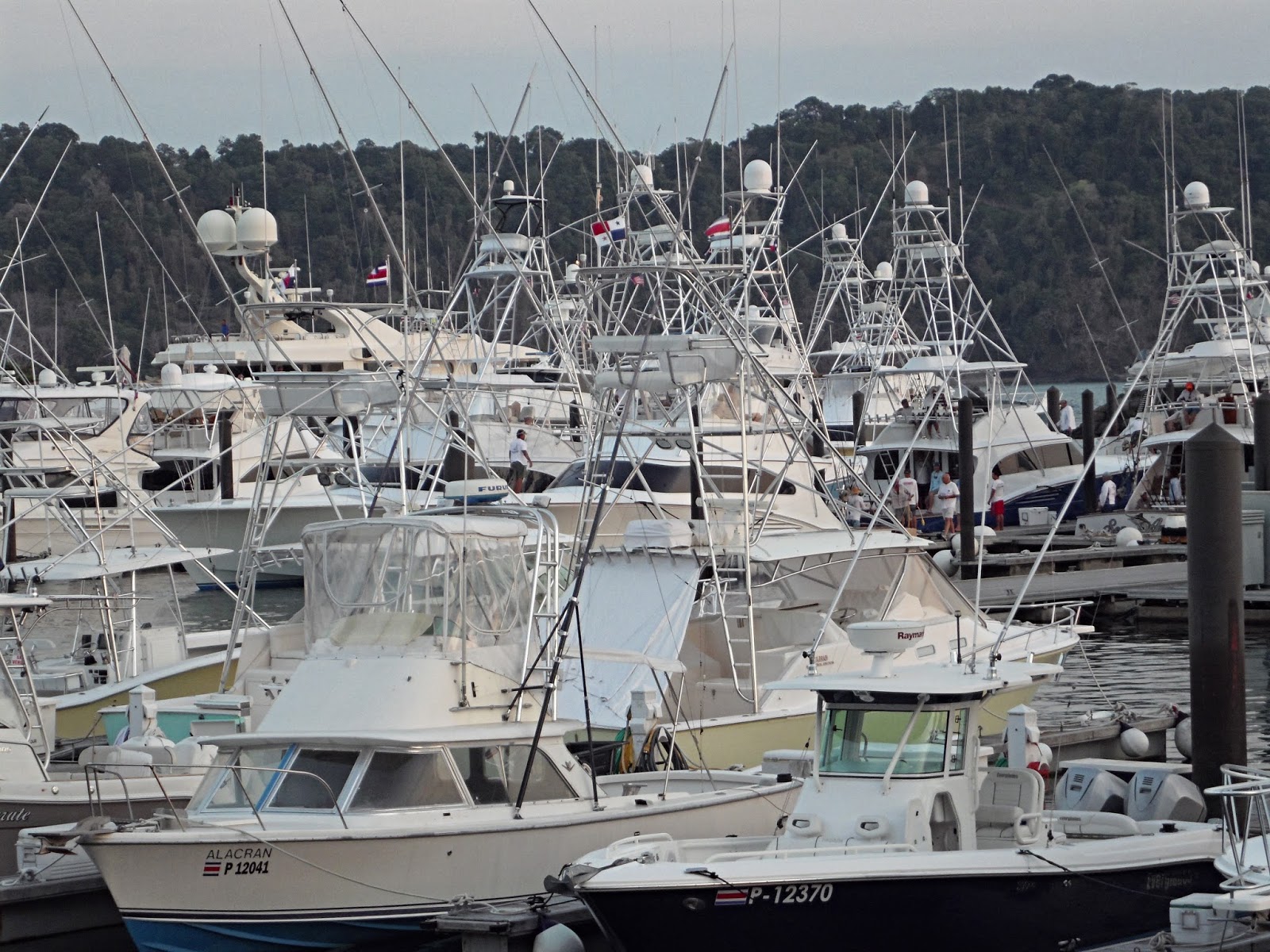
The water continues to stay blue, calm and beautiful as Anna Mae and crew move down the coast of Costa Rica. We have been anchoring in bays and staying in marina’s along the way. We anchored one night in Bahia Herradura and took a panga to shore. The Marina Los Suenos was hosting The 2014 Triple Crown Fishing Tournament. The docks where full to capacity with sport fishing boats.
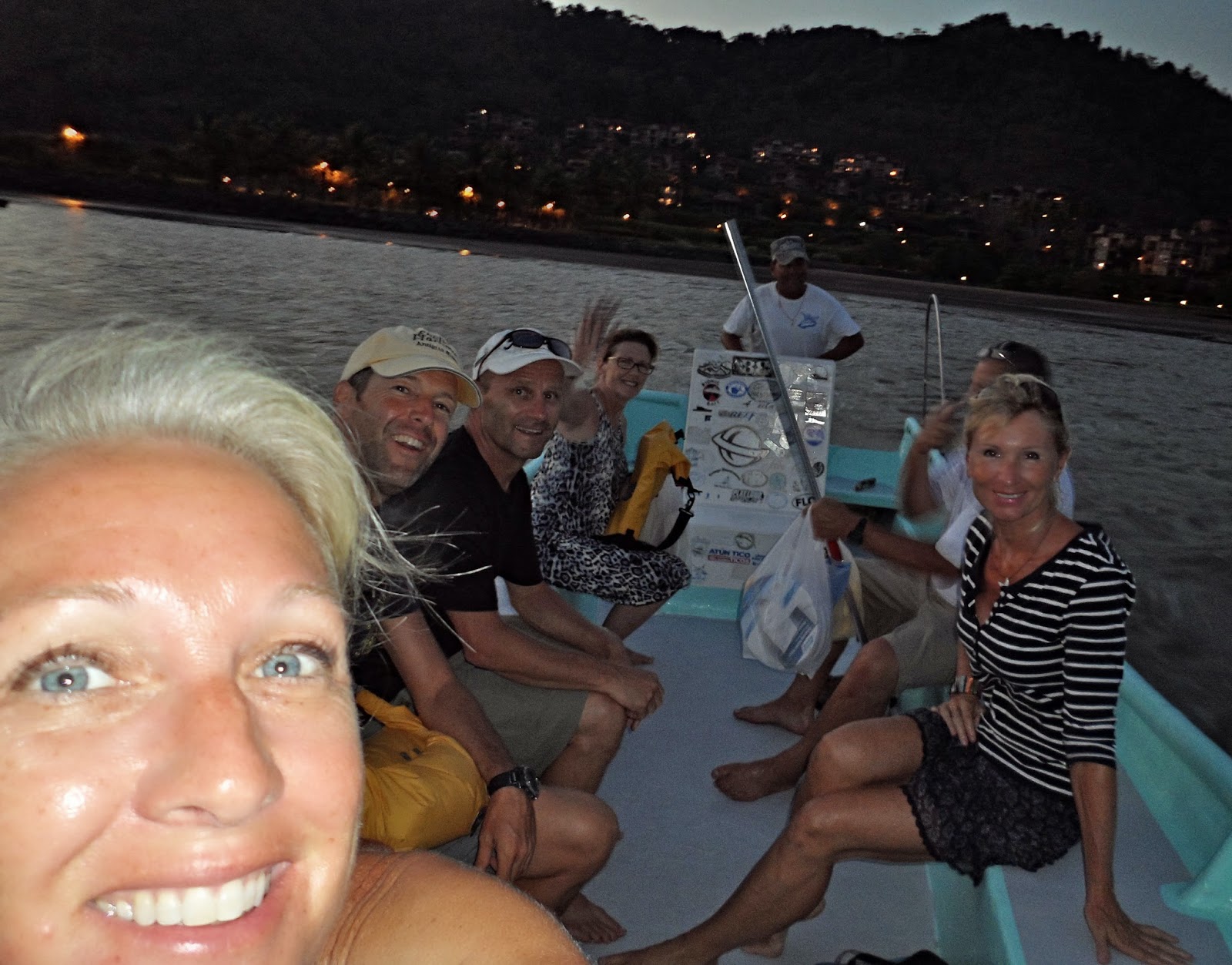 |
| A fun panga ride to shore |
 |
| Fun on the beach |
Our next stop was Quepos. We stayed at Marina Pez Vela and struggled with more surge… The facility was very nice, along with helpful and friendly marina staff. Surge continues to be a problem with our heavy trawler. Anna Mae groans with the pull of the turbulent currents that tug her lines. It makes for a noisy bumpy night and a frustrated crew. Our bumpers and dock lines are looking sadly used.
While at Quepos we explored Manuel Antonio National Park, the most famous biological reserve in Costa Rica. Our guide pointed out various animal and plant life, we would not have seen much without his help. The tour was relaxing and interesting, but not as much wildlife as we had anticipated.
 |
| The whole family |
 |
| High up in a tree, a Sloth with her baby. |
 |
| A male iguana relaxing in the sun. The razor wire didn’t seem to bother him. |
I have decided that we are all very spoiled with the amazing wildlife we have experienced while at sea. It doesn’t matter how many times I watch the dolphins race to our bow and perform for us, it’s always a thrill. We have learned to lean out and wave to get the dolphins attention. They turn sideways and look up at us as we clap for them. Yesterday I took Bill’s harmonica out and blew a few notes. They stayed on our bow for about twenty minutes. We slowed the boat hopeful they would hang around to swim with us. No such luck, as soon as we slowed, they swam out of sight.
 |
| Dolphins on the bow of Anna Mae |


 |
| Anna Mae anchored at Cane Island |

Our one night stay at Isla del Cano or “Cane Island” was magical. It lays 12 miles NW of Oso Peninsula. There are at least 5 plateaus with 10 spectacular dive sites. Tom and Susanne paddled over on their SUP and checked us into the Isla del Cano National Biosphere Preserve. We paid our $6.00 anchorage fee, $8.00 per person snorkel fee and the numerous documents needing our signature. We set our anchor and settled in for the day. We snorkeled coral reefs with pinnacles reaching up from the white sandy bottom. The fish life was colorful, plentiful and amazing. Several sea turtles entertained us with their slow easy movements in the clear blue water. Numerous Manta rays hugged the bottom as we swam above. A couple of white tipped reef sharks swam by along with a large school of grouper.
We have learned many lessons while in the waters of Costa Rica. Don’t try to check into a Port or a marina on the weekend or before 9am and after 5pm. When asked how long you will be staying, alway request the longest amount of time available and get your fingers ready to sign, sign, sign on the dotted line. This country is very ecologically friendly but they use an entire forest each and every day with the mountains of paperwork they require. The country is lovely, but not boater friendly. We anticipated more boats in these waters, now we understand why. We are still working on paperwork to exit the country. Hopefully we can get everything resolved prior to our scheduled flight home to Oregon in the next few days. Currently tied to the dock at Banana Bay Marina while will continue to struggle with customs and emigrations issues. Thankfully we are in paradise…
YOU CAN LIVE THE DREAM – part two
The 2nd of three parts of our article recently published in Pacific Passagemaker magazine.
.JPG)
Sources of cruising and technical information
Those interested in the live-aboard cruising lifestyle can find valuable information from:
– Voyaging Under Power, the Bible of passage making by Captain Robert P Beebe, 4th edition updated by Denis Umstot
– PassageMaker magazine (US)
– Seven Seas Cruising Association
– Cruising blogs
– Web sites of various passagemaker builders, often with links to cruising blogs
– Brand owners’ websites
– Noonsite.com
– Cruising guides to various areas
– OEM instruction Manuals and manufacturers of the equipment
– Technical books (e.g. Nigel Calder‘s Boatowners’ Mechanical and Electrical Manual)
– Other cruisers
– Local marine engineering companies and/or agents for equipment
– Internet and You Tube searches
– Previous owners of your boat
Buying your passagemaker
Although the boat market has come out of the bottom of the trough it’s still a buyer’s market, and now is a good time to purchase and enjoy your new or pre-owned passagemaker.
A passagemaker is a modest-sized motor vessel that can safely, comfortably and economically cross oceans to take its owners and their families anywhere in the world.
Typically it will be heavy-displacement, single-engined, diesel powered, around 12 to 23 metres in length, with sufficient in-built fuel tank capacity to cruise at least 2,500 miles, easily handled by two people, able to proceed in open seas in most weather conditions, and equipped for long periods of living aboard.
To simplify your selection process a good first step is to decide the specific brand and size of boat you want to buy. An excellent resource is the US magazine, PassageMaker, having a wealth of useful information about passage making as well as listing many vessels for sale and providing an excellent guide to market values.
Passagemakers are technically complex making a comparison of different vessels for sale with varying equipment levels challenging. We used a spreadsheet to list vessels plus their equipment and inventories so that we were able to objectively compare what was included with each vessel, and judge their relative value.
Consider the location of vessels for sale and your intended cruising area. We wanted to use our passagemaker in the Med so primarily looked at vessels located in Europe.
Allied to the location issue is the complex one of port of registry. If you importing a vessel to your home country you may be required to pay some form of tax or duty. If you are locating a vessel elsewhere you will often be able to avoid this indefinitely. For example our New Zealand-registered vessel can remain in EU waters up to 18 months at a time without paying tax (VAT). Before the expiry of the 18 month period it’s only necessary to leave EU waters for a few days, and the 18 month clock is re-set. This is a complex issue and if buying offshore we suggest involving an experienced marine solicitor to ensure the vessel is unencumbered, and that correct documentary procedures are followed to minimise your liabilities.
You can cruise to stunning places like this bay in Croatia
Do all live-aboard cruisers cross oceans?
Absolutely not; there are literally thousands of people living aboard all manner of boats, and some do cross oceans, but a much large number enjoy what I’ll describe as adventurous coastal cruising.
Our live-aboard experience is five years cruising 11,000 miles in the Med but we’re rarely more than 40 miles from the nearest land. Many cruisers enjoy fantastic cruising locations like the Med, the Bahamas, North and South America, and South-East Asia without needing to venture across the major oceans, and while it’s a great feeling to have a boat that is ocean-capable, the majority of cruisers elect to ship even these vessels aboard purpose-built freighters rather than traverse the large distances on their own hulls. From a cost perspective the two options are generally considered to be similar. Many of the cruisers who do cross oceans take extra crew along to assist during that part of their voyage. We greatly admire the exploits of folks like Jim and Suzy Sink, who in 1990 were the first to circumnavigate the world aboard a production motor yacht, Salvation 11 – a Nordhavn 46, covering over 50,000 nm during five years, but we don’t plan to do that ourselves.
Read the 3rd and final part of this article next week.
Enjoying the wildlife in Costa Rica
I am taking advantage of this fast internet signal we have at Marina Pez Villa in Quepos Costa Rica. Sharing a few pictures of my friends. They come in all shapes, sizes and colors.
THE ARGONAUT OF March 15, 2014
CAPTAIN’S LOG March 11 – 13: Departing Port Antonio bound for Colombia We planned to get underway today and fortunately our sat-phone replacement part arrived at 0930. Christina, the administrator of the harbor office was so kind and helpful in getting our part through customs, and we can’t thank her enough. The fees to get this supposedly duty free part into the country were $156, more than the cost of the part itself. Christina gave us a free day of dockage to make up for our frustratio…
THE ARGONAUT OF March 15, 2014
CAPTAIN’S LOG
March 11 – 13: Departing Port Antonio bound for Colombia
We planned to get underway today and fortunately our sat-phone replacement part arrived at 0930. Christina, the administrator of the harbor office was so kind and helpful in getting our part through customs, and we can’t thank her enough. The fees to get this supposedly duty free part into the country were $156, more than the cost of the part itself. Christina gave us a free day of dockage to make up for our frustration, which was very nice of her. At noon we departed with our friends Ismael, Olga and Paul (the harbor master) on the dock waving us off. It was very nice, but sad to depart from the wonderful people we had met.
The sea state on our way south was as expected: 4-5 foot seas running toward the west, in line with the Trade Winds. Not knowing exactly what we might encounter, we decided to head for Santa Marta on the north coast of Colombia near the Venezuelan border, but retained the option of turning west toward Cartagena or Panama if conditions warranted. Going to Santa Marta was the most aggressive route as it put us directly abeam of the waves, and depending on their size, we might have to heave to and turn westward to put them on our stern. As we progressed southward the wind and waves were in the 24 knot/4-7 foot range with periods of both higher and lower conditions. ARGO road them very well, but our movement was tedious and tiring. Being bounced around all the time makes me very sleepy for the first few days. Although the seas built as we headed south, things were tolerable and we continued to Santa Marta.
Santa Marta is located behind a point that forms a bay, sheltered by the Serra Nevada de Santa Marta Mountains, which rise sharply several thousand feet from the sea. The Trade Winds are particularly strong this time of year. They are known as the “Christmas Trades” and reach 20-30 knots in the open sea, but close to the coast the wind is funneled by the mountains down toward the coast line and can reach much higher speeds. The wind was over 50knots as we approached the coast at 0100 Friday morning. With big wind comes big waves, and I had been watching the weather in this region for several months. Thirteen foot seas on a daily basis are not unusual, although they usually subside to around an average of five feet as the rainy season approaches in April. We hoped spring might come early this year.
The Caribbean Sea is a cauldron of tormented water. The trade Winds blow in from the Atlantic Ocean along the coast of South America. The mountains focus and accelerate the wind at sea level, seas build and blow to the coast of Central America. There they meet solid land and are pushed northward toward the Gulf of Mexico, eventually leaving the Caribbean via the Gulf Stream. Inside the Caribbean, the water rotates in a clockwise direction, but near the center where we crossed the currents are seemingly random. For a period of time the current will be going in one direction, then suddenly change to another. Wind pushing against the current changes the shape and intensity of the waves, which effect ARGO’s speed as well as her roll and pitch. At sea, wind and wave intensity is stronger around sunrise and sunset.
As the days passed and we got closer to shore we became optimistic that we could actually make it to Santa Marta. The hours hung like days. Around 2300 we were within 3 hours of port, but the wind was building to over 30 knots and the sea started to roll ARGO in a concerning manner. As the current beneath us changed direction, the rolling ceased for a while, but then it would reoccur and gave me thoughts of changing course. Around midnight winds were in the 40’s, and we began to tack against the sea. At 0030 on the 14th we were about 5 miles off shore, but the wind was over 50 knots with waves to match. We headed for the lee of a shoal near the entrance to the harbor. It was pitch dark and it was very hard to read the sea state. We couldn’t spot the big rollers or see the direction from which they might come. Tyler tried to open the upper part of the door to look out, but 50 knot winds made it all but impossible to open. It was a dangerous moment. My goal was to cut the waves at a 45 degree angle, but the correct course was hard to determine. The last mile or two into port were tense as the seas moved this big and heavy boat around like a toy, rolling us nearly 40 degrees. That was a little concerning to say the least! Changing course positioned us into the waves and lessened the danger, but slowed our progress to get behind the shoal. By 0130 we breathed a sigh of relief as we were in calm water behind the shoal and headed into the harbor. The lights of Santa Marta were a welcomed sight.
We tied up at the marina. ARGO was completely covered in thick, gritty salt. Inside, the walls and counters were also covered in a misty-salty coating. She had been through a difficult passage and kept us safe and sound. She is a great boat and we feel very safe on her.
March 14: Santa Marta
This is a lovely town; clean, interesting, historical and friendly. Simon Bolivar died here at a sugar cane hacienda. The marina is an IGY, which is a chain located all over the world. They are clean and well managed. We are glad to be here.
In Colombia one has to hire an agent to deal with clearance formalities. Dino, our agent, has been very efficient and reasonably priced. We spent perhaps 2 hours altogether, there were no inspections, they do not seem to care what you have aboard as long as you do not bring it ashore. This has been the easiest port entry we have ever made.
The town is clean, there are many parks and public modern art sculptures decorating the thoroughfares. Along the bay is a long beach bordered by the Simon Bolivar Park. The park is about fifteen blocks long and fronts the city center located between an extension of the park and a second “Couples Park”. In this part of the city are many colonial style buildings that are brightly painted and very colorful. The parks are clean and neat and occupied by people enjoying the siesta period in the afternoon, or the cooler temperatures of the evening. The main streets are busy with little cars from all over the world, the sidewalks are narrow and crowded with pedestrians trying to get passed each other and the little stands selling everything from toys for tots to clothing, food and everything else. It is a real cornucopia of sights and sounds and smells. The other side of the city is modern and conventional with six or seven lovely high-rise apartments and hotels on the beach.
Racially, Colombians seem to be a mixture of all the races that have occupied this territory over the millenniums; native Indian, Spanish, Negros and even Asians. Regardless of how hot it is here, the men wear trousers and often long sleeve shirts (like my old Navy boss Chief Lingenfelter said: “Women wear pants and men wear trousers”), sometimes a coat, rarely shorts. Women on the other hand seem to prefer brightly colored and very tight spandex or jeans of some sort. Whatever they are wearing it is usually very tight on the top and bottom. The men are handsome; they apparently prefer their women a little plump, pear shaped. Many of the ladies are very beautiful, with jet black hair, almond shaped faces and eyes, and lovely complexions. There are a large number of native people here and their appearance is striking. Their skin is a brownish red, and their facial features are just like they came alive from an ancient stone carving. One wonders what their life experience has been. Colombians seem to be hardworking and very pleasant people who are proud of their country and their culture. I am not sure that we in North America, particularly the U.S., have a very accurate image of Colombia or the depth and beauty of their culture.
We are leaving for four days in Cartagena and then to Bogotá for a few days before returning to Santa Marta.
Thanks for looking in on us.
Randy and Rebecca
Almost Forgot
Happy Birthday, RadarOur boy turned 9 today.Nordhavn Exumas Abacos Bahamas trawler Caribbean Pickwick Boat dogs
Memphis Downtown
We Can See Jupiter As Well
Nordhavn Exumas Abacos Bahamas trawler Caribbean Pickwick Boat dogs
Memphis Downtown
YOU CAN LIVE THE DREAM – CUTTING LOOSE FOR THE LIVE-ABOARD LIFE Part One
Read the first of three parts of our article recently published in Pacific Passagemaker magazine. Is the live-aboard cruising life for everyone?No the cruising life isn’t for everyone. I can’t think of anything worse than riding a horse, and …
