Tag Archives | Nordhavn

THE ARGONAUT Kingdom of Tonga 8/11 to 9/21, 2014

CAPTAIN’S LOG                     August 21 to September 30, 2014

The Kingdom of Tonga          Vava’U – Ha’Apia – Tongatapu   


Samoa to Vava’U: Our 320 mile trip down to Tonga from Samoa was a rough ride, with swells from the east in the 8-10 foot range.  ARGO handles high seas very well, our stabilizers keep her from rolling or yawing very much, but the constant pitching and movement was unpleasant.   It was a beam sea, and some of the swells were so large that we rolled to starboard as they began to pass under us, then leveled at the crest, and then rolled to port and slid down the back side of the wave sideways as it passed under us.  Of course we didn’t leave Samoa without a weather forecast, but it was dead wrong.   Unfortunately a trough had formed and it was blowing around 30 knots for the whole voyage.   No one felt well during the trip, and I got a good dose of sea sickness to boot.  It’s passages like this that make us think fondly of spending our time in a plush hotel in Provence!

Arrival at Neiafu:  We arrived at the town of Neiafu on the Island of Vava’U at 0700 and tied to the custom’s dock.  Before our lines were secured, the immigration, health and customs agents were on the dock and ready for business.   After filling out the customary forms and paying about $100 in various fees, we went ashore.   It wasn’t long before we had arranged telephone service, bought fresh vegetables from the farmers’ market near the dock, and made a short walk down Main Street to see what Neiafu was all about.  What we found was a rag-tag collection of a few stores, three banks, a Western Union office, several bars, restaurants, churches, and souvenir shops.  Neiafu is a waypoint for boaters who are either going south to Tongatapu and New Zealand, or westward to Fiji.   The harbor is very large, clear blue, and deep.  It can accommodate any size ship that can make it past the narrow channel in the reef at its entrance.  When we arrived, there were about thirty boats on mooring balls in the harbor.  At anchor in the western end of the harbor was Paul Allen’s 225 ft. yacht Meduse, one of several he owns.  Along the waterfront were a selection of bars and restaurants, however the Aquarium Restaurant seemed to be the gathering spot for most of the boaters.  Mike, its American owner, was a congenial fellow who gladly provided information about the island and help with anything anyone needed. 

Late in the morning we moved to an anchorage just west of town and anchored in 95 feet of water near Meduse.   Rumor had it that some big shot like Bill Gates was coming, but no one showed up while we were there.  Not to be outdone, we had our own personage to welcome aboard at Neiafu.  Just as we dropped anchor, Mike from the Aquarium called on the VHF to tell us that our intrepid friend Reid Sherard had arrived and was at his dockside restaurant waiting for us to pick him up.  Reid had flown 36 hours from Los Angeles to Auckland, then to Nuku’alofa, and finally on to Neiafu.  He actually arrived a day ahead of schedule.   With him were two bottles of vodka and three printer cartridges (which are unique to the U.S.).  It was great to see our old friend. 

Meanwhile back on Argo, Tyler was diligently washing the sea salt off and readying her for company.   Giving Argo a bath is a lot of work and takes an entire day. We are very lucky to have Tyler onboard; Tyler takes a great deal of pride in his work and makes this yacht shine like no other!  He is a great asset to us!

The weather in Vava’U was in some ways a welcome relief from the searing heat and high humidity we had experienced since leaving Jamaica six months ago.  For the first time we didn’t need air conditioning.   The Tongans told us that it was unseasonable cold:  the temperature was consistently about 770, humidity in the high 60’s, and the sea water temperature was 780.  Despite this perfect combination of factors, the wind blew at 20 mph for days making the water a little too rough and cloudy to enjoy water sports or riding about in the dingy.  This is springtime in this part of the world and transitional weather patterns brought more clouds and wind than usual.  We were disappointed that Reid didn’t have better conditions given the long trip he made to get here.

We found Neiafu to be a very pleasant place with friendly people who were helpful and kind.  Many boating friends that we had met along the way were also there, so we spent a few enjoyable evenings catching up and hearing about their experiences.   Altogether we spent eighteen days at anchor diving, touring the island, talking with friends, whale snorkeling, going to church, feasting, and enjoying all that is. 

The Kingdom of Tonga: The Vava’U Group is the northern most archipelago of the Kingdom of Tonga.  The Kingdom is made up of three island groups: Vava’U to the north, Ha’Apia, in the center lying 60 miles south of Vava’U, and Tongatapu, the third archipelago that lies 60 miles south of Ha’Apia and is home to the kingdom’s capital city, Nuku’alofa.  Altogether the three groups stretch about 160 miles from north to south along the Tonga Ridge, which is formed by the meeting of the Australian and Pacific Plates in the South Pacific Ocean.  Tonga is thought to be moving eastward at 25 cm per year and is gradually sinking into the ocean.

Unlike all the other islands of Polynesia, The Kingdom of Tonga has never been colonized by Westerners.  Tonga is governed by a king who enjoys all the regalia that goes with a monarchy: e.g., nobles, royal lands, money minted with the king’s image on it, royal tombs, a palace, and of course, ownership of the key money making enterprises.  Originally the three island groups were each governed by a Tu’iTonga, a man/god chief.  The Tu’iTonga on Ha’Apia with the help of the Wesleyan Methodists and the British Navy, attacked the Tu’iTonga on Tongatapu and in the twenty year war overthrew him and established a kingdom modeled on the British monarchy.  The chiefs who supported him were made nobles and the Methodist Church and the British were granted special rights.  The king named himself George I (all kings are named George and today we have George VI).  He proclaimed that all land was owned by God and given to him by God for safe keeping.  Of course he took the prime and largest cuts for himself, his cronies, and the Wesleyan Methodists.  Even today all land in Tonga is owned by the king, but some time ago the king granted title to eight acre parcels to individual Tongan males.  Woman may not own land.   

The country has a constitution established in the mid 1800’s.   Until 2006 the king was more or less an absolute monarch and ruled a nation of about 103,000 people.  There were riots and the burning of buildings in 2006 as Tongans demanded greater democratization of the government, but it isn’t clear that anything of substance has changed, although it now has a parliament. 

There are estimated to be about 70,000 Tongans living abroad who send money back to their families in Tonga and this constitutes the largest source of foreign revenue for the country.  About 70,000 people live in the capital of Nukualofa, about 15,000 live on Vava’U, and the balance live on other islands.  Land can only be titled to Tongans, however “squatter’s rights” comes into play when a person moves onto land that no one is paying attention to and resides there for ten years or more.  The original owner loses title.  A Tongan must appear in person on his land at least once every ten years and chase any squatters off or risk losing it.  If a “palangi” (a white person) wishes to acquire property, it can only be leased from a Tongan or noble and leases must be approved by parliament and the king.  Leases are easily obtained and the lessee will eventually get a copy of the lease with the king’s signature and the royal seal in wax at the bottom.  Leases can extend up to fifty years.

As in Samoa, families are large (average ten children) and those members that are ambitious are encouraged to migrate abroad and send money home.  By and large I don’t think Tongans are a very motivated lot, although they are very friendly.   The country is very poor and the brighter people head for Australia, New Zealand or the U.S. if they can get a visa, which is increasingly had to come by.  Most countries feel that they have enough islander immigrants, particularly as some Tongans abroad have been pushed into crime to meet the financial demands of their families at home.  Title to land is devised on a primo-genitor basis, so if you are not the first born male you might as well leave for greener pastures.   Of course at least one lucky soul is obligated to stay home and take care of mom, dad, grandma, and keep an eye on the family’s property.   Despite their obvious poverty, few beg or go hungry.  Tongans take care of each other and are deeply committed to their family.  Tongans seem to be proud people; they have their islands, their heritage, and their religions.  They also have a Western Union office in almost every village of any size, and its sign is the only one in good repair. Aside from having children, they raise pigs and chickens (raise is too strong a verb as they just let them run about and grab one for dinner as needed), cultivate small gardens of taro, kava, bananas, carrots and whatever else will grow.  Most of the land I saw under cultivation was done by human labor: no beasts of burden or tractors.  Driving around the whole island I saw four tractors and one horse.  Undoubtedly there are a few more, but most land is cultivated on small plots on a human scale.  All this is supplemented by fish the men catch. 

The climate here is more temperate than all the other islands we have visited, and for the first time we have seen fruits and vegetables that we are more accustomed to seeing at home.   Each village has at least one church, and Sunday is an observed day of rest, religion, family and feast.  Their school system has managed to teach the English language to almost everyone over the last twenty five years.  The government provides primary school, and the religious sects, particularly Moorman and Wesleyan Methodist, provide secondary schools, although you have to belong to the church and tithe in order to send your children to the church’s school.  Driving around the countryside, you can see large noble estates, but most parcels are about eight acres in size and cultivated by a family for subsistence.  The churches in Tonga are shamefully medieval in the power and wealth the clergy wields, and in the way people are forced to give money to them.  The Mormons seem to be very aggressive and have built a facility at virtually every cross road.  Homes are very basic except for those of the local church ministers or government officials. Large houses (the size of a typical American suburban home) are either owned by nobles or church ministers.  The villages are not kept up as they are in the other parts of Polynesia, and on the smaller islands of the Ha’Apia Group cyclone damage from last summer’s storms is considerable.

Vava’U Group:   Coming into Vava’U was very different than the other islands we had visited during the last six months.  The island is not volcanic.  It is a coral island rising abruptly about 300 feet from the ocean’s surface to a flat plain that is covered in dense jungle.  From the sea, the islands look like huge stone monoliths with dramatic cliffs; beaches are present only where the cliffs give way to a little bay or indentations in the rock.  The water is crystal clear, and the bays and passages between the islands are deep sapphire blue and the islands colorful.  Here, in the shelter of the islands and the warm waters of the Mid-Pacific Ocean, Humpback Whales come to give birth and breed each year.

Whales:  Vava’U is most well-known for “swimming with whales”.  There are two or three outfitters who are licensed to take tourist on “whale dives”.   A dive is actually a surface snorkel and is an all day ordeal in which eight or so snorkelers accompany a guide, four at a time into the water to swim next to a cow and calf (usually).  Males are difficult to swim with because they are on the move and are often breaching or pushing each other around in an effort to attract the attention of a female (what’s new?).  Would-be swimmers wear wet suits and ride around for hours in the open boat until an appropriate female and calf are spotted.  Then the boat stops a hundred yards or so from the mother, and if she doesn’t swim off, four snorkelers at a time quietly enter the water with a guide and swim over to within fifteen or twenty feet of the whale.   Females with newborns often rest for part of the day so as to let the little one nurse and safely play.  As you swim toward the leviathan you can see how big these creatures are; 100 plus tons suspended just at the water’s surface with the majority of their body hanging perhaps 100 or more feet below.  You first see their giant black backs with a prominent spine, as you look downward you see the spine lead to the tail a hundred feet or so below in the blue water.  The black upper body changes to a white underside with huge folds in its skin.  The breathing hole is at the water’s surface and is about one third of the length of the body and behind the head.  Forward of the breathing hole the head rests suspended in fifteen or so feet of water and is a strange, but familiar shape.  The eyes are on the side of the head well back of its huge jaw line that is covered in barnacle like growths.  The little calf swims about its mother turning and twisting as it goes, and then pausing for refreshment if desired.  Calves drink about 50 gallons of a yogurt type mother’s milk each day and grow rapidly.  The adjective “little” really doesn’t apply as they can be thousands of pounds within weeks.  During our dives we were within ten or fifteen feet of these huge, beautiful animals.  On one of our dives we spent perhaps a half an hour within feet of a mother and calf.  The baby came so close to us and was so frisky I thought it might injure us, not knowing its own youthful strength.  After all the divers returned to the boat and were drying off, we watched the mother and baby at the surface of the water.  I saw the mother’s tale flukes rise high in the air, an indication of a deep dive.  I assumed she was leaving.  We were only a hundred yards or so from her.  A moment or two later she erupted straight up out of the sea, turning her immense body laterally over in the air, and then crashed down yards from our boat. It was awesome…spell binding…breathtaking…like nothing we had ever seen or imagined.  It was as though she was offering us one last glimpse into her world.  After a few moments to collect our wits, we departed thankful for the experience and emotionally closer to our origins in the natural world.  

The whale’s world underwater in Vava’U is silent, tranquil, warm and slow moving.  Occasionally you can hear the whales sing.  Sometimes you can see the males breaching, or pushing each other about in a contest of strength, or, more aggressively, slamming each other with their giant heads in an attempt to prove dominance.  For them this is not play, but the vital, essential business of life.  It’s also no place to snorkel!

We have posted videos and pictures of our whale dives on www.tischtravels.com

Feasts:  Like Samoans, Tongans love a feast.  Aside from their private Sunday family gatherings, entrepreneurs offer feasts to tourists several days a week at different locations around the islands.  We decided to go to one on Sunday at the En’toi Botanical Garden.  The proprietors picked us up in their rickety old, filthy van and drove across the island through the little villages with the shiny new Moorman facilities to their sea side establishment.  The owner, Halima (?), was celebrating his 69th birthday that day, so the feast was preceded by a speech in which he recalled growing up in the village and not knowing anything about the outside world, not even that it was round.  He thanked providence for his good fortune to become the Assistant Secretary of Agriculture during his career, for his wonderful children, and apologized to his wife Lucy for being less than a perfect husband.  With that, the feast was underway and one by one the eager guests proceeded to the buffet and began selecting from a variety of Tongan dishes including suckling pig, curried fish, poultry, taro, bread fruit, curried vegetables, and other dishes.  After the feast, I looked about and saw several pictures of Halima during his career meeting Pope John Paul in Rome in the company of other Tongan dignitaries including HRH the King.  He told me that he had actually met the Pope twice, and many other dignitaries from around the world as well.  Not bad for a country not bigger than a small town in mid-America!

Our 25th Wedding Anniversary:  We celebrated our 25th wedding anniversary here in Tonga.  Rebecca found a nice resort established a few years ago by a sail boating couple from Switzerland who were apparently ready for life on the hard.  Normally they are booked several weeks in advance, but somehow Rebecca got us in.  Kathryn had called them from NYC to try to arrange a surprise, like a bottle of champagne or a local musician to play for us, but nothing like that was available in Tonga.  We moved ARGO to an anchorage off shore and dingied in for a lovely dinner complete with a table cloth and a beautiful flower centerpiece.  Rebecca’s dish was quite interesting: a whole red snapper split down the back from head to tail and baked.  It was very artistic as it looked like a large, pink, spiral ribbon.  It was delicious.

Diving the Ship Wreck:  Just west of our anchorage at Neiafu was a wreck that sunk about twenty years ago in 125 feet of water.  This ship apparently had caught on fire and the captain and engineer stayed aboard to try and save her. Both died when she sank.  Wrecks are common in this part of the world. In Nuku’alofa we counted nine wrecks in the harbor.  In the third world maintenance is not a valued practice on anything much less a ship, and cyclones sweep thru these parts every year.  Many ships drag their anchor during big storms and wind up on a reef and break apart.  Compounding matters, often the crews are made up of local men and when a cyclone arrives, they abandon their ship to take care of their families. 

Tyler and I dove the wreck on a sunny morning.  I had never done that sort of diving before; it was a little spooky, given that at two people lost their lives.  The water wasn’t very clear, but we could see her lying broken on the bottom.  She was known as the Clan McClellan, a relatively large ship of a few hundred feet.  We explored the decks above 100ft in depth, seeing her railing and mast and thinking of the hopes that she carried with her and the tragedy of her demise.  

Going to Church in Neiafu: Religion is the center of community life in Polynesia, much like it is in the American south.  Here there is practically a church on every corner.   One Sunday we decided to go to church and see what a service in Neiafu was all about.  The church we visited was a Catholic Church.  It was built on the most prominent hill in the town and from the front looked like something you might find in Italy.  The façade was Italianate in design, very ornate with painted pictures of Christ on the bell tower.  It was built on a hill that required climbing about twenty five steps to reach the entrance, and the climb made the church all the more imposing.   Behind the facade was a more modest structure, sort of a pole barn with a white metal roof.  Inside were pews and a couple of statues and shrines, very typical of a modest Catholic church.  The service began when the choir started to sing, and that was something to behold and the real reason for our visit.  The choir constituted at least a quarter of the people in the church, but the quality of their singing was second to none.  They were terrific.  A procession then began when the priest, proceeded by a small retinue of elders and officiates, made their way down the aisle to the altar.  The church was packed and people were standing outside.    Men wore traditional Lava-lavas with a ta’ovala skirt wrapped around their waist.  The ta’ovala is a grass cloth traditional garb woven from mulberry tree bark as in the Samoan tapa making process that I wrote about in my Samoan blog.  The women were, of course, dressed in their finest, and they too wore a sort of grass skirt over their western dress, but much lacier and also made of tapa. Going to the church was a wonderful cultural experience for us. 

A Drive-about:  One of our friends, Adam Paskowitz Captain of Spirit of Adventure, mentioned that he had taken a dune buggy/go-cart tour on the back roads of Vava’U.   Rebecca and I thought it might be fun so we arranged for a tour.  The little company was run by a family of ex-pats trying to eke out a living in Neiafu.  We arrived at the appointed hour and we met our guide Joshua.  Joshua had grown up in New Zealand but had a Tongan father.  His father owned some property in town including a distillery of sorts, and at his death it became Joshua’s.   So Joshua came back to Tonga to claim his birthright. Things weren’t going all that well for him, but he knew the island well and spoke impeccable English, so off we went.

We should have known better as the cart was a death trap. I could hardly get into the thing, but anyway we rode over hill and dale, past the ubiquitous Moorman Church and basketball court, past the cemeteries with their huge quilts memorializing a recently deceased person, past the little hand tilled fields of taro, eventually finding the cow path Joshua was looking for.  This path took us several miles off the beaten track—through the dense jungle, past little subsistence farms to some of the most beautifully natural and unspoiled sights we have seen. One such place was a gorgeous cliff overlooking the sea.  The cliff had been eroded in a most unusual way by centuries of the relentless pounding of the sea.  About fifty feet above the sea was a huge circular hole about twenty feet in diameter in the cliff’s outcropping. On the prominence above it roosted hundreds of fox bats – fruit eating bats about a foot long that hung in the branches on the trees above.   

Ha’Apia Group: The Ha’Apia Group lies about 65 miles south of Vava’U.   We left our anchorage early in the morning and enjoyed a lovely cruise, one of the best we have experienced down to Ha’Apia.  It was a bright sunny day with calm seas and whales breaching along the way.  Our trip took about eight hours and we arrived at Haano Island.  Approaching these island takes great care and should only be done when the sunlight allows one to see all the coral heads and reefs.  We cautiously entered the anchorage with all hands focused on any signs of danger.  We were all very surprised by the geology of these islands compared to Vava’U; Ha’Apia Islands are flat sand atolls rising no more than five feet above the sea’s surface and covered in jungle and shrubs.   As I mentioned, surrounding the islands are extensive coral reefs, which makes them unpopular with boaters.  When we arrived we were the lone boat on the island.    After a pleasant and restful night at anchor, we went ashore the next morning to reconnoiter the little village of Haano.  Once ashore, we quickly appreciated that it had been terribly damaged by a cyclone the previous season.  As we walked through the little village, we saw men rebuilding a water tower, and some of the people whose homes were destroyed living in tents.  It was a very poor area in the best of times, but now it was devastated.  After walking about and greeting the people we met, we decided to move along to the next island of Lifuka and the capital pf Ha’Apia, Pangai Village.  

Tyler’s 30th birthday:  We thought that Piangai would have a little more to offer, and since it was Tyler’s 30th birthday we wanted to find a town with a suitable celebratory establishment.  We picked our way through the coral heads and reefs and anchored a mile or so offshore.  Our friends Jeff and Sherry on Grasshopper showed up in the anchorage shortly after we arrived to help celebrate, and we all went into Pangai Village.  The village itself was also heavily damaged by last January’s cyclone and people were living in very dilapidated circumstances.  The town seemed all but abandoned.  Dogs roamed the streets everywhere, which made us feel uneasy, particularly if they were to form packs.  As on other Polynesian islands, these dogs are a very sturdy breed and look to be part pit-bull.  On one street ten or fifteen of these dogs formed a pack and took off after a pig.  They nipped at it and badgered it.  Finally as they became more brazen and aggressive the pig must have sensed that the game could turn lethal at any moment, and with that, turned tail and outran the dogs in making its escape.  As we walked further along the only human activity we saw was centered on little food markets run by Chinese proprietors.  Older Tongans distrust the Chinese grocers because they sell alcohol to the young men, who in turn get drunk, rowdy, and fight.  As we turned the corner toward the Mariner’s Café, we heard a commotion and saw a serious fist fight erupt between two young men who had obviously been drinking.  We wanted to get away from the fight and the men who were hanging around watching, so we hurried on to the café only to find it closed.  A few minutes later the loser of the fight staggered by with the aid of an inebriated friend, his head bleeding profusely from a gash administered by his opponent with a wrench.  As soon as the little crowd disbursed, we headed back to Argo where Rebecca made a wonderful birthday dinner complete with filet minion, mashed potatoes, corn, and a fruit pie for dessert with candles for Tyler.  

The next day we moved south about thirty miles to the island of Haafava.  This island has a protected lagoon, like the Tuamotus. We entered the lagoon over a very narrow channel in the reef and anchored near the small dock the islanders use to bring in supplies.  The lagoon’s bottom was littered with coral heads and rocks, so Tyler stood lookout on the bow pulpit and we picked our way around until he found a patch of sand and we dropped anchor.  After settling down we found the area absolutely beautiful, but the wind was up and made for a rolling anchorage.  Tyler and Rebecca went for a swim and we all took the dingy for a spin later in the afternoon.  The view from Argo was absolutely beautiful.  We were surrounded by other islands and, more closely in, coral reefs.  The ocean swells were crashing on the reefs, and off in the distance we could see the silhouette of the only active volcano in Tonga, which made for a spectacular vista. 

As beautiful as it was, it was time to continue south toward Tongatapu and prepare for our passage to New Zealand.  Our wonderful friends Melanie and Curtis Hoff were meeting us in Nukualofa.  They planned on joining us for the final passage to New Zealand and the conclusion of our great adventure.  

Tongatapu Group: These are the main islands of the Kingdom of Tonga and site of its capitol Nuku’alofa.  The city is on the south side of a very large bay that is open to the north.  There are many reefs, coral heads and islands scattered about, but so far the charts have been accurate and we haven’t bumped into anything.  We anchored a little over a mile from the city’s docks and inner harbor, which are in a shambles and littered with sunken wrecks.  Several abandon, rusting Japanese fishing vessels are tied to a dock and bear witness to Tonga’s naval prowess; they confiscated the ships because the Japanese violated Tongan territorial waters.   We anchored off Pangiamotu Island at Big Mama’s Yacht Club.  Out front is a sunken bow of a large ship that went down here in a cyclone about twenty years ago. It acts as an artificial reef and attracts a lot of colorful fish.  People come out to see the fish, enjoy the beautiful beach and swim in the crystal clear water.  Mama is a very large lady, sort of like Aunt Jemima.  She owns the tikka bar here, which looks inviting, but the food is horrible.  At this end of the bay I counted nine partially sunken ships. 

To get to the city we took our tender about a mile and a half across the bay to the inner harbor, and then the inner-inner harbor or boat basin.  Instead of a proper, safe floating dock, they have taken scrapes of old wood and hobbled things together to build a walkway and floated it on old oil barrels.  It is rickety and wobbly.  The planks are unevenly spaced so that one could easily trip and fall through a space into the filthy water, or, if you get off center as Rebecca did, one end of a plank could give way; she nearly fell in.  Once the dock is negotiated the main road to town is near at hand, and the town center is about a fifteen minute walk.  Along the paved road are venders selling fruits and vegetables, taro, watermelons and fire wood; hundreds of neatly stacked piles of cut wood for cooking fires are stacked next to the road.  This is in contrast to optical fiber cable being installed along one of the main streets downtown.   

Like the harbor, Nukualofa suffers from aesthetic deprivation.  It is shabby and without many of the staples of everyday life that we had hoped to find here.  They have a very fine farmer’s market with all sorts of things we haven’t seen on other islands, like lettuce.  I was looking around for a Tonga cap, and asked the local cap embroiderer where I could find one or if he could make one for me? He looked at me as though I were nuts.  Who wants a Tonga hat?  All their caps have American or other foreign sports’ team logos on them.  ­­­­­­­Here, people identify with the west.

The next day we took a tour of the island.  I have put pictures of these sights on www.tischtravels.com. The first stop was the Royal Palace (19th century Victorian style summer home), then the Royal Tombs (it looks like a normal Tongan cemetery, where the soil is mounded over the body, but large stone statues of the deceased kings in European military garb stand over the graves). There were several beautiful coastal sites to see including blow holes and natural arches, and finally the Ha’amonga Trilithon, which is an ancient stone arch similar in some ways to Stone Hedge, which marked the ceremonial center where the Tu’iTonga presided.  Every village has at least one Moorman school, basketball court and meeting hall, and maybe a Catholic and or Wesleyan Methodist Church.   There are also the odd Seventh Day Adventist and Jehovah’s Witnesses’ meeting halls as well.   In Tonga the haves live well, the rest are serfs.

Leaving Tonga:  Our friends Melanie and Curtis Hoff joined us in Nuku’alofa for the ride south to New Zealand.  It was very symbolic in the sense that they came down to Stuart, Florida and waved good-bye to us from the bridge as we left America, and now they were joining us on our final leg of the journey to New Zealand.   Because the trip to New Zealand is long and fraught with the possibility of difficult seas, we offered them the chance to just meet us in Auckland, but they wanted to come along and we were very happy to have them. The Hoffs are boaters who have cruised the U.S. East Coast extensively, so we all studied the weather files and decided unanimously to leave as soon as possible after fueling Wednesday at noon.  Our passage involved threading the needle between three potential storms that were expected to form while we were at sea.  A low was due to make its way across our course bringing with it very high winds and high seas (13ft.), but if we left Tonga on Wednesday afternoon we felt there was a good chance that we could get south of it.  Tonga offers us the possibility of buying tax free fuel if we buy it on the way out, so Wednesday morning we hooved to a crumbling cement dock at the harbor (after helping an itinerate boater move to a mooring) and arranged to take on fuel.  To get the tax free permit we had to check out of the country with customs, which meant checking out with immigration (whose office was across town), then to the Harbor Master’s office to pay port charges (a real rip off at about $200 USD for a week at anchor), then to the Total Petroleum facility with $14,000 in Tongan cash.  My pockets were bulging with money, but that is the only way they do business.  To get the Tongan money, we had to go to the bank on Monday and convert our dollars.  Lucky for us, in Tonga you can convert without charge up to $10,000 Tongan per person.  So Rebecca and I each took USD’s and converted it so that we had enough to pay Total.  The tax free fuel price was the equivalent of $3.90 per gallon, which wasn’t too bad (they sell it in liters and we bought about 8,000 liters).

The fuel truck was due at noon, but arrived about an hour late (it’s on Tongan Time), and it took about an hour to fuel; in the end Argo was full!   We left Nuku’alofa on the incoming tide at about 14:30 on September 24 bound for Auckland, New Zealand and the end of our voyage. 

Our next Captain’s Log describes our experience with a Force Ten Gale on our way to Auckland.

The Argonaut FORCE TEN GALE September 28, 2014

CAPTAIN’S LOG   September 21-29, 2014

Encountering a Force Ten Gale

At Sea in South Pacific off the coast of New Zealand: Leaving Tongatapu required negotiating the channel between the reefs and Eau Island to the east.  The channel was boiling with an inrushing tidal current the severity of which we hadn’t seen since cruising Desolation Sound in British Columbia in 2011.  Once outside the channel we could see the waves crashing on shore and the blow holes spouting huge mists of water in the air.  After about an hour we reached the open sea and the real show began; the largest swells I have ever seen and only imagined came rolling toward us.  They were somewhere around 20ft high on a moment of 12sec.   They were massive mountains of water rolling at 30 mph under our keel.  It was truly a spectacular, awesome, spellbinding sight!  Argo was first lifted up by the waves, then she rolled over the top and came running down the backside.  It really looked like a somewhat smaller version of the waves shown in the movie The Perfect Storm.  Despite the size of the swells, our travel over them was pleasant due to their long moment.  Swells of that size are both things of beauty and amazement, and at the same time, terrifying.  As we moved along, the seas subsided to a more normal state; we had twenty knots of wind and 8 -12 ft. seas on the forward port quarter for the balance of the day.  We all took meclizine to combat sea sickness and as a result we were all sleepy, but not sick.  I slept like a baby as Tyler stood the night watch.  My crew mates, however, reported not sleeping so well that first night.

The next day things began to calm down and by the second full day our passage was very pleasant.  We downloaded a weather file from the satellite and confirmed that we were on track to avoid the worst of the storms that lay ahead.  The current in this part of the ocean can be as high as 2 knots on our nose.  It must be because of the upwelling of cold water from the Tongan Trench, which is one of the deepest parts of the ocean at 32,000 feet deep.  We ramped up our RPMs to 1500 to try and maintain a speed of at least 8 knots, but often we would barely make 7 knots.  We tried to maintain as much speed as possible to sneak past the rough weather emerging to our south; occasionally we made over 9 knots when the current slacked off.  During the third, fourth, and fifth day the ocean was like a lake, but our weather files showed the potential for rough seas as we approached New Zealand.  We made plans to alter our course for the northern port of Opua if things turned sour.  Meanwhile Rebecca and Melanie were cooking up some fantastic meals in the galley.  Before we made landfall in New Zealand, we had to eat all our meat and vegetables or the kiwis would confiscate it. 

Force Ten Gale:  Around 11:00 on September 29, with only 60 miles to go to Great Barrier Island, the radar picked up the image of a storm ahead.  The seas were calm, the barometer was 1014, and the wind was only 10 knots.  The forecasts had been very accurate during our passage and we were updating them four times a day via satellite.  We anticipated seas of 10-12 ft., which is no big deal for Argo; as it turned out, the actual weather we confronted was twice that forecast.  I put a picture of the weather chart on www.tischtravels.com so you can see what we wound up facing.  By 12:00 the seas had changed direction and were building as expected, and the wind was nearly 20 knots.  By 14:00 the wind was about 45 knots +/-, and the seas continued to build.  By 15:00 the winds were sustained over 45 knots and mostly in the 50 to 60 knot range, with top winds at 63.3 knots.  Seas became tremendous at 20 to 30 feet at 8 to 12 seconds.  They were huge, steep; mountains of water stair stepped by the ferocious wind, rolling toward us at 30 mph, sucking the water up from beneath and leaving in their wake a deep and treacherous valley.  The wind roared in a frightening howl, the ocean was a tumultuous, angry caldron.  I tried to position Argo to quarter the waves.  Suddenly a massive rogue wave slammed over our bow into the pilothouse windows.   My adrenaline shot up.  By now the wind was over 60 knots and I began to contemplate an emergency scenario.  At this point everyone was in the pilothouse helping me evaluate options; lucky for us Curtis Hoff has a PhD in marine engineering and many years of boating experience.   His council was very helpful.  I asked Tyler to call the Coast Guard and report our position; ultimately we reported to Maritime Radio Great Barrier Island every hour until we reached safe waters nine hours later.  In the meantime I focused on sea keeping issues; guiding Argo in a direction and speed that prevented her from being broadsided by one of those giant waves, or falling into a trough and pitch-polling.  From the pilot house we could see the giants coming our way; at first we could look up to the waves’ crest above our roof line.  It seemed as though they were going to crash into us, but then we would roll to starboard, be lifted to the top, see the combing crest and watch the crest flow under us.  We would then fall off the back of the wave, roll modestly to our port side and slide down into the trough.  Argo performed perfectly.  After a half hour or so we became concerned that by quartering the waves on our bow we were inextricably moving into the storm.  By this time we had been in the storm about 5 hours.  We hoped the wind would subside and the storm would blow out to sea, but instead it was intensifying.  We had to turn around and try to approximate a course toward land.  We discussed the pros and cons of coming about in these dangerous seas, but in the end I decided to take the risk. Turning is perhaps the most dangerous maneuver a captain can execute in a storm of this severity, but we had to do it.  The sun was setting and we didn’t want to lose the light.  We looked for a softening of the waves and found a moment in which to bring her about and put her stern to the waves.  Although we were afraid she might be breached over the stern or take a wave broadside, that never happened.  In fact, after the turn, Argo road the seas more comfortably than before.  We stayed on this course for about an hour.  By now it was 1900 and we had been in the storm for 6 hours, but we were much more confident in Argo and our ability to survive and ride out the storm.  At this point I decide we had to return to our original course, which would take us to the outer fringes of the storm and eventually to Auckland, but this required another turnabout.   After executing the turn, we were finally on course for Auckland again.  Argo was riding relatively well given the circumstances.  The sun had set, it was pitch black outside and the wind was screeching; we had five hours to go!  An hour or so later Tyler reported that the sea water pump for the hydraulic system had stopped functioning.  Without this pump the hydraulic system would soon overheat, we would lose our stabilizers, and we would be in serious, perhaps catastrophic danger.  Once again I had to turn Argo stern-to and position her so that we could turn off the stabilizers before they closed down due to overheating.  I found that Argo was most stable in this position.  So we turned on our spot light, determined the exact wave direction, waited for the right moment and initiated the turn with wide open throttle.  She made the turn between waves quickly and we found a very stable position for her to assume.  Tyler sprang into action:  he removed the strainer and the cover plate to the impeller: everything was OK.  Then he took the input hose off the heat exchanger thinking that perhaps it sucked in some air and became air locked; again everything seemed OK.  So we turned the system back on and, thank God, it worked.  At this point we needed to turn Argo back into the waves and resume our course toward Great Barrier Island and safe anchorage still five hours away.  Now it was pitch dark on the ocean.  We were in the middle of this terrible storm and waves were coming at us.   Argo road the waves perfectly, up and down, up and down.  Once in a while a rogue wave would slam us near the stern and spin us off course, but Argo took the pounding and we moved relentlessly toward safe harbor.  Every hour we called Maritime Radio to report our position and to obtain permission to anchor before checking into customs.  Finally, five hours later at 01:30, we made Great Barrier Island and Katherine’s Bay.  With the storm raging around us, we dropped our anchor, had a drink, and fell into bed.

The next morning we got underway at 08:45 and headed for Auckland, 55 miles away.  Winds in the protected channel and Auckland harbor were still in the 30 mph range.  We hove to the customs dock at 16:22, cleared-in in an hour, and tied up at our final destination, Viaduct Harbor Marina, at 18:00.  After 14,000 miles of travel and 8 months underway, we didn’t put so much as a scratch on this fantastic yacht!  All of us are in awe of this boat.  She took those huge seas with grace, and could take even more. 

We were well prepared for the storm; we conduct engine room checks every hour during normal conditions and on the half hour during high seas (which permitted us to always discover problems before that became emergencies), we had installed storm plates on our large salon windows, we knew from experience how to deal with the problems and conditions we faced, everything was tied down and properly stowed.  Nothing was broken.  No one was hurt. The outside of Argo and all of equipment was undamaged and in perfect condition.  It took a day or two for us to calm down, but we are all better seaman as a result of the experience.  However, we do not want to experience it again!   

Regarding the storm: it continued to rage for several days and intensified into a cyclone.

ENVOY COMPLETES CIRCUMNAVIGATION OF SICILY

Envoy is currently in Gouvia Marina, Corfu as a storm is due to pass over the area.

Our last post describes the Aeolian Islands – here is a map showing them

Our friends Doug and Mary were keen to visit Taormina, so we decided to leave Envoy in the Marina di Portorosa on Sicily’s north-east coast and travel there by car. This marina is particularly expensive at 135 Euros (NZ$211) per night, but there’s not much alternative offering good shelter in this area. Sadly the once grand marina complex is poorly maintained as evidenced by faded paint, plaster falling off buildings, pot-holed roads and vacant shops in the arcade. The marina is built around a canal system with many quality houses fronting the canals.

The sheltered Portorosa Marina is built around canals

I was on the quayside alongside Envoy’s passarelle when the paving stone I was standing on collapsed underneath me giving my left foot some nasty cuts and bruises. Fortunately nothing was broken but my foot was still sore two weeks later. This seems to be a regular occurrence as we notice many of the paving stones have been replaced.
From the marina we drove by rental car to stay one night in Taormina – a great town already mentioned in previous blogs.
Doug and Mary were flying out of Palermo the same day as Diane’s sister, Sharron, and her husband, Doug, were flying in, so we drove to Palermo and stayed one night there, enjoying a great night out with Doug and Mary on their last night, and then collected Sharron and Doug.
Back at Marina di Portorosa we had a rapidly rising north-west wind and approaching rain – not the greatest welcome for our new family guests. Sharron was also still recovering from a broken kneecap and it was with some difficulty she managed to walk across our passarelle and climb down into Envoy’s cockpit. The wind caused a surge to build up in the harbour and even with additional spring lines deployed Envoy moved backwards and forwards in her berth, making for a slightly uncomfortable night. The seas outside the marina had built up to nearly two metres, breaking across the three to four metre deep harbour entrance and making departure impossible for the next few days, so once again we hired a rental car for some touring inland and to the nearby coastal town of Milazzo. Spending so much time aboard we enjoy occasionally getting away from the sea, boats and marinas into the mountains.

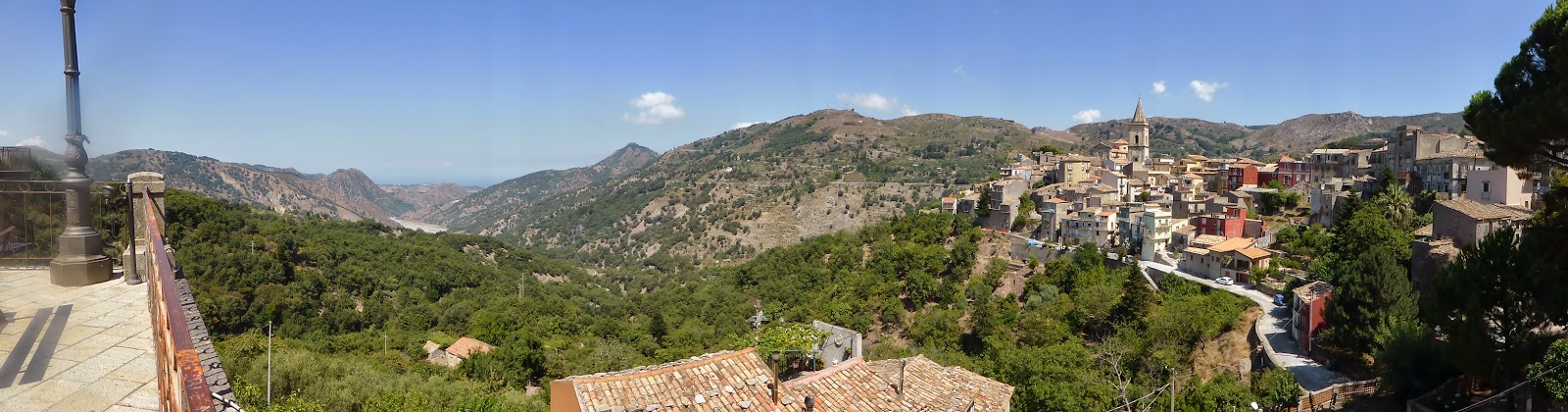
Mountain village of Nuvarra

Three days later conditions looked okay to depart so we left our berth and refueled at the diesel pumps for just the second time this year, taking on 800 litres. However the attendant warned us against leaving so we deferred to local knowledge and spent a further night in the marina. I could imagine deciding to leave regardless of local advice, having some type of accident – “I told you so!” The next day the seas calmed to less than half a metre and we set off early for a 70 mile cruise through the Strait of Messina to Taormina.

Map of Strait of Messina

Because the Strait is only about a mile wide at its northern end and often has considerable traffic you’re required to call “Messina VST” before entering the Strait and provide your vessel details and destination. It was quiet for us though, and we only saw one huge container ship and about six ferries.

We had to alter course to stay clear of this huge container ship

Conditions were calm but the Strait has swirling currents making an extra sharp watch essential. Historically the Strait had huge whirlpools and the largest, known as Charybdis, was dangerous to ships. An earthquake in 1783 altered the sea bottom and the whirlpools are no longer dangerous except to very small boats. Arriving back at Taormina completed our 15 week circumnavigation of Sicily.

Map of Sicily’s east coast shows many of the places we’ve mentioned

TECHNICAL – During our cruise to Taormina the Robertson autopilot’s motor failed. Fortunately we have two autopilots so simply switched to the Simrad unit until we can get the other repaired, probably in Corfu. The led display on my portable infra-red thermometer has also failed and will need to be replaced. I use this for monitoring operating temperatures of pumps, alternators etc.
Ditto our Radio Shack wireless thermometer enabling us to check the outside temperature from the pilothouse. Home in New Zealand you’d be able to replace these easily, but not so here.

ENVOY LOG – as at 5/9/14 we’d spent 150 days aboard and cruised 1,376 miles for 250 engine hours.

SICILY’S STUNNING AEOLIAN ISLANDS

Envoy is now at Kalami Bay, Corfu, Greece.
Next stop was the Aeolian Islands, a group of seven stunning still-active volcanic cones about 15 miles off Sicily’s central north coast. 
At Isole Vulcano we anchored off a great south coast beach called Gelso.

Laurie, Doug and Mary enjoying evening drinks on a small beach near Gelso

Another day there we couldn’t resist having a beer or three in an atmospheric palm frond-thatched beach bar, and while chatting to their friendly staff in our happy state we decided to have a fresh seafood lunch there the next day. On our way back to Envoy we were joined by a pod of frolicking dolphins rounding off a perfect day.

Very basic but totally atmospheric beach bar at Gelso

Two views of Envoy anchored off perfectly-calm Gelso beach

Mary taking in a sunset in Envoy’s cockpit

Next day we went ashore for lunch and the chef proudly displayed a platter holding a fresh fish that looked something like a three kg snapper. Doug asked him how much it was going to cost, and we all reeled in shock when he told us 100 Euros (NZ$156). After going into the restaurant we told our waiter we weren’t all that hungry and had decided to have a pizza instead. His English wasn’t all that great, and we were unsure if they really understood us as we ate our pizzas in trepidation of being served the super-expensive fish. Fortunately the restaurant was very busy and they must have been able to serve the fish to somebody else. Nearby Porto di Levante on Vulcano’s north east coast is anything but peaceful, and we made the mistake of paying 60 Euros (NZ$94) for a mooring only to be later surrounded by boats anchoring very close to us in the mooring area for free. Fortunately the wind stayed light and in the same direction or chaos would have resulted – a mix of anchored and moored boats doesn’t work. Ashore is a mud pool said to have therapeutic healing powers, and there was no shortage of people frolicking in the mud in various states of undress putting this theory to the test.

Two views of Vulcano’s mud pool

Isole Salina is about five miles NW of Vulcano, and here we anchored off the Santa Maria Marina in choppy conditions for one night allowing us to explore this peaceful small town without the tourist hordes of Vulcano and Lipari.

Mary watches a cane basket weaver at work in Salina

Many of Salina’s streets have beautiful flower gardens

Lipari is the main Aeolian island and we anchored off Marina Corta, slightly south of the old town. With all types of ferries constantly passing, the anchorage was anything but calm although did settle down during night time without passing boats churning up wakes.

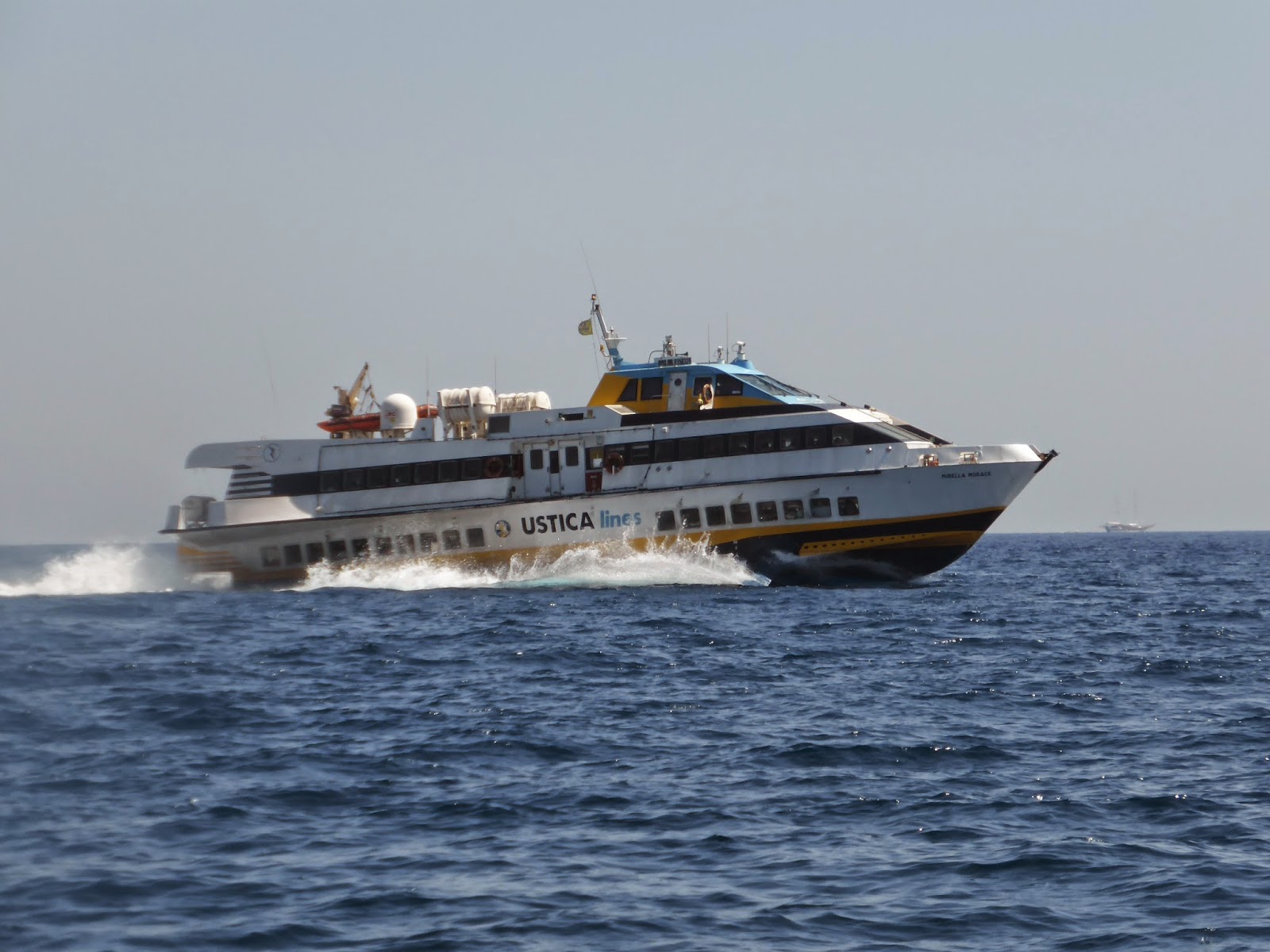
Ferries passing close to anchorages cause considerable wakes

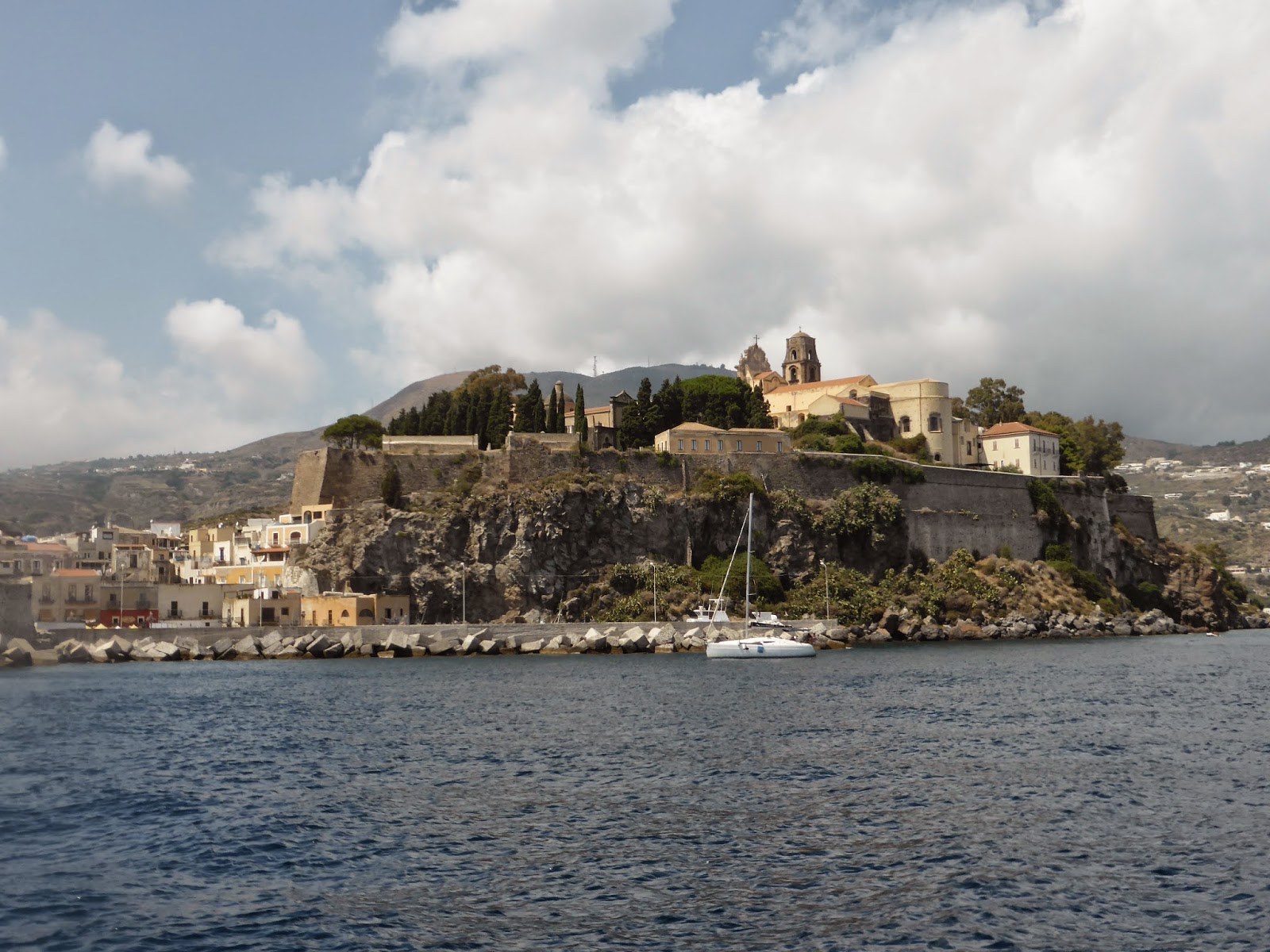
First settled 6,000 years ago Lipari has plenty to see ranging from the impressive and largely intact hilltop fortress to the narrow cobblestone streets of the old town.

What a view of Lipari from our anchorage 

We’d leave our RHIB in this great little harbour while ashore

Panorama of Lipari

On the western side of Lipari we found a reasonably sheltered and peaceful anchorage called Valle Muria away from tourists and ferry wakes, where a rustic taverna, built into an old cave serves welcome ice-cold beers.
Valle Muria’s beach bar

TECHNICAL Doug is an electrician and helped out with a few jobs, repairing a 12 volt socket in the pilothouse, installing a new engine room 12 volt blower to replace a failed one and making it more effective by installing new extraction ducting.

Returning to Anna Mae

After a few months of visiting our home town of Portland Oregon and becoming grandparents, we are flying out tomorrow to our beloved Anna Mae. She is awaiting our return to show off all the new upgrades we have commissioned.The Bahamas and Caribbean ar…

Returning to Anna Mae

After a few months of visiting our home town of Portland Oregon and becoming grandparents, we are flying out tomorrow to our beloved Anna Mae. She is awaiting our return to show off all the new upgrades we have commissioned.

The Bahamas and Caribbean…

[KensBlog 2014-Entry-10] Homeward Bound

Welcome to Ken’s Blog!

Greetings! My apologies for this report coming out weeks after when I should have sent it. You may have heard that the Cabo San Lucas area, where Roberta and I live four to five months a year, had a direct hit by a Cat 3/4 hurricane. I am the President of our homeowner’s association in Cabo and over the last week I’ve been consumed by coordinating our community’s disaster recovery effort and getting information out to homeowners. This particular blog entry is being rushed out and probably isn’t as good as it could have been, but… it is what it is.

No worries though. The blog will be back next year, and it should be a very good year for the blog, and a very good year for Roberta and I. I have lots of ideas for ways to make the blog more fun and more interactive, and some cool surprises for the blog that I just never had time for this year.

Our 2014 cruising season has now ended.

Roberta and I flew home to Seattle last Saturday and (excepting the incidents in Mexico) we are enjoying being back in America. For the first time in months I had fast internet! Roberta couldn’t wait to go to Starbucks! There are no words to describe how it felt to go into Costco here in Seattle. There is nothing on a similar scale that we saw in Croatia, Montenegro, Malta or Italy. The selection and quality of the vegetables, meats, and food is shocking when you’ve been out of the country for a while. It isn’t like we were traveling in third world countries, but.. America is unique in the world, and that fact is really driven home once you’ve been out of the US for a while.

Wow, what an incredible year this was!

We moved the boats over 2,000 miles and had some great times and we also had some challenging times. It was a year with high-highs and low-lows, that sometimes felt more like an advanced Captain’s training course than a vacation.

Here’s a quick map showing the route we took this year:

These maps show the over 2,000 miles that Seabird and Sans Souci covered this summer season. It’s hard for me to imagine that we did all of this in just a few months, but we started in Croatia, cruised down the east coast of Italy, explored the east and southern coasts of Sicily, cruised Malta, returned to Sicily, then out to the Aeolian islands, back to the west coast of Italy, out to the island of Ppnza, past the island of Capri, northeast Sardinia, the east coast of Corsica, past Montecristo, cruised Elba, returned to the mainland, visiting the Cinque-terra region of Italy, and finished in San Remo, on the border with France.

That’s a lot of paddling!

NOTE: CLICK ANY OF THE PICTURES IN THIS BLOG TO GET AN ENLARGED VIEW

At the end of my last blog entry, we had put Sans Souci into the Mirabello marina in mainland Italy, in the town of La Spezia. We had scheduled a date for some boat-mechanics from France to meet us, to accompany us on the last leg of the voyage. The boat was running fine, but I liked the idea of having someone in Europe who knew how to run the boat, just in case it would need to be moved for some reason.

Unfortunately, the guys who were supposed to accompany us were sidetracked, and wouldn’t be available for a week. We were fine with waiting, but were worried the weather, which had suddenly turned nice would turn nasty again. Our last ride would be a long one; over 100 nautical miles of open sea.

Roberta and I watched the weather reports closely, and when we saw a day of dead-calm seas followed by several days of bad weather, we decided to just go for it.

Roberta and I had planned to have crew along for our final 100 nautical mile cruise to San Remo. However, a couple of days before our planned departure a beautiful weather window opened and we decided to jump on it. The flat seas you see here were as rough as it got. It was a perfect way to finish the trip!

Roberta’s and my final trip was eleven hours long, on dead calm water, in perfect conditions. I had been dreading the trip, knowing that we were close to finishing the year with zero serious mechanical problems, and that it just felt like we were overdue for some crisis. I was confident that something would go wrong. Afterall, what are the odds that we’d get through an entire season with no major mechanical issues? As it turns out, the odds were 100%! We arrived at the boat’s final resting place for the 2014 season, at the Portosole marina in San Remo, without incident.

Several people we have spoken to, who have reading our blog entries have said, “It doesn’t sound like you had much fun this year?” I apologize for sending that impression, although I must admit that this was not our favorite year. It actually wasn’t so bad, and when we think back on it, there were some incredible highlights.

Perhaps part of the problem was that the last few years have been so incredible. We have been spoiled by Turkey, Greece, Montenegro and Croatia, all of which had spectacular anchorages spaced close together. This year we had long stretches where there weren’t really good places to anchor, and we also had a summer which was so bad that it made headlines in Europe. I read one article in the French press talking about this being a year where the luckiest vacationers were those who vacationed in September, after the summer was over. The weather finally stabilized and they were able to take advantage of the lower off-season rates. July and August were miserable at times.

Before you feel too sorry for us; keep in mind the old saying that goes something like, “The worst day on a boat beats the best day on shore.” I wouldn’t go quite that far, but I would say that if you watch this slideshow that I quickly threw together you’ll agree that if this was a bad summer, can you imagine how awesome a normal summer is?

Click the link below to see a slideshow highlighting the summer. I think you’ll like it!:

http://www.kensblog.com/uploads/16765/2014_09_07_final/slideshow.html

A warning before you continue reading…

The balance of this blog entry summarizes the effort to close up the boat for the winter. Some of it gets a bit techie. I did what I can to make it comprehensible to non-boaters, but … it is still stuff that some of you might be bored by. Form your own opinion. My feelings will not be hurt if you skip some of what follows.

With our journey finished, I was curious to analyze our fuel consumption and see how we did. The spreadsheet above shows that Sans Souci, our Nordhavn 68, consumed a whopping 3,600 gallons of fuel! Given that fuel costs around $9 per gallon in Europe you can imagine why it was important for us to fill up in the country of Montenegro where duty free fuel was possible.

Steven Argosy, on the boat we spent the summer traveling alongside, had to rub it in a little, as to how efficient his Nordhavn 62 is, by sending me this email:

“…I did some rough calculations. I averaged just over 5 GPH for the summer so far not including generator use. I used 1253 gallons so far on the main since Montenegro and 377 gallons on the generator. It works out to a bit more than 1.35 nm per gallon. – Steven”

While I am talking about the Nordhavn 62, I should probably mention something sad. Although the Nordhavn 62 is one of greatest boats ever built, it has been superceded (if not equalled) by newer model boats, and years ago, the molds from which it is made were literally put out to pasture. Finally, after years of the molds getting moldy, Nordhavn decided to permanently retire them. This article talks about the history, and end of the line of this phenomenal boat: http://www.nordhavn.com/news/headlines/rip_friend/

The topic of where to winter the boats became a soap opera that spanned the whole season.

We only cruise four or five months a year, which leaves seven or eight months when the boat is alone. One would think that the solution is to just put the boat into a marina, turn everything off, and then fly home.

I wish it were that simple.

On a boat as complex as Sans Souci, there is much that needs done during the off-season.

  • Zincs need checked.  The zincs are small chunks of metal attached to various places on the bottom of the boat (propellors, shafts) that are meant to be “sacrificial”. They are intended to be absorb the deterioration from electrolysis in the water, before it eats surrounding metals
  • Start the engines periodically. Sans Souci has four diesel engines (two main engines, two generators). These engines should be started once a month, just to keep them in good working condition and the starting batteries charged up
  • Wash and wax the boat. Keeping the boat clean is important to keeping the finish looking new for years to come
  • Wipe off the bottom. The bottom of the boat collects barnacles and other crud. It needs a diver to go down periodically to wipe it off
  • Check the lines. Over the winter there are a series of storms. The lines loosen and chafe. They need checked constantly and occasionally need tightened or replaced
  • Check the power. Sans Souci has power going at all times, even during the winter. The batteries need continual charging, and some electrical items, such as the bilge pumps, should always have access to power. Dock power is always unreliable during storms. There are power outages, power surges, even times when voltage sags. All of these can trip breakers and wreak havoc on the boat’s electrical system
  • Accept parts. Receive parts and put them onboard. I will be sending mechanics over at the start of the next year’s crusing season. They will need parts of various sorts, and those need to be shipped. There will be a series of shipments this winter headed to the boat.
  • Assist technicians. I will have various technicians on/off the boat over the winter. Someone needs to watch over them, and get them on/off the boat. I always want all work on the boat to happen while I am away. My goal is to fly home at the end of the season, leaving behind a list of work to be done, and then return at the start of the following season to a boat that has been restored to “new” condition.

Think of it this way…. Let’s say you had a million dollar bill, and were told you had to leave it lying somewhere in a foreign country, somewhere you had never been, and that you’d need to trust someone you’ve never met, and who doesn’t speak your language, to watch over it, and care for it, for seven months. You would want to be very careful about who you pick and where you place it. And the truth of the matter is that this analogy is not a good one for several reasons: 1) The boat costs more than a million dollars, and 2) A million dollar bill would be easy to care for and secure. Boats are complex!

Our search for a marina started months before this summer’s cruising even began. Moorage in Europe is not always easy to find, particularly when you are seeking moorage for two fairly large boats (Sans Souci and Seabird.) In some countries, such as France, there simply isn’t moorage available. To get a slip you have to know someone, have lots of money, and wait a very long time. Italy is easier, but even then, there is a bit of a game of musical chairs that goes on. During the summer slips are easily available for short-term moorage, as all of the boats are out cruising. At the end of the season, when the music stops, everyone returns to their home ports and the boats scramble to find moorage.

Before our search could begin this year, we had to determine where we would finish the season. That was a battle in itself, but resulted in us deciding we wanted to be somewhere near France. I then studied dozens of marinas, with only the information I could find on the internet to work with. There wasn’t much information. I wound up writing to many marinas to get pricing and availability. It was a long process with lots of back and forth.

We finally settled on a marina called Imperia, in Imperia Italy, about 50 miles from the border between Italy and France. I chose it because it was new, which would hopefully mean that the electricity was stable, and that there might be good wifi internet. It was also recommended by several other cruisers. Imperia required a $6,000 USD per boat deposit to hold space for our boats, and both our traveling companions (the Argosys, on Seabird) and ourselves wired money.

Months later, as the cruising season was starting, I stumbled onto a new article saying that the Imperia marina was filing bankruptcy! Emails to the marina went unanswered. I called them, and they assured me we would have moorage, but meanwhile their website disappeared, and emails continued to be unanswered. I received mixed reports from the cruising community. Some people said the marina was alive and well, while others asked me questions like, “Can you be certain that the security will be good? Or that the power will stay on?”

We spent most of the summer worrying, and hoping that someone would give us definitive information. I even paid some guys from France to drive to Imperia and have a look. They said good things about the marina, but we were still nervous.

To make a long story short… The marina continued to refuse to respond to emails, and we decided we couldn’t trust them. We bailed, forfeiting our deposits. We notified the marina and asked for refunds. The marina responding saying there were lots of creditors ahead of us, but that they’d tell the lawyers who would add us to the bottom of the list.

Midway through our season we stayed at a very nice marina, called Ragusa, on the southern end of Sicily. They offered a price for moorage for the winter that was roughly the same as the deposit we had paid at Imperia, and a lot less than we still owed Imperia. It was too good to be true, but was true. Even better, Ragusa is close to Tunisia where cheap fuel is available, and outside the EU [Note: For tax reasons we need to exit the EU every 18 months] and close to Malta, where we found great cruising! They also had a good shipyard, and offered dry storage on land if we wanted it. The downside was that it was 700 miles from where we had planned to finish the year. Steven said, “It’s only 700 miles, let’s just backtrack.” I said, “I don’t backtrack.” It would be 700 miles south, and then another 700 miles north. The savings just weren’t worth it to me, and I didn’t believe the savings were as big as Steven was thinking. It would be another 1,400 miles on the boats, and there is both a time and money cost for that distance. I didn’t want to split our two-boat group, but both Steven and I dug in our heels. I started the search over, finding it a little easier with only one boat to find space for, and settled on Portosole in San Remo, while Steven committed to Ragusa.

As I am sitting typing this, I know what happened after our two boats parted company, and it isn’t pretty. Seabird did make it south the 700 miles to Ragusa, but it was not a perfectly smooth trip. Steven and Carol have their own blog, and whereas my trip was boring, they will have a much more interesting end-of-season blog entry. I don’t want to spoil any surprises, but registering for Seabird’s blog at: www.seabirdlrc.com could be worthwhile. I have mentioned in the past that I always consider the blog a bit of a battle. When good times are happening, my blog is boring, and readers lose. When things go wrong, and I am least happy, the blog gets exciting! Steven’s blog (when he gets around to writing it) will win the competition between us for best final blog entry this year.

The town of San Remo turned out to be a wonderful surprise. From the marina to town is an easy walk, and there is all of the shopping and restaurants we could want. We drove over one afternoon to check out the other marinas that I had contacted, including the Imperia marina, and there was none I would have rather been at. We had somehow stumbled into a marina that was everything we had hoped for.

Our final days on the boat were more work than I had expected. Jeff Sanson, from www.pacificYachtManagement.com flew over for our last week, to help tuck the boat in for the winter. Jeff is a whirlwind of energy and whereas my plan was to relax and let him do all the work, that is easier said than done. We all stayed busy during the final week readying the boat for the winter.

One of the first things Roberta and I did after arrival was to look for someone to wash the outside of the boat. I found a local company who would wash the boat but they wanted to inspect it first. Their proposal surprised me: Five hundred euros (around $700 USD.) I didn’t love the price, but the boat was in desperate need of a good washing so I said, “Sure” and we headed off to lunch while they got started.

On return to the boat we were somewhat shocked. The cleaners had removed all the cushions, and basically everything outside the boat that wasn’t nailed down, and strung it all along the dock. The canvas you see dangling from the passarelle of the sailboat on Sans Souci’s port side comes from our boat! This picture shows only some of the “stuff” that was strewn down the dock. I can’t imagine what other boats thought. Perhaps they were thinking, “Oh look. Sans Souci is having a garage sale!”

It all turned out well though. The cleaners were unbelievably efficient and did an incredible job. They had a team of six people who brought their own hoses and brushes. The entire wash, which normally takes a full day was done in about three hours. The wash was well worth the money, and I tipped them well. Later, I went to thank the agent who arranged the cleaners, and he said they had been shocked by the amount of salt on our boat, and couldn’t imagine how we had gotten salt spray all the way up on the radar arch. Never under-estimate a Norhavn!

We were safely in port, but that isn’t the end of the story…

When I first spoke to the marina about a reservation they said they had no slips available for a boat my size. But then, minutes later, they wrote back to say that they had another large boat needing space, and could possibly wedge our boats into THREE slips on a dock meant for smaller boats. They needed me to commit within minutes if I wanted that option, and I took it. Why not? Well .. I was soon to find why not.

Access to the slip, and tying up at the dock were easier than expected. The three slips our two boats were sharing had all the space we could want, and then some.

We were delighted to find that our moorage at the Portosole marina, in San Remo Italy, was wider than our boat. It is very common for boats to fib about the width of their boat, because moorage rates depend on how wide your boat is. This means that you are often asked to back into a slip which is narrower than your boat, and you have to proceed backwards slowly, hoping that your boat will push aside other boats without causing damage. At some ports, such as St Tropez in France, this is a spectator sport. Huge crowds line the dock, particularly when there is a little wind to add to the “fun” as multi-million dollar boats struggle to shoe-horn into impossible places.

One of the many challenges with Med Mooring is the tying off of the bow line. The boat is tied at the bow by two lines which extend to the bottom of the marina, and at the stern (back) to two bollards (cleats) on shore. Because we would be leaving the boat for seven months, during which there would be heavy storms, we used the boats windlasses to make the lines tight at the front and the back of the boat. The bow line you see here, tied to a cleat at Sans Souci’s bow was trickier to tie than is apparent. That rope line you see is actually tied to about twenty feet of very heavy chain. The windlass is required to lift the chain off the bottom, and once you do that, you somehow need to get it off the windlass and onto a cleat. If you leave the line on the cleat a sudden surge from a wind-produced wave can wreck the windlass, meaning an expensive repair.

The only slip available for our boat was actually one and a half slips. This sounded fine at first, but then I discovered that there were complications. The bollards (on shore cleats) were positioned assuming a boat smaller than ours. We needed to center the boat by tying to bollards that were spaced incorrectly for our boat.


Because the bollards behind the boat were spaced for normal usage, and Sans Souci was spanning one and a half slips, there was no way to tie the boat correctly. We needed bollards in places where there weren’t any. We had two that were much too far apart, plus one that was in an awkward place centered behind my boat. Another concern was chafing. The lines will take a beating over the winter and whatever we do needs to hold up to extremely strong winds and surge. The first couple of pictures above show how other boats on the dock were using chain to tie up, and gave me the inspiration for what I should do on my boat. I drew the picture on the right to show how I could use chain to simulate having two different points to tie to behind the boat.

The drawing went through a number of iterations as I spoke to people in the port. The original version had shock absorbers on the lines, and I received a bid for $7,000 USD to put it together. I quickly removed the shock absorbers and simplified what I was trying to accomplish. My final solution still involved writing a nearly $3,000 check. Argh.

Tying the boat was a challenge, and then I hit an electrical surprise.

Because Sans Souci was tied up on a dock normally used by smaller boats the electrical power was also sized for smaller boats. We had three slips being shared by ourselves and a 100′ sailboat that was on our port (left) side. We moored within an hour of each other, and discovered simultaneously that the shore power wasn’t going to work. It was the wrong kind, and there wasn’t enough of it. [Note: Sans Souci is moored at a dock with 32 amp single phase 230v shorepower, whereas the “big boat” dock has 380v 64 amp 3-phase power.]

The joys of shorepower

We knew when we equipped Sans Souci that we’d be cruising around the world. One of the many challenges of world cruising is that different countries have different electrical standards. When we are away from the dock, it is irrelevant. We generate our own electricity. However, when we are in a marina, we usually try to connect to whatever shorepower the marina has to offer.

At most marinas you are not permitted to run your generator and must connect to shorepower. Running a generator while tied up within a few feet of other boats will make you extremely unpopular. Modern generators are very quiet, but they still have some noise and exhaust. No one wants to smell my generator exhaust all day.

Sans Souci gets around this by having a huge, heavy, expensive and fragile device called “The Atlas” which converts virtually any dockside shorepower into the same type of electricity (voltage, frequency) that we have at home in America. I am sure that the company who makes my Atlas would disagree with my calling their device “fragile” but I’ll stand by those words, and have the long history of repairs to back up what I say.

Despite this, I would install an Atlas again today, and consider it a must for the kind of world cruising Roberta and I have been doing, but the flexibility it offers does come at a price.

Actually, I’ll back off a little on my comment. In a “normal” environment, I am sure the Atlas is fine. However, we travel to places where the power is not only different than US standards, but often different at different parts of the day. We have been many places where voltage at the dock is best described as “random.” The voltage rises and falls based on events well beyond our boat. If someone in town runs their dryer, voltage can drop at the dock. We’ve been in marinas where the marina staff thinks nothing of turning off power to the dock several times a day. And, then there are the winter storms. These can create major power surges and long outages.

Another major disadvantage of the Atlas is that it consumes some percentage of all the electricity it is given, and has a fairly high minimum power requirement just to be operated. In some marinas electricity is very expensive, and the electricity consumed by the Atlas, even with virtually nothing on the boat using electricity, can cost a thousand dollars a month or more. We’ve also had issues with heat generated by the Atlas. When we are in extraordinarily hot places, such as when we were in Hong Kong, the Atlas was throwing out so much heat that my lazarette (where the Atlas lives) was overheating, causing problems with other electrical components, like my inverters. Luckily, I have good air conditioning in the lazarette and could bring the temperature down to a reasonable level, but the incremental air conditioning also cost electricity, and reduced my cooling capacity. In addition to heat, when the power at the dock is severely limited (not many amps available), the amps that the Atlas pigs for itself doesn’t leave many for the boat.

To make a long story short, I’ve decided that the right answer for when we are not on the boat is to run the boat off of the batteries. The boat has inverters which convert power stored in the 24v batteries to US-standard electricity. I should have done this years ago, and just didn’t think of it. The inverters only power the 120v appliances and electrical outlets. The heavy appliances on the boat, such as the washer, dryer, dive compressor, and air conditioning, aren’t used during the winter, so I don’t need to think about them, and the safety electronics, such as the bilge pumps run off 24v, so as long as the batteries are charged, they will operate.

To run off the batteries, I need a way to charge them, and I have a battery charger which is very flexible. Like the Atlas it can accept virtually any electricity thrown at it. This is fairly typical of most battery chargers. I am guessing that power surges and frequent outages can also “blow up” a battery charger, but instead of a $50,000 highly complex specialty item (the Atlas) needing repair, it is a $1,000 battery charger that can be found and replaced fairly easily.

For more than you ever wanted to know about how Sans Souci is wired, and how I’m running from shorepower, this is a slideshow I put together mostly for my own use. I tend to forget how these things work from year to year and need to leave myself some degree of documentation: http://tinyurl.com/ke9zwp4

Ordinarily I have no problem attaching to shorepower, but at the Portosole marina we were at a dock intended for smaller boats with lower power requirements. We battled for nearly a week to get shorepower working, and even brought over a specialized electrician from France on three seperate trips. But, finally, we did it! We got it working just in time to turn it all off, and stop using my fancy international power transformer (the Atlas), as we put the boat into winter-mode running off a battery charger.

See those silver buckets? They are each full of five gallons of 15-40w motor oil. I purchased five of them in order to change the oil on my two main engines, and two generators. You will be shocked by the cost: $1,100 USD! Gas, oil, diesel, and electricity are all much more expensive in Europe than what we pay in the United States.

Some of you may recall that earlier this season I had an oil hose pop off while changing the oil and manage to spray myself, and the entire lazarette, with dirty oil. I swore that I’d never do it again.

However, as this picture shows, my resolve not to spray oil didn’t last long. Jeff, my US mechanic who flew over to help me put away the boat for the season, asked me to start the pump so that we could test that it was working. He was holding a hose we were using to drain the starboard engine and thought only a trickle would come out. As you can see in this picture, it was more than a trickle. I can confirm that the oil pump was working quite well indeed.

Our final days on the boat were spent cleaning and packing. Here’s a picture of Roberta cleaning out shelves in the master bath while wearing headphones to listen to music. She has a pad of paper in her hands. One of the last tasks she does on the boat is to go through everything and make notes about what we need to bring back to the boat next year.

She won’t be happy I put this picture into the blog, but I thought she looked cute!

Just hours before we left the boat for the final time, the toilet in the master head broke. Someone (who shall remain nameless) was cleaning the toilet and had a brush down the throat when the ball valve at the base closed around the brush, stripping the gears. We carry lots of spares, and here we see Jeff being an incredibly good sport about swapping the guts of the toilet just hours before departure. (I was conveniently elsewhere at the moment)

Our final days were not all work. Our good friends from Cabo, Ray and Karen Hoffman, were on a small cruise ship that docked at San Remo. Interestingly, just before their arrival in San Remo, their cruise ship traveled to the south end of Corsica. This is noteworthy because at the time there was a huge mistral wind blowing. The mistral wind is a fierce wind (typically 30-60 knots) that can last for days in the Med. It was a good day to be in a marina, but their cruise went anyhow. They had an uncomfortable ride, but I guess cruise ships operate on a schedule, and have to move regardless of conditions. I prefer how we do it on Sans Souci. If the wind is blowing we sit still.

And, we didn’t know it at this time or we wouldn’t have been smiling, but wind was soon to play a larger role in our lives. Our homes and community in Cabo would soon be seeing winds over 100 knots.

One of our last projects on Sans Souci was to cover up the windows. This keeps the sun from damaging the interior over the off-season. We also bring in all the chairs, cushions, etc.

This has nothing to do with my blog, but I found it interesting…

Our favorite cruising ground thus far has been Turkey. This puzzles some people, and we often get questions about, “Why Turkey?” The answer is: “Great anchorages, great people and the chance to see history close-up.”

I mention that because of a thought-provoking email I was sent earlier today. It was sent by a cruiser to everyone who receives his blog, and is somewhat self-explanatory.

“… Dear all, […] We, Zehra and Lee, have been cruising the eastern Med for some years now. […] Oh and yes, let me remind you that in this part of the world, governments are not as interested in my civil liberties as one MIGHT suspect they are back home. So, emails that revolve around Arabic, Muslim, or otherwise, Middle Eastern Religious / otherwise behavior need some TLC.   Just receiving them can raise red flags for us.   How do I know?   From DIRECT AND PERSONAL EXPERIENCE dating back to the winter of 2011-12.   I chose to cruise here in this part of the world. I am willing to accept the consequence of that decision. I am also asking that those that forward email understand that your decision to forward to me what you may think is funny, may be seen as subversive or at least controversial when a foreign ISP views it.   I know this is not an easy request to process. All I can ask is please try.   OK?   […]   PS This email is NOT a result of a email to me It is a result of a conversation that we had last night with two french sailors that were question by Tunisian Authorities over an email they got about the absurdity of the veil a female might use to cover their face in France they received just a few months ago.   And for those that are thinking: Yes this place is worth cruising. For all of the above, being at a wall of a Greek or other Med port where probably, much of the wall was built centuries ago can be mind blowing. Walking up to a fort whose roots stared before Christ was born, and continued thru WW II does get one thinking.   So the grass here is NOT greener here than where you are. It is a different shade of green. We choose to accept those differences, deal with the consequences as they occur, and enjoy the life this area provides.

Thanks for listening.
Lee and Zehra Myrina Limnos Gr …”

And, this has nothing to do with boating, but I have to say a word about Cabo before closing…

The media has not said much about the hurricane that struck Baja California, where we have owned a home for nearly 17 years. Our community in Cabo is approaching two weeks now with no water or power. We are in Seattle, but I speak with people in Cabo many times a day. I would like to share that the devastation was much worse than you have heard, and that the recovery is happening much quicker than anyone would ever have thought possible. I already had tremendous respect for the people of Mexico before the hurricane, and far more than that now.

Below are links to two longish, but quite compelling, videos that tell a bit more of the story than you may have heard. One shows the destruction, and the other shows the clean-up that is already happening. My prediction is that within a few short weeks tourists will start arriving back in Cabo and for most it will feel as though nothing ever happened. However, if you view these videos, you’ll know the rest of the story.

Video 1 – Hurricane Odile and the aftermath: http://www.youtube.com/watch?v=XqwwTwuTNTM

Video 2 – The reconstruction: http://www.youtube.com/watch?v=evgvoy_ZyR4

And in closing…

If you missed the prior blog entries from this season, you may view them here:

If you haven’t been receiving my blog entries via email, click this link to register. It will be many months before I send another blog entry, but… why wait until the last minute:

http://www.kensblog.com/register

That’s it for the summer 2014 cruising season. Another year has come to an end. Thank you all!

Ken and Roberta Williams
ken(at)kensblog.com
MV Sans Souci
Nordhavn 68

Start your own blog now! Free!

THE MOUNTAIN VILLAGES OF MADONIE REGIONAL PARK

Envoy is currently in Gouvia Marina at the Greek island of Corfu undergoing maintenance.
Our last posting included a picture of a classic-looking 90 metre older-style ship. A reader informs us this is in fact a vessel called Nero, built in China in 2007 and currently for sale at 60 million Euros. But although a replica she still looks great.
With Doug and Mary we hired a car and driver for a day tour of mountain villages near Cefalu within the Madonie Regional Park on Sicily’s central northern coast.

Morning coffee in the village of Glatteri with our guide, Marco

The Gibilmanna monastery and its church dating from the 17th century were of special significance to Marco as he got married here

The monastery’s stunning gold altar

A beautiful archway leads into a hidden courtyard

The mountains of the Regional Park rise to nearly 2,000 metres

At the village of Pollina we came across a group of young boys playing soccer and Mary asked them to line up for a group photo – they were happy to oblige

Pollina is set on a mountain top

View of Cefalu area from Pollina

Laurie, Di, Mary and Doug at Pollina

Nuvarra is yet another stunning village

Our favourite village was Castelbuono where we enjoyed a sumptuous lunch of wild boar hocks in the stunning wood-paneled Ristorante Nangalarruni, set in the middle of a maze of cobbled lanes – we’d never have found it without our guide.

Wild boar hocks for lunch

The castle here was built in 1316 and remains in great shape, supposedly haunted by a ghostly apparition of Queen Constance Chiaramonte.
After leaving Cefalu we’d planned to berth at Marina Capo D’Orlando. Arriving outside the marina with a 20 knot onshore wind and one to two metre swells we peered inside but couldn’t see any yacht masts or larger motor vessels, but did notice some sand banks and apparent silting. Not wanting to take any chances in the adverse lee-shore conditions we cruised on to anchor inside a lagoon sheltered by an extensive sandbank south east of Capo Tindari, near the village of Marinello. While most of the anchorages along this coast are fully exposed except to the south, this one had reasonable shelter from all directions except the east, and we stayed a couple of nights.
August is peak holiday time and ashore is busy with mostly local tourists, while large RHIBs between five to nine metres predominate on the water. There are no apparent safe boating regulations, such as we have in New Zealand, so all day long RHIBs, jet skis, ferries and other vessels travel at speed close inshore and close to other vessels, creating large wakes and making us thankful for our flopper stoppers.

TECHNICAL – nothing to report

But What About Istaboa?

Istaboa’s fine, she’s not going anywhere other than where she takes us.

 Once again, Istaboa is our dream being realized. Some will remember…

And, yes I know, there are those who feel there’s no better life than full time living aboard our boats, but we’ve been doing the cruising thing for many years. We like to think of the boat life as a dream being realized, but sometimes, for us anyway, it’s fun to hop on the bus and say — there’s no place like home — and our dream remains floating somewhere awaiting our return.

Istaboa also has a new home in Jupiter where we bought her a slip. She’ll only be a couple of miles away and when we’re not cruising, I’ll enjoy her everyday as my office.
She’ll return to her previous role, no longer home, but our escape.

And a great escape she is.

Adios,

Istaboa

Nordhavn Exumas Abacos Bahamas trawler Caribbean Pickwick Boat dogs
Memphis Downtown

Our House

Our house is a very, very fine house
with two dogs in the yard…
Okay, I took liberties with the old CS&N tune and the rest of it doesn’t apply, but you get the point.

Picking up from the last post — Like the tide, change is rising and about to wash over us part?
Well, the little house in the above photo is the catalyst for these changes.

Meet ‘Spearfish’, our little bungalow by the sea in Jupiter, FL

Going on 15 years now, Crew Istaboa has cruised the watery stretches between the Gulf Coast, the Keys, the East Coast, the Chesapeake Bay, and the Bahamas.  All along the way, in every marina where we’d tie up, Mel and I would take time to imagine what it’d be like to reside in that particular place. We explored each one thoroughly and they were all contenders in the hunt for the eventual/inevitable dirt dwelling where we knew one day we’d settle in.
Yes, we’ve unintentionally annoyed many realtors throughout the course of our travels.

For the last couple of years, The Jupiter area has become our home-port to return to.
For Florida, Jupiter’s a fairly progressive/live and let live kinda place. We enjoy it’s good food, the nice folks, and it’s seemingly kind attitude. Even during season the traffic’s not too bad, and the water’s truly beautiful.
Jupiter has one of the best beaches on the East Coast. It’s a dog friendly stretch of shoreline and seems pretty human friendly as well. We’ve found we like it here much. The Boyz love the beach and they’re really gonna enjoy the freedom that comes with the small fenced yard.

So unless something unforeseeable happens with our real estate transaction, it appears, on dry land anyway, we’ve finally found what we’re looking for. Or, maybe it found us.

And, we’ll call this home –> ‘Spearfish’.

Another chapter in our story.

More later —

Adios,

Istaboa

Nordhavn Exumas Abacos Bahamas trawler Caribbean Pickwick Boat dogs
Memphis Downtown