Tag Archives | Nordhavn

But What About Istaboa?

Istaboa’s fine, she’s not going anywhere other than where she takes us.

 Once again, Istaboa is our dream being realized. Some will remember…

And, yes I know, there are those who feel there’s no better life than full time living aboard our boats, but we’ve been doing the cruising thing for many years. We like to think of the boat life as a dream being realized, but sometimes, for us anyway, it’s fun to hop on the bus and say — there’s no place like home — and our dream remains floating somewhere awaiting our return.

Istaboa also has a new home in Jupiter where we bought her a slip. She’ll only be a couple of miles away and when we’re not cruising, I’ll enjoy her everyday as my office.
She’ll return to her previous role, no longer home, but our escape.

And a great escape she is.

Adios,

Istaboa

Nordhavn Exumas Abacos Bahamas trawler Caribbean Pickwick Boat dogs
Memphis Downtown

Our House

Our house is a very, very fine house
with two dogs in the yard…
Okay, I took liberties with the old CS&N tune and the rest of it doesn’t apply, but you get the point.

Picking up from the last post — Like the tide, change is rising and about to wash over us part?
Well, the little house in the above photo is the catalyst for these changes.

Meet ‘Spearfish’, our little bungalow by the sea in Jupiter, FL

Going on 15 years now, Crew Istaboa has cruised the watery stretches between the Gulf Coast, the Keys, the East Coast, the Chesapeake Bay, and the Bahamas.  All along the way, in every marina where we’d tie up, Mel and I would take time to imagine what it’d be like to reside in that particular place. We explored each one thoroughly and they were all contenders in the hunt for the eventual/inevitable dirt dwelling where we knew one day we’d settle in.
Yes, we’ve unintentionally annoyed many realtors throughout the course of our travels.

For the last couple of years, The Jupiter area has become our home-port to return to.
For Florida, Jupiter’s a fairly progressive/live and let live kinda place. We enjoy it’s good food, the nice folks, and it’s seemingly kind attitude. Even during season the traffic’s not too bad, and the water’s truly beautiful.
Jupiter has one of the best beaches on the East Coast. It’s a dog friendly stretch of shoreline and seems pretty human friendly as well. We’ve found we like it here much. The Boyz love the beach and they’re really gonna enjoy the freedom that comes with the small fenced yard.

So unless something unforeseeable happens with our real estate transaction, it appears, on dry land anyway, we’ve finally found what we’re looking for. Or, maybe it found us.

And, we’ll call this home –> ‘Spearfish’.

Another chapter in our story.

More later —

Adios,

Istaboa

Nordhavn Exumas Abacos Bahamas trawler Caribbean Pickwick Boat dogs
Memphis Downtown

Old Port Cove Sunrise

Finally got that sunrise…Nordhavn Exumas Abacos Bahamas trawler Caribbean Pickwick Boat dogs
Memphis Downtown

Siracusa, Sicily to Ragusa

Siracusa Italy, on the island of Sicily, was not on my personal bucket list.  Since everyone else, my wife Carol and the Sans Souci’s, Ken and Roberta were excited about it, it was fine with me.  I was surprised at how much I loved it.

Map of Siracusa

                                                                                           Map of Siracusa, Sicily

After we arrived from our overnight passage, we were all tired and decided to lay low for the day.  We were planning on staying for a few days before heading south to Malta, so we were in no hurry to get ashore.  We weren’t picking up my sister in law Tina in Palermo for a few days so we had plenty off time to wander about town.


Siracusa, like many big towns in Italy, had a fortress-like inner city that was built 2500 years ago by the Greeks.  Over the centuries it was taken over by various empires and invaders and it is amazing that it remains in tact, albeit with many upgrades and improvements since it’s inception.


Walled city

 Siracusa, Sicily Walled City

Within walled city is a massive network of narrow streets and buildings housing restaurants, shops and apartments where thousands off inhabitants live.


Outside the walled complex is a beautiful city of 125,000 people.  We had heard about the famous Siracusa markets, but to experience it is really something else.  Italians are very expressive people anyway, but the marketeers take it to a new level!  As you walk by the booths filled with fresh fruits, vegetables, fish, cheese and pastries, not only are your sight and sense of smell overwhelmed, but your ears too! Imagine a hundred people presenting their products all at the same time, acting as if you would be a fool not to buy from them and their products are the freshest you will ever find at the best prices!  All in Italian.  Did we understand them?  Nope.  But with their loud, flowery speech, arms waving in the air and their hands touching their chests over their hearts, you got the idea!


market


At the end of the market there was a deli, of sorts.  Out front there was a team of women dishing out samples of cheeses, bruschetta and bread.  They were not quite as expressive as the others, but we ended up spending a fortune because everything was so good.


PALERMO


Carol’s sister Tina arrived in Palermo a few days after we arrived in Siracusa for her annual visit so we rented a car from Avis and drove to pick her up.  She was arriving at 6am so we decided to get a hotel room the night before in Palermo. After picking her up at the airport we wandered about town for a few hours and then headed back to Siracusa. Tina is a Special Ed teacher and school had just finished.  She was fried and looked forward to some relaxation on Seabird!  The only problem for me is that now I had two of them and they don’t like to sit around.  I was outvoted constantly for two weeks and had to participate in many, many excursions. On the plus side, Tina likes food as much as I do, so it was a Roman Feast nearly every day!


                                                               I lost the original photo, but this is what we saw from the boat at 2am!

I didn’t mention this in my previous blog, but while cruising overnight on June 16th from Crotone to Siracusa, Carol was on watch and noticed a bright orange light in the sky to the north of us.  She radio’d Ken on Sans Souci about it, and he thought it might be a reflection from the rising sun.  OK, Carol thought, but she looked at her watch and it showed 2am, which was 4 hours before sunrise.  She looked through the binoculars and discovered that it was red hot lava flowing down the side of a huge mountain!  She realized then that it had to be Mt Etna.  When I arrived for my shift at 3am, she showed it to me and we then decided that one of our trips in Sicily would be to visit Mt Etna close up. We were witnessing the last major eruption from the relative safety of the pilot house on Seabird!


After Tina arrived and she had her fill of Frozen Margaritas and a bit of rest, we planned our trip.  I have one of these little Garmin navigation systems that we bring with us.  It saves us tons of time trying to find places.  It did not work so well in Sicily, at least around the Mt Etna area.  We had a lot of false starts and hit a lot of dead ends before finally arriving at the main tourist base.  On the way there, it was like traveling on the moon.  The lava fields extended 10 or 15 miles from the volcano and roads had to be carved out from the cooled rock. 


While the base was really a disappointing tourist trap, the tour up the mountain to the volcano was not.  It consisted of a long tram ride followed by a ride up in this strange looking vehicle that looked like a cross between a school bus and a Hummer.


 our transportation to the volcano

I was surprised at how cold it was up there. When you suddenly realized that your feet were warm, you knew you were in Volcano Country.  Although the air was a chilly 45 degrees F, the ground was warm, very warm to the touch, even though the main crater was still miles away.  Mt Etna encompasses 459 square miles.  I would not want to be around if there was a cataclysmic event there.


A FUNNY THING HAPPENED ON THE WAY TO MALTA……


We like to think of ourselves as “flexible”cruisers.  Weather patterns, change of heart, unexpected repairs, all of these play a part in what we end up doing on the boat. Our plan had always been for Seabird and Sans Souci to cruise directly to Malta from Siracusa.  The passage from Siracusa to Malta was 82 NMR, or about 10 hours.  Since we wanted to arrive to clear customs by 4pm, that meant leaving Siracusa at 6am.  If we had to, we would, but we started looking for alternatives and found a small town in southern Sicily called Marina Ragusa, which was only 59 miles, or 6 hours from Malta.  It was a nice new marina and it looked like a fun place to stop for a few days.


Carol and I have gotten pretty good at Med Mooring. An invaluable addition to this process was a set of two way headsets that we purchased.  When we Med Moor, I need Carol in the back of the boat to guide me in, i.e. “Go left”, “go right”. Or “STOP!!!”  Which means I am about to hit something.  Anyway, when I am backing in between two boats set apart by only the width of my boat and the entire area behind the boat is one big blind spot, these headphones help a lot!


Siracusa to Marina Ragusa – 59 miles


It was really a nice marina.  The people were friendly and it was a safe, calm harbor.


Carol, Tina and I took a bus to the town of Ragusa, which was about 10 miles from the boat.  The town was kind of a cross between a typical European city and something out of a fairy tale.  The oldest part of the city, which we viewed from above, looked like a painting.  Look at the photo below.  It pretty much sums up exactly what we saw.


While we were at the marina, I decided that it would be interesting to find out what it would cost to keep our boat there for the winter.  Both Ken and I had given several thousand dollars in deposits to Porto Di Imperia marina in northern Italy, but our emails to them were unanswered recently and we found out that they had financial problems.  In May, they declared bankruptcy.  We had also heard that the security there was suspect.  I hated to lose the deposit, but we were concerned about leaving our boats there under the current financial strain.


I was astounded by the quote! The cost for the entire winter was about the same as one month at Porto Di Imperia!  In addition, they had a great guy there, George, who spoke perfect English and looked after many of the boats there.  The weather is mild so there is no need to winterize the boat and Tunisia is only a day away for cheap fuel and meeting the EU requirements for avoidance of the dreaded Value Added Tax (VAT), which could be up to 20% of a vessel’s value! 


To me it was a no brainer.  I would save over $15,000 on storage and probably another $15,000 in fuel costs. 


Ken and Roberta hedged on the idea and decided that they did not want to backtrack to Sicily at the end of the summer, so, the plan was to part company in Elba and meet again in the springtime.  Call me cheap……..


After 3 days in Ragusa. It was off to Malta….


Start your own blog now! Free!

Siracusa, Sicily to Ragusa

Siracusa Italy, on the island of Sicily, was not on my personal bucket list.  Since everyone else, my wife Carol and the Sans Souci’s, Ken and Roberta were excited about it, it was fine with me.  I was surprised at how much I loved it.

Map of Siracusa

                                                                                           Map of Siracusa, Sicily

After we arrived from our overnight passage, we were all tired and decided to lay low for the day.  We were planning on staying for a few days before heading south to Malta, so we were in no hurry to get ashore.  We weren’t picking up my sister in law Tina in Palermo for a few days so we had plenty off time to wander about town.


Siracusa, like many big towns in Italy, had a fortress-like inner city that was built 2500 years ago by the Greeks.  Over the centuries it was taken over by various empires and invaders and it is amazing that it remains in tact, albeit with many upgrades and improvements since it’s inception.


Walled city

 Siracusa, Sicily Walled City

Within walled city is a massive network of narrow streets and buildings housing restaurants, shops and apartments where thousands off inhabitants live.


Outside the walled complex is a beautiful city of 125,000 people.  We had heard about the famous Siracusa markets, but to experience it is really something else.  Italians are very expressive people anyway, but the marketeers take it to a new level!  As you walk by the booths filled with fresh fruits, vegetables, fish, cheese and pastries, not only are your sight and sense of smell overwhelmed, but your ears too! Imagine a hundred people presenting their products all at the same time, acting as if you would be a fool not to buy from them and their products are the freshest you will ever find at the best prices!  All in Italian.  Did we understand them?  Nope.  But with their loud, flowery speech, arms waving in the air and their hands touching their chests over their hearts, you got the idea!


market


At the end of the market there was a deli, of sorts.  Out front there was a team of women dishing out samples of cheeses, bruschetta and bread.  They were not quite as expressive as the others, but we ended up spending a fortune because everything was so good.


PALERMO


Carol’s sister Tina arrived in Palermo a few days after we arrived in Siracusa for her annual visit so we rented a car from Avis and drove to pick her up.  She was arriving at 6am so we decided to get a hotel room the night before in Palermo. After picking her up at the airport we wandered about town for a few hours and then headed back to Siracusa. Tina is a Special Ed teacher and school had just finished.  She was fried and looked forward to some relaxation on Seabird!  The only problem for me is that now I had two of them and they don’t like to sit around.  I was outvoted constantly for two weeks and had to participate in many, many excursions. On the plus side, Tina likes food as much as I do, so it was a Roman Feast nearly every day!


                                                               I lost the original photo, but this is what we saw from the boat at 2am!

I didn’t mention this in my previous blog, but while cruising overnight on June 16th from Crotone to Siracusa, Carol was on watch and noticed a bright orange light in the sky to the north of us.  She radio’d Ken on Sans Souci about it, and he thought it might be a reflection from the rising sun.  OK, Carol thought, but she looked at her watch and it showed 2am, which was 4 hours before sunrise.  She looked through the binoculars and discovered that it was red hot lava flowing down the side of a huge mountain!  She realized then that it had to be Mt Etna.  When I arrived for my shift at 3am, she showed it to me and we then decided that one of our trips in Sicily would be to visit Mt Etna close up. We were witnessing the last major eruption from the relative safety of the pilot house on Seabird!


After Tina arrived and she had her fill of Frozen Margaritas and a bit of rest, we planned our trip.  I have one of these little Garmin navigation systems that we bring with us.  It saves us tons of time trying to find places.  It did not work so well in Sicily, at least around the Mt Etna area.  We had a lot of false starts and hit a lot of dead ends before finally arriving at the main tourist base.  On the way there, it was like traveling on the moon.  The lava fields extended 10 or 15 miles from the volcano and roads had to be carved out from the cooled rock. 


While the base was really a disappointing tourist trap, the tour up the mountain to the volcano was not.  It consisted of a long tram ride followed by a ride up in this strange looking vehicle that looked like a cross between a school bus and a Hummer.


 our transportation to the volcano

I was surprised at how cold it was up there. When you suddenly realized that your feet were warm, you knew you were in Volcano Country.  Although the air was a chilly 45 degrees F, the ground was warm, very warm to the touch, even though the main crater was still miles away.  Mt Etna encompasses 459 square miles.  I would not want to be around if there was a cataclysmic event there.


A FUNNY THING HAPPENED ON THE WAY TO MALTA……


We like to think of ourselves as “flexible”cruisers.  Weather patterns, change of heart, unexpected repairs, all of these play a part in what we end up doing on the boat. Our plan had always been for Seabird and Sans Souci to cruise directly to Malta from Siracusa.  The passage from Siracusa to Malta was 82 NMR, or about 10 hours.  Since we wanted to arrive to clear customs by 4pm, that meant leaving Siracusa at 6am.  If we had to, we would, but we started looking for alternatives and found a small town in southern Sicily called Marina Ragusa, which was only 59 miles, or 6 hours from Malta.  It was a nice new marina and it looked like a fun place to stop for a few days.


Carol and I have gotten pretty good at Med Mooring. An invaluable addition to this process was a set of two way headsets that we purchased.  When we Med Moor, I need Carol in the back of the boat to guide me in, i.e. “Go left”, “go right”. Or “STOP!!!”  Which means I am about to hit something.  Anyway, when I am backing in between two boats set apart by only the width of my boat and the entire area behind the boat is one big blind spot, these headphones help a lot!


Siracusa to Marina Ragusa – 59 miles


It was really a nice marina.  The people were friendly and it was a safe, calm harbor.


Carol, Tina and I took a bus to the town of Ragusa, which was about 10 miles from the boat.  The town was kind of a cross between a typical European city and something out of a fairy tale.  The oldest part of the city, which we viewed from above, looked like a painting.  Look at the photo below.  It pretty much sums up exactly what we saw.


While we were at the marina, I decided that it would be interesting to find out what it would cost to keep our boat there for the winter.  Both Ken and I had given several thousand dollars in deposits to Porto Di Imperia marina in northern Italy, but our emails to them were unanswered recently and we found out that they had financial problems.  In May, they declared bankruptcy.  We had also heard that the security there was suspect.  I hated to lose the deposit, but we were concerned about leaving our boats there under the current financial strain.


I was astounded by the quote! The cost for the entire winter was about the same as one month at Porto Di Imperia!  In addition, they had a great guy there, George, who spoke perfect English and looked after many of the boats there.  The weather is mild so there is no need to winterize the boat and Tunisia is only a day away for cheap fuel and meeting the EU requirements for avoidance of the dreaded Value Added Tax (VAT), which could be up to 20% of a vessel’s value! 


To me it was a no brainer.  I would save over $15,000 on storage and probably another $15,000 in fuel costs. 


Ken and Roberta hedged on the idea and decided that they did not want to backtrack to Sicily at the end of the summer, so, the plan was to part company in Elba and meet again in the springtime.  Call me cheap……..


After 3 days in Ragusa. It was off to Malta….


Another Day

Well, the storm was a bust… not even rain. Maybe a sunrise.It’s nice being here at Old Port Cove; a nice distant horizon with an ocean breeze and a view of the rich and famous.We’ve still not gone home to The Bluffs or Memphis yet, but I’m feeling ch…

ENVOY CRUISES WEST ALONG THE NORTH COAST OF SICILY

You can’t write about Sicily without mentioning the Mafia, which has been heavily entwined in Sicily’s more recent history. Tourists don’t come into contact with the Mafia and have nothing to fear from them, but it’s estimated that 70 per cent of Sicilian businesses pay protection money or “pizzo” to the Mafia ranging from about 200 Euros (NZ$312) per month for a small shop or bar to Euro 5,000 (NZ$7,800) for a supermarket. Back in 2004 the Italian Mafia’s total annual income was estimated at 90 billion Euros (NZ$141b), of which about a third was generated in Sicily, and their total assets estimated at over a trillion Euros.
Thankfully the murder of anti-Mafia judges and police has ceased, but while a good part of the Mafia leadership are serving lengthy prison sentences the organization apparently continues to thrive, and still has tentacles in the highest levels of society.
After Amy’s departure we left Trapani for the last time, heading east and anchoring off north coast beaches – Scialandra, Capo Rama, Mondello and Porticello.

Views from our anchorage at Scialandra

We find many modern super yachts lacking in style but this grand old lady looks stunning

Along the coast of Sicily there are dozens of ancient watch towers

Although a few other boats were anchored off these beaches, none of them offer complete shelter and fortunately the winds were either southerly or very light northerlies with little swell. Again we were surprised by the very large number of RHIBs – at Mondello there were several hundred at anchor with people just sunbathing and swimming off them. In New Zealand you’d normally beach your RHIB or anchor it very close to shore and spend your time ashore, but here motor boats are not allowed in swimming areas so they have to anchor outside the buoyed swimming area. Considering the way Italians drive their small craft this is a very sensible precaution.

You rarely see a rooster tail like the one from this 70 footer

We bypassed Palermo and headed to Cefalu, anchoring off the marina and with some protection from a large marina breakwater. This is a great, picturesque anchorage, protected from all except NE winds and dominated by La Rocca (the rock), 278 metres high and the site of Il Castello, a ruined Norman castle. 

Cefalu and La Rocca viewed from the sea

Some swell penetrates the anchorage but our flopper stoppers kept us comfortable as well as keeping other boats from passing too closely.

Envoy in stunning Cefalu anchorage

View from Envoy at anchor in Cefalu

Cefalu’s extremely crowded sandy beach is quite typical

Many people choose to swim off less crowded rocks

Here in Cefalu our Kiwi friends Doug and Mary joined us for two weeks and we had no qualms about leaving Envoy unattended at anchor while we did some day trips ashore; although we’d spent some time in Cefalu in 2007 it was great to revisit this absolutely stunning medieval town with Doug and Mary.
A highlight is the Duomo di Cefalu, a stunning church built in the 12th century.

Duomo di Cefalu viewed from the sea

And from land

We found this very talented model maker in Cefalu – he charged us a Euro for taking his picture

TECHNICAL I changed the Lugger engine oil and filter after 200 hours, a job made easy by the 12 volt oil-change pump. Our large RHIB had been in the water for 9 weeks and was becoming increasingly difficult to keep clean (it’s not anti fouled), so we swapped it over for the small RHIB, which is OK while there’s only two of us aboard. The small RHIB is suspended from Envoy’s transom when not in use so marine growth isn’t an issue. The large RHIB is too heavy to suspend in that way and we tow it.

ENVOY LOG As at 17/8/14, we’d spent 130 days aboard and cruised 1,166 miles for 212 engine hours.

AMY’S VISIT TO SICILY

Envoy is now back at Taormina having completed a 15 week circumnavigation of Sicily.
Although we’d already spent six weeks in the Trapani and Egadi Islands area we always find some new places of interest and different things to do with new visitors, and this proved to be the case with our daughter, Amy.
Having been settled by Greeks, Corinthians, Phoenicians, Carthaginians, Romans, Byzantines, Arabs, Normans and Spanish the Egadis have a fascinating legacy of history culminating in the tuna trade. Since the 1960s tourism has taken over as the major activity.
Most of the jellyfish had gone although there was still the odd one around – I jump in the water first with my mask on to do a quick check. The water is a tropical 27d so we stay in for ages.
We cruised to Marettimo and berthed in a small marina – quite expensive at 85 Euros (NZ$133) per night, but at islands like this there’s no good shelter for anchoring with any wind. Here we dined at a great restaurant overlooking the marina, La Scalatta, made famous after a visit and positive reviews from Jamie Oliver. There are no menus and the chef, Giovanni, serves whatever delicious fare he feels like preparing, with a heavy fresh seafood bias. Giovanni served us a culinary six course treat of bruschetta, clam chowder, grilled tuna, prawn risotto, mixed grilled fish and cassata and lemon gateau, of course washed down with various local wine varieties.

Jamie Oliver with Giovanni

Laurie and Amy pose with Giovanni

Laurie and Amy enjoying La Scaletta’s ambience

Amy tucks into the clam chowder

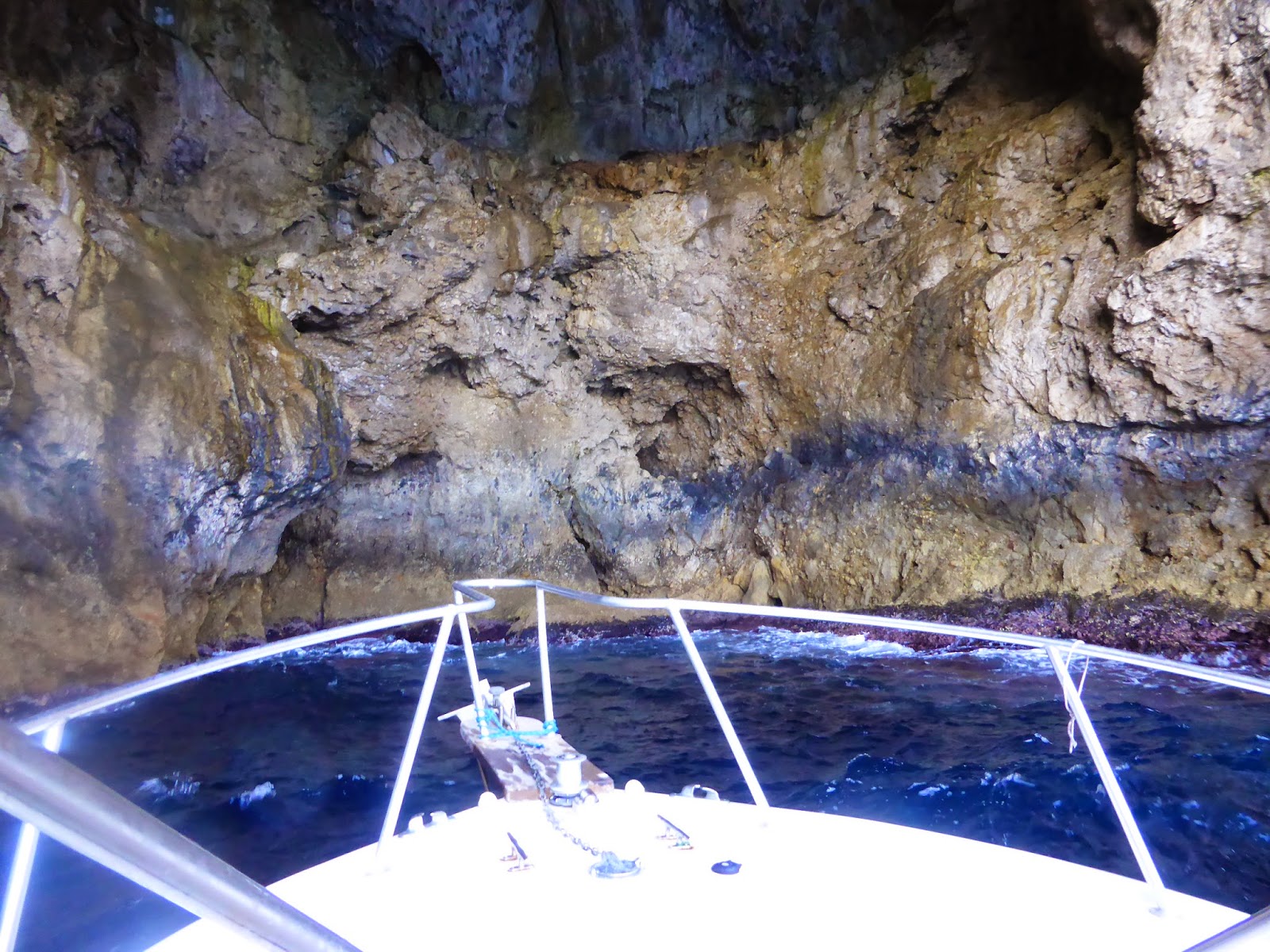
Next day we went around the island by tour boat visiting many deep sea caves and the two metre swell made it an adrenalin rush for all inside the caves, with waves bouncing us around and the thunder of blowholes.

The castle perched atop the craggy peak used to be a political prison

Inside the sea caves was a real adrenalin rush

Looking out from inside a sea cave

After cruising back to Levanzo Island we did a guided four wheel drive trip to see a cave – Grotta del Genovese which has some 14,000 year old cave paintings depicting deer, horses, cows, tuna and dolphins. 

Amy and Laurie alongside the Landrover

Entrance to Grotta del Genovese

Shopping in Favignana was of course compulsory for the girls and we found a fantastic delicatessen loaded with delicious treats.

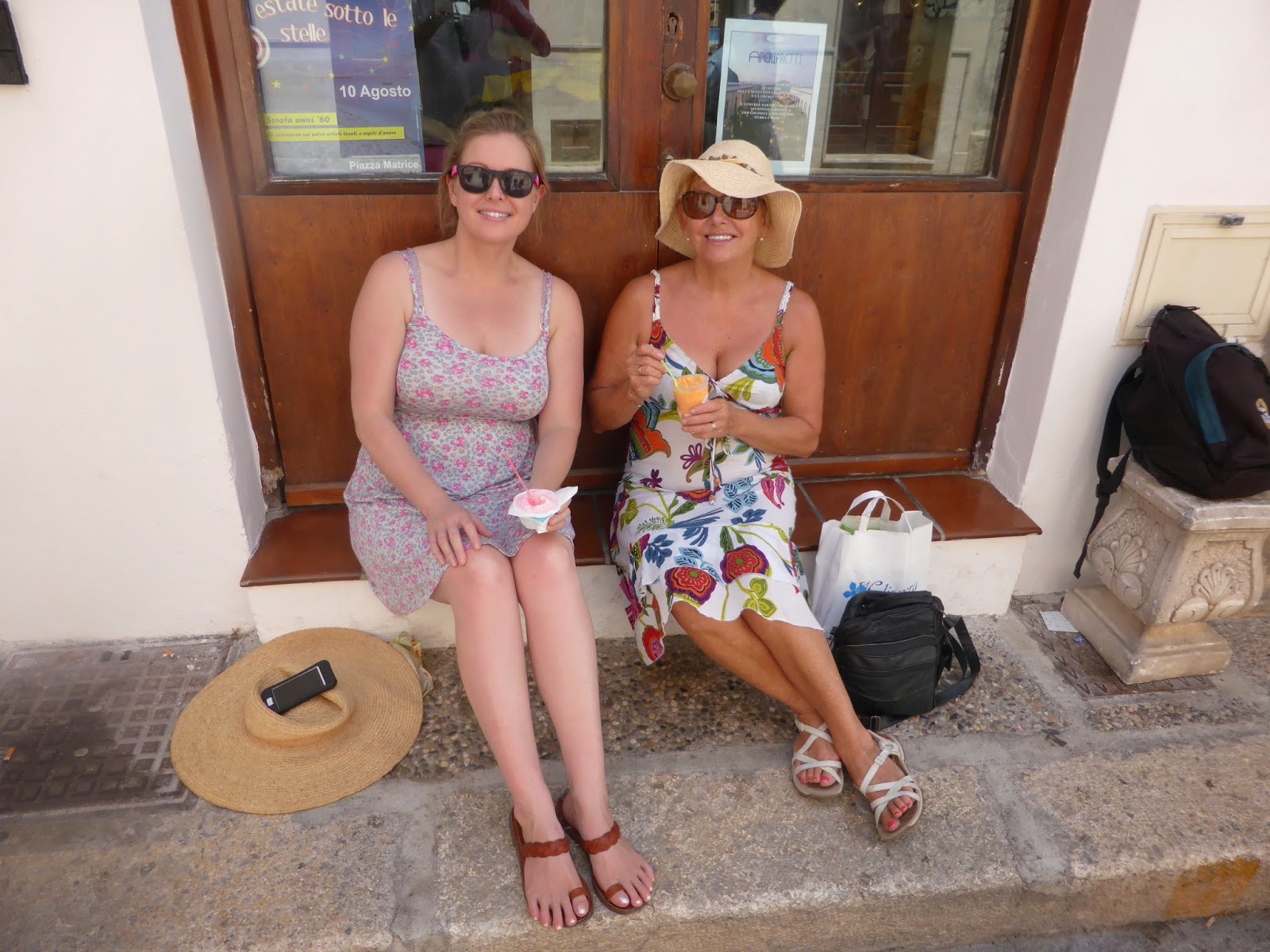
Amy and Di enjoy a gelato break while shopping

Amy and Laurie in atmospheric delicatessen

Preparing snacks in delicatessen

Envoy’s saloon table set for dinner

TECHNICAL – nothing to report

ENVOY LOG As at 10/8/14, we’d spent 124 days aboard and cruised 1,072 miles for 197 engine hours.

Lake Worth

Nordhavn Exumas Abacos Bahamas trawler Caribbean Pickwick Boat dogs
Memphis Downtown

The ARGONAUT August 21,2014 Samoa

CAPTAIN’S LOG                          Samoa

August 13 to August 21, 2014

Arrival:  We arrived in Apia, Samoa at 21:00 on August 13, 2014, after a lovely six day passage from Bora Bora.  Although it was dark when we arrived and we were unfamiliar with the harbor, entry was easy and straightforward.  The harbor is broad once inside the reef.  It is completely open to the north, so it doesn’t provide protection from the ocean’s swell when the wind clocks around.   We dropped the hook in 30 feet of water amongst a few sailboats at anchor.   After a cocktail and a bit of relaxation, we buttoned her up and went below for a good night’s sleep.  The next morning we contacted harbor control to begin the check-in procedure.  Within an hour or so both immigration and health service came aboard.  In early afternoon we went ashore to check in with customs and quarantine services, both of whom we had to bring back to the boat for an inspection.  Altogether there are four offices to check-in with, four sets of papers asking the same information to fill out, but no fees, which is very unusual.  Everyone was friendly and easy going. 

The Islands:  There are two large islands, Upolu and Savai’i, and several very small outer islands, only one or two of which are inhabited.  Samoa has a population of about 185,000; 150,000 live on Upolu and 35,000 live on Savai’i.   Apia is the capital where the majority of the population resides. There are two authorities in Samoa, the civil government and the tribal or village chiefs.   The civil government is elected and has legislative, executive and judicial branches.  The civil government is the final authority in all matters.  

The islands are mountainous and of volcanic origin.  The center of both islands is steep and rugged, strewn with lava rocks and overgrown with rain forests.  It is very hot and humid most of the time here, making it a wonderful environment for vegetation of all kinds. The islands are ravaged by cyclones each year, consequently the high rainforest canopy that you might expect is instead a patchwork of banyans and other tall hardwood trees that are able to withstand the wind, along with vines and broad leaf plants making up the lower layers of the forests.  Coconut Palms are truly the tree of life here in Samoa, and groves of them can be seen everywhere.  There are two seasons in Samoa, the wet season (October to March) and the dry season.  During the wet season it rains in torrents each day, filling the ravines with raging rivers.  Waterfalls cascade off the rugged plateaus from high up in the mountains, falling 900 feet straight down in several places.  The two waterfalls that we saw were spectacularly high, with the water creating a “bridal veil“ down the face of the black lava rock cliffs and falling into a beautiful cascade of small pools carved out of the lava over the millenniums and framed by coconut palms and giant ferns.  In addition to powerful cyclones, Samoa is also subject to periodic tsunamis that ravage the east and south coasts.

Upolu is the larger of the two islands.  Apia, the Capitol of Samoa, is located here and is the commercial and government center.   The city has several large open air farmers’ markets, many restaurants, a movie theater, and shops of all types.  It is clean, although it has no significant architectural buildings other than the recently restored 19th century Roman Catholic Italianate style Cathedral, and a modern government building.  Samoans are very proud of their little country and pride themselves on their friendliness.  Other than Apia, the Robert Lewis Stevenson plantation attracts a lot of interest.  It is a surprising large sprawling home with many verandas and surrounded by a fancy fence and imposing gate. Mr. Stevenson, who among other things authored Treasure Island, lived in the home for several years before succumbing to tuberculosis at the age of 44.  He and his wife Fanny (a physician from California) are buried on the property and our guide gladly took about five minutes to sing a cappella the funeral song composed by Mr. Stevenson himself for his own funeral.  To me, that certainly demonstrated Mr. Stevenson’s command of the moment!  Both our guide’s voice and the words of the song were quite lovely.  After leaving the home, we stopped by a Bahia Temple or House of Worship.  There are only a handful of these temples in the world and, since one of our friends is a Bahia member, we thought we would stop by and check it out.  The temple is of a modern architectural style and built of concrete in the shape of an inverted flower –maybe a tulip – with the stem end at the top and the petals as sides covering the worship area, which is a six sided room similar in its simplicity to a Quaker Meeting Hall.  The building is very plain with a lone small podium at floor level available for people to share their ideas, which, as I understand it, is the nature of the service.  Outside, the building is landscaped in beautiful gardens, which, when mature, are likely to be spectacular. 

As we continued our drive around the island we saw more village life; dogs, pigs, chickens, small children running about, and their parents lying on mats on the fale floor in the heat of mid-day.  When we reached the south shore of the island, we visited To Sua, a private park that features beautiful geologic and coastal lava formations as well as a garden.  The coast here stretches as far as the eye can see in both directions, and is a rugged lava stone matrix of arches and points against which the southern ocean pounds and upwells with spectacular effect.   Away from the cliff and on firm ground can be found deep lava tubes that the sea replenishes with water from below, some of which are about an acre in size and perhaps two hundred feet below ground level.  The sides of the tubes were covered in beautiful ferns, and the water below was crystal clear.  A stairway descends down the side of the lava tube to the pool so that the ambitious can swim in the pool for the price of climbing back up all those stairs.    

Savai’i is the second largest island of Samoa, and much more rural and traditional than Upolu. We spent two days there including the one hour ferry across Apolima Strait from Upolu.  There are five tourist attractions on Savai’i; the lava field, the blow holes, the sea arches, swimming with turtles, and the traditional craft of tapas cloth making.  The arches and blow holes occur on the southern shore of the island, and like To Sua on Upolu, are dramatic formations of lava where the island meets the sea.   I have posted pictures on the website showing most of these attraction.  The blow holes are the most spectacular that I have ever seen.  Given the right surf conditions, water spouts hundreds of feet in the air like a geyser.  Our guide, whose name was Turkey, put a coconut into the tube just before a wave came in and it shot several hundred feet into the air when the hole blew. It was so interesting that we watched the surf and the blow hole for quite a long time.   

As we drove around the island we stopped at the home of a village chief and his family.  The chief was reclined on the floor of his fale when we arrived.  He was a handsome, self-assured fellow.  Turkey asked if we could photograph his traditional Samoan tattoos.  He happily complied, stood up, adjusted his lava-lava* and proudly posed in the style of Arnold Schwarzenegger, resplendent with a girth appropriate for a chief of middle age.  A few minutes later we entered another fale where his wife was making tapa, a traditional cloth made from tree bark.  She took a four foot sapling stem of a particular tree and stripped the bark off, separated the moist inner bark from the weathered outer layer, and then pounded it into a four foot by two foot piece of course fabric.  As it had several knot holes and other imperfections, other pieces of the same fabric where then glued over it with a glue made from the tapioca root and pounded with a mallet until it was nearly uniform.  After the patchwork was complete, it appeared nearly perfect and very pleasing in both texture and appearance.  After a few hours drying, it becomes a thick, soft, flexible cloth that was traditionally used to make clothing.

* (A lava-lava is a single piece of cloth and when used by men is wrapped around the waist and extends to the knee and then pulled up in front and tied in a knot to form a cover.  It is the traditional dress for men in much of Polynesia. Men also have “western” lava-lavas made of heavier fabric like a suit would be made of and it has pockets.  Women use the same piece of cloth, but hang it above the breasts and tie it on the side as a dress.  No one wears underwear, in case you were wondering.)

A Very Little History: People first came to Samoa about 1,000 years ago from Taiwan.  They are the same tribe that populated Fiji, Tonga, Polynesia, Hawaii and the other South Pacific Islands.  Europeans first “discovered” Samoa in the 18th century.  Later, Britain, France, Germany and The United States tussled over control of the islands during the 19th century in order to use them as a coaling station for their commercial and naval fleets. The U.S. formed alliances with local chieftains to secure its position and wound up with what is now called American Samoa.  The Germans won Western Samoa, but lost it to the British during the First World War.  The British turned over administration to New Zealand after WWII, and Western Samoa become independent in 1962.  The citizens of American Samoa have voted to remain a protectorate of the United States.

Village Life: Eighty percent of the land of Samoa is owned by individuals and the remainder is owned by the government, some of which is available for purchase.  Private land is held within villages and is owned by the many extended families living there.  The population of a village can be as small as a few hundred people or as large as a couple of thousand.  Villages are governed by one or more” high chiefs” and a council of “talking chiefs”.  A high chief is elected from a family having royal blood, i.e., related in some way to one of the four ancestral royal families. The high chief is normally a male, but females may also qualify, particularly if there are no qualifying males.  High Chiefs are elected for life and are given a house adjoining the village fale, which is an open air, oblong, thatched or (more recently) steel roofed structure where gatherings are held.   “Talking Chiefs” are elected by the other families to represent and speak for them at council meetings held in the fale.  Chiefs are elected based on their service to the family, village, and church.  This can take the form of helping the old and infirmed, giving food to village members, or helping others defray the expense of funerals and weddings among other things.  The village is the center of life in Samoa.  If a person commits a capital offense that person may be expelled from the village and their house burned and property confiscated.  If this happens, the individual is effectively a stateless person with no means of support.    The chiefs handle matters such as property disputes, family domestic squabbles, teenage rowdiness, and other civil issues.  In the case of rowdiness or wife abuse for example, the chiefs may impose a fine of as much as a thousand dollars or more, which the offender’s family will have to pay if the individual cannot come up with the money.  Younger men wishing to become chiefs help the council maintain order and carry out their mandates.  Women have their own role, which is to keep the village clean and to decorate it with floral gardens, and to conduct money raising events, the proceeds of which go to fund village projects.   Women’s groups have their own leadership hierarchy.

Each family owns part of the village land and on their parcel are usually several homes and at least one fale. Often the homes are fales with little or no furniture and people sleeping on mats or low plank beds with a futon type mattress.  They are built up on pilings about three feet above ground level, the sides are open and have thatched palm blinds that can be lowered when it rains, and mosquito nets to assure a peaceful night’s sleep.  The roof is often thatched, but it can also be covered in steel sheeting.  Some fales are painted and fancy, some are made of concrete, and some are old and dilapidated wooden structures.  There are typically no rooms in a fale, it’s just one large space.  The temperature is so hot and it is so humid that open sided fales are very practical during the day to keep the rain out and provide some shade.  Behind or attached to the fale is often a modern looking four sided home constructed of brick.  There are usually several homes and fales on a site that may belong to different generations of a family.  Newlyweds are usually given a plot to build a fale for their home, or they take over an older abode and the elders move to newer lodging.  Somewhere in the front of the yard for all to see are the tombs of deceased ancestors.  These can be quite large if the deceased was a high chief or a person who rose to prominence. 

Driving around Samoa we saw a large percentage of fale made in the traditional way with people lying about on the floor on old tapa mats. No one looked like they were doing much, but they waved and were ready at the drop of a hat to have their picture taken.  Many of the people in Samoa are quite heavy and likely to be tattooed with ancestral and culturally meaningful designs. The yards were full of breadfruit, papaya, taro, banana and other edible plants.  Perhaps the Garden of Eden was here.   Dogs, chickens, and pigs roam about.  Behind the fale would likely be a small, square roofed structure with no sides; this is the kitchen.  Food is cooked over an open fire using banana leaves to steam vegetables.  Coconut husks are used for fuel, and coconut cream is used in many dishes.  It is obtained by first removing the husk and exposing the nut, then a well place strike of a stone along the lateral line of the shell will open it easily.  The chef then scrapes the coconut fruit into a bowl in shreds.  After he has collected enough shreds, he places the shreds on a fabric (like cheesecloth) made of the coconut husk and wrings the shreds inside the fabric until a milky liquid falls into a waiting bowl.  The resulting liquid has the consistency of cream and is delicious. The left over coconut shreds are fed to the hungry, but wary chickens.  This makes catching them possible.  As they brazenly come forth for the coconut, a quick grab results in one of the three main elements of the Sunday Feast.  The other two are fish and suckling pig.  

Samoans are very religious people and each village has one or more churches within its boundaries.  Many of these churches are quit elaborate and grand, given the appearance of the surrounding village. Each afternoon at around 6 PM a horn sounds or bells ring, calling family members home for evening prayers.  There is a curfew then, and under-chiefs patrol the village looking for truants.  Church attendance is mandatory on Sunday and subject to a fine of if a person fails to attend.  Each Sunday there is a morning service followed by the family feast, which is cooked by the men.  Men do most of the cooking in Samoa. When people go to church they wear their Sunday best.  For women that is pretty standard finery including a big, fancy hat.  For men it involves the Lava-Lava, which is the traditional long, wrap skirt.  Normally during the week they wear a working form of the lava-lava with or without a shirt.  Shirts are usually cotton with a tropical print.  On Sunday, despite the hot, humid weather, they wear an undershirt and English style white shirt and tie.  You can see them walking along the side of the road to and from the churches.  Once morning church services are over, they head back to the family compound for a feast with their extended family.  After the feast comes a nap.  When driving about the countryside, one can see resting on the floor of their fales heaving mounds of golden brown people snoozing blissfully in the mid-day heat.  When nap time is over, it is back to church for two or more hours of evening services. 

The village churches in Samoa are very big and impressive.  All but two villages in the whole country have two or more churches inside their borders.  There are the usually choices: Roman Catholic, Methodist, Jehovah’s Witness, Seventh Day Adventists, Presbyterian and Mormon.  Mormon is the fastest growing and they have new facilities everywhere.  I asked several people why that is; they have basketball courts, I was told.  Perhaps this is as deep as it gets.  Several of our drivers were Mormons and I asked them about their experiences; two of three had been foreign missionaries, and the offer of free travel abroad is probably very attractive to these young people.   I asked both what was the distinguishing belief that differentiated them from, say, Catholics or Protestants.  They didn’t have any idea. Churchgoers are expected to tithe to the church.  Once a month there is a special collection to support the minister or priest of the church, and if enough of a contribution isn’t forthcoming from the flock, names of the laggards may be posted.  The Protestant ministers that we saw lived in relatively lavish homes, with windows and air conditioning.  They drive fancy cars and are among the highest paid people in Samoan society…they take the prime cuts!

Families in Samoa are large, often 10 or more children.  Land is inherited by males, and females normally join their husband’s family and move to their husband’s village after marriage.  A high percentage of Samoan children leave the island as adults, residing in America, New Zealand and Australia during their working years, and return to Samoa and the family compound after they retire.  Children residing abroad are tapped constantly to help support their family at home, to provide the money to build a new home if needed, or to pay for the travel cost of visiting Samoan family members.   The ones remaining at home take care of mom, dad, and other family elders.  Weddings and funerals are lavish and expensive affairs.  These events can involve several days of feasting and a thousand or more invited and uninvited guests.  People come from all over to eat during the events, and they will often take food away with them when they go home.  Each nuclear family within the larger family will be tapped for several pigs, chickens and pounds of fruits and vegetables.  They will almost certainly be called on for a thousand or more dollars each, which is when the phones abroad will ring.  These events can cost ten or twelve thousand dollars on average!  One of our Samoan acquaintances told us that if their brother or sister’s overseas phone has been disconnected or isn’t answered, it is because they don’t want to hear from the folks back home and they are probably tapped out!  I don’t think I would be far off the facts if I said that Samoa’s largest export was its surplus population, and that its greatest import was cash from abroad.

On to Tonga: We checked out of Samoa on Tuesday and headed west around Upolu and south through the Apolima Strait toward Vava’U, Kingdom of Tonga.  It was a beautiful day to start our two day, 350 mile passage and the weather was forecasted to be very pleasant.  We put out our lines and what do you know, we got a very big strike on the way through the strait.  Tyler didn’t want to take it, so I did.  It seemed huge: I battled it for at least thirty minutes.  It was a strange fight though, because it didn’t run, it just wouldn’t come in.  I pulled and pulled, but I couldn’t make any headway for about a half an hour.  Then it began to weaken as I took advantage of every opportunity to reel it in.  I had to be careful as I could easily break the line and lose my $20 lure!  Gradually it gave way and I could see that I was bringing something in…a tuna…I pulled it up, and there it was a 15-20lb Big Eye.  Very small for that species of fish and not capable of the sort of fight I experienced.  I always wanted a Big Eye, but then I saw the problem…a third of it was gone.  A shark had grabbed its tail just as it struck my line and he was fighting me for the tuna…but I won most of it!

As for the trip down south…I am going to sell this damn thing!  Seriously, no sooner had we gotten off shore than we hit very large, steep waves (9-15 ft. @ 7-8 sec) that stayed with us for the two day passage.  It was a rough trip, and the only one this year that made me sea sick! 

We are now quietly anchored in Neiafu, Vava’U, The Kingdom of Tonga.  The weather is colder than usual at 760 and it is windy this week.  Paul Allen’s yacht, Meduse, is anchored next to us off to our starboard.  Rumor has it Bill and Melinda Gates will be here tomorrow. 

Thanks for checking in on us.

As has been said: “Keep your boat on the water and the water out of your boat!”  Certainly words to live by.


Randy and Rebecca

Start your own blog now! Free!