Tag Archives | Nordhavn

San Blas Island, Panama

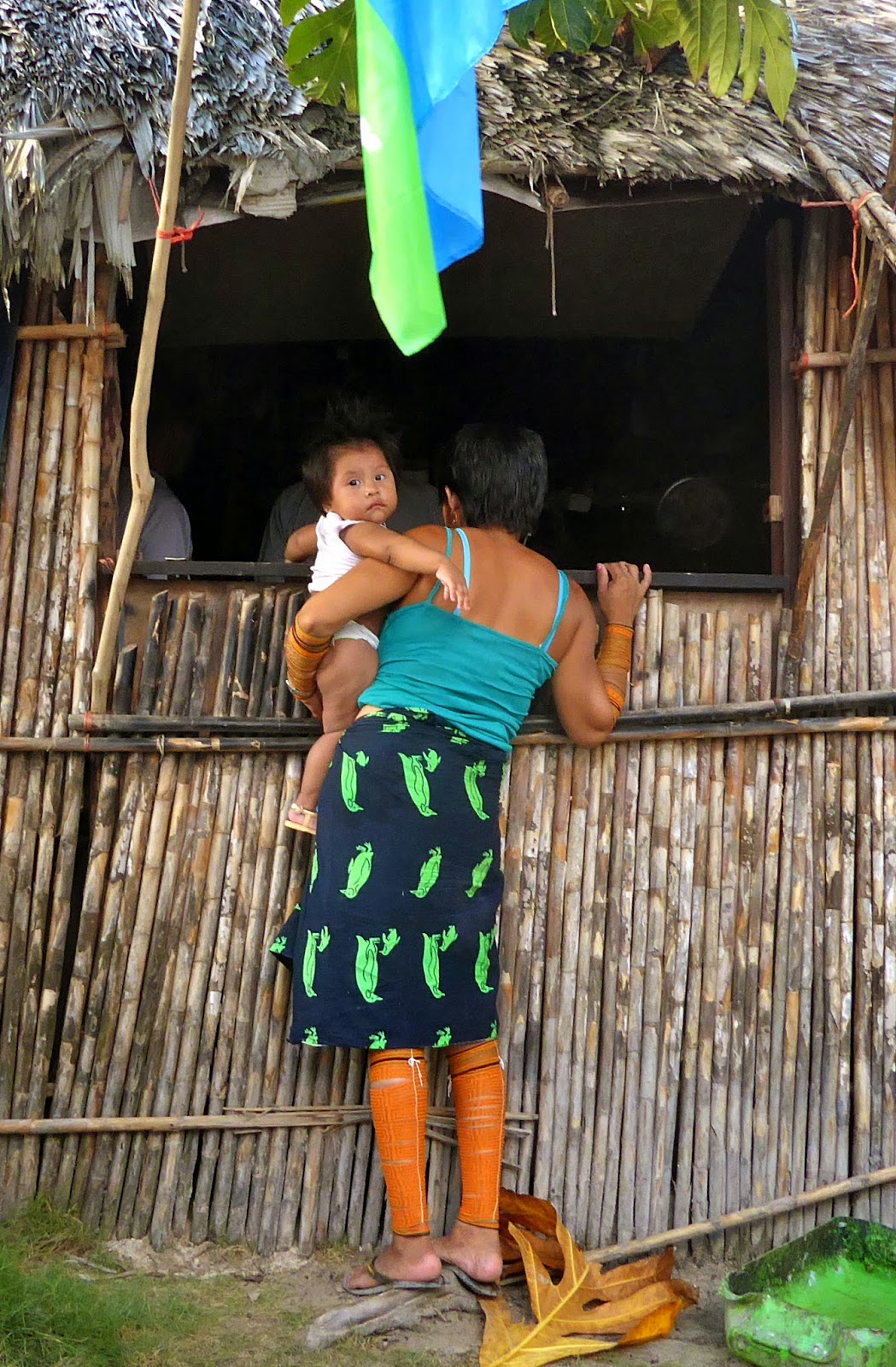
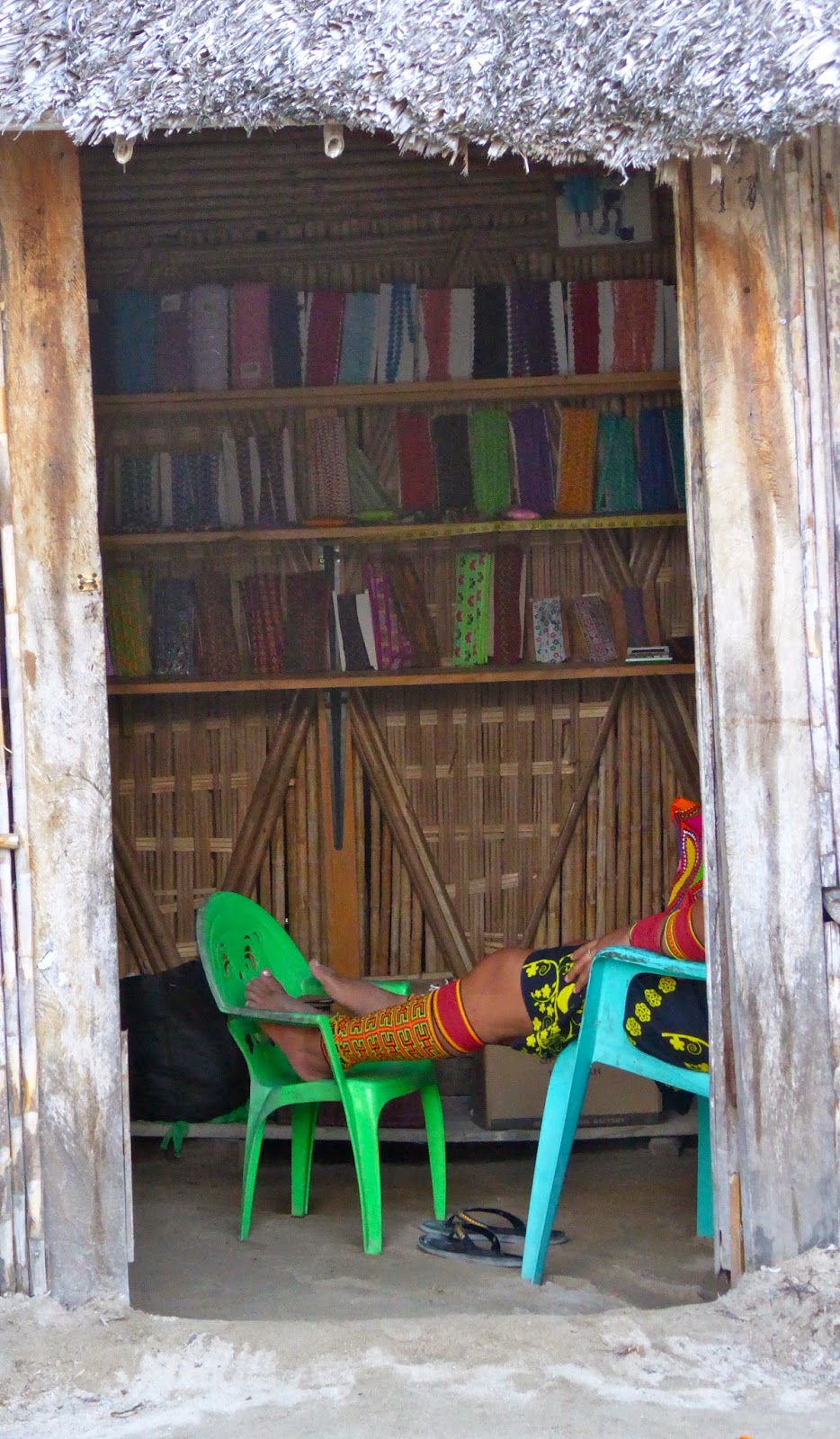
The past few days we have spent our time in The San Blas Islands, a large archipelago on Panama’s Caribbean coast. The 340 islands are the home of The Kuna Indians. We have enjoyed the untouched virgin rainforests and a cruising ground of incredible beauty.

Nester and his beautiful Kuna family approached Anna Mae as we anchored out side of Isla Porvenir. We traded various items and they invited us to visit their village.  They cooked us a delicious dinner of fish, rice and beans. 

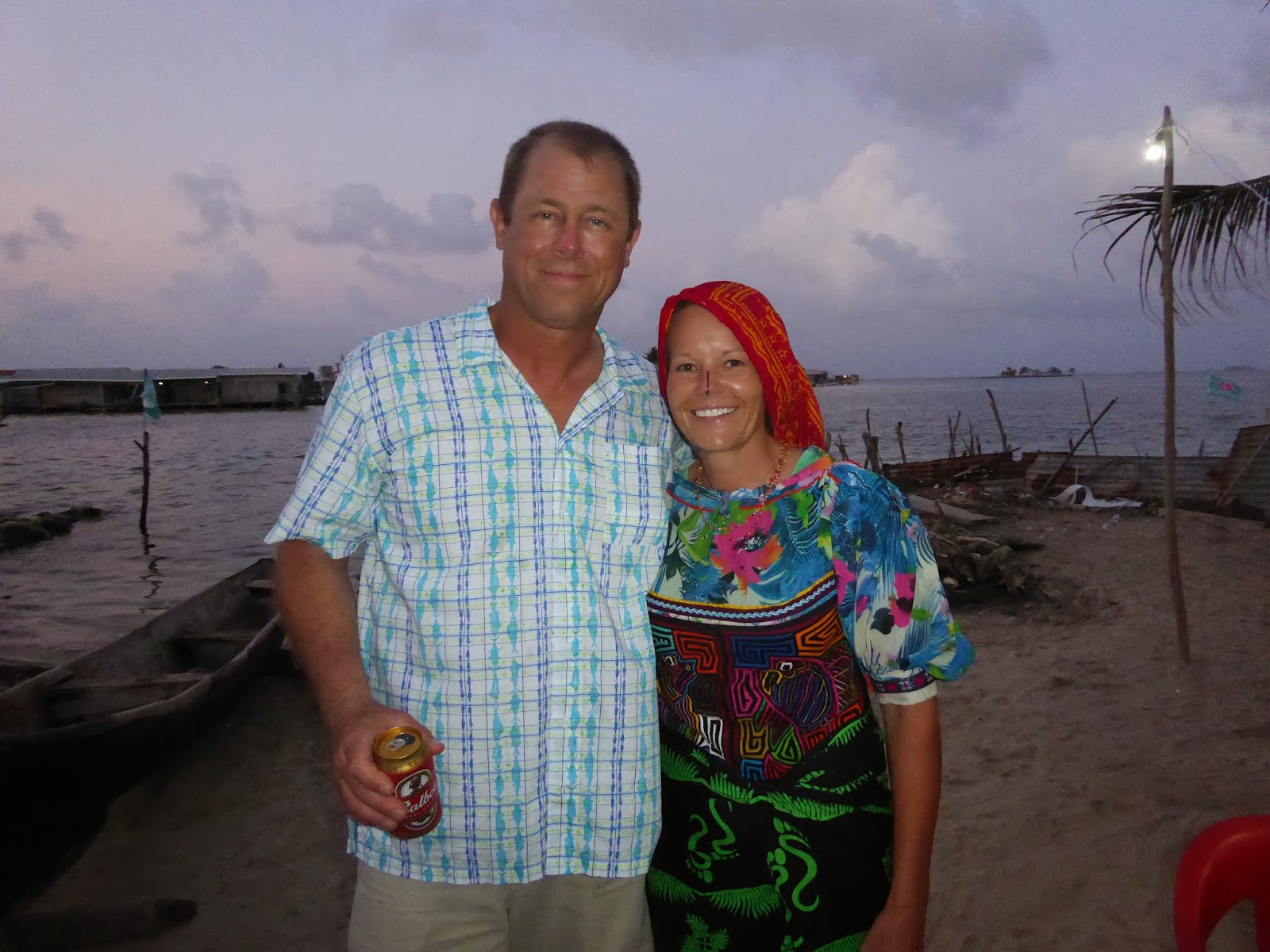
The Kuna women dressed us up in authentic Kuna clothing.  They painted a black line on our noses and  wrapped us up in their famous authentic mola stitched bodices.  


The Crew of Anna Mae and SpringDay with some of the Kuna children in the village we visited.

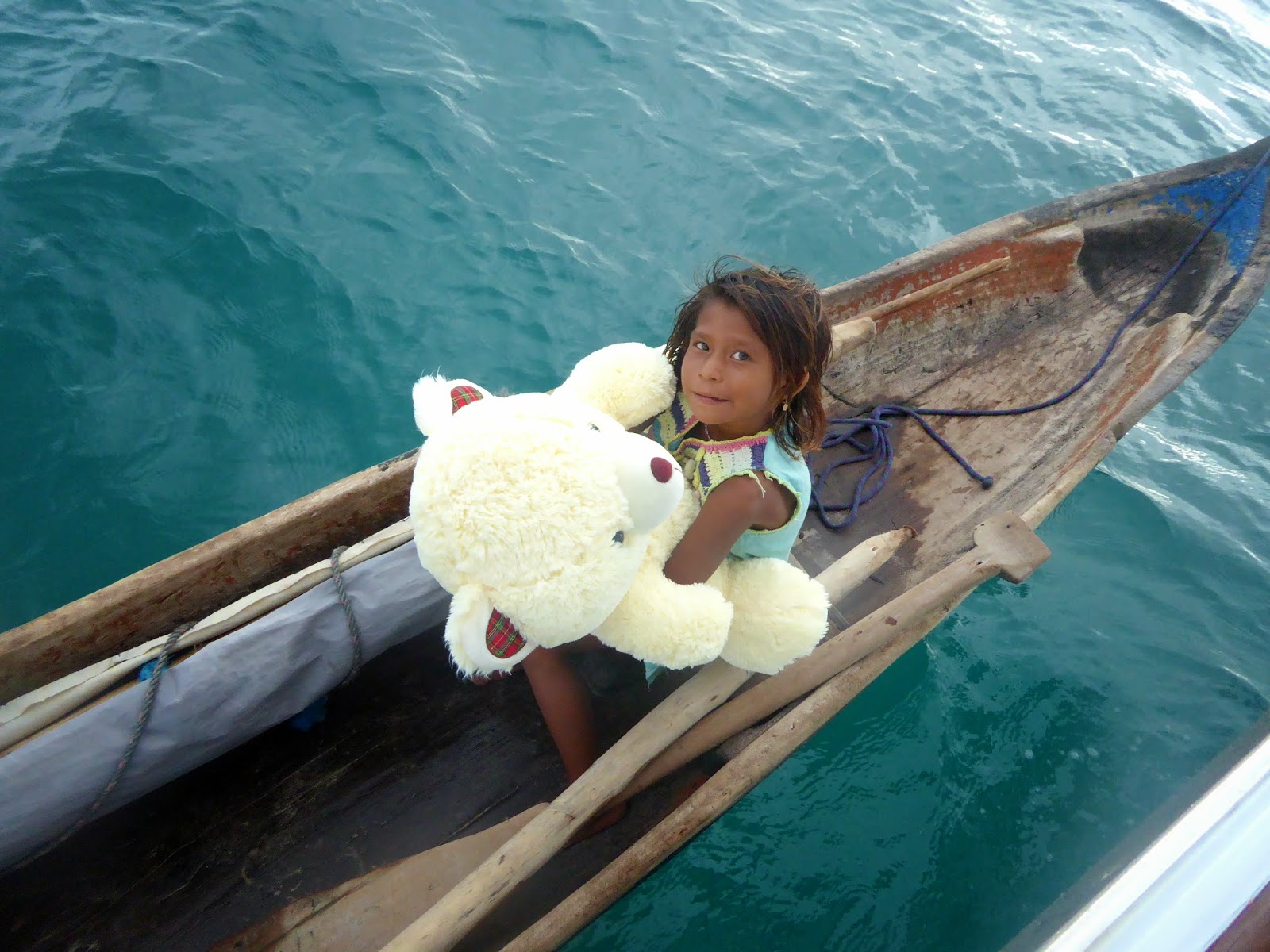
I found a new home for my Valentine Teddy.
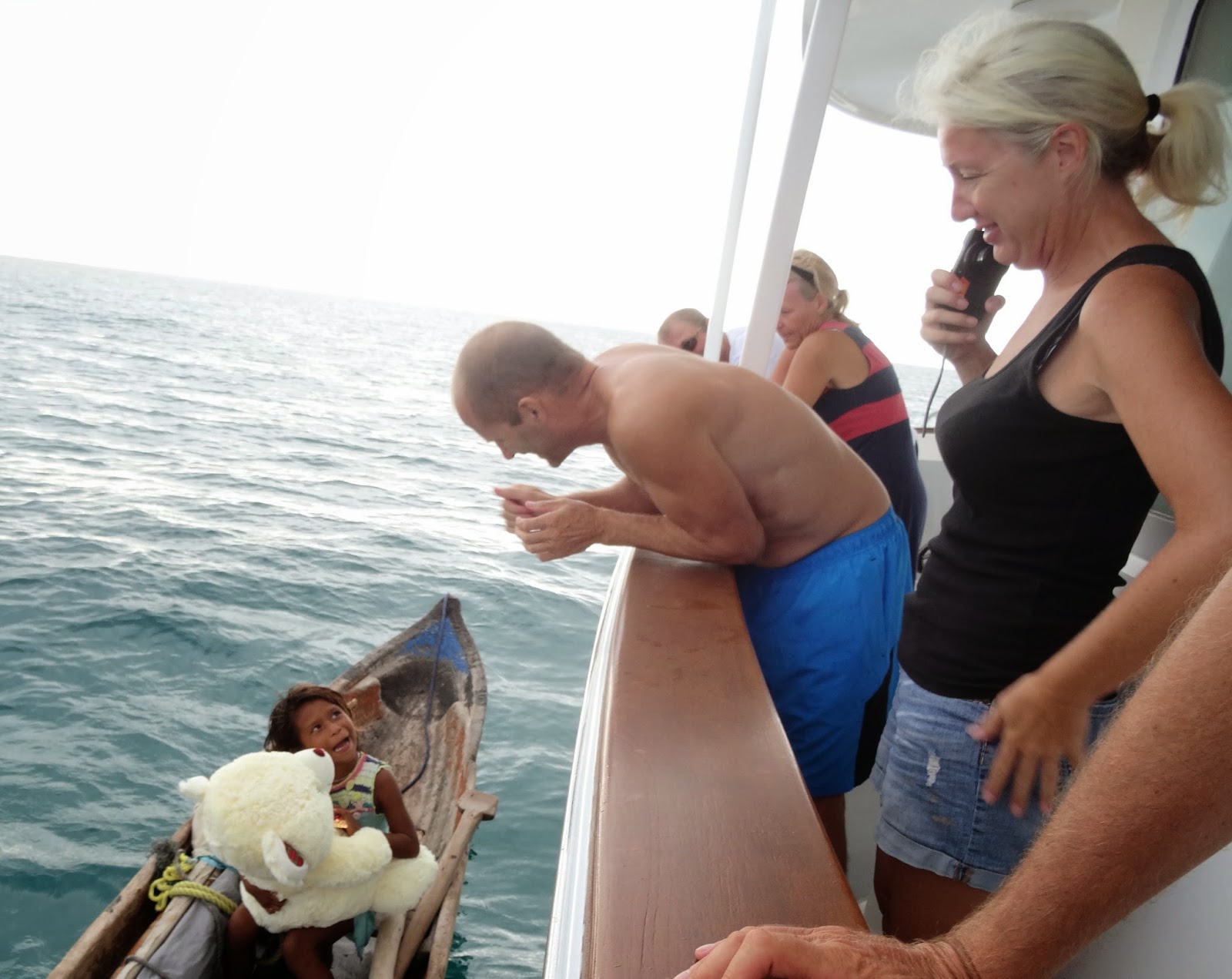
Caroline a sweet little Kuna Indian girl fell in love with it and us with her.
She has so much personality and likes to repeat everything I say back to me in English. I couldn’t even begin to communicate with her in Kuna, but I tried and she giggled at me…

Bill and I with Caroline and her new teddy.


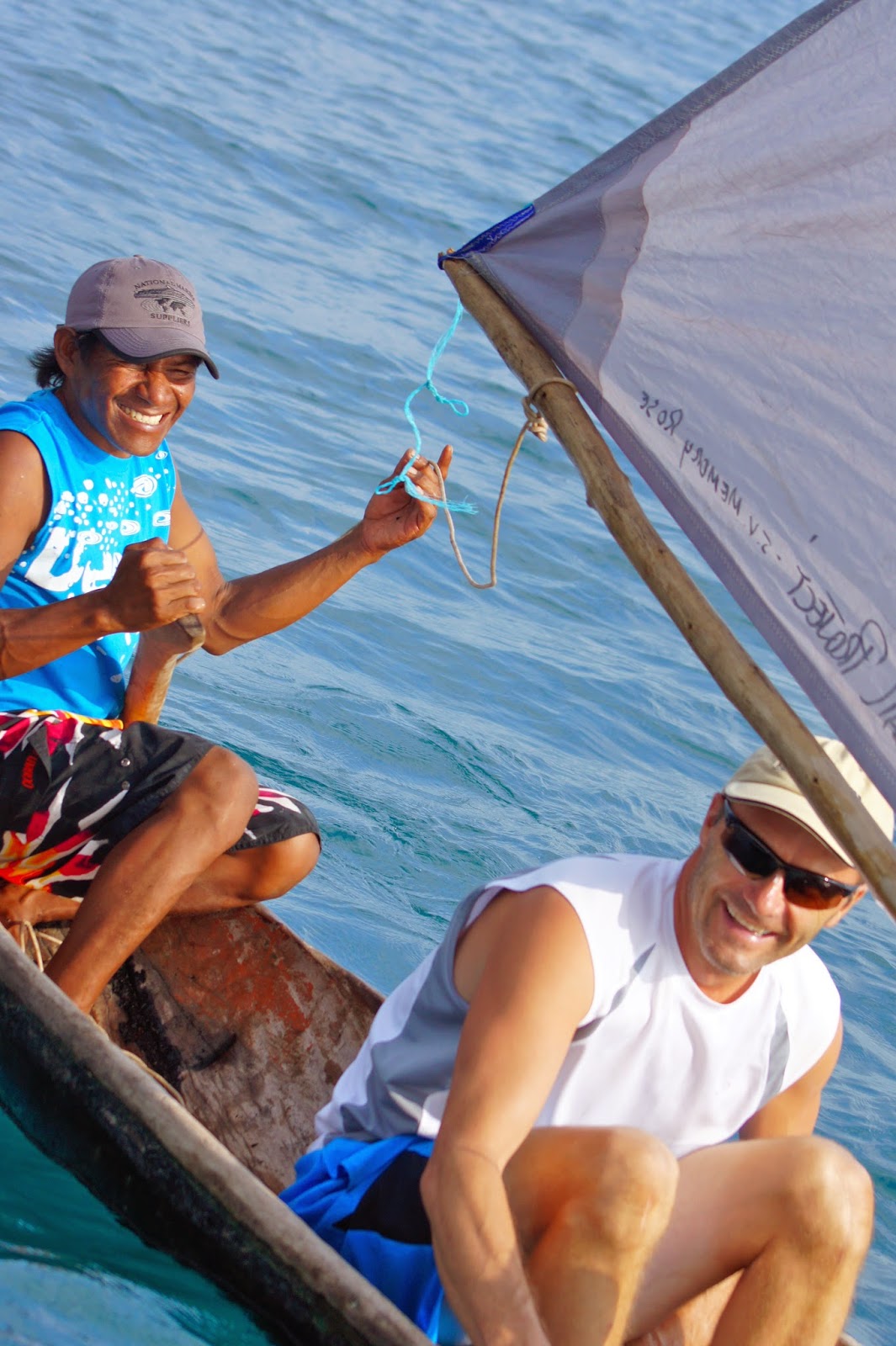
Nester gave Bill and Tom a sailing lesson. 
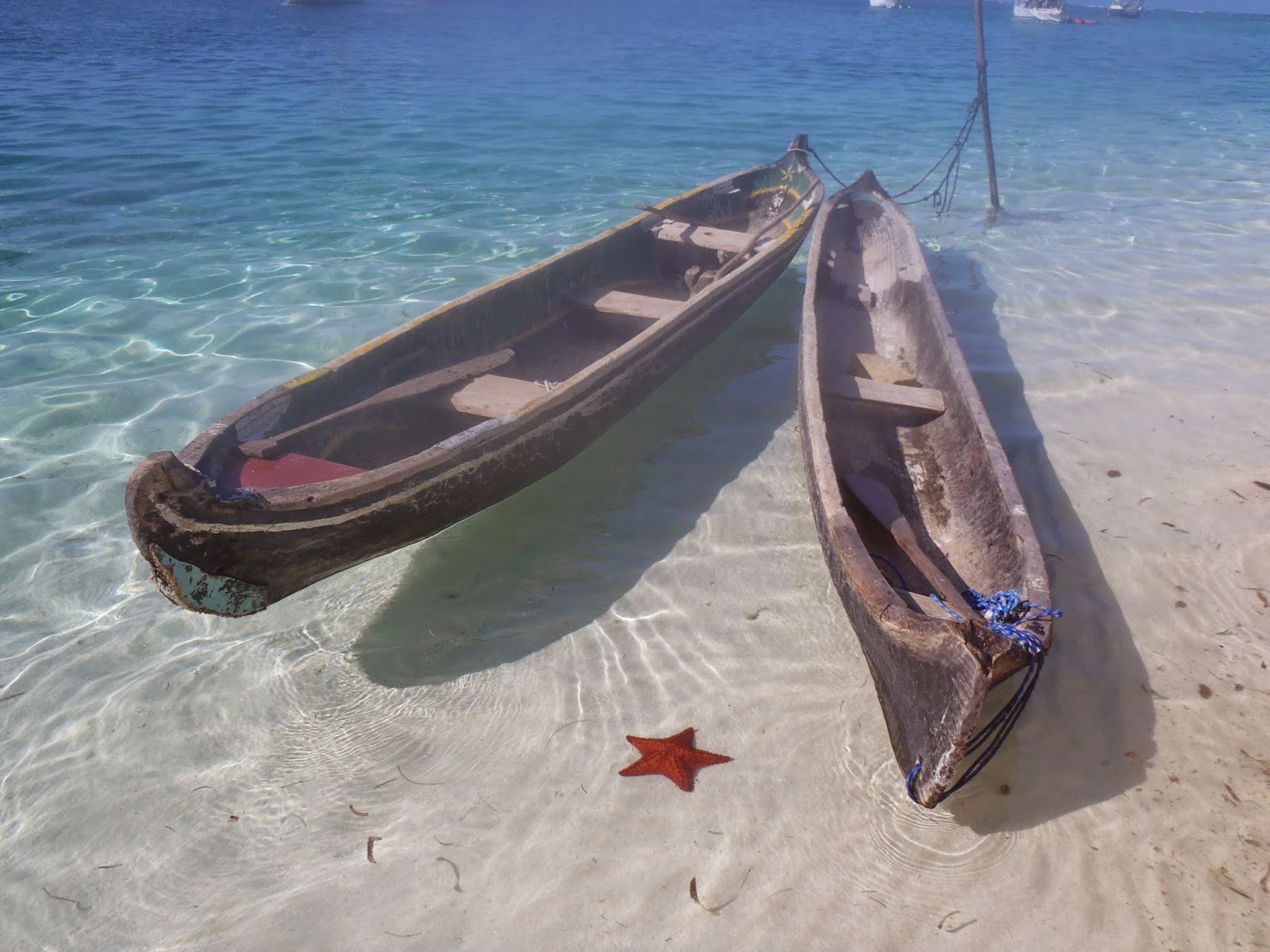
The one log canoe carved from Columbian timber is The Kuna’s favorite mode of transportation. Bill had a lot of respect for Nester’s ability to manuever his boat, with a paddle and sails.


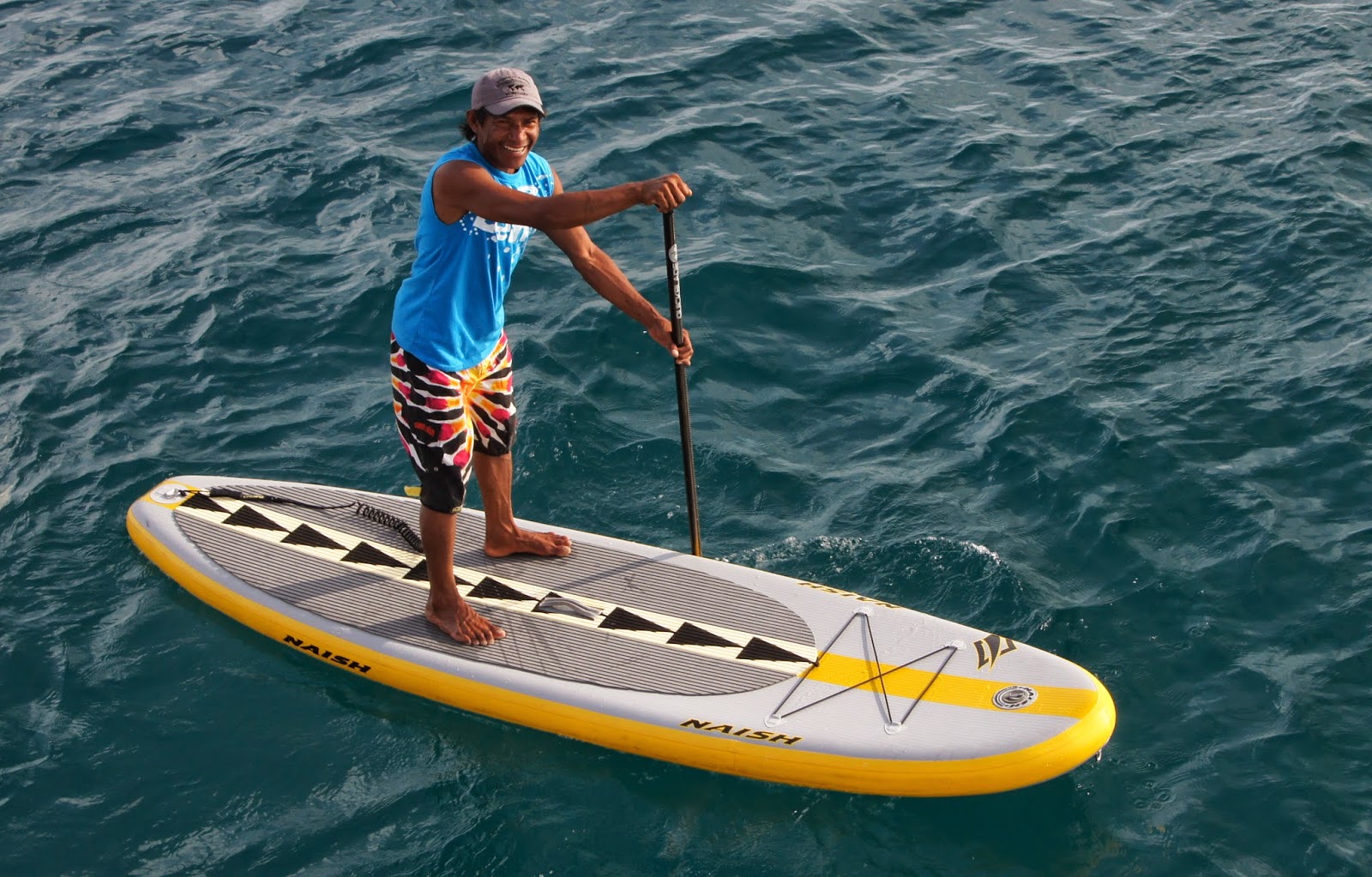
Nester managed to hop on our SUP and paddle around the boat on his first try. His balance is amazing after all the years of practice he has had on the water.


Taking a photo of a Kuna woman is not allowed, but I did manage to get a couple candid shots.


Bill played basketball on the makeshift court in the middle of the island, next to their school.

We anchored out on several of the islands. The water was clear and I added to a few new shells to my collection. Sand dollars, starfish and conch shells lay littering the coral and white sandy beaches of San Blas. We dove a shipwreck on one of the outlaying islands.

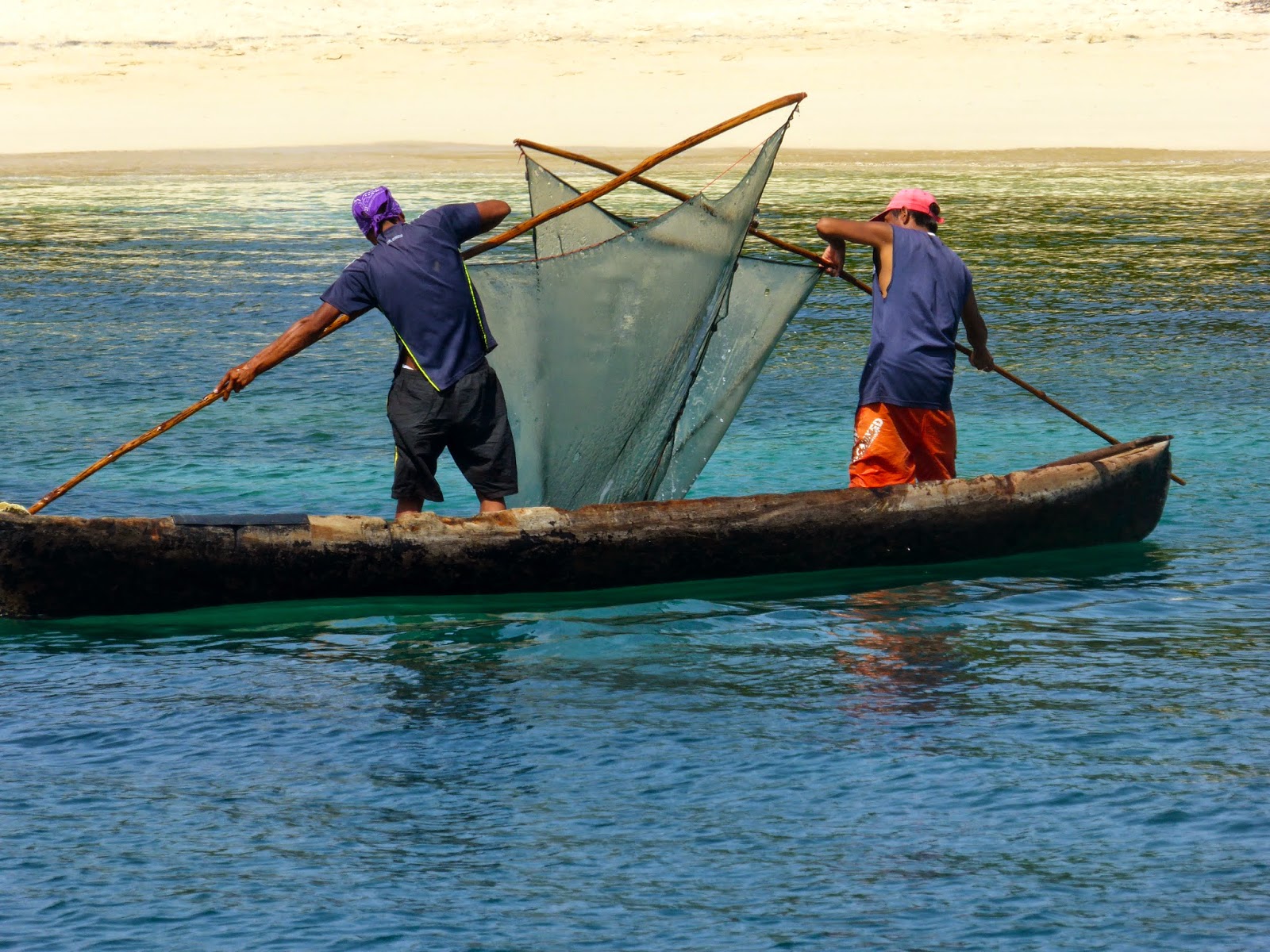
Fishing is a major source of income for The Kuna Indians.

Anna Mae and crew are settled into Shelter Bay to organize and plan the next leg of our journey up to North Carolina.

THE ARGONAUT April 29 to May 11, 2014 Galapagos to Marquesas

A CAPTAIN’S LOG     Galapagos to the Marquesas’ April 24:   Departing The Galapagos – Day 1 – Thursday   0o28s/90o26w We managed to get under way from the fuel dock at 1200.  In leaving Galapagonian waters, I was very cautious in giving a wide birth to hazards, and I transited the waters mostly during the day so I could see as much as possible and avoid unmarked rocks and hazards.  Late in the day as we were passing the last reef at a distance I thought would surely be safe, I noticed that …

THE ARGONAUT April 29 to May 11, 2014 Galapagos to Marquesas

Ap

CAPTAIN’S LOG     Galapagos to the Marquesas’

April 24:   Departing The Galapagos – Day 1 – Thursday   0o28s/90o26w

We managed to get under way from the fuel dock at 1200.  In leaving Galapagonian waters, I was very cautious in giving a wide birth to hazards, and I transited the waters mostly during the day so I could see as much as possible and avoid unmarked rocks and hazards.  Late in the day as we were passing the last reef at a distance I thought would surely be safe, I noticed that the depth sounder was reading 16ft., then 45ft., then 85ft., then 16 ft. again.  Could it be the reef?  Rocks or mountain tops just under us?  Had I missed something?  I swung Argo directly south and tried to put some distance between us and the island, although we were already six or more miles off shore.  Then I turned on our special, very sophisticated sonar and, low and behold, there it was.   I stepped outside to confirm what the sonar showed; we were enveloped in the living biomass of phosphorescent plankton thicker and denser than anything I had ever seen before.  It had emerged from the depths at sunset and was about 100 or more feet thick, so thick in fact that it fooled our sonar into thinking it was a solid mass! Outside, the ocean was all aglow as Argo pealed back the water and made its way toward the Marquesas.

Rebecca made a lovely apple bread with walnut-brown sugar crust that evening.  It was her best yet.  She loves to bake and we are her lucky recipients. 

Dinner that night was sliced sautéed chicken breasts on a green tossed salad.  Dessert: sautéed bananas with rum on soy ice cream.  Excellent!

April 25       at sea – day 2 – Friday                    2o09s/92o41w

Our route to Nuku Hiva in the Marquesas is 3168 miles from Baltra.  Our goal was to find the South Equatorial Current (SEC) and ride it to the Marquesas.  It will increase our speed by as much as 1 knot and save a considerable amount of fuel if I can find it.  I thought we could locate the current by heading southwest on a course of 240o True until we reach 3o 37 minutes south of the equator and 95o west of the international dateline (which is roughly midway between the Meridian (Greenwich, England) and the International Date line in the western Pacific). We selected this precise course because it takes advantage of favorable currents along the way and avoids those that are adverse.  The equator is by definition located at 0 degrees and the Galapagos are 45 minutes south.  Since each degree of latitude is 60 nautical miles and each minute one nautical mile, the Galapagos are therefore 45 nm south of the Equator.  Our goal was to be 217 miles south of the Equator and then turn west on a course of about 266o T at which point we should be in the SEC.  At 7 knots it will take us about 17 days to make the trip; at 8 knots it will take about 15 days. 

Our first day in the open ocean was very pleasant and we all agreed that if the remainder of the trip would be like this, we would be lucky and content.  The sky was clear, the breeze delightful, and sea rolled from our port bow gently under our keel.  The swells were large, perhaps eight to ten feet, but they were widely spaced and Argo rose and fell in a pleasant manner.  We were in a very favorable current, making over eight knots and burning less than 6 gallons per hour of fuel; sweet!

Rebecca made a very good Indian curried shrimp and rice dish for dinner with fresh peas from the Galapagos, presented with vegan biscuits and honey.   Dessert was fresh Galapagonian pineapple.

April 26       at sea- day 3 – Saturday               3o53s/95o13w   

The next day was entirely different.  A low front was moving south of us and the wind gusted up to 30 knots.  The sea boiled as eight to ten foot swells on a short moment slammed into us.  The radar showed storms all around us.  We had to adjust our course so as to handle the sea state because Argo was sliding sideways off the side of the swells at a serious angle.  Everyone was getting nauseated.  Bouncing around, in a constant state of motion is no fun and we were also a bit concerned because we didn’t know how long this would last, if it would get worse, and how much extra fuel we might consume.  I read one account of a yacht that made this passage having to put up with this sort of sea condition for most of the trip.  The thought of that was very depressing.  As the day progressed the wind rose, we continued to adjust our heading to accommodate the sea and our speed slowed considerably.  It was very unpleasant.  We didn’t eat much as the rolling of the boat precluded galley activities, and all anyone wanted to do was stay put and try to sleep through it.  Late in the day we saw a clearing ahead.  The radar showed that the storms had passed.  Shortly after sundown the seas subsided to a much more tolerable state, and we breathed a sigh of relief.

April 27       at sea – day 4 – Sunday              5o18s/97o27w

We awoke to a relatively pleasant day.  Swells of seven to eight feet approached from our beam to port quarter.  Winds had subsided.  We still had not found the current we were seeking, and proceeded southwest.  Many people never find a good current.  I downloaded a fresh set of weather and current charts off the sat-phone, and they confirmed our course and heading.  We were making about 6.5 knots and using 6 g.p.h. of fuel.   A Japanese freighter crossed our course about ten miles ahead of us, and we saw a whale spout.  About a dozen flying fish and squid litter our decks each day.  One wonders how they manage to get up on the boat deck, which is 15 feet above the water line.  Rebecca made a lovely tuna, okra and grits dinner.  It was tasty! 

April 28      at sea – day 5 – Monday            5o34s/100o15w

As we continued on our southwestern course, we finally began to see our speed increase, indicating that we had found a favorable current and that our predictions about the location of the current was correct.  Our speed increased to 8 knots or above and we glided over the swells, which were still in the eight foot range.  Later in the afternoon the seas became larger, perhaps in the ten foot range.  It is very hard to estimate the size of the swells, but when they continuously range above the tops of our salon windows that have to be big.  To me, they are frightening: huge, menacing, mindless, cold, dangerous, desolate, full of creatures with teeth that are hungry; this is no place for human beings.  Am I afraid?  Of course, you would have to be a fool not to be afraid.  But, we have planned well and overcoming the fear and trying to manage the risk is part of the adventure.  Also an important part is to understand and live with the natural world: for example; when the sun rises or sets, the sea gets very angry out here.  The swells grow larger and closer together.  After sunset they lay down somewhat.  Later in the evening, the dew point falls and the clouds release their water vapor as rain.  Storms dot the radar screen and near them the wind rises.  Overnight the sea builds and by morning the storms are mostly gone, but the high seas remain.  By evening it sometimes calms down, and then it starts all over again.  Another interesting thing to me is that the swells change all the time.  You can hit a very unpleasant area for ten or fifteen minutes or even less, and then for some inexplicable reason (at least to me) the sea takes on a different character.  The same is true of currents.

On Monday afternoon the seas were high and I became concerned about our fuel bladder becoming unstable.  It had done very well in larger seas, but it was beginning to track around and our lines were not as taught as they had formerly been.  We had it lashed down pretty well, but still I thought it would be best to get the fuel into our tanks and off the deck, particularly if things deteriorated overnight.  We hooked up our Jabsco 20 gal/minute 120 V pump to the bladder and the other end into our port fuel tank.  In fifteen minutes we had transferred 300 gallons, and we put the rest into the starboard tank.   Argo was rolling all over the place and in the process I pulled a back muscle. I limped around for a while helping Tyler get the final fuel onboard, then he took over and cleaned things up and stowed the equipment.    With the fuel bladder and its 3,500 lb. load below decks, Argo rode the waves better. 

That evening Rebecca took my watch and recommend that I stay in bed with a heating pad and Tylenol.  That was fine with me.  I have learned through experience that the best place to be in bad weather is below decks, in bed, assuming someone competent is at the helm.

For dinner Rebecca made seared tuna with sautéed potatoes and corn.  We had ice cream and berries for dessert. 

April 29      at sea – day 6 – Tuesday               5o49s/103o23w

I spent all day in bed watching vacuous TV serials and reading a very interesting book, The Idea Factory.  My back was getting better, and Argo was making steady progress.  We passed the 1,000 mile milestone (from the Galapagos).  Tyler and Rebecca stood all the watches that day.  I must say that lying in bed is an excellent way to pass the time; honestly, watching these big waves approaching the boat is not pleasant.  While lying in bed you don’t think about it or know what is going on.  I prefer that, as long as someone is watching. 

Regarding our watches: we always have someone at the helm.  We don’t want to bump into anybody out here!  So far we have seen only one freighter and no sailboats.  There is nothing and nobody out here. That is a surprise to us; we thought we would encounter at least a few sailboats on the way.  Our watch involves an hourly engine room check in which we look over the engine for oil leaks, look at alternator belts, check the shaft and its drip rate and look over the hydraulic system for water cooling and leaks. We periodically check the rudder and autopilot pumps, as well as the stabilizer fin drives too. Of course we check fuel pressures and the fuel level in all tanks.  Hourly checks help to assure that if something starts to go wrong we might be able to address it before it becomes an emergency or puts the boat in jeopardy.

April 30      at sea – day 7 – Wednesday          6o05s/105o26w

It was a relatively pleasant day with light clouds, sunshine and blue skies.  Seas were moderate, but nothing like the beautiful, loping swells off the coast of Baja that we had pictured in our minds as characteristic of the Pacific.  There is nothing nice or loping about these waves, which are large, short period swells.  On top of the swells are wind waves of a foot or two. The good news is that they are on our port quarter.  Winds are constantly in the mid-teens and the temperature is in the mid-eighties all the time. 

My back was getting better, but I was surprised when Rebecca came into our room early that morning to ask me to get up right away.  During his hourly engine room check, Tyler had discovered that our hydraulic sea water pump wasn’t working.  The water flow indicator had stopped.  If that situation was allowed to persist, our hydraulic oil would overheat and the system would shut down. This was potentially serious.  Without hydraulics we have no stabilizers, and in these seas that is very dangerous, so I rushed to the engine room. Tyler had already cleared storage containers away from the sea water pump and was getting ready to shut off the water to the sea strainer.  If we had taken in a squid or jelly fish, it could have clogged the through hull intake or strainer and clogged things up.  I went to the bridge and moved Argo perpendicular to the swells so as to reduce the need for stabilizers and then turned off the hydraulic pumps.  Tyler examined the sea strainer; nothing.  He then took the cover off the pump and examined the impeller: it was good too.  That was a problem; no identifiable problem was a problem.  At any rate, he put it all back together and we turned things on: it worked!  We don’t know what was wrong, maybe a squid or something got sucked into the through hull opening and then fell out when we shut things down.  It was disturbing.  In fact, I am feeling the need to do an engine room check again right now!

May 1      at sea – day 8 – Thursday                6o20s/109o28

At 1200 we completed 7 days underway and made 1,300 miles since Baltra.  Rebecca is thawing filet mignons for a mini-celebration of our half-way point, which we will probably reach tomorrow.  We set our clocks back one hour, so we are now -7 hours from GMT, which is the same as Denver or Phoenix.  Tyler just announced that he found a squid on our fly bridge, about 15 feet above the water line.  That one was true champion; the fly bridge is a long way up and an indication of how big these waves are.  Rebecca is doing her yoga with Priscilla (on DVD) this morning.

We continued on our course of 266o T as we had been doing for several days.  Argo plugs away, clipping along at eight nautical miles an hour.  For the last eighteen hours we have been in the South Equatorial Current, which flows east to west at a rate of about 1 knot.  For us it is a free ride; we are making eight knots and using only 5.6 gallons per hour of our precious fuel.  This is exactly what I had hoped for.  We still have wind in the mid-teens blowing at 140o relative, and swells in the 7-8 foot range.

Tonight’s dinner: fried chicken breasts, spinach and couscous with nuts and raisins.  Dessert?  Of course: ice cream (vegan ice cream) and cherries. 

May 2      at sea – day 9 – Friday                        6o36s/112o39w

Today we reached the half-way point, 1550 miles at sea.  We have about 7 or 8 days to go to reach Nuku Hiva.  Rebecca broke out the filet mignons last night and we had a delicious dinner, sans red wine though: no alcohol while underway.  We are all looking forward to a brewskie in Nuku Hiva!  Everything has been going well. We thought the shaft drip was too slow or non-existent, so we loosened the collar a bit and readjusted it a couple of times.  It was fun; it gave us something different to do. 

I was standing outside trying to cool off from being in the engine room when it dawned on me that we hadn’t seen a thing since leaving the Galapagos: no airplanes, boats, porpoises …na da.   We are so far away from anything I don’t know if a plane could rescue us.  The sea is full of life though; flying fish and squid litter the decks every morning.  Albatross fly about, sometimes convening on a school of fish off in the distance. The waves are so steep at times, a life raft would surely flip over.  Well, better to concentrate on something else.  Maybe I will watch another episode of Breaking Bad.

May 3      at sea – day 10 – Saturday               6o51s/115o44w

Rebecca’s a champ.  I don’t know what I would do without her.  Yesterday she took the late shift, i.e., stayed up to midnight when Tyler relieved her, and then up this morning at 0650 to relieve Tyler.  She doesn’t sleep well, so despite the fact it was my turn, she got up and let me sleep in.  I don’t usually have trouble sleeping.  Anyway, now she is doing laundry, will take some private time, and then start lunch.  She is always on the move!  She never wanted to go on this trip; I think she felt very anxious about it and for good reason I might add.  Like climbing a mountain, you have to be crazy to do this.   It took a lot of guts for her to come and she is doing very well.  Like a friend of ours says about these sorts of adventures: “it’s sort of like fun, but different.”  Her fears are justified, but we are well prepared; others have done it and so will we.

When we left The Galapagos we were still having trouble with the water maker; the low pressure pump alarm again.  I considered aborting the trip, but thought we could venture out a day or two and see if we could get the thing to work.  Same old problem that I thought I fixed by tightening the bolt on the pump (which did help for quite a while).  The sea water filter is housed in a clear Lucite container that threads onto a top that is connected to the machine.  It was only partially filling with water.  I suspected a vacuum leak.  This time I taped the threads on the top of the canister with plumbers tape.  Since then we have used it almost every day with no problems.  Maybe I got it this time. 

The night sky is something to behold here.  Of course there is no light whatsoever except the stars, and last night for the first time on this cruise, a new moon.  I looked out and almost couldn’t believe my eyes as the silvery light reflected off the waves.  The moon hung in the crystal clear, black night sky, surrounded by billions of stars.  Seeing the Southern Cross is something of a benchmark in sailing for a Great Lakes fellow like me.  It is a wondrous sight to behold. 

Rebecca’s feast tonight; crab cakes with corn bread, pan-fries, and broccoli.

May 4      at sea – day 11 – Sunday               7o07s/115o54w

A beautiful day with 5-7 foot swells on our far port quarter.  Wind blowing 13 knots on our stern.  We checked out fuel and mileage for yesterday: 179 miles using 130 gal of fuel.  .8 GPM, just as I has planned all those months ago in Michigan.  We should be in Nuku Hiva next Sunday.  We did some yoga today, read a little, wrote in the log, and watched some Breaking Bad episodes.

Dinner tonight: Spaghetti and vegan meat balls, corn, and peaches.

May 5      at sea – day 12 – Monday                7o21s/121o59w

Rebecca says that we have consumed almost all our fresh stores with only apples, potatoes, onions and few other things left.  We have plenty of canned and frozen food, so we won’t starve.  In fact we probably have enough stored food to last a month or more. 

The ocean is very pleasant this morning; following seas of about two or three feet.  It is now 87 degrees with light winds.  We are well into our routine.  We fill in the ship’s log every hour and do an engine room inspection.  Rebecca and I take the 1800 to 2400 and 0700 to 1200 watch, Tyler takes the 0000 to 0700 and fills in from 1200 to 1800 as seems comfortable.  At 1200 we measure the distance traveled over the last 24 hours and measure the fuel onboard and our rate of consumption.  We use the generators for cooking, making water, laundry, and for AC at night.  We usually try to combine a few of these functions and only use our small 13.5 KW generator so as to conserve fuel. We wind up running it about 10 hours a day.  It consumes about 1 gal and hour.  On a 20 day +/- trip it adds up.  At this point it looks like we will have 800 gallons or so to spare when we drop anchor in about six days.

At this point, and surely hope I am not jinxing us, Argo has performed marvelously.  She is comfortable, quiet, economical, and roomy enough so everyone has some personal space and quiet time.  We also have air conditioning for those muggy nights!  She is a perfect boat for our purposes.  As I sit in the pilot house, all I can hear is the low drone of our John Deere engine turning the screw at 1245 rpms.  The waves make muffled sounds as Argo pushes them aside: that’s it.   She moves relentless onward about 180 miles per day.

This evening the seas have subsided to their lowest level on this cruise.  I estimate that we have 2-3 foot ocean swells separated by about 8 seconds and almost no wind waves.  The sun is bright and beginning to set.  It is 85 degrees with a 12 knot following breeze.

Dinner: Sautéed Sea Scallops, Okra, Rice with Edemame and Cashews in Coconut Milk.  Excellent.

May 6      at sea – day 13 – Tuesday                    7o37s/125o03w

Last night was the most beautiful night imaginable.  It was truly sublime; it was the picture in the mind’s eye that we pursue in our dreams.  The sea had settled down to the point that we had hardly any motion on the boat.  The wind was refreshingly cool, blowing gently from astern.  When the sun set and the moon dominated the sky, its silvery glow was so bright it illuminated the periphery of the sky in a blue-black glow, almost like a mini-sun was shining.  The clouds were silhouetted with the moon’s metallic light.  In the deep space over head there were so many sparkling stars in addition to the Milky Way that the blackness of the canopy seemed even deeper.  The Southern Cross to our south reminded us that we are cruising in unaccustomed waters, yet the Big Dipper on the horizon to our north reminded us of home far away. 

This morning the seas were calm and life’s good!  900 miles to go.  We’ve been doing about 8 knots all day.  The sea life over the last couple of days seems to have diminished.  We are now over the Abasyl Plane, which is the name for this area of the ocean.  It is almost three miles deep in spots, and the amount of plankton seen at night is very much smaller than we saw earlier.  We do not have any squid coming on deck, and the number of birds is way down.   For a couple of nights we had birds land on our cockpit and spend the night, much to Tyler’s annoyance, but they are gone now. 

Lunch today was the fancy meal: Rebecca broke out in a new place today, a Syrian dish;

May 7      at sea – day 14 – Wednesday           7o50 S/127o42 W

The sun just came up, Tyler’s off to bed, Rebecca’s sleeping in, and I am witness to the wonder of it all.  The sky is cast in pink, the puffy clouds floating in the blue sky are touched with pink, and ocean too has a pink reflection.  It is magical. The sea is clam, only a gentle small swell to move Argo rhythmically. The wind is only 5 knots, the temperature is 83.  The current here is a little more confused than we have had so far, and likely to remain so for the duration of our voyage. 

Nothing much going on, just moving at about 7.5 knots toward the Marquesas now 700 miles away;   the engine hums along, the sound of waves braking on Argo’s bow, and the Brahms Hungarian Dances to start things off this morning.  We are making about 180 miles per day and using about 150 gallons of fuel.  Last at night we saw lights in the distance; it was a fishing trawler with its nets deployed.  It moved across our bow over the next couple of hours and then disappeared over the horizon. I hailed then on the VHF, but no response, which isn’t all that unusual where fishing trawlers are concerned.  Seeing it was a bit of a surprise, at first I thought it was a star.  We haven’t seen anything since day four, eleven days ago. 

Dinner last evening: lobster stuffed ravioli with broccoli, fresh bread, and for dessert a banana chocolate moose.  Wonderful and rich.

 May 8      at sea – day 15 – Thursday           8o05 S/130o39 W

Same-o, same-o:  Now we are 530 miles away; about 2/1/2 days to go.  Water-maker is giving us problems again, this time a different and as yet undiagnosed problem.  When Tyler rises at noon we’ll go look into it.  The sky is blue, a high pressure system continues to dominate and the seas all but flat.  The ocean is beautifully blue.  No marine life or photo plankton to speak of.  Sort of like an aquatic desert.  The night sky was really cool: clouds had moved in and obscured the moon except for a hole someplace ahead of us.   The sea was illuminated with what appeared to be giant silvery spotlight.


May 9      at sea – day 16 – Friday              8o23 S/134o18 W

We caught a good current and ran about 8 knots or more overnight.  350 miles/ 1.5 days to go.  We have enjoyed 12 days of high pressure, virtually perfect weather.  However, it’s a little gray this morning: heavy cumulus clouds with some alto-cumulus mixed in.  A weak low must be passing south of us.  The winds picked up to 16 knots for a while, and the wind waves picked up too.  By 1000 it cleared pretty much and things are settling down again.  The alto-cumulus are still ahead of us, so there must be an upper level disturbance somewhere around.


May 10     at sea – day 17 – Saturday          8o32 S/136o09 W


Wouldn’t you know it, bad stuff seems to always happen at night.  At 0200 Tyler called from the pilothouse; the water maker failed and the stabilizer alarm was sounding.  The seas had been picking up and our ride was indeed rougher.  Losing the stabilizers would be a big if not dangerous problem.  I shut the unit off and tried to restart it, thinking that might get an unknown gremlin out of the works.  That didn’t work.  Tyler and I went to the crew’s quarters and removed the lower bunk so that we could access the stabilizer unit.  The locking pin was locked in place, which it shouldn’t have been. A problem with the hydraulic system was one that I dreaded since I have the least knowledge and experience with this equipment.  We got the manuals out and looked over all the hydraulic system components as best we could.  Nothing was leaking and everything looked OK.  Finally I called the ABT tech in Ft. Lauderdale, Steve Owens.  Ft, Lauderdale was 4 hours behind us, and by this time it was 0800 there.  Lucky for us Steve answered the phone.  We spent quite a bit of $1.50 a minute phone time troubleshooting the unit.   His diagnosis; a bad locking pin assembly.  We would need about a half a dozen parts, which will be transported here by Gus and Lyle, our next guests.  In the meantime, we can get along on one stabilizer fin.  We could have gotten the fin working by removing the locking pin assembly, but this requires an extremely large Allen wrench that I didn’t have onboard.

The rest of the night was pretty nerve racking.  The waves were bigger than usual, but Argo rode them well.  Tyler and I started working on the water maker again, and although we replaced the low pressure pump with the new one Kathryn brought us in the Galapagos, it didn’t fix the problem.  We remained very worried. We were all looking forward to getting into port and out of harm’s way.  Only 100 miles to go.

May 11     at sea – day 18 – Sunday          8o46 S/139o05 W

0700 was the start of my watch.  I was excited to get up and see landfall at Nuku Hiva.  The pictures of it show a fabulously beautiful, exotic place.   Unfortunately I was called early to the bridge because the seas had become dangerously large.  Apparently the low pressure system that had been forming over the last day or two had intensified.  We were only nine miles from port, but we were experiencing huge and nasty seas.  The waves were somewhere north of 15 feet, and they were stacked in very short intervals, maybe 6 seconds.  Argo was tossed around like a toy; furniture was on the move, things were sliding as she rolled sideways in the storm.   With only one stabilizer working, we were all concerned.  I turned Argo so as to approach the waves at a 450 angle.  We kept that course for about ten minutes.  Winds hit 40 knots.  Then it began to subside a little.  We were  900 off our course and had moved a couple of miles off our rum line to port , but that distance allowed us to turn stern to, and with the lessening of conditions, we made port within the hour and our voyage was safely over. 

Nuku Hiva as immense volcano that rises thousands of feet almost straight up out of the ocean.  Its cliffs remind you of El Capitan in Yosemite, but they are hundreds of times larger. Nuku Hiva is one of the most awe inspiring geological sights on the planet.  The harbor of Taiohae where we are anchored is situated in the cone of the ancient volcano.  The sides of the mountain rise steeply all around us except of a slice of about 200, which is the entrance from the sea.   The walls are nearly vertical, and they are covered in tropical plants and lush greenery.  The ocean is cerulean blue and clear.   The air is warm, the winds calm, and we have reached a paradise, safely.

We traveled 3,168 miles, burned 950 gallons of fuel, and average 7.76 knots.  Believe it or not, it all went mostly as planned.  Now we are in Taiohae at anchor.  It is a little village of 2100 people.  There are a couple of little tikki restaurants, a bank of course, grocery store, a church and a few government offices.  The bay, which is pretty large, is positioned to allow the ocean swell directly in, so Argo rocks and rolls constantly.  We will take an island tour while we are here, and spend a few days doing maintenance and poking around. 


ril 29 to May 11  
Start your own blog now! Free!

ENVOY STARTS 2014 CRUISE

This is a longer post than usual, as the last one was about three weeks ago – will be more regular from now. We returned from Scotland to Lefkas Marina late April where our close Kiwi friend, Chris O’Brien, joined us. We loved north-east Scotland and later will post a Blog about the fascinating Lossiemouth marina. We’ve since departed Lefkas en route to Corfu, where we’ll clear-out of Greece and head to Albania later this week. Apart from the fact that we haven’t been to Albania before, we need to take Envoy out of the EU once every 18 months to avoid hefty VAT (tax).
In Greece it’s not summery yet, with temperatures around 20dC, but for the last few days we have been swimming each morning and barbecuing at night.

Lefkas waterfront just minutes walk from the marina

Envoy at Lefkas Marina with winter storage cover

There’s a small library in the marina where cruisers also leave gear they no longer need for others to use

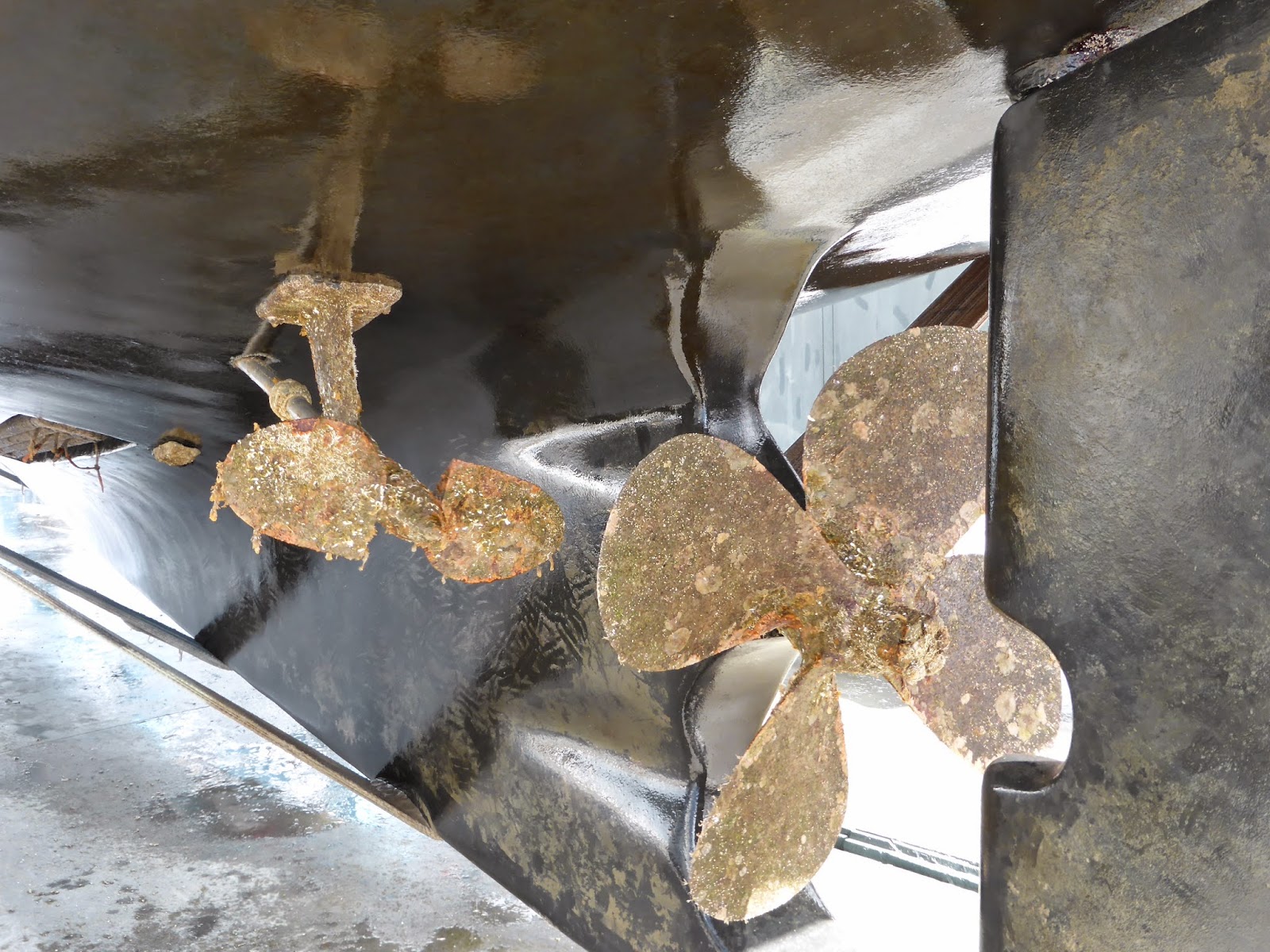
When we pulled Envoy out after nearly a year in the water the hull was clean but the props were fouled after 5 months non-use

Envoy hidden among a forest of masts on the hardstand – note security fence

On the hardstand it’s a constant climb up and down the ladder

From 1 May there’s a very noticeable increase in boating activity and this is when charters start in earnest. One day in the marina a nearby charter yacht left her berth but her skipper steered too close to Envoy and the yacht’s keel fouled our bow line. This brought the yacht to a rapid halt and the beam wind drove her sideways down onto Envoy’s bow. Fortunately for us Envoy’s point of contact was her large anchor, and the yacht’s crew had a big incentive to hold themselves clear. Shortly one of the marina’s sailors appeared in a workboat to tow the yacht clear with no harm done.

Charter yacht wind-driven onto Envoy’s bow

In Lefkas we paid 5 Euros (NZ$6.50) to have some shoes repaired at this interesting, ancient looking cobbler’s shop

TECHNICAL Apart from the previously mentioned failure of our Seapower 120V AC engine-driven generator there’s been no major issues. For the time being we’re going to use our genset to produce AC power for refrigeration while we weigh up different long term options (which might include staying with the genset). In the marina we tried running refrigeration using our 2500 watt inverter. The refrigeration system draws about 30 amps momentarily on startup, then 7 amps. It started and ran OK but our 60 amp battery charger, powered by shore power, couldn’t maintain sufficient charge. An option would be to run this inverter while charging with our 160 amp Lugger-driven Balmar alternator, but the inverter is a modified sine wave one, and there are some possible over-heating issues around powering induction electric motors with modified sine wave (as distinct from pure sine wave) inverters. The refrigerator manufacturer confirmed it might run a bit hotter, but didn’t think it to be a major issue, since the motor is seawater cooled. However I prefer to play safe at this point. Any expert comment welcome!
So, other technical events have been:
During winter we had some chaps made for our smaller RHIB. These are excellent for protection against U/V, abrasion and impact, and great to extend the life of your RHIB.

Envoy’s smaller RHIB with new chaps fitted

Envoy has a 6 person liferaft that hadn’t been tested for several years and we decided to get it inspected and re-certified. Bought in 1995 the liferaft failed the test due to some glued seams coming apart and being beyond repair – not bad for nearly 20 years though. As we’re only coastal cruising at present and carry two RHIBs we won’t replace it at this point.

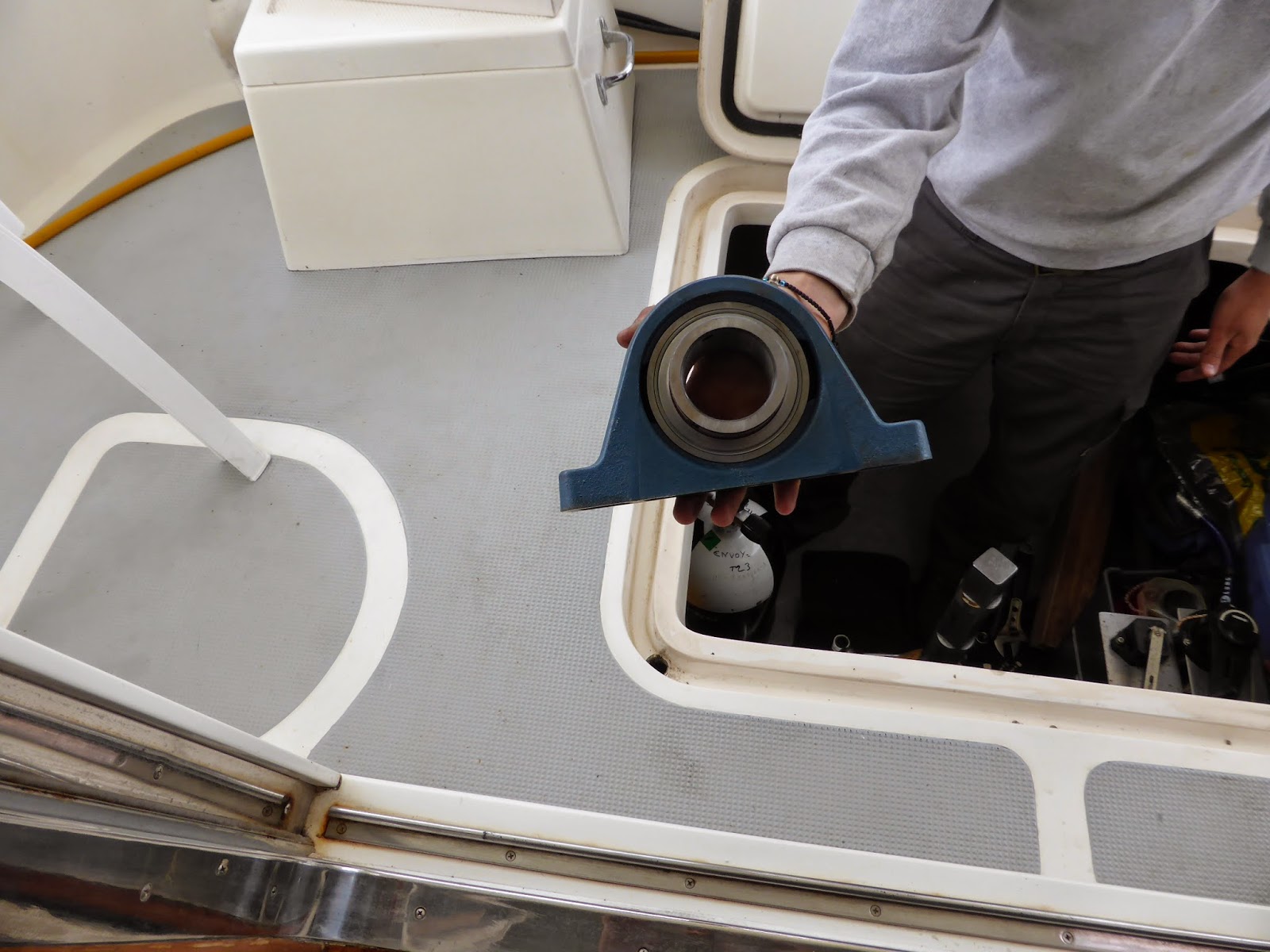
New main rudder bearing

We tried to get our engine room fire extinguishing system re-certified. The inspector said that since it’s a Halon extinguisher, which is no longer allowed for environmental reasons, he can’t certify it. However he went on to say that Halon is very good technically and advised us to keep it. We’ll do that this year but in the longer term we’d feel happier with a system that can be checked and certified. Also the present system has an interlock so that if the extinguisher is faulty you can’t start the engine. I don’t like that idea and would like a system without that interlock. We’ve replaced two 1kg disposable extinguishers with two 2 kg serviceable ones – according to the same inspector, only extinguishers with metal nozzles (and not plastic) can be serviced. We also had our largest (6kg) portable dry powder extinguisher serviced.
Every three or four years we need to re-galvanize the anchor chain. This year we turned it end-for-end as half of the chain is in near perfect condition, while the other half isn’t too bad and will last another couple of seasons.
Envoy’s fuel system has a Walbro low pressure pump for pressurising the fuel system after filter changes. This has failed and been replaced with our on-board new spare.
Two portholes have been leaking in heavy spray so these were taken out, all old sealant removed, the adjacent hull areas dried out and then the portholes sealed back in place.
All engine mounts were inspected with the Lugger and genset found to be fine. The Yanmar mounts need replacing and this will be done during next winter.
The Lugger’s alternator bearings were found to be worn even though this was reconditioned a year ago. This time heavier duty bearing have been sourced and fitted, and a spare set stored away.
The Lugger’s prop shaft was disconnected from the gearbox flange to be checked, and new bolts and nuts fitted. Then the shaft was re-aligned using a laser,
We carry several cartridges of sealant (such as 3M 5200) aboard in case needed for emergency repairs. Recently we discivered that even unopened cartridges have a limited shelf life of 1-2 year, and to replace them is expensive. Also some sealants can’t be used in wet conditions (although I believe 5200 can). We’ve now gone to another emergency repair product called StayAfloat, which can be used underwater and has a longer shelf life.

THE ARGONAUT April 10 to April 24 The Galapagos

Captain’s Log      April 10 to 24 – The Galapagos About the Galapagos Far out in the Pacific, 500 miles west of Ecuador, the low domed peaks of massive shield volcanoes rise from the depths.  Here they break the surface as the thirteen (main) islands of the Galapagos.  They are the product of one of the most active geological regions on the earth, a place where the Cocos Plate and the Nazca Plate meet at the Galapagos and Carnegie Ridges.  Here the earth’s mantle is very thin, allowing huge c…

THE ARGONAUT April 10 to April 24 The Galapagos

Captain’s Log      April 10 to 24 – The Galapagos

About the Galapagos

Far out in the Pacific, 500 miles west of Ecuador, the low domed peaks of massive shield volcanoes rise from the depths.  Here they break the surface as the thirteen (main) islands of the Galapagos.  They are the product of one of the most active geological regions on the earth, a place where the Cocos Plate and the Nazca Plate meet at the Galapagos and Carnegie Ridges.  Here the earth’s mantle is very thin, allowing huge calderas to form and break the surface as eruptions:  in the last 200 years there have been 60 eruptions.  When visiting the islands you can see massive lava flows, vent tubes, unbelievably intricate and interesting formations of lava as it solidified when it met the ocean and was then, over the centuries, covered in flora such as lichens, moss or other plants.  The Islands of Isabela and Santa Cruz bear witness to incredibly violent para-plastic eruptions as boulders and rocks of all size litter hundreds of square miles of landscape.   Meanwhile the sun beats down with a fierce intensity.  There is no fresh water anywhere, only the briny sea fed by several ocean currents that converge here.  From the south flows the cold Humboldt Current, bringing nourishment from the Antarctic and the ocean’s depths; from the east, the warm Panamanian Current bringing life from Central America. 

97% of the islands are part of the Parque Nacional de Galapagos, a UNICEF World Heritage Site and part of the country of  Ecuador.

Entering the Galapagos

Entering the Galapagos Islands with a boat requires a cruising permit, a wad of cash, and a fair amount of patience.  In preparing for our trip to this port we had done a reasonable amount of research and preparation.  We were warned by other boaters that the bottom of our boat would be inspected for marine growth when we arrive in the Galapagos, so we had the bottom cleaned in Panama and pictures taken of it.  We were told stories of boats deemed to have excess marine growth on their hulls being forced to travel 70 miles off shore with a park service diver to clean them at a cost of $500.   We were also told that we needed to have Argo fumigated and obtain a certificate from a licensed company showing the chemical used.  We did this too, although the company only gave us an official looking paper, charged $100, but never actually fumigated our boat; they said it wasn’t necessary.  We also read a long list of plants and foods that couldn’t be taken to the islands.  All of this is understandable when you consider the environmental damage done to the Great Lakes by foreign ships entering without restriction, so we entered ready to comply with any demand.

About twenty miles offshore we were hailed by name by the park service on VHF channel 16.  The man didn’t speak much English, but Tyler speaks Spanish and between the three of us we managed to find out that he was instructing us to go to the wrong port.  This was a little disconcerting to me, but after being persistent, we were authorized to follow the correct heading and course and make our way into Puerto Ayora.  Our first sight of the Galapagos was of Santa Cruz Island.  Just as Darwin noted in 1835 the island was shrouded in clouds.  As we came closer, we could make out the arid, rocky, lava laced shoreline.  We nervously groped our way toward Puerto Ayora as our charts were not very detailed.  Eventually we saw the harbor and pointed Argo toward other ships at anchor.  It is a crowded harbor with no breakwater.  There were two or three small freighters offloading onto barges.  There were about ten sail boats and catamarans at anchor.  We were the largest yacht for most of the time we were there.  The other twenty or so boats were tour boats waiting for this week’s plane load of tourists to arrive from Guayaquil.  Swells roll in directly off the ocean.   Boats at anchor constantly pitch up and down and roll around despite being very close to each other.  As we gingerly picked our way between the boats and their fore and aft anchor lines we found an empty mooring ball and tied to it.  Later we deployed a stern anchor to hold us into the swell, put out our stabilizers, and dropped our forward anchor in case the mooring ball failed (often mooring balls fail because they are not properly maintained).  A few moments after we were secure, we called our agent and he arranged for the commencement of entry formalities.

To stay in the Galapagos one needs a cruising permit that can only be obtained through the Capitanea de Puerto at a port of entry.  There are effectively two ports of entry into the Galapagos; Puerto Ayora on Santa Cruz Island and San Cristobal on San Cristobal Island. The length of stay is at the discretion of the port captain, but cannot exceed 21 days without a visa.  If a visa is desired, one must apply three months in advance of the visit. To get a cruising permit, the port captain together with a National Parks official, a police officer, an immigration officer, a health inspector, and a diver all visit to inspect the boat.  Since hardly any officials speak English, we hired an agent to help us through the formalities.   All the officials came to our boat shortly after we anchored in Puerto Ayora and completed all their inspections in about two hours.  While on board they looked through all the compartments, took pictures of our black water tank and our soap dispensers, read our trash policy, looked around the engine room, checked out our refrigerator, and, as a special request, the Port Captain asked if we would take his picture while he stood next to our helm and wooden wheel.  He said he never saw a pilot house like ours nor had he seen a wooden helm.  So we were happy to comply.   Meanwhile a diver came to the boat and inspected our hull.  After all the official business was conducted, pictures taken and departing pleasantries exchanged, the bill was presented; $2,183 for a 21 day permit.  If we wanted to travel to other islands via our boat, we would need a guide and a ranger.  This would cost about $1,500 per day including permits.  Later, in talking with other boaters, we found out that one of the boats had no black water tank and dumped sewage directly overboard (frankly, I didn’t know any boat was built or allowed to do that.)  They showed the officials a water tank and he took pictures of that.  More importantly, when we went ashore we found that the city dumped their sewage directly into the bay.  So much for all the inspections.

While all the officials were on board we received a call on our VHF.  A 52 foot Oyster sailboat from the U.S.A was calling.  They had left Costa Rica eight days before with four adults and two children aboard.  They motored all the way to The Galapagos and arrived with hardly any food or water left and only a few gallons of fuel.  They were desparate. We heard them call Ricardo, our agent, for help in getting a cruising permit, but he told them he was too busy to help them.  Unfortunately they were technically not allowed ashore until they had a permit and cleared customs.  Apparently they saw the inspection party come aboard Argo and our American flag off the stern and decided to call us to see if we could help them get the inspection party to relent and come to their boat.  Off course we asked Ricardo and he agreed.  Later they brought a bottle of Johnnie Jameson over as a token of their gratitude.   Really nice and completely unnecessary, but particularly in light of the absence of any water or nourishment on their boat!  In talking with them later, we found out that these Californians had planned to cross the Pacific just as we were doing, but I think they realized that they were not properly prepared or had insufficient experience to continue on such an ambitious journey.  A few days later they pulled up their anchor and headed back to Costa Rica. 

Puerto Ayora

Puerto Ayora is the tourist capital of the Galapagos.  The little town has about 3,000 permanent residents, a substantial commercial area, many restaurants and shops, and the Darwin Center.  We anchored Argo here for about two weeks and toured several islands by plane and stayed in local hotels.  We were very excited because our daughter, Kathryn, was flying in for a week to visit and tour the islands with us.  

The harbor was always rolling with ocean swells and Argo was in constant state of motion.  Sometimes it was very rocky, and it was always very annoying.  To get off the boat and into town we called a water taxi on VHF 14 and asked for a pick up.  The fare was 60 cents per person each way.  The taxi dropped us at a municipal dock especially constructed for the purpose.  Sometimes customers had to step over a sea lion that was resting on the gangway, or it could be found lounging completely oblivious to passersby on a park bench on the upper walkway.   A short walk past the skate board park brought us to Main Street, which was very nicely constructed of brick with wide sidewalks and newly planted trees to shade the weary walkers.  The heat at midday was really intense, perhaps 100 degrees with equivalent humidity.  It was almost unbearable, which I am sure is why siestas are popular.  Most businesses opened from 9 AM to noon, then close and reopened at 3 PM and remained open until 8 or 9 PM.   Many of the restaurants were quite acceptable and we enjoyed them frequently.  Food shopping was fun; we went to the farmers market on two Saturdays and enjoyed the bounty of the highlands amidst all the sights, smells and cultural delights of a country market.  At the waterfront we bought an 18 pound Yellow Fin Tuna for $2 a pound, a pretty good deal we thought considering Monahan’s Fish Market in Ann Arbor wants about $25 a pound.   The local mercado offered the usual packaged goods, but it also had a very good bakery that we enjoyed on several occasions.  On Good Friday we went into town for an ice cream cone and witnessed the Easter Passion Festival where hundreds of people followed the Way of the Cross complete with a Jesus dragging the cross along the route with costumed Roman soldiers and statues of several apostles carried aloft on the shoulders of devout believers.  One evening we met our tour agent and she invited us Casa del Mar restaurant for a freshly caught Tuna and Wahoo dinner (someone also brought a little goat) with friends and the Uruguanians who caught them that day.   The fish was perhaps the best I ever had, and the two Australians we met were very interesting people. 

The harbor was a little cloudy because of all the algae in the water.  It caused our water-maker filters to frequently clog.  We had to make water because they do not offer any services for yachts in that harbor and we would need a permit to leave the harbor, even if it only to make water or empty our black water tanks.  So, as we had a long trip ahead of us, I thought we better see if we could buy some 5 micron sea water filters.  Our agent Ricardo Arenas directed us to Bodega Blanco, a boating supply store about ten blocks from the taxi dock.   Rebecca and I decided to walk and even though it was only 9 AM it was already so hot that I was drenched by the time we got there.  We found what we wanted and eventually talked to the owner, who spoke perfect English.  He inquired about us and us about him; he grew up in L.A and his mother graduated from U of M in English!  It is a small world.

Touring

 Kathryn arrived and brought with her a few parts for Argo that we wanted, like a ten pound low pressure pump for the water maker.  She enjoyed a day of rest from her 18 hour flight from NYC and then we started our tour of the islands.  The first place we went was to The Charles Darwin Center on the outskirts of Puerto Ayora.  The institute raises various species tortoises for reintroduction on the appropriate islands.  Many islands have distinct species of tortoises and after a little while you can tell them apart by their shells.  Galapagos means saddle in Spanish.  It was so named because the island’s discoverers thought some of the tortoise shells looked like saddles, and indeed some do.  When Darwin arrived in 1835 there were an estimated 400,000 tortoises roaming about.  By the early 1980’s there were only 3,000 left.   At the center they have a hatchery and pens to raise the little ones until they can fend for themselves.  They have no natural enemies aside from man, but as humans have released domestic animals that in time have become feral, these dogs, cats, pigs and goats eat the little tortoises or their forage.  So, the idea is to raise tortoises in captivity until they are large enough to protect themselves from these predators.  Officials have been conducting an eradication program for some time and with some success.  The Institute also has a number of large enclosures in which are kept adult tortoises of various types.  They are very interesting and really something to see, particularly when they are eating or mating.  The Institute also has both marine iguanas and land iguanas, that latter of which is large and very colorful. 

The next day we hopped a plane to the group’s largest island, Isabela.  Here is what we saw the on the afternoon of our arrival:

  1. Wall of Tears, a huge wall built by prisoners from the rocks thrown out by the volcano thousands of years ago.  The wall has a sort of hideous beauty; stone by stone piled one upon another by prisoners carrying them from distant places in searing heat.   Surely many of them died, but living here would have been truly a hell on earth.  The prison was built on the site of a W.W. II U.S. base.   I believe the prison was closed in the late 60’s.
  2. Marine Iguanas: They look like octopi when they swim; they are pitch black and match the color of the lava rocks on which they cling.  They have webbed feet and long claws; they spend their time going in the water to eat algae growing on the rocks, then back to shore to warm up, then back for more food, etc.
  3. Lava Vent: Next our guide took us for a hike along the rocky beach to climb down into a lava vent; very interesting.
  4. Vista: Next, a climb up a couple of hundred stairs to the top of a vent/hill to look over the vista of a volcanic island. Simply beautiful.
  5. Tortoise breeding center, just like the one we saw at The Charles Darwin Center.  Then, back to our hotel.  


Our hotel wasn’t too bad and was located in a shabby little town with dirt streets called Puerto Villamil.  Every one of the 110,000 tourist that comes to the Galapagos annually will at some point probably find their way here.  It does have a few hotels and several restaurants.  The one restaurant we tried was horrible, although our hotel served very good food, particularly the ceviche, which was actually the best I ever had.  Kathryn was full of energy and being from NYC wanted to “go out”, so down the beach we walked toward the place she heard was the best in town.  Later we learned her recommendation came from the tour guide, and later yet we learned that his boss owned the place.  Anyway he was probably right, it turned out to be lot of fun.  It was a surf side bar complete with a sand volley ball court and, most interesting of all, a tight rope on which young beer drinkers tried their skills as wan’a-be Wollendas.  We watched them through several drinks: please make mine another Coco-Loco!

The next day was packed with very interesting things.  We were picked up early at the hotel and taken to the dock, then aboard a speed boat for an hour’s ride to an area I can only describe as “mind blowing”.  It was truly “other worldly”, in that it was formed by lava flows frozen in the most interesting and bazar configurations both above and below water.   Getting into the place required real local knowledge and skill; first we had to pass over the very large ten foot sea swells rolling in from the ocean and then maneuver between rock formations that broke the swells into surf, then around and through the maze of lava formations, all the time avoiding rocky outcroppings that could have easily broken the propellers.   We landed and offloaded on a cliff that was five or six feet above the water line.  Once we had climbed up the rocks onto a flat surface we could really appreciate why we were brought here.  The pitch black lava formed arches and bridges in an endless maze that was interwoven with the brilliant blue water of the ocean creating small lagoons that sea turtles and sharks frequented during their matting season.  It was fascinating to watch the sea turtles effortlessly glide, almost fly through the water.   Blue-Footed Boobies were everywhere.  When we first saw two of them standing together above a nesting site (a flat, black rock surface encircled by white bird poop) they just stood there and looked at us despite the fact that we were only a few feet from them.  Like all the animals we encountered in the Galapagos, they are not afraid of human beings.  The Boobies are a beautiful bird, words don’t really describe them.  Their heads are covered in small, blue-brown-white feathers, their bodies are brown and white, yellow rimmed eyes, blue-grey beak, and of course the most distinguishing feature of all, powder blue webbed feet and legs.  They are just spectacular, and when they go fishing, they form flocks and dive like arrows into the water after their prey.

After exploring the lava field we went snorkeling.  Here we got to see the underwater world: many tropical reef fish as one might expect, just an arm’s length away sea turtles (huge 4 feet by 3 feet turtles) feeding on the algae growing on the rocks, Penguins ten feet away, Sea Lions playing and dashing adroitly through the water, Marine Iguanas, Frigate Birds, Boobies, and White and Black Tip Reef Sharks tending to their young ones in a cave. We were a little cautious around those things, although it was very interesting and exciting.  Later as we headed back to the little town and our hotel, Kathryn dove with 12 foot Manta Rays in the open ocean; wow, what an experience! 

The next day we visited another lava field, this one different than the other in that it looked like nothing I had ever seen on earth before.  The lava was formed into twisted figures about three feet high and partially covered in white lichen.  It looked like a field of strange outer space beings.  Amidst all the little men were Marine Iguanas.  

That afternoon we flew back to Santa Cruz.  The flight was interesting in that we could see the rims of partially submerged extinct volcanoes rising out of the ocean as well as a vista of the entire western part of the island.  After we landed we drove to the “highlands” for lunch at a coffee farm.  The owners were the extended family of our tour operator.  Apparently Ecuador never knew quite what to do with the Galapagos until UNICEF made it a World Heritage Site.   Nothing much can be grown here commercially or mined.  It is so hot agriculture cannot be sustained on a commercial basis, there is little soil, and there is little water.  Many people tried to establish homesteads here and failed; the government used it for a prison colony for a time, but even that failed.  During the 70’s Ecuador granted 200 acres to any citizen willing to make a homestead here.  That’s how our friends got a hold of this farm land, but they couldn’t clear it all or maintain it so they gave 100 acres back to the government.  Now, in light of tourism and the fact that 97% of the land is part of the Parque Nacional, land here is very expensive and almost impossible for an outsider to acquire. Immigration to these island is no longer permitted.

On the way to the farm we stopped by a lava tube buried deep in the hillside.  It was at least 30 feet in diameter, much like a subway tunnel, but one that extended about 3,000 feet or more.  Later we returned to the farm and walked about to see the tortoises living in their natural environment.   There were many large old males and many smaller females walking laboriously about.  It was the mating season.  As we walked the paths in the lush jungle forest we could hear the grunting of the male as it was in the act of mating.  We were told that it takes about four hours to complete their mission, meanwhile the beast grunts and extends his head several feet out of his shell.  The 500 lb. male somehow climbs on top the female that is perhaps only 100 lbs.  She seems to just sit and wait for the event to end.  Meanwhile several other females were on standby nearby.  Apparently these animals live up to 200 +/- years.  We were told that females can hold the sperm of several males simultaneously for up to five years and release it into her eggs when conditions are right.  Interestingly, they walk as far as twenty miles or more over rocky and inhospitable terrain to the beach to lay their eggs in the sand (like the sea turtles).   It must be a primordial impulse, at any rate it is an incredible feat.   After leaving the tortoises we drove back to Puerto Ayora, but along the way we stopped to see two very large sunken calderas and associated lava vents.  These geological features exist at an altitude of 650 meters that supports and unusual forest of trees peculiar to the Galapagos on which hangs Spanish moss, the view of which was most interesting an unusual.

After returning to Argo, we needed to decide on a spot for dinner.  Kathryn had heard from NYC friends that had recently been here that the “Deli” had the best fish and chips anywhere this side of London.  So we tried it out together with our friends Javier and Jill, two lovely people that owned the tour company.  Kathryn was absolutely correct; these were the great fish and chips!

The next day we set out for North Seymour Island and the land of the Frigate Birds.  Once again we had to make the fifty mile trip across the island to Baltra and the boat dock that in this case would take us to North Seymour Island instead of the airport.  We made the trip in a bus along with about forty other people, but since we had a private guide we were ushered along in a pleasant manner.  From the boat dock we went by dingy to an old cabin cruiser.  Inside was a captain in full dress whites with epaulets, and a heavy set, friendly cook in the galley making lunch for the twenty or so passengers.  Our trip to the island took about an hour and during that time we had a surprisingly good sautéed Yellow Fin Tuna lunch.  It was a lot of fun. 

North Seymour Island is a flat slab of rock perhaps a mile square.  It is about twenty-five feet above sea level and volcanic in origin.  It is covered with a dwarf, grey-bark spindly tree that at the time we were there had no foliage.  Whatever grass was there was brown and dried up, and Prickly-Pear Cactus trees, also unique to the island, punctuated the rocky landscape.  It hadn’t rained in five months, but the rainy season was supposed to begin soon.  In the branches of the trees were nests, some of which held hungry chicks.  Neither the nests nor the chicks were small.  These are pretty large birds.  Mating was in the air literally as red pouched male Frigate Birds sailed overhead looking for a suitable place to inflate their mating equipment.  As we walked along the path we saw several Land Iguanas with their oddly beautiful orangey-green-gold- tan coloration.  They are much larger than their marine cousins.

We continued our walk through the strange pigmy forest looking for the male Frigate in full mating display.   The males have a flaming red sack on their throat that they inflate to attract the females.  We were able to get within a few feet of several of these birds and get some wonderful pictures.  The birds themselves are much bigger than a pheasant but smaller than a turkey, and their red display is about the size of half a football.  It is really something to see.   We spent about two hours here and it was one of the most interesting animal adventures we have had.

On the way back the boat stopped at a beach used by turtles to lay their eggs.  It was defined by black lava that spilled into the sea and solidified, the beach itself as white coral sand that rose broadly and steeply to a ridge one hundred or more yards above the water line.  It was there we found the large concave bowls dug by the turtles and in which they deposited their eggs, but further on we came to a brackish pond just over the crest of the sand.  There we could see a flamingo.  We watched the beautiful bird feed on little shrimp, its long neck moving about to allow the angled black beak to sift through the mud on the pond’s bottom.  Suddenly the magnificent bird started to run, its stick like legs and knees awkwardly gaining speed.  Then it extended its wings and began to take off; its fabulous pink plumage accented by the black feathers under its wings that make the pink unbelievably brilliant. Then the awkwardness was transformed into graceful, effortless flight.  On the beach were two Lava Gulls, the last of only two hundred known to exist.  They too were magnificent: they look like a sea gull, but their coloration is very dark grey and black to match the color of lava.  It was simply a spectacular sight to behold.

Our final Few days in the Galapagos

We returned to Argo on Friday late in the day.  Kathryn was scheduled to go home on Sunday, so we had a day for her to rest and roam around Puerto Ayora.  Saturday morning we all went to the farmer’s mercado, which was a lot of fun.  It was hot even early in the morning.  Kathryn wanted to order some Ecuadorian pastries like the one’s she had on Isabela – she’s a foodie!  We spent a couple of hours at the internet store, about the only place you can get on line there, lunch and then dinner on the boat.  We had a lovely visit and were, of course, sad to see her go as always.   

After Kathryn departed it was time for us to arrange fueling and obtain our Zarpes.  Each island in the Galapagos has a port and each port has a Port Captain.  To enter or leave a port the boat captain must contact the Port Captain and apply for a Zarpe or clearance permission form.   In the Galapagos this requires an agent, who in our case obtains a Zarpe allowing us to leave Porto Ayroa and travel 32 miles north to the Island of Baltra where the fuel docks are located.    This costs $7.81 plus an agent’s fee.  We also wanted to purchase fuel in Baltra, so the procedure here is that you have to tell the government officials how much fuel you want, pay for the fuel in advance in cash at a special office (or in our case we bought it through a fuel agent in the U.S. who arranged everything otherwise we would use our own local fuel agent).  The fuel price is set each Thursday morning and holds for one week. 

So Wednesday morning before departing for Baltra, we took a water taxi into Port Ayora and finished up our internet chores and picked up more fresh provisions.  We met our agent Ricardo Arenas who gave us our Zarpe permitting us to move the boat to Baltra.  Meanwhile Tyler was taking down our sun shades that cover the outer decks that help keep the boat cool.  When I came back, we hauled in our flopper-stoppers, a passive stabilizing system that is supposed to help keep the boat stable in a rolling anchorage.  When we finished all that and cleaned the lines that had been in the water for ten days, we called a water taxi to help us raise our stern anchor and untie from the mooring ball.  Once all that was completed, we raised the anchor and began to make our way between the densely packed boats at anchor to open water and Baltra.  It was a beautiful day.

Once out of the harbor, the vistas from Argo were simply fabulous.  Santa Cruz Island is a volcanic island, as are all the islands of the Galapagos.   The top of the volcano is shrouded in clouds, the mountain side gradually declines at five or ten degrees for the ten or fifteen miles to the sea.  The upper part of the mountain is lush and green and the mist from the clouds is the only source of water on the island.  The flora changes in type and density every few hundred meters until it gradually becomes arid near the sea.  The coast is made up of lava rock for the most part, sometimes formed in cliffs, and sometimes in lava flows that ended in the sea, punctuated here and there by coral sand beaches that are the destinations of nesting sea turtles and land tortoises during the egg laying season.  Off the coast are rock formations; these are the tops of volcanoes that once were above sea level during the ice ages, but now are partially submerged so that now only the un-eroded part of their cone remains in view.  Along the way we saw sea turtles rising for air, and tuna jumping in schools.  Galapagos Sea Lions dove and played along the way.  Frigate Birds, some males with their red mating pouch visible although deflated, rode the air pressure wave above our boat and hung there for hours.  Occasionally a Blue Footed Booby (everyone loves boobies) would come along, sometimes landing on our railings for a rest. This was maddening for Tyler, since the birds often made a mess and he is devoted to keeping Argo in Bristol condition.

Cruising around the Galapagos is somewhat dangerous as the charts are very sketchy and either don’t show hazards at all, or fail to show them at the right location.  For example, the channel between two islands as drawn on the chart as wide open, yet in looking at it one could plainly see that it was obstructed by a rocky outcropping from the island.  In another case, the chart showed a clear and navigable passage and I set our chart plotter and autopilot accordingly.  After a couple of hours we could tell that we were headed into an unmarked ancient volcano top several acres in size!  I was told by a local boat captain with whom I consulted before departing Baltra, that the charts used until the 1990’s were created by Captain FitzRoy of the HMS Beagle (the ship that brought Darwin to the Galapagos in 1835) and the current charts aren’t any better!  About 1730 we arrived in Baltra and anchored for the night.

At 0800 the next morning we were called to the dock, but as our agent hadn’t arrived yet, they couldn’t start pumping fuel.  It was a Thursday morning, so this created special problems because our agent had to pay for our fuel before we could load it, and the payment office opens in Puerto Ayora at 0800, but that is an hour’s drive away from Baltra.  Once the agent arrived, he had to bring the port captain and the head of the police office aboard to inspect our yacht and fill out the same paperwork that we completed in Porto Ayora.  This port captain is the one to grant the exit Zarpe, clearing us out of the Galapagos and to the Marquesas.  Rebecca and I had to laugh as the uniformed port captain, complete with gold stripped epaulettes, carefully read with arms extended in the most officious manner the Zarpe from Port Ayora.  He must have read a document like that a thousand times before, yet here he was meticulously examining every period and colon! We concluded that if you are going to be a government official, you have to be able to read the most mundane form as though it were unique and complicated and that its meaning can only be understood in its full complexity by an anointed one.

We needed to buy as much fuel as possible since we planned to leave Baltra directly for the Marquesas, 3,000 miles away.  An expensive problem developed from the fact our fuel tank measuring system is very inaccurate; we have site gauges on each fuel tank, but they are not accurately calibrated and only provide an estimate of the fuel onboard.  I ordered 1325 gallons, but as it turned out we could only take on 1125 gallons, so we paid for 200 gallons that we couldn’t put aboard and lost over $1,000 at the fuel price of $5.25/gal.  I have never experienced a fueling procedure like the one in the Galapagos; in addition to being arcane, inefficient from a buyer’s perspective, and inconvenient, it seems, like many things here, designed to relieve Gringos of as much money as possible!   So at noon we sucked it up and shoved off for the Isle Marquesas’.  God help us (please)!

Start your own blog now! Free!
Panama Canal Transit

The crew of Anna Mae is happy to report a successful transit of The Panama Canal. Our experience was exciting. The day was long and stressful at times along with the thrill we anticipated.

We woke early to arrange our fenders for the transit. The Por…

Panama Canal Transit

The crew of Anna Mae is happy to report a successful transit of The Panama Canal. Our experience was exciting. The day was long and stressful at times along with the thrill we anticipated.We woke early to arrange our fenders for the transit. The Port A…

Quick Trip To Sarasota

Nordhavn Exumas Abacos Bahamas trawler Caribbean Pickwick Boat dogs
Memphis Downtown

Sunday May 4, 2014 – Dana Point

Sunday, May 4, 2014 – Enroute from San Diego to Dana Point
Friday night Clark treated us to an awesome dinner at the Punta Moro Resort near the marina.  It is a spectacular setting, reminiscent of La Joya and the restaurant was on a par with the view.  Everything was beautifully prepared and served.  It was a wonderful last dinner in Mexico.
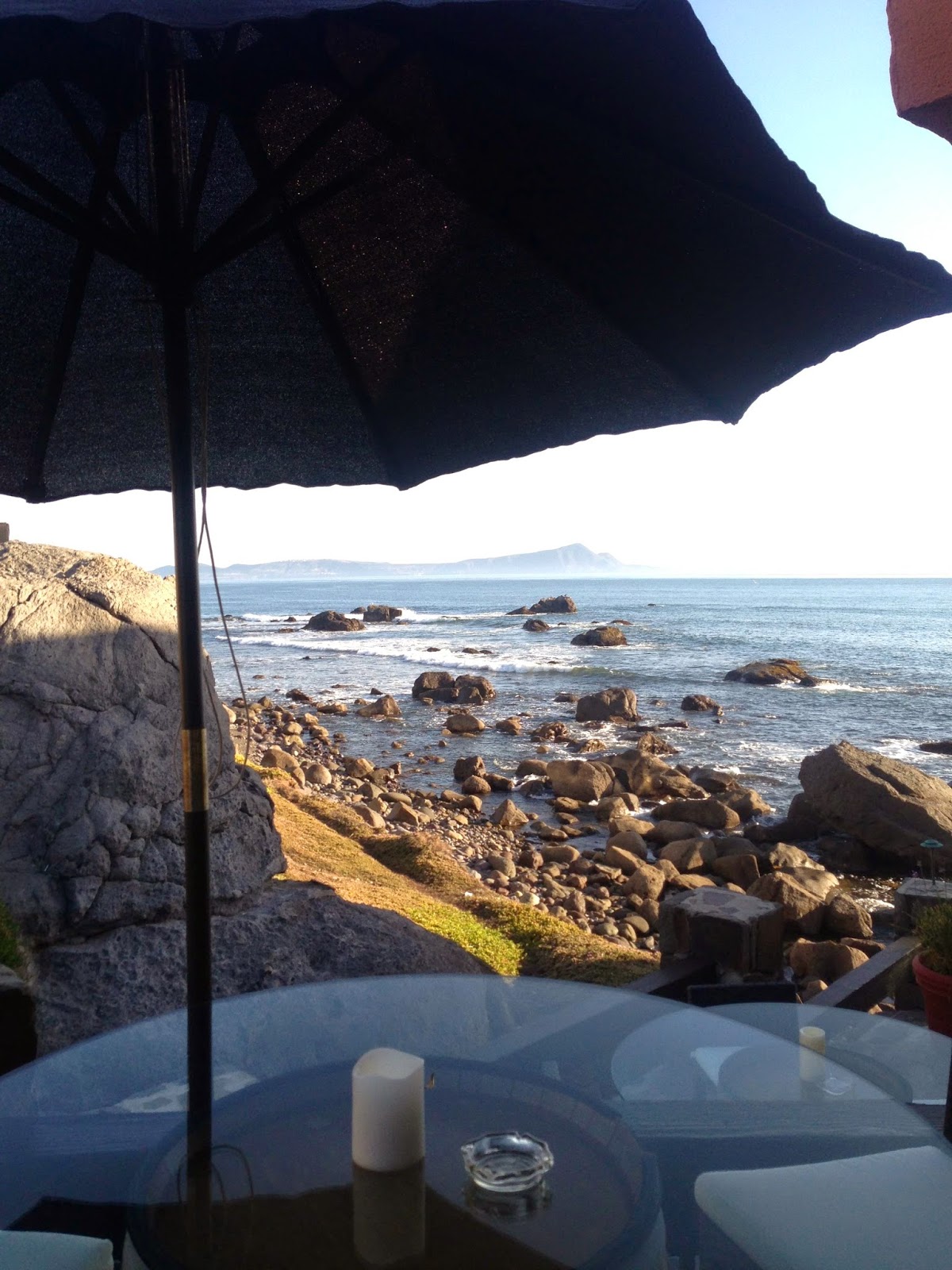
View from the restaurant at Punto Moro

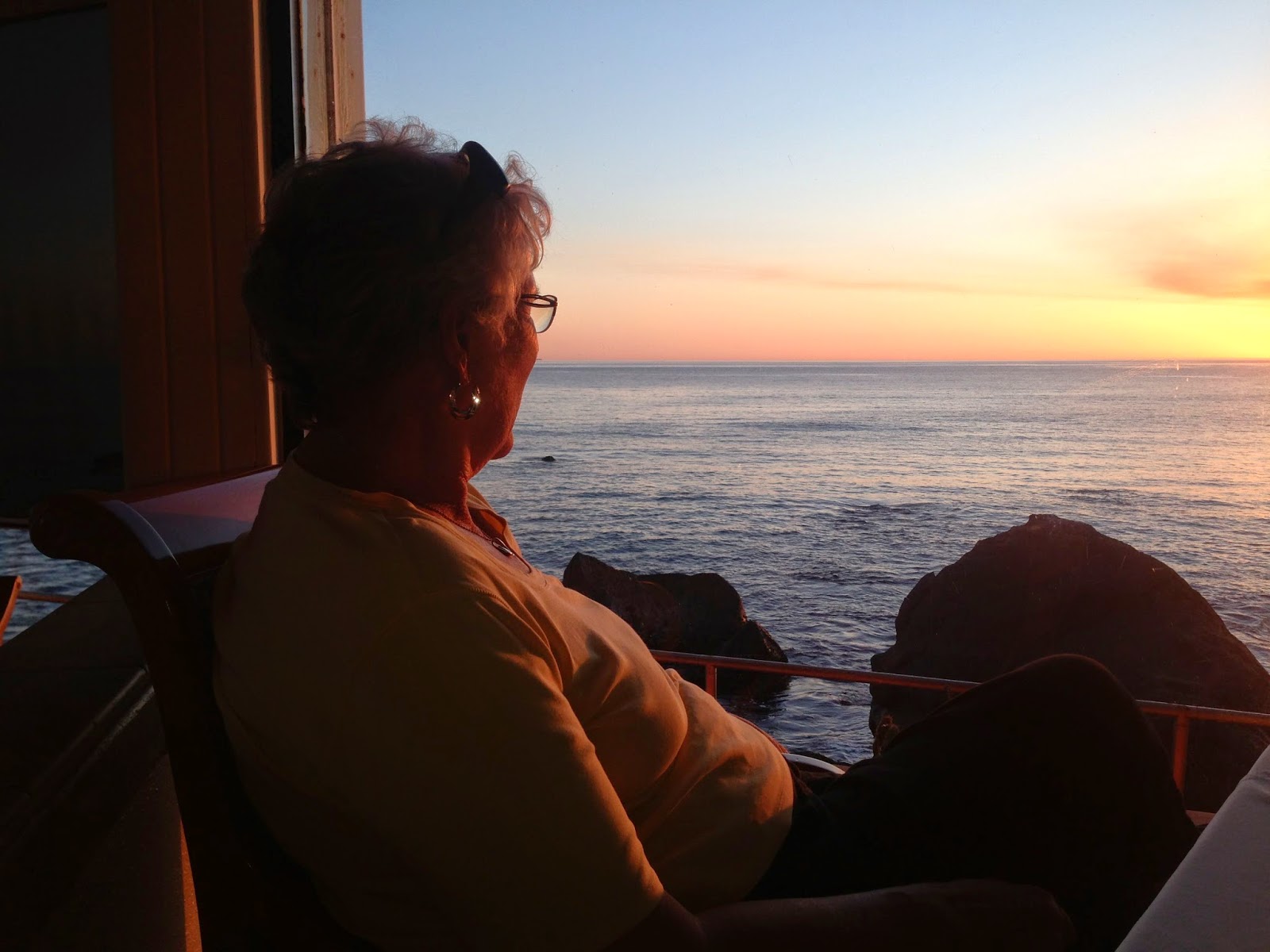
Joan looking for the green flash
Post dinner stroll at Punta Moro
Sometime around 5 am on Saturday we took off for San Diego, blessed with smooth seas and a favorable current that boosted our speed to 7+ knots.  Would that all days going north could be the same!  
Blowing 40 plus
Seas as they ought to be
As we travelled north, I knew we were getting close to Southern California when I spotted the first mylar balloon.  On the way down, the sea was spotted with hundreds of them.  A very sad thing to see. 
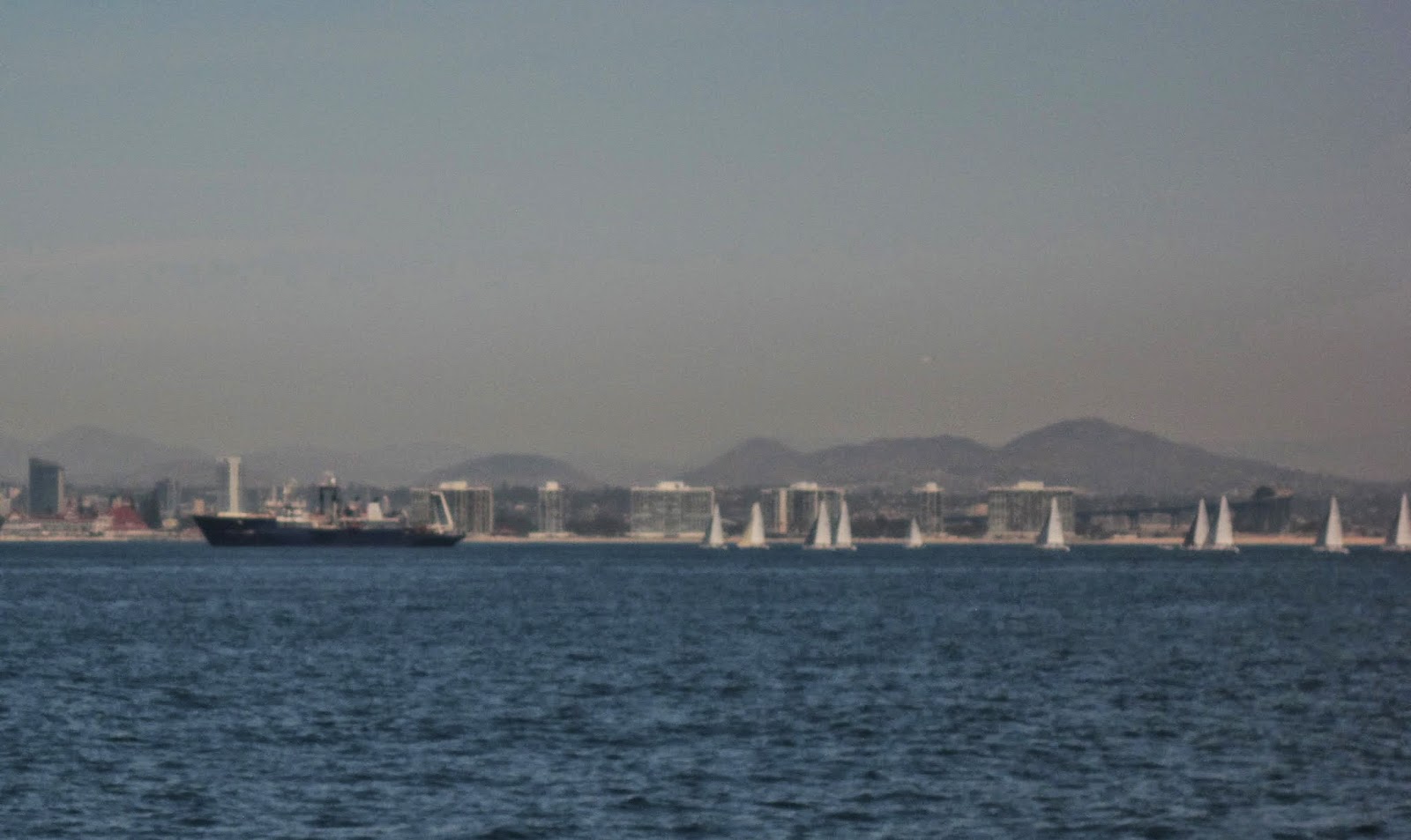
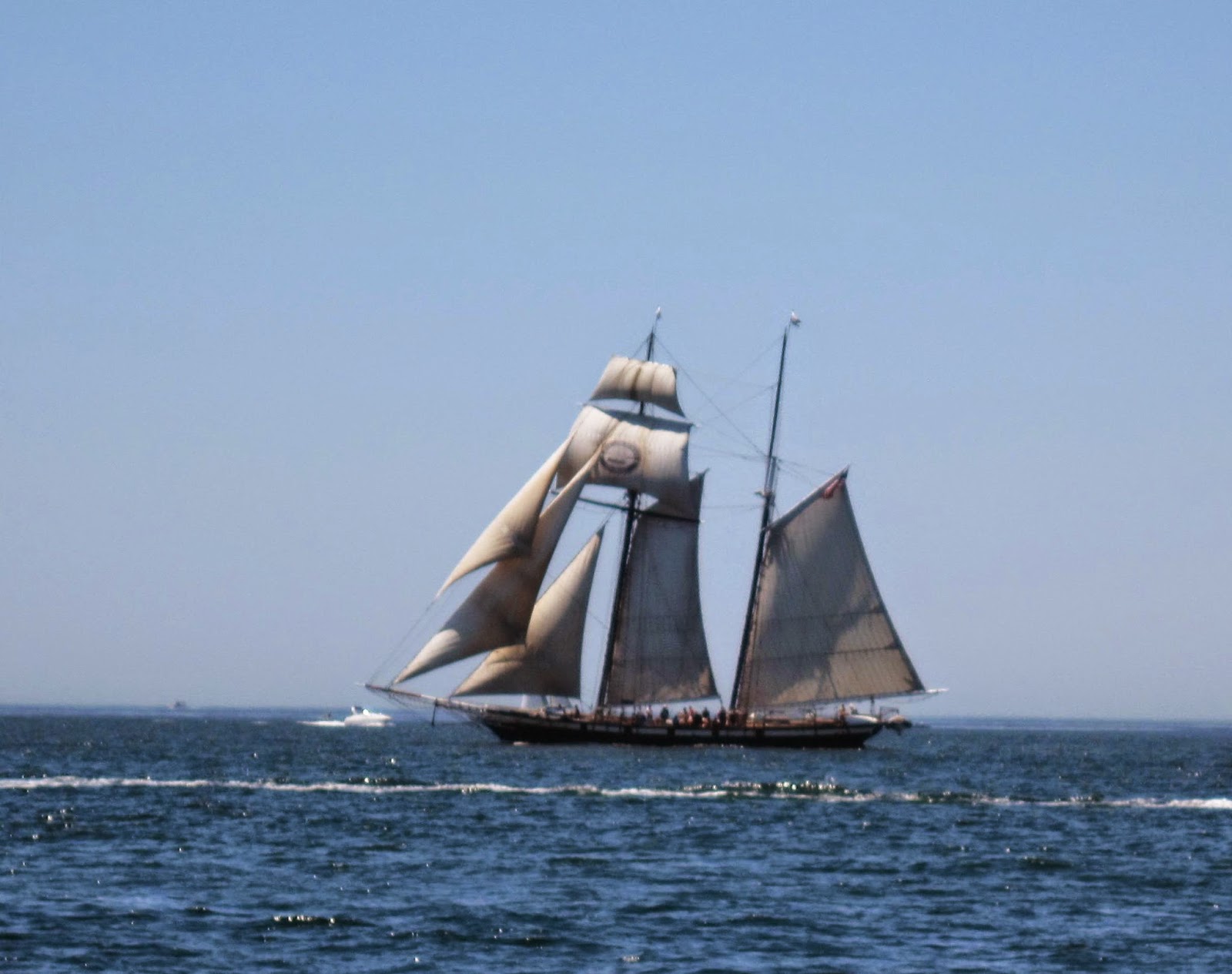
As we approached San Diego the traffic and activity increased.  Several sail boats races where underway and we enjoyed watching the boats drop their jibs and lift their colorful spinnakers as they rounded the buoy.  In addition to racers, there were many other assorted craft enjoying the beautiful weather.  We particular enjoyed a couple of classic multi sailed boats
Boats in front of San Diego
Beautiful Sailor!
Coming into San Diego, we felt like country bumpkins hitting the big city for the first time.  After 5 years of boating in Mexico, we were unaccustomed to the hurly burly of a major port.  Although there were clearly marked traffic lanes going into the harbor, we seemed to be one of the few boats to honor them.  Vessels of all descriptions, from freighters to kayaks and paddleboards, were going every which way!  The only things not moving were the piles of sea lions hauled out on the buoys, something we had not seen since we left the USA in 2009. 

Sea lions let you know you are back in California
We were pretty stressed by the time we managed to tie up at the police dock to clear customs. 

Earl had asked me to check on the hours that customs were open before we left Ensenada.  The website I had found indicated that they were opened until 5 everyday but Sunday and listed procedures for contacting them.  Happily Earl had written down the information because it turned out that they were not on hand on Saturdays.  After an hour or so, a couple of very nice men came down and did the paperwork for us to reenter.  Turns out they were originally from New York and one of them gave me a big hug before leaving. 
We had made reservations at the Cabrillo Marina.  When we finally found our slip, not an easy task in this giant place, it turned out to be too narrow.  Earl did manage to slip in, but there was no room for bumpers on either side.  Fuming, Earl went to the marina office to demand a slip to fit us.  He did well.  In compensation for our trouble, we got a 72 foot slip gratis. 
We had done such a good job of eating all the food that might be confiscated at customs that our larder was pretty bare.  I had hoped to make a quick trip to Trader Joes that is only a mile from our moorage, but happily settled for pizza delivered to the marina from Pizza Nova.  It was very good and Joan and Clark are now converts to Thai Chicken Pizza.  After dinner we walked up to the little deli near the marina office and picked up eggs to make French toast for breakfast from the sour dough bread that had come along with the pizza.  Joan spied a freezer of ice cream bars, so we all had Hagen Daas ice cream bars for dessert.  A wonderful welcome home to the USA meal!
We said goodbye to Joan and Clark a little before 8 am and were off within minutes for our run to Dana Point where we will be spending a few day.  In 2007 when we bought the boat, we had rugs made by Jeddy in Dana Point.  Now after 7 years of use and abuse (what else could you call spilling a whole jar of Yoy Soy Sauce) they are rather sad and we are looking forward to replacements.
In addition, despite Earl’s best efforts with the toilet plunger, the master head after complaining for the last few months has finally said no mas!  A new toilet awaits us in Dana Point.  Fortunately we only had to share the forward head with guests for a couple of days.  During that time, we developed a new meaning to the verb facilitate.  For us it meant using the facilities as in asking others if they had any objections to our facilitating.
Two things to which we will need to become reaccustomed:  NOAA weather forecasts over the radio and reliable charts on the plotter.  Both are blessings that before cruising in Mexico we took for granted. I for one will take a while to internalize the reliability of the plotter after years of having it show us crossing islands in the Sea of Cortez.
I am doing a whole day of laundry as we head north.  Our laundry bag which is on Earl’s side of the bed when we have guests, had long since reached capacity and there was a small mountain that threated to soon reach the as high as the bed.  We have so many things hanging out to dry on the railing that Earl says someone may think we are trying to signal distress.