
After Boot Akkrum delivered our new tender, we went out on a tour of the Harlingen harbors to get the new Honda 50 broken in quickly. We found a lot there—Harlingen businesses include Dutch shipbuilder Icon Yachts, several boat yards with focus on the offshore oil industry, and barge offloading facilities. Below are trip highlights…
ANCHORING IN STRONG WINDS WITH SAFETY AND CONFIDENCE (PART 2)
Envoy is berthed in Greece’s Lefkas Marina while Diane and are home in Auckland. We’re not planning any major Med cruising this year, but hope to visit Lefkas around mid August to check on Envoy and cruise until end October.
Pacific Passagemaker magazine recently published an article we’d written on anchoring in strong winds.
Here’s the second of two parts of an edited version of that article.
So Part One has put our vessel into a suitable bay for anchoring.
Much is written about different anchors and their supposed advantages but provided your vessel has a recognised mainstream type of anchor your security will be determined more by your anchoring technique including the weight of chain you have on the seabed.
Much is written about different anchors and their supposed advantages but provided your vessel has a recognised mainstream type of anchor your security will be determined more by your anchoring technique including the weight of chain you have on the seabed.
This article assumes your vessel has totally adequate ground tackle and that is a whole subject in itself. Our main anchor is a 40 kg (88 pound) Delta Setfast with 400 feet of 10.8mm BBB chain and having anchored nearly 2,000 times can only recall Envoy dragging anchor twice (once of which was during a non-forecast 60 knot wind).
A commonly used method to calculate the required length of chain is to add the maximum expected water depth at high tide to the distance from the anchor roller to the water and then multiply that figure by five, six or seven times depending on the conditions. However this formula doesn’t work so well in very shallow water or deep water. I prefer to allow for the depth of water plus 30-40 metres of chain on the bottom.
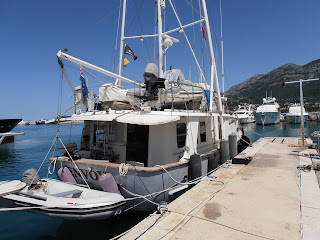
We rarely go into harbours or marinas as it’s too expensive when living aboard

In very strong winds we lay out as much chain as possible, even up to ten times total depth while keeping in mind the proximity of other vessels and the consequences of a wind shift. Of course you must be able to monitor how much chain you are paying out using a chain counter or marks on the chain (we use coloured cable ties).
Our anchoring technique is to very slowly motor upwind and stop in the position where we want our anchor to sit, pay out chain until the anchor is almost to the bottom and then give a short burst of reverse thrust so that Envoymoves astern no faster than the speed at which chain is paying out. We don’t advocate allowing the anchor chain to free-fall until the anchor is on the bottom and reverse movement has commenced as chain can otherwise become tangled around the anchor while it’s dropping. However once the anchor is on the bottom, free falling the chain does save wear on the windlass motor. In our experience and observations of other vessels, if too much reverse power is applied immediately on laying the anchor it will often result in dragging the anchor along the bottom, particularly if the bottom is mud or covered in weed. We prefer to first give the anchor time to settle onto the bottom and dig in properly. We then observe whether the vessel is holding and if all is OK after about 15 minutes we motor forward about half the distance of the chain length and then let the vessel drift back with the wind. The anchor will fully dig in when it stops the vessel’s backwards drift and then we apply a little reverse thrust to ensure the anchor holds. When the vessel “bounces back” on its rope rode you know it’s holding.
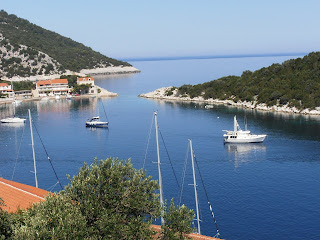
Envoy in superb Zaklopalica, Croatia
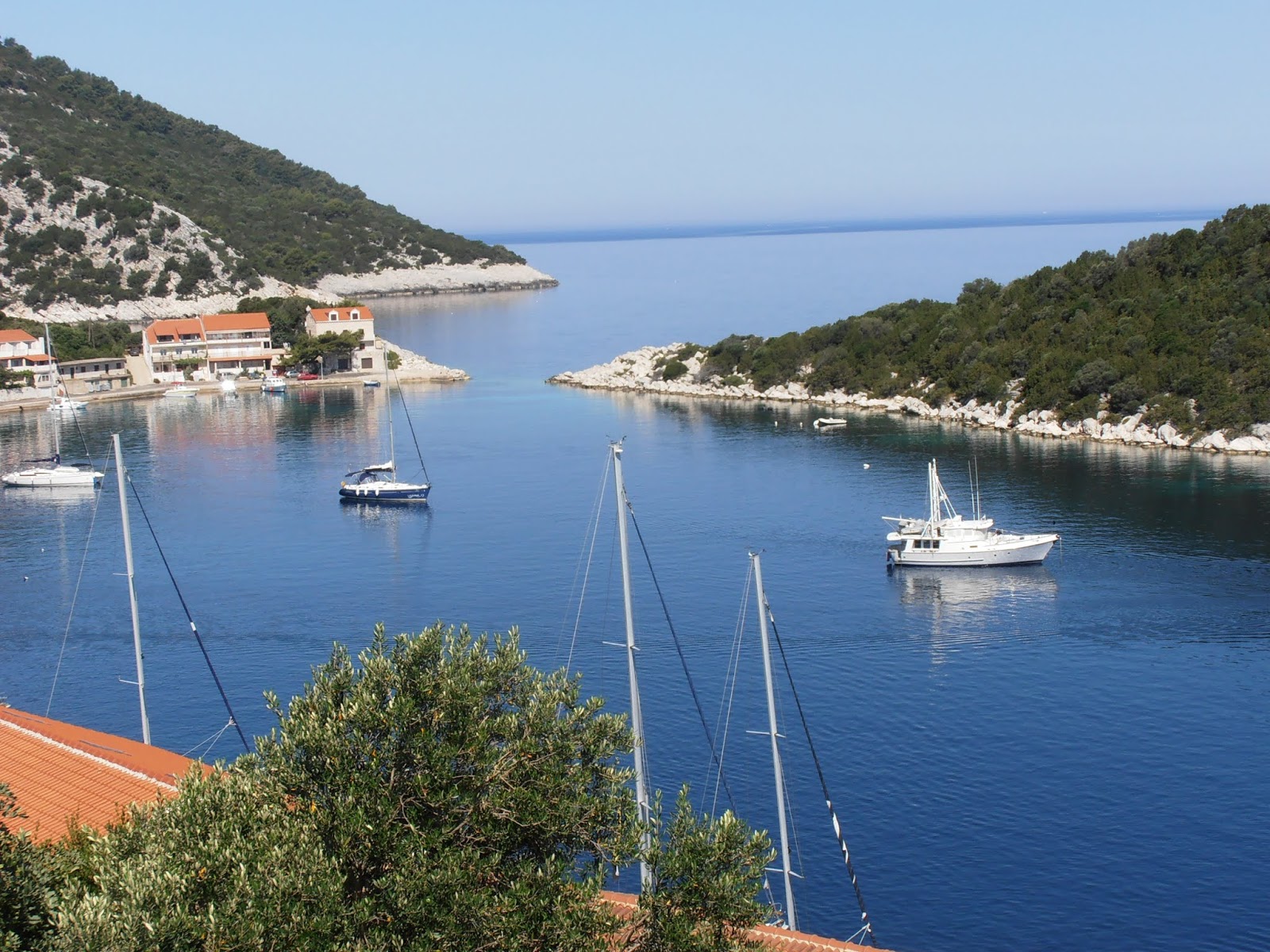
In strong winds it is important to use a heavy duty and longer than usual anchor rode to act as a good spring. We set this up with the snubbing fitting just below water level and with several feet of chain hanging on the vessel side of the fitting to add to the spring effect. Now we record our GPS position and activate our anchor and depth alarms to monitor any dragging.
If depth, water temperature and visibility allow we check the anchor using a mask and snorkel to ensure the anchor is well set and not obstructed.
We then make preparations for the coming blow, ensuring all gear on deck is securely lashed down, buffers are readily available in case of another vessel dragging into ours, and that we are able to drop or cut the anchor chain with a buoy in an emergency.
If there are other vessels nearby we put our buffers in position.
We prefer to leave our tender in the water in case it’s needed, but secure it well close behind Envoy’sstern. Never leave a lightweight tender on its painter behind your vessel in a strong wind as you may lose it or it may flip upside down.
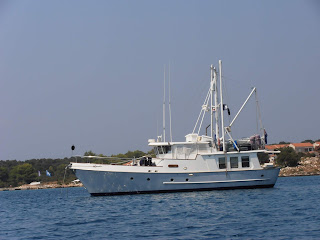
Secure at anchor in Croatia’s Loviste
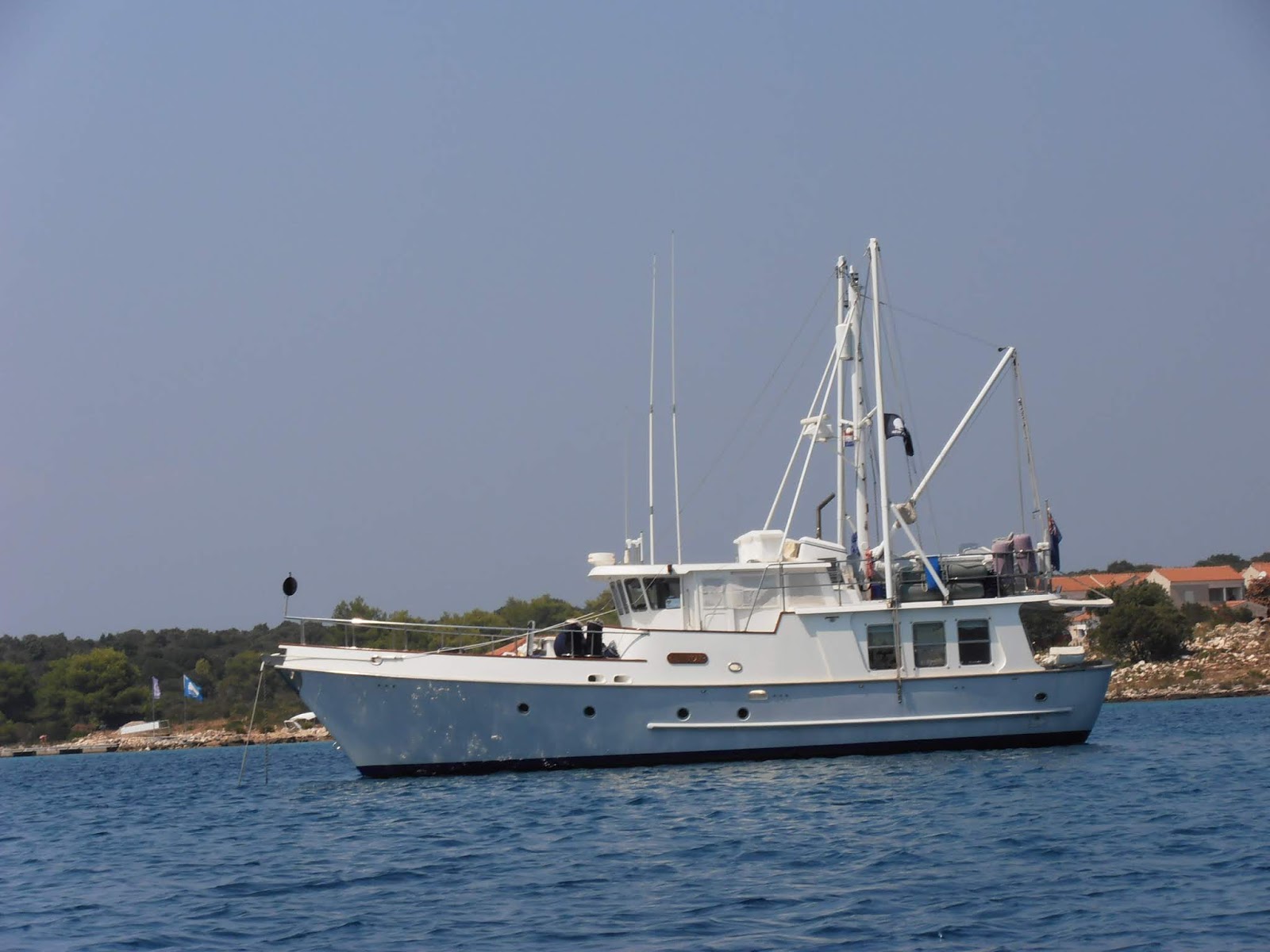
Now is a good time to think what may happen if there is a significant wind shift or a need to move. Check the anchorage using radar and plotter during daylight to know exactly how it looks, because everything looks very different by night. It’s also a good idea for the skipper to get some sleep during the daytime when others can more easily monitor and handle any situation.
Before darkness arrives rig your spotlights, have flashlights to hand, turn the radar on standby, and ensure the engine is ready to start in case of any emergency arising, such as the need to avoid a dragging vessel, or the need to reduce strain on the anchor in very high gusts. As skipper, I also sleep in the pilot house so that I can constantly monitor the situation and react quickly.
When the strong wind arrives it’s usual to see sheets of spray lifted off the surface of the water and wind waves up to about two or three feet, even in a sheltered bay with little fetch.
Sometimes your vessel will appear to drag a few metres as the chain straightens out along the seabed, so don’t be in too much of a hurry to move if the position alarm sounds.
Of course there is usually some trepidation and a need to maintain a state of high alert, but by following the above procedures we’ve safely and comfortably anchored though many blows.
We’ve never encountered winds above 70 knots and realise that circumstances may be very different in winds of for example 90 knots or more.
The “strength” of wind does not increase in a linear way relative to wind speed, but dramatically more so as the square of the difference. For example to compare the strength of a 40 knot wind with a 20 knot wind:
20 knots squared = 400
40 knots squared = 1600
So a 40 knot wind is 4 times as strong as a 20 knot wind.
Similarly a 90 knot wind is nearly twice the strength of a 70 knot wind.
We’ll be happy not to experience trying to anchor in those conditions.
Happy and safe anchoring.
Heading to Canada May 2, 2018 to May 21, 2018
Wednesday, May 2nd – We were able to pick up the U-Haul the evening before our departure so we started loading it as soon as we got home. In the morning we finished loading and headed out for our first stop – Texarkana, TX.
Thanks to ou…
Heading to Canada May 2, 2018 to May 21, 2018
Wednesday, May 2nd – We were able to pick up the U-Haul the evening before our departure so we started loading it as soon as we got home. In the morning we finished loading and headed out for our first stop – Texarkana, TX.Thanks to our friend Sa…
May 18 – Hammondsports, NY
“The purpose of life is to live it, to taste experience to the utmost, to reach out eagerly and without fear for newer and richer experience.” – Eleanor Roosevelt
Since it was a nice day we decided to take a drive over to Keuka Lake and check out the little town of Hammondsport. This cute little village sits at the south end of Keuka (Q ka) Lake, which is two lakes west of Cayuga Lake. Keuka Lake is one of the few Y-shaped lakes in the world and considered by many to be the most scenic of the Finger Lakes…we definitely thought it was amazingly picturesque. Hammondsport was voted “Coolest Small Town in America” by readers of Budget Travel. It too is very picturesque with historic homes and buildings. The town square is filled with restaurants, boutiques, art gallerias and antique shops. There are several museums in the area and many wineries that have wonderful views of the lake.
CONTINUE READING HERE…»
London, UK to Harlingen, NL
From London we made a 267-mile run to Harlingen, NL to pickup our new tender before continuing on to Norway. We spent a peaceful night anchored at Stangate Creek near the mouth of the Thames before making an overnight run to Harlingen so that we would arrive in the morning on a rising tide. Except…
Inside Passage to Alaska part one
Day 1: Sidney to Thetis Island: Today we are beginning our trip up the inside passage to Alaska. Our goal is to reach Glacier Bay by July 4 . We have been granted a much coveted permit to enter Glacier Bay July 5-11th. You can apply for these permits 60 days in advance. Only 13 […]
Yesterday sucked. Today’s better.
I’ve had my IROC-Z in a storage container at a local business since last year. I bought winter tires for the Jeep off the young fella running the place and he let me store my summer wheels in there as well. Stopped in there yesterday to get them and th…
Yesterday sucked. Today’s better.
I’ve had my IROC-Z in a storage container at a local business since last year. I bought winter tires for the Jeep off the young fella running the place and he let me store my summer wheels in there as well. Stopped in there yesterday to get them and th…
May 17 – Cascadilla Gorge Trail
Allan H. Treman State Marine ParkUpstate New York…so many lakes, so many cute towns, so many wineries, so many waterfalls, so many trails and so many beautiful places to explore. A beautiful day means we go out and play, so today we rode our bikes up…
