
The Morehead City pit stop had gone very well. By Tuesday at 2:15 PM, we were back on the water after a rather efficient fueling process that had taken only an hour and 45 minutes. Now we were headed southwest along the North Carolina, Sout…
Snowbird Fall Migration: Skip’s Impressions
A month or two ago, I signed on as an able seaman to assist in the delivery of Guided Discovery from Hingham to Sarasota, not really knowing what to expect other than a leisurely trip to warmer clime. I figured it would be mostly sightseeing, get…
Free Blue Jay Tickets
New Early Bird Contest In this case the Early Bird happens to be a Blue Jay and the prize is 2 tickets for a Toronto Blue Jays game at Rogers Centre during the 2016 summer season. To win simply book your 2016 Boatel … Continue reading →
Falling Towards Winter
With the exception of a few days we’ve had a pretty mild Fall here in NW Illinois. Pam & I have been passing the time by standing on the local marinas fuel docks trying to catch a ride just to get on the river one last time before the snow flies.I’…
Fiji: Around Lautoka
Around Lautoka
In search of Hurricane Holes
November 8, 2015 – Yadua Island (Vanua Levu)
Something happened to me in Fiji… I reset my clock to Fiji Time, and it had nothing to do with crossing the International Date Line. Instead, it had everything to do with slowing down and taking time to enjoy… the sceneries, the people, the marvelous underwater life. All in all, taking the excuse of a broken computer keyboard, I stopped writing, started to play the ukulele, and just did nothing but soak up the surrounding calm and beauty, letting JP and Domino happily shuttle me from one place to the other. Where have we been? I suppose it’s about time to share our Fiji experience with you.
 |
| From Port Denarau to Vitogo Bay, there are several anchoring and marina options |
Around Lautoka. Since we have decided to stay in Fiji for the cyclone season, one of our tasks has been to survey the possible hurricane holes and available marinas. What is the risk of cyclone in this “El Nino” year? 1.5 the normal risk, if you are to believe FijiMet. Yet, according to satellite imagery, a finger of cold water extending towards Fiji seems to somewhat protect the area, while French Polynesia seems more at risk than we are. Who knows? Regardless, we need to develop a strategy in addition to our plan for a quick getaway at sea, which requires our tanks well fueled-up at all times.
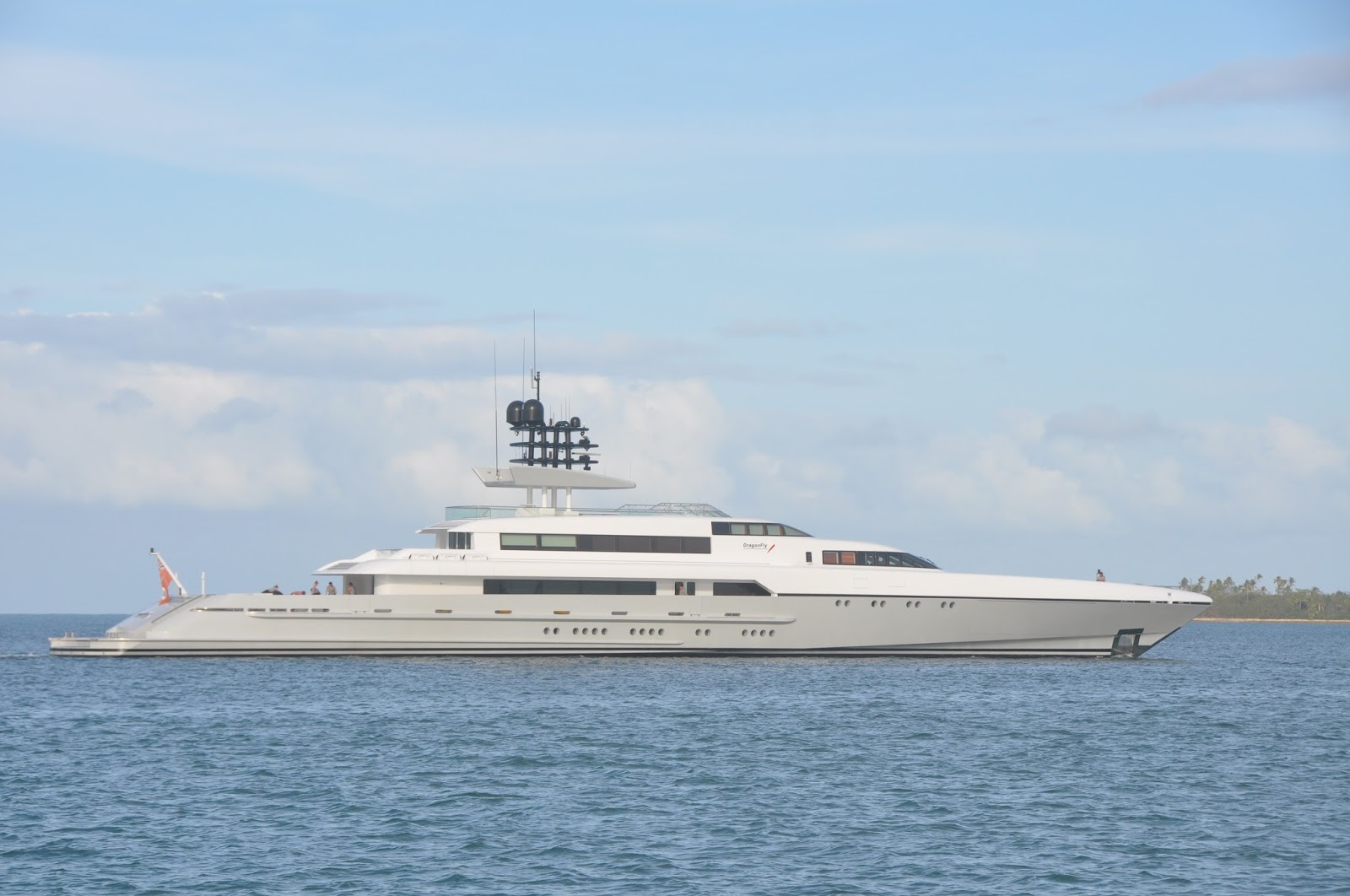 |
| Megayacht “Dragonfly” exits Denarau Want to charter it? |
– Port Denarau –VHF 11 – A world-class marina and home to the most prestigious yachts around, Denarau does not have moorings for yachts longer than 15 meters. Space at the dock is at a premium but we still managed to secure a spot when our granddaughters joined us for a 2-week cruise in the Yasawas. In 16 hours, we managed to knock down 5 loads of laundry (the only hot-water washers in all of Fiji!), take delivery of our groceries from FarmBoy (928-6371), receive our major shopping load from Cost U Less take the $1 bus to finish provisioning in Nadi Town, raid Denarau’s luxury deli for cheese, chips and salsa, and the Wine store for Fiji rum (55 degrees strong!) – When Denarau has no room inside, the only solution is to anchor outside (Malan Cay), where the barge traffic is nasty and the dinghy ride rather wet.
 |
| Port Denarau Marina, the “outer anchorage” at Malan Cay, and the “Bamboo” anchorage deep inside Nadi Bay, close to the airport… beware the reefs! |
Other solution: anchor in Nadi Bay, in front of the “Bamboo” backpacker hotel. Taxis are always eager to take you to town for half the price than the Denarau cabs. Just take your dink up the beach. At night, enjoy the many fire-dancing shows on the beach.
As for cyclone strategy at Denarau, the marina holds a seminar and the marina crew will lead boats up the mangrove at Denarau, but it’s a small spot, crowded with boats… not the best option.
VUDA POINT MARINA (Extension being proposed)
 |
| Vuda Point Marina |
– Vuda Point Marina– VHF 14 – A favorite among cruisers, Vuda has room for 40 boats inside its circular lagoon. It also has one temporary/quarantine mooring buoy outside: wow! Rough anchorage… We left Domino for a month at Vuda and were happy with the care.
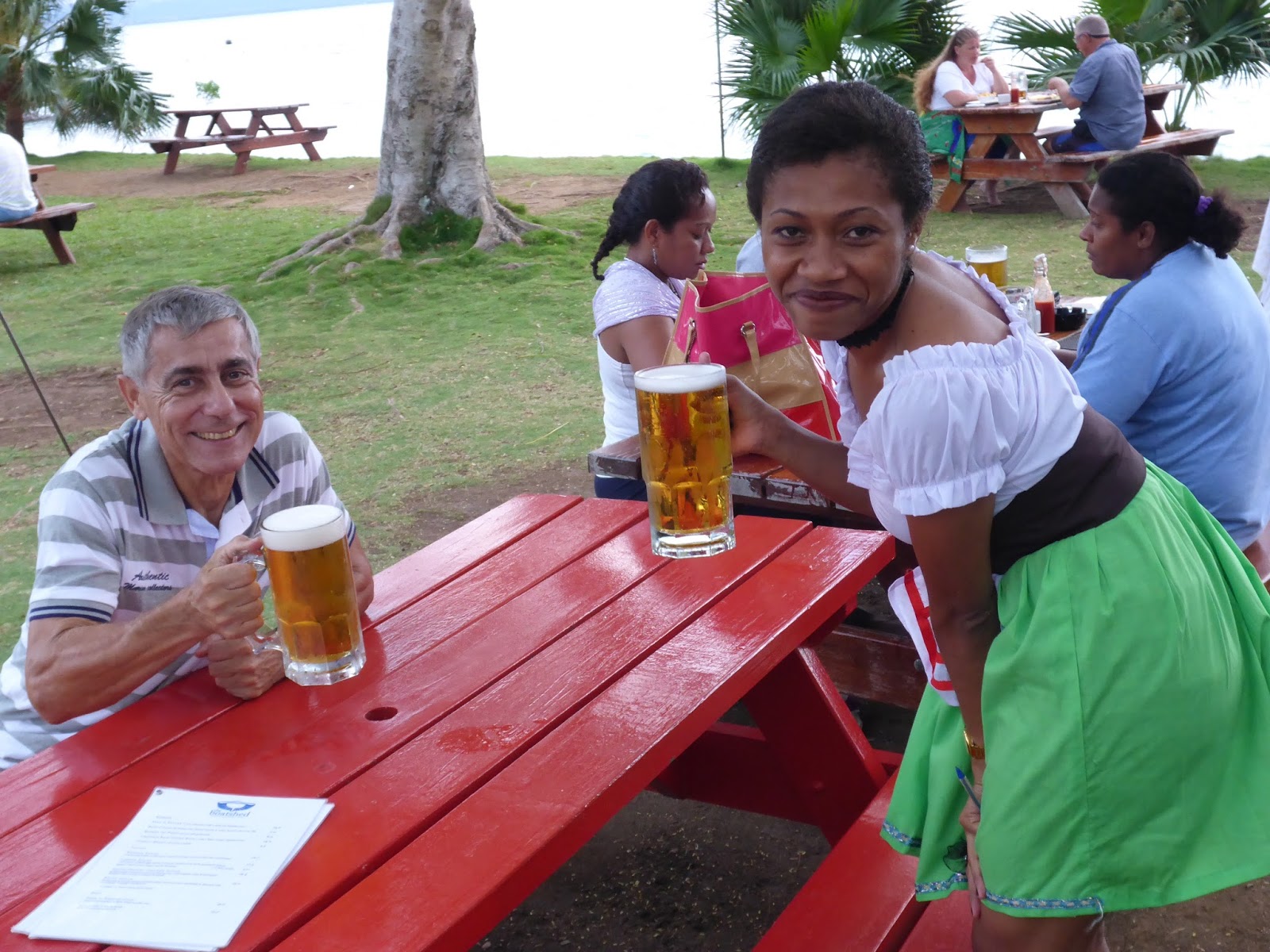 |
| The staff at Vuda Point is always eager to please Oktoberfest was a blast! MUSKET COVE MARINA |
Vuda is our favorite fueling dock in Fiji: easy access and high sides. It’s a good place to leave your boat during cyclone season, in the “keel pits.” It’s also a good place to haul out small boats for a quick paint job. But not for us…
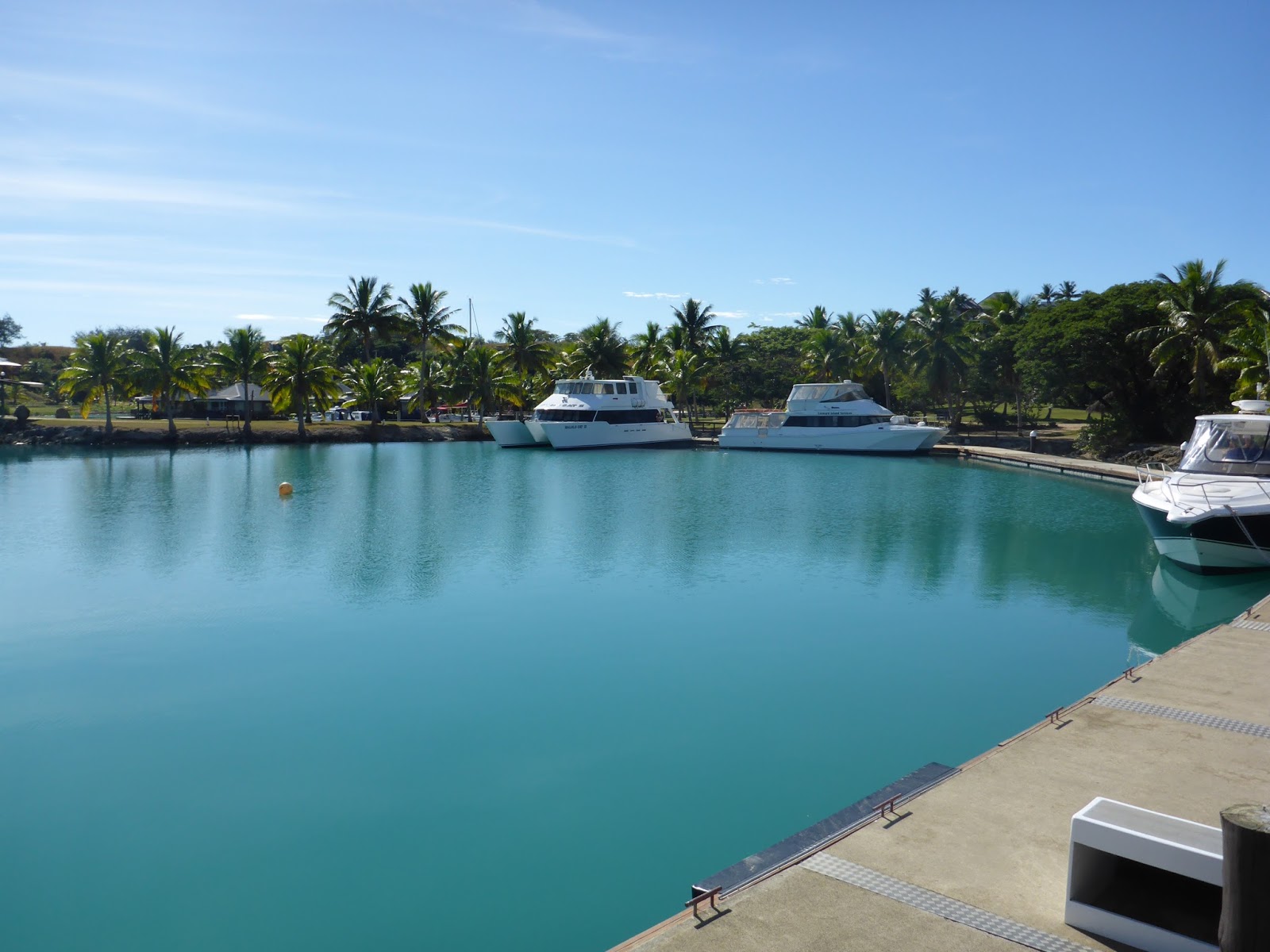 |
| The lagoon at Muket Cove, home of our sistership, the Malolocat IV |
– Musket Cove Marina– VHF 68 – On Malolo Island, Musket Cove is certainly a hit with the cruisers. There are 20 berths and a number of mooring balls, capable to take yachts up to 25 Tons. The marina is packed at the end of the season, after the Regatta and when the yachts await a weather window to make the passage to New Zealand… and then, it’s ghost town! Last week, the marina was empty. Cyclone hole? Not really, except for one spot in the inside lagoon, where we could have left Domino… but didn’t.
 |
| The route to Musket Cove marina and anchorage. Well marked, still watch the reef A splendid Swan ketch ended up on Nuku reef last month! |
– Lautoka – This is a big commercial harbor, not for us to wander into. YET, the river leads deep into the mangrove and that’s ONE possible strategy in case of cyclone. Call the Lautoka Pilot on VHF 16 and he’ll escort you up the mangrove. Call early: 1st come, 1st served.
This said, Lautoka is a great place for provisioning and various yacht services. Rigging, electrical (we had to get an alternator fixed), you name it: cruisers town!
– Vitogo Bay – 17*33.946 S – 177*29.526 E – Slightly north of Lautoka, this large bay is where we escaped to when rough weather hit. Not a cyclone hole per-se, it’s a good anchorage and can accommodate a large number of boats, with good holding in thick mud. The NW end not protected by land is barred by 2 small reefs that cut the NW chop. We spent a week hiding there, not feeling a breeze or a ripple on the water, while yachts everywhere else were slammed with 25-30 Kts, gusting at 40! One drawback: access to shore may exist, but there is no road leading from shore to anywhere… this is swamp land.
 |
| North of Lautoka, Vitogo Bay is our favorite rough weather option |
– Saweni Bay – 17*38.398 S – 177*23.711 E – Between Vuda Point and Lautoka, Saweni Beach is a convenient little anchorage, with excellent holding in “cement” mud, but to be entered with good visibility: Beware the rocks, especially on the SW of the bay. On shore, the public beach is a favorite with the locals, with road access and bus stop, and the apartment complex has a small grocery store. So, it there is no room at Vuda Point Marina, Saweni Bay is an excellent anchoring option.
 |
| Between Vuda Point and Lautoka, Saweni Beach is an easy anchorage, with easy public access |
– Dreketi Bay – 17*39.699 S – 177*22.998 E – Just south of Saweni Bay, Dreketi is a small inlet, open to the west. Although we’ve noticed yachts anchored there, we didn’t explore it, mostly because we found it too open to the west.
Now that we feel better about our bad weather options, we are continuing our circumnavigation of Fiji. The winter has been rather cold, the coldest in the last 10 years, with high winds and cold water, the fish has migrated to warmer waters and the snorkeling has been chilly, 4-mil wetsuit needed. We have been dodging high winds all season, only enjoying a calm day in every 10 or so… rough cruising but still, it’s cruising and it’s beautiful. So, let’s go cruising the Manamucas and Yasawas!

Till next time…
dominomarie
Stuff on Furthur

Recently we have been cruising with a great buddy boat and crew. The owner is new to long range cruising and wanted to join us on the rally to Indonesia to learn the cruising ways. From time to time he has needed help and things i have on Furthur. This inspired me to document the articles i have accumulated that i believe are essential to long range power cruising. Some are big items that came with boat, many are just little things that make a big difference.

The lovely Donna modeling the 2 micron filters used in the fuel polishing system
On the equipment list that is “do not leave home without” list; the most important for cruising 3rd world countries is the ESI Fuel Polishing system, standard equipment on Selene’s. Fuel is a huge issue as my buddy found out. He had a major fuel problem that resulted in me towing him 140 miles and a gigantic repair bill. I run new fuel through the system at least three times with a 2 micron Racor filter before it ever leaves the tank. Another issue with fueling is just getting it aboard. In places, most we travel, there are no fuel docks and fuel is delivered via small boat and barrel or gerry can. A high volume electric fuel pump is needed for the transfer with plenty of hose. I can empty a 200 liter barrel in a matter of minutes, good when bouncing off a cement pier.
Second on the list of larger items is my Forespar Rolex stationary stabilizer system, we loving call “the Fish”. This takes most of the roll out of bumpy anchorages and was used often on this last voyage.

the Rolex system keeps us sleeping at night
Speaking of anchoring, i carry an over sized 55kg Bruce type anchor, really big! I also carry an unusually large amount of chain, 200 meters (600 ft). i have cruised with two boats that carry half that amount and it has genuinely restricted where they can anchor. Just the other day i dropped the hook in 145ft of water to access a fantastic dive area. i also carry an array of spare anchors and rode, all unused in the last six years but essential. Due to upsizing my windlass to accommodate the heavy gear, i actually carry a spare windlass. i will also have a spare motor for the larger one delivered soon, the windlass working is a mandatory part of cruising.
We often grab a mooring in many places we visit. In the past we used the traditional boat hook to grab the tail of the mooring, this was always a challenge and caused great angst with the crew, not to mention several lost boat hooks. I watched the livaboard dive boats with even taller bows than Furthur secure moorings and saw they used a three pronged hook and line with great ease. We now have such a hook and it is far easier to use.

our “happy hooker, mooring hook
Marinas are few and far between, we often go months without docking, when we do they are frequently rolly and crude. Sometimes we tie to a non floating wharf or larger steel ship. A good selection of large fenders and long dock lines is needed in such cases, big ones!
Water and air, cannot live without them! We have a great FCI water maker, 200 liters an hour, i had a smaller unit that has failed and will be replaced soon. i like having two water makers, one high volume and one smaller that can run on the inverter while underway. No water, no happy crew! We also have an inline charcoal filter for the dock hose for the times we are at a marina. We are dive fanatics, so my Bauer dive compressor gets a work out. My cruising mates without compressors often miss the best diving and are reliant on finding dive shops for tank fills. The compressor on Furthur is electric so requires a generator, many carry gas driven compressors, noisy and require a separate fuel supply and extreme care to access clean air in the intake. We carry eight tanks.
The dinghy is the king, without it the trip ends, period. i carry a small spare roll up inflatable with small outboard as well as my larger one. My good friend and cruising guru, John Neal, told me at the beginning of the trip, “lift it or lose it” and after another friend got their dinghy stolen in Tahiti, i have always put the dinghy up at night, no exceptions! I opted for the mast/boom davit arrangement instead of the powerful hydraulic crane Selene offered. I can completely replace the moving parts of my system with parts carried aboard.

the dinghy hook saves the coral
As we dive off the dinghy we have a small anchor, a local style which is a crude hook made of rebar. i used to carry a more traditional anchor with chain lead but found that did damage to the precious coral we were diving to see, the hook does little damage and is more secure.
To the smaller stuff; the recent towing incident reminded me why i carry a long, strong tow line, one that has been neatly coiled and unused until really needed, really needed. I also carry a large spool of small line for stern tying in small anchorages, this gets used more often, fortunately.

the shore tie long line and reel
A cruising boat requires an inordinate variety of petroleum pridust to keep going and a replacement supply for each is needed: dive compressor oil, water maker oil, steering ram fluid, engine and gen oil (they used the same grade), transmission oil, outboard 2 cycle oil, hydraulic oil, and even the essential massage oil supplies are stored on Furthur. Along with the petroleum products comes an array of filters; water maker, ESI system, engine, gen factory filters and Racors for each, hydraulic filter, water filters, the list goes on. i can now repack my dive compressor filters so that is a big savings. Between needed oils and filters my inventory reaches into the thousand dollar range not to mention the space to store it all but it is all needed when it is needed.
Along with this inventory comes an endless supply of spare parts too long to list. My motto is if it broke once it will again so any time i replace a part, i buy two, this goes for the large array of pumps i carry. On the essential list are plenty of impellors for all things that use them, i also discovered the wonders of silicone grease to install impellors and lengthen their life.
Add to the list an extensive supply of nuts/bolts, fuses, light bulbs, O rings, anything you can think of that might break. It is often the small things that stop a happy cruise. i now carry complete rebuild kits for all pumps and hydraulic rams. There is a great rule of engineering, if it moves and is not supposed to use duct tape or wire ties. If it supposed to move and does not use WD40. So carry plenty of each. i also like the silicon spray WD puts out. Along with that carry ratcheting cargo straps and bungee cords to secure things on the deck. We carry a vast selection of adhesives; from super glue to dinghy repair glue to epoxy to silicon and the all important 5200.
Clearing in and out of foreign countries can be daunting at first but soon seen as just part of the deal. I find it handy to have a printer/scanner onboard so i can make the dozens of copies of documents required by the various agencies. This will expedite clearing in and out and gives you the appearance of knowing what you are doing when you can produce anything they ask for. This can also save you the angst of handing your passport and boat docs to a stranger, often known for corruption, to get copies made at the last minute.
Just for Americans: If your boat is from the West, it is probably 110v 60 htz and will not run appliances made in the East, or anywhere else. Carry spare power tools, fans and appliances that run on 110v only along with spare extension cords.
Some just for fun: One of the things my cruising mates marvel at and desire is my balloon tying kit. i love to sit in a small village and make balloon animals, nothing will get you into the heart of a small village like balloon animals. We also carry a supply of small toys for kids.

The trick is to distinguish between the things you need, might really need and never need. There are items i will never use but keep, safety items like the life raft. there are never used items i have found multiple uses for; the tow line doubles as a storm mooring line and i have made our own moorings with it at dive sites. Then there are the piles of crap one collects and never uses or never will. The trick is to determine what to throw and what to use, i go through this process yearly.
So here is my list, use it as you will. i am sure there are things i forgot and things i am missing and will add another time. Cruising happily depends on three things: prepare the boat as thoroughly as you can, take spares for the predictable and unpredictable, know your systems and have a plan to temporarily fix or do without. Follow these things and the world is yours!
Another Dog Park…
We spent longer than we originally anticipated at Hinckley Yacht Services in Savannah but left with the engine room in better condition than when we arrived. Boat yards are not typically good places to spend time but this stop was made great by the oth…
Snowbird Fall Migration: Transiting Cape Hatteras at Night
Cape Hatteras is a challenge for small pleasure boats, which is why most opt for the ICW between Norfolk and Morehead City. That said, based on the number of wrecks, it also a challenge for ships.
Hatteras presents several unique challenges. The Gulf Stream’s 2 to 3 knot warm water current turns northeast here and converges with the weaker cold water Labradore Current. Because of these currents, the Cape often sets up its own weather patterns and conditions can change rapidly (which we experienced last November). It can also set up standing waves when winds and currents are in opposition. Add the need to head 12 miles out to sea to round Hatteras’ uncrossable Diamond Shoal, and the fact the east bound weather fronts often converge here and you have a formula for rough unpredictable water.
I watch the weather at Hatteras almost every day trying to understand the factors that contribute to the consistently rough seas. My watch intensifies as the cruise south approaches. Hence, my decision, days earlier, that we had a weather window for the trip reflected my analysis of the predicted weather at the Cape.
This was still true on Saturday as shown in the photos below. A weak high pressure system dominates the east coast and Siruis’ sea condition screen reflects calm seas on the east coast.
Late Monday, as we approached Hatteras, the forecast for Monday evening called for west winds of 10 to 15 knots with 3 to 5 foots seas and a period of 6 seconds. NOAA’s Tuesday prediction called for the winds to swing north and increase to 15 to 20 with 4 to 6 foot seas with a chance of showers in the morning.
Actually, as early as Monday morning the winds had already swung northeast and continued to build as we proceeded south toward the cape. Northeast winds are favorable as they produce a push and a following sea (more push). 46 miles north of the Cape Hatteras Light at 10:00 PM we had 20 knot east northeast winds gusting to 25. Seas, which we estimated at 3 to 4 feet, were off the port beam. The boat was riding smoothly. That said, this is Hatteras and conditions can get bad real fast. As a precaution, we followed our Standard Operating Procedure for preparing the boat for rough seas. They never came.
At 2:00 AM on Tuesday we rounded the end of Diamond Shoal with northeast winds and a 3 to 4 foot following sea and continued on to Cape Lookout with essentially unchanged conditions. In the 24 period starting at around 11:00 AM on Monday, we had rounded the dreaded Cape Hatteras and her somewhat nasty step sister, Cape Lookout, without difficulty.
We also picked up speed and therefore time on the Cape Charles (Virginia Beach) to Morehead segment due to the following sea. At Block Island on Saturday night, we were averaging 8.6 knots. Then came the offshore crossing between the Hamptons and Cape May (NJ) where we dropped to 8.1 kts due to head winds and heavy seas. Then Cape Hatteras segment got us up to 8.3 kts and within .1 knts of the boat’s optimum cruising speed of 8.4.
At 12:30 PM on Tuesday we pulled into Morehead Yacht Basin. Refueling was completed in 1 hour and 45 minutes by one very efficient crew. We took on 849.1 gallons of diesel and by 2:15 PM we were on the water for the Morehead to Stuart Florida leg. Did I mention that we paid $2.26 for fuel? That is the lowest price I’ve paid for diesel in years. Below are statistics:
Hingham to Morehead City Data
> Engine Hours: 79 hours
> Time Enroute: 4 days and 3 nights
> Average Speed: 8.3 kts
> Diesel Fuel: 849.1 gallons
> Cost per gallon: $2.26
Written by Les.
Shot With An iPhone
Pretty amazing — Chasing Light: Switzerland from Austin Mann on Vimeo.Nordhavn Exumas Abacos Bahamas trawler Caribbean Pickwick Boat dogs
Memphis Downtown
Snowbird Fall Migration: Weather Surprise
This article is trip south second installment
Saturday, we awoke to clear skies and calm winds. Then Skip and Guy arrived and we, the crew, made final departure preparations (stow the boarding ladder, the deck chairs and pull the power cord). We were off the dock at 7:15 AM. Not bad.
But not perfect. When it came time to cast off, well actually after we had untied all but the stern line, I discovered that I had not fired up the engines. Guy’s fast action of not releasing the line when I declared a “problem” turned my error into an inside joke rather than a potential accident. When I arrive in Sarasota I’m going to get checked for dementia.
Side Story: Several days earlier I had moved the departure time back to 6:00 AM, but Diana thought that was too uncivilized. Reluctantly I moved it ahead to 7:00 AM. Diana’s desire to change the time worked in our favor hours later when we arrived at the Cape Cod Canal.
Anyhow, we were off with perfect weather as we effortlessly cruised south along Cape Cod Bay to the Cape Cod Canal. Our passage through the Canal took just short of an hour. Luckily, Diana’s time change reduced both the time and velocity of the unfavorable current at the west end of the canal resulting in a loss of only 1 knot. Then, at mid canal, the current swung and we gained back 2 knots. Most importantly, we also had a favorable current in Buzzards Bay so that by the time we reached Block Island at 7:52 PM we were flying (OK slight exaggeration) at an average speed of 8.7 knots, .3 knots above our 1400 RPM optimal cruise speed (and that average is starting from the dock).
A (close to) gourmet dinner was served at 5:30 PM as the sun was setting. Salad of romaine lettuce, avocado, tomatoes, onions, walnuts, raisins and pine nut with a balsamic vinaigrette; oven heated meatballs in marinara sauce and oven baked potatoes with herbs de proveance and garlic. The wine was 2012 Mount Veeder Cabernet Savingnon, my favorite. Desert was fresh raspberries with whipped cream. Truly I was “Cruising Like a Gentleman” (which was the title of Passagemaker’s October 2014 lead story on our 63 Outer Reef).
After dinner we “settled in” for a pleasant overnight cruise along the south coast of Long Island.
Explanatory Note: “Settled in” involves taping off light sources to preserve night vision and setting up the multifunction screens with chartplotter, AIS, radar and night vision.
I have a Long Island cruising strategy. If the sea condition are rough, my programmed route takes us close (within 2.5 miles) of the coast to take advantage of the shallower water that tends to diminish wave height. If seas are favorable, I avoid the New York Harbor shipping lanes by cutting southwest toward Atlantic City just east of Shinnecock Inlet (South Hampton, NY).
Just after 1:00 AM we received a Coast Guard broadcast alerting us to a dredging operation off Moriches Inlet extending 2.5 miles out into the ocean on the surface. We marked the location and determined that it was within a half mile of our intended route. Offshore sea conditions on satellite weather showed 3 foot head seas for the 95 nautical mile run direct to the New Jersey shore. Since we had been riding comfortably in 3 foot heads seas for hours we turned to a heading of 241 degrees. This move also saves us 14 NM which saves one and a half hours of running time (or about 15 gallons of fuel).
At 4:00 AM on Sunday, we recorded winds from the west southwest at 25-30 knots and head seas of 3 to 4 feet. Still comfortable. A check of satellite weather continued to show 3 foot seas for the next 24 hours.
Totally disregarding Sirius Satellite Weather’s existing and predicted wave heights (just kidding) the wind and seas continued to build. At 7:00 AM we recorded 25 to 30 knot winds with seas of 4 to 6 with and occasional 7. Not so comfortable.
Three hours later (10:39 AM) with head winds continuing at 25 to 30 knots we recorded 6 to 8 foot head seas with an occasional 10. Not good. All books on the shelves in the VIP stateroom were dislodged when the wood rails fell out of their slots. No damage but what a mess. Also the forward hatch leaked but a twist of the screwdriver solved that problem. The bigger problem was 600 feet of anchor chain that was airborne in the chain lockers. Readers will recall that the platforms in the lockers wound up on top of the chain when we encountered 10 to 12s off Cape Hatteras last May when we were running ahead of Tropical Storm Anna. I expected this would be the case this time and my worst fears were confirmed when I reluctantly checked the lockers during refueling in Morehead City. The port platform was sitting on top of the chain (see photo). Oh well, another three hours project straightening out the chain and re-seating the platform in it rightful place. Did I mention that our position at 7:18 AM was 30 NM southeast of New York Harbor ?
Decision time. At 7:18 AM, we were 60% of the way to the Jersey Shore and 30 NM from New York Harbor. Turing northwest to there would put the seas on our beam. Turning back or due north toward Long Island was a possible option as it would improve the ride but would delay the trip. Holding the course was reasonable as the seas would diminish as we got close to shore. We chose that option and within 3 hours the sea conditions had improved to a tolerable 5 to 7. Four hours later (6:00 PM), seas were 3 to 4 and we were able to cook dinner. At that point Sirius Satellite Weather got “serious” and started reporting the true conditions.
Dinner Sunday evening included a salad, shells stuffed with ricotta and spinach, white wine and raspberries with whipped cream for desert. Very civilized.
Explanatory Note: My daughter, Lesley, graciously volunteered to cook gourmet meals that could be frozen and reheated (either with the microwave if seas were rough or oven heated if seas were calm). This replaced the Trader Joes frozen dinners that I had used in the past. What a difference!
At 9:00 PM on Sunday evening we were off Cape May New Jersey riding comfortably on 2 to 3 foot head seas.
The head winds, head seas and big waves encountered on Sunday Night and Monday morning reduced our average speed to 8.1 knots.
Next challenge Cape Hatteras.
Written by Les.
