
|
|||||||||
[KensBlog]A Smooth Passage from France to Spain
Passagemaking with a Nordhavn 2015-08-03 21:14:53
|
|||||||||
BOATING ETIQUETTE
In New Zealand we’re fortunate that the majority of skippers have some degree of competence and sense of courtesy to others, and that we have a sensible and reasonably enforced set of Navigation Safety Rules.
But cruising around Mediterranean countries it’s an entirely different story and we frequently observe poor behavior on the water ranging from the discourteous to the downright dangerous – for example failure to observe collision regulations, crew bow riding on high speed vessels, anchoring too closely, and speeding or water skiing between anchored vessels and close to swimmers.
Most aggravation that occurs seems to revolve around anchoring, speed, wakes, jet-skis and noise and I’m going to take a light-hearted look at these issues.
The first people in an anchorage have priority and should expect skippers of later arrivals to respect their space and peace as much as possible. But this doesn’t mean they can have the anchorage all to themselves; how often have you slowly cruised into an anchorage to see one or two other skippers standing on deck, unsmiling, with hands on hips and negative body language intently watching your every move? You approach their stern and drop your anchor about two metres behind them.
“Why don’t you drop your anchor in my cockpit?” is sometimes asked aggressively.
I’m often tempted to reply, “yeah I was aiming for it but missed”.
There is nothing wrong with laying your anchor immediately astern of another boat or even close alongside it, as your own vessel will drop well back behind them respecting their space and privacy.
Sometimes you will anchor your boat safely clear of and in front of another whose skipper will yell out, “hey your boat’s over my anchor.” There’s nothing wrong with being over someone else’s anchor, provided you move your boat if necessary when they want to retrieve it. This is not to be confused with laying your anchor or chain over the top of somebody else’s, an understandably annoying practice.
It can be a good idea to buoy your anchor in rocky anchorages so that if it gets fouled you can retrieve it more easily (though this doesn’t always work). However some skippers have the annoying practice of using buoys wherever they anchor, probably with the aim of keeping other vessels away. The problem here is that as boats move position with tide and wind changes the buoy’s line can foul another boat’s running gear. Buoyed anchors and stern anchors have no place in a busy anchorage where all boats must be able to swing freely, and if another vessel’s anchor buoy becomes a hazard you should politely ask her skipper to remove it.
Nowadays we see much larger planing vessels than were apparent several years ago and most of these cause considerable wakes. Unfortunately many skippers helming this type of boat seem to have more money than sense or experience and a regular widespread problem is planing boats approaching anchorages at a speed just off the plane, pushing up huge wakes, their skippers seemingly oblivious to the fact they will cause every vessel at anchor to roll alarmingly. Good seamanship requires approaching an anchorage at a speed which will cause the smallest possible wake.
We now see ever larger high speed planing boats putting up dangerous wakes
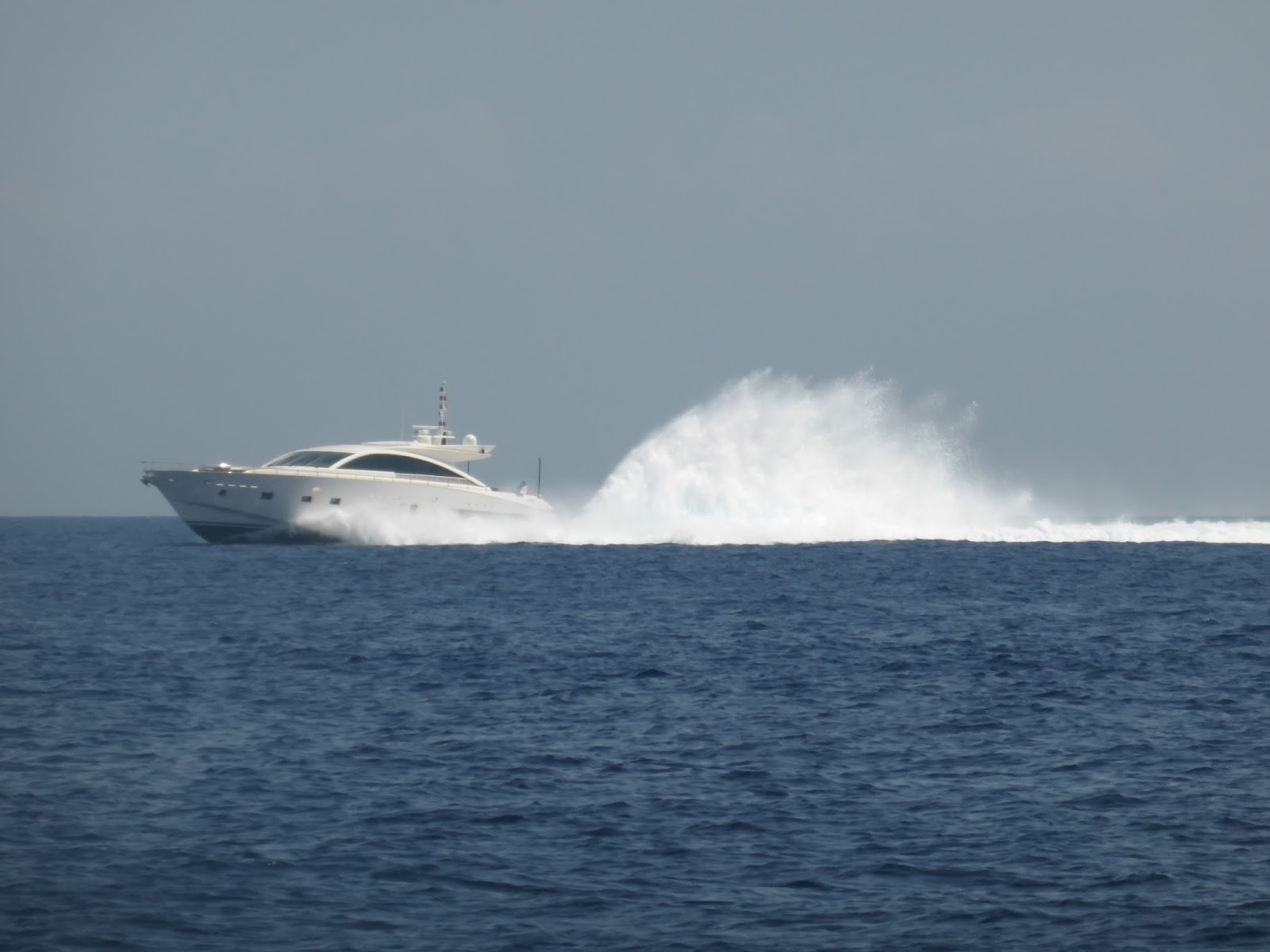
In the Med people driving dinghies or jet skis at high speed or water skiing within a few metres of anchored vessels is a major problem, and extremely dangerous since people are often swimming around their vessels. In six years cruising here we’ve never seen any type of action by authorities to prevent this.
Many boaties enjoy listening to their music over a few drinks in the evening as they recount the day’s events, but these days there are so many high-powered sound systems that an anchorage can sound like a raging battle of the bands. If a nearby boat was anchored first and has a good sound system, why not listen to their music rather than try to drown it out with yours?
Many people like to enjoy themselves and make a bit of noise until a reasonable hour, but if you intend to party loudly all night long, best anchor well away from others.
Boating remains one of the great pleasures in life and can be made that much more enjoyable if all observe regulations, show consideration to others, keep their cool and avoid confrontation.
2015-15 Pelican to Idaho Inlet, Hoonah, Funter Bay, St James Bay, and Juneau
Tuesday, July 28th: Pelican to Idaho InletThe storm was abating and we had high hopes for sunshine. Off the dock by 7:30AM we cruised up Lisianski Inlet (not Strait) towards the small fishing village of Elfin Cove, self-proclaimed “A drinki…
Cefalu to Sardinia

Chart of our cruise from Sicily to Sardinia
I am always a bit anxious about our first overnight trip of the season and I am not quite sure why. With our array of instruments, including 2 radars, 4 GPS, AIS, night vision and depth finders, it is as safe as cruising during the day. The issue is that you don’t get much sleep. If you are on a 5 or 6 day passage, you get into kind of a rhythm. We normally do 3 hour shifts at the helm from 6 pm until 6 am. After a few days, you develop the ability to fall asleep shortly after your 3 hr shift and wake up to do another 3 hours later with no problem. Doing it for just one night leaves you kind of beat the next day. the 12 to 3 shift and the 3 to 6 shifts are probably the worst because getting up at midnight or 3 am after having only a few hours rest is unnatural.
One of the questions people always ask us is “How do you prevent yourself from falling asleep at the wheel”. Well, it is not easy! Fortunately we installed a device called Watch Commander.

As you can see in the picture, it has a timer switch on it. We normally set it for 20 minutes. Before the twenty minutes expire, you need to push the red reset button or a subtle alarm goes off, loud enough to wake you, but not everyone else on the boat. Should the alarm continue to beep for more than 20 seconds, the LOUD alarm goes off, and that will wake EVERYONE on board. It is a good thing because if the person at the helm cannot shut off the first alarm within 20 seconds, it means that they are not there or incapacitated. Let’s say that during the night the helmsman decided to step outside for some fresh air and somehow fell over the rail and into the sea. If the shift had just started, it could be 3 hours before they were discovered missing, leaving little or no chance of finding them. If the watch commander is used, only 20 minutes would have expired, making the chance of recovery much better. Also, on seabird, we are supposed to wear inflatable vests if going outside at night with a strobe light attached.
When we installed it, I connected it to the circuit breaker on the compass light so that no one could figure out how to turn it off. While on one trip,we had friends aboard who found the device distracting and while on their shift, traced the wire to the compass light circuit breaker and shut it off. Needless to say, when we discovered this, we “spoke to them”, reminding them that while at sea on Seabird, it is not a Democracy and we set the rules.
Having said all of that, a beautiful moonlit night cruise with flat calm seas is a delight. Well, the weather gurus promised but in this case did not deliver. Late in the day, the waves started to build. We were heading directly into it which meant the bow would be pitching up and down, making the trip uncomfortable and eliminating any possibility of sleep! Then, on the radar…….

Storms. All of the red that you see in the above picture of our radar indicate storms. Storms unfortunately can bring much higher winds and lightning. We have been through them many times before but my fondness of them has not grown one bit. On top of that, if the rain is heavy enough, it just about obliterates any radar targets out there, leaving you to fly blind. Fortunately, most of the big boats that could squash me like a grape have an AIS (Automatic Identity System) which will show up on my chart plotter in any weather with position, speed, course and most importantly, CPA (Closest Point of Approach). The small boats, which I could squash, usually don’t have an AIS and I am also worried about them. In this weather, they should not and probably aren’t out here in this.
Interestingly enough, there was not all that much wind. If you had not experienced it before, you might wonder how it could be so rough with so little wind. These are referred to as swells. In New England, where we grew up, swells could be very large, but with long spaces between them, causing little discomfort. In other places, like the Med, the swells can be large, with almost no space between them and no apparent wind pushing them.
The other things we have experienced here in the med that we did not see much of elsewhere were conflicting wave patterns. On this trip, we had big, choppy swells coming from the south/southeast and in addition to that, a good size chop coming from the northeast. This produces these pointy waves that Seabird does not like one bit, nor does the crew! On this trip, the seas were 7 to 12 feet of pointed ugliness.
The night was predictable. Unless you can sleep while being slammed up and down in the bed with all of the noises that accompany that, it would be a long night. On the off shift, all you can do is lay there on your bed with your eyes closed hoping to get a few moments of shuteye before the 3 hour alarm goes off. At midnight, my iPad annoyingly beeped at me. I dragged myself out of bed, splashed some water on my face and went into the engine room to do the 3 hour check. Just a not: VERY few times have I gone into the engine room for that check and found anything amiss. We have a checklist of about 25 items to verify. Odd smells, loose or missing belts, high temperatures, fuel flow problems, leaks. For those few times myself or Carol have found a problem, it has been worth going down there. Good periodic maintenance prevents problems. This time, everything was fine and I went up to the pilot house to take my watch from my tired and bleary eyed wife. In 3 hours time, I would be equally bleary eyed.
My shift went just fine, but the weather never improved. I was not surprised when Carol came up at 3 am slightly less bleary eyed and said that she had not slept much. I did another engine room check and hit the hay for another 3 hours of trying to sleep on the roller coaster.
I have never ceased to be amazed at the ruggedness of these boats. They can be slammed mercilessly for days at a time with hardly a complaint. WE may complain, but we never hear a peep from the boat. We have been through much, much worse for much longer periods on Seabird, so, even though it was uncomfortable, I knew she would get us home, as she did this time.
As the sun rose and we got closer to Sardinia, the weather started to improve. We were tired but happy to see land.
In my previous email, I complained about med mooring. Carol corrected me the other day. I do hate the “slime lines”, but we can get through that. The real problem is our Passarelle, which we use for getting on and off of the boat while med moored. Deploying it and keeping it in place is a full time job in bad weather. It was not really well thought out. Had I given it more thought, I would have heaved the hundred pound thing overboard and gotten one of the attached systems with a hydraulic lift. They are not cheap, but would have made our stay here in the med more enjoyable. I also would have installed a vertical rope windlass, even a hand operated one, to use for hauling in and tightening the slime line one we were in the slip.

Our big beast of a Passarelle. It is welded aluminum and nearly indestructible except that
Carol and I nearly self destructed several times getting it off of the roof and onto the dock.
We landed in Sardinia at a town called Villasimius. It is on the southwest corner of Sardinia and has a beautiful marina, one with a few restaurants, a decent marine store and some nice shops. Once we were tied up, connected to shore power and registered at the office, we made the decision to do our touring later, after a well deserved rest.

Our marina in Villasimius
We spent the next day touring the town of Villasimius. It was about a two mile walk which took us mostly by pretty homes and a few farms. One of the farms we went by had these cute little miniature horses.

Minature horses in Villasimius. Who told the people of Sardinia that bangs are back in style?
The town was a surprise. It was very upscale. You can always tell by the type of cars that you see in the town. In this one, it was probably 50% Mercedes, Audis and BMWs. Interesting, in the land of Ferrari, Lamborghini and Maserati, you rarely see one of them. The people that can afford them are buying German. Anyway, I could tell that if you wanted to live there, even for the summer, it was going to be expensive. Not that we people on boats are suffering too much! If I had to burn a single memory into my brain about the town, it would be how clean it was. I didnt see a scrap of paper on the street. It seems that the more trash cans that are available in town, the less trash on the street. In Japan, it was the quite the opposite. You NEVER saw a trash can on the street, but everyone knew that the trash was your responsibility and you were supposed to bring it home with you.

The next day, our friends Bill and Janet arrived on their boat, Airstream. Its funny, we met briefly in Turkey and lost track of them until Italy. Even though we had our own individual cruising agendas, for several months we ended up in the same location. When Bill was in the Marines over 40 years ago, he had a drill seargent with the same last name as me (not exactly, but close enough so that when he overheard me giving my name to the customs agent, he asked if I was related). Turns out it was my cousin Sonny! Fortunately, even though it was basic training on the famous Paris Island “resort”, Sonny was not too mean to Bill and he was happy to make my acquaintance. In Villasimius, we had dinner several nights.
Although we liked the marina, we were hoping to stay at a place with a little more to do, so we moved on to the town of Cagliari, a two hour cruise from Villasimius.
Cagliari is the capital of Sardinia. The attraction for us is that the marina is in the center of town, which meant restaurants, shops and good people watching. We really liked the town, but it was either not that spectacular or it was just time to leave Italy. I think it was a little of both. We loved Italy and the people who lived there, but we were also looking forward to moving on to Spain and the Balearic Islands, our next cruising grounds. So, a few days after arriving in Cagliari, we set out for our next overnighter to Mahon, a small city on the western tip of Menorca, the first of the Spanish Balearic Islands.
Next up: Mahon, Menorca.
a few more pics:

A view of our marina in Cagliari from high up

A city street in old Cagliari

The cruise ship Queen Elizabeth as it departs Cagliari in back of our boat.
And last but not least….
Look, I am not a complainer. I could not be charactarized by anyone who knows me as
a “foodie”. My tastes are very simple. You might even call it “truck driver food”.
Many years ago, my brother in law Chip, who was also my good friend and fellow boater,
established “Cheeseburger Sunday”. It is every Sunday and I look forward to my
Cheeseburger. You can imagine my glee when I saw the sign in Cagliari that advertised
the best Cheeseburgers in town. I pictured a big, fat, juicy half pound job and my mouth was watering
just thinking about it. You canjust imagine my disappointment……..

Cefalu to Sardinia
Chart of our cruise from Sicily to Sardinia
I am always a bit anxious about our first overnight trip of the season and I am not quite sure why. With our array of instruments, including 2 radars, 4 GPS, AIS, night vision and depth finders, it is as safe as cruising during the day. The issue is that you don’t get much sleep. If you are on a 5 or 6 day passage, you get into kind of a rhythm. We normally do 3 hour shifts at the helm from 6 pm until 6 am. After a few days, you develop the ability to fall asleep shortly after your 3 hr shift and wake up to do another 3 hours later with no problem. Doing it for just one night leaves you kind of beat the next day. the 12 to 3 shift and the 3 to 6 shifts are probably the worst because getting up at midnight or 3 am after having only a few hours rest is unnatural.
One of the questions people always ask us is “How do you prevent yourself from falling asleep at the wheel”. Well, it is not easy! Fortunately we installed a device called Watch Commander.
As you can see in the picture, it has a timer switch on it. We normally set it for 20 minutes. Before the twenty minutes expire, you need to push the red reset button or a subtle alarm goes off, loud enough to wake you, but not everyone else on the boat. Should the alarm continue to beep for more than 20 seconds, the LOUD alarm goes off, and that will wake EVERYONE on board. It is a good thing because if the person at the helm cannot shut off the first alarm within 20 seconds, it means that they are not there or incapacitated. Let’s say that during the night the helmsman decided to step outside for some fresh air and somehow fell over the rail and into the sea. If the shift had just started, it could be 3 hours before they were discovered missing, leaving little or no chance of finding them. If the watch commander is used, only 20 minutes would have expired, making the chance of recovery much better. Also, on seabird, we are supposed to wear inflatable vests if going outside at night with a strobe light attached.
When we installed it, I connected it to the circuit breaker on the compass light so that no one could figure out how to turn it off. While on one trip,we had friends aboard who found the device distracting and while on their shift, traced the wire to the compass light circuit breaker and shut it off. Needless to say, when we discovered this, we “spoke to them”, reminding them that while at sea on Seabird, it is not a Democracy and we set the rules.
Having said all of that, a beautiful moonlit night cruise with flat calm seas is a delight. Well, the weather gurus promised but in this case did not deliver. Late in the day, the waves started to build. We were heading directly into it which meant the bow would be pitching up and down, making the trip uncomfortable and eliminating any possibility of sleep! Then, on the radar…….
Storms. All of the red that you see in the above picture of our radar indicate storms. Storms unfortunately can bring much higher winds and lightning. We have been through them many times before but my fondness of them has not grown one bit. On top of that, if the rain is heavy enough, it just about obliterates any radar targets out there, leaving you to fly blind. Fortunately, most of the big boats that could squash me like a grape have an AIS (Automatic Identity System) which will show up on my chart plotter in any weather with position, speed, course and most importantly, CPA (Closest Point of Approach). The small boats, which I could squash, usually don’t have an AIS and I am also worried about them. In this weather, they should not and probably aren’t out here in this.
Interestingly enough, there was not all that much wind. If you had not experienced it before, you might wonder how it could be so rough with so little wind. These are referred to as swells. In New England, where we grew up, swells could be very large, but with long spaces between them, causing little discomfort. In other places, like the Med, the swells can be large, with almost no space between them and no apparent wind pushing them.
The other things we have experienced here in the med that we did not see much of elsewhere were conflicting wave patterns. On this trip, we had big, choppy swells coming from the south/southeast and in addition to that, a good size chop coming from the northeast. This produces these pointy waves that Seabird does not like one bit, nor does the crew! On this trip, the seas were 7 to 12 feet of pointed ugliness.
The night was predictable. Unless you can sleep while being slammed up and down in the bed with all of the noises that accompany that, it would be a long night. On the off shift, all you can do is lay there on your bed with your eyes closed hoping to get a few moments of shuteye before the 3 hour alarm goes off. At midnight, my iPad annoyingly beeped at me. I dragged myself out of bed, splashed some water on my face and went into the engine room to do the 3 hour check. Just a not: VERY few times have I gone into the engine room for that check and found anything amiss. We have a checklist of about 25 items to verify. Odd smells, loose or missing belts, high temperatures, fuel flow problems, leaks. For those few times myself or Carol have found a problem, it has been worth going down there. Good periodic maintenance prevents problems. This time, everything was fine and I went up to the pilot house to take my watch from my tired and bleary eyed wife. In 3 hours time, I would be equally bleary eyed.
My shift went just fine, but the weather never improved. I was not surprised when Carol came up at 3 am slightly less bleary eyed and said that she had not slept much. I did another engine room check and hit the hay for another 3 hours of trying to sleep on the roller coaster.
I have never ceased to be amazed at the ruggedness of these boats. They can be slammed mercilessly for days at a time with hardly a complaint. WE may complain, but we never hear a peep from the boat. We have been through much, much worse for much longer periods on Seabird, so, even though it was uncomfortable, I knew she would get us home, as she did this time.
As the sun rose and we got closer to Sardinia, the weather started to improve. We were tired but happy to see land.
In my previous email, I complained about med mooring. Carol corrected me the other day. I do hate the “slime lines”, but we can get through that. The real problem is our Passarelle, which we use for getting on and off of the boat while med moored. Deploying it and keeping it in place is a full time job in bad weather. It was not really well thought out. Had I given it more thought, I would have heaved the hundred pound thing overboard and gotten one of the attached systems with a hydraulic lift. They are not cheap, but would have made our stay here in the med more enjoyable. I also would have installed a vertical rope windlass, even a hand operated one, to use for hauling in and tightening the slime line one we were in the slip.
Our big beast of a Passarelle. It is welded aluminum and nearly indestructible except that
Carol and I nearly self destructed several times getting it off of the roof and onto the dock.
We landed in Sardinia at a town called Villasimius. It is on the southwest corner of Sardinia and has a beautiful marina, one with a few restaurants, a decent marine store and some nice shops. Once we were tied up, connected to shore power and registered at the office, we made the decision to do our touring later, after a well deserved rest.
Our marina in Villasimius
We spent the next day touring the town of Villasimius. It was about a two mile walk which took us mostly by pretty homes and a few farms. One of the farms we went by had these cute little miniature horses.
Minature horses in Villasimius. Who told the people of Sardinia that bangs are back in style?
The town was a surprise. It was very upscale. You can always tell by the type of cars that you see in the town. In this one, it was probably 50% Mercedes, Audis and BMWs. Interesting, in the land of Ferrari, Lamborghini and Maserati, you rarely see one of them. The people that can afford them are buying German. Anyway, I could tell that if you wanted to live there, even for the summer, it was going to be expensive. Not that we people on boats are suffering too much! If I had to burn a single memory into my brain about the town, it would be how clean it was. I didnt see a scrap of paper on the street. It seems that the more trash cans that are available in town, the less trash on the street. In Japan, it was the quite the opposite. You NEVER saw a trash can on the street, but everyone knew that the trash was your responsibility and you were supposed to bring it home with you.
The next day, our friends Bill and Janet arrived on their boat, Airstream. Its funny, we met briefly in Turkey and lost track of them until Italy. Even though we had our own individual cruising agendas, for several months we ended up in the same location. When Bill was in the Marines over 40 years ago, he had a drill seargent with the same last name as me (not exactly, but close enough so that when he overheard me giving my name to the customs agent, he asked if I was related). Turns out it was my cousin Sonny! Fortunately, even though it was basic training on the famous Paris Island “resort”, Sonny was not too mean to Bill and he was happy to make my acquaintance. In Villasimius, we had dinner several nights.
Although we liked the marina, we were hoping to stay at a place with a little more to do, so we moved on to the town of Cagliari, a two hour cruise from Villasimius.
Cagliari is the capital of Sardinia. The attraction for us is that the marina is in the center of town, which meant restaurants, shops and good people watching. We really liked the town, but it was either not that spectacular or it was just time to leave Italy. I think it was a little of both. We loved Italy and the people who lived there, but we were also looking forward to moving on to Spain and the Balearic Islands, our next cruising grounds. So, a few days after arriving in Cagliari, we set out for our next overnighter to Mahon, a small city on the western tip of Menorca, the first of the Spanish Balearic Islands.
Next up: Mahon, Menorca.
a few more pics:
A view of our marina in Cagliari from high up
A city street in old Cagliari
The cruise ship Queen Elizabeth as it departs Cagliari in back of our boat.
And last but not least….
Look, I am not a complainer. I could not be charactarized by anyone who knows me as
a “foodie”. My tastes are very simple. You might even call it “truck driver food”.
Many years ago, my brother in law Chip, who was also my good friend and fellow boater,
established “Cheeseburger Sunday”. It is every Sunday and I look forward to my
Cheeseburger. You can imagine my glee when I saw the sign in Cagliari that advertised
the best Cheeseburgers in town. I pictured a big, fat, juicy half pound job and my mouth was watering
just thinking about it. You canjust imagine my disappointment……..
Being Flexible
So we’ve postpone our departure from Ketchikan another day on account of the “snotty” weather. We were all prepared to leave despite the rain and wind because the forecast was for improving conditions as the day progressed.
All of the electronics, including the VHF radio were operating, when we heard two recreational boaters conversing on the radio. One was just leaving Ketchikan (they were transmitting their position via AIS) and the other was about 6 or 7 miles from Ketchikan on the way to Prince Rupert as we were intending. The vessel further out said they were turning around on account of sea conditions (“The dog was howling”). The closer vessel said they were pushing on based on the forecast. The further out vessel shortly thereafter called back to say they were pulling into a temporary anchorage in order to wait for conditions to improve. Both boats had Foggy Bay as their destination for the night (same as us).
We already knew that a “Mother Goose” flotilla of six boats from NW Explorations had left yesterday for Foggy Bay with the goal of Prince Rupert today. If conditions were poor just a few miles from Ketchikan, we thought that there was a high likelihood that they’d take a weather day rather than pound their way across Dixon Entrance.
We knew that on account of our speed, we’d likely be one of the last boats to arrive to a very crowded Foggy Bay. We’d also be one of the last to arrive the next day to a very crowded Prince Rupert Rowing and Yacht Club marine (just about the only marina for transients in Prince Rupert). Since the weather for Saturday, August 1 is forecast to be better yet, we’re being flexible and spending another day in Ketchikan to let this wave of boaters heading south to get ahead of us. Of course there is another “wave” all ready building around us by that is just the way things are.
In the mean time, I am taking this opportunity and Internet connectivity to post a video of Dall’s Porpoises surfing our bow wake.
And another video of us crossing the entrance of Behm Canal as it meets Clarence Strait just north of Ketchikan. The wind was blowing SE 15-20 knots and the seas were 3 to 4 feet with a short period. We were meeting the waves on the starboard forward quarter so we weren’t rolling much, just the bow crashing a bit.
Ketchikan – The Rain Continues
Now I don’t want to sound like a broken record or a “weather brat” but this rain is starting to get to me. For additional “amusement”, we’re now getting a touch of wind added to the precipitation.
 It hasn’t been all bad, though. We did harvest prawns in Hoonah Sound and Pybus Bay, and we broke our fishing dry spell by catching 3 halibut in Fredrick Sound.
We also had some of the best whale activity of the season in and around Pybus Bay. The whales were feeding in the same area where we placed our pawn traps which caused us  concern that the traps might be inadvertently dragged away by a humpback whale chowing down on a herring ball near our float and line. Fortunately, the whales avoided our lines while they did their fishing.
While we had wind and rain, we avoided the major thrubbing we had in Clarence Strait that we experienced last year. Rather than 30 knot winds and 6 foot seas which we mostly avoided by holing up in Meyers Chuck last year, we only had 15 knot winds and 3 foot seas. Of course these were Clarence “3-footers” which means they were closely spaced and steep, making for a bouncy, wet ride.
We plan on leaving Ketchikan tomorrow, July 31, having spent an extra day here waiting for forecasted calmer conditions crossing Dixon Entrance into Canada. We’re hoping the overall weather begins to improve as well.
 While I whine about the weather, the cats only whine/meow about food or its absence. The rest of the time they sleep.
————-
P.S. – Our sistership, Laysan, that crossed the Pacific to its homeport in Honolulu in 2011-12, is now relocating to the Pacific NW. Its journey can be followed at https://roundtopdr.wordpress.com/
A NEW ADVENTURE FOR THE CREW OF M/V ABREOJOS
Trawlers are great fun. Aboard Abreojos, we go lots of places. There are limitations, however. The Roughwater 41 is an excellent coastal cruiser. In my opinion, it’s one of the best. She has adequate range and is very seaworthy. Yet, she was never meant to cross oceans.
This August, Brenda and I will be doing just that – crossing an ocean. Unfortunately, our Abreojos will be awaiting our return at the dock.
Our friends, Phil and Sara, have a Swann 44 over in Hawaii that they want brought home. Her name is Second Chance, for many good reasons.
In 2011, Second Chance raced from Long Beach, California to Hawaii in the Transpac. Here she is at the start of the race:

She completed the race. However, not long before crossing the finish line, she earned herself a bit of acclaim by rescuing a rather forlorn paddler who managed to get himself into something of a pinch quite a distance from the beach. Here is a link to an article that explains essentially what happened:
http://www.sailmagazine.com/racing/regattas/luck-on-the-transpac/
For the last 4 years since the race, Second Chance has called the island of Oahu home. Most recently, she has been berthed at the beautiful Ko’ Olina Marina which lies on the south-west side of the island of Oahu near the town of Kapolei.
This year, Second Chance is coming home to Channel Islands Harbor in sunny Oxnard, California, and Brenda, my friends Robert and Lou, and I will be bringing her home.
We will be leaving for Hawaii on July 29 and plan to leave the marina on August 1. Although this is really not a “cruise” so to speak, the same adage as we apply to cruising applies; cruising plans are often written in the sand on a rising tide. As I write this, the National Whatever Service is keeping an eye on a tropical depression they are calling “Tropical Depression 18e”. Here is what they say:
The National Hurricane Center in Miami Florida is issuing advisories on tropical depression Eight-E, located 1715 miles east-southeast of Hilo Hawaii, under AWIPS header tcpep3 and WMO header wtpz33 KNHC. Eight-e is expected to cross 140°W into the Central Pacific Hurricane Center area of responsibility Thursday morning.

This will probably turn out to be a fizzle and cause no more than a period of excessive heat and humidity. Moreover, we are heading north and it appears, based on the projected cone of influence, that the unstable weather will pass well to the south of the Hawaiian Islands. Nevertheless, it adds one more thing to the matrix of matters that form the myriad of considerations taken in planning this trip.
The trip is approximately 2600 nautical miles. It will take us somewhat north (probably to around the latitude of Oregon) before we start heading easterly and then south-easterly towards Channel Islands Harbor. This is primarily because of the belt in which the trades blow and the location of the center of the North Pacific High. The way things look now, we will almost always be sailing well off the wind on a variety of headings that make great points of sail for Second Chance. In that regard, we hope the trip will not take us more than 14-18 days. I have asked my crew to bring their passports with them, however. Granted, one would think navigating from Hawaii to California is easy – just head east. Well, it’s not THAT simple. I mean, what if we get in close and tune the fm radio and hear Spanish music? Well, then we turn left. If we approach shore and are met by folks paddling skin covered canoes and offering us seal blubber to eat, well, then we turn right. Seriously, August is the best time of year to do this trip because the weather conditions are most apt to remind us of just why the Pacific is so called.
So, we head out tomorrow morning to catch an early flight to Honolulu. From there, we’ll catch a shuttle to a friend’s house where we will pick up his truck which he generously offered us for our use prior to shoving off. Then, we’ll head down to Second Chance and begin the process of packing and unpacking and provisioning. It promises to be a big job. Although there will only be 4 of us aboard, and thus plenty of space, there will also be provisions for 4, all of which must be stowed appropriately. I’m glad we have a couple days to get it right before we head to the fuel dock. Yes, I said it, “fuel dock.” While Second Chance is a first rate sailing vessel, she does have an auxiliary engine and a generator that need to be fed. We’ll carry as much fuel as we can possibly stuff aboard so, if we have to, we will easily make it across the North Pacific High, although the goal will be to sail as much and as fast as possible recognizing, of course that we are only 4 and we are not in a race. Second Chance had a much larger crew when she sailed TO Hawaii.
So, for now, I’m going to close this out and hope that you will follow our progress. How is that possible, you ask? Easy! We will have a DeLorme In Reach device on the boat. This is a two way satellite communication device that relies on the Iridium system. It does many amazing things. Perhaps the most amazing is it will function as a tracker linked to a website so our friends and family can not only follow our progress, but send us text-like messages. The following link is the link to our page. Check it out. We will turn the tracker on and start “pinging” the website when we leave the harbor on August 1…..we hope. I’ll also ping the link to my own timeline on Facebook.
https://share.delorme.com/LawrenceGolkin
I’ll try to write more before we leave and let you know how the provisioning goes. So, for now, this is the crew of M/V Abreojos, on temporary assignment aboard S/V Second Chance, signing off.
Out!
And Then I Sneezed!
We’ve been home for awhile now and a few followers of this blog have been suggesting that I get back to the keyboard and put something out there for all to see. So here is our summer so far in pictures.

Got the TT out of storage.


Pam got new hardware for the cabinets.


Went for a ride in Ange & Doug’s new boat.

Passed the Spirit of Dubuque excursion boat.


Went golfing with Mike & Nancy. The 19th hole proved to be our best!

Princess Chair flotilla.

A dangerous pair!

Northbound tow below Dubuque.

Northbound tow at night.
Before we ever arrived home our daughter Angela talked me into doing two days of RAGBRAI which is a bike ride across the state of Iowa. The complete ride takes a week and has attracted riders from all over the world since 1973. (www.ragbrai.com) Once home I got the bike out and started training. I went so far as to buy the clip on pedals and shoes to go with them. The salesman and our son Ryan warned me that I would end up on the ground a couple of times before I got used to them. They were right!

The results of one of the falls.


Celebrated Father’s Day.

We were guests of Kim & Lu to watch the fireworks display at Dubuque from their boat.


We weren’t the only ones with that idea. The weather was perfect!


We enjoyed the air show before the fireworks.

Nothing says Holiday like the Colonel!


Holiday Revelers.
The 4th of July is our son Addam’s birthday so we loaded up the car and drove to the hinterlands of Iowa to celebrate with him at his new home.


A good time was had by all!

Back home the work continued with 8 yards of mulch to spread around the shrubs.


We celebrated Vada’s 80th birthday with family and friends.
My bike training continued with the assistance of my brother-in-law Bill who is a Ragbrai veteran.
And Then I Sneezed!
That’s right. One sneeze changed my plans. While in the bathroom to take care of some business I sneezed hard enough to throw my back out. As a result of the sneeze I invented a few new cuss words to ease my pain. Now 2 weeks later and some muscle relaxants I’m just starting to come around.
