
The NOAA weather forecast for Sunday at 3:00 AM was for northeast winds 25 to 35 KT with gusts up to 40 and seas 9 to 12 feet on the open waters. At 8:00 AM, NOAA showed the same winds but had upped their wave height prediction to 9 to 14 fe…
Happy Easter
Nordhavn Exumas Abacos Bahamas trawler Caribbean Pickwick Boat dogs
Memphis Downtown
Still at Marsh Harbour Marina
4-15-2014, Tuesday: Basil, our mechanic, came early this morning and it took several hours for him to get the transmission oil cooler core out. He took it, along with 2 older ones we found in the boat, back to his shop to pressure test them all. Our friends from Wind Warrior came in this afternoon. Their company is flying out of Marsh Harbour tomorrow morning. Wind Warrior and Casey Dee are kinda like our friends from Roy El; they know every body! There were several other sail boaters here at the marina and we had a big get together at the pool, drinking “Bilge Burners” and having a good time. It was good for the CO to try and forget our boat problems. Basil, our mechanic called back later and said that all 3 oil coolers had leaks. He is going to try to fix them and will get back to us.
.JPG)
4-15-2014: Jan and Ron from Wind Warrior
.JPG)
4-15-2014: Semper Fi; Mike from Casey Dee and Keith
.JPG)
4-15-2014: CO and XO
4-16-2014, Wednesday: Rib Night at Marsh Harbour Marina. Several boaters got together again to enjoy the ribs and the entertainment. Most are winding down and preparing to return to the US and/or Canada as soon as the weather permits.
Bad news on our transmission oil cooler core unit. After conversing with a company in the states it was decided it can’t be fixed. We have to send the old one to a company in the State of Washington to have a new one built. Contrary to what we were told last November by the company who sold it to us, we did not get a new one installed at that time; it was rebuilt. Very frustrating.
.JPG)
.JPG)
.JPG)
4-16-2014: Enjoying Rib Night at Marsh Harbour Marina, Jib Room as well as the live entertainment.
.
4-17-2014, Thursday: Everyone at the marina had a get together at the Jib Room for “Happy Hours” from 17:00 to 19:00. There was a special on some bar drinks and we all brought hors d’oeuvres. There was a big turn out. After we went over to Jan and Ron’s sail boat for a quiet, enjoyable evening.
4-18-2014, Friday: Couldn’t get a car for today so we went for a sail with Mike, Sherry, Bob and Charles (Sherry’s dog) over to Guana Cay and had lunch at Nippers. It was a nice enough day with just the right amount of wind so we sailed all the way over there without the engine running; Mike had two sails up. If was very peaceful and quiet ride. It was awesome. We got over 5 knots with just the sails and that made Mike very happy. We had a good lunch, took some pictures, checked out some of the shops and headed back to Marsh Harbour. We had stronger winds on the way back so we only had the small sail up and also the engine running; I am told it is called “motor sailing”. When we returned we had drinks on Bob and Sherry’s sail boat. My first sail and it was a great day.
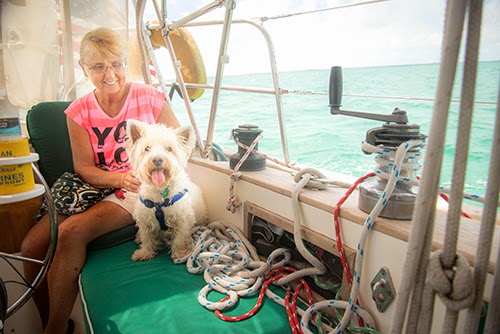
4-18-2014: Bobbie with her new friend, Charles
.JPG)
4-18-2014: On the Casey Dee with sails up.

4-18-2014: Mike and his crew; Keith and Bob

4-18-2014: Keith and Bob up on the bow of the Casey Dee with sails up.
.JPG)
4-18-2014: Lunch at Nippers on the beach.
.JPG)
4-18-2014: Sherry, Charles, Bob and Mike enjoying the ocean view.
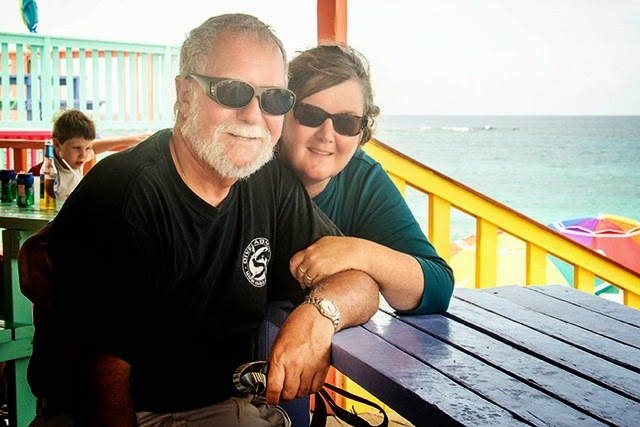
4-18-2014: Bob and Sherry from Wind Song II
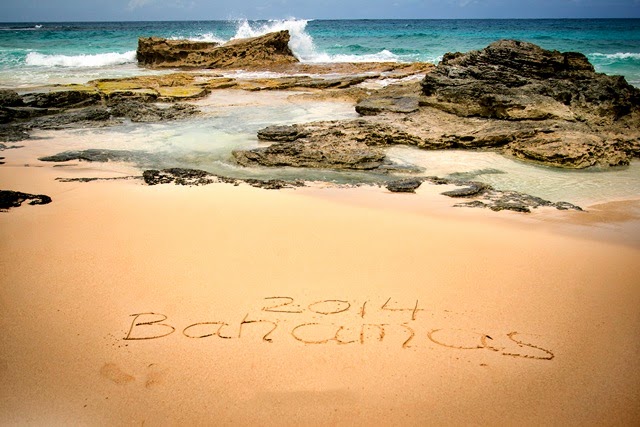
4-18-2014: Nippers at the beach on Atlantic Ocean; a Post Card compliments of Sherry.
4-19-2014, Saturday: Rain and thunderstorms all day. I didn’t even leave the boat.
4-20-2014, Sunday: Happy Easter! We are still here and will be for a while.
Quieting down the engine noise and some trim work
Here’s some projects from the last few weeks… After our last weekend trip, it was apparent that we still have some improvements to make on our sound isolation from the engine room. The basic insulation set-up that we installed works pretty well, but …
April 19 – Astor, FL
Blackwater Inn Dock
“There is nothing—absolutely nothing—half so much worth doing as simply messing about in boats.” —Kenneth Grahame
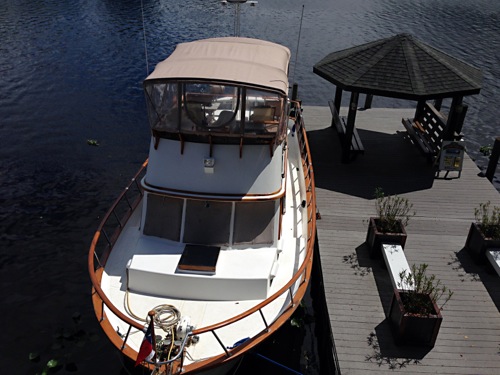
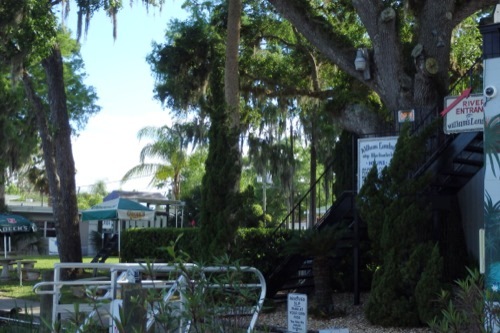
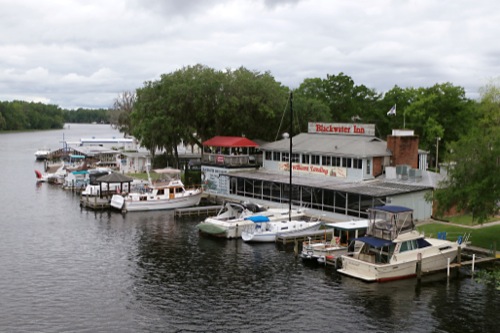
We had a very short trip today…less than two miles around a few bends in the river. We moved from our quiet anchorage to the dock at the Blackwater Inn, a restaurant on the river that allows docking if you dine with them. They also provide water and electric so a small fee. We were getting a little low on water and decided to pay the fee to fill up and give our batteries a chance to fully charge up. The dock was fun, we had a large pier with a gazebo and we were just steps from lunch. But we also had the noise from the near by bridge. It seemed loader than other we’ve docked by…I guess we noticed it more since we’ve had such quiet anchorages and docks lately. We have really gotten use to the quiet night with only the birds and frogs to listen to.
St.John’s River Tours leaves from the other side of the dock and we had fun visiting with tour guest and the captain. It was also fun to watch the activity on the river from our flybridge. The majority of the boats on the river our pontoon boats, party boats, I call them. Some are fixed up with little kitchens, bars and grills…a fun way for people to spend a day on the river.
The Pearl at Blackwater Inn
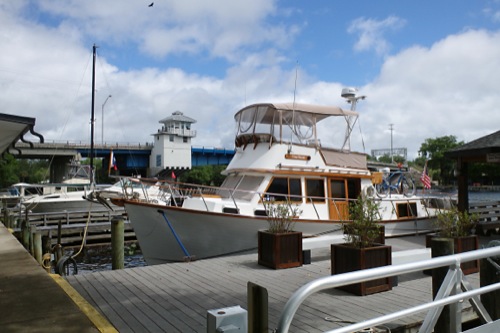
Looking down on The Pearl from the deck of Blackwater Inn
Our view from the deck
Looking at the Blackwater Inn from the bridge
John Russell Gallery and “Tony Coe”
Cheers,
The sky is gray, the wind is chilly and rain is predicted for most of the morning. Hopefully this afternoon we’ll be able to go out for a walk through Christchurch Park.
The other day during my walk around town I stopped in at the John Russell Gallery on the waterfront. I didn’t even bother to […]
Rough Weather – Beaufort to Belhaven NC
We spent four days in Beaufort, partly due to the weather and partly because this is a nice place to stop. That said, even if Beaufort was not a good place to stop we would have had to stay there because of the weather.Diana and I pose with the Beaufor…
Day 99 – 365 Project…Horned Grebes
Welcome to day 99 of 365 photos…I was excited to get these photos of Horned Grebes. I have never seen them before so even though they didn’t want to come closer for a better photo op, it was great to see them. I took these yesterday on Cedar Island where there are large ditches on… Continue Reading
The post Day 99 – 365 Project…Horned Grebes appeared first on Moosetique Musing.
THE ARGONAUT March 25 to April 10, 2014
CAPTAIN’S LOG March 25 – April 10 Panama and the Canal We departed Santa Marta at 0900 with a stiff 25 knot trade wind on starboard quarter. It was hot and humid, a far cry from the bitter winter still gripping our home in Michigan. We had a 386 mile – 2 ½ day cruise ahead of us. I felt a little trepidation about this passage as the Caribbean can be a quit rough this time of year particularly at its western end near Colon. We moved easily out of the harbor’s wide entrance, past…
THE ARGONAUT March 25 to April 10, 2014
CAPTAIN’S LOG
March 25 – April 10 Panama and the Canal
We departed Santa Marta at 0900 with a stiff 25 knot trade wind on starboard quarter. It was hot and humid, a far cry from the bitter winter still gripping our home in Michigan. We had a 386 mile – 2 ½ day cruise ahead of us. I felt a little trepidation about this passage as the Caribbean can be a quit rough this time of year particularly at its western end near Colon. We moved easily out of the harbor’s wide entrance, past the mountain island at its mouth, which is brightly lit at night with varying colors, past the ships at anchor and out onto the sea proper. After an hour or so we settled into our familiar pattern: Tyler began to wash the soot off the boat, Rebecca was thinking about food shopping in Panama and provisioning for the next six months, I was checking over the equipment and setting our course. When we leave a port we generally fill our water tanks, but in Santa Marta the dock water isn’t potable. If you want drinkable water there you have to order it in 10 gallon jugs and pour it by hand into the ship’s tanks. Our tanks hold 500 gallons, enough to last many days if it is carefully used, but the soot in Santa Marta coated the boat with a fine coal dust created by the loading of coal onto ships nearby (ships that take Colombian coal to Jacksonville, Fl.) and so Tyler began washing the boat. After a little while I noticed that our water supply was diminishing quickly, so I turned on our water maker. It worked for a while, then quit working. I went below to check things out, but nothing obvious was wrong. Tyler and I then went back and started taking things apart, still nothing. Meanwhile, seeing that we didn’t have enough water to take showers we reviewed our emergency plan. I called the manufacture’s technician in Fort Lauderdale via sat phone and reviewed the possibilities, and after two or three more hours in a hot engine room, still no permanent solution. I did manage to get the unit to work for several hours; that made the difference and we were able to shower and use our water, but it put quit a scare into us. When we got to Shelter Bay Marina at the south end of the canal, I took another stab at it. This time I removed the low pressure pump, took it apart to see if the impeller had gone wrong, and then realized that one of eight bolts holding the thing together was loose. That one of eight, small, loose Allen bolts allowed air to seep into the chamber and reduce the suction, denying the machine adequate water. The lesson here is that ocean sailing is as much about keeping all the equipment working as it is about navigation and seamanship.
The cruise to Panama and Shelter Bay was more pleasant than I anticipated with calm seas as we entered Colon Harbor. Scheduling a transit through the Panama Canal is fairly complicated and needs to be made several weeks in advance. For the three of us and the boat, the fees totaled about $3,300. The basic canal fee is $1,500, but an agent is required to complete formalities. That costs $700. The rest is made up of incidental taxes, fees, immigration visas, etc. Often times the authorities tell you that they are experiencing a shortage of “measurers” (they send someone out to measure the exact dimensions of the vessel) or some other trade. The choices then are either wait two weeks until they can get around to you or pay a $340 overtime charge. There is a bundle of paper work to complete and all of the fees have to be wired to The Panamanian National Bank two weeks or so prior to transit. Finally, when you leave your last port of call you have to email your Zarpe or departure authorization to the agent in Panama. After all the details are in hand, the wheels grind at the canal authority and the agent calls with a transit date.
We tied up at Shelter Bay at 1000 on March 27. After checking in at the marina, washing the boat again, fixing the water maker, cleaning the interior and trying to use Skype to get ahold of our agent, we headed for the restaurant for a beer on a blazing hot and sultry afternoon. There we met Charlie, a prince of a fellow and very generous guy who tells endless, interesting stories. Charlie is an expat and has lived with his family in Cartagena for many years. He is a lawyer who handles the import/export formalities for large shipping companies. Charlie has traveled all over the region and when we met him he was in Panama doing work on his sail boat.
Charlie rented a car and invited us for a tour of Colon. By ourselves we would have never gone there, but with such an invitation, off we went. Colon is about a half hour ride requiring crossing the canal. If a ship is passing through, you could wait an hour or more, but on this day we drove right across. The crossing is made via a single lane bridge that falls in place when the second lock’s gates are closed. Colon, once a pearl of the region, has descended into the darkest oblivion. It is a squalid and dangerous place where the odds of a white person being mugged or worse rise to near certainty after dark. Carrying a weapon for self-protection is common place here. The buildings, however, despite their dilapidated condition cannot hide the architectural beauty of its golden age and the vibrancy that once must have been. Driving around one sees suspicious looking vagrants and unemployed people milling about, but in contrast, you see a large number of private schools with the children of all ages dressed neatly in their uniforms, white shirts and ties for the boys, dresses and bobby socks for the girls. There are also residential areas that seem quite normal and secure. The city fathers are trying to resurrect Colon by making it a cruise ship destination and shopping mecca. We went to its duty free zone, said to be second in size only to Hong Kong; it’s about ten city blocks square packed with hundreds of stores. Getting in requires going into a special office at the secure entry gate, have your passports screened and if everything is in order, being granted admission for the price of for $9. Once inside, we wondered around here for a couple of hours in sweltering heat. It isn’t really a very nice place, and despite the heat, not a single place to buy water or a beer, much less a sandwich. However, all was not lost as I found a very good deal on some Cuban cigars, half the price offered in Cartagena.
Once back at Shelter Bay Marina, we invited our new friends Charlie and Mark to dinner on board Argo. Mark is an anesthesiologist from Seattle who has taken six months off to sail with his wife. They had made it from the east coast to Panama when their boat broke down and was laid up for repairs. Mark’s wife abandoned ship and went home to attend to family matters, leaving him to see to the boat while living aboard on the hard in humid 100 degree heat. We thought both Charlie and Mark needed a good dinner, so we invited them over and had a heck of a good time together.
The next day, Sunday March 30, we expected two friends, Mark and Dash, to join us onboard for a trip through the canal. Mark is an editor for Passagemaker Magazine, an important magazine for people like us who wanted to learn about owning a boat and cruising the world. Before we bought Odyssey, I looked forward to every issue and read it cover to cover. It inspired me to start our own odyssey. So when Peter Shepard, Mark’s boss called an asked it they could do an article on our passage through the canal, we thought it would be a lot of fun. With camera and note pad in hand, Mark came aboard early Sunday morning. Late that day Dash came aboard. Dash is an old friend from the 80’s, when he and I attended professional meetings and executive education courses together. We hadn’t seen each other in about 25 years, and although still in business, Dash winters at his home in Boca Del Toro, about 100 miles north of Colon.
Our transit through the canal was scheduled for Monday. Before leaving we needed to get four 125 foot lines and 12 fenders (tires wrapped in garbage bags) onboard. We hired a line handler (Stanley) to assist with the transit. We were instructed to leave the marina at 1330, anchor in the harbor and await a call on VHF Chanel 12. As we were arriving on station, a call came and told us were to meet the pilot boat. Around 1400 a pilot (Ricardo) came aboard, and he was a very pleasant, talkative fellow. Our transit was scheduled for 1530, but we didn’t actually get into the lock until 1915. The sun had set by the time we entered the first of three locks in the Gatun series. When we entered the lock we tied up to a steel work boat that preceded us. After it tied up to the wall, we came alongside and tied up to her. The task appears pretty straight forward, but wind and turbulence in the lock, combined with jittery nerves, large objects confined to a small space and the possibility of jagged steel scrapping ARGO made for a little tension. The hands threw lines forward and aft as well as two spring lines. Argo was safe and secure, and after repeating the process through two more locks that evening, everyone felt pretty comfortable. We cleared the last lock around 2100 and moved in total darkness to an anchorage for the night. As we latter learned, southbound ships transit only at night, and yachts must anchor in lake overnight and proceed southbound in daylight. We got under way with a new pilot named George (an American who has worked for the canal 42 years) at 1000. We completed our transit about 1600 and tied up at our dock at La Playita Club at 1700.
This year is the 100th anniversary of the opening of the canal, and it shows. We were told by our two pilots that the cement at the locks is beginning to crumble and that major renovations and reconstruction of the existing locks will be needed soon. New, much larger locks are under construction now that can handle larger ships, but the number of ships that can pass through the canal won’t change, and smaller ships will not be allowed to use the bigger locks. The canal can handle 40 ships per day and each ship uses 58 million gallons of water during its transit. The new locks will require even more water, which is a potential problem. The canal authority uses the excess flow of the Charges River to generate electricity that it sells. In order to operate the new locks more water from the Charges will have to be diverted, which will reduce this revenue. Economics is a factor. When the Americans ran the canal, they raised transit fees three times in 75 years. The joke here is that since the Panamanians took over, they have raised prices 75 times in 3 years! The result is that some of the canal’s largest customers, like Maersk Lines and others have notified the canal authorities that they are re-routing their ships so that they will not use the canal beginning next year because of high fees; everything will go through the Suez Canal. As it is they are having trouble financing the construction of the new locks. During our transit we noticed fewer ships waiting for transit despite a stronger economy, and no cruise liners were going through because of the higher fees, now $400,000 per transit. So, the Panamanians seem to be facing challenges.
The former Canal Zone, once the jewel of the U.S. Army and a plumb boondoggle of a military assignment, is basically in ruins. The Panamanians have done virtually nothing with it and the air bases that protected the zone. What they have done is build a beautiful city, many say with laundered drug money. However it got here, it is very impressive. They are building a new subway that is due to open this month. Traffic congestion should be reduced considerably. Most of the buildings are condominiums, used by Americans, Russians, and Venezuelans as a refuge from either winter, taxes, tyrants or all three. The Cleveland Clinic has built a hospital in the midst of it all. Rebecca and I had dinner at the Trump International in the heart of “new town”. It is a beautiful building with a Waldorf Astoria Hotel located on the 20th floor and above. We dined at a restaurant on the 15th floor that had a wonderful view of the city scape. One couldn’t help but notice that most of the hundreds of apartments in the buildings around us were vacant; in one forty story building we counted only two apartments with lights on. Despite it being a Friday night, no cars or people were on the street or dining at the restaurants.
Panama City also has an historic area called Casa Viejo. Originally it had buildings like those found in Cartagena, but the area has fallen into disrepair over the years. Many of the buildings are very lovely, and the community is in the process of redevelopment. We dined in a lovely Habana style restaurant with our friend Dash and his friend Carolina. Dash also took us to the best restaurant in the city, La Posta, the evening before for a truly lovely dinner in a classic ‘40s Panamanian setting. It sure was nice to have a friend that knows the city! When the redevelopment of Casa Viejo is complete, Panama City will have one more jewel in its crown. It will certainly be, if it isn’t already, one of the most interesting and vibrant cities in the world.
We headed out the morning of April 6th for the Galapagos Islands, about 950 miles west of Panama. Our course took us to the Las Perlas Islands about 35 miles out into the Bay of Panama, and then head straight for the Galapagos. It was a beautiful, calm day and we enjoyed a delightful cruise to islands. Islas Contadora is the main attraction; it is quiet and small but has several lovely boutique hotels and homes located on its beaches. It looks like a great spot for a short vacation and a place I would like to return to.
Later that night we headed out of the Gulf of Panama and past many large ships coming and going to the canal. As we entered the Pacific Ocean proper we encountered a moderate ocean swells from the south. For the balance of our five day passage we encountered southerly winds between 15 and 20 knots, sometimes a little more on our port bow. In all but one of the days, the seas were moderate (6 -8 foot seas with a fairly long moment) and pleasant, but one day was a little uncomfortable. One of the interesting things was the variability of the ocean currents: we changed course to avail ourselves of a more favorable ride. Sometime we would be pushed along at 8-9 knots, while at others we crept along at near 6 knots, all at the same engine speed and power. The difference is strictly caused by the direction of the ocean currents. This area of the ocean has four large currents converging at the Galapagos, which creates a very confused sea. On the fifth day we crossed the equator and made landfall at Puerto Ayroa on the island of Santa Cruz in the Galapagos.
Thanks for checking in on us. We will try to post a blog on our Galapagos visit before we leave for the Marquesas later this week.
Randy and Rebecca
