
The crew of Anna Mae has enjoyed a short stay on Isla San Andres, a small little Columbian Island east of main land Nicaragua. There is a reef that surrounds the eastern side of the island which allows wonderful snorkel opportunities in shallow water w…
Tag Archives | Nordhavn
Wednesday May 21, 2014 Fort Bragg from Dana Point
Monday May 12, 2014 – Heading to Point Conception
We spent 5 nights at Dana Point and got a ton accomplished. Jeddy was able to find an appropriate fabric, which if anything goes better with the upholstery than the old, and got the new rugs cut and installed by Thursday am. He is a wonder, fast and very reasonable. Earl and I are each hoping that we will not be the first to spill on them.
The other major accomplishment was the installation by Earl of a beautiful new toilet in our master head. What a Mother’s Day gift! It is a Dometic. It is a simple design and seems to use less water more efficiently than the Raritan that it replaced. We are ecstatic!
On Tuesday night we were able to hook up with my cousin Brad who lives in Pasadena. Brad, Shannon and daughter Cassandra came for a boat tour and dinner. Cassie did not really understand how one could live on a boat until her tour and then she suggested that she continue on with us and send Daisy to keep her parents company. She is a delightful 8 year old and a budding marine biologist. She had a wonderful time with my shell collection and, impressively, quickly identified a partial sea urchin shell. Pretty smart young one as well as cute as a button.
 |
| Brad, Shannon and Cassie |
We were in a slip right on the main dock in front of the Nordhavn offices and Earl was delighted to have a number of people stop to admire Serenity and ask if she was new. Fito has done a great job keeping her looking that way!
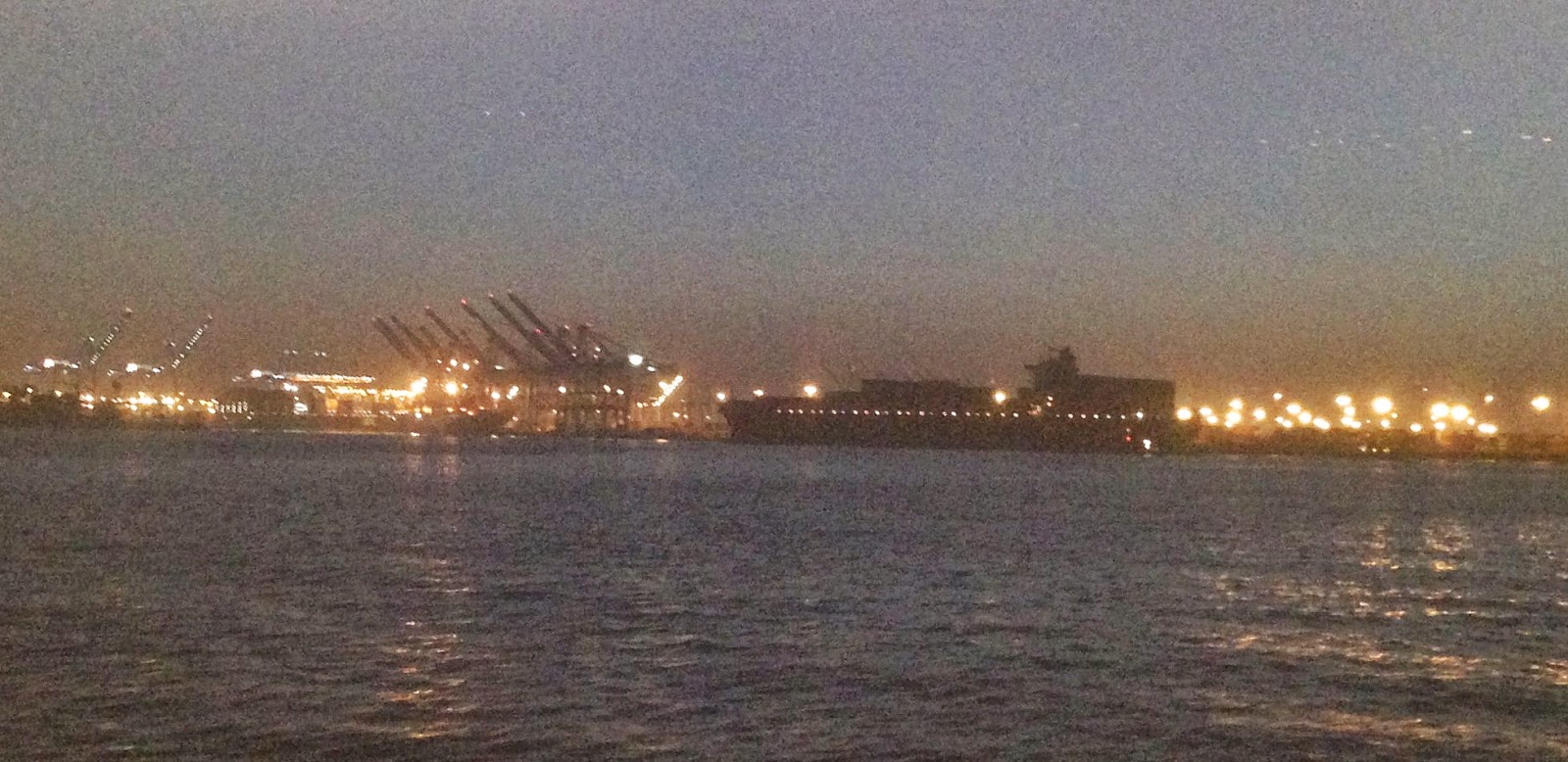
We left Dana Point at 5 am on Friday the 9th anxious to make some distance. By mid morning it became clear that the weather was deteriorating and we headed into the Los Angles harbor where we waiting out the winds the next day. It was a great anchorage and we were treated to a show. The winds combined with the breakwater were a godsend to the windsurfers who whipped around us performing acrobatics. Meantime, in the distance we could see tankers, cruise ships and container ships moving in and out of their berths non stop. The Long Beach – Los Angles harbor complex is beyond busy!
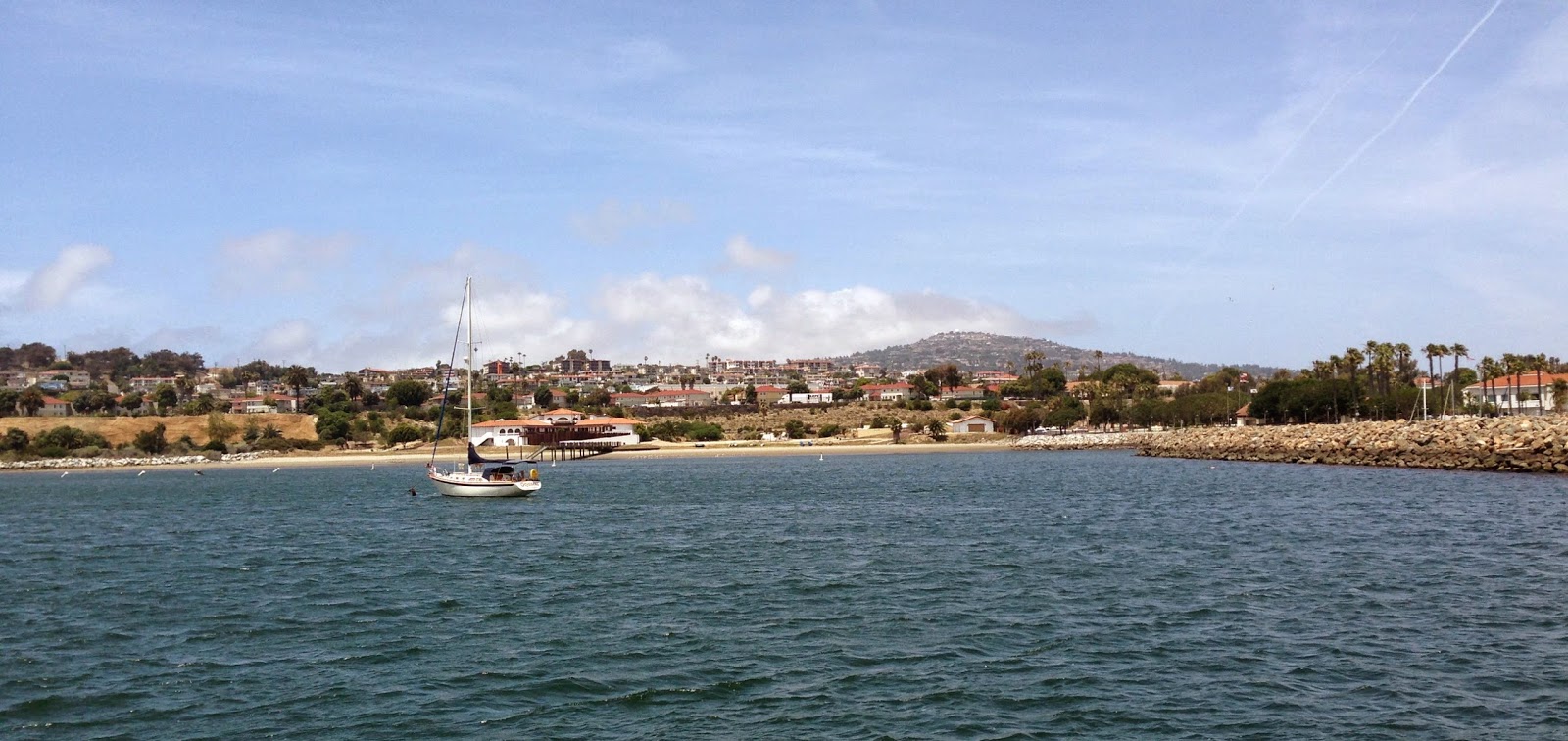 |
| Anchorage at north end of LA Harbor |
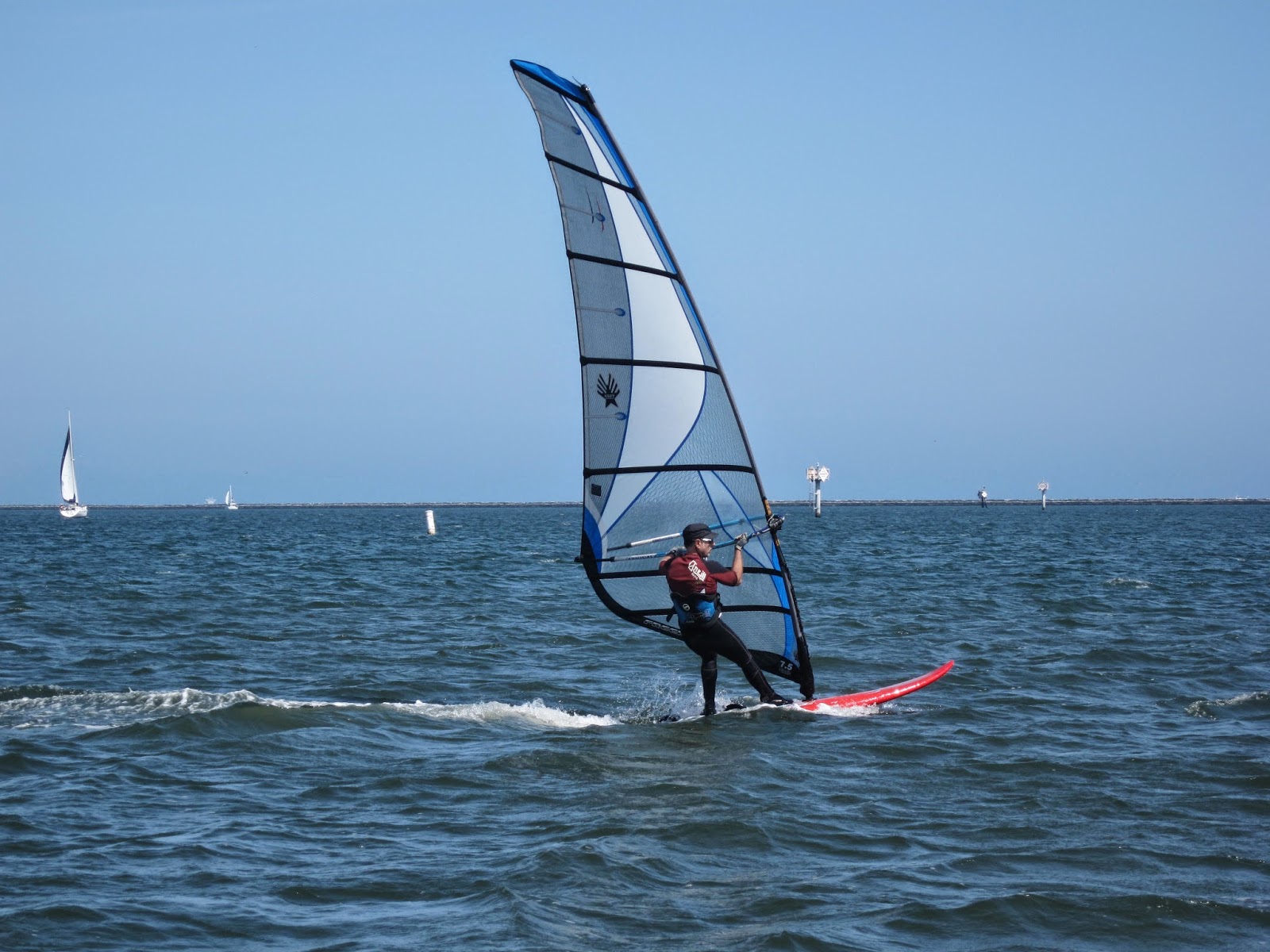 |
| Entertainment |
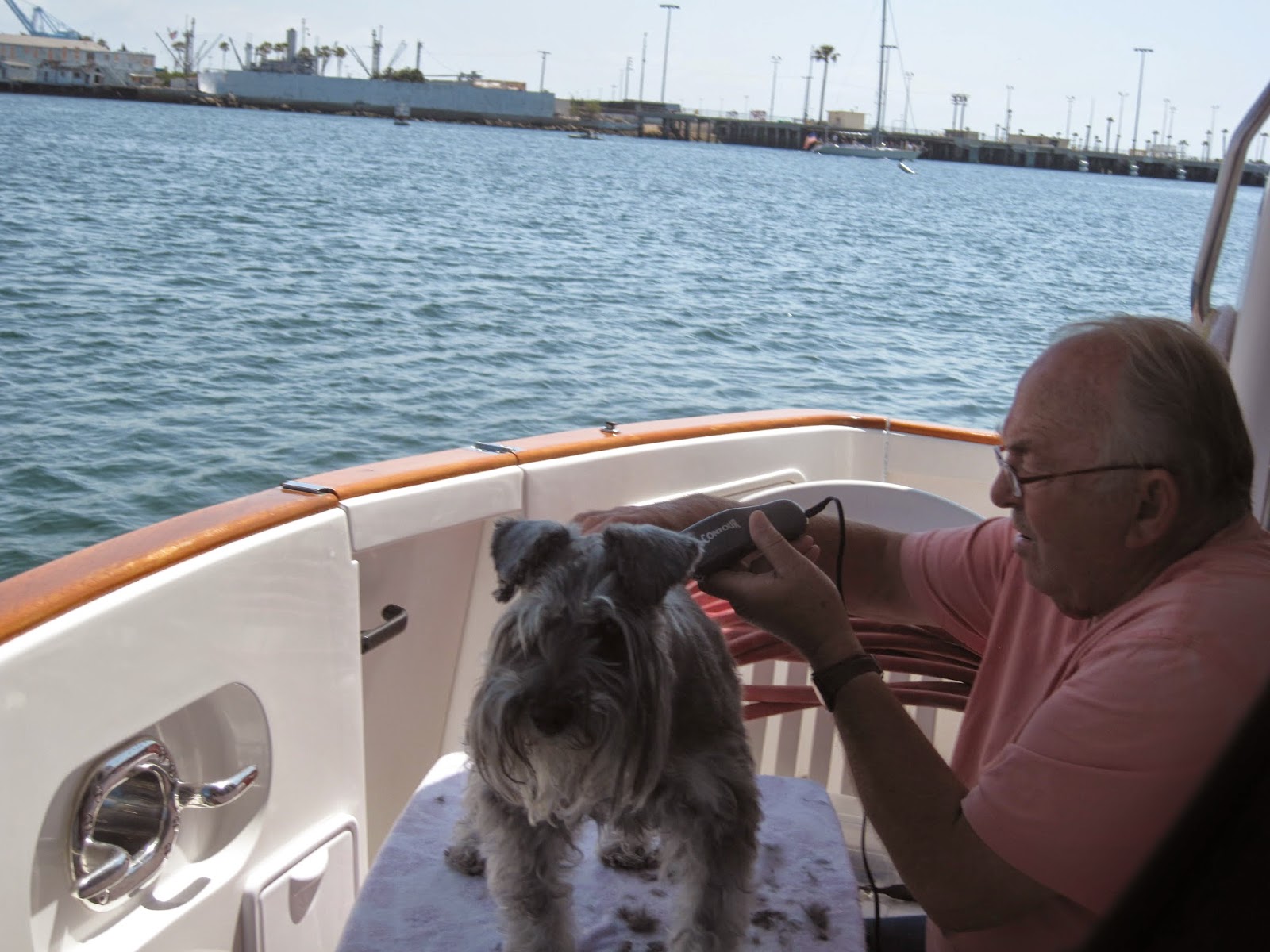 |
| Daisy gets an LA trim |
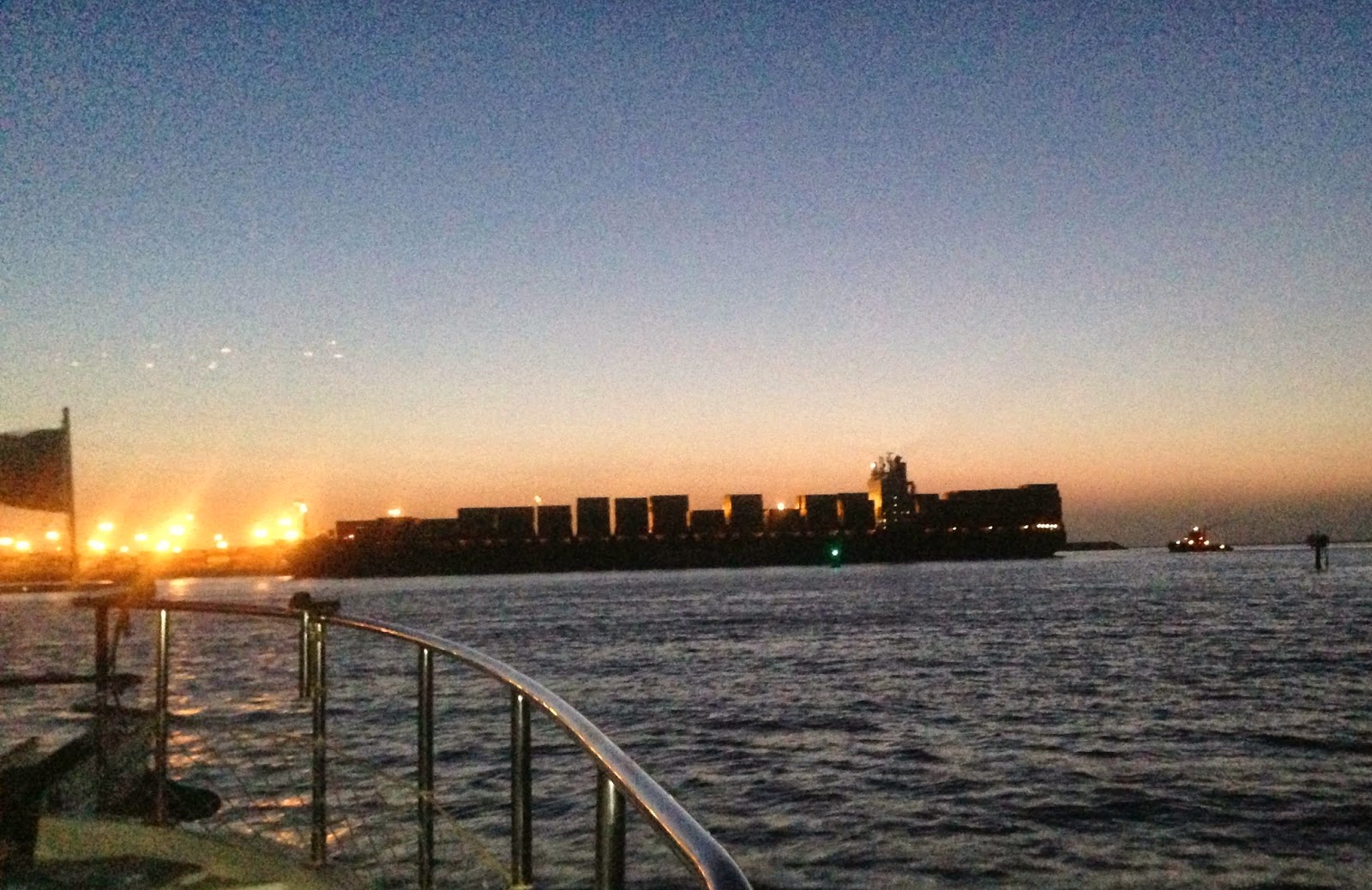 |
| Container ship |
 |
| Incoming ship |
Convinced that the weather would be great, we head out again at 5 am on Sunday the 11th. Happy Mother’s Day! It was blowing 25, a six-foot swell with a 3-foot chop on top. A very uncomfortable ride. We had planned on a 15-hour 90-mile day to Santa Barbara, but were delighted to tie up in the Channel Islands Harbor in Oxnard, miles short of our goal. It is a ‘moderate’ sized marina – at least by California standards- only room for 2,600 boats.
At 5 am on the 12 we were at it again. Monday the 12th is an important day for at least one member of our family. Our darling Bella turned 10, into the double digits and too rapidly leaving childhood in the rear mirror.
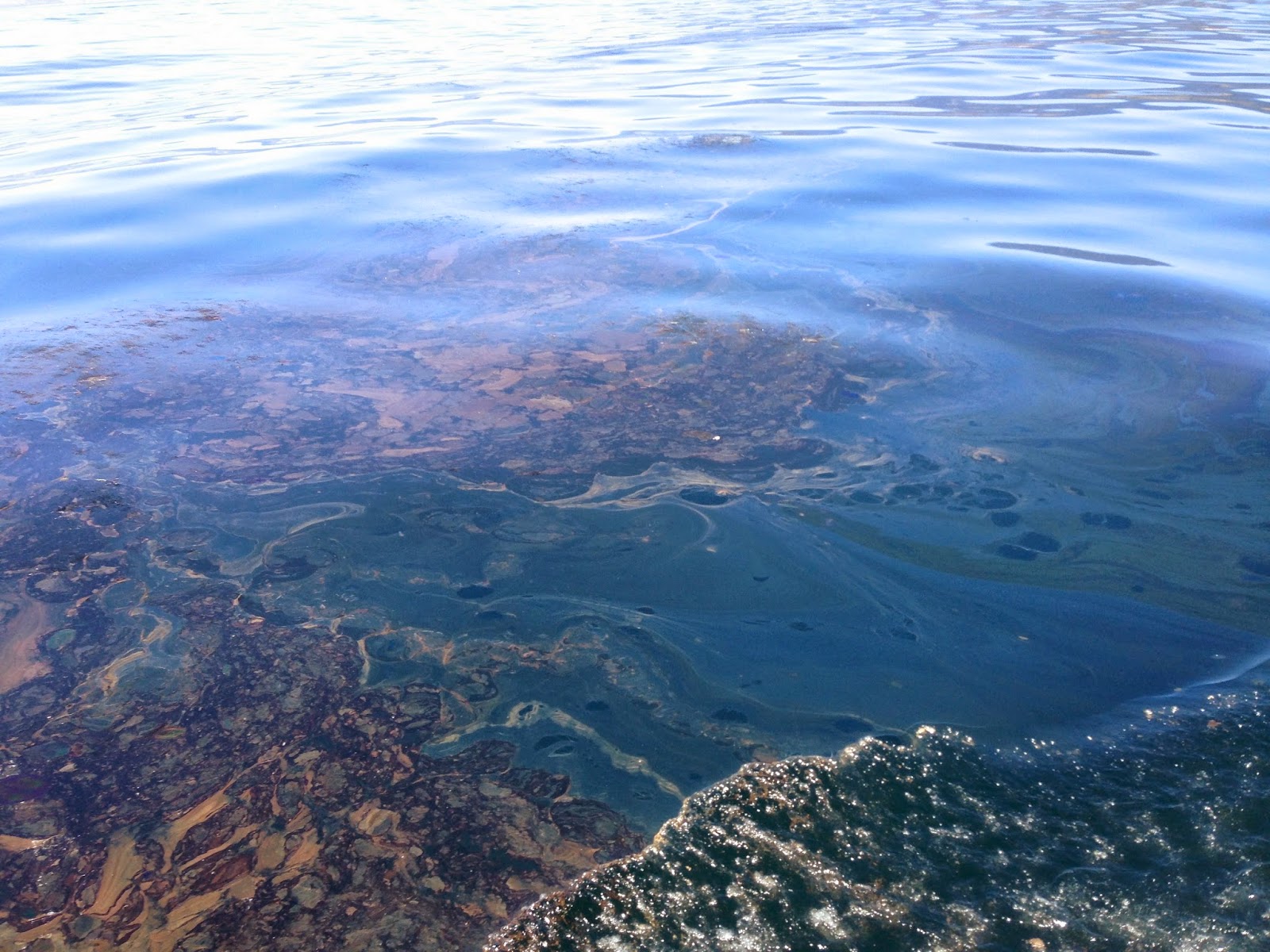
Monday turned into an interesting day – for once not due to lumpy seas. Around 10 am 5 miles of so past Santa Barbara we began to notice a diesel smell. It got stronger and the odor was joined by oil sheen. As we neared a drilling platform (Holly) we started to see substantial amounts of dirty oil in the water. Earl called the Coast Guard who told us that there were natural seeps in the area but gave us the national spill report hotline. Earl called and spoke to someone on the East Coast, and in time we received a call from Brett, from the Coast Guard in Santa Barbara. We sent him some photos and he advised us that he had called the platform and they reported no problems. Apparently there can be natural discharges of oil in the range of 50 to 150 barrels a day. 6,500 gallons is a good deal of oil, but we are still not convinced. Anyway, we went on our way wondering how much dirty oil we would have on our water line.
 |
| Oil in Santa Barbara Channel |
 |
| “Natural Seep” |
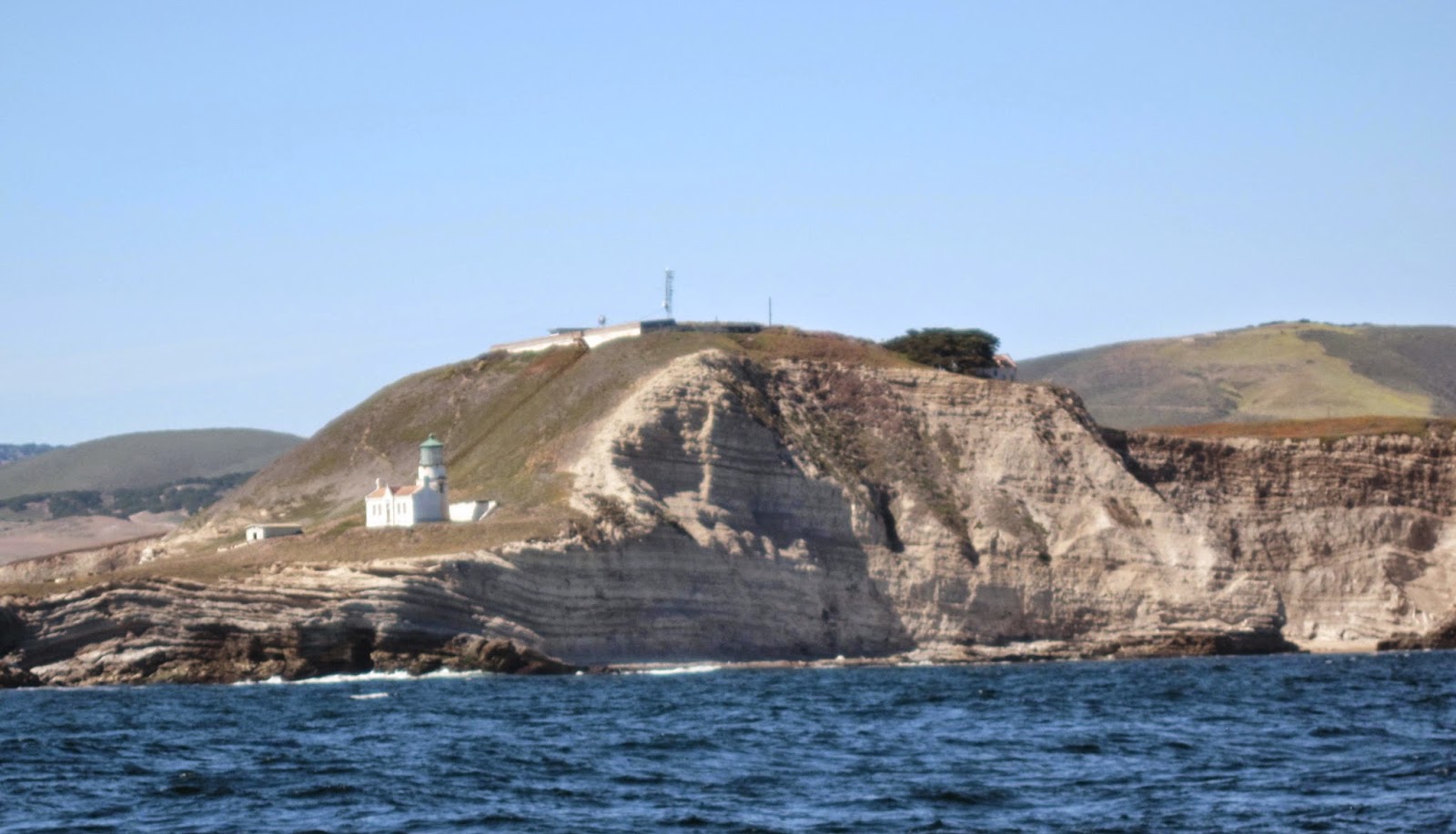
The seas were lovely so we decided to go around Point Conception and head on north. Point Conception can be knarly, but it was fine today, except…. We were about 200 yards off the rocky point and had just photographed the lighthouse when the boat suddenly stopped responding to the wheel and started to turn in circles. We had lost our steering. Although this was a pretty bad place to lose control of the boat, Earl was calm as cucumber and knew exactly what to do. As he suspected the bolt connecting the hydraulic cylinder to the tiller had fallen off and with a large crescent wrench in hand he descended into the lazarette and had the problem fixed within 10 minutes. My hero!
 |
| Pt Conception Light House |
Finally about midnight, having left Oxnard at 5 am, we arrived at Port San Luis, approximately 120 miles from our starting point. Determining where to anchor was a little dicey with only the radar and a guidebook. We have great lights, but they are so bright that Earl did not want to turn them for fear of disturbing others. Finally, finding ourselves in 40 feet of water, we set our anchor and collapsed into our beds.
Tuesday May 13th, from Port San Luis to Monterey.
Having managed 120 miles yesterday, we decided to go for it again today. The weather is just about perfect and it was Monterey or San Simeon, with San Simeon only 40 miles from Port San Luis. The weather for today and tomorrow is forecast to be fine, with winds starting on Thursday pm and continuing at least till Tuesday. We will have to cool our heels for the better part of week, so today and tomorrow we will be going for distance. Hopefully Thursday pm will see us in Bodega Bay, nice and snug and maybe with a rental car.
So far today nothing exciting has happened, which is how we like it. The sea is mostly glassy and we are benefiting from a near shore current that has been keeping our speed closer to 7 knots than to 6. The weather is in the 70’s and Daisy is enchanted to be able to run in and out to her look out on the bow.
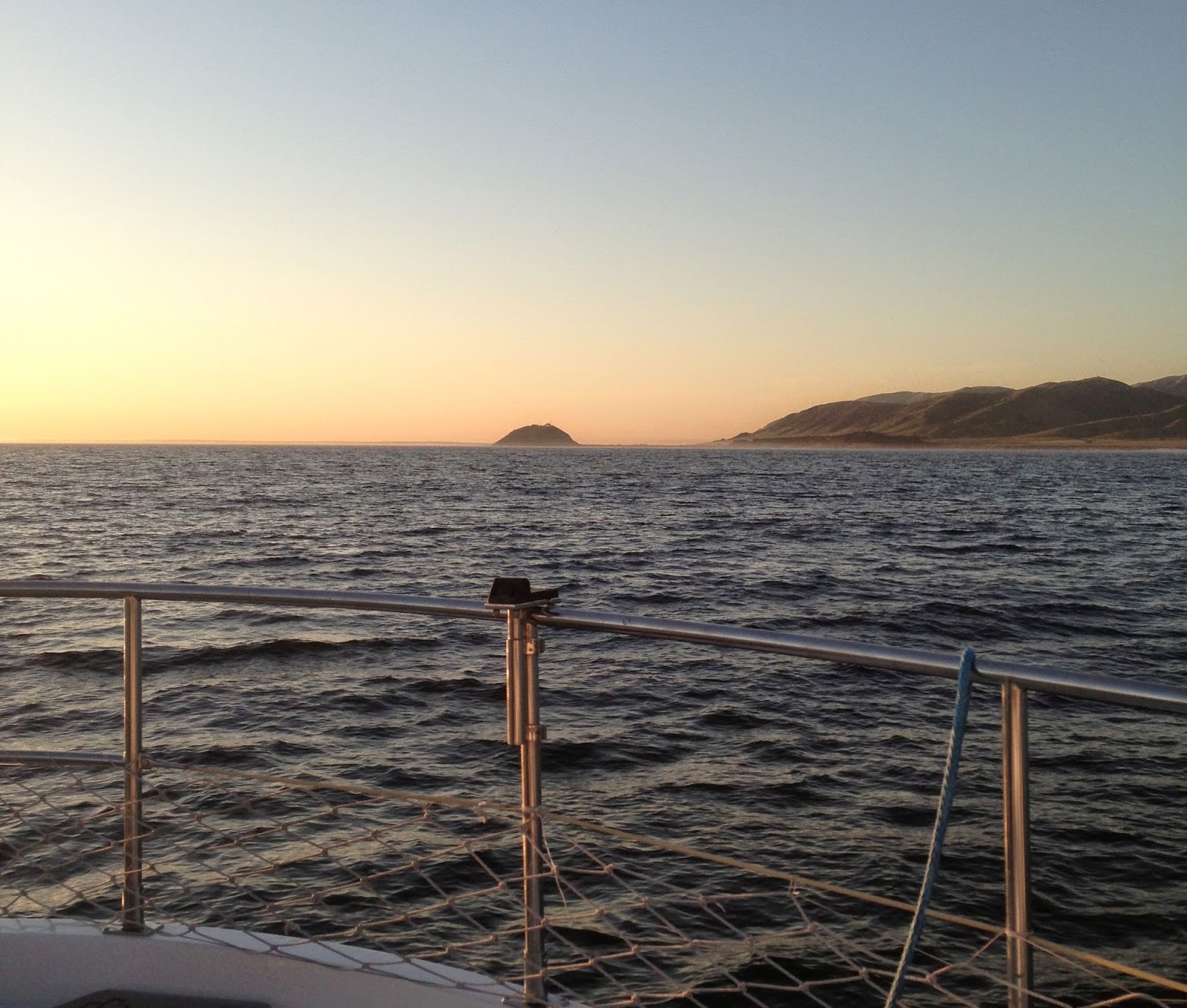
This is a beautiful and unsettled coast. We were able to see the Hearst Castle at San Simeon, but since then there has been little sign of civilization other than the coast road and the train right by the edge of the shore. Earl has enjoyed watching the reflections of cars windshields disappear as they go through tunnels. The road must have been very expensive to build.
 |
| Big Sur |
As an indication of the remoteness of this coast, for the first time since we neared Ensenada Mexico, we have lost cell phone coverage. Technologically we have made strides since we went south in 09. In Mexico we got used to using the modem and a router to provide us with Wi Fi in the boat. Once we crossed into the USA and using data on our AT&T iPhones became financially doable, we turned Earl’s iPhone into a hotspot and have enjoyed Wi Fi for our iPad and iMac. We are connected!
One nice thing about having the Wi Fi is the weather forecasting. We got used to using Buoyweather and Predictwind in Mexico when there was no option. Although we can get weather from Ocens on our Sat phone or from the NOAA, I find I prefer these programs that let me really study the wind patterns. NOAA has a very long forecast, only a small portion of which is of interest to us.
Thursday, May 15, 2014 – underway from Drakes Bay to Bodega Bay
It was 12:30 Tuesday night when we set our anchor in Monterey. A very long day and about 120 miles from the predawn departure from San Luis, but we agreed that we did not feel as tired as the night before and that we could not remember many more lovely days. It was glassy all day and the scenery was incredible.
There were so many lights and boats in Monterey that even with the radar and plotter we found finding the anchorage a challenge. It is far easier to go into a remote anchorage at night than an unfamiliar town.
Wednesday was another perfect day. Only the scenery changed as we cruised past Half Moon Bay and across in front of San Francisco and the golden gate bridge. The seas continued glassy. We would have felt completely blessed if it had not been for the crab pots that littered our way. It certainly forced us work the watch more diligently than we have in the past. Welcome to the start of the Northwest.
We arrived in Drakes Bay at 10 pm and anchored along side a small fleet of commercial boats under a beautiful full moon. The 100 mile day felt much shorter than the two 120 days that had preceded it. With only 20 miles to Bodega Bay the next morning, we went to bed determined to sleep in.
And we did sleep in. Amazing that leaving at 6:45 can seem so late. It was after dawn and all the commercial boats were gone, so at least by those measures it was late.
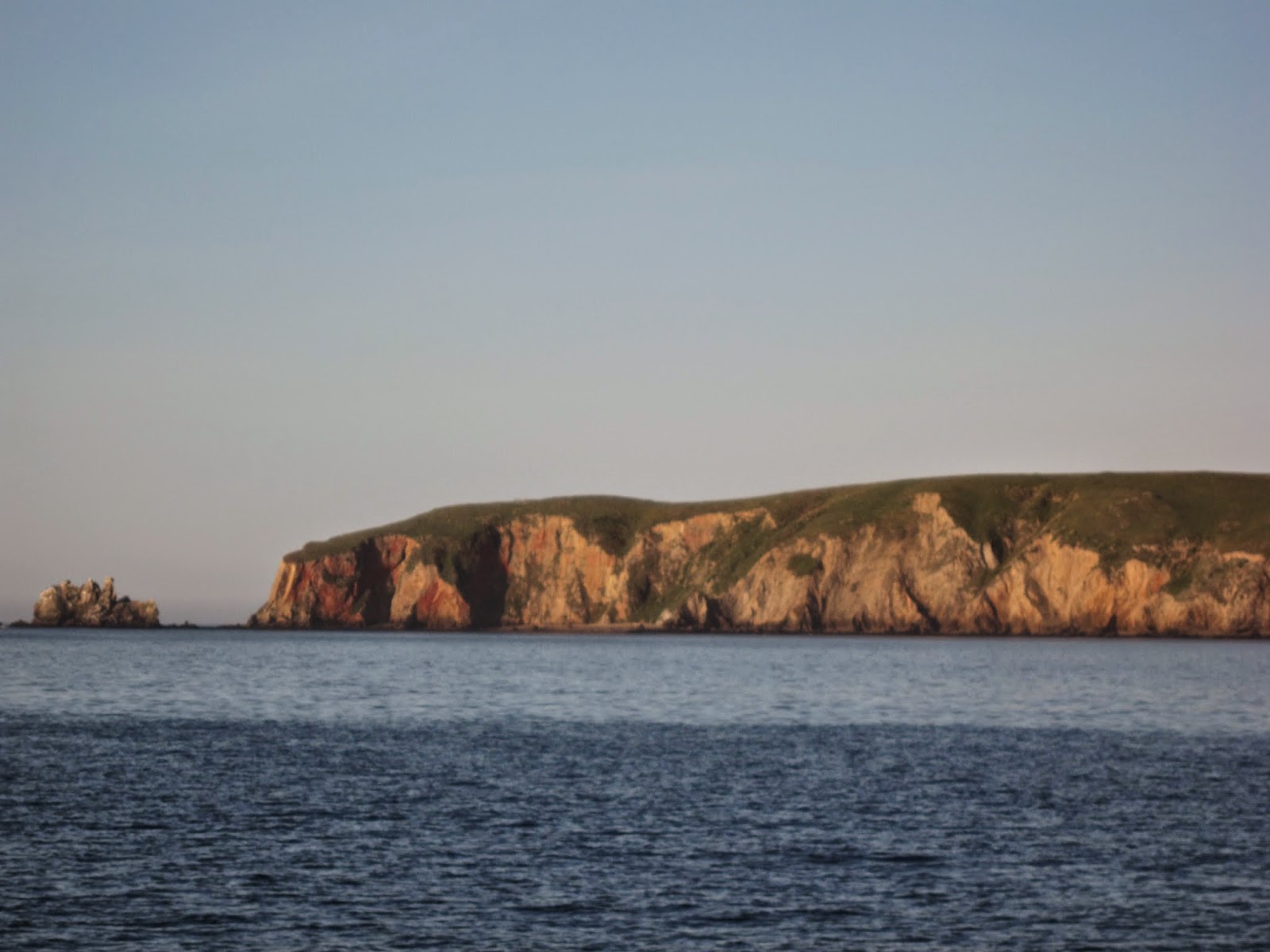 |
| Leaving Drakes Bay |
It was lovely when we left Drakes Bay, but we were soon into Northwest Fog. The radar is on. The weather forecast after Friday is poor. We will stop and visit family.
 |
| Pt Reyes Light House |
Wednesday, May 21, 2014
Gale warnings for today, so we are snug in a slip in Fort Bragg. Actually, snug is exactly the right word. One foot less in either direction and we would not fit.
We had a nice stop in Bodega Bay. Spud Point Marina is a very nice marina with lovely cement docks. But what a change from Mexico! This is primarily a commercial fishing marina. We were something of a rarity and got a lot of interest from the locals, who like us had heard nasty weather forecasts.
 |
| Bodega Bay – Not a cruiser hang out |
This was our first chance to wash the boat since leaving Oxnard. As we expected, we have an oil ring around our boat from the “natural seeps” in the Santa Barbara Channel. We were only able to get to one side of the boat. She will really need a wash when we get to Anacortes.
Friday we rented a car. This required taking a bus to Sebastopol to pick up the car since Enterprise’s pickup range was only 10 miles. While I was getting the car, Earl was getting some crab. There had been no live crab available Thursday, but Friday morning we saw a crab boat unload. Prices are very high. We paid $20 a piece for some beautiful ones. We cooked them all and ate two for lunch, bringing the others with us to Teri and Stuart to share.
Teri and Stuart, our son and daughter in law, live in Santa Rosa, about 45 minutes from Bodega Bay. Of course, we had managed to arrive the one week when Stuart had warned us he would be out of town. He had a big conference in Monterey and Teri drove down to join him for a weekend of R&R. Teri had left a key under the mat and we made ourselves at home, which included giving their kitty the unending love that he demanded.
On Saturday I drove down to San Jose to see my nephew and his two daughters. The eldest, Sarah, I had last seen on our way south in 2009. She remembered our boat and, even more, Daisy. Alison was in utero at the time, so this was my first chance to meet her. We met at Happy Hallow, a combination zoo and amusement park. The girls are delightful and we had a great time getting to know one another.
 |
| Sarah and Alison |
Sunday, we did some minor shopping for an eclectic assortment of items. That evening Stu, Teri, daughter Meaghan plus Meaghan’s young man John had dinner with us. Instead of having crab cakes, Earl having eaten all the crab, we went to Willi’s Wine Bar and had a very California experience. We drank lovely wine while sharing little small plates of good things. It was a very nice, if expensive, evening.
Monday, everyone went off to work and we headed back to Bodega Bay and unloaded the clean laundry and groceries. Then I drove back to return the car and killed 3 hours waiting for the bus to return to the marina.
Tuesday the alarm went off at 3:30 and we were off by 4 am on our trek north. Our destination was not yet set. Fort Bragg is the only marina within reach but there are several anchorages that we could use, although most were not ones we would be comfortable going into after dark. The morning was not bad. There was no wind and the swells were in the 6-foot range. Then we rounded Point Arena and the swells grew and got closer together. The USCG announced that the bar conditions at Fort Bragg were hazardous and posted gale warning starting at 3 for outside waters. We decided against anchoring out. Luckily we had no wind, but we certainly had big swell relatively close. Some of them must have been 15 feet with ‘feathers’ on top. I did not enjoy the afternoon.
Because of the warning and being unfamiliar with Fort Bragg, Earl called the Coast Guard to tell them that we were coming in. They helpfully provided an escort, but actually the bar here was something of a non-event. It was much pleasanter than the swell outside. That said, I was pretty whipped by the time we got into our slip. My knees felt like jelly and Earl said his did too. Thank God for the stabilizers. Even with them we had things tossed around. My major worry was that they would choose that moment to go out.
Tomorrow we will try to get around Cape Mendocino. We are forecast to have about a 12-hour weather window. Once north of the Cape we can start to look forward to better weather as we get up to the Oregon Coast.
Wednesday May 21, 2014 Fort Bragg from Dana Point
Monday May 12, 2014 – Heading to Point Conception
We spent 5 nights at Dana Point and got a ton accomplished. Jeddy was able to find an appropriate fabric, which if anything goes better with the upholstery than the old, and got the new rugs cut and installed by Thursday am. He is a wonder, fast and very reasonable. Earl and I are each hoping that we will not be the first to spill on them.
The other major accomplishment was the installation by Earl of a beautiful new toilet in our master head. What a Mother’s Day gift! It is a Dometic. It is a simple design and seems to use less water more efficiently than the Raritan that it replaced. We are ecstatic!
On Tuesday night we were able to hook up with my cousin Brad who lives in Pasadena. Brad, Shannon and daughter Cassandra came for a boat tour and dinner. Cassie did not really understand how one could live on a boat until her tour and then she suggested that she continue on with us and send Daisy to keep her parents company. She is a delightful 8 year old and a budding marine biologist. She had a wonderful time with my shell collection and, impressively, quickly identified a partial sea urchin shell. Pretty smart young one as well as cute as a button.
|
| Brad, Shannon and Cassie |
We were in a slip right on the main dock in front of the Nordhavn offices and Earl was delighted to have a number of people stop to admire Serenity and ask if she was new. Fito has done a great job keeping her looking that way!
We left Dana Point at 5 am on Friday the 9th anxious to make some distance. By mid morning it became clear that the weather was deteriorating and we headed into the Los Angles harbor where we waiting out the winds the next day. It was a great anchorage and we were treated to a show. The winds combined with the breakwater were a godsend to the windsurfers who whipped around us performing acrobatics. Meantime, in the distance we could see tankers, cruise ships and container ships moving in and out of their berths non stop. The Long Beach – Los Angles harbor complex is beyond busy!
|
| Anchorage at north end of LA Harbor |
|
| Entertainment |
|
| Daisy gets an LA trim |
|
| Container ship |
|
| Incoming ship |
Convinced that the weather would be great, we head out again at 5 am on Sunday the 11th. Happy Mother’s Day! It was blowing 25, a six-foot swell with a 3-foot chop on top. A very uncomfortable ride. We had planned on a 15-hour 90-mile day to Santa Barbara, but were delighted to tie up in the Channel Islands Harbor in Oxnard, miles short of our goal. It is a ‘moderate’ sized marina – at least by California standards- only room for 2,600 boats.
At 5 am on the 12 we were at it again. Monday the 12th is an important day for at least one member of our family. Our darling Bella turned 10, into the double digits and too rapidly leaving childhood in the rear mirror.
Monday turned into an interesting day – for once not due to lumpy seas. Around 10 am 5 miles of so past Santa Barbara we began to notice a diesel smell. It got stronger and the odor was joined by oil sheen. As we neared a drilling platform (Holly) we started to see substantial amounts of dirty oil in the water. Earl called the Coast Guard who told us that there were natural seeps in the area but gave us the national spill report hotline. Earl called and spoke to someone on the East Coast, and in time we received a call from Brett, from the Coast Guard in Santa Barbara. We sent him some photos and he advised us that he had called the platform and they reported no problems. Apparently there can be natural discharges of oil in the range of 50 to 150 barrels a day. 6,500 gallons is a good deal of oil, but we are still not convinced. Anyway, we went on our way wondering how much dirty oil we would have on our water line.
|
| Oil in Santa Barbara Channel |
|
| “Natural Seep” |
The seas were lovely so we decided to go around Point Conception and head on north. Point Conception can be knarly, but it was fine today, except…. We were about 200 yards off the rocky point and had just photographed the lighthouse when the boat suddenly stopped responding to the wheel and started to turn in circles. We had lost our steering. Although this was a pretty bad place to lose control of the boat, Earl was calm as cucumber and knew exactly what to do. As he suspected the bolt connecting the hydraulic cylinder to the tiller had fallen off and with a large crescent wrench in hand he descended into the lazarette and had the problem fixed within 10 minutes. My hero!
|
| Pt Conception Light House |
Finally about midnight, having left Oxnard at 5 am, we arrived at Port San Luis, approximately 120 miles from our starting point. Determining where to anchor was a little dicey with only the radar and a guidebook. We have great lights, but they are so bright that Earl did not want to turn them for fear of disturbing others. Finally, finding ourselves in 40 feet of water, we set our anchor and collapsed into our beds.
Tuesday May 13th, from Port San Luis to Monterey.
Having managed 120 miles yesterday, we decided to go for it again today. The weather is just about perfect and it was Monterey or San Simeon, with San Simeon only 40 miles from Port San Luis. The weather for today and tomorrow is forecast to be fine, with winds starting on Thursday pm and continuing at least till Tuesday. We will have to cool our heels for the better part of week, so today and tomorrow we will be going for distance. Hopefully Thursday pm will see us in Bodega Bay, nice and snug and maybe with a rental car.
So far today nothing exciting has happened, which is how we like it. The sea is mostly glassy and we are benefiting from a near shore current that has been keeping our speed closer to 7 knots than to 6. The weather is in the 70’s and Daisy is enchanted to be able to run in and out to her look out on the bow.
This is a beautiful and unsettled coast. We were able to see the Hearst Castle at San Simeon, but since then there has been little sign of civilization other than the coast road and the train right by the edge of the shore. Earl has enjoyed watching the reflections of cars windshields disappear as they go through tunnels. The road must have been very expensive to build.
|
| Big Sur |
As an indication of the remoteness of this coast, for the first time since we neared Ensenada Mexico, we have lost cell phone coverage. Technologically we have made strides since we went south in 09. In Mexico we got used to using the modem and a router to provide us with Wi Fi in the boat. Once we crossed into the USA and using data on our AT&T iPhones became financially doable, we turned Earl’s iPhone into a hotspot and have enjoyed Wi Fi for our iPad and iMac. We are connected!
One nice thing about having the Wi Fi is the weather forecasting. We got used to using Buoyweather and Predictwind in Mexico when there was no option. Although we can get weather from Ocens on our Sat phone or from the NOAA, I find I prefer these programs that let me really study the wind patterns. NOAA has a very long forecast, only a small portion of which is of interest to us.
Thursday, May 15, 2014 – underway from Drakes Bay to Bodega Bay
It was 12:30 Tuesday night when we set our anchor in Monterey. A very long day and about 120 miles from the predawn departure from San Luis, but we agreed that we did not feel as tired as the night before and that we could not remember many more lovely days. It was glassy all day and the scenery was incredible.
There were so many lights and boats in Monterey that even with the radar and plotter we found finding the anchorage a challenge. It is far easier to go into a remote anchorage at night than an unfamiliar town.
Wednesday was another perfect day. Only the scenery changed as we cruised past Half Moon Bay and across in front of San Francisco and the golden gate bridge. The seas continued glassy. We would have felt completely blessed if it had not been for the crab pots that littered our way. It certainly forced us work the watch more diligently than we have in the past. Welcome to the start of the Northwest.
We arrived in Drakes Bay at 10 pm and anchored along side a small fleet of commercial boats under a beautiful full moon. The 100 mile day felt much shorter than the two 120 days that had preceded it. With only 20 miles to Bodega Bay the next morning, we went to bed determined to sleep in.
And we did sleep in. Amazing that leaving at 6:45 can seem so late. It was after dawn and all the commercial boats were gone, so at least by those measures it was late.
|
| Leaving Drakes Bay |
It was lovely when we left Drakes Bay, but we were soon into Northwest Fog. The radar is on. The weather forecast after Friday is poor. We will stop and visit family.
|
| Pt Reyes Light House |
Wednesday, May 21, 2014
Gale warnings for today, so we are snug in a slip in Fort Bragg. Actually, snug is exactly the right word. One foot less in either direction and we would not fit.
We had a nice stop in Bodega Bay. Spud Point Marina is a very nice marina with lovely cement docks. But what a change from Mexico! This is primarily a commercial fishing marina. We were something of a rarity and got a lot of interest from the locals, who like us had heard nasty weather forecasts.
|
| Bodega Bay – Not a cruiser hang out |
This was our first chance to wash the boat since leaving Oxnard. As we expected, we have an oil ring around our boat from the “natural seeps” in the Santa Barbara Channel. We were only able to get to one side of the boat. She will really need a wash when we get to Anacortes.
Friday we rented a car. This required taking a bus to Sebastopol to pick up the car since Enterprise’s pickup range was only 10 miles. While I was getting the car, Earl was getting some crab. There had been no live crab available Thursday, but Friday morning we saw a crab boat unload. Prices are very high. We paid $20 a piece for some beautiful ones. We cooked them all and ate two for lunch, bringing the others with us to Teri and Stuart to share.
Teri and Stuart, our son and daughter in law, live in Santa Rosa, about 45 minutes from Bodega Bay. Of course, we had managed to arrive the one week when Stuart had warned us he would be out of town. He had a big conference in Monterey and Teri drove down to join him for a weekend of R&R. Teri had left a key under the mat and we made ourselves at home, which included giving their kitty the unending love that he demanded.
On Saturday I drove down to San Jose to see my nephew and his two daughters. The eldest, Sarah, I had last seen on our way south in 2009. She remembered our boat and, even more, Daisy. Alison was in utero at the time, so this was my first chance to meet her. We met at Happy Hallow, a combination zoo and amusement park. The girls are delightful and we had a great time getting to know one another.
|
| Sarah and Alison |
Sunday, we did some minor shopping for an eclectic assortment of items. That evening Stu, Teri, daughter Meaghan plus Meaghan’s young man John had dinner with us. Instead of having crab cakes, Earl having eaten all the crab, we went to Willi’s Wine Bar and had a very California experience. We drank lovely wine while sharing little small plates of good things. It was a very nice, if expensive, evening.
Monday, everyone went off to work and we headed back to Bodega Bay and unloaded the clean laundry and groceries. Then I drove back to return the car and killed 3 hours waiting for the bus to return to the marina.
Tuesday the alarm went off at 3:30 and we were off by 4 am on our trek north. Our destination was not yet set. Fort Bragg is the only marina within reach but there are several anchorages that we could use, although most were not ones we would be comfortable going into after dark. The morning was not bad. There was no wind and the swells were in the 6-foot range. Then we rounded Point Arena and the swells grew and got closer together. The USCG announced that the bar conditions at Fort Bragg were hazardous and posted gale warning starting at 3 for outside waters. We decided against anchoring out. Luckily we had no wind, but we certainly had big swell relatively close. Some of them must have been 15 feet with ‘feathers’ on top. I did not enjoy the afternoon.
Because of the warning and being unfamiliar with Fort Bragg, Earl called the Coast Guard to tell them that we were coming in. They helpfully provided an escort, but actually the bar here was something of a non-event. It was much pleasanter than the swell outside. That said, I was pretty whipped by the time we got into our slip. My knees felt like jelly and Earl said his did too. Thank God for the stabilizers. Even with them we had things tossed around. My major worry was that they would choose that moment to go out.
Tomorrow we will try to get around Cape Mendocino. We are forecast to have about a 12-hour weather window. Once north of the Cape we can start to look forward to better weather as we get up to the Oregon Coast.
CRUISING TO CORFU
Envoy is now at Santa Maria di Leuca, East Coast of Italy. We don’t have proper Internet access here yet so I’ve made this post without pics, which I’ll add later (the captions are here).
A dredger clearing mud from the Lefkas Canal
On our first night we anchored in Meganisi Island’s Port Atheni – a beautiful bay with clear water, picturesque surroundings and a beckoning taverna. Soon after we’d anchored a Greek fishing boat, about 9 metres long, came into the bay and her captain started shouting at us very loudly from about 50 metres away. We had no idea what he was trying to say and looked around for any fishing nets, or rocks or other possible problems, but seeing nothing we ignored him. In early evening we went ashore to the taverna for a beer, and as mostly happens the friendly proprietor introduced himself and spoke with us. When we recounted our experience with the fisherman and pointed out the boat in question he said, “Oh don’t worry, that fisherman’s quite crazy, just ignore him.”
Envoy anchored in Port Atheni with the taverna behind Port Atheni waterfront
While having a beer in a waterfront taverna in Preveza we noticed a British-crewed charter yacht backing into the quay, so Chris and I went over to assist with their stern lines. The skipper was using far too much throttle and the yacht’s transom was about to hit the rough concrete quay when Chris leaned forward to fend the yacht off. Then the skipper gave a big burst of forward throttle moving the yacht away from the quay. Chris was now over-balanced and to avoid falling in the water had to take a gigantic leap onto the yacht’s stern. There he stayed for about 20 minutes while the yacht berthed some distance away, leaving Diane and I joking that Chris had jumped ship after just a week.
Laurie and Chris enjoy a beer in Preveza after the incident with a charter yacht
Wending our way to Corfu Island’s Gouvia Marina to clear-out of Greece, we spent one night anchored at Parga and one at beautiful End Bay at Mourtos on the mainland.
Stunning Parga
We’d planned to spend two nights in Gouvia and then head to Albania, but on the morning of departure day Chris had a medical concern. In late February he had a serious case of appendicitis involving peritonitis, and thought a complication had arisen. This turned out to be a great test of the Greek medical system (and I write this at Chris’s suggestion). At midday we met with our agent, A1Yachting, who arranged an immediate appointment with a GP. The GP was highly professional, charged 40 Euros (about NZ$65) and concluded that Chris needed to see a specialist for tests. Chris saw the specialist late that same afternoon for a fee of 50 Euros (about NZ$65) and was asked to get a blood test the next morning, also costing 40 Euros. Chris received a full clearance from the specialist after he’d reviewed the blood tests leaving us all impressed with the speed, efficiency and cost of the system.
We waited another day in the marina for 30 knot winds to subside and then cruised about 15 miles to Sarande in southern Albania. There were only three boats at the quayside, and they told us they’d had a bad couple of nights with swell from the strong winds coming into the harbour, two of them having elected to abandon the quay and anchor off. All about Albania in next post.
TECHNICAL We’ve always had some intermittent starting problems with our Lugger main engine. There was a slight delay from turning the starter until starting, and occasionally the engine wouldn’t start with the first turn of the starter, but only on the 2nd, 3rd or 4th turn. During winter we had the starter motor and solenoid serviced, hoping to solve the problem, but it hasn’t. Chris and I used the multimeter to check the ignition switch and voltages to the starter motor and guessed the fault lay with the relay that powers the start solenoid. In Gouvia we had the mechanic, Leon, take a look at this, and he confirmed the problem lay with a big voltage drop, and installed a new relay with heavier wiring located closer to the solenoid. So far since then the Lugger has starting quicker and always first time. We also spoke with Leon about the genset, as its exhaust often leaves some very light oily residues on the surface of the water. The maker – Northern Lights, had already advised that 95% of the time this is caused by under-loading. The genset is rated 7.5 Kw, but most of the time we’re only running refrigeration drawing about 8 amps. Leon confirmed under-loading to be the issue, so in future unless we’re running the water maker (which requires about 30 amps) we’ll run the forward Aircon to increase the load.
Anna Mae and crew in The Cayos De Albuquerque
After a hectic day of trying to clear out of Panama, a taxi ride to Colon and paper shuffling, we set out late on the afternoon of the 16th for our 215NM run to a tiny little island owned by Columbia, Cayos De Albuquerque.
The water was bumpier than we anticipated. Leaving Shelter Bay, passing through the breakwater into The Caribbean and leaving The Panama Canal behind, the winds bounced around us blowing 25 knots. The wave heights hit up to 9’ averaging around 7’ at 8 seconds, Anna Mae performed flawlessly.
The captain maintained a positive attitude, his first mate was not much help through the night. I’m glad to have Tom and Susanne on board. Early the next morning I managed to take a few shifts, I am experimenting with motion sickness medication, enough said…
By late afternoon of the 17th we could see our destination in the distance. A large reef surrounds the two islands of Cayos De Albuquerque with a tricky entrance of many shallow areas. One of the Islands is a Columbian military base and the other a small fishing camp. Our VHF radio sounded as we approached. A not so happy Spanish voice expressed in unfriendly terms that we were not welcome, although our Columbian Zarpe and crew list showed that we could drop our anchor in Columbian waters.
Bill and I had our eyes on the charts trying to decide which mapping program was the most accurate, Nobeltec, Coastal Explorer or Navionics on my IPad. Tom and Susanne gave us hand signals from the bow. Watching the depth sounder made all of us very tense. Continually conversing with the Spanish voice on the VHF that we needed to anchor before the sun set. Attempting to maneuver out of the coral reef in the dark was not an option.
Eventually we found a spot to anchor and repeating No hablo Espanol Senor the gruff Spanish military voice relented and reluctantly allowed us to stay and we settled in for the night.
We woke the next morning to blue skies, and a visit to The Columbian Military Base on the island. As we approached a very young man with a machine gun approached and escorted us through sandy walkways shaded with palm trees and lined with conch shells. I wanted to scoop up as many as I could, but was afraid that might be frowned upon by our Columbian friend with the machine gun, so I refrained.
The military base is very primitive. The 20 or so soldiers on the island live in a small building with bunks stacked three high. None of them look to be older than 25 or 30. When they examined our passports, exit papers, Zarpe and crew list from Panama indicating our entry into Columbia they decided all was okay. Several even smiled and attempted to joked with us. My Spanish isn’t great and Bill’s even worse. Bill was talking with them in his famous Spanglish dialect. They all laughed, I’m sure not with him but at him…
As we walked back to our dingy one of the soldiers knew I had my eye on the conch shells stacked in piles along the bank and lining the walkways. I wish I had a picture, but was told no photos permitted. One of the soldiers got a huge smile on his face and asked me to wait while he got something for me. I thought for sure I was going to add a big beautiful conch shell to my collection.(Cherie you would have been in shell heaven). Instead of the shiny shell I was anticipating he walked out from behind a palm with a live sea turtle and handed it to me. For the time being the shell was forgotten, I was instantly in love with the little turtle.
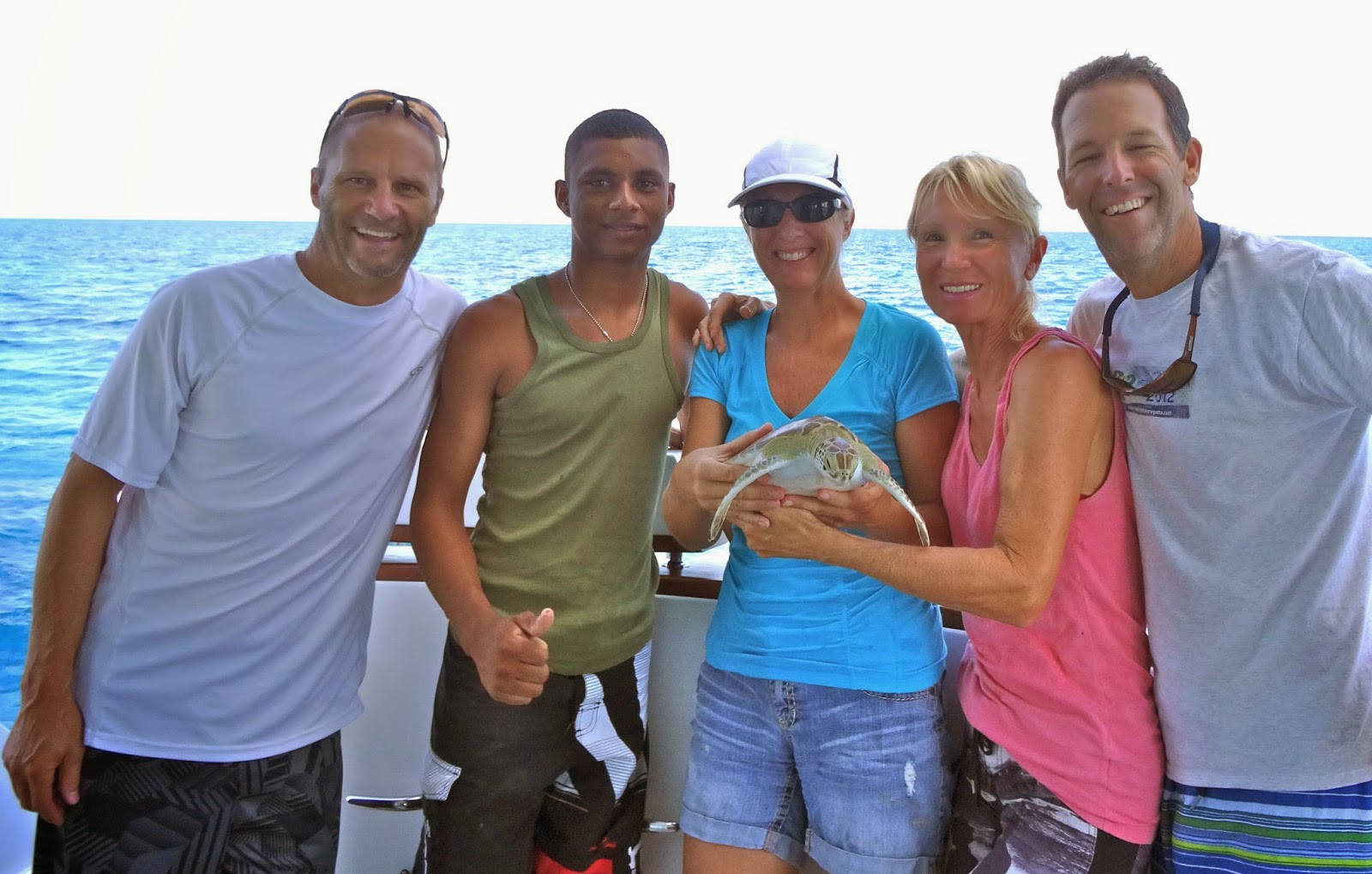 |
| Our new crew members. |
My first thought was why do you have this little guy and please tell me you don’t eat them? They all laughed, indicated they they helped the turtles as they migrated to the island to lay their eggs. This little guy was about 5 years old. As I was holding him his front flippers slapped at my hands and he stretched his neck toward the water.
Two of the soldiers asked to come aboard Anna Mae for a tour. The turtle was snuggled in my lap as we all made the short ride dingy ride out to Anna Mae. I petted the turtle behind his head and on his tummy, he was so soft.
After a quick tour of Anna Mae and a few pictures, we filled a bag with drinks and some food the soldiers could share with their buddies. We had a little ceremony when we set our turtle free, he swam away quickly with a smile on his face.
Today we snorkeled off the reefs surrounding the islands, the crystal clear water is beautiful with so many colorful fish and amazing sea life. We saw a large lion fish hanging out in a cave along with a multitude of colorful sea life.
Anna Mae sits alone in this anchorage, it’s a beautiful area and from the sound of things not many boats are allowed to stay. We visited with a couple of fishermen that showed us their catch of the day. They dive down for conch, lobster and fish the various reefs. Most of them are from Isla San Andres.
I’m happy to report a couple of additions to my collection, a mini conch and two puffy sand dollars.
We are happily anchored in a little bay off Isla Andres. We hope to stay a few days and already talked with some locals that want to share a nice snorkel site with us tomorrow.
When my internet signal improves I will share some pictures.
Anna Mae and crew in The Cayos De Albuquerque
After a hectic day of trying to clear out of Panama, a taxi ride to Colon and paper shuffling, we set out late on the afternoon of the 16th for our 215NM run to a tiny little island owned by Columbia, Cayos De Albuquerque.
The water was bumpier than we anticipated. Leaving Shelter Bay, passing through the breakwater into The Caribbean and leaving The Panama Canal behind, the winds bounced around us blowing 25 knots. The wave heights hit up to 9’ averaging around 7’ at 8 seconds, Anna Mae performed flawlessly.
The captain maintained a positive attitude, his first mate was not much help through the night. I’m glad to have Tom and Susanne on board. Early the next morning I managed to take a few shifts, I am experimenting with motion sickness medication, enough said…
By late afternoon of the 17th we could see our destination in the distance. A large reef surrounds the two islands of Cayos De Albuquerque with a tricky entrance of many shallow areas. One of the Islands is a Columbian military base and the other a small fishing camp. Our VHF radio sounded as we approached. A not so happy Spanish voice expressed in unfriendly terms that we were not welcome, although our Columbian Zarpe and crew list showed that we could drop our anchor in Columbian waters.
Bill and I had our eyes on the charts trying to decide which mapping program was the most accurate, Nobeltec, Coastal Explorer or Navionics on my IPad. Tom and Susanne gave us hand signals from the bow. Watching the depth sounder made all of us very tense. Continually conversing with the Spanish voice on the VHF that we needed to anchor before the sun set. Attempting to maneuver out of the coral reef in the dark was not an option.
Eventually we found a spot to anchor and repeating No hablo Espanol Senor the gruff Spanish military voice relented and reluctantly allowed us to stay and we settled in for the night.
We woke the next morning to blue skies, and a visit to The Columbian Military Base on the island. As we approached a very young man with a machine gun approached and escorted us through sandy walkways shaded with palm trees and lined with conch shells. I wanted to scoop up as many as I could, but was afraid that might be frowned upon by our Columbian friend with the machine gun, so I refrained.
The military base is very primitive. The 20 or so soldiers on the island live in a small building with bunks stacked three high. None of them look to be older than 25 or 30. When they examined our passports, exit papers, Zarpe and crew list from Panama indicating our entry into Columbia they decided all was okay. Several even smiled and attempted to joked with us. My Spanish isn’t great and Bill’s even worse. Bill was talking with them in his famous Spanglish dialect. They all laughed, I’m sure not with him but at him…
As we walked back to our dingy one of the soldiers knew I had my eye on the conch shells stacked in piles along the bank and lining the walkways. I wish I had a picture, but was told no photos permitted. One of the soldiers got a huge smile on his face and asked me to wait while he got something for me. I thought for sure I was going to add a big beautiful conch shell to my collection.(Cherie you would have been in shell heaven). Instead of the shiny shell I was anticipating he walked out from behind a palm with a live sea turtle and handed it to me. For the time being the shell was forgotten, I was instantly in love with the little turtle.
|
| Our new crew members. |
My first thought was why do you have this little guy and please tell me you don’t eat them? They all laughed, indicated they they helped the turtles as they migrated to the island to lay their eggs. This little guy was about 5 years old. As I was holding him his front flippers slapped at my hands and he stretched his neck toward the water.
Two of the soldiers asked to come aboard Anna Mae for a tour. The turtle was snuggled in my lap as we all made the short ride dingy ride out to Anna Mae. I petted the turtle behind his head and on his tummy, he was so soft.
After a quick tour of Anna Mae and a few pictures, we filled a bag with drinks and some food the soldiers could share with their buddies. We had a little ceremony when we set our turtle free, he swam away quickly with a smile on his face.
Today we snorkeled off the reefs surrounding the islands, the crystal clear water is beautiful with so many colorful fish and amazing sea life. We saw a large lion fish hanging out in a cave along with a multitude of colorful sea life.
Anna Mae sits alone in this anchorage, it’s a beautiful area and from the sound of things not many boats are allowed to stay. We visited with a couple of fishermen that showed us their catch of the day. They dive down for conch, lobster and fish the various reefs. Most of them are from Isla San Andres.
I’m happy to report a couple of additions to my collection, a mini conch and two puffy sand dollars.
We are happily anchored in a little bay off Isla Andres. We hope to stay a few days and already talked with some locals that want to share a nice snorkel site with us tomorrow.
When my internet signal improves I will share some pictures.
Charleston,South Carolina
Well, Emily Gracemay well have tried to make us linger in Charleston as she proceeded to let the overboard macerator pump fail on the passage from Georgia. Since this little pump allows us to discharge waste when 3 miles offshore, it is mighty important and she may have succeeded. The captain, however, thwarted any such mutinous plan by having 2 spare pump impellers aboard. Although that fixed the problem, the captain was also ready with another complete replacement pump!


In any event, we entered the Ashley River and found the private mooring ball that we had found and reserved using Active Captain on our Coastal Explorer navigation software. Unfortunately the owner had left a decrepit dingy tied to it using copious amounts of rope. Despite valiant efforts by Captain and crew, we couldn’t get the tangled line free with our boat hook and ended up with the dingy painter wrapped around the underwater stabilizer fin. A local boater came over and with his help and the swift 2 knot current, we managed to break free unharmed and get temporarily re-attached to the mooring/dingy mess. The owner of the mooring was then called and he borrowed my knife to cut off the tangled mess he had left us and we were then properly attached to the mooring ball. It all worked out well, since we paid him $15 per night for a $20 per night mooring. He got a $45 windfall for our 3-night stay and we got a good deal.
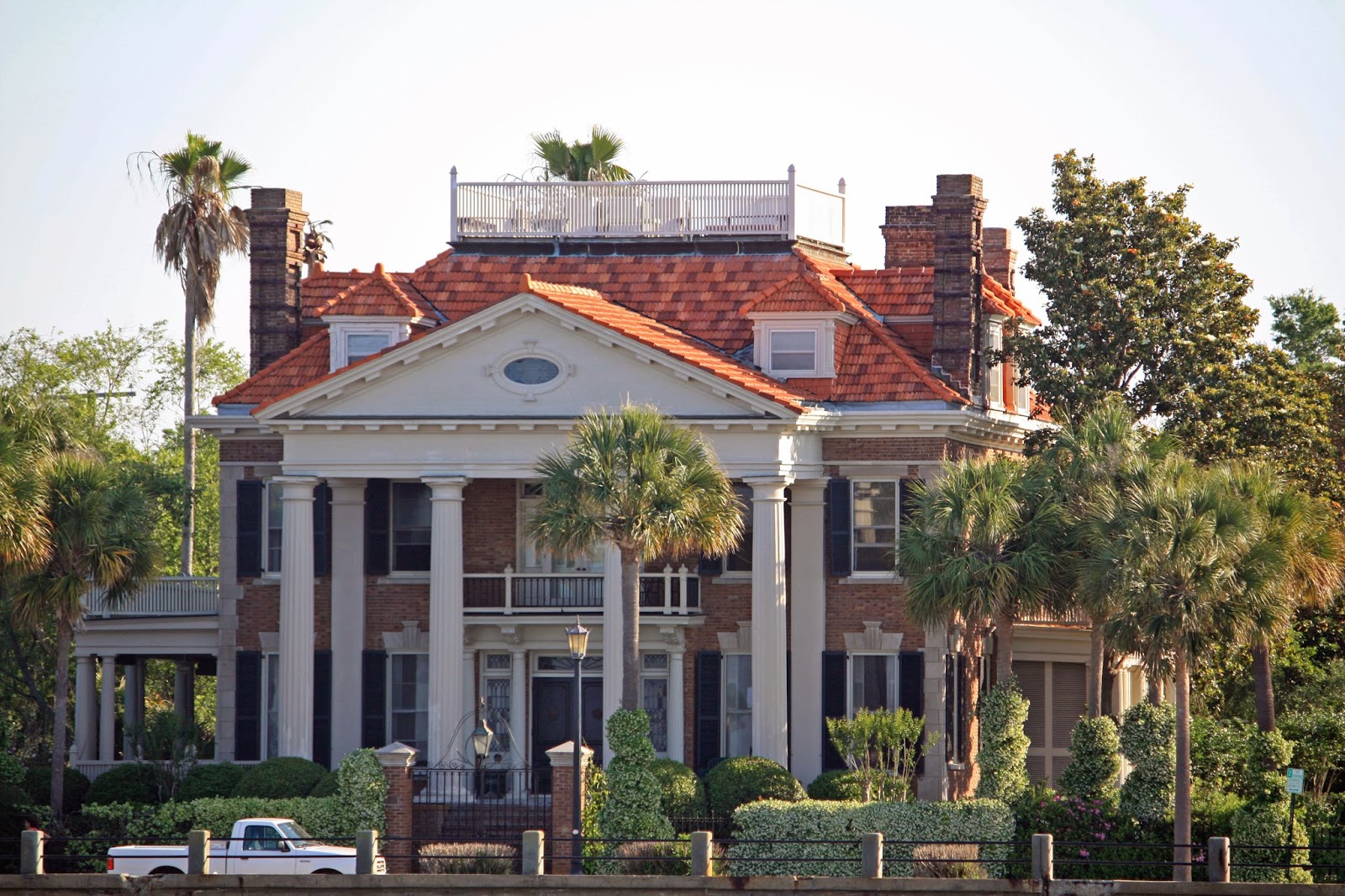
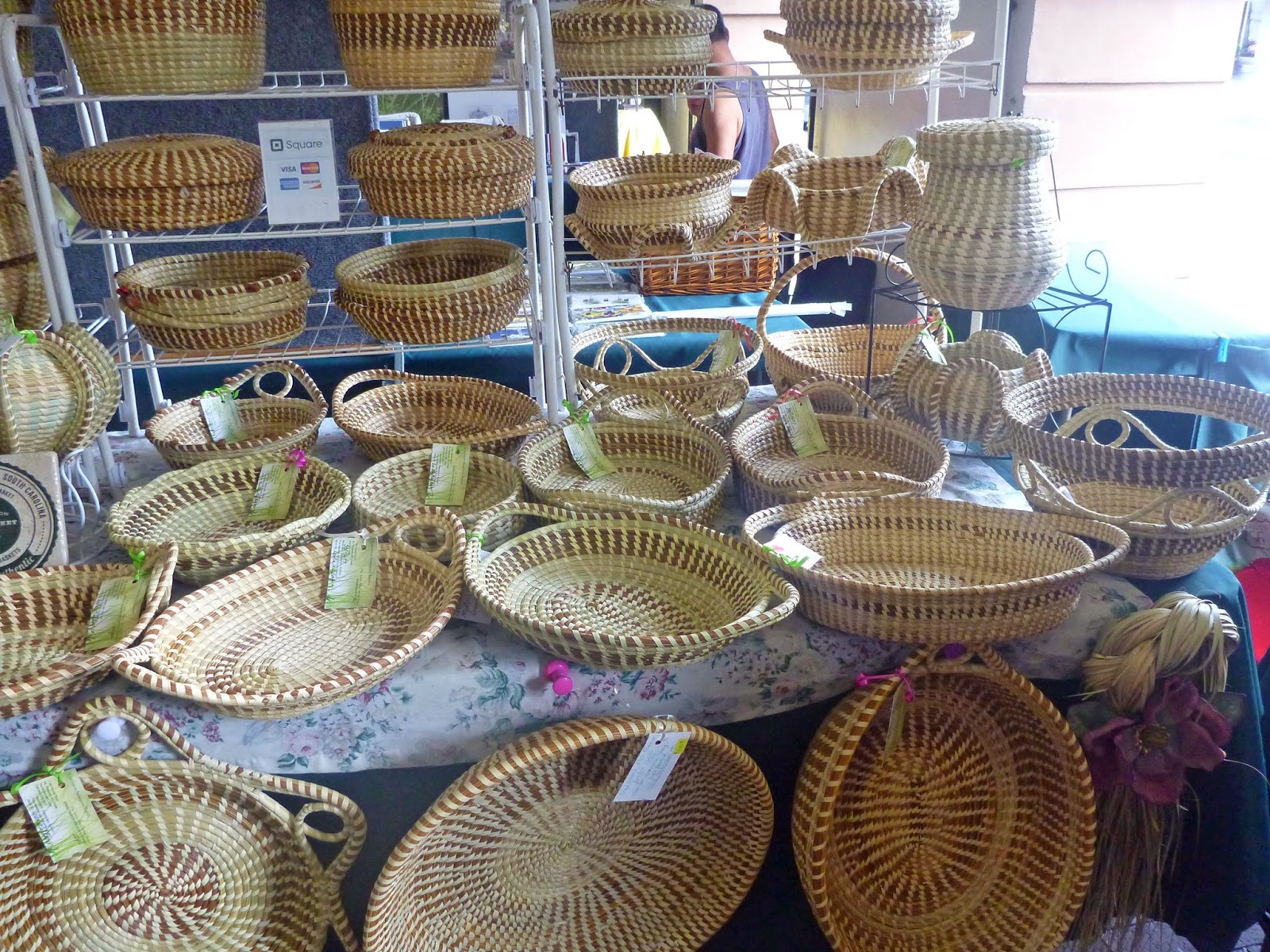
After foiling the mutiny and surviving the attack mooring ball, the crew deservedly went ashore to explore Charleston. We found the gracious waterfront mansions and well-made but overpriced sweetgrass baskets were still as we left them back in our 2008 visit. We revisited the oldest museum in America, the old slave market and the historic Nathaniel Russell house.

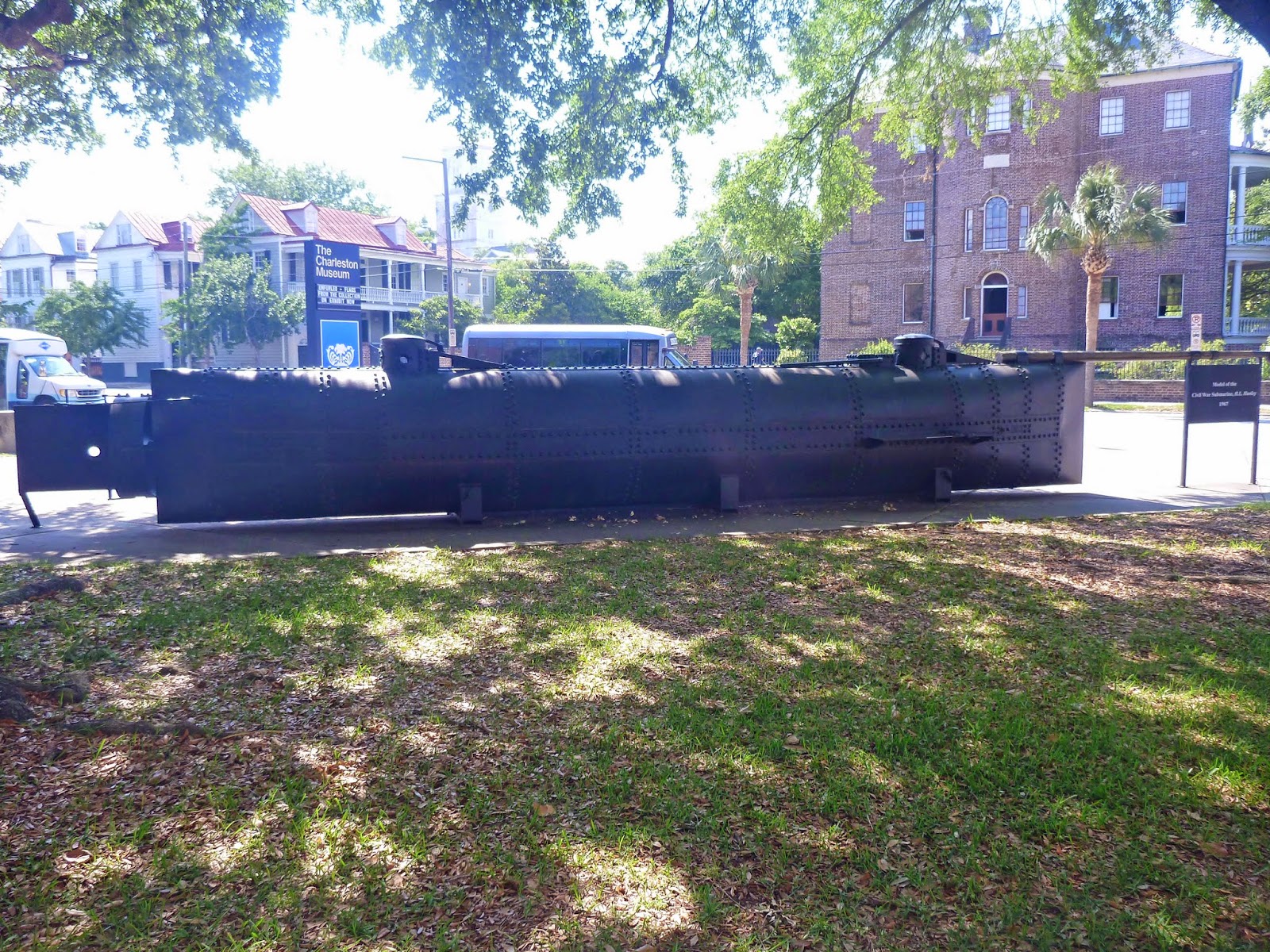
America’s oldest museum happens to be The Charleston Museum right here in South Carolina. It opened in 1773, and from the beginning, displayed geological specimens from its surrounding areas. Outside there is a replica of the American Civil War H. L. Hunley submarine of the Confederate States of America. Drawing from my vast experience working at the Groton submarine factory (Ha Ha), I explained to Emily that the Hunley demonstrated the advantages and the dangers of undersea warfare. She was the first combat submarine to sink a warship, although Hunley was not completely submerged and, following her successful attack, was lost along with her crew before she could return to her base. Apparently, the bowsprit containing the explosive charge was not quite long enough!
The exhibits inside run the gamut from textile and clothing to silver to lowcountry life, rise of the South, Revolutionary War, Civil War, natural history, and the most impressive arsenal of weaponry I’ve ever seen. If we only had one of these multibarrel rifles aboard, maybe we could have gone through the Somalia pirate waters!


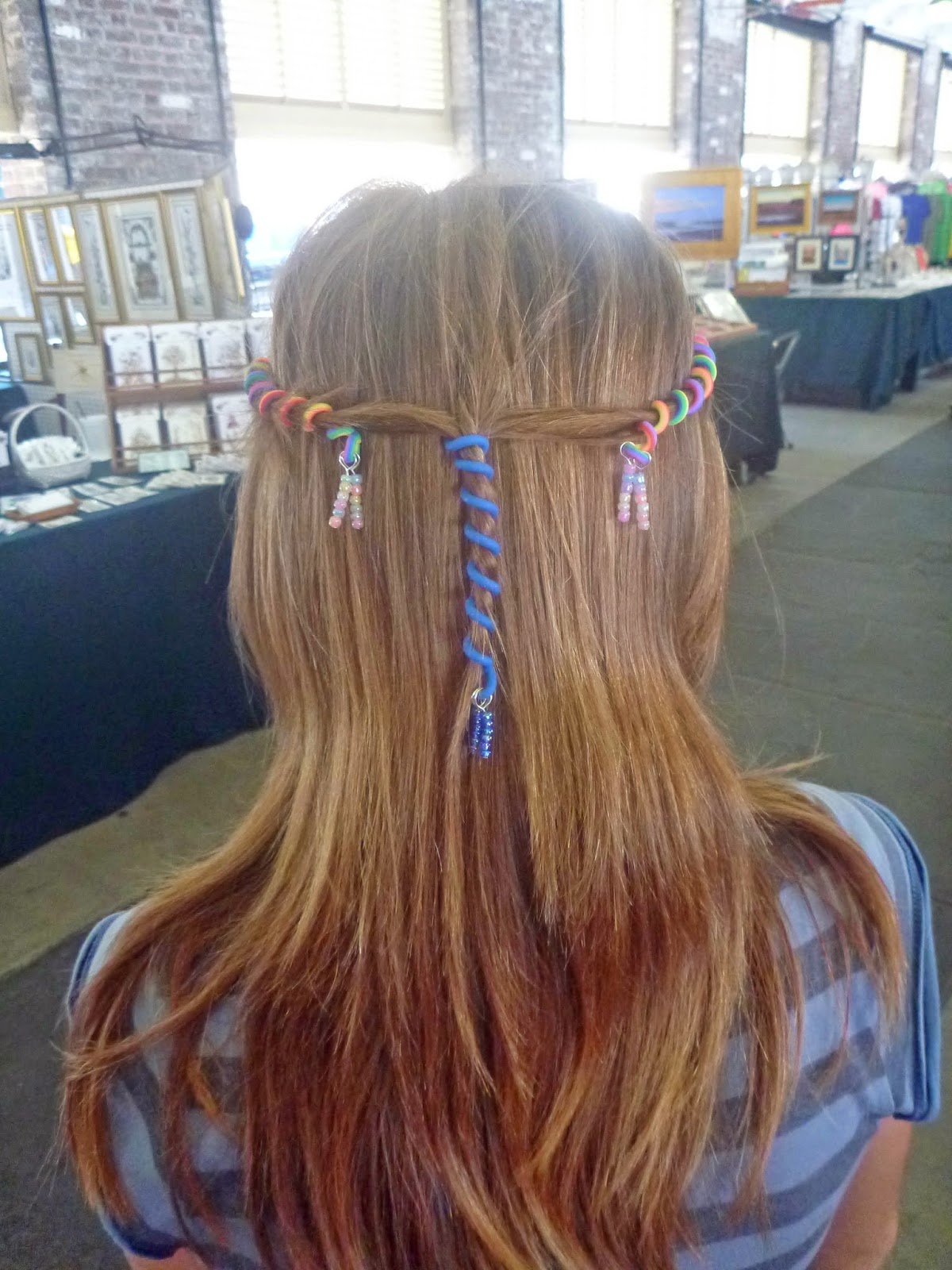
The slave markets only redeeming quality is the ability to see the nicely made sweetgrass baskets. Since we found and bought these same baskets in Dominica for less than 1/10th of the selling price here, we simply looked and complemented the ladies on their work. Among the cheap trinkets being hawked here, Emily found some cool resin hair thingy’s she hopes will be OK with the school girls in Ludlow, Mass.
Located in Downtown Charleston near High Battery, the Nathaniel Russell House Museum at 51 Meeting Street, is widely recognized as one of America’s most important neoclassical dwellings and was worth the stop. The Historic Charleston Foundation purchased the National Historic Landmark in 1955, and the house served as the Foundation’s headquarters for 37 years. Today, the interiors are restored to their original 1808 grandeur and surrounded by formal gardens.
Nathaniel Russell was born in Bristol, Rhode Island. He settled in Charleston at the age of 27 in 1765, when Charleston was a bustling seaport. By 1774, Charleston boasted a per capita of wealth nearly four times that of all the American colonies. Russell’s career as a merchant involved the shipment of cargoes to and from New England, the West Indies, South America, Virginia, Great Britain, continental Europe, West Africa and Asia.
While most of his profits came from the exportation of staples, such as Carolina Gold rice, indigo, tobacco and cotton, Russell handled a broad range of imported goods. He also participated in the African slave trade both before and after the American Revolution.
The Nathaniel Russell House is an excellent example of the Adam style of architecture. Russell’s house was built when local carpenters had a decade of experience with the light and airy manner made popular by Robert Adam. His house has been called an exercise in ellipses, for from its free-flying stair to the wrought iron balconies, to the principal windows and doors, we found it to be extraordinary. It was the last great house of the city’s post-revolutionary period. Built in 1809, the house was listed in the National Register in 1971 and Designated a National Historic Landmark in 1973.


We also stepped into the Cathedral of St. John the Baptist. The Cathedral seats 720 people and is noted for its Franz Mayer & Co. stained glass, hand painted Stations of the Cross, and neo-gothic architecture. The cornerstone was laid in 1890, and the church opened in 1907.
The sides of the Sanctuary are adorned with windows depicting the 4 Gospel writers with their winged creatures. Above the High Altar is the Chancel window. The top section is a rose window depicting St. John the Baptist baptizing Jesus with the Holy Spirit above. It is surrounded by 8 adoring angels playing instruments. Above the Rose window is a Sacred Heart. To the left of the Rose window is a pelican feeding her three newborn pelicans, and to the right is the Lamb of God. Below all of this is a 5-light replica of Da Vinci’s Last Supper.


In general, Charleston was a nice stop. They need some free dingy docks and the shuttle busses (although free) were really overcrowded; but those are minor complaints. After 2 tiring days of sightseeing, Tom started to plot the trip up the ditch towards North Carolina. When we compared 3 long days of hand steering and bridge openings, we again decided to head for the ocean since we could do the same trip easily overnight. Come along as our next stop will be in Carolina Beach, North Carolina.
Tom
Charleston,South Carolina
Normal
0
false
false
false
EN-US
X-NONE
X-NONE
/* Style Definitions */
table.MsoNormalTable
{mso-style-name:”Table Normal”;
mso-tstyle-rowband-size:0;
mso-tstyle-colband-size:0;
mso-style-noshow:yes;
mso-style-priority:99;
mso-style-parent:””;
mso-padding-alt:0in 5.4pt 0in 5.4pt;
mso-para-margin-top:auto;
mso-para-margin-right:0in;
mso-para-margin-bottom:auto;
mso-para-margin-left:0in;
mso-pagination:widow-orphan;
font-size:11.0pt;
font-family:”Comic Sans MS”;}
Normal
0
false
false
false
EN-US
X-NONE
X-NONE
/* Style Definitions */
table.MsoNormalTable
{mso-style-name:”Table Normal”;
mso-tstyle-rowband-size:0;
mso-tstyle-colband-size:0;
mso-style-noshow:yes;
mso-style-priority:99;
mso-style-parent:””;
mso-padding-alt:0in 5.4pt 0in 5.4pt;
mso-para-margin-top:auto;
mso-para-margin-right:0in;
mso-para-margin-bottom:auto;
mso-para-margin-left:0in;
mso-pagination:widow-orphan;
font-size:11.0pt;
font-family:”Comic Sans MS”;}
Well, Emily Grace
may well have tried to make us linger in Charleston as she proceeded to let the
overboard macerator pump fail on the passage from Georgia. Since this little pump allows us to discharge
waste when 3 miles offshore, it is mighty important and she may have succeeded.
The captain, however, thwarted any such mutinous plan by having 2 spare pump
impellers aboard. Although that fixed
the problem, the captain was also ready with another complete replacement pump!
In any event, we entered the Ashley River and found the
private mooring ball that we had found and reserved using Active Captain on our
Coastal Explorer navigation software.
Unfortunately the owner had left a decrepit dingy tied to it using
copious amounts of rope. Despite valiant
efforts by Captain and crew, we couldn’t get the tangled line free with our
boat hook and ended up with the dingy painter wrapped around the underwater
stabilizer fin. A local boater came over
and with his help and the swift 2 knot current, we managed to break free
unharmed and get temporarily re-attached to the mooring/dingy mess. The owner of the mooring was then called and
he borrowed my knife to cut off the tangled mess he had left us and we were then
properly attached to the mooring ball.
It all worked out well, since we paid him $15 per night for a $20 per
night mooring. He got a $45 windfall for
our 3-night stay and we got a good deal.
private mooring ball that we had found and reserved using Active Captain on our
Coastal Explorer navigation software.
Unfortunately the owner had left a decrepit dingy tied to it using
copious amounts of rope. Despite valiant
efforts by Captain and crew, we couldn’t get the tangled line free with our
boat hook and ended up with the dingy painter wrapped around the underwater
stabilizer fin. A local boater came over
and with his help and the swift 2 knot current, we managed to break free
unharmed and get temporarily re-attached to the mooring/dingy mess. The owner of the mooring was then called and
he borrowed my knife to cut off the tangled mess he had left us and we were then
properly attached to the mooring ball.
It all worked out well, since we paid him $15 per night for a $20 per
night mooring. He got a $45 windfall for
our 3-night stay and we got a good deal.
After foiling the mutiny and surviving the attack mooring
ball, the crew deservedly went ashore to explore Charleston. We found the gracious waterfront mansions and
well-made but overpriced sweetgrass baskets were still as we left them back in
our 2008 visit. We revisited the oldest
museum in America, the old slave market and the historic Nathaniel Russell
house.
ball, the crew deservedly went ashore to explore Charleston. We found the gracious waterfront mansions and
well-made but overpriced sweetgrass baskets were still as we left them back in
our 2008 visit. We revisited the oldest
museum in America, the old slave market and the historic Nathaniel Russell
house.
America’s oldest museum happens to be The Charleston Museum right
here in South Carolina. It opened in 1773, and from the beginning, displayed
geological specimens from its surrounding areas. Outside there is a replica of the American
Civil War H. L. Hunley submarine of the Confederate States of America. Drawing
from my vast experience working at the Groton submarine factory (Ha Ha), I explained
to Emily that the Hunley demonstrated the advantages and the dangers of
undersea warfare. She was the first combat submarine to sink a warship,
although Hunley was not completely submerged and, following her successful
attack, was lost along with her crew before she could return to her base. Apparently, the bowsprit containing the explosive charge was not quite long enough!
here in South Carolina. It opened in 1773, and from the beginning, displayed
geological specimens from its surrounding areas. Outside there is a replica of the American
Civil War H. L. Hunley submarine of the Confederate States of America. Drawing
from my vast experience working at the Groton submarine factory (Ha Ha), I explained
to Emily that the Hunley demonstrated the advantages and the dangers of
undersea warfare. She was the first combat submarine to sink a warship,
although Hunley was not completely submerged and, following her successful
attack, was lost along with her crew before she could return to her base. Apparently, the bowsprit containing the explosive charge was not quite long enough!
The exhibits inside run the gamut from textile and clothing
to silver to lowcountry life, rise of the South, Revolutionary War, Civil War,
natural history, and the most impressive arsenal of weaponry I’ve ever seen. If
we only had one of these multibarrel rifles aboard, maybe we could have gone
through the Somalia pirate waters!
to silver to lowcountry life, rise of the South, Revolutionary War, Civil War,
natural history, and the most impressive arsenal of weaponry I’ve ever seen. If
we only had one of these multibarrel rifles aboard, maybe we could have gone
through the Somalia pirate waters!
The slave markets only redeeming quality is the ability to
see the nicely made sweetgrass baskets. Since
we found and bought these same baskets in Dominica for less than 1/10th of the
selling price here, we simply looked and complemented the ladies on their work. Among the cheap trinkets being hawked here,
Emily found some cool resin hair thingy’s she hopes will be OK with the school girls
in Ludlow, Mass.
see the nicely made sweetgrass baskets. Since
we found and bought these same baskets in Dominica for less than 1/10th of the
selling price here, we simply looked and complemented the ladies on their work. Among the cheap trinkets being hawked here,
Emily found some cool resin hair thingy’s she hopes will be OK with the school girls
in Ludlow, Mass.
Located in Downtown Charleston near High Battery, the
Nathaniel Russell House Museum at 51 Meeting Street, is widely recognized as one
of America’s most important neoclassical dwellings and was worth the stop. The Historic
Charleston Foundation purchased the National Historic Landmark in 1955, and the
house served as the Foundation’s headquarters for 37 years. Today, the
interiors are restored to their original 1808 grandeur and surrounded by formal
gardens.
Nathaniel Russell House Museum at 51 Meeting Street, is widely recognized as one
of America’s most important neoclassical dwellings and was worth the stop. The Historic
Charleston Foundation purchased the National Historic Landmark in 1955, and the
house served as the Foundation’s headquarters for 37 years. Today, the
interiors are restored to their original 1808 grandeur and surrounded by formal
gardens.
Nathaniel Russell was born in Bristol, Rhode
Island. He settled in Charleston at the age of 27 in 1765, when Charleston was
a bustling seaport. By 1774, Charleston boasted a per capita of wealth nearly
four times that of all the American colonies. Russell’s career as a merchant
involved the shipment of cargoes to and from New England, the West Indies,
South America, Virginia, Great Britain, continental Europe, West Africa and
Asia.
While most of his profits came from the
exportation of staples, such as Carolina Gold rice, indigo, tobacco and cotton,
Russell handled a broad range of imported goods. He also participated in the
African slave trade both before and after the American Revolution.
The Nathaniel Russell House is an excellent
example of the Adam style of architecture. Russell’s house was built when local
carpenters had a decade of experience with the light and airy manner made
popular by Robert Adam. His house has been called an exercise in ellipses, for
from its free-flying stair to the wrought iron balconies, to the principal
windows and doors, we found it to be extraordinary. It was the last great house
of the city’s post-revolutionary period. Built in 1809, the house was listed in
the National Register in 1971 and Designated a National Historic Landmark in 1973.
We also stepped into the Cathedral of St. John
the Baptist. The Cathedral seats 720 people and is noted for its Franz Mayer
& Co. stained glass, hand painted Stations of the Cross, and neo-gothic
architecture. The cornerstone was laid in 1890, and the church opened in 1907.
The sides of the Sanctuary are adorned with
windows depicting the 4 Gospel writers with their winged creatures. Above the
High Altar is the Chancel window. The top section is a rose window depicting
St. John the Baptist baptizing Jesus with the Holy Spirit above. It is
surrounded by 8 adoring angels playing instruments. Above the Rose window is a Sacred
Heart. To the left of the Rose window is a pelican feeding her three newborn
pelicans, and to the right is the Lamb of God. Below all of this is a 5-light
replica of Da Vinci’s Last Supper.
In general, Charleston was a nice stop. They need some free dingy docks and the shuttle
busses (although free) were really overcrowded; but those are minor
complaints. After 2 tiring days of sightseeing,
Tom started to plot the trip up the ditch towards North Carolina. When we compared 3 long days of hand steering
and bridge openings, we again decided to head for the ocean since we could do
the same trip easily overnight. Come
along as our next stop will be in Carolina Beach, North Carolina.
Tom
Normal
0
false
false
false
EN-US
X-NONE
X-NONE
/* Style Definitions */
table.MsoNormalTable
{mso-style-name:”Table Normal”;
mso-tstyle-rowband-size:0;
mso-tstyle-colband-size:0;
mso-style-noshow:yes;
mso-style-priority:99;
mso-style-parent:””;
mso-padding-alt:0in 5.4pt 0in 5.4pt;
mso-para-margin-top:auto;
mso-para-margin-right:0in;
mso-para-margin-bottom:auto;
mso-para-margin-left:0in;
mso-pagination:widow-orphan;
font-size:11.0pt;
font-family:”Comic Sans MS”;}
An alarm sounded which always gets my attention…
The damaged culprit As we passed through the final lock in our transit through The Panama Canal a nasty and shrill alarm sounded. The hydraulic alarm was complaining that it was showing a low fluid level in the hydraulic tank.Maneuvering through t…
An alarm sounded which always gets my attention…
The damaged culprit
As we passed through the final lock in our transit through The Panama Canal a nasty and shrill alarm sounded. The hydraulic alarm was complaining that it was showing a low fluid level in the hydraulic tank.
Mane…
