
Nordhavn Exumas Abacos Bahamas trawler Caribbean Pickwick Boat dogs
Memphis Downtown
Tag Archives | Nordhavn
Longboat Key
Movin’ On
Another opportunity has surfaced so we’re leaving Legacy Harbour to head back up north toward Sarasota.
But, before we left… We ventured into downtown Ft. Myers to the 86 Room; which on this night was an excellent Jazz Club. Featured vocalist: Lynn Richardson.
Lynn is Eric’s wife and he’s told me over the years his wife was a good singer — she’s not good at all, she’s truly a remarkable vocalist, the woman sings like a bell. We stuck around for a couple of sets and very much enjoyed Lynn and the band. The players are a trio of accomplished Jazz vets.
Great band, Great music, a wonderful night.
I’m writing this in retrospect while tied up at The Crow’s Nest Marina in Venice, FL.
Got several pics on my phone of Lynn and her band, but no bars. I’ll post them later when we find net.
So, movin’ on.
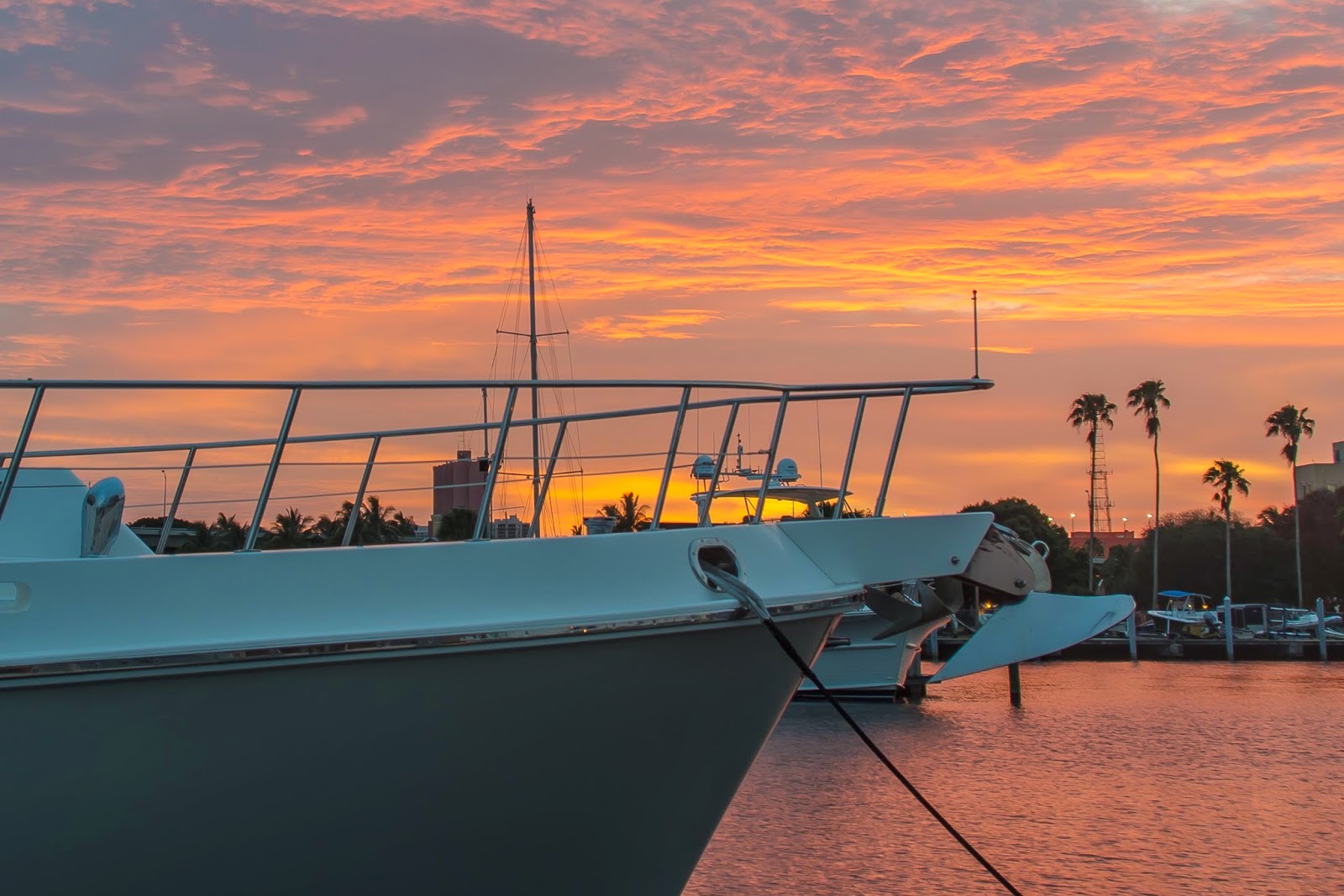
One of those “Red Skies Mornings”
Should’ve never untied
We left Legacy with a falling tide which gave us a knot of speed. I noticed the winds were a bit puffier than forecast, but we clipped along at 9knts heading for Boca Grande Pass.
Our plan was to try and take what the locals call the, Sneaky Pete” cut out of the pass which would save us 45 minutes or so, but when we looked at the seas we deemed it too unsettled to try. It’s shallow and there’s no room for mistakes.
So we headed out Boca Grande with a head sea that was a bit rolly, then a bit rollier, then became bumpy, then quickly turned into a bull ride. To add to the excitement, Boca Grande has shoaled in quite a bit and the marked channel took us into 40′ depths, followed by 9′ depths.
At one time I saw 3′ under the boat as we were riding over 6′ rollers. Breathtaking!
Should’ve take Sneaky Pete.
Looking back now… that’s two should’ves on a day we shouldn’t have.
We forgot the Gulf of Mexico must be respected, but we quickly remembered the tall/sharp/mean rollers she can deal you. We had a Nordhavn day—Istaboa’s a great boat.
After about 3o minutes, we turned south, putting the seas on our stern and surfed all the way to Venice.
After the bull ride, the following seas were a respite. We made it into Venice before a storm hit so we decided to tie up here and wait for more settled weather.
Today will be Sarasota and Longboat Key.
A better day, we hope.
Adios,
Istaboa
Nordhavn Exumas Abacos Bahamas trawler Caribbean Pickwick Boat dogs
Memphis Downtown
Memphis Downtown
Friday, May 2, 2014 – From Cabo to Ensenada
–>
Sunday, April 27 – Turtle Bay
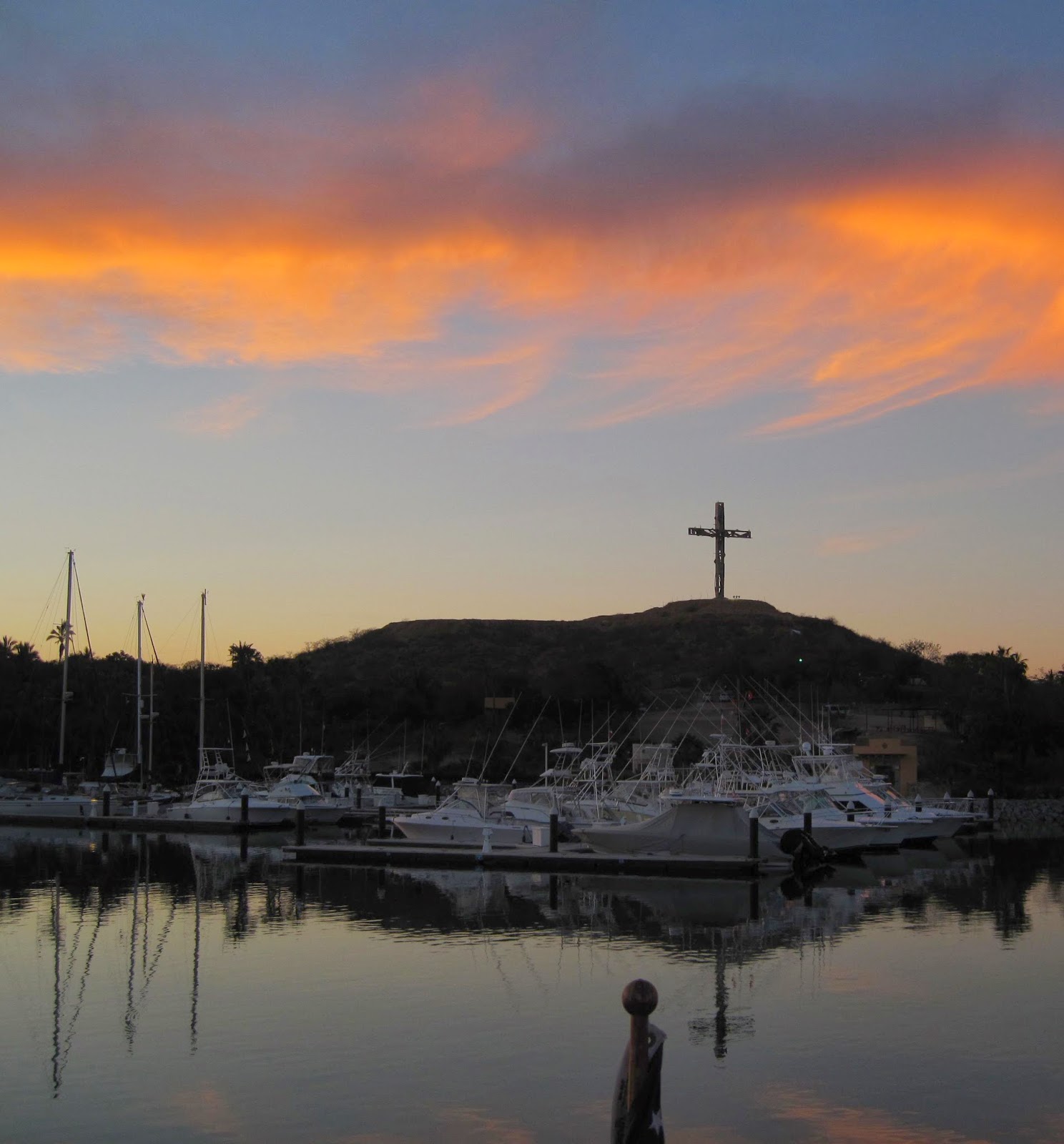 |
| Cross above Cabo San Jose Marina |
We spent a couple of pleasant days at San Jose del Cabo. The marina is comfortable– although not anywhere as nice as Costa Baja with very industrial artwork. We enjoyed dinner at Sharon and Dave’s condo where we discussed politics until 11:30. Pretty late for us folks. The next two days we provisioned and cleaned before picking up Joan and Clark at the airport. We had a good dinner at the Tropicana, recommended for Mexican food. Although it was not the fish tacos which I had expected, the food was excellent and the entertainment unexpected. Halfway through dinner a large group in crazy masks and very enhanced bosoms danced their way up the sidewalk and around us looking for donations. They were a hoot.
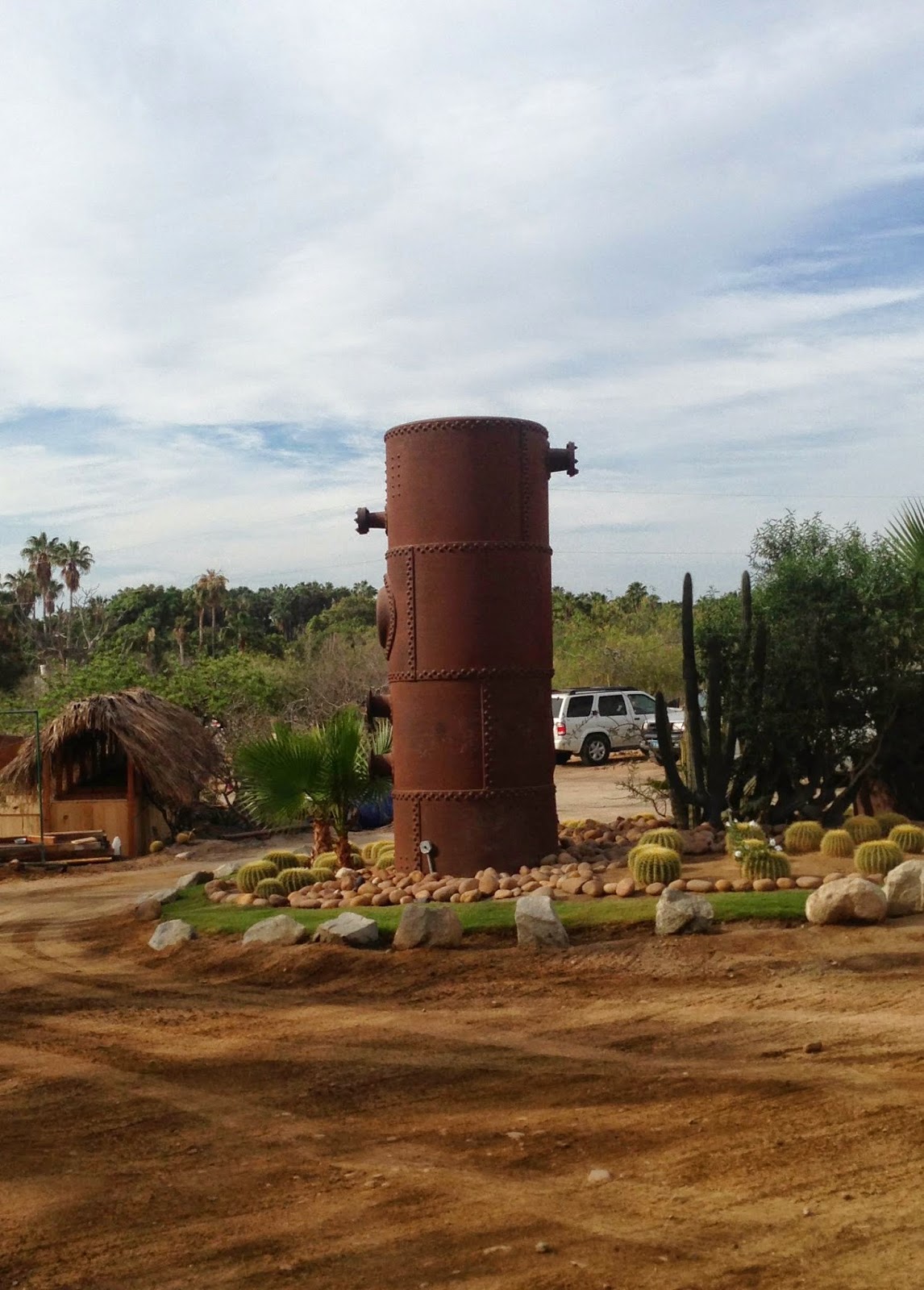 |
| Art???? |
We left San Jose del Cabo on Friday the 18th. The going was not nice and Earl decided when the wind hit 30 that we would be well served to go and anchor for the night in front of Cabo San Lucas. It was both Good Friday and Joan and Clark’s 50th wedding anniversary.
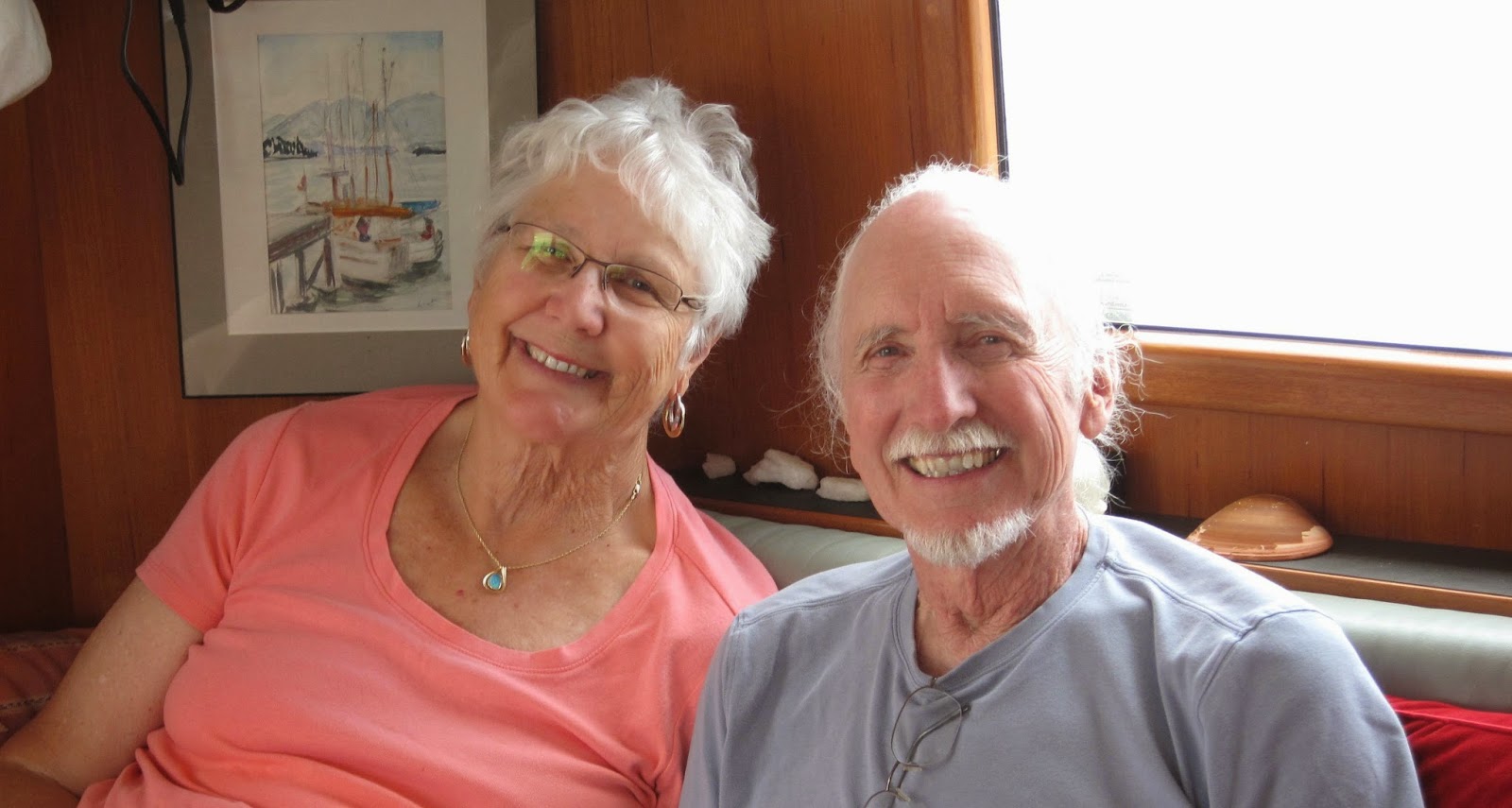 |
| Joan and Clark – 50 years and going strong |
Holy Week is a big holiday for the Mexicans and we felt rather as if we had anchored in the middle of an amusement park. The beach was literally covered with beach umbrellas and people, while a few brave souls were in the rather chilly water swimming or kayaking. One woman was attached to some kind of device that powered water jets under her feet and sent her soaring into the air. There was music blaring and everyone was apparently having a wonderful time. A barge anchored near us selling beer was covered with drinkers. At sunset, a number of boats turned on decorative lights and then there were fireworks. It was very festive. Not exactly what I would have thought for Good Friday in a Catholic country.
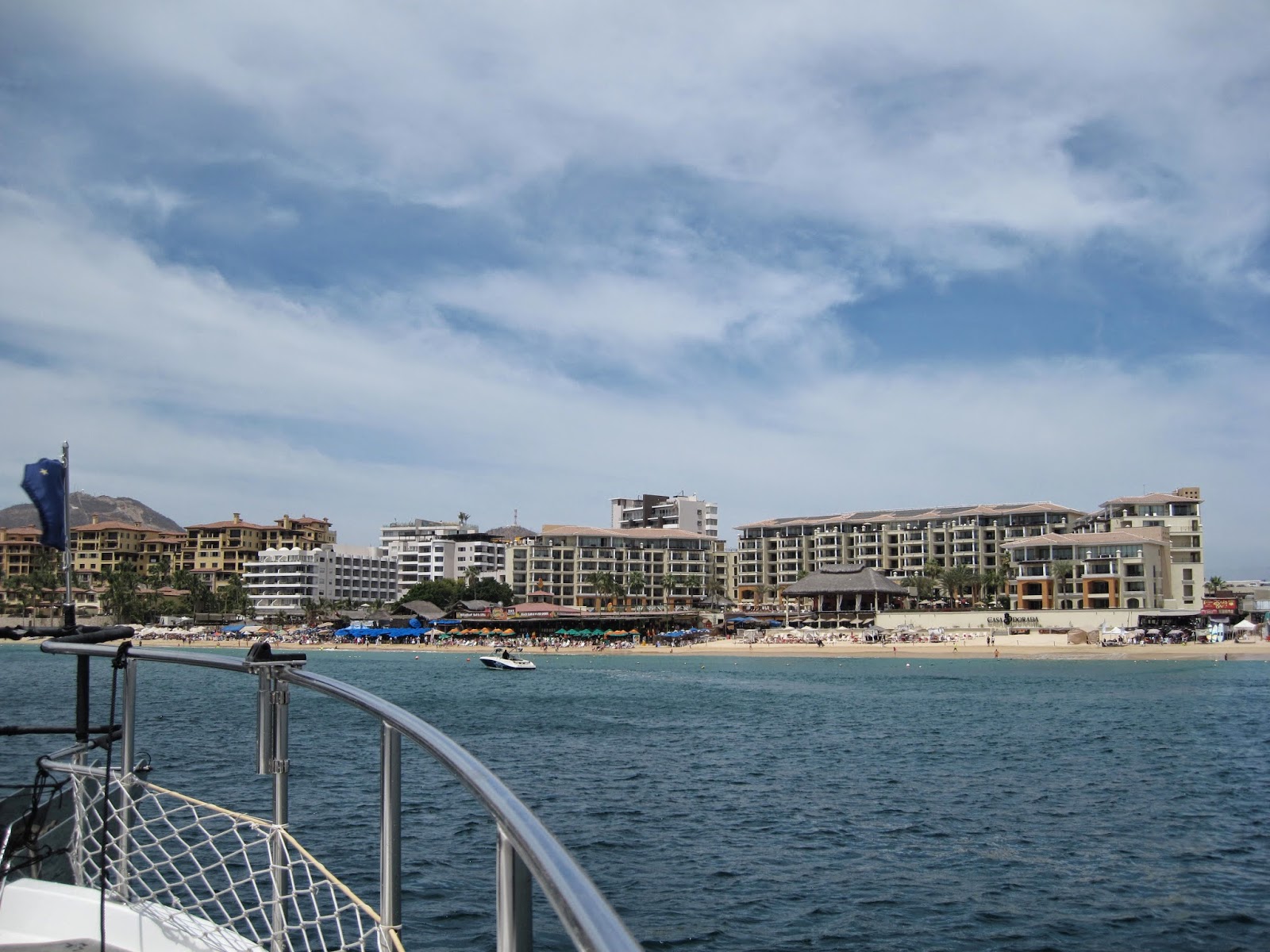 |
| Cabo beach |
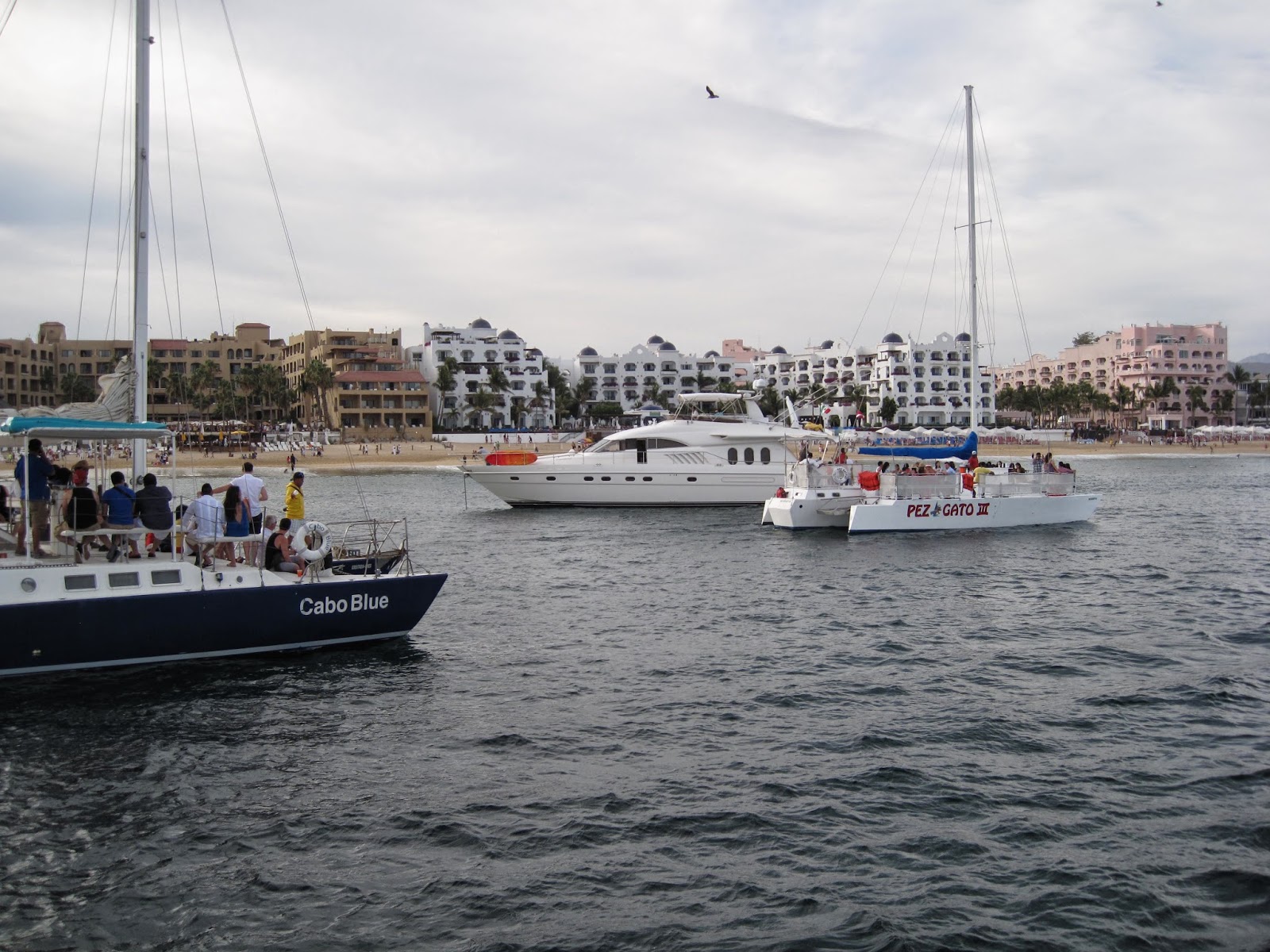 |
| Party Boats |
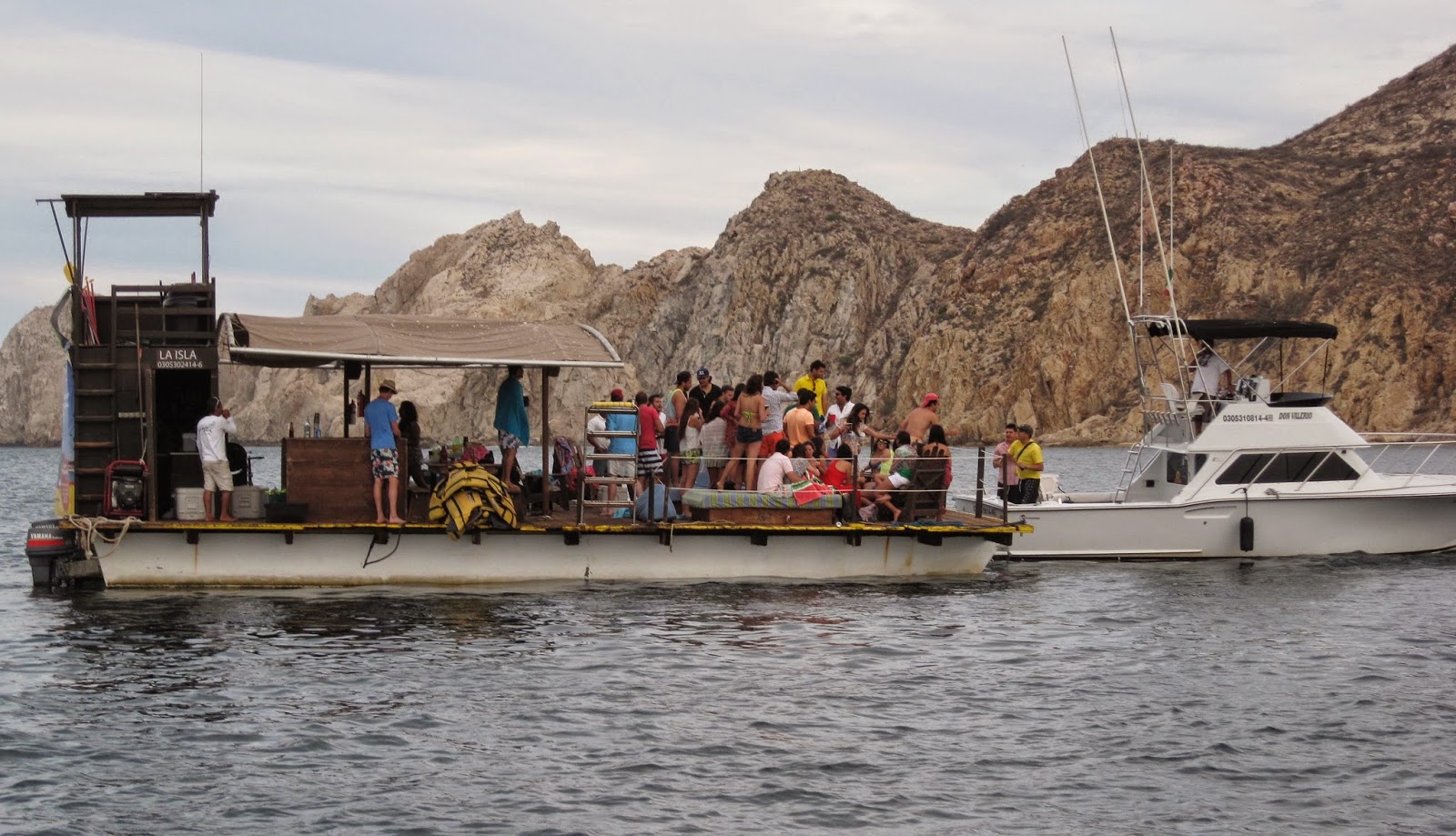 |
| Beer Barge |
We celebrated the anniversary with pepper steaks, champagne and a frozen Costco chocolate cake that we are still have not finished a week later.
Saturday morning just as the sky was lightening, we started off for a long run to Santa Maria just north of Mag Bay. As we rounded the Cape we were treated to the sight of a large whale breaching beside us. I guess he was wishing us a good trip north. It was a lovely start to our bash.
 |
| The Cape (Cabo San Lucas) |
Between Cabo San Lucas and Mag Bay it is a long 152 miles at 6 mph with no place to stop. It was choppy when we started and got worse. No fun! We bucked our way north and worked muscles we had forgotten about trying to keep from falling as we made our way around the boat. Daisy had the worst of it. She could not stand on the bow to relieve herself and even walking in the boat was tough. Earl finally put a towel down on the back deck so that she could get some traction. It took her several days to recover. The weather got worse during the night but by the time we arrived at Santa Maria, 172 miles from Cabo on Sunday the 21st it was actually becoming pleasant.
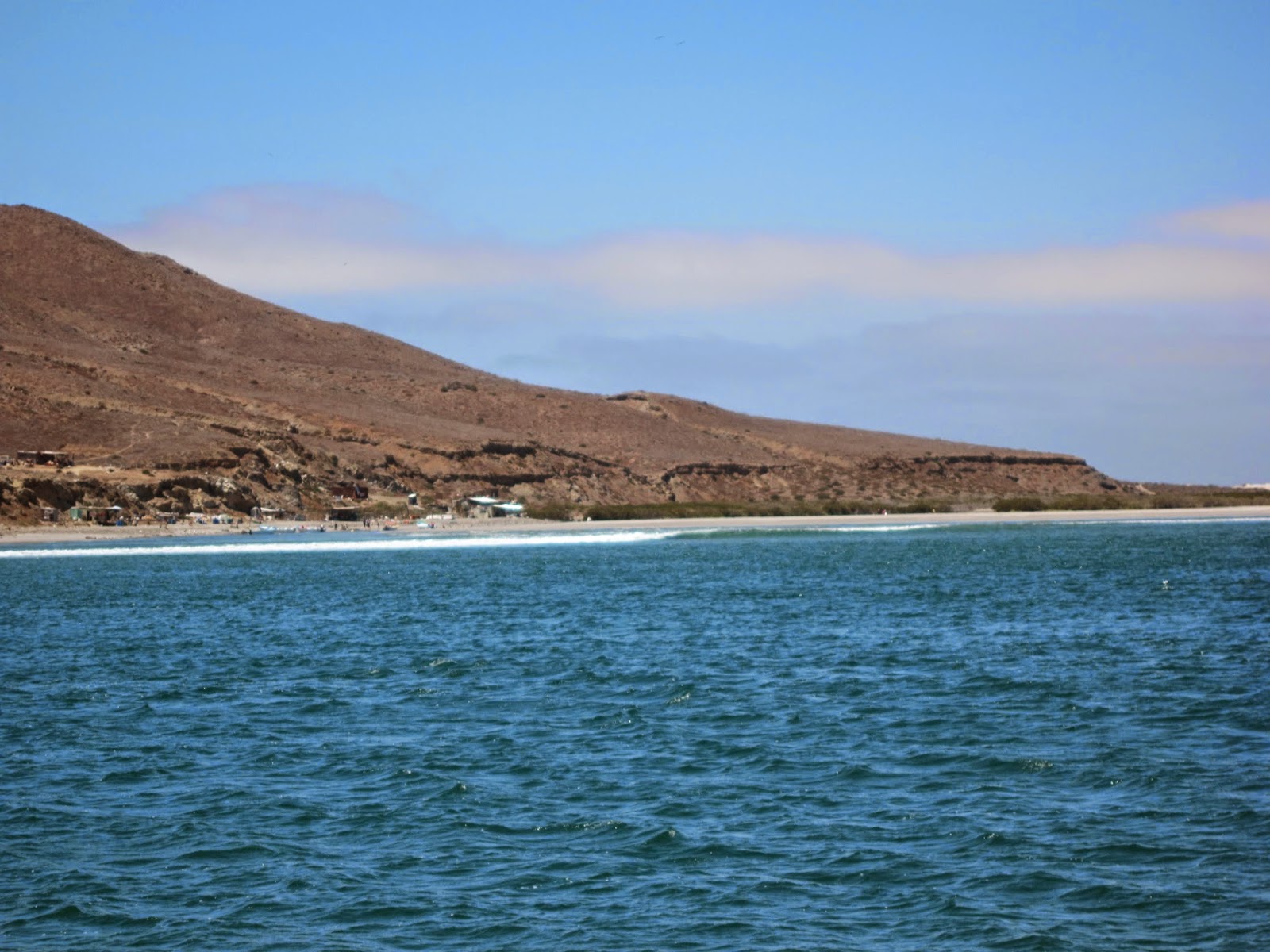 |
| Bahia Santa Maria |
We were exhausted and spent the next day recovering. Apparently we are all 5 years older than when we came south and probably we are better off not doing too many over night runs. We celebrated our safe arrival with a luxury dinner of rack of lamb and the next night suffered through fresh lobsters that Clark bought from a pangero. They were probably not legal since we have since been told everywhere else north that the season is closed.
 |
| Lobster Night! |
We saw what may be the new generation of Baja fisherman. Still in pangas, these guys wore nice raingear, spoke some English and had a boatload of hammerhead sharks, which must be a profitable catch. From what we could understand, the fins go to Asia and the bulk of the meat is made into surimi.
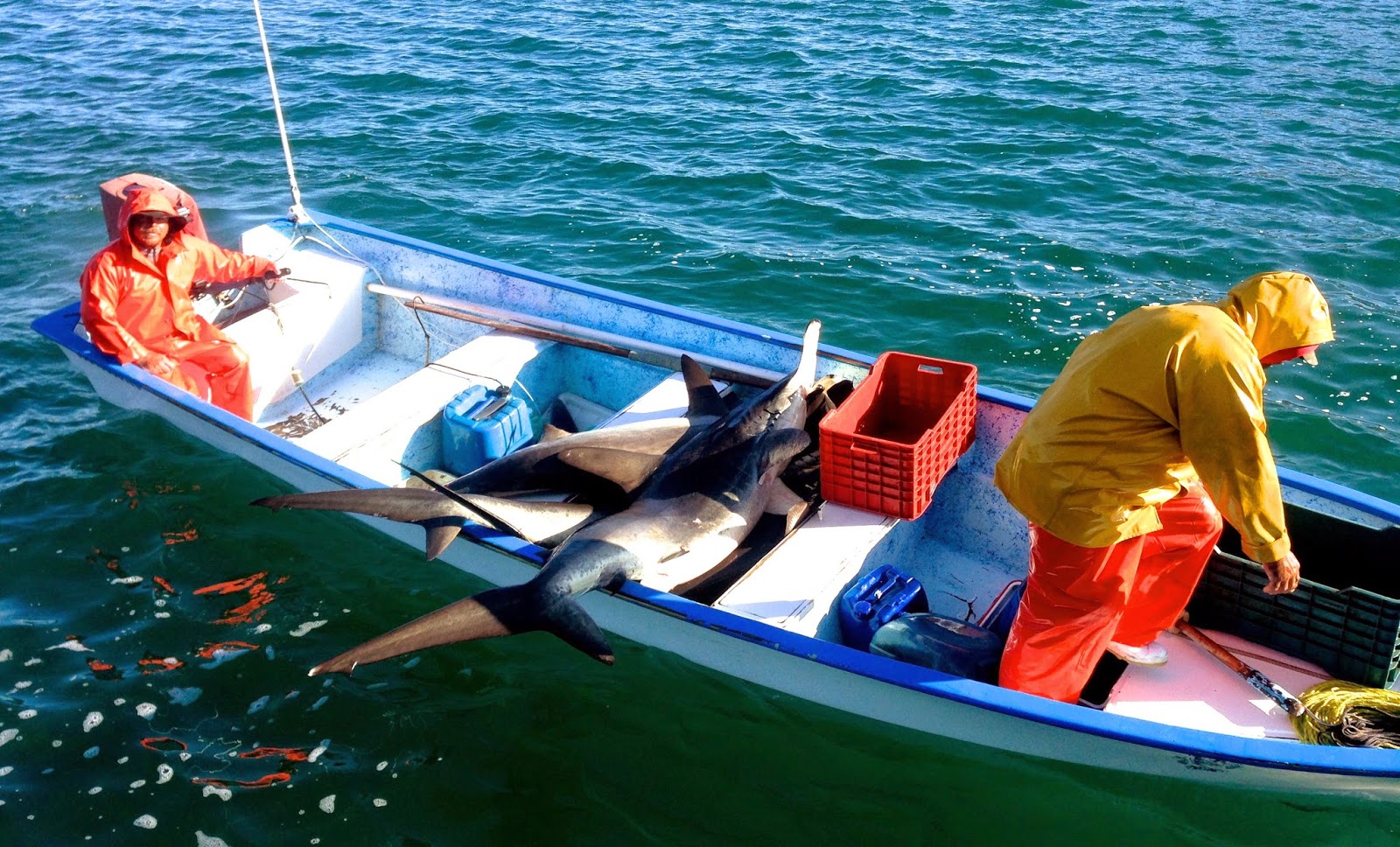 |
| Panga load of hammerheads |
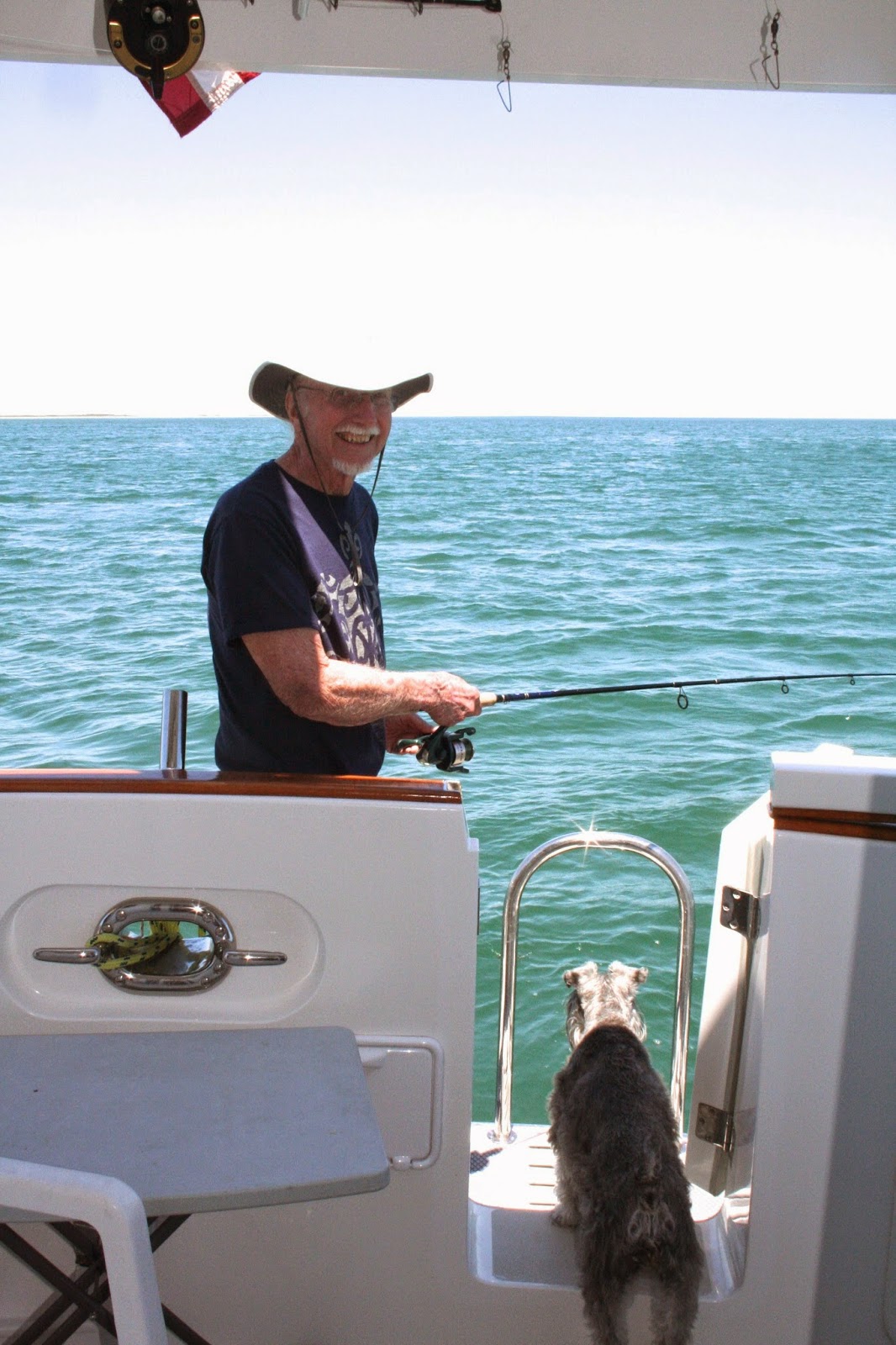 |
| Clark and Daisy fishing |
The trip south along the Baja with the winds on your tail is called the Baha Haha and it was a pleasant trip. The trip north is rightly called the Baja Bash. As one of the guide books put it: The prevailing wind and swell that was fun at 15 -20 knots going downwind, can become a bear when beating into an apparent wind in excess of 20-25 knots. The advice is to hug the coast to reduce the winds but that adds about 100 miles to the distance. It is also advised to travel early in the day before the afternoon winds come up. Thus, we have been making more stops than we did going south and instead of the 8 days it took us from Ensenada to Cabo in 2009, we will be lucky to make it in two weeks.
A 3 am departure from Santa Maria on Tuesday, April 22 got us to Juanico 7:20 pm. It was a long overcast day, but seas were reasonable. We saw a few large grey whales. One crossed right in front of the boat so Clark slowed down and gave it the right of way- it was coming from the right. The time was filled with lots of knitting and naps. Joan is a machine, whipping off a cap a day.
An 11 hour run got us from Juanico to Abre Ojos at 7 pm on Wednesday. It was choppy, but we were treated to gulls fighting for position on our front railing and porpoises came for Daisy’s delight. After we anchored, two pangas, each modified by the addition of a cabin, came by. They were the Mexican federal fish and game checking to see if we were poachers.
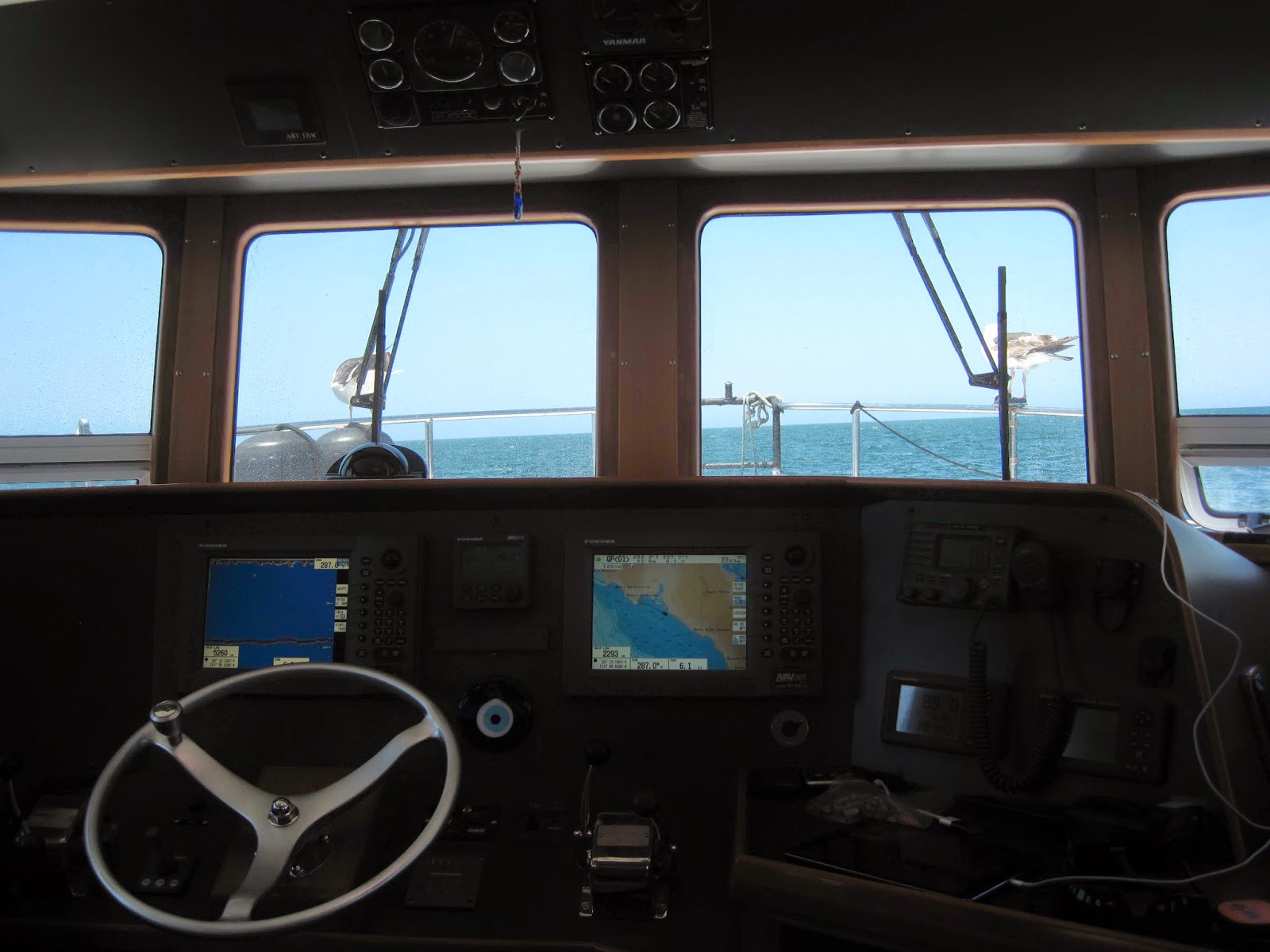 |
| Gulls on the railing |
 |
| Mexican Fish and Game |
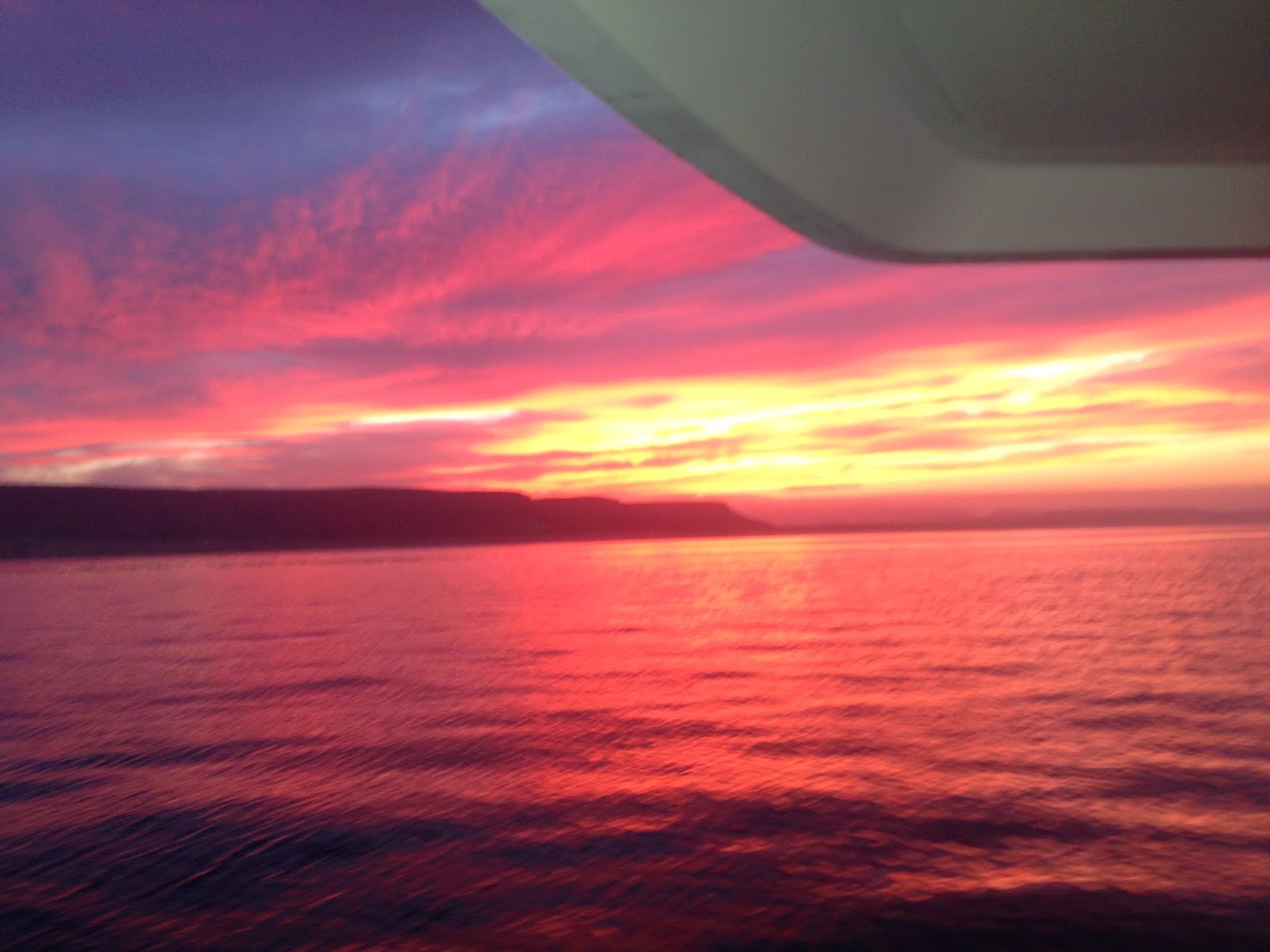 |
| Leaving Abre Ojos at dawn |
Thursday April 24th was a choppy nine hour ride from Abre Ojos to Asuncion which we left early so as to get to Turtle Bay in time to do some shopping on the 25th. The conditions were wonderful as we neared Turtle Bay but the weather report was for some big winds on the afternoon of the 26th and lasting through the am on the 28th. We were tempted to run north, but Turtle Bay is by far the best anchorage in which to wait out the weather. So there we stayed
It would not be boating if there were not some issue. The first day out Clark mentioned that the water pressure was low. It would start out fine but quickly fall off. There were lots of theories and heavy engineering discussions between the capitanos. The first attempt was to check the electrical connections. That was declared a success – at least for 15 minutes. The next attempt, on the theory that something was stuck in the line- was to blow air through the pipes using an electrical air pump. Again a success. Again short-lived. The final (always the one that works) was replacing the pump. Apparently the pump that we had replaced just before leaving La Paz had a connector that was cross-threaded and allowed air to leak into the system. Somebody goofed, but all is well that ends well.
The water maker was also not working well. It kept shutting itself off. We assumed it was connected to the water pressure issue. But it turned out not to be so. So when we finally had water pressure, we did not have enough water to take showers and do laundry. The situation was becoming desperate when Earl checked the filters and discovered that they were plugged with plankton. New filters and new water pump and life is good. We are all less fragrant.
Joan, Clark and I took a panga ride into the pier to do some shopping in Turtle Bay. The panga ride was fine, but the landing was not ideal. We tied up at a dock that was far beyond rickety. The pangero demonstrated walking precisely in the middle so as to keep from tipping into the water. When we got to the stair of the pier, we were faced with a sad looking stairway about 2 feet across the water from the shaky dock. We made it and walked a guano covered pier to shore.
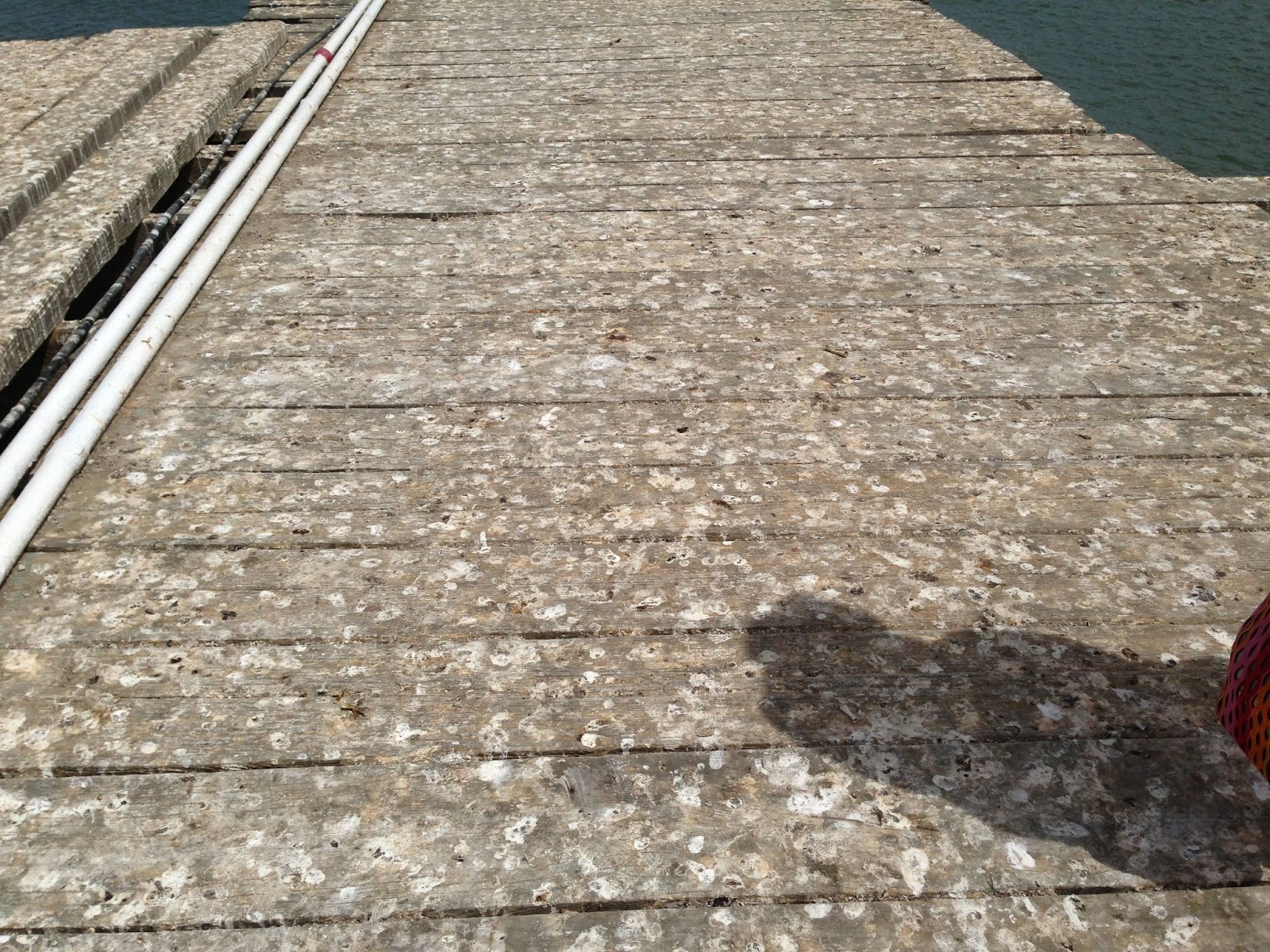 |
| Guano encrusted dock (smelled good too!) |
We had toured Turtle Bay on our way south and it was as dusty as we remember. The buildings by the pier are derelict and rusty and the town is worn. The grocery store was more impressive than I remember – probably due to 5 years of shopping in tiny village tiendas on the Baja. The fruit and vegetable selection was not large but we got enough to see us to Ensenada.
 |
| Turtle Bay – not really a resort community |
We stayed at anchor for two days and watched as the harbor filled up. A number of other boats joined us to wait out the weather and we watched a surprising amount of commercial fishing traffic. There were a couple of old seiners and the scene was pretty remenisant of our Alaska fishing days.
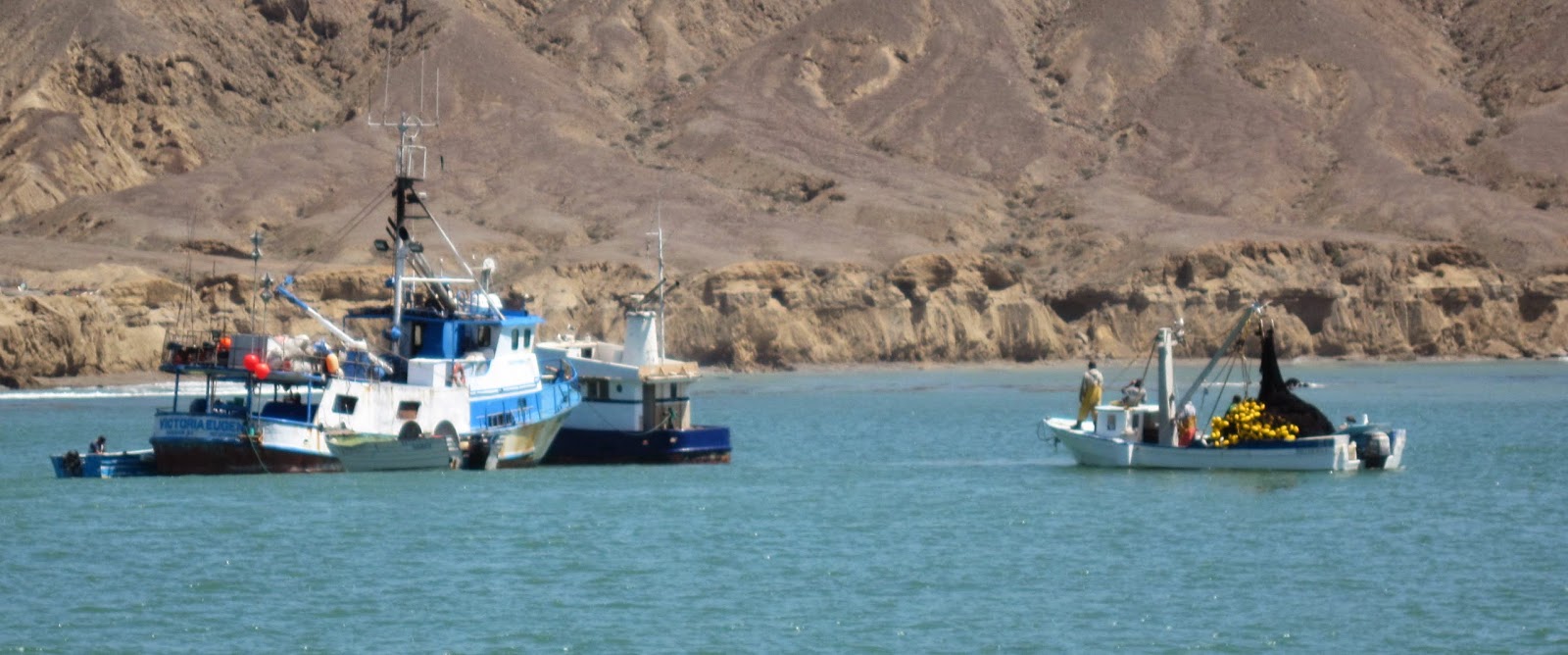 |
| Commercial fishing boats |
So here we sit making water and doing laundry and resting.
Tuesday, April 29th – enroute to Bahia San Carlos
After considerably checking of weather, we left Turtle Bay at 7:15 on Monday morning headed for the north end of Cedros Island. It looked as it we would have a lumpy but not impossible ride that day and better weather the next. We were met by good sized swells with white caps on top. Thank God for stabilizers. The Serenity rides like a duck. Joan and I spent the morning knitting, playing cards and killing flies. We apparently brought a boatload of them with us from Turtle Bay.
As soon as we got in the lee of Cedros Island the water flattened out. The south end of the island has a deep harbor at which ocean going tankers are filled with salt. The salt is produced in Scammon Lagoon, loaded on barges and tugged over to the island. The barges are equipped with conveyer belt system to unload the salt on to the shore where it is added to the huge pile that is already there.
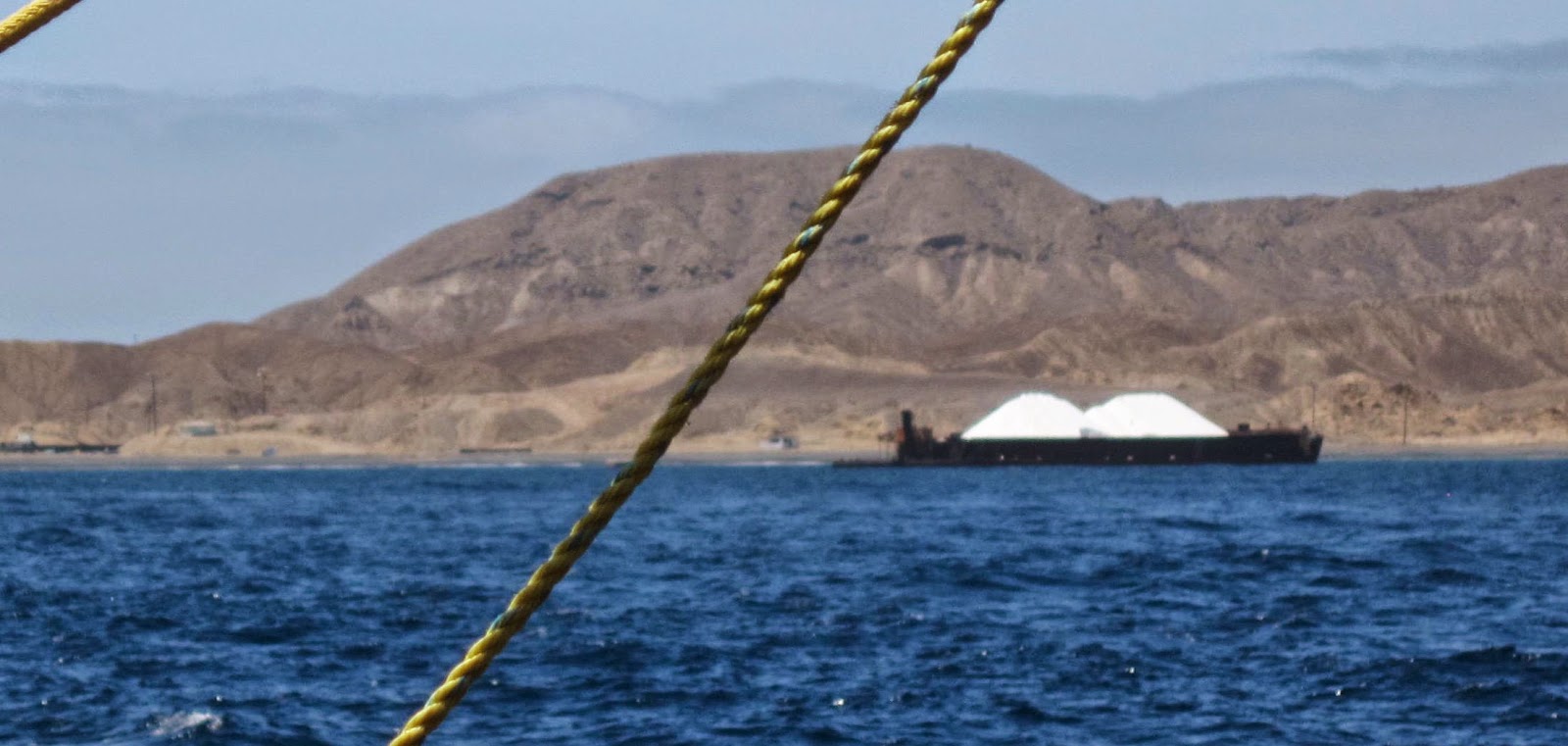 |
| Loaded salt barge |
The ride up the east side of the island was scenic. The hillsides are very dramatic. As we got to the northern end, we started passing beaches covered with sea lions. They lie on the shore like cord wood and bark.
 |
| Sea lions on the beach |
Our anchorage was steep, so we anchored close the beach and the seals. Earl put out 150 feet of chain and we enjoyed quiet rocking and noisy seals. Earl got up in the middle of the night and saw some of them swimming through our underwater lights.
We started off a dawn on Tuesday to head north to San Carlos,
We had very large swells, 9 or 10 feet, but we seem to be getting our sea legs. Daisy even made it to the front deck and managed to do her business. A true Salty Dog. I have rediscovered the technique of bracing oneself in the galley that I had mastered when we commercial fished. It must be like riding a bike – one never forgets. The boat continued to perform beautifully and we passed a pleasant day. As the evening approached the seas flattened and the report for Wednesday is excellent. We will probably do an overnight from San Carlos into Ensenada.
Wednesday, April 30, heading north from San Carlos
Well we had quite a night! The anchorage in the bay is a good way off the beach, but as we anchored we could hear the surf roar. It seemed almost as if it echoed around the little bay. At 1 am the wind came up from land to the NE. By 2, the boat was pitching and we could hear loud banging noises. The wind was warm – 78 degrees – and wild. We clocked 56 mph. Earl and I went upstairs in our nightclothes to see what was going on – my initial thought was that the stabilizer had somehow gotten fouled. But no, our trusty chain hook on the bridle had failed and was inoperable. Earl managed to find our spare bridle in a storage box on top of the house and went out to hook up the replacement and retrieve the bent one. As soon as he had that done, he replaced the hook on our bridle with a different model. Just in time, as the second one also failed. By this time Clark had come up and we gave Earl our moral support from the cabin as we watched him bent over the bow roller, his nightshirt around his ears, attaching the bridle. It was an unforgettable sight – no photos.
 |
| Twisted chain hook #2 |
As it grew light around 5:30, we began the process of pulling up an anchor that was more than well-set in wind that was still gusting 45. With the wind on our starboard we blew out San Carlos and headed north.
Fortunately, once away from the shore, the Santa Ana type wind dissipated and we are enjoying a good ride with long swells. We had some unexpected visitors. Some little yellow birds –identified by Clark as Wilson Warblers-, apparently blown offshore, landed on the boat and flew in and out of the cabin. They were not the least afraid and made themselves at home, helpfully doing away with the last of the flies that we had been carrying with us. One landed on Daisy’s back and rested, then another tried to preen Daisy’s beard. Joan had one on her finger and Earl’s head was apparently also an appealing perch. Delightful!
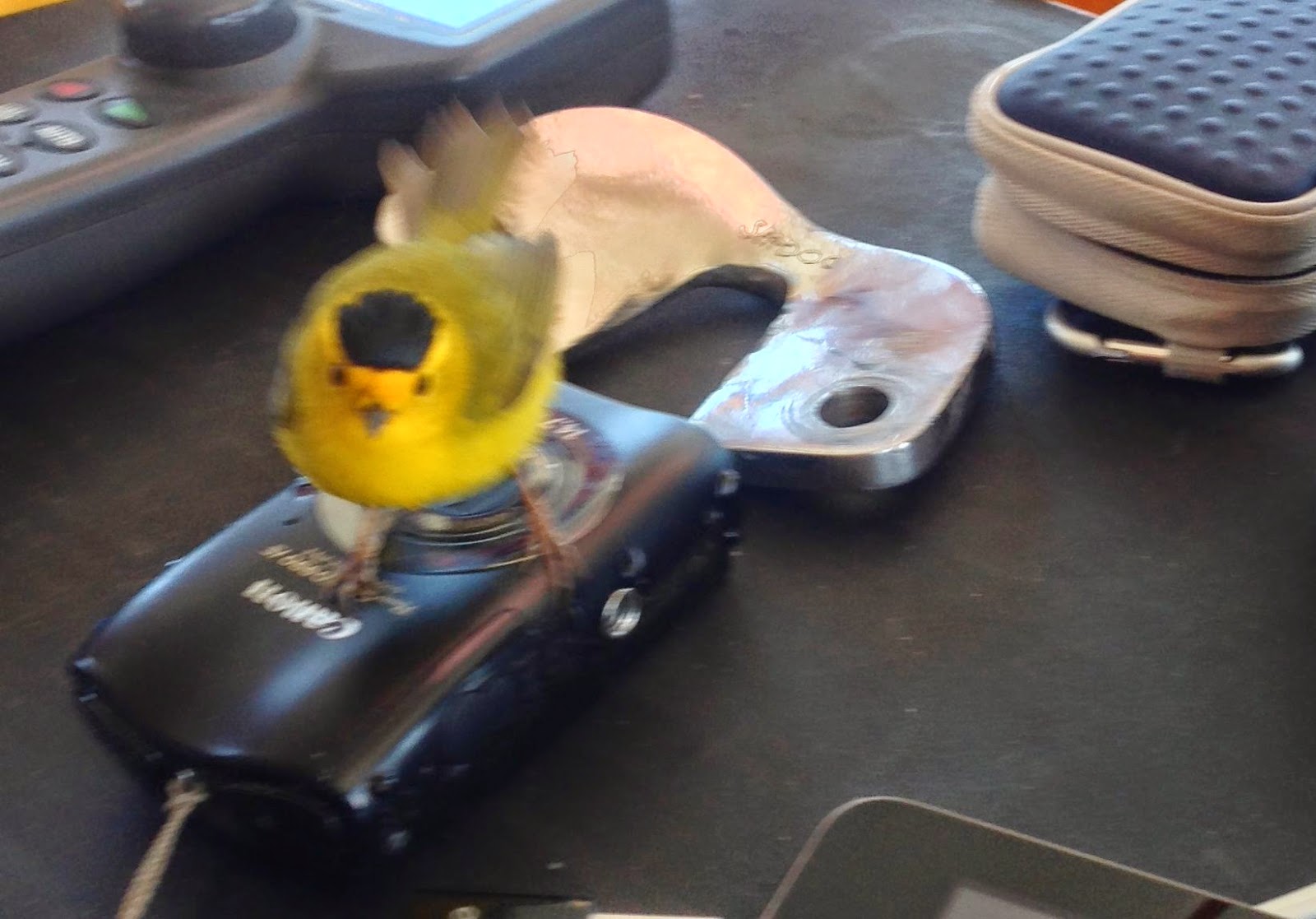 |
| Wilson Warbler on our camera. Chain hook #1 in background |
 |
| Earl’s new friend |
Friday, May 2, 2014 – Ensenada
We did an overnight to Ensenada, arriving about 8 am. The seas were wonderful! Earl had planned on being able to get our check out documents, but, as Joan reminded me, when in Mexico, expect holidays. May 1 is Labor Day here and nothing was open.
We took on fuel, significantly cheaper here than in San Diego, and Earl rinsed the first layer of salt and grit off Serenity, before finally going to bed for a few hours of sleep. He does not sleep much during overnights. Apparently he has inadequate confidence in the crew.
While Earl slept, Joan, Clark and I went to the grocery store to pick up a few items – oranges for 2 mornings worth of juice, some bread, cookies and mangos and, most critical, a toilet plunger. It was a short distance, but the heat was awful and it seemed like a steep uphill. We got back only to find that we had left the plunger behind, so back to the store I went. Death march.
Dinner was in the air-conditioned boat. We are trying to use up any food that might be confiscated, so we had the last of our steaks. Yummy. We finally finished off the last of the Costco cake. My freezer is definitely looking rather empty.
Today is a little cooler. We have gone downtown to complete the process of checking us and the boat out of Mexico. The marina provides an assistant to take care of dealing with all the official personnel, but it was still a 2 hour process. We are currently sitting in our air conditioned cabin while Serenity gets a much needed wash. (Earl is not impressed by the job that is being done). This evening we will go for an on shore dinner courtesy of Clark then we will be off early in the am so as to arrive in San Diego while customs is open
 |
|
| Cabo north to Turtle Bay |
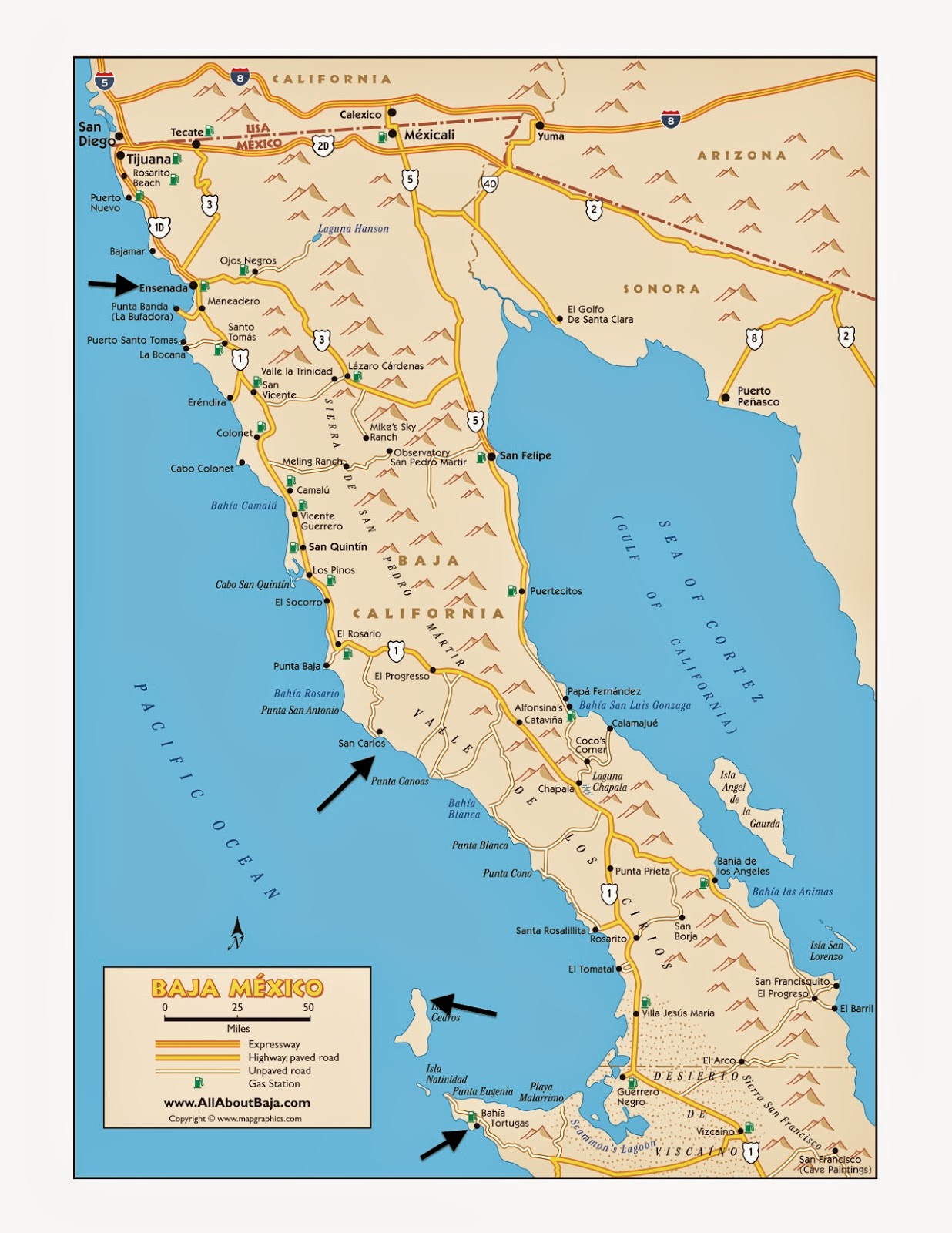
Turtle Bay north to Ensenada
Friday, May 2, 2014 – From Cabo to Ensenada
–>
Sunday,
April 27 – Turtle Bay
April 27 – Turtle Bay
|
| Cross above Cabo San Jose Marina |
We spent
a couple of pleasant days at San Jose del Cabo.
The marina is comfortable– although not anywhere as nice as Costa Baja
with very industrial artwork. We enjoyed dinner at Sharon and Dave’s condo
where we discussed politics until 11:30.
Pretty late for us folks. The
next two days we provisioned and cleaned before picking up Joan and Clark at
the airport. We had a good dinner at the
Tropicana, recommended for Mexican food.
Although it was not the fish tacos which I had expected, the food was
excellent and the entertainment unexpected.
Halfway through dinner a large group in crazy masks and very enhanced
bosoms danced their way up the sidewalk and around us looking for
donations. They were a hoot.
a couple of pleasant days at San Jose del Cabo.
The marina is comfortable– although not anywhere as nice as Costa Baja
with very industrial artwork. We enjoyed dinner at Sharon and Dave’s condo
where we discussed politics until 11:30.
Pretty late for us folks. The
next two days we provisioned and cleaned before picking up Joan and Clark at
the airport. We had a good dinner at the
Tropicana, recommended for Mexican food.
Although it was not the fish tacos which I had expected, the food was
excellent and the entertainment unexpected.
Halfway through dinner a large group in crazy masks and very enhanced
bosoms danced their way up the sidewalk and around us looking for
donations. They were a hoot.
|
| Art???? |
We left
San Jose del Cabo on Friday the 18th. The going was not nice and Earl decided when
the wind hit 30 that we would be well served to go and anchor for the night in
front of Cabo San Lucas. It was both
Good Friday and Joan and Clark’s 50th wedding anniversary.
San Jose del Cabo on Friday the 18th. The going was not nice and Earl decided when
the wind hit 30 that we would be well served to go and anchor for the night in
front of Cabo San Lucas. It was both
Good Friday and Joan and Clark’s 50th wedding anniversary.
|
| Joan and Clark – 50 years and going strong |
Holy Week is a big holiday for the Mexicans
and we felt rather as if we had anchored in the middle of an amusement
park. The beach was literally covered with
beach umbrellas and people, while a few brave souls were in the rather chilly
water swimming or kayaking. One woman
was attached to some kind of device that powered water jets under her feet and
sent her soaring into the air. There was
music blaring and everyone was apparently having a wonderful time. A barge anchored near us selling beer was
covered with drinkers. At sunset, a
number of boats turned on decorative lights and then there were fireworks. It was very festive. Not exactly what I would have thought for
Good Friday in a Catholic country.
and we felt rather as if we had anchored in the middle of an amusement
park. The beach was literally covered with
beach umbrellas and people, while a few brave souls were in the rather chilly
water swimming or kayaking. One woman
was attached to some kind of device that powered water jets under her feet and
sent her soaring into the air. There was
music blaring and everyone was apparently having a wonderful time. A barge anchored near us selling beer was
covered with drinkers. At sunset, a
number of boats turned on decorative lights and then there were fireworks. It was very festive. Not exactly what I would have thought for
Good Friday in a Catholic country.
|
| Cabo beach |
|
| Party Boats |
|
| Beer Barge |
We
celebrated the anniversary with pepper steaks, champagne and a frozen Costco
chocolate cake that we are still have not finished a week later.
celebrated the anniversary with pepper steaks, champagne and a frozen Costco
chocolate cake that we are still have not finished a week later.
Saturday
morning just as the sky was lightening, we started off for a long run to Santa
Maria just north of Mag Bay. As we
rounded the Cape we were treated to the sight of a large whale breaching beside
us. I guess he was wishing us a good
trip north. It was a lovely start to our
bash.
morning just as the sky was lightening, we started off for a long run to Santa
Maria just north of Mag Bay. As we
rounded the Cape we were treated to the sight of a large whale breaching beside
us. I guess he was wishing us a good
trip north. It was a lovely start to our
bash.
|
| The Cape (Cabo San Lucas) |
Between
Cabo San Lucas and Mag Bay it is a long 152 miles at 6 mph with no place to
stop. It was choppy when we started and
got worse. No fun! We bucked our way north and worked muscles we
had forgotten about trying to keep from falling as we made our way around the
boat. Daisy had the worst of it. She could not stand on the bow to relieve
herself and even walking in the boat was tough.
Earl finally put a towel down on the back deck so that she could get
some traction. It took her several days
to recover. The weather got worse during
the night but by the time we arrived at Santa Maria, 172 miles from Cabo on
Sunday the 21st it was actually becoming pleasant.
Cabo San Lucas and Mag Bay it is a long 152 miles at 6 mph with no place to
stop. It was choppy when we started and
got worse. No fun! We bucked our way north and worked muscles we
had forgotten about trying to keep from falling as we made our way around the
boat. Daisy had the worst of it. She could not stand on the bow to relieve
herself and even walking in the boat was tough.
Earl finally put a towel down on the back deck so that she could get
some traction. It took her several days
to recover. The weather got worse during
the night but by the time we arrived at Santa Maria, 172 miles from Cabo on
Sunday the 21st it was actually becoming pleasant.
|
| Bahia Santa Maria |
We were
exhausted and spent the next day recovering. Apparently we are all 5 years older than when
we came south and probably we are better off not doing too many over night runs.
We celebrated our safe arrival with a
luxury dinner of rack of lamb and the next night suffered through fresh
lobsters that Clark bought from a pangero.
They were probably not legal since we have since been told everywhere else
north that the season is closed.
exhausted and spent the next day recovering. Apparently we are all 5 years older than when
we came south and probably we are better off not doing too many over night runs.
We celebrated our safe arrival with a
luxury dinner of rack of lamb and the next night suffered through fresh
lobsters that Clark bought from a pangero.
They were probably not legal since we have since been told everywhere else
north that the season is closed.
|
| Lobster Night! |
We saw
what may be the new generation of Baja fisherman. Still in pangas, these guys wore nice
raingear, spoke some English and had a boatload of hammerhead sharks, which must
be a profitable catch. From what we
could understand, the fins go to Asia and the bulk of the meat is made into
surimi.
what may be the new generation of Baja fisherman. Still in pangas, these guys wore nice
raingear, spoke some English and had a boatload of hammerhead sharks, which must
be a profitable catch. From what we
could understand, the fins go to Asia and the bulk of the meat is made into
surimi.
|
| Panga load of hammerheads |
|
| Clark and Daisy fishing |
The
trip south along the Baja with the winds on your tail is called the Baha Haha
and it was a pleasant trip. The trip
north is rightly called the Baja Bash.
As one of the guide books put it:
The prevailing wind and swell that was fun at 15 -20 knots going
downwind, can become a bear when beating into an apparent wind in excess of
20-25 knots. The advice is to hug the
coast to reduce the winds but that adds about 100 miles to the distance. It is also advised to travel early in the day
before the afternoon winds come up.
Thus, we have been making more stops than we did going south and instead
of the 8 days it took us from Ensenada to Cabo in 2009, we will be lucky to
make it in two weeks.
trip south along the Baja with the winds on your tail is called the Baha Haha
and it was a pleasant trip. The trip
north is rightly called the Baja Bash.
As one of the guide books put it:
The prevailing wind and swell that was fun at 15 -20 knots going
downwind, can become a bear when beating into an apparent wind in excess of
20-25 knots. The advice is to hug the
coast to reduce the winds but that adds about 100 miles to the distance. It is also advised to travel early in the day
before the afternoon winds come up.
Thus, we have been making more stops than we did going south and instead
of the 8 days it took us from Ensenada to Cabo in 2009, we will be lucky to
make it in two weeks.
A 3 am
departure from Santa Maria on Tuesday, April 22 got us to Juanico 7:20 pm. It was a long overcast day, but seas were reasonable.
We saw a few large grey whales. One crossed right in front of the boat so Clark
slowed down and gave it the right of way- it was coming from the right. The time was filled with lots of knitting and
naps. Joan is a machine, whipping off a
cap a day.
departure from Santa Maria on Tuesday, April 22 got us to Juanico 7:20 pm. It was a long overcast day, but seas were reasonable.
We saw a few large grey whales. One crossed right in front of the boat so Clark
slowed down and gave it the right of way- it was coming from the right. The time was filled with lots of knitting and
naps. Joan is a machine, whipping off a
cap a day.
An 11 hour
run got us from Juanico to Abre Ojos at 7 pm on Wednesday. It was choppy, but
we were treated to gulls fighting for position on our front railing and
porpoises came for Daisy’s delight.
After we anchored, two pangas, each modified by the addition of a cabin,
came by. They were the Mexican federal
fish and game checking to see if we were poachers.
run got us from Juanico to Abre Ojos at 7 pm on Wednesday. It was choppy, but
we were treated to gulls fighting for position on our front railing and
porpoises came for Daisy’s delight.
After we anchored, two pangas, each modified by the addition of a cabin,
came by. They were the Mexican federal
fish and game checking to see if we were poachers.
|
| Gulls on the railing |
|
| Mexican Fish and Game |
|
| Leaving Abre Ojos at dawn |
Thursday
April 24th was a choppy nine hour ride from Abre Ojos to Asuncion which
we left early so as to get to Turtle Bay in time to do some shopping on the 25th.
The conditions were wonderful as we
neared Turtle Bay but the weather report was for some big winds on the
afternoon of the 26th and lasting through the am on the 28th. We were tempted to run north, but Turtle Bay
is by far the best anchorage in which to wait out the weather. So there we
stayed
April 24th was a choppy nine hour ride from Abre Ojos to Asuncion which
we left early so as to get to Turtle Bay in time to do some shopping on the 25th.
The conditions were wonderful as we
neared Turtle Bay but the weather report was for some big winds on the
afternoon of the 26th and lasting through the am on the 28th. We were tempted to run north, but Turtle Bay
is by far the best anchorage in which to wait out the weather. So there we
stayed
It
would not be boating if there were not some issue. The first day out Clark mentioned that the
water pressure was low. It would start
out fine but quickly fall off. There were
lots of theories and heavy engineering discussions between the capitanos. The first attempt was to check the electrical
connections. That was declared a success
– at least for 15 minutes. The next
attempt, on the theory that something was stuck in the line- was to blow air
through the pipes using an electrical air pump.
Again a success. Again short-lived. The final (always the one that works) was
replacing the pump. Apparently the pump
that we had replaced just before leaving La Paz had a connector that was cross-threaded
and allowed air to leak into the system.
Somebody goofed, but all is well that ends well.
would not be boating if there were not some issue. The first day out Clark mentioned that the
water pressure was low. It would start
out fine but quickly fall off. There were
lots of theories and heavy engineering discussions between the capitanos. The first attempt was to check the electrical
connections. That was declared a success
– at least for 15 minutes. The next
attempt, on the theory that something was stuck in the line- was to blow air
through the pipes using an electrical air pump.
Again a success. Again short-lived. The final (always the one that works) was
replacing the pump. Apparently the pump
that we had replaced just before leaving La Paz had a connector that was cross-threaded
and allowed air to leak into the system.
Somebody goofed, but all is well that ends well.
The water
maker was also not working well. It kept
shutting itself off. We assumed it was
connected to the water pressure issue.
But it turned out not to be so.
So when we finally had water pressure, we did not have enough water to
take showers and do laundry. The
situation was becoming desperate when Earl checked the filters and discovered
that they were plugged with plankton.
New filters and new water pump and life is good. We are all less fragrant.
maker was also not working well. It kept
shutting itself off. We assumed it was
connected to the water pressure issue.
But it turned out not to be so.
So when we finally had water pressure, we did not have enough water to
take showers and do laundry. The
situation was becoming desperate when Earl checked the filters and discovered
that they were plugged with plankton.
New filters and new water pump and life is good. We are all less fragrant.
Joan,
Clark and I took a panga ride into the pier to do some shopping in Turtle
Bay. The panga ride was fine, but the
landing was not ideal. We tied up at a dock that was far beyond rickety. The pangero demonstrated walking precisely in
the middle so as to keep from tipping into the water. When we got to the stair
of the pier, we were faced with a sad looking stairway about 2 feet across the
water from the shaky dock. We made it
and walked a guano covered pier to shore.
Clark and I took a panga ride into the pier to do some shopping in Turtle
Bay. The panga ride was fine, but the
landing was not ideal. We tied up at a dock that was far beyond rickety. The pangero demonstrated walking precisely in
the middle so as to keep from tipping into the water. When we got to the stair
of the pier, we were faced with a sad looking stairway about 2 feet across the
water from the shaky dock. We made it
and walked a guano covered pier to shore.
|
| Guano encrusted dock (smelled good too!) |
We had
toured Turtle Bay on our way south and it was as dusty as we remember. The buildings by the pier are derelict and
rusty and the town is worn. The grocery
store was more impressive than I remember – probably due to 5 years of shopping
in tiny village tiendas on the Baja. The
fruit and vegetable selection was not large but we got enough to see us to
Ensenada.
toured Turtle Bay on our way south and it was as dusty as we remember. The buildings by the pier are derelict and
rusty and the town is worn. The grocery
store was more impressive than I remember – probably due to 5 years of shopping
in tiny village tiendas on the Baja. The
fruit and vegetable selection was not large but we got enough to see us to
Ensenada.
|
| Turtle Bay – not really a resort community |
We
stayed at anchor for two days and watched as the harbor filled up. A number of other boats joined us to wait out
the weather and we watched a surprising amount of commercial fishing traffic. There were a couple of old seiners and the
scene was pretty remenisant of our Alaska fishing days.
stayed at anchor for two days and watched as the harbor filled up. A number of other boats joined us to wait out
the weather and we watched a surprising amount of commercial fishing traffic. There were a couple of old seiners and the
scene was pretty remenisant of our Alaska fishing days.
|
| Commercial fishing boats |
So here
we sit making water and doing laundry and resting.
we sit making water and doing laundry and resting.
Tuesday,
April 29th – enroute to Bahia San Carlos
April 29th – enroute to Bahia San Carlos
After
considerably checking of weather, we left Turtle Bay at 7:15 on Monday morning
headed for the north end of Cedros Island.
It looked as it we would have a lumpy but not impossible ride that day
and better weather the next. We were met
by good sized swells with white caps on top.
Thank God for stabilizers. The
Serenity rides like a duck. Joan and I
spent the morning knitting, playing cards and killing flies. We apparently brought a boatload of them with
us from Turtle Bay.
considerably checking of weather, we left Turtle Bay at 7:15 on Monday morning
headed for the north end of Cedros Island.
It looked as it we would have a lumpy but not impossible ride that day
and better weather the next. We were met
by good sized swells with white caps on top.
Thank God for stabilizers. The
Serenity rides like a duck. Joan and I
spent the morning knitting, playing cards and killing flies. We apparently brought a boatload of them with
us from Turtle Bay.
As soon
as we got in the lee of Cedros Island the water flattened out. The south end of the island has a deep harbor
at which ocean going tankers are filled with salt. The salt is produced in Scammon Lagoon,
loaded on barges and tugged over to the island.
The barges are equipped with conveyer belt system to unload the salt on
to the shore where it is added to the huge pile that is already there.
as we got in the lee of Cedros Island the water flattened out. The south end of the island has a deep harbor
at which ocean going tankers are filled with salt. The salt is produced in Scammon Lagoon,
loaded on barges and tugged over to the island.
The barges are equipped with conveyer belt system to unload the salt on
to the shore where it is added to the huge pile that is already there.
|
| Loaded salt barge |
The
ride up the east side of the island was scenic.
The hillsides are very dramatic.
As we got to the northern end, we started passing beaches covered with
sea lions. They lie on the shore like cord
wood and bark.
ride up the east side of the island was scenic.
The hillsides are very dramatic.
As we got to the northern end, we started passing beaches covered with
sea lions. They lie on the shore like cord
wood and bark.
|
| Sea lions on the beach |
Our
anchorage was steep, so we anchored close the beach and the seals. Earl put out
150 feet of chain and we enjoyed quiet rocking and noisy seals. Earl got up in the middle of the night and
saw some of them swimming through our underwater lights.
anchorage was steep, so we anchored close the beach and the seals. Earl put out
150 feet of chain and we enjoyed quiet rocking and noisy seals. Earl got up in the middle of the night and
saw some of them swimming through our underwater lights.
We
started off a dawn on Tuesday to head north to San Carlos,
started off a dawn on Tuesday to head north to San Carlos,
We had
very large swells, 9 or 10 feet, but we seem to be getting our sea legs. Daisy even made it to the front deck and
managed to do her business. A true Salty
Dog. I have rediscovered the technique
of bracing oneself in the galley that I had mastered when we commercial fished. It must be like riding a bike – one never
forgets. The boat continued to perform
beautifully and we passed a pleasant day.
As the evening approached the seas flattened and the report for
Wednesday is excellent. We will probably
do an overnight from San Carlos into Ensenada.
very large swells, 9 or 10 feet, but we seem to be getting our sea legs. Daisy even made it to the front deck and
managed to do her business. A true Salty
Dog. I have rediscovered the technique
of bracing oneself in the galley that I had mastered when we commercial fished. It must be like riding a bike – one never
forgets. The boat continued to perform
beautifully and we passed a pleasant day.
As the evening approached the seas flattened and the report for
Wednesday is excellent. We will probably
do an overnight from San Carlos into Ensenada.
Wednesday,
April 30, heading north from San Carlos
April 30, heading north from San Carlos
Well we
had quite a night! The anchorage in the
bay is a good way off the beach, but as we anchored we could hear the surf
roar. It seemed almost as if it echoed
around the little bay. At 1 am the wind came up from land to the NE. By 2, the boat was pitching and we could hear
loud banging noises. The wind was warm –
78 degrees – and wild. We clocked 56
mph. Earl and I went upstairs in our
nightclothes to see what was going on – my initial thought was that the
stabilizer had somehow gotten fouled.
But no, our trusty chain hook on the bridle had failed and was
inoperable. Earl managed to find our
spare bridle in a storage box on top of the house and went out to hook up the
replacement and retrieve the bent one.
As soon as he had that done, he replaced the hook on our bridle with a
different model. Just in time, as the
second one also failed. By this time
Clark had come up and we gave Earl our moral support from the cabin as we
watched him bent over the bow roller, his nightshirt around his ears, attaching
the bridle. It was an unforgettable
sight – no photos.
had quite a night! The anchorage in the
bay is a good way off the beach, but as we anchored we could hear the surf
roar. It seemed almost as if it echoed
around the little bay. At 1 am the wind came up from land to the NE. By 2, the boat was pitching and we could hear
loud banging noises. The wind was warm –
78 degrees – and wild. We clocked 56
mph. Earl and I went upstairs in our
nightclothes to see what was going on – my initial thought was that the
stabilizer had somehow gotten fouled.
But no, our trusty chain hook on the bridle had failed and was
inoperable. Earl managed to find our
spare bridle in a storage box on top of the house and went out to hook up the
replacement and retrieve the bent one.
As soon as he had that done, he replaced the hook on our bridle with a
different model. Just in time, as the
second one also failed. By this time
Clark had come up and we gave Earl our moral support from the cabin as we
watched him bent over the bow roller, his nightshirt around his ears, attaching
the bridle. It was an unforgettable
sight – no photos.
|
| Twisted chain hook #2 |
As it
grew light around 5:30, we began the process of pulling up an anchor that was
more than well-set in wind that was still gusting 45. With the wind on our starboard we blew out
San Carlos and headed north.
grew light around 5:30, we began the process of pulling up an anchor that was
more than well-set in wind that was still gusting 45. With the wind on our starboard we blew out
San Carlos and headed north.
Fortunately,
once away from the shore, the Santa Ana type wind dissipated and we are
enjoying a good ride with long swells.
We had some unexpected visitors. Some
little yellow birds –identified by Clark as Wilson Warblers-, apparently blown
offshore, landed on the boat and flew in and out of the cabin. They were not the least afraid and made
themselves at home, helpfully doing away with the last of the flies that we had
been carrying with us. One landed on
Daisy’s back and rested, then another tried to preen Daisy’s beard. Joan had one on her finger and Earl’s head
was apparently also an appealing perch. Delightful!
once away from the shore, the Santa Ana type wind dissipated and we are
enjoying a good ride with long swells.
We had some unexpected visitors. Some
little yellow birds –identified by Clark as Wilson Warblers-, apparently blown
offshore, landed on the boat and flew in and out of the cabin. They were not the least afraid and made
themselves at home, helpfully doing away with the last of the flies that we had
been carrying with us. One landed on
Daisy’s back and rested, then another tried to preen Daisy’s beard. Joan had one on her finger and Earl’s head
was apparently also an appealing perch. Delightful!
|
| Wilson Warbler on our camera. Chain hook #1 in background |
|
| Earl’s new friend |
Friday,
May 2, 2014 – Ensenada
May 2, 2014 – Ensenada
We did
an overnight to Ensenada, arriving about 8 am.
The seas were wonderful! Earl had
planned on being able to get our check out documents, but, as Joan reminded me,
when in Mexico, expect holidays. May 1
is Labor Day here and nothing was open.
an overnight to Ensenada, arriving about 8 am.
The seas were wonderful! Earl had
planned on being able to get our check out documents, but, as Joan reminded me,
when in Mexico, expect holidays. May 1
is Labor Day here and nothing was open.
We took
on fuel, significantly cheaper here than in San Diego, and Earl rinsed the first layer of salt and
grit off Serenity, before finally going to bed for a few hours of sleep. He does not sleep much during overnights. Apparently he has inadequate confidence in
the crew.
on fuel, significantly cheaper here than in San Diego, and Earl rinsed the first layer of salt and
grit off Serenity, before finally going to bed for a few hours of sleep. He does not sleep much during overnights. Apparently he has inadequate confidence in
the crew.
While
Earl slept, Joan, Clark and I went to the grocery store to pick up a few items
– oranges for 2 mornings worth of juice, some bread, cookies and mangos and,
most critical, a toilet plunger. It was
a short distance, but the heat was awful and it seemed like a steep
uphill. We got back only to find that
we had left the plunger behind, so back to the store I went. Death march.
Earl slept, Joan, Clark and I went to the grocery store to pick up a few items
– oranges for 2 mornings worth of juice, some bread, cookies and mangos and,
most critical, a toilet plunger. It was
a short distance, but the heat was awful and it seemed like a steep
uphill. We got back only to find that
we had left the plunger behind, so back to the store I went. Death march.
Dinner
was in the air-conditioned boat. We are
trying to use up any food that might be confiscated, so we had the last of our
steaks. Yummy. We finally finished off the last of the
Costco cake. My freezer is definitely
looking rather empty.
was in the air-conditioned boat. We are
trying to use up any food that might be confiscated, so we had the last of our
steaks. Yummy. We finally finished off the last of the
Costco cake. My freezer is definitely
looking rather empty.
Today is a little cooler. We have gone downtown to complete the process
of checking us and the boat out of Mexico.
The marina provides an assistant to take care of dealing with all the
official personnel, but it was still a 2 hour process. We are currently sitting in our air
conditioned cabin while Serenity gets a much needed wash. (Earl is not impressed by the job that is
being done). This evening we will go for an on shore dinner courtesy of Clark
then we will be off early in the am so as to arrive in San Diego while customs
is open
| |
|
| Cabo north to Turtle Bay |
Turtle Bay north to Ensenada
We made it!
We anchored this morning, checked into Panama, Anna Mae was measured and given the go ahead to transit The Canal. We think on the 5th. keeping our fingers crossed.http://www.marinetraffic.com/en/ais/details/ships/367563310
Down the Coast of Panama
After checking out of Costa Rica, Customs, Immigration and The Golfito Port Captain gave us 72 hours to exit their waters.
We planned a special dinner to say our goodbyes to the wonderful staff at Banana Bay Marina. If you find yourself in Golfito be sure to stop and spend a few days, they are very helpful.
We left the dock early April 24th at low tide and traveled to Isla Pardida. The anchorage was exposed with little shelter. We have been lucky to encountered mild winds. We enjoyed a soft little roll that put us all to sleep.
The next day we continued on to anchor on the east side of Isla De Coiba for the night. The snorkeling was mediocre with visibility at about 20 to 30 feet. A 4 foot morey ell let us know not to get to close. He was very protective of his home. Several large schools of shiny silver fish surrounded us. A variety of colorful large and small fish entertained us until the rainstorm; lightening and thunder forced us back onboard. I did manage to make it to shore to find a few shells. I was able to sneak a special few onboard. My collection continues to grow.
Another system learned the hard way. It’s a never-ending process and always a reward of accomplishment when we learn something new. We have been pampering our water makers and collected all of the necessary parts when we flew home last month. Upon our return Bill installed new fresh water diversion and flush valves. The old valves he replaced had been allowing air into the system. We had a celebration when both water makers were pushing out between 250 and 350 parts per million.
Now the interesting lesson… We had our 20KW running to enable us to run our air conditioning, hydraulic cooling pump and the two water makers. Bob Senter would be so proud of us. We know he is smiling when we have our NL generator running a heavy load. Luckily after our high fives Bill did another engine room check and found the water makers warm with excessive vibration. Note to self, in the future do not run the water makers, air conditioning and hydraulic cooling pump at the same time? Apparently our sea chest wasn’t engineered to adequately allow the volume of water needed to run all these systems simultaneously.
Frustration, is a mild word to use when this was discovered as a matter of fact, Bill used many words… At the time we were unsure how much damage had been done to the pumps on the water makers. We waited until we stopped for the night to investigate the situation, giving the water makers and engine room time to cool down. Our engine room temperature generally runs between 105 – 110 degrees in this warm weather / waters, much warmer than we are used to in The Pacific Northwest. Prior to heading out on this trip, we installed several fans and a blower in the engine room to help with the extreme heat.
We anchored and took a quick swim to cool off and allow the engine room to cool down and started the water makers again. We are keeping our fingers crossed, not much damage to report. One of the water makers has a slight vibration, but is making water. YEAH!!!
Our last little hurdle before getting to the canal was Punta Malo. We have heard the waters can be challenging. We experienced a strong current on our bow as the tide was going out. We dropped back to 6.5 knots. The seas remained calm throughout the day. We even managed to catch several dorado, they ranged from 20 to 35 pounds. Our freezer is getting full.
We are on our way to Isla Otoque to anchor for the night. Tomorrow we will continue to an anchorage outside of The Flaminco Yacht Club to wait for our agent to clear us into Panama.
Our plan is to spend a couple of days in Panama City. We have guests, Mitch and Cherie Vandehey flying in to transit the canal with us and explore Panama City.
Never a dull moment, we have enjoyed another wonderful day on Anna Mae. I am anticipating a delicious fish dinner tonight. I wish you could join us!
I have numerous pictures to share and would love to if my iphoto program would cooperate… Hope to rectify that issue shortly at the Mac store in Panama City tomorrow!
Well… We Didn’t Get Far
As mentioned in the last post from Sarasota, our intentions, weather permitting, were to stop at Legacy Harbour in downtown Ft Myers before heading east to Jupiter and home.It turns out, upon leaving Marina Jack’s we got a call from Eric at Legacy and …
PDX, DEN, SJO and then finally back to Golfito Costa Rica
We made a quick trip home to tie up a few loose ends and make the tax man happy…We have enjoyed catching up with family and friends over the past few weeks. Abby watched each bag being loaded into the car and pouted on the garage floor… She is in g…
The Abacos
Normal
0
false
false
false
EN-US
X-NONE
X-NONE
/* Style Definitions */
table.MsoNormalTable
{mso-style-name:”Table Normal”;
mso-tstyle-rowband-size:0;
mso-tstyle-colband-size:0;
mso-style-noshow:yes;
mso-style-priority:99;
mso-style-parent:””;
mso-padding-alt:0in 5.4pt 0in 5.4pt;
mso-para-margin-top:auto;
mso-para-margin-right:0in;
mso-para-margin-bottom:auto;
mso-para-margin-left:0in;
mso-pagination:widow-orphan;
font-size:11.0pt;
font-family:”Calibri”,”sans-serif”;
mso-ascii-font-family:Calibri;
mso-ascii-theme-font:minor-latin;
mso-hansi-font-family:Calibri;
mso-hansi-theme-font:minor-latin;}
We had a smooth
passage north towards the Abacos and our first stop was at Spanish Wells in
northern Eleuthera. The winds were west
so we tucked on the east side of Meeks patch and the next day as the winds went
North we anchored just south of Russell Island.
From here it was an easy dingy ride into Spanish Wells.
Spanish
Wells is a very unique island. It is almost all white and very prosperous. It
is also dry so no alcohol is sold or served in restaurants. The main industry
is fishing and the major catch is crayfish or Bahamian Lobster. Spanish Wells
supplies over half of the lobsters for all of the Bahamas and the fisherman
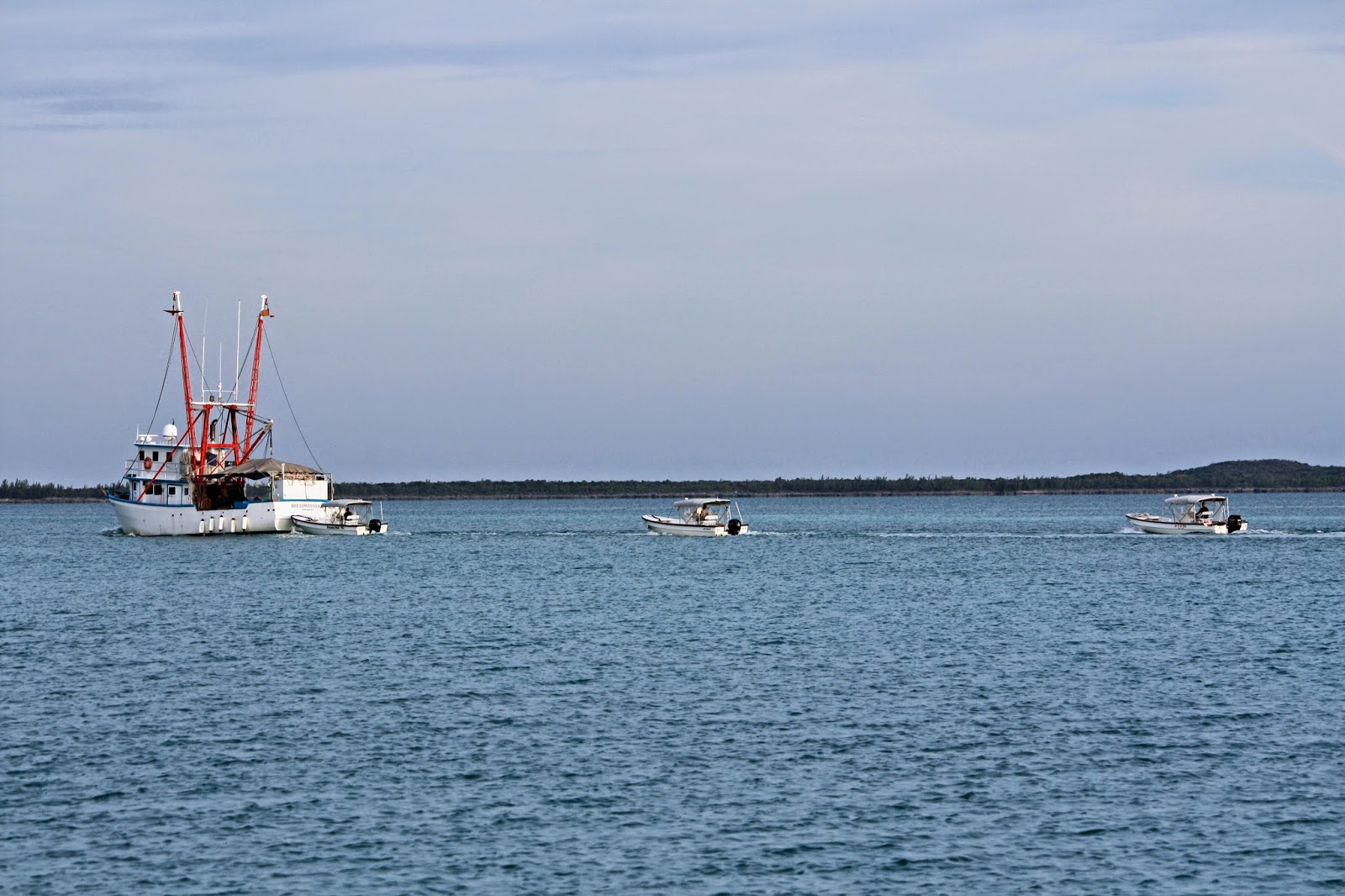
make a very good living. We saw several
of the mother boats returning to harbor with their catch. They towed the small boats used by divers
hunting for lobster and conch. Most
mother ships had at least 3 and sometimes as many as 6 of the small boats.
Wells is a very unique island. It is almost all white and very prosperous. It
is also dry so no alcohol is sold or served in restaurants. The main industry
is fishing and the major catch is crayfish or Bahamian Lobster. Spanish Wells
supplies over half of the lobsters for all of the Bahamas and the fisherman
make a very good living. We saw several
of the mother boats returning to harbor with their catch. They towed the small boats used by divers
hunting for lobster and conch. Most
mother ships had at least 3 and sometimes as many as 6 of the small boats.
We went
in and filled a propane gas tank, did some food shopping and had a nice
lunch. Kim suffered without her normal
Kalik beer but somehow survived. These
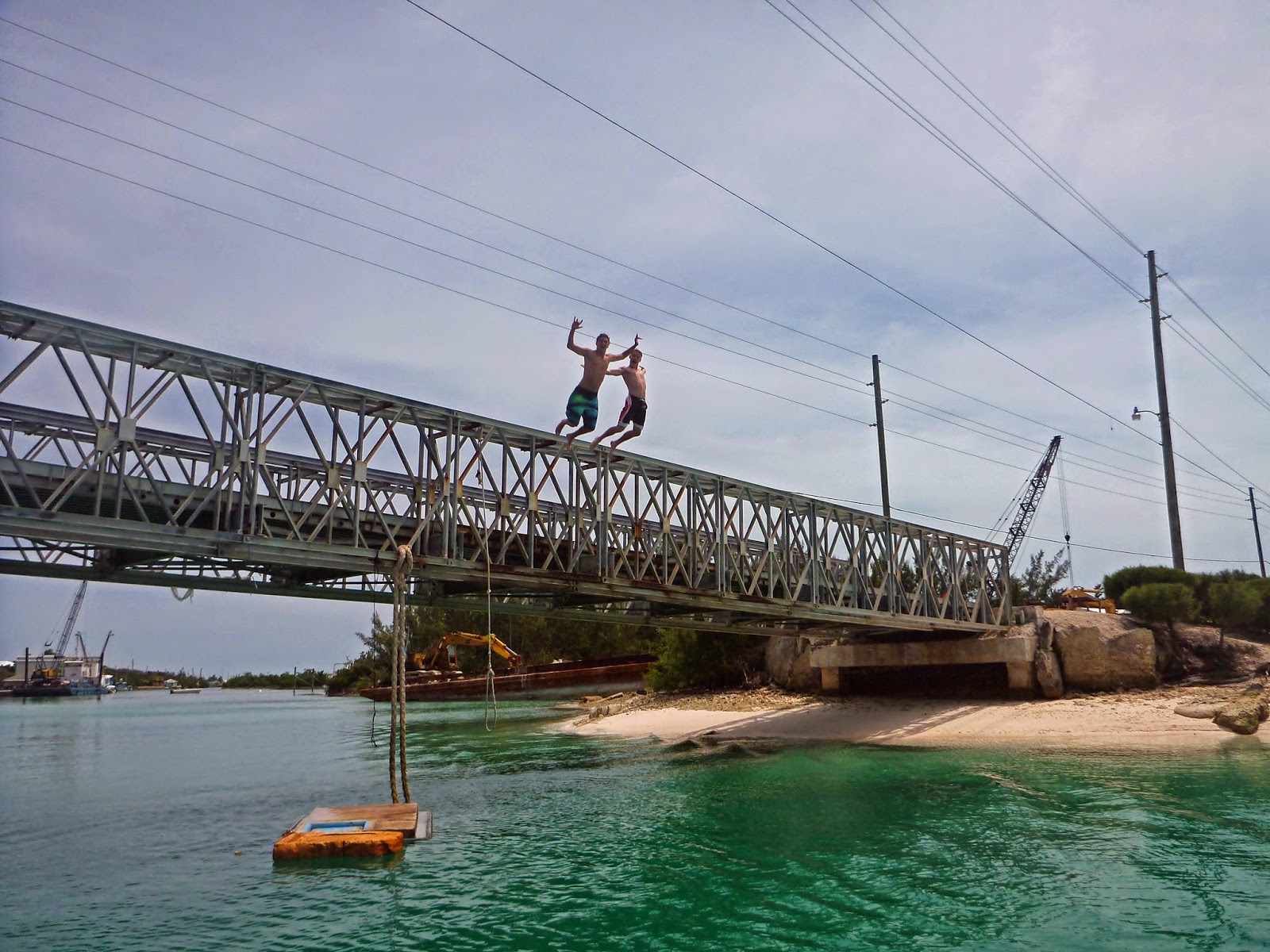
kids were jumping of the bridge and agreed to perform for us. We bought some grouper directly from a
fisherman but the lobster prices were too dear for us.
in and filled a propane gas tank, did some food shopping and had a nice
lunch. Kim suffered without her normal
Kalik beer but somehow survived. These
kids were jumping of the bridge and agreed to perform for us. We bought some grouper directly from a
fisherman but the lobster prices were too dear for us.
After a
quiet night we made the 10 hour passage to the Abacos and anchored just inside
Lynyard Cay where we found a calm spot to drop the hook in about 8ft over white
sand. The next day we took a 2 mile
dingy ride into Little Harbor.
quiet night we made the 10 hour passage to the Abacos and anchored just inside
Lynyard Cay where we found a calm spot to drop the hook in about 8ft over white
sand. The next day we took a 2 mile
dingy ride into Little Harbor.
Our guidebooks say Little Harbor “comes close to anyone’s dream of a
Bahamian hideaway”. It is a much protected bay with a mixed shoreline of
high rock cliffs and caves, a smattering of cottages, and a sandy beach.
We were enticed
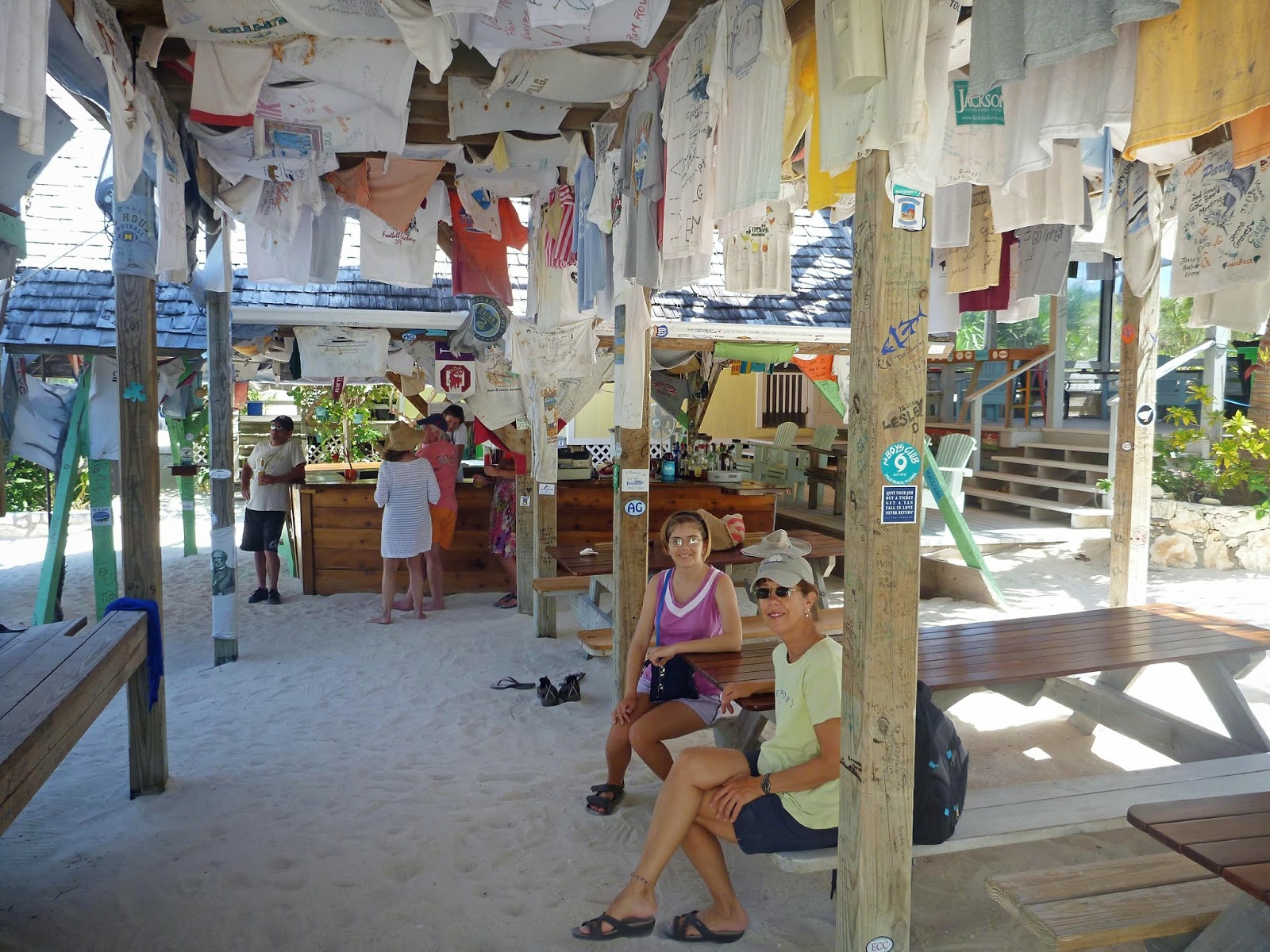
ashore by the aromas wafting from Pete’s pub. The pub has a roof, but no walls
or floor, a small bar area and large eating area with heavy wood tables and
benches that sit on the sand. You could wiggle your toes in the warm sand floor
and read the signed tee shirts hanging from the ceiling. The pub served
burgers, conch and a variety of fresh caught fish…grouper, snapper, wahoo,
and Kim had trigger fish…excellent. After lunch at the pub we wandered to the
Gallery where bronze works were displayed and for sale.
ashore by the aromas wafting from Pete’s pub. The pub has a roof, but no walls
or floor, a small bar area and large eating area with heavy wood tables and
benches that sit on the sand. You could wiggle your toes in the warm sand floor
and read the signed tee shirts hanging from the ceiling. The pub served
burgers, conch and a variety of fresh caught fish…grouper, snapper, wahoo,
and Kim had trigger fish…excellent. After lunch at the pub we wandered to the
Gallery where bronze works were displayed and for sale.
This is the Gallery,
Studio and Forge of the late Randolph Johnstone, well known artist of bronze
sculptures. His sculptures became famous and ultimately lucrative. One of his
large works, titled “St. Peter: Fisher of Men,” rests in the
Vatican’s museum in Rome. It is now his son Pete Johnston, himself an acclaimed
bronze & wood sculptor, who operates the facility.
Studio and Forge of the late Randolph Johnstone, well known artist of bronze
sculptures. His sculptures became famous and ultimately lucrative. One of his
large works, titled “St. Peter: Fisher of Men,” rests in the
Vatican’s museum in Rome. It is now his son Pete Johnston, himself an acclaimed
bronze & wood sculptor, who operates the facility.


There were some
pieces done by the late Randolph Johnstone but most of the pieces were done by
his son Pete (hence ‘Pete’s Pub’). Emily bought a nice leather belt with a cast
turtle buckle. Further along the path we
came to the Studio and Foundry, where the bronzes are cast. We were unable to
see the casting process, which is done only a few times during the summer
season.
pieces done by the late Randolph Johnstone but most of the pieces were done by
his son Pete (hence ‘Pete’s Pub’). Emily bought a nice leather belt with a cast
turtle buckle. Further along the path we
came to the Studio and Foundry, where the bronzes are cast. We were unable to
see the casting process, which is done only a few times during the summer
season.
We met a nice
couple cruising on Mud Puddle Rose, a
Grand Banks, and we went north with them for a snorkel on Sandy Cay. The snorkeling was good but the swell made it
a little rolly. After the snorkel both
boats moved north just outside Hopetown for calmer waters where Joe and Susan
joined us on Emily Grace for dinner
with Kim’s nasi goreng. Joe was
full of cruising tips for the few remaining cays to my northwest and it was a
nice evening. They brought their poodle
Bocci and Emily enjoyed playing with her.
couple cruising on Mud Puddle Rose, a
Grand Banks, and we went north with them for a snorkel on Sandy Cay. The snorkeling was good but the swell made it
a little rolly. After the snorkel both
boats moved north just outside Hopetown for calmer waters where Joe and Susan
joined us on Emily Grace for dinner
with Kim’s nasi goreng. Joe was
full of cruising tips for the few remaining cays to my northwest and it was a
nice evening. They brought their poodle
Bocci and Emily enjoyed playing with her.

Next we motored
north to Hopetown. Hope Town was settled
by British Loyalists who were seeking safe refuge after the American
Revolution. Many of the settlers came from the Carolinas, by way of East
Florida, after that area was turned over to Spain in the Peace of Paris
(1783). The same treaty called for the evacuation of New York by the
loyalists. Many people moved back to England, Canada, or south to the
British Caribbean. The initial settlements were at Carleton (near the
current Treasure Cay) and Marsh Harbour. By 1785, there were over 1,000
refugees in Abaco who were distributed in five or six settlements. The
settlement at Hope Town was founded in 1785, in part, by a widow from South
Carolina named Wyannie Malone. Wyannie, along with her children, started
a dynasty in Hope Town that spread the Malone name throughout the Bahamas, over
to Florida, and outwards from there.
north to Hopetown. Hope Town was settled
by British Loyalists who were seeking safe refuge after the American
Revolution. Many of the settlers came from the Carolinas, by way of East
Florida, after that area was turned over to Spain in the Peace of Paris
(1783). The same treaty called for the evacuation of New York by the
loyalists. Many people moved back to England, Canada, or south to the
British Caribbean. The initial settlements were at Carleton (near the
current Treasure Cay) and Marsh Harbour. By 1785, there were over 1,000
refugees in Abaco who were distributed in five or six settlements. The
settlement at Hope Town was founded in 1785, in part, by a widow from South
Carolina named Wyannie Malone. Wyannie, along with her children, started
a dynasty in Hope Town that spread the Malone name throughout the Bahamas, over
to Florida, and outwards from there.

Every magazine
picture of the Bahamas includes a photograph of one very historic lighthouse.
After making our arrival at Hope Town Marina, we proceeded to the end of the
island to the lighthouse steps. After a short walk to the entrance to the
lighthouse, you enter, and then work your way up six levels to the top. You get
great views of the Abacos in almost every direction.
picture of the Bahamas includes a photograph of one very historic lighthouse.
After making our arrival at Hope Town Marina, we proceeded to the end of the
island to the lighthouse steps. After a short walk to the entrance to the
lighthouse, you enter, and then work your way up six levels to the top. You get
great views of the Abacos in almost every direction.
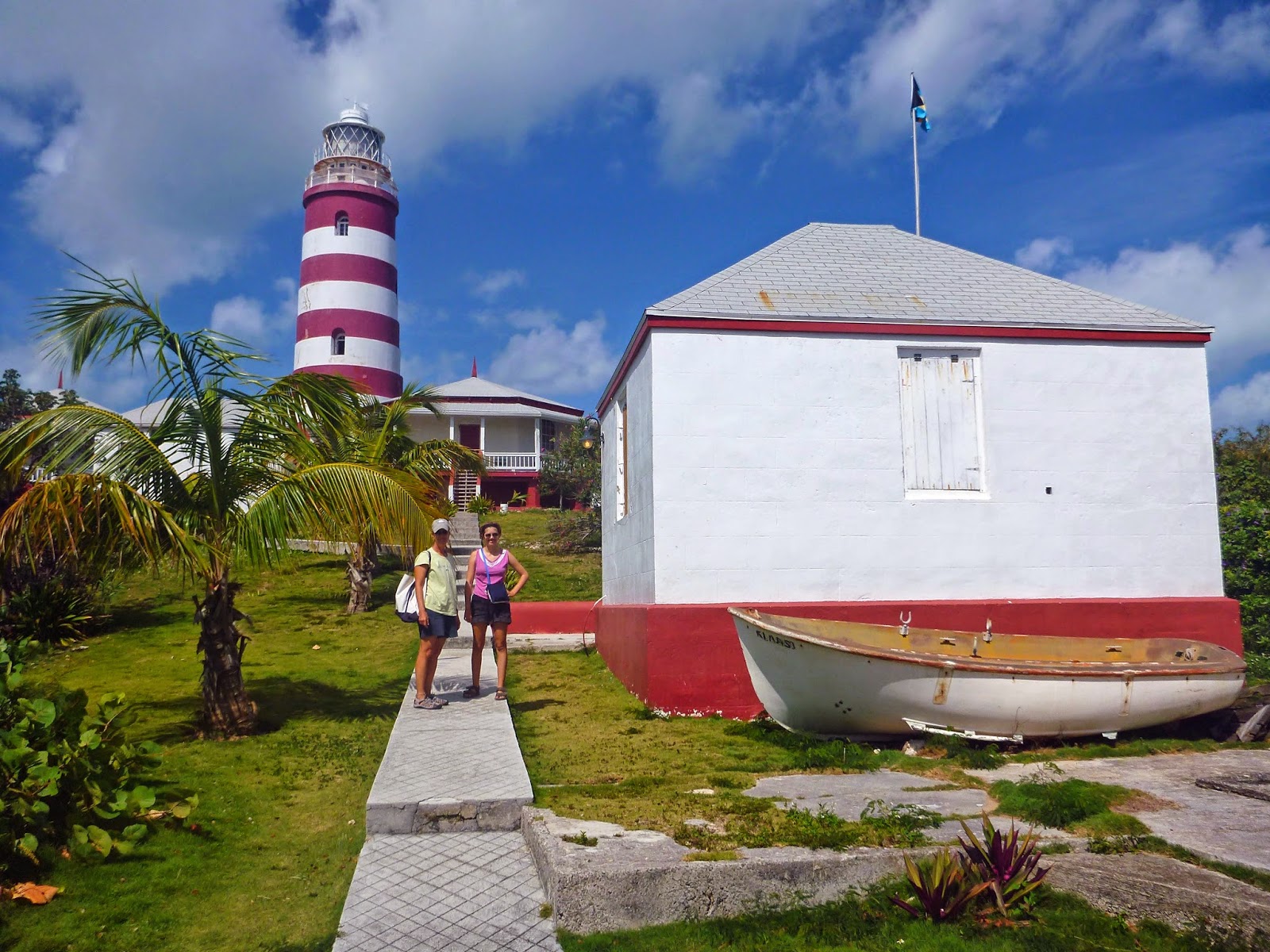

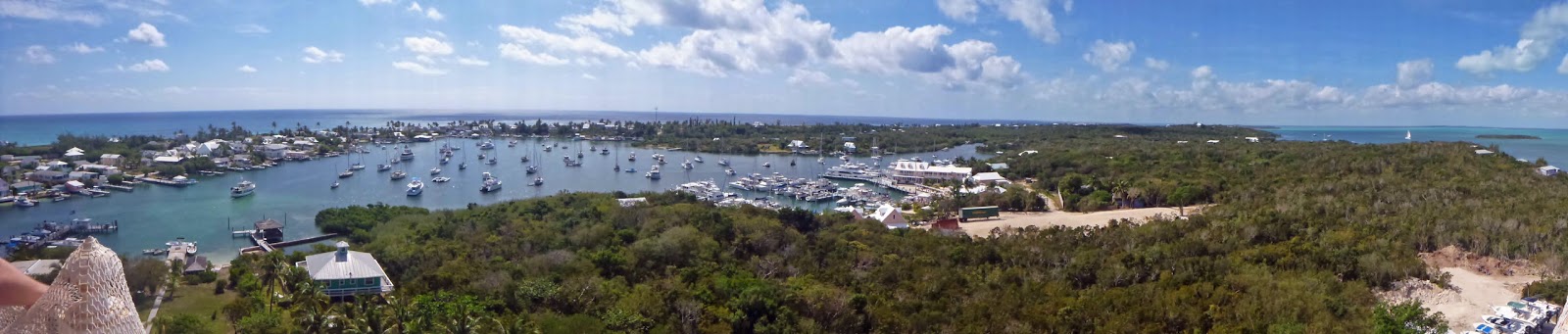
This lighthouse is the only kerosene fueled lighthouse remaining in the
Bahamas. There once were three, but technology and cost of ownership, has seen
two of the remaining three converted. This lighthouse has been added to the
UNESCO trust.
Bahamas. There once were three, but technology and cost of ownership, has seen
two of the remaining three converted. This lighthouse has been added to the
UNESCO trust.
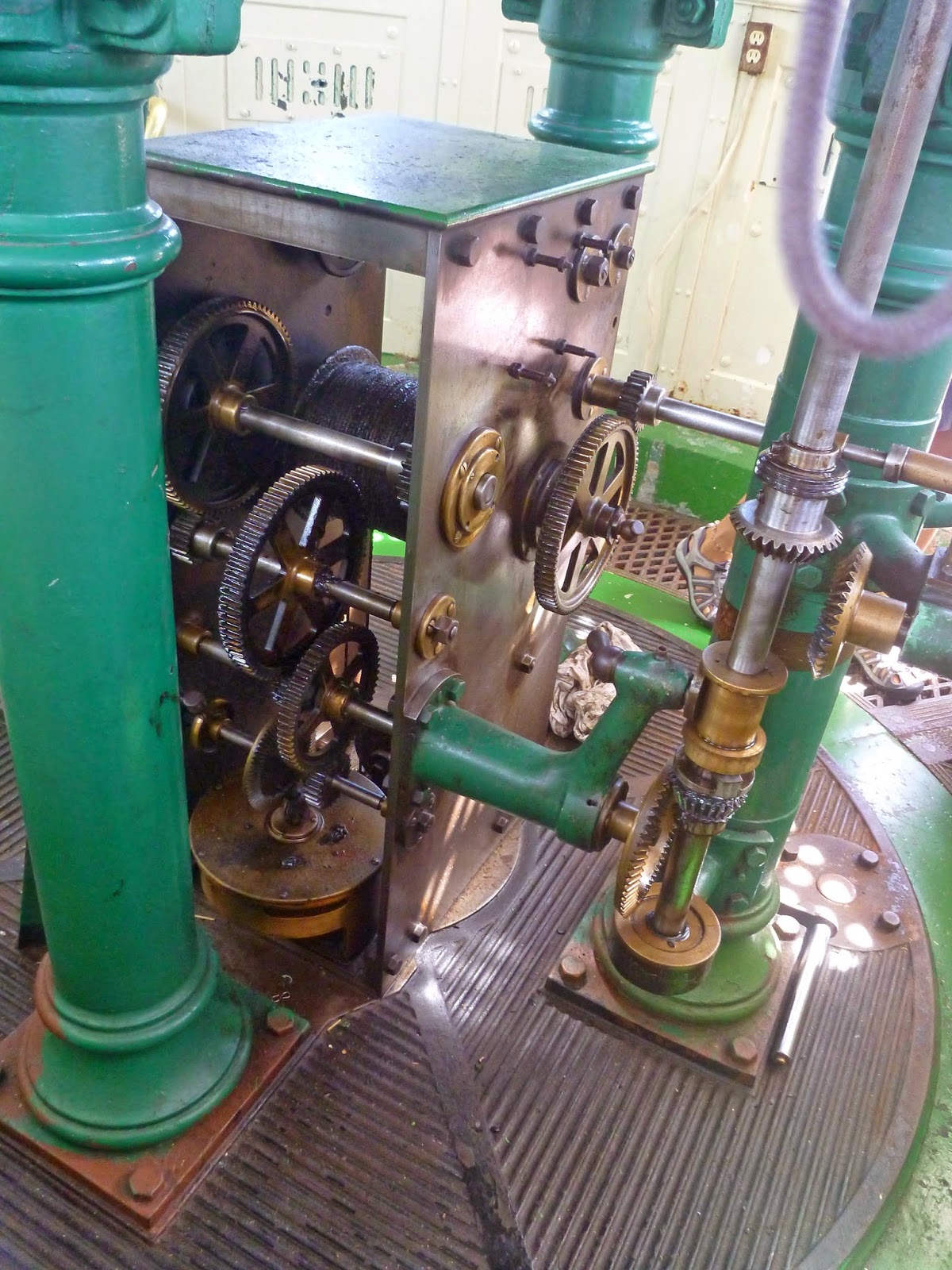
The candy striped
tower rises 124 steps above the mound upon which it stands. The mechanism that
rotates the light is a clockwork mechanism that is powered by a huge weight and
must be rewound every two hours. The 8000 pound burner and its Fresnel lens
rotate on a pool of mercury that reduces friction. A light push of the hand is
enough to turn it. Construction of the lighthouse was opposed by inhabitants of
Hope Town who made their living salvaging valuable cargo from ships that
wrecked in the shallow waters. In one incident, salvers rescued the cargo of a
ship en route to Cuba—slaves. They took the human cargo to Nassau where they
were set free.
tower rises 124 steps above the mound upon which it stands. The mechanism that
rotates the light is a clockwork mechanism that is powered by a huge weight and
must be rewound every two hours. The 8000 pound burner and its Fresnel lens
rotate on a pool of mercury that reduces friction. A light push of the hand is
enough to turn it. Construction of the lighthouse was opposed by inhabitants of
Hope Town who made their living salvaging valuable cargo from ships that
wrecked in the shallow waters. In one incident, salvers rescued the cargo of a
ship en route to Cuba—slaves. They took the human cargo to Nassau where they
were set free.
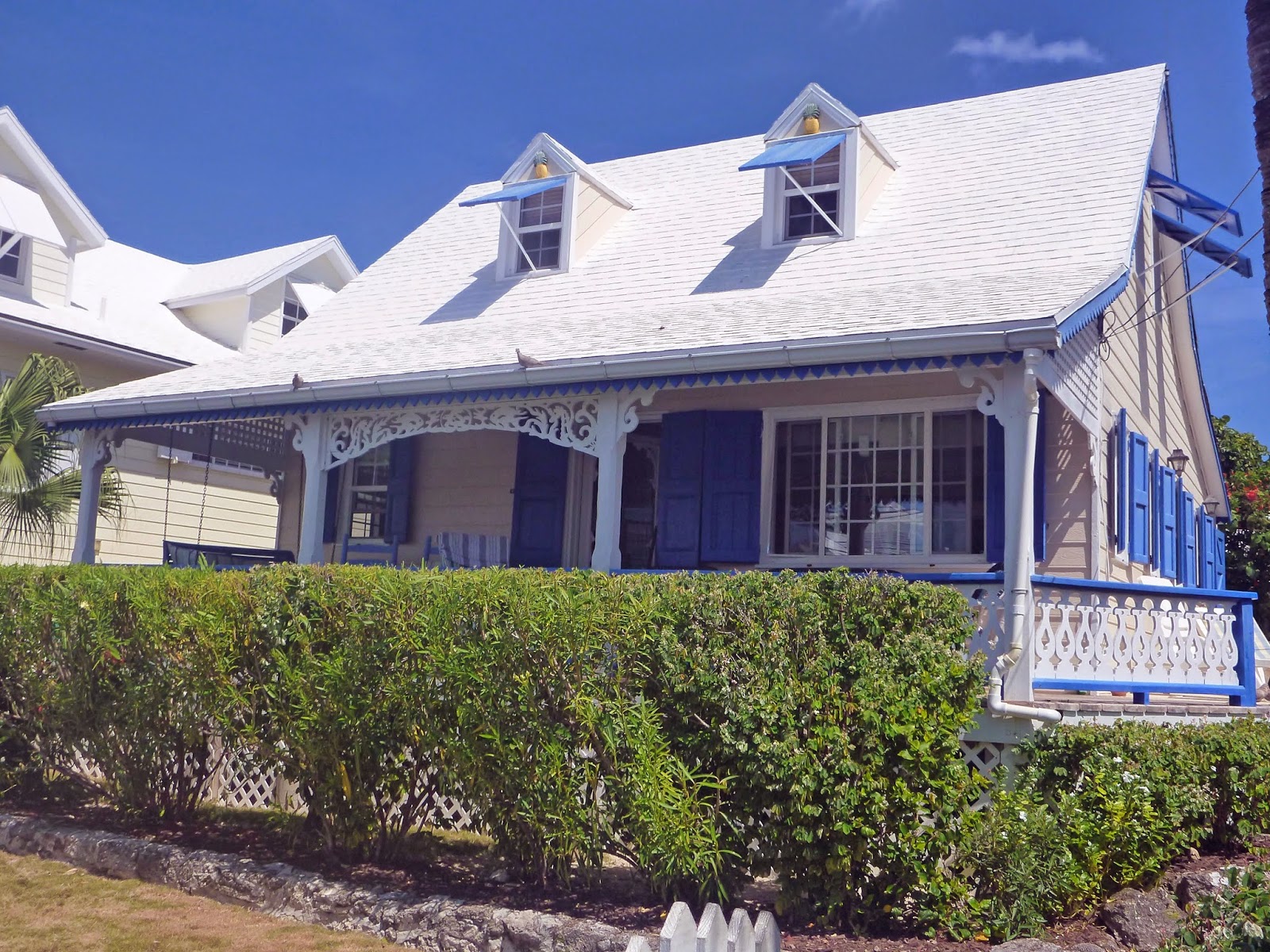
It is a
picturesque little town with small, colorful houses, lots of flowers and narrow
streets and lanes. There is only one
real street that forks into two branches for a short distance. That street is
navigable by small cars and trucks but the most common form of transportation
is the golf cart. The lanes are so narrow that they are accessible only to
pedestrians and bicycles.
picturesque little town with small, colorful houses, lots of flowers and narrow
streets and lanes. There is only one
real street that forks into two branches for a short distance. That street is
navigable by small cars and trucks but the most common form of transportation
is the golf cart. The lanes are so narrow that they are accessible only to
pedestrians and bicycles.

We were walking
along looking at the pastel painted houses when we came across a small tree
being devoured by about a dozen of these enormous colorful caterpillars. We looked them up when we got back and found
that they become a large but very dull looking moth.
along looking at the pastel painted houses when we came across a small tree
being devoured by about a dozen of these enormous colorful caterpillars. We looked them up when we got back and found
that they become a large but very dull looking moth.


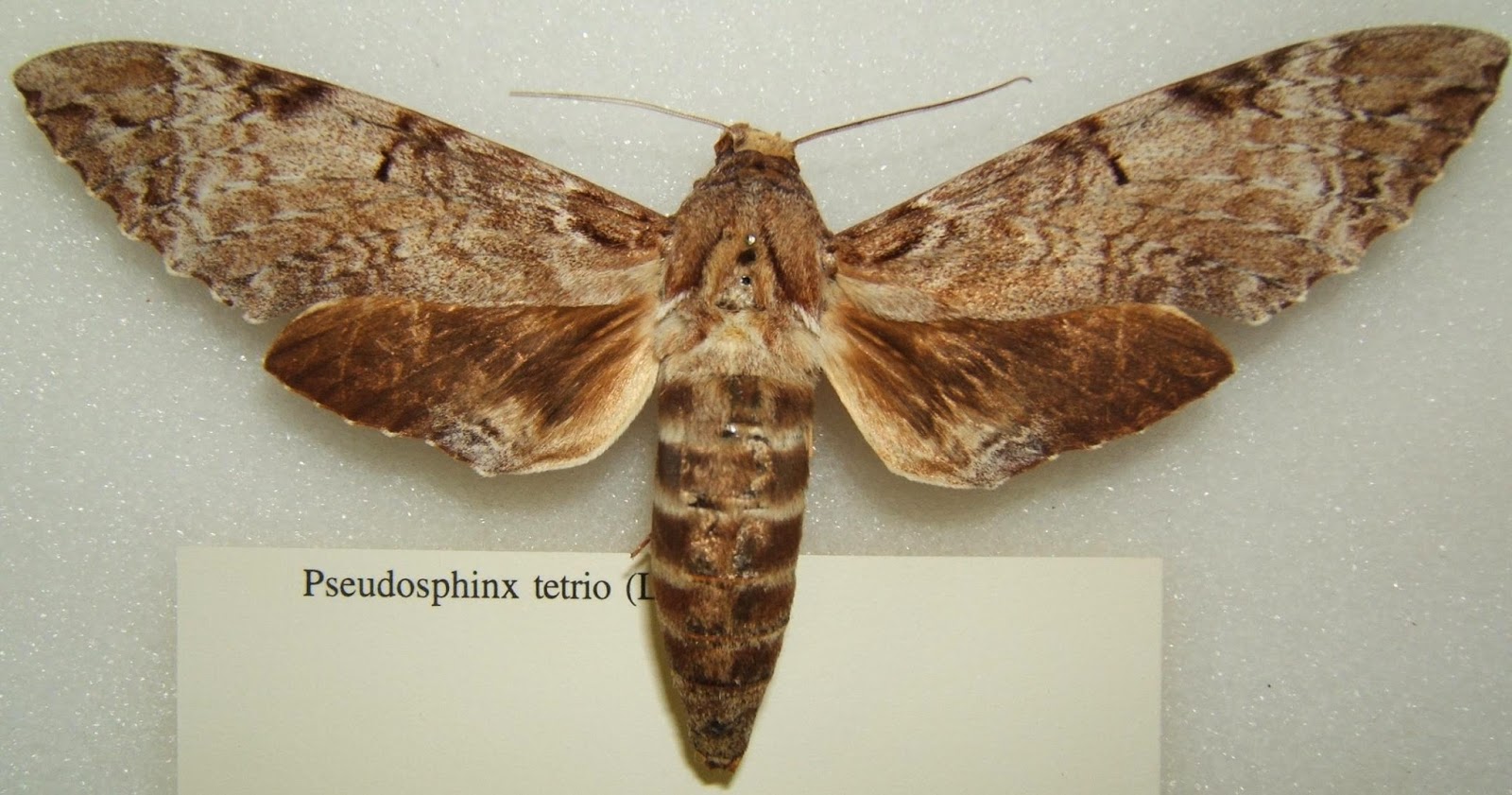
Pseudosphinx
tetrio is a species of moth in the family Sphingidae. Its common names include
tetrio sphinx, giant gray sphinx, frangipani hornworm, and plumeria
caterpillar. It is native to the tropical and subtropical Americas from the
southern and southwestern United States to Brazil. The occasional individual
has been recorded as far north as the northeastern United States so we must be
getting close to home.
tetrio is a species of moth in the family Sphingidae. Its common names include
tetrio sphinx, giant gray sphinx, frangipani hornworm, and plumeria
caterpillar. It is native to the tropical and subtropical Americas from the
southern and southwestern United States to Brazil. The occasional individual
has been recorded as far north as the northeastern United States so we must be
getting close to home.
Normal
0
false
false
false
EN-US
X-NONE
X-NONE
/* Style Definitions */
table.MsoNormalTable
{mso-style-name:”Table Normal”;
mso-tstyle-rowband-size:0;
mso-tstyle-colband-size:0;
mso-style-noshow:yes;
mso-style-priority:99;
mso-style-parent:””;
mso-padding-alt:0in 5.4pt 0in 5.4pt;
mso-para-margin-top:auto;
mso-para-margin-right:0in;
mso-para-margin-bottom:auto;
mso-para-margin-left:0in;
mso-pagination:widow-orphan;
font-size:11.0pt;
font-family:”Calibri”,”sans-serif”;
mso-ascii-font-family:Calibri;
mso-ascii-theme-font:minor-latin;
mso-hansi-font-family:Calibri;
mso-hansi-theme-font:minor-latin;}
After Hopetown, we
anchored in Marsh Harbor which is a good size town with a US style grocery store. We got a few provisions to hold us until we
reach Florida. After the winds clocked
around east again, we visited Great Guana Cay.
We first anchored in Bakers bay that was created by a cruise ship
company. They dredged out a deep water
bay and actually created an island with the dredged sand. The cruise ship company has long abandoned this
harbor but the island was great for collecting shells. After 2 days we moved just outside Settlement
harbor for lunch at Nippers Bar.
anchored in Marsh Harbor which is a good size town with a US style grocery store. We got a few provisions to hold us until we
reach Florida. After the winds clocked
around east again, we visited Great Guana Cay.
We first anchored in Bakers bay that was created by a cruise ship
company. They dredged out a deep water
bay and actually created an island with the dredged sand. The cruise ship company has long abandoned this
harbor but the island was great for collecting shells. After 2 days we moved just outside Settlement
harbor for lunch at Nippers Bar.
Next stop was
Green Turtle Cay and we anchored outside the harbor for the first night. Tom took the dingy into Black Sound with the
depth sounder and made sure Emily Grace
would not run aground going in the narrow, shallow channel. The next morning at high tide we entered
without any drama with 8 inches under the keel…plenty of depth! Inside we found deeper water and grabbed a
mooring ball at $15 per night at Donny’s Dock.
Green Turtle Cay and we anchored outside the harbor for the first night. Tom took the dingy into Black Sound with the
depth sounder and made sure Emily Grace
would not run aground going in the narrow, shallow channel. The next morning at high tide we entered
without any drama with 8 inches under the keel…plenty of depth! Inside we found deeper water and grabbed a
mooring ball at $15 per night at Donny’s Dock.
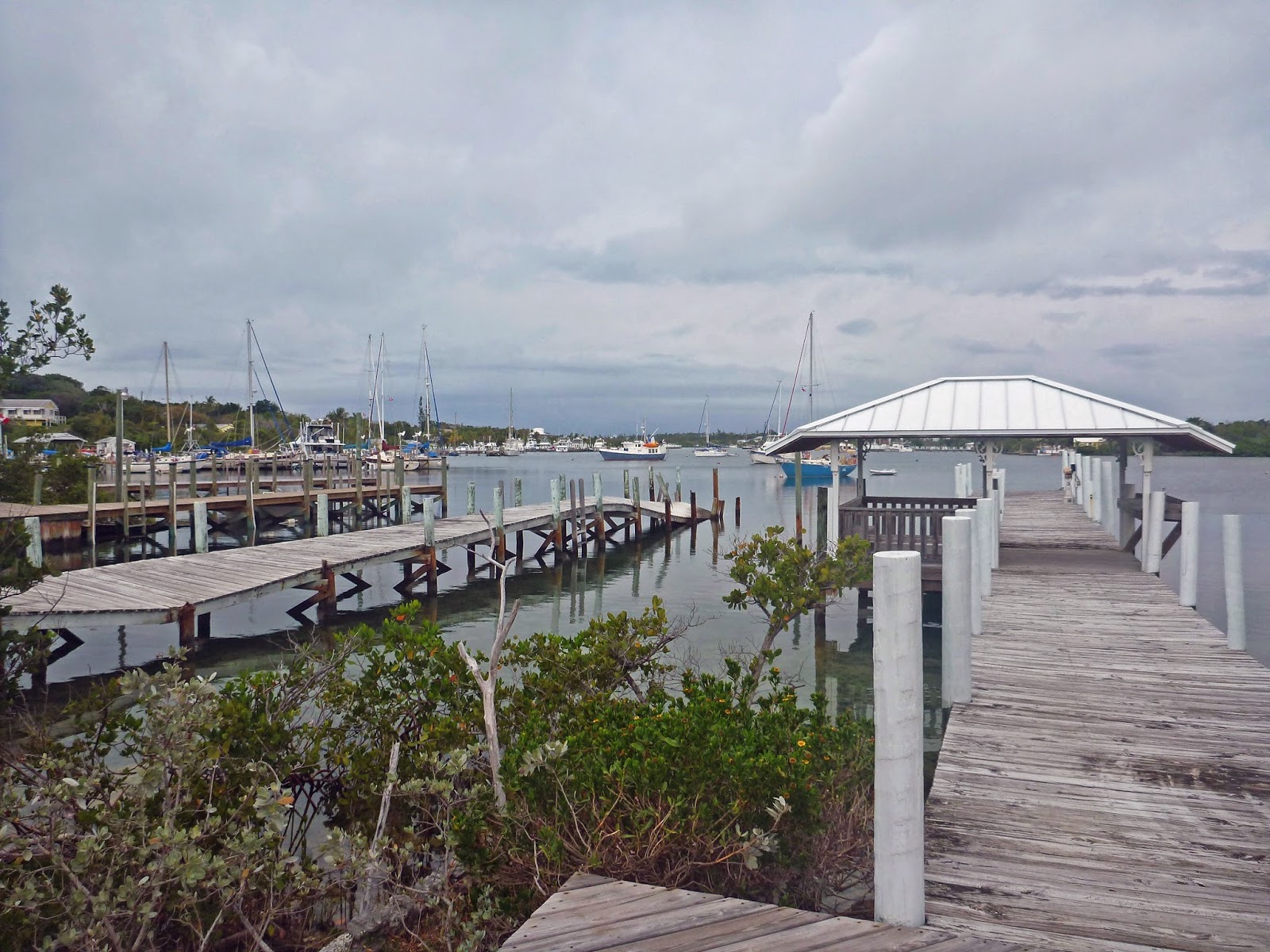
Originally settled
in 1783 by the “Loyalists” escaping the revolutionary war, Green
Turtle Cay is one of the most historical of the out islands. New Plymouth,
Green Turtle’s main settlement with its brightly painted clapboard and gingerbread
adorned houses and narrow picket fence lined streets is reminiscent of a quaint New England town.
in 1783 by the “Loyalists” escaping the revolutionary war, Green
Turtle Cay is one of the most historical of the out islands. New Plymouth,
Green Turtle’s main settlement with its brightly painted clapboard and gingerbread
adorned houses and narrow picket fence lined streets is reminiscent of a quaint New England town.


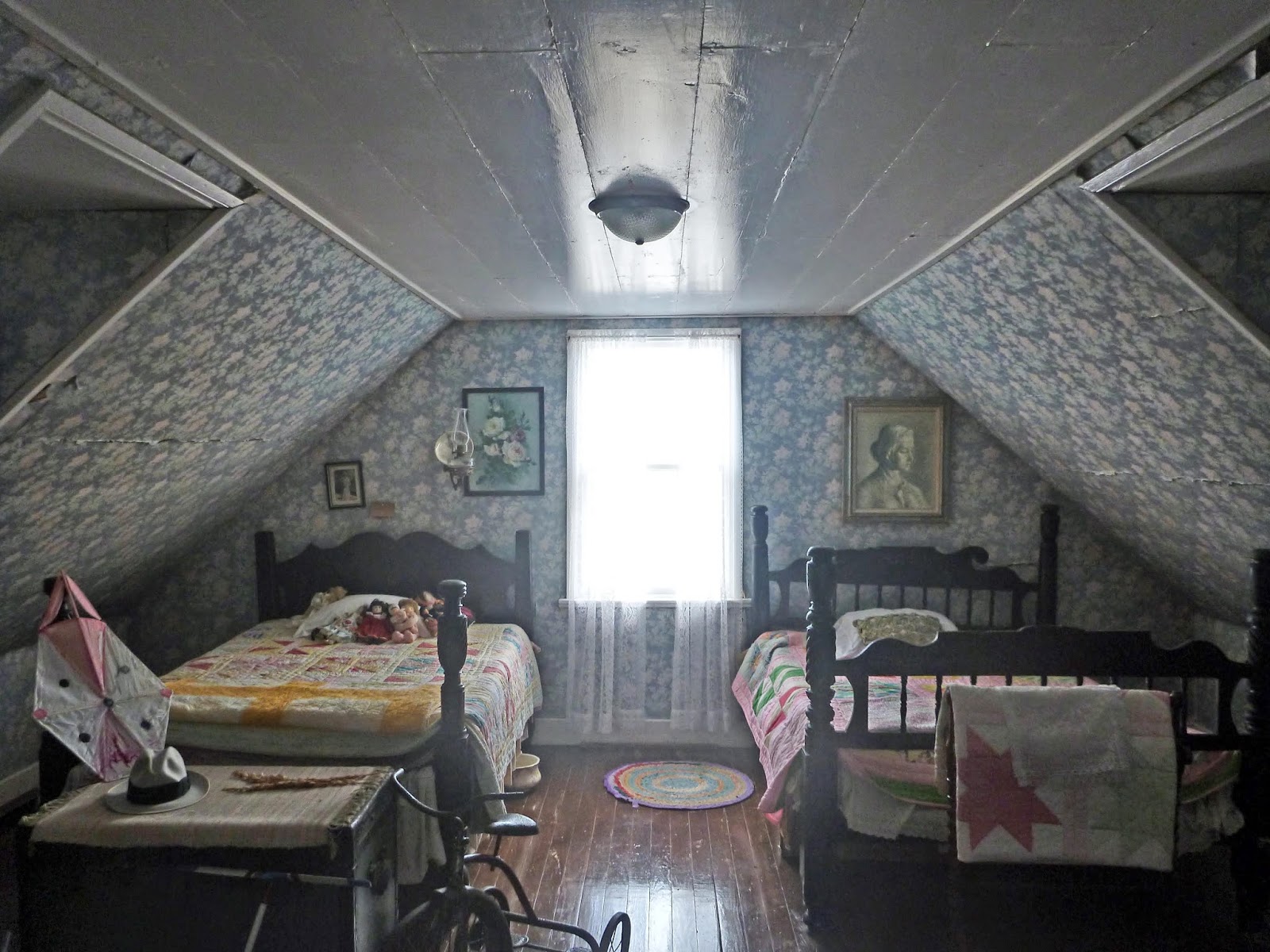
The town offers several historical sites including its 200 year old cemetery,
the Cays original jail (now painted pink) a model schooner museum, Albert Lowe
Museum, a Sculpture Garden with bronze busts of famous Bahamian historical
figures along with many historical homes.
the Cays original jail (now painted pink) a model schooner museum, Albert Lowe
Museum, a Sculpture Garden with bronze busts of famous Bahamian historical
figures along with many historical homes.

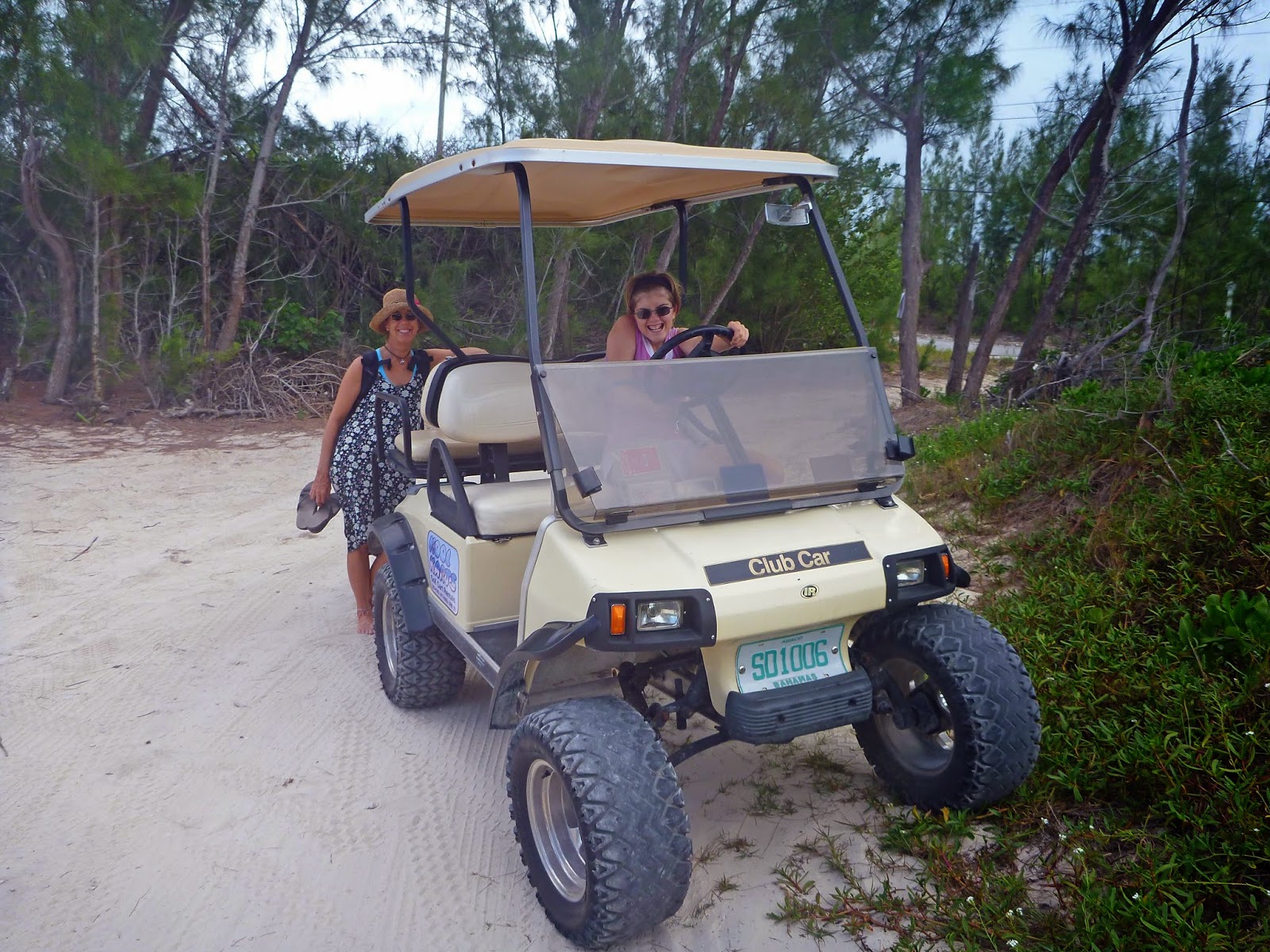
We rented a golf
cart for two days and Emily really enjoyed driving around. The Captain took over in the narrow concrete
streets of New Plymouth but Emily did pretty good elsewhere.
cart for two days and Emily really enjoyed driving around. The Captain took over in the narrow concrete
streets of New Plymouth but Emily did pretty good elsewhere.
We enjoyed lunches ashore and bought some
local coconut bread warm from the oven.
We are now officially famous since we were recognized by some strangers
who have been reading our blog. They
nervously approached us at a restaurant and asked if we were that famous circumnavigator
family. News quickly spread around the
dock and soon other cruisers were coming by to ask about favorite places, best
equipment to have on a cruising boat, how much it all cost, etc. The captain handed out wisdom and stories while
Emily folded and handed out origami birds and dragons. It was all pretty cool and yes, we now all
have swelled heads.
local coconut bread warm from the oven.
We are now officially famous since we were recognized by some strangers
who have been reading our blog. They
nervously approached us at a restaurant and asked if we were that famous circumnavigator
family. News quickly spread around the
dock and soon other cruisers were coming by to ask about favorite places, best
equipment to have on a cruising boat, how much it all cost, etc. The captain handed out wisdom and stories while
Emily folded and handed out origami birds and dragons. It was all pretty cool and yes, we now all
have swelled heads.
Normal
0
false
false
false
EN-US
X-NONE
X-NONE
/* Style Definitions */
table.MsoNormalTable
{mso-style-name:”Table Normal”;
mso-tstyle-rowband-size:0;
mso-tstyle-colband-size:0;
mso-style-noshow:yes;
mso-style-priority:99;
mso-style-parent:””;
mso-padding-alt:0in 5.4pt 0in 5.4pt;
mso-para-margin-top:auto;
mso-para-margin-right:0in;
mso-para-margin-bottom:auto;
mso-para-margin-left:0in;
mso-pagination:widow-orphan;
font-size:11.0pt;
font-family:”Calibri”,”sans-serif”;
mso-ascii-font-family:Calibri;
mso-ascii-theme-font:minor-latin;
mso-hansi-font-family:Calibri;
mso-hansi-theme-font:minor-latin;}
After Green Turtle
Cay we moved to an uninhabited island called Powell Cay. It was recommended by Aries II as a nice
place to relax in front of a white sand beach.
It was just that and Kim and Emily snorkeled and collected more shells
there. We stayed 2 days until the winds
shifted and drove us into the protected shores of Coopers Town. There we walked the small working town and
found a restaurant to serve us cracked conch fritters.
Cay we moved to an uninhabited island called Powell Cay. It was recommended by Aries II as a nice
place to relax in front of a white sand beach.
It was just that and Kim and Emily snorkeled and collected more shells
there. We stayed 2 days until the winds
shifted and drove us into the protected shores of Coopers Town. There we walked the small working town and
found a restaurant to serve us cracked conch fritters.
We stopped once
more at Crab Cay to collect the weather while we were within range of the cell
towers. Since we now have a good
forecast we will head off tomorrow. Tomorrows’
run will be a 7 hour run to Great Sale Cay and will take us out of cell phone/internet range .
This is other uninhabited island with a white sand beach. We will spend the night there and leave Wednesday
morning for the 160 mile passage across the Gulf Stream and into Cape
Canaveral. The key here is to avoid any north winds that would oppose the swift
north flowing current and build big waves.
With any luck our last tricky passage will go well.
more at Crab Cay to collect the weather while we were within range of the cell
towers. Since we now have a good
forecast we will head off tomorrow. Tomorrows’
run will be a 7 hour run to Great Sale Cay and will take us out of cell phone/internet range .
This is other uninhabited island with a white sand beach. We will spend the night there and leave Wednesday
morning for the 160 mile passage across the Gulf Stream and into Cape
Canaveral. The key here is to avoid any north winds that would oppose the swift
north flowing current and build big waves.
With any luck our last tricky passage will go well.
Stay tuned Dear reader
to see how we did.
to see how we did.
Tom
The Abacos
We had a smooth passage north towards the Abacos and our first stop was at Spanish Wells in northern Eleuthera. The winds were west so we tucked on the east side of Meeks patch and the next day as the winds went North we anchored just south of Russell Island. From here it was an easy dingy ride into Spanish Wells.
Spanish Wells is a very unique island. It is almost all white and very prosperous. It is also dry so no alcohol is sold or served in restaurants. The main industry is fishing and the major catch is crayfish or Bahamian Lobster. Spanish Wells supplies over half of the lobsters for all of the Bahamas and the fisherman make a very good living. We saw several of the mother boats returning to harbor with their catch. They towed the small boats used by divers hunting for lobster and conch. Most mother ships had at least 3 and sometimes as many as 6 of the small boats.
We went in and filled a propane gas tank, did some food shopping and had a nice lunch. Kim suffered without her normal Kalik beer but somehow survived. These kids were jumping of the bridge and agreed to perform for us. We bought some grouper directly from a fisherman but the lobster prices were too dear for us.
After a quiet night we made the 10 hour passage to the Abacos and anchored just inside Lynyard Cay where we found a calm spot to drop the hook in about 8ft over white sand. The next day we took a 2 mile dingy ride into Little Harbor.
Our guidebooks say Little Harbor “comes close to anyone’s dream of a Bahamian hideaway”. It is a much protected bay with a mixed shoreline of high rock cliffs and caves, a smattering of cottages, and a sandy beach.
We were enticed ashore by the aromas wafting from Pete’s pub. The pub has a roof, but no walls or floor, a small bar area and large eating area with heavy wood tables and benches that sit on the sand. You could wiggle your toes in the warm sand floor and read the signed tee shirts hanging from the ceiling. The pub served burgers, conch and a variety of fresh caught fish…grouper, snapper, wahoo, and Kim had trigger fish…excellent. After lunch at the pub we wandered to the Gallery where bronze works were displayed and for sale.
This is the Gallery, Studio and Forge of the late Randolph Johnstone, well known artist of bronze sculptures. His sculptures became famous and ultimately lucrative. One of his large works, titled “St. Peter: Fisher of Men,” rests in the Vatican’s museum in Rome. It is now his son Pete Johnston, himself an acclaimed bronze & wood sculptor, who operates the facility.
There were some pieces done by the late Randolph Johnstone but most of the pieces were done by his son Pete (hence ‘Pete’s Pub’). Emily bought a nice leather belt with a cast turtle buckle. Further along the path we came to the Studio and Foundry, where the bronzes are cast. We were unable to see the casting process, which is done only a few times during the summer season.
We met a nice couple cruising on Mud Puddle Rose, a Grand Banks, and we went north with them for a snorkel on Sandy Cay. The snorkeling was good but the swell made it a little rolly. After the snorkel both boats moved north just outside Hopetown for calmer waters where Joe and Susan joined us on Emily Grace for dinner with Kim’s nasi goreng. Joe was full of cruising tips for the few remaining cays to my northwest and it was a nice evening. They brought their poodle Bocci and Emily enjoyed playing with her.
Next we motored north to Hopetown. Hope Town was settled by British Loyalists who were seeking safe refuge after the American Revolution. Many of the settlers came from the Carolinas, by way of East Florida, after that area was turned over to Spain in the Peace of Paris (1783). The same treaty called for the evacuation of New York by the loyalists. Many people moved back to England, Canada, or south to the British Caribbean. The initial settlements were at Carleton (near the current Treasure Cay) and Marsh Harbour. By 1785, there were over 1,000 refugees in Abaco who were distributed in five or six settlements. The settlement at Hope Town was founded in 1785, in part, by a widow from South Carolina named Wyannie Malone. Wyannie, along with her children, started a dynasty in Hope Town that spread the Malone name throughout the Bahamas, over to Florida, and outwards from there.
Every magazine picture of the Bahamas includes a photograph of one very historic lighthouse. After making our arrival at Hope Town Marina, we proceeded to the end of the island to the lighthouse steps. After a short walk to the entrance to the lighthouse, you enter, and then work your way up six levels to the top. You get great views of the Abacos in almost every direction.
This lighthouse is the only kerosene fueled lighthouse remaining in the Bahamas. There once were three, but technology and cost of ownership, has seen two of the remaining three converted. This lighthouse has been added to the UNESCO trust.
The candy striped tower rises 124 steps above the mound upon which it stands. The mechanism that rotates the light is a clockwork mechanism that is powered by a huge weight and must be rewound every two hours. The 8000 pound burner and its Fresnel lens rotate on a pool of mercury that reduces friction. A light push of the hand is enough to turn it. Construction of the lighthouse was opposed by inhabitants of Hope Town who made their living salvaging valuable cargo from ships that wrecked in the shallow waters. In one incident, salvers rescued the cargo of a ship en route to Cuba—slaves. They took the human cargo to Nassau where they were set free.
It is a picturesque little town with small, colorful houses, lots of flowers and narrow streets and lanes. There is only one real street that forks into two branches for a short distance. That street is navigable by small cars and trucks but the most common form of transportation is the golf cart. The lanes are so narrow that they are accessible only to pedestrians and bicycles.
We were walking along looking at the pastel painted houses when we came across a small tree being devoured by about a dozen of these enormous colorful caterpillars. We looked them up when we got back and found that they become a large but very dull looking moth.
Pseudosphinx tetrio is a species of moth in the family Sphingidae. Its common names include tetrio sphinx, giant gray sphinx, frangipani hornworm, and plumeria caterpillar. It is native to the tropical and subtropical Americas from the southern and southwestern United States to Brazil. The occasional individual has been recorded as far north as the northeastern United States so we must be getting close to home.
After Hopetown, we anchored in Marsh Harbor which is a good size town with a US style grocery store. We got a few provisions to hold us until we reach Florida. After the winds clocked around east again, we visited Great Guana Cay. We first anchored in Bakers bay that was created by a cruise ship company. They dredged out a deep water bay and actually created an island with the dredged sand. The cruise ship company has long abandoned this harbor but the island was great for collecting shells. After 2 days we moved just outside Settlement harbor for lunch at Nippers Bar.
Next stop was Green Turtle Cay and we anchored outside the harbor for the first night. Tom took the dingy into Black Sound with the depth sounder and made sure Emily Gracewould not run aground going in the narrow, shallow channel. The next morning at high tide we entered without any drama with 8 inches under the keel…plenty of depth! Inside we found deeper water and grabbed a mooring ball at $15 per night at Donny’s Dock.
Originally settled in 1783 by the “Loyalists” escaping the revolutionary war, Green Turtle Cay is one of the most historical of the out islands. New Plymouth, Green Turtle’s main settlement with its brightly painted clapboard and gingerbread adorned houses and narrow picket fence lined streets is reminiscent of a quaint New England town.
The town offers several historical sites including its 200 year old cemetery, the Cays original jail (now painted pink) a model schooner museum, Albert Lowe Museum, a Sculpture Garden with bronze busts of famous Bahamian historical figures along with many historical homes.
We rented a golf cart for two days and Emily really enjoyed driving around. The Captain took over in the narrow concrete streets of New Plymouth but Emily did pretty good elsewhere.
We enjoyed lunches ashore and bought some local coconut bread warm from the oven. We are now officially famous since we were recognized by some strangers who have been reading our blog. They nervously approached us at a restaurant and asked if we were that famous circumnavigator family. News quickly spread around the dock and soon other cruisers were coming by to ask about favorite places, best equipment to have on a cruising boat, how much it all cost, etc. The captain handed out wisdom and stories while Emily folded and handed out origami birds and dragons. It was all pretty cool and yes, we now all have swelled heads.
After Green Turtle Cay we moved to an uninhabited island called Powell Cay. It was recommended by Aries II as a nice place to relax in front of a white sand beach. It was just that and Kim and Emily snorkeled and collected more shells there. We stayed 2 days until the winds shifted and drove us into the protected shores of Coopers Town. There we walked the small working town and found a restaurant to serve us cracked conch fritters.
We stopped once more at Crab Cay to collect the weather while we were within range of the cell towers. Since we now have a good forecast we will head off tomorrow. Tomorrows’ run will be a 7 hour run to Great Sale Cay and will take us out of cell phone/internet range . This is other uninhabited island with a white sand beach. We will spend the night there and leave Wednesday morning for the 160 mile passage across the Gulf Stream and into Cape Canaveral. The key here is to avoid any north winds that would oppose the swift north flowing current and build big waves. With any luck our last tricky passage will go well.
Stay tuned Dear reader to see how we did.
Tom
