Tag Archives | trawler

Belleville to Trenton – May 22 & 23, 2018

Tuesday, May 22nd

Teak had another vet appointment at 9:30 in the morning to be checked once again before we headed out for Port Trent Marina.  Our rent car needed to be back by noon, and we needed to find out about the alarm going off on our b…

Afsluitdijk Dam

The 20-mile (32km) Afsluitdijk dam, completed in 1932, protects the Netherlands coast from flooding and provides an important source of freshwater by transforming the saltwater bay Zuiderzee into a freshwater lake renamed IJsselmeer. The dam also provides an important road link between the provinces of Friesland, where Harlingen is, and North Holland. An easy bike…

Harlingen Canals

We set of from Harlingen just past 7am on a warm and sunny day to test the new tender on a longer trip and to enjoy the inland canals. After passing through the sea lock, we spent several hours touring the narrow and shallow inland canals, passing through small towns and alongside old-style Dutch windmills….

Northbound 2018: Playing the Weather to Hingham

As noted in the previous article, we arrived the Morehead City Yacht Basin fuel dock at 0815 hours on Wednesday morning. Our goal was to take on fuel, top off our water tank, offload garbage and, since the forecasts looked favorable for following seas …

Northbound 2018: Playing the Weather to Hingham

As noted in the previous article, we arrived the Morehead City Yacht Basin fuel dock at 0815 hours on Wednesday morning. Our goal was to take on fuel, top off our water tank, offload garbage and, since the forecasts looked favorable for following seas …

A Pox Upon Your Bottom

So this was the year to haul out and redo the boat’s anti-fouling coating (the nasty stuff that keeps barnacles and sea weed from growing on the boat’s bottom).  Since the boat was going to be out of the water, we thought we take advantage of that and have some of the major dings to the boat’s top coat (acquired mostly from learning how to dock in close quarters and in the wind).

2018-Haulout-003xUnfortunately, top coating is more sensitive to temperature and humidity than the bottom paint so that meant we had to be in an interior work space.  That meant we could not live aboard while the work was being done (liability/insurance concerns) plus the mast would have to come down before the haul out and be raised after we splashed at the end of the process.  Suddenly our hoped for 2-week work package was becoming closer to 3-1/2 weeks.

2018-Haulout-018xScheduling of the inside work area at the boatyard we were using, Port Townsend Shipwrights Coop (PTSC), was a challenge because spring is their busy time (both fishing and recreational boats are trying to get ready).  The date we got in the second week of April was about a week or two later than we would have preferred.

2018-Haulout-020xWe arrived in Port Townsend on Monday, April 9, but between the necessary work for laying the mast down on the boat and some stiff south winds, we didn’t actually get hauled out until Thursday, April 12.  Initially the bottom looked pretty good because there wasn’t much growth on it.  But not long after the pressure washer started taking the green stuff off, bottom paint chips flew and other issues became apparent.  After some scraping at trouble areas and measurements of paint thickness, we knew we had a problem.

2018-Haulout-040xI often joke about our boat being a giant floating chemistry experiment. The boat is made up of many dissimilar metals and bathed in an environment (salt water) that encourages these dissimilar metals to react.  The role of paint (or, more appropriately, coatings) is to keep these dissimilar metals from interacting with each other or the water.  When the coating begins to fail, chemical reactions occur and, in the long run, bad things will happen to the boat.

2018-Haulout-051xThat was the situation we were facing.  The barrier coat we had on the boat was failing and chemical reactions were starting to pop the barrier coatings away from the boat’s steel bottom.  While point repairs are possible, inevitably there would be more and more failures taking more time and money than really fixing it.  We bit the bullet and decided to have the bottom sand blasted back to bare metal and be totally recoated with new primer, barrier coat and anti-fouling coat.  Suddenly the cost of our work statement doubled and its length went to 5 weeks.

2018-Haulout-082xAt the end of this uncomfortable process (not the least of which was living in a motel room for 5 weeks with our cat Maggie), we splashed back into the water on May 17 with robust new bottom coatings.  We hurried back to Bainbridge Island and completed our provisioning activities in record time.  We depart tomorrow, May 25 for our 2018 cruising season.

Alaska 2018 Blog Post 9 – Petersburg to Takatz

May 19, 2018

Saturday was a lazy day in Petersburg; Patrick replaced engine zincs and cleaned sea strainers.  We made our final grocery trips.  The day was still sunny, but cool once out of the direct sun.  The morning was livened by the kid’s fishing derby, with the docks lined with kids and parents trying their luck.

May 20, 2018

Spirit was underway at 0646, riding the ebb tide out of Wrangell Narrows and then west in Frederick Sound.  We left in rain, which lifted briefly, then started again heavier as we approached Cannery Cove.  Winds remained less than 15 knots and seas were calm.  There was very little other traffic, just a couple of fishing boats and several pleasure craft.

There are usually lots of whales in Frederick Sound, but today we only spied two distant spouts. 

We arrived and had the anchor down in Cannery Cove at 1256, just behind a large sailing yacht that beat us in by 10 minutes.  Our first choice of locations was too close to the other boat for our comfort, given the prediction of a SE gale overnight and, so we moved and re-anchored in 50 feet of water on one of our other 2016 anchor marks further out in the cove.  Then the rain really started.  When the low clouds lifted, we could see snow down to below 500 feet on the hills surrounding the head of the bay.  The rain was so heavy we decided to keep the Apex inflatable on-board and forgo prawning, especially with the weather prediction.

We will spend 2 nights here due to predicted inclement weather for a crossing of Chatham Strait tomorrow, with winds in excess of 40 knots and 8-foot seas.

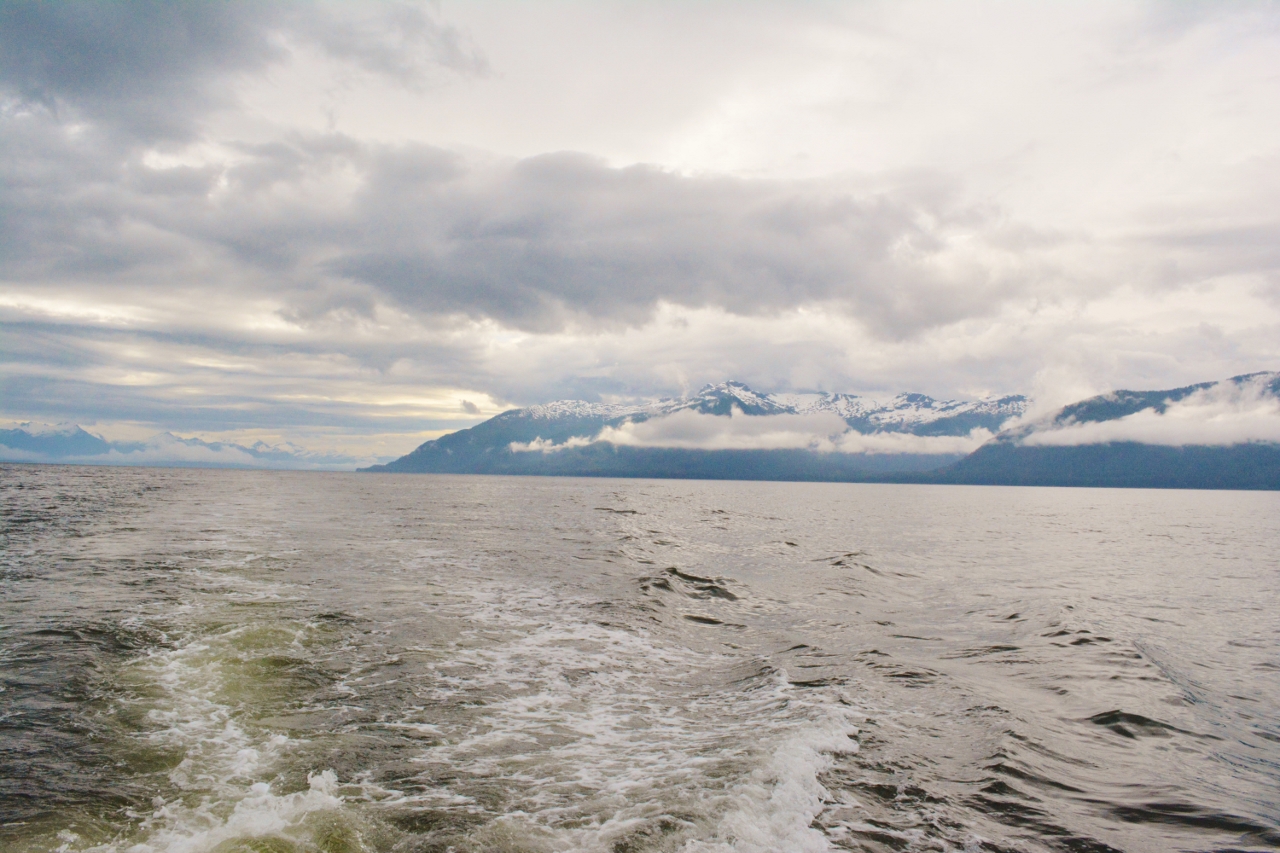
Heading west in Frederick Sound in light rain

Cannery Cove before the deluge began

May 21, 2018

Overnight we had lots of motion as the wind swirled into Pybus Bay.  The bay is not nearly as protected from SE winds as the cruising guides indicate.  We believe the wind reflects off the hills and changes direction by nearly 90 degrees coming into the bay.  Also, the waves coming up West Channel wrap around the point and into Cannery Cove.  So, instead of protection from the SE, the winds and waves were coming directly into the bay from the NE.  The rain was torrential, never letting up, just getting blown sideways as the wind gusted to 30 knots.  The air temperature hit a high of 49 degrees; no wonder the snow is still so low on the hillsides.  We were glad we did not have to go and pull prawn pots or even go outside on the deck.
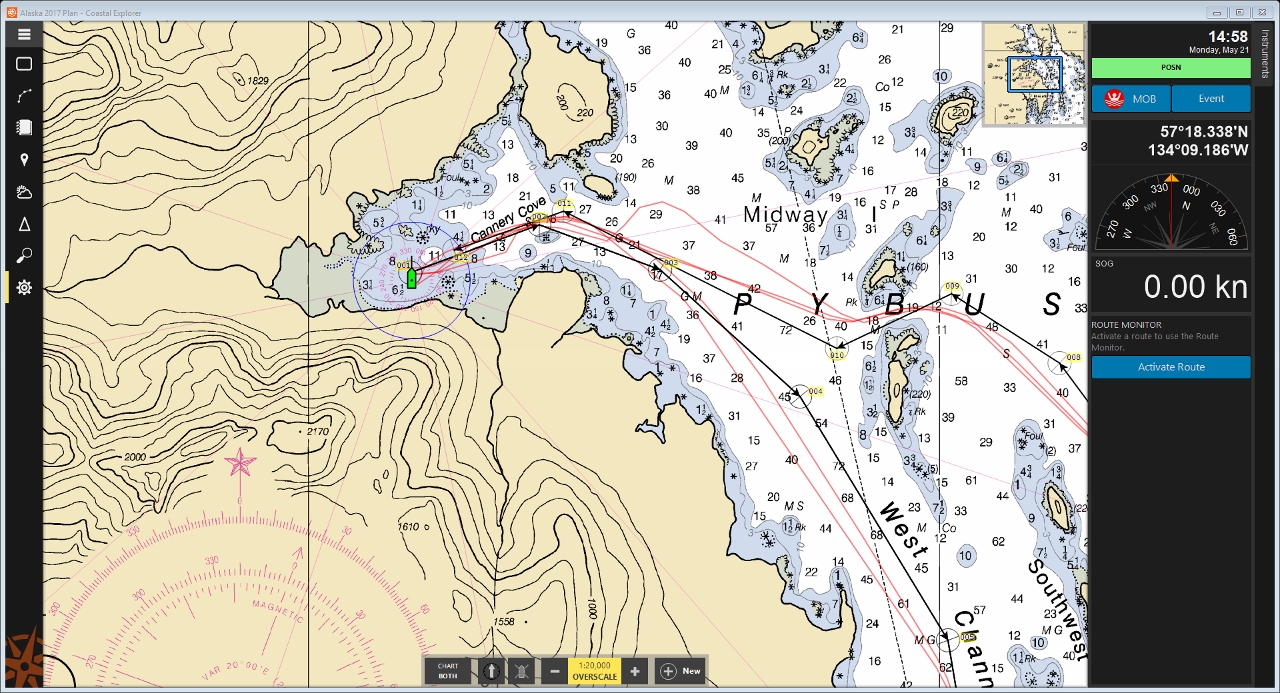


Cannery Cove where SE winds and Waves wrap around into the bay


In the afternoon, the crew of the sailing yacht “Delphina” anchored near us, brought over excess crab, which we will cook later this evening.  Their pots were full, more than their limits.

As the afternoon wore on, the waves entering the bay continued to increase and the combination of wind and current kept us broadside to the waves, very uncomfortable.  The heavy rains have increased the outflow from the streams and turned the surface water muddy brown over most of the cove.

With the heavy rains and low temperatures, soup sounded good for dinner, so even with the rolling motions we prepared a big pot of split pea with ham soup and watched a couple of episodes of “Blue Planet II”, a series we started watching at home and then purchased the Blu-ray DVD to take with us.  The wind and seas gradually decreased and by 2100 we were back to calm seas and moderate winds.

May 22, 2018

The weather front passed over during the night, so the seas were calm, just some residual wind and continued cool temperatures, in the upper 40’s.

We pulled the anchor and 260 feet of chain from the sticky mud in Cannery Cove at 0700 and headed to Henry’s Arm to investigate it as an alternate anchorage in a SE gale.  The entrance is easy to negotiate, and the water was still inside, with virtually no wind, even though it was blowing 15 knots outside.  There is room for several boats to anchor in 50 feet of water.  The barge shown on all our charts is gone, just a floating log sticking out from shore.

Heading down West Channel we re-entered Frederick Sound, riding the ebb tide to Yasha Island.  The expected ebb current in Chatham Strait was not present, probably due to the 20-knot southerly wind and residual swell from the previous day’s storm.

We entered Red Bluff Bay at 1215, quickly out of the wind and waves in Chatham, and by 1300 we were anchored at the head of the bay, the only boat for the present.

The red bluffs at the entrance to the bay
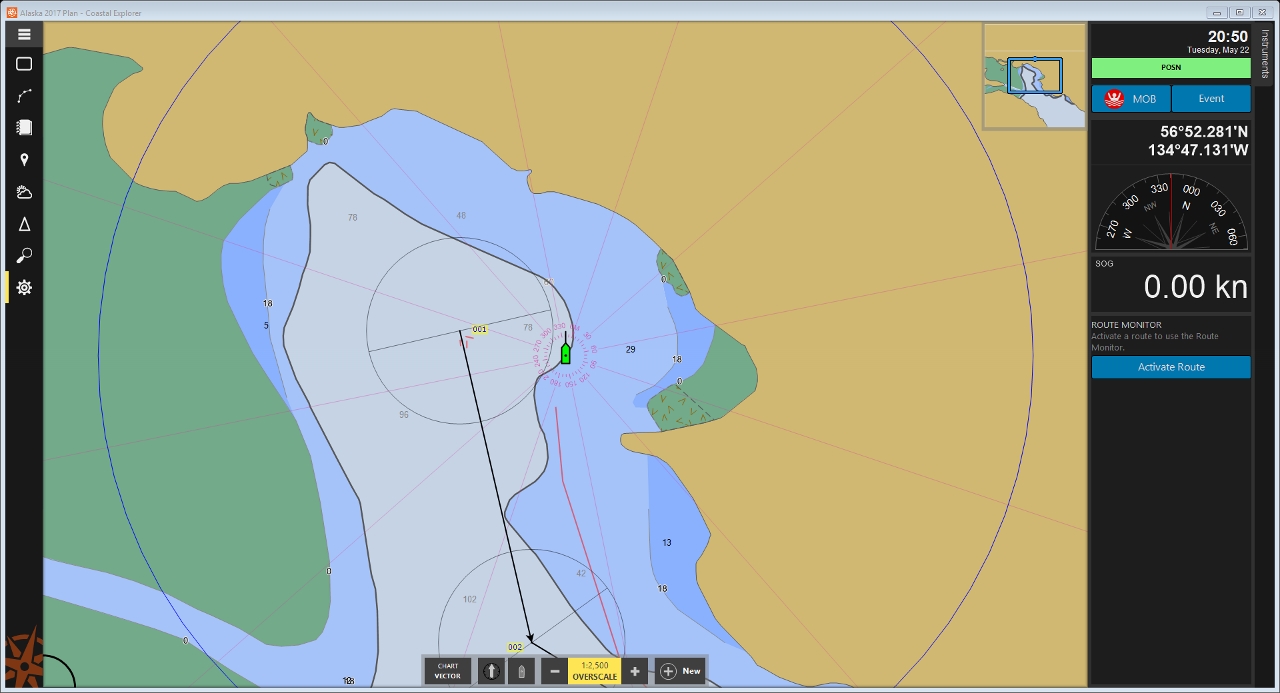
Anchor location in Red Bluff Bay

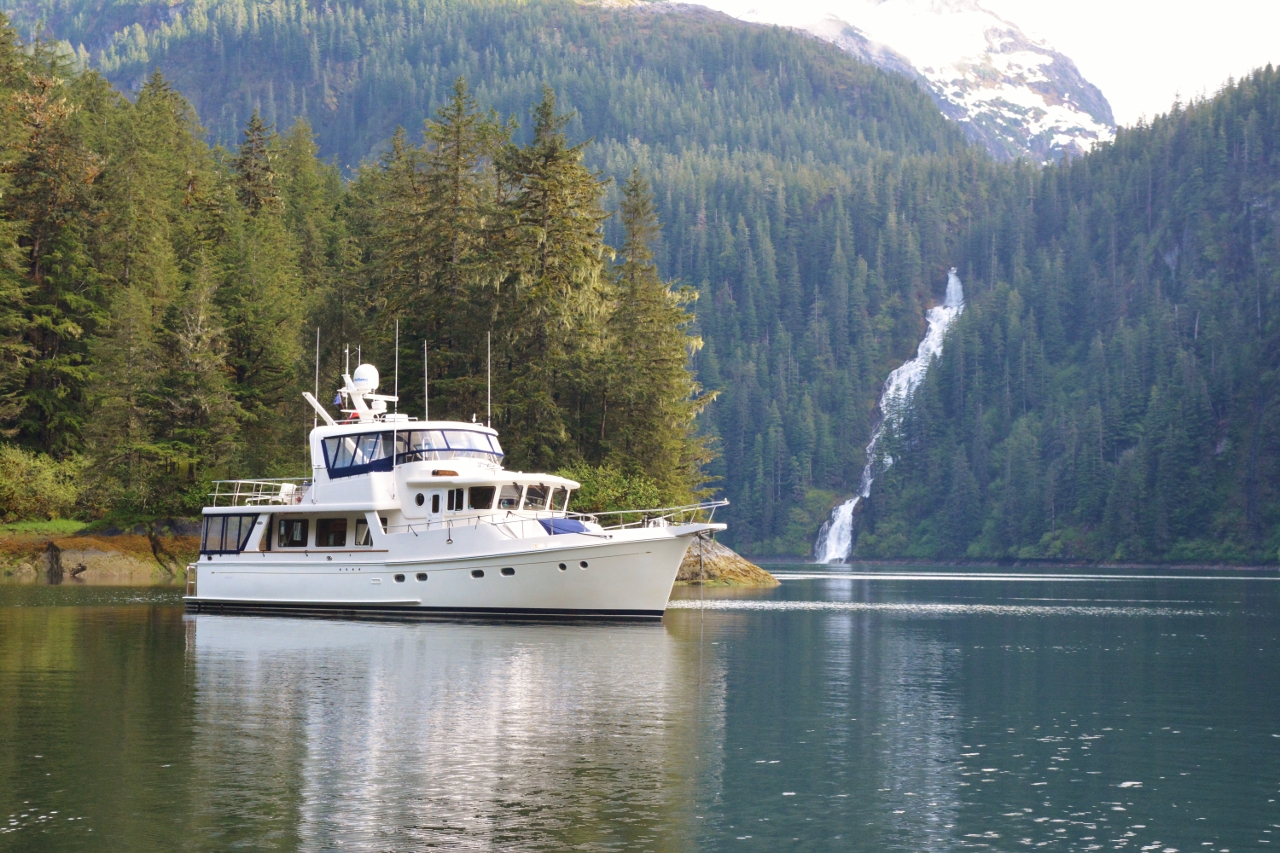
Anchored with a great view of the falls

Our neighbors on Luck Dragon

 After a lunch of leftover soup from last night, Patrick took the prawn traps to our favorite location.  Returning to Spirit, the sun alternated with the rain as we enjoyed the view of the waterfall from our anchorage.  We looked for bears on the river delta where we had seen them before, but, alas, none were to be seen.  Later in the afternoon, the Diesel Duck “Luck Dragon” anchored near us.  We have met them several times over the last few years and they are headed the same direction as us in the morning, although they intend to leave at 0500.  We hope we are still asleep, although it will have been light for several hours.

Also disappointing was the evening check of the prawn traps.  Other than 2 small fish, there were only 10 prawns between three traps.  We did see sea otters today, they may have already devastated the prawns and crab.

May 23, 2018

Obviously, our favorite location for prawns must change.  After pulling the anchor, Patrick headed to the traps and Miriam brought Spirit down and drifted as Patrick hauled the traps.  There were only 2 dozen large prawns, hardly enough for an appetizer.

Morning in Red Bluff Bay

Heading out of Red Bluff Bay shortly after 0800 we encountered moderate North winds and 1-2 foot chop.  Just off Nelson Bay stood a bank of fog, with visibility of less than ¼ mile.  The fog persisted until just south of Warm Springs Bay.  Entering the bay, we found an open spot on the new dock, which now charges for moorage.  The dock seems to be in the same location as before but constructed well with a new gangway.  The reef off the end is still there, and at higher tides the current makes docking a challenge.

New dock in Warm Springs Bay

New Ramp – much better
The public bathhouse is unchanged, and Patrick enjoyed a leisurely soak in one of the three tubs; each one in its own room.

May 24, 2018
The weather report calls for another front to come in from the SE on Friday and Saturday, with winds to 30 knots and 6-8 foot seas in Chatham..  Since we have a few days before we need to be in Sitka, we have decided to fish a little in the open fishery near Hidden Falls and then anchor in Takatz Bay for several days.
We fished for several hours and only hooked one black rockfish, enough for fish tacos.
By 1015 we were anchored in Takatz Bay with two other boats, both of whom were in Warm Springs with us the night before.
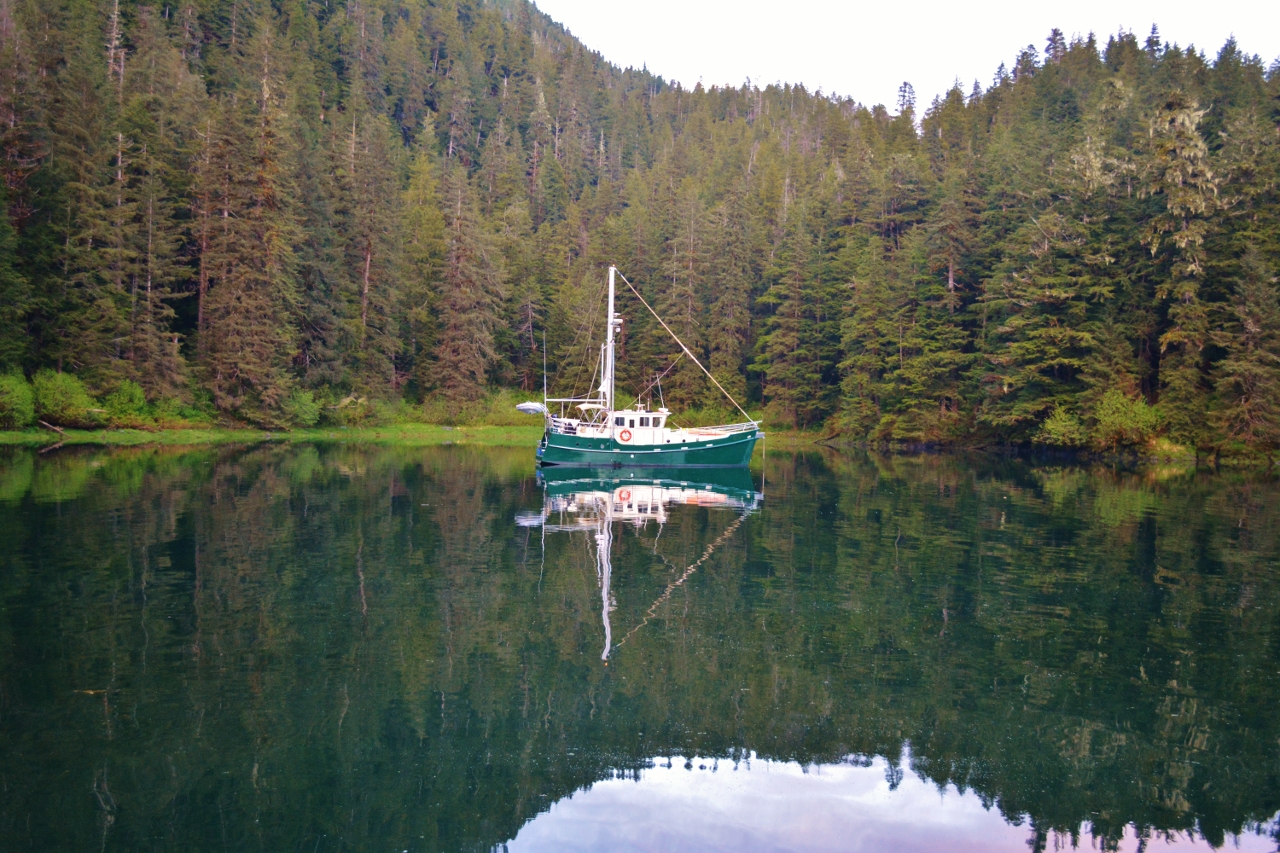
Our anchorage in Takatz Bay


Harlingen Harbors

After Boot Akkrum delivered our new tender, we went out on a tour of the Harlingen harbors to get the new Honda 50 broken in quickly. We found a lot there—Harlingen businesses include Dutch shipbuilder Icon Yachts, several boat yards with focus on the offshore oil industry, and barge offloading facilities. Below are trip highlights…

ANCHORING IN STRONG WINDS WITH SAFETY AND CONFIDENCE (PART 2)

Envoy is berthed in Greece’s Lefkas Marina while Diane and are home in Auckland. We’re not planning any major Med cruising this year, but hope to visit Lefkas around mid August to check on Envoy and cruise until end October.
Pacific Passagemaker magazine recently published an article we’d written on anchoring in strong winds.
Here’s the second of two parts of an edited version of that article.
So Part One has put our vessel into a suitable bay for anchoring.
Much is written about different anchors and their supposed advantages but provided your vessel has a recognised mainstream type of anchor your security will be determined more by your anchoring technique including the weight of chain you have on the seabed.
This article assumes your vessel has totally adequate ground tackle and that is a whole subject in itself. Our main anchor is a 40 kg (88 pound) Delta Setfast with 400 feet of 10.8mm BBB chain and having anchored nearly 2,000 times can only recall Envoy dragging anchor twice (once of which was during a non-forecast 60 knot wind).
A commonly used method to calculate the required length of chain is to add the maximum expected water depth at high tide to the distance from the anchor roller to the water and then multiply that figure by five, six or seven times depending on the conditions. However this formula doesn’t work so well in very shallow water or deep water. I prefer to allow for the depth of water plus 30-40 metres of chain on the bottom.

We rarely go into harbours or marinas as it’s too expensive when living aboard

In very strong winds we lay out as much chain as possible, even up to ten times total depth while keeping in mind the proximity of other vessels and the consequences of a wind shift. Of course you must be able to monitor how much chain you are paying out using a chain counter or marks on the chain (we use coloured cable ties).
Our anchoring technique is to very slowly motor upwind and stop in the position where we want our anchor to sit, pay out chain until the anchor is almost to the bottom and then give a short burst of reverse thrust so that Envoymoves astern no faster than the speed at which chain is paying out. We don’t advocate allowing the anchor chain to free-fall until the anchor is on the bottom and reverse movement has commenced as chain can otherwise become tangled around the anchor while it’s dropping. However once the anchor is on the bottom, free falling the chain does save wear on the windlass motor. In our experience and observations of other vessels, if too much reverse power is applied immediately on laying the anchor it will often result in dragging the anchor along the bottom, particularly if the bottom is mud or covered in weed. We prefer to first give the anchor time to settle onto the bottom and dig in properly. We then observe whether the vessel is holding and if all is OK after about 15 minutes we motor forward about half the distance of the chain length and then let the vessel drift back with the wind. The anchor will fully dig in when it stops the vessel’s backwards drift and then we apply a little reverse thrust to ensure the anchor holds. When the vessel “bounces back” on its rope rode you know it’s holding.

Envoy in superb Zaklopalica, Croatia

In strong winds it is important to use a heavy duty and longer than usual anchor rode to act as a good spring. We set this up with the snubbing fitting just below water level and with several feet of chain hanging on the vessel side of the fitting to add to the spring effect. Now we record our GPS position and activate our anchor and depth alarms to monitor any dragging.
If depth, water temperature and visibility allow we check the anchor using a mask and snorkel to ensure the anchor is well set and not obstructed.
We then make preparations for the coming blow, ensuring all gear on deck is securely lashed down, buffers are readily available in case of another vessel dragging into ours, and that we are able to drop or cut the anchor chain with a buoy in an emergency. 
If there are other vessels nearby we put our buffers in position. 
We prefer to leave our tender in the water in case it’s needed, but secure it well close behind Envoy’sstern. Never leave a lightweight tender on its painter behind your vessel in a strong wind as you may lose it or it may flip upside down.

Secure at anchor in Croatia’s Loviste
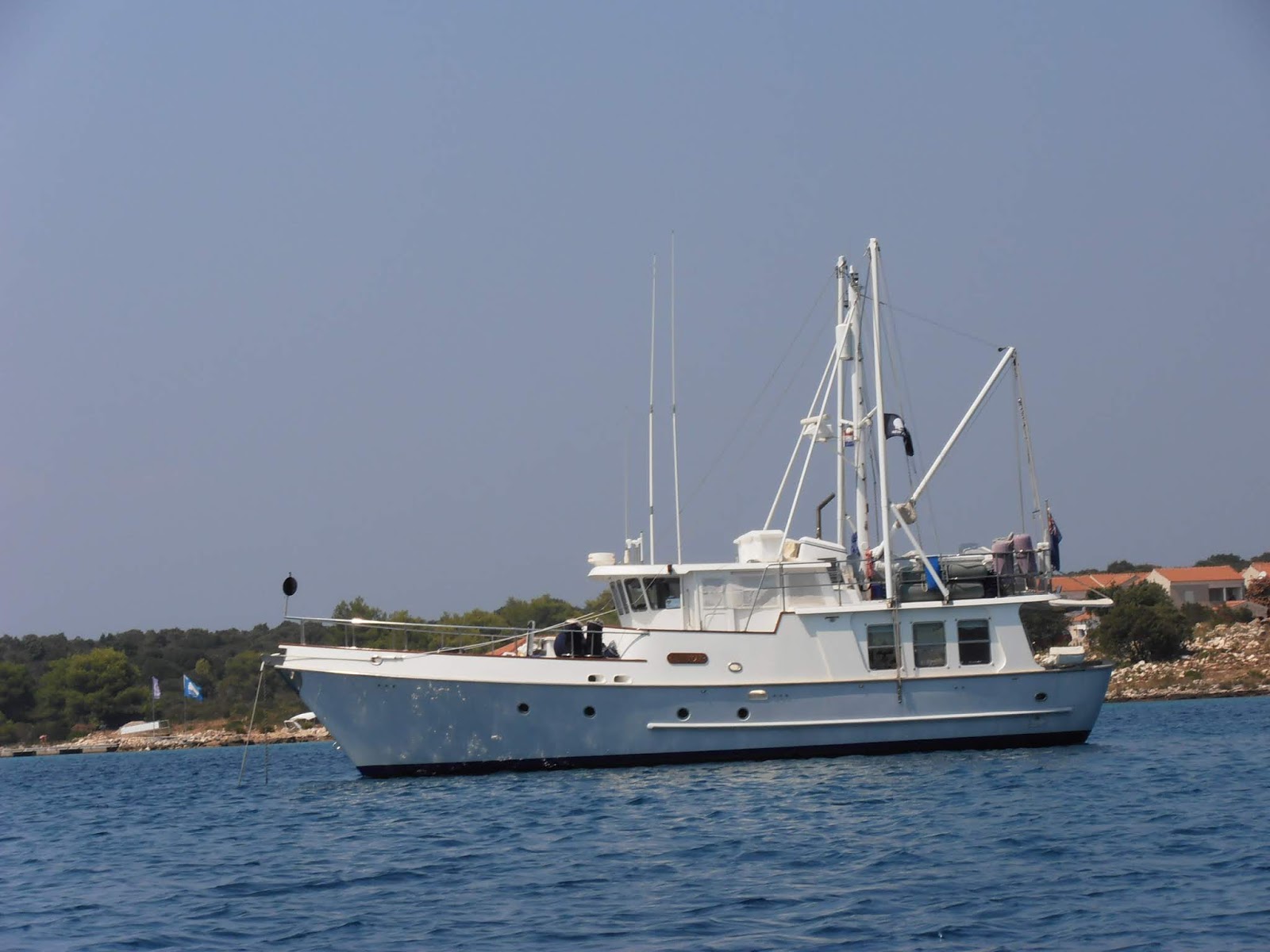
Now is a good time to think what may happen if there is a significant wind shift or a need to move. Check the anchorage using radar and plotter during daylight to know exactly how it looks, because everything looks very different by night. It’s also a good idea for the skipper to get some sleep during the daytime when others can more easily monitor and handle any situation.
Before darkness arrives rig your spotlights, have flashlights to hand, turn the radar on standby, and ensure the engine is ready to start in case of any emergency arising, such as the need to avoid a dragging vessel, or the need to reduce strain on the anchor in very high gusts. As skipper, I also sleep in the pilot house so that I can constantly monitor the situation and react quickly.
When the strong wind arrives it’s usual to see sheets of spray lifted off the surface of the water and wind waves up to about two or three feet, even in a sheltered bay with little fetch.
Sometimes your vessel will appear to drag a few metres as the chain straightens out along the seabed, so don’t be in too much of a hurry to move if the position alarm sounds.
Of course there is usually some trepidation and a need to maintain a state of high alert, but by following the above procedures we’ve safely and comfortably anchored though many blows.
We’ve never encountered winds above 70 knots and realise that circumstances may be very different in winds of for example 90 knots or more.
The “strength” of wind does not increase in a linear way relative to wind speed, but dramatically more so as the square of the difference. For example to compare the strength of a 40 knot wind with a 20 knot wind:
20 knots squared = 400
40 knots squared = 1600
So a 40 knot wind is 4 times as strong as a 20 knot wind.
Similarly a 90 knot wind is nearly twice the strength of a 70 knot wind.
We’ll be happy not to experience trying to anchor in those conditions.
Happy and safe anchoring.

Heading to Canada May 2, 2018 to May 21, 2018

Wednesday, May 2nd – We were able to pick up the U-Haul the evening before our departure so we started loading it as soon as we got home.  In the morning we finished loading and headed out for our first stop – Texarkana, TX.

Thanks to ou…