
May 15, 2018In October-November, 2017 the Wild Blue cruised down the California and Mexican Coasts to La Paz, Mexico. This downwind-downswell run is, and was, quite enjoyable. Cruising up these Coasts, that is upwind and upwave, is less so….
Tag Archives | trawler
FPB History: A Look Back At The Design Cycle That Lead To These Yachts
Fifteen years ago, when we were just starting to build the FPB Series prototype Wind Horse, we put together a …Read More
VANUATU – The Happiest People
VANUATU – The Happiest People on Earth
 |
| Bettina… my little friend |
May 14, 2018
Majuro, Marshall Islands,
As our 8-year island-cruising extravaganza draws to a close, we look back and draw hyperboles, unearth superlatives, and clumsily catalog our most unforgettable experiences. Let’s start with the happiest people on Earth: VANUATU.
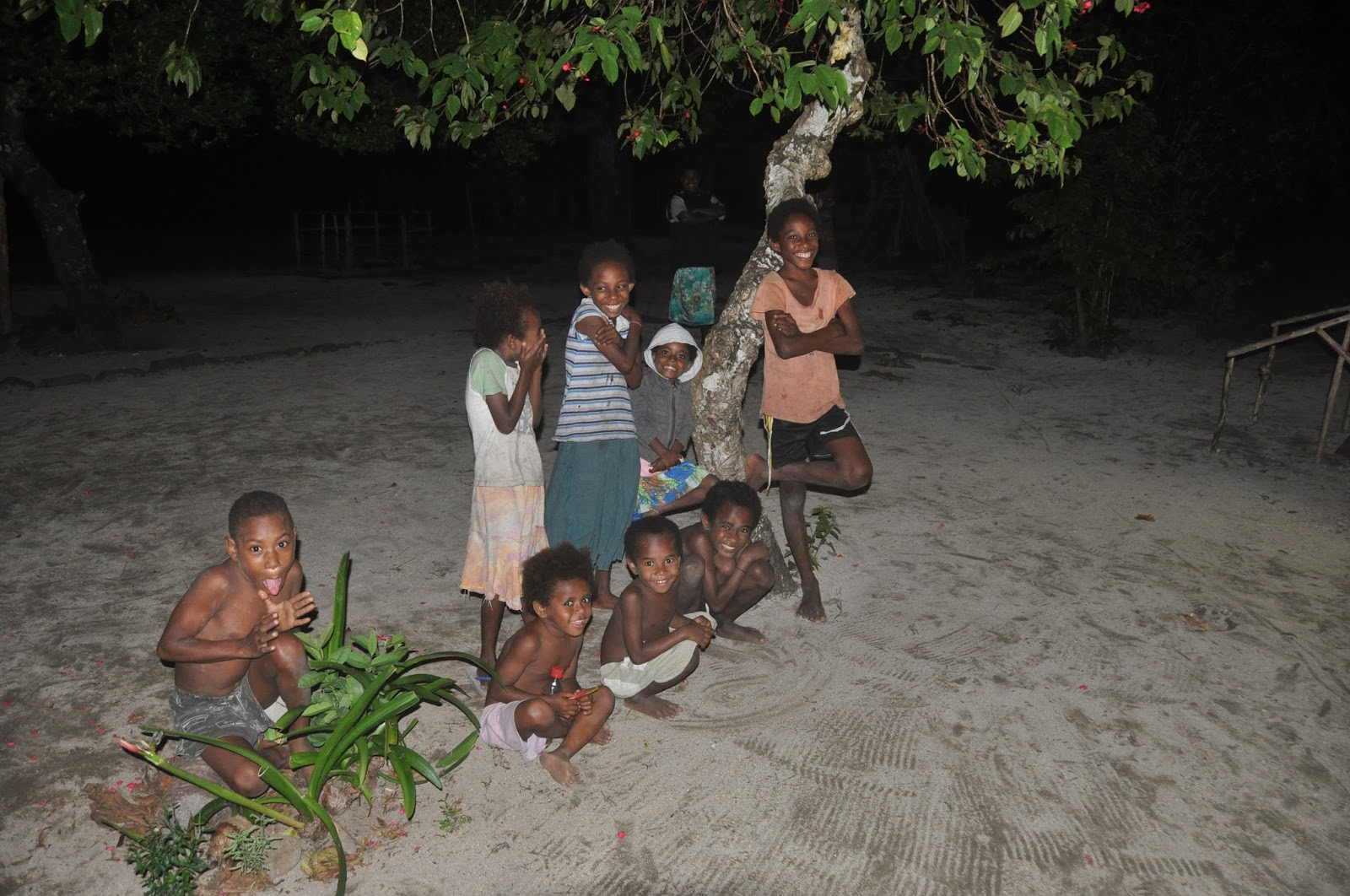 |
| Children everywhere, laughing and happy. But parents are concerned that the island may not be able to sustain so many lives. Family planning is sporadic, with accent on” family,” not so much on “planning” as the health worker often runs out of BCP |
It’s true. A recent survey determined that the islanders of what used to be known as the New Hebrides are, indeed, the happiest people on earth. We could debate whether they absorbed their joie de vivre from their early French colons or retained the phlegmatic cool of their English tutelage. Certainly, it was unsettling to land on a beach and address the villagers to the North in French, those to the South in English, observe how the twain didn’t meet, each happy in their identity (French-Catholic vs/ English/Protestant).
 |
| this 5-year-old already wields his dug-out with mastery |
Yet again, there still exist the traditional villages where no visitor are allowed, possibly the most authentic and worry-free people we ever met as they came out of their villages to meet us and share their culture with (Yam Festival, High Jump, Canoe Festival in the Meskalines.)
 |
| In the lush valley, the village lay still |
This authenticity is especially true in the North of the archipelago, the Banks Islands. If Port Vila, the capital, is an amalgam of shanties, corrugated tin walls, black plastic-wrapped rotting frames, and rubbish-strewn streets, the villages in the Banks Islands are neatly built, houses of woven pandanus and coconut, the sand-and-pounded-dirt streets raked and clean, the gardens neatly tended.
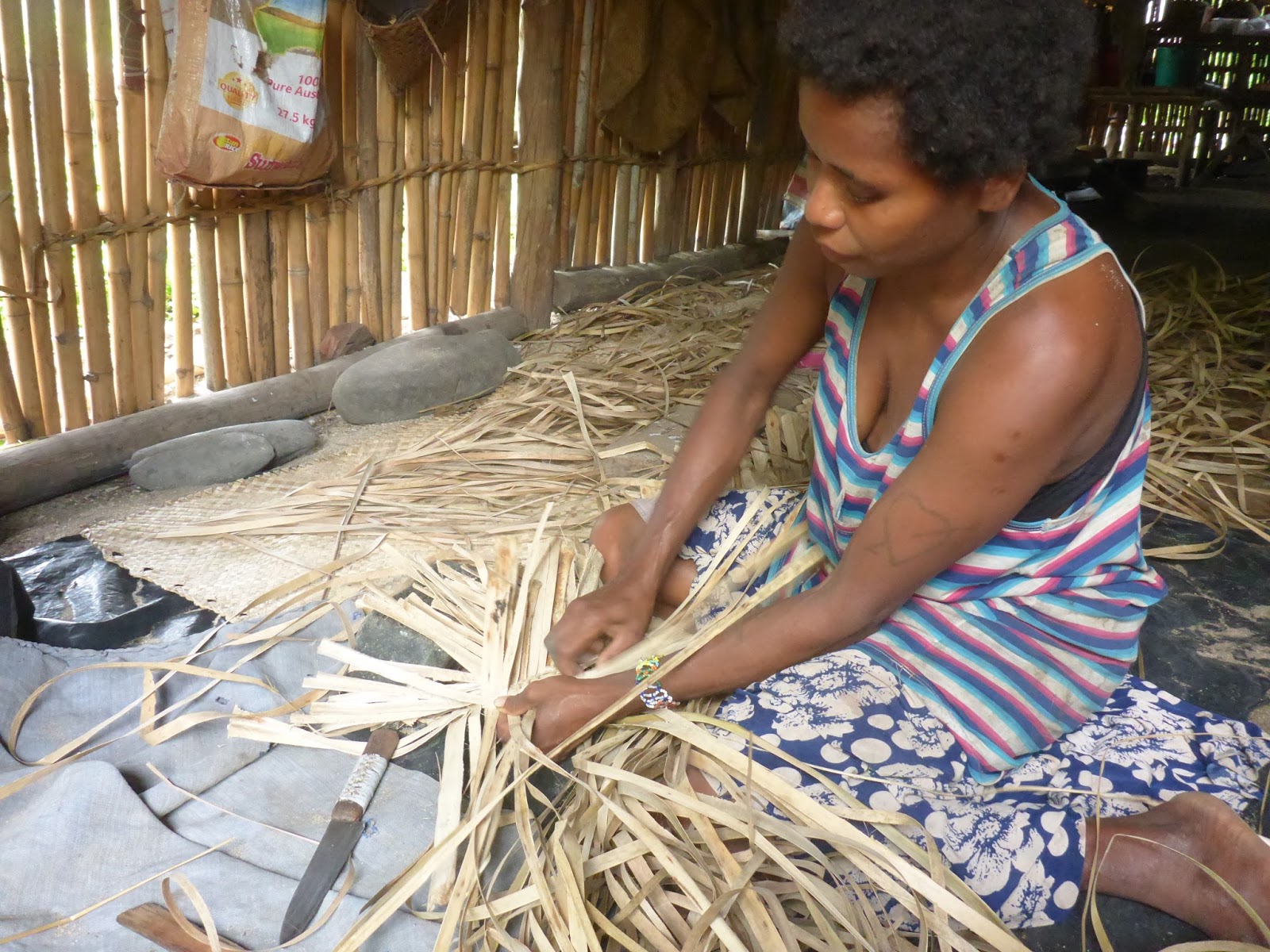 |
| Cynthia, Fred’s wife, works hard, as all Vanuatu women. When she is not at the garden, she weaves mats and handicraft |
In the Banks, the needs are simple: water (usually from mountain streams) and food (lagoon and pelagic fish, yam, and fresh veggies from the gardens.)
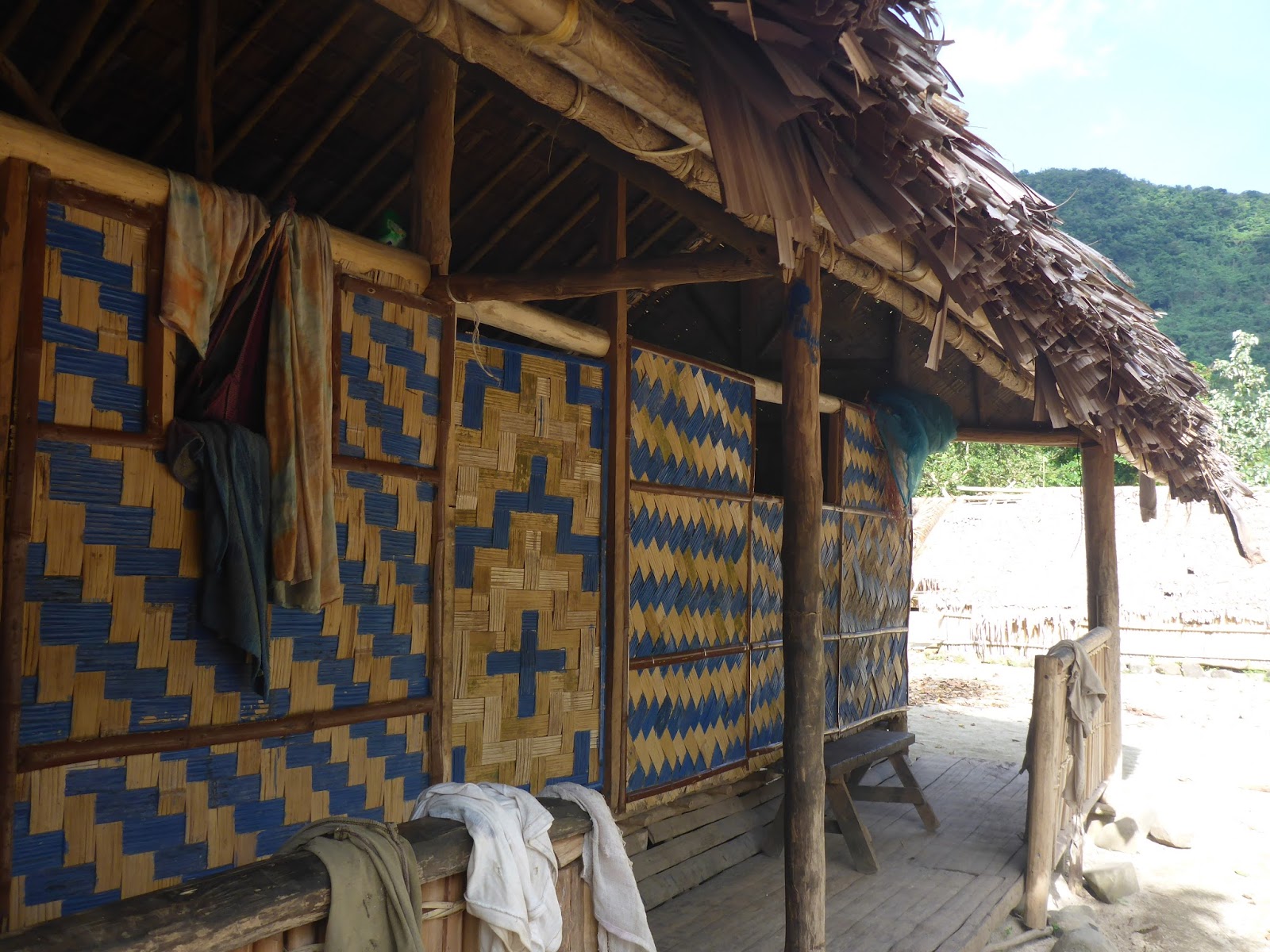 |
| The bath house and shower stalls |
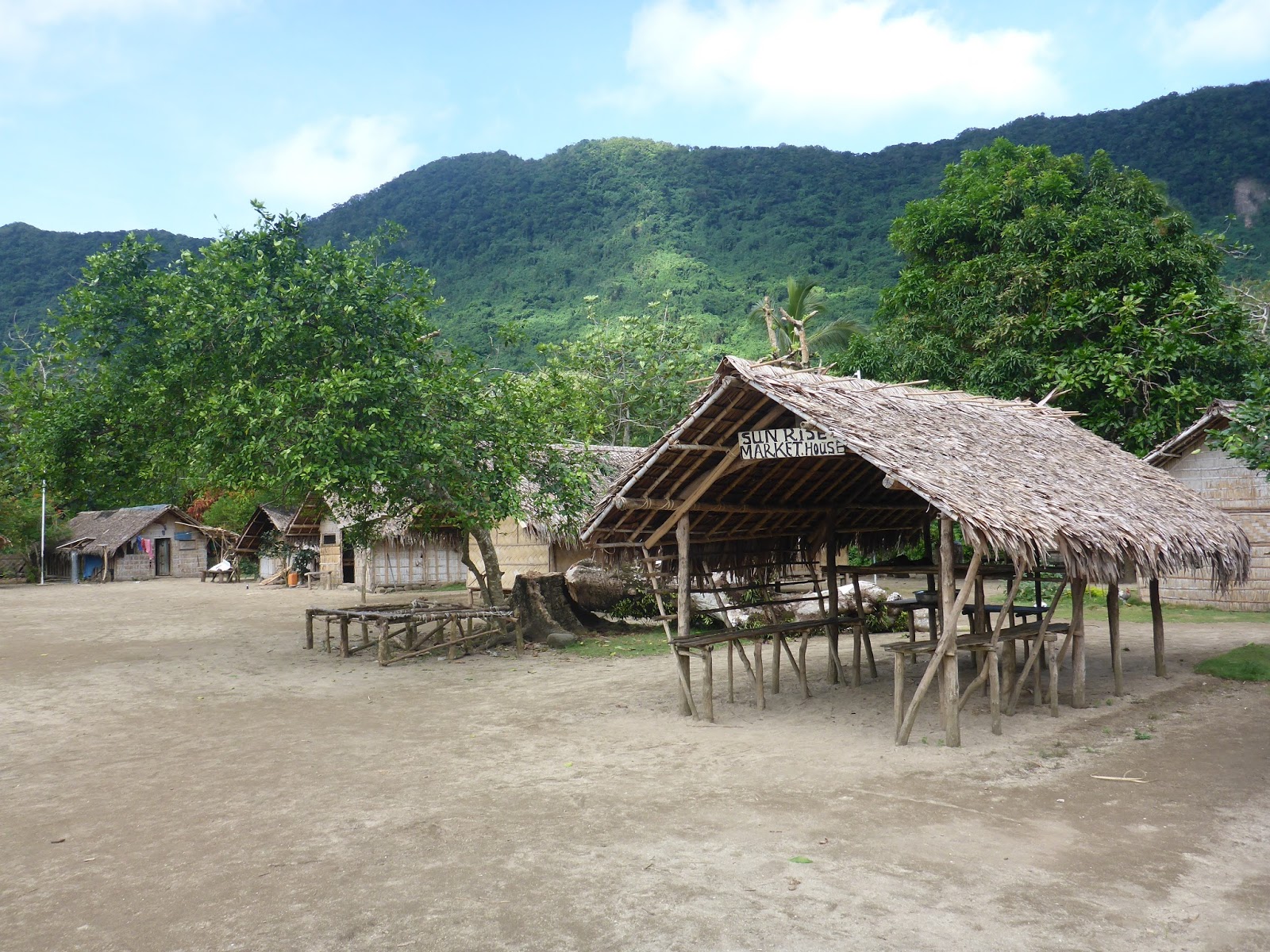 |
| Farmers Market – Never used… perhaps when the supply ship comes? |
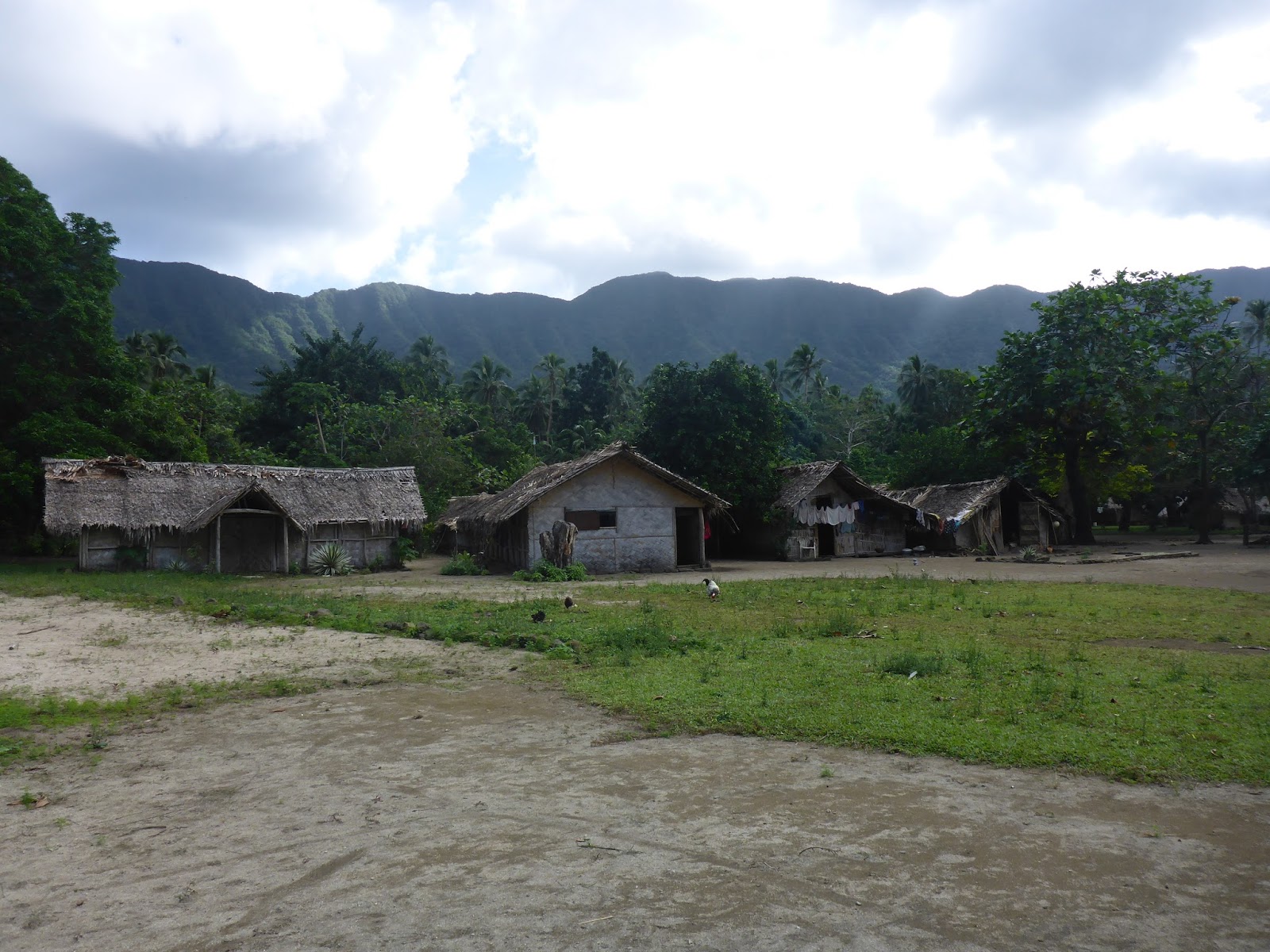 |
| Very traditional, with dramatic backdrop |
Our 3-week stay in Ureparapara opened our eyes. This is a rather isolated island, nothing more than a volcano whose crater has collapsed, letting the ocean flow in, where the soil is fertile and the valley hospitable. There are six active volcanoes in Vanuatu, and evacuation of an island or another is frequent, as it happened in Aoba while we were there, 11,000 islanders evacuated. But Ureparapara is an extinct volcano, safe for now.
 |
| The key to the crater |
As we steered DOMINO into the maw of the swamped crater, we were enveloped by the absolute magic oozing from the steep banks, the mist caught in the coconut trees, the hush of the jungle broken only by the sound of a conch signaling our arrival. Soon, dugout canoes were converging on us, welcoming us (and wondering if we had caught any fish!)
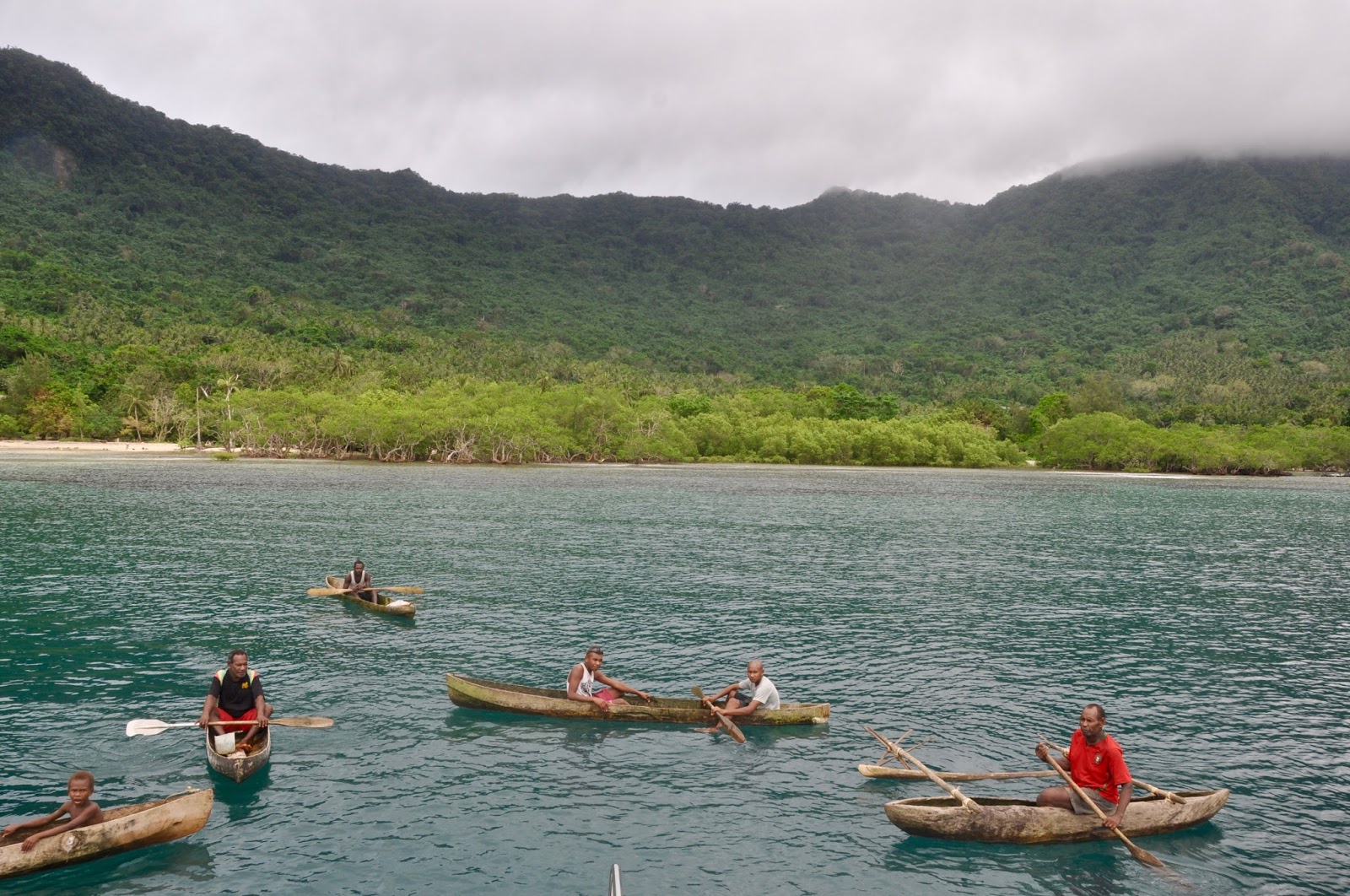 |
| The receptions committee |
We arrived 2 weeks after Cyclone Donna had done a ravage on the island: ruined the gardens, decimated the coconuts, uprooted and brined the taro roots.
 |
| Shells – great game pieces! |
The only fiberglass panga used by the villagers was holed in several places. The village had run out of rice and no government help had arrived yet. What could we do? We had not even caught a fish, skunked again, having lost some 12 big fish in a row… pitiful!
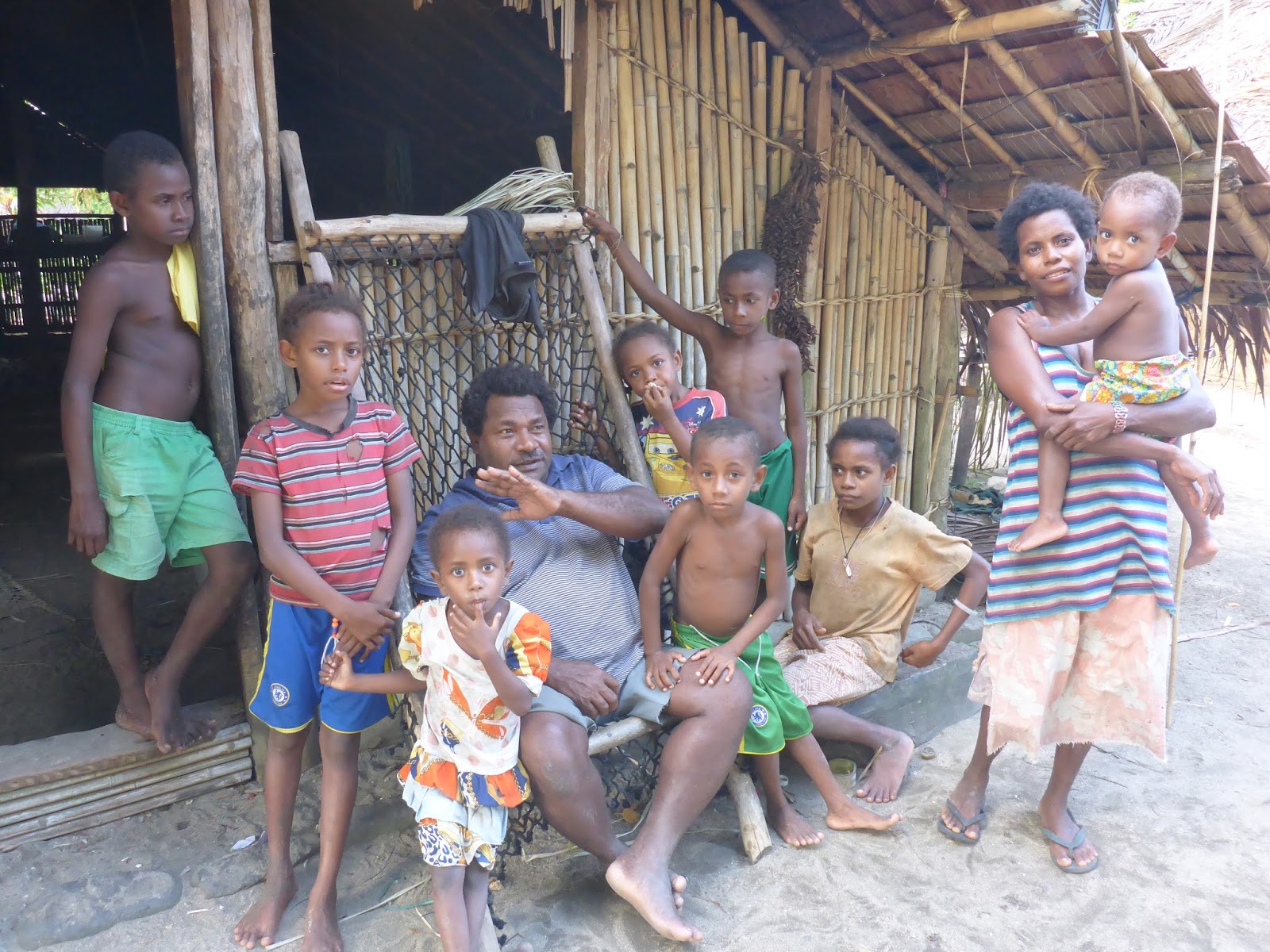 |
| Papa Fred and his brood |
Simply, Fred (could be the village greeter, or Big Papa since he can always be seen with a dozen kids trailing behind him) invited us ashore. Of course, we brought all the rice we had on board which, we knew, would not cover the needs of the 120 or so souls on the island. The 6 dozen cookies I had quickly baked were reverently accepted by the kids while Fred portioned out the 2 banana breads (I hoped for a miracle!).
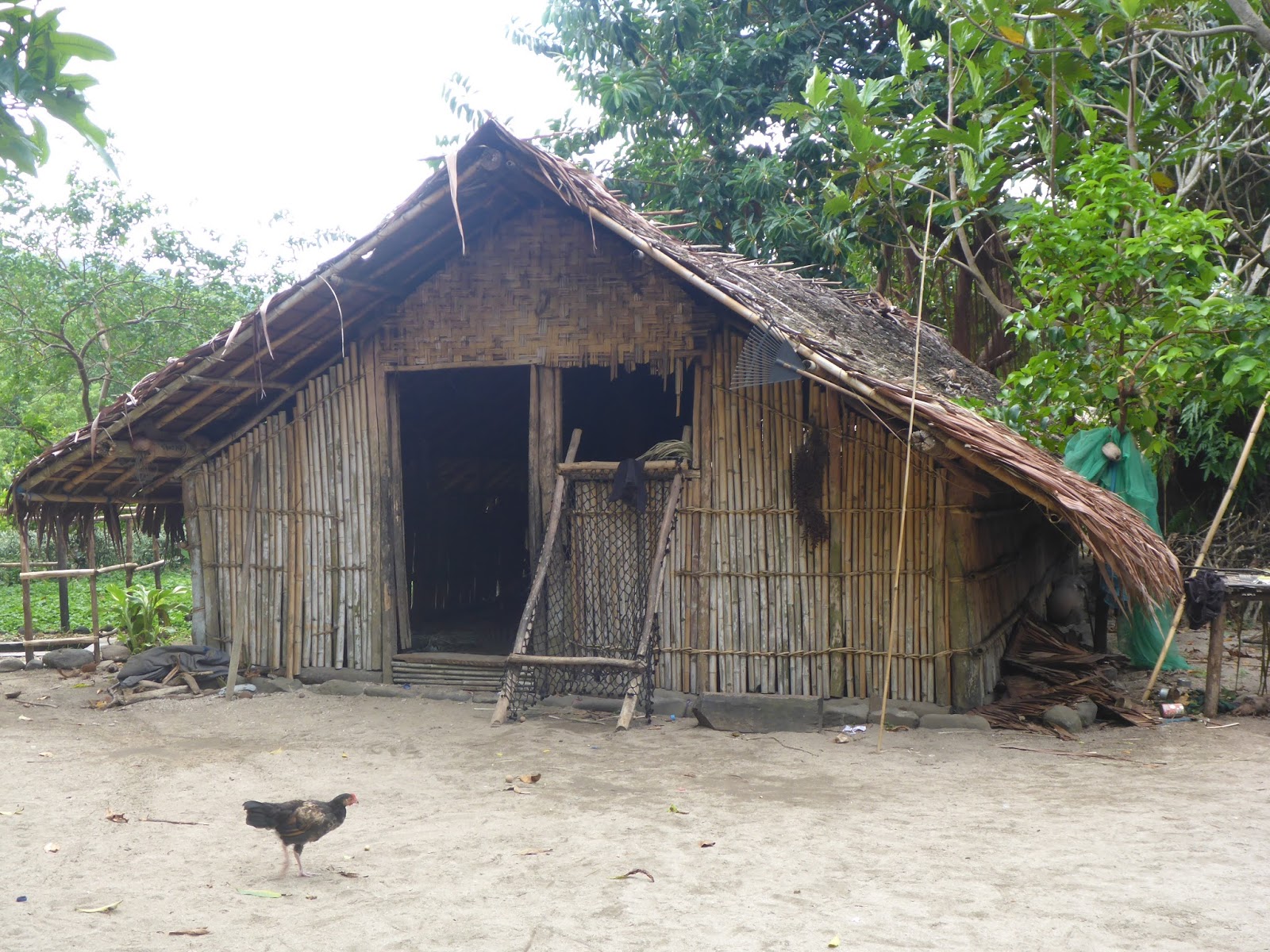 |
| Fred and Cynthia’s home… for a couple and 6 children |
The village, though simple, was immaculate. Family compounds were neatly arranged, the paths raked clean, 3 water spouts were strategically placed for water distribution (water piped from a mountain stream), a central shower hut, outhouse, a community solar panel and individual home solar units were in disrepair, but the village was holding together. Then, the fishermen grabbed JP and asked if he could fix the panga.
 |
| JP Inspects the damages, and John is very eager to learn, under all the men’s supervision |
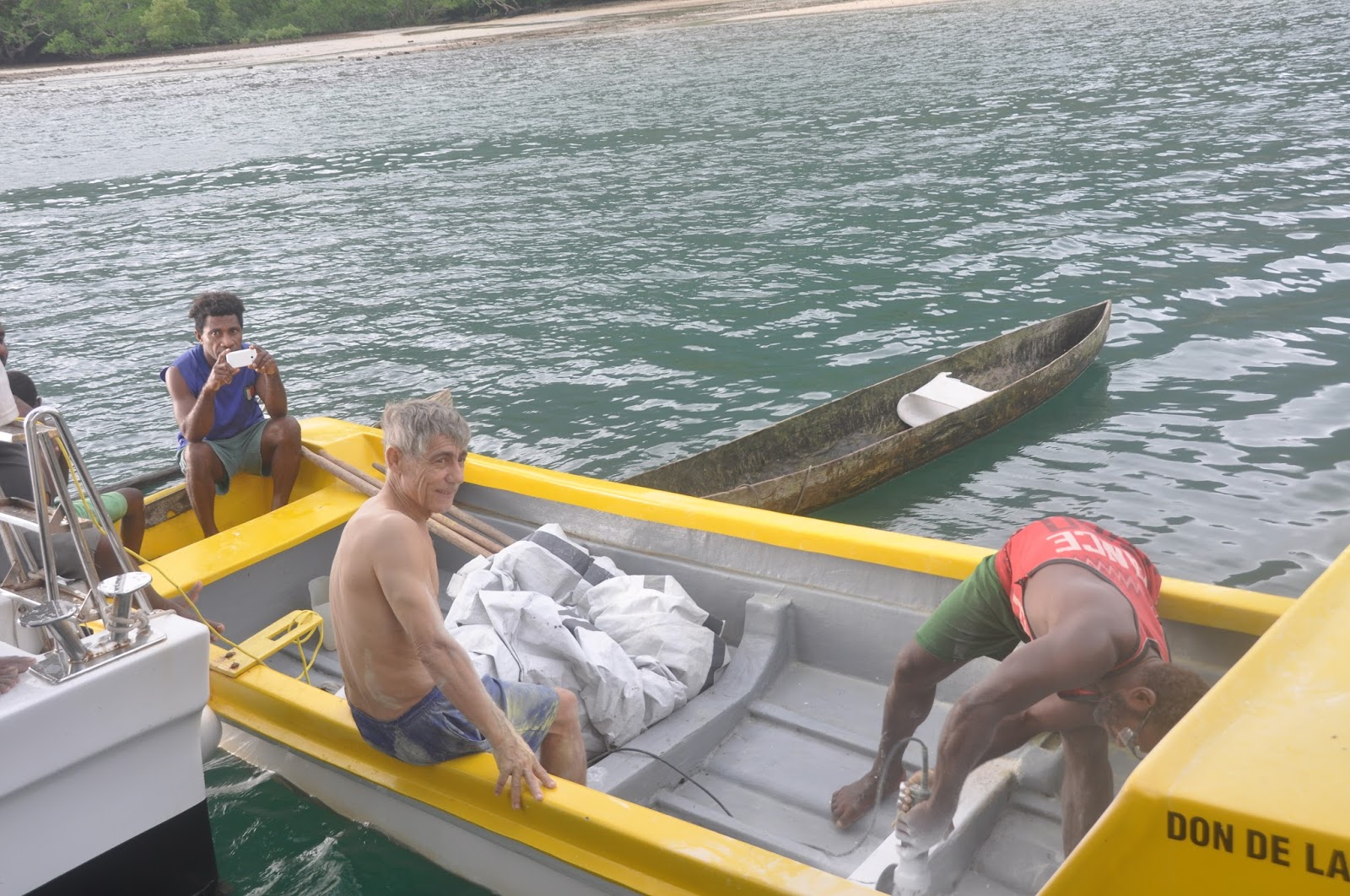 |
| No 110v power on the island? Just paddle the panga over to our stern and start grinding away. John gets a lesson in wielding the grinder |
 |
| A thank-you gift from the fishermen |
Oh Boy! the rest is history… we had three weeks of fiberglass grinding and laying, fiberglass lessons, making blankets for the 6 newborn babies, baking hundreds of cookies, banana bread, and polenta pies, repairing solar panels and HF radio, and night fishing with our hosts.
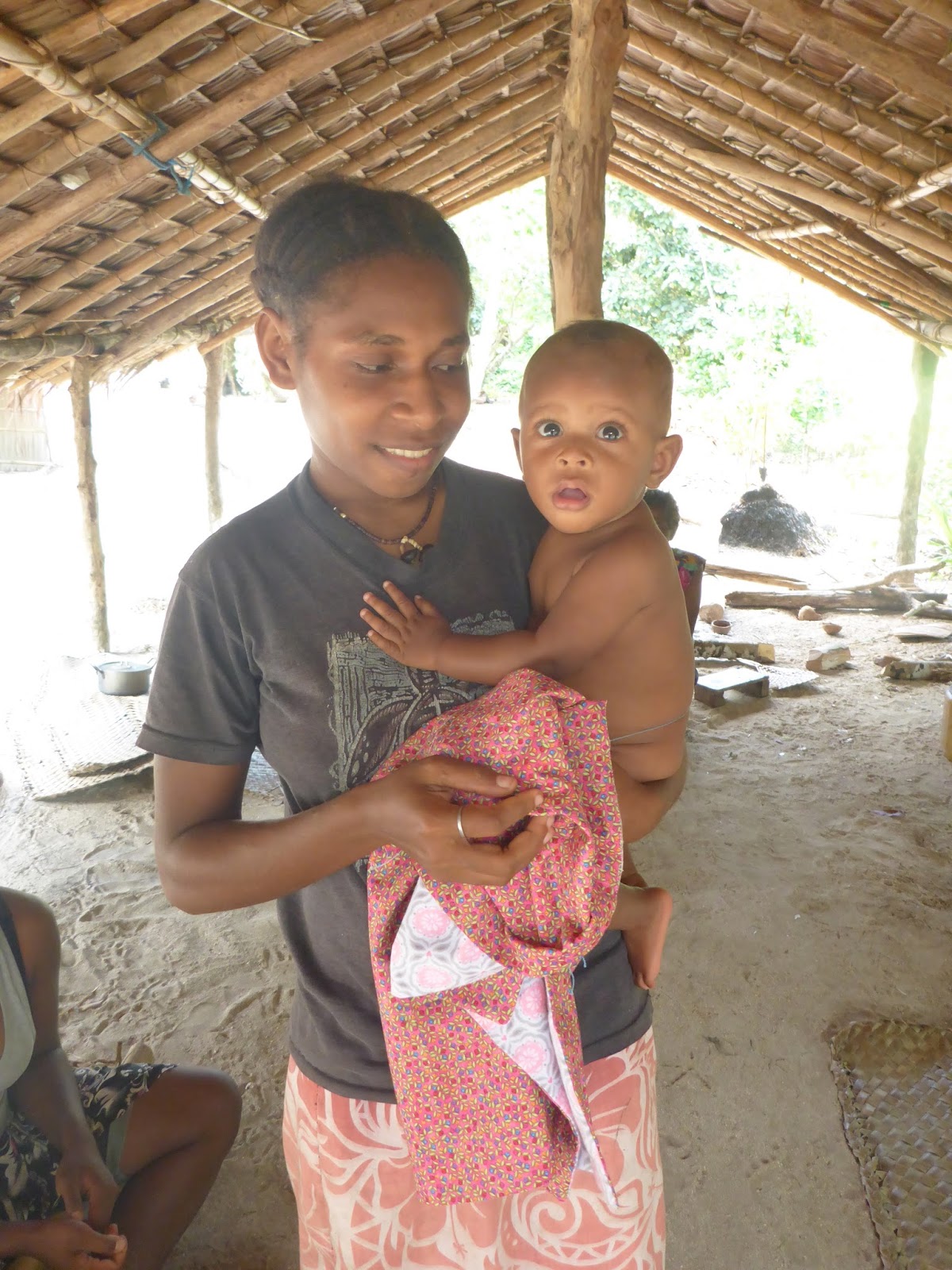 |
| 6-month old Fred loves his quilt |
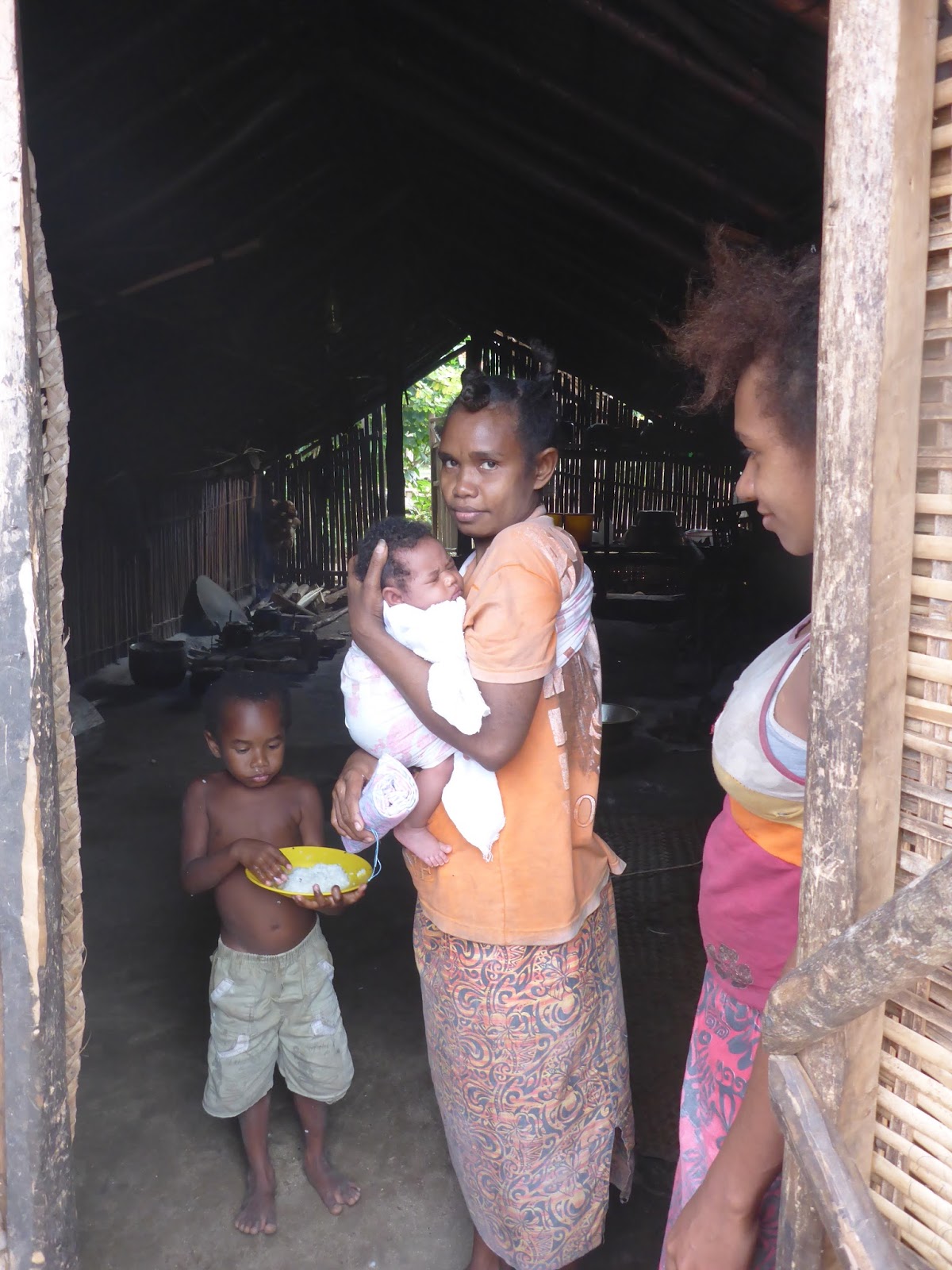 |
| 1-month old Katrina Named after the anthropologist who lived with the village for a year, an honor for Katrina. |
The supply boat — who anchors about once a month in the shallows — finally brought some rice, more than a month after the cyclone hit. It left with the coconut harvest, poor, the trees decimated by the cyclone. Copra production is the main income source on the island, and it will be another 4 months before they collect any coco of value. Bananas? ripped out too!
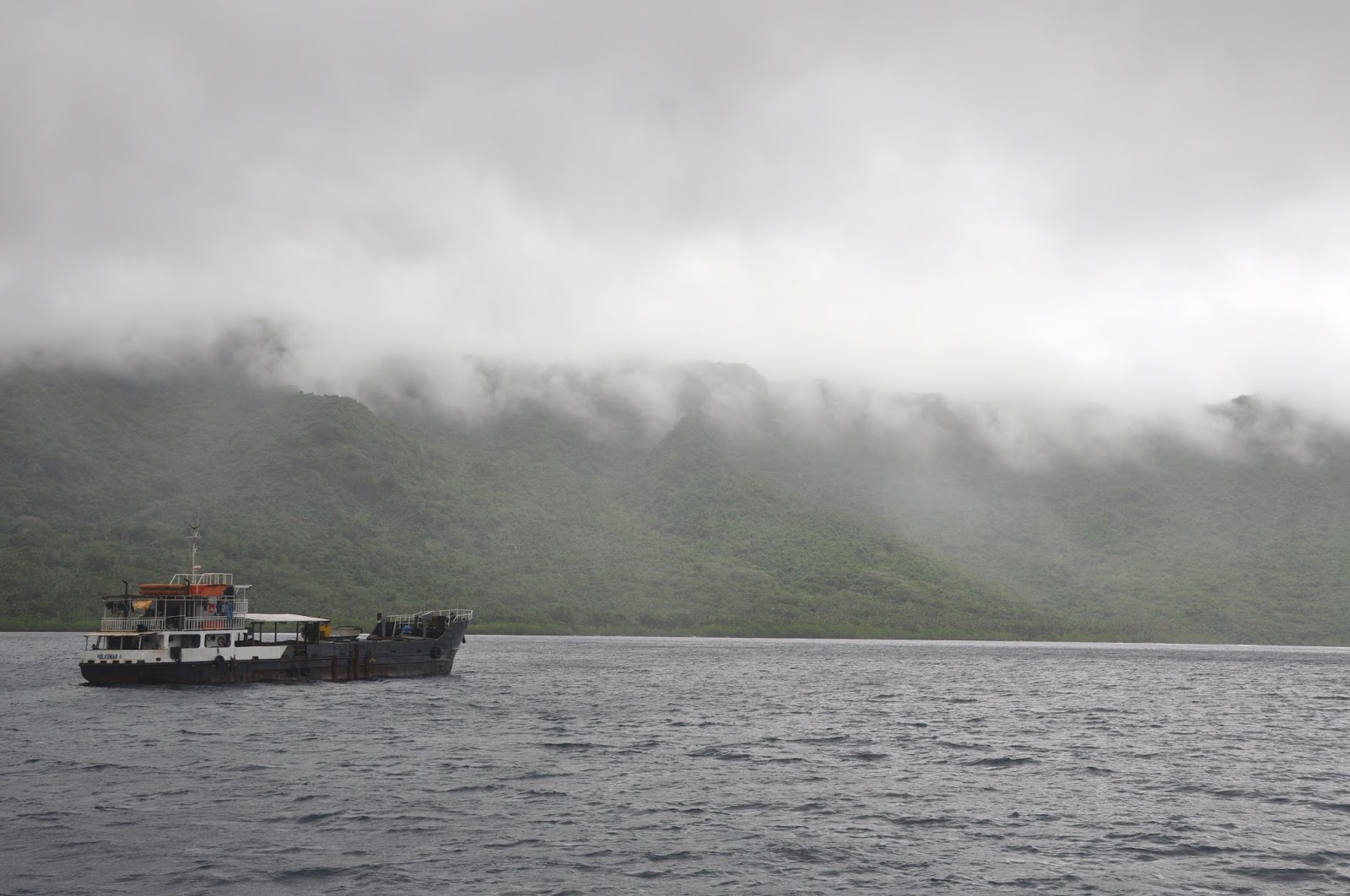 |
| The supply boat keeps on its schedule, in spite of the dismal weather, 18-20′ waves outside! |
There is no phone service on the island, the HF radio was broken and we had to take it to Port Vila for repair, so there is no way for the villagers to communicate with the outer world. But, for those who have the courage to walk a few hours, over the crest and to the other side, there is a weak reception… 4-hour round trip!
 |
| John’s canoe, super light and fast |
As we ran out of butter, flour and eggs for making cookies and breads, my little friend Bettina organized a supply gang. Hey kids, you want cookies? Let’s find what we need!
 |
| Shy, Sweet, Resourceful Bettina |
The team of 18 kids delivered a quart of freshly-squeezed coconut milk (28 coconuts squeezed!), sweet potatoes, ad 14 eggs, begging for more cookies. Sweet-potato/coconut milk and lime zest make, indeed, wonderful cookies.

But the eggs? oh my! Sure, chickens roam free and you just KNOW there are eggs around… but where? No chicken coop! Although Fred swears that he knows his chickens and where they lay, out of the 14 eggs produced, twelve yielded chicks in various stages of development. Chickens are a status symbol on the island, a sign of wealth, a brick in the road to power, therefore it’s more important to grow chickens than to harvest eggs.
 |
| Chickens roam free all over the islands |
This incident, of course, had to be immortalized in a quilt, “Island Chickens.”
 |
| Bok Bok! |
At the end of our stay, the gardens where starting to produce, the guys were fishing on their panga, and all was well again.
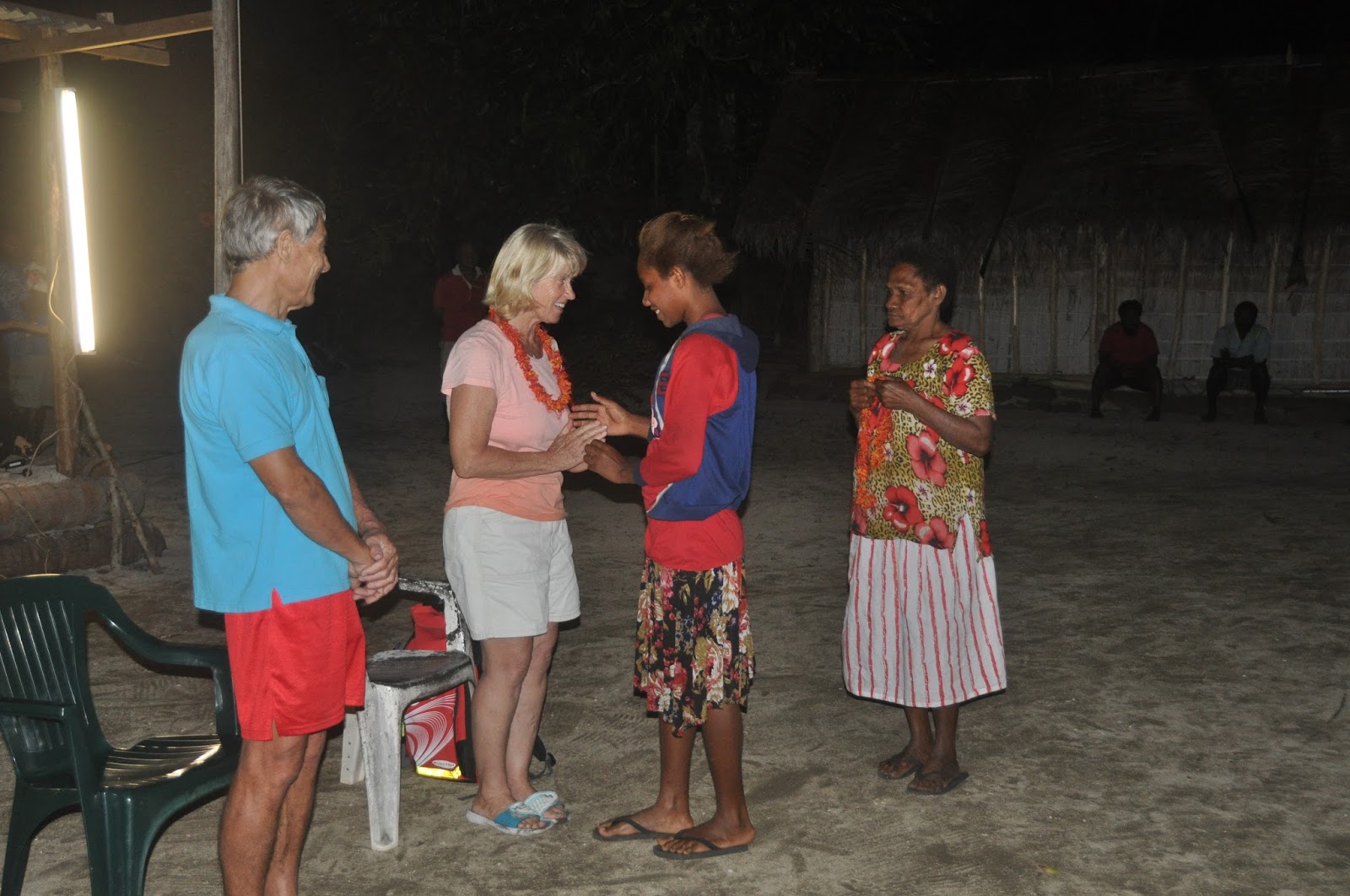 |
| Flower crowns, AKA Leis |
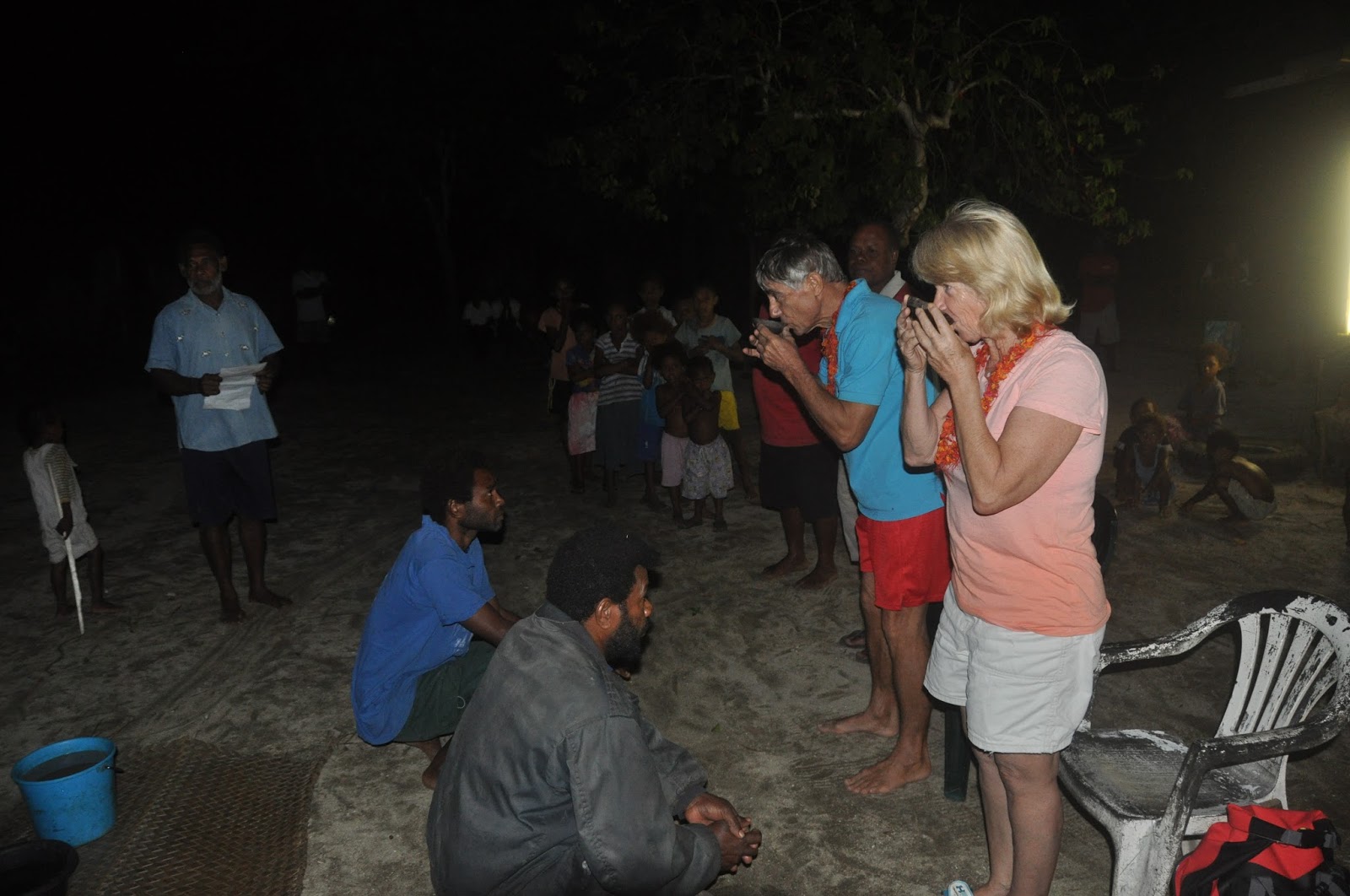 |
| Served kava on bended knees |
But we were not to leave this island without the Chief throwing us a party — or, as they call it, a “Program.”
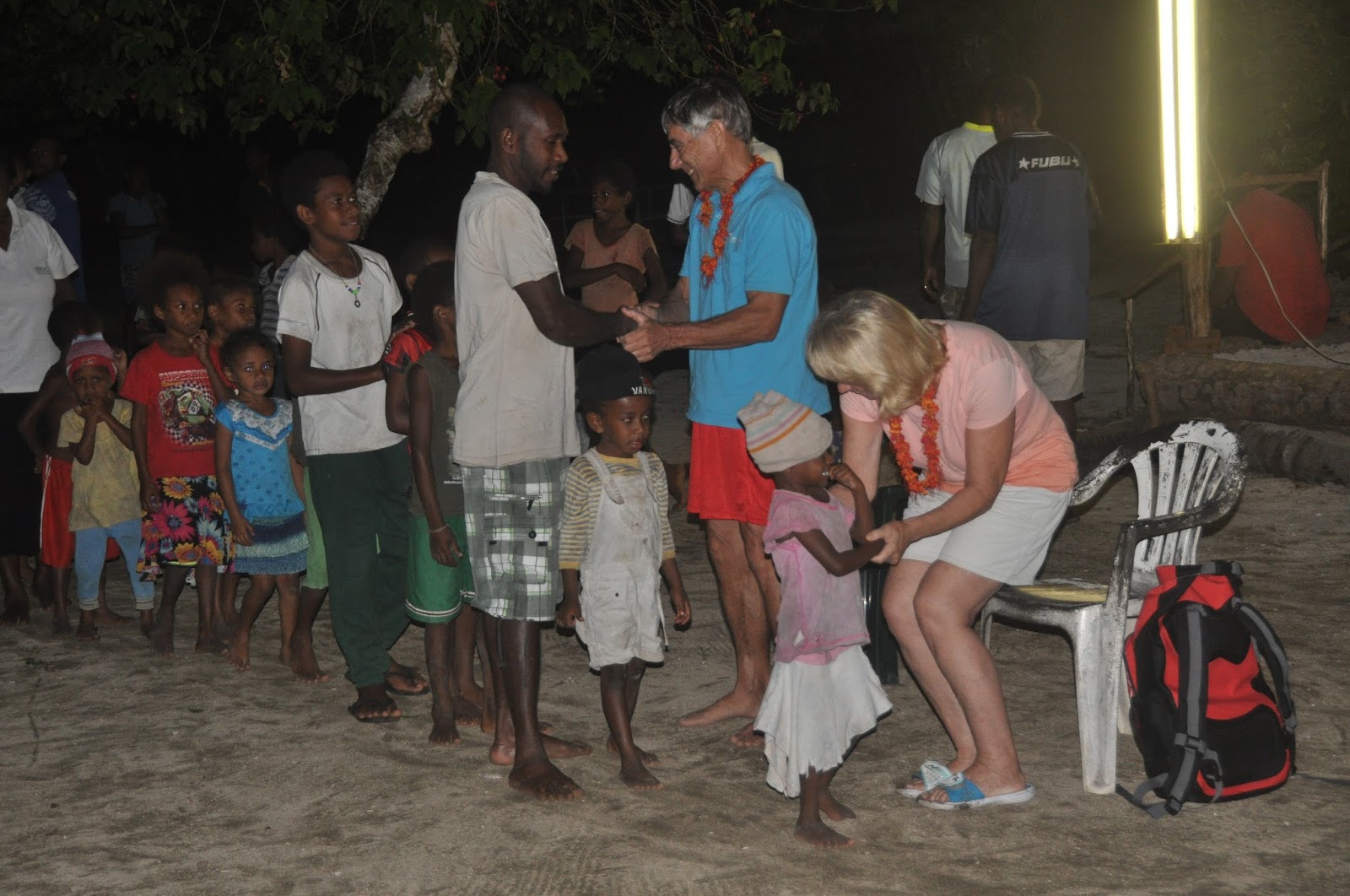 |
| The Shaking of the Hand |
On the eve of our departure, the entire village converged to the meeting grounds, the Chief introduced us and thanked us, flower necklaces, kava ceremony, speech, prayer, and the amazing “shaking of the hand” reception line, as every single villager shook our hand in thanks.
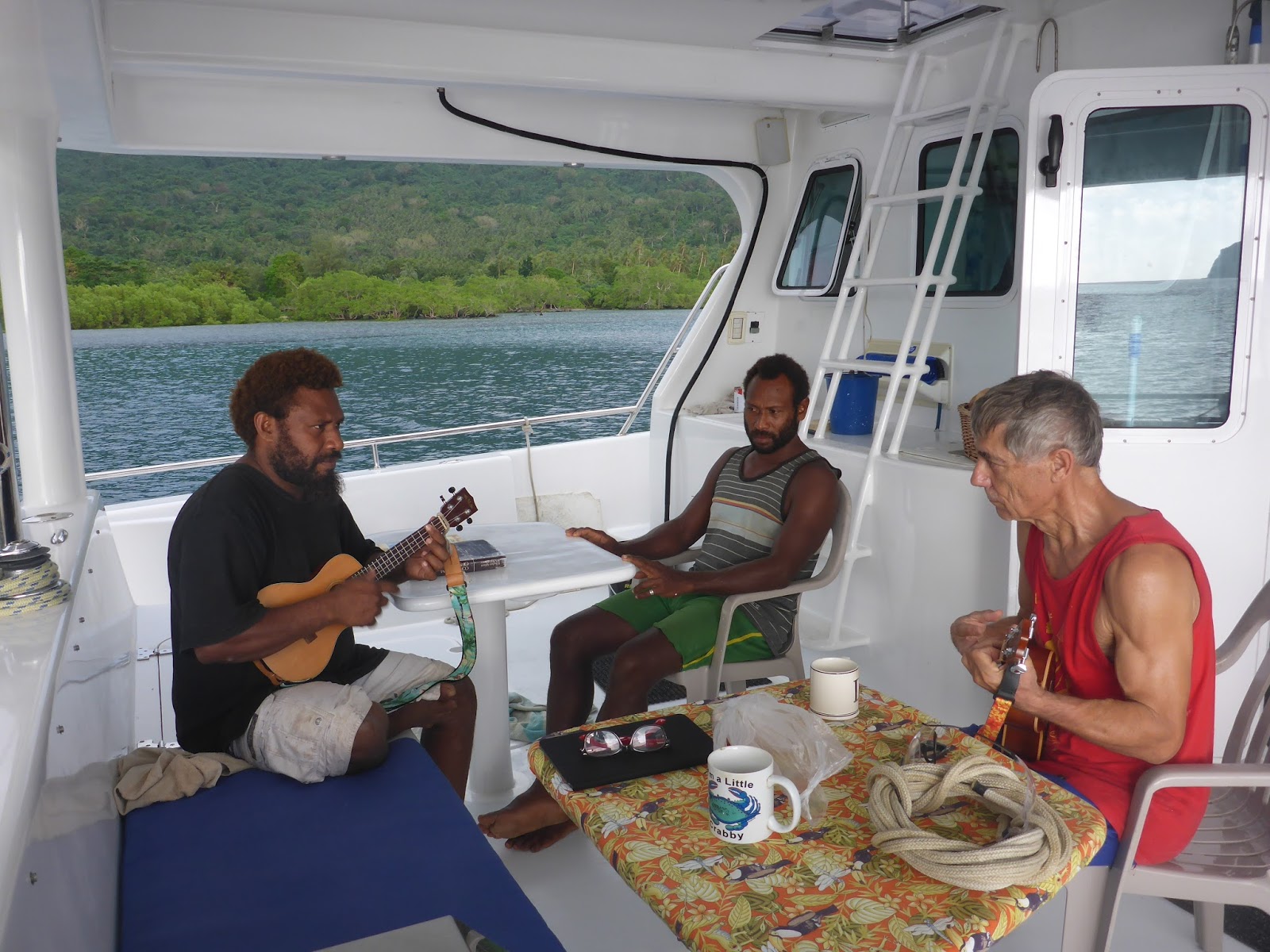 |
| John’s brother gives JP a ukulele lesson |
To top it all, John-the-fisherman, our “go-to” man, even named his first grandson “Jean-Pierre” — probably a phonetic version— and sent us on our way with a bag of Pamplemousse and a bag of coconuts, laughing, crying, singing, ringing the boat with their canoes, waving from shore.
 |
| Time to say goodbye |
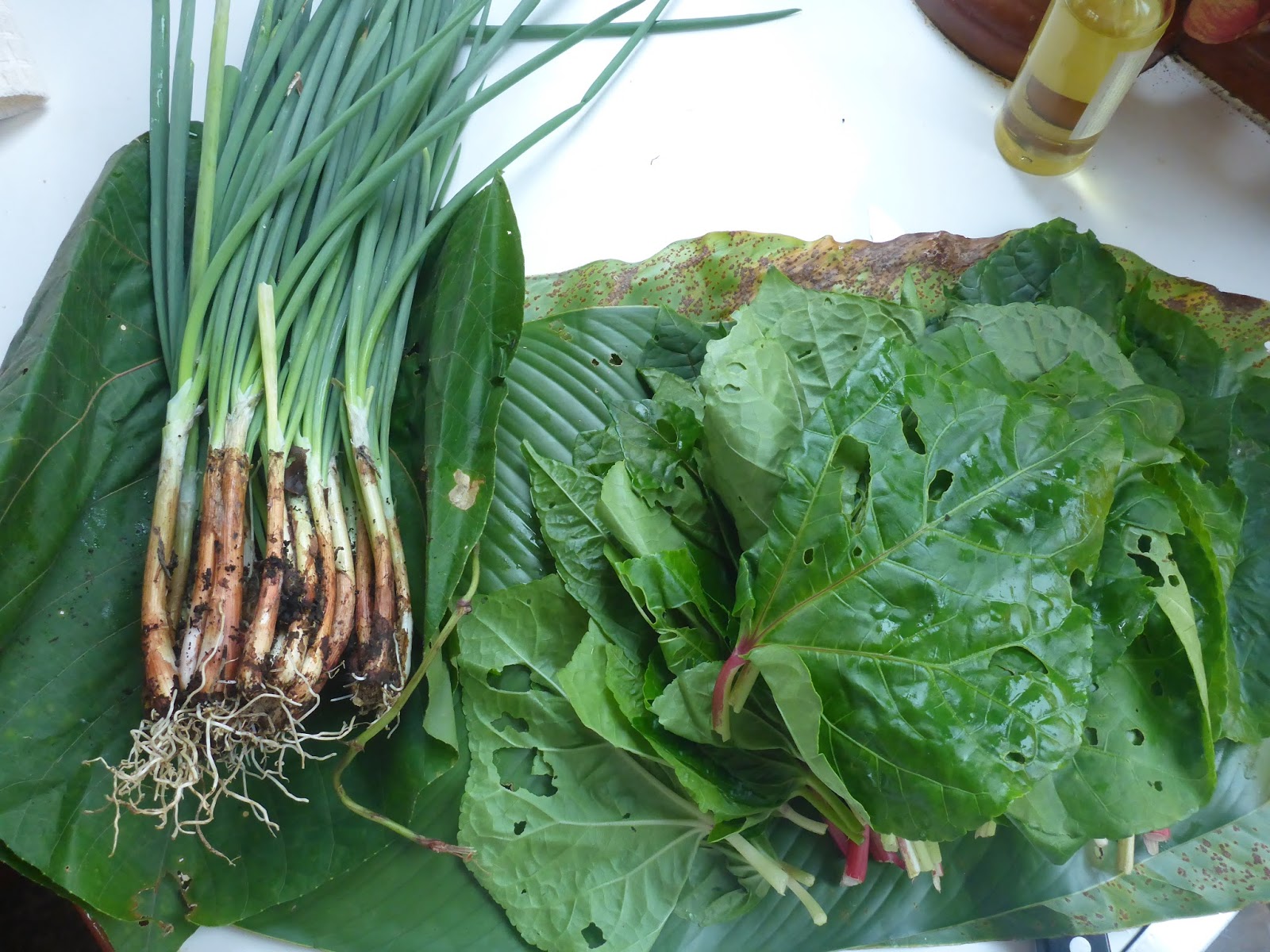 |
| Fresh scallions and Island Cabbage (tastes between spinach and taro leaf, yummy!) |
Yes, happy Vanuatu, simple, traditional, endearing. If you cruise the Banks, do not miss Ureparapara and say hello for us.
Till next time.
 |
| Pamplemousses, limes, and we are very grateful |
 |
| This beautiful hanging flower is actually a nut |
 |
| The fruit |
 |
| The nut, incredibly hard to crack |
dominomarie
VANUATU – The Happiest People
VANUATU – The Happiest People on Earth
|
| Bettina… my little friend |
May 14, 2018
Majuro, Marshall Islands,
As our 8-year island-cruising extravaganza draws to a close, we look back and draw hyperboles, unearth superlatives, and clumsily catalog our most unforgettable experiences. Let’s start with the happiest people on Earth: VANUATU.
|
| Children everywhere, laughing and happy. But parents are concerned that the island may not be able to sustain so many lives. Family planning is sporadic, with accent on” family,” not so much on “planning” as the health worker often runs out of BCP |
It’s true. A recent survey determined that the islanders of what used to be known as the New Hebrides are, indeed, the happiest people on earth. We could debate whether they absorbed their joie de vivre from their early French colons or retained the phlegmatic cool of their English tutelage. Certainly, it was unsettling to land on a beach and address the villagers to the North in French, those to the South in English, observe how the twain didn’t meet, each happy in their identity (French-Catholic vs/ English/Protestant).
|
| this 5-year-old already wields his dug-out with mastery |
Yet again, there still exist the traditional villages where no visitor are allowed, possibly the most authentic and worry-free people we ever met as they came out of their villages to meet us and share their culture with (Yam Festival, High Jump, Canoe Festival in the Meskalines.)
|
| In the lush valley, the village lay still |
This authenticity is especially true in the North of the archipelago, the Banks Islands. If Port Vila, the capital, is an amalgam of shanties, corrugated tin walls, black plastic-wrapped rotting frames, and rubbish-strewn streets, the villages in the Banks Islands are neatly built, houses of woven pandanus and coconut, the sand-and-pounded-dirt streets raked and clean, the gardens neatly tended.
|
| Cynthia, Fred’s wife, works hard, as all Vanuatu women. When she is not at the garden, she weaves mats and handicraft |
In the Banks, the needs are simple: water (usually from mountain streams) and food (lagoon and pelagic fish, yam, and fresh veggies from the gardens.)
|
| The bath house and shower stalls |
|
| Farmers Market – Never used… perhaps when the supply ship comes? |
|
| Very traditional, with dramatic backdrop |
Our 3-week stay in Ureparapara opened our eyes. This is a rather isolated island, nothing more than a volcano whose crater has collapsed, letting the ocean flow in, where the soil is fertile and the valley hospitable. There are six active volcanoes in Vanuatu, and evacuation of an island or another is frequent, as it happened in Aoba while we were there, 11,000 islanders evacuated. But Ureparapara is an extinct volcano, safe for now.
|
| The key to the crater |
As we steered DOMINO into the maw of the swamped crater, we were enveloped by the absolute magic oozing from the steep banks, the mist caught in the coconut trees, the hush of the jungle broken only by the sound of a conch signaling our arrival. Soon, dugout canoes were converging on us, welcoming us (and wondering if we had caught any fish!)
|
| The receptions committee |
We arrived 2 weeks after Cyclone Donna had done a ravage on the island: ruined the gardens, decimated the coconuts, uprooted and brined the taro roots.
|
| Shells – great game pieces! |
The only fiberglass panga used by the villagers was holed in several places. The village had run out of rice and no government help had arrived yet. What could we do? We had not even caught a fish, skunked again, having lost some 12 big fish in a row… pitiful!
|
| Papa Fred and his brood |
Simply, Fred (could be the village greeter, or Big Papa since he can always be seen with a dozen kids trailing behind him) invited us ashore. Of course, we brought all the rice we had on board which, we knew, would not cover the needs of the 120 or so souls on the island. The 6 dozen cookies I had quickly baked were reverently accepted by the kids while Fred portioned out the 2 banana breads (I hoped for a miracle!).
|
| Fred and Cynthia’s home… for a couple and 6 children |
The village, though simple, was immaculate. Family compounds were neatly arranged, the paths raked clean, 3 water spouts were strategically placed for water distribution (water piped from a mountain stream), a central shower hut, outhouse, a community solar panel and individual home solar units were in disrepair, but the village was holding together. Then, the fishermen grabbed JP and asked if he could fix the panga.
|
| JP Inspects the damages, and John is very eager to learn, under all the men’s supervision |
|
| No 110v power on the island? Just paddle the panga over to our stern and start grinding away. John gets a lesson in wielding the grinder |
|
| A thank-you gift from the fishermen |
Oh Boy! the rest is history… we had three weeks of fiberglass grinding and laying, fiberglass lessons, making blankets for the 6 newborn babies, baking hundreds of cookies, banana bread, and polenta pies, repairing solar panels and HF radio, and night fishing with our hosts.
|
| 6-month old Fred loves his quilt |
|
| 1-month old Katrina Named after the anthropologist who lived with the village for a year, an honor for Katrina. |
The supply boat — who anchors about once a month in the shallows — finally brought some rice, more than a month after the cyclone hit. It left with the coconut harvest, poor, the trees decimated by the cyclone. Copra production is the main income source on the island, and it will be another 4 months before they collect any coco of value. Bananas? ripped out too!
|
| The supply boat keeps on its schedule, in spite of the dismal weather, 18-20′ waves outside! |
There is no phone service on the island, the HF radio was broken and we had to take it to Port Vila for repair, so there is no way for the villagers to communicate with the outer world. But, for those who have the courage to walk a few hours, over the crest and to the other side, there is a weak reception… 4-hour round trip!
|
| John’s canoe, super light and fast |
As we ran out of butter, flour and eggs for making cookies and breads, my little friend Bettina organized a supply gang. Hey kids, you want cookies? Let’s find what we need!
|
| Shy, Sweet, Resourceful Bettina |
The team of 18 kids delivered a quart of freshly-squeezed coconut milk (28 coconuts squeezed!), sweet potatoes, ad 14 eggs, begging for more cookies. Sweet-potato/coconut milk and lime zest make, indeed, wonderful cookies.
But the eggs? oh my! Sure, chickens roam free and you just KNOW there are eggs around… but where? No chicken coop! Although Fred swears that he knows his chickens and where they lay, out of the 14 eggs produced, twelve yielded chicks in various stages of development. Chickens are a status symbol on the island, a sign of wealth, a brick in the road to power, therefore it’s more important to grow chickens than to harvest eggs.
|
| Chickens roam free all over the islands |
This incident, of course, had to be immortalized in a quilt, “Island Chickens.”
|
| Bok Bok! |
At the end of our stay, the gardens where starting to produce, the guys were fishing on their panga, and all was well again.
|
| Flower crowns, AKA Leis |
|
| Served kava on bended knees |
But we were not to leave this island without the Chief throwing us a party — or, as they call it, a “Program.”
|
| The Shaking of the Hand |
On the eve of our departure, the entire village converged to the meeting grounds, the Chief introduced us and thanked us, flower necklaces, kava ceremony, speech, prayer, and the amazing “shaking of the hand” reception line, as every single villager shook our hand in thanks.
|
| John’s brother gives JP a ukulele lesson |
To top it all, John-the-fisherman, our “go-to” man, even named his first grandson “Jean-Pierre” — probably a phonetic version— and sent us on our way with a bag of Pamplemousse and a bag of coconuts, laughing, crying, singing, ringing the boat with their canoes, waving from shore.
|
| Time to say goodbye |
|
| Fresh scallions and Island Cabbage (tastes between spinach and taro leaf, yummy!) |
Yes, happy Vanuatu, simple, traditional, endearing. If you cruise the Banks, do not miss Ureparapara and say hello for us.
Till next time.
|
| Pamplemousses, limes, and we are very grateful |
|
| This beautiful hanging flower is actually a nut |
|
| The fruit |
|
| The nut, incredibly hard to crack |
dominomarie
Dora’s First Voyage
Today we took Red Head out for a sea trial to check the new bow thruster, shaft changes, and other miscellaneous work. It was pretty exciting to be underway, even if it was just a short jaunt up and down the river. Things went very well with the most e…
London Socializing
With London being both a popular travel destination and a hub for Europe, we did a lot more socializing than usual. This gave us an opportunity to catch up with some old friends, finally meet in person some that we’d corresponded with years, and make new acquaintances with locals or those travelling to the area….
Spitalfields Market
Spitalfields Market started in 1638, was covered in the late 19th century and modernized in 2006. The market is full of small vendors selling wares ranging from jewelery to fresh vegetables with many food stalls and restaurants. We made a pass through the market and surrounding area as part of a trip to pick up…
Alaska 2018 Blog Post 6 – Ketchikan to Wrangell
May 9, 2018
We woke to the sound of rain on the deck. The rain persisted all day, sometimes light, sometimes moderately heavy. There was only one cruise ship in town today, the Zaandam, and all the shops catering to the passengers were in full operation. This was the Zaandam’s first Alaskan port of call and many of the passengers looked miserable sloshing through the puddles, with inadequate clothing such as skirts, shorts, high heels and flipflops, for the 50-degree wet weather. There must have also been a sale on clear plastic ponchos due to the number of them in sight.
Our morning was spent walking to the Safeway near Bar Harbor and replenishing our fresh provisions and dumping the garbage. Even our raingear leaked a little.
About 1730, just after the Zaandam left, a fierce squall blew through, with very heavy nearly horizontal rain and winds to over 30 knots. We were glad to be tied to the dock! By 1800 the wind was down to 5 knots and the rain was only moderate.
May 10, 2018
After washing the salt from the boat and filling the water tanks, we played tourist and walked downtown, window shopping and watching the 6000+ passengers invade the downtown area. The jewelry and souvenir stores were filled, especially when the rain began once again. We stopped for lunch at the Alaska Fish House and had some good fish and chips, as well as some smoked salmon chowder. Late in the afternoon the sun appeared, and it stayed nice all evening.
May 11, 2018
Spirit slipped the mooring lines from the dock at 0710 to take advantage of the flood tide as we headed up Tongass Narrows in occasional rain and low clouds. Heading up Clarence Strait, the wind increased to 15-20 knots from the south as predicted, but a favorable current persisted until we turned the corner at Lemesurier Point into Ernest Sound. This location is good for Coho salmon later in the year. We bypassed Meyers Chuck since the only attraction, the art gallery, is closed this time of year. Just before passing Meyers Chuck we spotted our first whale spout of the season. Traversing Ernest Sound we spied several more Humpback whales before turning into Santa Anna Inlet. The anchor was down and set at 1330 after a 54 mile run from Ketchikan. By 1430 three prawn traps were in place in our favorite spot.
We found the inlet to be infested with jellyfish, not a problem until they clog the generator sea strainer and shut the generator down.
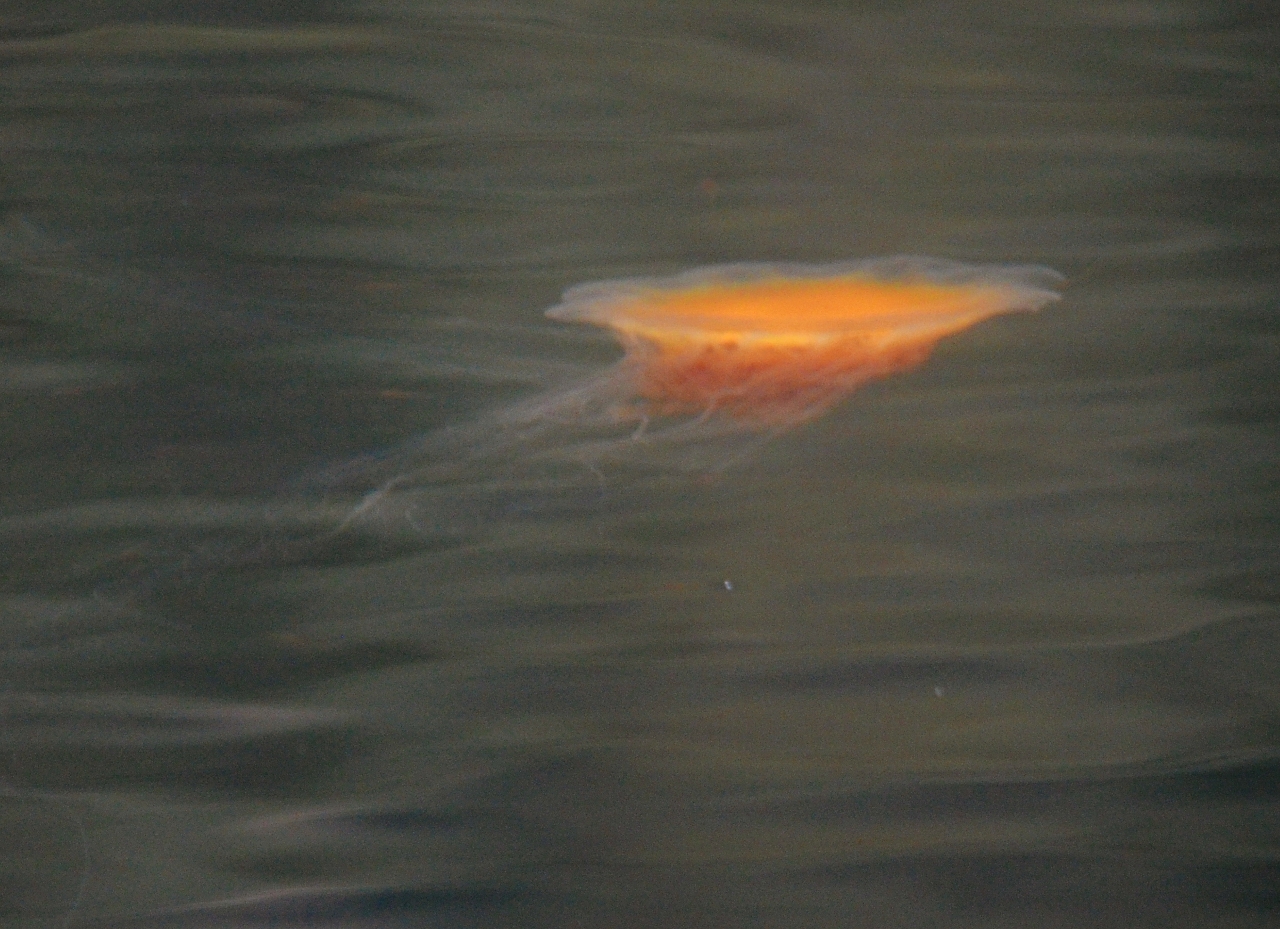 |
| Jellyfish in Santa Anna Inlet |
 |
| More abstract art jellyfish |
A check of the traps at 2000 yielded 6 quarts headed spot prawns, the daily limit for two persons.
May 12, 2018
After a quiet night at anchor, with only the sounds of a gurgling stream on shore to keep us company, Patrick headed out to check the prawn traps. A disappointingly small number of prawns were there, with two of the three pots empty, as well as the bait containers. Still, there were several quarts of headed prawns. The afternoon pull completed our prawn limits for the day.
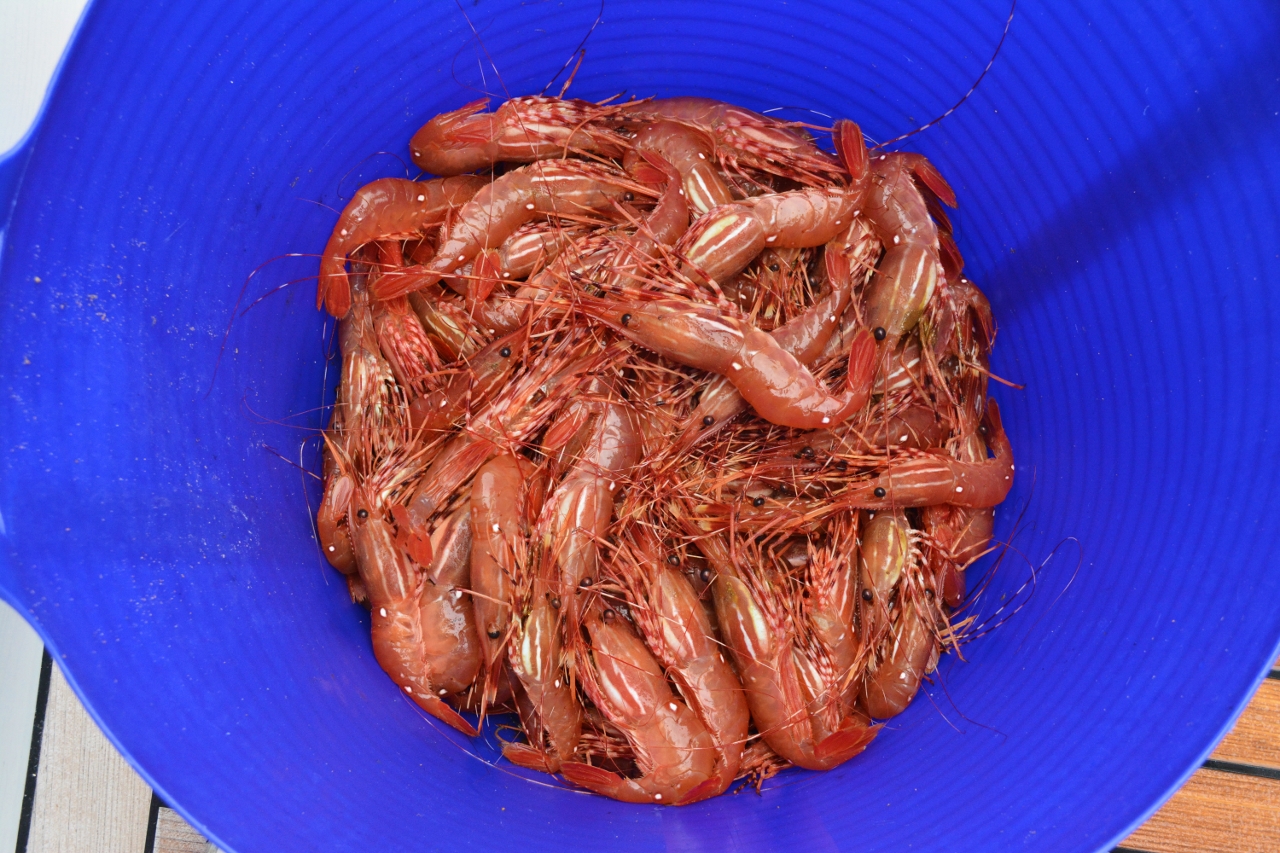 |
| Our limit of spot prawns |
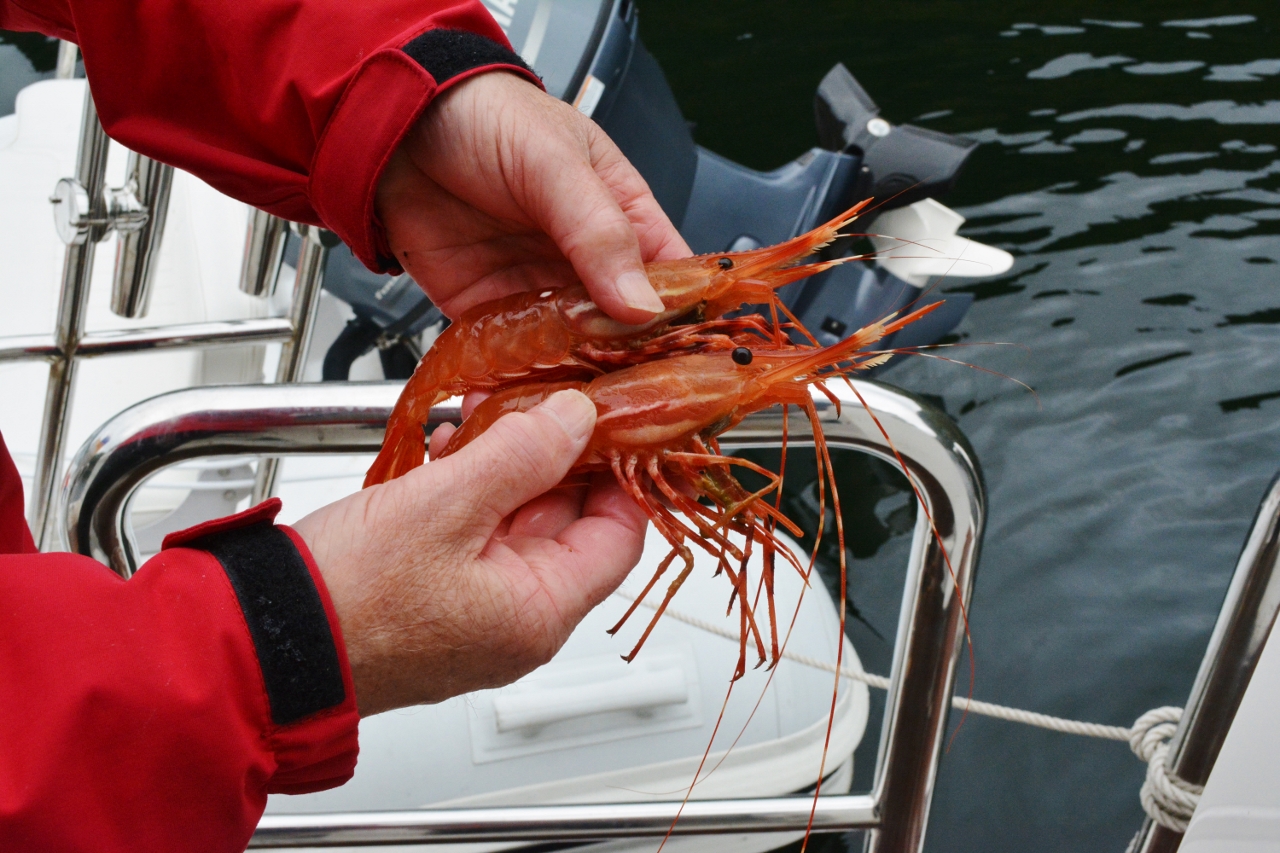 |
| Most prawns were large |
With occasional light rain showers throughout the day, we stayed inside and re-organized our storage, making room in the second guest stateroom for Josie, our grand-daughter, who arrives in a month. It was a good chance to inventory the supplies and get rid of excess stuff, which will be discarded in Wrangell.
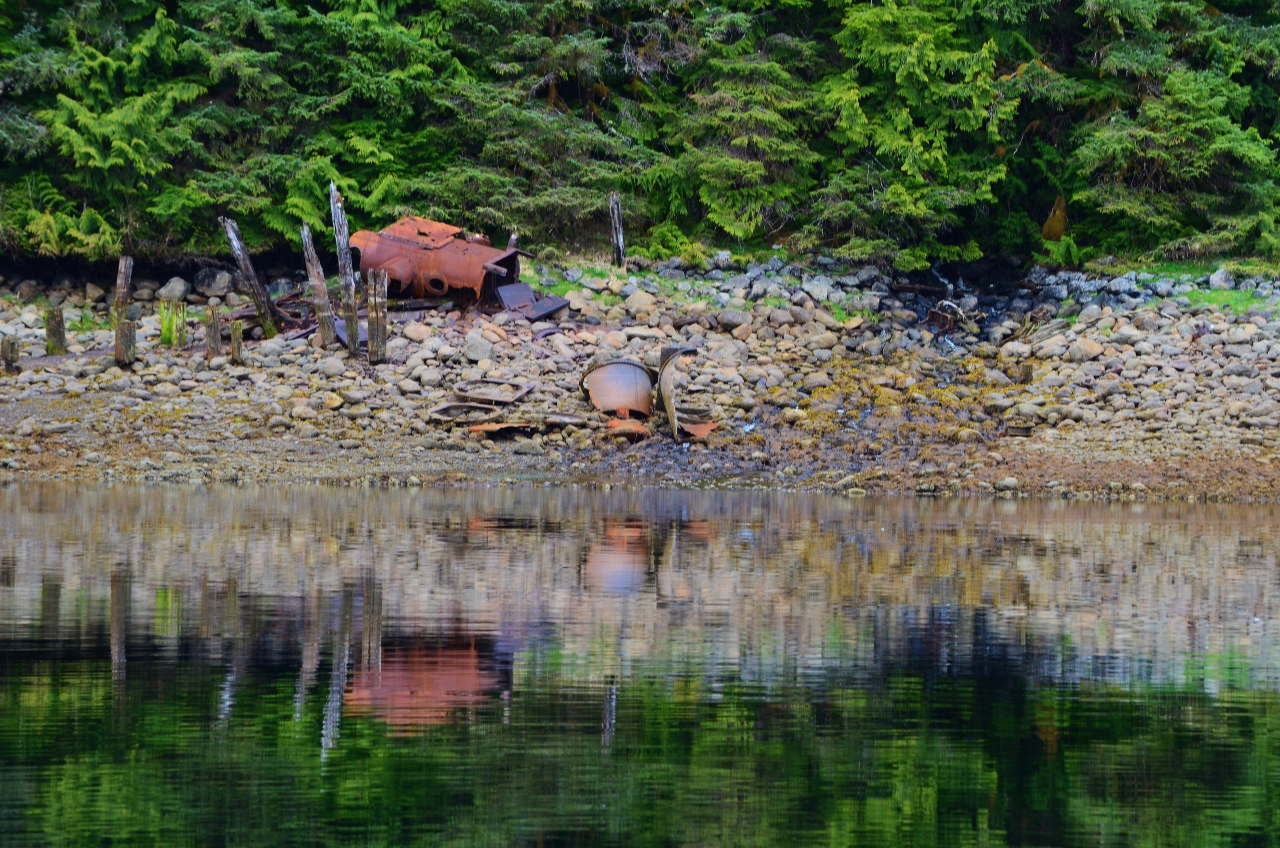
Low tides revealed more of the rusting machinery on the beach, which has been slowly rusting away since our first visit to Santa Anna Inlet in 2010.
 |
| Rusting machinery on beach |
May 13, 2018
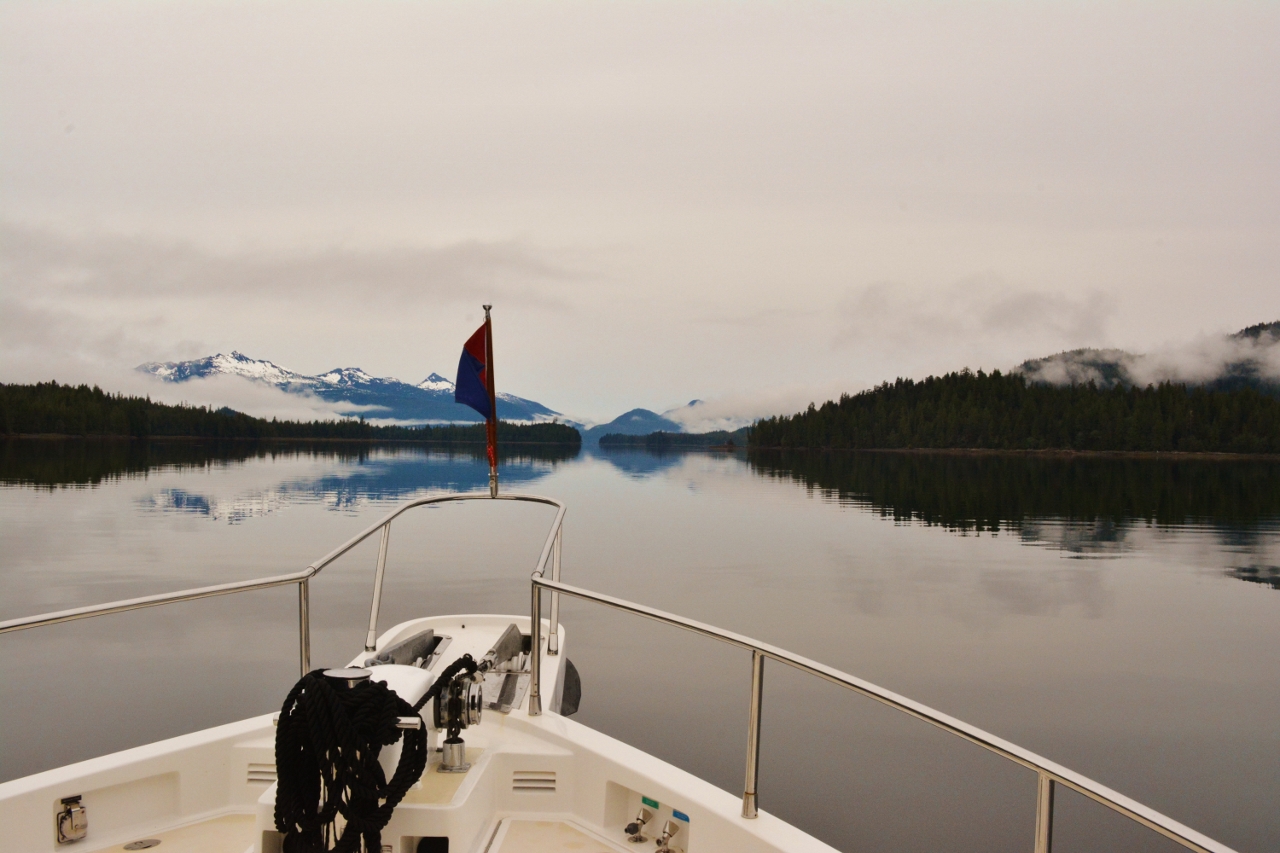
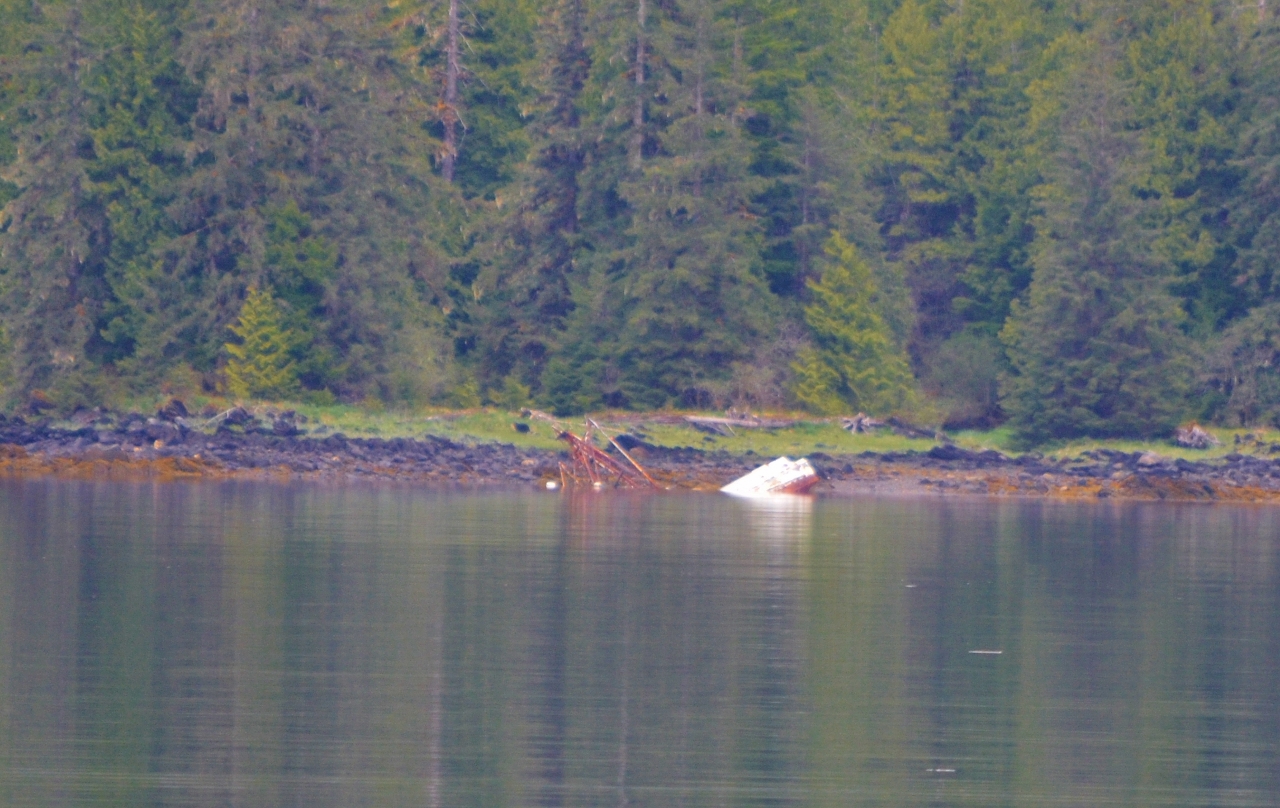
The morning check of the prawn traps was again disappointing, just a few. After putting the tender back on deck, we pulled the anchor at 0815 and headed up Seward Passage, which even on a flood tide seems to ebb south. Spirit entered Zimovia Strait accompanied by several porpoises, and several whales spouting in front of Thoms Place. Exiting Zimovia Strait we encountered the muddy waters of the Stikine River the rest of the way to Wrangell.
 |
| Entering Zimovia Strait |
 |
| New wreck on the beach in Zimovia Strait |
Spirit was moored in Heritage Harbor at 1245 after a 36 nautical mile run.
Spring Cleanup
As is normal, winter left a mess in the shed. When Mother Nature decided to blow the top off the shed and let in the snow & rain it whipped up quite a mess. It looks like the white Tyvek is starting to disintegrate and falling into the boat as a fi…
Spring Cleanup
As is normal, winter left a mess in the shed. When Mother Nature decided to blow the top off the shed and let in the snow & rain it whipped up quite a mess. It looks like the white Tyvek is starting to disintegrate and falling into the boat as a fi…
