
I saw this post a few days ago, thought it interesting and worth passing along. Not a pretty site. The Charlotte B on the rocks in MexicoJames & Claire aboard Pendana have put together a factual account and a good read. Story here h…
FPB 78 Video: Quiet-As Cochise
The already quiet FPB 78 is now almost silent in powerboat terms, with some exhaust system refinements. As we continue …Read More
Oil Analysis
Oil analysis is one of these practices where many people I know find it valuable and send their oil out for analysis on every oil change. We don’t on Dirona not because we don’t believe in it but more from a perspective that the hassle/cost-to-value equation isn’t sufficiently compelling for our usage. When I raced…
1-5 August 2016 Halifax – Lunenburg – Blue Rocks
 Our arrival in Nova Scotia occurred the end of July but we’re still here—and lovin’ it—so bear with me if I repeat. We fancy ourselves to be ‘active travelers’ because we plunge into the entire experience of the culture, people, and settings of the places we visit. We chat with local people, take in their festivals, and go off the beaten track to discover how citizens of each area truly live. In Nova Scotia, the tides have shaped not only their coastline but also the cultures and traditions of those who live here. This little part of our world is blessed by geography. Nowhere in the province are you ever far from the ocean so choice seafood abounds everywhere.

By far, my favorite village is Old Town Lunenburg, UNESCO World Heritage Site, established in 1753, is an ideal example of a British planned colonial settlement in North America. I love its colorful waterfront, red wooden warehouses, narrow streets, charming architecture and nautical history. It continues to be a working waterfront. The heritage homes used to be white, then pastel, and now they’re painted very bright, almost glow-in-the-dark colors—-like bright purple trimmed in a bright green—loved that color combo. With all the bright contrasting colors set off by the crystal blue water, in my imagination I see the Lunenburg waterfront as a piece of jewel-toned tapestry.

 Lunenburg, was settled by “foreign protestants” who were mainly german-speaking Lutherans with a strong work ethic. They survived then thrived, moving from farming to the fishing. Some of the last names have changed but 10 generations later, many of these folk still live here.
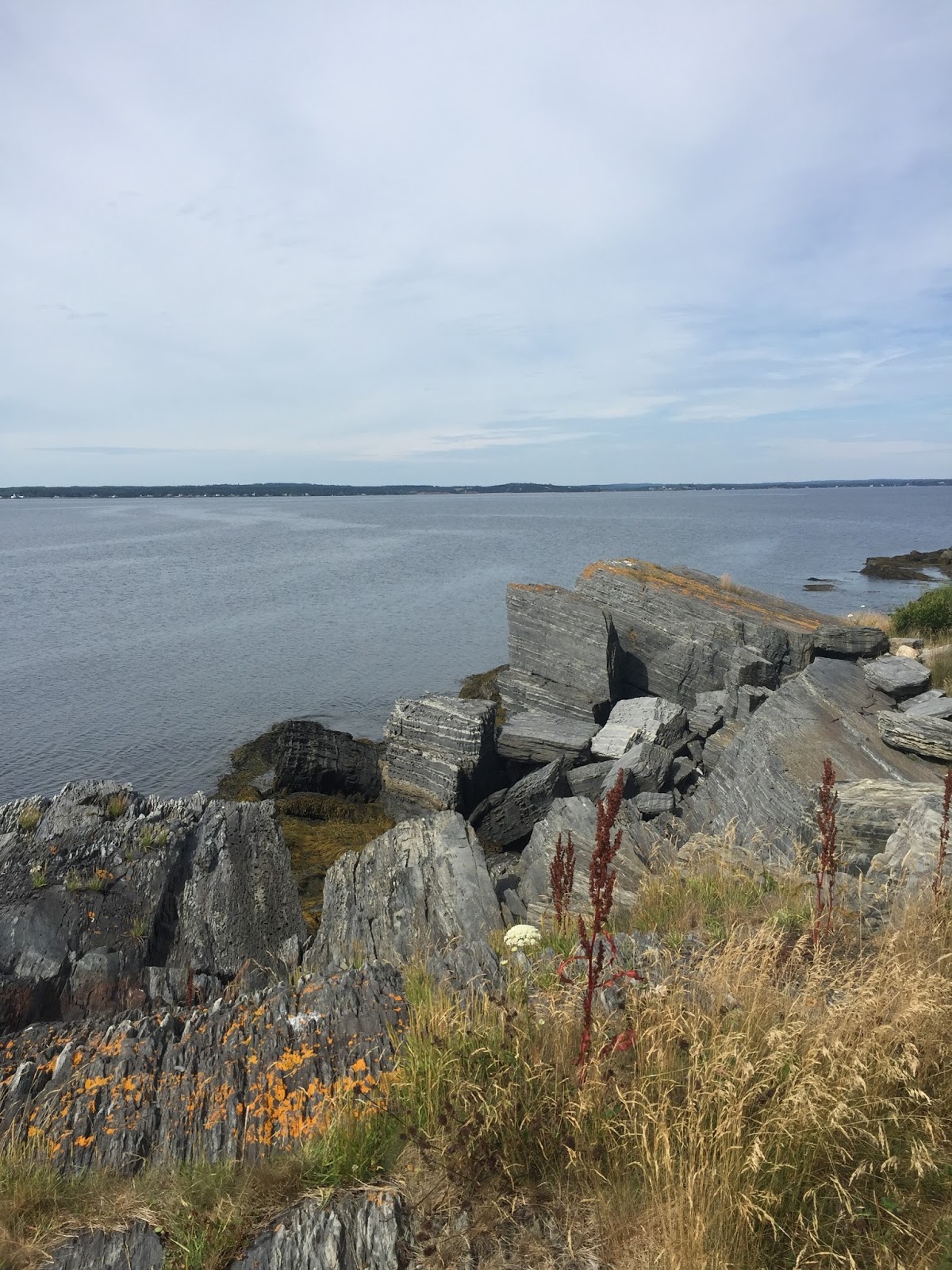
We felt we’d come to the watery edge of the earth when we wandered a bit down the road from Lunenburg to Blue Rocks, a micro-village of fishermen and truly a step back in time. It’s a ruggedly quaint paradise trimmed in little fish shacks that carry so much natural charm. They are still alive with the work of the inshore fishermen and salty breezes reeking of a natural beauty that’s indisputable. It is truly a place out of time. The name, Blue Rocks, comes for the bluish tint (sort of) of the slate lining the shore. This is an artist’s paradise and is inspiring enough to make the unartistic want to pick up a brush and paint. Inhale clean salt air, dip your toes in the cold Atlantic, relax, and take pleasure in the knowledge that, thankfully, places like this still exist.
I’ve heard of Peggy’s Cove quite a bit and even though Bill had been there several time, this was my first. He often traveled to N.S before his retirement from Michelin. There were Michelin plants in that area that were his destination. We walked over to the bas-relief sculpture chiseled from the granite of a 98 foot rock face. This is a William E. deGarthe creation showing the lives and legends of local fishermen.
 |
| deGarth’s carving on a 98 foot wall of granite |
The light at Peggy’s Cove is probably the most photographed light house. But no wonder—it’s picture perfect, perched atop massive granite, polished by the pounding waves. It’s been guiding sailors and fishermen home since 1868. When you go, don’t be in a rush so that you can sit on the rocks and watch the sea crash against those boulders. The sight and sound is hypnotic.
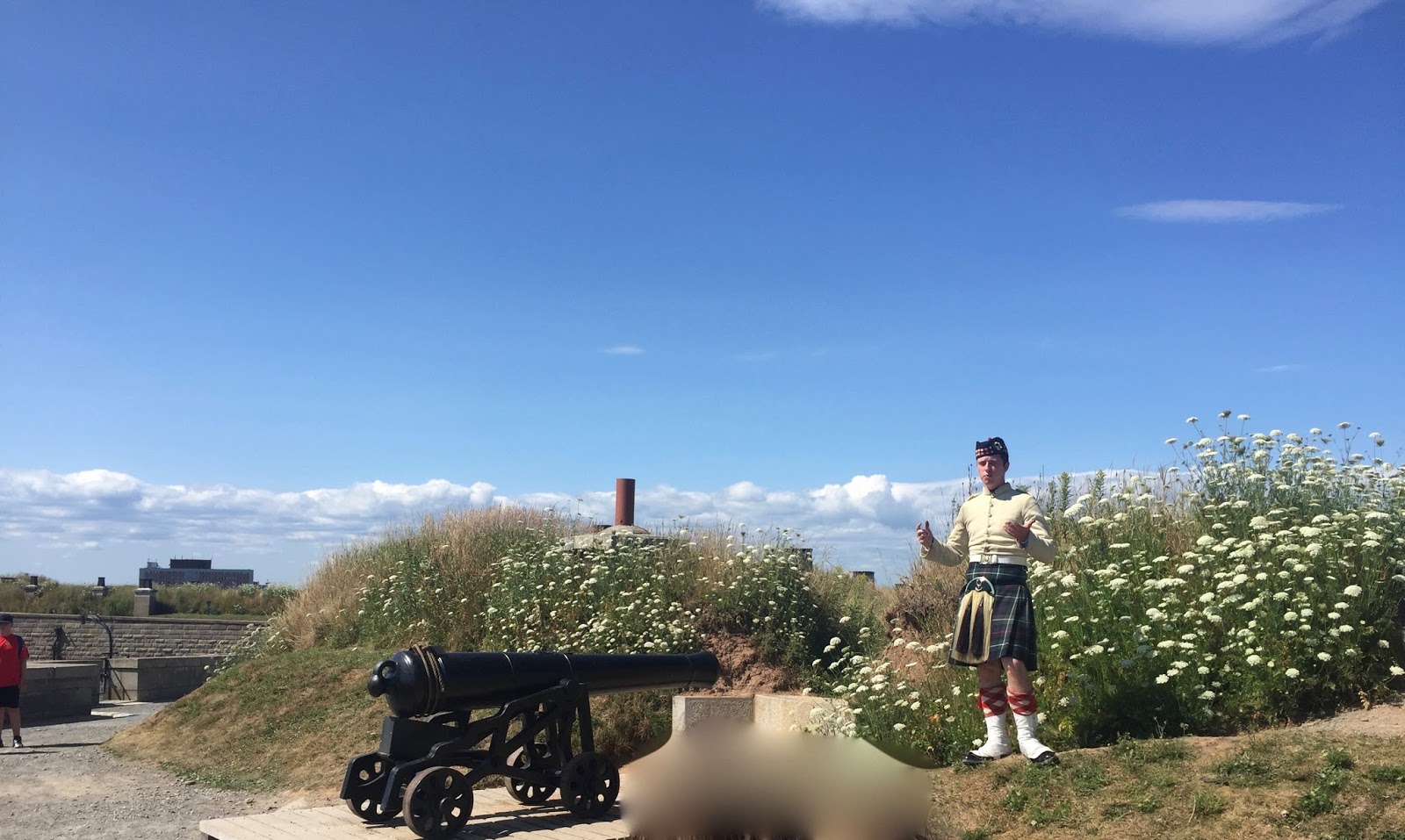 |
| Our Guide |
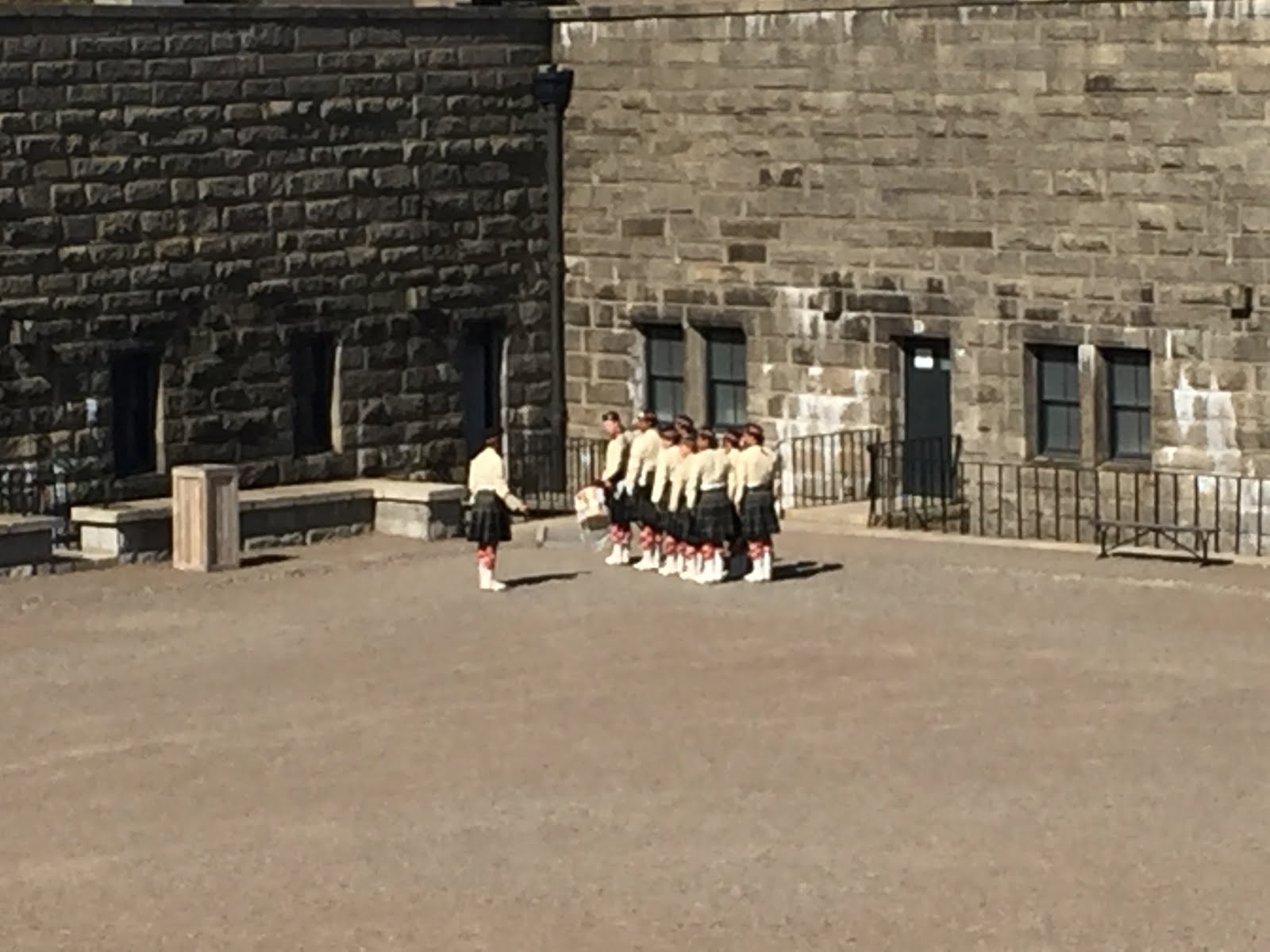
In Halifax, founded in 1749, we dived head first into their maritime and military heritage. We climbed the grassy knoll (not to be confused with Cadillac Mountain!) to visit the star-shaped fortress, the Halifax Citadel. It has stood watch over the city since the mid-1800’s. We were in trenches which totally changed the mental image that I had of battlefield trenches. For summer jobs, college students dress in period soldier costumes and provide tours both in French and English. The kilts and jackets they wear are 100% scratchy wool but it was a cool day when we toured so the outfits were probably very comfortable except for the itchiness.
 |
| There were fewer of this uniform than the kilts. They remind me of Little Johnny, the Phillip Morris man. You’d know him only if you were born before 1950. |
Many friends told us to not miss the Maritime Museum of the Atlantic in Halifax. Besides the exhibits, we went into the chandlery which is in the original location and looks exactly like I imagined that it did “back then”. They had a huge inventory of nautical hardware. The museum’s collections include over 24,000 artifacts relating to the Royal Canadian Navy, Canadian merchant marine, Nova Scotia small craft, and shipwrecks, and over 20,000 photos and artifacts from the Titanic disaster. I’ve always been fascinated by the idea of diving a wreck but their videos didn’t reinforce my beliefs of what they would look like. Generally, by the time they’re found, things are covered with sand, silt, marine growth, and have corroded beyond recognition by the untrained eye so that’s one thing I can remove from my bucket list.
 |
| Fresnel Lens in Maritime Museum |
 |
| Found this hauled and undergoing some work My first sail boat, I christened Whim. I was nearing the end of school piled high with student loans, no money, and no job on the horizon. I found a little boat that I HAD to have and bought her on a whim. Therefore her name. I wonder the story behind this little boat’s name. |
Also, displayed in that museum are photos and recounts of several Halifax fires. One was caused when 2 ships collided in the harbor in broad open daylight and one was carrying tons of ammo, gasses, and other explosives which pretty much wiped out the city, killing 1600 people. Another was a fire on a jetty where ammo was stored and after the fire began, it took 24 hours for all them explosives to finish firing. Halifax was closest to the Titanic catastrophe so were first to reach the site and that was re-told and photographed in great detail.
Hugging Halifax’s downtown waterfront is a 10 block boardwalk that provides access to shops, restaurants, and historic sites. It makes for a pleasant stroll we were always kept comfortable by the oceans cooling breeze.
The Halifax Seaport Farmer’s Market is billed as the longest continuously running market in North America. More than 250 vendors sell fresh produce, baked goods, cheeses, wines, and hand-crafted items. There’s a roof-top patio where you can eat your purchased lunch while enjoying the harbor view.
Just leaving Halifax for a week’s stay on Cape Breton. Stay tuned.
Bill and Laura
Halifax, N.S.

Chewy.com is Here!
The box from Chewy.com arrived yesterday evening, unfortunately, too late for the kids’ supper. We gotta keep to a schedule…So this morning Dee Dee got her first helping of kangaroo. She liked it fine but then Labs really will eat pretty much anythin…
Charlestown Marina
Charlestown Marina was an excellent home base for the six weeks we spent in Boston. We chose it mainly because we could get a good long-stay rate there compared to the other marinas closer to downtown, but the marina worked out very well for touring around Boston and we’d happily return. The marina itself was…
2016-21 Fishing Our Way to Ketchikan
2016-21 Fishing Our Way to KetchikanWednesday, August 3, 2016: Ketchikan
ミュゼなどの脱毛クリームは…。
錆がついていたり切れが悪いカミソリでムダ毛の処理を行うと、自分の皮膚にダメージを負わせるのみならず、衛生的にも…
Craig to Prince Rupert
We decided to bypass Ketchikan on our way out of Alaska this year. From Craig headed SE. We hit three new (to us, anyway) anchorages, Shelikof Island Cove, Mabel Bay and Hunter Bay in successive nights then headed for Hydaburg.
Hydaburg is primarily populated by members of the Haida native Alaskan clans. Cruising friends of ours had recommended Hydaburg to us for its native culture and friendly community. The last week of July they have Haida Culture Camp intended to spread and preserve Haida culture in the community. It is open to the public and we attended classes one day and then the closing feast event. The foundation for a new long house to be used in Haida cultural events was dedicated while we were there. We were terrifically impressed by the community spirit and the efforts they are going through to preserve their culture.
After Hydaburg, we sneaked around Cape Chacon and spent the night in Gardner Bay. It is to far (at least at our leisurely speeds) to make it to Prince Rupert in one day from the south tip of Prince of Wales Island. Instead, we crossed Clarence Strait, scooted around the north side of Duke Island and made our way to the mainland side of Revillagigedo Channel. Our last night in Alaska for 2016 was in Foggy Bay, the same anchorage we used for our first night this year.
An early start the next morning, the first day of August, got us into Prince Rupert at the Prince Rupert Rowing & Yacht Club (PRRYC) by 1 PM (and that is with losing an hour going from AKDT to PDT). We’ll spend a couple of nights in Prince Rupert before continuing the slow journey south. Our rough schedule has us rounding Cape Caution, the exposed section that separates the northern portion of the BC Inside Passage from the southern portion, towards the end of August.
Kangaroo Anyone?
Since Dee Dee was a tiny pup we have had problems with ear infections. She visited half the vets along the Great Loop that first year. We’ve tried allergy medicine, ear washes, grain-free foods, fish only, even bison diets. Nothing worked over the long…
